Establishing a writing classroom, one in which children want to write, develop confidence in writing and develop the skills to write with accuracy and clarity, begins from the first day of school.
Characteristics of a writing classroom
Nine characteristics of a writing classroom are:
purposeful writing occurs throughout the day in all areas of the curriculum,
the process of writing is modelled,
children’s writing is scaffolded,
children write in response to set tasks,
children write about topics and in genres of their own choice,
the message is paramount,
writing conventions; such as spelling, punctuation and grammar, are learned by writing,
children’s writing is celebrated, and
children enjoy writing.
If children are provided only with writing tasks and topics set by the teacher, they may view writing simply as a task to perform, something to please the teacher, rather than as a vehicle for self-expression or for sharing imaginative and creative thoughts and stories or information.
Opportunities for writing occur throughout the day and should include:
Sally is not only generous in her promotions of other authors’ work, but she is also generous to readers. Until Christmas Eve, she is offering five of her ebooks to readers – FREE! Pop over to Sally’s place for details.
I’m absolutely delighted to be included in Sally Cronin’s Christmas celebrations. I shared the story of my most memorable Christmas present and Sally gave me a beautiful gift in return.
Pop over to Sally’s to check it out. While you’re there, check out Sally’s books and all her other wonderful guests too. Thank you so much for inviting me to your blog, Sally. xx
The results of the Carrot Ranch Rodeo Contest #5 The Sound and the Fury have been announced. What fabulous stories. Ride on over to the Ranch to read the winners, the Honourable Mentions and all the entries. Great writing everyone!
Have you ever engaged in an experiment to see how bean seeds grow when kept in the dark compared to how they grow when provided with sunlight? It’s an experiment familiar to many school children. The purpose of the experiment is to show that light is needed for the seeds to grow and children soon find that those kept in the dark do not thrive.
My father used to say that what you don’t know doesn’t hurt you. He wasn’t happy when my brother wrote in my autograph book that what you don’t know doesn’t do you much good either.
Although my parents were keen for my siblings and me to get a good education, there were some things about which they preferred to keep us in the dark — secret adult things. It seems they thought some knowledge might be dangerous, so they were selective in what we were told.
I am of the opposite view, thinking that a lack of knowledge may be even more dangerous. Just as bean seeds don’t thrive in the dark, minds can’t thrive if kept in the dark either.
Nowadays, in schools, there is an emphasis on the need for being explicit in our teaching, of making sure that children know what they will be learning, what is expected of them and why.
In my childhood days, if a reason was given, it was often ‘Because I said so’ or ‘Because it is’. I much prefer the modern way and, as with many things, believe that knowledge begets knowledge. It is difficult to be interested in something about which you know nothing. But knowing, even just a little, can stimulate curiosity to know more.
Funnily enough, the prompt took me to neither darkness of the mind nor heart, but to the literal darkness of a stormy night. I hope you enjoy it.
Stepping into the unfamiliar
The car lights dimmed as she reached the door – timed perfectly. But, when the porch light didn’t activate, immersing her in total darkness, she cursed the storm. As she pushed the door of the still unfamiliar house, she rummaged for her phone. Dang! No charge. She inched along the wall, fingers seeking the corner and toes the step she knew was close. Stepping down, she dumped her bag and tossed her saturated scarf. She edged towards the sideboard and a battery-powered candelabra. As she fumbled for the switch, the room was flooded with light and cheers of ‘Happy housewarming!’
Thank you for reading. I appreciate your feedback. Please share your thoughts.
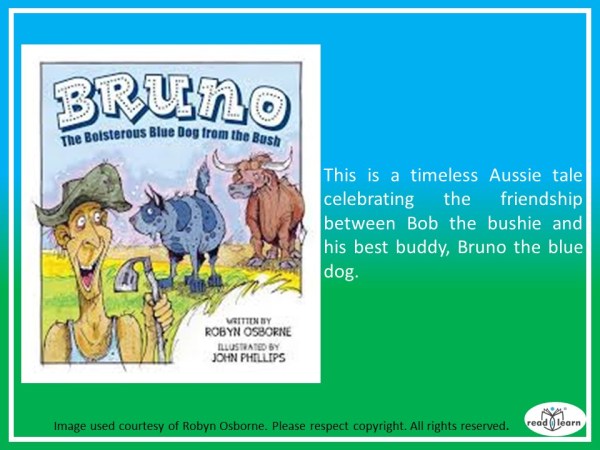
This week I am delighted to introduce you to Australian author and fellow Queensland educator Robyn Osborne and her delightful picture book Bruno, the Boisterous Blue Dog from the Bush.
This post is but one of several celebrating Robyn’s book in Romi Sharp’s Books on Tour. Please read to the end of the post for details of other posts celebrating Robyn’s work.
About Robyn
Robyn Osborne is an Australian author and teacher based in Queensland. She is dog obsessive and many of her books, including Bruno, have been inspired by her furry friends. Robyn grew up on the Sunshine Coast in South East Queensland where her father worked as a sugarcane cutter. As a child, she was surrounded by pets and quickly became an animal fanatic. At age eleven, when she made the connection between cows and steak, she became a vegetarian.
Although she always wanted to be a writer, a number of uncreative roles got in the way. It was when she became a teacher that she rediscovered her love of writing. She has won or been shortlisted for many awards and has published many short stories, junior novels and picture books.
About Bruno, the Boisterous Blue Dog from the Bush
This is a timeless Aussie tale celebrating the friendship between Bob the bushie and his best buddy, Bruno the blue dog.
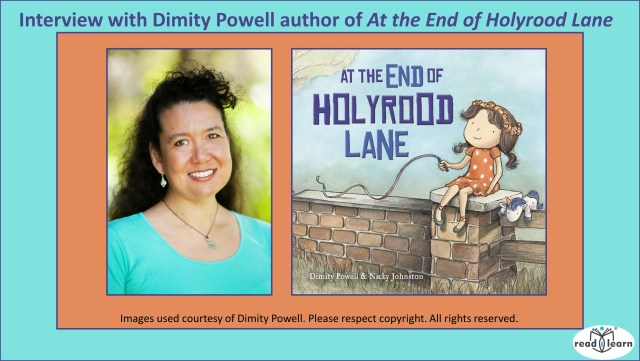
Dimity likes to fill every spare moment with words. She writes and reviews stories exclusively for kids and is the Managing Editor for Kids’ Book Review. Her word webs appear in anthologies, school magazines, junior novels, as creative digital content, and picture books including The Fix-It Man (2017) and At The End of Holyrood Lane (2018) with more to follow in 2019 and 2020.
She is a seasoned presenter both in Australia and overseas, an accredited Write Like An Author facilitator and a Books in Homes Role Model Volunteer in Australia.
Dimity believes picture books are soul food, to be consumed at least 10 times a week. If these aren’t available, she’ll settle for ice-cream. She lives just around the corner from Bat Man on the Gold Coast although she still prefers hanging out in libraries than with superheroes.
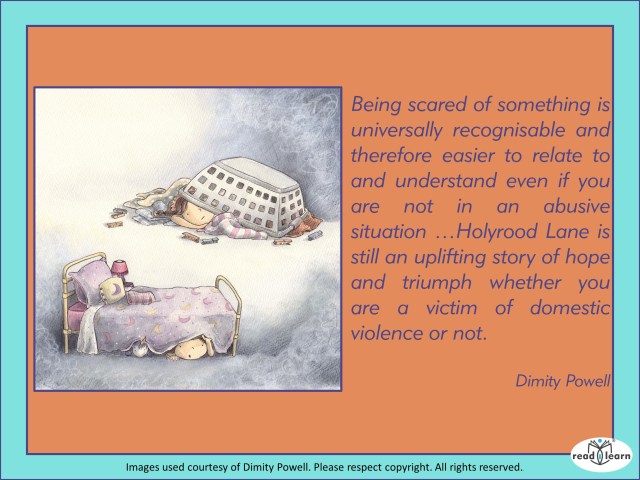
In this post, Dimity discusses her latest picture book At the End of Holyrood Lane. The book, illustrated by Nicky Johnston and published by EK Books, deals sensitively with the tough issue of domestic violence.
The story
At The End of Holyrood Lane is a poignant yet uplifting picture book that deals with domestic violence in a way that provides understanding and offers hope to young children.
‘At the End of Holyrood Lane is enigmatic. Different children will be able to interpret the story in different ways. I think this is excellent. Kudos to both author and illustrator for a successful creation that I hope will enrich many children’s lives.’ Susan Stephenson, The Book Chook.
The interview
Welcome to readilearn, Dimity.
Thank you for inviting me.
Dimity, At the End of Holyrood Lane was written for a very special purpose and a very special situation. Can you tell us a little about how you came to write this story and why it was important to you to do so?
And the results of #1 Carrot Ranch Flash Fiction Contest are in. Congratulations to the winners, honourable mentions and all who entered. Read the winning entries in the Carrot Ranch post and follow the link to read all entries. What a fabulous read!
The last of the Rodeo contests is on and I think it’s the scariest of all. Write about danger, she says; dance it, feel it, hear it, smell it, touch it, taste it. I’d really rather stay where I’m safe and warm, but perhaps I can give it a go. It is just a story after all. Are you ready to unleash a dangerous story?














 Norah Colvin