Live Love Laugh Learn … Create the possibilities

Tag: thoughts and ideas

  • Would you believe?

    When I was growing up “Get Smart” was a popular show with my family and friends.  The question “Would you believe . . .?” was often asked humorously, in Max-style, starting off with an exaggerated and unbelievable suggestion, then moving through a series of diminishing magnitude to the, often insignificant, reality.

    I am not going to start with an exaggeration for I am rather pleased with what I have achieved. I wish to make no comparison with anyone else who may have achieved a whole lot more, or even those who may have done less. I just know that I have learned a lot, and in fact, have learned so much that I now know what future learning I need to do.

    If you know nothing, you don’t know what you need to know. It is only when you know something that you get an inkling of what there is to learn.

    If, this time last year, you had said to me:

    “One year from now you will be writing a blog and publishing your fiftieth blog post; you will have over 800 followers on Twitter and you will engage in conversations with people from all over the world.”

    I would have laughed and said you were crazy. I had no thought of writing a blog and thought Twitter was just for twits.

    travel-map
    http://www.openclipart.org
    van
    http://www.openclipart.org

    I had followed only one or two blogs posted by family and friends on holidays so knew nothing of the pleasure or potential of writing or following blogs.

    Eating-Breakfast-like-Pig-1
    http://www.openclipart.org

    What I “knew” of Twitter was minimal and misinformed. I thought it was people sending messages about eating breakfast, going to the bathroom and other mundane events. I couldn’t see the point in that.

    How wrong were my misconceptions how they have changed!

    How I have changed.

    What I would have considered a Max-style exaggeration a year ago is now a reality. And it didn’t take a year. It has all happened in just six months.

    tweet_birs-2
    http://www.openclipart.org

    Six months ago I published my first blog post and tweeted for the first time.

    I was both nervous and excited and had no expectations other than to see what would happen.

    I am delighted with the result: the learning I have done, the people I have met and the way my writing has grown. One of the greatest pleasures is having control over what I write; another is meeting so many interesting people, some like-minded and others with differing views, but all supportive and willing to share their knowledge, ideas and thoughts.

    I wouldn’t have started upon this journey without the Queensland Writers’ Centre (QWC).

    cropped forest
    http://www.morguefile.com

    In late 2012 I did a couple of sessions about digital publishing with Simon Groth (Manager of if:book Australia), and another at the beginning of 2013. While the talks were fascinating and I learned a lot, I was such a N00b that it was all still a forest to me and I couldn’t see the path to take me in and didn’t have the tools to clear a path. I needed more time to absorb the information I had heard and work out what to do with it. I still wasn’t convinced that blogging and social media were for me.

    Belinda Pollard of Small Blue Dog Publishing changed all that at another QWC session in June. I am very grateful to her for convincing me that this was the way to go and that I just needed to get started. She described Twitter as the “water cooler for writers” and a great way to meet other writers.

    Less than two months after hearing Belinda speak I was on my way, hacking a path through the undergrowth, searching for the warmth of sunlight through the canopy.  My quest for information started with her website  and crawled its way out and around other websites and blogs, some of which I return to often for reassurance, reminders and more information.

    Now in answer to the question, “Are you experienced?” I can reply with a very definitive: ”Yes, I am experienced!”

    I have lost my nervousness, but not my excitement. I have grown in confidence and knowledge but know that there is so much more to learn. In my Twitter profile I say that I was born too soon, but maybe I just started late. Considering that there were no computers and no internet for more than half my life and the only “mobile” phone I knew in my younger days was Maxwell Smart’s shoe, I think I’m doing okay in the catch-up.

    In addition to all the generous bloggers and twitter users who have helped me along the way, many without knowing it, I am also very grateful to you, my readers and followers, who have visited, commented, liked, favourited and otherwise shared my posts and tweets, but more especially your knowledge, support and ideas.  While I had no expectation that any of you would drop by to read or engage me in conversation, I’m so glad you did. Thank you. Please stay with me as my journey continues.

    Thank_you_pinned_note
    http://www.openclipart.org
  • Seeking praise – Stephen Grosz revisited

    Praise may be defined as an expression of approval or admiration.

    Who wouldn’t want that?

    If you write a blog, don’t you love it when others “like” a post, leave a positive comment, re-blog your article or link to it via theirs? I do. Aren’t these all expressions of approval or admiration?

    What about on Twitter when someone Re-tweets, favourites or replies positively to your comment, engaging you in conversation?

    Aren’t these also expressions of approval or admiration?

    I love to receive all these signs of encouragement and support that let me know that my efforts are appreciated and confirm that I am on the right track. If I did not receive any of this feedback I would feel quite isolated and consider my efforts to be fruitless and a waste of time. I would probably just give up.

    As a teacher I have always considered it of primary importance to create a happy and welcoming classroom environment in which children feel valued, affirmed and supported. Expressions of approval and admiration for behaviour, effort and achievement were generously given with the aim of encouraging the desired response, a happy child being foremost. I have written about this in previous posts, including:

    Happy being me

    Affirmations: How good are they?

    As a parent too I considered it important to affirm my children and display my approval and admiration for them. I still do, even now they are adults. The need for approval never ends. I know sometimes you just have to go out there and say what you know is right, even though others will disagree or ridicule you. I am not talking about those instances here.

    My strong belief in the power of affirmations and approval stems partly from the dearth of them in my childhood and school days. I have also mentioned this in a previous post: 

    Mouthing the words – the golem effect

    Recently I listened to a fabulous (audio)book, “The Examined Life: How We Lose and Find Ourselves” by Stephen Grosz. I wrote about it in my previous post A book worth reading: Stephen Grosz “The Examined Life” saying that

    “What appeals to a reader about a book, or what a reader takes away from a book is as individual and personal as the reader. What is of most significant to one, may be of lesser importance, or even insignificant to another. “

    For me the chapter of most significance is chapter 3 “How praise can cause a loss of competence”.

    To say I was startled by the title would be an understatement. I was puzzled, intrigued and challenged. How could praise cause a loss of competence? Surely negative feedback or a lack of encouragement altogether would be major contributors to diminishing competence. Was everything I had believed and practiced wrong? (Oh no –there’s my need for approval and affirmation!)

    Grosz says that during the past decade studies into self-esteem have found that praising a child as “clever” may not only inhibit school achievement, it may cause under performance. He suggests children may react to praise by quitting. Why would you try to improve or do something new if you have already done something really well or are the “best”?

    Studies showed that children who were praised for effort, rather than for being clever, were more willing to try new approaches and were more resilient. Children who were praised for being clever, tended to worry more about failure and chose unchallenging tasks, tasks they knew they could achieve or had already achieved. Being told they were clever led to a loss in self-esteem and motivation and to increased anxiety. Some children who had been praised for being clever (rather than working hard), when confronted with a more difficult task and asked to comment on it, were so unhappy with the results they lied about them, exaggerating their achievements to others.

    Grosz questions whether we may lavish praise on our children nowadays in order to demonstrate that we are different from our parents who possibly used criticism, rather than praise, on us. I hinted at something similar earlier in this article.

    While admiring our children with words like “Good boy” or “Good girl” may temporarily lift our self-esteem by showing others what wonderful parents we are or how wonderful our children are, Grosz says, it isn’t doing much for a child’s sense of self. He says that in trying to be different from our parents we end up doing the same thing: doling out empty praise where an earlier generation doled out thoughtless criticism.

    Grosz says that if we offer this empty praise without thinking about the child’s individuality and needs we are effectively showing the child indifference.

    So what do we do?

    I think the emphasis here is on the empty praise. I think support, encouragement and positive feedback are all essential. Sure, knowing in yourself that you have done well is fine but a little recognition certainly helps too. I think the difference is in recognizing what has been achieved, the learning or progress made, and the effort it took, the message communicated in a story or painting and the techniques used; not a hollow “Well done”, “Good work” or “Good boy” but “Tell be about . . .”, “Why do you think that?” “How did you work it out?” “I like the way you . . .”

    As Grosz says, this is being attentive to the child, to what the child has done and how it has been done.

    To read more on this topic:

    Sian Griffiths interviewed Stephen Grosz and reported on the interview in the article “Praise her . . . and see her fail” which adds even more clarity to my precis above.

    Maria Popova delves into the messages of this same chapter in her article “Presence, Not Praise: How to Cultivate a Healthy Relationship with Achievement

    Being attentive, being present, being really with someone, noticing what they have done and how they have done it – is it more precious than praise?

    In these days of constant distractions and must-dos to put all aside to be in the present with the child, friend or partner to talk, listen share and laugh, what better affirmation is there than that?

    What do you think?

    How has praise encouraged or discouraged you?   When has criticism hindered you?

    I’d love to hear your thoughts.

  • A book worth reading: Stephen Grosz “The Examined Life”

    CoD_fsfe_Books_icon

    What appeals to a reader about a book, or what a reader takes away from a book is as individual and personal as the reader. What is of most significant to one, may be of lesser importance, or even insignificant to another. The fact that many different readers can read the same book and take away a very different impression, understanding and emotional connection is testament to the power of the written word, the value of reading and the ability of an author to reach readers on many different levels.

    Recently I read Anne Goodwin’s review of the book “The Examined Life: How We Lose and Find Ourselves” by Stephen Grosz. Anne described the book as a “must read for any thoughtful individual.”

    I was already familiar with the quote attributed to Socrates:

    “An unexamined life is not worth living.”

    and recently read an article by Simon Longstaff in the NewPhilosopher magazine examining the quote.

    Simon suggested that

    “one can make sense of Socrates’ claim if it is understood to mean something like – those who do not examine their lives (make conscious ethical decisions) fail to live a life that allows them to experience being fully human.”

    He goes on to say that

    “In a world of abiding uncertainty and complexity one can recognise a certain attraction in not examining too much, for too long in life. Thus the allure of those who offer to provide clear answers, simple directions, precise instructions (whatever) so that you may set aside examination and merely comply, or unthinkingly follow custom and practice – perhaps living a conventionally moral life rather than an examined ethical life. One can easily imagine how pleasant an unexamined life might be.” 

    I like to think of myself as a thinker often engaging in a bit of self- or other-reflection, living a somewhat examined life, not blindly complying or following customs and practice and always open to a challenge of my beliefs and ideas.

    Anne’s review intrigued me.  By fortunate coincidence I was finishing one audiobook and ready for another, and was delighted to find that “The Examined Life” was available in audio format.

    Anne’s review gives 7 reasons why readers and writers of fiction should read “The Examined Life”. You can read them here.

    As Anne suggested, I found it compelling “reading” throughout and agree with her description of the stories as

    “especially exquisite. Beautiful prose, tightly structured, these are moral stories without being moralistic, gentle fables . . . that leave us pondering the big questions of how to live.”

    Alex Clark on Vintage Books was also complimentary, saying that

    “what The Examined Life shows above all else is that we should not fear looking deeply into ourselves, because it is more likely that the effort of holding our feelings at bay will render them far more damaging.”

    In search of a succinct synopsis, I found this on the Book Depository:

    “We are all storytellers we create stories to make sense of our lives. But it is not enough to tell tales. There must be someone to listen. In his work as a practicing psychoanalyst, Stephen Grosz has spent the last twenty-five years uncovering the hidden feelings behind our most baffling behavior. The Examined Life distils more than 50,000 hours of conversation into pure psychological insight without the jargon. This extraordinary book is about one ordinary process: talking, listening, and understanding. Its aphoristic and elegant stories teach us a new kind of attentiveness. They also unveil a delicate self-portrait of the analyst at work and show how lessons learned in the consulting room can reveal as much to the analyst as to the patient. These are stories about our everyday lives: they are about the people we love and the lies we tell, the changes we bear and the grief. Ultimately, they show us not only how we lose ourselves but also how we might find ourselves.”

    Each of these reviews focused upon the importance of examining life, of delving into our own stories and emotions.

    At the commencement of this article I suggested that what we each take away from a book is as individual as we are; because what each of us brings to a book is very different, and what we need to take away is also different.

    The part of this book that had the greatest impact upon my thinking will the subject of my next post. I hope you will join me for it.

    If you have read or read “The Examined Life” by Stephen Grosz I would love to know what you think of it and which of it resonates mostly with you.

    Please share your thoughts.

    Quick links to articles mentioned in this post:

    Anne Goodwin (Annethology)

    New Philosopher

    Vintage Books

    Book Depository

  • Reflections on learning

    In a previous post To school or not to school I explored some issues I was grappling with as my daughter reached school age. I stated then that in future posts I would explore the effects of decisions I made upon my children’s (and my) education.

    My daughter, Bec, now 26 and working towards a PhD in Environmental Management at UQ, has beaten me to the post by writing the following reflections on her schooling experiences. Who better to explore the effects upon her education than she herself?

    Bec’s reflections on learning

    When I was a wee girl I felt I had a very prolonged ‘childhood’. Not that I became a (painful) teenager later than others, or even an adult later; but more that the early years went for longer for me than they did for others. While other children I knew were in school, wearing uniforms and filling in worksheets, I was on my way into the Brisbane library with my mother, excited about the new books I would get to read. (I always anticipated the craft activities which were on offer, and specifically recall excellent activities related to owls.)

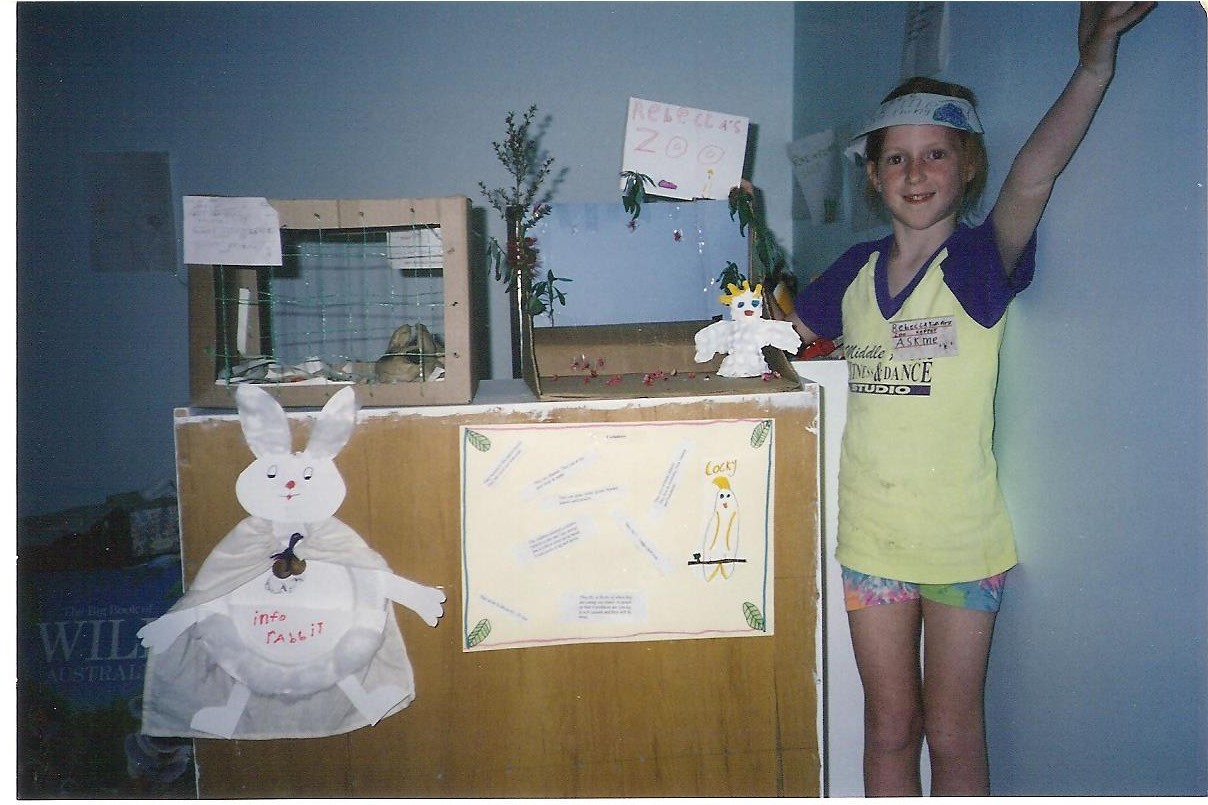
    I also remember that when most other children were in school, I got to play with clay at home, and used the clay to create ‘exhibits’ for a zoo about my favourite animal. It was a great motivation to find out as much as I could about the animal, and I immersed myself in it. I started with rabbits (which I still love though have a real ethical struggle with given they’re such a disastrous environmental pest here in Australia) and then moved onto the Sulphur Crested Cockatoo.
    rabbit and cockatoo projects

    koala cuddleAnother memory, from my very long childhood, was that when most other children were in school, I set up at home ‘The Rainforest Club’, where I made a desk, a rainforest-related library, and a membership program. What was the point of the club? Who knows – but the evidence is still present in a number of Norah’s books which include markings on the inner cover to the effect of ‘This belongs to the library of the Rainforest Club’.

    I remember frequent trips to the Sciencentre when it was in its old digs on the other side of the river, and a day starting with picking strawberries at a local farm, then bringing them home to mix into home-made strawberry ice cream. I also remember being very proud of myself when I got to cartwheel in a parade at the ‘Out of the Box’ celebration at Southbank.

    Out of the box

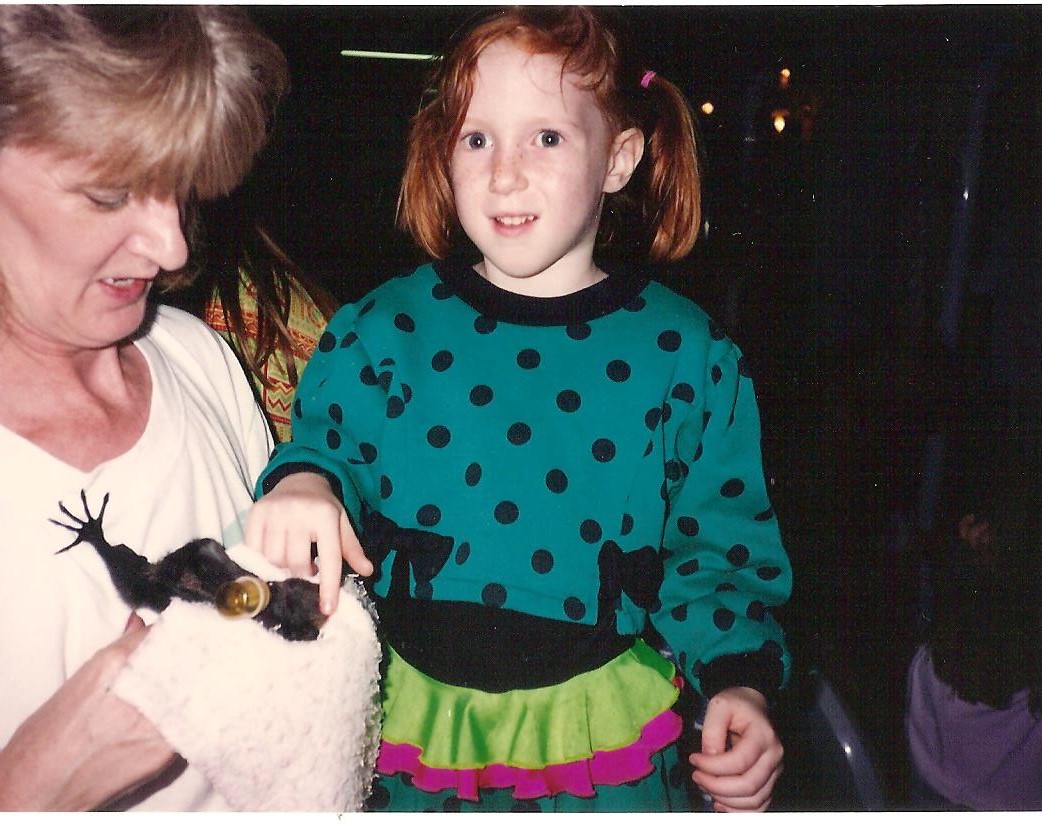
    Then there was the day when an intimidatingly large cane toad launched toward me when I was sitting at the front of a group of children watching an engaging talk about animals (unlike the bunny rabbit, I am not quite so much torn between heart and mind about this invasive species, although increasingly it seems that the story of the cane toad in Australia reflects the story of post-1788 colonisation in Australia). A less traumatic animal experience was going on the ‘Batty Cruise’ down the Brisbane River as the macro bat colonies were stirring shortly after sunset. It was absolutely incredible – there were thousands of bats flying overhead – and an expert on board had a baby bat AND a baby echidna.

    batty cruise

    I also know Norah still has the story I wrote which explained all of the mysteries of neuroscience; “How the Brain Works”. Obviously, it’s a little man who lives in my brain, working efficiently with a series of filing cabinets.

    What this little man didn’t work out at the time though – and only really worked through the files to figure out years later – was that despite not being at the time in School with a capital S, I was in school during every moment of the day and night during those early years. I LOVED visiting the library and the museum and the Sciencentre. I LOVED reading books, researching about animals, writing stories and experiencing my world.

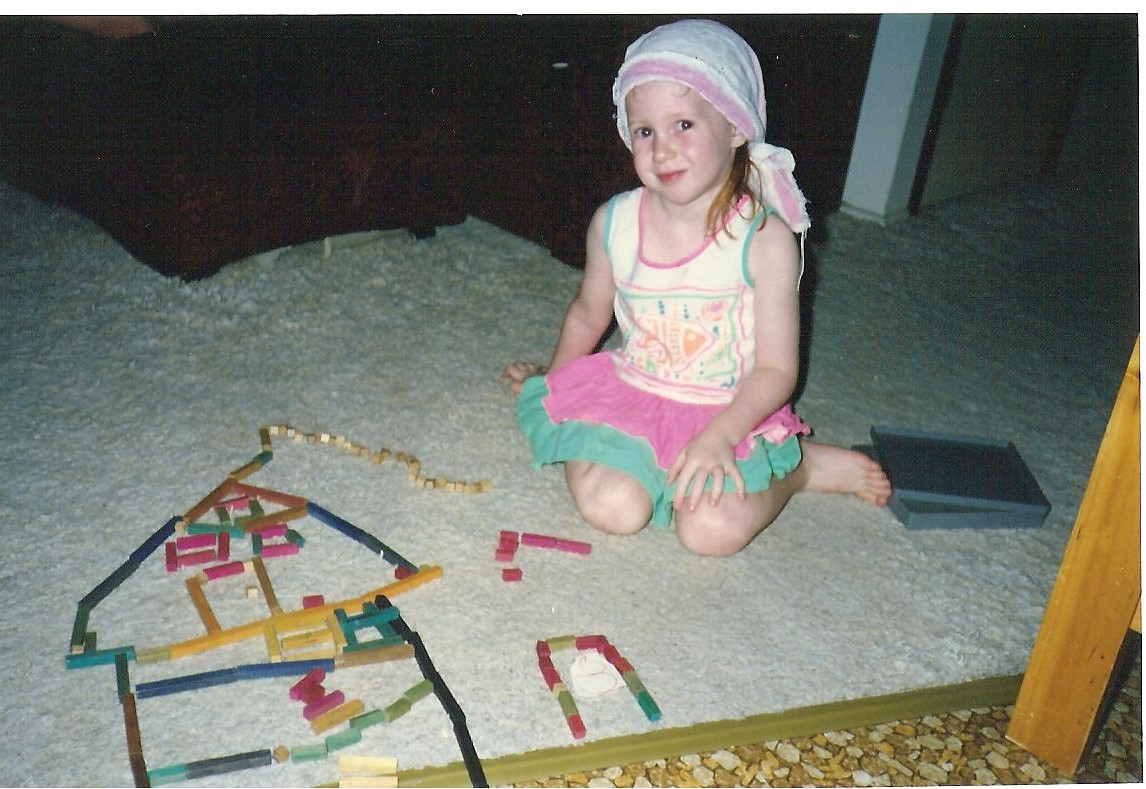
    Bec's cuisinaire house may 91        writing

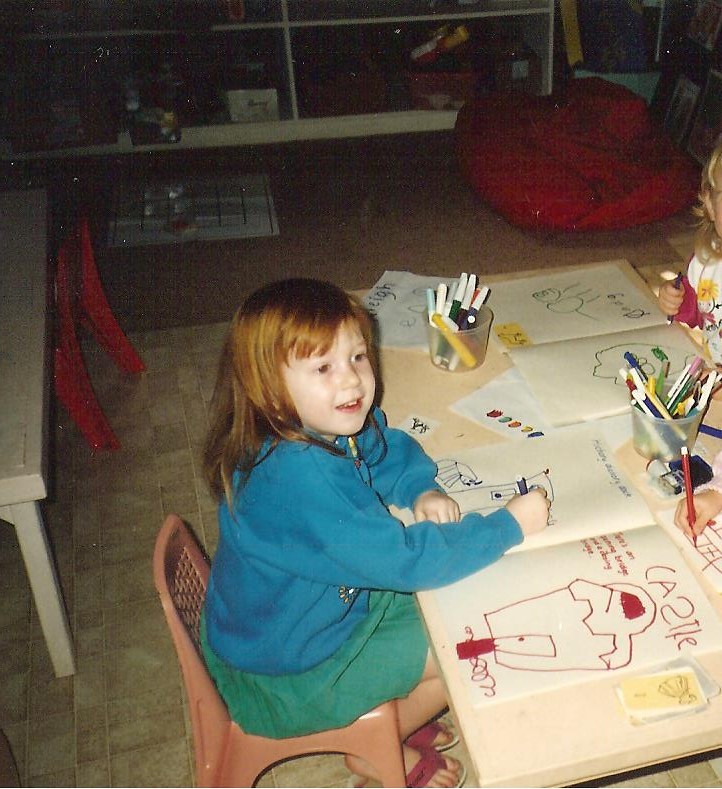
    There’s no evidence in my memories that I was ever actively Being Schooled – I remember playing, spending time with my mother, going on fun day trips, and being creative. All of this, as far as I knew, without a formal lesson plan presented to me in the morning, without worksheets to complete (though I did spend a lot of time writing for fun – can you imagine such a thing?), without testing which would give me a reductive and quantitative measure of my intellect, abilities, and ranking against other children.

    I started School with a capital S in grade 4, which was very hard to begin with. ist day of schoolThe decisions which led to my enrolment in a School are absent from my memories of the time, but I think I remember that I wanted to be with other children. It makes me sad to think back on this, because I worry that as a child knowing nothing but my own life as the basis for all of my understandings about the world, that perhaps I didn’t appreciate Norah enough, and maybe I hurt her feelings when I wanted to be with other children. When I started School, I have a vivid and poignant memory on the first or second day being given a worksheet with no idea about how to complete it, as it was such a foreign concept. I felt out of my depth and incapable of fitting in, and I was upset. It took a little while to make friends (which resulted in a number of lonely lunch breaks), but once I did I was happy. I enjoyed most of the school work, and as far as I am aware my schooling experience from that point on was no more extraordinary than that of any other child at a state School. I missed being with Norah during the day but I was lucky that she was involved as a parent helper in my class, and then had a teaching position at my School.

    So there is no dramatic end to the story – I was home educated and then I went to a School. I find this difficult to explain, but as a child, there is no other life that I knew. So it didn’t feel like my home education years were cut short by going to School, nor did it feel like I was starting School late (though I was aware that I was a bit different in terms of my schooling). Now as an adult and with hindsight, I am very thankful for the gift of home education that Norah gave me. (I am also proud to know that I was a bit different in terms of my schooling.)

    I would like to offer some evidence of the impact that being home educated has had on my life, but I am not sure how to do this, after all, I’m the experiment and there’s no control for comparison. I can, however, say that I loved my childhood and I still have a very strong and driving love of learning.

    Click on the link below to see some photos from Bec’s scrapbook.Photos from the scrapbook

    These early photos portray activities that continue to interest Bec to this day: a love of animals and nature, an enjoyment in cooking and sewing, creative crafts, mathematics and writing.

  • Welcome to my blog

    Welcome to my blog. This is a whole new adventure for me and I am excited about where it may lead. I hope you will be inclined to pop in from time to time to share my journey and offer some encouragement along the way.

    Since education is my life a good deal of what I write will focus on my thoughts and ideas about education and learning. Check out my poem Education is on the “Education is” tab to see how different I believe education and schooling to be. I would love to hear the ways in which you may or may not agree with me. I am in for a bit of education myself as I explore this new world (to me) of blogging and I know there are many wonderful teachers out there ready to teach me what I need to know.

    When the student is ready the teacher appears.”

    I am ready.

    Let the adventure begin!