Live Love Laugh Learn … Create the possibilities

Tag: technology

  • Marnie Stories and AI

    Marnie Stories and AI

    If you followed my blog over the years when I was posting regularly, you may remember the Marnie stories that I wrote in response to Flash Fiction prompts by Charli Mills at the Carrot Ranch. Depending upon the prompts, the 99-word stories provided a snippet of Marnie at various times of her life, from childhood to adulthood. They weren’t written in chronological order of her life, and I hadn’t already written anything of greater length from which I drew them. The stories were simply responses to the prompts as they occurred, and I used them to help develop her character. If you are interested, I collected the stories on their own page, Marnie.

    Recently, a writer friend told me about using AI (ChatGPT) for assistance with her writing, for ideas when stuck, for sequencing events, for suggesting alternate endings. She explained that you could ask ChatGPT anything and it would help. I was surprised. I wouldn’t have thought of using it in that way. I wouldn’t have thought of her using it that way. I wouldn’t have expected her to share so openly that she found it so beneficial. However, as she continued to explain, I was impressed at her resourcefulness and came to understand how useful it could be as an assistant.

    Since writing the Marnie stories, I’d often thought of using them as the basis for writing a longer story about Marnie but hadn’t got around to doing anything with them. I wondered if ChatGPT might help me get started and was amazed at the result.

    I began by asking if it would be able to put different snippets of text about one main character and other characters in time order.

    The response was:

    “Sure! Please share the snippets of text you have. I’ll organize them in chronological (time) order based on the events involving the main character and other characters.”

    So, I inserted all the texts (5620 words) in the order in which I’d written them, and the response was almost instant:

    “Thanks for sharing all the text — there’s a rich and deeply emotional narrative here. I’ve now organized the snippets into chronological order, based on Marnie’s life journey. Some events overlap or reflect back in time, so I’ve placed them where they seem to fit best narratively and psychologically.”

    This was followed by a list of all the snippets (flash fiction stories) under the headings:

    Early Childhood – Home Life and Abuse (5 stories)

    Early School Years – Introduction to School, Bullying, Trauma (20 stories)

    Turning Points – Friendship, Courage, Escape (7 stories)

    Escape, Reinvention, Adulthood (7 stories)

    Resolution – Closure, Reflection, Healing (5 stories)

    Side Scenes/Thematic Parallels (2 stories)

    Needless to say, I was pretty impressed with the speed of response and the organisation of the stories.

    I was then asked: “Would you like this ordered version exported into a document (PDF/Word)? Or do you want me to analyze themes, character arcs, or tone across the timeline?”

    I asked for it to be analyzed for consistency of character, themes and storyline.

    The response was:

    “Absolutely. Your collection of vignettes weaves a deeply emotional and coherent narrative. Here’s a detailed analysis of character consistency, thematic unity, and storyline progression, with specific observations about how these elements succeed — and a few small areas you might refine or clarify if you wish to polish it even further.”

    I was delighted with the ChatGPT conclusion about Marnie’s character:

    “Marnie is written with exceptional psychological realism and emotional depth. Her development follows a believable arc from traumatized child to resilient adult. Across dozens of fragments, her behaviors, reactions, and internal thoughts consistently reflect:

    • Complex trauma symptoms: dissociation, hyper-vigilance, self-blame, learned helplessness, retreating to small enclosed spaces.
    • Moments of growth: brief smiles, curiosity, creativity, cautious trust.
    • Innate sensitivity and intelligence, masked by educational delays, confusion, or misunderstanding of expectations.
    • Symbolism in the unicorn: a through-line in her identity — innocence, escape, comfort — even when mocked or confiscated.

    Her arc feels deeply earned, from sucking her thumb under the desk to boldly walking away from her past, and finally extending kindness to others.

    Success: Marnie remains emotionally and psychologically coherent at every age, even as her voice matures.”

    In fact, across all the characters, themes and story elements, I was excited about what ChatGPT was giving me. The overall response was positive, but there were also suggestions for improvement.

    🔹 Overall Evaluation

    🌟 Strengths:

    • Deep psychological insight.
    • Lyrical but grounded language.
    • Emotional authenticity.
    • Clear voice for each character.
    • Motifs like unicorns, mud, colour, silence, and locked doors are effective and memorable.

    🛠 Possible Refinements (only if aiming for publication-level polish):

    • Slight reduction of duplicate imagery (multiple unicorn-tripping incidents).
    • Make sure developmental language matches Marnie’s age, especially in early internal monologues.
    • Brucie’s arc could either be extended or left open intentionally — just make it a conscious choice.”

    Now that I have this first evaluation with suggestions for refinement, I feel empowered to continue working on Marnie and her story. Whether human readers would feel as positive, I don’t know, but at least now I’m ready to give it a go.

    My main purpose in writing this post is to encourage you, if you haven’t done so yet, to give ChatGPT a try if you’re stuck on an idea or need a prompt to get started. If you’ve also experienced success in using it, I’d love to hear how.

  • Old World — So Last Century

    Old World — So Last Century

    Carrot Ranch flash fiction challenge old world

    This week at the Carrot Ranch Charli Mills challenged writer to In 99 words (no more, no less) write a story about old world charm. It can be nostalgic or irreverent. You can invent an “old world,” return to migrant roots or recall ancient times. Go where the prompt leads you!

    Born mid-way last century and unlikely to see the middle of this, from this angle anyway, I have to admit that I’m of the ‘old world’. The young ones think I’m ancient.

    When my daughter, now an adult herself and ‘old’ to younger eyes, was but a child, she often asked me to tell her what life was like ‘in the olden days’ when I was a child. She even asked what the dinosaurs were like!

    Although she teased, it has become entrenched in family lore. (Most family members have been obsessed by dinosaurs at some time — perhaps in the hope of locating ancestors?) But perhaps the juxtaposition is not that unlikely if one has not yet developed an understanding of the evolutionary timeline.

    I’ve always appreciated the quote, often mistakenly attributed to Einstein, that says the only reason we have time is to prevent everything happening at once. There is another that questions whether, if a tree was to fall in the forest and no one was there to hear it, would it make any sound?

    Could it be that for children, until they develop a sense of time, anything that has occurred outside of their memory, prior to their birth, seems to have happened all at once in that long ago, old world time.

    The first children to have been born this century are already reaching adult status but it is difficult for them to imagine life before mobile phones, text messaging, iPads, social media, the internet, instant information, streaming and video games, let alone television. Even for some of us who experienced those ‘olden days’, it can be difficult to remember just what it was like.

    This video of children reacting to rotary phones may help you recall.

    How did we meet up with friends when we didn’t have phones, never mind mobile phones? What did we do when we were waiting for an appointment or an event and we didn’t have our phones for entertainment? What did we do when we wanted to know something and we weren’t at the library, beside a set of encyclopedias, or someone knowledgeable? No wonder our parents answered our questions with statements such as; “Because it is” and admonished us for asking too many questions. No child should ever have their questions shut down now with answers just a button away.

    This year marks the 50th anniversary of momentous events such as the Moon Landing, Woodstock, and my final year of school. I may not have roamed with the dinosaurs, but how life has changed since then. My story reflects back on time in that ‘old world’. I hope you like it.

    So Last Century

    “What did you play on the iPad when you were little, Grandma?”

    “There weren’t any iPads when I was little.”

    “What?”

    “We didn’t even have computers.”

    “What? How did you watch movies? On your phone?”

    Grandma laughed. “No, we couldn’t watch movies on our phones. They didn’t have screens. And we couldn’t carry them in our pockets either. We went to the cinema to watch movies. When I was really little, we didn’t even have television.”

    “Wow! What did you do then?”

    “Lots — played games, read books, made our own fun.”

    “Can we play a game?”

    “Of course, love.”

    Thank you blog post

    Thank you for reading. I appreciate your feedback. Please share your thoughts.


  • Why Kindergartners Must Learn Technology – readilearn

    Why Kindergartners Must Learn Technology – readilearn

    Today I am delighted to introduce you to Jacqui Murray, the Tech Teacher, who is able to answer all your questions about using technology in schools.

    Jacqui’s blog Ask a Tech Teacher is very informative. It is packed with helpful advice for both teachers and parents on children’s use of technology and the suitability of tools and software for use in different situations and with different age groups, especially in the classroom. If I need to know anything about technology, Jacqui’s blog is an excellent resource.

    As Jacqui is often asked questions about teaching Kindergartners to Tech, a topic that is dear to her, this is the topic of discussion in this post. Please feel free to ask Jacqui any additional questions you may have in the comment section at the end!

    Note: Jacqui is based in the US and the kindergarteners she refers to are 5-to-6-year-olds.

     Welcome to readilearn, Jacqui. Over to you.

    When I started teaching technology almost twenty years ago, I taught K-8, three classes in each grade every week. I was buried under lesson plans, grades, and parent meetings. I remember suggesting to my principal that he ease my schedule by eliminating tech for kindergartners. They wouldn’t miss anything if I started them in first or second grade.

    And back then, that was true.

    Even a decade ago, technology was an extra class in student schedules where now, it is a life skill. Today, my teacher colleagues tell me kids arrive at school already comfortable in the use of iPads and smartphones, doing movements like swipe, squeeze, and flick better than most adults. Many teachers, even administrators, use that as the reason why technology training isn’t needed for them, arguing, “They’re digital natives.”

    Continue reading: Why Kindergartners Must Learn Technology – Readilearn

  • STEM in early childhood classrooms – readilearn

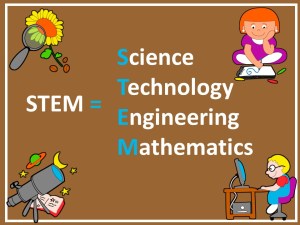
    Making space for STEM in early childhood classrooms is easy; or should be.

    Children are naturally curious about the world. They want to know:

    • Why is it so?
    • How does it work?
    • What will happen if?
    • How can I?

    It is important to harness their curiosity, explore their questions, engage their interests and inspire their imaginations.

    Provide them with opportunities to investigate objects and phenomena in the world around them. Don’t always be in a rush to provide answers to their questions. Help them explore ways of finding the answer for themselves, if possible, or conduct the research with them.

    A story reported by Michael Rosen in his book Good Ideas: How to Be Your Child’s (and Your Own) Best Teacher inspires me. The story explains that, as a child, David Attenborough took an interest in bones. If he was out walking and found some bones, he would take them home and ask his father about them.

    His father, who was a GP and would have known, didn’t just tell him. Wanting his son to be curious and interested in finding things out for himself, he responded, for example: “I wonder if we can work it out . . .” They would then look through books about zoology and anatomy and try to identify the bone’s origin.

    However, the answers don’t always have to be found in a book or on the internet. Some answers can be discovered through explorations and experimentation. Experts can also be consulted.

    In a stimulating early childhood classroom where children have access to a range of resources and opportunities

    Continue reading: STEM in early childhood classrooms – readilearn

  • I’ll just look that up: lazy or smart thinking?

    1 (5)

    I often lament that I was born too soon. I love what can be done with information technology and am constantly learning more of its uses. I am in awe of what can be achieved with the aid of digital tools. Unfortunately, some things, because they can be done, are vastly overdone.

    I remember being at an education conference in the early 80s, at the time when computers were becoming more common in classrooms and in homes. A presenter at the conference excited us about the wonders of digital technology and its ability to ease our work load. He predicted that computers would be used to do so many of our menial tasks that by the year 2000 we would have so much spare time we wouldn’t know what to do with ourselves.

    His prediction, in my opinion, was way off the mark. While the use of computers has greatly enhanced our capabilities and our knowledge, it has also driven us to constantly do more. I notice this particularly with data collection in schools. If it can be quantified, then it must be quantified, analysed and compared. Whether what is being measured is of any value is of no consequence. If it can be done, it will be done.

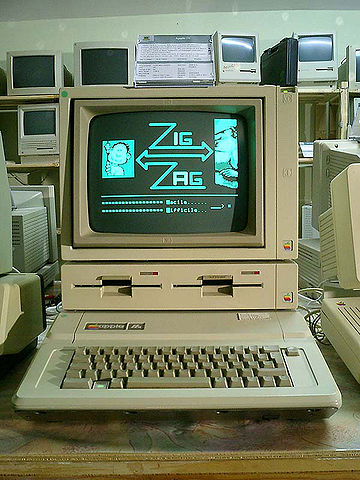
    1985 was the year I first used a computer at school and bought my first computer for home. They were Apple IIe (huge) desktop computers. I can remember how excited I was to be able to program little games using BASIC coding language. There were some good problem solving software programs on floppy disks I used with children at school; and my son played his way through the series of Ultima role playing games.

    CC BY-SA 3.0, https://commons.wikimedia.org/w/index.php?curid=1049963
    CC BY-SA 3.0, https://commons.wikimedia.org/w/index.php?curid=1049963

    Back then, the thought of having a computer that could be carried in a pocket was as absurd, to the general population, as having a phone that wasn’t attached to a wall. Fortunately, there were others with imagination and vision who were able to make these things a reality.

    http://cdn.morguefile.com/imageData/public/files/c/chelle/preview/fldr_2008_11_08/file000985579226.jpg
    http://cdn.morguefile.com/imageData/public/files/c/chelle/preview/fldr_2008_11_08/file000985579226.jpg

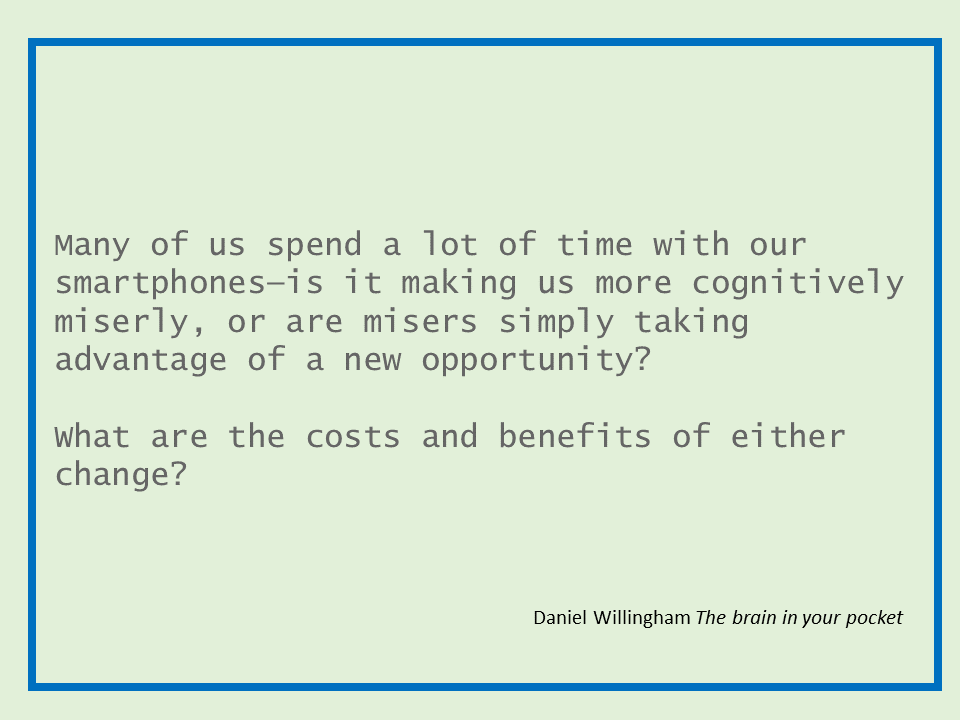
    I recently read a post on Daniel Willingham’s blog Science and education entitled The brain in your pocket. The brain that he is talking about I carry in my handbag. In fact, I often have two with me, though I’m not convinced that this supports the theory that two brains are better than one.

    In the post Willingham shares some observations about our current use of technology to replace thinking. He suggests that, as thinking requires effort, people don’t like to engage it and find ways to avoid it. He referred to this as “miserly thinking”, a term coined by Robyn Dawes in the 1970s.

    Two strategies for avoiding thinking include use of:

    • Memory – repeating earlier actions or doing things the way you’ve always done them; such as ordering the same item from a menu or always travelling the same route to work
    • Associations – using strategies that worked in other similar situations.

    Willingham then shared this question as a test of miserly thinking:

    bat and ball question

    He suggested that if you, like many others, answered 10 cents you were using miserly thinking triggered by the word “more”, immediately thinking that subtraction was required and not checking to see if the answer was correct.

    He used this to demonstrate a similar effect that use of the internet has had upon thinking in recent years, when answers to many questions are just a motion (click, tap or swipe) away. In more recent years of course nearly everyone is carrying a smartphone in a pocket or handbag, that is, if it’s not grasped firmly in hand. This easy access, he suggests, makes people less reliant on their own memories as they look to the internet for a quick answer.

    1 (8)

    Research cited by Willingham suggests that a higher use of the internet for answers reduces the ability to solve problems like the bat and ball question shown above. He says thatpeople who are more cognitively miserly are more likely to search information out on their smartphone.” He adds that “The reason is not clear. It may be that low-cognitive-ability people seek information—look up a word meaning, calculate a tip—that high-ability people have in their heads.

    He asks the questions:

    daniel willingham questions

    What do you think?

    I love having the “external memory” that I can use to find out what I want to know when I want to know it. Previously I would have had to remember to look it up at some other time. If I didn’t know the right question to ask, or the appropriate term to look under, I may have been left in the dark forever.

    I love being able to spell check my work or check a dictionary or thesaurus to confirm that I have used a word correctly. These things enhance my knowledge and improve my skills. I am a bit peeved at the idea that it is those with low cognitive ability who look things up. I thought it was a smart thing to do!

    Do these actions make me a miserly thinker and decrease my cognitive skills? I really don’t want to think about that, but I sincerely hope not!

    I first became familiar with Willingham’s work through his book Why Don’t Students Like School?: A Cognitive Scientist Answers Questions About How the Mind Works and What It Means for the Classroom. I thought I had mentioned it in a previous post, but if I have, my search feature, upon which I am reliant, couldn’t find it. I’ll have to remember to do so in the future!

    Thank you

    Thank you for reading. I appreciate your feedback. Please share your thoughts.


  • Power tools


    www.openclipart.org
    http://www.openclipart.org

    This week at the Carrot Ranch Charli Mills has challenged writers to In 99 words (no more, no less) include a tool in a story. I open this post with a quote by Jackie French I used to close my previous post.

    Jackie French - books - tools

    Books are a great tool. So is the ability to think creatively.

    Being literate is a key that opens many doors. Being able to think opens many more. You could say they are the power tools of education and success.

    In his book The Outliers (recommended to me by Rowena who blogs at Beyond the Flow), Malcolm Gladwell talks about the role of intelligence in success. He says that “intelligence only matters up to a point”, and that “past that point, other things — things that have nothing to do with intelligence — must start to matter more”. He raises the question of what those things are.

    He makes a suggestion to

    “Write down as many different uses that you can think of for the following objects:

    1. a brick
    2. a blanket”

    and calls it a “divergence test”. Rather than asking you to come up with a one right answer, a divergence test “requires you to use your imagination and take your mind in as many different directions as possible.”

    Gladwell describes the test as a measure of creativity, of the ability to come up with imaginative and unique responses rather than a list of commonplace uses. He considers this imaginative thinking combined with intelligence, not intelligence alone, to be what is required to make new discoveries such as those that may be awarded Nobel Prizes.

    www.openclipart.com
    http://www.openclipart.com

    Can this sort of creative thinking be taught?

    Edward de Bono certainly thinks so. As long ago, dare I say, as the late 60s I read (and did) The Five Day Course in Thinking, a series of puzzles to help readers (thinkers) understand their thinking strategies. The puzzles in the book are divided into three sections: Insight Thinking, Sequential Thinking, and Strategic Thinking.

    Over the years I read a number of de Bono’s books including but not limited to Lateral Thinking, Six Thinking Hats, How to Have a Beautiful Mind, Teach Your Child How to Think, Textbook of Wisdom and Why I Want to Be King of Australia. I had a thirst for learning how to think, as thinking had not been encouraged and memorising content had not come easily in my younger years. Discovering that I was able to think, and think outside the box, was empowering.

    www.openclipart.org
    http://www.openclipart.org

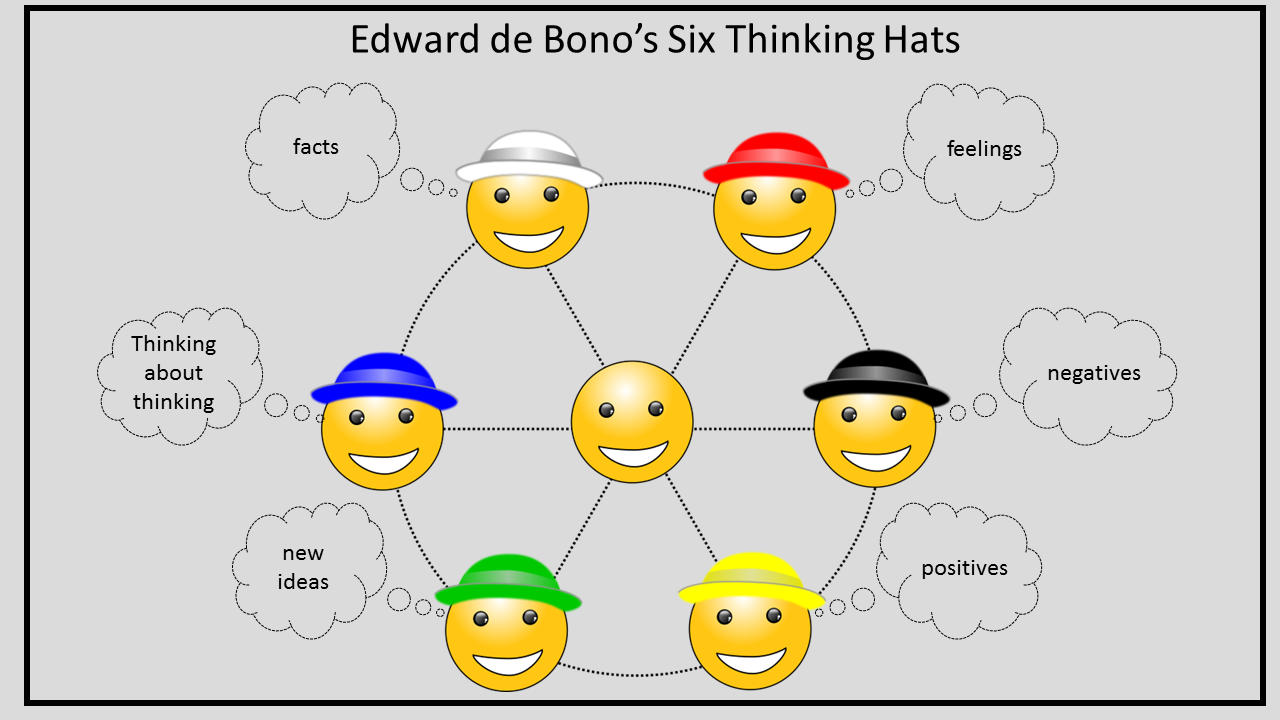
    I enjoyed using de Bono’s strategies and teaching them to my own children as well as to children in my classrooms over the years. His Six Thinking Hats are used in classrooms worldwide as are many others of his thinking strategies.

    six hats

    In this video de Bono talks about creativity, creative thinking, and thinking “outside the box”:

    Tony Ryan is another educator who believes it can. He has published a number of books that aim to get students thinking in creative ways. His Thinkers Keys “a powerful program for teaching children to become extraordinary thinkers” is designed to do just that.

    Tony Ryan says that we now need to think beyond the square and think “outside the dodecahedron”.

    In a comment on a previous post about Lifetime Changes, Steven linked to an amusing video showing the reactions of 21st century children to our earliest computers, tools of technology. This is it in case you missed it:

    I combined the notions of books, creative thinking and technology as tools for learning, productivity and success with a little bit of backward (historical) thinking to inspire my futuristic flash this week. I hope you enjoy it.

    tools for learning

    Relic

    The family shuffled amongst the haphazard collection of primitive artefacts without attempting to disguise disinterest or disdain. The waiting seemed interminable in this “so-last-century” outpost.

    Haven’s seen one of these before,” they’d been told. “I’ll need to order a specialized tool as well as the part. Shouldn’t take long though. Look around while you wait.”

    Confidence in the simpleton’s tools “upstairs”, even if the correct parts arrived, was as low as their interest.

    Hey look!” one called. “Is this …?”

    Can’t be.”

    All destroyed centuries ago.”

    Would be worth a fortune though.’’

    They opened it.

    A book!” they gasped.

    Thank you

    Thank you for reading. I appreciate your feedback. Please share your thoughts about any aspect of this post or flash fiction.