Live Love Laugh Learn … Create the possibilities

Tag: teaching

  • Who gives a crap?

    This week at the Carrot Ranch, Charli Mills asks “Who gives a crap?” and about what. She declares some things that are important to her, things she gives a crap about, including, but not limited to:

    • the environment
    • nature
    • truth
    • principles
    • equality
    • diversity
    • jobs for all
    • literature and it’s role in society, and
    • conflict resolution.

    She says that

    “Conflict resolution is finding a peaceful solution to a disagreement. It’s drawing back my hand from the urge to smack. It’s letting go of a need to punish. It’s hearing both sides of the concerns and working toward a way to save our environment and jobs. It means acknowledging the rights or privileges of all. It means agreeing to disagree with compassion for the other. It means uplifting the lowest in our midst instead of only seeking to better our own. It also means checking our words and behavior.”

    I give a crap about education. I care about the education of our children. It is through education that we can make a difference in the world; but we can only do that if we educate our children to be thinking, caring, responsible, contributing participants in society and inhabitants of the planet.

    We need to teach children about their relationship with the environment, and the impact of their individual, and our collective, actions.

    We need to give children time to experience nature and the outdoors; to marvel at its beauty, to appreciate its diversity, and to wonder …

    We need to model for children a principled life, in which truth, equality, and diversity are valued, and in which the collective good is more important than an individual’s need for fame or fortune.

    We acknowledge that making mistakes is integral to an individual’s learning and tell children it is okay to make, and learn from, mistakes. We encourage them to think for themselves and to be innovative, to see alternative solutions to problems.

    If we were to teach them to just accept things as they are because that’s the way they’ve always been (and I query that statement!) how can we expect them to come up with solutions to issues that confront us?

    Some of the conflicts mentioned by Charli; for example, providing jobs and preserving the environment, have resulted from our learning, our development, our education.

    Maybe we should consider that making mistakes is also integral to our collective learning and development; and be prepared to accept them as such, learn from them, and devise alternative solutions.

    For example: We learned about fossil fuels. We saw how they would enhance our lifestyle, and we implemented that learning, creating many new jobs as a consequence.

    Now we see that some of those advancements are not as beneficial overall as was initially thought. We made a mistake. It is time for reassessment, for learning, and for thinking of new strategies. We need to leave behind what does not work, and embrace the next step in our development.

    Charli asks, “When did we start thinking that only our crap matters and stop giving a crap about others?”

    For a while the focus moved away from the importance of community to the importance of the individual and individual rights. Maybe now it’s time to put the focus on community and the role of the individual in it. Let’s not ask what the community/humanity/the world can do for me, but what I can do for the community/humanity/the world.

    This brings me back to Charli’s flash fiction prompt to: “In 99 words (no more, no less) write a story that expresses a strong concern, something to give a crap about. Something that brings out the feeling to stand up. How can you use it to show tension or reveal attitudes?”

    This is my response. I hope you enjoy it.

    Pulling together

    “It’s mine!” they spat at each other. With faces red and contorted, they pulled in opposite directions.

    The object finally stretched to its limit and ripped apart, catapulting the opponents backwards to land on their derrieres.

    “Now look what you’ve done!” they accused each other, and scrambled to retrieve what was salvageable.

    They contemplated the useless fragments. There were no winners, only losers. Their eyes, previously filled with hate, now brimmed with sorrow.

    “What have we done?”

    Moving together, each comforted the other, feeling as much for the other’s loss as for their own.

    “Let’s start anew,” they said.

    I’d love to know what situation you think my story might be about. I’d also love to know what it is that you give a crap about.

    Oh, and thanks to Bec’s reminder, I will mention the Who gives a crap toilet paper (that is far from crappy and great for the environment) that Charli mentioned in her post, and I previously mentioned in Around the Campfire.

    Thank you

    Thank you for reading. I appreciate your feedback. Please share your thoughts.

  • Getting to know you – Readilearn

    getting-to-know-you-2

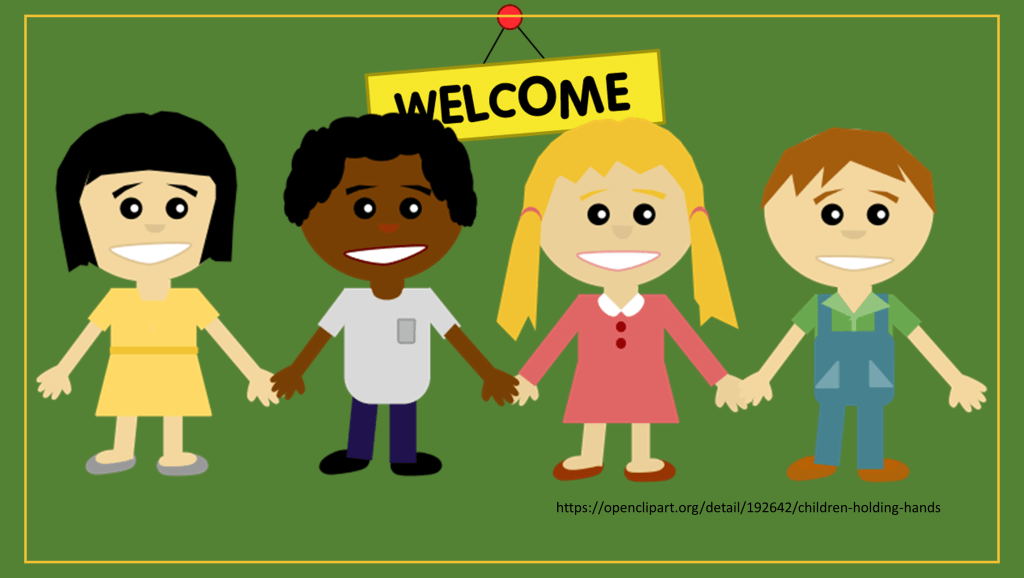
    The beginning of the year is a great time for getting to know each other. Children will feel comfortable and friendly towards each other in a welcoming classroom environment that values and respects individuals; and in which appreciation for our diversity, as well as our commonality, is nurtured.

    When children feel safe to be who they are, they are more accepting of others.

    While it is important to establish a welcoming environment at the beginning of the school year, it is equally important to maintain the supportive environment throughout the year. It is not something we do to pretty the room and then forget about it. It is a part of who we are, and comes from a firm belief in the value of each individual, of community, of humanity, and of our world.

    Source: Getting to know you – Readilearn

  • What lies beyond

    This week at the Carrot Ranch Charli Mills has challenged writers to In 99 words (no more, no less) write a story that steps beyond.

    She says,

    “The paths often fork and always seem steep. You just have to keep stepping out, risk being vulnerable, learn as you go from both masters and your own observations, and explore what could be.” 

    How apt a description for learners and teachers alike. The focus of a teacher’s work is always on what lies beyond; encouraging learners to step out, take those risks, embrace vulnerability, and explore the unknown. Each journey is unique with its own periods of calm interrupted by rough patches and inclines that require both teacher and learner to step beyond comfort and what is familiar.

    While learners are appreciated for who they are, and for their achievements, in each moment, a teacher is always stretching them to grow towards the possibilities of an unknown future; preparing learners to grasp, and create, new opportunities.

    In Are you ready to embrace the future? published in July 2014, I introduced you to Tony Ryan, learning consultant and futurist. In his online seminar Future-proofing Kids, Tony says,

    “Many of the children alive today in Western societies will still be around in the 22nd Century. How can we possibly predict what they will experience between now and then? And if we can’t do that, then how do we best prepare them for whatever is up ahead?”

    I listed, as essential to successfully living in that unknown future, the development of the following attitudes and character traits:

    •  Confidence
    • Persistence
    • Resourcefulness
    • Resilience
    • Able to seek solutions to problems
    • Openness to new ideas and possibilities
    • Creativity
    • Divergent thinking
    • Questioning
    • Optimism

    These add to basic levels of literacy and numeracy and the ability to critically evaluate material; for example, using information about an author’s credentials and purpose, and understanding the ways texts are constructed to persuade.

    On his website, Tony Ryan says,

    “The world up ahead will be amazing, but it will take each of us to push our intellect and our spirit beyond all previous possibilities.”

    He describes the focus of his work as supporting others to do just that

    In addition to educating for the future, teachers need to see past the labels to the truths that lie within, encouraging all learners to stretch beyond what they thought was possible. I hope there was a teacher in your life who enriched your journey.

    For the teachers among you: know the importance of your role and the effect on all learners when you help them see the value of self and open their eyes to their own potential. When you help them step beyond the limits imposed by others, you help them create possibilities in their own, and our collective, futures.

    It is from this perspective that I have written my response to Charli’s flash challenge.

    Beyond surface features

    The registrar ushered him to the doorway and promptly disappeared.  He stared blankly: hair askew, face dotted with remnants of meals past, shirt lopsided and collar awry, shoes scruffy. Another needy child. You name it, he had it: split family, mother in jail, successive foster homes, sixth school in two years, learning difficulties, generally unresponsive, prone to aggressive outbursts …  

    No magic ball, just a futures optimism, she saw beyond the exterior to the potential within. In a moment, she was there, smiling, taking his hand, reassuring. “Everyone, say good morning to Zane. Let’s welcome him into our class.”

    Thank you

    Thank you for reading. I appreciate your feedback. Please share your thoughts.
  • It’s not what you see

    1-2

    This week at the Carrot Ranch, Charli Mills is talking about the effect of changing a lens on how things are viewed. She says,

     “No matter what lens we apply, there is something to be seen in each of us that is worthy.

    Perhaps if we focus differently, we might actually achieve peace.”

    This is true too of children. Sadly, I think too often children are seen for what they are not yet, rather than appreciated for what they are. Childhood is all too fleeting, and with the current focus on assessment and teaching-to-the-test in many educational systems, it is becoming almost non-existent. Recess and free-play times are being eroded to cram in more cramming time.

    I recently read an article in the Washington Post that told of children in a US school having to walk laps during a 20-minute recess. The supposed intention was to get the children active. However, most children would be naturally active if allowed the freedom to run and play. The benefits of free-play activities for health, well-being, and social development would be far greater than that of walking laps.

    file1051239031460

    This practice contrasts with one described in an article in the Sydney Morning Herald. Children in Finland have fifteen minutes of mandatory outdoor play every hour, whatever the weather. “Fresh air, nature and regular physical activity breaks are considered engines of learning.”

    Each of these practices recognises the importance of activity, but each has a different way of providing for it, and only one is effective. I wonder why those with the power to make positive changes in education, fail to see the damage being done by didactic and test-driven practices that rob children of any love for or joy in learning. It seems to matter little what lens is used, they are unable to focus clearly on what matters most.

    In this TEDx talk, Nancy Carlsson-Paige explains what happens When Education Goes Wrong: Taking the Creativity and Play out of Learning.

    Towards the end of the talk, beginning at 12:45, Nancy says,

     “The difference between understanding concepts and reciting facts is very important for us to understand right now, because it captures the essence of what is happening in education today. There is a gross misunderstanding of what education is that has swept across the country, and the unfortunate belief is that you can direct teach, and you can measure and you can quantify learning; but the truth is, it is only the most superficial and the most mechanical aspects of learning that can be reduced to numbers. Unfortunately, this mistaken idea about the nature of education has pushed down to our youngest children. “

    She says that when we “drill and grill” kids, we not only lose the power of the learning experience, we lose all the amazing capacities that children bring to us in education:

    • initiative
    • creativity
    • the ability to define and solve their own problems
    • originality of thought
    • invention of new ideas
    • perseverance
    • cooperation.

    She says that when we take those capacities out, we take away the love of and joy in learning, not only from the children but from teachers too.

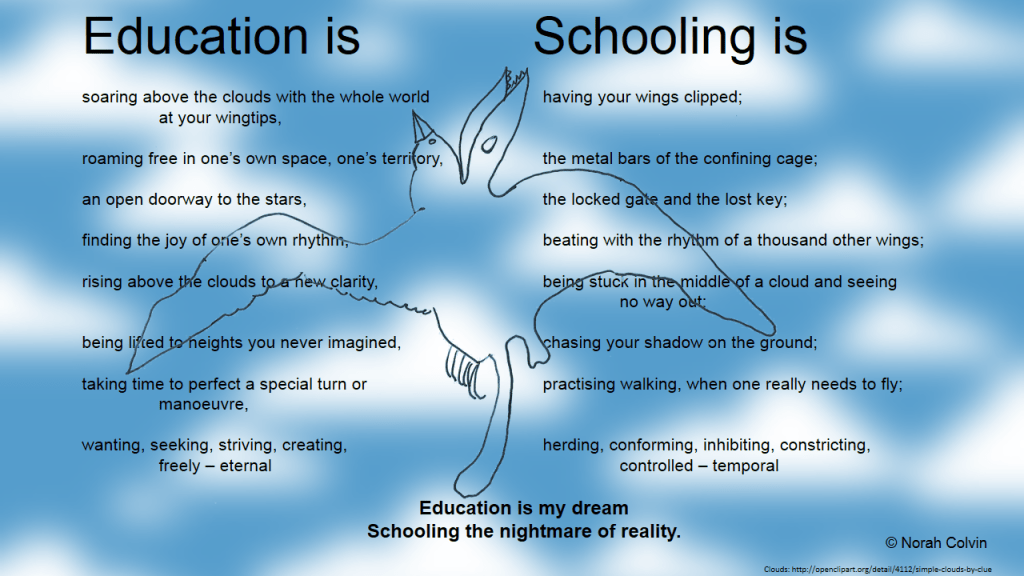
    These are themes that are familiar to regular readers of my blog, and the most influential when I decided to leave the classroom. More than thirty years ago I wrote a poem to describe the differences between what often is, and what could be.

    © Norah Colvin
    © Norah Colvin

    Sadly, I cannot say that nothing has changed. It has. The differences have become more stark.

    Here is my response to Charli’s prompt to: In 99 words (no more, no less) write a story using a lens. It can be literal, like looking at the world through rose-colored lenses or the need for spectacles.

    pink-sunglasses-clipart-1

    Unfortunately, I couldn’t find my rose-coloured glasses.

    What you see

    They saw him for what he wasn’t and what he lacked, not for what he was and what he could be. Their ill-fitting garments failed to clothe, and their unpalatable diet failed to nourish. If only they’d zoomed in upon his potential. Instead the wide-angled lens showed a panorama of disadvantage: an excuse for failure to fulfil his needs or enable his possibilities. A lens in proper focus may have seen a burning curiosity, a rich imagination, a wisdom older than time, and a heart in harmony with the universe. Instead they considered the negatives not worthy of development.

    Thank you

    Thank you for reading. I appreciate your feedback. Please share your thoughts.

  • The Principal’s Office

    Principal's office

    The thought of being sent to the Principal’s Office is notoriously fear-inducing with the implication that some misdemeanour has occurred and that punishment will follow. Of course, I know this only from the stories of others. It’s true: I have no recollection of ever having been sent to the Principal’s Office during my school days. In fact, I have no recollection of there being a Principal’s Office at all, or indeed who that principal might have been. Perhaps there are some serious omissions in my memory files.

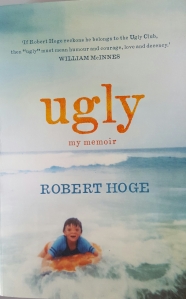
    In a previous post, I introduced you to Robert Hoge and his memoir Ugly through a lying incident he relates. Robert also shares recollections of being sent to the offices of a deputy principal and a principal while he was at school. Both incidents are also included in the version for Younger Readers.

    Ugly coverUgly for kids.PNG

    Robert recalls that,

    Most of the school lived in a vague, unspecified fear of Mr Fuller (the deputy principal). He was the perfect second-in-command. He delivered the bad news when needed and administered a strict, no-nonsense form of discipline that mainly worked by keeping students so in fear of the threat of getting in trouble, they behaved.

    One day when Robert was summoned to Mr Fuller’s office he was informed that some teasing had been occurring. As he was usually the one being teased, Robert was relieved that he wasn’t getting into trouble. Instead of informing on others who had teased him, Robert said,

    “Well, sir, it wasn’t anything really. Nothing that got me very upset anyway.”

    Sadly, though, it was Robert’s turn to be reprimanded for being the teaser. The children who were so good at teasing him, weren’t so good at taking a little teasing in return, and had made a complaint.

    Robert confesses surprise at how much the other child had been upset because he (Robert) “was teased so often … (that he) … became better and better at dealing with it” as he got older. However, it wasn’t just the children who were cruel and sometimes, when adults were cruel, he found it more difficult to take.

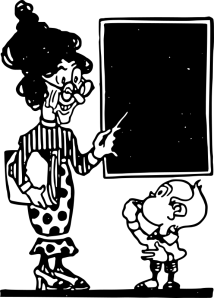
    SnipsandClips, Teacher and Child https://openclipart.org/detail/205589/teacher-and-child
    SnipsandClips, Teacher and Child https://openclipart.org/detail/205589/teacher-and-child

    Robert describes an incident that occurred in year ten when he and another student elected to do a week’s work experience as teachers at a local primary school. He was allocated to a year seven class and the other student to a year two class. Robert enjoyed the week and was pleased that his appearance drew few comments from the students.

    On Friday afternoon Robert was summoned to the principal’s office. Waiting outside, expecting perhaps to get a ‘thank you’ from the principal, he was surprised when the other student wasn’t also there. What happened when he was called into the office is astonishing.

    Without so much as a greeting, Robert was chastised for the school’s not having being warned before he arrived. Warned about what, Robert wasn’t sure. When he enquired, the principal quickly informed him, that she should have been warned about him; that when he’d arrived on Monday they’d had to swap the classes to which he and the other student were assigned. Robert was initially confused as to the reason, then he realised that she was talking about his appearance, that perhaps the year two students would not be able to cope as well as the year sevens.

    Robert was upset. He didn’t know what to say and started to cry. When he said, “I’m sorry”, the principal responded with “Good” and showed him the door. Of course, Robert was distraught. He writes,

    It wasn’t the last time I cried about the way I looked, but it was the very last time I apologised to anyone else for it.

    Each of these incidents occurred in a Catholic school. Anne Goodwin who blogs at Annecdotal recently shared a guest post here about the legacy of a Catholic childhood. I was also educated at Catholic schools. While most of my teaching service occurred in the state system, I did teach for a few years in Catholic schools. I saw and experienced many instances of adults being mean to children. I also saw many instances of kindness.

    For my flash fiction response to this week’s challenge set by Charli Mills at Carrot Ranch Communications to In 99 words (no more, no less) write an office story, I have decided to write an alternative encounter for Robert with a more principled  and compassionate principal. I’d love to know what you think.

    movie board

    The Principal’s Office, Take Two

    “Ah, Robert, come in,” she said, extending her hand and shaking mine as if I was an adult rather than a work experience student. As she returned to her desk, she indicated for me to also sit. I was puzzled. I knew I’d done a good job in the classroom. Why would the principal want to see me?  I waited. She looked at me quizzically. “Robert, I’ve heard a great deal about you this week …”  I squirmed. “… and all of it positive.” She smiled. “I’d like to suggest, if you’re still undecided, that you consider teaching as a career …”

    48

    Although Robert didn’t choose a career in teaching, he has powerful lessons for us through sharing his story.

    Thank you

    Thank you for reading. I appreciate your feedback. Please share your thoughts.

  • The importance of feedback


    39

    Feedback, whether inherent in the task itself or supplied by another, is essential to learning. This is true whether figuring out what happens when an item is dropped from a high chair (will it always land on the floor; will a carer always retrieve it?), how hard and at what angle to kick a ball to send it over the goalpost; how much a sibling can be antagonised before retaliation ensues; or whether your performance meets expectations.

    In almost all of these cases, the tasks are self-selected and the feedback is integral and immediate, enabling the learner to adjust what happens next accordingly. While those conditions may also be true when considering the success of performance; such as our own assessment of our output, it is not always so.

    F

    Students and employees may be engaged in tasks that are not of their choosing, which provide little inherent feedback, and are reliant upon feedback from others that may be neither timely nor specific to the learners’ needs. Sometimes the feedback can be unhelpful and hinder, rather than encourage, learning, without any real explanation of how improvement could be made.

    As a teacher, I found it necessary for an exchange of feedback between me and my students. This was sometimes supplemented with feedback from carers and other school personnel. How well the students engaged in the classroom, participated in class activities and performed tasks provided me with feedback on my performance as a teacher and provided important information about what to do next, which in turn involved feedback to students.

    While feedback is an essential ingredient in any classroom task, one of the most enjoyable for me was the daily journal. Each morning the children would write to me and every afternoon after they had gone home I would read and respond to their messages. The children loved writing these diaries as much as I loved reading and responding to them. Responding was time consuming but I believe it was worth it:

    • The children had a purpose for writing
    • Their writing had an audience
    • They saw writing as a tool for communication

    When responding to their writing, I would make neither corrections nor changes. However, I would model correct grammar, spelling and punctuation as I responded to the content of their messages. The children were then able to refer to my comment when writing their next message.

    Sometimes the children would tell me about something different each day. Sometimes we would have conversations that could extend over weeks. I always felt it a privilege to have this window into the children’s lives. At the same time, it provided a record of their development as writers.

    At the end of the year I would bundle up all of the journals that had been filled during the year and present them to the children to take home. Recently when I was talking to the mother of a child I taught in the eighties, she told me how they had been looking at those journals with his young children who are now at a similar age to his when he wrote them. How gratifying it is to know that they were treasured by at least one family.

    thank you - rose

    When I started blogging, unbelievably, almost three years ago, I had no idea of what to expect. I am a little more knowledgeable now, with thanks to those who provide feedback by reading and commenting. I am very grateful to all who have joined me along the way. The conversations here or on your own blogs are what have made the journey enjoyable and worthwhile.

    yves_guillou_question

    Now I have a decision to make and I would appreciate your feedback in helping reach it.

    At the same time as I have been blogging, I have been preparing early childhood teaching resources for my website readilearn. I always expected readilearn to include a blog and a newsletter. I knew I couldn’t write that additional content alongside posting twice weekly here and preparing new readilearn resources as well. I thought to:

    • post once a week on this original blog by continuing to participate in the flash fiction challenges set by Charli Mills at the Carrot Ranch, as I have done for more than two years; and
    • post once a week on the readilearn blog with content written specifically for early childhood teachers rather than general readership.

    However, it has recently come to my attention that it may not be possible for readers to leave comments on the readilearn blog, which leads to my quandary.

    I enjoy the discussions in response to posts almost as much as writing them; and

    I am disappointed when I am unable to “like”, leave a comment on, or share another’s blog post I have enjoyed.

    megaphone

    It seems some bloggers are more interested in broadcasting than engaging with a community, but that is not my way.

    Newsletters differ from blogs, though, and the readilearn newsletter, which will provide information about new resources, teaching suggestions and other educational content, will “broadcast” and not invite feedback.

    How important, then, is it to have a blog that doesn’t invite feedback. I’m thinking that, without feedback, I’ll quickly lose motivation.

    What do you think?

    When you read blogs, do you look for an opportunity to add your voice through a “like” button, leaving a comment, or sharing content on social media? Is the ability to engage with the writer important to you, or do you simply read?

    As a blogger, do you welcome comments and discussion, or is it more important just to get your ideas out there?

    Thank you

    Thank you for reading. I am very interested to know what you think and appreciate your feedback. Please share your thoughts.

     

  • Desert surprise

    When you hear the word “desert”, what image does your mind conjure up?

    Is it of endless sand dunes such as those of  Rub’ al Khali (“Empty quarter”) of Saudi Arabia?

    https://commons.wikimedia.org/wiki/File:Rub_al_Khali_002.JPG
    https://commons.wikimedia.org/wiki/File:Rub_al_Khali_002.JPG

    Or is if of something a little less desolate?

    This week at Carrot Ranch Communications, Charli Mills writes about a desert close to where she is staying in her temporary, though seemingly endless, state of imposed homelessness.

    The desert Charli describes, in eastern Washington, is “flat and prickly” with “trees (that) are better described as shrubs and any ground cover growing out of the black sand has thorns.” She describes the “sagebrush with soft leaves of silvery blue and twisting trunks of brittle gray bark.” The images created by these descriptions is vastly different from those of endless sand dunes.

    A desert is usually described as an arid area where there is little rainfall and conditions do not favour  plant and animal life. As much as one third of the earth’s land surface is arid or semi-arid. This is also true of mainland Australia with its ten named deserts which mostly lie in the centre.

    Deserts of Australia
    https://upload.wikimedia.org/wikipedia/commons/0/08/Deserts_in_Australia_en.png

    Last year I was fortunate to visit Uluru and Kata Tjuta which are in semi-arid areas surrounded by desert in Central Australia. I have put together some images of the area to show the variation that occurs in the semi-arid landscape.

    Thinking of the word “desert” (noun – arid area) also brings to mind its heteronym “desert” (verb – leave), which has its own homonym meaning deserved e.g.” just deserts” and homophone “dessert”. These words are often confused by both readers and writers with pronunciation and spelling indistinguishable out of context.

    I have combined these different meanings to respond to Charli’s flash fiction challenge to in 99 words (no more, no less) write about a surprise from a desert. While not specifically about education, I also acknowledge the power of a teacher’s influence.

    Deserts

    They reminded her constantly what an inconvenience she was; that she’d never be anything; that she was simply trash like the one who birthed, and dumped her. Somehow she’d never believed them: their truth was not hers. She’d shielded her inner core with a shell over which their words flowed but could not penetrate. Not caring whether they ever knew, she’d prove them wrong. A favourite teacher inspired an interest in food science. As soon as possible she escaped to apprentice with master chef Jules. After years of determination and hard work, she opened her own patisserie “Just Desserts”.

    Thank you

    Thank you for reading. I appreciate your feedback. Please share your thoughts.
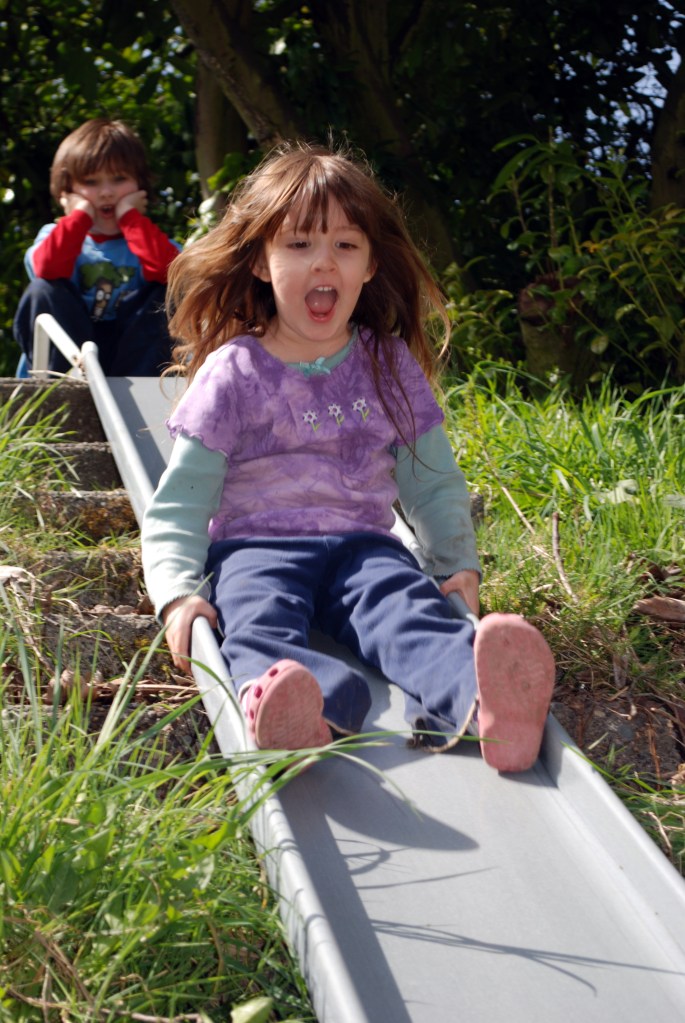
     

  • Can I help?

    81

    I have written a few posts recently about requesting help and the difficulty many of us experience in doing so. It’s a topic that is oft repeated. Not only do many have difficulty in asking for help, we are often unsure about when to offer help, how to help, and whether any assistance will be beneficial.

    20

    In a comment on one of those posts Anne Goodwin, who blogs at Annecdotal, said that the way our first cries for help are responded to in infancy influences our attitudes to asking for help later in life. I suggest that the way we are responded to when offering to help in those early years also influences our attitudes later.

    In an earlier post entitled Lending a helping hand, I asserted that

     “Little ones love to help and hate to be helped in almost equal measure. “Let me do it!” and “I can do it myself!” are two frequently heard phrases in households with little ones. Opportunities for both are essential for their developing sense of self, independence and confidence. Both require a great deal of patience on the part of parents and a larger allocation of time than one would normally feel necessary.”

    Sometimes, when young children ask, “Can I help?”, parents are reluctant to involve them because of the additional time required, and often the extra effort it takes to clean up the mess that may also be created. However, I recommend that the time and energy expended are more than compensated for by the benefits to the parent-child relationship, as well as to the child’s development of knowledge and skills.

    Nor and Bec reading
    © Norah Colvin

    Just as time to play together and read together is factored into the family routine, it is important to set aside time for tasks such as cooking and cleaning that help to develop independence and life skills.

    With cleaning, as with other tasks, it is important to provide guidance and encouragement, and to accept the result. Don’t expect the child’s efforts to match yours. You can always finish off the task later, if you must, when the child is out of sight. Expecting too high a standard or being too critical will discourage a child’s willingness to try again.

    As at home, in the classroom children can take responsibility for cleaning up after themselves and working together to keep the room organised and tidy on a daily basis. It may take a little longer to establish good habits initially, but the benefits are reaped throughout the year.

    When I was in the classroom I provided children with a number of strategies to help them develop organisation skills.

    • At the beginning of the year I showed them how to organise their belongings in their tidy trays so that they could easily find what they were looking for. I made a photo display to provide visual as well as verbal reminders.
    • Throughout the day I would play music or transition games to help them move from one activity to another, and to indicate how much time remained until they were to be ready for the next activity.
    • We had a wonderful programme called You Can Do it! which helped children develop personal and social skills, one of which is organisation. We had a great set of songs to support development of the skills. At the end of each day when it was time to pack up, I would play the organisation song. The children would happily sing along and have the room neat and tidy and themselves ready for home by the time the song ended.

    These simple strategies helped the day run smoothly and required a minimum of instructions and reminders.

    cooking banner
    © Norah Colvin

    Cooking, or more specifically food preparation not necessarily requiring heat, in the classroom requires additional planning which will be influenced by the facilities and support available. Whenever possible I organised cooking experiences for small groups with the assistance of an aide or parent volunteer. This gave children more opportunities for discussion and involvement.

    © Norah Colvin 2016
    © Norah Colvin 2016

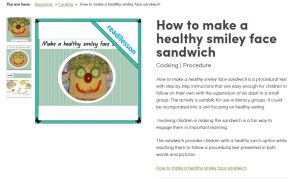
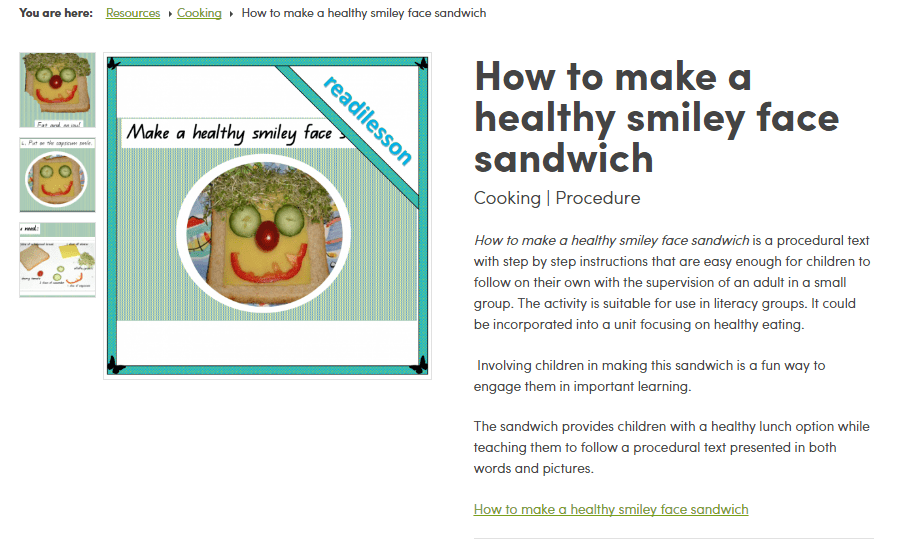
    I always organised for the healthy smiley face sandwich to be made in small groups.

    kebab 1
    © Norah Colvin

    Cutting up fruit and making fruit kebabs is suitable for small groups too. Children can be asked to bring in a serve of fruit to contribute to the choices. We used to have a daily mid-morning fruit snack so it did not require any extra effort on the part of parents, just scheduling on my part.

    © Norah Colvin
    © Norah Colvin

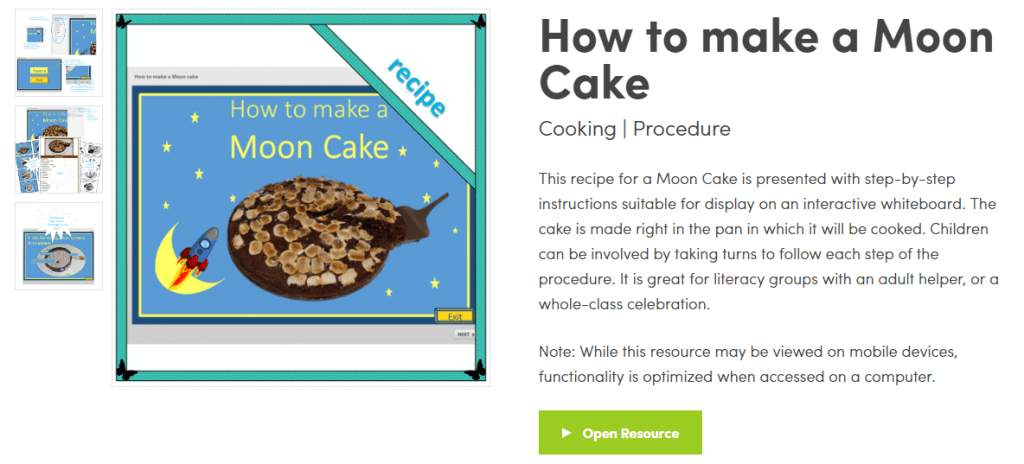
    One of my favourite cakes to cook with children is a moon cake. It is both fun to make and delicious to eat, and provides many opportunities for discussion. It is just as suitable for making in the classroom as it is for home. I have prepared a guided recipe which will be available on my readilearn website.

    © Norah Colvin
    © Norah Colvin

    I recently made the recipe with my grandchildren. They were eager to help and took turns to add and mix the ingredients. There are sufficient things to do to give everyone in a small group an opportunity of being involved. However, it is also suitable to do with the whole class observing while individual children do different tasks.

    tasks to do

    Making the cake provides great opportunities for observing, turn taking, vocabulary development, curiosity, and development of science knowledge. All of these contribute to life skills and experiences. And then there’s the treat at the end!

    © Norah Colvin
    © Norah Colvin

    Although involving children in tasks like cooking and cleaning at home or at school involves extra organisation and time, it is well worth it for the long-term, as well as immediate, benefits.

    Do you have any recollections of helping with tasks at home or at school? How did you feel about it? How has it influenced your current attitudes?

    Thank you

    Thank you for reading. I appreciate your feedback. Please share your thoughts.


  • You’d have to be mad!

    That is, as in M.A.D. — Making a Difference.

    I love to hear of children being involved in projects that help others, that aim to make a difference to the world. I have previously written about some of those projects here, here, and here.  Sarah Brentyn, who blogs at Lemon Shark, often shares about the wonderful ways in which she and her boys are making a positive difference in their community.

    This week I read about the M.A.D. projects of Canadian teacher Peter Cameron (a.k.a. Mr. C) and his students. At the beginning of the school year Mr. C challenged his students with the question, What will you do to make a difference? The projects, which were selected, organised, and conducted by the students, were recently completed. They included things such as:

    • Helping others on snowy days by shovelling driveways
    • Helping parents, grandparents, and great grandparents
    • Giving compliments
    • Supporting Doctors Without Borders
    • Helping the elderly
    • Helping at the Humane Society
    • Keeping their school tidy
    • Assisting the homeless by collecting socks, making supper, and hot chocolate
    • Encouraging kids to eat healthy, and to spend more time outdoors.
    • You can see a celebration of their projects in this video.

    Mr. C. said that it was one of the most rewarding aspects of his 20+ years teaching career. The acknowledgement received from their member of parliament in the Canadian House of Commons, and his encouragement for others to join in, further affirmed the merit of the project.

    Now Mr C. is reaching out to other classes around the world to join in with their M.A.D. projects and form a Global Make a Difference Team in which participants complete a M.A.D Project to help make our world an even better, happier, healthier place to live”.  Their goal is to have 100+ classes join in. Will yours be one of them?

    To make it easy, Mr. C is making available to teachers all of his resources which may be modified to suit individual classes and situations. He says,

    “The goal is simple: challenge your school, class, clubs and individual or groups of students to make a difference and see where it takes them! Be sure to let us know that your school/class will be participating and fill in the form to add your class to our M.A.D map!”

    Places on the map are so far confined to North America. How wonderful it would be for locations to be added from all around the world. Children would see not only the differences they are making in their own communities, but also the positive actions of others around the world, which may in turn, inspire further projects.

    Be sure to let us know of other projects that involve children in making a difference. I know there are many, some conducted by organisations, and others by individuals and families. They are what give us hope for the future.

    Thank you

    Thank you for reading. I appreciate your feedback. Please share your thoughts.



  • Recipes for the classroom

    cooking banner
    © Norah Colvin 2016

    As completion, and therefore launch, of readilearn, my website of early childhood teaching resources approaches, it has become obvious that some categories are less well-resourced than others.

    I consider food preparation to be a great way of involving children in learning that is fun, purposeful, integrates curriculum areas, and develops skills that can be applied in everyday life. I have previously written about learning in the kitchen with suggestions for parents at home.

    In the introduction to the readilearn cooking resources I write

    Cooking, including food preparation that doesn’t include any heating, is a great way to teach life skills and integrate learning in a meaningful and enjoyable way across curriculum areas. When children are involved in food preparation they may be developing:

    • Social skills of cooperation, turn taking, sharing, patience
    • Literacy skills – reading and following the recipe, selecting ingredients, writing a menu and invitations, writing a recount, writing a shopping list
    • Mathematics – counting e.g. the number of eggs, measuring with spoons and cups, measuring time, sharing (e.g. the number of cookies, how many slices to make)
    • Science – mixing, adding or removing heat
    • Safety – with knives, peelers and hot implements and ingredients
    • Social Studies: Culture – when preparing ethnic food

    readilearn materials are designed to engage children in activities that are both fun and purposeful, with opportunities for learning across the curriculum in a meaningful context.

    I was disappointed to realise that I had only one cooking resource prepared: How to make a healthy smiley face sandwich

    © Norah Colvin 2016
    © Norah Colvin 2016

    A remedy was required and I tried to think of other resources I could add.

    I have previously made ladybird biscuits by icing an Arrowroot biscuit and adding Smarties for spots. I will probably add that recipe in the future, but I was trying to think of something healthier to begin with. I wondered if it might be possible to make a ladybird from an apple. This is what I did:

    © Norah Colvin 2016
    © Norah Colvin 2016
    © Norah Colvin 2016
    © Norah Colvin 2016
    © Norah Colvin 2016
    © Norah Colvin 2016
    © Norah Colvin 2016
    © Norah Colvin 2016
    © Norah Colvin 2016
    © Norah Colvin 2016
    © Norah Colvin 2016
    © Norah Colvin 2016
    © Norah Colvin 2016
    © Norah Colvin 2016
    © Norah Colvin 2016
    © Norah Colvin 2016
    © Norah Colvin 2016
    © Norah Colvin 2016

    When I made one for my grandson on the weekend, I was pleased that he recognised it as a ladybird beetle, even without the spots!

    Unfortunately, it’s more suitable for an adult to make for a child than for children to make for themselves. Apples are too difficult for young children to cut. It is therefore not suitable for readilearn. However, I had fun making it and will continue to think of other recipes I can add to readilearn’s cooking collection.
    Thank you

    Thank you for reading. I appreciate your feedback. Please share your thoughts.