Live Love Laugh Learn … Create the possibilities

Tag: teaching and learning

  • Are we finished?

    work-in-progress
    Anonymous, Work in progress https://openclipart.org/detail/12941/work-in-progress

    I am a work in progress. I reflect on the past, predict the future, and live in the present moment. Nearly everything I do is a work in progress. Some things just make more progress than others!

    Over the past few years I have been preparing resources for my readilearn website. It’s slow going, slower than I expected, but I’m getting … somewhere. Even when the website launches it will be a work in progress as I update old and add new resources.

    Launching soon - readilearn2

    In a flurry of activity, with the intention of completing additional resources as development of the website nears completion, I experimented with making a product promotional video. My intention is to make a number of these, possibly explaining the use of each interactive resource. Doing so is far more time consuming that I had expected.

    Below is my first attempt. But please don’t let that word “first” mislead you into mistakenly thinking it was my only attempt. I lost count of the number of takes and couldn’t believe how difficult it was to utter just a few short sentences. While I am sharing it, please consider it a work in progress. Making promotional videos for my products is something I need much more practice with.

    My purpose in sharing the video is to illustrate the importance of being a lifelong learner, which involves a combination of persistence, resilience and confidence, including:

    • a willingness to make mistakes and repeated attempts
    • a growth mindset without an expectation of immediate success
    • confidence to say “I haven’t got it yet, but I’m working on it”
    • belief in the ability to succeed, either independently or with support
    • an ability to adjust future attempts according to feedback provided from the past.

    I learned a lot in making this video, perhaps more about what doesn’t work than what does. But eliminating what doesn’t work is crucial in finding out what does. For example, I learned after repeated attempts on both, that selfie videos recorded with phone or iPad just weren’t going to be good enough. I learned that neither of the software programs for making videos I owned would allow me to achieve what I wanted on its own. I needed to combine recordings from each. After many trials I finally made something that at least has the semblance of an attempt.

    Included in my passion for learning is a passion for learning about learning: how we learn, why we learn and the conditions that contribute to our learning. I am fascinated by learning that occurs at all ages, but particularly during early childhood.

    Morguefile http://mrg.bz/omEd2M
    Morguefile http://mrg.bz/omEd2M

    In the process of repeated attempts described above, I responded constantly to feedback provided, and adjusted each new attempt accordingly. Feedback is necessary for learning. But perhaps more important than the feedback is the response to it.

    Hopeful of getting some other feedback, I shared the video with my family on the weekend. They made some helpful suggestions. But perhaps the most interesting feedback, about feedback, was that given by my four-year-old granddaughter, G2.

    G2 watched the video with her mother and immediately wanted to play the game. I was delighted, of course, and opened the resource on the iPad for her to use. She had no trouble manipulating the objects to make the ice creams and quickly made a few combinations. When I asked if a mango with strawberry on the top was the same as, or different from, a strawberry with mango on the top, she confidently explained that they were different because “this one’s got the strawberry on the top and this one’s got the mango on the top”. She went on making combinations.

    icecreams
    © Norah Colvin

    After she’d made about ten combinations she asked, “Are we finished yet?” I said, “We can finish whenever you like.” I wasn’t using it as a “teaching episode”, simply as something fun for her to do. She asked again, “But are we finished? You know –“ and she indicated for something to happen on the screen showing that we had finished.

    Suddenly I realised that she was wanting feedback from the program to tell her that she was finished, that she was successful; perhaps some bells, whistles or fireworks. Because I designed the resource as an open-ended teaching episode, for use by a teacher with a class rather than by individual children, the resource does not have any inbuilt feedback. The feedback occurs in the discussion between teacher and students.

    What I intended as a teaching episode became, for me, a learning episode; thinking and learning about feedback.

    • G2 expected to receive feedback about completion, and
    • she wished to continue until she received that feedback.

    However,

    • she doesn’t’ require feedback about completion from all apps, for example, drawing programs: she decides when she is finished, and
    • during play she decides which activity she will take up and when she will finish.

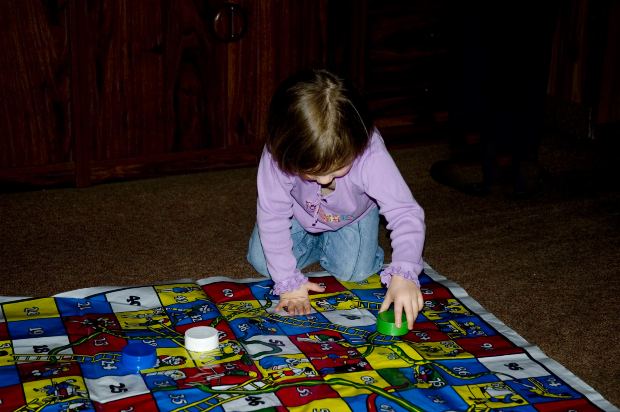
    G2 has a good balance of activities with home and Kindy; indoor and outdoor with a variety self-selected and self-directed imaginative play mixed with cooperative activities including reading, board games and screen time with a variety of apps.

    GDJ, Playful stick figures https://openclipart.org/detail/230070/playful-stick-figure-kids
    GDJ, Playful stick figures https://openclipart.org/detail/230070/playful-stick-figure-kids

    With such variety she receives feedback from many sources including self and others, as well as from manipulation with real and electronic objects. I think her question “Are we finished yet?” was related to use of the specific device and type of activity (game to her), not indicative of a generalised need for feedback from outside.

    But what of children who are more engaged with electronic games, have less time for self-directed activity, and fewer opportunities to engage with others? Will the need for feedback from an outside source overtake the ability to provide feedback for self? I hope not. I believe the abilities to self-monitor, self-regulate and self-determine to be extremely important to life-long learning. What do you think?

    Thank you

    Thank you for reading. I appreciate your feedback. It is important to me! Please share your thoughts about any aspect of this post.

     

  • Which school? I found one!

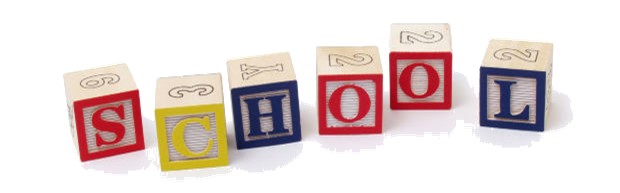
    school cropped

    Most parents want to provide what is best for their children. However, they don’t always know what that best is, where it is available or how to get it. This is just as true of schooling as it is of anything else. Fortunately, most children are adequately schooled locally, be it at a state or privately run facility.

    I attended a Catholic school and have taught in both the Catholic and State systems. I see little real difference between what is offered in local private and local public schools as far as philosophy, pedagogy and quality of teaching goes. The differences, as I see them, are more due to the inequities in funding for facilities and resources, the restriction to accessibility by the imposition of fees, and the ability of privately run organisations to decline students as opposed to the state’s willingness to cater for all.

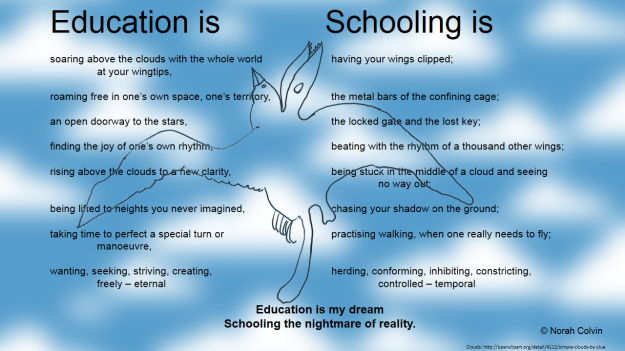
    While I think most schools do an excellent job of schooling, there are aspects I don’t like.

    © Norah Colvin
    © Norah Colvin

    Fortunately, most children survive school and graduate adequately prepared for life in the adult world. But the scarring carried by many, whether visible or hidden, emotional or intellectual, is a cost that should not be accepted.

    In this TED talk Sir Ken Robinson asks “Do Schools Kill Creativity? He explains why he thinks they do and the manner in which they do it. He ends the talk saying,

    “our task is to educate their whole being, so they can face this future. … we may not see this future, but they will. And our job is to help them make something of it. “

    By the time Bec was born I had already decided that I wanted more than schooling for her. I had read voraciously about learning and education. I had observed the magic of learning as my son wondered, questioned, explored and reignited my own curiosity, during his before school years. I saw those same traits inhibited by uninspiring teachers. I have written about this before here and in an article published in a teachers’ magazine when Bec was of school starting age. At that time, it was necessary to make decisions about her ongoing education.

    To school or not to school

    www.openclipart.org
    http://www.openclipart.org

    I had already explored local (and not-so local) alternatives. I attended information sessions, read their publications (no Google back then), and visited schools to observe their practices and speak with teachers, children and parents. Disappointingly I found none that met all of my criteria.

    Some “schools” provided little stimulus or input to extend or challenge children’s thinking. Some were very structured and without flexibility in their approach. Some that claimed to be alternative appeared to be not so with uniforms and strict rules and timetables. Some that claimed to be mainstream were more child-focused with an organic curriculum matched to children’s interests, but lacked other things I sought.

    When the pluses and minuses of each were considered, there wasn’t one with a compelling scoresheet. There was nothing for it but to found my own, a possibility I had been contemplating for some time and a “dream” shared by many teachers. The Centre of Learning Opportunities was born. These are some of the original documents drawn up by the team back then.

    Vision

    Symbol

    outside

    COLO brochure inside

    While working to establish this alternative to school, I began an MPhil research project “Educational Diversity: Why school? What school?” which, as well as exploring educational alternatives, was to record the first year of an (my) alternative school. As part of the project I conducted a survey of local alternative schools with the aim of recording the diversity of approaches available in order to demonstrate that there is more than one way to obtain a quality education.

    Although the degree went down the same dead end path as the school, I was able to (self) publish and distribute the results of my research to participating schools in a document titled “Diversity in Schooling: Discovering educational alternatives in South-East Queensland.” (Surprise, surprise, I have just discovered it in a Google search. How weird is that!)

    Diversity

    I was reminded of my research and this document by a recent discussion with Pauline King, The Contented Crafter in response to my post Life — A “choose your own” adventure. When I alluded to the wisdom of young children and “our” efforts to obliterate it, Pauline agreed and suggested that she could do a post-long comment on the topic.  I jumped at the chance and immediately invited her to do so. Pauline again agreed but suggested I refine a set of questions as she could fill a book with her ideas. I”m working on it.

    Responding to The Industrious Child Pauline wrote,

    “Teachers need to be SO flexible in their ability to see their world, their work, their class as a whole and their individual students – it is never a one step process and different expectations and challenges can be laid down for different abilities. Almost every child will shine somewhere within the curriculum and many struggle somewhere else. After all, we all have our different talents and abilities. Schools are structured to meet the needs of a certain academic ability and those who fall above or below that parameter are, in my opinion, so often mis-educated.”

    It is obvious that Pauline, Ken Robinson, and I, along with many others, are part of the same revolution.

    In another comment on my post I found it first Pauline shared that she had spent many years trying to establish a school of her own but had found “an already working alternative system and never regretted it.”

    I think I have questions enough for Pauline to fill a book’s worth of posts and look forward to sharing some of these in the future. If you have questions of your own, please pop them into a comment and we’ll see what we can do.

    Thank you

    Thank you for reading. I appreciate your feedback. Please share your thoughts.

  • You’ve got a friend in me


    https://openclipart.org/detail/117199/Friendship
    https://openclipart.org/detail/117199/Friendship

    One of the greatest contributors to a child’s happiness at school, indeed for happiness in life, is friendship. Talking with children about their day at school will more than likely contain some reference to their friends; who they played with, who they didn’t, who was absent, who was mean. If they felt sad during the day it was possibly because someone wouldn’t play, wouldn’t let them play, or was mean.

    Getting along with others seems to come naturally to some children, especially to those who see positive social skills modelled by parents and family friends, who are given lots of opportunities to mix with others of all ages, and who are encouraged to express themselves and their feelings. Other children don’t find it so easy, sometimes due to lack of positive role models, but often for other reasons.

    http://www.morguefile.com/
    http://www.morguefile.com/

    Most children require some explicit teaching from time to time, for example to share, take turns and to use friendly words. Many schools incorporate the development of friendship skills into their programs. Some schools, such as one that employed me to write and teach a friendship skills program in years one to three, develop their own programs. Other schools use published materials such as the excellent You Can Do It! program which teaches the social and emotional skills of getting along, organisation, persistence, confidence and resilience.

    In the early childhood classrooms of my previous school, we used the songs, puppets and stories included in the You Can Do It! Program. We also involved children in role play and discussion, providing them with opportunities to learn the language and practice the skills in supportive and non-threatening situations. Having a common language with which to discuss feelings, concerns and acceptable responses meant issues were more easily dealt with. More importantly children learned strategies for developing positive relationships and friendships with others. They came to understand their own responses as well as those of others.

    SMAG ccbyncnd

    I have talked about friendship in many previous posts, including here, here and here. My online friend Anne Goodwin, who blogs at Annecdotal even wrote about it in a guest post here, and I described friendship trees that I used with my class here.

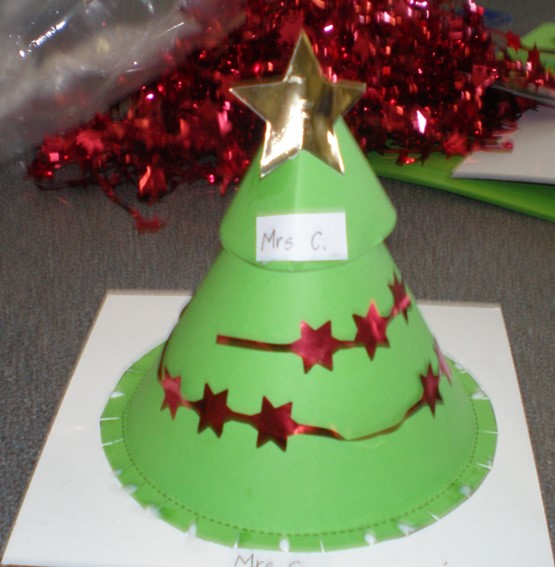
    Friendship tree

    In this post I want to acknowledge a new friend and a long-time friend. (I can’t say ‘old’. She’s younger than I!)

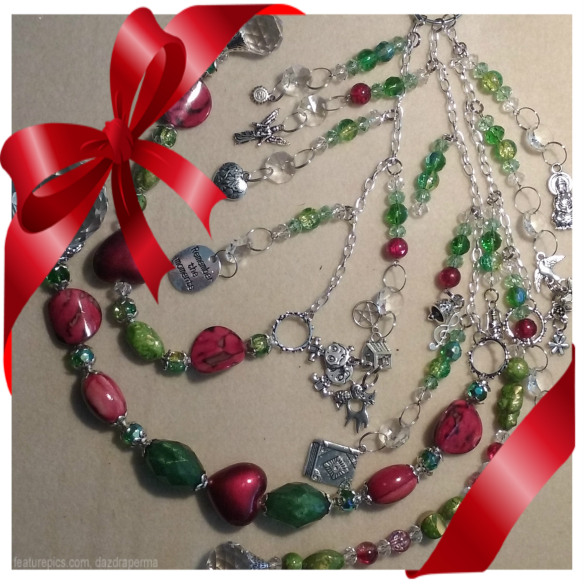
    My new friend is Pauline, The Contented Crafter. At the beginning of last week Pauline announced a very generous giveaway for Christmas which I shared with you here.  Pauline invited readers to nominate someone as a deserving recipient of her beautiful Christmas light catcher. She posted the nominees and their stories here and invited readers to vote for the two they would most like to receive the light catcher.

    pizap1

    I nominated Robin, a friend of over thirty years. That must be deserving of an award in itself! In case you missed her story on Pauline’s blog, I include it here so that you can understand why I value her friendship so highly.

    I have a wonderful friend for whom this beautiful light catcher would be a perfect gift. Each of its strands holds a special significance, as if Pauline had her in mind.

    She gifted her friendship to me more than thirty years ago and, thanks to a miracle and the protection of angels, it is a gift that continues.

    Over twenty years ago, on my birthday, she was involved in a serious car accident. My birthday became her life day, a constant reminder that life and each passing year is a precious gift. 

    Her many injuries, requiring numerous surgeries over the years, did not injure her bright, cheerful nature and positive outlook on life. Although she lives with constant pain you wouldn’t know unless you asked, and then only if she chose to tell you.

    She has an enormous generous and loving heart, and her home is warm and welcoming. Family, especially her two grown daughters and her dear Mum who passed this year, is important to her. She loves to bake and craft individual gifts for her family and friends. She is always busily thinking of others.

    She is a gifted musician and amazing music teacher. She plays the flute and sings like a Robin. She incorporates music and fun into classes for children and lessons for adults learning English. All come to her classes eager to learn and leave singing with joy and acceptance.

    At Christmas the family gather round to decorate the tree and “remember the moments” marked by ornaments made by smaller hands, collected on travels, or signifying achievements and occasions like graduations and engagements.

    I know my friend would treasure this beautiful light catcher as another reminder of life’s precious gifts and moments that make it magic. Thank you Pauline for the opportunity to express openly how much I value her friendship.

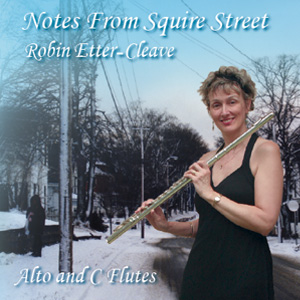
    You can find out more about Robin on her website and even purchase her wonderful CD “Notes from Squire Street”.

    Robin - Notes from Squire Street

    I am very excited to say that Robin is included in Pauline’s list of winners. In fact Pauline’s generosity is being extended to many of the nominees, and even to one for commenting on the post. Very soon Pauline’s light catchers will be dispersing rainbow light of friendship and joy around the world. I think that is a beautiful and generous gesture.

    Thank you

    Thank you for reading. I appreciate your feedback. Please share your thoughts.


  • Five Photos Five Stories – Day two

    Back to Day one and introduction

    What am I?

    One may wonder why I have responded to Geoff Le Pard‘s challenge almost immediately when there are other invitations that have lain opened but unanswered for longer than I like to admit. For example, some months ago Anne Goodwin tagged me in a writing process blog hop. She shared the what, how and why of her writing process and invited me to share mine. She applied no pressure or time constraints and neither nudged me to comply nor chastised me for not having done so.  Not quite as long ago Sherri Matthews tagged me in a work space blog hop. She shared beautiful images and descriptions of her delightful Summerhouse writing space and invited me to share mine. Sarah Brentyn then shared some questions for writers that I hinted I might answer, but haven’t yet.

    Why the procrastination?

    1. I’m still figuring out what kind of writer I am and how to describe my process.
    2. My writing space isn’t all that exciting. It’s a just a laptop sitting on a desktop that is cluttered with books and other paraphernalia waiting to be organised or dealt with, and surrounded by shelves filled with more of the same; not a bad analogy to my writing process perhaps.
    3. I’ve been working in other quadrants, dealing with ‘easier’ stuff as it arises.

    As with Geoff’s challenge, responses to these blog hops are not compulsory and there is no set time-frame but I do wish to, and do intend to, answer them. Thank you Anne, Sherri and Sarah for your patience. I will get there. Eventually.

    My writing space 14 May 2015
    My writing space 14 May 2015

    My procrastination is in part due to the way I view myself as a writer.

    I find it difficult to define the “type” of writer I am. That I am a writer is true. But what kind? I wonder if I am a writer without a label, without a box?

    Perhaps if you can help me answer this I’ll be more confident about joining in conversations about writing.

    I am not a novelist, not a poet, not a biographer or an auto-biographer, not a picture book writer . . . I am an educational writer, incorporating something of each genre.

    I remember doing a psychometric test at some past time. The results suggested that a desire to be everything to everybody would be my undoing. Perhaps that is also an issue with my writing?

    Sometimes when asked by other writers what type of writing I do, for want of another label I refer to myself as an educational writer. I immediately feel a shrinking away as if educational writing isn’t ‘real’ writing and I’m perhaps not a “real” writer.

    “Oh educational writing,” they judge, “that’s so prescriptive. It’s not creative.”

    Sure I have done my share of prescriptive writing. The “writing” for which I have been employed for the past three years is definitely prescriptive – more cross the “t”s and dot the “i”s without a modicum of creativity; and as my list of publications shows, I have written workbooks for other publishers, “prostituting” myself one kind-hearted friend suggested. But there are worse ways to earn a living, right?

    I don’t consider my self-initiated educational writing as prescriptive. Most of what I write is designed to encourage thinking, problem solving, creativity, interest in a variety of topics, or develop literacy and numeracy skills, but definitely not in a structured, skills-oriented, prescriptive approach. I write fiction, non-fiction and poetry; and open ended materials that encourage children to question. I love to add a touch of humour where possible and mostly aim for engaging materials that motivate thinking and learning.

    My current writing schedule involves writing content for this blog and for an in-progress online store of early childhood educational resources.

    So, what sort of writer am I?

    There is one I know I am not. I am not a songwriter.

    I nominate Anne Goodwin, Sherri Matthews and Sarah Brentyn to take up this Five Photos Five Stories challenge if and when they so choose. But they need to be aware that I require no more of them than they have expected of me!

    The “rules” of the Five Photos, Five Stories Challenge are:

    1) Post a photo each day for five consecutive days.
    2) Attach a story to the photo. It can be fiction, non-fiction, poetry, or a short paragraph. It’s entirely up to the individual.
    3) Nominate another blogger to carry on the challenge. Your nominee is free to accept or decline the invitation. This is fun, not a command performance!

    Thank you

    Thank you for reading. I appreciate your feedback. Please share your thoughts about any aspect of this post.
  • Assessing the impact of blogging on writing goals

    cyberscooty, a basketball about to enter a basketball hoop https://openclipart.org/detail/205569/basketball
    cyberscooty, a basketball about to enter a basketball hoop https://openclipart.org/detail/205569/basketball

    I love writing. Always have. I usually confess that I am a better writer than a speaker.

    I like the time that I can take to choose a word or phrase and combine them to mean just what I intend.

    I like the opportunity to check a word’s appropriateness before using it. Often when speaking I leave my sentence hanging embarrassingly in mid-air while I grope around in the murkiness of my mind for the “correct” word.  Why can my fingertips find the right word, without any thought, and the tongue cannot?

    And of course there are all the opportunities that writing provides for self-expression, creativity and sharing ideas with a wider audience.

    I started out writing stories, poems and songs, as most children, do and tried my hand at short stories, children’s stories and poetry as I got older. As I became more involved with my career in education, and in raising my children, I had (or made) less time for those creative pursuits.

    There are many reasons I loved being a teacher and one of those was the opportunity it provided for me to be creative: creative and innovative in the way I worked with children to encourage their learning; and creative in writing resources to assist my teaching and the children’s learning.

    I was fortunate in having a variety of opportunities to write materials for educational publishers at different times during my career, and I am currently writing documents to support curriculum implementation for my state educational authority. But I really wanted to be in control of my own writing.

    At the back of my mind there was always the thought of sharing my teaching and learning resources with a wider audience. (Just a little bit further back, or maybe even close to equal footing, is the thought of publishing children’s stories, short stories, and maybe even a novel . . . one day.) I had had no success with submitting unsolicited manuscripts before and couldn’t think what publisher might be interested in the variety of educational resources I had made, many specifically for use on a computer.

    So a couple of years ago I decided that a website of my own was the ideal platform for sharing my resources.  Getting that website up and running is my primary goal. However, observers could be mistaken in thinking that writing a blog is my primary goal. The path to establishing a website has taken a side-track via blogging.

    venkatrao, A butterfly flying with a dotted path over a hill background https://openclipart.org/detail/69967/1278212857
    venkatrao, A butterfly flying with a dotted path over a hill background https://openclipart.org/detail/69967/1278212857

    Blogging, Twitter, Facebook and other forms of social media were recommended me to right from the beginning as a way of targeting and establishing an audience. At the time I was familiar with none of these and set off learning how to become involved. It has been an exciting journey. I have learned lots and made many wonderful online friends.

    However I am not sure how far it has moved me towards achieving my website goal. In fact, I think very little progress has been made.

    • I have not found and established my “target” audience and am really none the wiser about doing that.
    • The time that I am spending writing, reading and commenting on blogs is time that I am not spending on preparing materials for my website.
    • I need to be more proactive in finding illustrators for my work.
    • When I discovered the Teachers Pay Teachers site and established my Teachers Pay Teachers Store I had thought this may be an alternative avenue for sharing my work. But I haven’t been as successful there as I would like either. This may be telling me something about my website goal. What is it telling me? Should I listen?

    So my dilemma comes down to these questions”

    To blog or not to blog?

    How to blog?

    How much time for blogging?

    The answer to the first one is easy:

    Yes! I very much enjoy writing my post and receiving the almost immediate feedback from the wonderful community of writers I engage with.

    Yes! I love reading and commenting on others’ blogs and joining in the discussions that ensue. We are a S.M.A.G. group: Society of Mutual Appreciation and Gratitude. What’s to not like?

    The second two questions are a little more difficult.

    The focus of my blog is education, but my audience consists of writers. Educators have shown little interest in developing a relationship with me online. I haven’t been able to figure that one out, but I have a few hazy ideas, none of which I think I want to address at this stage. If I change the way I blog I would quite likely fall out with the community I have become part of; and there is no guarantee I would pick up a teacher audience. So I’ll have to keep mulling this one over for a while.

    The third question is the one I have been “researching” for close on five months. As time is limited and I need to devote more time to achieving my primary goal, it is important that time spent on blogging activities is worthwhile.

    I decided to find out who is keen to engage with me and who isn’t.

    I began keeping a record of the number of comments I made on others’ blogs, and of those they made on mine.  It wasn’t always as I expected, and highlighted some interesting trends; the main one of which I have noted above:

    Writers have a wonderful sense of community.

    The record helped me ensure that, if someone visited and commented on my blog, I would visit and comment on theirs, maintaining a balance as much as possible.

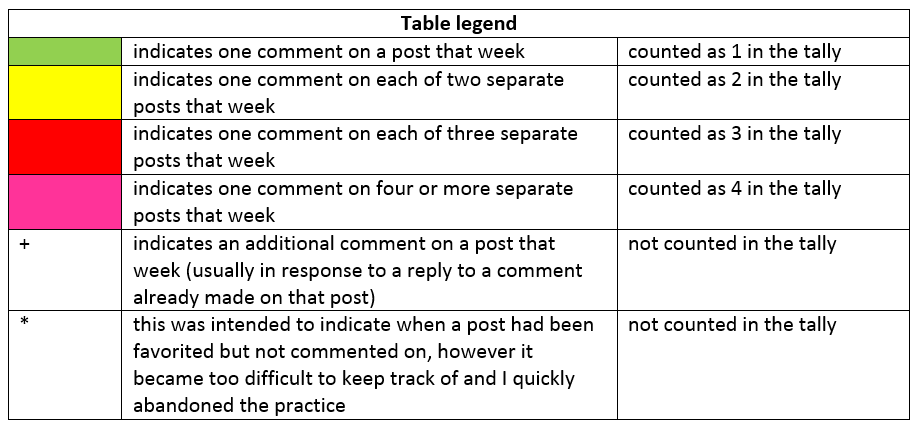
    This key explains how to interpret the information on the tables below.

    Table legend

    I have removed names from the tables to respect privacy. (I don’t really expect you to look too hard at the tables. You have better things to do. But they do look pretty!)

    November 9 2014 – Jan 24 2015

    Slide1


    Jan 25 2015 – March 26 2015


    Slide2

    I have not included all blogs I “follow”, or even all the ones I have ever commented on. Only the ones on which there has been some consistency in connecting.

    I have also not included the comments of those who follow and comment on my posts but do not have a blog of their own on which I could reciprocate.

    I generally post twice a week.

    Others post more often.

    Sometimes the number of comments I make on their posts in relation to their comments on mine is affected by the greater number of times they post. If someone chooses to post more often than twice a week, I will not necessarily read all their posts, regardless of how much I enjoy reading them, as there are other ways I must use my time, including a reading greater variety of writer’s work, and getting more done on my own. I’m sure they have enough other readers to not miss me!

    Sometimes when a blogger posts less frequently than I do, their comments on my posts may tip the scales in my favour. I can’t do much about that either, but I do try to catch up when next they post.

    I have found that it can take a few weeks of commenting on a blog I like to get a return visit and comment on my blog. Frequently I don’t even get a response to a comment I’ve made on theirs. I guess that’s how it goes. Some bloggers blog to develop community. Others blog to broadcast. I just need to decide how best to use my time.

    If you have walked with me to the end of this post, thank you. It is rather longer than I intended. I had intended to respond to Anne Goodwin’s invitation to join in a writing process blog hop , Sherri Matthews’ invitation to join a workspace blog hop, and Sarah Brentyn’s questions for writers, as well as explain my writing goals to Sacha Black, thank Julie stock for her Sisterhood of the World bloggers award and draw on Paula Reed Nancarrow’s wonderful survey about Twitter #hashtag days and blogging. But they will have to wait. We all have others things to do.

    Contributing partly to my procrastination with responding to these wonderful invitations, which I do very much appreciate, is that I have already nominated the majority of bloggers I follow, or if I haven’t someone else has. And the remaining ones don’t wish to be nominated. What is a girl to do? I’d appreciate your suggestions.

    Thank you

    Thank you for reading.

    I appreciate your feedback. Please share your thoughts and advice, especially about how to increase time. If anyone knows a good time alchemist, I’d love to meet her!