
Live Love Laugh Learn … Create the possibilities

Tag: Reading

  • 20 suggestions for maintaining reading momentum during the school holidays

    20 suggestions for maintaining reading momentum during the school holidays

    happy_sun_gm
    http://www.openclipart.org

    The school year in Australia is over and the long summer holidays have begun.

    Parents often wonder how they will keep their children entertained during the long days with few structured or timetabled activities.

    When returning to school after many weeks without the formal practice of skills taught during the previous year, teachers often lament that children’s reading fluency and level has fallen.

    What is one way of addressing both these issues?

    The answer might just be in a book!

    Well in reading anyway.

    19180-Text-Book-Graphic
    http://www.openclipart.org

    Here are 20 suggestions for keeping your children entertained while maintaining their reading skills.

    I’m sure you can think of many more!

    Please keep in mind, as you read the list, that the amount of support given, or independence allowed, in each activity will need to be adjusted to the individual child’s age and reading ability. Even young children who are not yet reading independently can be included in most activities.

    1.  Read to and with your child every day – continue the practice established throughout the year with special sharing times during the day or at bed-time — or both!
    2. Demonstrate that you value reading by making time for your own reading, or setting aside a special quiet time when everyone in the family reads.
    3. Visit the library and borrow to read, read, read!
    4. Read poetry books, song books, picture books, joke and riddle books, crossword books, information books, chapter books (these can be read to younger children, or with older children – taking turns to read a page or a chapter each) — what are your favourites?
    5. Trade books no longer read for others at a second-hand book store.
    6.  When dining out, have your children read the menu and choose their own meal.
    7. Include your child in holiday cooking and have them read the recipe – ingredients and method. Perhaps they could read the recipe book to select the meal for the day.
    8. Suggest your child read the TV guide to find when favourite programs are showing and establish a timetable for viewing, rather than haphazard watching with random flicking through channels.
    9. Provide your child with bookstore catalogues and encourage them to read book descriptions to guide their next selection. 
    10. Bestow upon your child the title of ‘Family weather watcher’ and have them consult weather forecasts in the newspaper or online to select the most suitable days for planned outings and activities. 
    11. Include your child in making decisions about holiday activities. Give them the guide, or read the guide together and jointly choose the activities. 
    12. Make the library, museums and art galleries high on the list of must-dos. Many of these offer a wonderful assortment of free holiday entertainment for children, and reading is an essential part of getting the most from each visit! 
    13. Engage your child in some craft activities which require them to follow written instructions. The ability to understand and follow procedures is empowering and requires the ability to read written, as well as visual, instructions. 
    14. Encourage your child to ask questions about every day events and phenomena. Help them to research in books at home, in the library or on the internet. 
    15. Provide eBooks as well as books in print. Good ones bring a new dimension to the reading experience. 
    16. When going out for the day, or journeying further away on a holiday, support your child in locating destinations on a map and in selecting an appropriate route. Engage your child in giving directions while en route. 
    17. Include your child when reading bus or train timetables. 
    18. When doing the family grocery shop, give your child their own list of items to look for. 
    19. Listen to recorded books on long car journeys, or have books for listening to or reading along with in bed. 
    20. Make the most of every reading opportunity that occurs throughout the day!

    What are your favourite ways of incorporating reading into everyday activities?

    When I was a child, I loved receiving books as gifts. I still do! Books are among my most treasured possessions.
    www.openclipart.org
    http://www.openclipart.org

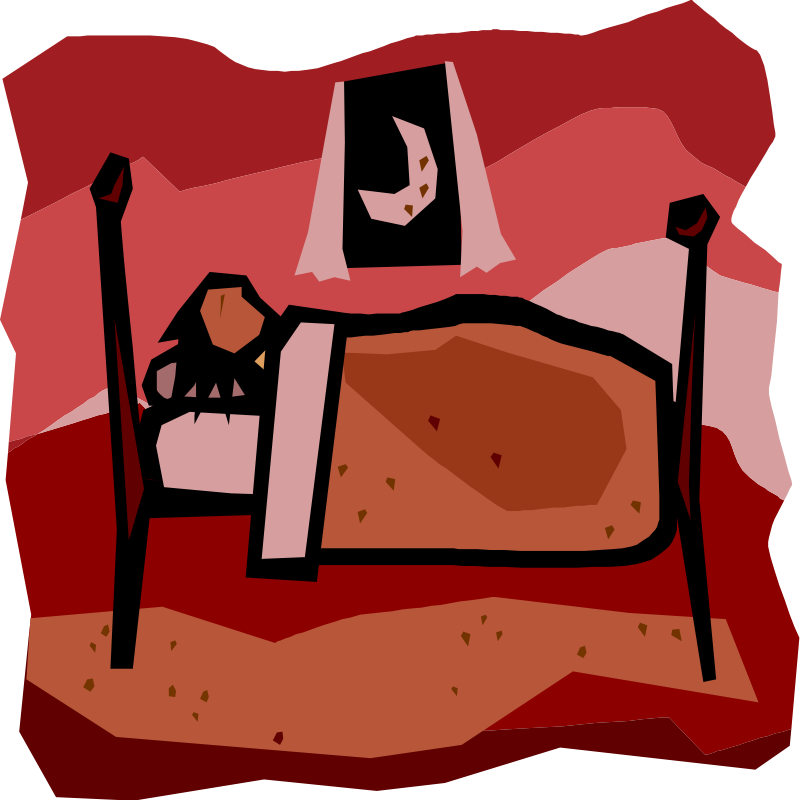
    I remember the delight when, on awaking in the dark of an early Christmas morning, I would reach down to end of my bed and discover a book there. I couldn’t see it, but I could feel the smooth glossy cover and the familiar roughness of the pages. I would lift the book up and breathe in the rich, delicious smell which promised so much pleasure I almost wanted to devour it. I knew that something delightful was in-store for me, and as the dawn’s soft glow began light the room, I watched the colours, pictures and words slowly take form and reveal themselves to me. What joy!

    I am forever grateful to my parents for encouraging my love of reading.

    The love of reading is one of the greatest gifts a parent can give a child.

    So, here is #21, it probably should have been #1!

    21. Give books as gifts!

    Read! Read! Read!

    You are welcome to download and distribute the 21 suggestions FREE from my TEACHERSpayTEACHERS store.

    You can read another post on this topic by Nanny SHECANDO by clicking here.

  • Searching for meaning in a picture book — Part A

    Searching for meaning in a picture book — Part A

    Do you recognise this book?

    The Very Hungry Caterpillar

    Chances are you do.

    According to the website of the author Eric Carle, since its publication in 1969 it has been published in over 50 languages and more than 33 million copies have been sold worldwide. It ranks highly in the Wikipedia List of best-selling books.

    Most primary schools, preschools and kindergartens would have numerous copies in their libraries with a copy in most classrooms as well as in teachers’ private collections. Most homes with young children would have a copy in their storybook collection.

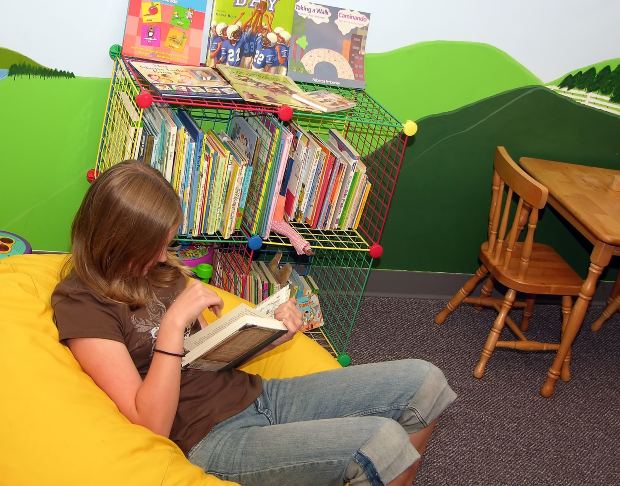
    reading

    In addition to the books, many of those schools, classrooms and homes would have some of the associated merchandise; including toys, games, puzzles, posters and colouring books, which are now available.

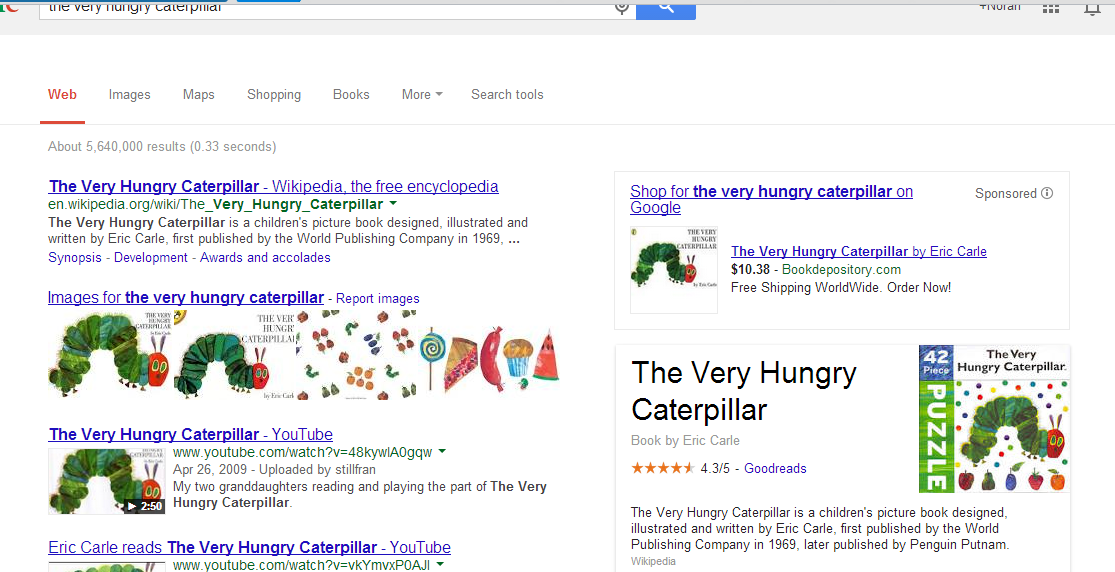
    When I typed ‘the very hungry caterpillar’ into the Google search bar about 5,640,000 results were listed in 0.33 seconds!

     Google search the very hungry caterpillar

    There are activities, lesson plans, printables, videos, and advertisements for merchandise. There is a plethora of suggestions for using the book as a teaching resource, including counting, days of the week and sequencing.

    I think you would be hard pressed to find someone that hasn’t at least heard of the book. That is quite an impact, wouldn’t you say?

    For a book to have done so well, it must have a lot going for it. And it does.

    There are many things I like about this book, including:

    • The bright, colourful, collages with immediate appeal
    • The natural flow and rhythm of the language making it easy to read, dramatize and recall
    • The sequence of numbers and days encouraging children to predict and join in with the reading and retelling
    • The match between the illustrations and the text supporting beginning readers as they set out upon their journey into print
    • The simple narrative structure with an identifiable beginning, a complication in the middle with which most children can empathise (being ill from overeating) and a “happy” resolution with the caterpillar turning into a beautiful butterfly.

    Reading to children

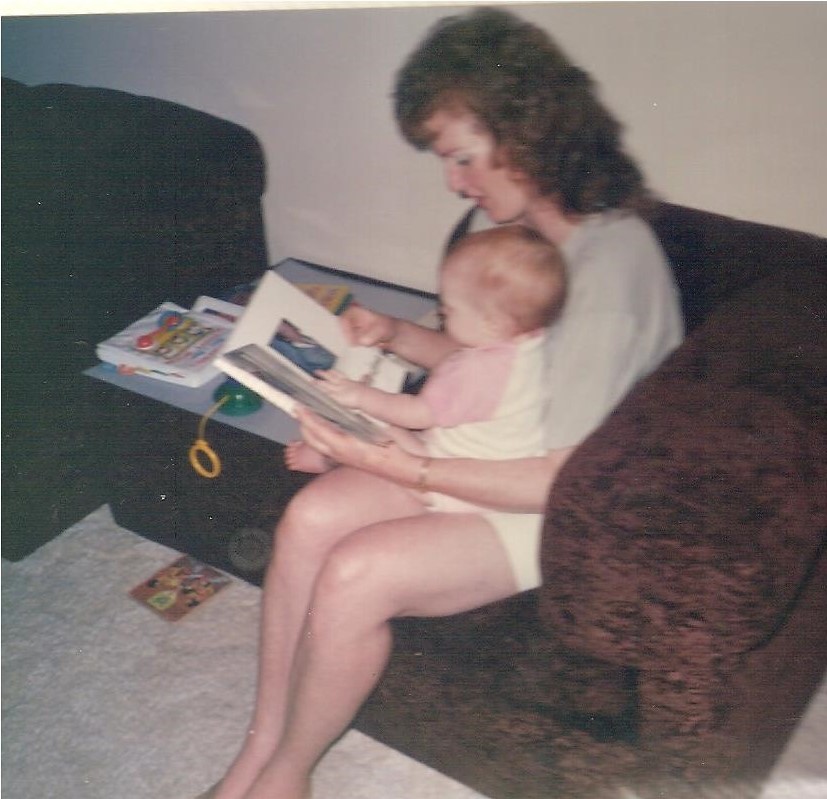
     Nor and Bec reading

    Sharing of picture books with children from a very young age has a very powerful effect upon their learning.

    There are many benefits to both parent and child of a daily shared reading session.

    clock

    It can be seen as a special time of togetherness, of bonding; of sharing stories and ideas. It can be a quiet and calming time; a time to soothe rough edges and hurt feelings; a time for boisterous fun and laughter; or a time for curiosity, inquiry, imagination and wonder.


    Whatever the time, it is always a special time for a book
    ; and all the while, children are learning language.

    8-12-2013 7-38-33 PM
    © Bernadette Drent. Used with permission.

    They are hearing the sounds and rhythm of their language. They are being exposed to new vocabulary, sentence structures, concepts and ideas. They are learning important understandings that will support them on their journey into literacy e.g. they are learning that the language of a book differs from oral language and that the words in a book always stay the same.

    They begin to realise that it is the little black squiggly marks that carry the message, and they may even start to recognise some words.

    Robert 2

    Many of these, and other, features make “The Very Hungry Caterpillar” suitable for incorporation in an early childhood curriculum, for example:

    The Very Hungry Caterpillar

    • Literature appreciation – love of language, knowledge of story, interest in books
    • Reading – the clear, simple and predictable text make it an easy first reader
    • Maths – counting and sequencing the numbers, sequencing the days of the week
    • Visual arts – learning about collage and composition of a picture
    • Philosophical inquiry —sharing interpretations and discussing feelings about the story, asking questions raised including the ‘big questions’ of life

    ryanlerch_thinkingboy_outline

    Eric Carle, in an interview with Reading rockets, describes it as a book of hope. He says:

    You little, ugly, little, insignificant bug: you, too, can grow up to be a beautiful, big butterfly and fly into the world, and unfold your talents.”

    He goes on to explain that,

    I didn’t think of this when I did the book, but I think that is the appeal of the book.”

    But I’m not going to let him have the last word!

    While “The Very Hungry Caterpillar” has always been one of my very favourite picture books, I do have some misgivings about the impact that this book has had.

    In future posts I will share what I consider to be some limitations of the text, and what I consider to be the most powerful use of all.

    What do you think?

    What appeals to you about this book?

    What questions does it raise for you?

    Please share your ideas. I look forward to hearing what you think.

  • “I love the mountains”

    More than 30 years ago I had the extreme good fortune of being at Brown bear brown beara literacy teachers’ conference at which Bill Martin Jr. (author of “Brown Bear, Brown Bear”) was speaking. What a memorable occasion it was.

    At the moment I can recall no other speakers, but I have never forgotten the captivatingly melodic and sonorous voice of Bill and the power of his message.

    Bill inspired his audience as he spoke about coming to reading later than most, at about the age of twenty, by teaching himself to read through his love of poetry. He attributed this love to being read to daily as a child. His delight in and playfulness with language was obvious as his voice danced through his stories, poems and songs to the accompaniment of his rich lilting laughter.

    He demonstrated, through audience participation, the joy of learning through song and the importance of the sounds and rhythms of language. Having fun and playing with language provides much joy for adults and children alike.

    In the days of overhead projectors, long before the now familiar electronic slideshows, Bill displayed a simple song “I love the mountains” on the screen. In an instant he had the audience rollicking in their seats, singing along with the words on the screen, and following the rhythmic lead of his voice without any other accompaniment. The energy created by this spontaneous engagement of the audience was electrifying. How could anyone not wish to participate? I quickly noted the words and tried desperately to commit the tune to memory. (I have since found out that this is a traditional camping song but, since I am not a camper, it was unfamiliar to me at the time though it may have been known by other members of the audience.)

    image courtesy of openclipart.org
    image courtesy of openclipart.org

    Every year since then, I have shared that song with my children.

    At the beginning of year one, in their 2nd or 3rd week of school, long before many of them could read or write very much at all, I would write the words on a chart and have them singing along, sharing through me, Bill Martin’s joy of song and language.

    One title in the "Sounds of Language" series
    One title in the “Sounds of Language” series

    Then, as soon as they were masters of the tune, we would engage in another of Bill’s suggested activities, “transforming sentences”. As Bill recommended, they were “taking an author’s structure and hanging their own thoughts on it.” (Sounds of Language, 1972)

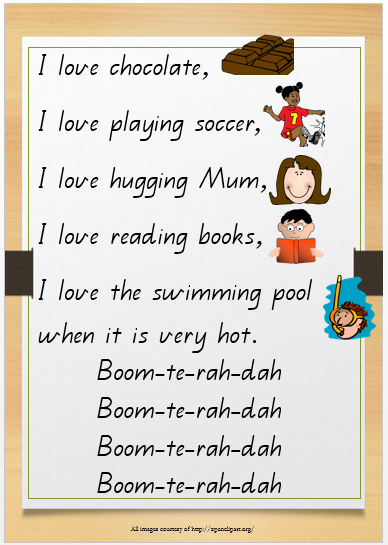
    We changed Bill’s choice of “loves” for our own, and wrote our own collective song, which we sang repeatedly and with great gusto. Although the original did include a rhyme, we didn’t concern ourselves with that at this stage. We just concentrated on sharing our loves in a song such as this one:

    I love chocolate

    While they were having fun with language, the children were also learning a subtle and unstated lesson about how powerful a tool for communication self-expression through language, both oral and written, could be.

    The children’s suggestions for things they loved were many more than the lines of one collective song would allow, so there was nothing else to do but write one of their own. Which they did. They had already seen how easy it was. They knew the rhythm.  They had the basic sentence structure. All they had to do was substitute their own thoughts and make the song their own.

    How wonderful it was to hear the children singing their own lyrics as they wrote them, ensuring that the words telling of their loves fitted the rhythm of the song. The children delighted in sharing their songs with each other and with anyone else who would listen. At the end of the day they took them home to share with their parents as a special gift of themselves for Valentine’s Day.

    While my children did not have the benefit of Bill’s magical voice, or even a tuneful model from me, they delighted in his song. You can share a version (without Bill’s voice, or mine) by clicking here.

    Why not create your own songs, and support your children to create theirs, using this song model. You’ve seen how easy and joyful it can be. A song to sing about things you love is a little “happiness pill” that can be taken daily with no known side effects.

    I invite you to share your own versions here for us all to enjoy.

    Bill Martin Jr. wrote in Sounds of Language (1972):

    “As children gain skill in using their ears to guide their eyes in reading, they have a qualitatively different reading experience. Consider the young child who has frequently heard his teacher read “Ten Little Indians.” Once a child has these sounds clearly and solidly in his ear, he has little difficulty reading this old rhyme in its printed form. Once his ears begin telling him what his eyes are seeing, he approaches the reading with confidence and expectation. And when he comes to his teacher and exultingly declares,

    I know that word, Miss Barber! That word is “little!”

    she has evidence that he is relating sight and sound in reading.”

    What a joy and honour it is, as an early childhood teacher (including parent) to share a child’s journey into independent and joyful reading and writing.

    Nor and Bec readingwriting

    Robert 2

    It was a sad day when Bill Martin Jr. passed away on August 11, 2004, but his legacy lives on in the hearts of many readers, both young and old, whose lives have been touched by his love of language, and who may have indeed stepped across the threshold into reading through one of his many wonderful books.

    Click on the title to listen to Bill singing another fabulous song “I am Freedom’s Child” and his message for democracy: what another great song to start each day!

    I will have more about Bill Martin Jr. and his legacy in future posts.

    If you liked this post, please subscribe to follow.