On the last Friday of each month in the We Are The World Blogfest, bloggers post positive news items that demonstrate that “love, humanity, and brotherhood” still exist in a world where negative news items seem to proliferate. They encourage as many bloggers as possible to join in and share good news stories.
I’m a bit late joining in this week, but I wanted to ensure you heard this wonderful news about teachers and children helping out those affected by the recent devastating hurricanes – education of the heart.
Books, children, reading, children helping children, teachers, compassion, empathy. Great ingredients for a better world.
If you would like to join in, click Here to enter their link . As they say, “Bigger the #WATWB group each month, more the joy!”
This is the story I share with you as part of the Blogfest this month:
When Hurricane Harvey struck this week, second grade teacher Kathryn Butler Mills of Katy, Texas quickly learned how many of her students were affected. In photos on social media, she saw “several of my students, past and present, sitting under staircases, in bathrooms, and in pantries, waiting out tornado watches and warnings.” She wanted to find a way to “bring a little normal to them in very not normal circumstances.” After seeing a number of kids pictured with books in hand, she hit on the idea of creating an online boo
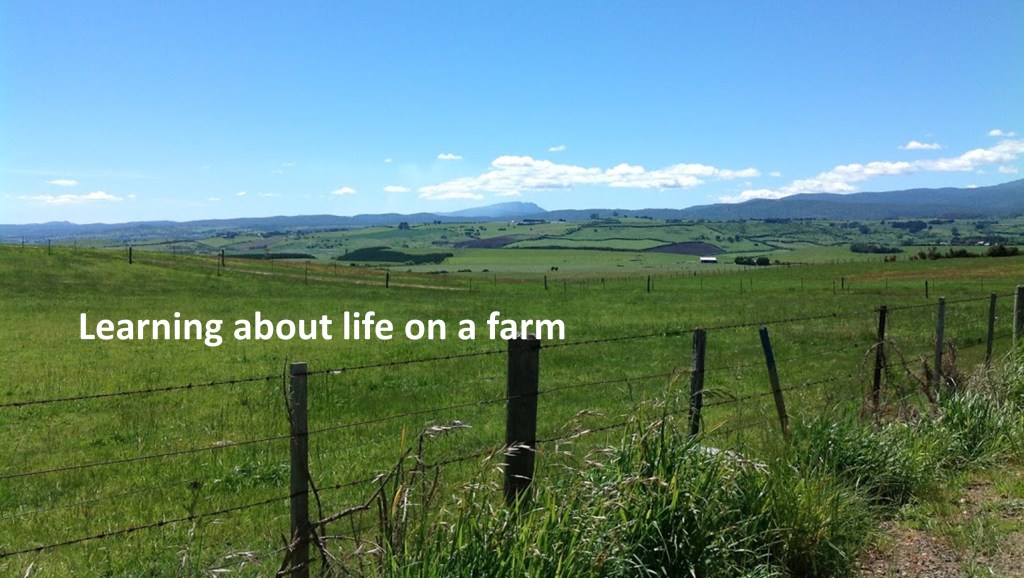
Learning about life on a farm holds great interest for children and many opportunities for integrated learning across the curriculum. Most of today’s children are town-dwellers and have little experience with rural and farm life. Many have no idea where their food comes from beyond the attractive supermarket shelves.
This week I have uploaded some new resources which support an early childhood K-2 unit of work about farms. However, they can be used as part of a literacy program, independent of a farm unit. Sight words and phonic skills can be developed through reading in a context that is both meaningful and interesting to children.
New resources include:
On the farm Who am I? This interactive digital story is great for use on the interactive whiteboard. Children are presented with a series of clues to help them identify an animal that lives on a farm. Children select the answer from those provided. The resource includes both domestic and “wild” animals.
Six early years activities for celebrating Mother’s Day. Develop literacy skills while making a personalised and special gift for Mums.
Mother’s Day is celebrated on the second Sunday in May in many countries, including Australia, the United States, and Canada. With the celebration little more than a week away, I thought I’d share some suggestions that are low on cost but packed with learning opportunities to incorporate into your class literacy and art programs.
Encouraging children to create and give a gift from the heart demonstrates that not all gifts need come from a shop. It allows children from even the poorest families to give their Mums a special Mother’s Day gift. It helps develop their creativity and teaches them skills that they can apply in future gift-giving situations. It shows how thoughtfulness and imagination can combine to make a unique gift that will be treasured.
A gift of love lasts longer than many store-bought gifts.
The importance of reading cannot be overstated. It is an essential skill, integral to almost everything we do. Teaching children to read is one of the most important, and most rewarding, aspects of our role as early childhood educators.
Some children come to school already reading. Others come not yet reading, but with a love of books and an expectation that they will learn to read. They understand that reading involves making sense of the squiggles on the page. These children usually learn to read effortlessly regardless of what we do.
Other children come to school with little experience of books and reading. For them, learning to read is a mystery and a greater challenge. For these children especially, it is important that we provide an environment rich in language and book experiences. We need to excite them about books and reading, interest them in words and language, and show them that books can be both a source of enjoyment and information.
I often hear teachers lament that there’s just not enough time in the crowded curriculum to read to children any more. But reading aloud to children, especially early childhood children, should be non-negotiable and a priority every day. How can we excite them about books, and interest them in reading, if we don’t read to them?
It is impossible to turn children onto books in one isolated reading lesson each day. In fact, reading lessons as such probably don’t turn children onto reading at all. That is not their purpose. Their purpose is to teach skills. But those skills should always be taught in context, and never in isolation. Nor should they be confined to lessons timetabled for English. Reading must occur across the curriculum and for a multitude of purposes throughout the day, from noting who is at school, interpreting the job roster and group allocations, to understanding connected text in various subject areas.
Many readilearn resources are designed to provide children with opportunities for reading across the curriculum. Even those designed specifically to develop reading skills have application in other subject areas.
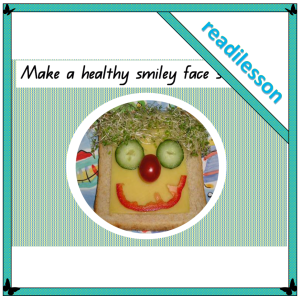
Reading and following procedures is a part of everyday life. We need to follow a procedure to make a cake, take medicine, repair a bicycle, treat head lice, assemble a DIY bookcase, or install an app on a digital device. The list in inexhaustible.
Sometimes procedures are presented as text, sometimes as illustrations or diagrams, and sometimes as a combination of both. They work best when each step of the sequence is accurately described and illustrated.
However, not all procedural texts are created equal. Sometimes the language may be inappropriate and unclear. Sometimes steps are omitted or sequenced incorrectly. Sometimes diagrams have little resemblance to what is required and confuse, rather than clarify, the process.
Trying to figure out what to do can cause a great deal of frustration in such circumstances. The more practised we are with following procedures, the more adept we are at interpreting inadequate instructions to achieve a good outcome.
It is never too soon for children to learn to read and follow procedures. The inclusion of procedural texts in a classroom literacy program has many benefits.
Following a procedure provides a context and purpose for reading. It requires children to interpret instructions through a combination of text and visual representation. It generally implies that children are doing or making something, which engages their interest and encourages participation. It develops an essential real-life skill that is transferrable to a range of situations. The sense of achievement in successfully completing a project is both affirming and empowering and often requires no other feedback.
Procedural texts can be easily incorporated into a class reading program as an independent or group reading activity. An assistant to support, encourage and oversee can be invaluable.
Features of procedural texts
The reading of a procedural texts differs from reading fiction or non-fiction texts.
The title, and sometimes a short description, tells what will be done or made.
There is generally a list of requirements.
The body of the procedure is written as a sequential series of commands.
The verb, telling the action to be performed, occurs at the beginning of the sentence.
The sentence is directed to the reader, and means, “You do this.”
Each sentence is generally short with one action to be performed in each step.
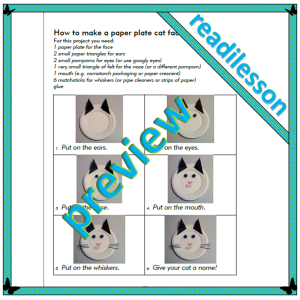
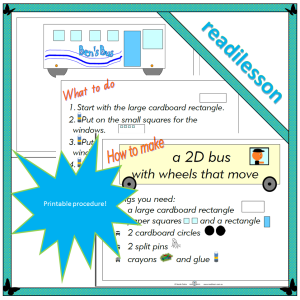
There is a range of readilearn resources to involve children in reading and following procedural texts. Many of the procedures are provided in different formats for use with the whole class or with small groups or by individuals. Some are supported by additional resources, and How to make a paper plate cat face is presented with two levels of text.
I hope you and your children enjoy using these resources. They were always enjoyed in my own classroom, and have been the most popular resources in my Teachers Pay Teachers store.
Please contact me if you have any questions. I welcome your feedback, especially suggestions for improvements to existing resources and ideas for new ones.
Remember, if you haven’t yet subscribed, an introductory discount of 20% is available to all who subscribe this year. Just use the coupon code welcome2 at the checkout to receive your discount.
I’ll see you next week. In the meantime, enjoy the weekend.
Hi, welcome to the readilearn blog and the first in our Author Spotlight series.
Spring is here and summer is on its way in Australia. The excitement of new life is everywhere as flowers bloom, birds sing, and insects abound. The excitement flows into the classroom as children observe and record the life stages of the amazing minibeasts that inhabit our world.
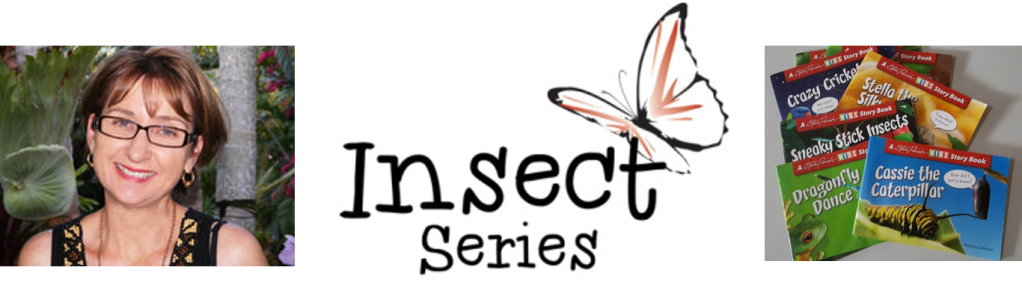
There is no better time than spring to introduce you to Brisbane author Rebecca Johnson and her Insect Series which was awarded the 2014 Whitley Certificate of Commendation for Best Educational Series.
Rebecca Johnson: award-winning author and primary school science teacher
Rebecca’s Insect Series of ten books focuses on metamorphosis, survival, adaptations, properties of natural materials and the usefulness of insects through fiction stories. The stories are accompanied by stunning close-up photos of insects of all kinds.
The books, which won the 2014 Whitley Award for Best Educational Series, have strong listed links to the Australian Curriculum for many year levels. They are a great resource for teaching and learning about insects. The fiction stories that accompany the facts make the learning even more fun. Two free blackline masters support the use of each book. The blackline masters can be accessed on the Blake Education Website.
While the books feature Australian insects and have links to the Australian curriculum, they are loved by children all over the world. I am happy to introduce you to Rebecca and her lovely series of books.
Welcome to readilearn, Rebecca. We are looking forward to getting to know you a little better.
Thanks for inviting me!
When did you know you wanted to be a writer?
When I was reading a lot of picture books to my very young children and could see how much they loved them.
Where do you write? Do you like to be by yourself in the quiet, or do you like to write in a noisy space?
I do most of my ‘writing’ in my head. I think about my stories for ages and pitch them verbally to victims until I am sure I have it all sorted in my head, then I sit to write in my lovely, quiet study overlooking my garden. I encourage children to tell their stories out loud before they write too, because, in my opinion, it is almost impossible to write a good story if you can’t tell one.
What do you use to write – pencil and paper or computer?
Head first. VERY few drafts, then I type it into the computer. I can type a 7000 word novel in a week that is publisher-ready, but I have thought about it and pitched it and sounded it out in my head for weeks beforehand. I hate sitting down all day, and I hate re-doing things over and over even more, so I do heaps of my drafting mentally whilst I do other (fun) stuff like gardening, then by the time I sit down to write, it’s like typing out a movie I know really well. People give you more honest feedback too, when you tell them a story. They feel less nervous about letting you know how they really feel about it. Try it some time.
When is the best time for you to write?
I do my best work from 5am when the house is really quiet. I’m always too tired at night (I still teach three days a week) for anything too creative.
When and where do you get your ideas?
From my life’s experiences as a mother, teacher, child and my own children. I think you have to write about what you know and love.
What gave you the idea for this series about insects?
I am a science teacher and I love insects, and I just couldn’t find the books I needed to succinctly and factually tell kids about the life-cycles and characteristics of insects in a fun way, so I wrote some.
What do you like best about the series?
Kids love them because they are funny and a bit silly, but they are still full of facts and information. I think they remember things better if it is presented in more appealing and humorous way.
What can you tell us about the photographs that illustrate the books?
My sister (Narinda Sandry) took most of them and it was hilarious. We didn’t want to harm any of the insects, so we had to put some, like the mealworms, in the fridge for a while to slow them down to get the shots. I will always smile as I recall the day we sat around a cow pat in a paddock trying to photograph dung beetles before they re-dug themselves in! The old farmer that had let us into the paddock stood to the side scratching his head in disbelief.
How did your feel when you wrote these stories?
I was really pleased when they came out because the photos are just gorgeous, and they were very well received by schools and parents. Winning the Whitley awards was really lovely recognition too.
How do you hope readers will feel?
Hopefully empowered with more information and knowledge, and perhaps inspired to look more closely at the wonderful world of insects and an appreciation of the benefits they bring.
How would you like teachers to present your books to children?
I’d love them to make them part of their science lesson, and even team them with some real insects (like mealworms) to make it all so much more engaging. There are two free blackline masters for each one too, that are designed to be able to be used independently by children in reading groups etc. There are heaps of facts inside the covers, and a glossary of terms, so plenty to learn in each one.
Are there any messages you would like them to discuss?
The main thing is that insects are so important and not just a good excuse to whack something!
Do you have any advice for teachers in their role as writing guides?
As I said earlier….talk before writing as much as you can. It is amazing how hard kids find it to describe something verbally and yet we ask them to do it in the written form all the time with disappointing results.
Do you have any advice for children as writers?
Tell, tell, tell, and don’t be too hard on yourself if it takes a long time to get it right. It took me five years to get my first book published.
What is your favourite picture book? What do you like about it?
I have so many favourites, but Bob Graham’s Greetings from Sandy Beach always makes me laugh out loud, and humour is really important to me in a book.
Who is your favourite children’s author? What do you like about his or her work?
The Lion the Witch and the Wardrobe (CS Lewis). He made me see a movie in my head. I could picture every scene, decades before there was a movie. I remember thinking that one day, I wanted to make a reader feel like that.
Thank you Rebecca Johnson for sharing these insights about your Insect Series and your writing process. We wish you success.
Thank you, and thanks for having me!
To find out more about Rebecca and her award winning books visit her website at rebeccajohnson.com.au. You can find out about and purchase her Insect Series and other books on her website.
This interview and information about Rebecca is available as a printable resource in a new subcategory in readilearnliteracy resources: Author Spotlight. The information may be displayed in your classroom or included in a class book about authors and illustrators.
I have previously mentioned the enjoyment I get from commuting. It’s not the sitting in traffic I enjoy, it’s the extra time for reading I have while I’m driving: reading with my ears rather than my eyes. I have a new-found love of audiobooks.
Over the past few years my library of audiobooks has grown alongside my library of ebooks and printed books. The range of genres represented in each category is pretty much the same when considering recent acquisitions, though measured alongside the collection of a lifetime the comparative numbers may differ. My collections include fiction and nonfiction, memoir and biography, children’s stories and picture books. Sadly, books of poetry are almost absent from recent purchases, though I do have one on order. Maybe I should improve on that sometime soon.
Although I have rarely been disappointed by any narrator, I especially enjoy it when authors read their own work. I recall disappointment and the need to correct, in my head, the narration of only one book. (It wasn’t read by the author.)
Three things I like about audiobooks:
They increase reading time. I can listen while I do other things like driving, walking, ironing.
I can take them anywhere and, with a pair of headphones, listen anywhere.
There are many genres and titles to choose from. I can catch up on classics I’ve missed, or read new releases.
Five things that disappoint me about audiobooks:
Not all titles I would like to read are available.
They are not cheap, with prices equivalent or higher than a hardback edition. The last audiobook I bought was A$38; the next on my list is A$52!
It is difficult to skip forward or back, find a particular place, make notes, or highlight quotes (if I find I want to do this with a book I have listened to, I invariably purchase it as an ebook or printed book, and sometimes both).
Sometimes, but not always, my place has been lost when I have closed one book and opened another.
They cannot be lent or transferred to another device (or maybe that’s because I buy them on iTunes for my iPad and I do not own any other Apple devices. Maybe someone can let me know.) This is probably better for the authors and their royalty payments.
I find that I very much enjoy being read to, listening to the words spoken by another, thinking about the richness of the voice and its accent, allowing me to be transported into the writer’s world through the voice’s musicality. It is like the author is speaking directly to me.
I was interested then, to recently read the opinions of two other writers about audiobooks:
Virginia explains her recent delight in finding audiobooks as a way of making more time for reading after her first child was born. She wonders how much boredom may have been prevented in previous years had audiobooks been available. She says,
‘even the most frantic among us probably has a few minutes in the day when we can listen to a book, even if there’s no time to physically sit down and read one. Working out, cleaning, commuting, watching your kid’s baseball practice, procrastinating at the office and yes, even grading bananas – now all have the potential to be a lot less dull.”
As I do, she finds listening to books as she commutes to work a real bonus. In addition to the excitement of listening, Virginia is excited that her novel Life After Coffee is to be produced as an audiobook. How exciting.
Virginia refers to the Association of American Publishers and its findings that sales of audiobooks are increasing and may be overtaking those of ebooks. Obviously Virginia and I are not the only ones enjoying audiobooks. But are we cheating by listening rather than decoding? Is listening not real reading?
Willingham says that he’s been asked numerous times if listening to an audiobook is cheating. As I indicated in the title, I wouldn’t have thought of it in that way, other than perhaps cheating time. Is making more efficient use of time cheating?
Willingham says he doesn’t like the question. He chooses to rephrase it this way:
“does your mind do more or less the same thing when you listen to an audio book and when you read print?”
He says mostly it does, that “listening to an audio book is exactly like reading print, except that the latter requires decoding and the former doesn’t.” The same language processes are involved, and this is especially true when the purposes for reading are similar to the purposes for listening.
He cites research showing that differences in reading ability in lower grades are due to differences in decoding ability rather than language processes, and that in higher grades the differences are more to do with language processes that support comprehension. He says that there is a high correlation between listening and reading comprehension in adults.
However, he says that the processes may differ according to purpose; for example, when studying for a test or a quiz, or scanning for information, perhaps a printed text may be of more benefit. I agree but suggest print is definitely a better choice in these circumstances (see things I listed as disappointments earlier). He implies that listening, however, might provide additional meaning and aid comprehension through intonation. I think this is possibly true too.
In conclusion, Willingham explains that
Listening to audiobooks is not cheating because:
“Cheating” implies an unfair advantage, as though you are receiving a benefit while skirting some work. Why talk about reading as though it were work?
Listening to an audio book might be considered cheating if the act of decoding were the point; audio books allow you to seem to have decoded without doing so. But if appreciating the language and the story is the point, it’s not.
Comparing audio books to cheating is like meeting a friend at Disneyland and saying “you took a bus here? I drove myself, you big cheater.” The point is getting to and enjoying the destination. The point is not how you travelled.
What do you think? Do you listen to audiobooks? Do you consider it cheating? Why would you, or would you not, choose to listen to audiobooks?
Thank you for reading. I appreciate your feedback. Please share your thoughts.
I thought it was quite timely for me as I had just written a piece about audiobooks. However, I have decided to keep that for posting another day and have instead decided to look at picture books. Regular readers may not be surprised.
Picture books are often a child’s first introduction to stories, poems, fantasy and other worlds. The language of picture books is immensely important and must captivate the ear as the illustrations engage the eye. Through picture books children are learning the sounds of the language: its rhythms and intonations; its accents and pronunciations; its beauty and its meaning.
Many picture books are written in rhythmic, rhyming language and we are quick to note when the timing is a little off or the rhyme not quite right. Successful picture book authors write and rewrite until they get the sound of the language just right for a read aloud experience. Though the words may be few, the task may be difficult. Children, their parents, and teachers are a discerning audience.
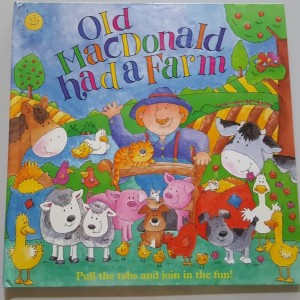
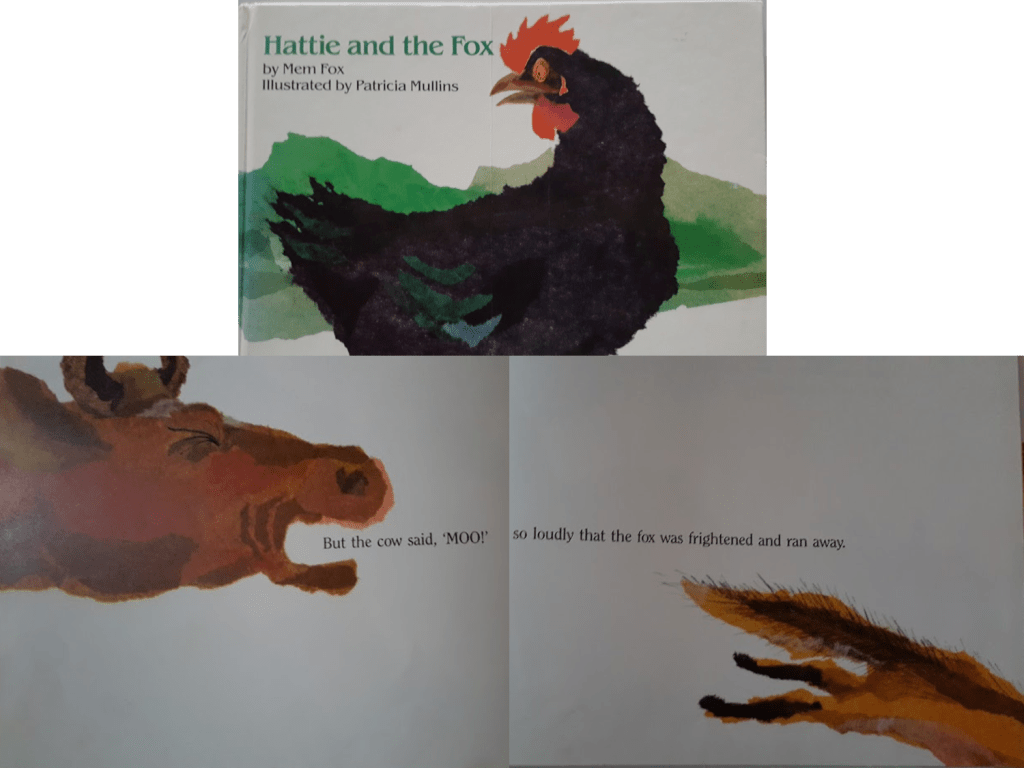
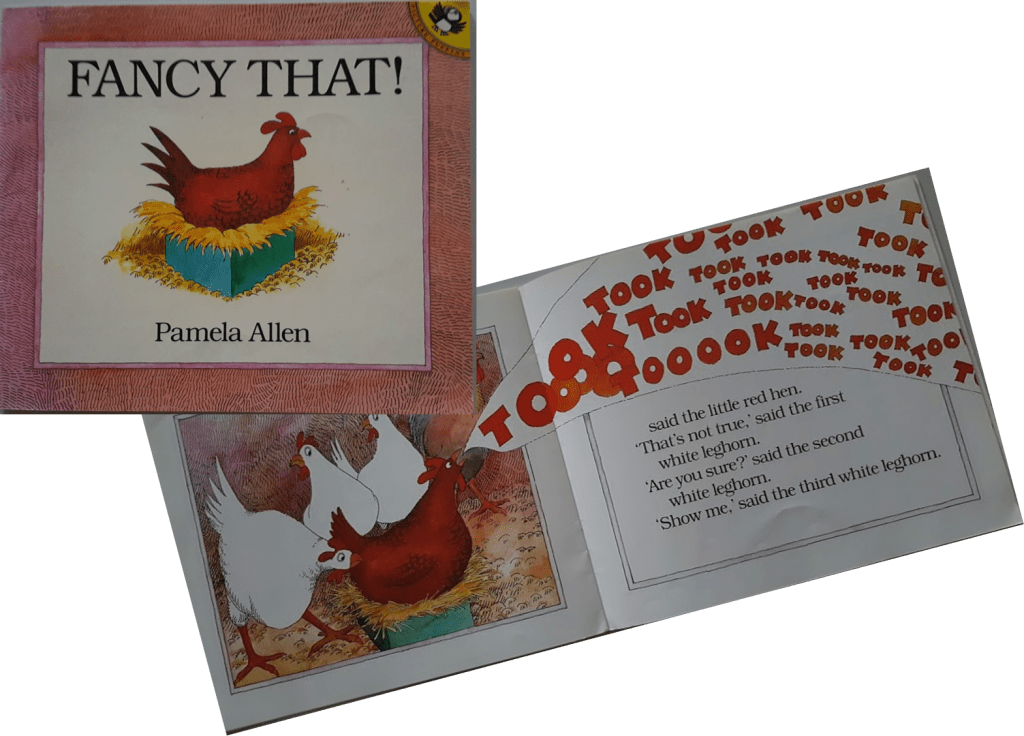
Animal sounds, familiar through songs such as Old MacDonald Had a Farm, frequently occur in picture books, including Hattie and the Fox and Fancy That!
The sounds of machines are also popular. Some of you may recall the song about The Marvellous Toy that “went zip when it moved, and bop when it stopped, and whirr when it stood still.”
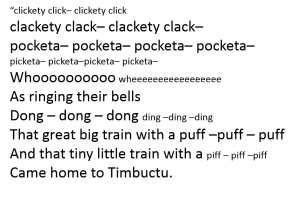
The repetitive rhythmic sound of a train’s motion is frequently portrayed, as in The Train to Timbuctu that went
and The Little Engine that Could with its
“I think I can – I think I can – I think I can – I think I can – I think I can – I think I can – I think I can – I think I can – I think I can.”
followed by
“I thought I could. I thought I could. I thought I could. I thought I could. I thought I could. I thought I could.”
A great demonstration of a growth mindset.
There are also the sounds of musical instruments as in Bertie and the Bear.
There are the sounds associated with actions, like the swish of the broomstick and the plop of the hop toad in Old Old Witch;
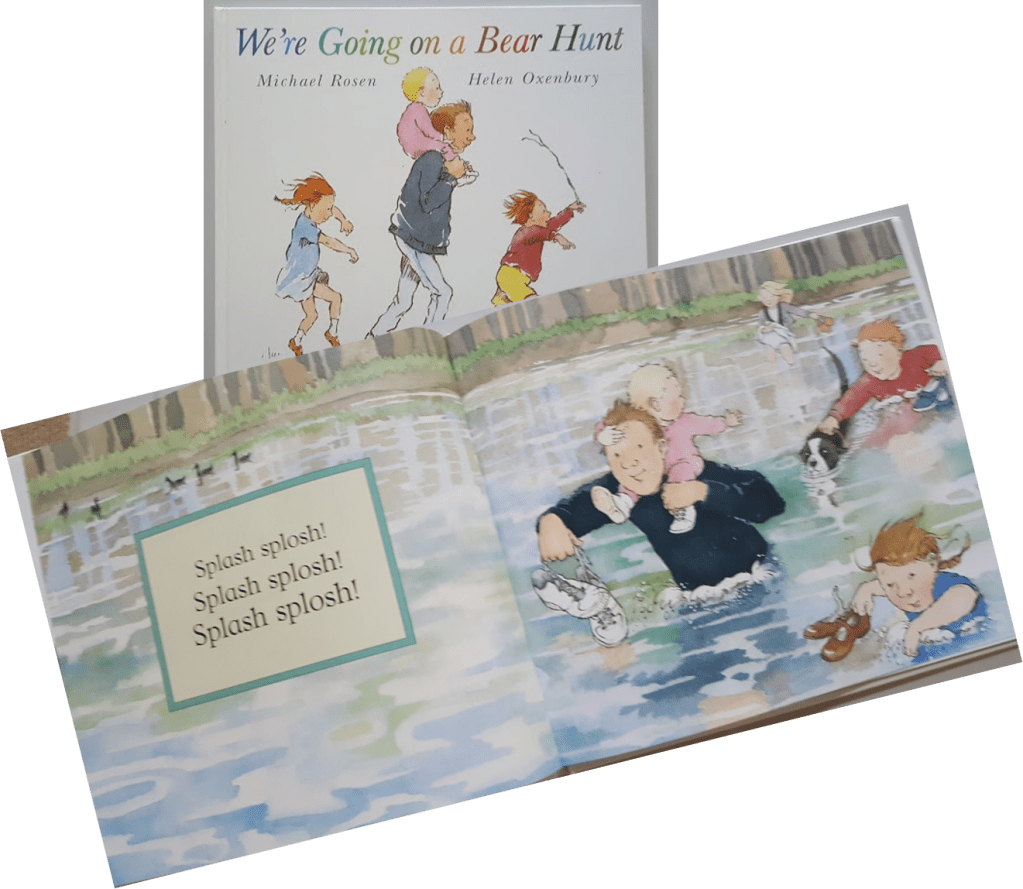
and those from Going on a Bear Hunt with its swishy swashy of moving through grass, splash splosh of wading through water, and squelch squelch of walking in mud.
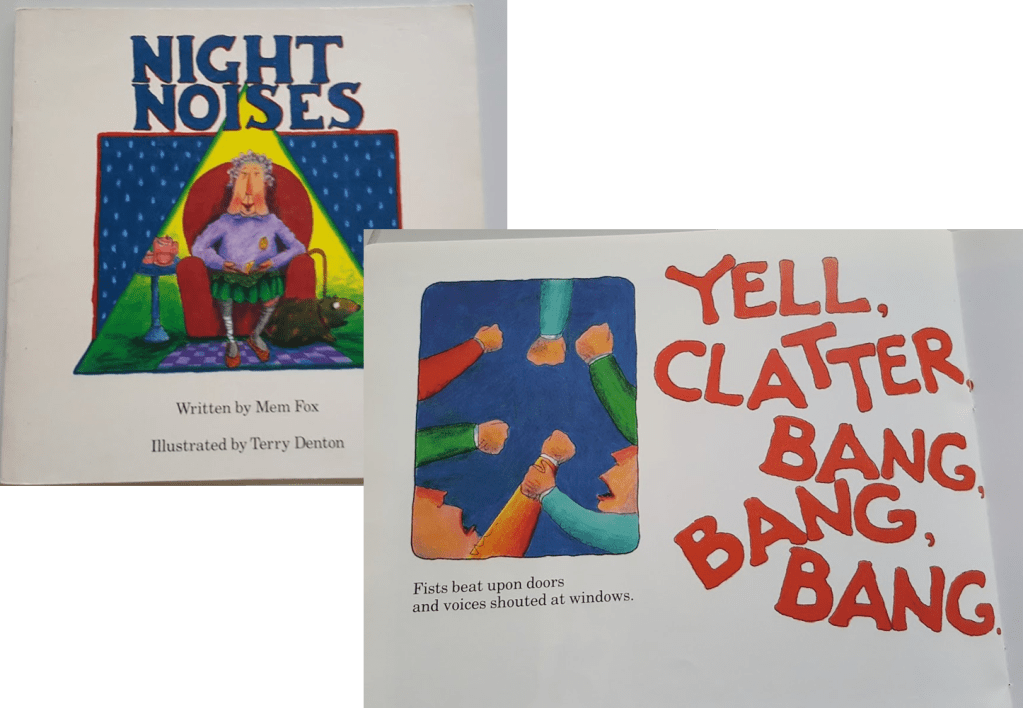
Some stories introduce a variety of onomatopoeic words. Night Noises, about a surprise party for Lillie Laceby who was nearly ninety, includes the click clack of car doors opening and closing, the crinch crunch of feet tip-toeing on a garden path, the murmur and mutter of voices whispering, the creak crack of knees, and the snick snack of bolts on the door.
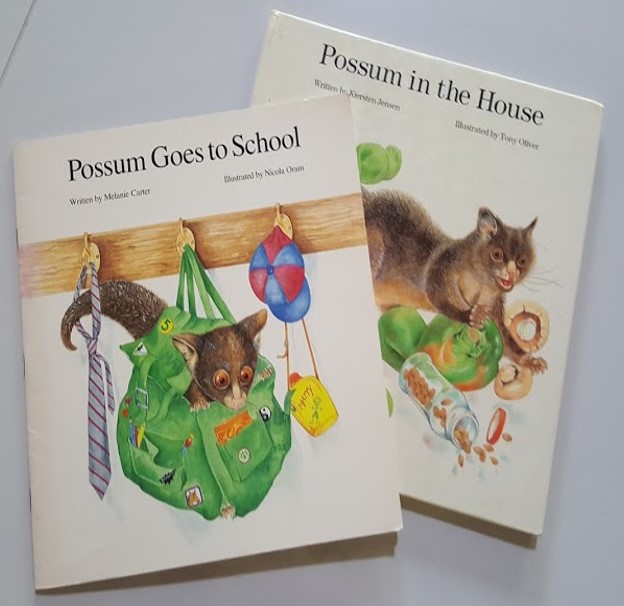
When there’s a Possum in the House or Possum Goes to School, there is nothing but trouble, with possum making a mess at every opportunity.
At home, in the pantry the cornflakes go crunch crunch, in the kitchen the saucepans go clatter clatter, and in the study the pages go rustle rustle. Each time the possum’s whereabouts is discovered, it goes screech screech and runs off to another room to create yet more mess.
The same occurs at school with paints going drip drip in the art room, claws going scratch scratch in the staff room, and the goldfish going splash splash in the science room.
Then of course, there are also the body noises that children seem to take delight in, like those from Burping Baby.
I recently discovered Lauri Fortino’s Frog on a [B]log, a blog celebrating picture books. Lauri has a delightful picture book of her own The Peddler’s Bed, illustrated by Bong Redila. Lauri recently shared a reading of the story on her blog. Since we are talking about sounds, if you have a few spare minutes, pop over and have a listen. You will also find an example of onomatopoeia in her story with the repetition of squeak squeak squeak.
Onomatopoeic words are often presented in fonts of different size or colour, or even different type. Children are fascinated by them, pointing to, asking about, maybe even recognising them, long before they are able to recognise any other words. You can help to get them started by pointing to the words and inviting them to join in the hullabaloo. What a great introduction to the world of reading.
Now that I have reminded you of these types of onomatopoeia and provided you with these wonderful examples, I wonder what I was thinking. How can I match them in my flash? I need a flash of inspiration, or maybe a flash of lightning to begin my story about a mother and child hurrying to make it home before the storm hits. I hope you enjoy it.
The eye of the storm
“Storm’s coming!”
Pit pitter-patter Pat pitter-patter hasten four feet.
Lightning and thunder boom down the street.
“H-h-h-hurry.” Mum urges. “Home – nearly there.”
Pit scuffle-scuffle Pat scuffle-scuffle “Straight up the stair.”
Clink-chink-fumble-fumble “No need to knock.”
Scritch-scratch “I’ve managed – the key’s in the lock.”
Whoosh! chortles wind, as it rushes inside.
Damn! cusses chair chucked onto its side.
P-u-sh! The door bangs! Avoid pellets of ice
Smashing and tumbling like millions of dice.
Rat-a-tat raindrops, another crash-boom!
Shuffle and scurry. “Straight to the safe room.”
Huddled together, hardly daring to breathe,
Listening and waiting for the monster to leave.
…
Then sudden quiet, the child whispers hope
“Is it all over?” Mum answers, “Nope.”
The first fifteen lines meet Charli’s 99 work criteria. I added the last two because I was thinking of the eye of a storm that brings a quiet calm but not the end of the storm – there’s still more to come. I’d love to know what you think.
Thank you for reading. I appreciate your feedback. Please share your thoughts.
In that post I mentioned classroom sharing circles where everyone comes together to share their work, thoughts and ideas, not unlike the sharing of stories and ideas at the Carrot Ranch. In the classroom everyone in the circle is equal, with equal opportunity to see and hear, and to be seen and heard. The focus is lifted from the teacher and shared equally among class members, creating a democracy.
In this post I describe some of the sharing circles I used in my classroom and show how these processes are not all that dissimilar from our own blogging circles.
D.E.A.R.(Drop Everything and Read) is a daily quiet reading session lasting about 15 minutes. In these sessions everyone, including the teacher, chooses a book and finds a comfortable space for reading. Some children sit at desks, some on cushions in the reading corner, others prop themselves up against the wall, and others lie on the floor.
The one rule is:
Everybody reads without interruption.
This means:
Nobody talks
Everybody chooses enough reading material for the session
No outside interruptions are permitted (unless it’s an emergency)
It is essential for the teacher to engage in personal reading, along with the children, to show that reading is valued and to provide a model of “expert reader” behaviour. Inviting other school personnel to join the session is also valuable. It is particularly important for children, who may not see adults engaged in regular sustained recreational reading at home, to see adults enjoying reading.
I always concluded my D.E.A.R. sessions with a Reader’s circle. Children would bring their books to the circle and share what they had read. While there wasn’t time for every child to share every day, I ensured each child had an opportunity of doing so at least once a week. Children would:
Tell the book’s title and author
What it was about
What they liked about it, and
Read a small section to the class
I loved the way children would look to each other’s book responses to guide their own selection, often asking others to help them find a book that had previously been talked about. We do the same in sharing and reading book reviews on our blogs.
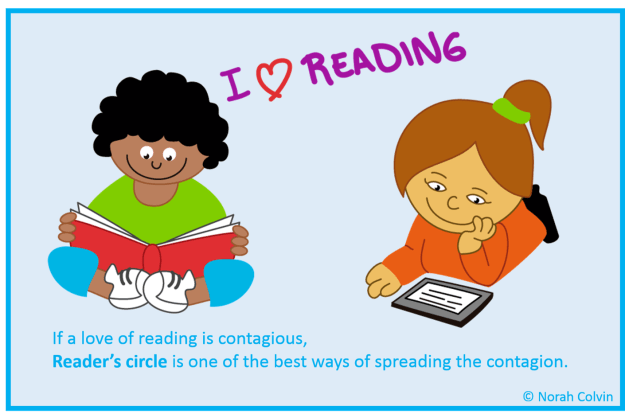
If a love of reading is contagious, Reader’s circle is one of the best ways of spreading the contagion.
A love of writing can be equally contagious. One of the things children enjoyed most about writing, other than the actual writing, was sharing it with others. Children would have opportunities to discuss and read their writing to each other in pairs and small groups as well as in the Writer’s circle.
Sometimes we would have a pre-writing circle to share ideas and inspiration. It was rare that anyone would leave the circle without an idea. Surprisingly perhaps, it was even rarer that two would write about the same thing. Bouncing ideas off each other seemed to encourage a diversity, rather than similarity, of ideas. I guess the responses to Charli’s flash fiction prompt demonstrate the same principle.
Post-writing circles provided opportunities to discuss what had been written and to read sections to others. Writers might share what they liked about their writing, or what they were having trouble with. Others might ask questions for clarification, to understand character motivations, or to find out what will happen next. Sometimes, with the writer’s permission, I would use a piece of writing to discuss an aspect of the writing process that would have application for many. If any children were reluctant to read their own writing, I would be more than happy to read it with them.
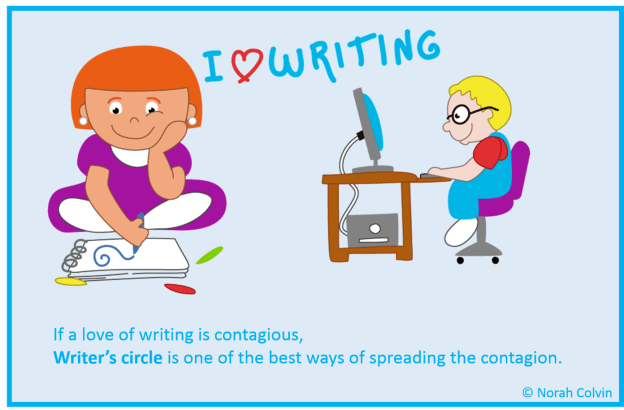
If a love of writing is contagious, Writer’s circle is one of the best ways of spreading the contagion.
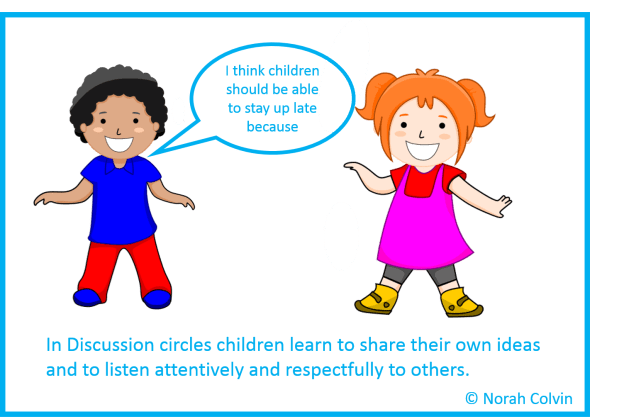
Discussion circles could occur at any time, in any subject on any topic where a sharing of ideas was required. I had a lovely smiley face ball that children would sometimes pass around, or across the circle, to each other, to indicate whose turn it was to talk. This ensured that everyone had an opportunity to share their ideas and thoughts, as well as to hear the ideas and thoughts of others. Topics could be as diverse as:
“I feel happy when …”
“When I lose a tooth …”
“On the holidays, I …”
“I think children should be able to … because …”
Each of these sharing circles gives children a voice, demonstrating that they, their thoughts, their ideas and their opinions are accepted and valued. Each encourages children to listen attentively and respectfully to others by providing a supportive environment in which they can test out ideas, then reflect and reassess in response to the reactions of others.
These discussions are not unlike those we engage in on our blogs; sharing books and articles read, and videos watched, along with our ideas and opinions and, most of all, our writing.
Thank you for the opportunity of sharing mine. I appreciate your feedback. Please share your thoughts.
Although I am enjoying the audiobook, I think I will be none the wiser at its conclusion and retain little more than in earlier days. It is a reflection on my retention rather than the worthiness of the book. At the top of Taggart’s webpage is a statement from the Yorkshire Post that I think is probably no idle boast:
Caroline Taggart…has carved out a niche for herself in user-friendly, wittily written factual books which capture the imagination and quickly find their way to the top of the bestseller lists.
Prior to reading this statement I had thought that it was perhaps the narration that had brought the book alive in a most entertaining way. I was surprised that the narrator was not the author for the wonderful meanings and interest he evokes. If not the author then, I thought, he must be a wonderful character actor. Indeed, I was not surprised to find, he was.
According to the Yorkshire Post, the writing itself is worthy too, though it seems to me, in many ways to be little more than a list of names, dates and snippets of events brought to life by an expert narrator. I’m not sure that I would read it cover to cover as I have listened to it, but it would definitely make a useful resource for checking out who and when, which is more or less impossible to do with an audiobook.
One thing I have not liked about the book is the repeated opinion that maths and science in school are boring, and that most of us would only groan when thinking of what mathematicians like Archimedes and Pythagoras have burdened us with. If you’ve read many of my posts you would probably accuse me of being inconsistent, for haven’t I often agreed with that opinion of maths at school?
However, learning in mathematics should not be that way. I wish that everything we learned in school would be alive with interest, purpose and meaning. Then there’d be no need to groan. We’d be amazed and inspired by these great thinkers who have enlightened our lives.
“Mathematics is not just solving for x, it’s also figuring out why.”
But I digress a little. Charli’s main point was about the joy to be found in libraries. In my younger years I spent many hours in libraries. And if I wasn’t in a library, I was reading a book I’d borrowed from a library. Our home was filled with books but there were never enough to read and my parents and many of my siblings were frequent library book borrowers. On many Saturday afternoons throughout my teenage years I would walk the 5½ kilometre journey to the local library and back. I can’t remember how many books I was allowed to borrow, but I borrowed as many as I could.
So many things about libraries have changed from those days of enforced silence, carded catalogues, and microfiche readers. But I don’t feel nostalgic for it. The systems are much more efficient now, and libraries have much more to offer the changing needs of a changing society.
What does sadden me is that many local councils and schools are doing away with their libraries, and many schools are choosing administrators over teacher librarians when organising their staffing. A teacher librarian should be first enlisted. Nobody knows books and readers better than a teacher librarian.
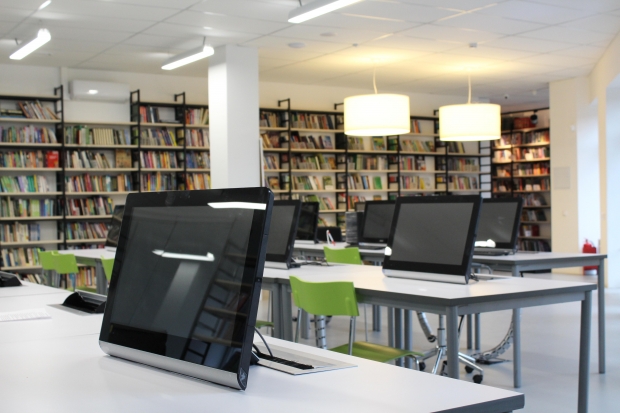
While I have not frequented my local library in recent years, I would be very distressed if it were to close. Not everyone has the luxury of being able to choose ownership over borrowing as I do. Libraries are important to communities and should be accessible to everyone; and not only for their books. Libraries play a significant role in developing a sense of community by providing meeting spaces for books clubs and groups of all sorts, activities for children including storytelling and reading, craft activities, films, games and puzzles, visits by authors and illustrators …
They are also a great place to brush up on the classics that you may have missed out on in school, or find a book about mathematics that may inspire you to ask a big question and figure out why.
Another life, another dream, another possibility …
The Book Lady
She pulled the trailer from the shed, cleaned off the grime, gave it a lick of paint and hitched it to its once permanent position behind her bicycle. A trial ride around the yard confirmed all, including her knees, were still in working order. She propped the bike against the stairs and trundled back to her library where books lay scattered, spewed from shelves no longer able to hold them. She bundled them lovingly, tied them with memories, and wished them new hands to hold and hearts to love. It was time to share, and she knew just where.
Thank you for reading. I appreciate your feedback. Please share your thoughts.

 On the last Friday of each month in the We Are The World Blogfest, bloggers post positive news items that demonstrate that “love, humanity, and brotherhood” still exist in a world where negative news items seem to proliferate. They encourage as many bloggers as possible to join in and share good news stories.

















![By UnknownMarie-Lan Nguyen (Own work) [CC BY 3.0 (http://creativecommons.org/licenses/by/3.0)], via Wikimedia Commons](https://norahcolvin.com/wp-content/uploads/2016/03/330px-homeros_caetani_louvre_ma440_n2-must-be-attributed.jpg?w=330&h=480)



 Norah Colvin