This week I have great pleasure in introducing Elizabeth Cummings author of The Forever Kid. This post is but one of several celebrating Elizabeth’s beautiful picture book in Romi Sharp’s Books on Tour. Please read to the end of the post for details of other posts celebrating Elizabeth’s work.
About Elizabeth Cummings
Elizabeth Mary Cummings is a British author based in Australia. She writes, advocates for and speaks about storytelling and health matters for families and youth. She is a qualified Primary School teacher and has worked in many schools in the UK, New Zealand and Australia. She is a member of the American Psychology Association and studied psychology and business studies at The University of Edinburgh in Scotland before training to be a Primary School teacher and travelling around the world with her family.
The topics in Elizabeth’s books are of both local and global significance. Elizabeth travels globally to talk about family and mental health matters as well as creative writing.
About The Forever Kid
The Forever Kid, a sensitively written picture book about life after the death of a sibling, is a culmination of four years’ work. Beautifully illustrated by Cheri Hughes, it is published in Australia by Big Sky Publishing.
Synopsis
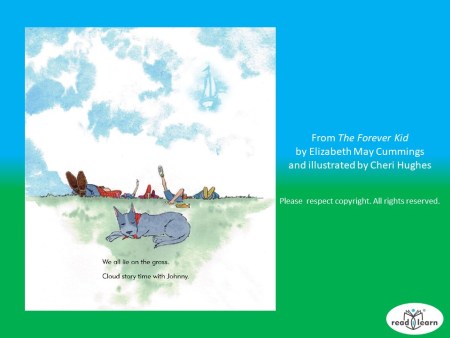
It is Johnny’s birthday and, although Johnny is no longer with them, his family gather to celebrate. Johnny’s brother explains to the reader how much Johnny meant to every member of the family and how the family feel closest to him when they remember him on his birthday. The story finishes with the family lying together on the grass telling each other cloud stories, just like they used to with Johnny.
In this post, I explain what readilearn is and how it works. There is more to readilearn than just this blog. In fact, this blog is just one small part of it.
readilearn is a collection of digital teaching resources designed for use with children from about five to seven years of age in their first three years of school. They are equally suited to the homeschool situation and for use with ESL students.
A freemium website, readilearn provides free support and resources for teachers in a variety of ways. However, some resources are exclusive to subscribers. The small annual subscription of just AU$25 reduces teachers’ workloads with lessons ready to teach and recognises and adds little to the expenditure many already occur in purchasing resources for their classrooms.
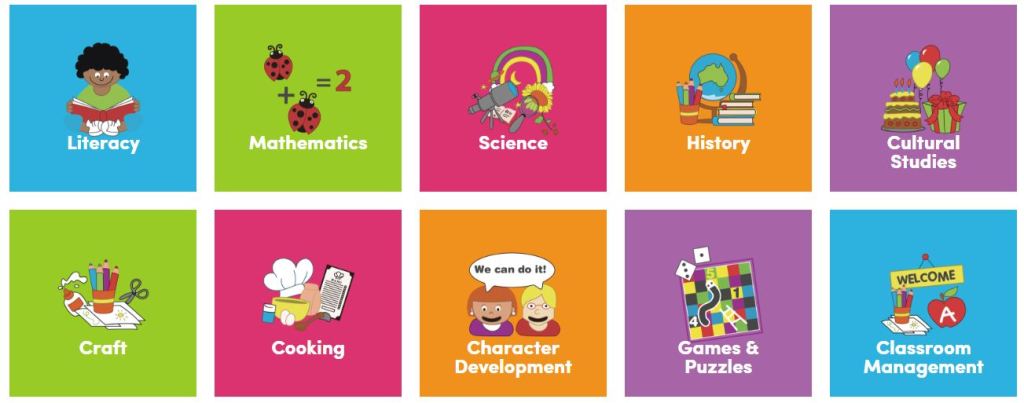
Resources are available across curriculum areas. Many provide contexts for integrating learning in fun and meaningful ways.
readilearn resources support teachers teaching and children learning by providing opportunities for discussions that promote thinking, collaboration and learning across the curriculum. Open-ended discussions encourage children to learn from each other as well as the teacher and to participate at their own level.
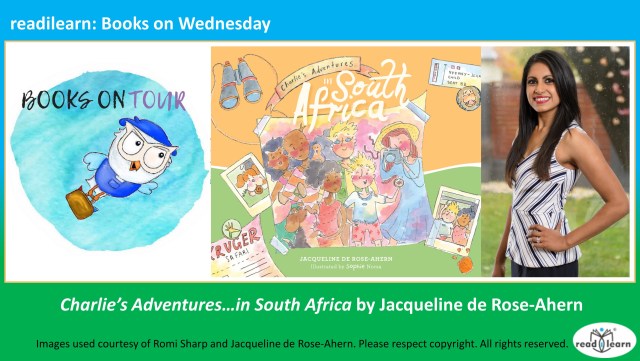
This week I have great pleasure in introducing Jacqueline de Rose-Ahern author of Charlie’s Adventures…in South Africa. This post is but one of several celebrating Jacqueline’s beautiful picture book in Romi Sharp’s Books on Tour. Please read to the end of the post for details of other posts celebrating Jacqueline’s work.
About Jacqueline de Rose-Ahern
Jacqueline de Rose-Ahern is a Canberra based author and the recipient of the ACT Writers Centre 2017 Anne Edgeworth Fellowship. Her debut picture book, Charlie’s Adventures…in Hawaii, was shortlisted for the 2017 Speech Pathology Australia Book of the Year Awards and chosen as a finalist in the 2017 American Best Book Awards. Her second book in the Charlie’s Adventure series, Charlie’s Adventures…in South Africa, was recently released. At the heart of Jacqueline’s books are an appreciation of travel and the uniqueness of culture. She endeavours to encourage her readers to learn more about the world, supporting an empathetic and inclusive community.
About Charlie’s Adventures…in South Africa
Charlie is off on the second of his adventures with his family … to South Africa! With his friends, Charlie is set on a discovery of different clues to uncover South Africa’s Rainbow Nation. Join Charlie and his family on their adventures across the world.
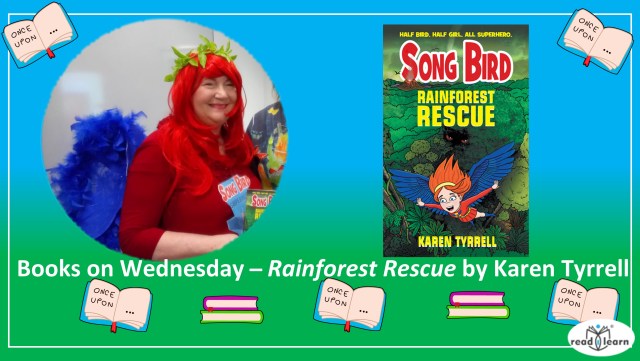
A review of Rainforest Rescue the third in the Song Bird series of empowering junior fiction books by author Karen Tyrrell.
This week, I want to let you know about Rainforest Rescue, newly released and third junior fiction novel in the Song Bird series of empowering books for young people, by Karen Tyrrell.
I have previously interviewed Karen about the other books in her Song Bird series, Song Bird Superhero and The Battle of Bug World so wanted to let you know that the third is now available.
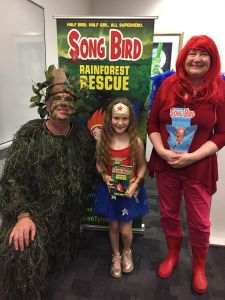
I was delighted to attend the recent launch of Rainforest Rescue. Song Bird (Karen) and Tree Man (Karen’s husband and co-author, Steve) wowed their audience that included other superheroes as well as mere mortals like me.
Since the launch, Karen and Steve have been busy visiting schools and making bookshop appearances as part of Book Week Celebrations. If you would like a visit from Karen with one of her empowering presentations or pantomimes, you can contact her on her website here, or connect with her on social media — Twitter: @Karen_Tyrrell. FB: @KarenTyrrellAuthor.
Visit Karen’s website for free teacher resources, a special offer for Australian readers, and information about purchasing Rainforest Rescue elsewhere.
This is my review of Rainforest Rescue, which you can read on Amazon here.
Rainforest Rescue is the third book in the Song Bird series by Karen Tyrrell and the best yet.
My children were early readers. Both began reading real books well before their fourth birthdays. Of course, the timing, whether early or late, matters little now that they are adults. What matters is that they are readers who read competently and confidently for a range of purposes including for information and pleasure. They are readers by choice as well as purpose.
The ability to read is something that most of us take for granted. Many have no recollection of learning to read, only of being able to do so all of a sudden, as if we just could, by magic.
But, as with any spell, there are certain essential ingredients that make the magic happen and others that inhibit the process. Creating readers of choice and not just purpose is the real magic. Creating non-readers is the effect of a spell in reverse, of a bad mix of ingredients, that sadly occurs all too often.
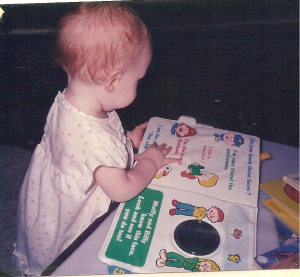
Bec reading to herself at 12 months
My children were readers of choice long before they could read anything for themselves. I wouldn’t say I set out to “teach” them to read. In fact, I didn’t at all. I set out to encourage in them a love of books and writing. Their learning to read was a by-product of sharing the love of words, language and reading.
The magic ingredients for developing readers:
Talk
Play
Read
Write
Love
Fun
I loved having time with my children. Being with them, watching them grow and develop was special, the best and most magical of days. They taught me as much or more about love, life and learning as they learned from me.
Talk
From their earliest days I talked to them, explained things to them — what was happening, what we were doing, and how things worked. I pointed things out and told them what it was called, what it was doing, what it was used for, or how it worked. When we were out and about, I’d point out signs and explain how I knew to stop or where to go. I avoided “baby” talk and always used appropriate everyday language.
Play
We played and had fun together, using our imaginations to create our own games. Sometimes we played simple board games and completed jigsaw puzzles. Whatever we played, talk always accompanied it.
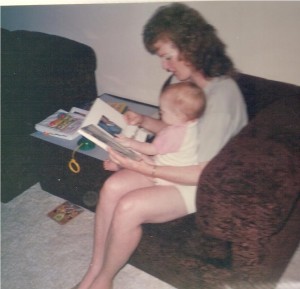
Reading to Bec at about 12 months old.
Read
I read to them, every day, not just one but many books. As I read, we discussed details in the illustrations and made predictions about the stories, sharing our thoughts. If a word was presented in a large or colourful font, I’d point to it as I read it. We’d laugh at the funny stories and cry at the sad and discuss all the story events. When they could read, they’d read to me, and we took turns reading together until they were early teens.
Write
When they first started to talk, I made books with pictures and words from their growing vocabulary. I labelled items in their rooms; for example, bed, shelf, window, door.
I made books about things we did with photographs and text. A book about our family made for my daughter’s first birthday was one of the favourites when cousins came to visit too.
The environment
I provided my children with an environment rich in language, books and opportunities for thinking. I’d read and write with them and to them, and they’d see me reading and writing for myself as well.
When son Rob was little, I didn’t yet know what I now know about the development of language, reading, and thinking. He taught me much that was later confirmed by my studies.
Rob, aged two, reading to some of his toys.
When he was only two, Rob would line up his toys on the couch, sit in the middle, and “read” to them. He would almost recite the stories from beginning to end. He already knew that the words in a book remain the same each time they are read — an important concept for beginning readers to grasp. When he was only three, he’d jump into bed beside me in the early morning after Hub had gone to work, prise my eyes open, and read to me! Magic!
Daughter Bec was born twelve years after Rob. Meanwhile, I had returned to college and studied the development of reading and language. I was amazed to find that we had unwittingly created the essential mix of ingredients for his learning to occur
Naturally, armed with experience as well as understanding, I did things pretty much the same for Bec — talking, reading, writing, playing, having fun and enjoying time together.
Bec sharing one of her favourite books.
When she was five, Bec was invited to participate in a study of children who learned to read before starting school. Of the children (maybe half a dozen) involved in the study, Bec was the only one the researcher considered to be really reading. She was reading fluently, with comprehension and at a higher level than the other children.
Some of the children were able to recognise isolated words, but not read them in continuous text. Others had been taught letters and sounds using flashcards and stopped to ‘sound’ out every word. They hadn’t become real readers.
Bec was not subjected to reading “lessons” as the other children had been. She was immersed in an environment that encouraged a love of learning, language and literacy. The other parents had a need for their children to read as if their value as parents depended on it.
While I had an expectation that Bec would read, I was confident that she would come to it in her own time. My credibility as a parent was not tied to her ability. Having said that, both children (adults) are now very successful in their chosen fields, so I must have done something right. Or perhaps we were just lucky that we chanced upon the magic mix of ingredients.
I do wish that all parents would include a sprinkle of language and a pinch of reading mixed with love and fun into their children’s lives every day. It would contribute greatly toward eradicating illiteracy.
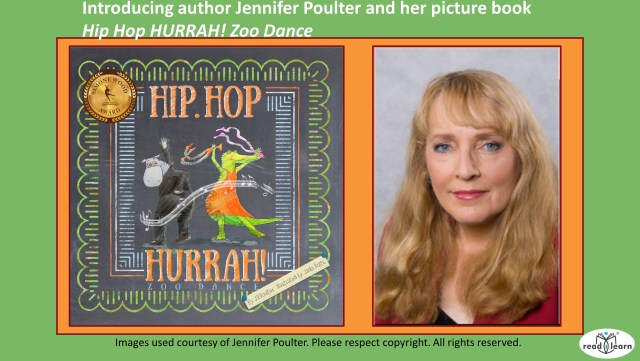
Meet Australian author J.R. Poulter as she discusses her beautiful picture book Hip Hop Hurrah Zoo Dance which is great for reading and getting kids moving.
This week I am delighted to introduce you to prolific Australian author Jennifer Poulter. Jennifer writes fiction and poetry for children, education and the literary market. She has had over 50 traditional books and thirteen digital picture books published. She writes under the names J.R. Poulter and J.R. McRae and has received numerous awards for both fiction and poetry writing.
Throughout her career, Jennifer has been employed in numerous roles including Senior Education Officer with the Queensland Studies Authority and Senior Librarian with the State Library of Queensland. She even once worked in a circus. In addition to writing, Jennifer is also an editor and artist. Now, under the banner of Word Wings, Jennifer collaborates with other creatives from over 20 countries.
Today I am talking with Jennifer about her picture book Hip Hop HURRAH! Zoo Dance.
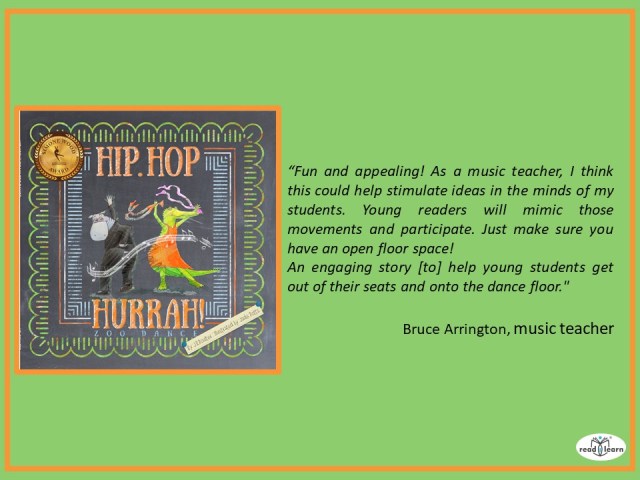
What initially attracted me to this book is its ability to get children moving. What a great way to incorporate fun with movement and reading into any day.
The book also fits perfectly with a dance curriculum that encourages children to become aware of their bodies and how they move in space, to explore and improvise dance movements. Children can be encouraged to move like the zoo animals in the book or improvise movements for other animals and objects that move.
But Hip Hop HURRAH! Zoo Dance can also find its place in the literacy curriculum. Written in rhythmic verse, it encourages children to join in with the reading. It has a treasure of words to delight and extend vocabularies and add sparkle to writing; words like ‘limber, fandangle, prance and shimmies’. Children will laugh at the hippos with the backside wobbles and be intrigued by the combination of illustrations by Jade Potts and the variety of media used by designer Takara Beech in creating the double page spreads.
If you throw in some counting of animals and legs, needs and features of living things, and places they live, you can cover almost the entire curriculum with this one little book. But enough from me, let’s find out what Jennifer has to say.
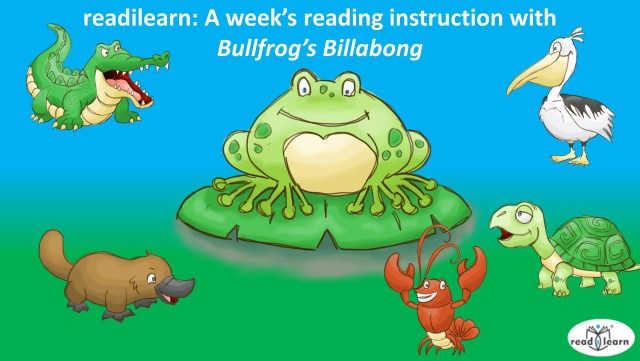
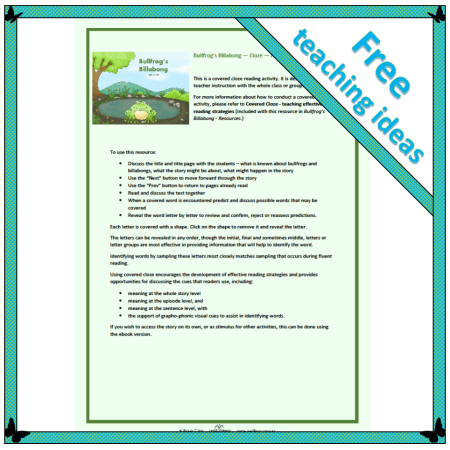
The readilearn Bullfrog’s Billabong suite of cross-curricular resources can be used as the foundation for planning a week’s reading instruction including lessons with the whole class and small groups and independent work. The activities cater for different ability levels in your early childhood classroom and can culminate in a performance to be presented to other members of the class, other classes in the school, or parents.
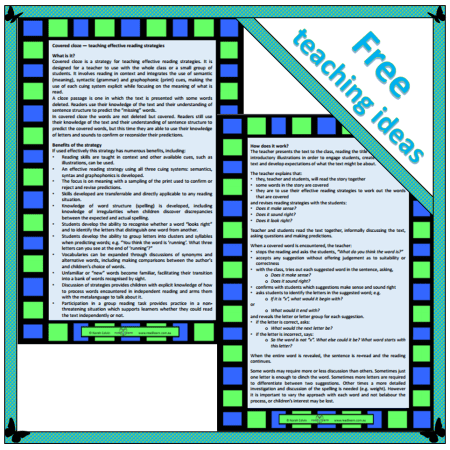
Begin by introducing the story as a covered cloze activity (a lesson ready for you to teach) presented to the whole class on the interactive whiteboard. Although all children are engaged in reading the same story, the activity allows them to participate at their own level. The teacher-led discussion can be tailored to student needs, allowing each to contribute according to what they already know and extending their understanding by discussing cues for reading and irregular as well as regular spelling patterns. Children learn from each other as they actively participate in the cooperative reading activity. Refer to Covered cloze — teaching effective reading strategies and Bullfrog’s Billabong — Cloze — How to use this resource for suggestions.
As with introducing all new reading material, it is important to engage children’s interest by making connections with what they already know about the topic and explaining what may be unfamiliar; for example, a billabong, and encouraging them to make predictions about what might happen in the story. As the story unfolds, children may adjust their predictions and thoughts about the story.
My thoughts were a bit sketchy. This is what I came up with. I’d be interested to know your perception.
Sketchy Perceptions
He sketched the outline with chalk then filled in the details, outside-in. Curious passers-by gathered as the image emerged. Was the artist a paid entertainer or busker earning a buck? Some pushed coins into children’s hands to add to the chalk-drawn cap. When satisfied with his work, the artist stood in its centre and tossed the cap and contents high. As they fell, he spread his arms and disappeared into the painting. Perplexed on-lookers reported different perceptions. Many said he plummeted into darkness. Some said he flew on gold-tipped wings. Others described him simply as absorbed by his art.
It is easy to make snap judgements about others and situations from sketchy information, even at first sight. We do it all the time as we try to make sense of what we perceive, evaluating it against our existing knowledge and beliefs.
I have strong beliefs about education and how children learn so can quickly judge whether I will agree with the content of articles or not. However, I don’t confine my reading to articles that I know will support my beliefs. I read articles from a variety of viewpoints to gain some understanding of others’ positions. If I don’t know what they think, how can I interrogate those thoughts and evaluate them against my own, perhaps even reassess my beliefs? I would rather be informed than base my ideas upon sketchy information.
This week, I had the pleasure of reading two articles in popular media which reiterate things I have written about a number of times previously.
The title of an article by Angela Mollard in my local Courier-Mail intrigued me: We should be ashamed of how we treat teachers. The media is often quick to criticise teachers, blaming them for almost all of society’s ills, it sometimes seems. I wondered at the intent of this article. Mollard wrote that, although she is the daughter of a teacher, sister-in-law of a teacher, and friends with many teachers, she had no idea of a teacher’s life until she read the book Teacher by Gabbie Stroud. I am yet to read this memoir, but it is now high on my TBR list.
Mollard says, “She (Stroud) writes of the sacred bond between teacher and pupil, of advocating exhaustively for their needs, of loving them even when they were abusive and damaged and victims of the most heartbreaking of family circumstances.”
Mollard follows this by telling us that “Ultimately, Stroud gives up being a teacher. She’s broken by the profession but she maintains that she didn’t leave teaching, it left her”, and describes her book as “a clarion call to educators to change a system that values standardisation over creativity, curiosity, progress, self-belief and autonomy.”
Oh, yes! I applaud. I know many teachers who feel the same way.
Mollard then goes on to say that if parents want inspirational teachers for their children, they must be inspirational too, that they must stand beside and support teachers and do what they can to lighten their workload so more help can be given where it is truly needed. If you are a parent, please read the article for her suggestions. I have sketched out just a few of her ideas here.
If you can do only one thing for your children, it should be shared reading is the title of an article by Ameneh Shahaeian and Cen Wang in The Conversation. To any regular readers of my blog, the idea behind the title will be very familiar. It gladdens me when I see others promoting such good advice for parents.
However, in the article Shahaeian and Wang surprised me with the question, “is it really book reading that’s beneficial or is it because parents who read more to their children also provide a lot of other resources, and engage in a range of other activities with their children?”
Does the question intrigue you as much as it did me? Shahaeian and Wang share the results of a longitudinal study they carried out to find an answer. Please read the article for their conclusions and suggestions for parents.
I’ve provided you with just the sketchy outlines of both these articles. If you are interested enough to read them, I’d love to know what you think.
Thank you for reading. I appreciate your feedback. Please share your thoughts.
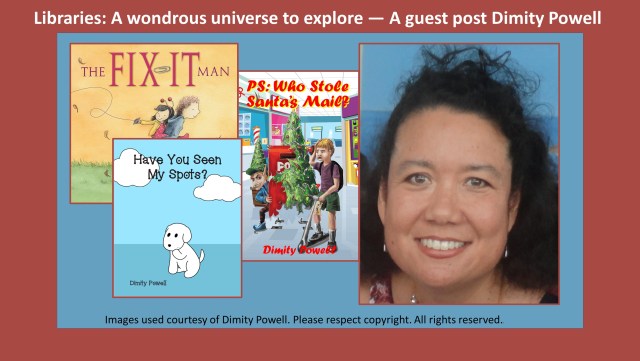
This week I am delighted to introduce you to award-winning children’s author Dimity Powell.
Dimity likes to fill every spare moment with words. She writes and reviews stories exclusively for kids and is the Managing Editor for Kids’ Book Review. Her word webs appear in anthologies, school magazines, junior novels, as creative digital content, and picture books including The Fix-It Man (2017) and At The End of Holyrood Lane (2018).
She is a seasoned presenter both in Australia and overseas, an accredited Write Like An Author facilitator and a Books in Homes Role Model Volunteer in Australia.
Dimity believes picture books are soul food, to be consumed at least 10 times a week. If these aren’t available, she’ll settle for ice-cream. She lives just around the corner from Bat Man on the Gold Coast although she still prefers hanging out in libraries than with superheroes.
In this post, Dimity shares her love of libraries and explains why it is important to ensure every child has access to a library at school and every reader a local library.
The ability to read is one of the most valuable skills we can acquire. It is a tool for thinking, learning and entertainment. Reading opens doors and minds; it gives us the ability to unlock the secrets of the universe and release our imaginations. It is a skill that many of us take for granted, but without it the world would seem a more unfriendly place.
No wonder learning to read is a vital part of each and every school day!
Like everything else —the more you read, the better you get!
Reading is more than just saying all the words on the page in order. Reading is a process of getting meaning from print. Effective readers use their knowledge of the world and of language in their quest to make meaning from the words on the page. Reading takes place when the reader understands the message of the writer.
Strategies used by effective readers
Effective readers use a combination of three cuing systems to predict and check what the author has written. The use of these systems is obvious in the miscues (rather than “mistakes”) that readers make.
The most important cuing system is knowledge of the topic. If you know lots about dinosaurs, you can read those big difficult-looking words and understand what they mean. If you know nothing of legal jargon then even sounding out those big difficult-looking words won’t help you understand.
The second system is knowledge of language and grammar. We expect the words to flow with meaning and not be a jumble of nonsense.
The first two systems combine to predict the words on the page. We then check with the print to ensure our expectations were correct.
For example, if the story is about a cowboy you may expect that he would jump on his pony, but when you look at the print, you find he actually jumped on his horse.
Effective readers may say ‘pony’ instead of horse, but they definitely wouldn’t say ‘house’ (which looks similar) as it just wouldn’t make sense!


















 Norah Colvin