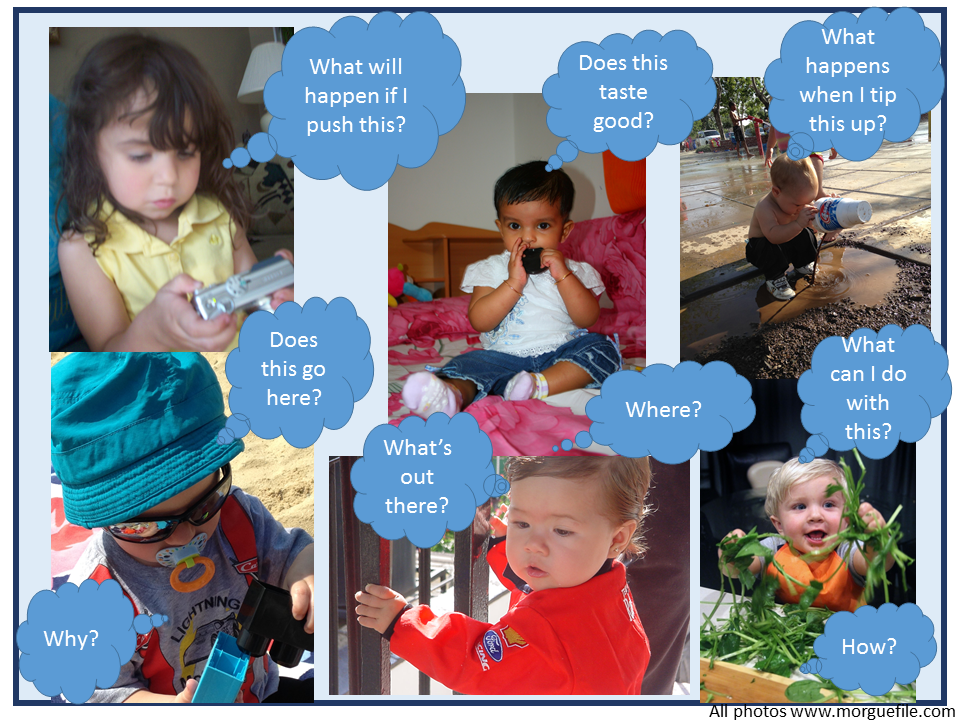
It is no secret that I love having time with young children. Their development constantly amazes me. They are curious learners on a quest to find out as much as they can about the world and how it works. They are scientific researchers making observations, forming hypotheses, and drawing conclusions; always with a plan for the next step if the results aren’t what was expected.
How many times do they need to release a spoon to be confident that it will always be pulled towards the floor? How early do they laugh when something doesn’t perform as expected; for example, when a balloon floats up instead of falling down?
Many of a young child’s explorations seek answers to questions they ask of themselves; questions that may never be verbalised.
After they have investigated their immediate environment, and their language begins to develop, they start to look at the wider world, and begin to ask questions about how things work and why things happen.
Here are a couple my granddaughter asked me recently:
“Norah, you know about gravity? Why do clouds stay up in the air? Why don’t they fall down?”
“If babies grow into adults, and adults give birth to babies. Which came first the baby or the mother?”
The determination and persistence of young children is also almost limitless. Watch them learning to roll, or to sit, or to stand. It is never achieved on the first attempt, but that doesn’t stop them. They don’t give up. They try and try again until they do it. The look of satisfaction on their faces is priceless. No stickers are required. Sometimes, when the result differs from expectation, the look is of surprise. But even then they are quickly deciding what to do next.
Without formal instruction of any kind, in their first few years, children perform amazing feats. Without the imposition of test requirements or standardised assessment, children are driven to learn. Intrinsic rewards, accompanied by the encouragement of significant others, for example, parents, are sufficient. Children are driven by a “yet” mindset and a belief that there is no such thing as “can’t”. This ensures they continue to practice until they succeed. Immediately they succeed, they set themselves another challenge. That is, unless they are taught otherwise.
When they are nurtured in an environment that is encouraging and supportive, with a balance of comfort and challenge, and well-timed feedback, children will thrive physically, emotionally, and mentally. They will learn through their observations and interactions with people and objects. Each question answered will stimulate the next.
These are just a few of the remarkable achievements made by children before setting foot inside any formal education establishment. They learn to
interact
roll over
sit up
crawl
clap hands
stand
walk
place things inside, and take things out of, other objects
feed oneself
talk
run
undo and do up buttons
push buttons (of all sorts)
open doors
play games
…
Given an encouraging, supportive environment with caring adults who respond to their needs, surround them with language, love them, and model behaviour, children learn amazing things.
Everything she had ever done was preparation for this moment. All eyes were on her. The audience’s expectation was palpable, bolstering her determination. She pulled herself up to full height and looked around, smiling. The audience waited. She checked the positioning of her feet, and her balance. She held up one hand, signifying that an attempt was imminent. She put one foot forward; then raised the other hand as she brought her back foot alongside the first. She paused, poised, momentarily. Immediately cameras clicked and cheers erupted. After two more steps, she launched, triumphant, into her father’s waiting arms.
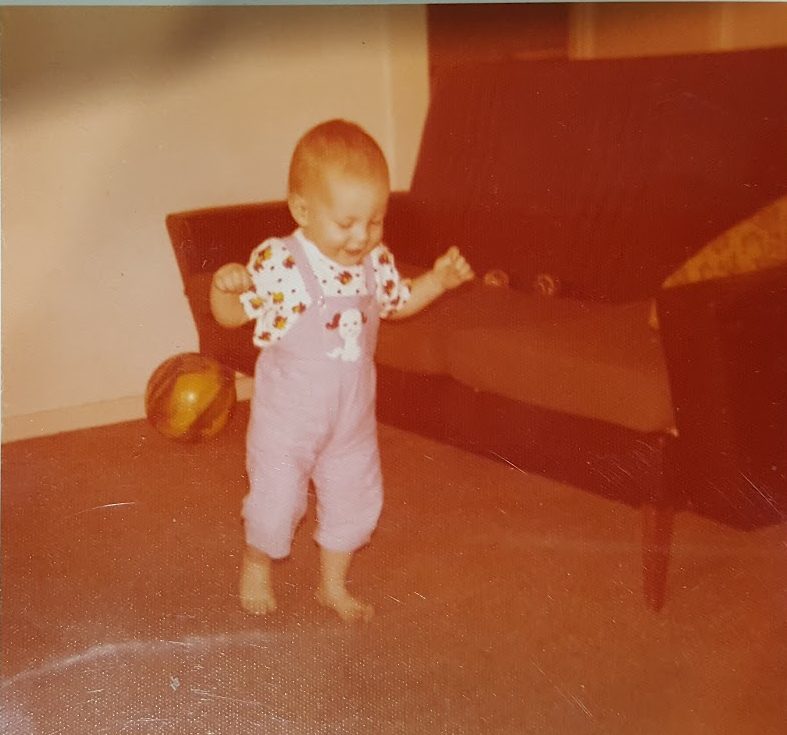
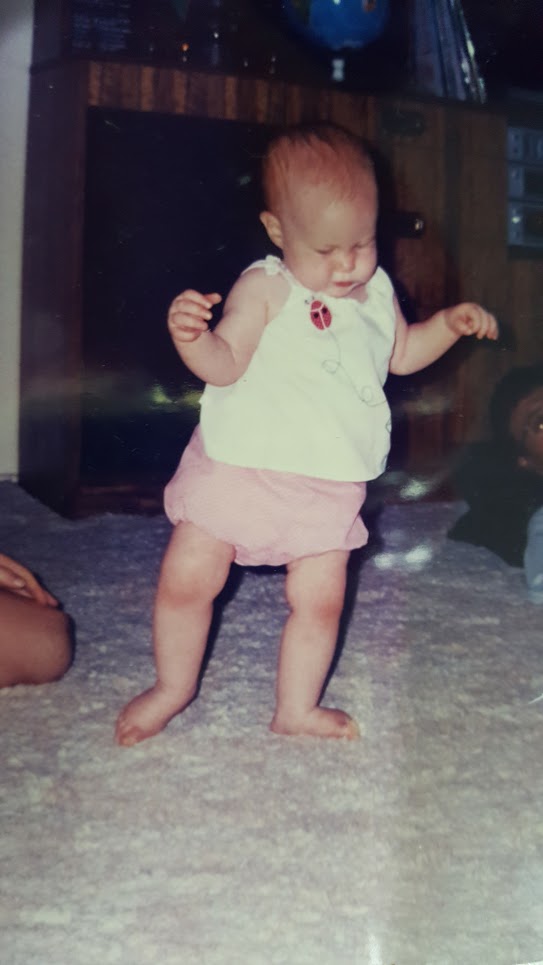
Here are photos of my two little (now big) ones. While not of their first steps, these photos were taken within the first month each of them walked.
In that post I mentioned classroom sharing circles where everyone comes together to share their work, thoughts and ideas, not unlike the sharing of stories and ideas at the Carrot Ranch. In the classroom everyone in the circle is equal, with equal opportunity to see and hear, and to be seen and heard. The focus is lifted from the teacher and shared equally among class members, creating a democracy.
In this post I describe some of the sharing circles I used in my classroom and show how these processes are not all that dissimilar from our own blogging circles.
D.E.A.R.(Drop Everything and Read) is a daily quiet reading session lasting about 15 minutes. In these sessions everyone, including the teacher, chooses a book and finds a comfortable space for reading. Some children sit at desks, some on cushions in the reading corner, others prop themselves up against the wall, and others lie on the floor.
The one rule is:
Everybody reads without interruption.
This means:
Nobody talks
Everybody chooses enough reading material for the session
No outside interruptions are permitted (unless it’s an emergency)
It is essential for the teacher to engage in personal reading, along with the children, to show that reading is valued and to provide a model of “expert reader” behaviour. Inviting other school personnel to join the session is also valuable. It is particularly important for children, who may not see adults engaged in regular sustained recreational reading at home, to see adults enjoying reading.
I always concluded my D.E.A.R. sessions with a Reader’s circle. Children would bring their books to the circle and share what they had read. While there wasn’t time for every child to share every day, I ensured each child had an opportunity of doing so at least once a week. Children would:
Tell the book’s title and author
What it was about
What they liked about it, and
Read a small section to the class
I loved the way children would look to each other’s book responses to guide their own selection, often asking others to help them find a book that had previously been talked about. We do the same in sharing and reading book reviews on our blogs.
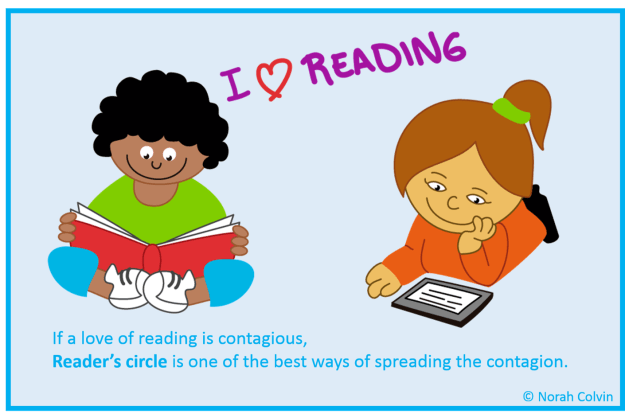
If a love of reading is contagious, Reader’s circle is one of the best ways of spreading the contagion.
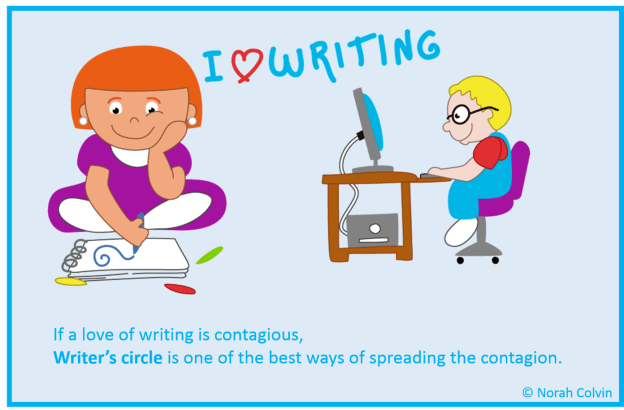
A love of writing can be equally contagious. One of the things children enjoyed most about writing, other than the actual writing, was sharing it with others. Children would have opportunities to discuss and read their writing to each other in pairs and small groups as well as in the Writer’s circle.
Sometimes we would have a pre-writing circle to share ideas and inspiration. It was rare that anyone would leave the circle without an idea. Surprisingly perhaps, it was even rarer that two would write about the same thing. Bouncing ideas off each other seemed to encourage a diversity, rather than similarity, of ideas. I guess the responses to Charli’s flash fiction prompt demonstrate the same principle.
Post-writing circles provided opportunities to discuss what had been written and to read sections to others. Writers might share what they liked about their writing, or what they were having trouble with. Others might ask questions for clarification, to understand character motivations, or to find out what will happen next. Sometimes, with the writer’s permission, I would use a piece of writing to discuss an aspect of the writing process that would have application for many. If any children were reluctant to read their own writing, I would be more than happy to read it with them.
If a love of writing is contagious, Writer’s circle is one of the best ways of spreading the contagion.
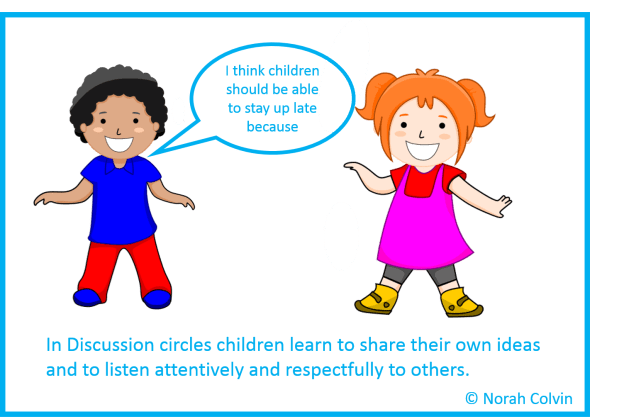
Discussion circles could occur at any time, in any subject on any topic where a sharing of ideas was required. I had a lovely smiley face ball that children would sometimes pass around, or across the circle, to each other, to indicate whose turn it was to talk. This ensured that everyone had an opportunity to share their ideas and thoughts, as well as to hear the ideas and thoughts of others. Topics could be as diverse as:
“I feel happy when …”
“When I lose a tooth …”
“On the holidays, I …”
“I think children should be able to … because …”
Each of these sharing circles gives children a voice, demonstrating that they, their thoughts, their ideas and their opinions are accepted and valued. Each encourages children to listen attentively and respectfully to others by providing a supportive environment in which they can test out ideas, then reflect and reassess in response to the reactions of others.
These discussions are not unlike those we engage in on our blogs; sharing books and articles read, and videos watched, along with our ideas and opinions and, most of all, our writing.
Thank you for the opportunity of sharing mine. I appreciate your feedback. Please share your thoughts.
I am struggling with a writing task at the moment. Part of the reason is that is has been at the back, rather than the forefront, of my mind as I worked on other tasks, and part of the reason is that it involves self-promotion in a marketing kind of way. It confuses me a little, because haven’t I been self-promoting all the time I have been writing a blog? Surely putting my ideas out there is at least presentation, if not promotion, of said ideas.
With the goal of sharing original early childhood teaching resources and stories for children on a website of my own, I began writing a blog and engaging in social media about two and a half years ago. This was in responses to advice received from attending writing seminars and reading books about website development. Preparation of resources for my website took a back seat for a while as I engaged with other writers in the blogosphere.
Now it is time to turn the focus back onto the website, the launch of which is fast approaching. With an extra effort over the past couple of weeks, I now have sufficient resources to begin. Additional resources will be uploaded at relatively frequent, if irregular, intervals, not unlike adding to my blog.
I have no issue with ideas for additional resources or blog posts. My stumbling block is the content for my bio and promotional information about the website. It should be easy, I know, but I am struggling to find the answers to these questions:
What do people want or need to know about me?
How can I promote my resources in an honest way that entices people to sign up to a paid subscription?
What is a fair price for subscription?
How can I persuade potential subscribers that they will get value for money?
How can I ensure that subscribers do not feel let down by the available resources or ripped off by misleading promotion?
These questions arise even before I begin to tackle the really difficult one:
How do I connect with my target audience: early childhood teachers?
I know I am not alone with these concerns.
Recently Sarah Brentyn, who blogs at Lemon Shark, questioned the validity of her profile, enflaming my anxiety by stating that “It’s seen by far too many people who judge you by those 10 – 20 words.” The thought to change my blog’s About page, with far more than 10-20 words, hasn’t yet moved beyond that guilt-ridden thought. And while I know it is not suitable as is for my website, perhaps editing or rewriting it is a place to start.
Throughout the year Anne Goodwin, who blogs at Annecdotal, shared the process of stepping out from under the covers of introversion to promote her debut novel Sugar and Snails. In her post One huge leap for Anne, one teeny tiny step for womankind, she questioned how to balance celebrating her achievement with the suspicion that many would be unimpressed. In another post on Book pricing: a cautionary tale Anne questioned pricing and value and shared the hope that people wouldn’t feel ripped off. I am fairly confident that Anne’s concern on each of these issues turned out to be unwarranted. Will mine be the same?
“My intention … (is) to write and publish novels. My intention is to be a successful author. Success to me is publishing books I want to write for readers who want to read them. My secondary goal is to market well enough to eat more than hand-picked dandelions from my yard. Many will say it’s a fool’s dream.”
Charli has expressed it well. Substitute “early childhood teaching resources and stories for children” for novels and it could be me. I hope that neither Charli nor I are dreaming the impossible. Charli at least has a long list of credentials.
I have spent some time looking at other websites which may be considered competitors and looking at bios on others. If there’s one thing I have discovered it is this:
There is a multitude of websites offering early childhood teaching resources. Some websites offer all resources free. Teachers love freebies. There are also many websites with resources available to subscribers. Why would anyone want mine?
However, I’m not going to give up now.
I hope there are many early childhood teachers who will see sufficient value in my website to pay the annual subscription. As far as I explored, I have not found anyone offering interactive resources similar to mine. It is possible that they exist and I just haven’t found them. However, I am hoping that teachers see value enough in these alone, and consider the other resources a bonus. Time will tell. If it returns nothing but the pleasure of achievement, then I will consider it my jetski. If it does more than that I will be well pleased.
So, if I am not going to give up, maybe I just need to get on with the task of writing my bio and promotion paragraph. The other day I read a bio that described the website owner as its founder. Hmm. I thought. Maybe that’s a title I could use.
I was amused at the thought that I would found something that hadn’t been lost. It just hadn’t been before. I thought about other things, briefly mentioned in other posts, that I had founded:
Create-A-Way, educational sessions for children of before-school-age and their parents.
and talks about sowing compassion to make our world a “worthier place to live”.
These are wonderful ways of thinking about dirt and good reminders of the importance of the earth beneath our feet, which is often taken for granted, even ignored, unless one is a farmer, a gardener, perhaps a miner, or possibly a child.
Children are often admonished about playing in the dirt, as if washing off a little soil was the greatest difficulty. In our towns and cities we cover the soil with concrete and leave few patches of bare earth where children have an opportunity to dig.
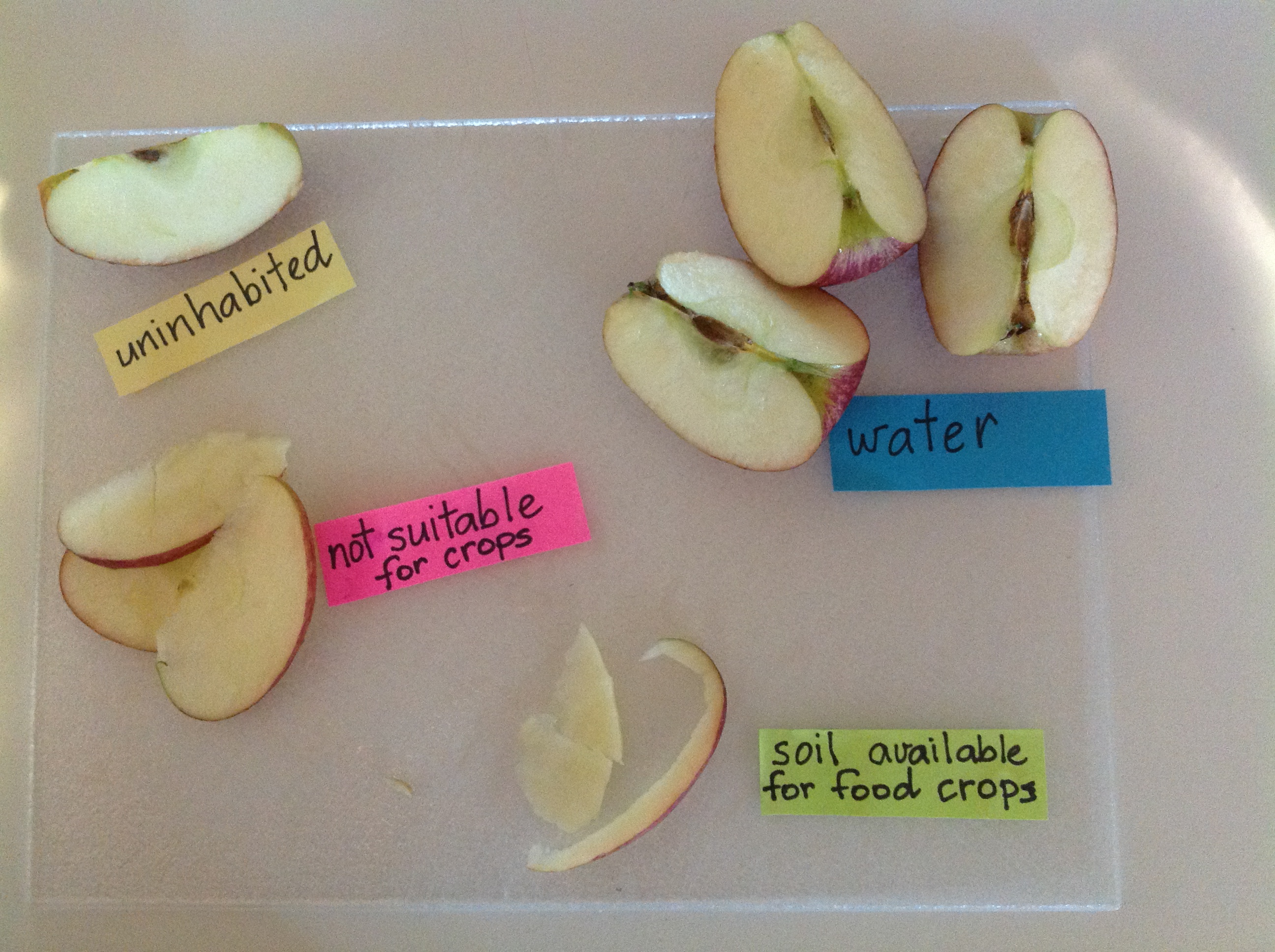
Soil, though an essential resource of our Earth, is often overlooked. Ask a young child what living things need and they may say “water, air, food, sunshine and shelter”. Soil won’t rate a mention. But without it we wouldn’t have a thing to stand on! Nor would we have our other essentials: air, food and shelter – all dependent on the soil for their production. The importance of soil and of conserving becomes even more evident with the realisation of how little of the Earth’s surface is available for producing food.
Another great gift from the soil is knowledge. Much of what we know of Earth’s history and human history has been revealed by the soil as successive layers have been exposed or excavated; uncovering secrets of the past and enabling a much richer understanding of earlier times.
Our knowledge of dinosaurs has all been revealed from the earth with the first discoveries and identifications made only a few hundred years ago. And there is still much more to be discovered. My children and grandchildren, along with many other children and adults, are fascinated by dinosaurs. How exciting it would be to make a new dinosaur discovery, find hidden treasures or unlock secrets of the past!
It is possible that many more dinosaur, and other, discoveries are yet to be made. The world’s only known evidence of a dinosaur stampede was found in Australia just a little over fifty years ago. Even more recently a gardener in the UK found a dinosaur bone in his backyard! In the US, if you find a dinosaur fossil in your backyard it’s yours to keep!
According to this video, finding dinosaur fossils is quite easy:
But his father didn’t just tell him. Wanting his son to be curious and interested in finding things out for himself, he responded, for example: “I wonder if we can work it out . . .” They would then look through books about zoology and anatomy and try to identify the bone’s origin.
Knowing that it is through the comparison of found bones with bones of familiar creatures that scientists have been able to work out much of what we now know about dinosaurs and other extinct creatures makes such an activity even more exciting and inspirational.
Rosen goes on to share an experience from his own school days. When a teacher confessed to students that he didn’t understand Comus by Milton, which had been set for study, the class and teacher spent the year together figuring out its meaning. Rosen compares the effectiveness of this approach to many others, stating that study techniques, “didn’t teach me how to find things that I really wanted to learn about. It didn’t take me down interesting side-alleys where I would find things that I didn’t know I would be interested in until I found them.” But he says what he learned from exploring Comus was “something that’s more to do with feeling than knowledge or learning: it was a confidence that I could investigate and discover things for myself. It’s ironic, isn’t it, that I got that feeling from someone who quite genuinely didn’t understand something?”
A sense of wonder and curiosity, and a desire and willingness to find out for oneself answers to one’s own questions is fundamental to learning. Digging in the dirt occasionally can’t do that much harm. You never know what new discovery you may make!
The thought of just such a discovery is what inspired my response to Charli’s challenge:
Digging for gold
Her spade crunched against the obstinate soil. Then tap, tap, tap, another thin layer loosened. She scooped up the soil and tossed it onto the pile growing steadily beside the excavation site. With expectant eyes and gentle fingertips she scanned each new surface. Then again: tap, tap, tap — toss; tap, tap, tap —toss!
She pushed back her hat to wipe her sweaty brow, leaving a smudge of dirt as evidence. She glanced skyward. The sun was high. She’d been digging for hours. She must find something soon. What would it be? Pirate’s treasure or dinosaur bones . . .?
Thank you for reading. I appreciate your feedback. Please share your thoughts about any aspect of this post or flash fiction.
Recently, in a post introducing the idea of S.M.A.G. (Society of Mutual Admiration and Gratitude), I reflected upon my blogging journey and the gradual growth of readership and development of a S.M.A.G. over time. With this reflection came the realisation that many have missed earlier posts. That realisation, along with a comment by Sarah Brentyn, prompted me to share a few of my favourites.
The first posts I will revisit are from a series about using Eric Carle’s picture book The Very Hungry Caterpillar for educational purposes in an early childhood setting.
The series of four posts;
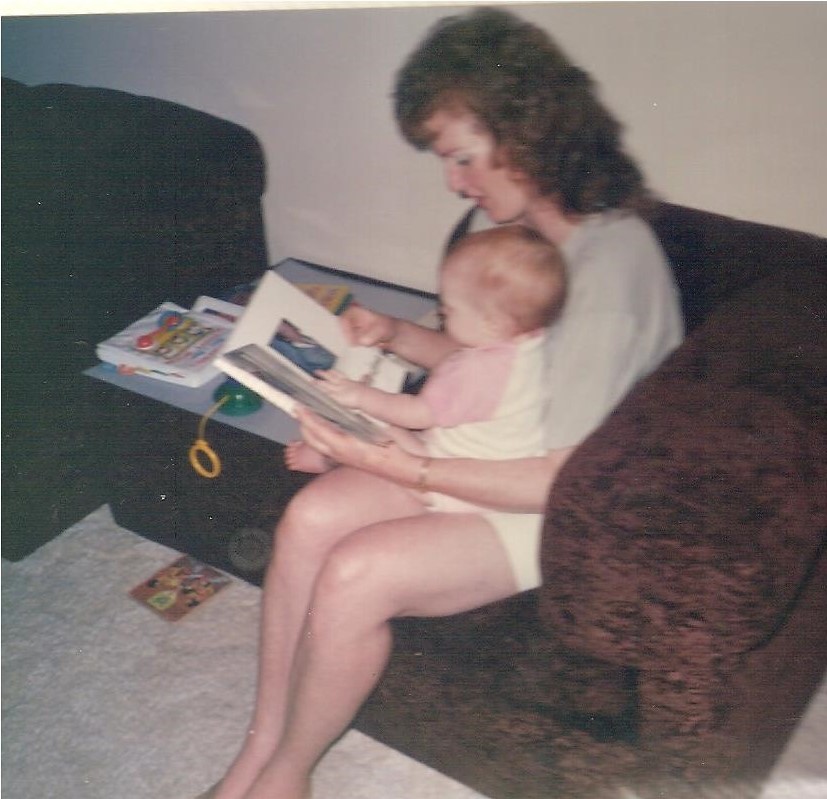
explores benefits of reading picture books to children
questions the place of factual information in fictional texts, and
suggests the importance of teaching critical literacy from a young age.
I will provide a brief overview of each post. I would be delighted to have you follow the links to read the posts in full.
In this post I explained that sharing picture books with children has many benefits, including:
At home:
It can help strengthen the parent-child bond, becoming a special time of togetherness and of sharing stories and ideas.
It has a very positive effect upon their learning, helping them develop language, knowledge of print and books, and exposes them to new ideas and concepts.
In early childhood classrooms, The Very Hungry Caterpillar provides opportunities for work in many subject areas including:
Literature appreciation
Reading
Maths
Visual arts, and
Philosophical inquiry, but not Science (as I will explain later)
In this post I discuss some purposes for using picture books and raise some questions about their content.
A sampling of purposes:
encourages a love of reading and books
develops vocabulary and knowledge of language
provides a link between the language of home and the language used in the wider community and in education
supports beginning readers
inspires imagination
provides opportunities to discuss feelings, emotions, ideas, responses
develops feelings of empathy, identification, recognition, hope
instils an appreciation of art
Some questions:
Do fictional picture books have a role, and do picture book authors have a responsibility, in imparting factual information in their books?
Does it matter:
that, although lions don’t live in jungles, they are often referred to as “King of the jungle” and appears in that setting in many stories?
if animals that don’t co-exist, for example penguins and polar bears, appear in stories together?
if the portrayal of animals in stories is not anatomically correct, for example spiders shown with legs joined to their abdomens rather than cephalothoraxes?
Do errors such as these influence children’s understanding of the world?
How should adults handle the misinformation when sharing books with children?
In this post I refer specifically to inaccuracies in The Very Hungry Caterpillar and the pervasiveness of the misconceptions, if not totally attributable to the book, then at least in part. I suggest how acknowledging the inaccuracy can help develop critical literacy.
In his book Eric Carle writes that
“He (the caterpillar) built a small house, called a cocoon, around himself. He stayed inside for more than two weeks. Then he nibbled a hole in the cocoon, pushed his way out and . . . he was a beautiful butterfly!”
However, as this (hopefully correct) information from the Australian Museum shows, butterflies do not spin cocoons around themselves. Moths do. Some butterflies and skippers do form a silken shelter, but not a cocoon as in Carle’s picture book.
Unfortunately many articles found in an internet search share the same misinformation. I wonder how many adults grew up believing what Carle shared through his picture books. Even teachers have been surprised to learn that butterfly caterpillars do not spin cocoons.
In the original post I share some lovely videos related to butterfly and moth metamorphosis. It is worth taking a peek at them.
Does it matter if children (and adults) think that butterflies hatch out of cocoons?Eric Carle didn’t seem to think so. Do you?
In this post I argue that The Very Hungry Caterpillar has no place in a science lesson because of the misinformation contained therein: caterpillars do not eat many different foods and butterflies do not come out of cocoons.
The greatest value of the book is as a tool for teaching critical literacy; for teaching children that just because something is in print, doesn’t make it true. It is also important to realise that misinformation is not restricted to picture books, and that they need to question all sources of information for the author’s credentials and purpose in writing.
I suggest that teachers and parents:
point out inaccuracies and inconsistencies
encourage children to evaluate what they are reading and hearing against what they already know
support children to verify the source of the information and to check it against other more authoritative/reliable sources
help children to recognise that every author has a purpose and to identify that purpose
invite children to ask questions about what they are reading and to interrogate the content
encourage them to question, question, question.
Eric Carle says “If we can accept giants tied down by dwarfs, genies in bottles, and knights who attack windmills, why can’t a caterpillar (sic) come out of a cocoon?”
What do you think? Do picture book authors have a responsibility to be accurate? Is a butterfly coming out of a cocoon in the same realm as giants tied down by dwarfs? Would we accept a child hatching out of an egg? What parts of a story should be based in reality and which parts can be imagined?
“Why can’t a butterfly come out of a cocoon?” asks Eric.
Well, Eric, they just don’t.
Thank you for reading. I appreciate your feedback. Please share your thoughts about any of issues I have raised in these posts.
I have often expressed concern about what I consider to be an over-emphasis on standardised and national testing and the pressure it puts on students to achieve. I explained some reasons for my misgivings here and here and here, for example.
As a parent and a teacher the most important thing I want for my children is for them to be happy. After that I wish for them to be healthy and successful. But what is success? In a recent post I referred to a seventy-five year study conducted by George Vaillant who came to the conclusion that success means leading a happy life and that “warmth of relationships throughout life have the greatest positive impact on ‘life satisfaction‘”.
Last week I wrote about spelling tests and spelling bees and the effect that doing well, or not, might have upon a learner’s self-esteem as well as attitude to self as a learner, attitude to school, and to learning in general. While writing it I was not aware of an article written by Kate Taylor and published in the New York Times on April 6 2015: At Success Academy Charter Schools, High Scores and Polarizing Tactics.
Taylor opens the article by describing how the struggles of students to learn are made public, for all to see; posted on charts in hallways and reproduced in class newsletters. To see one’s name at the bottom of the list in a red zone, clearly showing that year level expectations have not been reached seems to be rather harsh, and humiliating for the child. Perhaps even more so if the teacher considered the student was just not trying. The teacher, it is reported, had difficulty watching the child take the tests for fear she would be upset by his mistakes. Months later the child scored 90% and was warmly congratulated.
Taylor goes on to say that the school, which has mostly poor black and Hispanic students, outscores many students from more affluent areas with results much higher than average on the state wide tests. I know that everybody loves a winner and that we all want our students to succeed, but at what cost? The article describes the school as being very rigid with a competitive atmosphere that requires strict adherence to rules.
Last week in my post A sprinkling of semicolons I shared an article by Ron Berger who talks about regular students whose “teachers have helped them develop the skills and mindsets necessary to produce work of exceptional quality, and have built classroom and school cultures in which exceptional work is the norm.” He says that most of the work comes from students in low-income urban schools.
I suddenly became fearful. Were the students and schools described by Berger similar to those of the Success Academy schools as described in Taylor’s article?
In both cases the students were from poor areas and they achieved remarkable success with most attending college. Austin, as described by Berger, made six drafts of his butterfly drawing before it was considered to be “scientific” enough. I wondered how much, if any, duress he had been under.
The article described Berger as the Chief Program Office of Expeditionary Learning Schools. I followed the link to discover a little more about Expeditionary Schools, checked with Wikipedia and other sites that came up in a Google search, including Open World Learning which says that expeditionary learning (EL) “fosters curiosity about the world by creating learning situations that provide something important to think about, time to experiment, and time to make sense of what is observed.” It also says that EL schools “promote rigorous and engaging curriculum; active, inquiry-based pedagogy; and a school culture that demands and teaches compassion and good citizenship. EL schools are based on the Outward Bound model, which starts with the belief that we learn best through experience.”
This all sounds wonderful and praise-worthy, and I was feeling a little happier about what I had shared. However, if there’s one thing I have realised after a lifetime involvement in education is that the written statements of any educational institution sound wonderful and praise-worthy. It’s the way the principles are applied in practice that makes the difference.
I didn’t like what I had read about Success Academy Charter Schools in the New York Times, so I thought I’d better check out their website to discover what philosophy and principles guide them. First thing I spotted was a letter from a parent responding to the article in the New York Times! The parent, Polina Bulman, painted a very different picture of the school from that offered in the Times.
Bulman describes the decision-making process she went through in choosing the Success Academy for her five year old daughter. She shares what had concerned her and explains how those concerns had been answered. She describes her daughter’s happiness at school and the progress she is making in all areas of her learning. She has nothing but praise for the school, and concludes her letter, which she shared on Facebook, with these words:
“I was so touched by the warm and welcoming atmosphere. I had a chance to hang out in the hallways, listening to what teachers say to students as they pass by, and watching what teachers and staff members say to one another. I saw so much collaboration and kindness, so much teamwork. The best thing is that as a parent I feel like a part of this team and am proud of it!”
These words are in quite strong contrast to those of the New York Times.
The “Approach to Learning” statement of the Success Academy explains that students are engaged in only 80 minutes of direct instruction each day and that the rest of the time they are engaged in small group instruction and hands on learning.
So what does all this mean?
For one thing, just as you can’t judge a book by its cover, you can’t judge a school by its policy statement.
For another, you can’t believe everything you read, even when the source seems trustworthy, you must question the author’s credentials, viewpoint and purpose in writing, “What barrow are they pushing?” (I’m upfront about my biases!)
And mostly, question, question question.
These are important lessons for readers of any material and of all ages. I have talked about the importance of developing critical literacy in a series of posts about using “The Very Hungry Caterpillar” in the classroom. No, definitely not in science lessons, but in lessons to discuss those very points discussed above:
Don’t believe everything you read
Check an author’s credentials and purpose in writing
And question everything.
While I applaud the end result of Austin’s butterfly drawing, I question what the process may have been. We are not privy to that, though the supportive voices of students in the video do give us an inkling. I hope for the sake of all students that it was one of encouragement and support rather than pressure. Additionally I hope that the report in the New York Times got it all wrong. But if that is so, what is Taylor’s agenda and why would she attack these particular schools so fiercely?
Note: I wrote this article a couple of days ago and upon re-reading it now I have a couple of further thoughts re my advice to check an author’s credentials and purpose in writing. I have not followed my advice. I failed to check out the author of the NY Times article. However I think it is fair to say that Lloyd Lofthouse and Diane Ravitch are both anti the emphasis on standardised testing; and the Success Academy is probably reliant on the tests to measure its “success”.
There is no black and white truth. There are only shades of grey.
Thank you for reading. I appreciate your feedback. Please share your thoughts about any aspect of this post.
Most teachers try to incorporate a variety of experiences into their programs in order to maximise learning opportunities in the hope that, if students don’t “get” it one way, they will “get” it in another. The imposition of national standardised assessment makes doing this a challenge for teachers. The increased requirement for the implementation of particular approaches to teaching makes it even more so.
To say that I hold fairly strong views about learning, and the differences I consider there to be between education and schooling is perhaps an understatement, but it wasn’t always so.
My memory tells me that, while I probably didn’t “love” school, I probably didn’t “hate” it either. It was simply something that I had to do. I didn’t question it. I did my best to be a “good” girl, do what was expected of me, and conform. All of which I think I did pretty well.
The questioning came later and had more impact upon my teaching and parenting than it did on my own schooling. I came to view schooling as something that is “done” to us, and education as something that we do for ourselves. That is not to say that no worthwhile learning takes place in school, for it does, but education is a whole-of-life experience and schooling is but one small part of that.
However, if the importance of schooling, and here I mean learning of particular content by particular ages, is inflated and rated more highly than children’s natural curiosity, interests and abilities, then the consequences to individuals and the community in general can be more negative than positive. One consequence may be that children don’t enjoy school; another may be the view that only school knowledge is important; and yet another may be that children are turned off learning all together.
My first conscious discomfort with what, for convenience, I’ll call a factory model of schooling (children go in one end, have things “done” to them, and come out the other end all the same) was as a young teacher when all five year two teachers were expected to be doing the same thing at the same time. That imposition, along with other inadequacies that were beginning to become apparent, set me on a quest to learn more about learning and education. My quest has never ceased and I am still searching for answers.
Recently I read a book by Daniel T. Willingham entitled “Why Don’t Students Like School?” The title had instant appeal, of course, and I thought I’d recognise a few of the reasons at least. My initial expectation was of reading views similar to those of authors like John Holt, Ivan Illich, A.S. Neill and John Dewey whose books I had read in the 70s and 80s; but a closer look at the subtitle told me I was in for more: “A Cognitive Scientist Answers Questions About How The Mind Works and What It Means For The Classroom”.
The book is a wonderful read and I’m certain to share many of Willingham’s ideas with you in future posts. I enjoyed it because, in almost equal measure it reinforced, challenged and extended my thinking about many aspects of learning and how best to provide for and stimulate it in a classroom setting.
Sometimes Willingham would make a statement with which I agreed, and then go on to explain the faulty thinking behind it. Sometimes his statement would seem to completely contradict what I think but his explanation would show that we simply had different ways (mine perhaps inadequate) in explaining it.
What I really appreciate about the book is that Willingham carefully translates what has been learned from research into practices that can be implemented in the classroom to enhance student learning. Often research seems only to tell teachers what they already know from experience and observations, or provides information in such an abstract way that nothing of practical use can be gleaned.
The section of Willingham’s book that I refer to today is “Chapter 7 – How Should I Adjust My Teaching for Different Types of Learners?” Willingham opens the chapter with the words “All children are different.” He says that some learn visually, some auditorily; that some are linear thinkers and some holistic, for example, and that
“It seems that tailoring instruction to each student’s cognitive style is potentially of enormous significance”.
The important word in that sentence is “seems”. He talks about the differences in the way that hypothetical Sam and Donna might learn and says that “An enormous amount of research exploring this idea has been conducted in the last fifty years, and finding the differences between Sam and Donna that would fit this pattern has been the holy grail of educational research, but no one has found consistent evidence supporting a theory describing such a difference.”
He states that the “cognitive principle guiding this chapter is:
“Children are more alike than different in terms of how they think and learn.”
That statement really made me sit up and take notice: “Children are more alike than different”. But it turns out, those words are not the most important ones in the sentence. The most important ones are: “in terms of how they think and learn.”
He goes on to say that, “the claim is not that all children are alike, nor that teachers should treat children as interchangeable. Naturally some kids like math whereas other are better at English. Some children are shy and some are outgoing. Teachers interact with each student differently, just as they interact with friends differently; but teachers should be aware that, as far as scientists have been able to determine, there are not categorically different types of learners.”
He also talks about it in this video:
Willingham acknowledges that students differ in their cognitive abilities and styles. What he does in the chapter is “try to reconcile the differences among students with the conclusion that these differences don’t mean much for teachers.” In reading these words one might expect that Willingham is proposing that differentiation is not an important part of classroom practice. But such is not the case, as stated in this video:
In the book he writes, “I am not saying that teachers should not differentiate instruction. I hope and expect that they will. But when they do so, they should know that scientists cannot offer any help.” According to Willingham, scientists have not identified any types of learners or styles of learning. He says, “I would advise teachers to treat students differently on the basis of the teacher’s experience with each student and to remain alert for what works. When differentiating among students, craft knowledge trumps science.”
What Willingham says is of most importance for a learner to learn is background knowledge. If a student does not have sufficient background knowledge to understand the content or concepts which are presented, learning will not take place. This supports the advice that I repeatedly give to parents: read to your children, talk with them, and provide them with a wide range of experiences and activities.The same is true for teachers: ensure the students have sufficient knowledge on which to build the new work you are expecting them to grasp.
This week at the Carrot RanchCharli Mills has thrown a prompt with which I have struggled: In 99 words (no more, no less) write about the day the earth turned brown. I always like to tie my responses to the educational focus of my blog and this one had me stumped for a while. A mind journey following various twists and turns, retracing well-worn paths, and hitting many dead ends, finally led me to an oasis in the parched brown earth: the uniqueness of each of us; the amazing potential of each new child to create possibilities beyond our imagining; and the contrasting effect of a narrow test-driven school system that attempts to reduce each to the sameness of minimum standards and age (in-)appropriate benchmarks. A paint palette seemed a suitable medium for the story.
For those of you who have been following Marnie’s story, I apologise. She makes no appearance this time, though I have not ruled out the possibility with student M. I’d be pleased to know what you think.
Palette potential
She walked between the desks admiring their work. From the same small palette of primary colours, and a little black and white for shades and tones, what they produced was as individual as they: J’s fierce green dinosaur and exploding volcanoes; T’s bright blue sea with sailing boat and smiling yellow sun; B’s football match . . . At least in this they had some small opportunity for self-expression. She paused at M’s. M had mixed all the colours into one muddy brown and was using hands to smear palette, paper, desk and self . . .
Thank you for reading. I appreciate your feedback. Please share your thoughts about any aspect of this post or flash fiction.
In my current out-of-the-classroom position I write science curriculum materials for use in early childhood classrooms. It is an interesting and challenging role, but also lots of fun as I work with a number of other writers who are also teachers, with an added qualification in science. As many of them have studied science at tertiary level, worked in various other fields, and taught science at high school level, I am surrounded by people with a lot of knowledge and experience different from mine.
One thing that is wonderful about working with a group of scientists is the range of topics that are raised for discussion around the table at lunch time. Scientists are naturally curious and they don’t take anything at face value. They delve into it, interrogate, investigate and explore until they have answers to questions that may have arisen. I learn a lot! Like the difference between degradable and bio-degradable; how close the asteroid came to Earth; and mitochondria, genetics and children with three parents!
On the home front too, I am surrounded by scientists; computer scientists and environmental scientists, each with a strong sense of social responsibility and ethics. I am fortunate to be swept along in learning by their interests and enthusiasm.
In previous posts I have shared some thoughts about the importance of curiosity and of my opinion that children are born scientists. I am always delighted when I come across something that supports my opinion. (Yes, there are others!)
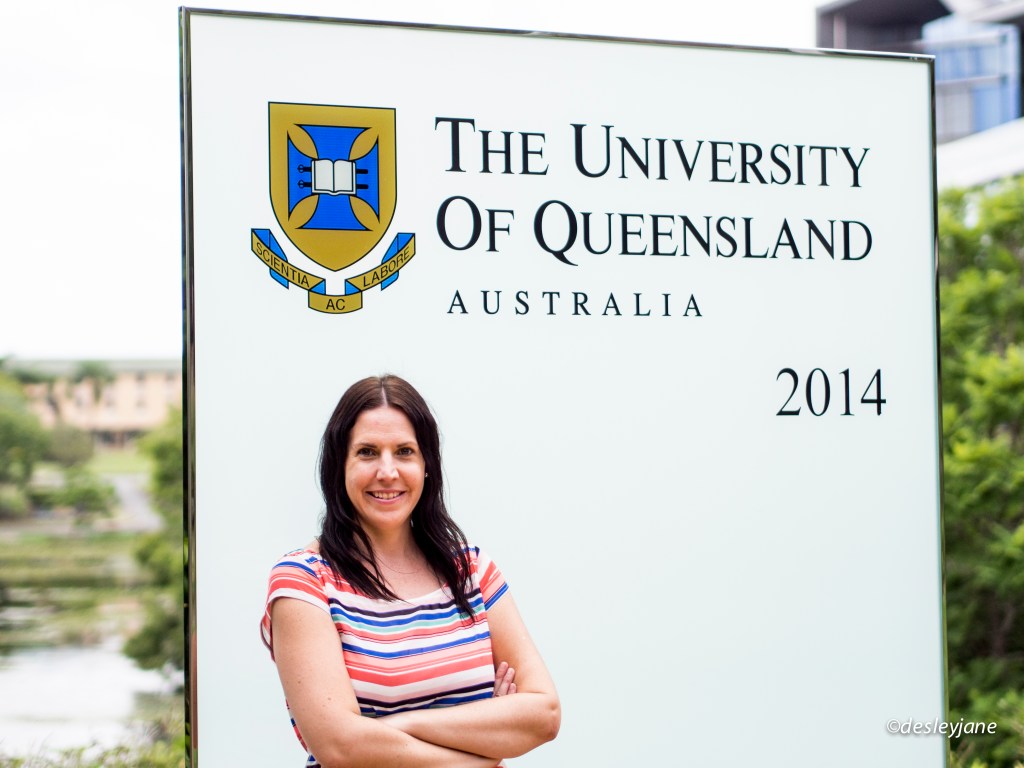
I have recently discovered a lovely blog Musings of a Frequent Flying Scientist written by a local scientist Desley Jane. This week she shared an interview with another local scientist Julia Archbold. I enjoyed it so much I decided to share it with you.
These are just a few of things I like about it: They are both young female scientists. (For too long science was seen as a male-only province.) The importance placed upon curiosity, asking questions and ‘quizativity’ (what a great word!) The excitement of learning. That their engagement with science makes a positive contribution ‘the world’.
Please visit Desley’s blog to read the entire interview and explore what else she has to offer.
Thanks for reading. I appreciate your feedback. Please share your thoughts about any aspect of this post.
This is my first interview for my Scientific Reasoning feature. The questions will be the same for each interviewee and I hope that they will give us some insight into the lives of a few of today’s scientists.
Dr Julia Archbold is a good friend of mine. We have known each other for many years and have worked together in the past in our twenties (ish). I admire Julia greatly, both as a scientist and as a person. She is warm and talented, with a quick wit and a very kind soul. She is about to embark on an exciting new adventure and I caught her just in time for this interview.
me: So I know you’re a scientist, but when did you decide to become a scientist? What were you thinking? (Not WHAT WERE YOU THINKING?!?! but what made you decide that science was going to be your future?)
I decided to give myself a break from writing about the confusion that students may feel as they attempt to navigate the murky waters of expectations and inappropriate curricula that have little connection with their lives; or about how disoriented they may feel in an environment that bears little resemblance to any other they will experience.
Instead I decided to share an interesting story I heard this week and a flash fiction which is more memoir than fiction, a reminder to self of how lucky I am to be doing what I am.
“Each letter in the book is linked to a topic. Each chapter takes on different aspects of how the alphabet has been used. Each chapter is preceded by the short story of how that particular letter evolved, how its name came to be pronounced that way and something on how the letter itself is spoken and played with.”
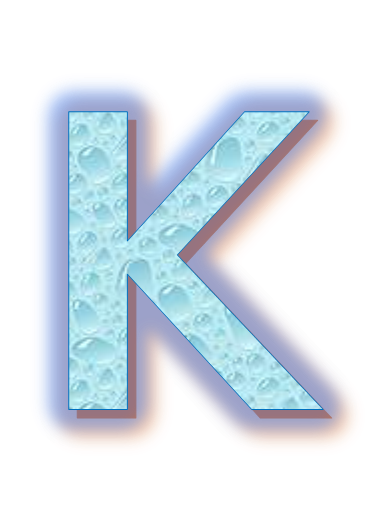
When listening to Rosen read his chapter about the letter ‘K’, “K is for Korean”, I was fascinated to find out that the alphabet of South Korea, Hangul, is “the earliest known successful example of a sudden, conscious, total transformation of a country’s writing.”
The alphabet, described by Rosen as more of “syllabic monograms” than letters and is easy to learn, was devised in the mid-fifteenth century by the ruler of the time, King Sejong, as a way of enabling everyone to be literate.
Prior to the introduction of this alphabet, Chinese characters were used. According to an article on Wikipedia “using Chinese characters to write was so difficult for the common people that only privileged aristocrats usually male, could read and write fluently. The majority of Koreans were effectively illiterate before the invention of Hangul.”
Rosen says that what is “remarkable . . . is that there was an already existing system of writing which was, to all intents and purposes, overthrown in its entirety – not adapted. (It happened) because one part of the ruling elite decided that a total change was the only way in which everyone could read and write easily.”
Hear! Hear! I say, and express a wish that all our students of English would find learning to read and write far more easy and enjoyable than many do, that more emphasis would be placed upon helping students learn than in “teaching” particular content at particular times.
Also included in Rosen’s chapter about ‘K’ was mention of the Voynich Manuscript which appears to be scientific in origin, but which contains fictitious plants and is written in a “language” which no one, including codebreaking experts, has been able to decipher and read. Rosen says that “With one beautifully executed volume, (the author) causes instability and doubt at the heart of the production, ownership and use of knowledge. It is a carefully constructed absurdist joke.”
Unfortunately for a small (but too large) number of our students, reading and writing for them is often as confusing as the Voynich Manuscript.
For a little bit of reminiscing, here is a video of Michael Rosen talking about the dreaded Friday spelling test. I wonder how his experience matches yours.
And so to my flash fiction of disorientation and confusion . . .
Obfuscation
The pulsing train wheels pounded in my head.
Way off in the distance voices called instructions to each other.
“What day is it?” I said.
The voices were closer now. “She’s in here.”
“Can you walk? Come with us,” they said.
They led me to a vehicle and bade me lie down inside.
Then came the questions:
What’s your name? When were you born? What day is it? Why are you here? Who are you with?
Slowly, as if from the deepest recesses, I drew each recalcitrant answer, recreating identity.
“You’re okay. You bumped your head,” they said.
Thank you for reading. I appreciate your feedback. Please share your thoughts about any aspect of this post or flash fiction.
‘Always look on the bright side of life’ is a philosophy to which I aspire. Many think I have achieved it but they don’t know how hard I struggle. I do try to find the good in people and situations, but it’s not always my first and instinctive reaction. When I realise I’ve reacted negatively I try to change or hide my negative thoughts and replace them with positive ones. But it’s not always easy to convince myself, regardless of whether I convince anyone else or not.
It reminds me of a quote on a laundry bag which has stayed with me in eight different homes in three different states and for well more than thirty years. After all this support I have finally thought to seek out the source of the wisdom and found it to be UK poet and playwright Christopher Fry.
I feel the quote represents me quite well; doing what I can to hold it all together and keeping those negative instincts in check by ‘nipping them in the bud’, all the while fearful of one day just losing it and letting it all out in one mighty swoosh. I guess the expectation of fewer years remaining in which I will need to keep myself contained makes me a little optimistic. (Always look on the bright side!)
I like to think I’m more of a hopeful realist than either a Pollyanna or a negative realistic. A discussion about optimism and pessimism followed a previous post in which I asked How much of a meliorist are you? But meliorism is more a belief that the world can be improved by the actions of humans than an optimistic or pessimistic expectation of the outcome.
I believe that humans have an amazing potential for improving our world (i.e. every aspect of it). That makes me a meliorist. Recognising what is happening in the world now makes me a realist. A belief that human actions will make improvements in the future makes me an optimist, but not one without some pessimistic fears. While stories of terrorism, climate change and violence fuel the fears, stories like this TED talk by Tasso Azevedo show that improvements can be, and are being, made.
I am an education meliorist. I believe that education is a powerful agent for change and has an enormous potential for improving lives. My optimism that education will impact positively upon individual lives as well as the collective human situation outweighs my pessimism about the outcomes I see in current systemic trends and leads me to seek out educators, like Ken Robinson, Chris Lehmann , Michael Rosen, Barbara Arrowsmith-Young and Rita Pierson who share my vision of what could be.
A quest to improve my own life and the lives of others through education has been a long time passion. Ensuring that my own children experienced the benefits of learnacy, though I hadn’t heard of the term at the time, as well as literacy and numeracy was of great importance to me. I encouraged them to question, to create, to think critically, to read, to learn, to wonder . . . There is so much we teach our children the list goes on. It is very rewarding for me to see that they have a love of learning and are passing that same love on to the next generation.
Having, sharing and fostering a lifelong love of learning perhaps in some ways contributes to giving meaning to my life. But it also leads me to question life and its purpose in ways that many others don’t. This questioning can lead to a sense of unease, of lacking fulfilment, of needing to do and achieve more. I know others who better accept the way things are, accept each day as it comes, and are content in their existence. Sometimes I envy their complacency. Other times I want to shake them and make them realise that there is more to life than this.
But am I wrong? Is there actually less to life than this? It is sometimes said that there is no point in accumulating wealth and possessions as you can’t take them with you when you go. But is there any point in accumulating a lot of learning and knowledge? After all, you can’t take it with you when you go either; but like wealth and possessions, you can leave it behind for future generations. If we lived only for what we could take with us, would there be a point?
I guess what matters is what helps each of us reach that level of contentment, of being here and now in the present moment because, after all, it is all we ever have.
I often think about life, existence, why we are here and the purpose of it all, constantly wavering between seeing a point and not. A recent discussion with a friend about her feelings of emptiness and needing to find more purpose and meaning in life disturbed my approaching, but elusive, equilibrium again. Will I ever reach that blissful and enviable state of contentment: knowing and accepting who I am, where I am, where I am going and how I am going to get there? Who knows? But I can have fun figuring it out. I am determined to enjoy the journey. I don’t think there will be much joy at the end!
She smiled. She knew. She only needed official confirmation.
He wanted dates. She supplied.
But she knew the very moment an unexpected but welcome spark enlivened her being with its playful announcement, “Surprise! I’m here!”
She’d carried the secret joy within her for weeks, never letting on, keeping it to herself, waiting. No one would have believed her without proof. But with her whole being she knew.
Finally, after nine inseparable months, she held the child, distinct and individual. She marvelled at the tiny creation whose existence breathed purpose and meaning into hers.
Thank you for reading. I appreciate your feedback. Please share your thoughts about any aspect of this post and flash fiction.

























 Norah Colvin

