Live Love Laugh Learn … Create the possibilities

Tag: Picture books

  • Meet Australian author: Jane Jolly – Readilearn

    Reblogged from readilearn

    This week I have the great pleasure of inviting South Australian author Jane Jolly to the readilearn blog. Jane is author of a number of books, including the recently published Radio Rescue!

    The book about which I am talking with Jane in this interview is Tea and Sugar Christmas. Like many of Jane’s publications, this one is based on a true story. It tells of a Christmas experience that is likely very different from your own.

    The Tea and Sugar Train

    Click the link to read the original: Meet Australian author: Jane Jolly – Readilearn

  • Books make the #1 best gifts!

    The love of reading is gift

    I am notorious for gifting books. I’ve written about this before in Guess what you’re getting for Christmas and other posts. It would not surprise me if you are also a notorious gifter of books. Perhaps that could be our super power: The Book Gifters!

    Reading is empowering. A book is a gift that continues to give, long after the occasion has past. It’s effects cannot always be measured.

    books-life-memories

    In this post, I suggest some books you may like to purchase for special people in your life. And why not treat yourself with one or two as well?

    Most, but not all, are fairly recent releases. A few are long-time favourites.

    Most, but not all, are written by people I know personally or through blogging. You might recognise their names from comments on other of my blog posts. A few are long-time favourites written by people who inspire me.

    I have read most. The only two not read (the books of short stories) are very, very recent. However I am happy to recommend them as I am already familiar with some of the stories, and the writers’ work  from their blogs.

    Disclaimer: These are books that appeal to me. They may not appeal to you. The important thing in choosing books for others is in finding something that they will like.

    The list is not exhaustive. It is just a beginning to provide a few ideas that you may not have considered. There are many other wonderful books that could just as easily have been included.

    I have arranged my list in this way:

    For children:

    Picture books (including fiction, non-fiction, and poetry)

    Early chapter books (for readers of about 7 to 12 years)

    For adults:

    Books of short stories

    Novels

    Memoirs

    Books for teachers and parents

    If you follow the links you will be able to discover more about the writers and their other work.

    For children:

    Picture books – Fiction

    picture-books

    Lauri Fortino The Peddler’s Bed This heart-warming story demonstrates that a kindness given can encourage kindness in others. You can read a lovely interview with Lauri on the readilearn blog here.

    Tara Lazar Little Red Gliding Hood In this fun fractured fairy tale, Little Red Riding Hood needs a new pair of skates. The only way she can acquire them is by winning a skating competition. But which fairy tale character will be her partner?

    Galvin Scott Davis Daisy Chain This is a beautifully illustrated, animated and interactive, anti-bullying book app, narrated by Kate Winslet.

    Non-fiction

    non-fiction-picture

    Rebecca Johnson The Insect Series This series of ten little books, each about a different insect, combines both fact and fiction with stunning close-up photographs. You can read a lovely interview with Rebecca on the readilearn blog here.

    Sue Fliess The Bug Book This book about bugs is beautifully illustrated with stunning photographs. Written in rhyme, it introduces children to many tiny creatures.

    Poetry
    book-cover

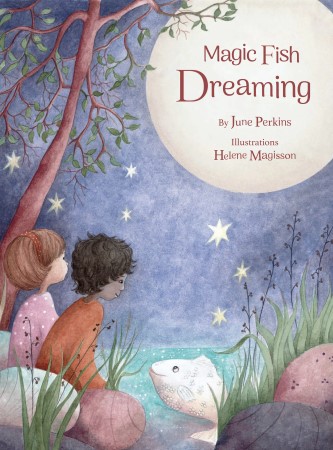
    June Perkins Magic Fish Dreaming This gorgeous book of poems with its focus on nature will uplift and inspire you and your children. You can read a lovely interview with June on the readilearn blog here.

    Early chapter books (about 7 to 12 years)
    early-chapter-books

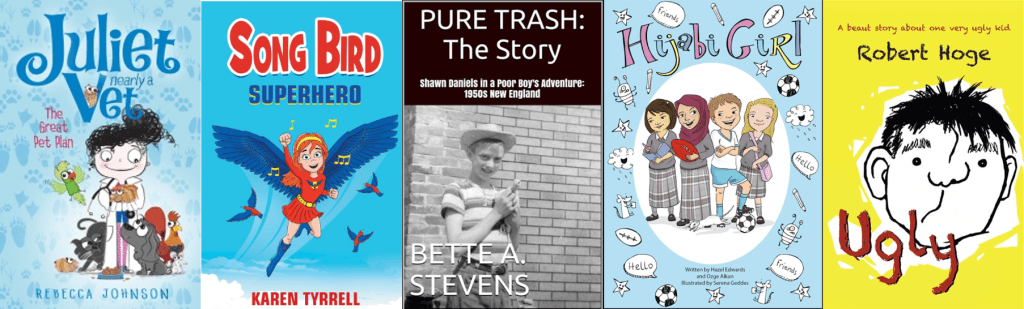
    Rebecca Johnson Juliet nearly a Vet This lovely series of books tells of the adventures of ten-year-old Juliet who aspires to be a vet, just like her mother.

    Karen Tyrrell Song Bird Superhero This story tells of Rosella Bird and her quest to fly. While she battles the bully at school and at home, she is empowered and discovers the joy of flight when she finds her voice.

    Bette A. Stevens Pure Trash: The Story Set in New England in the 1950s, this story tells of a Saturday afternoon adventure of two young boys. The Kindle version is free on Amazon until 29 November (today – be quick!). 

    Hazel Edwards & Ozge Alkan Hijabi Girl In this story, when eight-year-old Melek is deciding what to wear to the book parade, she is unable to find a super-hero who wears a hijab, so she creates her own.

    Robert Hoge Ugly (a memoir) Robert’s story is one of resilience, of survival against the odds, and of making hard decisions. While coping with difference and bullying, Robert shows that strength of character is a trait of survivors. I have introduced you to Robert previously here and here.

    Books of short stories

    short-stories

    Sarah Brentyn Hinting at Shadows This book is a collection of very short stories, each 100 words or less. While each may be a quick read, they will give insight, inspiration, and a greater understanding of what it means to be human.

    Hugh Roberts Glimpses Launching on 2 December, available for pre-order “28 short stories that will take your mind on a rollercoaster of a ride into worlds that conceal unexpected twists and turns.”

    Novels
    novels

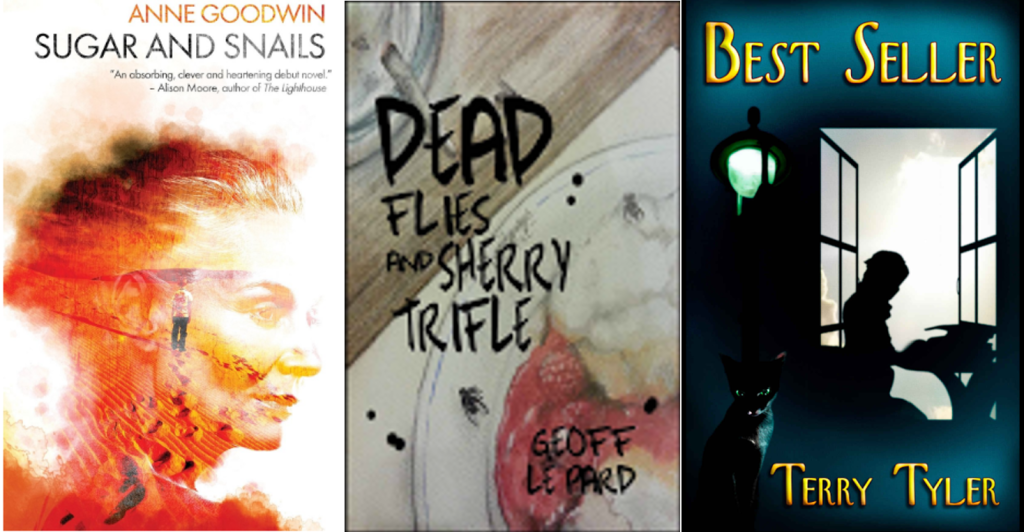
    Anne Goodwin Sugar and Snails In this mid-life coming-of-age story, Diana Dodsworth has some tough decisions to make as she comes to terms with who she really is. Anne has previously talked about her book on my blog here and here.

    Geoff Le Pard Dead Flies and Sherry Trifle This story about nineteen-year-old Harry Spittle, who is home from university for the hottest of hot holidays, will have you laughing out loud at his misadventures.

    Terry Tyler Best Seller This intriguing novella is about three writers, all of whom wish to write a best seller. One does; but which one?

    Memoirs

    memoir

    Robert Hoge Ugly (a biography) Robert’s inspirational story is one of resilience, of survival against the odds, and of making hard decisions. While coping with difference and bullying, Robert shows that strength of character is a trait of survivors. I have introduced you to Robert previously here and here.

    Lesley and Tammy Williams Not Just Black and White Told as a conversation between mother and daughter, this inspirational story tells of the importance of family, of difficulties experienced by many Indigenous Australians in relatively current times, with a drive to ensure that history is neither forgotten nor repeated.

    Malala Yousafzai Malala The Girl Who Stood up for Education and Changed the World The story of Malala, winner of the Nobel Peace Prize, is one of courage and of the difference that one person can make in the world. I have previously written about Malala here.

    Magda Szubanski Reckoning: A Memoir With a Polish father, a Scottish mother and an Australian childhood, Magda’s story is complex, courageous, compassionate, and inspirational.

    Books for teachers and parents

    for-teachers-and-parents

    Mem Fox Reading Magic This book provides lots of practical advice and support for parents in developing a love of reading in their children. I have introduced you to Mem many times previously, including here and here.

    Michael Rosen Good Ideas: How to be Your Child’s (and Your Own) Best Teacher This very readable book is packed full of suggestions for encouraging curiosity and learning in children (and you!) I have previously introduced you to Michael here and here.

    Vivian Kirkfield Show Me How Vivian passion’s for picture books and her understanding of the importance of literacy are obvious in this book that provides great ideas for reading and extending the learning experience associated with many picture books.

    Or, for a special early childhood educator, gift a subscription to readilearn, a collection of teaching resources that can be used throughout the year.

    special-gift-for-special-teacher-ad

    It’s easy. Simply send an email to hello@readilearn.com.au, arrange payment for the currently discounted subscription, and you will be emailed a voucher with a coupon code, unique to your special teacher. Print the voucher and personalise it with your own message before presenting your gift.

    Note: The subscription is for 12 months from date of activation, not purchase: a gift that will go on giving all year long.

    2

    I hope there is something in this list that you can add to your gift list.
    Thank you

    Thank you for reading. I appreciate your feedback. Please share your thoughts.


  • Listen to the sounds

    Charli's picture

    This week at the Carrot Ranch, Charli Mills is talking about sound, and has challenged writers to

    In 99 words (no more, no less) write a story that includes the sense of sound. It can be an onomatopoeia, a swearing session with sound alike substitutes, lyrical prose or a description of a sound. Go where you hear the prompt calling.

    I thought it was quite timely for me as I had just written a piece about audiobooks. However, I have decided to keep that for posting another day and have instead decided to look at picture books. Regular readers may not be surprised.

    Picture books are often a child’s first introduction to stories, poems, fantasy and other worlds. The language of picture books is immensely important and must captivate the ear as the illustrations engage the eye. Through picture books children are learning the sounds of the language: its rhythms and intonations; its accents and pronunciations; its beauty and its meaning.

    Many picture books are written in rhythmic, rhyming language and we are quick to note when the timing is a little off or the rhyme not quite right. Successful picture book authors write and rewrite until they get the sound of the language just right for a read aloud experience. Though the words may be few, the task may be difficult. Children, their parents, and teachers are a discerning audience.

    As onomatopoeia (a word that phonetically imitates, resembles or suggests the source of the sound that it describes) features in many children’s songs and picture books, it is the focus of this post.

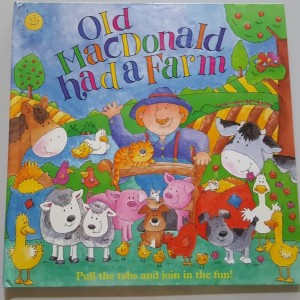
    Old MacDonald had a Farm

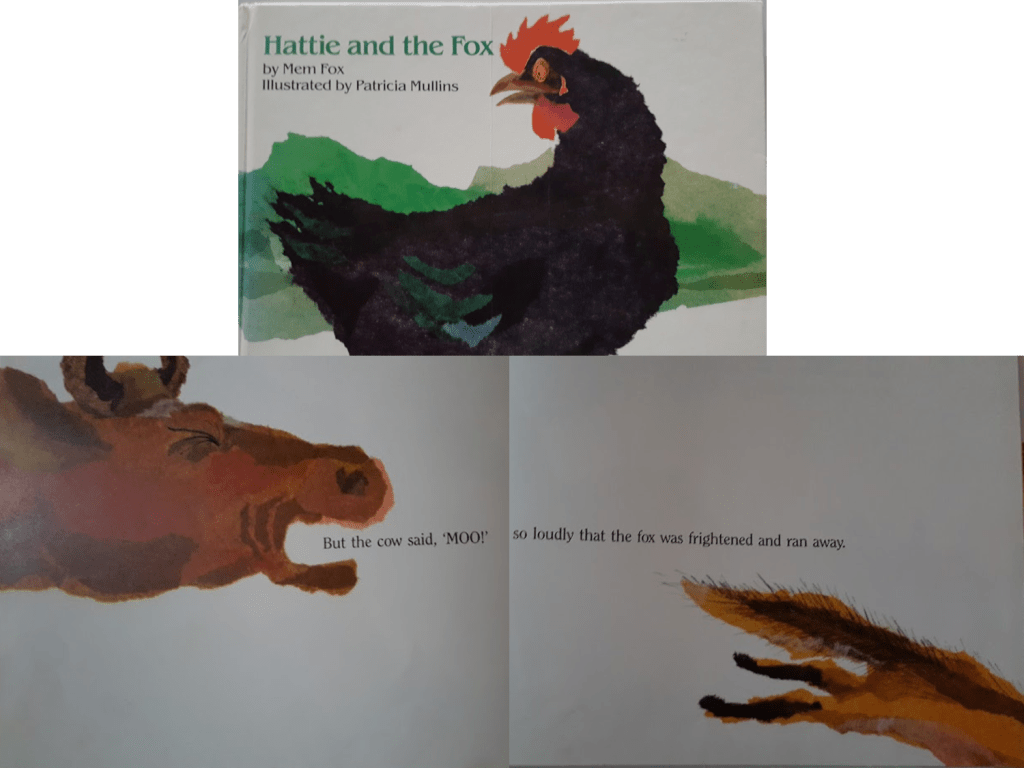
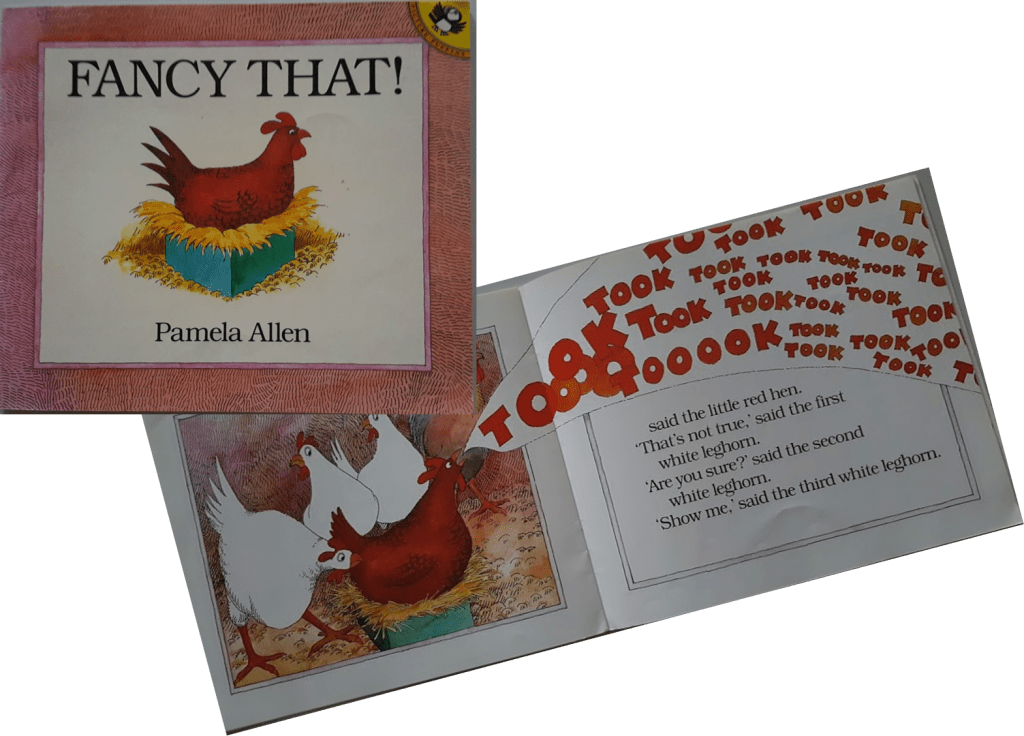
    Animal sounds, familiar through songs such as Old MacDonald Had a Farm, frequently occur in picture books, including Hattie and the Fox and Fancy That!

    Hattie and the Fox

    Fancy That

    The sounds of machines are also popular. Some of you may recall the song about The Marvellous Toy that “went zip when it moved, and bop when it stopped, and whirr when it stood still.”

    the Train to Timbuctu

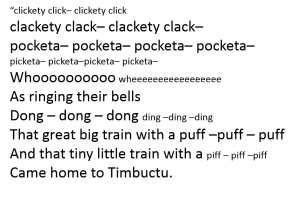
    The repetitive rhythmic sound of a train’s motion is frequently portrayed, as in The Train to Timbuctu that went

    Timbuctu rhyme

    the Little Engine that Could

    and The Little Engine that Could with its

    “I think I can – I think I can – I think I can – I think I can – I think I can – I think I can – I think I can – I think I can – I think I can.”

    followed by

    “I thought I could. I thought I could. I thought I could. I thought I could. I thought I could. I thought I could.”

    A great demonstration of a growth mindset.

    Bertie and the Bear

    There are also the sounds of musical instruments as in Bertie and the Bear.

    An Old Witch Song

    There are the sounds associated with actions, like the swish of the broomstick and the plop of the hop toad in Old Old Witch;

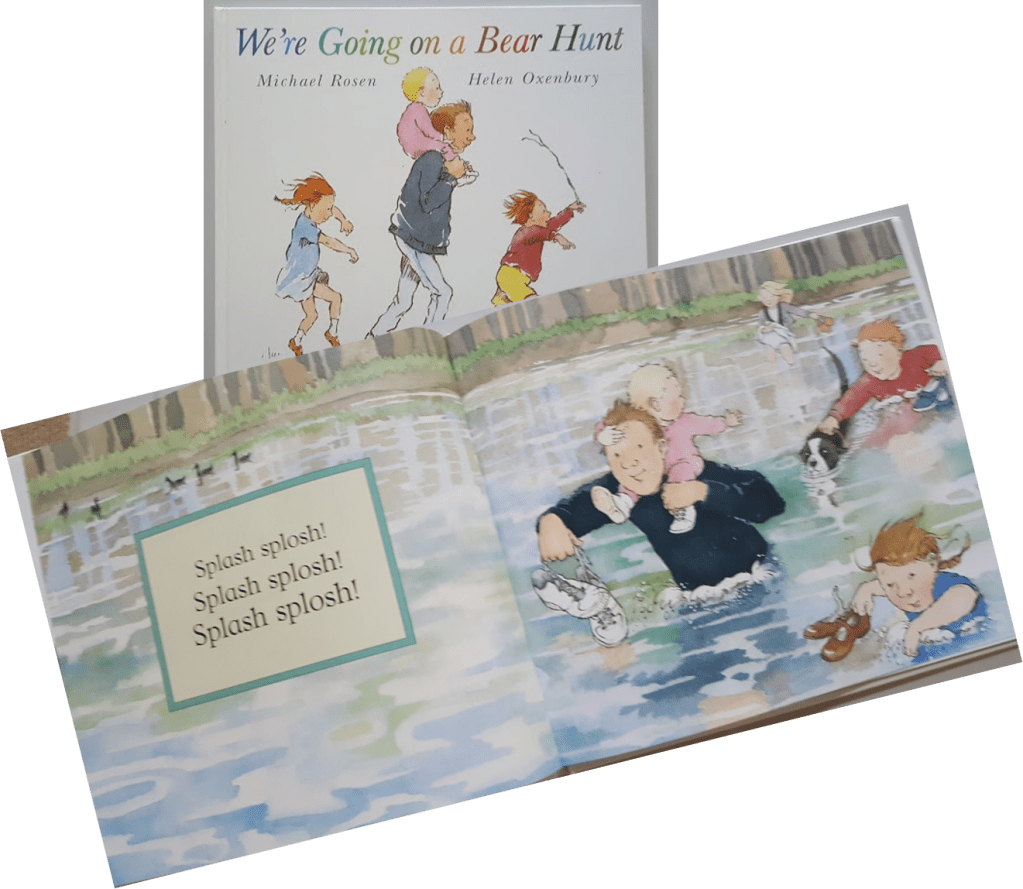
    Going on a bear hunt

    and those from Going on a Bear Hunt with its swishy swashy of moving through grass, splash splosh of wading through water, and squelch squelch of walking in mud.

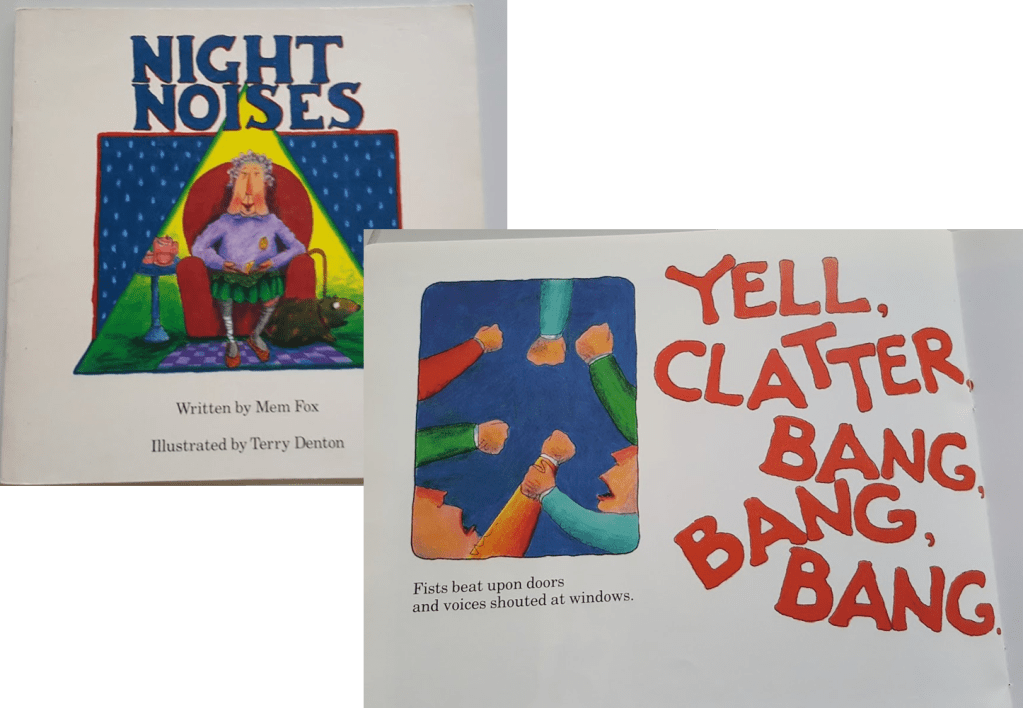
    Night Noises

    Some stories introduce a variety of onomatopoeic words. Night Noises, about a surprise party for Lillie Laceby who was nearly ninety, includes the click clack of car doors opening and closing, the crinch crunch of feet tip-toeing on a garden path, the murmur and mutter of voices whispering, the creak crack of knees, and the snick snack of bolts on the door.

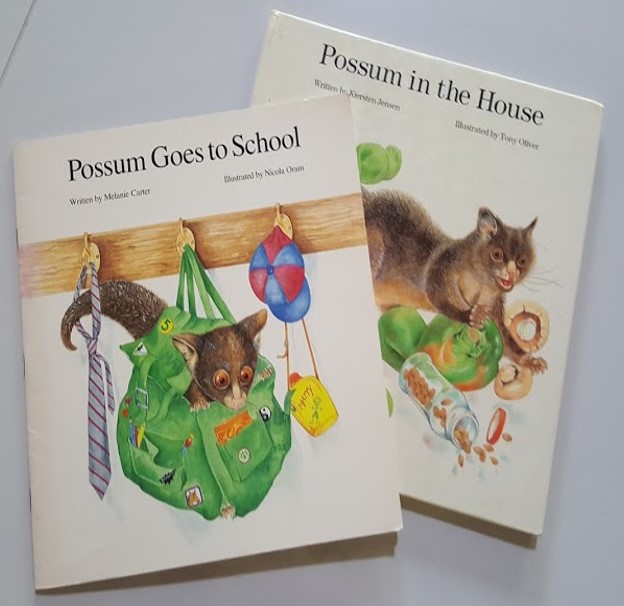
    Possum goes to school

    When there’s a Possum in the House or Possum Goes to School, there is nothing but trouble, with possum making a mess at every opportunity.

    At home, in the pantry the cornflakes go crunch crunch, in the kitchen the saucepans go clatter clatter, and in the study the pages go rustle rustle. Each time the possum’s whereabouts is discovered, it goes screech screech and runs off to another room to create yet more mess.

    The same occurs at school with paints going drip drip in the art room, claws going scratch scratch in the staff room, and the goldfish going splash splash in the science room.

    Burping Baby

    Then of course, there are also the body noises that children seem to take delight in, like those from Burping Baby.

    I recently discovered Lauri Fortino’s Frog on a [B]log, a blog celebrating picture books. Lauri has a delightful picture book of her own The Peddler’s Bed, illustrated by Bong Redila. Lauri recently shared a reading of the story on her blog. Since we are talking about sounds, if you have a few spare minutes, pop over and have a listen.  You will also find an example of onomatopoeia in her story with the repetition of squeak squeak squeak.

    Onomatopoeic words are often presented in fonts of different size or colour, or even different type. Children are fascinated by them, pointing to, asking about, maybe even recognising them, long before they are able to recognise any other words. You can help to get them started by pointing to the words and inviting them to join in the hullabaloo. What a great introduction to the world of reading.

    Now that I have reminded you of these types of onomatopoeia and provided you with these wonderful examples, I wonder what I was thinking. How can I match them in my flash? I need a flash of inspiration, or maybe a flash of lightning to begin my story about a mother and child hurrying to make it home before the storm hits. I hope you enjoy it.

    The eye of the storm

    “Storm’s coming!”

    Pit pitter-patter Pat pitter-patter hasten four feet.

    Lightning and thunder boom down the street.

    “H-h-h-hurry.” Mum urges. “Home – nearly there.”

    Pit scuffle-scuffle Pat scuffle-scuffle “Straight up the stair.”

    Clink-chink-fumble-fumble “No need to knock.”

    Scritch-scratch “I’ve managed – the key’s in the lock.”

    Whoosh! chortles wind, as it rushes inside.

    Damn! cusses chair chucked onto its side.

    P-u-sh!  The door bangs! Avoid pellets of ice

    Smashing and tumbling like millions of dice.

    Rat-a-tat raindrops, another crash-boom!

    Shuffle and scurry. “Straight to the safe room.”

    Huddled together, hardly daring to breathe,

    Listening and waiting for the monster to leave.

    Then sudden quiet, the child whispers hope

    “Is it all over?” Mum answers, “Nope.”


    The first fifteen lines meet Charli’s 99 work criteria. I added the last two because I was thinking of the eye of a storm that brings a quiet calm but not the end of the storm –  there’s still more to come. I’d love to know what you think.

    Thank you

    Thank you for reading. I appreciate your feedback. Please share your thoughts.

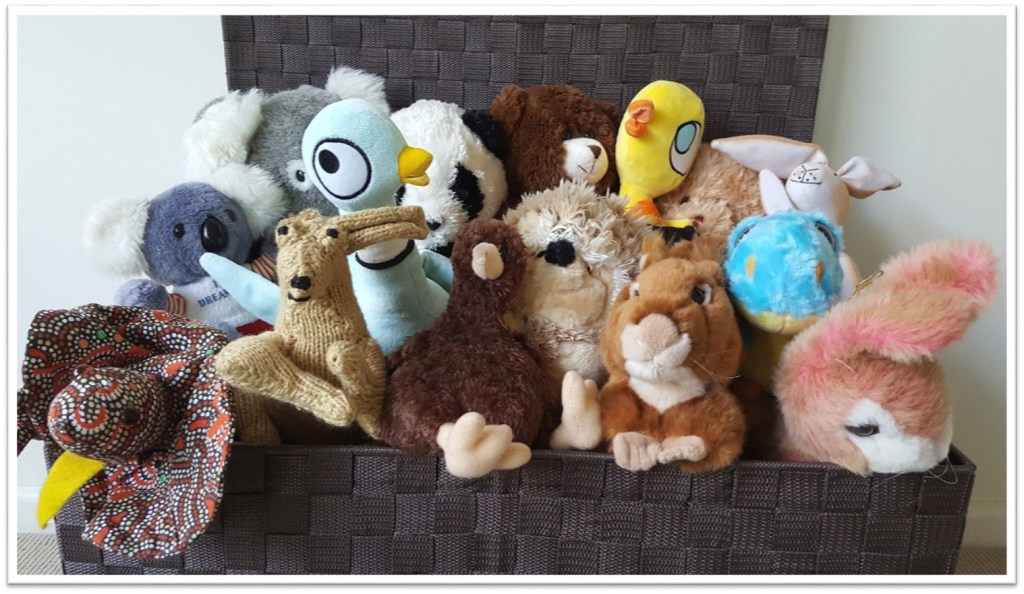
  • Welcome to the toy box

    © Norah Colvin
    © Norah Colvin

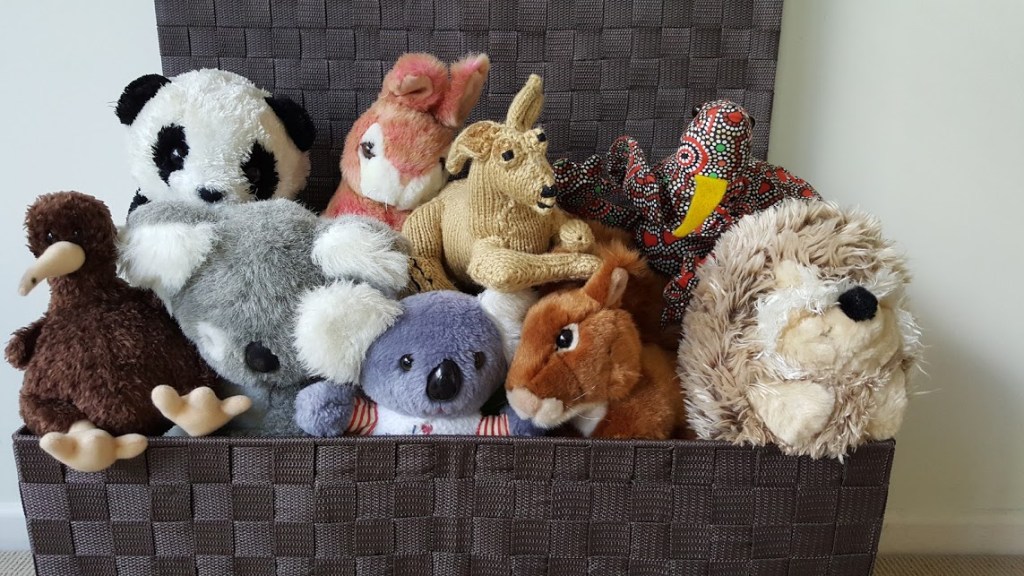
    A little while ago I wrote about my (small) collection of international toys and the fact that I wished to add to it when I visited Los Angeles and New York with my grandchildren. I received a few suggestions:

    Sarah suggested anything I wouldn’t want to stare in the eye

    Irene thought maybe a rattle snake, coyote or woodpecker

    Charli wondered if a bison or grizzly bear would do, and

    Geoff suggested a snake.

    Many requested I share my choice.

    I have now returned from that quick visit to the US, and did indeed bring back a small collection of toys to add to my toy box. (Four-year-old granddaughter informs me that 2 can be a collection, 3 is even better, and 100 is definitely a collection!) I have three to add to the toy box. A fourth got confiscated along the way.

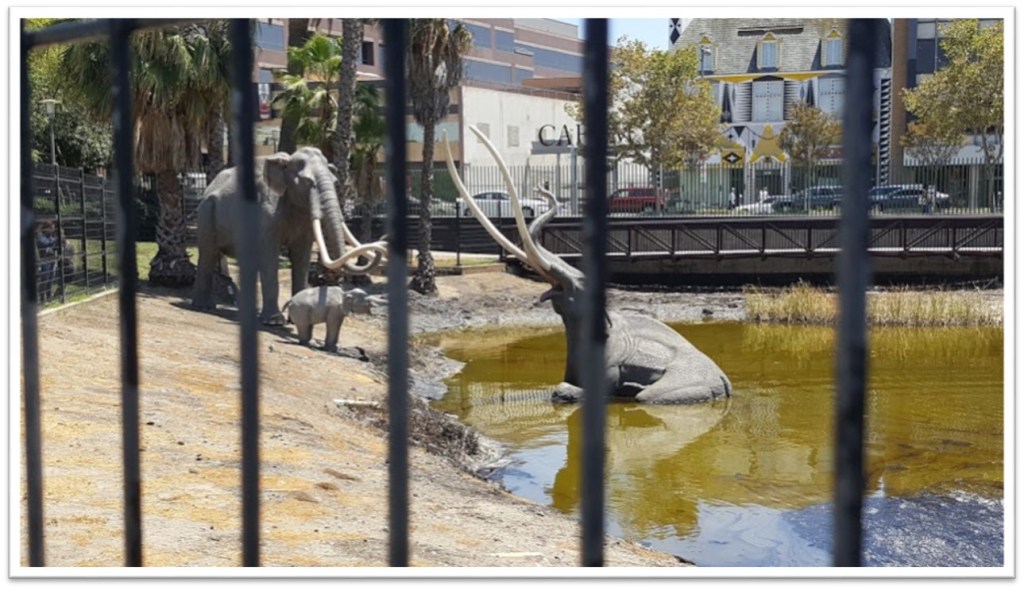
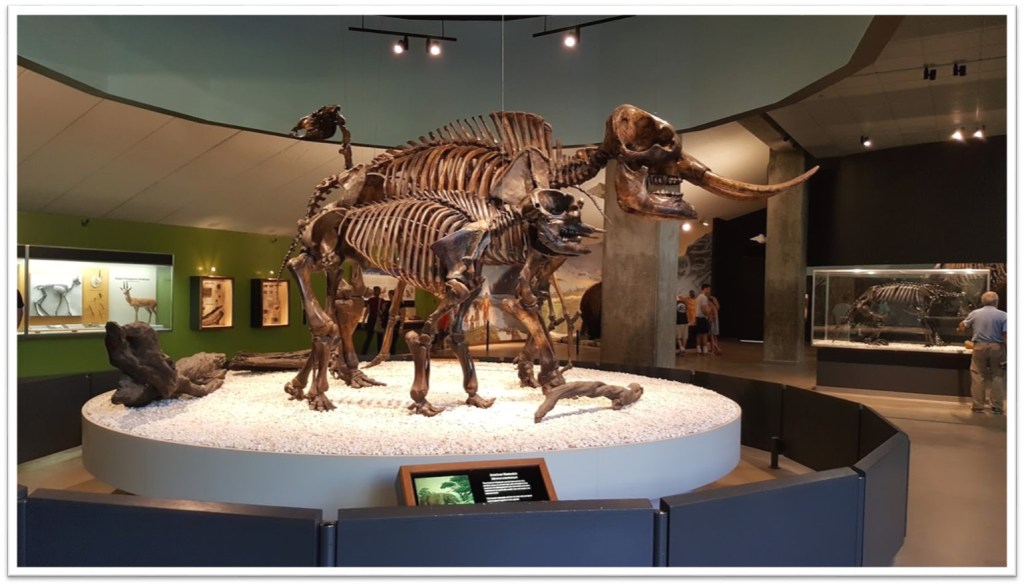
    When we visited Los Angeles, we went to the La Brea Tar Pits, a fossil site with an active excavation and museum. For a family fascinated with prehistoric creatures, the museum was a must visit. We were not disappointed.

    © Norah Colvin
    © Norah Colvin

    Outside the museum we saw life-size sculptures of a mammoth family succumbing to the sticky entrapment of the tar pit. You may wonder why the sculptures are fenced. The mammoths may not be real, but the tar pit is! We saw much tar oozing up through cracks around the site as well as in the pond.

    © Norah Colvin
    © Norah Colvin

    Inside the museum we saw skeletons and depictions of many of the animals trapped in the tar pits. These are skeletons of a mother and baby mastodon who fell victim of the tar:

    © Norah Colvin
    © Norah Colvin

    We also viewed a 3D movie that provided information about the Titans of the Ice Age, including stories to explain the fate of animals whose fossils were found in the tar.

    In this short of the movie, you may sight Smilodon, a sabre tooth cat.

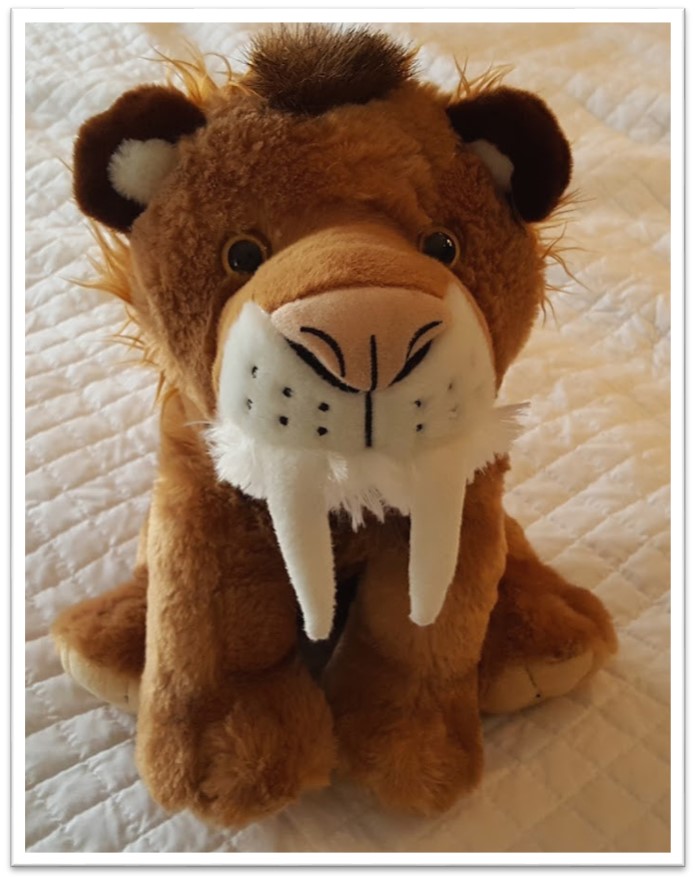
    I discovered that Smilodon is California’s State Fossil, so it was the first toy to add to my collection.

    © Norah Colvin
    © Norah Colvin

    Unfortunately, Smilodon was confiscated by my grandchildren and didn’t make it home with me. I am assured it is very happy at their place with its competitor Dire Wolf, also seen in the movie trailer.

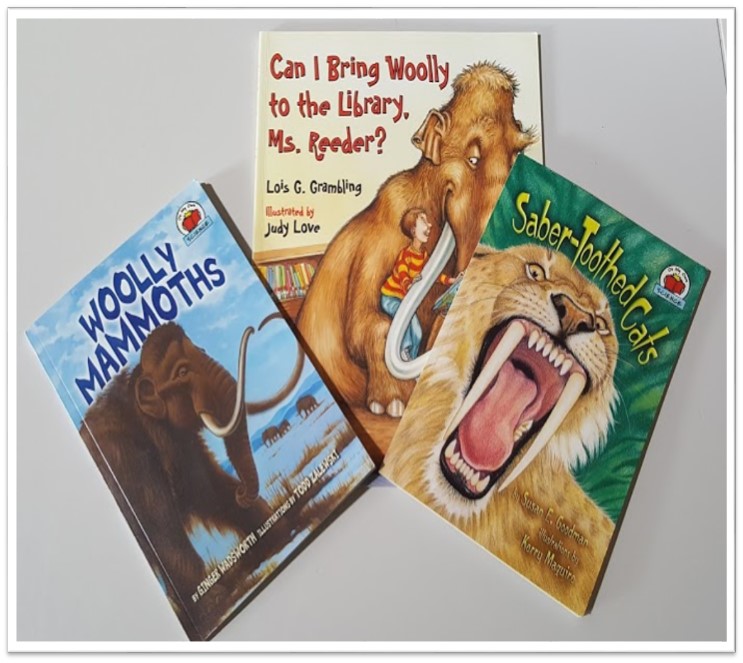
    Of course, I couldn’t leave the store without some books as well.

    © Norah Colvin
    © Norah Colvin

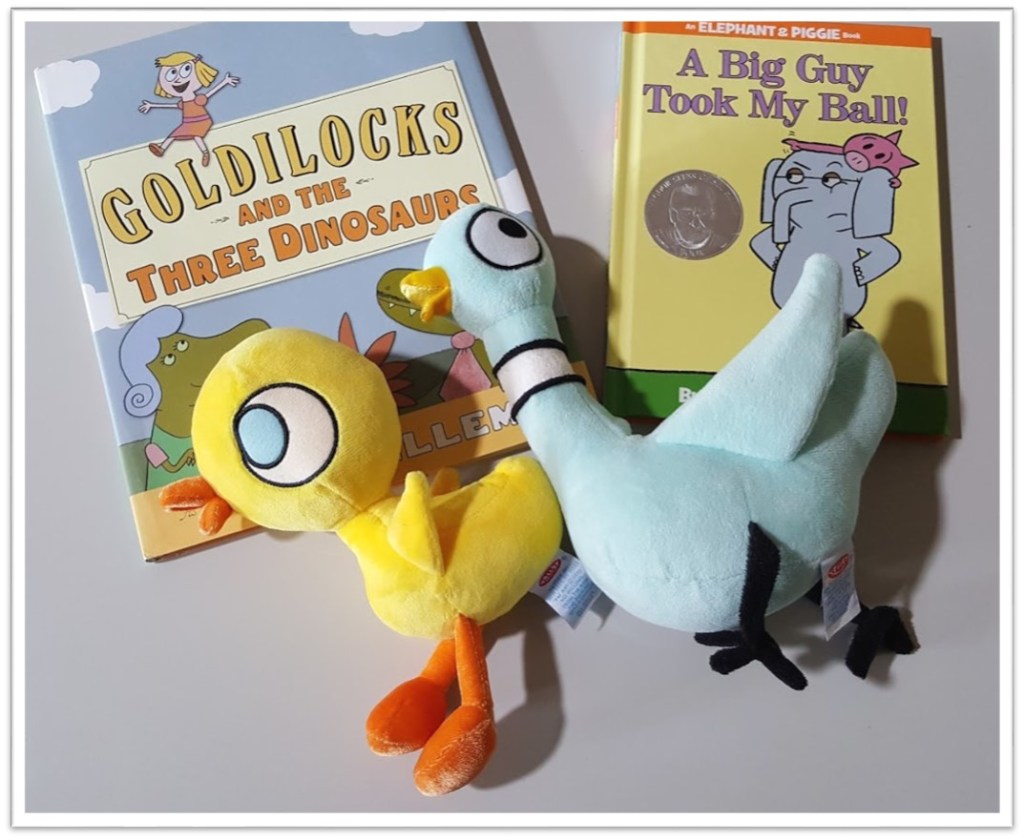
    In New York my choices turned to fiction. I discovered that an exhibition of works by Mo Willems was being held at New York’s oldest museum, the New York Historical Society Museum and Library, not far from where we were staying.  I have previously shared my delight in Willems’ books. His books are humorous, and his illustrations, with their seemingly simple line drawings, are very expressive. Of course, I had to go, and had to buy.

    I came away with Pigeon and Duckling, and two of Willems’ books.

    © Norah Colvin
    © Norah Colvin

    I thought I was done adding to my toy collection, but when we visited the American Museum of Natural History, granddaughter insisted that I purchase this T-Rex because it was my favourite colour. How could I resist?

    © Norah Colvin
    © Norah Colvin

    Now that I am home, I have introduced Pigeon, Duckling and T-Rex to the other toys in my toy box.

    welcome to the toy box
    © Norah Colvin

    They are settling in quite well, though everyone is complaining that it is becoming a bit squishy. However, I think they are rather pleased that Smilodon got waylaid along the way!

    So I didn’t end up with any of the suggested choices. I hope you don’t mind.

    Thank you

    Thank you for reading. I appreciate your feedback. Please share your thoughts. 


  • Guess what you’re getting for Christmas!

    The love of reading is gift

    I went Christmas shopping yesterday, and guess what I bought!

    © Norah Colvin The titles of these books are hidden to maintain the “surprise” for the recipients.
    © Norah Colvin
    The titles of these books are hidden to maintain the “surprise” for the recipients.

    Books! It wasn’t difficult to guess was it? I have written in previous posts about both giving and receiving books as gifts.  I’ll let you in on a little secret though. I did buy a few others things as well. That’s probably a good thing, otherwise the memory game My grandmother went shopping and she bought … would not do anything to develop memory and would be rather boring:

    “My grandmother went shopping and she bought … a book … and a book … and a book … and a book …:

    one

    I have already received one beautiful book for Christmas this year: One: How many people does it take to make a difference?, and the recommendation of many others, some of which I have purchased for myself or as gifts. Books received as gifts often take a very special place in a collection.

    HeidiHeidi inside

    One of my strongest memories is of waking before sunrise one Christmas morning, checking to see if Santa had been, and discovering a book at the end of my bed. While there was not enough light at first to see the illustrations or read the words, I delighted in the smoothness of the cover and the smell of the pages. Slowly as the sun rose the title revealed itself: Heidi by Johanna Spyri, and I started to read. I loved that story and read it many times. After more than fifty years I still have the book in my possession, rather tattered and worn, not unlike its owner, but still loved.

    In a recent post I shared some Australian Christmas picture books.   In a comment on that post Sherri Matthews, who blogs at A View from My Summerhouse,  reminded me of the Janet and Allan Ahlberg book, The Jolly Christmas Postman.   Although it was given to Bec for Christmas exactly thirty years after I received Heidi, I still have it in my possession. Shh! Don’t tell Bec. Of course the reason it was not included in my list of Christmas books is that the authors were British. (Allan is now aged 77. Janet passed away in 1994.)

    cover

    The Jolly Christmas Postman was published in 1991 and followed the success of the original Jolly Postman story. It is a delightful interactive book in which the postman delivers Christmas mail to storybook characters, including:

    • A Christmas card for Baby Bear from Goldilocks and her sister
    • A game about being safe in the woods for Red Riding Hood from Mr Wolf, who declares he is a “changed wolf”
    • A Humpty Dumpty jigsaw puzzle for Humpty Dumpty from all the king’s men
    • A Christmas annual and book in a book for the Gingerbread Man from Pat O’Cake Bakers
    • A Wolf Spotter’s Guide for Mr Wolf from Red Riding Hood , and
    • A special concertina “peep-show” for the postman from Santa and Mrs Santa.

    activities

    After the postman delivers the children’s letters to Santa, has a cup of tea and receives his gift, he hitches a ride back home on Santa’s sleigh. What a delightful conclusion to the story.

    There is much to explore in this little book for both young and old; far too much for just one sitting. With books to read, games to play and puzzles to do it could entertain for hours. A full appreciation of the cleverness and humour in the story requires an understanding of fairy stories such as Goldilocks and the Three Bears, Red Riding Hood, The Gingerbread Man, The Three Little Pigs; and nursery rhymes such as Humpty Dumpty, Doctor Foster, and Pat-a-cake, amongst others. Reading the book is a literary adventure.

    I wonder how soon before it will also be an adventure in history. It was published in 1991 before email became popular and social media was invented. The number of items sent by “snail mail” is decreasing. It may not be long before children also need a history lesson to understand what is mean by “a postman”.

    Books make special memories. What special memories will you create for someone with a book this year? What books have made a special memory for you?

    Thank you

    Thank you for reading. I appreciate your feedback. Please share your thoughts.


  •  A celebration of Australian picture books #7 — celebrating Christmas


    With Christmas just around the corner it is appropriate to continue my series in Celebration of Australian Picture Books with some Australian Christmas picture books. This post is the seventh in a series celebrating picture books by Australian authors. If you missed earlier posts, please follow these links to the introductionMem FoxKim Michelle ToftNarelle OliverJeannie Baker and Jackie French.

    www.openclipart.org
    http://www.openclipart.org

    Christmas in Australia is unlike that in most other parts of the world that celebrate the holiday. In Australia, Christmas falls in summer and people generally head for the beach or somewhere with air conditioning to cool down. While many still follow the traditions of the Northern Hemisphere with baked dinner and plum puddings, many opt for seafood  and salad, and outdoor barbecues and picnics. Whatever the weather Christmas is a great time for catching up with family and friends (or not, depending on your family!)

    www.morguefile.com
    http://www.morguefile.com

    I shared some thoughts about Christmas in Australia last year when I posted I’m (not) dreaming of a white Christmas. This year the post is specific to picture books.

    Some Australian Christmas picture books
    Some Australian Christmas picture books

    Because our climate is so different and we have such a small population down here, most of what is available for us to read, sing or view deals with situations very different from our warm sunny days. I’m pleased to say, though, that there is an increasing number of songs and books with an Australian flavour available. However, many are merely innovations on the traditional such, as The Australian Twelve Days of ChristmasAussie Jingle Bells or An Aussie Night before Christmas.

    12 underwater days of Christmas

    One innovation I particularly like is The Twelve Underwater Days of Christmas by Kim Michelle Toft. I celebrated Kim’s work previously in this series. Kim is an Australian who uses her talents as author and illustrator to educate children about things for which she is passionate: ocean life and coastal habitats. The stunning illustrations in this book, as in others, are hand-painted on silk; providing a richness of information through visual as well as textual features. In addition to the information about the animals, Kim includes a stunning six-page foldout poster, and information about the original carol.

    Christmas Wombat

    Jackie French, another whose work I have previously shared in this series, also has a Christmas picture book in the Wombat series, Christmas Wombat. It is just as delightful as the other wombat stories and tells of Wombat’s Christmas Day with sleep, adventure, sleep, and treats.

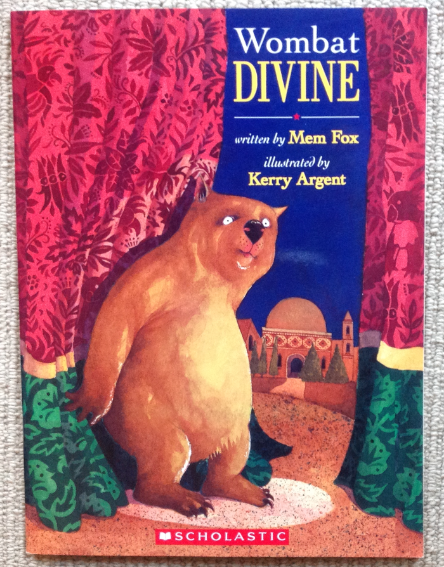
    Wombat Divine

    Using the traditional Nativity play as the setting, Mem Fox, another whose work I shared in this series created an original and fresh story in Wombat Divine. It is a delightful tale of Wombat who loved everything Christmas. When finally he was old enough to be in the Nativity Play he rushed along to the auditions. Unfortunately, it was difficult to find a role that was just right for Wombat. Can you guess which one he got? You’ll have to read the book to find out! Children all over the world will identify with Wombat and his predicament, and enjoy the heart-warming tale.

    PS who stole santa's mail

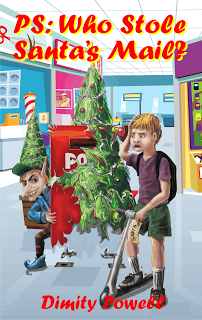
    For slightly older children there is the first chapter book PS: Who Stole Santa’s Mail by Dimity Powell, who is very active in the local SCBWI group. She blogs at  Dim’s Write Stuff. This is a fun story filled with mystery, magic and humour and a great first step into chapter books. I thoroughly enjoyed reading it.

    We do have a few original Christmas songs to listen to as well. One that I enjoyed listening to on the radio as a child, and delight in now hearing my grandchildren sing, is Six White Boomers. It is a lovely tale of a joey kangaroo who is lost and alone in a zoo. Santa rescues Joey and reunites him with his mother on Christmas Day. Of course to get there, Joey is treated to a ride on Santa’s sleigh pulled by six huge white kangaroos.

    Peter Combe has written two albums of original, but with a traditional rather than specifically Australian flavour, Christmas songs for children, including this one:

    Children around Australia are finishing their last few days of the school year within the next week. They will then have five to six weeks of holidays before starting back for a new school year. I have shared previously about the importance of keeping children’s love of learning alive and described easy ways of incorporating learning into everyday family activities. If you know of any families in need of suggestions, please give them a copy of:

    20 suggestions for maintaining reading momentum during the school holidays

    Let the children write! 20 suggestions to get children writing during the school holidays

    Counting on the holidays!

    These are available free download in my Teachers Pay Teachers and Teach in a Box stores. Soon they will also available free on my website.

    rg 1024, gift https://openclipart.org/detail/31159/gift
    rg 1024, gift https://openclipart.org/detail/31159/gift

    Of course books always make wonderful gifts and any of the books mentioned here would be a great addition to anyone’s collection.

    Thank you

    Thank you for reading. I appreciate your feedback. Please share your thoughts about any aspect of this post.


  • A celebration of Australian picture books #6 — Jackie French

    If-you-want-intelligent children

    This post is the sixth in a series celebrating picture books by Australian authors. If you missed earlier posts, please follow these links to the introduction, Mem Fox, Kim Michelle Toft, Narelle Oliver and Jeannie Baker.

    In this post I reintroduce you to Jackie French, prolific and well-known Australian author and advocate for literacy and the environment. She is currently the Australian Children’s Laureate with the task of promoting the importance and transformational power of reading, creativity and story in the lives of young Australians. In January she received an Australian of the Year Award for her contribution to literacy. Jackie’s words from her acceptance speech “If you want intelligent children, give them a book” resonated with me.

    You can listen to Jackie’s acceptance speech in its entirety here:

    These are some of my favourite quotes from the speech:

    Failure-is-not-an-option

    A-book-can-change-the

    There-is-no-such-thing

    Jackie has written over 140 books and won more than 60 awards. I am not going to share all of Jackie’s books here; just a few of her picture books that I own. This complete(ish) list of her books indicates the range of genres in which Jackie writes. Although in Standing on the Shoulders of Giants by Mark Rifidi Jackie describes it differently. She says,

    “People assume I write in different genres. From my point of view I don’t. Whether it’s history, ecology, or the fiction I’m writing about now, it’s all grounded in the way of life here and the landscape here.”

    (Jackie lives a self-sufficient life in the Araluen valley on the edge of the Deua wilderness area.)

    jackie french's books

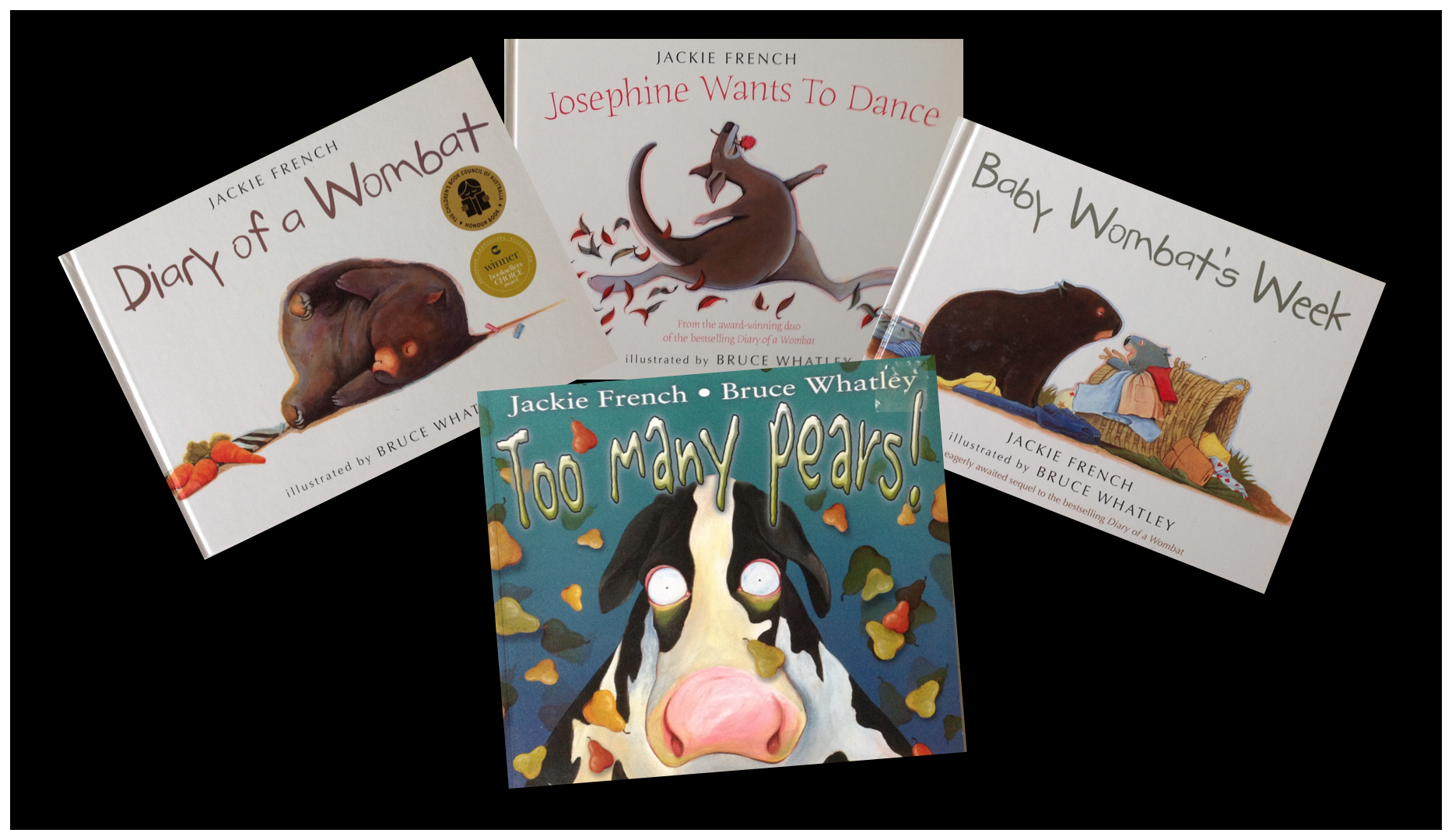
    These are the four of Jackie’s picture books that I currently own. I have read others and given others away as gifts. While these four are illustrated by Bruce Whatley, Bruce is not the only illustrator of her work.

    2015-09-19 11.19.08

    Diary of a Wombat is probably Jackie’s best known and most popular picture book. This is what Jackie says about it, as recorded in Standing on the Shoulders of Giants:

    Diary of a Wombat isn’t fiction … (it) is pretty much a week in the life of Mothball, who is one of the wombats that got fed last night” 

    The seeming simplicity of the text coupled with Bruce Whatley’s gorgeous illustrations make this book a joy to read, over and over.

    In the book Mothball sleeps, eats, scratches, eats, sleeps, and easily trains humans to be “quite good pets”.

    You can listen to Jackie read it here.

    2015-09-19 11.16.36

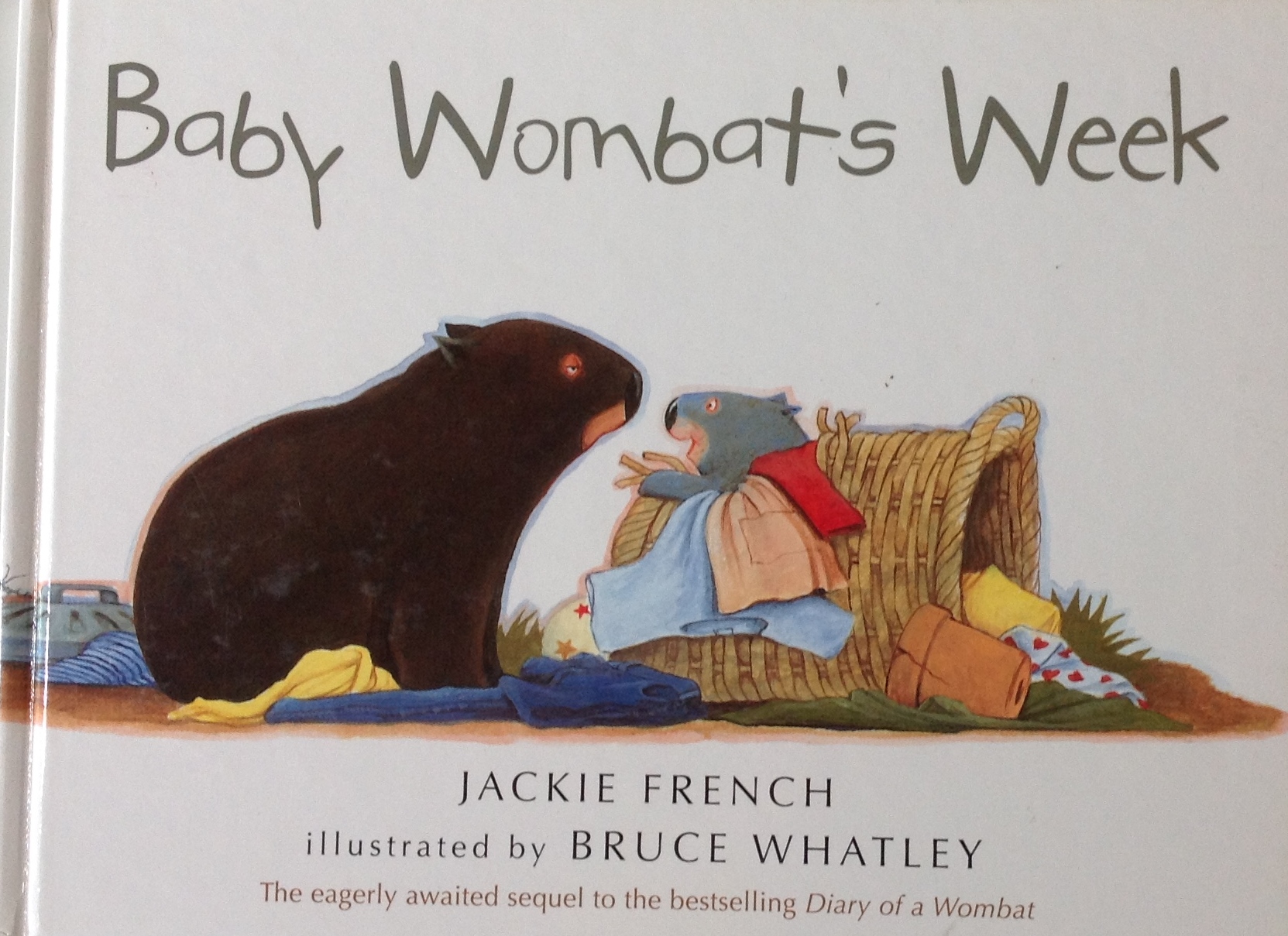
    A sequel to the Diary, Baby Wombat’s Week is pretty much a week in the life of Mothball’s baby. It is just as delightful and humorous as the original story with new adventures and escapades; but still lots of sleeping and eating.

    There are two other books in the series: Wombat Goes to School and Christmas Wombat. The Secret World of Wombats is a non-fiction text exploring “everything you ever wanted to know about wombats.”

    2015-09-19 11.15.56

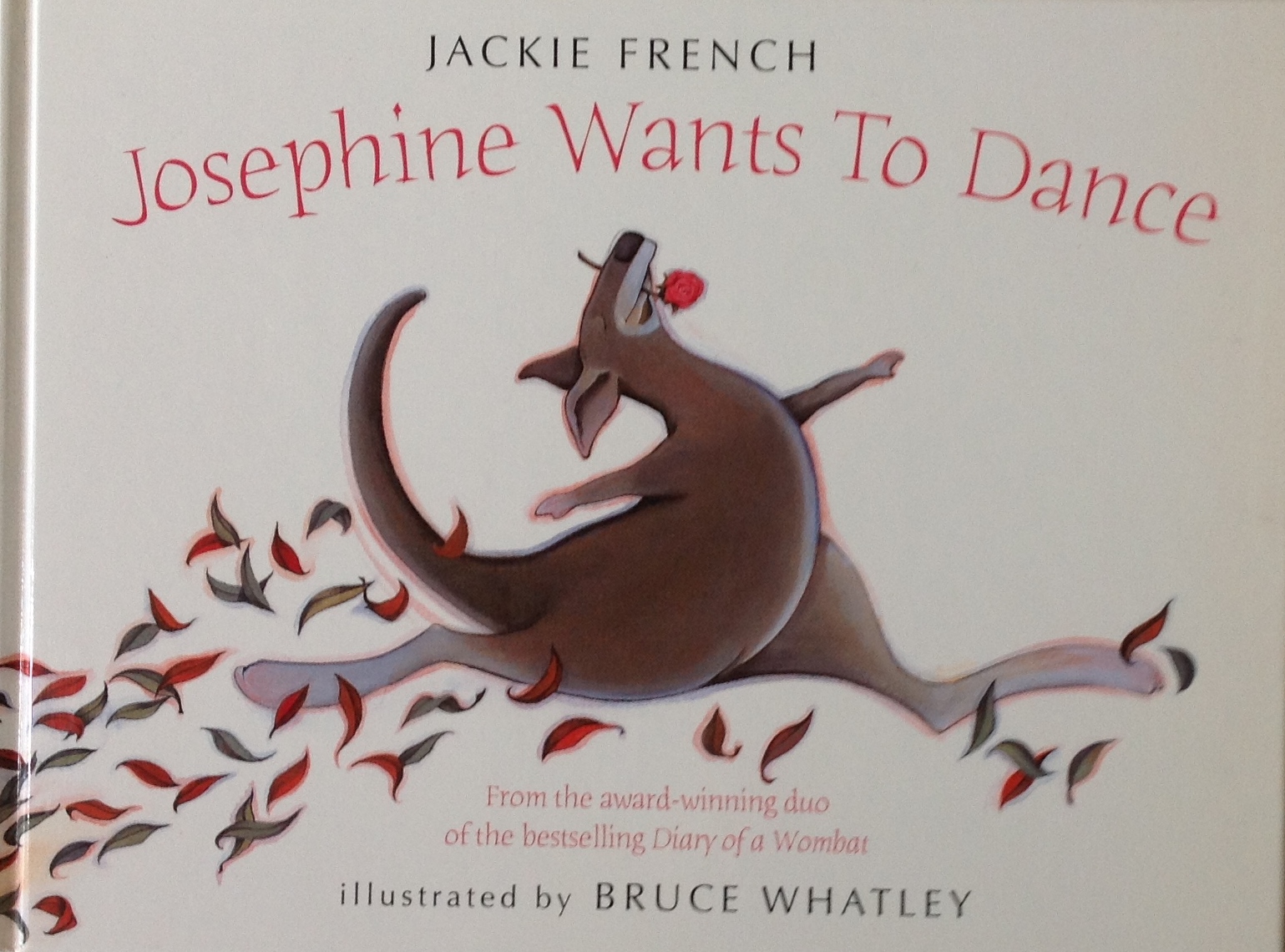
    Josephine Wants to Dance is a delightful story of a kangaroo who loved to dance but dreamed of dancing another way. One day the ballet came to town and Josephine decided that was how she wanted to dance. Though others discouraged her, Josephine was determined to give it a try. It is a lovely story of believing in yourself and following your dreams.

    2015-09-19 11.18.32

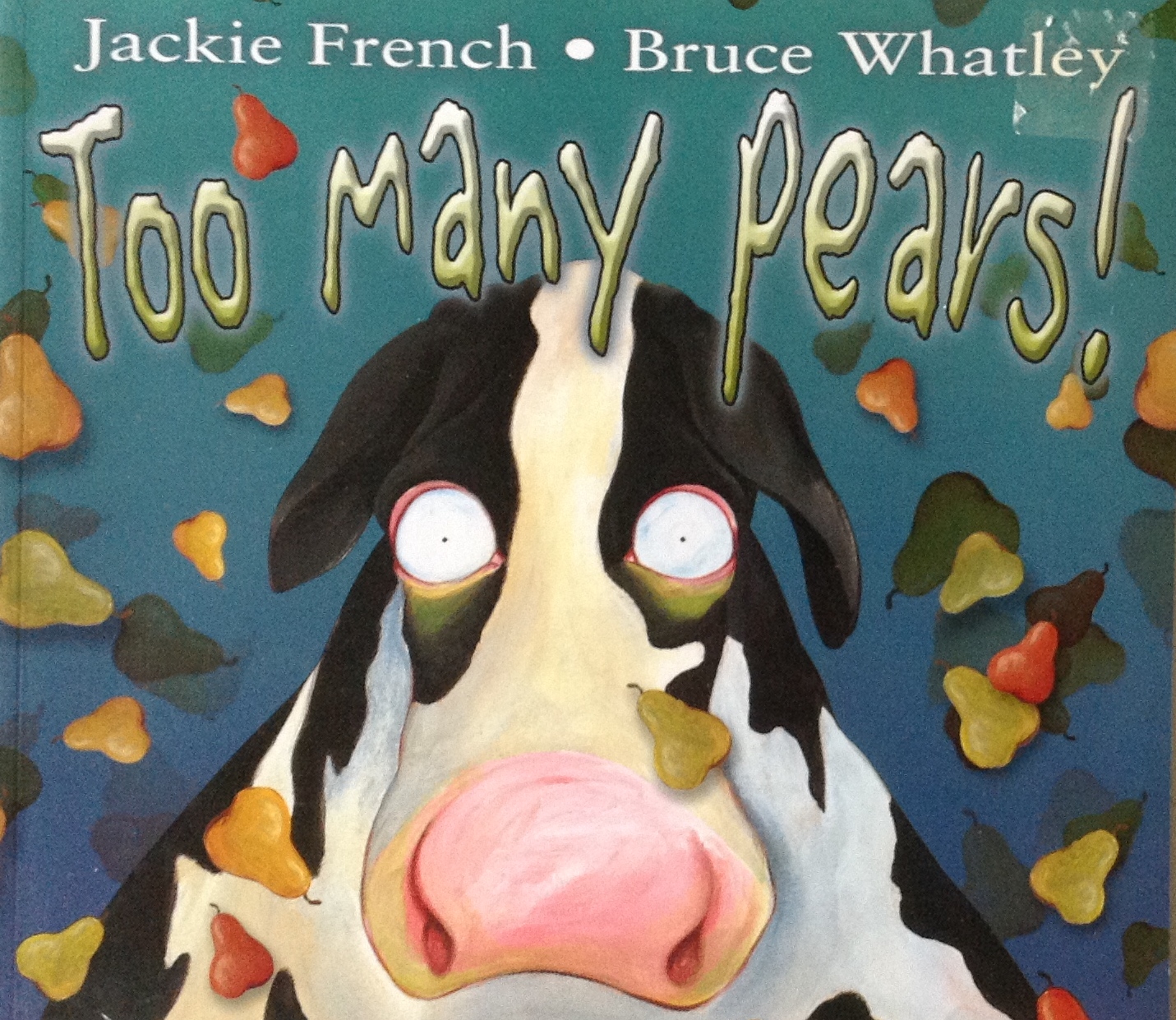
    Too Many Pears is another delightful and humorous story with illustrations that add interest and humour. (It reminds me a little of the battle Charli Mills had with gophers in her vegetable patch.)

    Pamela, a cow, loves pears. She loves them straight from the tree, in pies, with ice cream … any way she can get them. Amy and her family have to figure out a way of stopping Pamela from eating all their pears. They do. But then Pamela spies the apples!

    I am happy to recommend each of these books. They will not disappoint. Jackie’s text coupled with Bruce’s perfectly matched illustrations continue to delight during repeated readings.

    Jackie’s website too is a treasure trove of interesting stuff. On her Kids’ Facts and Info for School Projects page she shares her writing process and a lot of other information that would be of interest to writers as well as to kids. She also has a page of Writing  Tips and Advice and a page about How to Get Kids Reading, topics close to my heart.

    In addition to illustrating Jackie’s books, Bruce Whatley writes and illustrates books of his own as well as those of other authors. In a recent post I talked about drawing on the right side of your brain. In this video Bruce challenges everyone to have a go at drawing with their left hand. Is that engaging the right side of your brain?

    I am very grateful to Sarah Brentyn, who blogs at Lemon Shark, for alerting me to Standing on the Shoulders of Giants by Mark Rifidi just in time for this post. Thank you Sarah and Mark. I’m certain I will be having more to say about Mark’s book in future posts. It is a great resource celebrating the work of 20 Australian picture book authors and illustrators.

    In the final paragraph of her biography chapter in Mark’s book, Jackie says,

    “The one thing you show readers by writing about history is not to be afraid of change. Tomorrow always is going to be different from yesterday. It always has been. But human beings are extraordinarily good survivors, superb adapters. We are very good at creating a sort of world that we want. Books are perhaps the most effective tool to help us find it.”

    I like her thinking!

    Thank you

    Thank you for reading. I appreciate your feedback. Please share your thoughts about any aspect of this post.


  • Curiosity, dead chooks, science and the S.T.E.M. push

    Curiosity, questioning and science are recurring themes on my blog. How could a post entitled “Curiosity, dead chooks, science and the  S.T.E.M. push” not appeal to me? While I don’t think I’ve written about dead chooks, yet, when I was six I was the best chicken catcher in the family and I definitely saw a few chooks running around with their heads chopped off!
    In this post Sheryl Gwyther talks about the awakening of her scientific questioning at age four when seeing a similar a spectacle. The transcript of a talk delivered to other authors “Children are born scientists … It’s called curiosity” (my words exactly!) is included in the post. Sheryl urges authors to include science in their writing for children and suggests three rules for doing so:
    Never be didactic
    Entertain
    Create characters that children can connect with
    While she doesn’t say it in so many words, I think the message of keeping the science accurate is implied. (I have questioned the inaccuracy in The Very Hungry Caterpillar in previous posts.)
    Sheryl’s closing paragraphs motivate and inspire writers. She says,
    “We have the opportunity, the passion and hopefully, the commitment to reach out to young Australian children through stories about the wonder of science, and the responsibility for their future custody of this planet.
    Great stories, cleverly laced with scientific understanding not didactic waffle.
    Great stories to make them feel and think, and question.
    Great stories – for the sake of their future on this planet.”

    Some of the authors from my celebration of Australian picture book series are doing just that:
    Kim Michelle Toft
    Narelle Oliver
    Jeannie Baker
    Please read Sheryl’s post in its entirety. She offers much good advice and inspiration. You can find out more about Sheryl by following these links:
    Sheryl Gwyther SCBWI Assistant Regional Advisor Queensland Public Profile
    Author webpage
    Author blog
    Twitter

    Thank you

    Thank you for reading. I appreciate your feedback. Please share your thoughts.
  • A Celebration of Australian picture books #5 — Jeannie Baker

    Jeannie Baker - planet changing

    This post is the fifth in a series celebrating picture books by Australian authors. If you missed earlier posts, please follow these links to the introduction, Mem Fox, Kim Michelle Toft and Narelle Oliver.

    In this post I introduce you to Jeannie Baker, a collage artist and author. Jeannie was born in the UK but has lived most of her adult life in Australia, and most of her books, though having universal themes, are set in Australia.

    2015-09-19 11.09.45

    Jeannie had already published a number of books prior to 1992 when I first became aware of her work through “Window”, winner of the Australian Picture Book of the Year Award.

    Window tells, in beautifully detailed collage, of the transformation of a landscape from natural bush to city-scape. The changes are observed through a window by a boy as he celebrates alternate birthdays from birth to 24 years. Like many of Jeannie’s books, “Window” carries a strong environmental message. In her note at the end of the book, she says,

    “Our planet is changing before our eyes. However, by understanding and changing the way we personally affect the environment, we can make a difference.”

    The intricate details in this textless picture book provide many opportunities for discussion. Children and adults are enticed to study and compare the changes that take place in each successive picture. The carefully constructed collages give a sense of being able to almost step into the scene and experience the sights, sounds and smells of each landscape.

    Jeannie Baker - time

    I was fortunate to attend an exhibition of Jeannie’s artwork for “Window” as it toured the country in 1992. What surprised me most was the size of the collages. With all their detail I had expected them to be quite large; but they weren’t. They are miniature, much smaller than a page of the picture book on which they appear. The collection and arrangement of a mix of natural and artificial materials is amazing. Jeannie describes the process of constructing her collages here.

    2015-09-19 11.11.04

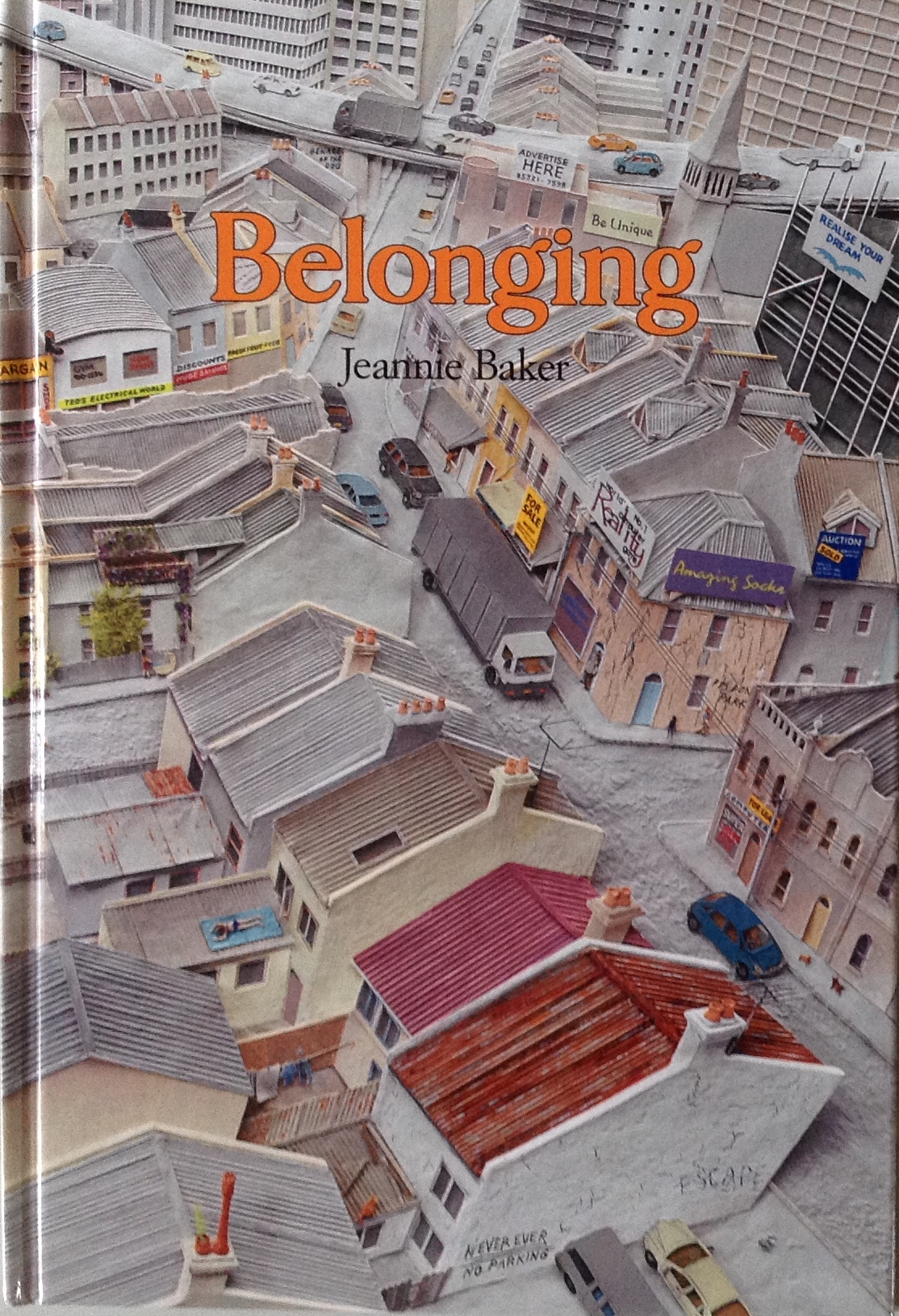
    In 2004 Jeannie published a companion book to “Window” called “Belonging, which, in 2005, also received a number of awards, including one from the Wilderness Society. This textless picture book tells a story of a changing landscape over a number of years as a city is transformed with plants and welcoming spaces for children and families. In a note at the end of this book, Jeannie says,

    “It takes time … But by understanding the land on which we live and by caring for it we can choose between just having a place to live or belonging to a living home.”

    2015-09-19 11.10.25

    One Hungry Spideris the third of Jeannie’s books I own. Unlike “Window” andBelonging, the illustrations in this one are accompanied by text. One Hungry Spideris a counting book, but a counting book with a difference: it includes information about the spider. For example when one of seven ladybirds gets caught in the web we find out that “the spider took no notice (because) spiders don’t like the taste of ladybirds.” And when nine wasps fly by the spider left the web and hid because wasps catch spiders. Additional details about the spider are provided at the back of the book. Once again the illustrations throughout the book are magnificent.

    Surprisingly I own only these three of Jeannie’s books. However I am familiar with others. At school I had access to many of her titles in big book format (approximately 50 x 40 cm) which were perfect for sharing with a class of children.

    4 of Jeannie Baker's books

    These are other favourites:

    Where the Forest Meets the Sea”, “The Hidden Forest”, “Mirrorand The Story of Rosy Dock”.

    Are you familiar with Jeannie’s work? If so, which ones and what do you think of them?

    Please check out these and other titles of Jeannie’s if you have a chance. Their illustrations will intrigue you and their positive messages will inspire you.

    As a writer, I found inspiration in Jeannie’s response to the question,

    “Of all the books you have made, which is your favourite?”

    She answered,

    “When a book is finally finished, I find it hard to think about it anymore …I want to fill my
    head with something totally different, with a new book.  My favourite book is the
    ‘new’ book I’m working on, still working out and trying to make better than the books I
    made before it!”

    I think that indicates a strong growth mindset and Jeannie’s joy in the “continual challenges this medium gives … to invent techniques and explore and experiment with materials and their textures.”

    Jeannie Baker - favourite book

    It affirms the quest for improvement and a reason to embrace the challenges we both set for ourselves and meet along the way.

    Thank you

    Thank you for reading. I appreciate your feedback. Please share your thoughts.
  • A celebration of Australian picture books #4 — Narelle Oliver

    This post is the fourth in a series celebrating picture books by Australian authors. If you missed earlier posts, please follow these links to the introduction, Mem Fox and Kim Michelle Toft.

    Narelle Oliver

    In this post I introduce you to Narelle Oliver, a Brisbane-based author and illustrator. There is much to explore on Narelle’s site, including: information about her writing process and tips for would-be picture book authors; the research involved in creating her books, many of which are about nature; and illustration techniques that involve the use of linocut printing and rubbing, and other assorted media.

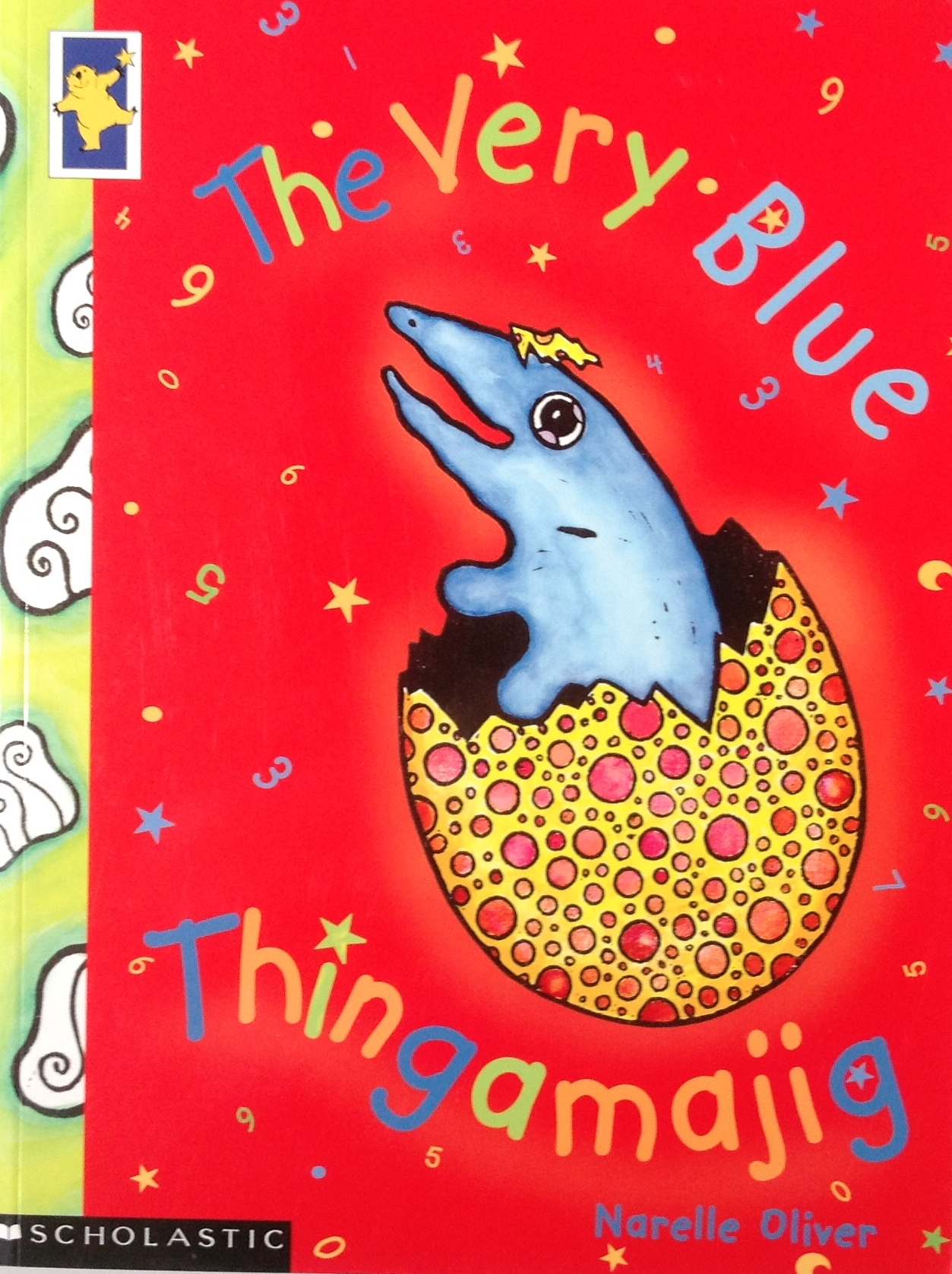
    Narelle conducts workshops for children and adults. She visits schools to share with children the wonder of her books and talks to them about her writing and illustrating processes. When she visited “my” school she brought along first thoughts and illustrations for, and a dummy book of, The Very Blue Thingamajig, plus a soft toy prototype – and we all wanted one! She also brought a fox from the museum and talked about illustrating Fox and fine feathers. She read to the children, involved them in activities and gave them an experience of linocut printing. It was fascinating for both children and teachers.

    Narelle talks about her workshops and sessions in this video.

    While you can find a complete list of Narelle’s books here, I will share those I have on my bookshelf (in no particular order).

    2015-09-19 11.14.10

    The Very Blue Thingamajig is as story about difference and acceptance told in a fun way involving mathematical concepts of patterns, counting and days of the week. The colourful illustrations made using hand-coloured linocuts are appealing, and children love to find the little bird who provides a secondary story throughout the book. On Narelle’s fun page you can colour and decorate your own thingamajig.

    2015-09-19 11.11.44

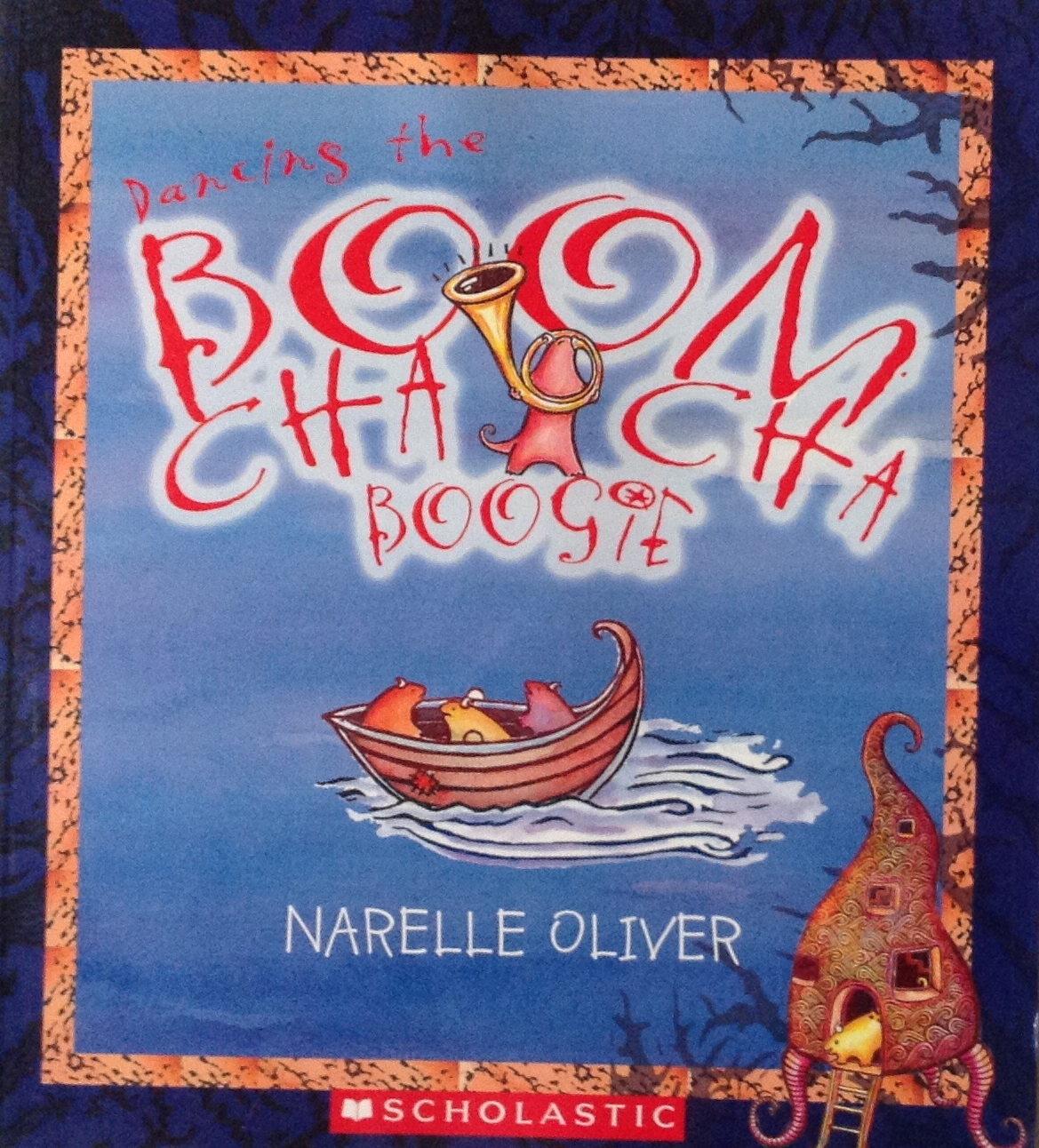
    Dancing the Boom Cha Cha Boogie is a gorgeous tale of three little murmels who are washed out to sea in an arkel and arrive on a foreign shore where they are not welcomed by the resident snigs. They are imprisoned until when, the arkel is repaired, they are to leave. At night a young snig releases the murmels who teach the snig to have fun. In the end the murmels are accepted and stay happily in Snigdom with the snigs, learning from and enjoying each other’s company. This book is illustrated with hand-coloured linocuts.

    2015-09-19 11.13.26

    Fox and fine feathers is a story of friendship, of looking out for each other and keeping each other safe. The attention to detail in these linocut illustrations coloured with pencils and pastels is amazing and accurately depicts the five creatures and the forest setting. Narelle has supported the story with information about the birds, their habitat and the dangers imposed by the feral fox, which is now a serious threat, along with other feral animals, to native species in Australia.

    2015-09-19 11.12.23

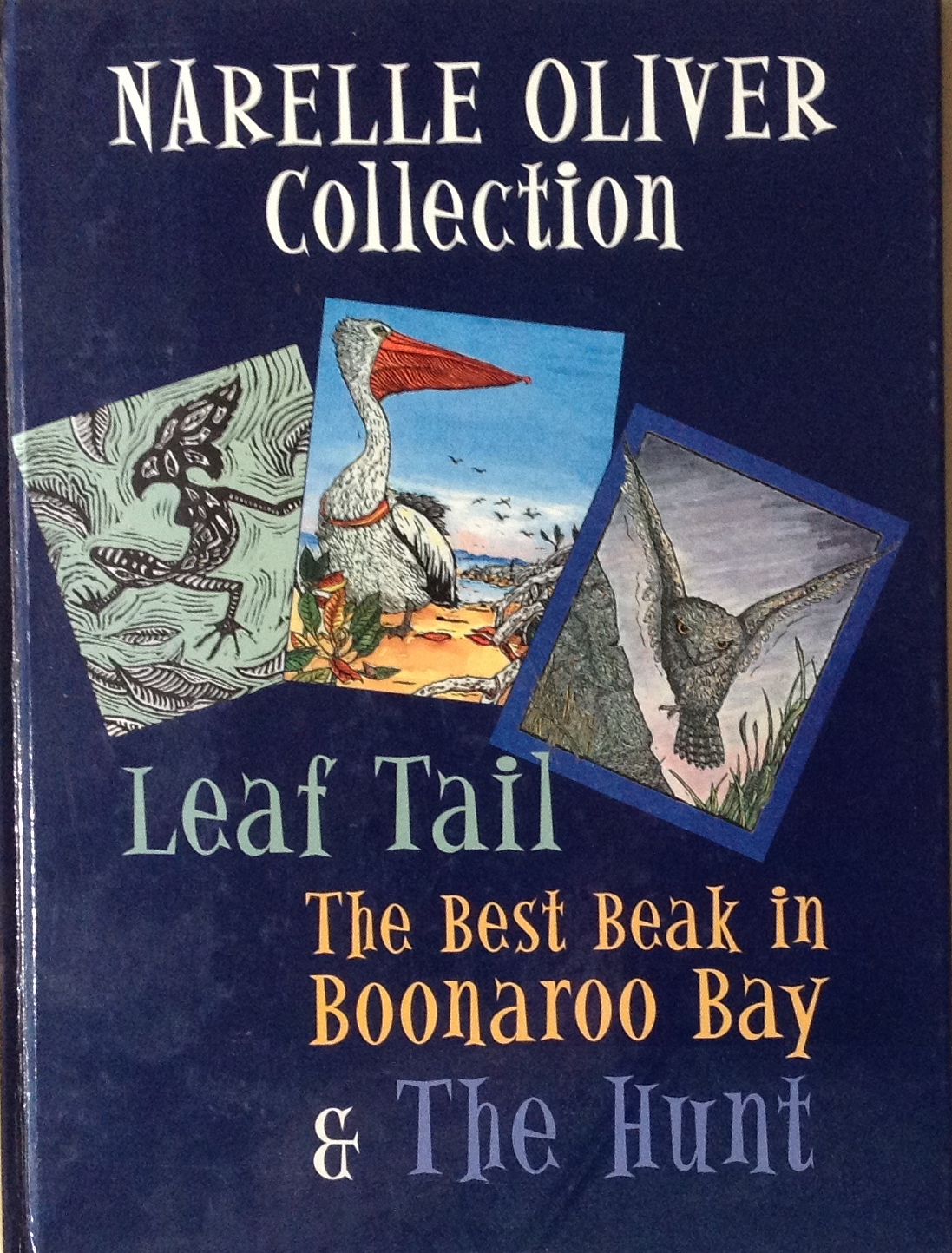
    Narelle Oliver Collection of three stories: Leaf Tail, The Best Beak in Boonaroo Bay and The Hunt.

    • Leaf Tail, Narelle’s first picture book, illustrated by beautiful linocuts, tells the story of a leaf tail gecko and the importance of camouflage to survival in the Queensland forest.
    • The Best Beak in Boonaroo Bay, also illustrated with hand-coloured linocuts, tells of a squabble between five different birds, each professing its own beak to be the best. Finally clever pelican holds a contest that enables the birds to see that each beak is best in its own way. As well as a delightful story about wildlife, it also provides a springboard into discussions about, and appreciation of, differences.
    • The Hunt is another beautifully illustrated wildlife story of camouflage and survival. The story is supported with information about its setting and the workings of animal camouflage and disguise. There are also black and white drawings showing where to find the animals camouflaged in each illustration. It is fun to see if all the animals can be found without referring to the guide.

    2015-09-19 11.15.11

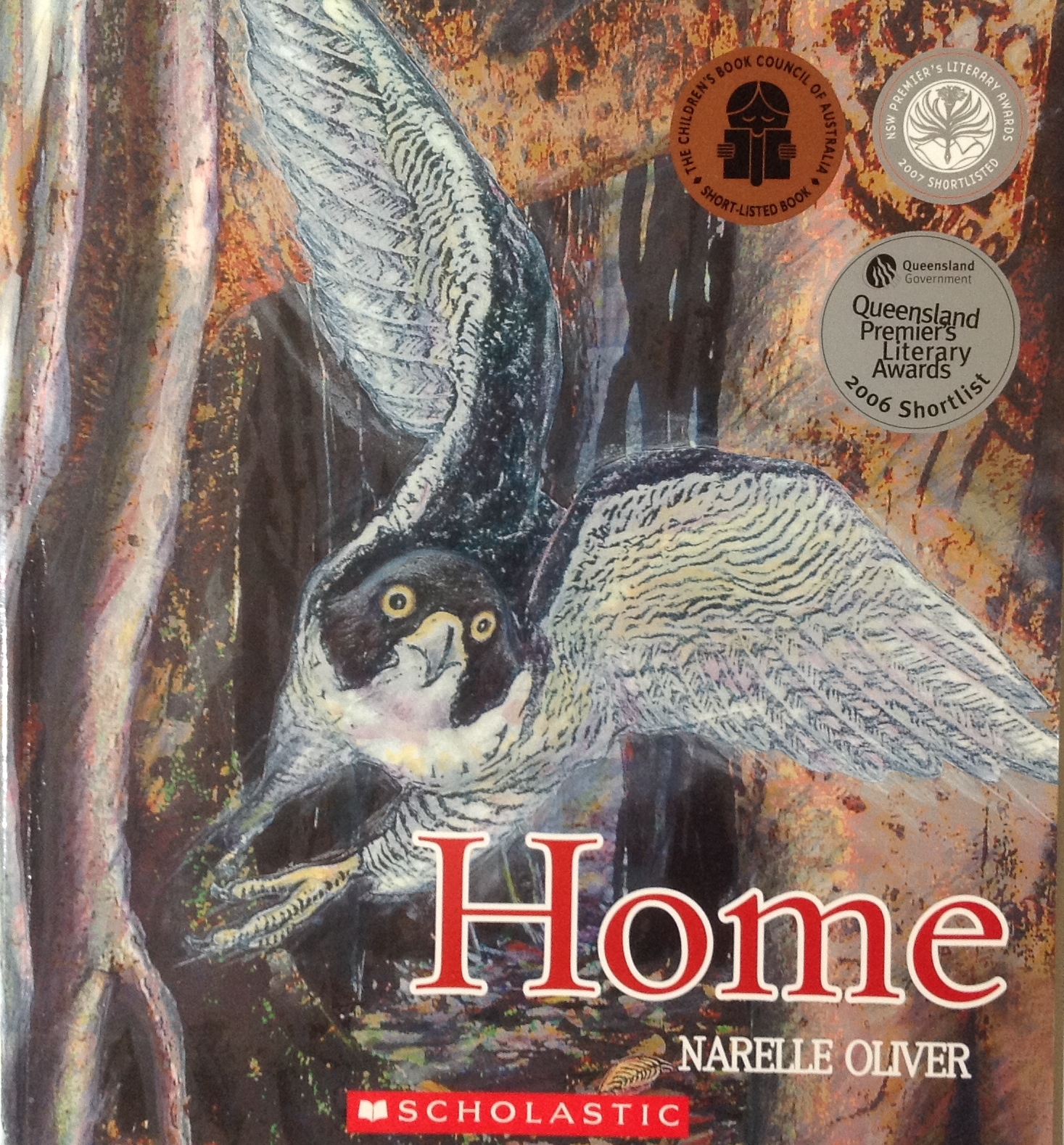
    Home, referred to in a previous post Home or away, is perhaps a favourite if only because it is based on a true story of a pair of peregrine falcons that nested at the top of a 27-storey building in the city of Brisbane. The birds, named Frodo and Frieda, fascinated a city and, for a while, had their own reality show “Frodocam”. The story, beautifully illustrated using a combination of media including linocut rubbings, collage, photographs, pencil, pastels and watercolours, tells of the adaptation of wildlife to new landscapes and environments.

    Each of these books can be appreciated for its story or used as a springboard for discussion. The illustrations appeal to adults and children alike for the attention to detail and accurate representation of wildlife. The addition of supporting information encourages an appreciation for wildlife and their habitats and develops an awareness of the need for their protection. They would be a wonderful addition to any book collection and be much appreciated as gifts.

    Thank you

    Thank you for reading. I appreciate your feedback. Please share your thoughts.