Live Love Laugh Learn … Create the possibilities

Tag: Literacy

  • Power tools


    www.openclipart.org
    http://www.openclipart.org

    This week at the Carrot Ranch Charli Mills has challenged writers to In 99 words (no more, no less) include a tool in a story. I open this post with a quote by Jackie French I used to close my previous post.

    Jackie French - books - tools

    Books are a great tool. So is the ability to think creatively.

    Being literate is a key that opens many doors. Being able to think opens many more. You could say they are the power tools of education and success.

    In his book The Outliers (recommended to me by Rowena who blogs at Beyond the Flow), Malcolm Gladwell talks about the role of intelligence in success. He says that “intelligence only matters up to a point”, and that “past that point, other things — things that have nothing to do with intelligence — must start to matter more”. He raises the question of what those things are.

    He makes a suggestion to

    “Write down as many different uses that you can think of for the following objects:

    1. a brick
    2. a blanket”

    and calls it a “divergence test”. Rather than asking you to come up with a one right answer, a divergence test “requires you to use your imagination and take your mind in as many different directions as possible.”

    Gladwell describes the test as a measure of creativity, of the ability to come up with imaginative and unique responses rather than a list of commonplace uses. He considers this imaginative thinking combined with intelligence, not intelligence alone, to be what is required to make new discoveries such as those that may be awarded Nobel Prizes.

    www.openclipart.com
    http://www.openclipart.com

    Can this sort of creative thinking be taught?

    Edward de Bono certainly thinks so. As long ago, dare I say, as the late 60s I read (and did) The Five Day Course in Thinking, a series of puzzles to help readers (thinkers) understand their thinking strategies. The puzzles in the book are divided into three sections: Insight Thinking, Sequential Thinking, and Strategic Thinking.

    Over the years I read a number of de Bono’s books including but not limited to Lateral Thinking, Six Thinking Hats, How to Have a Beautiful Mind, Teach Your Child How to Think, Textbook of Wisdom and Why I Want to Be King of Australia. I had a thirst for learning how to think, as thinking had not been encouraged and memorising content had not come easily in my younger years. Discovering that I was able to think, and think outside the box, was empowering.

    www.openclipart.org
    http://www.openclipart.org

    I enjoyed using de Bono’s strategies and teaching them to my own children as well as to children in my classrooms over the years. His Six Thinking Hats are used in classrooms worldwide as are many others of his thinking strategies.
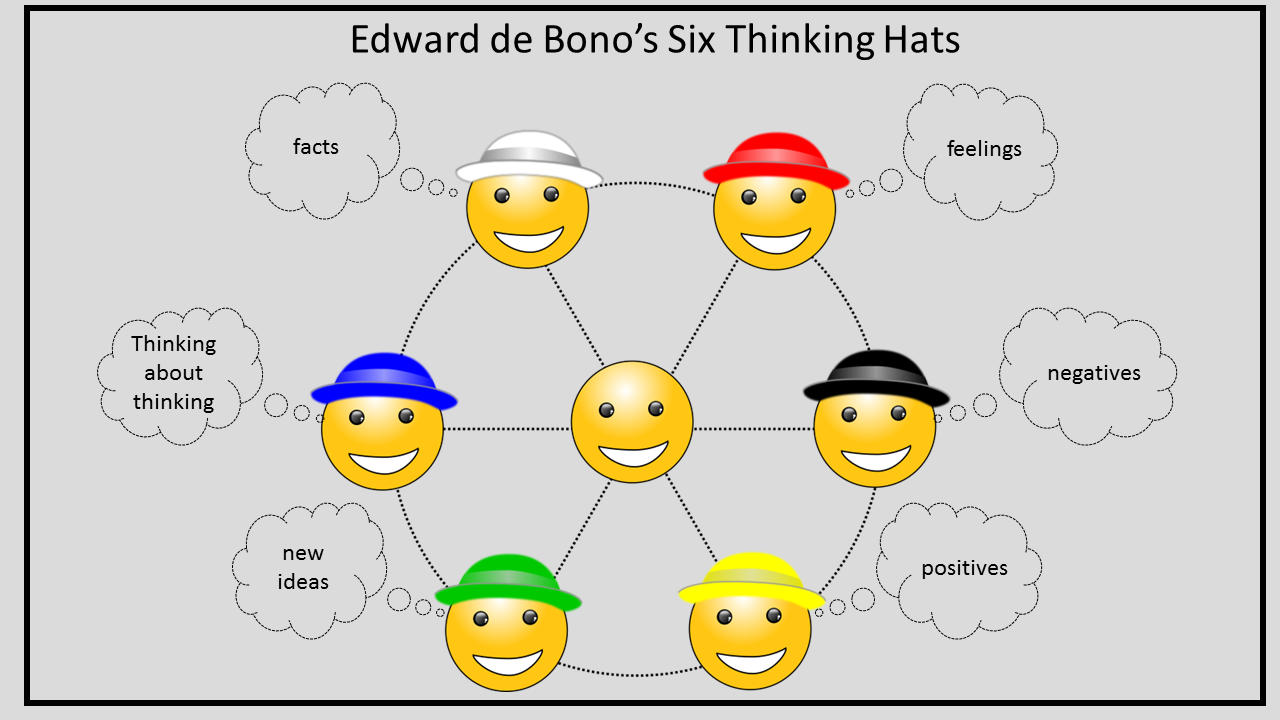
    six hats

    In this video de Bono talks about creativity, creative thinking, and thinking “outside the box”:

    Tony Ryan is another educator who believes it can. He has published a number of books that aim to get students thinking in creative ways. His Thinkers Keys “a powerful program for teaching children to become extraordinary thinkers” is designed to do just that.

    Tony Ryan says that we now need to think beyond the square and think “outside the dodecahedron”.

    In a comment on a previous post about Lifetime Changes, Steven linked to an amusing video showing the reactions of 21st century children to our earliest computers, tools of technology. This is it in case you missed it:

    I combined the notions of books, creative thinking and technology as tools for learning, productivity and success with a little bit of backward (historical) thinking to inspire my futuristic flash this week. I hope you enjoy it.

    tools for learning

    Relic

    The family shuffled amongst the haphazard collection of primitive artefacts without attempting to disguise disinterest or disdain. The waiting seemed interminable in this “so-last-century” outpost.

    Haven’s seen one of these before,” they’d been told. “I’ll need to order a specialized tool as well as the part. Shouldn’t take long though. Look around while you wait.”

    Confidence in the simpleton’s tools “upstairs”, even if the correct parts arrived, was as low as their interest.

    Hey look!” one called. “Is this …?”

    Can’t be.”

    All destroyed centuries ago.”

    Would be worth a fortune though.’’

    They opened it.

    A book!” they gasped.

    Thank you

    Thank you for reading. I appreciate your feedback. Please share your thoughts about any aspect of this post or flash fiction.

  • Five Photos Five Stories – Day one

    For the love of books

    This week I was surprised to be nominated by, writer extraordinaire, Geoff Le Pard in a Five Photos Five Stories challenge. Geoff blogs at TanGental where he shares numerous and beautiful photos of his garden, family, travels and adventures. He writes an eclectic assortment of prose and poetry, memoir and fiction, with content both challenging and humorous. He also posts at the speed of light with at least one post each day. I can understand why the challenge would appeal to Geoff.

    I’m not like that. I tend to stick to my routine of two posts each week and write mainly expository text about education with a response to a flash fiction prompt by Charli Mills thrown in. I rarely write explanations of or stories about photos and mostly use photos to support and add interest to the page. Why would Geoff nominate me?

    Well it seems Geoff must have known something about me that I didn’t, as I have decided to throw caution to the wind and join in the challenge.

    The rules of the Five Photos, Five Stories Challenge are:

    1) Post a photo each day for five consecutive days.
    2) Attach a story to the photo. It can be fiction, non-fiction, poetry, or a short paragraph. It’s entirely up to the individual.
    3) Nominate another blogger to carry on the challenge. Your nominee is free to accept or decline the invitation. This is fun, not a command performance!

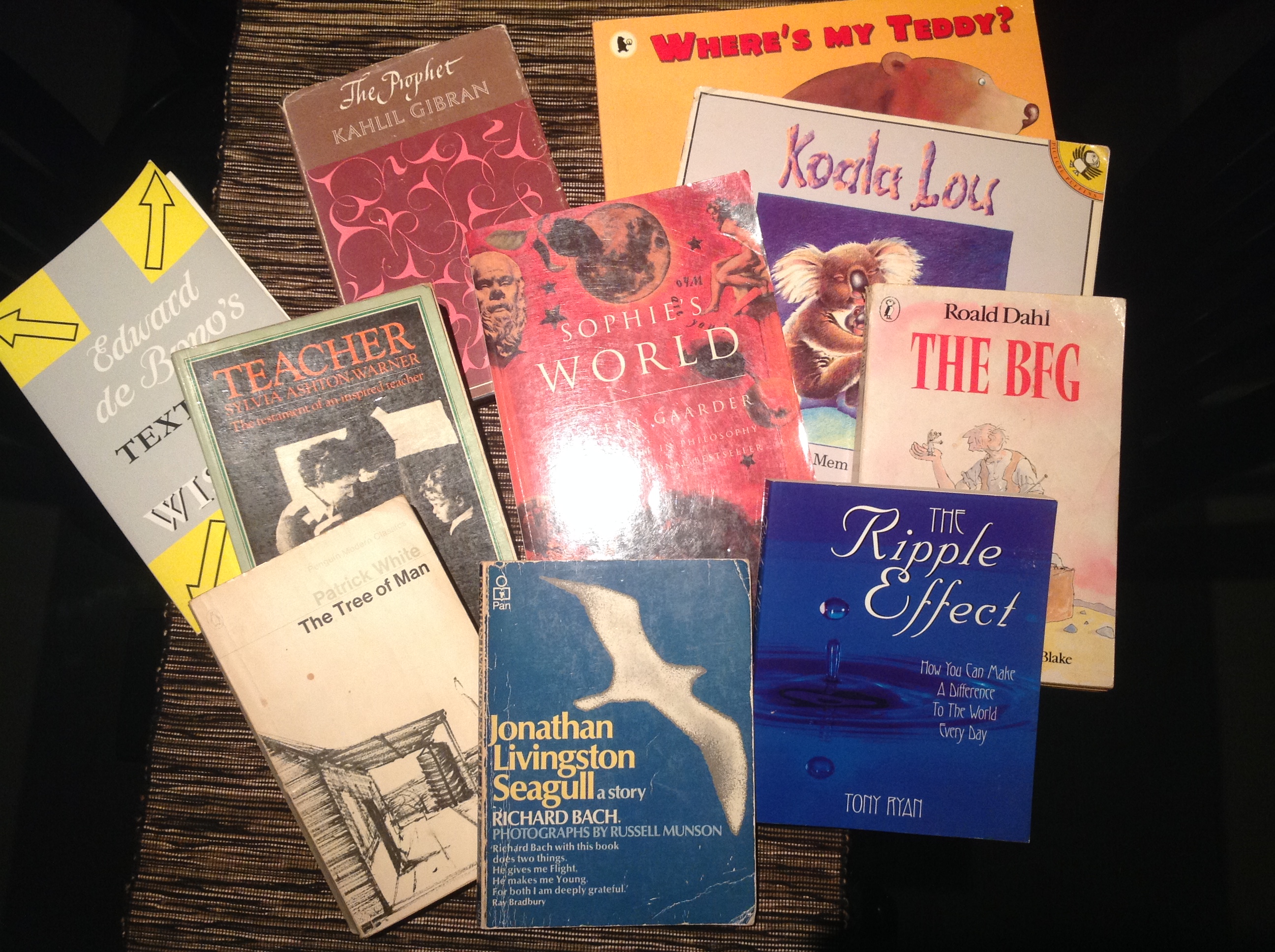
    For my first photo I have chosen, and you won’t be surprised, books:

    books

    These are just a few of my favourites. As you can see I have chosen a range including picture books and chapter books for children and both fiction and non-fiction titles for adults. There are others that should have been there but I could not fit my entire collection into one photo!

    Books have always been an important part of my life and I think a love of reading is one of life’s greatest pleasures. My love of books and reading is one of the reasons, if not THE reason I feel so passionately about education and the teaching of literacy. Sharing a learner’s excitement at becoming literate is both an honour and a joy. I have been privileged to share that excitement with many children during my teaching career, and of course with my own two children who both learned to read well before starting school.

    I have written about the importance of reading many times before, including here, here, and here.

    For this post, and for this photo, I will share ten totally random recollections of books and reading from my younger years.

    I remember:

    • books as gifts for Christmas and birthdays
    • an expedition to the council library, a six-kilometre walk there and back, each Saturday afternoon for an armful of books to read during the week
    • being deaf to the world when totally absorbed in a book for hours on end (particularly so when there were jobs to be done)
    • the eagerness of wanting to get to the end of a book and the sadness and reaching the last page
    • the excitement of finding the next book in a series or by a favourite author
    • marvelling at words and phrases for the imagery or feelings they evoked
    • enjoying an author’s style and trying to emulate it by writing and writing and writing, and wishing to one day be an author too
    • the smell of new books
    • tracing the embossed lettering on the hardcover when the jacket was removed
    • being fiercely protective of my books and having a great dislike of seeing them torn or marked
    • the joy of ownership

    And now I nominate the lovely Michelle James who blogs at Book Chat to take up this challenge if she so wishes. Her love of books is at least as great as my own!

    Thank you


    Thank you for reading. I appreciate your feedback. Please share your thoughts about any aspect of this post.

  • Are you ready or what?

    When thinking about schooling and education there is always a lot of discussion about readiness and the things that must be done to have a child ready for school, ready for the next class, ready go to college or university . . .

    While I agree that a learner must be ready to take the next step, to broaden understanding of a concept or to grasp the complexity of deeper issues; just what that readiness requires is often up for conjecture.

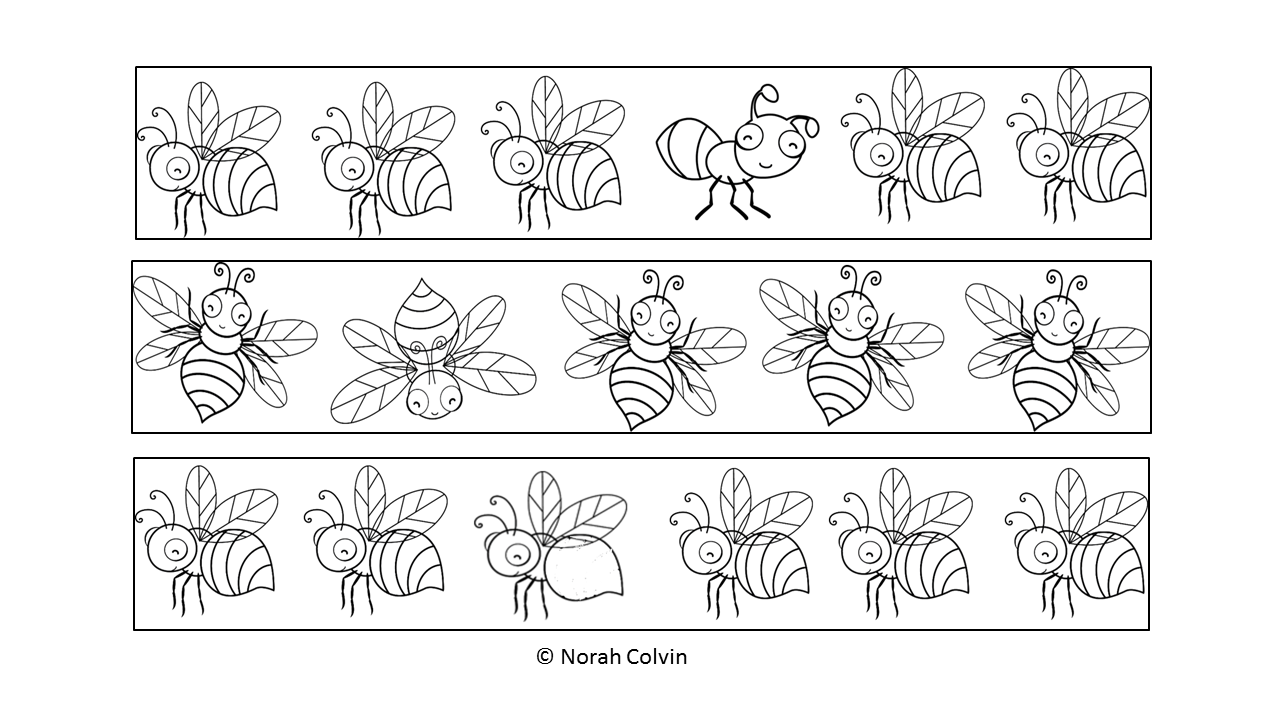
    Back in the early days of my teaching experience workbooks of ‘reading readiness’ exercises were frequently used with students in their first year of school. These activities generally required children to identify the one that was different in a group of objects. The exercises, such as those shown below, progressed through various levels of difficulty with the aim of preparing children for reading.
    reading readiness exercises

    Fortunately our understanding of how reading is learned has progressed since then and it is now recognised that exercises such as those did little to prepare children for learning to read. We now know that the best preparation for reading is to be immersed in language through conversations, with adults especially; to be read to frequently; and to develop a love of books and interest in print by sharing with others. The role of parents in preparing children for reading cannot be underestimated.

    This week I watched a video of a presentation by Yong Zhao about a type of readiness he referred to as “Out of basement readiness”. I admit I hadn’t heard the term before but the concept is definitely familiar.

    I do recommend you listen to Zhao’s talk. It is interesting, thought-provoking and humorous. I think I enjoyed listening to this talk as much as to Ken Robinson’s on How schools kill creativity which I have mentioned in previous posts here and here, amongst others. However at 55 minutes some of you may not be willing to commit the time. For me, it is 55 minutes of my life I’m very happy to not get back!

    I will not attempt to share all the content of the talk; there is too much of value, but here are just a few snippets that resonated with me:

    Zhao explains out of basement readiness this way:

    out-of-basement readiness - Yong Zhao


    Zhao says that students are being mis-educated, that they are being educated for something that doesn’t exist, and suggests that we should remove several phrases from the language we use to talk about education, especially

    • Under-performance
    • Evidence based
    • Data driven


    His description of the traditional education paradigm will be familiar to any frequent readers of my blog. He says that it is “about forcing people to do what some other people prescribe them to do” and that we reduce it to just a few subjects that can be tested.


    He talks about the “homogenisation” of schooling, and explained that homogenisation was the best way of getting rid of creative people and innovative thinkers.


    He mentioned kindergarten readiness tests, and suggests that the only test should be whether the kindergarten was ready for the children and parents.


    He recognises the uniqueness of every student, with different backgrounds, motivations and talents; and stresses the importance of effort. He says, “You cannot be born to be great. If you do not put effort into it you can never be good at it.” He explains it this way:

     “If you put ten thousand hours into something you are good at, something you are interested in you get great talent. But if I force you to spend time on something you have no interest in, you hate and something you are not good at, you at best become mediocre.”

    He says that countries that produce high test scores, score low on confidence and interest.

    He says,

    “Everyone is born to be creative, that’s a human being, that’s our gift: to be able to adapt, to learn and relearn and do new things. But school has typically tried to suppress it (with) . . . short term learning. . . Direct instruction may give the short-term gain but cause long term damages Studies show that if you teach children how to play with the toy, they lose creativity, lose curiosity and if you allow children to explore more they may not test very well but they maintain creativity and curiosity.”

    American schools _ Yong Zhao

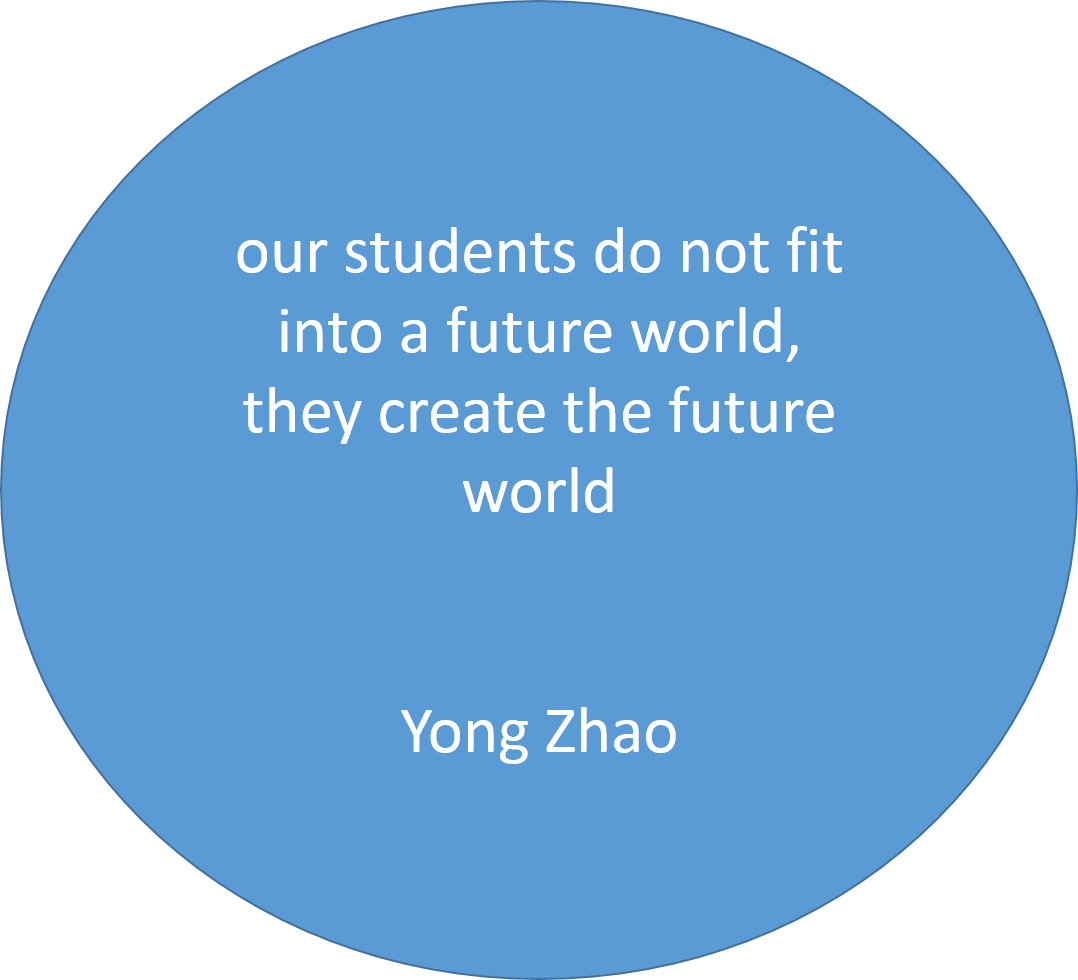
    Zhao says that “our students do not fit into a future world, they create the future world. This is why we need a different type of education.” He says that “education is to create opportunities for every individual student, they are not an average, they are not a probability, they need to be improved as individual human beings.”

    our students do not fit - Yong Zhao

    I couldn’t agree more. What do you think?


    I was led to Zhao’s talk via Diane Ravitch’s blog which is about the education system and situation in the US. Much of what she writes has applications further afield and I recommend it to anyone wishing to stay informed of current issues in education.

    Thank you

    Thank you for reading. I appreciate your feedback. Please share your thoughts on any aspect of this post.


  • Spelling tests – How well do you score?

    ABC

    Familiar to most will be the weekly spelling test held on a Friday morning after a week’s practice at learning a list of words. Some will have dreaded the test fearing they may forget the “i before e”, “silent” letter or double letter rules, for example, their inadequacies made all too obvious by the large red crosses. Others would have relished the experience, requiring little effort to learn words they already knew, seemingly by osmosis, with the expectation of large red ticks and 10/10.

    Spelling test

    I dare say that most of you reading this blog are of the 10/10 variety. Just to be sure this is so, I have set you a little spelling test to do before you read any further. Please get your pen and paper, finger and notebook, or keyboard ready, then press PLAY to take the test.

    So how did you go?

    I hope you could see from that exercise that knowing how to spell has a lot to do with meaning. In fact the spelling of many of our words in English has more to do with morphology than with sound, and although sound can be helpful there are often many different letters or letter combinations that can be used to represent the same sound, for example:

    eye

    According to the Bullock Report, published in 1975:

    “For 6092 two-syllable words among the 9000 words in the ‘comprehension vocabularies’ of a group of 6-9 year olds, 211 different spellings of the phonemes were needed – and these spellings required 166 rules to govern their use! Even at that, 10% of the words had to be left aside as ‘exceptions’; which means that ‘even if a young child memorised these rules while learning to read he would still encounter hundreds of words not governed by them.’”

    Lists of words, such as spelling lists, provide little support for learners, rarely providing context or meaning which might help them remember the words, or choose the correct meaning and therefore spelling, as shown by the spelling test exercise given above.

    Alphabetical

    In his book “Alphabetical: How Every Letter Tells a Story”, Michael Rosen explains that transmitting meaning is the reason for writing, for having an alphabet.

    Rosen describes the alphabet as “a stunningly brilliant invention. We could call it a ‘cunning code’ or a ‘system of signs’ whereby we use some symbols (letters) to indicate some of the sounds of a language. … Though it is wonderful, there are some snags for users …” including:

    • letters and letter combinations do not represent the same sound each time they are used (e.g. ‘c’ in ‘cat’ and ‘city’)
    • letters represents different sounds according to regional accents
    • a particular sound is not always represented by the same letters (see the ‘eye’ example above)

    He says that “Becoming or being a reader of English involves absorbing all these variations and then forgetting that they exist.”

    a phonic's teacher's lament

    He explains that the alphabet is more than a system of sounds and syllables and that “Our forebears devised alphabets so that they could store and retrieve meaning … over time and/or space”.

    While not speaking specifically about learning spelling words, in his book “Why Don’t Students Like School? A Cognitive Scientist Answers Questions About How The Mind Works and What It Means For Your Classroom” (referred to in a previous post here), Daniel T. Willingham consistently refers to the importance of meaning when acquiring knowledge. He says,

    “Teachers should not take the importance of knowledge to mean they should create lists of facts . . . some benefit may might accrue, but it would be small. Knowledge pays off when it is conceptual and when the facts are related to one another, and that is not true of list learning. Also … such drilling would do far more harm by making students miserable and by encouraging the belief that school is a place of boredom and drudgery, not excitement and discovery.”

    When a child scores poorly in a spelling tests and their errors are marked in red they see themselves as bad spellers, lose confidence in their ability and have a defeatist attitude before they even try.

    Why is spelling important?

    Standard spelling is essential to ensure the meaning of the message is transmitted correctly from writer to reader. While readers may very quickly notice spelling errors in text they are reading, these few errors, when embedded in meaningful text, rarely inhibit the transmission of meaning. However if the bulk of the text is in nonstandard spelling, the message would be virtually indecipherable.

    How do we learn to spell?

    The most effective way most of us use to learn to spell is reading. While reading we are exposed to a large number of correctly spelled works in context. If we read often enough, we see words frequently and learn to recognise them. We notice when they are misspelled and so recognise how they are spelled.

    The importance of spelling correctly is relevant to and a tool for our writing. The learning of particular words is best done in the context of writing.

    These are some strategies that can be used with beginning writers:

    • Model writing for them, let them see you write for real purposes, think out loud so they can see what you are doing, for example: “I going to write a . . . I’m going to start … I need to write … ”
    • Encourage them to write for self-expression, to share ideas, to tell a story . . . sustained and uninterrupted writing without the fear of a red pen anywhere.
    • Encourage them to listen to the sounds in the words and write any of the letters they know (Beginners usually start with the initial consonant, then perhaps the initial and final consonant. Vowel sounds are the most difficult to hear and differentiate and are irregular in how they are represented.)
    • Respond to their writing with written comments to their messages, modelling the correct form, for example: If the child writes “I wet to the bich on the weced” you could reply with “Did you have fun when you went to the beach on the weekend?” This enables the child to see the importance of writing for communication, demonstrates the correct spelling without being “corrected” and provides a model which can be used in future writing.
    • Encourage children to proofread their own writing by circling words they weren’t sure how to spell. Don’t always expect them to discover the correct spelling. Being able to recognise when a word is or is not spelled correctly is a first step in developing competence.
    • Notice and comment on any development that can be seen in the child’s spelling ability, for example: “You have written the word ‘kitten’. You have written the ‘k’, you know that it begins with ‘k’; you have written the ‘t’ you can hear in the middle and the ‘n’ at the end. You have listened very well to the sounds in the word.”  
    • If you want to give a child a list of words to learn, use words that have been misspelled in independent writing. Independent writing provides you with information about what the child wants to write about.
    • As they begin using technology for writing, show them how to use the tools available for checking their spelling.

    bee 5

    As a final note, in the Conversation this week was an article by Nathaniel Swain, entitled Spelling bees don’t teach kids literacy, or much else. The article discusses a soon-to-be aired television show that pits nine to thirteen year old children against each other in a spelling competition.

    Swain says,

    “How would you go spelling feuilleton, stichomythia, cymotrichous, or appoggiatura? More importantly, do you know the meaning of these words, and could you use them in a sentence?

    Challenging and insightful, or obscure and essentially pointless? Spelling bees encourage endless memorisation of complex but low-frequency words – and are a distraction from the core of literacy education.”

    Thank you

    Thank you for reading. I appreciate your feedback. Please share your thoughts about any aspect of this post.


  • Why do you read?

    CoD_fsfe_Books_icon

    I read every day.

    I read:

    • Blog posts
    • Emails
    • Tweets
    • Articles
    • News reports
    • Notifications
    • Comments on blogs
    • Road signs
    • Menus
    • Labels on products
    • Receipts
    • Bills
    • Bank statements
    • Letters
    • Instructions

    The list could go on …

    At the moment my reading of full-length books is limited, though recently I read a novel (Dead Flies and Sherry Trifle by Geoff Le Pard) and a memoir (On Hearing of My Mother’s Death Six Years after it Happened by Lori Schafer), both of which I read as ebooks. I also read a non-fiction paper book (Retiring with Attitude by Caroline Lodge and Eileen Carnell) and am part-way through a number of other non-fiction titles.

    Most of the full-length book reading I currently do is in audiobook format. My in-car time on the way to work is usually from about 45-60 minutes and I use this time to listen to audiobooks. During the past year I have listened to quite a variety including both fiction and non-fiction. I particularly enjoy it when the author reads the book, as with my current “read” Alphabetical: How Every Letter Tells a Story by Michael Rosen.

    Blog posts are probably my number one source of reading material at the moment. I read a variety of blogs; some about writing for writers, some about teaching for teachers, some with a variety of information about a range of subjects, lots about books! Picture books, young adult novels, fiction and non-fiction. I am always on the lookout for something new to read or to give as a gift for someone else to read.

    I always enjoy Anne Goodwin’s reviews on her blog Annecdotal. Not all of the books that Anne reviews appeal to me, and few of them will I read. Last year I did read one of her suggestions (The Examined Life by Stephen Grosz) and we had quite a discussion about his chapter on praise. I also read Stephen Pinker’s Better Angels of Our Nature, that was recommended to me by Geoff Le Pard, and Stephen King’s On Writing that was recommended by Lisa Reiter.

    Sometimes when I read reviews or think of all the wonderful books I could be reading, I chastise myself for the little “reading” I do. But then I remind myself that the reading I choose/need to do at the moment is different. One day soon I’ll be back to more fiction rather than informational texts.

    I was reminded of this when I re-read an article written by Charlotte Zolotow and published in The Horn Book: Writing for the Very Young: An Emotional Déjà Vu.

    In the article Zolotow says,

    “I have so much left to read and reread and so little time left in which to do it that I want to select what fills my emotional needs — needs which are often different from, or unknown to, even my closest friends.”

    Zolotow goes on to explain that

    “It was not this way when I was an adolescent or in my middle years, when I had a wide, all encompassing, devouring, greedy desire to read everything. But if I think back, I do remember as a child wanting certain books over and over again and others not at all. Very young children, like older people, want to read or hear read books that help them sort out their own most acute needs, their own inquiries about life.”

    I thought how true it is. Throughout life our reading habits and choices change. I have always been a reader. As a child and teenager I read fiction, and lots of it. Even as a young adult I continued to read fiction and poetry, but my reading of non-fiction, mainly but not exclusively to do with education, began to exceed those choices. At that time there were only paper books, and I loved them, thinking that nothing could come between me and my books.

    How wrong I was and how times change. Now I read online, ebooks and audiobooks. There is a much greater variety of material available for readers and, I think, the demands are greater. In days gone by if you weren’t reading books you weren’t reading. Now the distinction is not so clear. Because I am not reading full-length paper books as frequently as before, I think of myself as a non-reader. But that is unfair and untrue. I spend most of my day reading, and when I am not reading, I am writing. But these days reading is a huge part of my writing. I am constantly researching and reading online to give extra credence or support to what I am writing.

    What about you? How do you view yourself as a reader? Does one need to read books to be considered a reader?

    Thank you

    Thank you for reading. I appreciate your feedback. Please share your thoughts.

  • Clearing confusion – reading and writing for the masses

    This week at the Carrot Ranch, Charli Mills is talking about disorientation and has challenged writers to In 99 words no more, no less) write a story about disorientation. She suggested exploring different ways confusion could be expressed, and the tension that could be created by that confusion.

    I decided to give myself a break from writing about the confusion that students may feel as they attempt to navigate the murky waters of expectations and inappropriate curricula that have little connection with their lives; or about how disoriented they may feel in an environment that bears little resemblance to any other they will experience.

    Instead I decided to share an interesting story I heard this week and a flash fiction which is more memoir than fiction, a reminder to self of how lucky I am to be doing what I am.

    First for the story.

    My current audiobook is Alphabetical: How Every Letter Tells a Story by Michael Rosen. In the book Rosen talks about the English alphabet, dealing with each of the 26 letters in turn. He has organised the book so that

    “Each letter in the book is linked to a topic. Each chapter takes on different aspects of how the alphabet has been used. Each chapter is preceded by the short story of how that particular letter evolved, how its name came to be pronounced that way and something on how the letter itself is spoken and played with.”

    K

    When listening to Rosen read his chapter about the letter ‘K’, “K is for Korean”, I was fascinated to find out that the alphabet of South Korea, Hangul, is “the earliest known successful example of a sudden, conscious, total transformation of a country’s writing.”

    The alphabet, described by Rosen as more of “syllabic monograms” than letters and is easy to learn, was devised in the mid-fifteenth century by the ruler of the time, King Sejong, as a way of enabling everyone to be literate.

    Prior to the introduction of this alphabet, Chinese characters were used. According to an article on Wikipediausing Chinese characters to write was so difficult for the common people that only privileged aristocrats usually male, could read and write fluently. The majority of Koreans were effectively illiterate before the invention of Hangul.

    Rosen says that what is “remarkable . . . is that there was an already existing system of writing which was, to all intents and purposes, overthrown in its entirety – not adapted. (It happened) because one part of the ruling elite decided that a total change was the only way in which everyone could read and write easily.

    Hear! Hear! I say, and express a wish that all our students of English would find learning to read and write far more easy and enjoyable than many do, that more emphasis would be placed upon helping students learn than in “teaching” particular content at particular times.

    Also included in Rosen’s chapter about ‘K’ was mention of the Voynich Manuscript which appears to be scientific in origin, but which contains fictitious plants and is written in a “language” which no one, including codebreaking experts, has been able to decipher and read. Rosen says that “With one beautifully executed volume, (the author) causes instability and doubt at the heart of the production, ownership and use of knowledge. It is a carefully constructed absurdist joke.

    Unfortunately for a small (but too large) number of our students, reading and writing for them is often as confusing as the Voynich Manuscript.

    Man-resigning


    For a little bit of reminiscing, here is a video of Michael Rosen talking about the dreaded Friday spelling test. I wonder how his experience matches yours.

    And so to my flash fiction of disorientation and confusion . . .

    Obfuscation

    The pulsing train wheels pounded in my head.

    Way off in the distance voices called instructions to each other.

    “What day is it?” I said.

    The voices were closer now. “She’s in here.”

    “Can you walk? Come with us,” they said.

    They led me to a vehicle and bade me lie down inside.

    Then came the questions:

    What’s your name? When were you born? What day is it? Why are you here? Who are you with?

    Slowly, as if from the deepest recesses, I drew each recalcitrant answer, recreating identity.

    “You’re okay. You bumped your head,” they said.

    Thank you

    Thank you for reading. I appreciate your feedback. Please share your thoughts about any aspect of this post or flash fiction.

  • “If you want intelligent children, give them a book …”

    If-you-want-intelligent children

    These words piqued* my interest as they wafted to my ears from the TV set in the other room.

    Who is that?” I called out.

    Jackie French,” he replied.

    I jumped up, eager to see and hear more.

    Jackie French is a well-known Australian author and advocate for literacy and the environment. She is currently the Australian Children’s Laureate with the task of promoting “the importance and transformational power of reading, creativity and story in the lives of young Australians”.

    I was delighted to find that Jackie’s speech was in acceptance of an Australian of the Year Award.

    The media announcement released by the Minister for Social Services explains that Jackie was recognised for her “long and distinguished career as a beloved children’s writer, earning more than 60 literary prizes for her books.”

     “Jackie embodies this commitment (to changing lives in our community) and I’d like thank her for the work she continues to do sharing the power of reading and story-telling for young Australians, and her work in conservation.” 

    Here is Jackie, Senior Australian of the Year 2015, accepting her award.

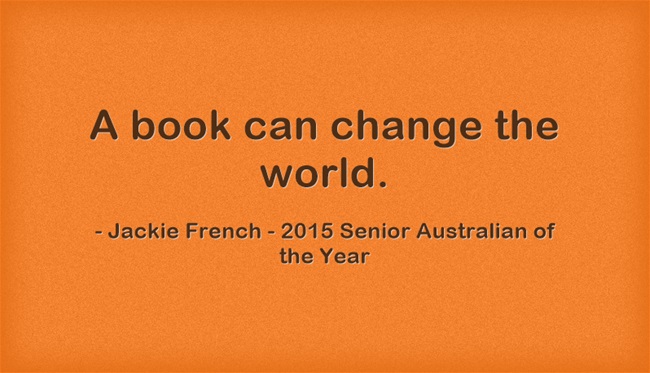
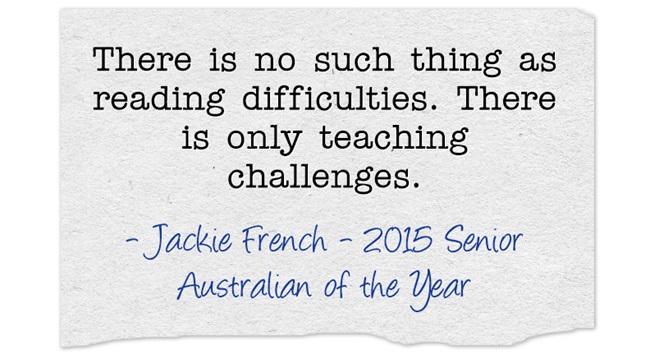
    Failure-is-not-an-optionA-book-can-change-theThere-is-no-such-thing


    In this next video Jackie talks about her book “Hitler’s Daughter”. You don’t have to have read the book to glean much of interest from the interview. In the discussion Jackie shares her thoughts about reading and writing. She questions how the ‘world’ in which one is, influences thoughts about good and evil and decisions that are made. She discusses how the need for evil to be resolved in a work of fiction differs between children and adults. She talks about whether it is necessary for a child to apologise for the sins of the previous generation, and how still controversial issues can be dealt with in an historical situation. It is worth listening to if you simply want something to ponder over.

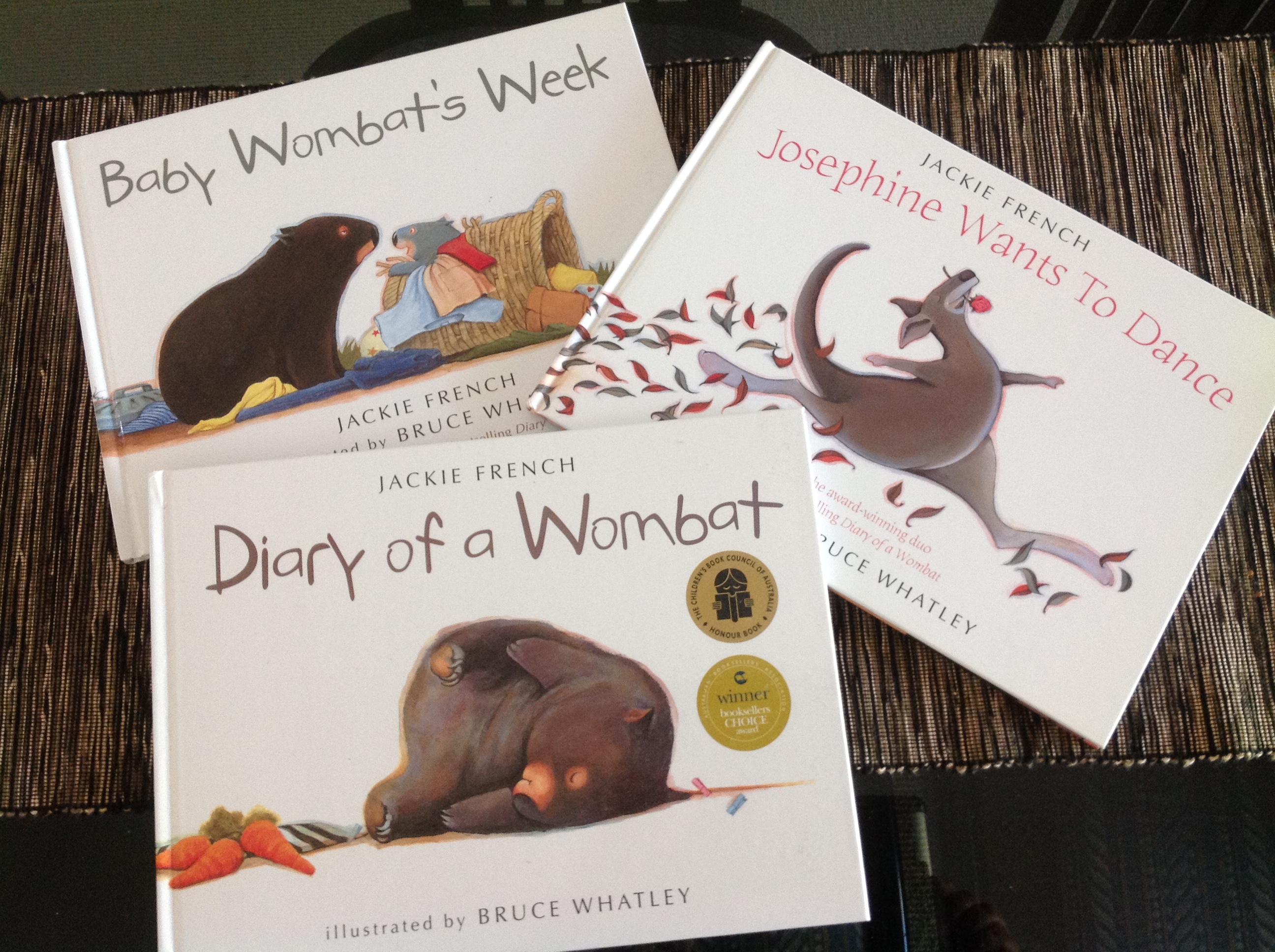
    Being an early childhood teacher I am more familiar with Jackie’s picture books such as

    Diary of a Wombat, Baby Wombat’s Week, and Josephine Wants to Dance, which are delightful.

    IMG_4302

    Here is a video of Jackie reading Diary of a Wombat.

    I have just discovered that Hitler’s Daughter is available as an audiobook, so it is going onto my list!

    https://openclipart.org/image/800px/svg_to_png/148843/1310261210.png
    https://openclipart.org/image/800px/svg_to_png/148843/1310261210.png


    I congratulate Jackie on her award and thank her for the contribution she is making to the lives of so many and the future of our planet.


    *piqued

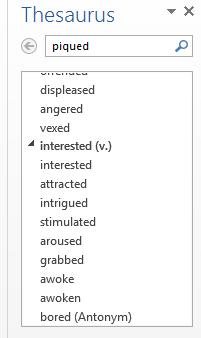
    In this sentence, I am using the word “piqued” to mean “stimulated or aroused my interest”.

    How can one word be used to express opposite meanings? I don’t know how anyone is expected to learn or understand the nuances of this language we call English!

    When I checked with my thesaurus to ensure I had chosen the correct word, this is what I found:

    piqued 1         piqued 2

    How many other words do you know that could almost be listed as its antonym?

    Thank you

    Thank you for reading. I appreciate your feedback. Please share your thoughts about any aspect of this post.

  • Reading is out of this world!

    Space-Sketched

    Reading is a wonderful pastime. Since you are reading this blog I am sure you will agree.

    People read for many different reasons, including:

    • for information e.g. about world events or something of interest, to find out what’s on offer, how to do something, or the time and place to catch a bus,
    • to be challenged e.g. by philosophical or ethical arguments and viewpoints
    • to stay in touch e.g. through letters, emails, blogs, Twitter, Facebook and other social media
    • to be enthralled by a story or delighted by poetic words and imagery
    • to escape the everyday.

    I am certain you could add to the list in breadth and specificity without too much trouble.

    Robert 2

    Developing a lifelong habit, if not love, of reading is important to fully function in society. The “bug” is more easily caught in early childhood but can be developed at any stage throughout life when its rewards become apparent.

    Nor and Bec readingI have previously shared ideas about the importance of talking with and reading to young children, including here and here.

    Another highly influential factor in creating readers is for children to see adults engaged in reading for real purposes, for information and pleasure; and having the opportunity to discuss the purposes of, and ways of reading, different material e.g. the way we read a menu is different from the way we read a story or a newspaper.

    peole_computer

    Additionally, it is useful for children to realise that the importance of reading extends beyond the home. There may be opportunities for them to observe people reading in the workplace or to discuss the need for reading in different roles.

    The Very Hungry Caterpillar

    Another important aspect of reading that I have previously discussed, using ”The Very Hungry Caterpillar” by Eric Carle as an example here, is critical literacy, the ability to interrogate the veracity of the information, its source and author.

    I recently read discussions about difficulty experienced incorporating non-fiction material, especially science information, into classroom reading programs. I was a bit blown away by this because I believe that children will be interested in anything and everything if it is presented in an interesting way.

    An information book doesn’t have to be read all at once, from cover to cover in any particular order. It can be dipped into, pored over, or explored bit by bit.

    Sometimes information can be found in a work of fiction, but it is important, as cautioned with “The Very Hungry Caterpillar”, to check the source and the “facts”.

    So to tie together the elements discussed above, these are important elements for motivating children to read:

    • Talking with them about things of interest to them
    • Reading to them
    • Modelling and discussing positive reading habits
    • Demonstrating the importance of reading
    • Discussing the importance of not believing everything that is read and of evaluating the source of the information and the intent of the author

    In my exploration this week of one of my favourite educational websites, edutopia, I discovered through a post written by Ben Johnson and called When Astronauts Read Aloud Children’s Stories – From Space! a site that met many of the above criteria: Story Time From Space

    Story Time From Space features astronauts on the space station reading story books to children. At the moment there is one story available, but more are planned, as are teaching suggestions and activities, including experiments.

    The story, Max Goes to the International Space Station is the first of a series of five stories written by Dr. Jeffrey Bennett who describes himself as “an astronomer by training and a teacher by trade, but currently spend most of my time as a writer.”

    In his post, Johnson expands on that, describing Bennett as “a research associate at the University of Colorado Center for Astrophysics and Space Astronomy, … (who) has worked at the California Institute of Technology Jet Propulsion Laboratories and NASA Headquarters in Washington, D.C.” He goes on to say that “Dr. Bennett strives to write books that are factually correct, fun, and interesting for students to read.” The experiments that the astronauts do will correspond to those in the books.

    roto-spacesuit-mkiii-clean-new


    While parts of the Story Time From Space site are still “coming”, I think this project has great potential for motivating children to read and for inspiring an interest in the world and beyond. Being read a story by an astronaut isn’t something that happens every day!

    Thank you

    Thank you for reading. I appreciate your feedback. Please share your thoughts about any aspect of this post.

  • Talking the way out

    https://openclipart.org/image/800px/svg_to_png/100009/Coffee-by-netalloy
    https://openclipart.org/image/800px/svg_to_png/100009/Coffee-by-netalloy

    Recently I met up with some teacher friends and, as always happens with teachers, the discussion turned to school, teaching and children. There was talk about the crowdedness and inappropriateness of many aspects of the curriculum, of resources that were ambiguous and poorly written, of time spent practising and preparing for tests, of (other) teachers who were ill-equipped to teach and not interested in professional learning.

    It made me sad. It has always made me sad. Sad and frustrated with the inappropriateness of so much that happens in schools and the effect it has on diminishing our most precious resource: the ability to think, learn, innovate and create.

    The fact that I am unable to do anything about this situation at times overwhelms me and I just want to curl up in a ball in the corner and cry. That I have spent almost my entire adult life swimming against the tide trying, through a variety of means, to make a positive difference through education with an effect as insignificant as a grain of salt in the ocean, makes my efforts seem futile and worthless. A waste of time and energy. I should just give up.

    But, foolishly maybe, I haven’t and don’t. Here I am writing a blog about education. One more way to try; with a website on the way as well. What effect will they have? Probably very little, but at least I am doing something that is important to me; something that gives my life meaning; even if it has no real value beyond that.

    I have been out of the classroom now for three years. I escaped before the introduction of new programs which I would have found philosophically and pedagogically impossible to implement. It had always been a balancing act, doing what my employer expected of me and what I believed to be best for the children and their learning. (Of course there is no saying that what I thought was better. The value of my thinking may well have been just in my head!)

    Five times before I had left the classroom, only twice for reasons unrelated to dissatisfaction (the birth of children). But I could never shake off my belief that education delivery could be improved. I read widely, seeking alternative ways of making a positive difference but, although I had vowed at each departure to never return, something always drew me back.

    Man-resigning
    https://openclipart.org/detail/211086/man-resigning.-by-doodleguy-211086

    Rather than allowing the situation to overwhelm me by accepting that there was nothing I could do; rather than throwing my hands in the air, walking away and admitting that it’s all too hard, I didn’t let go. Perhaps it was foolhardy. Maybe I should. Maybe one day I will. But not yet.

    Instead I choose to focus on the good things I see happening; the parents, teachers, nannies and child care workers who strive to make a positive difference. We know we can’t change the whole world. We can’t rid it of all the injustices, inequalities, violence and other wrongdoings against humanity and the Earth. But we can make a difference in our own little corner; and my own little corner has always been my focus. If I can make a difference with something as simple as a smile or sharing a positive thought then I will do it. If I can do more than that then I will, but I will focus on what I can rather than what I can’t.

    So for my little bit of positivity today, I am sharing some of what I think are great things that are happening, making a positive contribution to education and children’s lives; some things that make my heart sing and confirm my belief that if we want to, we can make a difference.

    marshmallow 5

    I have previously shared some thoughts that stimulated great discussion about the famous Marshmallow Test conducted by Professor Walter Mischel.

    On All Our Words I recently read a report of an address made by Mischel to the team at All Our Kin.

    In that address, Mischel is quoted as saying,

    “When a child grows up in a high-poverty, extremely unpredictable environment – in which anything can happen, in which danger is constantly present, in which chaos is always possible – it affects him at a biological level. Those experiences turn into chronic stress, or toxic stress, and they actually change his brain. They limit the potential of the cool system to make long-term plans and be patient and work for a distant goal.”

    The author of the article, Christina Nelson writes

    “Fighting against the biology of disadvantage requires a sustained effort that begins at birth, or even earlier, which is why creating high quality early care and education is so important for vulnerable children.”

    Mischel’s address further supports that view and congratulates the team at All our Kin for their work, saying

    “By providing a sense of trust, a sense that the rewards are attainable, that promises will be kept, that life doesn’t have to be chaotic and unpredictable, you folks are providing exactly the basis for the development of the cool system, and for the regulation of the hot system. The kids who have that when they are two years old are the same kids who are successful at the marshmallow test at five.”

    The praise from Mischel would not have been given lightly. I’m impressed with what I have read about All Our Kin, including this from their mission statement:

    “. . . children, regardless of where they live, their racial or ethnic background, or how much money their parents earn, will begin their lives with all the advantages, tools, and experiences that we, as a society, are capable of giving them.”

    family1

    The Talking is Teaching program, which was launched by Hillary Clinton as part of the Too Small to Fail initiative, in Oakland aims to reduce educational (and life) disadvantages by teaching parents the importance of talking to their children from birth.

    Thanks to my friend Anne Goodwin and daughter Bec I was also alerted to an article in the New Yorker The Talking Cure which described a program in Providence that also encourages low-income parents to talk more with their children.

    The author of the article, Margaret Talbot says that “The way you converse with your child is one of the most intimate aspects of parenting, shaped both by your personality and by cultural habits so deep that they can feel automatic. Changing how low-income parents interact with their children is a delicate matter”. The aim of the program is to support parents in non-threatening ways to support their children.

    I have previously mentioned a recent publication by Michael Rosen entitled Good Ideas: How to Be Your Child’s (and Your Own) Best Teacher. This book provides wonderful support for parents of children of any age. In very readable, accessible language, Rosen’s book is packed full of simple, inexpensive, fun and powerful ways for parents to support their children’s learning, effectively but unobtrusively, in their everyday lives. I think this book should be supplied to all parents on the birth of their children.

    Closer to home here in Australia are Community Hubs  and other programs such as Learning for Life run by the Smith Family and Acting Early, Changing Lives by the Benevolent Society.

    These are but a few of the good things that are happening. I have focussed on community programs rather than individuals (except for Michael Rosen’s book) in this post. I know there are many more great programs, and individual teachers doing amazing work. I’d love to hear about some that you admire.

    Thank you

    Thank you for reading. I value your feedback. Please share your thoughts about any aspect of this post.


  • Finding meaning

    Always look on the bright side of life’ is a philosophy to which I aspire. Many think I have achieved it but they don’t know how hard I struggle. I do try to find the good in people and situations, but it’s not always my first and instinctive reaction. When I realise I’ve reacted negatively I try to change or hide my negative thoughts and replace them with positive ones. But it’s not always easy to convince myself, regardless of whether I convince anyone else or not.

    It reminds me of a quote on a laundry bag which has stayed with me in eight different homes in three different states and for well more than thirty years. After all this support I have finally thought to seek out the source of the wisdom and found it to be UK poet and playwright Christopher Fry.

    bag

    I feel the quote represents me quite well; doing what I can to hold it all together and keeping those negative instincts in check by ‘nipping them in the bud’, all the while fearful of one day just losing it and letting it all out in one mighty swoosh. I guess the expectation of fewer years remaining in which I will need to keep myself contained makes me a little optimistic. (Always look on the bright side!)

    I like to think I’m more of a hopeful realist than either a Pollyanna or a negative realistic. A discussion about optimism and pessimism followed a previous post in which I asked How much of a meliorist are you?  But meliorism is more a belief that the world can be improved by the actions of humans than an optimistic or pessimistic expectation of the outcome.

    I believe that humans have an amazing potential for improving our world (i.e. every aspect of it). That makes me a meliorist. Recognising what is happening in the world now makes me a realist. A belief that human actions will make improvements in the future makes me an optimist, but not one without some pessimistic fears. While stories of terrorism, climate change and violence fuel the fears, stories like this TED talk by Tasso Azevedo show that improvements can be, and are being, made.

    I am an education meliorist. I believe that education is a powerful agent for change and has an enormous potential for improving lives. My optimism that education will impact positively upon individual lives as well as the collective human situation outweighs my pessimism about the outcomes I see in current systemic trends and leads me to seek out educators, like Ken Robinson, Chris Lehmann , Michael Rosen, Barbara Arrowsmith-Young and Rita Pierson who share my vision of what could be.

    A quest to improve my own life and the lives of others through education has been a long time passion. Ensuring that my own children experienced the benefits of learnacy, though I hadn’t heard of the term at the time, as well as literacy and numeracy was of great importance to me. I encouraged them to question, to create, to think critically, to read, to learn, to wonder . . .  There is so much we teach our children the list goes on. It is very rewarding for me to see that they have a love of learning and are passing that same love on to the next generation.

    Having, sharing and fostering a lifelong love of learning perhaps in some ways contributes to giving meaning to my life. But it also leads me to question life and its purpose in ways that many others don’t.  This questioning can lead to a sense of unease, of lacking fulfilment, of needing to do and achieve more. I know others who better accept the way things are, accept each day as it comes, and are content in their existence. Sometimes I envy their complacency.  Other times I want to shake them and make them realise that there is more to life than this.

    But am I wrong? Is there actually less to life than this? It is sometimes said that there is no point in accumulating wealth and possessions as you can’t take them with you when you go. But is there any point in accumulating a lot of learning and knowledge? After all, you can’t take it with you when you go either; but like wealth and possessions, you can leave it behind for future generations. If we lived only for what we could take with us, would there be a point?

    I guess what matters is what helps each of us reach that level of contentment, of being here and now in the present moment because, after all, it is all we ever have.

    I often think about life, existence, why we are here and the purpose of it all, constantly wavering between seeing a point and not. A recent discussion with a friend about her feelings of emptiness and needing to find more purpose and meaning in life disturbed my approaching, but elusive, equilibrium again. Will I ever reach that blissful and enviable state of contentment: knowing and accepting who I am, where I am, where I am going and how I am going to get there? Who knows? But I can have fun figuring it out. I am determined to enjoy the journey. I don’t think there will be much joy at the end!

    Which is all very timely with the current flash fiction prompt set by Charli Mills at the Carrot Ranch who talks about actions that we take to reach our goals and challenges writers to In 99 words (no more, no less) write a story that describes a moment of being.

    I hope you enjoy my response.

    Being, positive

    “It’s positive,” he said.

    She smiled. She knew. She only needed official confirmation.

    He wanted dates. She supplied.

    But she knew the very moment an unexpected but welcome spark enlivened her being with its playful announcement, “Surprise! I’m here!”

    She’d carried the secret joy within her for weeks, never letting on, keeping it to herself, waiting. No one would have believed her without proof. But with her whole being she knew.

    Finally, after nine inseparable months, she held the child, distinct and individual. She marvelled at the tiny creation whose existence breathed purpose and meaning into hers.

    Thank you

    Thank you for reading. I appreciate your feedback. Please share your thoughts about any aspect of this post and flash fiction.