Live Love Laugh Learn … Create the possibilities

Tag: Literacy

  • What is education, anyway? Pt.1

    One of my favourite talks about education is a TED talk given by Ken Robinson in 2006 “How schools kill creativity”.

    His contention is that

    “creativity . . . is as important in education as literacy, and we should treat it with the same status.”

    Although the video has had more than 21 million views (while quite a few of them mine, nowhere near that number!) and drawn over 3 000 comments during the last 8 years, his views need to reach a wider audience still; an audience with the power to enact change.
    One thing I had always loved about teaching was the opportunity to express myself creatively, and to encourage my students to do the same. Unfortunately the current emphasis on a content-driven, top-down approach where test results reign supreme has left little room for anyone’s creativity. I am not saying there was ever much opportunity for creativity in formal schooling, but creative teachers could always squeeze a bit it. Now the opportunities for creative “massage” are few.
    My optimism for positive change in education is always raised when I read or hear of others who share similar views. I think if enough voices are heard chanting the same message that a change may come.
    This post (and article in Saturday’s QWeekend magazine) by Mary-Rose Maccoll “Why Banff means the World” also proclaims the vision of Ken Robinson. Mary-Rose is another fan.
    She says that

    “Being at the Banff Centre (in Canada) has made me reflect on what we lose when we don’t foster art, when we don’t foster creativity. And what we lose is the world.”

    She says that

    “even as school education becomes increasingly narrow in its focus, we’re also seeing a decline in performance on the very outcomes that standardisation seeks to improve.”

    She concludes by saying,

    “As I sit in my room and watch the mountains, listening to the trail of a contraband sax down the hall (you’re supposed to play in the soundproofed studios in the forest), reading a piece by a Scottish writer, I am grateful for artists. In our 21st century world, we surely need them.”

    I agree wholeheartedly as, I’m sure would Ken Robinson, along with Teachling whose post What is Education, anyway?Pt 1 I reblog for you here.

    I agree with Teachling’s belief that

    “many teachers would feel that – as well as their students’ innate talents and creativity being snuffed – their own talents and creativity don’t get much of a look-in. I believe most teachers are very restricted in terms of what they teach as well as how they teach it.”

    I also agree with her when she states that

    “that there’s very little teachers can do about it.

    It’s the administrators and politicians that should take Robinson’s advice. It’s also the perceptions of a majority of parents that would need to vastly change if any rethinking of fundamental principles were to occur.”

    Have a listen to Ken and read these other posts, then let me know what you think.

    How can we make our voices be heard to ensure that creativity and innovation is not lost for the future?

    Teachling's avatarTeachling

    Ken Robinson’s take on schools, and how they kill creativity…

    You’re likely one of the 20,738,467 viewers of Ken Robinson’s “Schools Kill Creativity” 2006 TED Talk. Robinson’s assertion, and general gist of the talk, is that “all kids have tremendous talents, and we squander them; pretty ruthlessly”. The “we”, we can infer from the rest of his talk, are schools.

    Let me pick out some key points:
    • “My contention is that creativity, now, is as important in education as literacy, and we should treat it with the same status.”
    • “We are educating people out of their creative capacities.”
    • “Every education system on Earth has the same hierarchy of subjects… At the top are Mathematics and Languages, then the Humanities and at the bottom are the Arts… And in pretty much every education system there’s a hierarchy within the Arts. Art and Music are normally given a higher…

    View original post 423 more words

  • Searching for purpose in a picture book – Part B

    Searching for purpose in a picture book – Part B

    What is the purpose of picture books? Is their purpose simply to entertain with an interesting story and rhythmical language that is fun to read and recite? Is it simply, as I said in my previous post Searching for meaning in a picture book – Part A, “. . . a special time of togetherness, of bonding; of sharing stories and ideas . . . “ Could the purposes of picture books extend beyond entertainment alone? I think most people would acknowledge that reading picture books to young children has a profound effect upon children’s learning and development. In addition to entertainment, picture books can be used for a multitude of purposes, including:

    • to encourage a love of reading and books
    • to develop vocabulary and knowledge of language (through immersion and engagement rather than direct instruction)
    • to provide a link between the language of home and the language used in the wider community and in education
    • to support children embarking on their own journeys into reading
    • to inspire imaginations
    • to provide opportunities for discussing feelings, emotions, ideas, responses
    • to develop feelings of empathy, identification, recognition, hope
    • to instill an appreciation of art by presentation of a wide variety of styles, mediums and techniques

    I’m sure you can think of many more than I have listed here. But what of knowledge, information and facts?

    yves_guillou_question
    http://www.openclipart.org

    How, and when, do children learn to distinguish fiction from fact, or fact from fiction? At the moment that question is too big for me to even think about answering, but it is a question that I ponder frequently and may return to in future posts.

    ryanlerch_thinkingboy_outline
    http://www.openclipart.org

    Children seem to realise early on that animals don’t really behave like humans and wear clothing.

    mouse dressed up
    http://www.openclipart.org

    They don’t expect their toys to come to life and start talking.

    teddy_bear_and_doll
    http://www.openclipart.org

    They quickly understand, when it is explained to them, that unicorns and dragons are mythical creatures and, to our knowledge, don’t exist.

    toy unicorn
    http://www.openclipart.org
    dragon_on_a_leash
    http://www.openclipart.org

    But what happens when the lines between fact and fiction blur and content, though presented in fiction, has the appearance of being based in fact? For example: The lion is often referred to as “King of the jungle” and appears in that setting in many stories. However, lions don’t live in jungles. According to Buzzle, they live in a variety of habitats and jungle isn’t one of them. You knew that didn’t you? But what about the children? When will children learn that lions are not really kings of the jungle? Do you think it matters if children grow up thinking that lions live in jungles?

    Lion_Cartoon
    http://www.openclipart.org

    What about when animals that don’t co-exist appear in stories together? For example: Penguins often share a storyline alongside polar bears. Does this encourage children to think that penguins and polar bears co-exist? When do adults explain to children that penguins and polar bears live at opposite ends of the planet? At what age do you think children will happen upon that information? Does it matter?

    tauch_pinguin_ocal
    http://www.openclipart.org
    lemmling_Cartoon_polarbear
    http://www.openclipart.org

    What about the way animals are visually portrayed in stories? Must the illustrations be anatomically correct? For example: We all know that spiders have eight legs. Right? If I was to ask you to draw a picture of a spider, how would you do it? Have a go. It will only take a second or two. I can wait.

    whistle
    http://www.openclipart.org

    Now compare your drawing with these:

    spiderswirl2
    http://www.clipart.org
    Little_Miss_Muffet_Spider
    http://www.openclipart.org
    spider
    http://www.openclipart.org

    How did you go?

    While children easily realise that this picture is fictional:

    pet_spider_girl
    http://www.openclipart.org

    They have less success is understanding what is wrong with the previous images. Spiders have eight legs. Those drawings show eight legged furry creatures. The story says they are spiders. That must be what spiders look like. Right? Unfortunately, real spiders look more like this one:

    johnny_automatic_spider
    http://www.openclipart.org

    All eight legs are attached to the cephalothorax, not the abdomen (or even one body part) as shown in most picture books. While I am sure you drew a spider correctly (didn’t you?), most children and many adults draw them more as they are depicted in children’s stories. Is this a problem?

    LOVE_2
    http://www.openclipart.org

    I am not for one moment suggesting that we get rid of fictional picture books and stories. I love them! And as I have said, and will continue to say, many times: they are essential to a child’s learning and development. There is no such thing as too many or too often with picture books. Instead, I would like you to consider the misconceptions that may be developed when the content of picture (and other) books may be misleading, and how we adults should handle that when sharing books with children. One of the books that gets me thinking most about this topic is “The Very Hungry Caterpillar” by Eric Carle.

    The Very Hungry Caterpillar

    As I said in a previous post, it has been published in over 50 languages and more than 33 million copies have been sold worldwide. I am almost certain that you will be familiar with it, and upon that assumption, I have one final task for you in this post. Please share your response to the question in this poll:

    To be continued . . .

    I would love to receive any other comments you would like to share regarding the content in this post.

    I do apologize that I have been unable to get the text and pictures in the layout I desire. I obviously have more investigations to carry out and learning to do.  🙂

    Maybe next time I’ll have it mastered, says she, hopefully!

  • Searching for meaning in a picture book — Part A

    Searching for meaning in a picture book — Part A

    Do you recognise this book?

    The Very Hungry Caterpillar

    Chances are you do.

    According to the website of the author Eric Carle, since its publication in 1969 it has been published in over 50 languages and more than 33 million copies have been sold worldwide. It ranks highly in the Wikipedia List of best-selling books.

    Most primary schools, preschools and kindergartens would have numerous copies in their libraries with a copy in most classrooms as well as in teachers’ private collections. Most homes with young children would have a copy in their storybook collection.

    reading

    In addition to the books, many of those schools, classrooms and homes would have some of the associated merchandise; including toys, games, puzzles, posters and colouring books, which are now available.

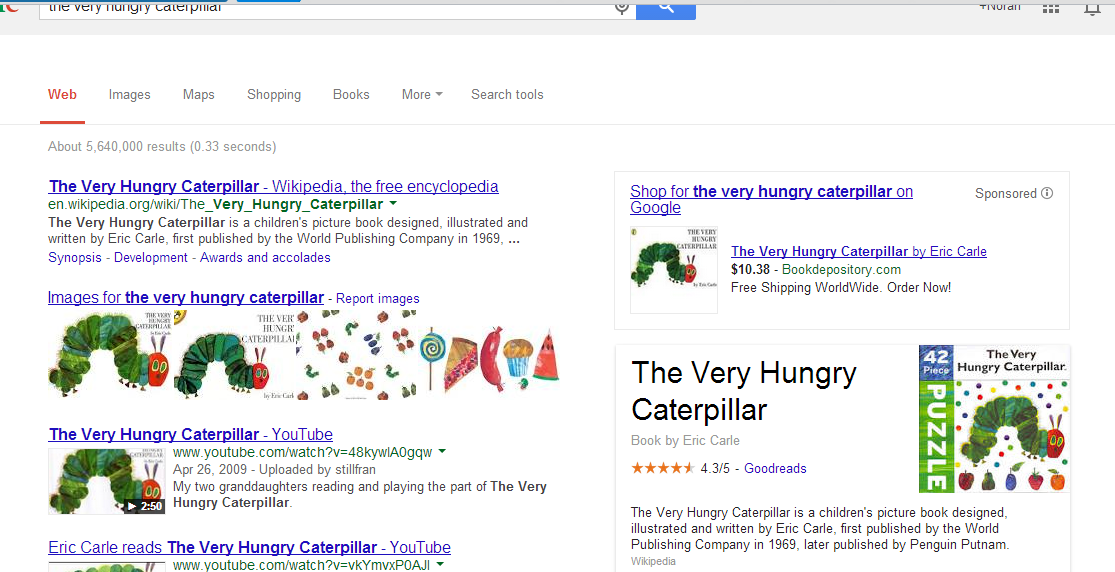
    When I typed ‘the very hungry caterpillar’ into the Google search bar about 5,640,000 results were listed in 0.33 seconds!

     Google search the very hungry caterpillar

    There are activities, lesson plans, printables, videos, and advertisements for merchandise. There is a plethora of suggestions for using the book as a teaching resource, including counting, days of the week and sequencing.

    I think you would be hard pressed to find someone that hasn’t at least heard of the book. That is quite an impact, wouldn’t you say?

    For a book to have done so well, it must have a lot going for it. And it does.

    There are many things I like about this book, including:

    • The bright, colourful, collages with immediate appeal
    • The natural flow and rhythm of the language making it easy to read, dramatize and recall
    • The sequence of numbers and days encouraging children to predict and join in with the reading and retelling
    • The match between the illustrations and the text supporting beginning readers as they set out upon their journey into print
    • The simple narrative structure with an identifiable beginning, a complication in the middle with which most children can empathise (being ill from overeating) and a “happy” resolution with the caterpillar turning into a beautiful butterfly.

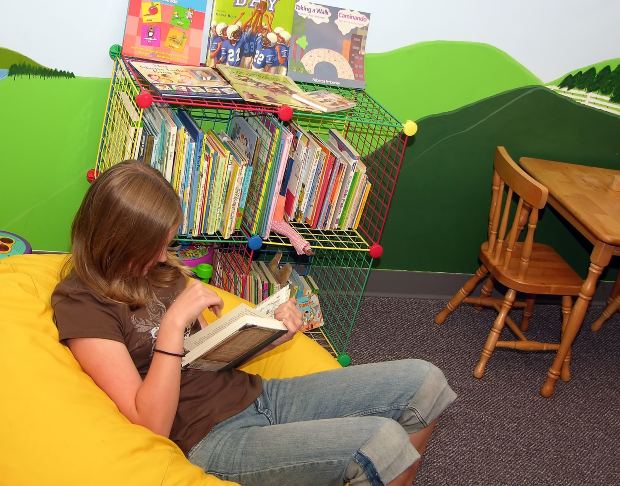
    Reading to children

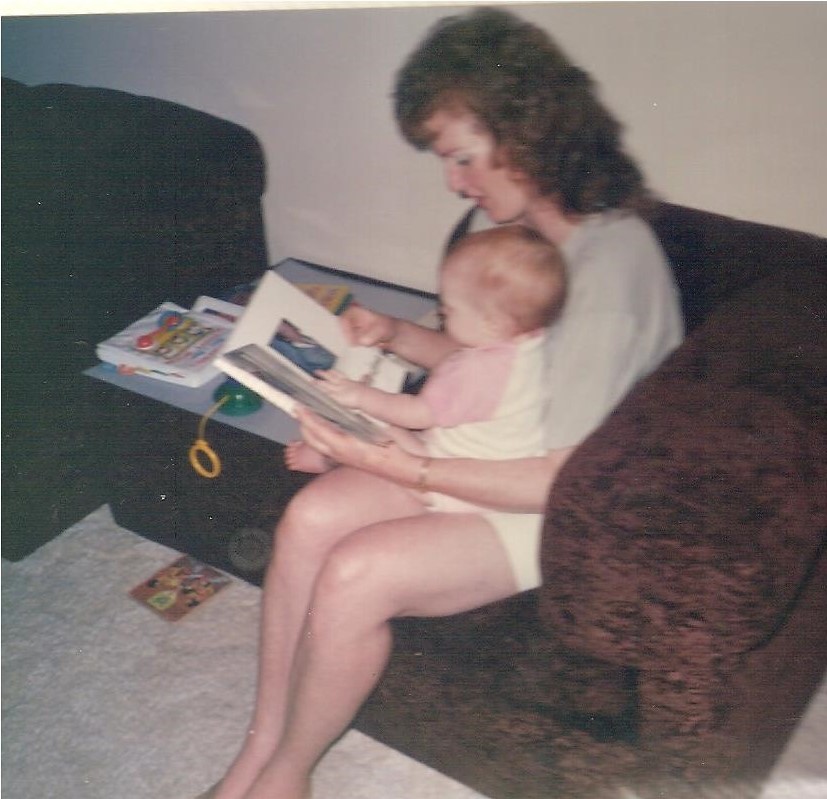
     Nor and Bec reading

    Sharing of picture books with children from a very young age has a very powerful effect upon their learning.

    There are many benefits to both parent and child of a daily shared reading session.

    clock

    It can be seen as a special time of togetherness, of bonding; of sharing stories and ideas. It can be a quiet and calming time; a time to soothe rough edges and hurt feelings; a time for boisterous fun and laughter; or a time for curiosity, inquiry, imagination and wonder.


    Whatever the time, it is always a special time for a book
    ; and all the while, children are learning language.

    8-12-2013 7-38-33 PM
    © Bernadette Drent. Used with permission.

    They are hearing the sounds and rhythm of their language. They are being exposed to new vocabulary, sentence structures, concepts and ideas. They are learning important understandings that will support them on their journey into literacy e.g. they are learning that the language of a book differs from oral language and that the words in a book always stay the same.

    They begin to realise that it is the little black squiggly marks that carry the message, and they may even start to recognise some words.

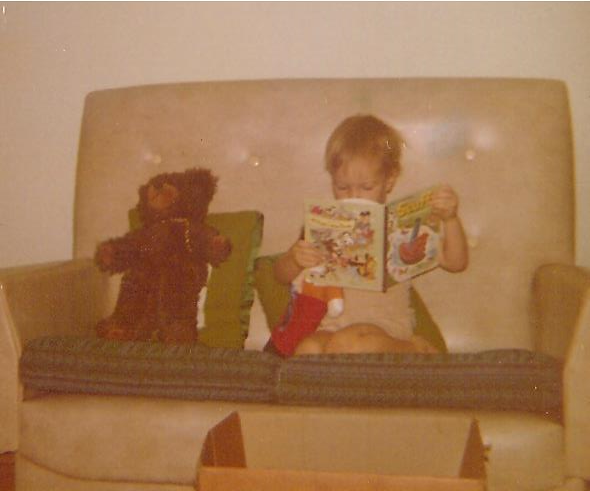
    Robert 2

    Many of these, and other, features make “The Very Hungry Caterpillar” suitable for incorporation in an early childhood curriculum, for example:

    The Very Hungry Caterpillar

    • Literature appreciation – love of language, knowledge of story, interest in books
    • Reading – the clear, simple and predictable text make it an easy first reader
    • Maths – counting and sequencing the numbers, sequencing the days of the week
    • Visual arts – learning about collage and composition of a picture
    • Philosophical inquiry —sharing interpretations and discussing feelings about the story, asking questions raised including the ‘big questions’ of life

    ryanlerch_thinkingboy_outline

    Eric Carle, in an interview with Reading rockets, describes it as a book of hope. He says:

    You little, ugly, little, insignificant bug: you, too, can grow up to be a beautiful, big butterfly and fly into the world, and unfold your talents.”

    He goes on to explain that,

    I didn’t think of this when I did the book, but I think that is the appeal of the book.”

    But I’m not going to let him have the last word!

    While “The Very Hungry Caterpillar” has always been one of my very favourite picture books, I do have some misgivings about the impact that this book has had.

    In future posts I will share what I consider to be some limitations of the text, and what I consider to be the most powerful use of all.

    What do you think?

    What appeals to you about this book?

    What questions does it raise for you?

    Please share your ideas. I look forward to hearing what you think.

  • Happy being me

    Self-esteem

    One of the most precious but fragile qualities of a person is their sense of self and self-esteem.

    A positive word of encouragement can reinforce the strength of one’s self-image.

    Machovka_Happy_fish
    image courtesy of http://www.openclipart.org

    But that image can be shattered all too easily through a sigh, a grimace, an ill-chosen word or careless remark.

    image courtesy of www.openclipart.org
    image courtesy of http://www.openclipart.org

    Our self-esteem flourishes when we are happy and wilts when we are sad. It is much easier to boost someone when they are up, and to hit them when they are down. Maintaining a healthy self-image requires just the right amount of self-knowledge and confidence to be resilient when faced with negative feedback and to not adopt an inflated sense of importance when receiving false, or genuine, positive input.

    Fostering self-esteem in the classroom

    image courtesy of www.openclipart.org
    image courtesy of http://www.openclipart.org

    As a teacher I have always considered it to be equally or more important to strengthen a child’s self-image as it is to extend their thinking and learning abilities.

    My primary aim has always been to cultivate a group of happy children, with strong senses of self, confident in what they could do and willing to have a go to extend their learning. I believe that these qualities are necessary in order for children to learn efficiently.

    A child who lacks confidence and is fearful of having a go lest a mistake be made, will make slow progress, finding it difficult to move out of the “comfort zone” into the unknown.

    Because children have no choice in whether to be in school or not, despite whether they like it or not, then, I believe, it must be a happy place, a place where they want to be and look forward to coming. How powerless must they feel if they are compelled to attend every day in a situation which gives them no pleasure.

    www.openclipart.org
    image courtesy of http://www.openclipart.org

    Sometimes the response to this remark is, “It’s life. They just have to get used to it.”

    But really, when you think of it, adults, no matter how trapped they may feel in certain situations, do have a choice. The choices may be no more palatable than the one they are in, but they are able to make that choice. My point is: children don’t make this choice. The choice is made for them. We are lucky that most children accept, and most rather willingly, indeed with enjoyment, this institution of childhood.

    Start each day with a song

    image courtesy of openclipart.org
    image courtesy of openclipart.org

    Because these beliefs and values guided the choices I made as a teacher, I started every day with at least a song or two, and always one of affirmation. It is almost impossible to frown when singing, and almost as impossible to not join in when everyone around is singing too.

    There were mornings when it was just as important for me to sing the songs as it was for the children. As for them, it gave me time to forget the problem that had occurred outside the classroom, the difficulty getting something to work the required way, or the disagreement that had taken place some time earlier. As for them, it gave me a quiet time to reflect and reassure myself, “I’m okay. I can do this. Let’s get on with our day.”

    I noticed, too, that when parent volunteers or other visitors were with us for our song, they also joined in with our singing and invariably followed up with a spontaneous comment about how much they appreciated, and needed, the song as well. Many times I received comments from passers-by about how the class’s happy singing had helped them start their day.

    image courtesy of www.openclipart.org
    image courtesy of http://www.openclipart.org

    I took every possible opportunity to remind parents of how wonderful their children were and we always shared at least one of these songs with parents during end-of-term celebrations of work. I believe the songs help to model, for parents as well as teachers, a way of sharing positive feedback and affirmations with their children.

    Affirmation songs

    Some of the songs we sang regularly in the mornings were from Anne Infante’s “Special as I can be” CD, the title song of which is my favourite and always the first I introduce to the children.

    Anne Infante (image courtesy of Anne)
    Anne Infante (image courtesy of Anne)

    Image courtesy of Anne

    Click here to find out more about Anne and her songs.

    I always wrote the songs out on charts so that, from the first day of school, we could follow along with the words as Anne sang them, even before most of the children could recognise any of them. The melody and repetitive structure of each verse invited the children to join in:

    Nobody else is just like me. 

    I’m as unique as I can be.

    I am beautiful, wonderful and

    beautiful, special as I can be.”

    The following verses substituted things such as “Nobody’s face, nobody’s smile, nobody’s eyes.” I simply told them, before the verse started, the words that changed each time.

    It wasn’t long before the children were joining in with the singing and recognising some of the words repeated in the songs e.g. “I” and “beautiful”.

    If ever I was called away during the song, they took great delight in being the one to point to the words for the rest of the class to follow.

    As the children became confident with one song, I would introduce another; and as our repertoire built, we would sing a different one each day. Sometimes the children would change the chart I had selected for another of their choosing for that particular day.

    The children loved these songs, and often during the day, while they were working on another task, someone would start quietly singing a song, and before long everyone would be joining in with joyful affirmation. I loved it when they left the classroom in the afternoon singing another of Anne’s songs, “Today I’m feeling happy. I am, I am, I am.”

    image courtesy of www.openclipart.org
    image courtesy of http://www.openclipart.org

    Singing an affirmation song is a little “happiness pill” you can take every day without any side effects.

    Happy being me

    Affirmation songs provide benefits in many ways:

    • Share the joy of being alive and happiness with self
    • Put a smile on everyone’s face
    • Invite everyone to participate
    • Encourage acceptance of and respect for self and others
    • Reinforce self-esteem
    • Insulate the classroom from outside troubles
    • Quiet the mind and settle the body in preparation for the day’s work
    • Provide words to express feelings
    • Give musical pleasure
    • Are an avenue for literacy learning.

    Please feel welcome to share your thoughts.

    If you enjoyed this post please subscribe.

  • “I love the mountains”

    More than 30 years ago I had the extreme good fortune of being at Brown bear brown beara literacy teachers’ conference at which Bill Martin Jr. (author of “Brown Bear, Brown Bear”) was speaking. What a memorable occasion it was.

    At the moment I can recall no other speakers, but I have never forgotten the captivatingly melodic and sonorous voice of Bill and the power of his message.

    Bill inspired his audience as he spoke about coming to reading later than most, at about the age of twenty, by teaching himself to read through his love of poetry. He attributed this love to being read to daily as a child. His delight in and playfulness with language was obvious as his voice danced through his stories, poems and songs to the accompaniment of his rich lilting laughter.

    He demonstrated, through audience participation, the joy of learning through song and the importance of the sounds and rhythms of language. Having fun and playing with language provides much joy for adults and children alike.

    In the days of overhead projectors, long before the now familiar electronic slideshows, Bill displayed a simple song “I love the mountains” on the screen. In an instant he had the audience rollicking in their seats, singing along with the words on the screen, and following the rhythmic lead of his voice without any other accompaniment. The energy created by this spontaneous engagement of the audience was electrifying. How could anyone not wish to participate? I quickly noted the words and tried desperately to commit the tune to memory. (I have since found out that this is a traditional camping song but, since I am not a camper, it was unfamiliar to me at the time though it may have been known by other members of the audience.)

    image courtesy of openclipart.org
    image courtesy of openclipart.org

    Every year since then, I have shared that song with my children.

    At the beginning of year one, in their 2nd or 3rd week of school, long before many of them could read or write very much at all, I would write the words on a chart and have them singing along, sharing through me, Bill Martin’s joy of song and language.

    One title in the "Sounds of Language" series
    One title in the “Sounds of Language” series

    Then, as soon as they were masters of the tune, we would engage in another of Bill’s suggested activities, “transforming sentences”. As Bill recommended, they were “taking an author’s structure and hanging their own thoughts on it.” (Sounds of Language, 1972)

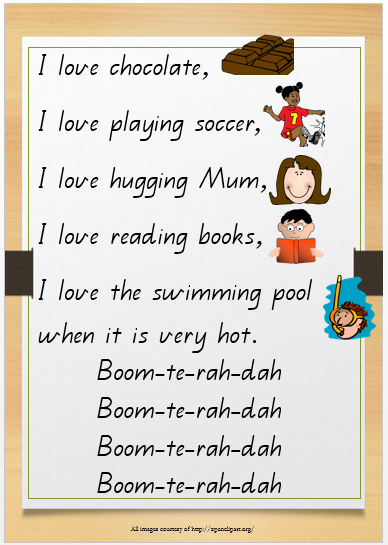
    We changed Bill’s choice of “loves” for our own, and wrote our own collective song, which we sang repeatedly and with great gusto. Although the original did include a rhyme, we didn’t concern ourselves with that at this stage. We just concentrated on sharing our loves in a song such as this one:

    I love chocolate

    While they were having fun with language, the children were also learning a subtle and unstated lesson about how powerful a tool for communication self-expression through language, both oral and written, could be.

    The children’s suggestions for things they loved were many more than the lines of one collective song would allow, so there was nothing else to do but write one of their own. Which they did. They had already seen how easy it was. They knew the rhythm.  They had the basic sentence structure. All they had to do was substitute their own thoughts and make the song their own.

    How wonderful it was to hear the children singing their own lyrics as they wrote them, ensuring that the words telling of their loves fitted the rhythm of the song. The children delighted in sharing their songs with each other and with anyone else who would listen. At the end of the day they took them home to share with their parents as a special gift of themselves for Valentine’s Day.

    While my children did not have the benefit of Bill’s magical voice, or even a tuneful model from me, they delighted in his song. You can share a version (without Bill’s voice, or mine) by clicking here.

    Why not create your own songs, and support your children to create theirs, using this song model. You’ve seen how easy and joyful it can be. A song to sing about things you love is a little “happiness pill” that can be taken daily with no known side effects.

    I invite you to share your own versions here for us all to enjoy.

    Bill Martin Jr. wrote in Sounds of Language (1972):

    “As children gain skill in using their ears to guide their eyes in reading, they have a qualitatively different reading experience. Consider the young child who has frequently heard his teacher read “Ten Little Indians.” Once a child has these sounds clearly and solidly in his ear, he has little difficulty reading this old rhyme in its printed form. Once his ears begin telling him what his eyes are seeing, he approaches the reading with confidence and expectation. And when he comes to his teacher and exultingly declares,

    I know that word, Miss Barber! That word is “little!”

    she has evidence that he is relating sight and sound in reading.”

    What a joy and honour it is, as an early childhood teacher (including parent) to share a child’s journey into independent and joyful reading and writing.

    Nor and Bec readingwriting

    Robert 2

    It was a sad day when Bill Martin Jr. passed away on August 11, 2004, but his legacy lives on in the hearts of many readers, both young and old, whose lives have been touched by his love of language, and who may have indeed stepped across the threshold into reading through one of his many wonderful books.

    Click on the title to listen to Bill singing another fabulous song “I am Freedom’s Child” and his message for democracy: what another great song to start each day!

    I will have more about Bill Martin Jr. and his legacy in future posts.

    If you liked this post, please subscribe to follow.