Live Love Laugh Learn … Create the possibilities

Tag: learning

  • Would you believe?

    When I was growing up “Get Smart” was a popular show with my family and friends.  The question “Would you believe . . .?” was often asked humorously, in Max-style, starting off with an exaggerated and unbelievable suggestion, then moving through a series of diminishing magnitude to the, often insignificant, reality.

    I am not going to start with an exaggeration for I am rather pleased with what I have achieved. I wish to make no comparison with anyone else who may have achieved a whole lot more, or even those who may have done less. I just know that I have learned a lot, and in fact, have learned so much that I now know what future learning I need to do.

    If you know nothing, you don’t know what you need to know. It is only when you know something that you get an inkling of what there is to learn.

    If, this time last year, you had said to me:

    “One year from now you will be writing a blog and publishing your fiftieth blog post; you will have over 800 followers on Twitter and you will engage in conversations with people from all over the world.”

    I would have laughed and said you were crazy. I had no thought of writing a blog and thought Twitter was just for twits.

    travel-map
    http://www.openclipart.org
    van
    http://www.openclipart.org

    I had followed only one or two blogs posted by family and friends on holidays so knew nothing of the pleasure or potential of writing or following blogs.

    Eating-Breakfast-like-Pig-1
    http://www.openclipart.org

    What I “knew” of Twitter was minimal and misinformed. I thought it was people sending messages about eating breakfast, going to the bathroom and other mundane events. I couldn’t see the point in that.

    How wrong were my misconceptions how they have changed!

    How I have changed.

    What I would have considered a Max-style exaggeration a year ago is now a reality. And it didn’t take a year. It has all happened in just six months.

    tweet_birs-2
    http://www.openclipart.org

    Six months ago I published my first blog post and tweeted for the first time.

    I was both nervous and excited and had no expectations other than to see what would happen.

    I am delighted with the result: the learning I have done, the people I have met and the way my writing has grown. One of the greatest pleasures is having control over what I write; another is meeting so many interesting people, some like-minded and others with differing views, but all supportive and willing to share their knowledge, ideas and thoughts.

    I wouldn’t have started upon this journey without the Queensland Writers’ Centre (QWC).

    cropped forest
    http://www.morguefile.com

    In late 2012 I did a couple of sessions about digital publishing with Simon Groth (Manager of if:book Australia), and another at the beginning of 2013. While the talks were fascinating and I learned a lot, I was such a N00b that it was all still a forest to me and I couldn’t see the path to take me in and didn’t have the tools to clear a path. I needed more time to absorb the information I had heard and work out what to do with it. I still wasn’t convinced that blogging and social media were for me.

    Belinda Pollard of Small Blue Dog Publishing changed all that at another QWC session in June. I am very grateful to her for convincing me that this was the way to go and that I just needed to get started. She described Twitter as the “water cooler for writers” and a great way to meet other writers.

    Less than two months after hearing Belinda speak I was on my way, hacking a path through the undergrowth, searching for the warmth of sunlight through the canopy.  My quest for information started with her website  and crawled its way out and around other websites and blogs, some of which I return to often for reassurance, reminders and more information.

    Now in answer to the question, “Are you experienced?” I can reply with a very definitive: ”Yes, I am experienced!”

    I have lost my nervousness, but not my excitement. I have grown in confidence and knowledge but know that there is so much more to learn. In my Twitter profile I say that I was born too soon, but maybe I just started late. Considering that there were no computers and no internet for more than half my life and the only “mobile” phone I knew in my younger days was Maxwell Smart’s shoe, I think I’m doing okay in the catch-up.

    In addition to all the generous bloggers and twitter users who have helped me along the way, many without knowing it, I am also very grateful to you, my readers and followers, who have visited, commented, liked, favourited and otherwise shared my posts and tweets, but more especially your knowledge, support and ideas.  While I had no expectation that any of you would drop by to read or engage me in conversation, I’m so glad you did. Thank you. Please stay with me as my journey continues.

    Thank_you_pinned_note
    http://www.openclipart.org
  • Seeking praise – Stephen Grosz revisited

    Praise may be defined as an expression of approval or admiration.

    Who wouldn’t want that?

    If you write a blog, don’t you love it when others “like” a post, leave a positive comment, re-blog your article or link to it via theirs? I do. Aren’t these all expressions of approval or admiration?

    What about on Twitter when someone Re-tweets, favourites or replies positively to your comment, engaging you in conversation?

    Aren’t these also expressions of approval or admiration?

    I love to receive all these signs of encouragement and support that let me know that my efforts are appreciated and confirm that I am on the right track. If I did not receive any of this feedback I would feel quite isolated and consider my efforts to be fruitless and a waste of time. I would probably just give up.

    As a teacher I have always considered it of primary importance to create a happy and welcoming classroom environment in which children feel valued, affirmed and supported. Expressions of approval and admiration for behaviour, effort and achievement were generously given with the aim of encouraging the desired response, a happy child being foremost. I have written about this in previous posts, including:

    Happy being me

    Affirmations: How good are they?

    As a parent too I considered it important to affirm my children and display my approval and admiration for them. I still do, even now they are adults. The need for approval never ends. I know sometimes you just have to go out there and say what you know is right, even though others will disagree or ridicule you. I am not talking about those instances here.

    My strong belief in the power of affirmations and approval stems partly from the dearth of them in my childhood and school days. I have also mentioned this in a previous post: 

    Mouthing the words – the golem effect

    Recently I listened to a fabulous (audio)book, “The Examined Life: How We Lose and Find Ourselves” by Stephen Grosz. I wrote about it in my previous post A book worth reading: Stephen Grosz “The Examined Life” saying that

    “What appeals to a reader about a book, or what a reader takes away from a book is as individual and personal as the reader. What is of most significant to one, may be of lesser importance, or even insignificant to another. “

    For me the chapter of most significance is chapter 3 “How praise can cause a loss of competence”.

    To say I was startled by the title would be an understatement. I was puzzled, intrigued and challenged. How could praise cause a loss of competence? Surely negative feedback or a lack of encouragement altogether would be major contributors to diminishing competence. Was everything I had believed and practiced wrong? (Oh no –there’s my need for approval and affirmation!)

    Grosz says that during the past decade studies into self-esteem have found that praising a child as “clever” may not only inhibit school achievement, it may cause under performance. He suggests children may react to praise by quitting. Why would you try to improve or do something new if you have already done something really well or are the “best”?

    Studies showed that children who were praised for effort, rather than for being clever, were more willing to try new approaches and were more resilient. Children who were praised for being clever, tended to worry more about failure and chose unchallenging tasks, tasks they knew they could achieve or had already achieved. Being told they were clever led to a loss in self-esteem and motivation and to increased anxiety. Some children who had been praised for being clever (rather than working hard), when confronted with a more difficult task and asked to comment on it, were so unhappy with the results they lied about them, exaggerating their achievements to others.

    Grosz questions whether we may lavish praise on our children nowadays in order to demonstrate that we are different from our parents who possibly used criticism, rather than praise, on us. I hinted at something similar earlier in this article.

    While admiring our children with words like “Good boy” or “Good girl” may temporarily lift our self-esteem by showing others what wonderful parents we are or how wonderful our children are, Grosz says, it isn’t doing much for a child’s sense of self. He says that in trying to be different from our parents we end up doing the same thing: doling out empty praise where an earlier generation doled out thoughtless criticism.

    Grosz says that if we offer this empty praise without thinking about the child’s individuality and needs we are effectively showing the child indifference.

    So what do we do?

    I think the emphasis here is on the empty praise. I think support, encouragement and positive feedback are all essential. Sure, knowing in yourself that you have done well is fine but a little recognition certainly helps too. I think the difference is in recognizing what has been achieved, the learning or progress made, and the effort it took, the message communicated in a story or painting and the techniques used; not a hollow “Well done”, “Good work” or “Good boy” but “Tell be about . . .”, “Why do you think that?” “How did you work it out?” “I like the way you . . .”

    As Grosz says, this is being attentive to the child, to what the child has done and how it has been done.

    To read more on this topic:

    Sian Griffiths interviewed Stephen Grosz and reported on the interview in the article “Praise her . . . and see her fail” which adds even more clarity to my precis above.

    Maria Popova delves into the messages of this same chapter in her article “Presence, Not Praise: How to Cultivate a Healthy Relationship with Achievement

    Being attentive, being present, being really with someone, noticing what they have done and how they have done it – is it more precious than praise?

    In these days of constant distractions and must-dos to put all aside to be in the present with the child, friend or partner to talk, listen share and laugh, what better affirmation is there than that?

    What do you think?

    How has praise encouraged or discouraged you?   When has criticism hindered you?

    I’d love to hear your thoughts.

  • What is education, anyway? Pt.1

    One of my favourite talks about education is a TED talk given by Ken Robinson in 2006 “How schools kill creativity”.

    His contention is that

    “creativity . . . is as important in education as literacy, and we should treat it with the same status.”

    Although the video has had more than 21 million views (while quite a few of them mine, nowhere near that number!) and drawn over 3 000 comments during the last 8 years, his views need to reach a wider audience still; an audience with the power to enact change.
    One thing I had always loved about teaching was the opportunity to express myself creatively, and to encourage my students to do the same. Unfortunately the current emphasis on a content-driven, top-down approach where test results reign supreme has left little room for anyone’s creativity. I am not saying there was ever much opportunity for creativity in formal schooling, but creative teachers could always squeeze a bit it. Now the opportunities for creative “massage” are few.
    My optimism for positive change in education is always raised when I read or hear of others who share similar views. I think if enough voices are heard chanting the same message that a change may come.
    This post (and article in Saturday’s QWeekend magazine) by Mary-Rose Maccoll “Why Banff means the World” also proclaims the vision of Ken Robinson. Mary-Rose is another fan.
    She says that

    “Being at the Banff Centre (in Canada) has made me reflect on what we lose when we don’t foster art, when we don’t foster creativity. And what we lose is the world.”

    She says that

    “even as school education becomes increasingly narrow in its focus, we’re also seeing a decline in performance on the very outcomes that standardisation seeks to improve.”

    She concludes by saying,

    “As I sit in my room and watch the mountains, listening to the trail of a contraband sax down the hall (you’re supposed to play in the soundproofed studios in the forest), reading a piece by a Scottish writer, I am grateful for artists. In our 21st century world, we surely need them.”

    I agree wholeheartedly as, I’m sure would Ken Robinson, along with Teachling whose post What is Education, anyway?Pt 1 I reblog for you here.

    I agree with Teachling’s belief that

    “many teachers would feel that – as well as their students’ innate talents and creativity being snuffed – their own talents and creativity don’t get much of a look-in. I believe most teachers are very restricted in terms of what they teach as well as how they teach it.”

    I also agree with her when she states that

    “that there’s very little teachers can do about it.

    It’s the administrators and politicians that should take Robinson’s advice. It’s also the perceptions of a majority of parents that would need to vastly change if any rethinking of fundamental principles were to occur.”

    Have a listen to Ken and read these other posts, then let me know what you think.

    How can we make our voices be heard to ensure that creativity and innovation is not lost for the future?

    Teachling's avatarTeachling

    Ken Robinson’s take on schools, and how they kill creativity…

    You’re likely one of the 20,738,467 viewers of Ken Robinson’s “Schools Kill Creativity” 2006 TED Talk. Robinson’s assertion, and general gist of the talk, is that “all kids have tremendous talents, and we squander them; pretty ruthlessly”. The “we”, we can infer from the rest of his talk, are schools.

    Let me pick out some key points:
    • “My contention is that creativity, now, is as important in education as literacy, and we should treat it with the same status.”
    • “We are educating people out of their creative capacities.”
    • “Every education system on Earth has the same hierarchy of subjects… At the top are Mathematics and Languages, then the Humanities and at the bottom are the Arts… And in pretty much every education system there’s a hierarchy within the Arts. Art and Music are normally given a higher…

    View original post 423 more words

  • Searching for purpose in a picture book – Part B

    Searching for purpose in a picture book – Part B

    What is the purpose of picture books? Is their purpose simply to entertain with an interesting story and rhythmical language that is fun to read and recite? Is it simply, as I said in my previous post Searching for meaning in a picture book – Part A, “. . . a special time of togetherness, of bonding; of sharing stories and ideas . . . “ Could the purposes of picture books extend beyond entertainment alone? I think most people would acknowledge that reading picture books to young children has a profound effect upon children’s learning and development. In addition to entertainment, picture books can be used for a multitude of purposes, including:

    • to encourage a love of reading and books
    • to develop vocabulary and knowledge of language (through immersion and engagement rather than direct instruction)
    • to provide a link between the language of home and the language used in the wider community and in education
    • to support children embarking on their own journeys into reading
    • to inspire imaginations
    • to provide opportunities for discussing feelings, emotions, ideas, responses
    • to develop feelings of empathy, identification, recognition, hope
    • to instill an appreciation of art by presentation of a wide variety of styles, mediums and techniques

    I’m sure you can think of many more than I have listed here. But what of knowledge, information and facts?

    yves_guillou_question
    http://www.openclipart.org

    How, and when, do children learn to distinguish fiction from fact, or fact from fiction? At the moment that question is too big for me to even think about answering, but it is a question that I ponder frequently and may return to in future posts.

    ryanlerch_thinkingboy_outline
    http://www.openclipart.org

    Children seem to realise early on that animals don’t really behave like humans and wear clothing.

    mouse dressed up
    http://www.openclipart.org

    They don’t expect their toys to come to life and start talking.

    teddy_bear_and_doll
    http://www.openclipart.org

    They quickly understand, when it is explained to them, that unicorns and dragons are mythical creatures and, to our knowledge, don’t exist.

    toy unicorn
    http://www.openclipart.org
    dragon_on_a_leash
    http://www.openclipart.org

    But what happens when the lines between fact and fiction blur and content, though presented in fiction, has the appearance of being based in fact? For example: The lion is often referred to as “King of the jungle” and appears in that setting in many stories. However, lions don’t live in jungles. According to Buzzle, they live in a variety of habitats and jungle isn’t one of them. You knew that didn’t you? But what about the children? When will children learn that lions are not really kings of the jungle? Do you think it matters if children grow up thinking that lions live in jungles?

    Lion_Cartoon
    http://www.openclipart.org

    What about when animals that don’t co-exist appear in stories together? For example: Penguins often share a storyline alongside polar bears. Does this encourage children to think that penguins and polar bears co-exist? When do adults explain to children that penguins and polar bears live at opposite ends of the planet? At what age do you think children will happen upon that information? Does it matter?

    tauch_pinguin_ocal
    http://www.openclipart.org
    lemmling_Cartoon_polarbear
    http://www.openclipart.org

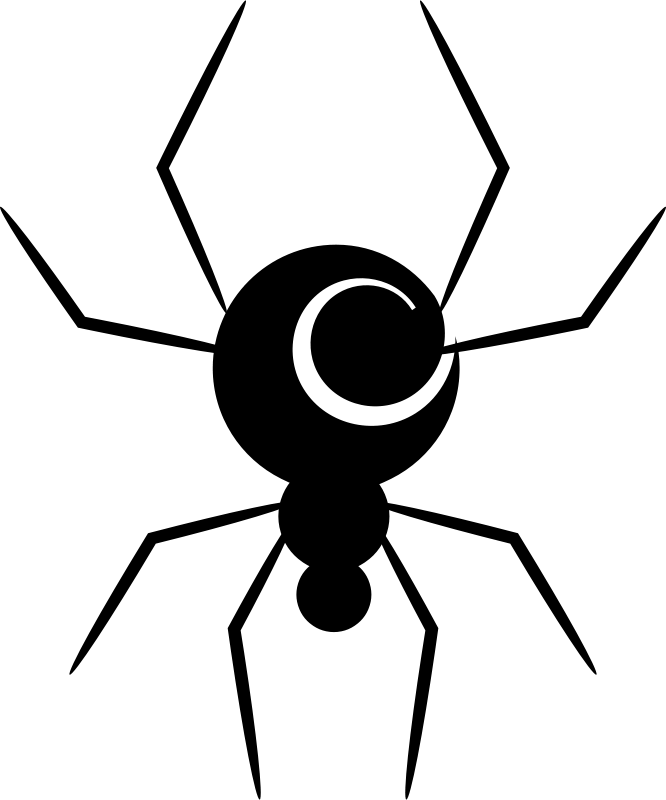
    What about the way animals are visually portrayed in stories? Must the illustrations be anatomically correct? For example: We all know that spiders have eight legs. Right? If I was to ask you to draw a picture of a spider, how would you do it? Have a go. It will only take a second or two. I can wait.

    whistle
    http://www.openclipart.org

    Now compare your drawing with these:

    spiderswirl2
    http://www.clipart.org
    Little_Miss_Muffet_Spider
    http://www.openclipart.org
    spider
    http://www.openclipart.org

    How did you go?

    While children easily realise that this picture is fictional:

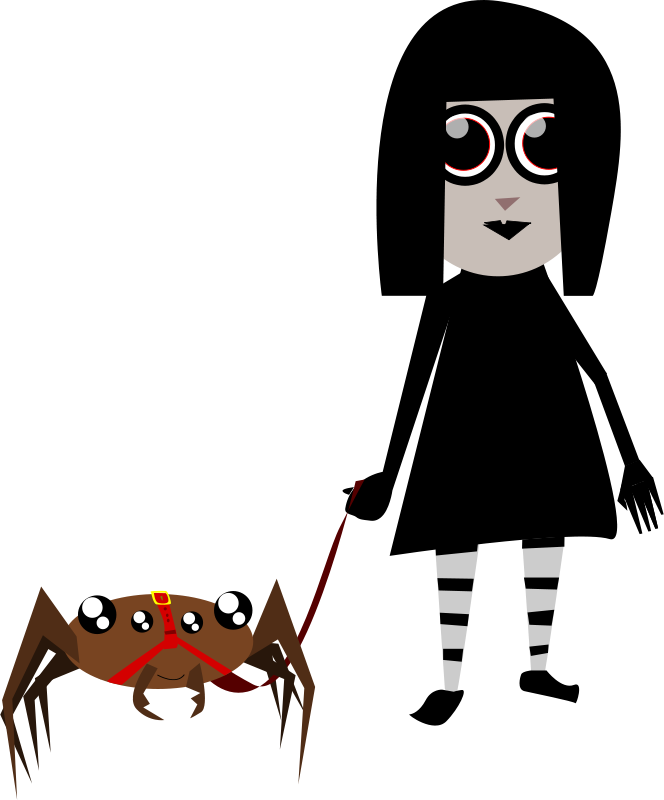
    pet_spider_girl
    http://www.openclipart.org

    They have less success is understanding what is wrong with the previous images. Spiders have eight legs. Those drawings show eight legged furry creatures. The story says they are spiders. That must be what spiders look like. Right? Unfortunately, real spiders look more like this one:

    johnny_automatic_spider
    http://www.openclipart.org

    All eight legs are attached to the cephalothorax, not the abdomen (or even one body part) as shown in most picture books. While I am sure you drew a spider correctly (didn’t you?), most children and many adults draw them more as they are depicted in children’s stories. Is this a problem?

    LOVE_2
    http://www.openclipart.org

    I am not for one moment suggesting that we get rid of fictional picture books and stories. I love them! And as I have said, and will continue to say, many times: they are essential to a child’s learning and development. There is no such thing as too many or too often with picture books. Instead, I would like you to consider the misconceptions that may be developed when the content of picture (and other) books may be misleading, and how we adults should handle that when sharing books with children. One of the books that gets me thinking most about this topic is “The Very Hungry Caterpillar” by Eric Carle.

    The Very Hungry Caterpillar

    As I said in a previous post, it has been published in over 50 languages and more than 33 million copies have been sold worldwide. I am almost certain that you will be familiar with it, and upon that assumption, I have one final task for you in this post. Please share your response to the question in this poll:

    To be continued . . .

    I would love to receive any other comments you would like to share regarding the content in this post.

    I do apologize that I have been unable to get the text and pictures in the layout I desire. I obviously have more investigations to carry out and learning to do.  🙂

    Maybe next time I’ll have it mastered, says she, hopefully!

  • Aren’t they amazing!

    Children, I mean.

    birthday cake 2

    My gorgeous little granddaughter is two years old today, and what a wonderful opportunity that provides me to reflect on the marvels of children’s ability to wonder and learn. I am forever in awe of their ability to learn language and all its nuances.

    Some people say they are “sponges”, spongebut I say they are far more than that. They are creators of their own understandings, learning far more than anyone could ever possibly teach them. From the moment they are born, children are actively seeking to make sense of the world: through their interactions with it and relationships they form in it.

    Anna is already using language for a multitude of purposes.

    She has an extensive vocabulary which includes:

    Names, for example, of

    • family members and friends
    • fruits and other foods
    • colours
    • animals
    • animal sounds
    • toys
    • dinosaurs (learnt from her big brother)
    • objects in the home and environment

    Action words (verbs) including eat, drink, play, read, watch, swim, jump, dance, clean

    Adjectives e.g. big and small

    Adverbs e.g. fast and slow

    Social graces for example greetings like hello and bye-bye, and manners like please and thank you

    She sometimes uses one word effectively to convey a complex meaning or thought, but more often now she is stringing together a number of words to form phrases and sentences. She is able to participate in conversations which require an exchange of information or an interchange of questions and answers.

    She uses:

    Questions with appropriate words and inflection to:

    • be informed e.g. Where’s Mummy?
    • request e.g. strawberry please Daddy? play trampoline Mummy?
    • interrogate e.g. why you eat pineapple Bob?

    Commands

    • more Beckii!
    • stop Bob!

    Statements e.g. I go sleep my home

    She understands the importance of facial expressions and body language that accompany these exchanges. She has learned the sway of accompanying a “please” with a smile and the power of an emphatic “No!”

    Although many of her sentences do not contain articles (a, the), prepositions or connectives, her meaning is easily understood in the context of the conversation.

    She knows the placement of adjectives before the noun e.g. “big ball”, not “ball big”.

    She pretends play, e.g. setting up a group of balls then instructing the adults to “shh”, because the eggs need quiet for hatching.

    She has learnt how to follow instructions and take turns in a game e.g. a game of memory turning over the cards to find the matching pairs.

    johnny_automatic_father_and_daughter_playingAnna understands far more than she is able to produce. She responds appropriately to the questions, commands and statements of her family, asking for more information and clarification if she needs it. She knows when the sounds are produced in play rather than for meaning e.g. “Billy-bobby-silly-Sally”, and responds with giggles rather than questions.

    She is familiar with the language of books and expects books to be a source of pleasure and language.

    party_pinguin__card_ocal

    She knows that songs and rhymes are not conversation and joins in rhythmically and tunefully. At her birthday party, she led the family in singing “Happy birthday” to herself, and did a marvellous job of conducting.

    All of these observations reveal but a sample of her actual language learning, glimpsed through the grandmother’s window, you could say, during weekend visits. The parents would be more able to describe in greater detail just how extensive the language development is.

    But is Anna’s ability with language remarkable?

    Yes, indeed it is. Just as the language learning of every other child is remarkable.

    In just two short years Anna, like most other children around the world, has learned the basis of her language. What conditions supported this enormous growth in language learning?

    johnny_automatic_playing_dress_up

    According to research, children are born with an innate ability to learn language. At first they have the potential to learn the sounds, words, grammar and use of any language, but as time goes on their ear is tuned to the language spoken around them, and by the age of one children have learned all the sounds of their native language. However, though this ability to learn language is innate, it doesn’t occur in a vacuum. It occurs in an environment rich in language, and the richer the environment, the stronger, the better the language growth.

    Anna is surrounded by a loving family who speak with her discussing the day’s events, explaining information, telling stories and playing imaginatively. They read to her many times a day, and play games that require thinking and talking. This exposure to language, both oral and written, is an important part of her life, every day.

    Conditions for language learning

    Anna’s environment clearly exhibits the conditions, described by Brian Cambourne, which encourage language learning:

    Immersion: Anna is surrounded by language. Her significant adults (parents and other carers e.g. aunt and uncle, grandparents) speak to her: interacting and playing with language. They read stories and sing songs to her. They hold conversations with each other about a wide range of topics. While not included in these conversations, Anna is quietly learning the nuances of adult discourse.

    Demonstration: Anna observes adults using language in many different situations and comes to understand the language of different contexts and purposes e.g. greeting friends, shopping, asking for help, giving information.

    Feedback: As soon as Anna started to make sounds of her own, her parents provided feedback by repeating the sounds she had made and by adding new ones for her to copy. When she started to say her first words, her parents responded with enthusiasm and encouragement.

    Approximation: Anna’s parents accept and respond to the message of her communication, without hint of it being incomplete or incorrect. Instead they support and elaborate, seeing it as part of the development towards language proficiency.

    Now that Anna is joining words into phrases and sentences, the adults respond, often with an agreement or explanation, by restating the sentence, and expanding on it, supplying the words not yet part of her vocabulary; demonstrating intuitively the target structures towards which Anna’s language is developing.

    The guidance offered by these responses is gentle and intuitive, giving both congratulations on the ability to communicate and reinforcing standard language usage. For example, when Anna says “Apple juice,” the parent may respond, “Would Anna like some apple juice? I will get some apple juice for Anna.”

    Expectation: Anna’s parents always expected that she would learn to talk and that her talk would develop through easily recognisable stages. They do not expect her to speak like a university professor at the age of two!

    They are also aware that not all children develop language at the same rate, and understand that if Anna wasn’t speaking in sentences at the age when another was, they would just continue to provide demonstration, feedback and support expecting that she would in her own time. While they know that seeking help early if concerned about a child’s language development in these early years is very important, they have no reason to be concerned about Anna’s language development.

    Responsibility: Anna’s parents recognise that the responsibility for her language learning rests with Anna. They provide the environment, they model language in use and provide her with feedback and support. They don’t attempt to formally teach her language structures which are not yet part of her developing language.

    Use: Anna uses language in real situations for real purposes: to get things done, to ask for help, to think and share.

    Don’t you agree it’s a pretty remarkable process?

    Children all over the world become proficient language users when they are immersed in rich language environments, often provided intuitively by parents who talk with and read to their children.

    Sadly, not all children have the benefit of an environment rich in language.

    If we could convince all parents of the importance of talking and reading with their children in these early learning years, we would have far fewer children with delayed learning abilities at school.

    Nor and Bec reading

    How do you think we can help parents of young children understand the difference it could make to the lives of their children, and themselves?

    Please share your ideas.

  • Flag this Twitter advice

    stop email

    I have just read a very helpful post by Claire Diaz-Ortiz explaining how to unsend an email.

    Reading it prompted me to write me this post which I have been mulling over for some time now. I would like to read a post entitled:

    “How to unflag on Twitter”.

    You see, I am a newcomer to Twitter; reading, tweeting and re-tweeting for just over two months now.

    Luckily for me there are many wonderful bloggers who generously share their tips and information to help newbies like me get started. I have read and re-read some of these blog posts many times in order to glean as much information as possible in order to avoid making it obvious to everybody just what a newbie I am.

    Just as an email can be unsent, the delete button on Twitter can be used to withdraw a message tweeted by mistake. That’s easy.

    However it is not so easy, in fact it is impossible, so far as I can see, to unflag a flag.

    Now I’m a reasonably intelligent person, and I have used a number of computer programs and applications over the years, and one thing that I have discovered is that learning is transferrable. What is learned in one program or application can generally be applied in others. I have also learned that one should not worry too much about clicking the wrong button because most things can be undone and not much harm can be done anyway.

    I had plenty of prior experience with flags to understand their use.

    Anonymous_globe_of_flags_1

    nicubunu_Game_marbles_-_flags

    In Microsoft  Word, the little flag icon is used to bookmark a part of the text one wishes to locate later.

    The flag in Microsoft Outlook is used to mark an email to follow up.

    I may use a flag to highlight a section of text in a book if I consider its content important or interesting enough to revisit another time.

    swim between the flags

    Flags on the beach indicate areas where it is safe to swim.

    Flags on a car-yard are there to entice would-be buyers.

    HappyNewYear_by_Rones
    Party time!

    In all these instances flags are used to draw attention to items of interest or importance to make them easy to locate. So it follows that I should be able to transfer this knowledge to other applications. Right?

    Well, usually; but not with Twitter.

    tweet bird
    A little Twitter panic!

    I learned this from my own first-hand experience though, so the learning is powerful and permanent and I will not need to revisit this situation again to make sure I have got it right. The learning was also accompanied by quite a degree of embarrassment and anguish, so if I can prevent anyone else from making the same mistake, my purpose in writing this post will be accomplished.

    tragicmaskThis is how the tragedy unfolded:

    One day I encountered a tweet with a fun poem attached as media. I wanted to be able to come back to this poem at a later time to reflect on it some more. I wondered how I might do that.

    Flag media

    Then, out of the corner of my eye, I noticed a little box down to the right that said “Flag media”.

    “Great,” I thought, “Easy,” and pressed the button.

    Immediately the button changed to “Flagged learn more”.

    Now where there’s a link there’s a way to new learning, so of course I clicked on it . . .

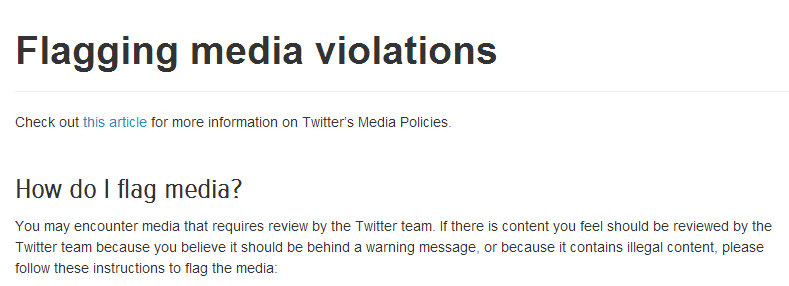
    and was totally aghast when I came to the Twitter Help Centre “Flagging media violations”.

    flagging media violations

    I hadn’t wanted to flag the poem as a media violation. I just wanted to read it again later.

    “Quick,” I thought, “better unflag it before anyone notices; especially the author!”

    As I frantically searched the Twitter Help Centre, the panic started to rise as I could find no instructions for unflagging.

    I couldn’t remember it being mentioned in any of the articles I had read, but I went back and checked, just to make sure. Nowhere could I find mention of flagging, let alone unflagging. I just had to let it be and hope that when the Twitter team checked the flag, they would realise that an error had been made. However, I do sincerely apologise to George and can only be thankful that my followers were few, and hopeful that nobody, especially George, noticed.

    So here is my number one piece of advice when using Twitter: Don’t flag!

    don't flag

    Not unless you consider “there is content you feel should be reviewed by the Twitter team because you believe it should be behind a warning message, or because it contains illegal content”.

    I wish I had read that before I flagged George’s poem, “Everything is a car!”

    Anonymous_double_star

    However you could use this strategy if you wish to come back to a tweet later:

    favourite it.

    That way it will turn up in your favourites list and you will easily be able to locate it.

    Just be wary of favouriting too many tweets as advised by Mary C. Long in the Social Times earlier this year. However Mary’s warning doesn’t apply to favouriting a tweet in the way I have just suggested.

    What have you learned about Twitter that you think I should know?

    What learning experiences would you like to share?

    Here are seven great bloggers or websites with useful advice about using Twitter appropriately:

    Mom this is how Twitter works

    The eLearning coach Ten ways to learn from Twitter

    Claire Diaz-Ortiz How to create your own Twitter profile (and others)

    Belinda Pollard Why emerging authors need Twitter (and others)

    Molly Greene  Ten tweets you should never send (and others)

    Jeff Bullas 10 tips for creating marketing and sharing content on Twitter

    Judy O’Connell Being web savvy includes twitter

    Rachel in the OC Ten quick tips to help any author

    And don’t forget the Twitter Support Centre

    Happy tweeting!

    All clipart courtesy of  www.openclipart.org  some with minor modifications and additions.

  • What did you do that for? Rewards and motivation

    ausines headphonesRecently, on the recommendation of my friend Rosie, I listened to a TED Talk by Michael Sandel “Why we shouldn’t trust markets with our civic life”.

    Rosie and I often suggest Talks to each other and then share thoughts and comments about them.

    This Talk, like most of those on TED, raises some very interesting, thought provoking and challenging ideas and issues. The issue of most importance to me in each of these Talks may not be the issue of most importance to Rosie, nor to any other listener. The understandings, beliefs and personal positions, (ideological, philosophical and ethical), that each person has will not only influence what they hear but how they interpret, organise and prioritise what they hear and what they take away from the Talk, whether intended by the speaker or not.

    In this Talk, Michael raises themoney bag issue of motivating students to learn, a challenge experienced in many schools.  He invited the audience to consider whether cash rewards should be used as incentives for students to perform well on tests or to read books.

    The reaction from the audience was mixed with fewer in favour of offering the rewards than against. When asked why cash incentives should not be used to encourage students to work harder or read more books, a participant stated that the students should be reading for intrinsic motivation, for an intrinsic desire to learn, and that a cash reward would take the intrinsic incentive away.

    studentbooksHowever: If a child is a reluctant reader or reads only when required, does that child have any intrinsic motivation for reading? If not with cash rewards, how can we inculcate an intrinsic motivation to read? What is or has happened in this child’s experience that an intrinsic motivation to read has already been killed? (I will offer some thoughts on these issues in a future post.)

    The argument for and against the use of rewards in schools, as well as homes, to encourage children to perform or behave in a particular way has waged for as long as I can remember and, I’m sure, even longer than that.

    stars

    Should children receive a sticker, a star or an award for that? Shouldn’t they just do what we want of them for the sheer joy of it / because it will do them good / because it’s the right thing to do? Shouldn’t they be intrinsically motivated and have no need of extrinsic rewards?

    It all sounds very good, doesn’t it? And maybe it works when a child is intrinsically motivated through a genuine interest, or maybe when children are happy to comply and perform expected tasks either through a need to please others or their own developing sense of how things should be.

    But what of the child who does not have this intrinsic motivation, no need to please or any ability to see a personal purpose in expected tasks or behaviours?

    One of the Talk participants suggested that results of offering a cash reward for reading books could be measured by a count of the books read while the reward was being offered, followed by a count of the books read after the payment ceased. Results of the experiment found that students, when offered cash rewards, read more books, but they also read shorter books.

    And why should we expect any more of children than we do of adults?

    tomas_arad_heart

    How many adults perform their work tasks for the sheer joy of it, powered by intrinsic motivation? Only the lucky few, I would guess, who are able to combine passion with employment, or who have sufficient resources to maintain the lifestyle they desire. Isn’t the extrinsic reward a major motivator for much of what we do? I dare say the performance of most adult workers would not measure highly after payment ceased!

    mystica_Coins_(Money)

    Okay. I know it’s not quite the same. The children are not in need of the cash rewards as they are supported by adults who receive cash rewards. Nevertheless, without that extrinsic reward, in most cases, that work would cease, regardless of whether the cash is actually required for survival or not.

    However I am always drawn back to an attempt at reconciling intrinsic motivation with compulsory schooling.

    tomas_arad_heartIntrinsic motivation is usually related to something of one’s own choice through interest, challenge or purpose. The motivation comes from within, not from the promise of any external reward.

    So how does this work for children in school?

    Not only is school attendance compulsory throughout most of their childhood years, children have few choices in school. They generally attend a school chosen by someone else, are taught by a teacher allocated by someone else, and expected to make friends with a group (class) allocated by someone else.

    teacherbellThey line up, eat, talk, play and toilet on the ring of a bell and are expected to perform academic feats on command. When they progress from one year to the next, they often suffer the disruption of new class group arrangements, decided by somebody else for questionable reasons. What would be so harmful about a child going through all the years of schooling with the same group of friends?

    Why then do we think that students should be intrinsically motivated to do something about which and in which they have very little choice and are most often powerless?

    Learning for the love of it, for the sheer fun and joy of it is a marvellous goal. And I believe children are innately intrinsically motivated to learn.

    How different would schools be if we began with the intrinsic motivation of each child and wrapped the leaning around that? How much more powerful would the learning be? What would that school look like?

    Is that what we call a child-centred approach? An approach that values the interests and needs of each learner. An approach that starts where the child is and supports them to find the paths that take them where they want to be. An approach that values their individual styles and timeframes while providing just the right amount of challenge to stretch them beyond where they thought they were able to go. That piques their interest in a vast array of topics and supports their learning of skills to achieve their desires.

    But often the lip service given to a child-centred approach in a traditional school, with all its constraints, still smacks of ‘You’ll do what I say but you’ll think that you have a choice’.

    What slap in the face it is to tell someone that they must do this, when to do it and how to do it; and then tell them they must do it because they want to do it!

    However there are teachers who passionately believe in a child-centred approach and in harnessing the power of intrinsic motivation. They work tirelessly and creatively, powered by their own intrinsic motivation, to employ a vast array of strategies designed to make a child’s opportunities for learning within the confines of an imposed curriculum of a traditional school motivating for each learner while targeting their individual needs.

    SnarkHunter_Arrow_in_the_gold

    Here are some strategies that teachers use in a child-centred approach:

    • Make connections with the children’s lives

    –          discussing their experiences

    –          valuing their contributions

    –          involving parents

    –          informing parents of classroom learning and experiences

    • Incorporate children’s interests

    –          using negotiated topics and tasks

    –          employing a variety of activities

    • Offer children some autonomy

    –          using negotiated topics and tasks

    –          employing a variety of activities

    –          providing opportunities for independent and self-directed learning

    • Make learning fun, meaningful and explicit

    –          using games, songs and hands-on participatory activity

    –          explaining how classroom learning connects to purposes in life

    –          providing clear and easy-to-follow procedures

    –          providing opportunities for finding solutions to real problems

    –          allowing explorations in creativity and innovation

    • Provide opportunities for cooperation and collaboration

    –          working with a partner or in groups

    –          allowing opportunities for discussion

    • Support and extend learning

    –          harnessing  spontaneous opportunities for optimising learning

    –          providing opportunities for practice and clarification

    –          challenging learners to stretch their imaginations and abilities

    • Add joy and laughter through happiness and humour every day

    These strategies may not tap into the intrinsic motivation of each student all of the time. However a supportive environment in which children are provided some choice of activities, opportunities to learn at a pace suited to their needs, and an understanding of the point of it all, will provide learners with the desire and skills to harness their intrinsic motivation for learning of their own choosing beyond the classroom.
    What do you think?

  • Being childwise, cultivating habits of the heart

    As a regular commenter on my blog Rosie has contributed additional value and insight, demonstrating her unlimited passion for the education of young learners as well as those who engage with them in a professional capacity.  A recurring topic in her comments is the importance of self-actualisation.

    I feel that Rosie’s message is important to share and, in response to my invitation, she has contributed a post, not just a comment, in order to more fully explain her views.

    Please enjoy Rosie’s contribution and feel welcome to add your own insights and comments in response.

    Growth toward self-actualisation (Maslow) requires integration of habits of heart and habits of mind.

    tomas_arad_heart             ryanlerch_thinkingboy_outline

    The development of these habits is essential to the balanced self. Schools have long attended to the habits of mind providing for a range of capabilities from the academic to the intellectual to the cognitive. The habits of the heart have received far less attention. Critically, however, attention to the first, habits of the mind, does little if it is not complemented by attention to habits of the heart.

    school cropped

    Curriculum frameworks have varied in the last forty years to the amount of attention focussed on habits of the heart. The trend to teach only that which is assessable and hence, that which can be measured, has resulted in many habits of the heart being neglected. To some teachers, habits of the heart, known also as the affective domain, are not within their role statement.

    CoD_fsfe_Checklist_icon

    Early years teachers have long recognised the importance of scaffolding the development of all aspects of the child. The belief that teaching the whole child has as its focus, the integration of emotional, social, physical, and cognitive. All interact as conditions for learning. When one area of development is not receiving attention, growth of the other areas may be restricted as well.

    58294main_The_Brain_in_Space-page-21-asian-girl-jumping

    From this perspective, words such as motivation, attitude, well-being, responsibility, independence, self-control, self-concept and identity become the “bread and butter” of a teacher’s daily activity. When learning is not occurring, the answer is not another worksheet or more of the same. These other conditions that form the habits of the heart are examined to formulate the next step to ensure growth.

    image courtesy of www.openclipart.org

    Views toward conditions for learning are slowly changing. For example, the Australian curriculum has at its focus, General capabilities embedded across all Learning areas. One of these capabilities refers to personal and social capability, bringing the affective domain into the realm of respectability as a teaching focus, at last. Despite this, the term ‘behaviour management’ continues to attract funding in some education systems.

    A proposal is to redirect attention away from behaviour management and engage with the direction of the Australian Curriculum. To do this, there is a need to view what needs to be taught and how to teach it if the habits of the heart are to develop.

    image courtesy of www.openclipart.org

    In looking at how to work with habits of the heart, some preservice teachers (now teachers), lecturers and a psychologist adapted “On becoming childwise” (Ezzo & Ezzo) to the needs of teachers and the classroom context. Documentation related to this program is available at www.teachersbeingchildwise.com.au. Videos are also available.

    teachersBeingChildwise

    All images, except Childwise, courtesy of www.openclipart.org

  • The accidental home educator

    In a previous post “To school or not to school” I discussed thoughts I had pondered and issues I had considered when deciding the future education of my daughter.

    Although the main focus of that article was whether to school or not, home education was not only not my first choice, but not even a consideration.

    The merest hint of an idea of starting my own school had niggled away in the back of my thoughts for a long time. More than ten years before that article was written, I was in college studying the teaching of literacy when the idea popped into conscious thought. In response to an assigned task, which required that I explain how I would implement a literacy program in a school, I surprised my lecturer (and myself) by explaining how I would do so in a school that I established. Although I was never afraid of placing my own spin upon a set task, I never really expected the idea of establishing a school of my own to be anything more than just that.

    In the ensuing years prior to the birth of my daughter, my son completed his primary schooling and I taught in a variety of roles, some of which were the most rewarding of my career. During those years I met many other teachers with a similar dream of starting their own school. They were mostly creative and innovative teachers, passionate about their own learning as well as the learning of their students. They inspired their students with an energy that at times seemed infinite. But they felt stymied by the formality and top-down approach of traditional schooling which they, like me, believed to be detrimental to children’s learning and personal growth.

    Many of these teachers left the profession, unable to conquer the battle between philosophy and practice waging within. Others continue teaching, constantly trying to balance their beliefs about learning and the needs of their students within the confines of the expected formal and didactic approach to teaching. Others have become burnt out, feeling isolated and unsupported, succumbing to the pressure to conform.

    Few teachers take action to make their dream a reality. Whatever one’s beliefs, it takes a great deal of courage to step outside the norm of accepted practices. To establish an alternative school, in addition to this courage, requirements include a bottomless well of financial resources, an infinite ability to persist under the onslaught of unremitting obstacles, and a firm commitment to ideals and philosophies.

    When Bec was born the nagging of this idea was so insistent that I was compelled to bring it out from where it was hiding and give it some serious consideration. Without any real understanding of the magnitude of the task ahead, without a well of financial resources, but with a firmly-held belief in what I was undertaking, I set upon the road to turn the dream to reality.

    Me with a group of my young learners.
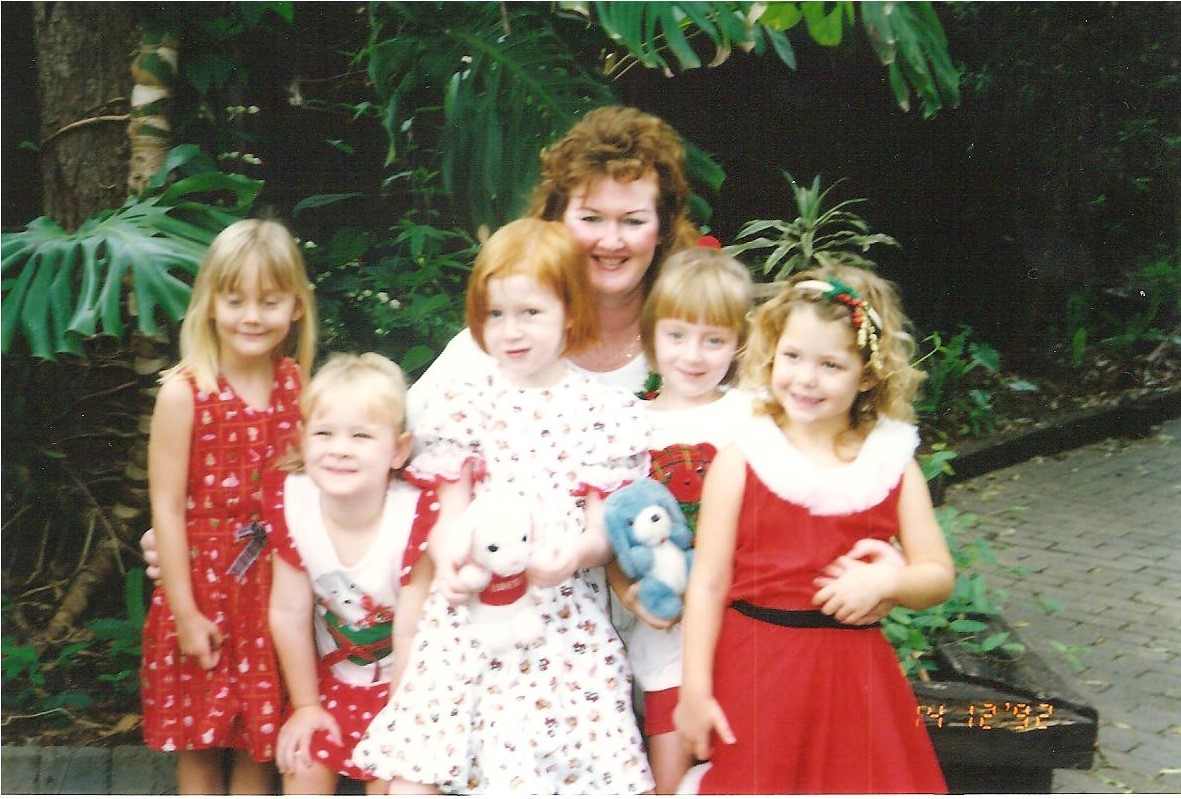
    Me with a group of “my” children, including Bec in the middle.

    When Bec was about 2, I established a small home-based (but not profitable) business providing educational care for other 2-3 year olds and educational play sessions for parents and children.

    For the children in care, I provided a stimulating learning environment with lots of talk, books and hands-on exploratory activities. I provided support as they learned to have a go and developed confidence in their abilities.

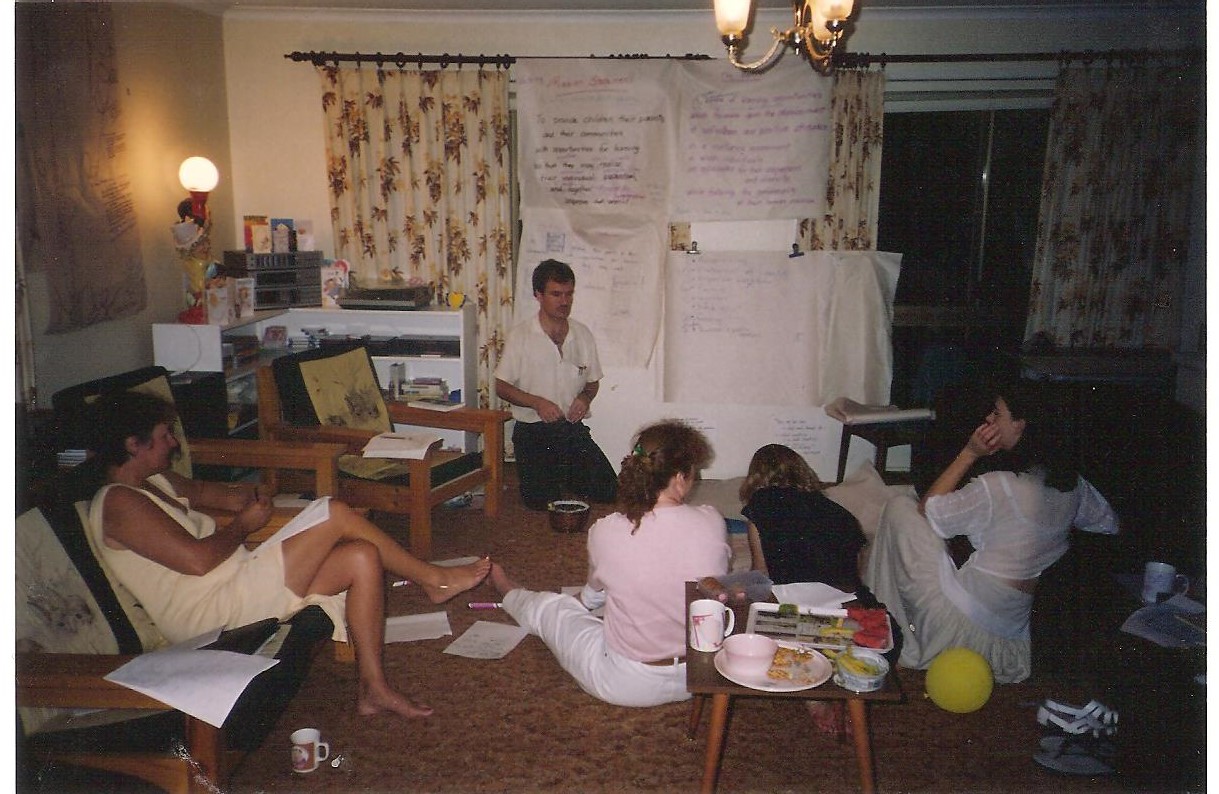
    Guiding parents in play sessions for parents and children.

    In the play sessions I guided parents’ engagement with their children in play, explained how they could develop vocabulary and concepts, and provided suggestions for them to continue at home. Even after 20 years, parents still tell me how valuable those session were to their children’s education.

    At the same time I investigated and explored alternatives to traditionally schooling available in my area but was disappointed that none exactly met my criteria. Some were too laissez faire, others followed pedagogical approaches I believed to be unsupportive of children’s learning, and others were based on philosophies I didn’t agree with.

    I began constructing a vision of what my ideal school would be. I invited other like-minded teachers to join me and we got to work on building a team, enlisting families, and seeking out a facility.

    Composing the vision statement.
    Composing the vision statement.

    Approval by the education department was easily achieved and interest of parents was forthcoming. In the end, the greatest stumbling block and final inhibitor of the project was town planning.

    Throughout those establishment years Bec was not enrolled in a school. She was educated at home while we waited for my alternative school to open. We participated in some home schooling group activities, and I continued to conduct home-based educational sessions for Bec and other children. After about 5 years and two aborted starts, the project was terminated and Bec’s home education came to an end. Well, it really didn’t come to an end. She continued to do a lot of learning at home, but as she was enrolled in the local government school, it was her official education provider.

    I often wonder what our lives would be like now if my dream of opening an alternative school had been achieved.

    It was difficult making the decision to let it go. I was torn between two equally compelling but conflicting pieces of advice which vied for my attention:

    snagit persist and listen

    I do believe I gave the dream my best shot, but after a long time and many false starts, I decided that perhaps I should listen to the messages. With most families, like ourselves, more interested in an alternative school than in home schooling, it was time to let it go. Other families, like me, were not enamoured with the local offerings, but then, also like me, had to decide the future of their children’s education.

    I no longer felt comfortable asking families to stay committed to the goal with no tangible start date in sight, and after a final search for a suitable property hit another dead end, the idea was abandoned. I was not committed to home education as a long-term alternative for Bec’s education, and so finally, in year 4, she started school.

  • What you don’t know . . .

    One of my favourite quotes is that of Manuel in the BBC television series Fawlty Towers: “I know nothing.” I love quoting this but, just like Manuel, I too am learning. And what a wonderful gift it is to be able to learn.

    Recently I read a post This time it’s personal by Tony Burkinshaw on his blog.

    He explained unconscious incompetence in the following way: “A total ignorance of just how much you don’t yet know for the simple reason that you don’t yet know enough to recognise that you don’t yet know what you don’t yet know.”

    This got me thinking about knowledge and learning and about some of the subtle ways in which our attitude to knowledge and learning is manipulated.

    When I was a teenager, my brother wrote for me in my autograph book: “What you don’t know won’t do you any good either.”

    My father was not impressed and stated quite emphatically, “What you don’t know won’t do you any harm.

    I think he subscribed to the same philosophy as many of my teachers: “Ignorance is bliss.”

    I mentioned in my article To school or not to school, a belief that the natural curiosity and eagerness to learn I’d had as a young child had been somewhat diminished during childhood by the attitudes of others around me. That’s not to say that they didn’t want me to do well in school, for they did, and always encouraged me and supported me to do my best; but it was my best at what the teachers told me to do and what the teachers told me to learn.

    Ready for school - year 2
    Ready for school – year 2

    Knowledge is power; and one of the easiest ways to suppress and maintain power over others is to keep them ignorant.

    While I am certain that my own willingness to be manipulated and need for acceptance also contributed, an encouragement of curiosity and active inquiry would have had the opposite and more positive effect. I am sure there are others who may not have bent so willingly under pressure and whose natural love of learning flourished despite it or even in response to it. But I know there are many more who bent and failed to rebound and are now trapped by their “unconscious incompetence” in an unassailable comfort zone; not knowing what they don’t know, for “Ignorance is bliss”.

    I am one of the lucky ones for, while I know a lot about some things, I know that there are things that I don’t know, and lots of them! Rather than make me a conscious incompetent, it makes me a willing learner, and passionate about ensuring the flames of curiosity and love of learning are maintained in others.

    Throughout their childhoods, I encouraged my children to question everything, including me, for I wanted them to arrive at their own understandings and did not want their thinking to be restricted the way mine had been.

    For many of you, a love of learning and an ability to acquire knowledge may have been a constant throughout your life. I ask then, that you do not dismiss those who don’t have the advantage of your information and your education. Many do not know what they do not know and they can’t even begin to imagine the questions they could start asking to ignite their learning. If they have had their natural curiosity suppressed and their wills broken, been convinced that submission and conformity were the way to being “good”, and willingly entered the cage and threw away the key; instead of judgment, derision and laughter, what they need is to be shown the open doorway … shown what they don’t know so they too, can start asking questions and filling in the gaps in their knowledge to regain power over their own lives.

    The saying “A little knowledge is a dangerous thing” is very true.

    How many times have you heard someone bemoan, “I wish I knew then what I know now”?

    What can you do to encourage a love of learning or pique someone’s interest today?

    How has your attitude to learning been influenced by the attitudes of others?