Live Love Laugh Learn … Create the possibilities

Tag: Language

  • I Feel the Need, the Need to Read! by Tiffany Oppelt

    I Feel the Need, the Need to Read! by Tiffany Oppelt

    One reader’s story!

    Tiffany has a “read for fun everyday” policy. It’s a great one, don’t you think!

    CBethM's avatarNerdy Book Club

    Hello, my name is Tiffany and I am a reader.  Always have been and always will be.  Reading is more than a hobby or a pleasurable activity.  It is a true need in my life.

    It all started early.  I don’t remember learning to read.  I clearly remember the day the words began to make sense to me.  I was about five years old and sitting at the kitchen table with the Sunday comics.  I got up to ask my mom to help me with a word and I never looked back.

    From that day forward, I was unstoppable.  Aided in large part by extremely supportive parents and grandparents, as well as key teachers and librarians, I became a voracious reader.

    Books were my constant companion throughout my childhood.  I received countless books as gifts.  I haunted my public and school libraries.  I would lose myself in stories, making new…

    View original post 519 more words

  • Passionate about literacy education

    Education is my passion.

    I have spent almost my entire life thinking about how to educate, and the rest of it being educated.

    That is to say, just like everyone else, I began to learn about the world from the moment I was born, if not before; probably before.

    From age ten I knew that I wanted to be a teacher and worked hard through school to achieve that goal.

    When I completed school I was fortunate to receive a teacher’s scholarship which meant that my three years of training was provided by the state education system and, in return, I was required to teach within the system for three years. Without the scholarship that path would have been unattainable.

    I remember sitting in my classroom on, what I will say was, my first day of teaching. I gathered a group of children around me, each of us with a reader in our hands, ready for a reading lesson. Suddenly I realised I didn’t have a clue what to do.

    Realisation 1: Teaching reading isn’t as simple as putting book in the hands of children and telling them to read.

    This was a third grade class, so I’m hoping that most of them were already able to read and we figured it out together. Round robin reading seemed to be the method of the moment.

    During that first, and the following year, I put a lot of energy into sorting books into levels and children into groups to read the books at the different levels.  I’m not sure what the children learned but I know I was earning my pay. I was ‘teaching’.

    Realisation 2: Children learn to read at different rates.

    At the beginning of my third year of teaching I was listening to children read individually, in order to group them according to reading ability, when one of the children, considered a good reader by his previous teacher, informed me proudly that he could read the book without looking; and proceeded to do so. He had memorised it! He didn’t recognise any of the words and could not read any other book.

    Realisation 3: Reading is more than reciting the words on the page.

    Major realisation: There was something wrong with the way reading was being taught, and I still didn’t feel confident about teaching it.

    Fortunately most children learn to read despite how it is taught, and although I sometimes think I’d like to apologise to all those students I “taught” when I didn’t have much of a clue, I’d like to say “I hope they’re not reading this”, but I really hope they can!

    Not long after this I had a break from teaching for a few years. During that time I read a lot of books about education, especially alternative views of schooling. I continued to feel strongly about reading instruction and even wrote a series of readers (unpublished) based on instruction in phonics. (Such was my ignorance!)

    I worked with groups of upper primary remedial readers who made great progress ostensibly using a phonics program. However they also received lots of individual attention, encouragement and opportunities for reading real books.

    At the same time I watched my three year old son become a reader without any formal instruction. I read to him, talked with him, wrote stories for him and transcribed his stories which we read together. We played games with language making up rhymes, playing “I spy”, singing songs and talking about print in our environment. Before I knew it he was jumping into bed in the mornings, prising my eyes open and begging to read to me!

    I struggled to make sense of what I was observing.

    Then the serendipitous moment arrived: I saw an advertisement for a graduate diploma in reading and language. It sounded tailored to my needs exactly. And it was.

    We packed up the family and moved across the country to enable me to undertake the study.

    It was one of the best things I have ever done. Suddenly everything made sense. The course about developing literacy skills also supported my developing beliefs and understandings about learning in general. I was at last in a place I felt comfortable. This was where I belonged. The course reignited my passion and provided the knowledge and skills that would underpin everything I have since done in education. Time has moved on but the essential understandings are timeless.

    The coordinator of the course, the person who deserves my sincerest gratitude, is just as passionate about literacy education today as he was then, influencing new generations of teachers and students. His name is Brian Cambourne, Principal Fellow on the Faculty of Education at the University of Wollongong. He is affiliated with the International Reading Association and the Australian Literacy Educators Association.

    Recently a friend sent me a link to an article about reading on The Conversation. It is titled “The seven messages of highly effective reading teachers” and begins with a caption under a photo:

    Teaching kids to read isn’t just about learning the alphabet or “sounding out”, it’s about making sense of what’s on the page.

    I read the article and quickly responded to my friend saying that I agreed wholeheartedly and that I was, in fact, writing a book about those very same ideas, right at that moment!

    Then I checked the author. Imagine my surprise when I discovered it was Brian Cambourne! I am delighted to be able to share his wisdom with you.

    In the article Brian explains the seven messages that highly effective reading teachers share with their students:

    1. A reader’s major focus should always be meaning

    2. Effective readers draw on all sources of information in the text

    3. Effective readers are always predicting

    4. Effective readers self-correct

    5. Effective readers have a range of strategies

    6. Effective readers know how they read

    7. Effective readers love reading


    Please read Brian’s full article on The Conversation.


    I welcome any feedback.

  • The magic effect – why children need books

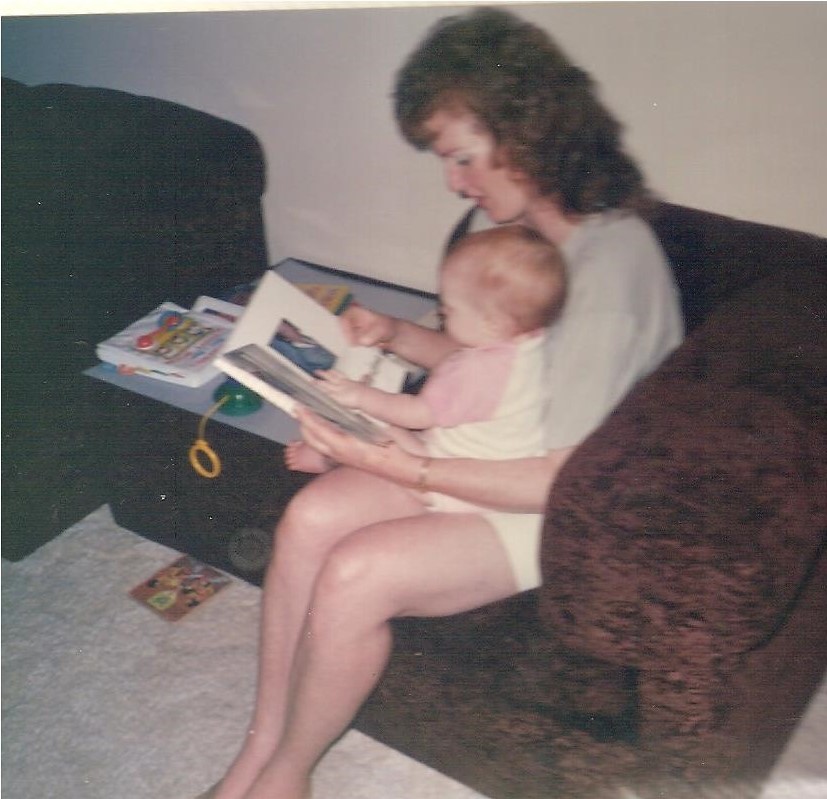
    Nor and Bec reading


    Children can be read to from the moment they are born, if not earlier. Preferably earlier!

    One of my favourite picture book authors and passionate advocate for reading to children is Mem Fox. I own, and have given as gifts, many of her wonderful books. I have attended her seminars and been mesmerised by her reading from her selection of stories. “Read more!” the adults beg. There are no children at these literacy seminars. This time it is a treat for only us: parents and teachers, literacy educators all.

    Currently Prince William, Kate and baby Prince George are visiting Australia. I was delighted to hear that they were given a gift of books by Australian authors, including some by Mem Fox. Over the years I have given many of Mem’s books as gifts; and kept just as many for myself!

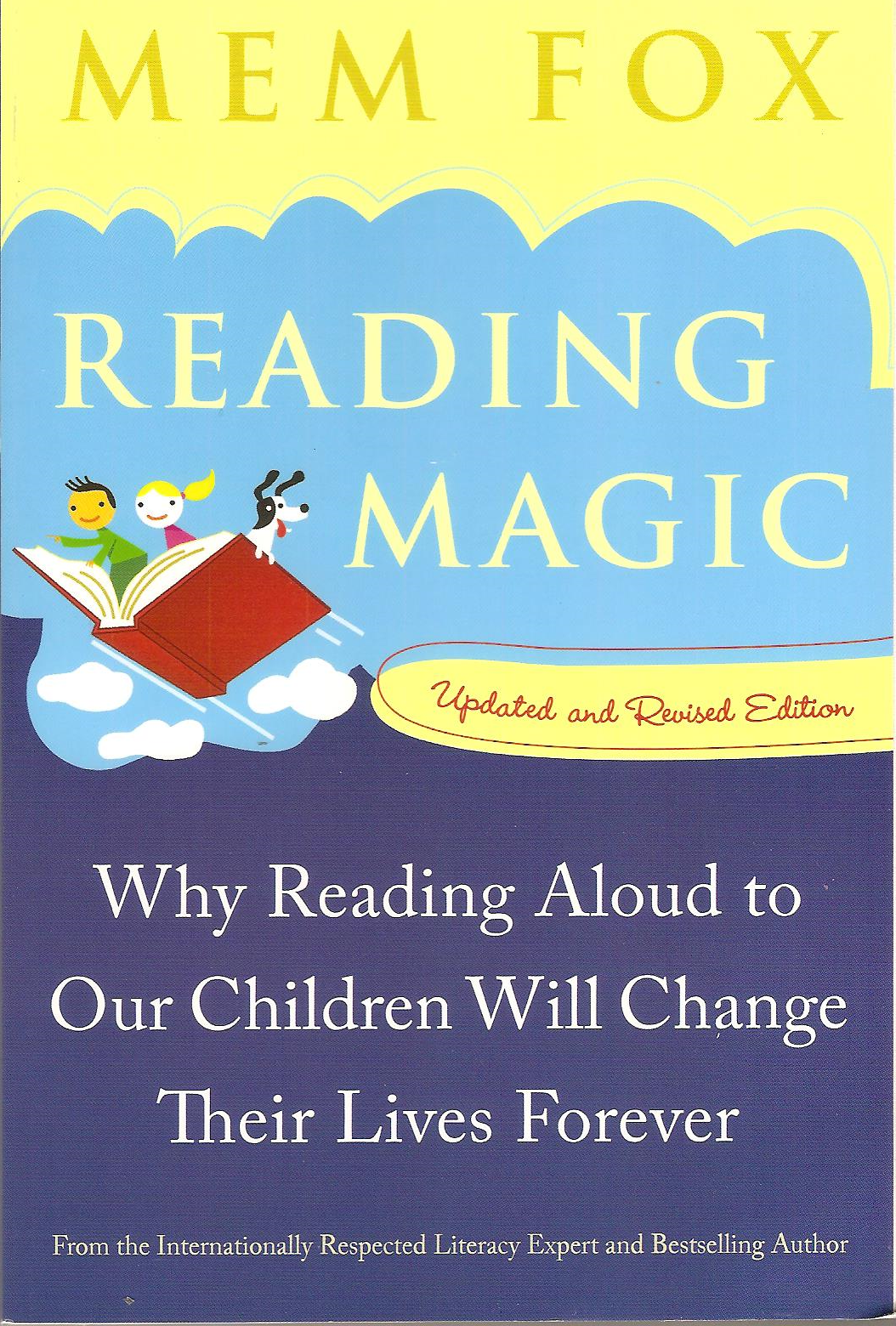
     Reading magic

    One that I have given to many new or expectant parents, as I consider it a “must read”, is Mem’s book “Reading Magic – Why Reading Aloud to Our Children Will Change Their Lives Forever”.

    I would love to quote the entire book for you, but it is better you read it for yourself. I will provide you with this quote from the foreword as a taster for the richness to be found inside.

    “It stands to reason that if we’re able to raise happier, brighter children by reading aloud to them, the well-being of the entire country will ramp up a notch. Children who realize in their first few weeks and months of life that listening to stories is the purest heaven; who understand that books are filled with delights, facts, fun, and food for thought; who fall in love with their parents, and their parents with them, while stores are being shared; and who are read aloud to for ten minutes a day in their first five years, usually learn to read quickly, happily and easily. And a whole lot of goodness follows for the entire community.”

    Mem's website


    Mem’s website, too, is a treasure trove just waiting to be explored by writers, teachers, parents, children and children-at-heart.

    You can listen to Mem read from her selection of books on the Current Read Aloud page. She reads three different books each month. Currently the books are Possum Magic, Harriet, You’ll Drive Me Wild! and Goodnight, Sleep Tight. Be quick to listen to these, though, as they will change at the end of the month. But never mind, there’ll be another three to enjoy next month!

    Mem even gives a read-aloud lesson! Now there’s no excuse! As she says,

    “. . . let’s get on and change the world, one page at a time.”

    Yes, Mem, let’s!


    What are your favourite read-aloud books? What did you enjoy as a child? What do you enjoy now?

  • Reading aloud – sharing stories

    Reading aloud – sharing stories

    I have always loved reading aloud to an audience, be it my own children, a class of children or, more recently, my grandchildren. I love the opportunity to escape into other characters and other worlds. I love to see the expressions on the children’s faces – anticipation, amusement, trepidation, relief, joy.  I love the sounds and rhythms of the language. I love the intricacies of story, poem and information.

    Reading stories aloud to children provides a great opportunity to establish a connection between author, reader and listener, a platform for sharing ideas, thoughts and dreams, an avenue for discussing ethical questions and implications of choices. These discussions may arise spontaneously and be child-initiated, or they may be pre-determined and teacher-lead as in philosophical discussions and bibliotherapy.

    Some parents find reading to their children a chore, something tedious that must be squeezed in around the day’s busyness. I am lucky. I never did.

    Some teachers find it difficult to make time for books in a content-driven classroom; but for me it was always priority.

    boy with books
    http://www.openclipart.org

    Some parents are delighted when their children start reading for it means the daily read-aloud ritual can cease. I never was. Well, I was delighted that they could read, but we kept on reading together.

    I read aloud with my children until they were almost teenagers. The books changed, but the joy of reading and sharing never did. During the teenage, and older, years we continued to discuss and share ideas about books we read and recommendations for reading. We still do: some for ourselves and some for the children, my grandchildren.

    Many of you reading this post take your ability to read and write for granted, as do I. But around the world many children do not have the opportunity to learn literacy skills. According to LitWorld more than 793 million people worldwide remain illiterate. About two-thirds of those are women.

    Like the people at Lit World, I believe that “the right to read and write belongs to all people”.

    I was delighted when I read about World Read Aloud Day on Gail Terp’s blog. I have been following Gail’s blog for a little while now. She titles her blog: “The Best Blog for Kids Who Hate to Read”. She says that one of her top goals is to connect children with books they love and her posts provide recommendations of great books to read to and with children, as well as to be read by children.

    In her post Read Alouds: Supporting Literacy One Book at a Time, Gail suggests 7 reasons for reading (picture books and other books) aloud:

        1. They are fun.
        2. They are motivating.
        3. They are easier to follow.
        4. They often introduce new vocabulary and expressions.
        5. They introduce a variety of writing styles, authors, and illustrators.
        6. They provide an excuse to stay close.
        7. They provide windows to complex subjects and ideas.

    Why not join in reading aloud on World Read Aloud Day this Wednesday, March 5.

    LitWorld, sponsors of the day, urge you to

    “imagine a world where everyone can read . . .”

    “World Read Aloud Day is about taking action to show the world that the right to read and write belongs to all people. World Read Aloud Day motivates children, teens, and adults worldwide to celebrate the power of words, especially those words that are shared from one person to another, and creates a community of readers advocating for every child’s right to a safe education and access to books and technology.

    By raising our voices together on this day we show the world’s children that we support their future: that they have the right to read, to write, and to share their words to change the world.”

    owl_books
    http://www.openclipart.org

    How will you celebrate and share World Read Aloud Day?

  • Searching for purpose in a picture book – Part B

    Searching for purpose in a picture book – Part B

    What is the purpose of picture books? Is their purpose simply to entertain with an interesting story and rhythmical language that is fun to read and recite? Is it simply, as I said in my previous post Searching for meaning in a picture book – Part A, “. . . a special time of togetherness, of bonding; of sharing stories and ideas . . . “ Could the purposes of picture books extend beyond entertainment alone? I think most people would acknowledge that reading picture books to young children has a profound effect upon children’s learning and development. In addition to entertainment, picture books can be used for a multitude of purposes, including:

    • to encourage a love of reading and books
    • to develop vocabulary and knowledge of language (through immersion and engagement rather than direct instruction)
    • to provide a link between the language of home and the language used in the wider community and in education
    • to support children embarking on their own journeys into reading
    • to inspire imaginations
    • to provide opportunities for discussing feelings, emotions, ideas, responses
    • to develop feelings of empathy, identification, recognition, hope
    • to instill an appreciation of art by presentation of a wide variety of styles, mediums and techniques

    I’m sure you can think of many more than I have listed here. But what of knowledge, information and facts?

    yves_guillou_question
    http://www.openclipart.org

    How, and when, do children learn to distinguish fiction from fact, or fact from fiction? At the moment that question is too big for me to even think about answering, but it is a question that I ponder frequently and may return to in future posts.

    ryanlerch_thinkingboy_outline
    http://www.openclipart.org

    Children seem to realise early on that animals don’t really behave like humans and wear clothing.

    mouse dressed up
    http://www.openclipart.org

    They don’t expect their toys to come to life and start talking.

    teddy_bear_and_doll
    http://www.openclipart.org

    They quickly understand, when it is explained to them, that unicorns and dragons are mythical creatures and, to our knowledge, don’t exist.

    toy unicorn
    http://www.openclipart.org
    dragon_on_a_leash
    http://www.openclipart.org

    But what happens when the lines between fact and fiction blur and content, though presented in fiction, has the appearance of being based in fact? For example: The lion is often referred to as “King of the jungle” and appears in that setting in many stories. However, lions don’t live in jungles. According to Buzzle, they live in a variety of habitats and jungle isn’t one of them. You knew that didn’t you? But what about the children? When will children learn that lions are not really kings of the jungle? Do you think it matters if children grow up thinking that lions live in jungles?

    Lion_Cartoon
    http://www.openclipart.org

    What about when animals that don’t co-exist appear in stories together? For example: Penguins often share a storyline alongside polar bears. Does this encourage children to think that penguins and polar bears co-exist? When do adults explain to children that penguins and polar bears live at opposite ends of the planet? At what age do you think children will happen upon that information? Does it matter?

    tauch_pinguin_ocal
    http://www.openclipart.org
    lemmling_Cartoon_polarbear
    http://www.openclipart.org

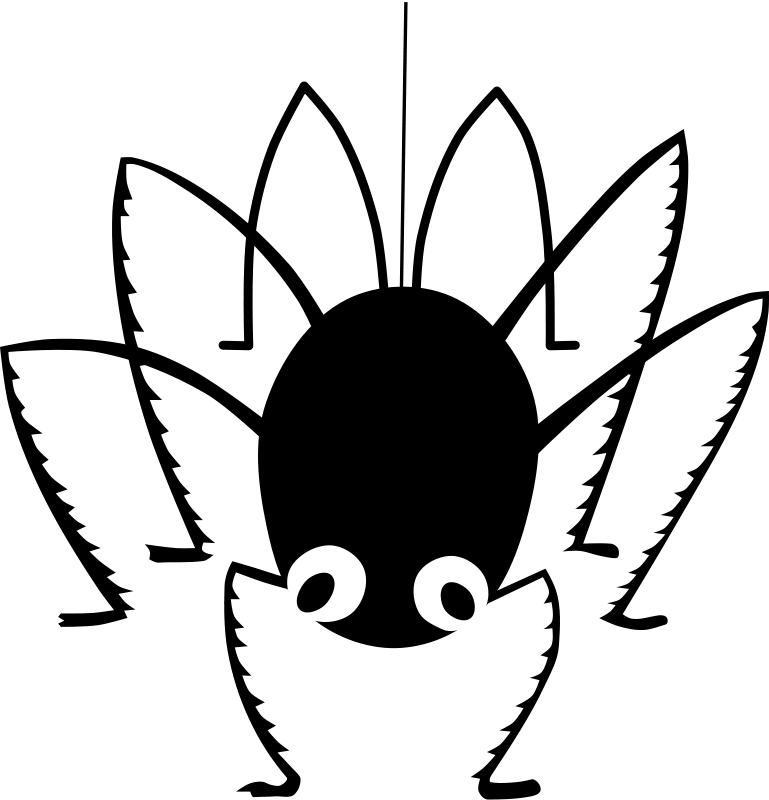
    What about the way animals are visually portrayed in stories? Must the illustrations be anatomically correct? For example: We all know that spiders have eight legs. Right? If I was to ask you to draw a picture of a spider, how would you do it? Have a go. It will only take a second or two. I can wait.

    whistle
    http://www.openclipart.org

    Now compare your drawing with these:

    spiderswirl2
    http://www.clipart.org
    Little_Miss_Muffet_Spider
    http://www.openclipart.org
    spider
    http://www.openclipart.org

    How did you go?

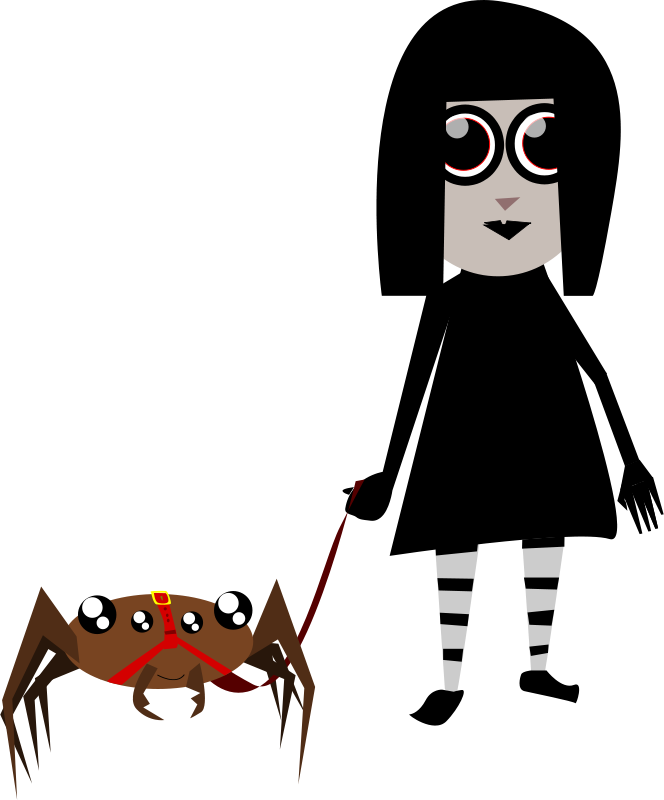
    While children easily realise that this picture is fictional:

    pet_spider_girl
    http://www.openclipart.org

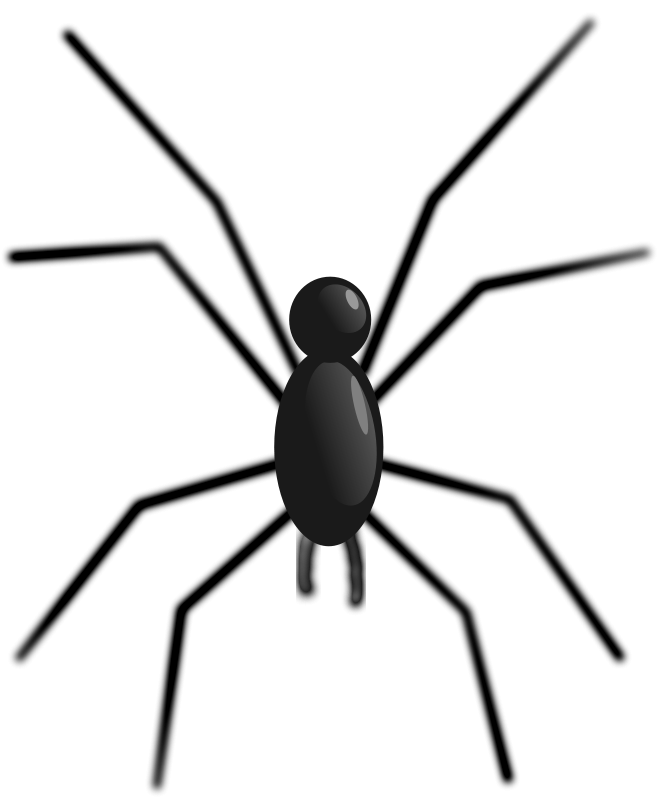
    They have less success is understanding what is wrong with the previous images. Spiders have eight legs. Those drawings show eight legged furry creatures. The story says they are spiders. That must be what spiders look like. Right? Unfortunately, real spiders look more like this one:

    johnny_automatic_spider
    http://www.openclipart.org

    All eight legs are attached to the cephalothorax, not the abdomen (or even one body part) as shown in most picture books. While I am sure you drew a spider correctly (didn’t you?), most children and many adults draw them more as they are depicted in children’s stories. Is this a problem?

    LOVE_2
    http://www.openclipart.org

    I am not for one moment suggesting that we get rid of fictional picture books and stories. I love them! And as I have said, and will continue to say, many times: they are essential to a child’s learning and development. There is no such thing as too many or too often with picture books. Instead, I would like you to consider the misconceptions that may be developed when the content of picture (and other) books may be misleading, and how we adults should handle that when sharing books with children. One of the books that gets me thinking most about this topic is “The Very Hungry Caterpillar” by Eric Carle.

    The Very Hungry Caterpillar

    As I said in a previous post, it has been published in over 50 languages and more than 33 million copies have been sold worldwide. I am almost certain that you will be familiar with it, and upon that assumption, I have one final task for you in this post. Please share your response to the question in this poll:

    To be continued . . .

    I would love to receive any other comments you would like to share regarding the content in this post.

    I do apologize that I have been unable to get the text and pictures in the layout I desire. I obviously have more investigations to carry out and learning to do.  🙂

    Maybe next time I’ll have it mastered, says she, hopefully!

  • Aren’t they amazing!

    Children, I mean.

    birthday cake 2

    My gorgeous little granddaughter is two years old today, and what a wonderful opportunity that provides me to reflect on the marvels of children’s ability to wonder and learn. I am forever in awe of their ability to learn language and all its nuances.

    Some people say they are “sponges”, spongebut I say they are far more than that. They are creators of their own understandings, learning far more than anyone could ever possibly teach them. From the moment they are born, children are actively seeking to make sense of the world: through their interactions with it and relationships they form in it.

    Anna is already using language for a multitude of purposes.

    She has an extensive vocabulary which includes:

    Names, for example, of

    • family members and friends
    • fruits and other foods
    • colours
    • animals
    • animal sounds
    • toys
    • dinosaurs (learnt from her big brother)
    • objects in the home and environment

    Action words (verbs) including eat, drink, play, read, watch, swim, jump, dance, clean

    Adjectives e.g. big and small

    Adverbs e.g. fast and slow

    Social graces for example greetings like hello and bye-bye, and manners like please and thank you

    She sometimes uses one word effectively to convey a complex meaning or thought, but more often now she is stringing together a number of words to form phrases and sentences. She is able to participate in conversations which require an exchange of information or an interchange of questions and answers.

    She uses:

    Questions with appropriate words and inflection to:

    • be informed e.g. Where’s Mummy?
    • request e.g. strawberry please Daddy? play trampoline Mummy?
    • interrogate e.g. why you eat pineapple Bob?

    Commands

    • more Beckii!
    • stop Bob!

    Statements e.g. I go sleep my home

    She understands the importance of facial expressions and body language that accompany these exchanges. She has learned the sway of accompanying a “please” with a smile and the power of an emphatic “No!”

    Although many of her sentences do not contain articles (a, the), prepositions or connectives, her meaning is easily understood in the context of the conversation.

    She knows the placement of adjectives before the noun e.g. “big ball”, not “ball big”.

    She pretends play, e.g. setting up a group of balls then instructing the adults to “shh”, because the eggs need quiet for hatching.

    She has learnt how to follow instructions and take turns in a game e.g. a game of memory turning over the cards to find the matching pairs.

    johnny_automatic_father_and_daughter_playingAnna understands far more than she is able to produce. She responds appropriately to the questions, commands and statements of her family, asking for more information and clarification if she needs it. She knows when the sounds are produced in play rather than for meaning e.g. “Billy-bobby-silly-Sally”, and responds with giggles rather than questions.

    She is familiar with the language of books and expects books to be a source of pleasure and language.

    party_pinguin__card_ocal

    She knows that songs and rhymes are not conversation and joins in rhythmically and tunefully. At her birthday party, she led the family in singing “Happy birthday” to herself, and did a marvellous job of conducting.

    All of these observations reveal but a sample of her actual language learning, glimpsed through the grandmother’s window, you could say, during weekend visits. The parents would be more able to describe in greater detail just how extensive the language development is.

    But is Anna’s ability with language remarkable?

    Yes, indeed it is. Just as the language learning of every other child is remarkable.

    In just two short years Anna, like most other children around the world, has learned the basis of her language. What conditions supported this enormous growth in language learning?

    johnny_automatic_playing_dress_up

    According to research, children are born with an innate ability to learn language. At first they have the potential to learn the sounds, words, grammar and use of any language, but as time goes on their ear is tuned to the language spoken around them, and by the age of one children have learned all the sounds of their native language. However, though this ability to learn language is innate, it doesn’t occur in a vacuum. It occurs in an environment rich in language, and the richer the environment, the stronger, the better the language growth.

    Anna is surrounded by a loving family who speak with her discussing the day’s events, explaining information, telling stories and playing imaginatively. They read to her many times a day, and play games that require thinking and talking. This exposure to language, both oral and written, is an important part of her life, every day.

    Conditions for language learning

    Anna’s environment clearly exhibits the conditions, described by Brian Cambourne, which encourage language learning:

    Immersion: Anna is surrounded by language. Her significant adults (parents and other carers e.g. aunt and uncle, grandparents) speak to her: interacting and playing with language. They read stories and sing songs to her. They hold conversations with each other about a wide range of topics. While not included in these conversations, Anna is quietly learning the nuances of adult discourse.

    Demonstration: Anna observes adults using language in many different situations and comes to understand the language of different contexts and purposes e.g. greeting friends, shopping, asking for help, giving information.

    Feedback: As soon as Anna started to make sounds of her own, her parents provided feedback by repeating the sounds she had made and by adding new ones for her to copy. When she started to say her first words, her parents responded with enthusiasm and encouragement.

    Approximation: Anna’s parents accept and respond to the message of her communication, without hint of it being incomplete or incorrect. Instead they support and elaborate, seeing it as part of the development towards language proficiency.

    Now that Anna is joining words into phrases and sentences, the adults respond, often with an agreement or explanation, by restating the sentence, and expanding on it, supplying the words not yet part of her vocabulary; demonstrating intuitively the target structures towards which Anna’s language is developing.

    The guidance offered by these responses is gentle and intuitive, giving both congratulations on the ability to communicate and reinforcing standard language usage. For example, when Anna says “Apple juice,” the parent may respond, “Would Anna like some apple juice? I will get some apple juice for Anna.”

    Expectation: Anna’s parents always expected that she would learn to talk and that her talk would develop through easily recognisable stages. They do not expect her to speak like a university professor at the age of two!

    They are also aware that not all children develop language at the same rate, and understand that if Anna wasn’t speaking in sentences at the age when another was, they would just continue to provide demonstration, feedback and support expecting that she would in her own time. While they know that seeking help early if concerned about a child’s language development in these early years is very important, they have no reason to be concerned about Anna’s language development.

    Responsibility: Anna’s parents recognise that the responsibility for her language learning rests with Anna. They provide the environment, they model language in use and provide her with feedback and support. They don’t attempt to formally teach her language structures which are not yet part of her developing language.

    Use: Anna uses language in real situations for real purposes: to get things done, to ask for help, to think and share.

    Don’t you agree it’s a pretty remarkable process?

    Children all over the world become proficient language users when they are immersed in rich language environments, often provided intuitively by parents who talk with and read to their children.

    Sadly, not all children have the benefit of an environment rich in language.

    If we could convince all parents of the importance of talking and reading with their children in these early learning years, we would have far fewer children with delayed learning abilities at school.

    Nor and Bec reading

    How do you think we can help parents of young children understand the difference it could make to the lives of their children, and themselves?

    Please share your ideas.

  • “I love the mountains”

    More than 30 years ago I had the extreme good fortune of being at Brown bear brown beara literacy teachers’ conference at which Bill Martin Jr. (author of “Brown Bear, Brown Bear”) was speaking. What a memorable occasion it was.

    At the moment I can recall no other speakers, but I have never forgotten the captivatingly melodic and sonorous voice of Bill and the power of his message.

    Bill inspired his audience as he spoke about coming to reading later than most, at about the age of twenty, by teaching himself to read through his love of poetry. He attributed this love to being read to daily as a child. His delight in and playfulness with language was obvious as his voice danced through his stories, poems and songs to the accompaniment of his rich lilting laughter.

    He demonstrated, through audience participation, the joy of learning through song and the importance of the sounds and rhythms of language. Having fun and playing with language provides much joy for adults and children alike.

    In the days of overhead projectors, long before the now familiar electronic slideshows, Bill displayed a simple song “I love the mountains” on the screen. In an instant he had the audience rollicking in their seats, singing along with the words on the screen, and following the rhythmic lead of his voice without any other accompaniment. The energy created by this spontaneous engagement of the audience was electrifying. How could anyone not wish to participate? I quickly noted the words and tried desperately to commit the tune to memory. (I have since found out that this is a traditional camping song but, since I am not a camper, it was unfamiliar to me at the time though it may have been known by other members of the audience.)

    image courtesy of openclipart.org
    image courtesy of openclipart.org

    Every year since then, I have shared that song with my children.

    At the beginning of year one, in their 2nd or 3rd week of school, long before many of them could read or write very much at all, I would write the words on a chart and have them singing along, sharing through me, Bill Martin’s joy of song and language.

    One title in the "Sounds of Language" series
    One title in the “Sounds of Language” series

    Then, as soon as they were masters of the tune, we would engage in another of Bill’s suggested activities, “transforming sentences”. As Bill recommended, they were “taking an author’s structure and hanging their own thoughts on it.” (Sounds of Language, 1972)

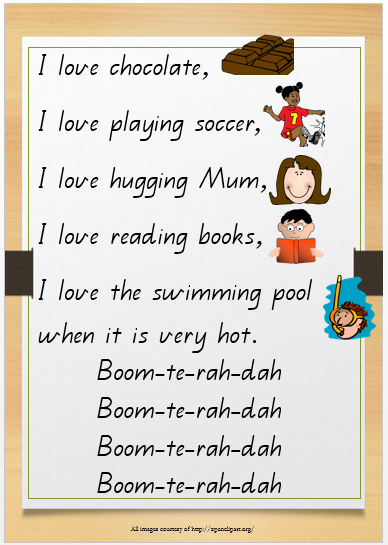
    We changed Bill’s choice of “loves” for our own, and wrote our own collective song, which we sang repeatedly and with great gusto. Although the original did include a rhyme, we didn’t concern ourselves with that at this stage. We just concentrated on sharing our loves in a song such as this one:

    I love chocolate

    While they were having fun with language, the children were also learning a subtle and unstated lesson about how powerful a tool for communication self-expression through language, both oral and written, could be.

    The children’s suggestions for things they loved were many more than the lines of one collective song would allow, so there was nothing else to do but write one of their own. Which they did. They had already seen how easy it was. They knew the rhythm.  They had the basic sentence structure. All they had to do was substitute their own thoughts and make the song their own.

    How wonderful it was to hear the children singing their own lyrics as they wrote them, ensuring that the words telling of their loves fitted the rhythm of the song. The children delighted in sharing their songs with each other and with anyone else who would listen. At the end of the day they took them home to share with their parents as a special gift of themselves for Valentine’s Day.

    While my children did not have the benefit of Bill’s magical voice, or even a tuneful model from me, they delighted in his song. You can share a version (without Bill’s voice, or mine) by clicking here.

    Why not create your own songs, and support your children to create theirs, using this song model. You’ve seen how easy and joyful it can be. A song to sing about things you love is a little “happiness pill” that can be taken daily with no known side effects.

    I invite you to share your own versions here for us all to enjoy.

    Bill Martin Jr. wrote in Sounds of Language (1972):

    “As children gain skill in using their ears to guide their eyes in reading, they have a qualitatively different reading experience. Consider the young child who has frequently heard his teacher read “Ten Little Indians.” Once a child has these sounds clearly and solidly in his ear, he has little difficulty reading this old rhyme in its printed form. Once his ears begin telling him what his eyes are seeing, he approaches the reading with confidence and expectation. And when he comes to his teacher and exultingly declares,

    I know that word, Miss Barber! That word is “little!”

    she has evidence that he is relating sight and sound in reading.”

    What a joy and honour it is, as an early childhood teacher (including parent) to share a child’s journey into independent and joyful reading and writing.

    Nor and Bec readingwriting

    Robert 2

    It was a sad day when Bill Martin Jr. passed away on August 11, 2004, but his legacy lives on in the hearts of many readers, both young and old, whose lives have been touched by his love of language, and who may have indeed stepped across the threshold into reading through one of his many wonderful books.

    Click on the title to listen to Bill singing another fabulous song “I am Freedom’s Child” and his message for democracy: what another great song to start each day!

    I will have more about Bill Martin Jr. and his legacy in future posts.

    If you liked this post, please subscribe to follow.