Live Love Laugh Learn … Create the possibilities

Tag: growth mindset

  • Don’t give up – Yet!

    Don’t give up – Yet!

    Discussions of the importance of having a ‘yet’ attitude or a growth mindset abound, including on this blog. I am very much in favour of the ‘yet’ thinking, as proposed by Carol Dweck.

    Basically, it means that we don’t consider our ability to learn as finite. We believe our potential to be constantly expanding. We may not know or be able to do something ‘yet’, but we can work at it and with each attempt come closer to achieving it.

    The resolve to maintain a growth mindset can be challenged at times when the going gets tough and there is no obvious solution. It can be difficult knowing when enough is enough and it’s time to move on; or if success is hiding just around the corner or on a slight detour.

    I often debate with myself about how to interpret the truth in the messages the universe seems to be sending, weighing up giving up against exerting just a little more persistence and patience. Consequently, I shouldn’t have been surprised by the unplanned theme in my response to the flash fiction prompt at the Carrot Ranch this week.

    charli mill's flash fiction challenge - colonnades

    Charli Mills challenged writers to In 99 words (no more, no less) write a story that includes colonnades. It can be natural, architectural, or a metaphor. Take a stroll and go where the prompt leads.

    What could colonnades possibly have to do with a growth mindset you might think, as would I. But when I sat at the keyboard, without a clue of what to write, this is what developed. I hope you like it.

    Never Give Up

    The solid grey wall stretched without end, both left and right —impenetrable, no way around, no way through. Perhaps a way over? Even from that distance, it appeared unscaleable.

    He removed his backpack and rested his head upon it as he lay, gazing upward. He sighed heavily. He’d trekked so far believing this was the way. How could he have been so wrong?

    He closed his eyes and drifted into a deep sleep. Refreshed, upon awakening, he decided to continue rather than retreat.

    As he drew closer, the wall separated into columns spaced perfectly to allow an easy passage.

    Do you see what I saw emerge? A story about not giving up? Of the importance of adjusting focus when it seems a dead end is reached, when there’s nowhere else to go and nothing else to try? Or is the theme significant to only me as I try to find a way through the colonnades in my path?

    As I was writing this story, I was reminded of one I wrote for children using the nursery rhyme Humpty Dumpty as a stimulus. In a similar way to Charli’s prompts, I was prompting children to think about possible reasons for Humpty Dumpty to be sitting on a wall and causes for him to fall.
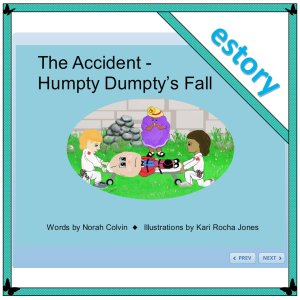
    The accident - an innovation on the nursery rhyme Humpty Dumpty

    Of course, I couldn’t do the prompting without writing a story of my own: The Accident – Humpty Dumpty’s Fall.

    In the story, ‘Humpty looked at the wall. He couldn’t see through it. He couldn’t see over it. And there was no way around it.’ He thought it was ‘no use’. Fortunately, his friend Pomble wasn’t one to give up quite so easily and found a way for them to see over the wall. It was what occurred when Humpty was looking over the wall that caused him to fall. I won’t tell you what happened but, unlike the nursery rhyme, my story has a happy ending.
    Thank you blog post

    Thank you for reading. I appreciate your feedback. Please share your thoughts.

  • Days like this

    Days like this

    Not the End of the World

    Ever have one of those days? You know—it seems the world is against you, and everything you do goes wrong. Maybe you oversleep and in your rush, you fumble, make mistakes and get even later. You hurry to the stop as your bus pulls away. You flop down reviewing life’s punishments, and some jackass walks by telling you to “Smile, it’s not the end of the world.” What would he know? You open your phone and scroll: trivial drivel. Then this one story blows your insignificancies away. You phone your appointment, apologise and reschedule. All is not lost.

    All is not lost Carrot Ranch flash fiction challenge

    I wrote this in response to the challenge that Charli Mills of the Carrot Ranch set for writers this week, to In 99 words (no more, no less) write a story about “not all is lost.” It can include recovery from disaster, an unexpected insight after a fall, or however the phrase moves you. Go where the prompt leads.

    In her post, Charli tells of her friend Cynthia who normally sleeps outside in a tent, even in the snow, but not on the night of June 16. As Charli explains, “In a few hours, the thunderstorm stalled over the lower Keweenaw and dumped 7 inches of rain. Cynthia, who usually sleeps where a mountain slammed into her house, slept inside that night. She and her daughter woke up when her refrigerator tumbled over. Water filled her stairwell to the bedrooms on the second floor and pushed against their doors in a torrent, preventing escape.”

    Though much was lost during that storm and its aftermath, Cynthia did not lose her spirit or her optimism. As she looked around at the devastation, she had thoughts other than loss (as quoted in Charli’s post):

    “This is what I saw: beloved neighbors talking with selfless helpers and eating something finally as they gazed over tge work of some long days, people still digging and puzzling in the waterway, laughter ringing, dogs barking, a moon rising… and I was so pleased, so happy, so fulfilled. This is life, this is who we are capable of being. This is who we are. It was such a beautiful scene. It is our new reality. Blessed be.”

    All around the world, there are tragedies of enormous proportion: wars, floods, fires, droughts, volcanic eruptions, illness. The list goes on.

    What I attempted to show through my flash is that it can be easy to get caught up in the trivialities of our daily lives and forget to look from afar and see how small they are. When our problems seem overwhelming, we don’t need to look too far to see someone in a worse position. For those of you who are truly suffering, I apologise, I in no way intend to trivialise your concerns.

    I also intended it as a reminder that we don’t always know what someone else is going through and an off-hand remark to tell them to “cheer up” may not helpful.

    It is the same for children in our schools, in our classes. We don’t know what bumps they may be experiencing to make them withdrawn, moody, hostile or aggressive.

    To truly understand another’s position we need to listen, put ourselves in their shoes and consider how we would feel. We need to accept that the world doesn’t always work in the way or timeframe we wish.

    If we could lend a helping hand, a listening ear, kind words, and an open heart what a more beautiful world it would be.

    Just as Cynthia chose to see beauty in the scene around her, it is important to remember there’ll be days like this, that all is not lost.

    Thank you blog post

    Thank you for reading. I appreciate your feedback. Please share your thoughts.

  • How important is perfection?

    Are you a perfectionist? If so, in what areas?

    I think it would be difficult to be a perfectionist in everything, indeed, in anything.

    I have never considered myself to be a perfectionist, though others have occasionally labelled my attitude to work that way. I do have certain standards that I like to meet, and I always strive to attain them, to do the best I can. I concede that my expectations of spelling, grammar and punctuation correction may tend towards perfection, but if I can, why would I not? Of course, the occasional imperfection will slip through. It is difficult to catch all when we are editing and proofing our own work. However, if I spot any, I will quickly change them, embarrassed that I let them escape.

    There are many areas in which I am far from a perfectionist – especially housework. I’ll do what needs to be done, but only if I must; and my idea of need may differ vastly from yours. I am often reminded of my mother’s words when I’d completed a household chore; for example, sweep the steps, when I was a child. She’d comment that I’d given it a “lick and a promise”. These days, housework rarely gets more than a promise, a promise I’m not good at keeping.

    As a teacher of young children, it was not perfection I was looking for in their work, but for the best they could do. I expected their work to reflect their development. If they were capable of the calculation, spelling or of using the correct punctuation, I expected them to use it. Opportunities to revise answers and responses were given and improvement was encouraged.

    I’ve hedged around this topic a few times in posts; such as, Is contentment compatible with a growth mindset? The end, Phrasing praise and What is failure.

    But how do we decide when good enough is good enough and that we have put in as much effort as the task requires? I know there are many who agree with me about housework, but what about other things; maybe like, hanging a picture, following a recipe, parking a car, making a payment, checking copyright, or painting a room?

    I recently watched a TED Talk by Jon Bowers entitled We should aim for perfection and stop fearing failure. Bowers provides some different perspectives on the topic of perfectionism, challenging an adjustment to thinking.

    He begins by discussing typos. We’ve all made them, haven’t we? The seemingly innocuous typo can give us a good laugh at times. But it can also do a lot of damage.

    Bowers tells us that “one little typo on Amazon’s supercode produced a massive internet slowdown that cost the company over 160 million dollars in the span of just four hours”, and “an employee at the New England Compound, which is a pharmaceutical manufacturer, didn’t clean a lab properly and now 76 people have died and 700 more have contracted meningitis.”

    Bowers says,

    “When did we come to live in a world where these types of typos, common errors, this do-your-best attitude or just good enough was acceptable? At some point, we’ve stopped valuing perfection, and now, these are the type of results that we get. You see, I think that we should all seek perfection, all the time, and I think we need to get to it quick.”

    traffic

    He talks about the need for perfection when behind the wheel of a vehicle. How many lives are lost daily through inattention, through lack of perfection?

    credit card

    He talks about the need for credit card manufacturers to demand perfection. How would it be if even 1% of our credit cards didn’t work properly?

    book

    He says that “if the Webster’s Dictionary was only 99.9 percent accurate, it would have 470 misspelled words in it.  If our doctors were only 99.9 percent correct, then every year, 4,453,000 prescriptions would be written incorrectly, and probably even scarier, 11 newborns would be given to the wrong parents every day in the United States.”

    He goes on to make many other statements that I’m sure will get you thinking too. At less than 11 minutes in length, the time commitment is far less than the potential learning gain.

    When I watched this video, I was contemplating my response to this week’s flash fiction prompt set by Charli Mills at the Carrot Ranch. Charli shared a “possibly spam” email received as an entry into the Carrot Ranch Rodeo Contest #2: Little and Laugh. You can read the email in Charli’s post, which also includes the challenge to In 99 words (no more, no less) write a fictional story about The Real Nanjo Castille. (The spammer).

    I thought the email to be a little too clever to be real spam, too many clever word choices, phonetic spellings, and our favourite: bitchcoin, that could be purchased for ten dollars, $20 or £20. And the poor writer has an identity crisis, not sure whether to spell his or her name Nanjo or Najno.

    I wondered about how the performance of this child in school might be viewed and what profession might be suggested as a goal.

    This is my response. I hope you enjoy it.

    A job for Nanjo?

    The parents waited.

    Start positive, she reminded herself.

    “Nanjo has a wonderful imagination.”

    They smiled.

    “Very creative too, especially with spelling and punctuation.”

    They exhaled.

    “Has trouble understanding money though, and his knowledge of number facts is non-existent – “ she hesitated, then continued quietly. “I can’t think of any employer who’d have him.”

    “Pardon?”

    “I mean, employment, suited to his – ah – special skills.”

    She cracked.

    “I’m sorry. Your son is unemployable. His spelling and grammar is atrocious. He can’t even spell his own name, for god’s sake! I don’t think he could even get a job as a spammer!”

    Make sure to check the results of Contest #2 at the Carrot Ranch. I’m not the winner. Nor is it Nanjo. Could it be you?

    Thank you for reading. I appreciate your feedback. Please share your thoughts.
  • readilearn: Introducing Pamela S. Wight, author of Birds of Paradise – Readilearn

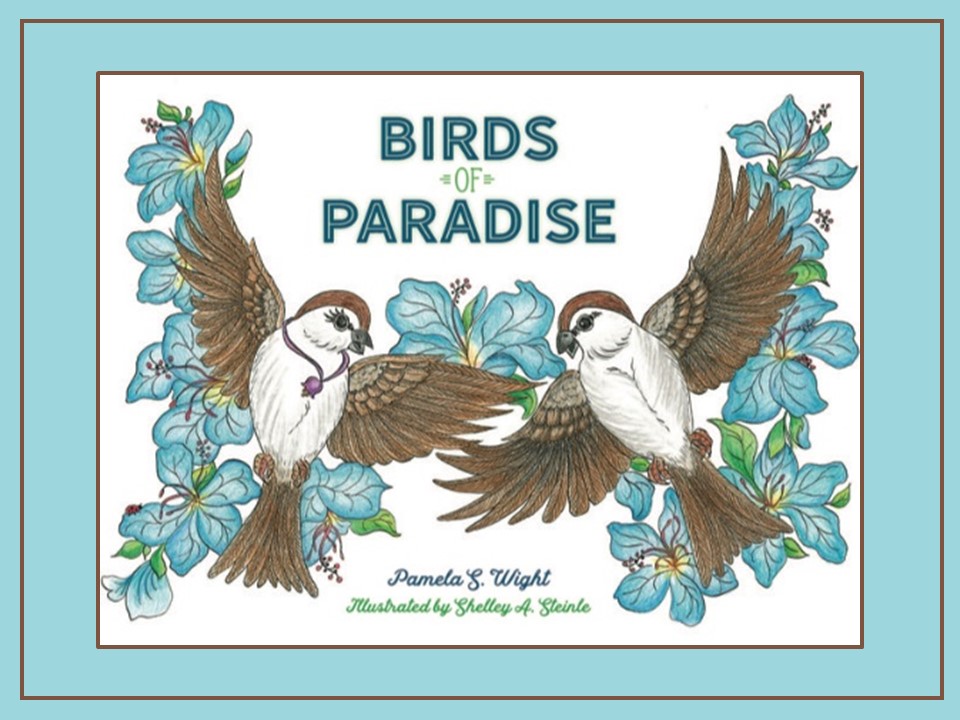
    In the author spotlight this month is Pamela S. Wight, a fellow blogger, writer, and teacher of creative writing. I enjoy the stories of life Pamela shares on her blog Rough Wighting, and also enjoyed reading her adult novels. But it was the story of how this picture book Birds of Paradise came to be, a picture book 35 years in the making, that really captivated me. I knew I wanted to share it with you. Before we start talking about the book, though, let me introduce you to Pamela.

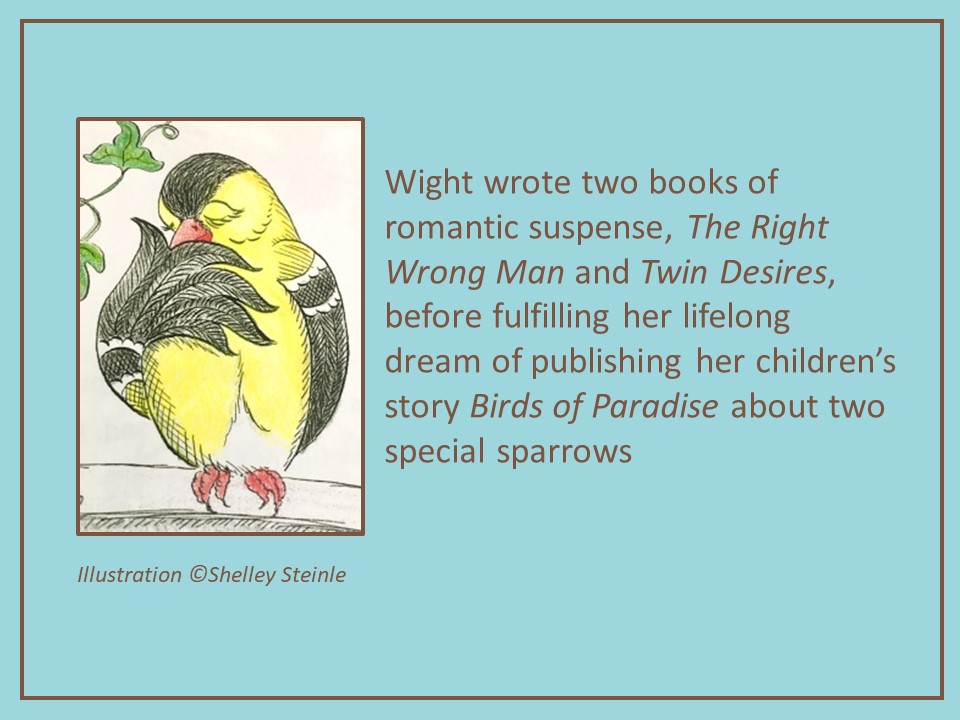
    yellow bird Pamela Wight

    Pamela Wight has joined the ranks of authors who are, as she calls it humorously “bi-genre” or “ambi-writers.” Think of Ian Fleming, who yes, wrote the James Bond books, but also switched genres and wrote the children’s book Chitty Chitty Bang Bang. Before A.A. Milne wrote the Winnie-the-Pooh books, he penned a popular whodunit entitled The Red House Mystery.

    Wight wrote two books of romantic suspense, The Right Wrong Man and Twin Desires, before fulfilling her lifelong dream of publishing her children’s story Birds of Paradise about two special sparrows.

    About the story:

    Birds of Paradise

    Sweet sparrows Bessie and Bert grow up as differently as night and day. Bessie is fearful of the dangers inherent in being a bird. She’s scared to leave her cozy branch. But Bert relishes flying in the sky and

    continue reading: readilearn: Introducing Pamela S. Wight, author of Birds of Paradise – Readilearn

  • Inspiring creativity – celebrating Dot Day – Readilearn

    inspiring creativity - dot day

    Next Friday 15 September is International Dot Day, a day for celebrating and promoting creativity, courage and collaboration.

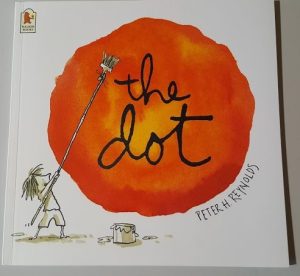
    Celebration of the day was initiated in 2009 with teacher Terry Shay introducing his class to the picture book The Dot by Peter H. Reynolds.

    The story is of Vashti and a teacher who encouraged her to make a mark and have a go. Lacking self-belief and courage, Vashti was reluctant to participate in art class. When the teacher framed and hung her signed painting of a tiny dot, Vashti was determined to do better. She painted all kinds of dots that wowed the people at the school art fair. What happened when one little boy admitted to Vashti that he wished he could draw will inspire children everywhere to be brave, have a go, and be creative.

    For a wealth of celebratory suggestions, visit the International Dot Day Get Started page and sign up to download a free Educator’s Handbook, which includes a lovely certificate of participation which can be printed and personalised for each child.

    I have included a link to the page in the new resource Getting creative with dots in which I suggest additional ideas to add to the celebration.

    getting creative with dots

    The suggestions, of which examples are shown below, can be used in conjunction with International Dot Day, or any day when you feel like going a little dotty.

    Continue reading: Inspiring creativity – celebrating Dot Day – Readilearn

  • Is contentment compatible with a growth mindset?

    I am quite a fan of the growth ‘not yet’ mindset which focuses on a belief in the ability to do and achieve more through persistence and hard work. I have previously written about this mindset in What do you have in mind? and in The power of not yet.

    I wonder how compatible a growth mindset is with a complacency or acceptance of the way things are; a “This is it. I can’t do anything about it.” attitude.

    When I think of contentment, I think of serenity, tranquillity, a feeling of peace and acceptance. I think of it as a positive state of mind. The dictionary defines it as:

    Does this imply that there is no wish for things to be different?

    I often talk about the importance of imagination and creativity to inspiring innovation and invention. But do they also require a certain degree of disequilibrium or discontent with the way things are? Is it necessary to find fault with something in order to improve upon it? How many gadgets do you use regularly, accepting their imperfections without a thought of how they might be improved? It is not necessary to have the ability to improve them in order to imagine how they might be improved.

    A fun thing to do with children is to get them to think of an easier or more enjoyable way of conducting a routine activity. How about an alternative to the traditional, in Australia anyway, emu parade which has children criss-crossing the school grounds, bobbing up and down to pick up rubbish? How about something to carry their heavy back-packs home? Or something to do their homework? (Oh, that’s right, they’ve already invented parents for that!)  I’m sure children, and you, can imagine far more exciting improvements.

    Imagination is the driver of innovation and change. But it also requires action. It is the action that gets us into the growth mindset; perseverance, hard work and repeated attempts. As Edison is oft quoted,

     “I have not failed. I’ve just found 10,000 ways that won’t work.”

    He also said,

    “To invent, you need a good imagination and a pile of junk.”

    I wonder how my friend Pauline King The Contented Crafter would respond to my title question. While I know she has reached a certain stage of contentment in her life, I also know that she strives to better her craft, and does what she can to make the world a better place. How much need for change or improvement can contentment tolerate?

    Charli Mills of the Carrot Ranch and her flash fiction challenge to In 99 words (no more, no less) write a story about feeling content  got me wondering about this. Charli talked about moments of contentment sprinkled among frustrating events and dreams of change.

    It helped me realise that, while they appear to be in contradiction, we need a little of both. We need to be happy with who we are, what we have, and what we have achieved; while at the same time, we need to be aware of what can and should be improved, and some strategies for action. Questioning is important to stimulate imagination, and when paired with creative thinking, innovation can occur. We need the inspiration of just one forward-thinker to lead us into the future.

    The same balance between contentment and growth can be seen in children’s play. I have used it as my response to Charli’s challenge. I hope you enjoy it.

    Purpose in play

    They worked furiously as if with one mind; digging, piling, shaping, smoothing the sand.  As if on cue, two began to tunnel through from opposite sides, meeting in the middle. Others carved into the surface, forming window-like shapes. Sticks, leaves, and other found objects adorned the structure. Then, simultaneously, the work stopped. They glowed with collective admiration. But Than was not yet content. Something was missing. He swooped on a long twig and stuck it into the top, antenna-like. “For communicating with the mother ship,” he declared. Soon they were all feverishly adding other improvements to their alien craft.

    Thank you for reading. I appreciate your feedback. Please share your thoughts.


  • You’re not allowed!

    child-1439468_1920

    How many of these did you hear when you were a child?

    • You’re too small
    • You’re too big
    • You’re too young
    • You’re too old
    • It’s too far
    • It costs too much
    • It’s too dangerous
    • Girls don’t do that
    • Boys don’t do that
    • It’s too …

    Sometimes it was difficult to find an activity that, like Baby Bear’s bed, was just right. Oftentimes it was only ‘just right’ in the eyes someone wielding the power; and not always in the eyes of the one wishing to have, do, go, or be. Setting limits is often easier than chasing possibilities.

    starr-cline-creativity

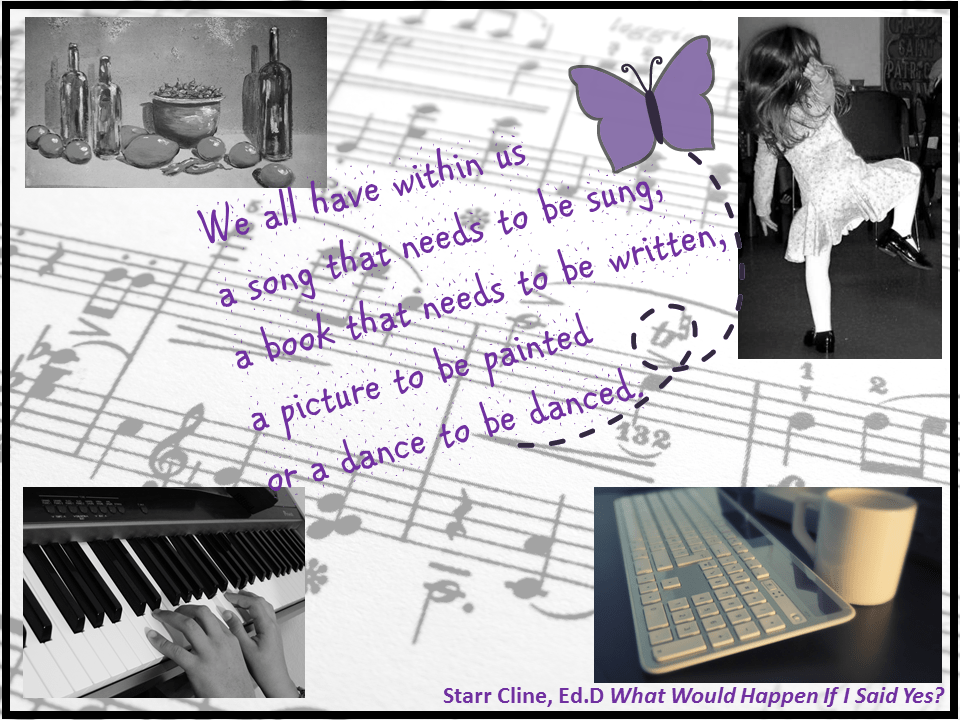
    Many years ago I read What Would Happen If I Said Yes?… A Guide to Creativity for Parents and Teachers by Starr Cline.  Cline writes about creativity, emotional intelligence, giftedness, intelligences, diversity, and the power of “Yes”. On her website, she makes this statement:

    “After years of observation and research, I have drawn the following conclusions:

    • Everyone has the ability to create.
    • The external environment is critical in the development of one’s potential, whether it be in mathematics, language, the arts, etc.
    • Individuals may have one or more areas in which they excel
    • IQ scores do not reflect specific talents or abilities
    • Creativity begins diminishing at about third grade”

    I’m inclined to agree, and feel especially sad about the last point she makes.

    What Would Happen If I Said Yes? challenged me to think about ways in which I could parent (and teach) more positively and encourage, rather than inhibit, creativity; encourage a willingness to try new things; and to avoid placing unnecessary limitations upon others and myself. I can’t say I was entirely successful, but I did make some gains.

    In the book, Cline suggests that you “STOP every time you are about to say no. THINK about what might happen if you said yes!”  Consider the worst scenario that could occur if you said yes, and whether it would be really that bad, or even likely.

    She says to consider why you may say No.

    “Is it because …

    You don’t want to be bothered

    It wasn’t your idea

    It’s a habit

    Someone treated you that way

    It makes you feel powerful”

    She reminds that the messages saying “No” often sends are:

    “Your idea is stupid

    You are stupid

    You’re not capable

    You’re not worth it.”

    In the long term, are these negative messages more important than a temporary inconvenience, or than the benefits that would accrue from positive responses?

    But don’t get me wrong. Cline doesn’t suggest you just say “Yes” to everything. She says that sometimes you may need to come up with a creative way of saying no. She provides many ways of doing so in her book, which I recommend as a great read for both parents and teachers.

    Even as adults we can find ourselves in situations where certain things are not allowed and rules are imposed, such as in the workplace or in clubs and other organisations.

    Sometimes the things we are not allowed to do are self-imposed limits; we may not allow ourselves to do things because:

    • It’s scary
    • It’s unfamiliar
    • We feel uncomfortable
    • We don’t know anybody there
    • It costs too much

    camping-1289930_1920

    Sometimes, as I explained about my attitude to camping in a previous post Around the campfire, we make choices and find ways of justifying our decisions, at least to ourselves if not to anyone else. There are many reasons I choose to avoid camping, many other things I’d prefer to do, and I don’t often consider myself to be missing out.

    Although I can appreciate camping’s appeal to others, it was only when I read a late comment by Bruce Mitchell that I began to consider some of the wonders, including Antarctica, I had missed. Maybe I’ll be more adventurous next time round!

    This week at the Carrot Ranch Charli Mills has challenged writers to In 99 words (no more, no less) write a story about something or someone not allowed

    In her post, Charli speaks of many injustices, including the rules that say who is and is not allowed to vote in elections in the United States. The rules affect many, for many different reasons (or petty excuses based on power) and tend to be divisive rather than inclusive.

    charli-mills-gift

    Charli says that,

    “The greatest gift you can give is to allow another. Allow someone else to listen to their favorite music. Allow someone else to tell you their story. Allow someone to connect to you even if you feel harried. Smile back, nod, acknowledge, empathize. Be loving. Some among us have denials you can’t see stamped upon their countenances because of circumstances.”

    While deciding what we will or will not allow our children to do may seem trivial in comparison, surely bringing up our younger generations to be confident, independent, responsible, and accepting of others, allowing them to join in; creating an inclusive society, is something to strive towards. Perhaps if we allow our children, they will allow others.

    For my response to Charli’s flash, I’ve gone back to childhood. Where else? I hope you enjoy it.

    Not allowed

    She knew they were in there. She heard their chatter. Her knocks began timidly, then louder. The room hushed. There was rustling, then padding feet. She waited. The door opened a peek. Her loving sister’s smiling face appeared, then contorted unrecognisably.

    “You’re not allowed!” the monster screeched, and slammed the door.

    She froze – obliterated, erased, smashed to smithereens. She was nowhere, nothing. Why? What had she done?

    She could only shrug when Mum asked why she wasn’t playing with her sister.

    Later, at dinner, she viewed her sister’s sweet smiles cautiously. Was she real? When would the monster reappear?

    thank-you-1200x757

    Thank you for reading. I appreciate your feedback. Please share your thoughts.

  • Scary monsters

    https://openclipart.org/detail/170917/little-monsters
    https://openclipart.org/detail/170917/little-monsters

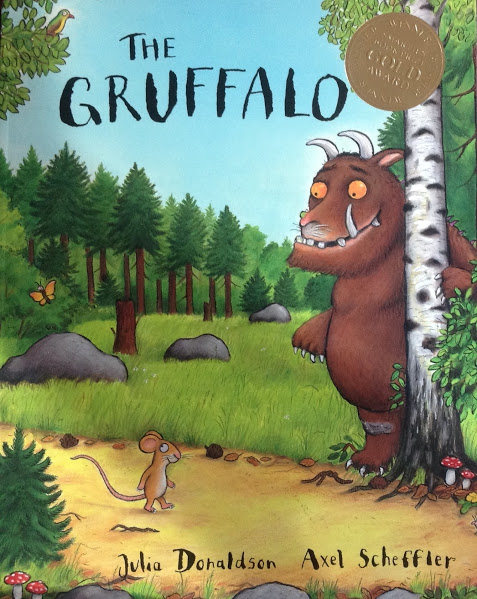
    This week at Carrot Ranch Communications Charli Mills has challenged writers to In 99 words (no more, no less) write a monster story.  Being an early childhood teacher I think immediately of picture books. Two of my favourites are The Gruffalo, written by Julia Donaldson and illustrated by Axel Scheffler, and The Monster at the End of this Book , written by Jon Stone and illustrated by Michael Smollin.

    The Gruffalo

    The Gruffalo is as fearsome as any monster you are likely to meet with its “terrible tusks, and terrible claws, And terrible teeth in his terrible jaws”; “a poisonous wart at the end of his nose” and “purple prickles all over his back”. The quick witted mouse, who imagines the Gruffalo into storybook “reality”, must find a way of ridding himself of the monster’s inherent danger and once again uses his ingenuity to escape.

    I’m not sure if it was Donaldson’s intention, but I think this is a great analogy for the monsters we create for ourselves such as self-doubt, unrealistic expectations, and (you can add your own monster here). Not that I’d be sharing that thought with young children.

    In this video Axel Scheffler explains his concept of the Gruffalo and even hints, a couple of times, that he too may be troubled by that all too common of personal monsters, self-doubt.

    Monster at the end of this book

    Throughout The Monster at the end of this Book Grover, from Sesame Street, pleads with the reader to not turn the page as there is a monster at the end of the book. You could almost say he is immobilised by this fear, or that he tries to immobilise the reader. Of course it is a lot of fun and provides much laughter. When we (reader and Grover) do get to the end of the book, he is rather embarrassed to find that he, “lovable, furry, old Grover” is the Monster. He tries to assure us that we, and not he, were the scared ones.

    Of course Grover wasn’t the monster only at the end of the book. He was always the “lovable, furry” harmless monster. It was his fear that was the real monster. How often are we immobilised by our fear, and how often when we take that jump despite it, do we find our fears to be groundless? Sometimes I think, or is it only me, we are our own worst monsters setting ourselves impossible targets with too-high expectations that lead us only to disappointment if we don’t achieve them.

    But if we view ourselves as works in progress, in the process of working out where we want to be and how to get there, we can find contentment in what we achieve along the way, in where we are and how far we have come, rather than ignoring those milestones and looking only at how much further we must (in our own minds) go.

    It is all too easy to contribute to the development of children’s personal monsters by doing to them what we do to ourselves: setting unrealistic targets, expecting too much, insisting on error-free work, measuring them against external benchmarks … To avoid this, we need to view them also as works in progress and encourage them, through a growth mindset, to reach their own milestones and goals in the time that is right for them.

    Like the mindset of the mouse in The Gruffalo who was able to think on his feet and overcome the obstacles, or that of Grover who realised there was really nothing to be worried about at all.

    We need to be not afraid of the monsters under the bed or in the cupboard, most of which we have created in our imaginations and stuffed there, sometimes with the assistance of others, allowing them to multiply like wire coat hangers until there is no room left for anything good. I have taken the theme of internal monsters for my response to Charli’s challenge.

    Open, close them, open anew

    The picture was clear. Taken with wide open shutters and long exposure, then developed in black and white for extra clarity, the result was undeniable and exactly what would be expected.

    “You’ll never amount to anything.”

    “That’s rubbish.”

    “Pathetic.”

    “You’re always the troublemaker.”

    “Because I said.”

    “Shut up!”

    “Stop asking questions.”

    An existence devoid of value was drilled with reminders hurled unrelentingly from birth. Well-schooled in self-loathing, the lessons were regurgitated without effort or question. The monsters without had created the monster within. How could one escape from what was recognised only as truth?

    And now for something a little lighter:

    The Monster Mash

    Thank you

    Thank you for reading. I appreciate your feedback. Please share your thoughts.

  • Are we finished?

    work-in-progress
    Anonymous, Work in progress https://openclipart.org/detail/12941/work-in-progress

    I am a work in progress. I reflect on the past, predict the future, and live in the present moment. Nearly everything I do is a work in progress. Some things just make more progress than others!

    Over the past few years I have been preparing resources for my readilearn website. It’s slow going, slower than I expected, but I’m getting … somewhere. Even when the website launches it will be a work in progress as I update old and add new resources.

    Launching soon - readilearn2

    In a flurry of activity, with the intention of completing additional resources as development of the website nears completion, I experimented with making a product promotional video. My intention is to make a number of these, possibly explaining the use of each interactive resource. Doing so is far more time consuming that I had expected.

    Below is my first attempt. But please don’t let that word “first” mislead you into mistakenly thinking it was my only attempt. I lost count of the number of takes and couldn’t believe how difficult it was to utter just a few short sentences. While I am sharing it, please consider it a work in progress. Making promotional videos for my products is something I need much more practice with.

    My purpose in sharing the video is to illustrate the importance of being a lifelong learner, which involves a combination of persistence, resilience and confidence, including:

    • a willingness to make mistakes and repeated attempts
    • a growth mindset without an expectation of immediate success
    • confidence to say “I haven’t got it yet, but I’m working on it”
    • belief in the ability to succeed, either independently or with support
    • an ability to adjust future attempts according to feedback provided from the past.

    I learned a lot in making this video, perhaps more about what doesn’t work than what does. But eliminating what doesn’t work is crucial in finding out what does. For example, I learned after repeated attempts on both, that selfie videos recorded with phone or iPad just weren’t going to be good enough. I learned that neither of the software programs for making videos I owned would allow me to achieve what I wanted on its own. I needed to combine recordings from each. After many trials I finally made something that at least has the semblance of an attempt.

    Included in my passion for learning is a passion for learning about learning: how we learn, why we learn and the conditions that contribute to our learning. I am fascinated by learning that occurs at all ages, but particularly during early childhood.

    Morguefile http://mrg.bz/omEd2M
    Morguefile http://mrg.bz/omEd2M

    In the process of repeated attempts described above, I responded constantly to feedback provided, and adjusted each new attempt accordingly. Feedback is necessary for learning. But perhaps more important than the feedback is the response to it.

    Hopeful of getting some other feedback, I shared the video with my family on the weekend. They made some helpful suggestions. But perhaps the most interesting feedback, about feedback, was that given by my four-year-old granddaughter, G2.

    G2 watched the video with her mother and immediately wanted to play the game. I was delighted, of course, and opened the resource on the iPad for her to use. She had no trouble manipulating the objects to make the ice creams and quickly made a few combinations. When I asked if a mango with strawberry on the top was the same as, or different from, a strawberry with mango on the top, she confidently explained that they were different because “this one’s got the strawberry on the top and this one’s got the mango on the top”. She went on making combinations.

    icecreams
    © Norah Colvin

    After she’d made about ten combinations she asked, “Are we finished yet?” I said, “We can finish whenever you like.” I wasn’t using it as a “teaching episode”, simply as something fun for her to do. She asked again, “But are we finished? You know –“ and she indicated for something to happen on the screen showing that we had finished.

    Suddenly I realised that she was wanting feedback from the program to tell her that she was finished, that she was successful; perhaps some bells, whistles or fireworks. Because I designed the resource as an open-ended teaching episode, for use by a teacher with a class rather than by individual children, the resource does not have any inbuilt feedback. The feedback occurs in the discussion between teacher and students.

    What I intended as a teaching episode became, for me, a learning episode; thinking and learning about feedback.

    • G2 expected to receive feedback about completion, and
    • she wished to continue until she received that feedback.

    However,

    • she doesn’t’ require feedback about completion from all apps, for example, drawing programs: she decides when she is finished, and
    • during play she decides which activity she will take up and when she will finish.

    G2 has a good balance of activities with home and Kindy; indoor and outdoor with a variety self-selected and self-directed imaginative play mixed with cooperative activities including reading, board games and screen time with a variety of apps.

    GDJ, Playful stick figures https://openclipart.org/detail/230070/playful-stick-figure-kids
    GDJ, Playful stick figures https://openclipart.org/detail/230070/playful-stick-figure-kids

    With such variety she receives feedback from many sources including self and others, as well as from manipulation with real and electronic objects. I think her question “Are we finished yet?” was related to use of the specific device and type of activity (game to her), not indicative of a generalised need for feedback from outside.

    But what of children who are more engaged with electronic games, have less time for self-directed activity, and fewer opportunities to engage with others? Will the need for feedback from an outside source overtake the ability to provide feedback for self? I hope not. I believe the abilities to self-monitor, self-regulate and self-determine to be extremely important to life-long learning. What do you think?

    Thank you

    Thank you for reading. I appreciate your feedback. It is important to me! Please share your thoughts about any aspect of this post.


  • The industrious child

    http://www.morguefile.com/archive/display/902642
    http://www.morguefile.com/archive/display/902642

    The advice to go to school, work hard, get a good job seems to be often repeated, as if it is advice given to all young people as they are growing up. Funnily enough, I don’t remember receiving it when I was in school, though I may have been given it. With or without it, I think I was fairly industrious, for the final year anyway, studying six hours long into the evening each day after school. I devoted one hour to each of my six subjects. I needed to work hard to get the job of my dreams: all I wanted to be was a teacher.

    SnipsandClips, Teacher and Child https://openclipart.org/detail/205589/teacher-and-child
    SnipsandClips, Teacher and Child https://openclipart.org/detail/205589/teacher-and-child

    I think I have probably always worked fairly hard, even when I wasn’t ‘working’. Maybe I should rephrase that, and say that I consistently put in a good effort, as long as low marks for exercise and housework are not put into the aggregate.  Effort doesn’t always produce the hoped-for results, and sometimes the results can be achieved without any apparent effort. I have not yet found that in relation to exercise or housework, though. I’ll let you know when I do.

    This week at the Carrot Ranch Charli Mills is talking about being industrious. She says that

    “Making a living as a writer is not exactly the career path any school counselor would promote, but any industrious writer can make it work.”

    Tony Wagner - iterations

    I hope she’s right. In the current iteration, of which there have been a few, of my teaching career, I am combining my passion for education with my love of writing.

    Charli says that

    “You have to find a niche … an outlet and fair payment.”

    I’m working on those and I’m hoping that this time my effort will produce the desired result.

    My niche: early childhood educational resources with a point of difference being interactivity in some

    My outlet: a website readilearn, soon to be launched

    Fair payment: while some resources will be available free of charge, others, including the interactive resources will be available only to subscribers

    The relationship between effort and result is relevant when thinking about growth mindset and praise, both of which have previously been discussed on this blog, here and here for example.

    fixed - growth mindset

    Growth mindset is a way of thinking about learning proposed by Carol Dweck; of viewing learning as occurring on a continuum of possibilities that may not yet be, but have the potential to be, achieved. It differs from thinking about the ability to learn as being fixed or limited in various unalterable ways.

    Much of the discussion about praise, see here, here, and here, referred to how the effect of praising for effort, “I can see you worked hard on this” differed from that of praising achievement ‘Great job!”. Personally, I’m hoping for a bit of both once my website launches. I’d like some praise for the product, but also recognition of the effort. I just have to hope others find it worthy. I definitely don’t want to receive any hollow praise, which I think is a major criticism of the comment “Good job!”.

    ryanlerch_thinkingboy_outline

    Needless to say my interest was piqued by a statement in the opening paragraph of the post Mindset, abundance by Mary Dooms on Curiouser and Curiouser this week:

    “a colleague … and I continue to commiserate on the implementation of Carol Dweck’s growth mindset research.”

    Dooms goes on to say that “nurturing a growth mindset is a daunting task” and explains that their fear “that growth mindset has been reduced to the grit mentality of telling the students to work harder” is shared by Dweck.

    I followed the link provided to an article published in September 2015 in which Carol Dweck revisits the ‘Growth Mindset’. In this article Dweck says that one of the biggest misconceptions about a growth mindset is equating it with effort. She says there is more to achievement than just effort and reminds us that effort has a goal: learning, improvement or achievement. Effort is not made simply for effort’s sake and there is no point if it is not achieving something. She cautioned that we need to be aware of when effort is not productive and to provide students with a range of strategies to use when they get stuck.

    She says

    “Too often nowadays, praise is given to students who are putting forth effort, but not learning, in order to make them feel good in the moment: “Great effort! You tried your best!” It’s good that the students tried, but it’s not good that they’re not learning.”

    She explains that

    “The growth-mindset approach helps children feel good in the short and long terms, by helping them thrive on challenges and setbacks on their way to learning. When they’re stuck, teachers can appreciate their work so far, but add: ‘Let’s talk about what you’ve tried, and what you can try next.’”

    She goes on to say that having a growth mindset is not a destination, it is a journey. We all have some thoughts and responses that are more akin to a growth mindset and some akin to a fixed mindset. It is important to recognise both and continue to grow in growth mindset thinking. I know I still have a lot of learning and growing to do, but with Dweck’s acknowledgment of the same, I know I am in good company.

    Dooms also links to an article by Peter DeWitt published in Education Week Why a ‘Growth Mindset’ Won’t Work. DeWitt states that according to John Hattie, whose work I have previously mentioned here, a growth mindset has little effect on classroom results. Now that’s putting the cat among the pigeons.

    www.morguefile.com
    http://www.morguefile.com

    However, DeWitt explains that the reason for the low effect is that most adults have fixed mindsets which they transfer to students. He says that, for the growth mindset to be more effective, we need to do things differently.

    First of all, he says, ditch the fixed mentality. Don’t see the problem as being with the student, see it in how or what is being taught. Adjust the teaching. (I’ve also mentioned this before here.)

    • Test less for grades and more to inform teaching
    • Provide feedback that supports student learning
    • Avoid grouping students by ability
    • Ask questions that require deep thinking
    • Stop talking!

    In fact, what he is saying is that we need to practice the growth mindset, not just preach it.

    Teachers with a growth mindset appreciate the incremental

    Which brings me back to being industrious, putting in the effort, and responding to Charli’s flash fiction challenge to “In 99 words (no more, no less) write an industrious story.

    I’m thinking of putting in the effort as being industrious. I’m thinking of our impression of it and responses to it in others, particularly of the need to recognise where difficulties lie for students and how to praise to assist learning.

    “Could do better”

    The words blared from the page.

    “Needs to try harder.”

    Down through the years the judgement repeated.

    “More effort required.”

    No one tried to understand his unique way of seeing, his particular point of view.

    “Doesn’t apply himself.”

    He struggled to repeat their pointless words and perform their meaningless tasks.

    “Needs to concentrate in class.”

    Inside his head the images danced in brilliant choreography.

    “He’ll never amount to anything.”

    Outside their white noise words crackled a cacophony of dissonance.

    Finally, school days done, they clamoured for the inspired works of the overnight success.

    “Brilliant!” “Talented” “Exceptional!”

    Thank you

    Thank you for reading. I appreciate your feedback. Please share your thoughts.