Live Love Laugh Learn … Create the possibilities

Tag: Flash fiction

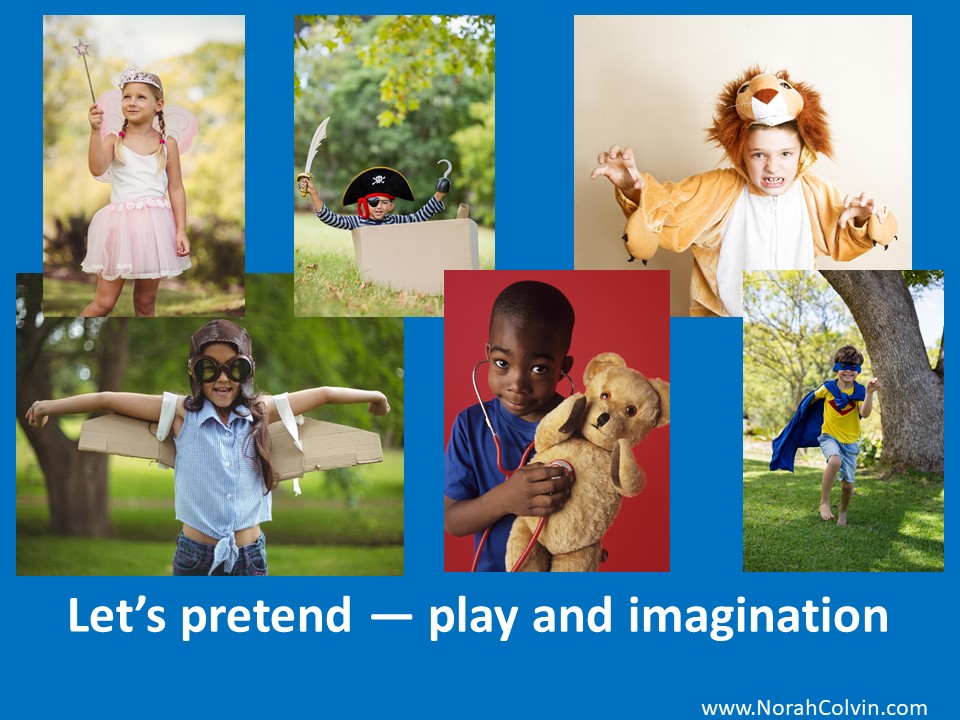
  • Let’s pretend — play and imagination

    Let’s pretend — play and imagination

    If the title conjures up images of children playing dress-ups with forts and castles, saving princesses and defeating dragons, that’s good. Such was my intention.

    Pretend play, in which children use their imaginations, allows them to try out different roles, experience different possibilities and enact a variety of solutions to problems they encounter.

    But play and imagination isn’t just for children. It is through playing with ideas that new discoveries are made, inventions are created, and innovations implemented. Without imagination, everything would always stay as it always was. Science wouldn’t progress and stories wouldn’t get written.

    Charli Mills of the Carrot Ranch flash fiction challenge Eminence

    When Charli Mills at the Carrot Ranch challenged writers to In 99 words (no more, no less) write a story that uses the word eminence. It’s a rich word full of different meanings. Explore how it sounds or how you might play with it. Go where the prompt leads!, I knew that imaginations the world over would be employed to respond.

    Every week when Charli sends out a prompt, writers play with ideas to engage readers with unique and imaginative perspectives on the word or phrase. When all have been submitted, Charli searches for threads that bind the diverse stories together and compiles them into a connected whole.

    Charli’s use of the word ‘eminence’ in her flash fiction story was unfamiliar to me, so I opted to stay within my comfort zone. With such a serious and imposing word though, what could I do but play? I hope you enjoy it.

    Your Eminence

    She glided in, regal robes flowing, loyal subjects lining the path.

    “Your eminence,” they bowed as she passed.

    She occasionally extended her gloved hand to receive their kisses of adoration or stopped to bestow a gift of royal chatter. Though her crown and responsibilities weighed heavily, she held her head high as she proceeded towards the throne. Decorum dictated every move. She dared not breathe out of sync. Her subjects depended upon her.

    When seated, she motioned for all to sit. They obeyed, listening respectfully.

    “I decree– “

    “Lunch is served, Your Majesty.”

    “Aw, Mu-um!”

    “You’ll reign again later.”
    Thank you blog post

    Thank you for reading. I appreciate your feedback. Please share your thoughts.

  • It’s a point of view

    It’s a point of view

    Have you ever been faced with a task, at work or at home, that seemed so big you didn’t know where to start?

    Have you ever been hustled by a supervisor, external or internal, to make a start whether ready or not?

    Have you ever jumped in, hoping it would all work out in the end?

    Have you ever chipped away without any real sense of direction and eventually found what you were looking for?

    Charli Mills flash fiction challenge chisel

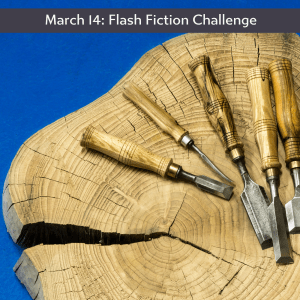
    It was of these situations I was thinking as I responded to this week’s flash fiction prompt set by Charli Mills at the Carrot Ranch to In 99 words (no more, no less) write a story that includes a chisel. Use chisel as a noun or a verb. Think about what might be chiseled, who is chiseling. Be the chisel. Go where the prompt leads!

    Perspective

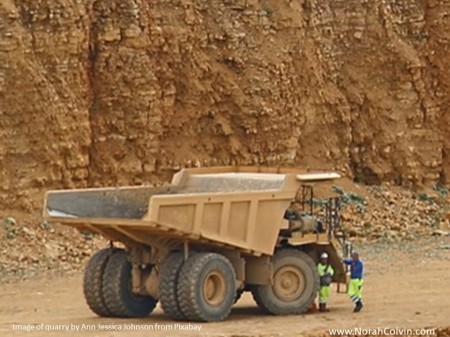
    The monumental task cast a shadow deep and long, miniaturising the toolkit at his feet.

    He shook his head, muttering complaints and impossibilities.

    The supervisor appeared. “Better get started. No time to waste.”

    He rummaged through the toolkit, lifting, inspecting and replacing each implement in turn.

    “What’s the holdup?” bellowed the supervisor.

    He grabbed the mallet and whacked the stone. “Take that!” Chunks smashed around him. He wiped his brow and whacked again.

    “Great. You’ve started at last,” encouraged the supervisor.

    Later, as the light turned, the shadow faded and diminished. He lifted his chisel and refined his work.

    size is a point of view

    Of course, I’ve had the opposite happen too. I’ve begun a task that I thought was miniscule but turned out to be mammoth. What about you?

    Thank you blog post

    Thank you for reading. I appreciate your feedback. Please share your thoughts.
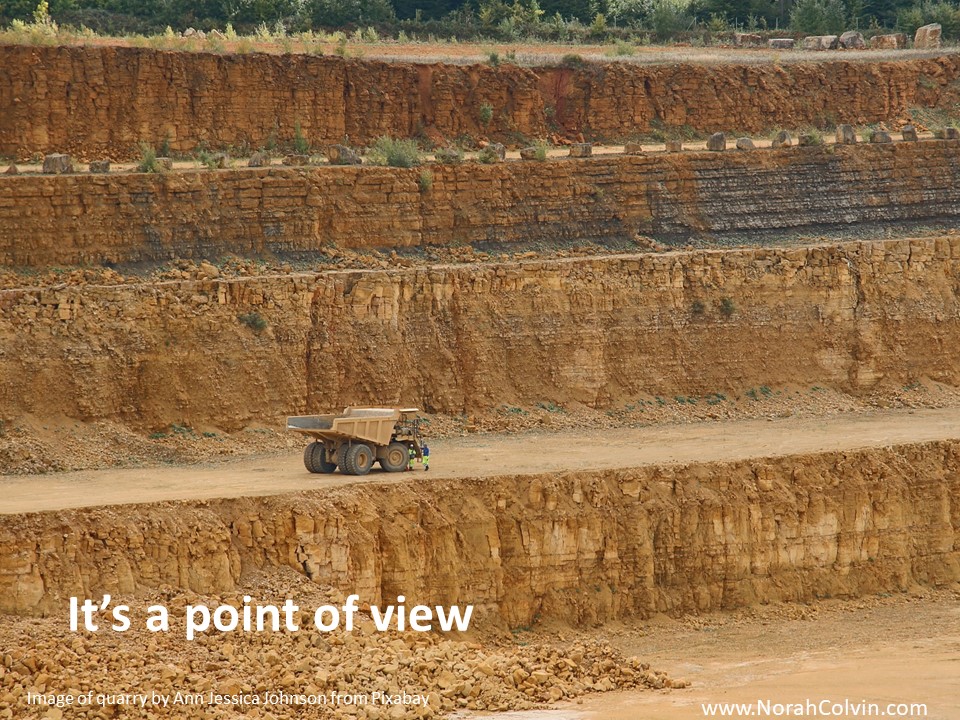
    Image of quarry by Ann Jessica Johnson from Pixabay.


  • What’s got your back up?

    What’s got your back up?

    This week at the Carrot Ranch, Charli Mills has urged writers to have a backup plan in place for their work. She suggested a variety of ways including storage on USBs or external hard drives, in the cloud or as hard copies. She also warned that no method is fail-safe.

    flash fiction challenge to back up

    The cautionary post preceded, as her posts often do, a flash fiction challenge to In 99 words (no more, no less) write a story using the term backup. You can back up or have a backup, just go where the prompt leads! However, there is no suggestion of caution in her final phrase ‘go where the prompt leads’.

    When I began to consider how I might use the term ‘backup’, I was soon faced with the complexity of our language and wondering how we ever learn to make any sense of it at all.

    Back up may be used as a two-word-phrase or as a compound word. The words, with their regular short vowel sounds and consonants, are easy to read and pronounce, even for the youngest beginning readers. Individually, their meanings are clear. Back refers to a part of the body or a location behind. Up is the opposite of down. But put them together and the complexity of meaning emerges with possible use as nouns, verbs or adjectives.

    Below are some examples of meanings that can be applied to the phrase:

    Feeling annoyed

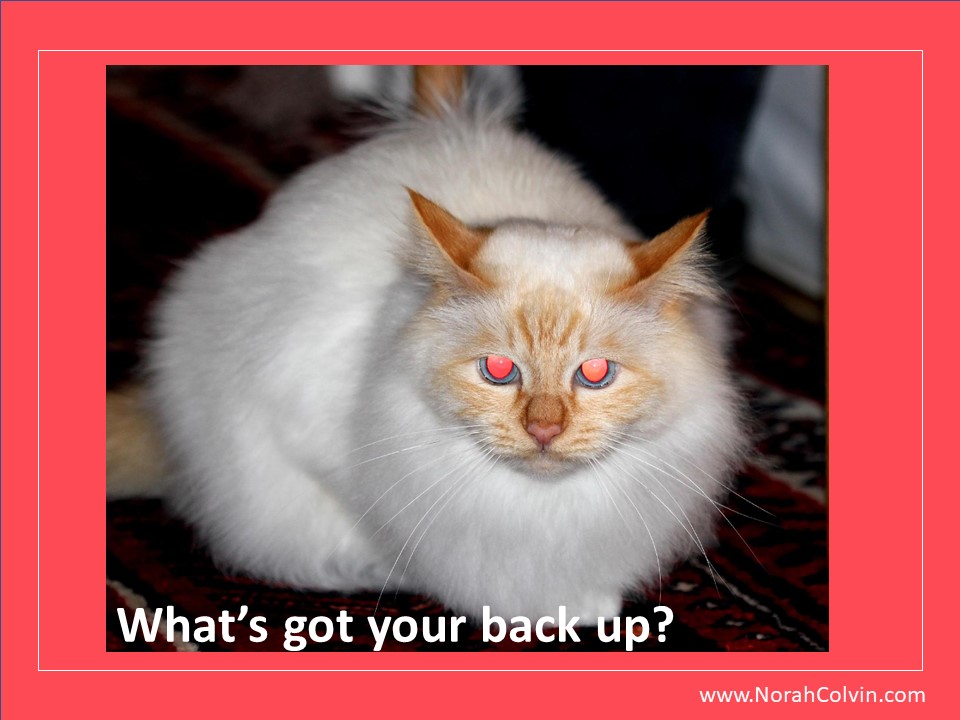
    Perhaps the most literal translation is in reference to a feeling of annoyance; for example, He got his back up when they insinuated he was always late for work. This use comes from a cat arching its back when annoyed.

    Move backwards

    The truck driver was told to back up to avoid blocking the driveway.

    He had to reconsider and back up when the others told him he was wrong.

    Teachers may need to back up on what they had planned when they realise the children are not understanding their lessons.

    Blocked

    The backup of traffic was caused by an earlier accident on the narrow bridge.

    The water would back up in the gutters and overflow every time it rained due to the leaves from the overhanging trees.

    Support

    It is important to back up any science report with evidence from research.

    The situation was escalating, and the police were relieved when backup arrived.

    The backup singer was required to take the lead when the performer got laryngitis.

    Alternative strategy

    You need a backup plan in case this one doesn’t work.

    You need to backup your digital work in case your computer crashes.

    Posture support

    One birthday, thoughtful Hub gifted me a wearable device for supporting my posture during long hours at my desk. Sadly, it was complicated, and he was the only one to don it, semi-successfully. Those of us less brave to even attempt were in stitches as he manoeuvred himself into it. Having failed to convince me or anyone else to try, it has been relegated to the back of an (unknown) cupboard ever since. Mere mention of the BackUp causes fits of laughter and it remained #1 inappropriate gift for many years – until he presented man perfume on another birthday.

    This is a true story. No names have been changed to protect the innocent. I tried to find an image of the device online, but it seems the design has probably improved over the years. The one Hub gave me had straps to go around the knees as well as the back.

    You’d think with all the different meanings of ‘back up’ that I’d have no trouble finding a story to write. However, since the description of my birthday surprise is 99 words, no more no less, and for the fact that I have no backup plan, that true story will be my contribution this week. I hope you like it. Perhaps truth is stranger than fiction.

    Thank you blog post

    Thank you for reading. I appreciate your comments. Please share your thoughts.

  • Technology Pushes Back

    Technology Pushes Back

    There’s been a glitch or three at the Carrot Ranch this week, and the usual Flash Fiction schedule has been interrupted. I haven’t yet written a response to Charli’s challenge, but pop over to read about Charli’s challenges and pen a response yourself.

  • What do you love?

    What do you love?

    We use the word ‘love’ to mean care deeply about, as in people, or like a lot, as in food, objects and activities. Questions such as “Who do you love?” and “What do you love?” will elicit very different responses and we generally have little difficulty in distinguishing between the intensity of the feelings. Mostly the whos are more important to us than the whats, and it is easy to distinguish between the likes and the loves, though they can sit along a continuum.

    love of vegetables on a continuum

    For me, housework sits at the opposite end of the continuum from reading and writing. You won’t find me writing any posts about housework. But you will find lots of posts about reading and writing, especially encouraging a love of reading and writing in children. I find sharing a love of reading and writing to be almost equal in enjoyment as reading and writing for myself. To see children light up with enthusiasm for reading and writing is sheer joy.

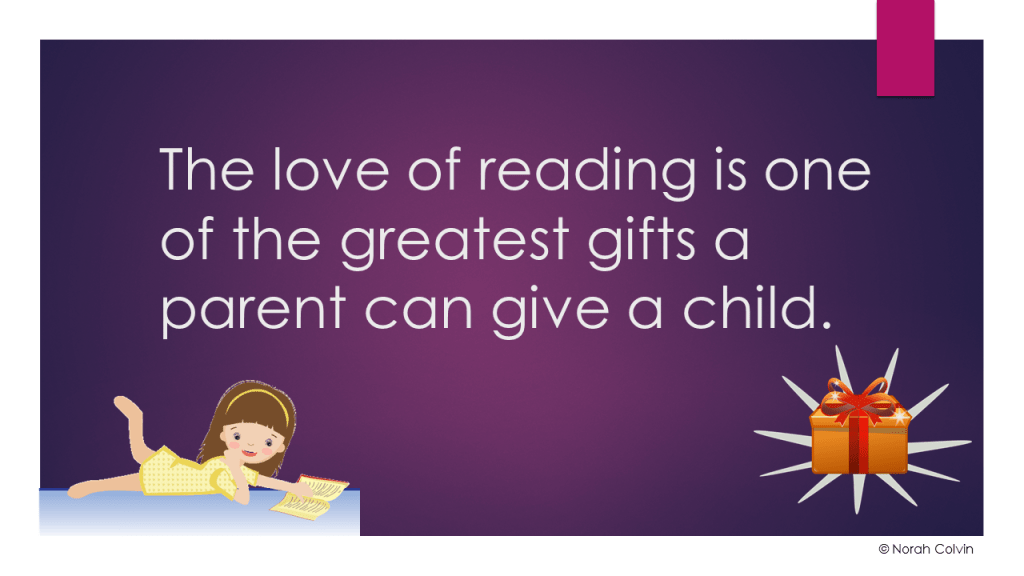
    the love of reading is one of the greatest gifts a parent can give a child

    I have often said that one of the greatest gifts a parent can give a child is a love of reading. A love of reading and writing, and indeed for all learning, is the best gift a teacher can give.

    the love of reading and writing is contagious

    It is often said that a love of reading is caught, not taught. The same goes for writing. It is important for teachers to ensure that there is time every day to read aloud to children, to inspire them and excite their imaginations with wonderful literature and to provide them with time for expressing their own thoughts and imaginative ideas through writing and any other of the expressive arts.

    I have written many blog posts, both here and for readilearn, with suggestions for making time for literature and literacy, but it was the prompt set by Charli Mills at the Carrot Ranch that kept me thinking that way this week.

    Carrot Ranch flash fiction challenge Valentines

    You see, Charli challenged writers to In 99 words (no more, no less) write a story about valentines. It can be Valentine’s Day, the exchange, love for another, romance, or friendship. Have a heart and go where the prompt leads!

    But, as well as being Valentine’s Day, 14 February is also Library Lovers’ Day and International Book Giving Day.

    Why wouldn’t I write about one of my loves — reading and writing? I hope you enjoy it.

    Just for the love of it

    The teacher closed the book, but the children were abuzz.

    “Keep going,” they urged.

    “Will they be alright?”

    “What will happen?”

    The teacher looked at the clock. The minutes had passed like seconds. Was there time?

    “Pleeeease!”

    The teacher opened the book.

    “Yay!” cheered the children, then hushed as the words flowed.

    As the story unfolded, their eyes lit up and imaginations sparked. They discussed the story’s intricacies and contemplated outcomes as they journeyed with the author through good and fearsome times. Finally, just as the dragon was about to swoop, the teacher stopped. “Now write! What happens next?”


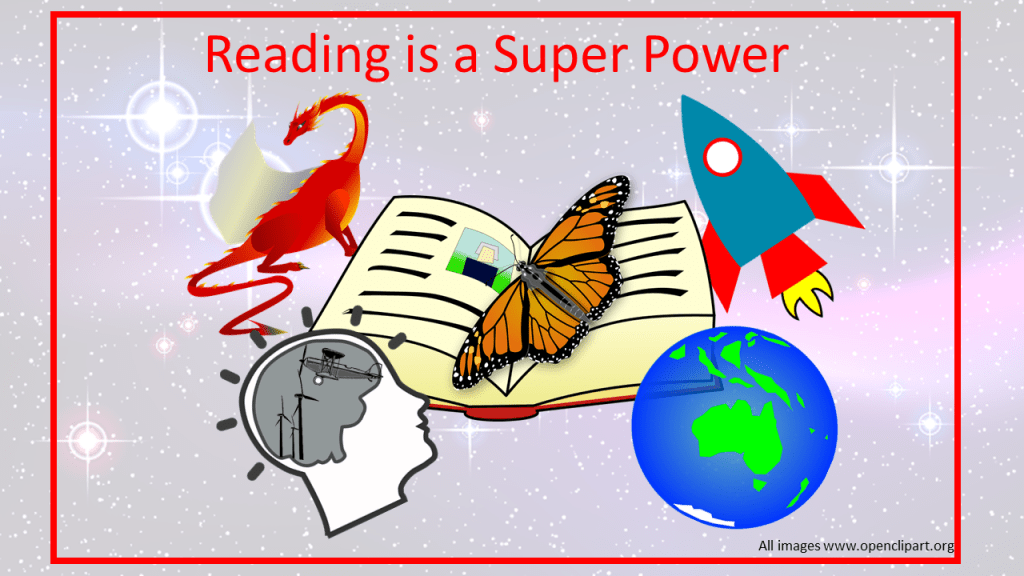
    reading is a super power

    Here are links to just five of the posts I’ve written about reading and writing:

    A sprinkle of this, a pinch of that, and Poof! It’s reading — magic!

    Wrapping up a year of books — the gift of reading

    I love poems

    Reading is all it’s cracked up to be: 10 tips for an early childhood classroom!

    Writing poetry with children

    And two more about libraries:

    Libraries: A wondrous universe to explore — a guest post by Dimity Powell

    Libraries, books and reading = infinite worlds to explore

    Thank you blog post

    Thank you for reading. I appreciate your feedback. Please share your thoughts.
  • Bonus Rodeo: Old Time Radio Winners

    Bonus Rodeo: Old Time Radio Winners

    The winners of the Bonus Old Time Radio Contest at the Carrot Ranch are announced! Read the winning entries here, and link through to all entries. What a feat!
    Thanks to the Continental Fire Company for their generous sponsorship and support.

  • Meaning in each word

    Meaning in each word

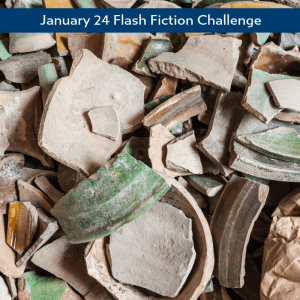
    This week at the Carrot Ranch, Charli Mills challenged writers to In 99 words (no more, no less) write a story about shards. You can write about the pieces, the item they once were, or who picks them up and why. Go where the prompt leads.

    I had an idea I wanted to craft into a story. I’ve had a go. I’m not certain that it expresses quite what I was hoping, and certainly not as explicitly as I hoped. I had wanted it to stand alone, requiring no other explanation or padding and, while it fails, I’ve let it do just that.

    Analyse the Detail

    The artisan turned each piece to the light, this way and that, fitting and refitting, arranging and rearranging. Finally, it was done. Each piece necessary and perfectly positioned creating the whole— exquisite, harmonious, illuminating—not one greater nor outshining any other. It filled each open heart with hopes of dreams fulfilled.

    Another sought to analyse its beauty, the power of its message to explore. He picked out all the pieces one by one and examined each in every detail. Too late he saw that, shattered and alone, not one shard revealed a secret. Only united did their meaning shine.

    Thank you blog post

    Thank you for reading. I appreciate your feedback. Please share your thoughts.
     

  • Don’t give up – Yet!

    Don’t give up – Yet!

    Discussions of the importance of having a ‘yet’ attitude or a growth mindset abound, including on this blog. I am very much in favour of the ‘yet’ thinking, as proposed by Carol Dweck.

    Basically, it means that we don’t consider our ability to learn as finite. We believe our potential to be constantly expanding. We may not know or be able to do something ‘yet’, but we can work at it and with each attempt come closer to achieving it.

    The resolve to maintain a growth mindset can be challenged at times when the going gets tough and there is no obvious solution. It can be difficult knowing when enough is enough and it’s time to move on; or if success is hiding just around the corner or on a slight detour.

    I often debate with myself about how to interpret the truth in the messages the universe seems to be sending, weighing up giving up against exerting just a little more persistence and patience. Consequently, I shouldn’t have been surprised by the unplanned theme in my response to the flash fiction prompt at the Carrot Ranch this week.

    charli mill's flash fiction challenge - colonnades

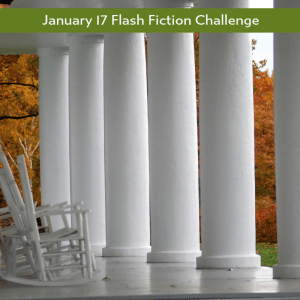
    Charli Mills challenged writers to In 99 words (no more, no less) write a story that includes colonnades. It can be natural, architectural, or a metaphor. Take a stroll and go where the prompt leads.

    What could colonnades possibly have to do with a growth mindset you might think, as would I. But when I sat at the keyboard, without a clue of what to write, this is what developed. I hope you like it.

    Never Give Up

    The solid grey wall stretched without end, both left and right —impenetrable, no way around, no way through. Perhaps a way over? Even from that distance, it appeared unscaleable.

    He removed his backpack and rested his head upon it as he lay, gazing upward. He sighed heavily. He’d trekked so far believing this was the way. How could he have been so wrong?

    He closed his eyes and drifted into a deep sleep. Refreshed, upon awakening, he decided to continue rather than retreat.

    As he drew closer, the wall separated into columns spaced perfectly to allow an easy passage.

    Do you see what I saw emerge? A story about not giving up? Of the importance of adjusting focus when it seems a dead end is reached, when there’s nowhere else to go and nothing else to try? Or is the theme significant to only me as I try to find a way through the colonnades in my path?

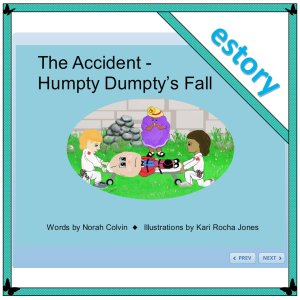
    As I was writing this story, I was reminded of one I wrote for children using the nursery rhyme Humpty Dumpty as a stimulus. In a similar way to Charli’s prompts, I was prompting children to think about possible reasons for Humpty Dumpty to be sitting on a wall and causes for him to fall.

    The accident - an innovation on the nursery rhyme Humpty Dumpty

    Of course, I couldn’t do the prompting without writing a story of my own: The Accident – Humpty Dumpty’s Fall.

    In the story, ‘Humpty looked at the wall. He couldn’t see through it. He couldn’t see over it. And there was no way around it.’ He thought it was ‘no use’. Fortunately, his friend Pomble wasn’t one to give up quite so easily and found a way for them to see over the wall. It was what occurred when Humpty was looking over the wall that caused him to fall. I won’t tell you what happened but, unlike the nursery rhyme, my story has a happy ending.

    Thank you blog post

    Thank you for reading. I appreciate your feedback. Please share your thoughts.

  • Don’t Look Back

    Don’t Look Back

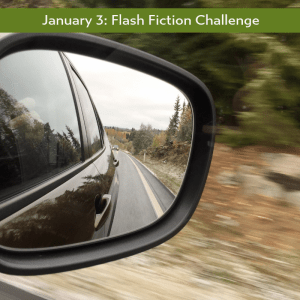
    Looking Back Carrot Ranch flash fiction prompt

    The beginning of a new year is often a time of reflection, of looking back on the previous year and of realigning goals for the year ahead. It is fitting then that, for the first prompt of the year, Charli Mills at the Carrot Ranch challenged writers to In 99 words (no more, no less) write a story about a character who looks back. It can be a metaphorical reflection or a glance in the rear-view mirror. Who is looking back, and why? Go where the prompt leads.

    Of course, there are many reasons for looking back but, perverse as I am, I’ve chosen to write about someone who wouldn’t look back.

    Don’t Look Back

    Don’t look back. Don’t look back.

    She pulled her coat tight, pressed her bag into her side and leaned into the wind, quickening her pace.

    The footsteps pounded behind her, closing in. She knew, even over the wind’s roar, they were coming for her. She breathed in shallow quick gasps.

    Don’t look back. Don’t look back. If she couldn’t see them, perhaps they didn’t exist?

    Her eyes stung. The wind stole her breath. Her side split.

    Lights ahead. Please. Please … almost.

    A hand on her shoulder. A deep gravelly unintelligible voice.  She twisted. “Noooo!”

    “Miss, you forgot your umbrella.”

    Thank you blog post

    Thank you for reading. I appreciate your feedback. Please share your thoughts.
  • Kept in the dark

    Kept in the dark

    Have you ever engaged in an experiment to see how bean seeds grow when kept in the dark compared to how they grow when provided with sunlight? It’s an experiment familiar to many school children. The purpose of the experiment is to show that light is needed for the seeds to grow and children soon find that those kept in the dark do not thrive.

    My father used to say that what you don’t know doesn’t hurt you. He wasn’t happy when my brother wrote in my autograph book that what you don’t know doesn’t do you much good either.

    what you don't know won't do you much good either
    © Norah Colvin

    Although my parents were keen for my siblings and me to get a good education, there were some things about which they preferred to keep us in the dark — secret adult things. It seems they thought some knowledge might be dangerous, so they were selective in what we were told.

    I am of the opposite view, thinking that a lack of knowledge may be even more dangerous. Just as bean seeds don’t thrive in the dark, minds can’t thrive if kept in the dark either.

    Nowadays, in schools, there is an emphasis on the need for being explicit in our teaching, of making sure that children know what they will be learning, what is expected of them and why.

    In my childhood days, if a reason was given, it was often ‘Because I said so’ or ‘Because it is’. I much prefer the modern way and, as with many things, believe that knowledge begets knowledge. It is difficult to be interested in something about which you know nothing. But knowing, even just a little, can stimulate curiosity to know more.

    I have written about this belief before in posts such as Child’s play —the science of asking questions, Visioning a better school, a better way of educating, and Reflect and refine, to name but a few.

    Into the dark flash fiction prompt at the Carrot Ranch

    This week at the Carrot Ranch, Charli Mills wrote about the darkness we feel when we’ve lost our guiding star, or when the spark of creativity has dimmed. She challenged writers to In 99 words (no more, no less) write a story using the phrase “into the dark.” What must a character face? Write about an encounter, journey, relationship, or quest. Follow the ship’s lights on gloomy seas. Go where the prompt leads you.

    Funnily enough, the prompt took me to neither darkness of the mind nor heart, but to the literal darkness of a stormy night. I hope you enjoy it.

    Stepping into the unfamiliar

    The car lights dimmed as she reached the door – timed perfectly. But, when the porch light didn’t activate, immersing her in total darkness, she cursed the storm. As she pushed the door of the still unfamiliar house, she rummaged for her phone. Dang! No charge. She inched along the wall, fingers seeking the corner and toes the step she knew was close. Stepping down, she dumped her bag and tossed her saturated scarf. She edged towards the sideboard and a battery-powered candelabra. As she fumbled for the switch, the room was flooded with light and cheers of ‘Happy housewarming!’

    Thank you blog post

    Thank you for reading. I appreciate your feedback. Please share your thoughts.