Live Love Laugh Learn … Create the possibilities

Tag: Flash fiction

  • Reflect and refine

    The end of a year is often used as a time for reflection, reassessment, and redefining goals. This week at the Carrot Ranch Charli Mills is talking just that: reflecting on the year that was, assessing her achievements and failures and redefining her goals for the next part of her journey. Charli admits that she didn’t achieve all she had hoped but acknowledges that those shortcomings were more opportunities for learning than failure as such. While she learned more about herself and her abilities she was able to recalculate her goals and redefine her vision.

    In education, failure is recognised as integral to learning.

    Willingness to

    • have a go
    • try something new
    • seek alternate solutions and ways of finding solutions
    • persist and not give up
    • recognise that success does not always come with a first attempt;

    these are effective characteristics of learners, innovators and creative people.

    Thomas Edison, after many unsuccessful attempts said,

    “I have not failed. I’ve just found 10,000 ways that won’t work.”

    There is no failure in a failed attempt; there is only failure in giving up.

    Again, to quote from Edison,

    “Many of life’s failures are people who did not realize how close they were to success when they gave up.”

    C.S. Lewis is also quoted as saying,

    “Failures, repeated failures, are finger posts on the road to achievement.”

    He says,

    “One fails forward toward success.”

    The-greatest-glory-in Ralph Waldo Emerson

    What helps that ability to rise again is a sense of where we are going, of what we are aiming for and what we want to achieve. This is often referred to as a vision, and it is a vision that Charli Mills has challenged writers to include in a flash fiction piece this week: In 99 words (no more, no less) write a story that includes a vision.

    Having a vision of the future and working towards that future is essential to effective teaching.

    As explained by Vicki Davis in her post Thank You Teacher for Your Presence on the Cool Cat Teacher blog, teachers are constantly preparing students for more independent and resourceful futures.

    Through learning from a mentor teacher Jackie Catcher was able to refine her vision for effective teaching, which she shared on Three Teachers Talk :

    “I learned that to lead students into our subject, we must make them feel valued within our community. We must work to acknowledge their strengths and show them that we are all equals when it comes to developing as readers and writers. We must praise their hard work and determination far more than their failures, and we must make ourselves available both in and outside of class to have meaningful conversations and connections. In the end, we are never too old to change our outlook and education. After all, one teacher can make the difference.”

    I constantly share my own, and others’, views about and vision for education on this blog.

    I-had-this-dream-Chris Lehmann

    Some of those posts are:

    Visioning a better school, a better way of educating

    Talking interviews

    Whose failure?

    Imagine that!

    Child’s play – the science of asking questions


    I have also referred to an alternative to traditional schooling that I “failed” to establish in the 1990s. The vision for that alternative was:

    “A dynamic centre of learning opportunities

    for children, families and communities

    which focuses upon the development

    of self-esteem and positive attitudes

    in a nurturing environment

    in which individuals are appreciated

    for their uniqueness and diversity

    while fostering the commonality of their human essence.”

    The-best-questions-are

    Which brings me to my flash fiction piece for this week. In it I attempt to draw together many threads from views expressed over the year and finish with an optimism for the future.


    The power of “No”

    It was grey.

    For as long as anyone could remember.

    They moved about, comfortable in the familiar, avoiding the unknown.

    Shadowy shapes beyond incited fear: a threat to all they knew?

    Lives lacked definition, blending to sameness, conforming to rules.

    “But why?” The tiny voice shattered the stillness.

    All eyes turned. Bodies stiffened.

    Whose was this unruly child?

    “Shhh!” the hapless parents failed to hide their offensive produce.

    “Why?”

    Again! No one moved.

    “Because!” was the parents’ definitive reply.

    They breathed. “Because!” they confirmed in unison.

    Defiantly the child pressed the dust-covered switch and flooded the world with light.
     

    The-principal-goal-of education - Piaget

    Thank you

    Thank you for reading. I appreciate your feedback. Please share your thoughts about any aspect of this post or flash fiction.

    I wish you success as your vision takes shape in 2015.

    HappyNewYear_by_Rones

  • It’s not fiction

    Most of my current writing is non-fiction with a strong focus on education. The two blog posts I publish each week generally address educational issues or share my thoughts about learning.

    In my ongoing work-for-self I develop educational materials and resources for parents, teachers and children. Some of these are available in my Teachers Pay Teachers store, and are listed on the Teaching and learning resources page of this blog.  My goal is to set up my own website on which all the resources I produce will be available.

    During my work-for-pay hours I am also involved in writing resources for teachers. Most of my published material, listed on the Writing – interest and publications page, is also educational.

    That is not to say that I am not interested in writing fiction. Over the years I have enjoyed writing in a variety of other genres including stories for children, short stories and poetry; and still do. They are just not my main focus at the moment. That may change in the future. Or it may not.

    One opportunity for writing fiction that I am very much enjoying at the moment is the weekly 99 word flash fiction challenge  set by Charli Mills at the Carrot Ranch.

    Initially my responses to Charli’s prompts were unsystematic. However it was not long before I was incorporating them into longer posts which maintained the educational focus of my blog. A recurrent theme is the importance for schooling to target the particular needs of individual children.

    Soon a character emerged: Marnie — a young girl, from a dysfunctional family, for whom school would be a threatening and meaningless experience without the support of a passionate and caring teacher. Sometimes, as with this week’s, the prompt inspires immediately and I write a story in which I hope that the message is strong enough for it to stand alone, without the support of a lengthier post explaining my thinking background.

    Here is this week’s response to Charlie’s prompt: In 99 words (no more, no less) write a story about rare gems. I’d love to know how successful you think I have been.


    glitch, trophy gem http://goo.gl/VEQVxM
    glitch, trophy gem http://goo.gl/VEQVxM

    Uncut gem

    She examined the new arrival, assessing the possible effects of integration into the existing collective. Would the group be enhanced or would this newcomer disrupt the established harmony?

    From every angle the edges were rough and uneven. The years of obvious neglect obscured the potential from any but a trained eye.

    Fortunately her eyes were keen. A bit of encouragement here, a little adjustment there, an opportunity to sparkle and display unique and positive attributes.

    She smiled. Experience had shown what could be achieved with a little polish and care.

    “Welcome to our class, Marnie,” she said.


    Thank you

    Thank you for reading. I value your feedback. Please share your thoughts about this post and flash fiction story.

  • A cute angel

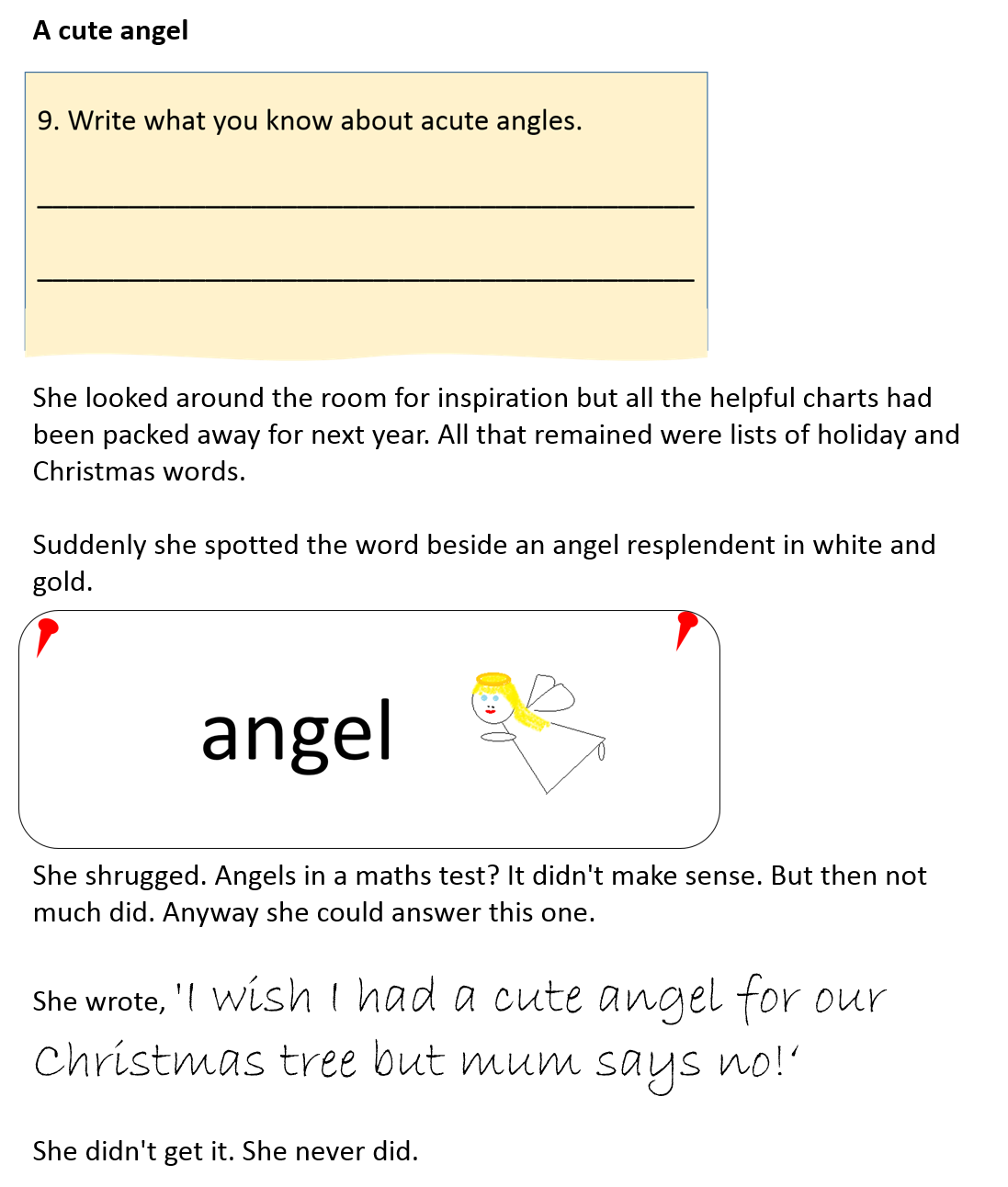
    This week at the Carrot Ranch Charli Mills has set an angel prompt: In 99 words (no more, no less) write a story that features an angel.

    Usually I include my responses to Charli’s prompts in longer posts sharing some thoughts about education.

    This week I’m going to leave it as a stand-alone, without the padding I usually provide. I am hopeful that the educational issues I have alluded to will be as obvious to you as they are to me. I’d love to know what you think.

    A cute angel

    Thank you

    Thanks for reading. I appreciate your feedback. Please share your thoughts about this flash and what you consider its message to be.


  • I’m (not) dreaming of a white Christmas

    https://openclipart.org/image/800px/svg_to_png/59389/happy_sun_gm.png
    https://openclipart.org/image/800px/svg_to_png/59389/happy_sun_gm.png

    Last week the flash fiction prompt set by Charli Mills of the Carrot Ranch was to write a story using two objects, people or ideas that don’t go together. There was quite an assortment of responses, including mine. You can read them all here.

    This week Charli has continued in the same vein, challenging us to In 99 words (no more, no less) write a story that pairs something seasonal with something odd. 

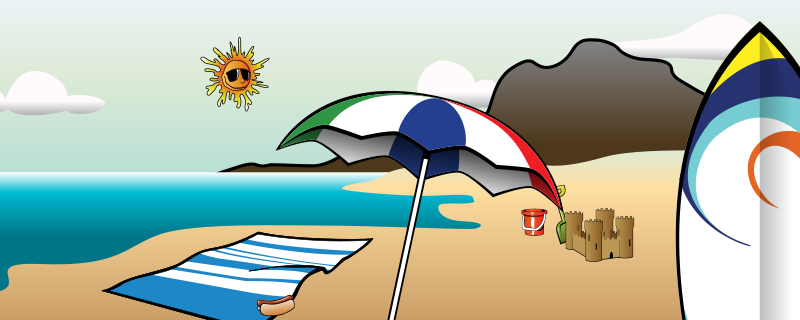
    In Australia that’s easy. We’ve already got Christmas in summer. Most people around the world would say you can’t get much odder than that!

    www.openclipart.org
    http://www.openclipart.org

    But it is summertime in Australia and Christmas is just around the corner.

    While we enjoy warm days at the beach and in the pool, picnics in the park and barbecues in the back yard, hoping the big storm doesn’t get us this time (like the one that hit Brisbane on 27 November); those from whom we have inherited our Christmas traditions are cooling down in the Northern Hemisphere, many looking forward to a (not too) white Christmas.


    Shops here are playing traditional (northern) carols with snow, sleighbells and mistletoe; decorations are tinged with fake snow and cards show snowy scenes with families huddled around the fireplace.

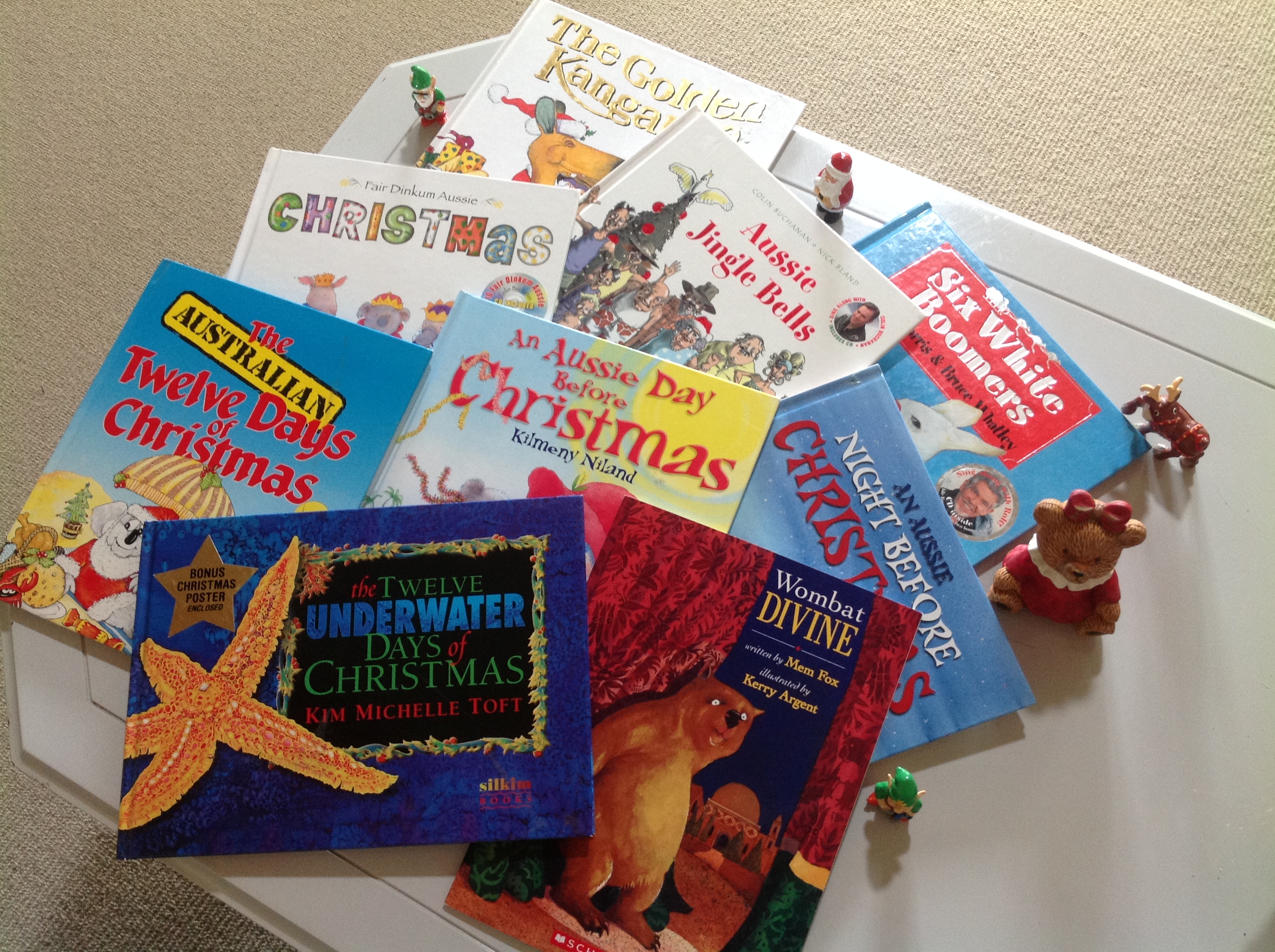
    While there is an increasing number of songs and books with an Australian flavour many are merely innovations on the traditional such, as “The Australian Twelve Days of Christmas”, “Aussie Jingle Bells” or “An Aussie Night before Christmas”.

    Some Australian Christmas picture books
    Some Australian Christmas picture books

    One innovation that I particularly like is The Twelve Underwater Days of Christmas by Kim Michelle Toft. Kim is an Australian who uses her talents as author and illustrator to educate children about the things she feels passionate about: ocean life and coastal habitats. Her illustrations, hand-painted on silk, are absolutely stunning.

    12 Underwater days

    In addition to the visual beauty of the book there is great value in the supporting information through which Kim explains the importance of conserving each of the creatures included in the book. While written by an Australian, the application of the book is not limited to our shores. Creatures from all over the world adorn the pages.  If you ever wished to own a book simply for the beauty of its illustrations, this is a great choice.

    One original song I enjoyed listening to on the radio as a child is “Six White Boomers”. Despite the reasons that make me reluctant to mention it this year, it is a delightful tale of a joey who rides on Santa’s sleigh, pulled by six huge white kangaroos, to be reunited with his mother on Christmas Day.

    Peter CombePeter Combe has written two albums of original, but with a traditional rather than specifically Australian flavour, Christmas songs for children, including this one:

    Some Christmas traditions popular with Australian communities are Nativity plays, carols by candlelight and Christmas parades. Many classes and schools perform their own end-of-year “break-up” concerts to which parents and the wider community are invited.

    Using the traditional Nativity play as the setting, Mem Fox created an original and fresh story in Wombat Divine. It is a delightful tale of Wombat who loved everything Christmas. When finally he was old enough to be in the Nativity Play he rushed along to the auditions. Unfortunately it was difficult to find a part that was just right for Wombat. Can you guess which part he got? You’ll have to read the book to find out! Children all over the world will identify with Wombat and his predicament and enjoy the heart-warming tale.

    Books are wonderful gifts to give or receive at any time. The titles I have mentioned here are perfect for giving, reading and sharing at this time of year. When I was growing up there was always a book for Christmas and birthdays, a tradition that I have continued with my extended family and friends. You can almost, but not always, guarantee that if it is a gift from Norah, it is a book.

    After my siblings and I had grown up and swelled the family numbers with partners and children of our own, my Mum used to say, “There’ll be no presents this year.” It wasn’t that she wasn’t a giving person, for she was. It was just that there were so many of us! When she passed away this year she had about fifteen grandchildren and eight grandchildren, in addition to her remaining nine children and their partners. (I’m saying ‘about’ for grandchildren and great-grandchildren in case I’ve missed some in the count!) You can imagine how daunting a task it would be to go shopping for all these people ranging in age from six months to sixty! However it was always surprising how frequently she did not follow her own rules and had a small something wrapped up to present to many of us.

    This year there will be no presents from Mum, and more sadly, we will be without her presence.

    Although I have borrowed my Mum’s words, “No presents” for both flash fiction pieces included in this post, the stories do not cast aspersions on her generosity. I have simply explored how the oddness of no presents or presence at Christmas time may have impacted Marnie, a character I have been developing in my flash fiction pieces, at different times in her life. At this stage of my writing I am still investigating her character, discovering a little more with each flash piece as her once indistinct figure begins to step out of the shadows and take shape.

    This first piece is written about a difficult time for teenager Marnie and a situation that may be the catalyst for her leaving home.


    No presents

    Marnie jerked backwards avoiding the predictable grope. In so doing she collided with her mother, sending her sprawling onto the tattered sofa.

    “Aargh!” her mother screamed. “Look what you’ve done!”

    Marnie watched the liquid from the upturned glass merge with the patchwork of stains collected in the carpet. If it was her blood it would not have mattered more.

    “I … I’m sorry,” she stammered. But her sorry was for all the years it had been like this.

    He smirked, raising his hand to strike, “No presents for you this year!”

    “That’s right!” She ducked. “No presence!”


    So as to not be too dismal at this time of year, I have written a second piece about a younger Marnie for whom there still seems a glimmer of hope.


    No presence

    With faces as bright as their Christmas wear, the children bubbled into the room, each carrying gifts for the Kindness tree, “for those less fortunate”.

    Parents fussed, removing smudges and replacing wayward hair before blowing kisses and hurrying off for the parade.

    And there was Marnie: no parent, no Christmas dress, no gift, no smoothed-down hair; no smile.

    One last chance.

    “Marnie!” I beckoned, and held out my Christmas cape and crown. “Will you be my special helper?”

    Our eyes locked communicating more than any words. Her smile was my reward.

    “I’m proud of you,” I whispered.

    Thank you

    Thank you for reading. I appreciate your feedback. Please share your thoughts about any aspect of this post or flash fiction pieces.

  • Which is your favourite thinking room?


    Do you have a quiet place at home where you like to think?

    do not disturb door

    Some people I know like to think in the toilet. (I’m not one of them. I prefer to not be in there long enough for that!) They see it as a quiet place where they can sit and think, undisturbed, for as long as they like. If they are “in the can”, “in the dunny”, “at the loo” or “out the back”, or whatever other euphemism you can come up with, their position is unassailable and their sanctuary respected. Mostly, anyway. Parents of young children may vehemently disagree with that!

    A couple of weeks* ago Anne Goodwin reminded us of World Toilet Day and how lucky we are to have access to toilets and sanitation. Most of us take what used to be the smallest room in (or out) of the house for granted, not giving its use a second thought as we flush away our waste.

    But not everyone is so lucky. It seems that more of the world’s population have access to a mobile phone, and or to the internet, than to a toilet. Visit Anne’s blog for many links that explain why a day for toilets is important.

    WaterAidAustralia explains that

    “The day was created to raise global awareness of the struggle faced by the 2.5 billion people living without access to sanitation. It is also used to explore some of the healthy, emotional and psychological consequences people endure as a result of not having a proper, clean toilet.”

    An article written by Nicole Arce and published in the Tech Times cites the U.S. Centers for Disease Control and Prevention for the information that 2,200 children around the world die every day due to diarrhoea. Proper sanitation would prevent most of those deaths.

    Arce writes that the Indian Prime Minister Narendra Modi has set 2019 as its target for “total sanitation”. However, as also suggested in Anne Goodwin’s flash fiction piece “Culture Shock”, the problem can be attributed to cultural as well as monetary issues.

    Charli Mills at the Carrot Ranch followed Anne Goodwin down the toilet path and extended the discussion to include the effect that poor sanitation has on education, particularly of young girls. The link is not as tenuous as it may first appear as explained here and here.

    Charli decided to use her flash fiction challenge to “spread awareness that toilets matter.” She invited readers to “Help spread the call for human dignity and basic sanitary health” by linking to UNICEF when responding to her prompt: In 99 words write a story that includes the toilet.

    I have decided to do just that, as have many others. Check out Charli’s post at the Carrot Ranch to read all responses.

    Toilet sanctuary

    “Miss. Marnie’s locked herself in the toilet and won’t come out.”

    “What now?” I thought, scanning the troubled face pleading for assistance as much as to be absolved of blame.

    “Okay,” I reassured Jasmine. “Let’s go see what’s up.”

    As we hurried to the toilet block Jasmine reiterated her innocence, she hadn’t done anything, she didn’t know what was wrong (it wasn’t her fault).

    “I know,” I smiled. The toilet cubicles had frequently been Marnie’s sanctuary. But not for weeks.  Jasmine’s kind-hearted friendship had seen to that.

    “She’s got her unicorn again,” Jasmine whispered.

    “Oh,” I said.


    *I apologise that this post may appear out of sync with World Toilet Day which was now ten days ago. Unfortunately I have been without internet access for 12 days and unable to publish although I had the post written. Fortunately I still had access to a flushing toilet, and if I had to choose between that and the internet, I’d go for the toilet every time! Though World Toilet Day has passed for this year, the message remains important every day!

    Thank you

    I appreciate your feedback. Please share your thoughts about any aspect of this post or flash fiction.


  • Whose failure?

    I think about education. A lot. You could say it consumes me. It has been my lifelong passion, and although I am not currently in the classroom I don’t stop thinking and reading about how we learn and how learning can best be encouraged. My discontent with how schooling often is and my optimism for what it could be has been a recurring theme on my blog and a driving force in my life. You would not have to open too many posts to find at least one expressing that view.

    education-is-2

    My poem “Education Is” sums up the differences I see between education and schooling. Some schools do education really well. Some professing to be educational institutions school, very badly. What I consider to be one of the major differences is that education encourages a love of learning that lasts a lifetime; while schooling attempts to force-feed content in such a way that learning is neither enjoyed nor viewed as anything other than what one is forced to do in school.

    In traditional schools assessment often takes the form a test which requires students to regurgitate information that has been thrust upon them, whether they like it, or are interested in it, or not. This occurs across all subject areas. I have written about it before in relation to writing tasks in these three posts: Writing to order – done in a flash!  Writing woes – flash fiction  and Who tests the testers?

    I contrasted my choice of responding to Charli Mills’ flash fiction prompts to the lack of choice students have in state- or nation-wide writing tasks. In Writing woes – flash fiction  I suggested that it would be difficult for me, on a given day, with a restricted amount of time, under the watchful eyes of supervisors, to produce my best work in response to a prompt about which I may have little experience, knowledge or interest.

    www.openclipart.org http://goo.gl/Ep1vK6
    http://www.openclipart.org http://goo.gl/Ep1vK6

    In my flash fiction responses I introduced a unicorn as a symbol of escape from the confines of the classroom or other oppressive situation, into the space where one is free to truly be oneself. It wasn’t a deliberate or premeditated choice, simply a response to Charli’s prompt. However I am happy to adopt it in my flash fiction as a symbol of playfulness and imagination unleashed; the basis for all great inquiry and innovation. Thank you, Charli, for the prompt!

    I introduced the unicorn in the post Of rainbows and unicorns – Part 1 – Fantastic creatures and magical realms and used it again in What do you have in mind? , I’m too busy to be tired! And Reading is all it’s cracked up to be: 10 tips for an early childhood classroom

    I have returned to both these themes again in response to Charli’s most recent prompt to In 99 words (no more, no less) write a story inspired by your muse. I’m not certain who my muse is, but I am certain that it would be very difficult to call upon a muse to assist when writing in a test situation such as that expected of students in school.

    My piece is titled ‘Failure’, but this is the question I have for you: Who really deserves the “F”? Whose failure is it really?

    Failure

    She spluttered out the splinters of pencil: no longer tasty, never helpful. The assessor’s steely eyes pounced. She wiped the last vestiges from her mouth; staring blankly, as blank as the paper in front of her.

    Outside the sunlight danced like fairies on the leaves, beckoning. Below, in the shade, the unicorn pranced and called her name.

    “Why do I have to do this stuff? Who cares anyway!”

    She grasped the broken pencil and scored a large “F” on the page.

    Then she closed her eyes and was away, riding to freedom and joy on the unicorn’s back.

    What do you think?

    Thank you

    I appreciate your feedback. Please share your thoughts about any aspect of this post or my flash fiction writing.

    If you are interested in reading other of my flash fictions pieces, I have collected them all together on one page which you can access here or click on the Flash Fiction tab above.

  • It’s written in the stars

    https://openclipart.org/image/800px/svg_to_png/129913/lkjhgfds.png
    https://openclipart.org/image/800px/svg_to_png/129913/lkjhgfds.png

    An interest in star signs is worldwide. A google search of ‘star signs’ brought up 126 000 000 results in 0.15 seconds. You can find out what your star sign is, famous people who share your sign, get a description of your personality, find out who you are or are not compatible with, and what the future holds for you.

    But how accurate do you think your star sign is, and how accurate are the predictions?

    Are they any more accurate than a teacher’s predictions of a child’s future?

    https://openclipart.org/image/800px/svg_to_png/191354/Good_Grade.png
    https://openclipart.org/image/800px/svg_to_png/191354/Good_Grade.png

    Think back to your school days and the comments written by your teachers on your report cards. Have you lived up, or down, to their expectations?

    Comments sometimes described me as conscientious and said that I worked hard. At other times I needed to work harder, and was told that I could do better, that I needed to concentrate more on … (insert subject name – any will do). Comments in opposition, like the two sides of a coin or the twins of my star sign Gemini.

    https://openclipart.org/image/800px/svg_to_png/178912/tweedles.png
    https://openclipart.org/image/800px/svg_to_png/178912/tweedles.png

    However teachers do not always know, and cannot always predict future life journeys of their students.  Consider how inaccurate were teachers’ predictions for people as diverse as Einstein, Edison, Churchill, Darwin and Pasteur who showed little promise while at school. Disney was accused of lacking imagination, and Salvador Dali of daydreaming. John Lennon’s teachers were not impressed when he answered “happy” in response to the question, “What do you want to be when you grow up?” The list of successful people with unforeseen potential is long. I’m sure you know stories of many others from all walks of life. Maybe yours is one!

    Over at the Carrot Ranch this week, the flash fiction prompt by Charli Mills is to: In 99 words (no more, no less) focus on the personality traits of a character informed by the zodiac.

    Mine is not exactly about the zodiac, but about another form of prediction equally as accurate.

    As expected

    A lawyer, a doctor and a journalist walked into a bar, ‘Class of ’99’ emblazoned on their backs.  

    Talk flowed freely.

    When someone mentioned old ‘four-eyes’ Proffet, laughter erupted.

    “Thought he was a prophet,” they chorused.

    “Mark my stars,” the lawyer mimicked, wagging his finger. “You need to learn to be less argumentative.”

    The doctor peered over her glasses and giggled, “And you miss, will never amount to anything!”

    “Remember Prophet’s favourite, ‘most likely to succeed’?” said the journalist. “Saw Daniel last week, handing out horrorscopes, on corner of Main and Black. Hardly recognised him. Poor sod.”

    Thank you

    Thank you for reading. I appreciate your feedback. Please share your thoughts about any aspect of this post, including my flash fiction

    I’ll leave you with a song about a star someone was born under. Not my star, and not the zodiac either, but a popular song when I was growing up.

    I was born under a wandering star  sung by Lee Marvin in Paint Your Wagon

  • Food for thought

    Food for thought

    Thinking is as much a part of life as is eating. Something to think about is often referred to as ‘food for thought’; and food for thought is just as important to wellbeing as is food for the body. When I’m not thinking about where I’ll partake of my next meal, or what I might eat, I’m often thinking about education.

    www.openclipart.com
    http://www.openclipart.com

    I recently read an article on Selected Reads called Teacher’s Guide to Teaching Students to Ask Their Own Questions which included a review of a book by Rothstein and Santana entitled “Make Just One Change: Teach Students to Ask Their Own Questions“.

    I will be upfront and admit that I have not read the book and am commenting on the review alone which states that the book brings together “several years of research and experience into a methodology for applying their groundbreaking thought and technique.” It goes on to say that “The basic argument … is pretty basic: for our students to achieve excellence and equity, we need to teach them the skill of question formulation.” (my emphasis)


    I really have no argument with the premise of the book. In fact, it sounds like a pretty good read to me. I have even previously blogged about the importance of asking questions in these posts: Child’s play – the science of asking questions  and What you don’t know …


    What I wonder about is: If it is so important for students to learn to ask questions, why do we spend so much time in school teaching them to stop asking questions and to learn just what is presented to them, whether they like it or not?


    Aren’t children born asking questions? Aren’t they pretty good at asking questions (verbal or otherwise) to figure out what they need to know about the world? Why then do we sit them in desks all day and force-feed them content for future on-demand regurgitation?


    I consider it to be a bit like inviting someone to a feast but feeding them pap, which is the essence of my flash fiction piece written in response to the prompt suggested by Charli Mills this week at the Carrot Ranch: In 99 words (no more, no less) include food in your story.


    Food?

    His eyes widened, flitting across the table, scanning the feast, a smorgasbord of sensory delights. His mouth moistened and tummy growled.

    Where to start? A bit of this. A little of that. A whole lot of that! Mmmm!

    He rubbed his belly and licked his lips.

    Suddenly he was marched away and slammed onto a hard wooden bench. A bowl of colourless pap was flung at him.  “Eat this!”

    He recoiled.

    “Eat it!”

    The overfilled spoon was shoved between tightened teeth.

    He gagged.

    “It’s good for you!”

    He spluttered.

    Over time he learned. “Not so bad,” he thought.


    Okay. Maybe I’m exaggerating. Maybe I’m painting the picture darker than reality. Maybe. But sometimes that is necessary for even partial recognition of the situation to occur. You know about the swinging pendulum.


    The picture painted by Scott McLeod of dangerously ! irrelevant is no brighter. In his post The declining economic value of routine cognitive work  he says that while most employees (in the U.S.) are engaged in non-routine cognitive and interpersonal work; routine cognitive work is what students are mostly engaged and assessed in, and what traditionalist parents and politicians advocate. So while work tasks may require “problem-solving, intuition, persuasion, and creativity”, school tasks involve things such as automation and repetition.


    My wish is that all parents, school administrators, education policy makers and teachers do as Rothstein and Santana suggest – let them ask questions!


    Of course I couldn’t write a post about food and questions and not mention the blog of one of my very favourite questioners, Bec, who writes about “wholefoods, vegetarianism, slow living and their existential friends” at There’s no food. There’s much food for thought there!

    And now for something a little bit different: The edible cookbook. It’s a cookbook you can read, cook and eat! I wonder what questions its designer was asking to come up with such an innovative and interesting design.

    Thank you

    Thank you for reading. I appreciate your feedback. Please join in the discussion or share your thoughts about any aspect of this post, including my flash fiction.


  • Sounds like . . .

    Kookaburra in my backyard
    Kookaburra in my backyard

    The flash fiction challenge set by Charli Mills at the Carrot Ranch this week is all about sounds, specifically a sound that heralds change.

    Of course I think immediately of the school sounds: the bells, buzzers or sirens that mark the beginning or end of a school session or day; children’s laughter in the playground interrupted by the cry over a scraped knee or elbow; the hush that overtakes the classroom when the teacher’s footsteps in the corridor announce her arrival; the monotonous chant of sounds parroted repeatedly as cards of letters are flashed in unrelenting sequence, marking the imposition of content-driven curricula where once were child-centred approaches and talk was king.

    I think, too, of the sounds of nature that tell me of the changes in the day: the birds that sing outside my window heralding each new day – the kookaburras, butcherbirds, magpies, little corellas and koels; the rainbow lorikeets that chatter noisily telling me that evening is on its way; the screeching and whooshing of fruit bats as they wing their way across the darkening sky; the thud of a possum landing on the fence and the scratching of its claws as its scrambles from tree to tree under cover of the night.

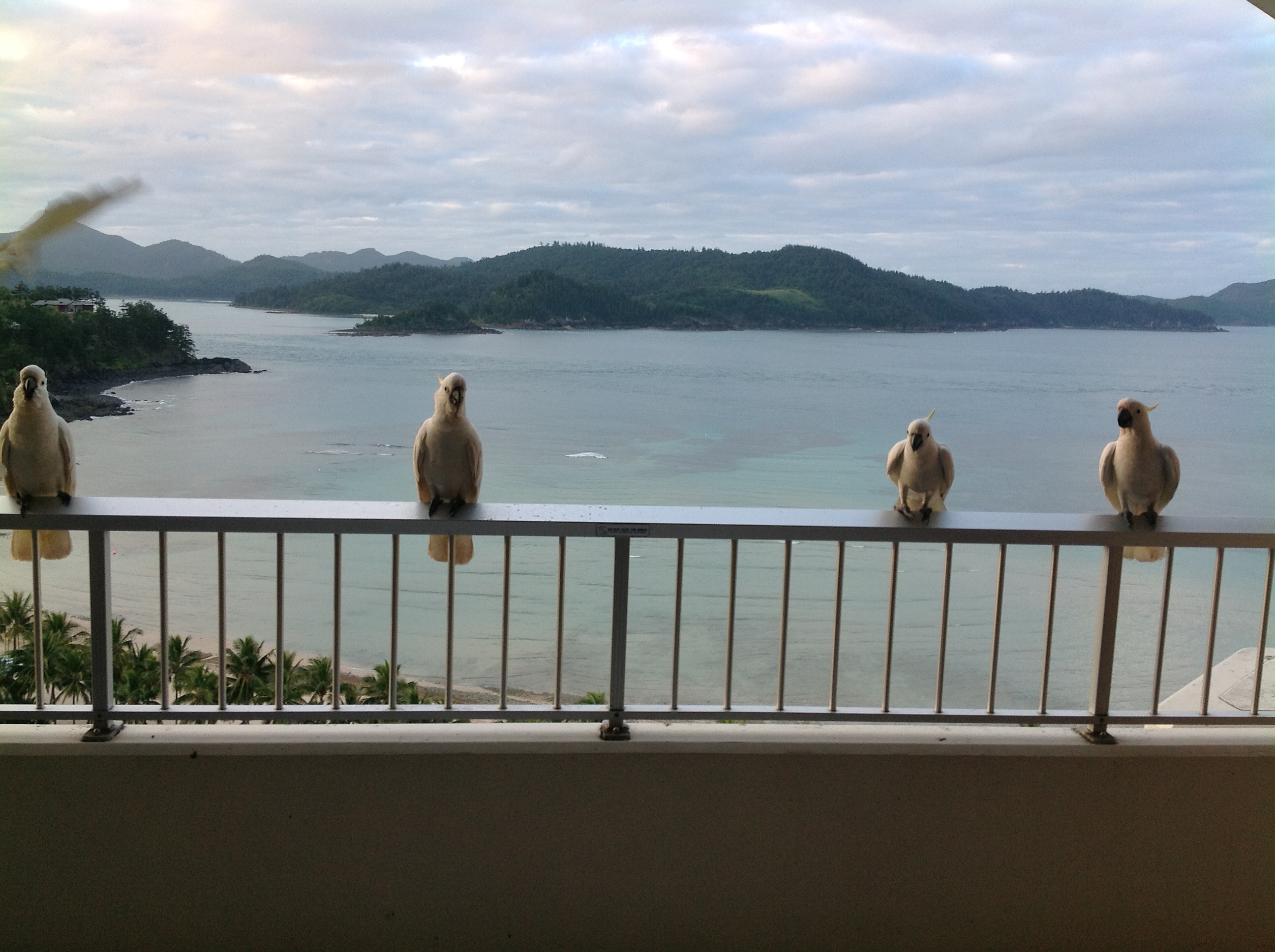
    Cockatoos looking for food, Hamilton Island
    Cockatoos looking for food, Hamilton Island

    We are fortunate in Australia that we don’t have a great number of large menacing animals terrorising our neighbourhoods. Sure dingoes, crocodiles and sharks may be scary but you don’t often come across them, and our most dangerous animals are more likely to be small and quiet and sneak up on you, like our spiders, snakes, jellyfish and ticks. There are no sounds associated with these to give you a warning.

    That’s not to say there are no scary sounding animals. Any sound, if you don’t know what is making it, has the potential to be scary; as in this 99-word flash (memoir):

    Awakened suddenly, I didn’t dare breathe. The sound was unrecognizable: guttural, movie theatre loud in surround sound. I sat up. The sound continued. I wasn’t dreaming.  I nudged Bob. No response. Gripped with fear but needing to know, I tiptoed to the window and peeked through the curtain slit. I expected to see The Creature from the Black Lagoon. There was nothing. Now it came from the front, inside the house? My son! I tore down the hall. He slept peacefully! Back to the bedroom. Bob awoke. “Did you hear that?” he asked, wide eyes staring . . .

    The following day I phoned the Queensland museum and attempted to explain what I heard. The fellow at the other end of the phone mimicked the sound exactly!! He identified it as a male brushtail possum warning others of its territory. These possums are very common in our area and I was amazed that I hadn’t heard this particular sound before. I hear it frequently now as every night they are moving about in the neighbourhood trees and running along our fences and roofs. I have never again heard it at the intensity of that first time, and now that I know what it is, it is no longer scary. In fact, possums are rather cute, as long as they are not living in your roof, eating the produce of your garden or stealing your Christmas puddings!

    This video gives a hint of the brush tail’s sound I heard:

    Another sound that I found quite unnerving at the time of first hearing was that of the mutton birds in the still of the night while we were holidaying on Heron Island, just off the Queensland coast at the southern end of the Great Barrier Reef. I had always thought the cry of the curlew to be quite eerie, but it didn’t match that of the mutton birds whose cry was more like that of the banshees.

    I have written about this frightening experience in the following 99-word flash (memoir):

    The boat tossed mercilessly. I battled to contain my insides while all around were losing theirs into little paper bags offered unceremoniously to obliging staff.

    Finally, just before landfall, I joined in. Then it was over – for me. Bob’s queasiness laid him up for the night; but I went to tea.

    The path back to the cabin was unlit but for a splash of moonlight. Suddenly horrific wailing assaulted my ears. Was Bob being murdered? I hurried back. He was fine, but the eerie sound unsettled us far into the night.

    In the morning we laughed: mutton birds nesting!

    I was fortunate to have not tripped and fallen as the mutton birds nest in burrows and these were dotted all over the island! Of course, once the source of the sound had been identified, we were no longer concerned.

    While my two snippets of memoir don’t fit Charli’s criterion of fiction, they are about sound and I have used them to point to the power of education to change one’s situation. When the source of the sound was unknown, it was frightening. Once we knew what it was, it was no longer scary.

    Knowledge is power. There is a saying, “What you don’t know won’t hurt you” but there is also another that says “What you don’t know won’t do you much good either”. I have written about this previously here.

    Conspiracy theorists believe that those with power withhold knowledge from the masses (e.g. aliens are among us); but I believe that schools that favour test marks over individual development; content over creativity and critical thinking; and conformity over diversity are conspiring to contain the masses. One of the easiest ways to suppress and maintain control over others is to keep them ignorant. I am not suggesting that schools keep students ignorant, but they could do a lot more to maintain children’s natural enthusiasm for learning. I look forward to sounds that will herald positive changes in education.


    I value your feedback. Please share your thoughts about any aspect of this post.


  • The best of days

    school cropped

    It is often said that school days are the best days of our lives.

    Considering that I have had far more days at school than not (as student and teacher) then I should probably agree, else I’d be saying that most of my days haven’t been the best.

    For many adults it is not the in-class time that is most memorable or of which they have the most pleasant memories, it is the playtimes and the before and after walking to and from school times.

    For some children, the in-class time drags while they daydream of long summer holidays and activities with family and friends. Other children thrive with the structured learning, soaking up everything offered to them.

    19178-School-Building-Graphic

    In her post, School: A Suitable Place for Fiction? Anne Goodwin wrote that she is ‘always pleasantly surprised when children these days claim to enjoy school’. On the other hand, in a comment left on previous post here, Lori Schafer said that all her life she had ‘failed to understand why most children don’t like school. Why don’t they enjoy learning, and why don’t they enjoying studying, and why don’t they enjoy writing papers? Because, of course, there are a small percentage of us who do genuinely appreciate the discipline of schooling.’ She was one of them.

    In his post, School’s Out – and Education’s In, Geoff Le Pard said that ‘People confuse school with education, as if they were synonymous’. (I have written a poem to express differences I see between education and schooling. You can read it here.) He goes on to say that ‘education is a constant, not a time limited schooling experience’ and disagrees with the cliché that school days are the best. He says that ‘all those days and bits of days when learning occurs make up the best days of your life’. I agree with Geoff that learning new things, particularly things one has an intrinsic motivation to learn, gives great joy.

    Irene Waters said in her post about school that she loved her primary school days. As the end of her high school years approached, unable to see the point in continuing, Irene wanted to leave and start her nursing career. Her parents convinced her to stay and finish year twelve. While she didn’t at the time, she now appreciates the value in having done so and is grateful that her ‘parents laid down the law’.

    Talking about education and schooling is nothing new for me, that’s what my blog is about after all. However for a lot of people, once finished, school is a thing of the past and not much thought is given to it later. The reason why so many others are talking about it this week is the flash fiction prompt set by Charli Mills at the Carrot Ranch. Each week Charli challenges writers to pen a 99 word story about a particular topic. This week her topic is school.

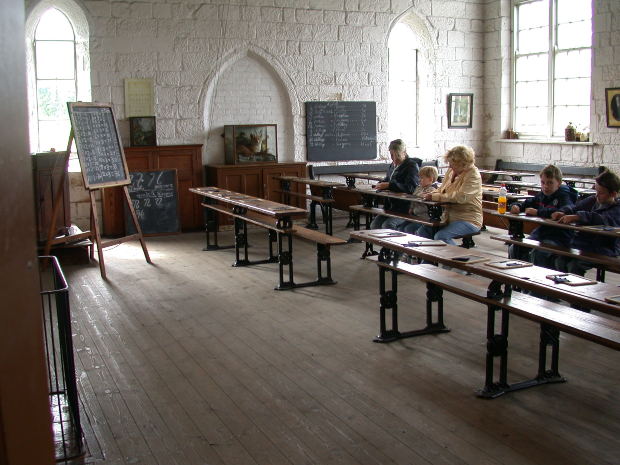
    old school room

    In her post, Charli describes an abandoned one-room schoolhouse that is close to her home. She explains that these schoolhouses ‘were often among the first structures built by pioneers’ and comments on the importance that was placed on education in those pioneering days. Indeed education has been important throughout the history of humankind. It is what sets us apart from other creatures.

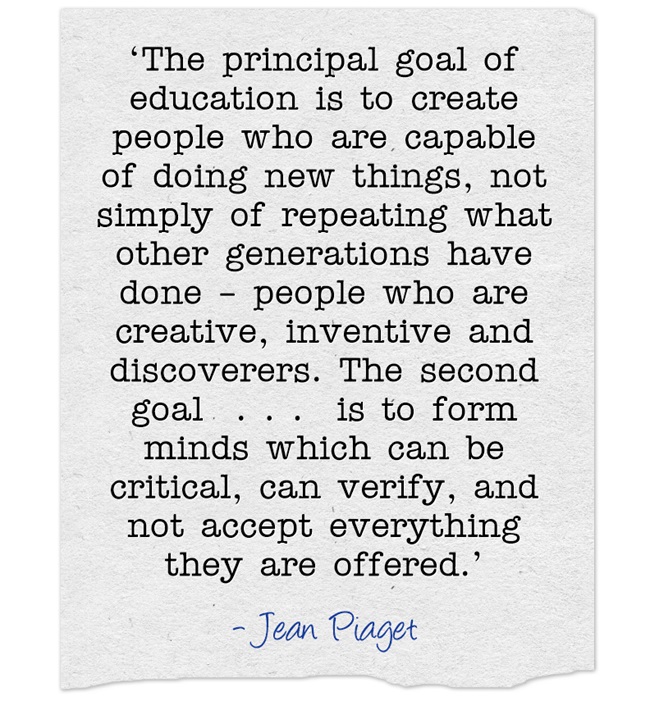
    In the words of Jean Piaget,

    The-principal-goal-of education - Piaget

    I have touched on these aspects of education in previous posts and will definitely do so again in future posts.

    In a tweet Anne Goodwin hinted that she thought I may find this post difficult to write as I have so many options to choose from. Charli Mills thought I might mention how we wrote on slates when I was at school (my children would probably have suggested I write about using dinosaur bones to scratch crude messages in the sand!)

    Instead, I thought about the strategies schools use to create uniformity, and of the many pathways that one may take through life after finishing school.  I hope the analogy makes sense to you.

     teacherbell

    Chocolate balls

    The final school bell tolled and the students erupted from the building like a burst box of chocolate balls, scattering in every direction and at varying speeds. Some stuck together along pathways safe and sure. Others crashed and bumped over roads less traveled seeking excitement, new discoveries and secrets to explore. Others stopped abruptly, their journeys foiled by stubborn obstacles. Still others, rolling upwards, failed to maintain the momentum to carry them over and beyond with those more adventurous others.  

    Who would know?

    Inside the box, they were identical, centers hidden. Outside, their uniqueness was on show.

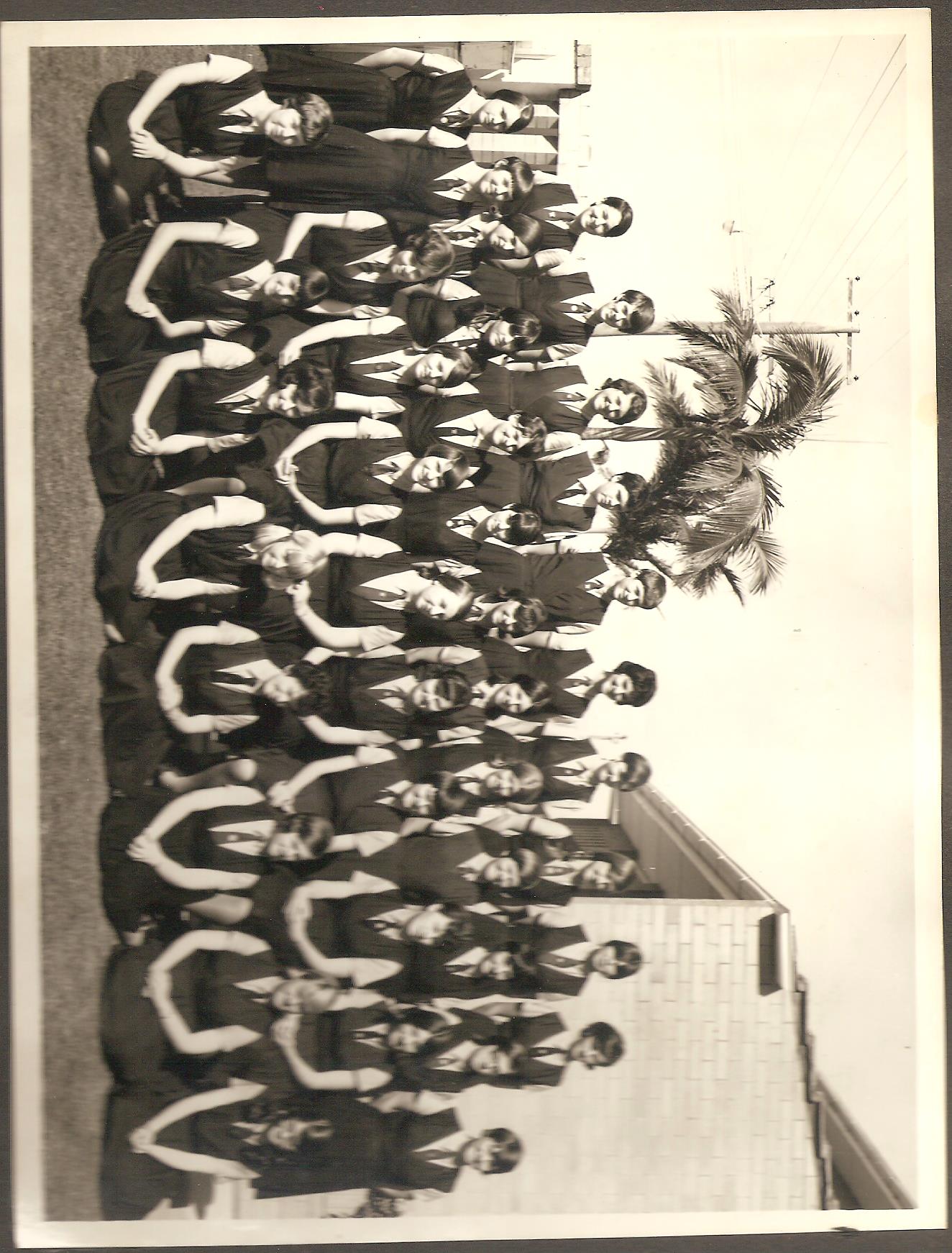
    My year 10 class - only 20 went on to year 12.
    My year 10 class – only 20 went on to year 12.

    I value your feedback. Please share your thoughts about any aspect of this post.