Live Love Laugh Learn … Create the possibilities

Tag: environment

  • The right place at the right time

    Charli Mills Serendipity

    This week at the Carrot Ranch Charli Mills is talking about serendipity and describes it this way:

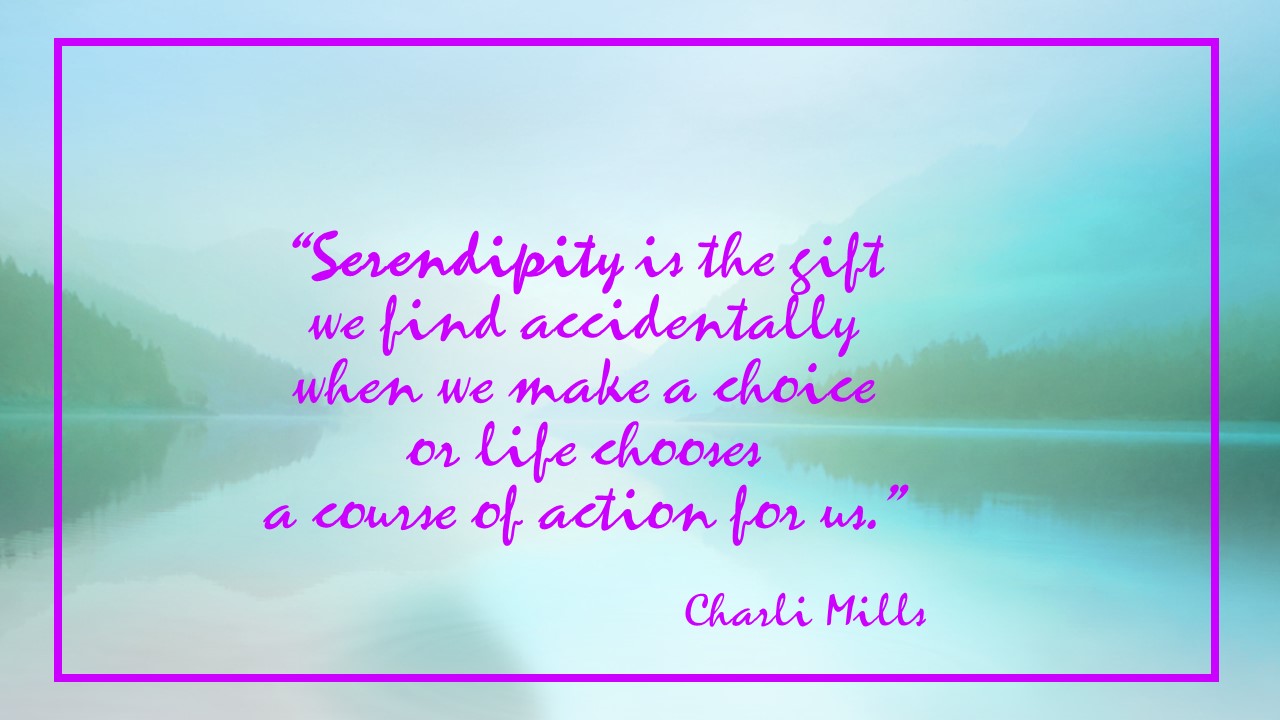
    “Serendipity is the gift we find accidentally when we make a choice or life chooses a course of action for us.”

    I often think of serendipity as being in the right place at the right time. There are many occasions in my life where that has occurred, and probably millions more when I’ve missed by a millisecond, but many of those I’ll never know.
    www.morguefile.com
    http://www.morguefile.com

    Our lives have been improved by many discoveries made through serendipity. This article on NOVA lists seven Accidental Discoveries  in medical science that have changed health outcomes people around the world:

    • Quinine
    • Smallpox vaccination
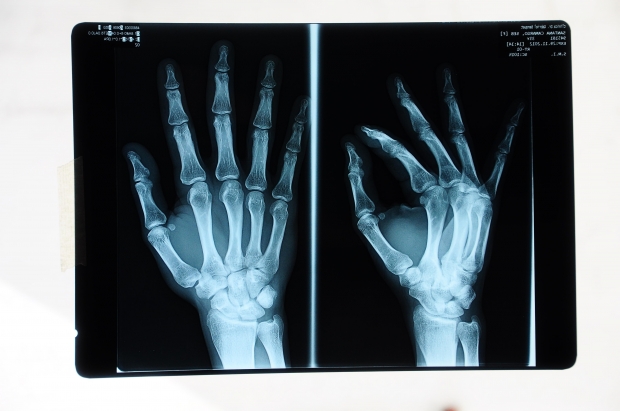
    • X-rays
    • Allergy
    • Insulin
    • Pap Smear
    • Penicillin

    Joseph Henry - seeds of discovery

    Lexi Krock, author of the article reminds us that, though some elements of serendipity, of chance, may have been involved in the discoveries, there was also a great degree of hard work, preparedness, creative thinking and an openness to possibilities. In fact Krock says that having an open mind is the most important ingredient. She quotes the words American physicist Joseph Henry:

     “The seeds of great discoveries are constantly floating around us, but they only take root in minds well prepared to receive them.”

    I came to that article through The story of serendipity on Understanding Science, which also talks about lucky coincidences, such as the story of Newton and the apple. This article states there is more than being in the right place at the right time to make a serendipitous discovery, including:

    • Background knowledge
    • An inquisitive mind
    • Creative thinking
    • The right tools, and
    • Good timing
    www.morguefile.com
    http://www.morguefile.com

    Another who attributes success in part, to serendipity, to being in the right place at the right time, is Malcolm Gladwell. Thanks to a serendipitous recommendation by Rowena, who blogs at Beyond the Flow, I have just finished listening to Gladwell read his book “The Outliers, The Story of Success”.

    Gladwell argues that there is more to success than just intelligence and hard work. Yes both are important: intelligence to a certain level and hard work to a greater degree. Through “The Outliers” Gladwell popularised the idea of 10 thousand being the “magic” number of hours to practice for success to occur, citing sporting heroes, The Beatles and Bill Gates, amongst others..

    However there is much dispute to this “rule”; and I must admit that, although I thoroughly enjoyed listening to and thinking about this book, it raised as many questions as it provided “answers” and I found myself wondering how much manipulation had gone into the figures to make them match his ideas, rather than the other way round. I am not saying there was any manipulation, I just wondered.

    www.openclipart.com
    http://www.openclipart.com

    However, one point he was making, that I think has value and fits with the theme this post, is that one’s circumstances; one’s family, environment and time, including birth year and month, play an enormous role in one’s success. These are things over which we have no control.

    According to Gladwell’s discussion of timing, I am correct in describing myself as “born too soon” in my Twitter bio. I was born just a few, but too many, years before the twelve month period that saw the births of Bill Joy, Steve Jobs and Bill Gates. I didn’t have the opportunities they had either.  Gladwell explains the importance of their timing, environment and opportunities in his book.

    In this Q and A Malcolm explains what an outlier is, what he thinks of as success, and how he thinks we should think of success. As well as the coincidence of Joy, Jobs and Gates, Gladwell says that “a surprising number of New York’s most powerful and successful corporate lawyers have almost the exact same biography: “they are Jewish men, born in the Bronx or Brooklyn in the mid-1930′s to immigrant parents who worked in the garment industry. “ He also says that “a hugely disproportionate number of professional hockey and soccer players are born in January, February and March.” Coincidence? He explains why.

    rg 1024, gift https://openclipart.org/detail/31159/gift
    rg 1024, gift https://openclipart.org/detail/31159/gift

    In her post Charli Mills states that

    “Serendipity holds no guarantees, but we can take the gifts it offers.”

    The gifts were there for the hockey and soccer players born in the first quarter of the year, but stacked against anyone born in the final months of the year. Likewise, serendipity held false promises for me when I was working towards establishing an alternative school.  Meeting the expectations of the Education Department proved no barrier. Meeting town planning requirements was much more elusive.

    The first property with any real potential we investigated was in Skew Street. Not surprisingly the odds were skewed against us and we couldn’t proceed there.

    Shortly after we located a much better property: more central, with ample indoor and outdoor space and a large playground. The arrangements seemed ideal, and the street names were much more promising. It was on the corner of Water and Love Street. Surely that had to bode better for us than Skew Street. Serendipity.

    Unfortunately, though it was definitely the right place, the timing was wrong. At the final moment, when leases were to be signed, a member of the organisation, who had been absent from previous meetings and discussions, turned up, objected and put an end to our plans.

    While some of us did continue to search for another location, it was like trying to find a needle in a haystack; there were few that met town planning requirements, and even fewer that met ours. Parents who had expected their children to start with us decided they could wait no longer and made other arrangements for their children’s education. The last minute loss of the ideal property rocked us to the core. With much heartbreak we finally admitted defeat and disbanded. Having read Gladwell’s book I am now willing to accept that it was not because I didn’t work hard enough but because there were other factors working against us.

    I decided that, in response to Charli’s flash fiction challenge to In 99 words (no more, no less) write a story that reveals or explores a moment of serendipity, this time I would provide Marnie with a positive experience, the beginning of a new phase in her life; serendipity working it’s magic.

    doors

    The wrong place at the right time

    Marnie was puzzled. The card definitely said 225; but there wasn’t any 225. There was 223, and 227, but no 225. She peered at the crack between the apartments as if willing 225 to materialise. Exhausted and confused, unsure of what to do next, she slumped on the step.

    “Can I help you?”

    The question interrupted her muddled thoughts. Seeing kindness in the eyes, Marnie explained her predicament.

    The woman read the card.

    “Street, not Avenue,” she said, pointing to the sign. “Are you Marnie? Lucky I got the wrong bus today. I’m Josephine. Come on. It’s not far.”

    Thank you

    Thank you for reading. I appreciate your feedback. Please share your thoughts about any aspect of this post or flash fiction.


  • A Celebration of Australian picture books #5 — Jeannie Baker

    Jeannie Baker - planet changing

    This post is the fifth in a series celebrating picture books by Australian authors. If you missed earlier posts, please follow these links to the introduction, Mem Fox, Kim Michelle Toft and Narelle Oliver.

    In this post I introduce you to Jeannie Baker, a collage artist and author. Jeannie was born in the UK but has lived most of her adult life in Australia, and most of her books, though having universal themes, are set in Australia.

    2015-09-19 11.09.45

    Jeannie had already published a number of books prior to 1992 when I first became aware of her work through “Window”, winner of the Australian Picture Book of the Year Award.

    Window tells, in beautifully detailed collage, of the transformation of a landscape from natural bush to city-scape. The changes are observed through a window by a boy as he celebrates alternate birthdays from birth to 24 years. Like many of Jeannie’s books, “Window” carries a strong environmental message. In her note at the end of the book, she says,

    “Our planet is changing before our eyes. However, by understanding and changing the way we personally affect the environment, we can make a difference.”

    The intricate details in this textless picture book provide many opportunities for discussion. Children and adults are enticed to study and compare the changes that take place in each successive picture. The carefully constructed collages give a sense of being able to almost step into the scene and experience the sights, sounds and smells of each landscape.

    Jeannie Baker - time

    I was fortunate to attend an exhibition of Jeannie’s artwork for “Window” as it toured the country in 1992. What surprised me most was the size of the collages. With all their detail I had expected them to be quite large; but they weren’t. They are miniature, much smaller than a page of the picture book on which they appear. The collection and arrangement of a mix of natural and artificial materials is amazing. Jeannie describes the process of constructing her collages here.

    2015-09-19 11.11.04

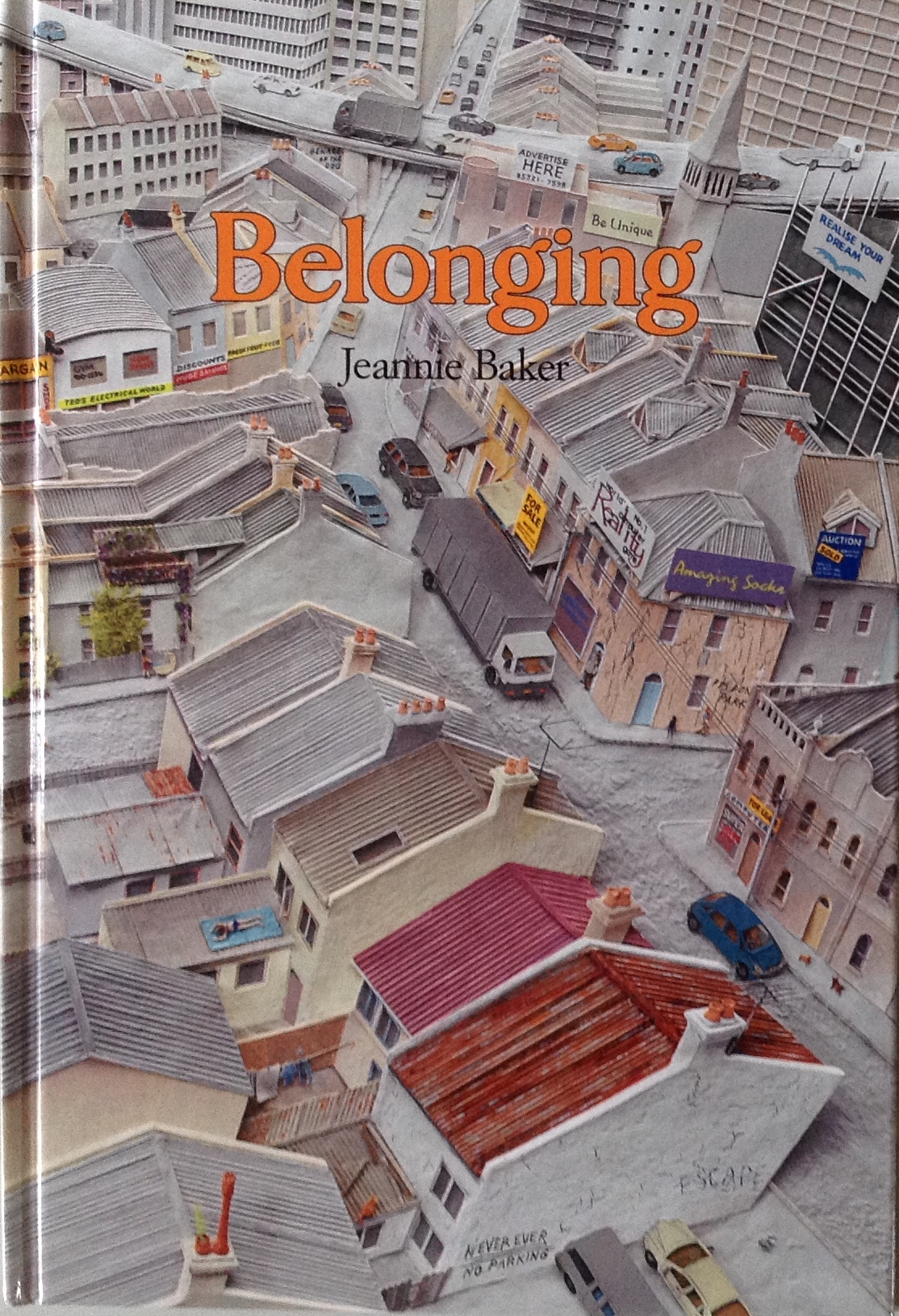
    In 2004 Jeannie published a companion book to “Window” called “Belonging, which, in 2005, also received a number of awards, including one from the Wilderness Society. This textless picture book tells a story of a changing landscape over a number of years as a city is transformed with plants and welcoming spaces for children and families. In a note at the end of this book, Jeannie says,

    “It takes time … But by understanding the land on which we live and by caring for it we can choose between just having a place to live or belonging to a living home.”

    2015-09-19 11.10.25

    One Hungry Spideris the third of Jeannie’s books I own. Unlike “Window” andBelonging, the illustrations in this one are accompanied by text. One Hungry Spideris a counting book, but a counting book with a difference: it includes information about the spider. For example when one of seven ladybirds gets caught in the web we find out that “the spider took no notice (because) spiders don’t like the taste of ladybirds.” And when nine wasps fly by the spider left the web and hid because wasps catch spiders. Additional details about the spider are provided at the back of the book. Once again the illustrations throughout the book are magnificent.

    Surprisingly I own only these three of Jeannie’s books. However I am familiar with others. At school I had access to many of her titles in big book format (approximately 50 x 40 cm) which were perfect for sharing with a class of children.

    4 of Jeannie Baker's books

    These are other favourites:

    Where the Forest Meets the Sea”, “The Hidden Forest”, “Mirrorand The Story of Rosy Dock”.

    Are you familiar with Jeannie’s work? If so, which ones and what do you think of them?

    Please check out these and other titles of Jeannie’s if you have a chance. Their illustrations will intrigue you and their positive messages will inspire you.

    As a writer, I found inspiration in Jeannie’s response to the question,

    “Of all the books you have made, which is your favourite?”

    She answered,

    “When a book is finally finished, I find it hard to think about it anymore …I want to fill my
    head with something totally different, with a new book.  My favourite book is the
    ‘new’ book I’m working on, still working out and trying to make better than the books I
    made before it!”

    I think that indicates a strong growth mindset and Jeannie’s joy in the “continual challenges this medium gives … to invent techniques and explore and experiment with materials and their textures.”

    Jeannie Baker - favourite book

    It affirms the quest for improvement and a reason to embrace the challenges we both set for ourselves and meet along the way.

    Thank you

    Thank you for reading. I appreciate your feedback. Please share your thoughts.

  • A celebration of Australian picture books #3 — Kim Michelle Toft

    Australia is a land of geographic diversity: of grassy plains, stony deserts, forested mountains, snow-capped peaks, golden beaches and sparking blue water.

    It is home to world’s largest coral reef system, the Great Barrier Reef, one of the seven wonders of the world and a popular tourist destination.

    Conservation of the Great Barrier Reef, along with other marine environments is important to the health of our planet.

    Kim Michelle Toft is an Australian silk artist who makes beautiful picture books with an environmental message aimed at increasing an appreciation of our oceans and their precious creatures and raising awareness of the importance of protecting them.

    Kim Michelle Toft's books

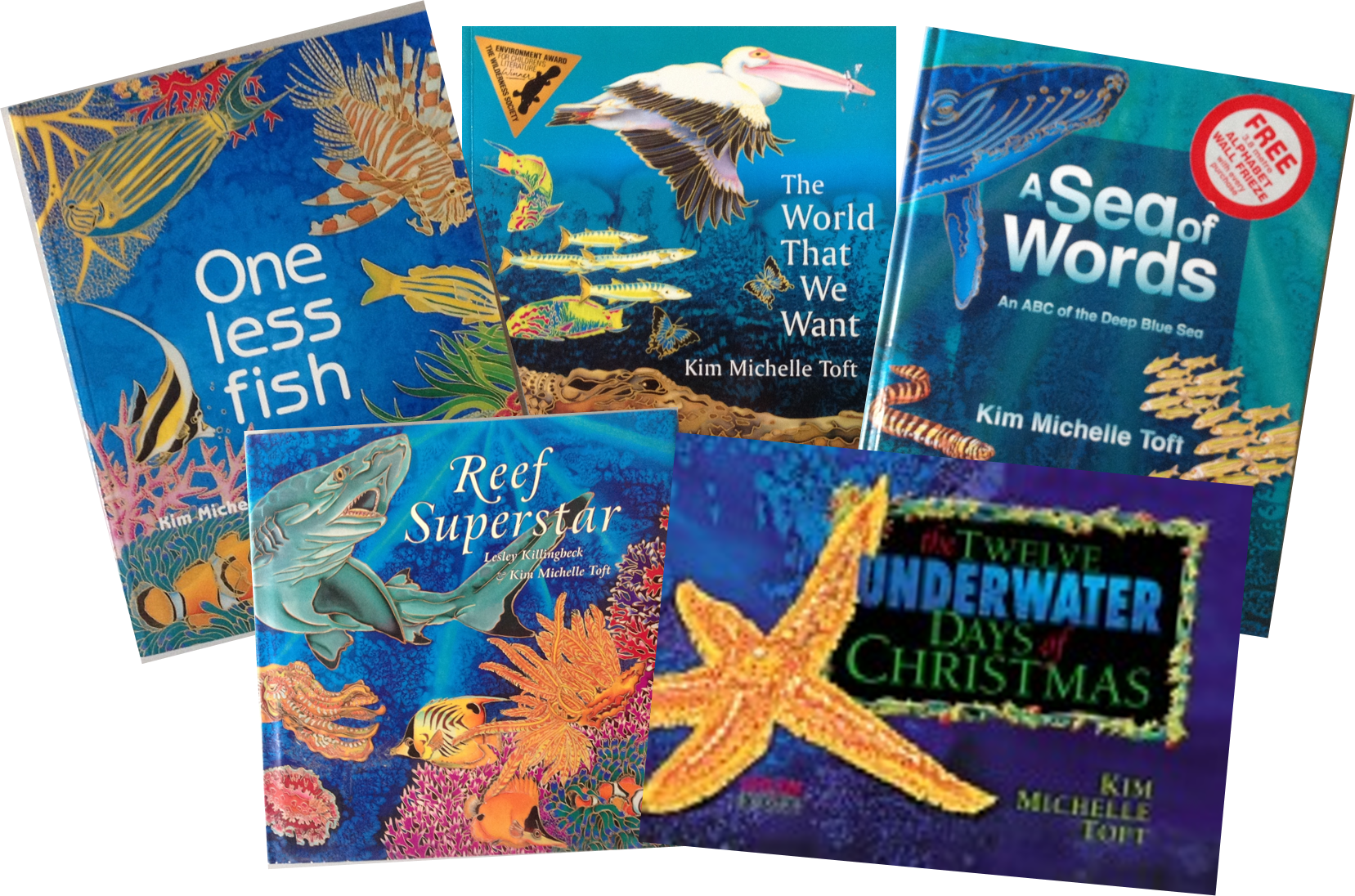
    I own these five of Kim’s books; each of which has an engaging story supported by child-friendly information about the marine environment and its importance, and is beautifully illustrated with magnificent silk paintings, which are delightful in themselves:

    2015-09-19 11.08.07

    One Less Fish counts back from twelve to zero and contains the message “Without constant care we will lose some of the world’s most beautiful natural resources. Remember: fish that die one by one may soon become none by none.”

    2015-09-19 11.08.56

    Reef Superstar introduces many creatures of the reef and provides supporting information about the reef and each creature featured. (Does not appear to be available at the moment.)

    2015-09-19 11.06.39

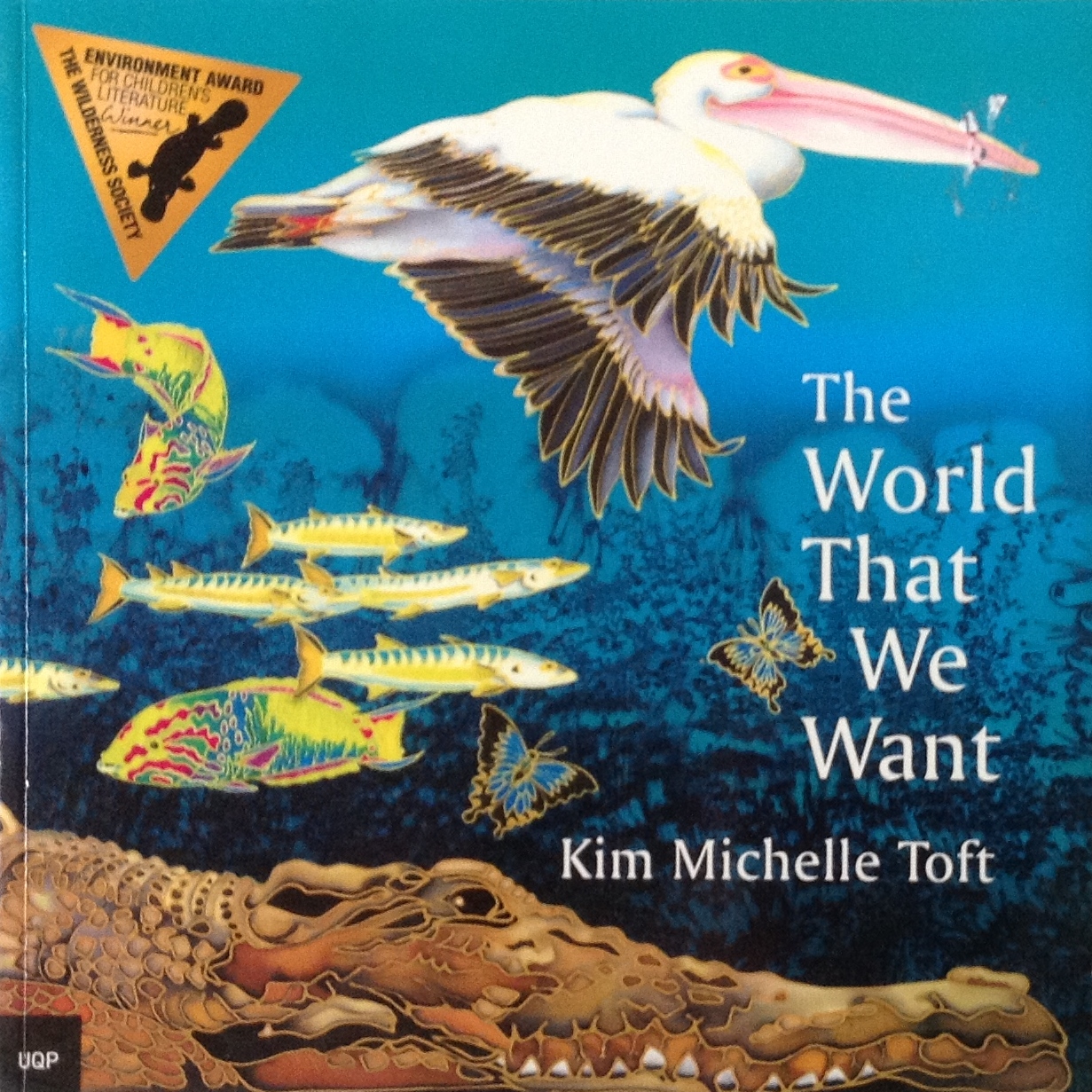
    The World That We Want contains forty-five creatures to be found in illustrations of nine different habitats and explains the inter-connectedness of ecosystems and their importance. The beautiful last pages open out to four pages in width showing the world that we want, from the forest to the ocean.

    2015-09-19 11.07.32

    A Sea of Words and accompanying Wall Frieze provide an alphabet of beautiful sea creatures with accompanying information.

    12 underwater days of Christmas

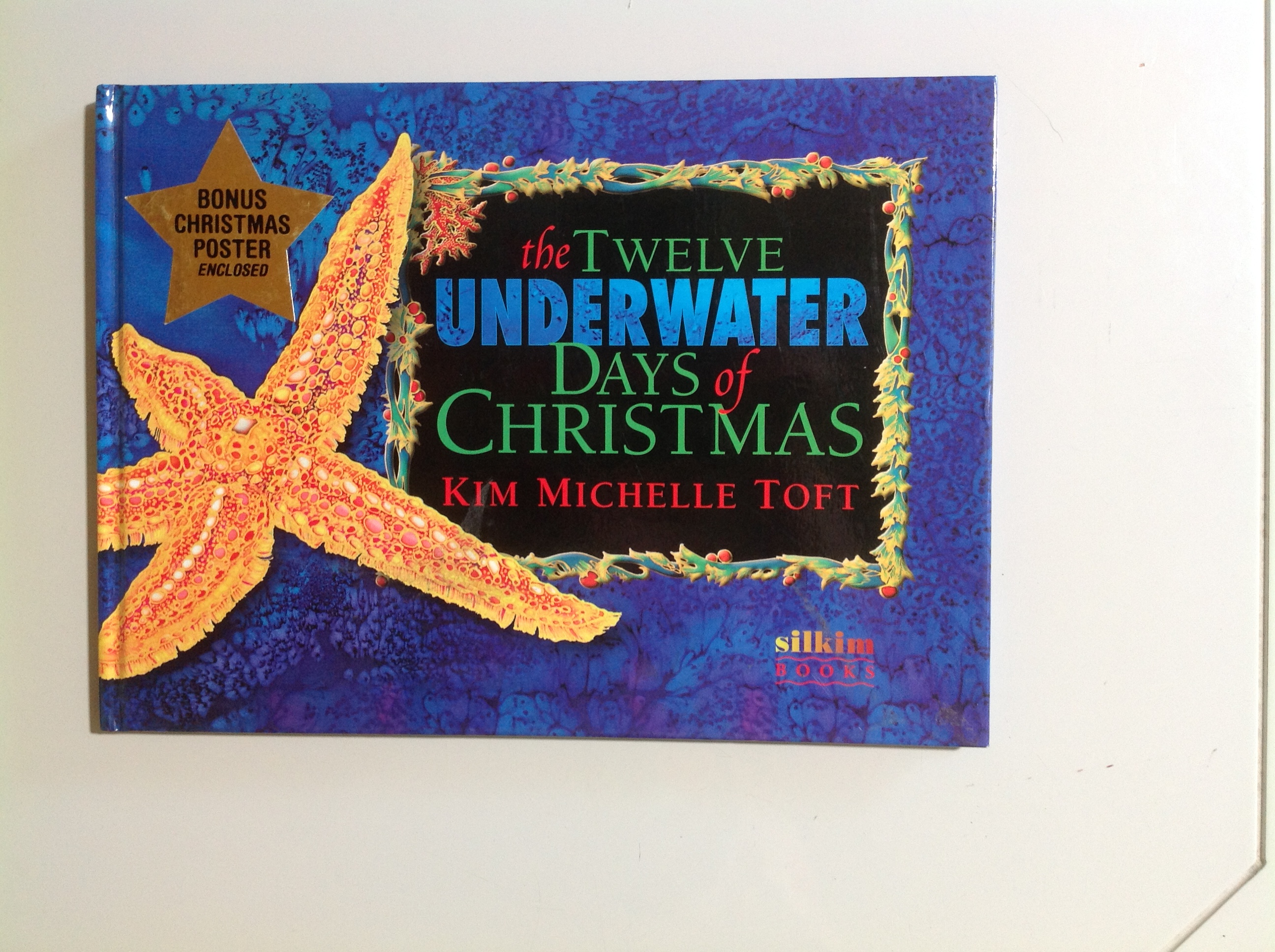
    The Twelve Underwater Days of Christmas is an innovation on the original carol using beautiful illustrations of marine creatures. As well as information about all the animals it includes a stunning six-page foldout poster, and information about the original carol.

    In this video Kim invites you into her gallery and studio and explains her silk painting technique.

    Kim is also available for visits to schools. When she visited “my” school she read from her books, engaged students in related activities and demonstrated silk painting by creating an original which the school was able to purchase. Her vast knowledge, experience, and passion for her work and the marine environment make these visits worthwhile.

    Kim’s books can be enjoyed by adults and children for the beauty of their illustrations alone. However the combination of visual appeal, richness of information and encouraging (strong, but gentle) environmental message provides even more reason to have them on your bookshelf or, better still, coffee table. They make perfect gifts for people of any age. I am happy to recommend Kim’s books to you.

    Thank you

    Thank you for reading. I appreciate your feedback. Please share your thoughts.

  • Better than a trail of breadcrumbs

    ©Glenn Althor www.http://obscurepieces.com/ Used with permission.
    ©Glenn Althor  Used with permission.

    When I think of children’s stories about being lost, Hansel and Gretel is one of the first that comes to mind. Whether or not this gruesome story is suitable for children, I’ll leave for another discussion. The children were correct in thinking it was important to mark their way into the forest in order to find their way out. They were incorrect in their choice of markers.

    Encouraging children to identify features of their environment has benefits beyond encouraging them to question and wonder. It is important for children to learn, from a young age, to identify markers on routes around the neighbourhood, shopping mall and school, as well as strategies to implement if lost or separated. Taking note of seasonal and other changes, both temporary and permanent, in addition to permanent features helps to build knowledge of one’s environment. This knowledge can be developing long before the need to find one’s way alone arises.

    http://www.morguefile.com/
    http://www.morguefile.com/

    One day there will be a need to navigate independently, whether it be to walk to school, go to the shop, visit a friend, catch a bus or drive a car. All of these will be far less daunting for the child, and much less worrisome for the parents, if the ability to find one’s way around has already been demonstrated through discussions or deciding which route will be taken for a journey.

    Often the first time children are required to navigate independently is when commencing school. They may need to find their way to the classroom in the morning, or to the gate in the afternoon. They will have to find the way to the playground, the office, the library, and the toilets and back to the classroom. Just as parents show children around the neighbourhood by pointing out landmarks, it is important for teachers to orient children in the school grounds and ensure they know how to find their way around confidently.

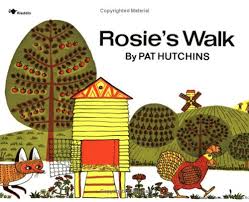
    A delightful book that can be used by both teachers and parents to discuss the importance of knowing one’s way around and of staying safe is the beautiful Pat Hutchins’ book Rosie’s Walk which tells the story of a hen who goes for a walk around the farmyard and gets back home safely in time for dinner. The story also introduces many positional words.

    Rosie's walk

    Understanding of positional terms and describing the location of neighbourhood and school landmarks in relation to each other  helps to develop spatial awareness along with language; for example:

    • past the shop
    • across the bridge
    • over the road
    • through the park
    • in the middle
    • beside the lake
    • along the road
    • next to the bakery
    • around the corner
    • behind the fence
    • as well as left and right.

    Discussing the placement of landmarks on a mud map of the neighbourhood or school and discussing different paths that could be taken encourages divergent thinking about ways of getting from one place to another. Sometimes it helps children to think of these maps as being from a birds’eye view, or from a plane. Other maps, for example Google Maps and street directories are also useful and children can learn to point out or mark places they have visited.

    mud map

    There are many opportunities, whether in the car or on foot, to take note of landmarks; for example:

    • house numbers,
    • types of fences
    • the number of streets to cross
    • large trees
    • the shopping centre entry
    • carpark space row and number
    • bridges crossed

    While the flash fiction challenge set by Charli Mills at the Carrot Ranch this week was to In 99 words (no more, no less) write a story about someone or something that’s lost, I have taken the theme of lost and used it to provide strategies that may help children avoid becoming lost. My flash is a rhyme for young children, and an example of the types of things that children can be encouraged to observe in their neighbourhood.

    To Grandma’s House

    Bub’s buckled in, away we go.

    Mum’s going to work, we can’t be slow.

    Down the street past the green painted door.

    Past the house with big number four.

    Stop at the curb and look each way.

    Off to Grandma’s, hip-hip-hooray!

    Quiet past here so the dogs don’t bark.

    Left at the corner and cut through the park.

    Up the hill, past the posting box.

    Open the gate, give three big knocks.

    Hugs for Grandma waiting for us.

    Wave to Mum as she boards the bus.

    Go inside for milk and toast.

    Days with Grandma we like the most.

    Thank you

    Thank you for reading. I appreciate your feedback. Please share your thoughts about any aspect of this post or flash fiction.