Live Love Laugh Learn … Create the possibilities

Tag: education

  • School Days, Reminiscences of Mabel Kwong

    School Days, Reminiscences of Mabel Kwong

    Welcome to the School Days, Reminiscences series in which my champion bloggers and authors share reminiscences of their school days. It’s my small way of thanking them for their support and of letting you know about their services and publications.

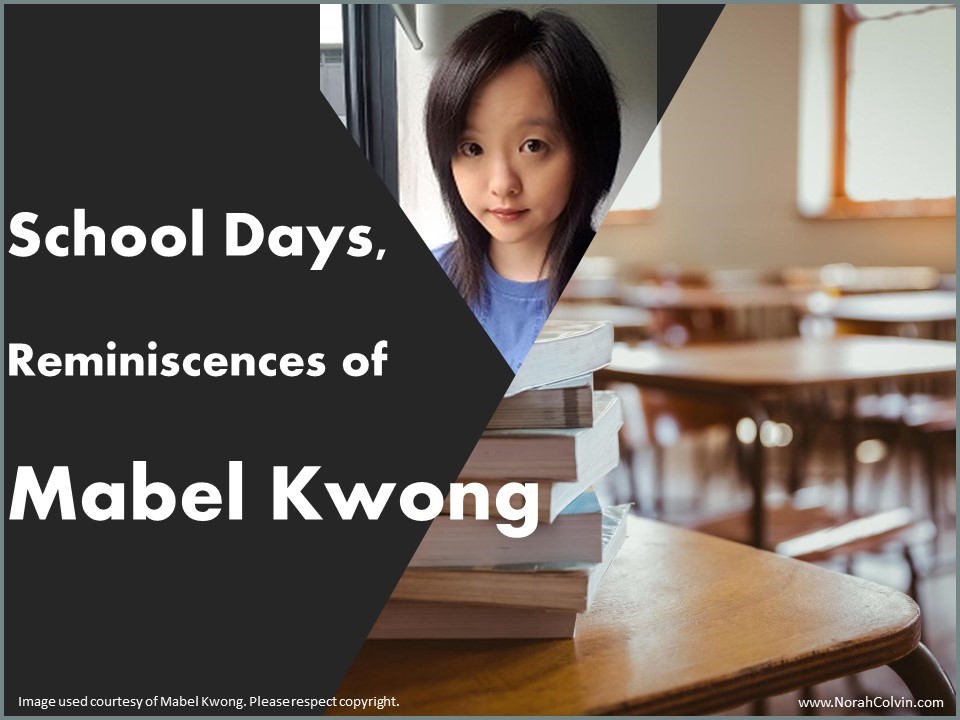
    This week, I am pleased to introduce Mabel Kwong, non-fiction writer and blogger. I enjoy reading Mabel’s eponymous blog where she shares her thoughts about life and attitudes in Australia. It is enlightening, and also saddening at times, to read her perspectives. It seems that racism is still alive and a little too well in Australia.

    I have great admiration for Mabel and admire her honesty. I think all Australians, and others, would benefit from reading her blog. Perhaps then we’d come to know and understand each other a little better and in turn, be more accepting and respectful.

    At the beginning of 2018, I was honoured when Mabel accepted my invitation to write a post for readilearn about her experience of Chinese New Year celebrations. She wrote this lovely post The significance of the Chinese New Year — a guest post by Mabel Kwong. Mabel also generously permitted me to present her information as an ebook Let’s read about Chinese New Year which is available to read free on readilearn.

    Before we begin the interview, I’ll allow Mabel to tell you a little of herself:

    Mabel Kwong is a non-fiction writer in Melbourne, Australia. Mabel was born in Australia and has spent time living in Singapore and Malaysia. With a keen eye on observing everyday details, she writes about multiculturalism, cultural differences and the writing process. She blogs at MabelKwong.com and shares various perspectives on these topics, encouraging all of us to learn from one other.

    In 2017, Mabel published ‘How I Found The Confidence To Chase My Passion’ in the self-help book Lady by the River: A collection of personal stories about persevering through challenging times. Her works on current affairs, lifestyle tips and audience reception have also been published in magazines, online editorials and academic journals. She is currently working on her first book about being Asian Australian and finding the inspiration to pursue one’s passion.

    Outside of writing, Mabel is a photographer and enjoys going to gigs, walking, playing video games and watching YouTube.
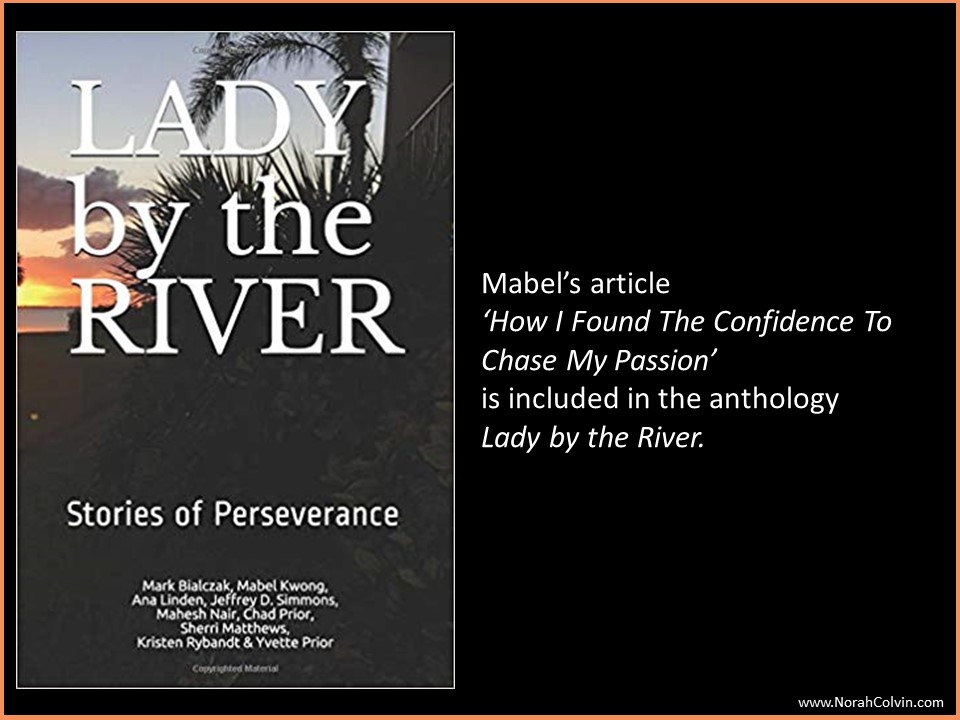
    Purchase Lady by the River here

    Welcome, Mabel.

    Now let’s talk school. First, please tell us where you went to school.

    Growing up as a third culture kid, I moved around a lot and attended schools in different countries. I went to kindergarten in Australia. Then I did primary school in Malaysia and later in Singapore. Most of my high school education was done in Singapore, and the last year was completed in Melbourne. I attended university in Melbourne.

    Did you attend a government, private or independent school?

    My education was a mix of government and private schooling.

    What is the highest level of education you achieved?

    A postgraduate degree.

    What work or profession did you choose after school and was there anything in school that influenced this choice?

    When I was in high school, I was intent on pursuing a career in the media, aspiring to be a journalist or a writer smithing non-fiction narratives. At university I was keen on developing my written skills and took writing classes in my Bachelor of Arts. I was also very good at maths and ended up majoring in that alongside cultural studies as part of my degree.

    What is your earliest memory of school?

    I remember my kindergarten days quite vividly. I was about five and went to kindergarten in a quiet eastern suburb in Victoria where the demographic was predominantly white. My classmates were mostly of western background. They came up to me during recess and laughed at my razor straight bangs and avoided sitting with me during lunch.

    I also remember back then my kindergarten had a set uniform code. Girls had the choice of dressing up in a green and yellow checkered dress that hit just at the knee or a blouse with long pants. My parents dressed me in the latter most of the time even when it was 30’C because they thought the dress was not modest enough.

    What memories do you have of learning to read?
    Mabel Kwong school days reminiscences

    Reading time was something I looked forward to in school. In kindergarten, reading time meant reading aloud. Each time it came to my turn to read, my stuttering voice stumbled over the words. Every time I got stuck at a word my heartbeat raced and my face felt flush. It was a mortifying feeling when the other kids giggled but my teacher was always patient, letting me finish reading aloud at my own pace.

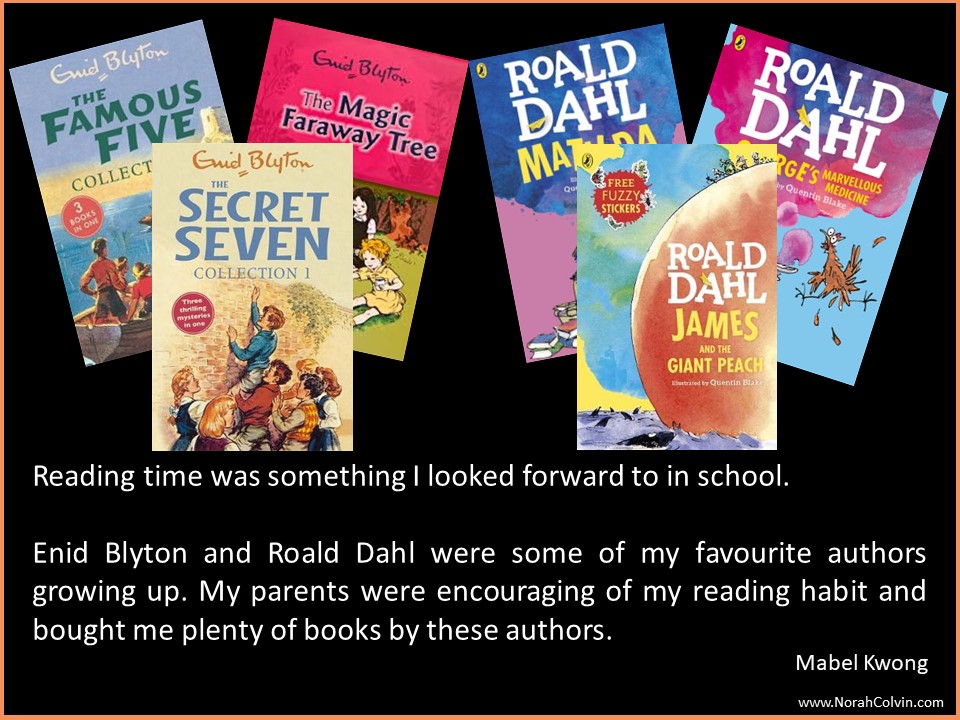
    Enid Blyton and Roald Dahl were some of my favourite authors growing up. My parents were encouraging of my reading habit and bought me plenty of books by these authors. As a teenager, I got into reading young adult fiction books based off TV series, including Buffy The Vampire Slayer, Charmed, Sabrina The Teenage Witch and also Archie Comics. Later on in high school, I started reading more non-fiction. My high school classes in Singapore made us read articles from the Reader’s Digest magazine each week. I was always the first to finish reading the required articles in class and went on to read more articles in the magazine.

    What memories do you have of learning to write?
    Mabel Kwong school days reminiscences

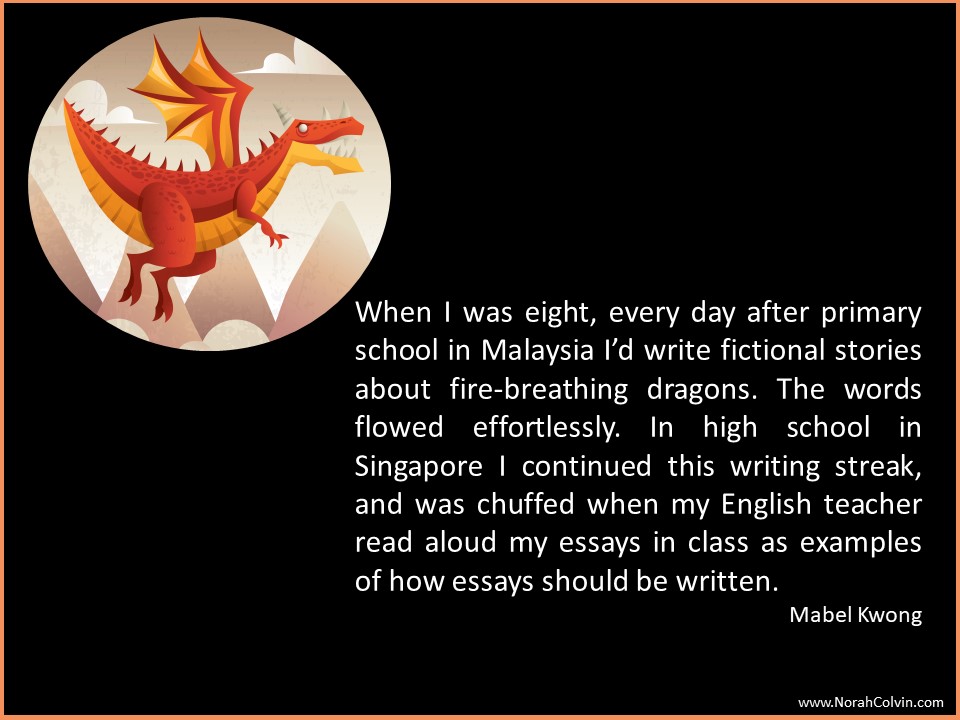
    When I was eight, every day after primary school in Malaysia I’d write fictional stories about fire-breathing dragons. The words flowed effortlessly. In high school in Singapore I continued this writing streak, and was chuffed when my English teacher read aloud my essays in class as examples of how essays should be written. Later at university in Australia I struggled to write poetry in creative writing classes and my tutors commented my attempts at journalistic news writing were ‘a good start’. Life at university did make me question my ability to be what it takes to be a writer.

    What do you remember about math classes?

    A love-hate relationship would be how I’d describe me and maths. All throughout school and university, I was good at maths. Studying maths is emphasised a lot in South-East Asian school curriculum and getting less than a B grade meant attending maths remedial classes. While I aced high school maths and aced calculus/fluid dynamics within my Applied Mathematics major at university, I lacked the passion for maths. When I sat down to revise for maths at university, my mind wandered to my cultural studies and journalism classes, planning that next story I wanted to write in my head. That said, from a young age my teachers instilled in me that maths (and science) is important – such as important for calculations, predicting weather patterns and drawing up code to build phone apps.

    What was your favourite subject?

    English. I’ve always wanted to be a writer and all things grammar and vocabulary appealed to me.

    What did you like best about school?
    Mabel Kwong school days reminiscences

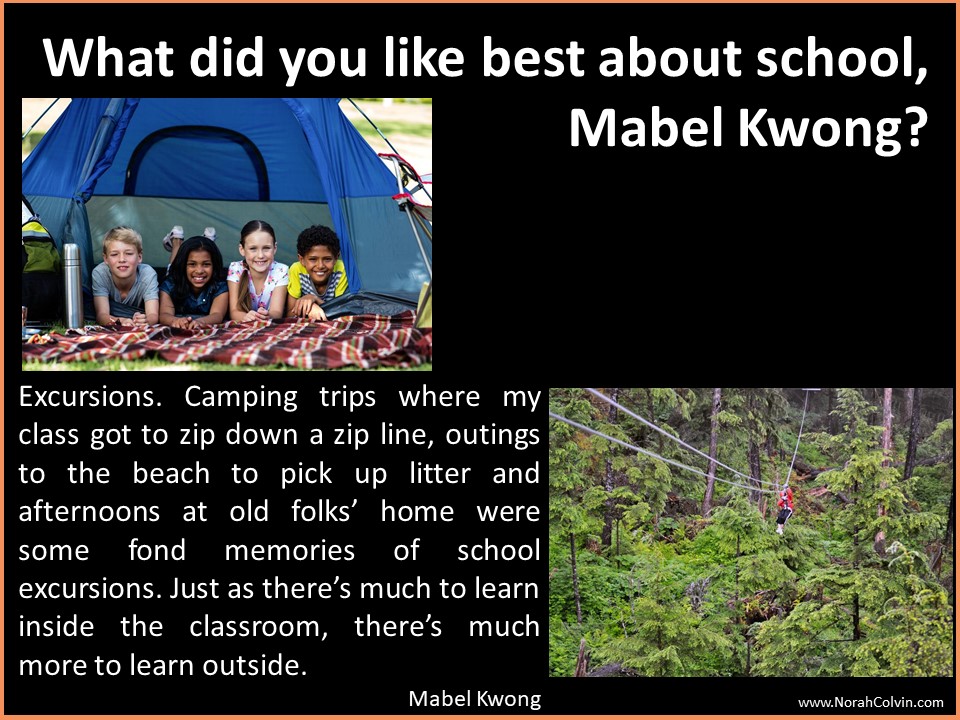
    Excursions. Camping trips where my class got to zip down a zip line, outings to the beach to pick up litter and afternoons at old folks’ home were some fond memories of school excursions. Just as there’s much to learn inside the classroom, there’s much more to learn outside.

    What did you like least about school?

    School is a place where there are rules to adhere to whether you like it or not. I wasn’t a huge fan of wearing compulsory school uniforms where skirts had to be a certain length and in Singapore schools, long hair had to be tied up (in some South-East Asian schools, girls’ hair couldn’t go past their ears). Also my Singapore high school divided the cohort into academic streams – the Express stream learnt at a faster pace and took more advanced subjects while the Normal stream took more technical subjects. Moreover, not everyone got to do the subjects they wanted to do; I wanted to do geography but by luck of the draw I was put into history class.

    There’s also not forgetting that my Singapore high school classes started at 7.30am each day. P.E. classes required us to run 2.5km within a certain time or get a low grade. As a night owl and someone who isn’t all that athletic, I don’t miss either of these.

    How do you think schools have changed since your school days?

    These days there are many options on getting an education especially higher education in Australia. Online and distance learning at our own pace off-campus can be convenient if we work full time. Notably, primary and secondary school fees are in the thousands each year per student and tertiary student loans are on the rise in Australia. While education may be more accessible, it might not be more affordable.

    What do you think schools (in general) do well?

    Patient and encouraging teachers make learning much more enjoyable.

    How do you think schools could be improved?
    Mabel Kwong on how schools could be improved

    At times school can be a place where we feel we don’t belong. As Hugh Roberts said in his interview for this series, ‘Nobody should feel afraid to go to school because they are bullied or just because they’re told they are different and don’t fit in.’ There needs to be more focus on bringing awareness towards discrimination, racism and bullying. Having more open discussions in class about different cultures, sexualities, gender, mental illness and disabilities would foster a stronger sense of belonging in school and encourage us to embrace and respect differences early on.
     

    thank you for your participation

    Thank you for sharing your reminiscences of school and thoughts about education in general, Mabel. It’s been wonderful to have you here. I think your suggestions for improving schools are lessons we could all apply throughout life. When we feel like we belong we are more likely to respect and accept others.

    Find out more about Mabel Kwong

    on her blog: MabelKwong.com

    or connect with her on social media

    Facebook: @TheMabelKwong

    Twitter: @TheMabelKwong

    Instagram: @TheMabelKwong1

    LinkedIn: @TheMabelKwong

    Purchase Lady by the River here

    Purchase your own copy of Lady By The River here on Amazon.

    If you missed previous reminiscences, check them out here:

    Charli Mills

    Sally Cronin

    Anne Goodwin

    Geoff Le Pard

    Hugh Roberts

    Debby Gies

    Pauline King

    JulesPaige

    D. Avery

    Christy Birmingham

    Miriam Hurdle

    Robbie Cheadle

    Marsha Ingrao

    Ritu Bhathal

    Joy Lennick

    Darlene Foster

    Susan Scott

    Barbara Vitelli

    Sherri Matthews

    Look for future interviews in this series to be posted on Sunday evenings AEST.
    Coming soon:
    Chelsea Owens

    Carol Taylor

    Pamela Wight

    Pete Springer


    Thank you blog post

    Thank you for reading. I appreciate your comments. Please share your thoughts.


  • School Days, Reminiscences of JulesPaige

    School Days, Reminiscences of JulesPaige

    Welcome to the School Days, Reminiscences series in which my champion bloggers and authors share reminiscences of their school days. It’s my small way of thanking them for their support and of letting you know about their services and publications.

    This week, I am pleased to introduce JulesPaige, poet, flash fiction artist and creator of gems that sparkle on the page.

    I met Jules at the Carrot Ranch where we both participate in flash fiction challenges set by Charli Mills each week. Jules is one of the most engaged and supportive participants. She always has something encouraging to say and is quick to offer helpful advice when a request is made.

    We have wonderful conversations about education, parenting and grandparenting on her frequent visits here. I think we would have a lot of fun entertaining our grandchildren together, if only we lived closer.

    Before we begin the interview, Jules will tell you a little of herself:

    I use the nom-de-plume JulesPaige because words are like jewels on a page. I am a poet for over fifty years, writer of flash fiction, and crafty creative person. More than less retired and love learning, but on my own terms. I have included a shadow photo as I wish, at this time, to remain anonymous.

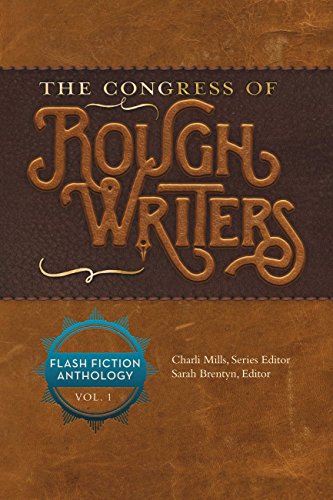
    I’ve had poetry included in school and college literary magazines. Poetry has also been accepted in chapbooks, the local newspaper, and online zines and linked to both poetry and flash fiction prompt sites. Recently I earned two first places and an honorable mention in Flash fiction contests via Carrot Ranch. Some of my stories feature in The Congress of Rough Writers Flash Fiction Anthology Vol 1.

    I am an active participant in several prompts for Flash Fiction and poetry:

    Carrot Ranch

    Mindlovemisery’s Menagerie

    Pure Haiku

    Thanks, Jules, and welcome. Let’s talk school.

     First, could you tell us where you attended school?

    New York and New Jersey, USA.

    Did you attend a government, private or independent school?

    All public schools. The last being a two-year community college that I paid my own tuition for.

    What work or profession did you choose after school and was there anything in school that influenced this choice?

    The profession I choose was Early Childhood Education Assistant. I did not want to go into business or be in the same classes of a sibling who chose the arts. I wanted to help children with their educational beginnings.

    What is your earliest memory of school?

    I remember being in a kindergarten class and wanting to play house, I didn’t get too many turns there. Then in first grade I ended up in the same room with the same teacher – who apparently didn’t like me. Since during the first days of class she allowed me to play in the housekeeping section that had not yet been restocked. I don’t have many memories of early school. I had a family tragedy and withdrew from getting attention which ended up getting me labeled as ‘slow’.

    What memories do you have of learning to read and write?

    I do not have all that many early memories of school. But since I was labeled ‘slow’, my stepmom made it a point to help me learn to read by reading to me every night. Perhaps in 5th grade I was in what was called an intermediate school. That was when I was around ten. That’s when I had a couple of English teachers who encouraged creative writing. At that time in the late 1960’s in that school, creativity was more of a focus than basics. So my math and grammar skills are lacking.

    What did you like best and least about school?

    I was always the new student at my schools. The odd one out and did not have many friends even in High School. No bonds were made in College. I liked my art classes. I did not like the negative or lack support of either my parents or most of my teachers. I only had a select few teachers that encouraged my creative avenues. While I attended the same High School for all four years 9-12, we moved mid-way through, which made seeing the friends I had difficult, and left no chance of participating in any after school programs.

    How do you think schools have changed since your school days?

    I am not entirely sure that public schools have changed for the better. While addressing bullying, special health needs and catering to highly intelligent prodigies… there still lacks a complete need to address all children with equal fairness. This is from the experience of raising my own children in the local public school system and having to invoke my ‘Parental Rights’ for my own children’s needs. The Parental rights to fair education is not something that the schools promote. I found out about them through another friend who was a teacher.

    How do you think schools could be improved?

    Public Schools need to prepare our children by starting language in the early grades and not waiting until older grades. Special language immersion classes were available in later years (of my children’s schools) for a select amount of students who were selected by a lottery. Public Schools also need to make sure basic math and estimation skills are taught without the assistance of calculators or iPads. Public schools also need to encourage acceptance of differences.

    If you choose to send your child to a public school, then you need to accept the parameters set therein. Public Schools also need to keep religion out of the schools. And if vaccines are a requirement, there should be no exceptions. Just one unvaccinated child can bring disease to a whole school population.

    thank you for your participation

    Thank you for sharing your reminiscences of school and thoughts about education in general, Jules. It’s been wonderful to have you here. I am sorry that your school days were not the most pleasant for you, but I am happy to know that you have done what you can to ensure the school days for your own children and others were more positive. It is always encouraging to hear stories of negative cycles being broken.

    Read more of Jules’ work on her blog Jules Pens Some Gems.

    If you missed previous reminiscences, check them out here:

    Charli Mills

    Sally Cronin

    Anne Goodwin

    Geoff Le Pard

    Hugh Roberts

    Debby Gies

    Pauline King

    Look for future interviews in this series to be posted on Sunday evenings AEST.

    Coming soon:

    D. Avery

    Christy Birmingham

    Miriam Hurdle

    Susan Scott

    with more to follow.

    Thank you blog post

    Thank you for reading. I appreciate your comments. Please share your thoughts.


  • School Days, Reminiscences of Pauline King

    School Days, Reminiscences of Pauline King

    Welcome to the School Days, Reminiscences series in which my champion bloggers and authors share reminiscences of their school days. It’s my small way of thanking them for their support and of letting you know about their services and publications.

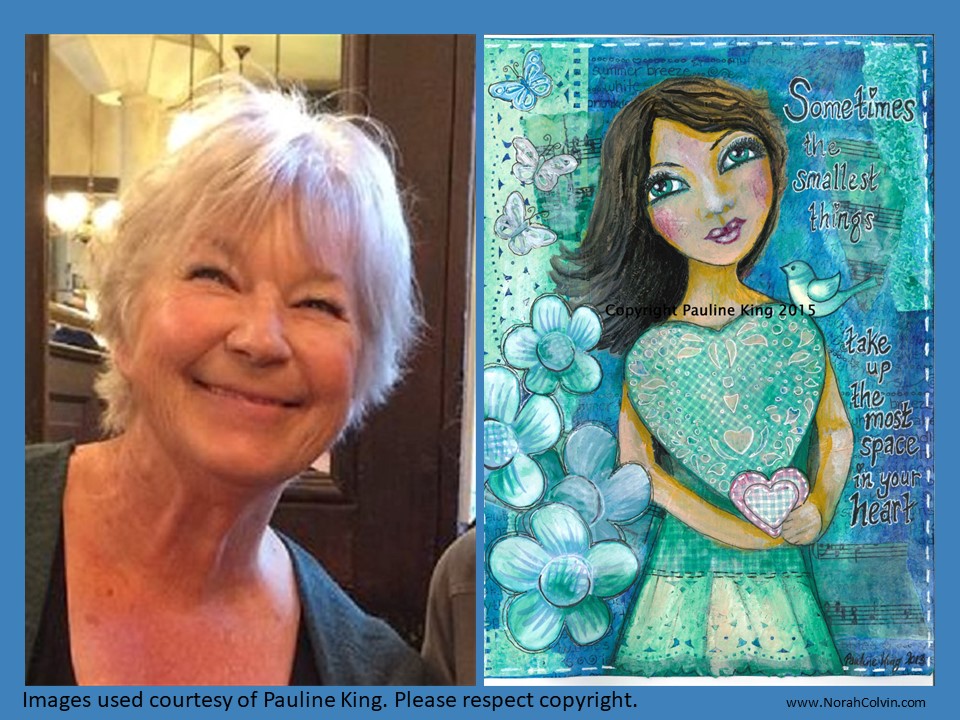
    This week, I am pleased to introduce Pauline King, The Contented Crafter. Pauline and I have been online friends for a long time. I can’t quite remember where we met, but I think it may have been through Geoff Le Pard.

    Pauline and I clicked straight away as we have a lot in common and share many similar views about education. At one time, each of us even contemplated starting our own school.

    I wish I’d known Pauline and had the opportunity of working alongside and learning from her while I was still working in the classroom. Although Pauline says that she has left that part (teaching) of her life behind, it doesn’t stop her sharing the value of her experience and words of wisdom when prompted. We shared so many in-depth conversations in response to posts, that I decided to give more space to her views in posts of their own. Follow these links to share in Pauline’s wisdom.

    Which school? I found one!

    Reflections on living a contented life, teaching and school

    On children and parents —more from the Contented Crafter

    Pauline King the Contented Crafter

    Before we begin the interview, I’ll let Pauline tell you a little about herself.

    I’ve had many incarnations as wife, mother, student, teacher, teacher trainer and mentor, curriculum writer and advisor, community hub developer, new worker trainer, and [whew!] life coach.  In between I painted, crafted, hand worked, gardened and generally tried to create beauty around me where ever I went.  Oh, I forgot to mention ‘world traveller’!

    These days I’m [mostly] a very contented crafter and pursuer of serenity.  And of course, I live with Orlando, a now elderly Maine Coon cat of great distinction and forbearance and a most delightfully joyful pup who goes by the name of Sid-Arthur [yes, a play on Siddhartha for those of you who picked it up].  They feature prominently throughout this blog.

    I’m retired now and happily spend my days doing whatever it pleases me to do.  Sometimes, in between my crafting projects, I still coach now and again, gratis, as a thank you for this blessed life I’ve been given.

    Welcome, Pauline. Now let’s talk school.

     First, could you tell us where you attended school?

    Porirua, then a village, now a city.  In the Wellington area.  NZ

    Did you attend a government, private or independent school?

    State school

    What is the highest level of education you achieved?

    Originally nothing. I was pulled from school by my mother before I turned 15.  I later gained School Cert and UE via correspondence as a young adult and at the age of 33, I trained as a Waldorf teacher.

    What work or profession did you choose after school and was there anything in school that influenced this choice? 

    It seems I always wanted to be a teacher, but the circumstances of my life dictated otherwise.  In my 30s I was finally enabled to follow that dream through the initial support of friends  buoying up my low confidence and a series of fortuitous events that allowed me to enter the Waldorf training despite not having a state teacher training  which was then a requirement of any Waldorf trainee teacher.  (It was here I heard for the first time that I was seen as a graduate of the University of Life — a designation that delighted me.)  I believe that meeting kindness and being encouraged in my early school years ignited the wish to be a teacher.

    What is your earliest memory of school?

    The first day of school, I was 5 years old and terrified.  My mother pushed me into the room and shut the door on me and I was crying as the teacher came to get me.  But the thing that caught my eye was the book display.  You know those shelves that hold books with the full cover showing. There were so many books and they all looked so beautiful and enticing.  I stopped crying and the teacher let me stay there looking at the books.  I still remember the first book I looked at, ‘Orlando the Marmalade Cat’.  I don’t remember anything else, but it was clearly a very important moment in my life.  That teacher went on to become a champion of mine and I never forgot her many kindnesses and through her my love of reading flowered.

    What memories do you have of learning to read and write?

    I don’t remember learning to read. It came very easily.  Writing too.  At age 10 my essays were entered into inter-school competitions by the headmaster.  Later he asked me to not write fantasy, but to write about ‘what you know, your life’.  That was the end of my writing career.  🙂

    What do you remember about math classes?

    I have no recall of maths classes.

    What was your favourite subject?

    I loved all the humanities classes – reading, writing, history, geography, social studies.  I loved music too, until I was pulled from a combined class practising choral singing and told to stand at the front of the room and listen as I was singing off key.  That was the end of my musical career too.  I never sang in front of anyone except for my babies for many years.

    What did you like best about school?

    Pauline King the Contented Crafter tells what she liked best about school

    For me in those first years, school was a safe place to be and I was fortunate to have in the early years women who took an interest in my welfare and some who even tried to help intervene in my home life. Their kindness made a huge impression on me and was probably partially responsible for the longing I felt to become a teacher.  They also had made me feel so safe that when the harsher teachers entered my world and humiliation and failure became the norm, I still liked school.  It was better than home, I guess.  I know I was, from a very young age, gathering information and evidence about what made a good teacher and what made a bad teacher.  It would all eventually come in handy when I parented and later became an actual teacher.

    How do you think schools have changed since your school days?

    My initial experience of state education is my own and the first two years of my children’s education.  (In the final six years of my working life I came up against the failures of the state system when I developed programmes for youth at risk in job training.)

    When I had children, I looked for something else outside the state system for them but had the resistance of my husband to work through.  Later after my daughters both had bad experiences with teachers he agreed, and we transferred them to the local Steiner School.  There I watched my children bloom and blossom and there I too found my place. It’s a wonderful thing when you find your tribe and I had finally found mine.

    What do you think schools (in general) do well?

    I think in general schools provide an adequate education for students who have an academic leaning.  But, as you know Norah, I believe that true education is sadly lacking.  It seems to me the role of education is to awaken the mind, to develop the skill of learning, to prepare people for a life of learning and enough of an interest in the world to want to learn about it.

    The reality is we spend all our lives learning, yet so many think they go to school to learn the skills needed to get a job.  I don’t know how many times I’ve heard a young person (or even a parent) complain that reading a certain book will be of no use to them after school and science or maths adds nothing to the skill-set they need for getting a job.

    It seems nobody talks to them about the joy of learning, of widening horizons, of deepening understanding or even of exercising their thinking capacities and developing their brains.  I’ve met many 15- and 16-years olds who can’t write their own addresses down.  They have no self-esteem, are angry and confused and turned off from society.  They don’t have the skills to hold down any kind of job because they also haven’t learnt about taking personal responsibility at school or at home.

    How do you think schools could be improved?

    Pauline King the Contented Crafter tells how schools could be improved

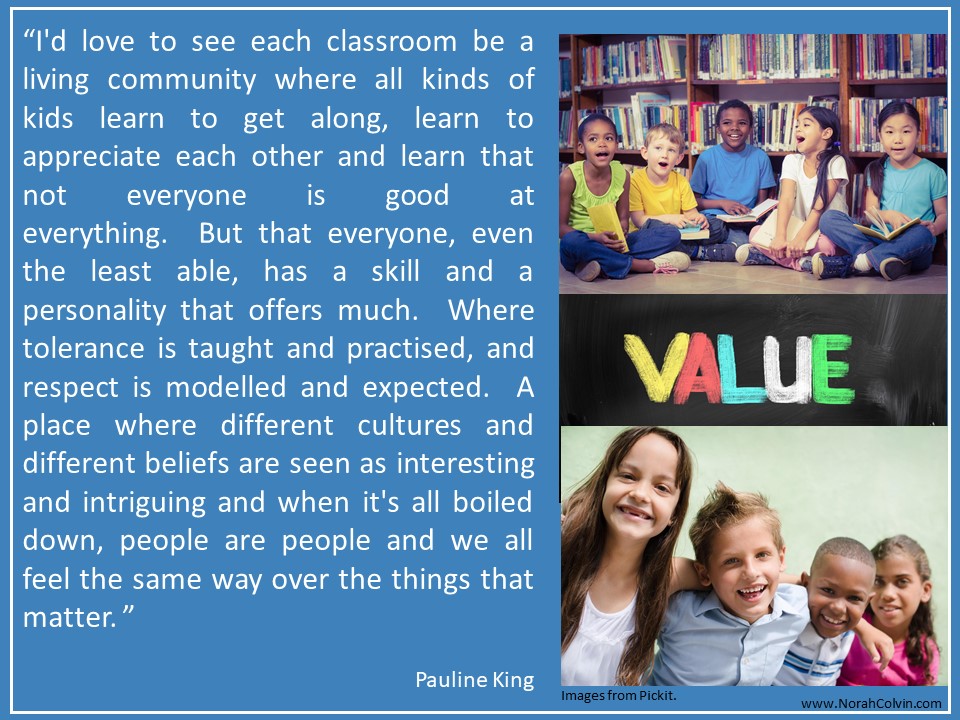
    I’d love to see a return to a balanced education that includes academia and the arts and life skills.  I’d love to see each classroom be a living community where all kinds of kids learn to get along, learn to appreciate each other and learn that not everyone is good at everything.  But that everyone, even the least able, has a skill and a personality that offers much.  Where tolerance is taught and practised, and respect is modelled and expected.  A place where different cultures and different beliefs are seen as interesting and intriguing and when it’s all boiled down, people are people and we all feel the same way over the things that matter.

    I’d like to see geography and social studies and all kinds of real arts and crafts come back to life in the classroom, I’d like to see kids singing and dancing and playing together in between learning the Three R’s.  I’d like to see the slow expansion of a planned curriculum that ensures a deepening understanding of the natural sciences — again attached to the developmental stages and understanding of the students.  Never bring hard facts too soon to young people — they kill childhood!

    I’d like everyone to understand that we live in a world that is changing so quickly that it is highly likely the jobs their kids will do haven’t yet been invented.  The only way to ensure their children will succeed as adults is that they will have a healthily developed sense of themselves, their interests and their abilities and be able to think, to assess, to understand the needs of the world and to have the entrepreneurial spirit to meet them.  It’s less about passing exams and more about an ability to learn; less about gaining the skills for a job, more about gaining an ability to learn new skills.

    Thank you for inviting me to join with your esteemed guests Norah, it is very kind of you.

    thank you for your participation

    Thank you for sharing your reminiscences of school and thoughts about education in general, Pauline. As always, it’s a pleasure to discuss education with you and, while it was great to hear of your early experiences and the influence of kind teachers, I am in total agreement with you about how schools could be improved. If only we could get those who make the decisions to listen to and enact your wisdom.


    Find out more about Pauline King

    on her website: The Contented Crafter

    Connect with her on social media

    Facebook: https://www.facebook.com/paulinekingnz

    Twitter: https://twitter.com/contentedP

    Browse her gift shop to purchase your own special piece of Pauline’s art or craft.

    If you missed previous reminiscences, check them out here:

    Charli Mills

    Sally Cronin

    Anne Goodwin

    Geoff Le Pard

    Hugh Roberts

    Debby Gies

    Look for future interviews in this series to be posted on Sunday evenings AEST.

    Coming soon:

    Jules Paige

    D. Avery

    Christy Birmingham

    Miriam Hurdle

    Susan Scott

    with more to follow.

    Thank you blog post

    Thank you for reading. I appreciate your comments. Please share your thoughts.


  • Keep the teacher fires burning

    Keep the teacher fires burning

    Teacher burnout is a huge problem. Fading are the days of veteran teachers staying in the job and sharing the wisdom of their experience with the younger generation of teachers. Many articles tell of teachers leaving the profession after five or fewer years.

    Teachers start out with fire in their hearts, with an ambition to change lives and improve outcomes for all the children in their care. Many leave after just a few years when that fire has not only burnt out but has burnt them out too.

    For others, who contemplate no alternative, the fire smoulders for years until they become cynical with a system that is ever-changing but rarely improving, and expectations that increase exponentially with little recognition of their efforts or the value they add to lives or society.

    I recently listened to a book on the topic written by a passionate educator whose fire was extinguished by overwhelming expectations and an inability to reconcile unrealistic demands with a desire to teach children.

    In a job interview, when asked what she taught, it was her response ‘I teach children’ that landed her the position. As the years passed, her employer’s focus turned from teaching children to teaching content and collecting data. As for many, her challenge was to continue educating the whole child while fulfilling the requirements of her employer. It’s a challenge that defeats many.

    Teacher: One woman’s struggle to keep the heart in teaching by Gabrielle J. Stroud is a personal record of one’s teacher’s journey and how she faced the challenge. But it is more than that. It is the story of a journey travelled by many teachers. The names and places may change, but the story stays the same.

    It is a book I wish I’d written. I laughed with Gabbie and cried with Gabbie. I’d walked in her shoes and she in mine. While our times and schools were different, our responses to the changing education landscape were very similar. She wrote from my heart as much as from hers.

    If something doesn’t happen soon to support teachers, there’ll be no heart left in education and it will be a wasteland of useless data, lost potential and unhappy futures. Of course, I’ve written about that before, describing differences between education and schooling in a poem I called Education is.

    If you are interested in reading more about teacher burnout and considering how teachers may be better supported, here are some articles to get you started:

    The Causes of Teacher Burnout: What Everyone Needs to Know on The Chalk Blog. (US)

    Burned out: why are so many teachers quitting or off sick with stress? In The Guardian. (UK)

    Stressed-out teacher? Try these self-care tips on ABC Life. (Australia)

    The hardest, most underestimated part of a teacher’s job on News.com.au. (Australia)

    Heartbreak becomes burnout for teachers when work is turbulent on The Conversation. (Australia)

    The Truth About Teacher Burnout: It’s Work Induced Depression on The American Psychology Association’s Psych Learning Curve. (US)

    Teacher Workload in the Spotlight from my own Queensland College of Teachers. (Australia)

    These are but a few of the many describing conditions that contribute to teacher burnout. However, for a truly entertaining but heartbreaking read that provides an accurate understanding of what happens to the heart of many a passionate teacher, you can’t go past Teacher: One woman’s struggle to keep the heart in teaching by Gabrielle J. Stroud. Gabbie summed it all up sadly by saying that she didn’t leave teaching, teaching left her.

    Carrot Ranch flash fiction challenge - fire

    It’s about the teacher fire that I’ve decided to respond to the flash fiction prompt set by Charli Mills this week at the Carrot Ranch. Charli challenged writers to In 99 words (no more, no less) write a story about fire. It can be a flame that burns or a light that inspires. Follow the flames and go where the prompt leads!

    99 no more no less fire words

    The heart of a teacher

    “It’s storytime, children.”

    They gathered at her feet, bright-eyed, transfixed.

    Jane read, instructed and encouraged. They never tired.

    Later, all snuggled up in bed, Mum asked, “What will you be when you grow up?”

    “A teacher.”


    “Storytime, children.”

    They gathered at her feet, bright-eyed, hearts open, minds buzzing.

    Miss Jane read. They hung on every word, contemplating obstacles and possible resolutions, following the heroes’ journey into the cave and out.


    “Ple-ease!”

    “No time for stories. It’s test time.”

    They slumped at desks, eyes glazed, minds dulled, hearts heavy.

    The cave was cold and dark. Were they ever coming out?

    Thank you blog post

    Thank you for reading. I appreciate your feedback. Please share your thoughts.


  • School Days, Reminiscences of Geoff Le Pard

    School Days, Reminiscences of Geoff Le Pard

    Welcome to the School Days, Reminiscences series in which my champion bloggers and authors share reminiscences of their school days. It’s my small way of thanking them for their support and of letting you know about their services and publications.

    This week, I am pleased to introduce Geoff Le Pard, author, blogger, humourist and all-round nice guy. I met Geoff through Anne Goodwin, if I remember correctly. We engaged in conversations on Anne’s blog first, then followed each other and engaged in conversations on each other’s blogs too.

    Anne and Geoff had already been lucky enough to meet in person on a writing course, but I hadn’t known either for long when I visited family in London for the first time in 2014. I very timidly emailed Geoff and asked if he’d like to meet up. (This was prior to the Bloggers’ Bash of which Geoff is now on the organising committee and I didn’t yet know of any other instances of bloggers meeting up.)

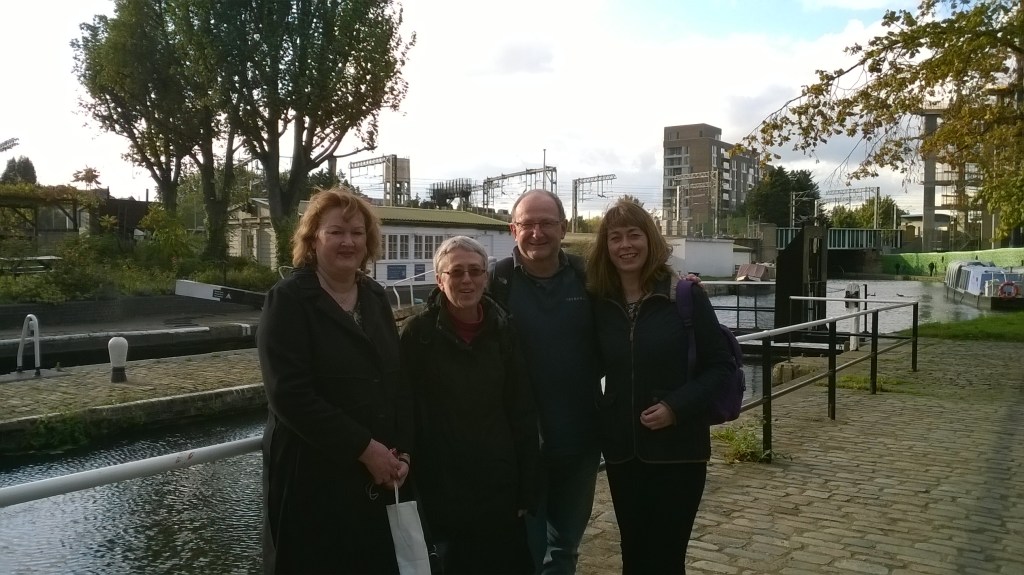
    I was both anxious and thrilled when Geoff, Anne and Lisa all agreed we’d meet up at the British Library. I think we were all wondering if these ‘strangers’ were who they said they were or if they might be potential axe murderers. Fortunately, though some of us may have a been a bit stranger than others, none were axe murderers and we had a very pleasant afternoon together.

    Norah, Anne, Geoff, Lisa beside the lock

    Since that auspicious occasion, Geoff has entertained thousands, if not millions, of readers with his blog posts that are sometimes hilarious, sometimes serious, often compassionate and always with his own tangent on life, love and anything in between. He has published four novels, three anthologies and one memoir. I have no hesitation in recommending them to you.

    But perhaps we should get to the real purpose of this post, which is to provide Geoff with an opportunity of sharing his reminiscences of school.

    Before we begin the interview though, I’ll allow Geoff to tell you a little of himself:

    Geoff Le Pard started writing to entertain in 2006. He hasn’t left his keyboard since. When he’s not churning out novels he writes some maudlin self-indulgent poetry, short fiction and blogs at geofflepard.com. He walks the dog for mutual inspiration and most of his best ideas come out of these strolls. He also cooks with passion if not precision.

    Welcome, Geoff.

    Let’s talk school. First, could you tell us where you attended school?

    My schooling started at 3 at Miss Stark’s nursery school in a large house about half a mile from home (mum walked me everyday). From there, at 5, I went to Maple Road Primary in Whyteleafe, in leafy Surrey this time about 2 miles away (I caught the bus – until I was 6 with mum, after that with my older brother (he was one year older). At 11 I moved to a local Grammar school, Purley Grammar school for boys, about 4 miles from home (I cycled) until I was 12 when the family moved to south Hampshire and joined Brockenhurst High School, also a Grammar, where I stayed until 16 when I moved into the adjacent sixth form college until 18 (the school was seven miles away and involved a daily train journey after a cycle ride).

    Did you attend a government, private or independent school?

    The nursery was private but the remaining schooling was Local education authority funded. Grammar schools were an attempt by the post war governments to give the best equivalent of a private education to those who couldn’t afford it. To enter you had to pass your 11 plus. I failed mine, had an interview as I was ‘borderline’ (makes it sound like it was a mental health issue) and was granted a place – I still think Paddington Bear was my saviour – this post explains my reason for thinking that.

    What is the highest level of education you achieved?

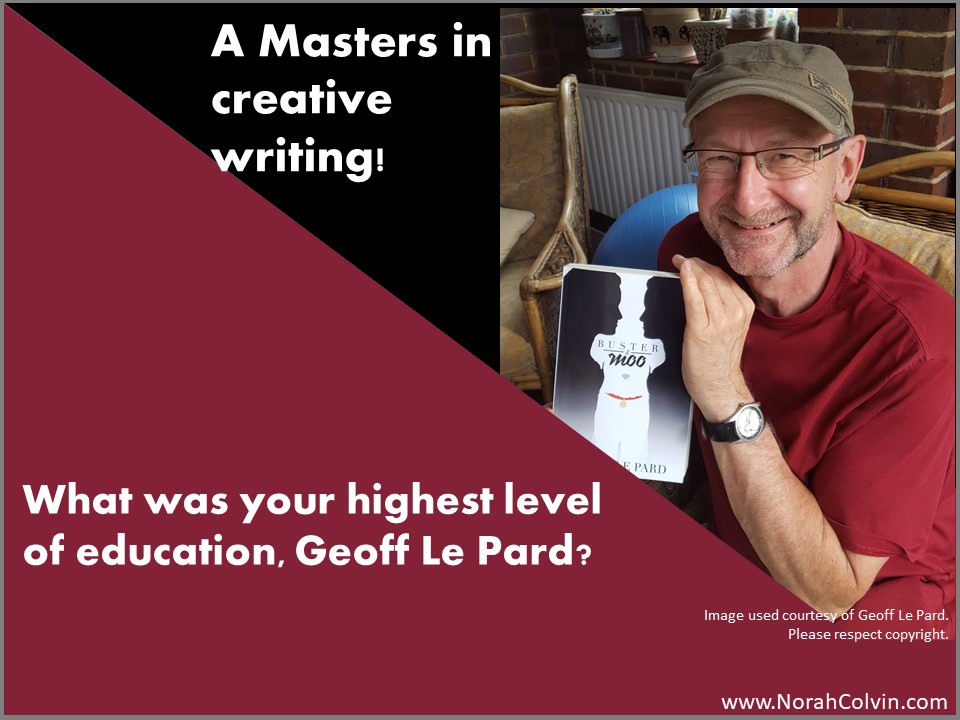
    I went through the sixth form, took four A levels (two maths, history and French plus S level maths – not sure what the ‘S’ stood for but it was meant to be equivalent of first or second year at uni – I managed 100% I was told – get me, much good it did me) and then attended University (Law, at Bristol University), and later in life went again for a masters (Creative Writing at Sheffield Hallam)

    Geoff Le Pard's highest level of education

    What work or profession did you choose after school and was there anything in school that influenced this choice?

    I chose a law degree at Uni that lead to a career in the Law. I can cite the following influences from school:

    • One of my school friends had already chosen law and it sounded cool;
    • I went to a careers’ evening organised at school and the two reps from Southampton University were law lecturers and they were the coolest people there
    • My maths teacher wanted me to go to Cambridge and do maths and he was anything but cool

    What is your earliest memory of school?

    The sandpit at nursery and the leather indoor slide and being made to stand in the corner for running when told not to.

    I recall the terror of my first day at primary school, the sun in my eyes through the high windows and all the other children; I also remember the old fashioned radio speaker on the wall – a large wooden box with a brass speaker in the middle and listening to a story on it. There was a separate playground for the first and second forms (years 1 and 2 nowadays) with a high wire fence around it, like a tennis court that we stared through, like caged animals, at the older children in their playground

    What memories do you have of learning to read?

    I’m pretty sure I could read before I went to primary school but unlike my older brother I didn’t really enjoy it. I have to thank him for inadvertently (in the sense that I was an irritating little shadow who he needed to rid himself of) persevering in finding me books to read and converting me to the joys of reading. This post may give you a sense of my journey

    What memories do you have of learning to write?

    Ah me! Handwriting has never been a strength – a school report, noted in the post above, said I achieved a B in my handwriting exam and the remark from my teacher was ‘I don’t know how he managed it’). We had lined books in which we repeated our own take in cursive writing and mine were not things of beauty – again, perhaps I should indulge another post, here with examples of my work.

    What do you remember about math classes?

    I was always ‘good’ at maths (if you ignore the geometry report cited above – ‘utterly confused in exam – good term’s work’). I didn’t always grasp a concept immediately like some but it didn’t take long and I generally could work back though to first principles if taught properly.  For some time it looked as if maths was my way into university until I was lucky enough to have an inspirational history teacher in the sixth form (years 11 to 13 now) who taught me to widen my horizons. He was cool.

    What was your favourite subject?

    History and the more modern the better.

    Geoff Le Pard tells what he liked best about school

    What did you like best about school?

    Play time, friends, being praised, winning badges, some school dinners and certain teachers. In secondary school I would add in sport and, after the age of 14, learning.

    What did you like least about school?

    Geography, biology, any sense I was in trouble, shepherd’s pie, girls until I was14 (my terror was different from there on) and certain teachers.

    How do you think schools have changed since your school days?

    Harder work, more pressure put overtly on children to perform (we had exams that were as difficult, we just weren’t bombarded with how important they were meant to be), a more rigorous structure to what they learn, less scope for great teachers to go off topic, far more Big Brother is watching you – we had scope to break rules, places to subvert – it seems today the rule breaking has to be in public and so is more likely to be chastised. I hear evidence that in certain places behaviour has degenerated but good teachers have always controlled classes. The punishment regime is less physical today and children are believed more than before. Perhaps the biggest changes are children are listened to more and teachers have less time to teach (or should that be to educate?)

    What do you think schools (in general) do well?

    When they do it well they inspire lifelong learning and in my experience that comes from the spark of an individual teacher capturing a child’s imagination. They give a child tools to learn, to teach, to educate him/herself – reading and writing and, no doubt today IT skills and after that to be inquiring, not to accept what they are told is the answer but to question – the ability to frame the right question is perhaps the greatest gift a teacher can give a pupil.

    Geoff Le Pard says teachers need to teach children to ask questions

    How do you think schools could be improved?

    They can spend more time educating and less teaching. The tyranny of the curriculum is one of teaching’s greatest challenges. The notion that if you learn to a script and regurgitate that script and you will succeed is one of life’s top five fictions; no actor worth their salt merely delivers a script – they have to understand it, live it, get beneath and inside it. That is precisely the same with learning. Get beneath the surface, go round the back, take off the lid and see the workings and that way so much joy will be had and so many avenues will be opened. Good education acknowledges the world is round and that all we can ever do is proceed to the next horizon and see what’s there; bad teachers are education’s flat earthers.


    thank you for your participation

    Thank you for sharing your reminiscences of school and thoughts about education in general, Geoff. It’s been wonderful to have you here. I learned so much I didn’t already know about you. I enjoyed hearing your perspective on education and agree with much of what you had to say about it.

    Find out more about Geoff Le Pard

    on his blog

    TanGental: Writing, the Universe and whatever occurs to me

    and his author page

    Geoff Le Pard’s Amazon Author Page


    Geoff’s Books:

    My Father and Other Liars by Geoff Le Pard

    My Father and Other Liars is a thriller set in the near future and takes its heroes, Maurice and Lori-Ann on a helter-skelter chase across continents.

    Smashwords

    Amazon.co.uk

    Amazon.com


    Dead Flies and Sherry Trifle by Geoff Le Pard

    Dead Flies and Sherry Trifle is a coming of age story. Set in 1976 the hero Harry Spittle is home from university for the holidays. He has three goals: to keep away from his family, earn money and hopefully have sex. Inevitably his summer turns out to be very different to that anticipated.

    Smashwords

    Amazon.co.uk

    Amazon.com

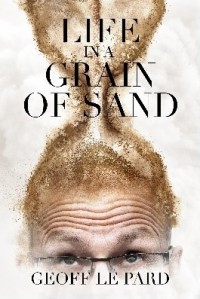
    Life in a Grain of Sand by Geoff Le Pard

    Life in a Grain of Sand is a 30 story anthology covering many genres: fantasy, romance, humour, thriller, espionage, conspiracy theories, MG and indeed something for everyone. All the stories were written during Nano 2015

    Smashwords

    Amazon.co.uk

    Amazon.com

    Salisbury Square by Geoff Le Pard

    Salisbury Square is a dark thriller set in present day London where a homeless woman and a Polish man, escaping the police at home, form an unlikely alliance to save themselves.

    This is available here

    Smashwords

    Amazon.co.uk

    Amazon.com

    Buster and Moo by Geoff Le Pard

    Buster & Moo is about two couples and the dog whose ownership passes from one to the other. When the couples meet, via the dog, the previously hidden cracks in their relationships surface and events begin to spiral out of control. If the relationships are to survive there is room for only one hero but who will that be?

    Smashwords

    Amazon.co.uk

    Amazon.com

    Life in a Flash by Geoff Le Pard

    Life in a Flash is a set of super short fiction, flash and micro fiction that should keep you engaged and amused for ages

    Amazon.co.uk

    Amazon.com

    Smashwords


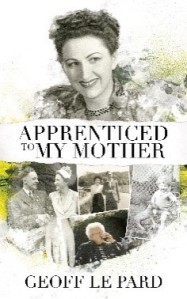
    Apprenticed to My Mother by Geoff Le Pard

    Apprenticed To My Mother describes the period after my father died when I thought I was to play the role of dutiful son, while Mum wanted a new, improved version of her husband – a sort of Desmond 2.0. We both had a lot to learn in those five years, with a lot of laughs and a few tears as we went.

    Amazon.co.uk

    Amazon.com

    Life in a Conversation by Geoff Le Pard

    Life in a Conversation is an anthology of short and super short fiction that explores connections through humour, speech and everything besides. If you enjoy the funny, the weird and the heart-rending then you’ll be sure to find something here.

    Amazon.co.uk

    Amazon.com


    If you missed previous reminiscences, check them out here:

    Charli Mills

    Sally Cronin

    Anne Goodwin

    Look for future interviews in this series to be posted on Sunday evenings AEST.

    Coming soon:

    Hugh Roberts

    Debby Gies

    D. Avery

    with more to follow.

    Thank you blog post

    Thank you for reading. I appreciate your comments. Please share your thoughts.


  • School Days, Reminiscences of Anne Goodwin

    School Days, Reminiscences of Anne Goodwin

    Welcome to the School Days, Reminiscences series in which my champion bloggers and authors share reminiscences of their school days. It’s my small way of thanking them for their support and of letting you know about their services and publications.

    This week, I am pleased to introduce Anne Goodwin, short story writer, novelist, reviewer and blogger … to list just a few of her many accomplishments.  Anne and I have been friends almost since the beginning of my blogging days and she has featured in my posts several times in the past, including here, here and here.

    Anne was not the first person I met when I began blogging, but she is the earliest to still be with me on my journey. Interestingly, we met on Twitter where a discussion about singing (or not) led to a blog post and then countless conversations on her blog and mine for more than five years. She also supported me as co-judge for two years running in the Carrot Ranch Rodeo Flash Fiction Contests.

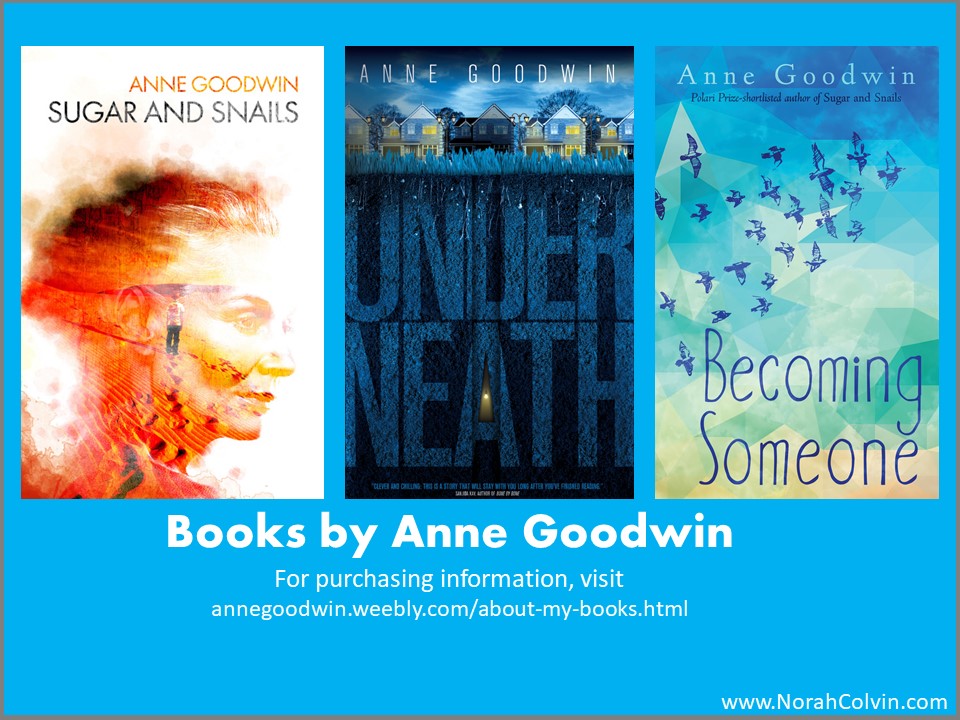
    I had the pleasure of meeting Anne in London in 2014 when I was visiting family. We met at the British Library and, during the course of the day, Anne revealed a secret – she had secured a contract for her first novel Sugar and Snails. She was already a published and award-winning writer of short stories, but now she could add novelist to her achievements. I was thrilled to be one of the first to know and I told her that I was pleased to have known her before she became famous.

    Since then Anne has published a second novel Underneath and is working towards publication of a third. Her most recent book Becoming Someone is a collection of her short stories. Some of the stories I had previously read, and just as many or more I hadn’t. I had been a fan of Anne’s stories since first encountering them and was thrilled to have a collection in one volume, perfect for savouring morsel by morsel. I was even more delighted with the acknowledgement in the front of the collection ‘For Norah Colvin and Charli Mills’. What’s to not like?

    I could continue to ‘sing’ Anne’s praises, but perhaps we should move onto her interview. Before we do, I’ll let Anne tell you a little of herself:

    Anne Goodwin’s debut novel, Sugar and Snails, about a woman who has kept her past identity a secret for thirty years, was shortlisted for the 2016 Polari First Book Prize. Her second novel, Underneath, about a man who keeps a woman captive in his cellar, was published in May 2017. Her short story collection, Becoming Someone, on the theme of identity, was published in November 2018. A former clinical psychologist, Anne is also a book blogger with a special interest in fictional therapists.

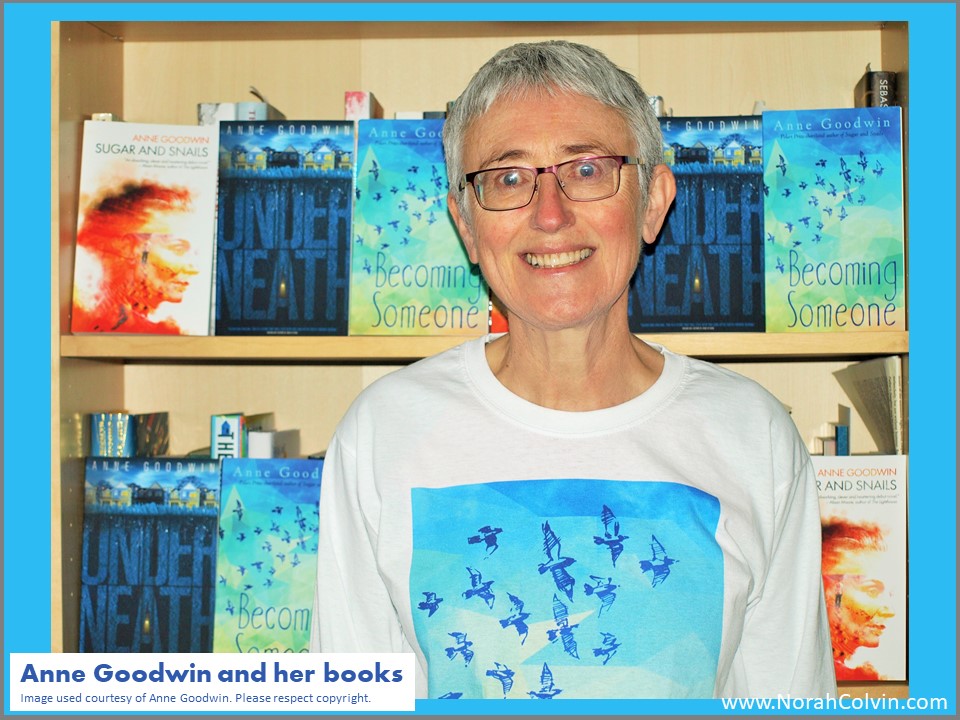
    Anne Goodwin and her books

    Welcome, Anne.

    Now let’s talk school. First of all, where did you go to school, and what was the highest level of education you received?

    I attended Catholic (state) schools in a small town in the north of England from the age of 5 to almost 18. I then went to university where I gained a BSc in Mathematics and Psychology and a PhD in Psychology, then an MSc in Clinical Psychology which was also a license to practice.

    What work or profession did you choose after school and was there anything in school that influenced this choice?

    I suspect my career in Clinical Psychology was despite my schooling – or perhaps unconsciously I wanted to understand why it was so bizarre! (One of my short stories, “Kinky Norm”, which you can read for free, is based on a true story of the impact of repression on adolescent girls.)

    What is your earliest memory of school?

    It might not be my earliest memory, but I do recall a boy being caught by the teacher picking his nose. ‘Where do you put it?’ she asked, vis-à-vis the snot. ‘Nowhere,’ said the boy, which I thought an excellent answer. I couldn’t understand why she ridiculed him but, in those days, ridicule was the norm.

    I also remember being so anxious that, if the teacher said an as in an apple, I heard it as Anne, and assumed some punishment was on its way. I suppose that was a product of the strictness of both school and home cultures, where it was deemed perfectly acceptable for an adult to hit a child. I think (memory being so fickle) I managed to avoid the worst of it by hypervigilance and obedience, which served me in good stead in a system that was less about genuine learning than doing as you were told.

    What memories do you have of learning to read?

    I couldn’t read on starting school, but quickly learnt, despite the classroom tension. I remember the primers (Janet and John) being ever so dull, but I didn’t mind too much as I soon moved on to better things.

    What memories do you have of learning to write?

    Learning to write was more frustrating, as described in a post on my blog. The teacher stood at the blackboard etching row upon row of noughts and crosses in coloured chalk. We sat at desks, copying the figures into our books with fat wax crayons. At home, colour meant drawing wherever the inspiration took me. When we progressed to proper letters, I couldn’t see why it was wrong to shape my ‘g’ and ‘a’ as they appeared in a printed book.

    What do you remember about maths classes?

    We didn’t embark on what I call mathematics (as opposed to arithmetic) until secondary school, with yummy simultaneous equations and those soon-to-be obsolete slide rules, of which I had two (and probably still have somewhere in the loft). Before that came the dreaded times tables, catechism with numbers, yet after hours of chanting (and a 1st class degree) I still can’t tell you what 7×8 makes, without stopping to work it out.

    What did you like best about school?

    School was a life sentence; I didn’t expect to enjoy it. But I always liked reading and writing, as long as we were free to choose the topic for ourselves. And Music and Movement, which was a radio programme that did what it says on the tin, and features in my debut novel, Sugar and Snails.

    What else would you like to tell us about your school days?

    I almost left school at sixteen, and stayed on for A’ levels (university entrance) only because the career officer’s recommendation that I work in a bank (being good at maths, albeit not at numbers) seemed even less inspiring. I’m so glad I did! Out of uniform and in classes of no more than a dozen (education post 16 being a new venture for my school), I blossomed, especially in English. (Why didn’t I study that at university? Maybe because I associated reading with leisure, although the texts we picked apart in class were anything but.)

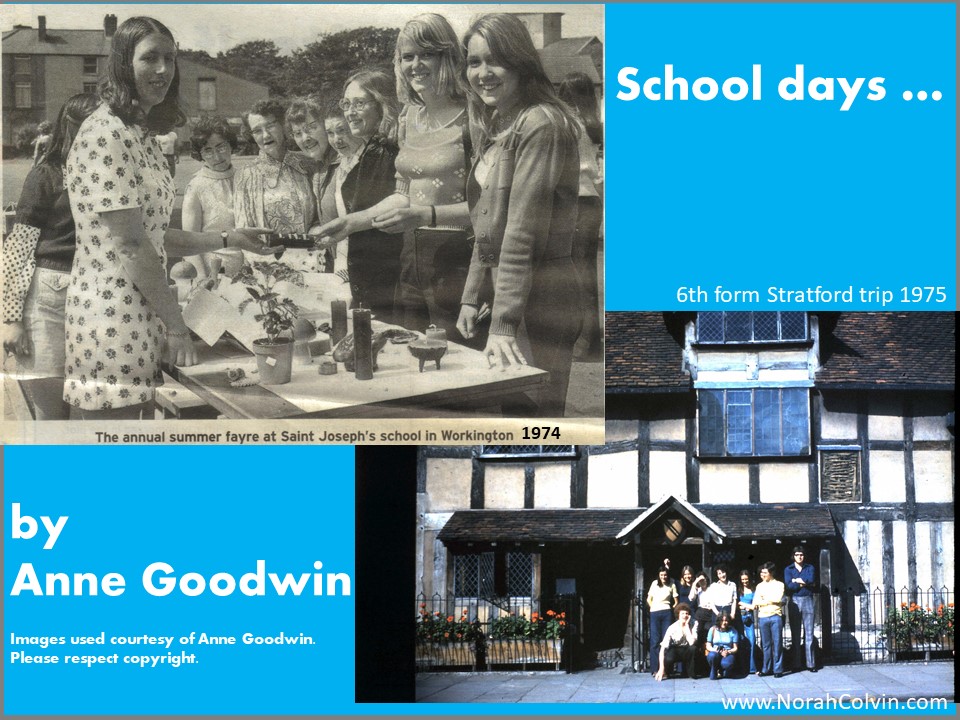
    Anne Goodwin's school days

    Given my capacity for compliance, I’m lucky I made the transition to critical analysis. Suddenly (although we’d probably been sliding dangerously towards it since the age of eleven), I was expected to have an opinion, to examine texts from different points of view. (Although not in maths, which provided a counterbalance, a safe space where the right answer remained stable over time.)

    All credit to Pauline Blair, the teacher who joined the school at the start of our A’ level years. I think she found it a culture shock, and we were equally bewildered by her. She was posh! She claimed to be a feminist which, in my ignorance, I thought meant feminine, given that she ticked me off for slouching and sitting with my legs wide apart. She took us to see the Royal Shakespeare Company in Stratford, and sang (properly, the way I do now) on the long drive home. She’s the only teacher I’d like to meet again, to see what she made of us in that insular part of the world.

    What are your thoughts about schools, then and now?

    I think it’s great that so many kids these days enjoy school: despite repeated ministerial interference, teachers must be doing something right. It’s great that there’s no physical punishment but, with limited resources, more kids are excluded than in my day. It’s still impossible to tailor teaching to individual learning styles (I’d probably have struggled in a noisy aka lively classroom) and much more pressure (or maybe my school was atypical in being insufficiently clued up for the antediluvian equivalent of league tables) on exams.

    How do you think school could be improved?

    1. Reinvest in SureStart (it was a UK New Labour thing for at-risk preschoolers) so that all kids have the skills they need for school.
    2. Scrap private schools’ charitable status and put the taxes raised into state education.
    3. Abolish all religious schools, and schools established to follow a particular fad.
    4. Provide every child with a light breakfast and a three-course vegan lunch (to avoid the expense of catering for different diets) for free. Kids can’t learn if they’re hungry, and we desperately need to give the adults of tomorrow the skills to pursue a healthy diet. (So cooking and gardening lessons too.)
    5. Halve class sizes, and give teachers more support, including optional counselling / short-term therapy for anyone working with kids.
    6. Foreign language and music classes from the early(ish) years and (although I hated it) compulsory exercise through a diversity of sports. (Why should these life-long benefits be restricted to those whose parents can cough up the dosh?)
    7. Prevent (religious) parents from withdrawing their children from certain lessons, such as sex and relationships, including same-sex couples.

    Idealistic? Too expensive? Not if we care about the future society we build.

    thank you for your participation

    Thank you for sharing your reminiscences of school and thoughts about education in general, Anne. It’s been wonderful to have you here again. I enjoyed learning about your school days and agree with so many of your recommendations for improving education. Now, if only we could get some of those with the ‘power’ to listen to us.

    Find out more about Anne Goodwin:

    Website: annegoodwin.weebly.com

    Blog: annegoodwin.weebly.com/annecdotal

    Amazon author page: https://www.amazon.co.uk/Anne-Goodwin/e/B0156O8PMO/

    and her books:

    Anne’s books: annegoodwin.weebly.com/about-my-books.html

    YouTube: www.youtube.com/channel/UCLxWxjJlY4hxuP9bzah5F_g

    Connect with her on social media:

    Twitter: @Annecdotist

    Books by Anne Goodwin

    If you missed previous reminiscences, check them out here:

    Charli Mills

    Sally Cronin

    Look for future interviews in this series to be posted on Sunday evenings AEST.

    Coming soon:

    Geoff Le Pard

    Hugh Roberts

    Debby Gies

    D. Avery

    with more to follow.

    Thank you blog post

    Thank you for reading. I appreciate your comments. Please share your thoughts.
     

  • School Days, Reminiscences of Charli Mills

    School Days, Reminiscences of Charli Mills

    Welcome to the School Days, Reminiscences series in which my champion bloggers and authors share reminiscences of their school days. It’s my small way of thanking them for their support and of letting you know about their services and publications.

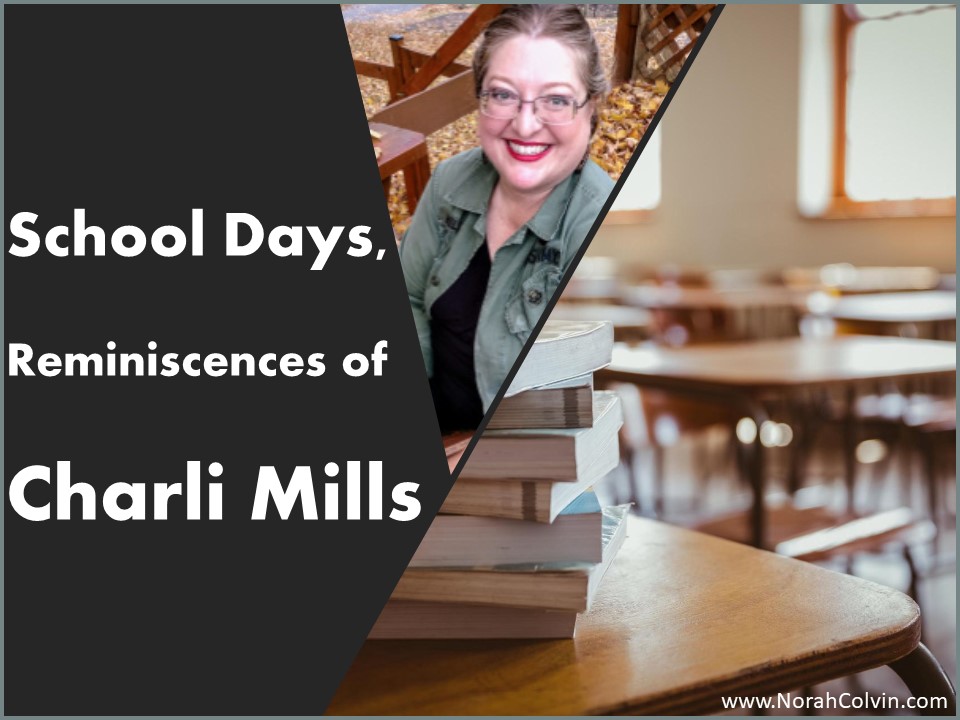
    First to share her reminiscences is Charli Mills, lead buckaroo at the Carrot Ranch where she challenges writers with a weekly flash fiction prompt and an annual flash fiction rodeo. She believes in the power of literary art to change lives and that it should be accessible to everyone. She encourages writers to find their voice in a supportive environment where everyone is welcome.

    I have known Charli for almost as long as I have been blogging and was among the first to participate in her flash fiction challenges when they began five years ago this month. I have rarely missed a week since. Charli’s support and encouragement of my writing and my work has been unfaltering, even when she was experiencing her own tough times, and I am extremely grateful for it. I don’t know how well I may have maintained my yet mindset without her.

    Before we begin the interview, I’ll allow Charli to tell you a little of herself:

    Charli Mills, a born buckaroo, is the award-winning goat-tying champion of a forgotten 1970s rodeo. Now she wrangles words. Married to a former US Army Ranger, Charli is “true grit” although shorter than John Wayne. She writes about the veteran spouse experience and gives voice to women and others marginalized in history, especially on frontiers. In 2014 she founded an imaginary place called Carrot Ranch where real literary artists could gather where she hosts a weekly 99-word challenge. She’s pursuing her MFA with SNHU, writing novels, and leading workshops to help writers with professional development.

    Welcome, Charli.

    Now let’s talk school. First of all, could you tell us where you attended school?

    Sacred Heart Catholic School (Hollister, California), Sunnyside Elementary (Hollister, California), Diamond Valley School (Woodfords, California), Douglas High School (Minden, Nevada), and Carroll College (Helena, MT).

    Did you attend a government, private or independent school?

    Sacred Heart was a private Catholic school, and so was Carroll College. I achieved kindergarten at one and a BA at the other. The other three were public schools. Diamond Valley was located next to the Woodfords Community of the Washoe Tribe. Our county was too small in population to warrant its own high school and the mountains cut us off from the nearest California option at Lake Tahoe so we were bussed into Nevada to Douglas High School, which was a horrible experience as we faced much prejudice as the “Alpine kids” even though not all of us were Native American.

    What is the highest level of education you achieved?

    To date, I’ve earned a Bachelor of Arts degree in English –Writing. However, I’m in the application process to pursue a Masters of Fine Art in Creative Writing.

    What work or profession did you choose after school and was there anything in school that influenced this choice?

    At Diamond Valley, in 7th-grade, Mr. Price made us write a spelling story once a week using the “prompt” of words from our spelling list. My stories were long and he encouraged me to write them longer. Then he asked me to read my stories aloud to the class every week, and I have loved reading my writing ever since. In high school, I struggled unless writing was involved. Ms. Bateman hit me hard with editing, but also taught me how to improve. She invited me to be on the newspaper team and I was the youngest member. By my senior year, I was co-editor. After high school I waited tables, worked road construction, and wrote for a daily newspaper, dreaming of going to college to be an archeologist and an author. Ten years later, I enrolled in a writing degree when my three young children started school. I often joked that I went back to kindergarten with them. My freelance writing took off while I was still in college. I never did become an archeologist and I worked 20 years in marketing before pursuing my author dreams, but my first novel will feature a character who is an archeologist. It’s all connected to my days at Diamond Valley School, and the skills I honed at Carroll College.

    What is your earliest memory of school?

    My earliest memory of school is being in trouble. I was highly imaginative and evidently, the nuns did not appreciate my drawings in textbooks. We lived on a ranch outside of Hollister California and my mother worked in town. She’d drop me off at a sitter’s and I’d walk to school every morning with the daughter who was in kindergarten, too. She never got in trouble. I recall wondering why I was so different and why the nuns didn’t like my freedom of expression. At Carroll College, I took an art appreciation class and wrote a paper on my theory of Greek influences on modern pornography. I worried I was going to get in trouble again for expressing my ideas, but the Jesuits loved it. I thought about sending that paper to Sister Margaret at Sacred Heart, explaining that I turned out fine, using my imagination.  Not sure she would agree!

    What memories do you have of learning to read?

    Books captivated me! I wanted to crack the code and would sit and pretend read. The nuns said I couldn’t read so the next grade placed me in remedial reading until the teacher caught me “pretend” reading a chapter book. She realized I wasn’t pretending. How I learned to read mystifies me. I couldn’t grasp the components, but I could read. Math was similar. I had the answers but struggled to show the work. Spelling escapes me but writing flows. Learning was always a frustration in school, yet I was always curious and even now I love to learn.

    What memories do you have of learning to write?

    Again, learning the actual mechanics of writing was frustrating, but any time teachers let me be creative or pursue curiosity, I could write volumes. Like reading, I just wrote. It wasn’t until high school when Ms. Bateman got a hold of me and drilled grammar into my head, and explained editing as a process. But I also felt it shut down my creativity. I didn’t learn until later how creativity serves as a bridge between my right and left brain. Once I understood that, I’ve made it a point to allow creativity to thrive in my work and writing.

    What do you remember about math classes?

    Pain and suffering! I never found a saving grace in math because I never found a way to be creative with numbers. In fact, creativity with numbers is frowned upon.

    What was your favourite subject?

    I loved history because it was full of stories. I’ve been a natural born story-catcher and history seemed to be a part of that. Where I lived was part of the old Comstock Lode and emigrant trails, and I attended school with Washoe students, learning their lore and history. My aunt used to take me relic hunting, and I had a huge collection of arrowheads, trade beads and square nails. I could spot a relic from on top of my horse. I learned to read the human imprint on the land, and when I was 17, I met a state archeologist who legitimized my ability and he coached me to record 11 archeological sites in my hometown area. So, in school, I loved history most.

    What did you like best about school?

    Charli Mills like skiing best at school

    Skiing. In the winter, we skied once a week at the ski resort near our school for winter PE. It was the best! I don’t know of any other school that ever had such a perk. I remember waking up so excited on ski days. The resort was huge and when we were young, six and seven years old, we were sent to the bunny hills and taught to alpine ski. By the time we were pre-teens we were skiing black diamond routes. I remember #4 best. I loved #4! We’d take the #1 chairlift up, and ski over to the #2 chairlift. At the top of #2, we’d ski down a long, steep and remote mountainside where chairlifts #3 and #4 sat perpendicular to each other. After we skied down #3, we’d take the longest lift at the resort, #4 all the way to the top of a mountain so isolated and remote, it boggles my mind today that we got to do this as school kids. Here’s a link to Kirkwood today: https://www.kirkwood.com/the-mountain/about-the-mountain/trail-map.aspx. When we skied, there were only six chairlifts, but you can see how far away #4 was from the lodge. Funny story – by the time I was in 7th-grade and was writing spelling stories, my good friend Gerald shared his dad’s Ian Fleming novels with me. I went from Little House on the Prairie to James Bond! Gerald was my skiing buddy and we used to make the #4 loop together. We’d pretend we were British spies! Ah, it was good to have someone to share an imagination with. I doubt anyone else who answers this question will ever say skiing.

    What did you like least about school?

    Mean people. Kids and adults can be cruel and I don’t fully understand why – is it cultural? Is it human nature? The level of cruelty could be stunning at times. I think this is what taught me empathy. Bullies taught me to care about others. If I wasn’t the one being bullied, I found I couldn’t tolerate others being bullied either.

    How do you think schools have changed since your school days?

    For one thing, I don’t think students are turned loose on ski hills anymore! I think there’s more respect for cultural diversity than when I went to school. Obviously, technology has changed. Diamond Valley is still a small remote school, but it now has an alternative high school, which is a good change. I think bullying is better dealt with now and parents are more involved, perhaps too involved. In the US, the crisis of school shootings is unfathomable to me. Even with all my bad experiences of being bullied and witnessing it, no one was armed. But that mean spirit was always there and now it has access to guns and that is terrifying. Hopefully, education continues to be important as technology changes our societal landscapes, and through education, we can resolve this shameful American blight on our school system. Maybe we need to focus less on gun control and getting more to the heart of abuses of power in our nation. We need to heal from institutions of slavery and Native American genocide. We need less division and more dignity.

    What do you think schools (in general) do well?

    I think schools provide inroads to learning that are valuable to becoming productive and happy human beings. Schools are amazing, really. They have been a part of what is America at its worst and what is America at its best. Schools do well to create environments where real learning takes place.

    How do you think schools could be improved?

    Most importantly, schools need to be safe. Early on, we need to give children the gifts of education and not the burdens. I think citizens should be involved in their public schools even if they don’t have children. How can we be part of the improvement? I don’t have the answers, but I’m willing to be a part of solutions. I support EveryTown for Gun Safety, and until we deal with the hardest cultural issues in our nation, it doesn’t matter if our schools achieve awards or graduate students who score well on tests.

    thank you for your participation

    Thank you for sharing your reminiscences of school and thoughts about education in general, Charli. It’s been wonderful to have you here. I learned so much I didn’t already know about you.

    Find out more about Charli Mills

    at the Carrot Ranch: https://carrotranch.com/

    and on her Amazon Author Page: https://www.amazon.com/Charli-Mills/e/B078FV6JGB

    Connect with her on social media

    Facebook Page: https://www.facebook.com/CarrotRanch/

    Twitter: https://twitter.com/charli_mills

    The Congress of Rough Writers Flash Fiction Anthology Vol 1

    Purchase your own copy of

    The Congress of the Rough Writers Flash Fiction Anthology Vol 1

    via the Carrot Ranch bookstore: https://store.bookbaby.com/book/The-Congress-of-Rough-Writers

    Participate in a

    Carrot Ranch Writing Refuge (Keep updated at the Ranch)

    Look for future interviews in this series to be posted on Sunday evenings AEST.

    Coming soon:

    Sally Cronin

    Anne Goodwin

    Geoff LePard

    Debby Gies

    Hugh Roberts

    D. Avery

    with more to follow.

    Thank you blog post

    Thank you for reading. I appreciate your comments. Please share your thoughts.

  • Holiday wishes and inspiring teaching videos 2018 – Readilearn

    Holiday wishes and inspiring teaching videos 2018 – Readilearn

    Holiday wishes

    As the holiday season draws nigh, I wish you and your loved ones a very happy and safe holiday season. May you have time to relax, refresh, rejuvenate and, most of all, have fun.

    Teaching inspiration

    Holiday time can be perfect for catching up on things missed during the busyness of work. To both affirm and inspire you, I have curated a short list of some of my favourite videos. I hope you find time to enjoy them too.

    Ten inspiring videos

    Kate DiCamillo on the magic of reading aloud

    Continue reading: Holiday wishes and inspiring teaching videos 2018 – Readilearn

  • Holiday activities maintain school learning – Readilearn

    Holiday activities maintain school learning – Readilearn

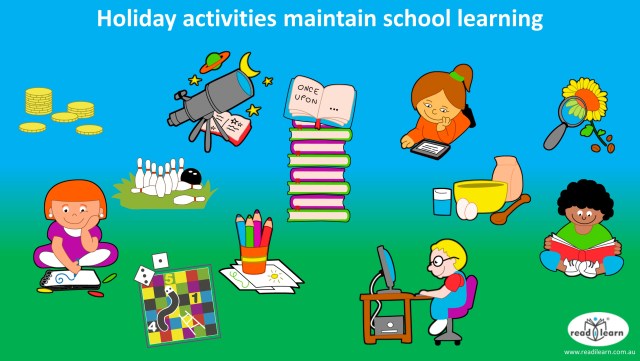
    Parents often ask teachers for suggestions of holiday activities that will maintain learning before children return to school. While we neither expect nor want children to spend hours at a desk engaged in school-type lessons, there is plenty that parents can do with their children to keep them curious and motivated to learn. This post includes suggestions teachers can provide to parents.

    Some of the best things parents can do to maintain children’s learning are: 

    • Encourage their questions and help them find, rather than simply provide, the answers.
    • Engage children in experiments to discover what happens. Don’t rely exclusively on books or internet searches.
    • Take them on outings and adventures to natural as well as constructed points of interest; such as rainforests, beaches, national parks, marine parks, libraries, museums and art galleries.
    • Talk with them about anything and everything including feelings, dreams, goals, desires for the future, fears, how things work and what happens if.
    • Read to them, with them and beside them. Show them you value reading for a range of purposes including for information and enjoyment.
    • Play games with them—indoor and outdoor games, board games and games you create or construct.
    • Most of all, spend time being with them, enjoying their company, getting to know them, in the present moment. Childhood is fleeting and each moment, precious.

    Free handouts of holiday activities that maintain school learning 

    There are three free handouts of holiday suggestions available for teachers to distribute to parents, or indeed for parents to access for themselves.

    Continue reading: Holiday activities maintain school learning – Readilearn

  • Kept in the dark

    Kept in the dark

    Have you ever engaged in an experiment to see how bean seeds grow when kept in the dark compared to how they grow when provided with sunlight? It’s an experiment familiar to many school children. The purpose of the experiment is to show that light is needed for the seeds to grow and children soon find that those kept in the dark do not thrive.

    My father used to say that what you don’t know doesn’t hurt you. He wasn’t happy when my brother wrote in my autograph book that what you don’t know doesn’t do you much good either.

    what you don't know won't do you much good either
    © Norah Colvin

    Although my parents were keen for my siblings and me to get a good education, there were some things about which they preferred to keep us in the dark — secret adult things. It seems they thought some knowledge might be dangerous, so they were selective in what we were told.

    I am of the opposite view, thinking that a lack of knowledge may be even more dangerous. Just as bean seeds don’t thrive in the dark, minds can’t thrive if kept in the dark either.

    Nowadays, in schools, there is an emphasis on the need for being explicit in our teaching, of making sure that children know what they will be learning, what is expected of them and why.

    In my childhood days, if a reason was given, it was often ‘Because I said so’ or ‘Because it is’. I much prefer the modern way and, as with many things, believe that knowledge begets knowledge. It is difficult to be interested in something about which you know nothing. But knowing, even just a little, can stimulate curiosity to know more.

    I have written about this belief before in posts such as Child’s play —the science of asking questions, Visioning a better school, a better way of educating, and Reflect and refine, to name but a few.

    Into the dark flash fiction prompt at the Carrot Ranch

    This week at the Carrot Ranch, Charli Mills wrote about the darkness we feel when we’ve lost our guiding star, or when the spark of creativity has dimmed. She challenged writers to In 99 words (no more, no less) write a story using the phrase “into the dark.” What must a character face? Write about an encounter, journey, relationship, or quest. Follow the ship’s lights on gloomy seas. Go where the prompt leads you.

    Funnily enough, the prompt took me to neither darkness of the mind nor heart, but to the literal darkness of a stormy night. I hope you enjoy it.

    Stepping into the unfamiliar

    The car lights dimmed as she reached the door – timed perfectly. But, when the porch light didn’t activate, immersing her in total darkness, she cursed the storm. As she pushed the door of the still unfamiliar house, she rummaged for her phone. Dang! No charge. She inched along the wall, fingers seeking the corner and toes the step she knew was close. Stepping down, she dumped her bag and tossed her saturated scarf. She edged towards the sideboard and a battery-powered candelabra. As she fumbled for the switch, the room was flooded with light and cheers of ‘Happy housewarming!’

    Thank you blog post

    Thank you for reading. I appreciate your feedback. Please share your thoughts.