The beginning of the year is a great time for getting to know each other. Children will feel comfortable and friendly towards each other in a welcoming classroom environment that values and respects individuals; and in which appreciation for our diversity, as well as our commonality, is nurtured.
When children feel safe to be who they are, they are more accepting of others.
While it is important to establish a welcoming environment at the beginning of the school year, it is equally important to maintain the supportive environment throughout the year. It is not something we do to pretty the room and then forget about it. It is a part of who we are, and comes from a firm belief in the value of each individual, of community, of humanity, and of our world.
I am one of ten children, though none of us are children any more. The youngest has turned 50, and the oldest is nearing 70 (but don’t tell her that).
My mother sometimes had difficulty retrieving the correct name and often went through a list before hitting on the child she wanted. I know what it’s like. Sometimes it is difficult enough when there are only two or three to choose from! Maybe you’ve experienced it too. There’s probably a name for this phenomenon, but if there is, I’m not aware of it.
One day, when wanting to give me a direction, she rattled off a few names, but not mine. Finally, exasperated, she said, “Well, you know who you are.” It has become a family joke. It’s mostly true that I do know who I am. However, sometimes I’m not so sure! I must say that Mum had a wonderful memory until the day she passed just a few weeks before her 91st birthday.
This week at the Carrot Ranch, Charli Mills is talking about the importance of being able to name things and experiences. She says, “Names are such a human attribute,” and asks, “What is in a name?”
The ability to name things is important and a young child’s vocabulary often begins with the names of people and objects in the environment; for example, Mum, Dad, dog, car, cookie, juice.
I read once that children don’t really become aware of an object until they are able to apply a name to it. This doesn’t mean they must be able to say the name, just recognise it by name. Unfortunately I don’t remember the source and was unable to verify it with a Google search; but there is no denying that a well-developed vocabulary is a definite advantage to learning.
Children also quickly learn to recognise their own names. Choosing names for children can be a difficult process for parents, with much to consider; for example:
The name’s meaning
Whether anyone else in the family has the name
How it is spelled
What the initials will be
How the first and last names sound together
Teachers always have the extra burden of being influenced by the names of children they have taught.
Although this blog simply bears my name, choosing a name for my website was a more involved process. Years ago, I ran a home business called Create-a-Way. I chose the name as I thought it expressed the purpose of my business perfectly: children were encouraged to be creative, and it created a way for me to work with children in the way I wanted. I hoped to reuse the name for my website. Unfortunately, the domain names were not available, and I had to think even more creatively.
I eventually settled on the name readilearn as I love reading, and I love learning, and the ‘i’ in the centre puts the focus on the individual learner. I wanted the name of my website to show the importance of reading and learning to an individual’s growth and empowerment. However, when I say the name, I pronounce it “ready learn”. This refers to an individual’s innate readiness to learn, as well as to the resources which are ready for teachers to use in their support of learners.
One of the most important things for a teacher is to get to know the children. I used to pride myself on knowing the children’s names before morning tea on the first day. Of course, I had many strategies in place to help me with that. I have written about some of these strategies before, and there are readilearn resources to support teachers with that as well. In fact, writing this post has stimulated ideas for new resources to create, including resources that help children get to know each other. (Thanks, Charli!)
I have always found it fun to notice when people’s names are a good match for their profession; for example, Matt Dry the weather forecaster.
The community hall was abuzz. Everyone was outtalking the other, except Ms Penn who quietly recorded everything.
“I’m pretty cut up about it,” complained Mr Carver.
“He fired me,” moaned Mr Burns.
“Said I was just loafing around,” grumbled Mr Leaven.
“Could’ve floored me,” griped Mr Lay.
“He was fishing for something,” remarked Ms Salmon.
“Said he’d top me,” sprouted Ms Bean.
“Another nail in his coffin,” whined Mr Chips.
Ms Chalk took the stand. “It’s not just black or white. He knows why you all avoid him like, well … Give him a chance. He’s not his name.”
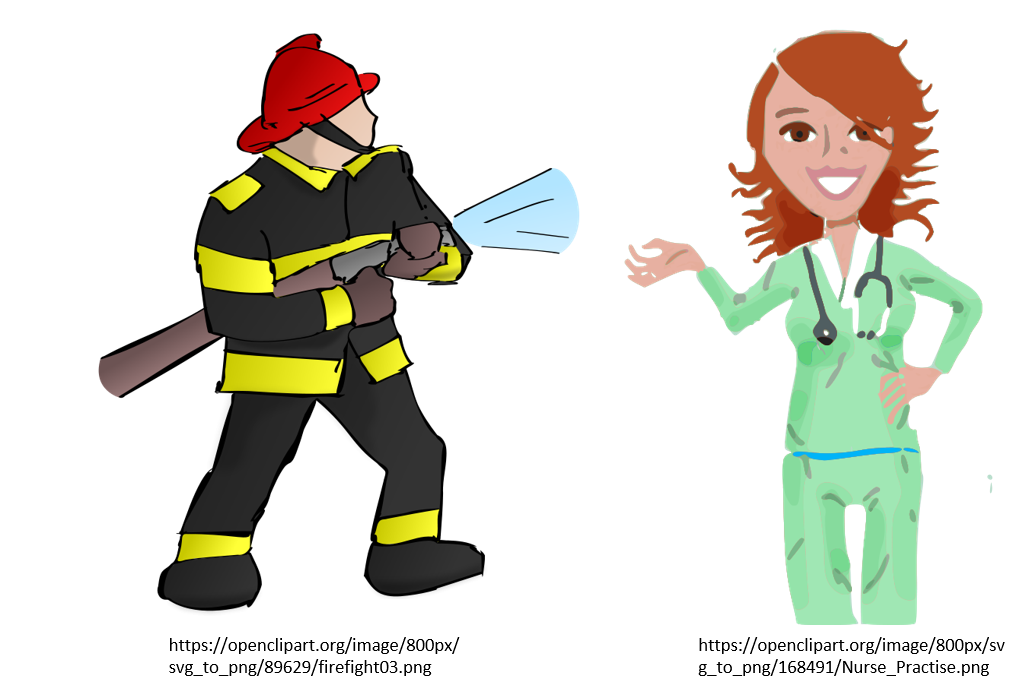
Did you recognise them all: the journalist, the butcher, the fireman, the baker, the tiler, the fishmonger, the greengrocer, the carpenter, the teacher; and, of course, the one they’re all talking about: the new doctor.
Thank you for reading. I appreciate your feedback. Please share your thoughts.
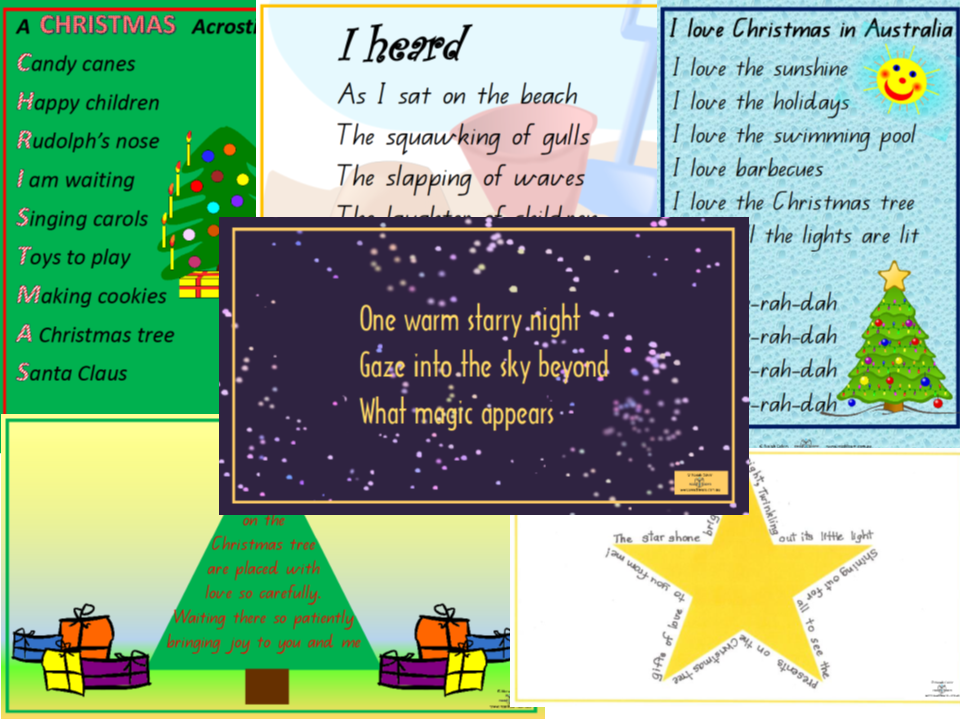
Giving young children a simple structure or a repetitive pattern to start from gets them thinking about words, how they sound, what they mean, the number of syllables and letters. All the while they are having fun, playing with words and sounds, and learning about language.
Five easy poems to write with children are:
Acrostic poems
Sound poems
Haiku
“I love” poems, and
Shape poems
Acrostic poems are one of the easiest. They don’t need to rhyme or follow a set rhythmic pattern.
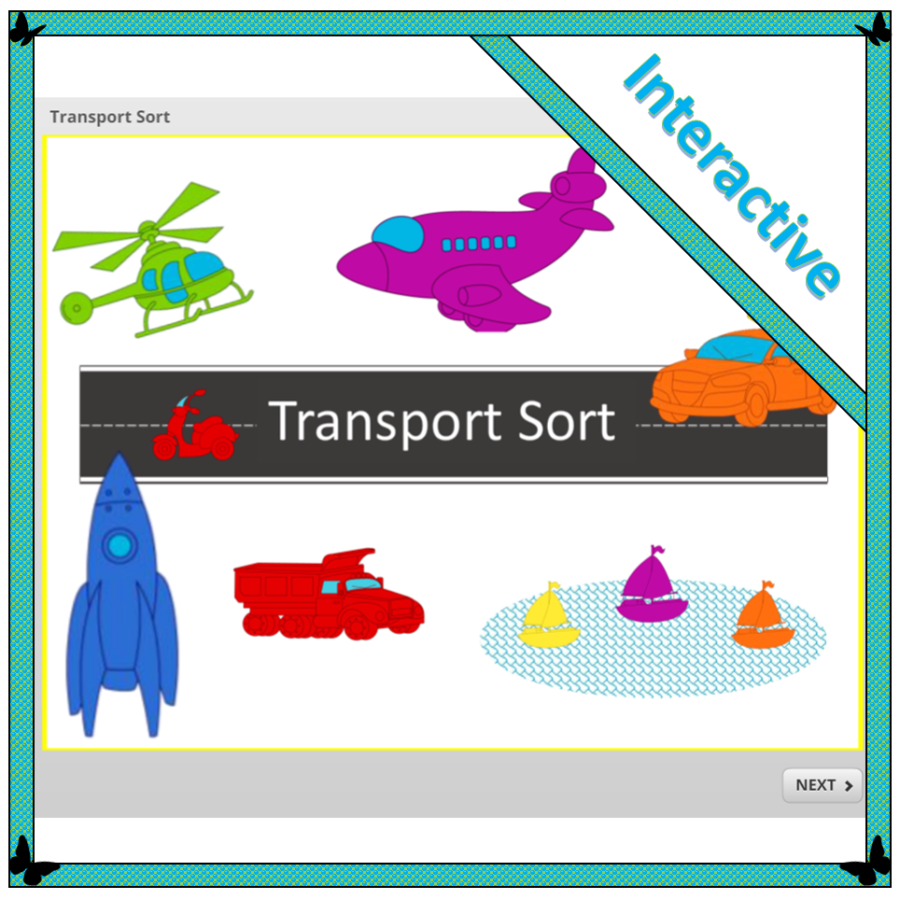
Sorting is a very important skill. We sort things every day without even thinking about it. We sort items in cutlery drawers, sort and arrange dishes in the dishwasher, even our socks and undies. While we might not physically sort them, while we are walking down the street we might sort familiar from the unfamiliar, friends from strangers, and safe from unsafe.
From a very young age, children learn to sort. They can spend a lot of time organising things that go together. By the time they arrive at school most children are able to sort objects according to their properties; such as shape, colour, texture, smell, and size. This prepares them for use of a dichotomous key in identifying natural and manufactured objects.
The interactive resource Transport Sort helps children develop sort
Australia is home to a great diversity of, and many unique animals. Most native Australians are not found anywhere beyond its territories. I guess that’s not surprising since it is the world largest island or smallest continent country with vast expanses of ocean between it and other continents.
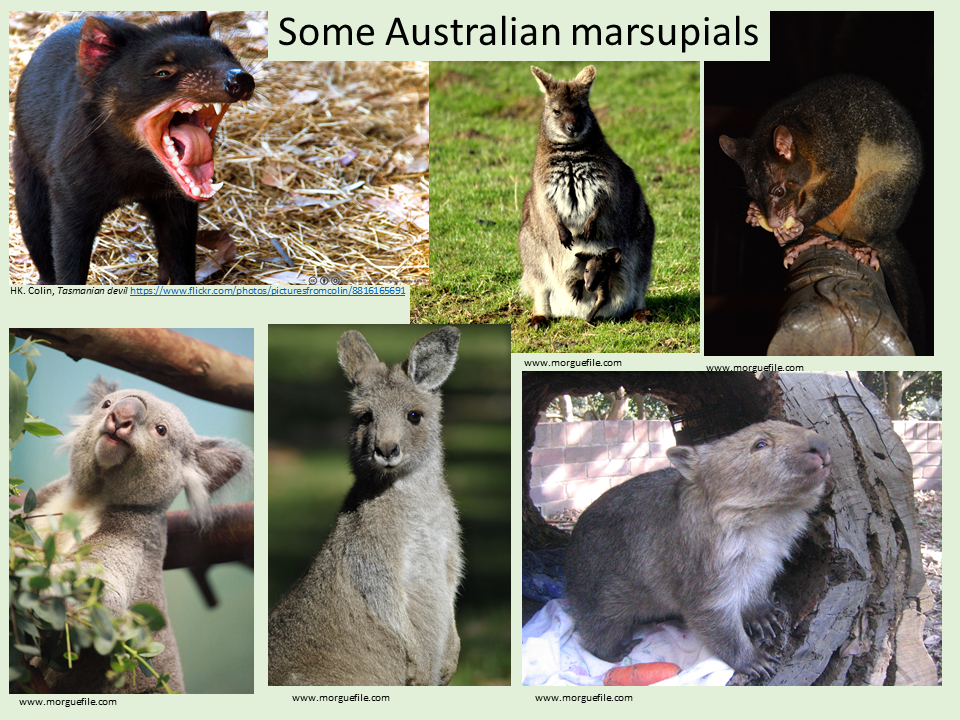
Australia is home to almost 70% of the world’s marsupials. Other marsupials are found in the Americas, mostly South America. Kangaroos, wallabies, koalas, possums, wombats, Tasmanian devils, numbats, bilbies, and quolls are among the species of marsupials found in Australia.
Marsupials are mammals that give birth to live young before they are fully developed. The young, usually referred to as joeys, continue to develop in the mother’s pouch for a number of months, suckling on their mother’s milk.
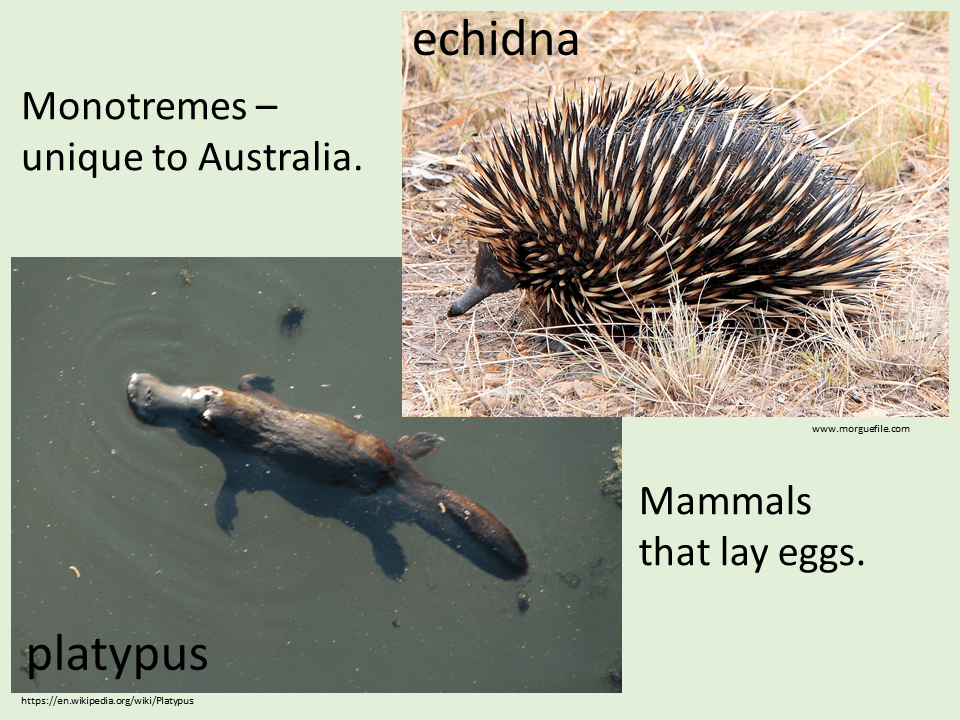
There is another group of even more unusual mammals: the monotremes. Monotremes are egg-laying mammals. The platypus and the echidna, the only existing species of monotremes, are unique to Australia.
The platypus
When Europeans first saw a platypus, they thought it was a hoax with its bill like a duck’s, tail like a beaver’s, and feet like an otter’s. It has fur like other mammals but, unlike other mammals, it lays eggs.
The platypus lives in burrows on the banks of freshwater streams and small rivers in eastern Australia, including Tasmania. It spends much of its time foraging in the muddy river beds for crayfish, worms and insect larvae.
Female platypus usually lay two eggs. When the young hatch, the mother releases milk from pores in her skin. The milk pools on her abdomen and is lapped up by the young for about three to four months. There is no special baby name for baby platypus. They are simply called ‘baby platypus’.
The male platypus, with a poisonous spur on its hind foot, is one of only a few venomous mammals.
Platypus predators include crocodiles, eagles, dingoes, and introduced animals such as foxes and feral cats.
The echidna
Echidnas, the oldest surviving mammals, live all over Australia in many different habitats. They usually live alone and are not territorial. Although it is rare to see an echidna in the wild, they are considered common. They generally hide away under vegetation, in logs, or in the burrows of other animals.
Echidnas eat termites and ants, and sometimes the larvae of other insects. They use their long snouts to forage in leaf litter, rotting logs, or ant mounds in search of food. Their long tongues are covered in sticky saliva for catching prey.
Echidnas are covered with spines along the head, back and tail. The spines are sharp and used for defence against predators.
Female echidnas usually lay one egg at a time. When the young, called a “puggle”, hatches, it makes its way to the mother’s pouch area to suckle milk. When the puggle starts to develop spines, at about 50 days, it is removed from the pouch. The mother continues to suckle it until it is about six to seven months old, at which time she deposits it at the entrance to the burrow, then walks away and abandons it.
Predators include goannas, Tasmanian devils, dingoes, eagles, and introduced animals such as foxes and feral cats. When threatened an echidna may run away or curl up in a ball.
Although all have spines, echidnas are not related to either hedgehogs or porcupines.
Here is a great article about these amazing echidnas.
If you are looking for books about Australian animals, check out the Steve Parish Storybook Collection by Rebecca Johnson, featured in last month’s Author Spotlight, which includes stories about both monotremes, many marsupials, and other fabulous creatures.
I was prompted to think about the diversity and uniqueness of these Australian animals, especially the echidna, by this week’s flash fiction challenge set by Charli Mills at Carrot Ranch Communications. She challenged writers to In 99 words (no more, no less) write a prickly story. I thought there was no better opportunity to share with you some of our amazing creatures, particularly since just last week I was lucky enough to see an echidna in the wild for the very first time.
The uniqueness and diversity of Australian animals reflects our own individual uniqueness and the diversity among us. We have much to learn about accepting difference, appreciating diversity, and acknowledging the unique characteristics each individual contributes to the enrichment of our collective humanity. Together we stand. Divided we fall.
Here is my response. I hope you enjoy it.
Stronger together
She bristled, warning platypus to stop. He didn’t.
“Feeling a little prickly, are we?”
Kookaburra, oblivious, laughed at the “joke”.
She smarted. Couldn’t he see the hurt in his words? Like a spur in her side, that last barb, really stung. Mocking difference pushed them apart.
The bush quietened. Not a breath of wind. Not a leaf’s rustle. Not a bird’s chirrup. Were all waiting for the victor to be decided?
Suddenly, out of the undergrowth, rushed a devil, hungry for blood.
Platypus turned to echidna. She contemplated leaving him. But stayed. Spur and spines together: a powerful defence.
Author’s note: Tasmanian devils have been known to eat echidnas, spines and all!
Thank you for reading. I appreciate your feedback. Please share your thoughts.
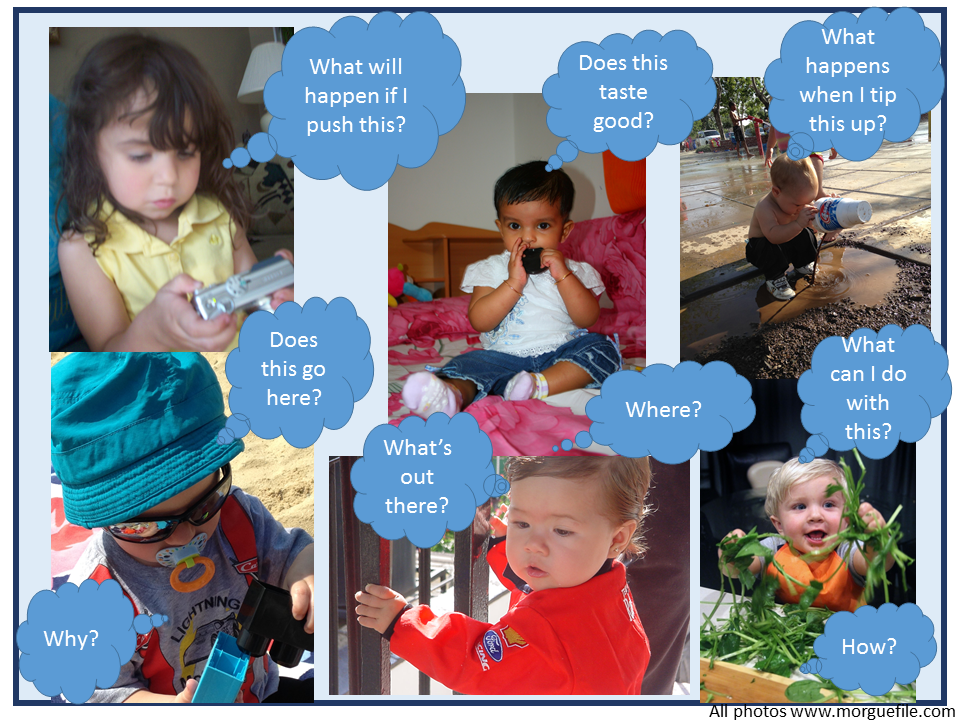
It is no secret that I love having time with young children. Their development constantly amazes me. They are curious learners on a quest to find out as much as they can about the world and how it works. They are scientific researchers making observations, forming hypotheses, and drawing conclusions; always with a plan for the next step if the results aren’t what was expected.
How many times do they need to release a spoon to be confident that it will always be pulled towards the floor? How early do they laugh when something doesn’t perform as expected; for example, when a balloon floats up instead of falling down?
Many of a young child’s explorations seek answers to questions they ask of themselves; questions that may never be verbalised.
After they have investigated their immediate environment, and their language begins to develop, they start to look at the wider world, and begin to ask questions about how things work and why things happen.
Here are a couple my granddaughter asked me recently:
“Norah, you know about gravity? Why do clouds stay up in the air? Why don’t they fall down?”
“If babies grow into adults, and adults give birth to babies. Which came first the baby or the mother?”
The determination and persistence of young children is also almost limitless. Watch them learning to roll, or to sit, or to stand. It is never achieved on the first attempt, but that doesn’t stop them. They don’t give up. They try and try again until they do it. The look of satisfaction on their faces is priceless. No stickers are required. Sometimes, when the result differs from expectation, the look is of surprise. But even then they are quickly deciding what to do next.
Without formal instruction of any kind, in their first few years, children perform amazing feats. Without the imposition of test requirements or standardised assessment, children are driven to learn. Intrinsic rewards, accompanied by the encouragement of significant others, for example, parents, are sufficient. Children are driven by a “yet” mindset and a belief that there is no such thing as “can’t”. This ensures they continue to practice until they succeed. Immediately they succeed, they set themselves another challenge. That is, unless they are taught otherwise.
When they are nurtured in an environment that is encouraging and supportive, with a balance of comfort and challenge, and well-timed feedback, children will thrive physically, emotionally, and mentally. They will learn through their observations and interactions with people and objects. Each question answered will stimulate the next.
These are just a few of the remarkable achievements made by children before setting foot inside any formal education establishment. They learn to
interact
roll over
sit up
crawl
clap hands
stand
walk
place things inside, and take things out of, other objects
feed oneself
talk
run
undo and do up buttons
push buttons (of all sorts)
open doors
play games
…
Given an encouraging, supportive environment with caring adults who respond to their needs, surround them with language, love them, and model behaviour, children learn amazing things.
Everything she had ever done was preparation for this moment. All eyes were on her. The audience’s expectation was palpable, bolstering her determination. She pulled herself up to full height and looked around, smiling. The audience waited. She checked the positioning of her feet, and her balance. She held up one hand, signifying that an attempt was imminent. She put one foot forward; then raised the other hand as she brought her back foot alongside the first. She paused, poised, momentarily. Immediately cameras clicked and cheers erupted. After two more steps, she launched, triumphant, into her father’s waiting arms.
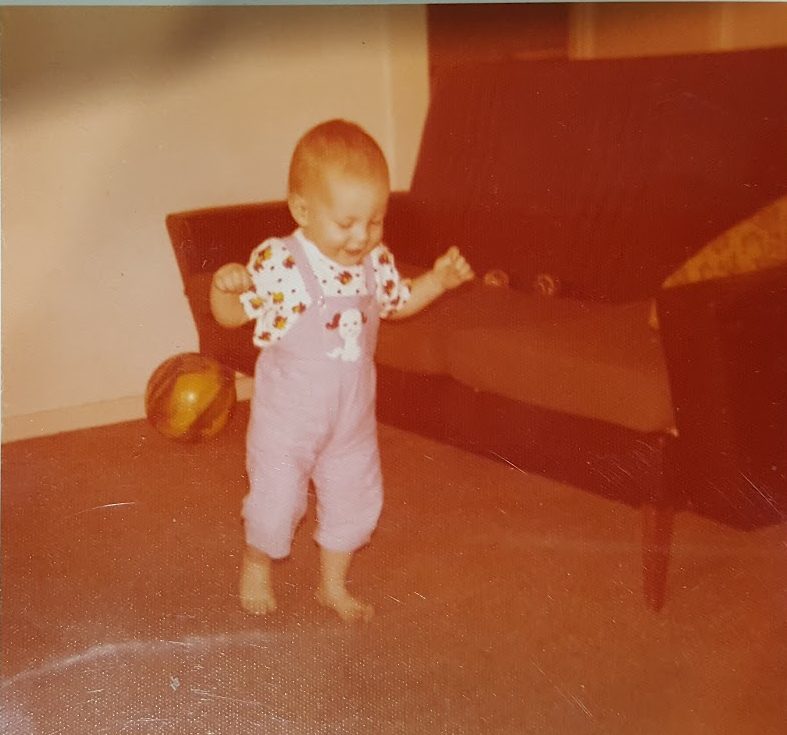
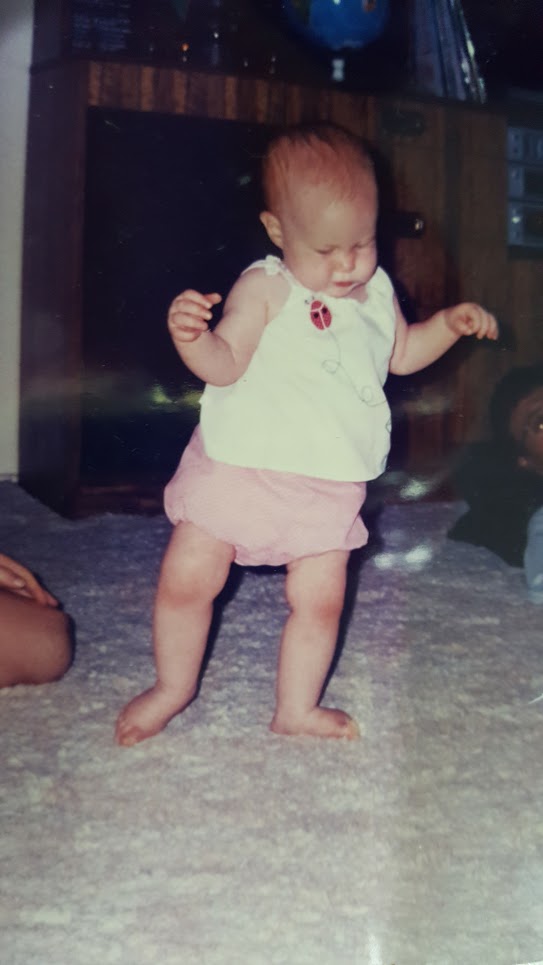
Here are photos of my two little (now big) ones. While not of their first steps, these photos were taken within the first month each of them walked.
I first published this post two years ago. I am sharing it again as I continue to hear of similar things happening. I apologise to those who may have read it the first time around. 🙂
Many would agree that to enjoy life to the full we must live in the present moment, appreciating what we have and being mindful of our surroundings and others.
Most would also agree that a certain amount of preparation for the future is necessary to both enjoy and deal with what lies ahead.
In previous posts I have referred to related ideas including The importance of emotional intelligence and the ability to delay gratification, for example when studying towards a degree or saving to purchase a car. Recently I wrote about future-proofing kids by preparing them to embrace the future. Schooling is often considered a preparation for the future, for ‘what you want to be when you grow up’.
Are the concepts of living in the present moment and preparing for the future contradictory?
Generally I would say that a balance is needed. We need to live in the present while making some preparation for the future. Hopefully the choices made can still be appreciated now and enjoyment is not all delayed until the future “When I . . .”
Recently I read an article that caused me some concern because, it seemed to me, there was little balance between appreciating the present and preparation for the future. Of greater concern was that the one for whom balance was lacking was not the one making the choice.
The article described a situation in which a 3½ year old was being taught to use scissors by an occupational therapist. The teaching, which had been occurring in regular sessions for over seven months, began before the child was three years of age.
Like I did, you might assume the child had a developmental delay which required regular sessions with the occupational therapist (OT). However no mention of that was made in the article.
The parent, writing the article, described feeling sad while watching the child experience difficulty in using the scissors. Additionally, it was mentioned that the child had not been requested by the parent to use scissors at home as it just made the child miserable.
After seven months the parent finally broached the subject with the OT, asking why the use of scissors was being pushed at this time.
It was the reported response of the OT that caused me greatest concern.
The OT explained that when the child entered kindergarten at age five, the ability to use scissors appropriately would be expected. The lessons in learning to use scissors were being given to avoid the child being behind when beginning kindergarten. The OT went on to further explain that the use of scissors was not developmentally appropriate until age five!
The OT, presumably a trained professional, who believed it was not developmentally appropriate for a child to be using scissors until age five, began teaching a child to use scissors before that child was even three years of age!
The child was miserable when using scissors and the parent was saddened when viewing the attempts!
If using scissors is developmentally appropriate at age five, then when the child is entering kindergarten, unless there is a development delay, coordination or muscular problem, that child will easily learn to use scissors appropriately, without the need for lessons from an OT. Forcing a child to practice a skill before developmentally ready is definitely not in the child’s best interests.
Think of the wonderful things about a child of two or three years of age; the things they are learning and doing. I am always amazed at how quickly children learn and progress. They grow up so quickly and are only little for such a short time. Why try to pressure them through to stages beyond their current development? These years of enormous growth and potential are precious. We are adults for most of our lives. What is wrong with appreciating the special two-ness or three-ness of a child? It will not matter in the future if scissors can be used at age three, age five or age seven.
If the child is constantly pressured to perform in ways that are not developmentally appropriate then feelings of inadequacy, loss of confidence and self-esteem may ensue, resulting in an ‘I can’t do it attitude’, a fear of failure and unwillingness to have a go. I believe many perceived behaviour problems are problems only because the expectations are not relevant to a child’s stage of development.
When adults strive for a child to achieve beyond the age expected norms they are not appreciating, but rather showing a lack of respect for, who the child is and for the stage of development. This is not living in the present. It is attempting to live in the future, which can become very scary if one does not feel it can approached with confidence.
One may hope this scissors example is an extreme and isolated incident, but sadly pressure placed upon children by expectations that are not developmentally appropriate is far too common.
Teaching colleagues here in Australia often express their dismay that children in the first three years of school are crying every day because they find the expectations upon their learning and behaviour too great.
I hear similar stories about trying to rush the children through from the UK, Canada and the USA. Maybe it is happening in other places too. Sadly the pressure of unrealistic expectations doesn’t achieve anything positive for the students, the teachers or the parents.
How different would schools be if, instead of being considered a preparation for life, they were focused on living life now? If three year olds were appreciated and respected as three year olds, five year olds as five year olds, and eight year olds as 8 year olds, rather than as apprentices for the adult they will one day be, how different would their school situation be?
An affirmation song I used to sing with my classes is one by Anne Infante called Just the way I am.
The song is made up of a series of verses about appreciating oneself just as one is – now, not in the future – including characteristics such as responsible, lovable, confident and friendly; for example:
I am beautiful and I like me,
I am beautiful and I like me,
I am beautiful and I like me,
Just the way I am.
I have written about using Anne’s songs of affirmation in previous posts, here and here.
What do you think? How have you seen developmentally appropriate programs in action? How have you seen them disregarded? What have been the effects?
Being able to verbalise the steps taken to arrive at an answer or a conclusion is a valuable skill. It is particularly important with mathematical thinking, even at beginning stages. Sometimes it feels as if the answer appears without the need for thought. Of course we aim for this with automaticity of number facts and times tables. However, I am referring to problems that may involve two or more different calculations.
Unless one understands the processes involved in solving one problem, it can be difficult to apply the same strategy in other situations. Sometimes it may be difficult for a teacher who finds the answer effortlessly to understand a learner’s confusion leading to mis-steps and miscalculations.
I generally collect my six-year-old grandson (G1) from school once or twice a week. Now that he’s a big year one boy he thinks he doesn’t need to hold my hand to cross the road. However, there is a bit of traffic around his school and I prefer him to do so, telling him it’s for my safety too.
One day I, erroneously, told him he needed to hold an adult’s hand until he was ten. (Ten is closer to the age for riding a bike unsupervised.) While this post is about mathematical thinking rather than traffic safety, if you wish to do so, you may find some information about traffic safety with young children here.
Always on the lookout for teachable moments that encourage thinking, I then asked if he knew how many more years it would be until he was ten. It was a bit of a redundant question because, of course he did. He is an able mathematician, just like his dad who constantly extends his ability to compute and think mathematically.
When G1 didn’t answer immediately, I assumed that he was either ignoring my question as it was too easy for him and not worth answering; or that he was thinking of the implications of my initial statement about holding an adult’s hand until he was ten. Then again, perhaps teacher-type questions from GM are sometimes better ignored, particularly after a day in school. I was happy to accept his silence as we continued across the road and didn’t press him for an answer.
Once safely on the footpath he said, “It’s four.”
“Know how I know?” he continued, pre-empting my question (he knows his grandmother well).
He held up both hands. “Because 5 and 5 are 10.” (He put down 4 fingers on one hand.) “And that’s 6. And 4 more makes 10.”
Although I hadn’t asked how he knew (on this occasion), I was pleased he was able to tell me, even though, in reality, he “knew” without having to work it out. On previous occasions when I had asked him how he worked it out, or how he knew, he hadn’t always provided an explanation. He may have shrugged, said “I don’t know” or simply ignored my question. Being able to explain his thinking demonstrates his growing mathematical knowledge and metacognition.
The ability to think through and verbalise steps is important to understanding. How many of you talk yourself through steps of a procedure you are following? I certainly do at times. While knowing that six plus four is ten is an automatic response for most of us. It wasn’t always so and we needed a strategy to help us understand the concept and recall the “fact”.
Opportunities for mathematical conversations occur frequently in everyday situations but are often overlooked. Recently I described some ways the children and I discussed different ways of combining five of us on an outing to show that 3 + 2 = 5.
Recently when two grandparents and two grandchildren were travelling together in the car four-year old G2, without any prompting from me, began describing how we could be combined to show that 2 + 2 = 4, for example
2 adults in the front, 2 children in the back, that makes 4. There were many different ways that we could be combined; and just as many that would group three together and leave one out, for example
1 driver and 3 passengers.
We had other mathematical discussions during that car trip. I had cut an apple for each child into a different number of pieces. Each was to guess how many pieces there were. G1 went first. I’d introduced him to prime number just once previously when I’d cut his apple into seventeen pieces so I didn’t expect him to be proficient with them. He certainly wouldn’t have been introduced to them at school at this stage.
These are the clues I gave him, the guesses he made and my responses supporting his growing understanding. I thought he did very well. He requests a guessing game each time I cut apple for him now. It’s sometimes a challenge for me to think of new clues.
I had cut 15 pieces for G2. G1 helped her work it out when I told her that she needed to count all of her fingers and the toes on one foot.
For an additional challenge I asked G1 if he knew how many fingers and toes there were in the car all together. He thought for a moment before giving the answer. Then proceeded to tell me how he knew as I started to ask. He explained that he had counted in twos because each of us had twenty, and counting twenties was just like counting twos but they’re tens. A quicker and more effective way that adding on twenty each time which I may have suggested he do.
Asking how do you know or how did you work it out helps children think about their own thinking. Listening to their responses helps adults understand where they are in developing mathematical concepts. Asking questions about their thinking can challenge and extend them further, but it is important to not expect too much and to support their developing understanding.
What maths did you engage in today? Did you even realise or was it automatic?
Thank you for reading. I appreciate your feedback. Please share your thoughts.
Last week I shared with you the post in which Charli Mills acknowledged that the Carrot Ranch was in Crisis. She admitted that, although she doesn’t like to ask for help, she needed it. She explained not only the type of help she required, but also the ways in which she is able to help others. I know many of you popped over to the Carrot Ranch to read Charli’s story and lend a helping hand. I sincerely thank you for doing so.
Difficulty in asking for help is something from which many of us suffer. The reasons are probably quite complex and may differ depending on the circumstance; for example, we may not:
wish to inconvenience others
consider ourselves worthy, there are always others with greater need
know who or how to ask
wish to admit that we can’t do it on our own, that we’re not perfect, not coping, or can’t do it all.
We may:
fear rejection
or fear making our vulnerabilities obvious when we had tried so hard to obscure them.
Of course, once one asks for help, then one must be prepared to accept kindness from others. Again, this is not always easy.
Susan says, “I used to feel that I had to do everything myself. I never thought I was perfect, but I wanted other people to think I was.” She says that she needed to learn how to accept that making mistakes was a part of life.
“One of the greatest barriers to connection is the cultural importance we place on “going it alone.” Somehow we’ve come to equate success with not needing anyone. Many of us are willing to extend a helping hand, but we’re very reluctant to reach out for help when we need it ourselves. It’s as if we’ve divided the world into “those who offer help” and “those who need help.” The truth is that we are both.”
Barbara Vitelliwho blogs at Book Club Mom also confessed her reluctance to ask for help in a post entitled The Art of Asking, using the title of Amanda Palmer’s book, which she reviews. Although the title appealed for its “self-help” potential, Barbara considers herself to have been misled as it is “mostly a memoir about Palmer’s performance and music career.” I guess this demonstrates, in part, that admitting help is required, if only to oneself, doesn’t always bring forth the assistance required. We need to know where to look and who to ask.
Palmer talks about her time as a street performer, then as a musician when she asked her fans for a place to sleep, for food, and for musicians to support her performances. She talks about making her music available for free, and explains the difference between making people pay, and asking people to pay. My son-in-law has been telling me about this concept for some time as he uses it for music he performs and purchases.
Three other organisations that do something similar by requesting financial support rather than payment by subscription are Wikipedia, The Conversation, and Brain Pickings . I’m sure there are others but these ones came immediately to mind.
As readilearn, my website of early childhood teaching resources, moves ever so slowly towards launch day, these ideas have got me thinking about my decision to go with a subscription model. My intention is that some resources will be available free to registered users, but the majority will be available through an annual subscription of $25.
I’m not about to change my mind, but I wonder how well it would work if I was to ask users to pay on an honour system, as others do. Of course I don’t have a following like Palmer’s fan base, or a readership to match Wikipedia. How useful others will consider my resources is yet unknown.
It will be impossible for me to ensure that users of my site don’t share with others or keep resources after their subscription expires. It’s just the way it is in the digital world, and with teachers. I know that. In this way I am already placing a certain amount of trust in people’s sense of fairness. I hope they consider my price fair, and that they will treat me fairly in return.
It is an interesting concept. It is often said that you only get what you pay for. If you don’t have to pay, will you? Everybody loves to get something for nothing, don’t they? It would be interesting to be able to compare two similar (small) projects, one with a set price, one with an honour system.
What do you think? Do you find it easy to ask for help, or are you in the reluctant boat? Have you ever put your hand out and asked for help? Have you used an honour system of payment, either in a project of your own, or when using the products of someone else? Do you consider, as Palmer does, that the honour system of payment is similar to asking for help?
Thank you for reading. I appreciate your feedback. Please share your thoughts.
This week at the Carrot RanchCharli Mills is talking about anxiety, panic attacks and agoraphobia.
The following statements taken from the Mayo Clinic website explain agoraphobia as:
“a type of anxiety disorder in which you fear and often avoid places or situations that might cause you to panic and make you feel trapped, helpless or embarrassed.”
“The anxiety is caused by fear that there’s no easy way to escape or seek help if intense anxiety develops.”
“Most people who have agoraphobia develop it after having one or more panic attacks, causing them to fear another attack and avoid the place where it occurred.”
“Agoraphobia treatment can be challenging because it usually means confronting your fears.”
Sometimes, as Charli says, we can face our fears head on and defeat them with the choices we make. Other times we may need support to help us overcome them. Sometimes therapy and medication may be needed to help those suffering the debilitating effects of anxiety. I will not be discussing those paths in this post. Nor am I going to talk about the anxieties of children with Asperger’s or Autism. There are others who do a much better job of it and are much more knowledgeable than I, such as Sherri Matthews and Shawna Ainslie.
However, it is not uncommon for a child to occasionally feel anxious and stressed by situations that occur at school. The incidence increases when children are placed in situations that are inappropriate to their development and don’t respect their needs. Sometimes the anxiety and stress is manageable and alleviated by more appropriate circumstances outside of the school environment. But sometimes the distress to the child and family can increase to a level at which more help and support is required.
A school environment more suited to children’s needs would reduce the number of anxious and stressed students, parents, and teachers. Creating a nurturing and supportive school environment requires a firm understanding of child development and a belief in their ability to learn. It also requires that children are respected and appreciated for who they are, and that they receive timely and appropriate feedback, encouragement, and support.
In recent posts I have mentioned the importance of play, and of time spent in, and learning outdoors, in nature. In his book Last Child in the Woods, Richard Louv espouses the importance of nature to the development of healthy children, as well as to the physical health and well-being of adults. Perhaps more time in nature would provide the calm that is needed to combat the hustle and bustle of modern life and pressures of formal, test-driven classrooms.
In fact, it is not just “perhaps”. In his article The School of Nature Louv provides evidence of benefits to learning that nature-based and place-based education can bring. He says, “greening schools may be one of the most cost-effective ways to raise student test scores.”
David Orr agrees. In his book Earth in Mind: On Education, Environment and the Human Prospect, he also stresses the importance of learning about, from, and in nature. He says, that, “all education is environmental education. By what is included or excluded we teach students that they are part of or apart from the natural world.”
It is easy to talk about the failings of the school system and suggest ways it could be improved. It is more difficult to make the desired changes happen. While the majority of teachers work hard to create warm, supportive, nurturing environments for children, there are many situations over which they have no control. It is important then to have strategies for dealing with anxiety and stress if they occur.
I recently came across a book that may be useful if your child tends towards anxiety. Stress Can Really Get on Your Nerves aims to provide children with strategies for coping with stress. Written by Trevor Romain and Elizabeth Verdick, it is published by free spirit Publishing as one of a series aimed at helping 8 – 13 year-olds “get through life rough spots”. With Trevor’s fun, cartoon-like illustrations on every page, the book promises to turn stressed out kids into “panic mechanics” with a toolkit of suggestions for reducing their own stress levels. I’d have to say, they’re not bad strategies for anyone’s toolkit.
I think time outdoors, breathing the fresh air, and enjoying the natural world is a great antidote to stress. I may no longer gambol in the grass, but I can sit in stillness and quiet, appreciating the beauty around me as I unplug from technology and reconnect by grounding myself in nature. I’m not sure how that works for agoraphobics with a fear of open places though. Perhaps having more time in nature as a child and learning techniques for coping with anxiety and stress could work as a preventative. But it’s only a thought. I am no expert.
This brings me back to Charli Mills and her flash fiction prompt to In 99 words (no more, no less) write a response to an agoraphobic moment. I have used the Mayo Clinic’s broader interpretation rather than the “narrow” definition of “fear of open spaces”. (I’d rather not be fenced in!) I hope my story portrays a recognisable response that could occur in a variety of circumstances. Please let me know what situation you think of as you read, and whether you consider my attempt successful.
Confrontation
She could hardly manage to chew, let alone swallow, the morsel of cereal occupying her mouth.
Her vacant stare and stifled moans alerted him.
“Are you okay?”
“I’m trying,” she mumbled, and squeezed her hands between her quivering knees.
“You’ll be fine. You haven’t had an attack for months. And, you’re prepared.”
“I know.” She pressed her arms against her gurgling belly. “But …”
He waited.
Finally, she looked at him. “But …”
He sponged her clammy forehead.
She looked away. “What if they don’t like me?”
“They won’t like you. They’ll love you. Come on. I’ll take you.”
What did you think of as you read? I wrote the piece about young teacher about to meet her first class. Did you pick it?
While anxiety about school is more commonly thought of as presenting in children, it is not uncommon for teachers to suffer from school anxiety as well. We accept that teaching is a stressful role, but for some it can also cause anxiety.
I think there are few who are immune from anxiety. We need to be more open in talking about mental health in general. Recognition, acknowledgment and supportive discussion are important factors in helping to overcome the effects of anxiety.
Thank you for reading. I appreciate your feedback. Please share your thoughts.






















 Norah Colvin