Live Love Laugh Learn … Create the possibilities

Tag: early childhood

  • readilearn: Celebrating reading and writing on International Literacy Day

    readilearn: Celebrating reading and writing on International Literacy Day

    Tomorrow is International Literacy Day. It has been celebrated on 8 September for over fifty years. The purpose of the day is to remind the international community of the importance of literacy and to eradicate illiteracy around the world. It values literacy education for young people the world over. This year’s theme is Literacy and skills development and focuses on the integration of literacy with other skills to enhance people’s lives and employment opportunities.

    In our early childhood classrooms, the focus is always on the development of literacy. A strong foundation in both reading and writing enables children to be more successful learners at school and independent learners out of school. It provides them with skills essential to full participation in and contribution to our world. While we may not be ostensibly training them for future employment, the literacy skills they learn in early childhood form the foundation upon which that learning develops.

    The idea of integrating literacy development with other skills is not unfamiliar to early childhood classrooms. The most effective approaches focus on teaching skills in meaningful contexts rather than in isolation.

    In celebration of International Literacy Day this year, I have uploaded some new resources to the literacy collection. As with other readilearn literacy resources, the focus is on teaching literacy skills in context.

    Continue reading: readilearn: Celebrating reading and writing on International Literacy Day

  • Lemons, Limes and Other Mysteries

    Lemons, Limes and Other Mysteries

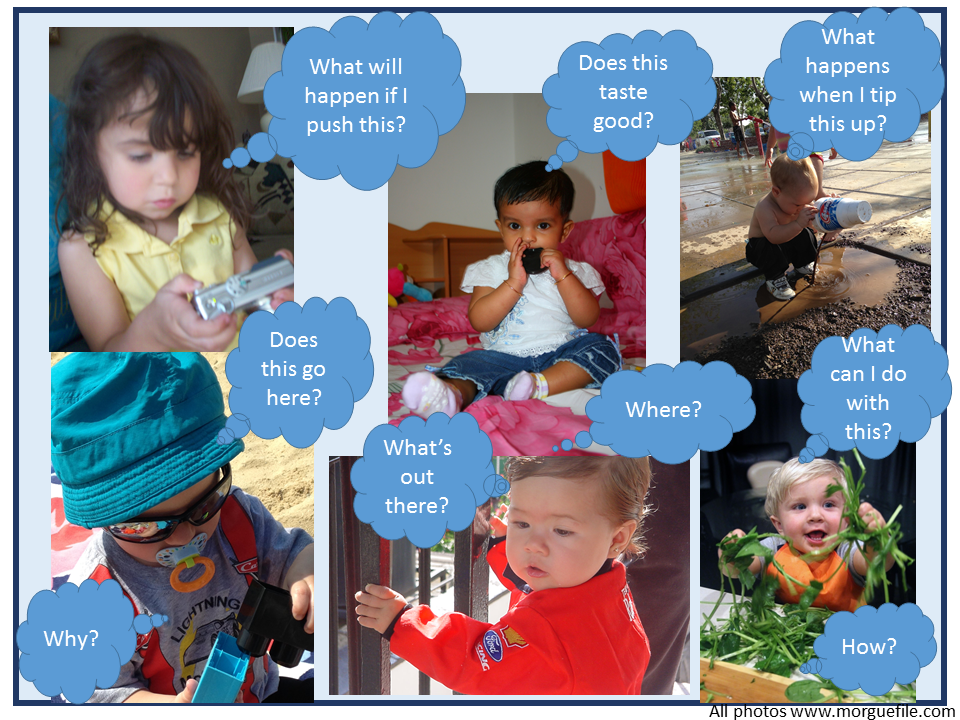
    Children are question machines, churning out question after question: why is it? how does it? Their mission is to find out about the world and everything in it, not to drive their parents crazy, as many believe.

    Of course, the best response to children’s questions is to help them find the answers, unlike in this scenario.

    Unknown source. Apologies. Happy to attribute if informed.

    I always love the story of David Attenborough shared by Michael Rosen in his wonderful book Good Ideas: How to Be Your Child’s (and Your Own) Best Teacher. Rosen says that, as a child, David took an interest in bones and if he was out walking and found some he would take them home and ask his father (a GP so would probably know) about them.

    But his father didn’t just tell him. Wanting his son to be curious and interested in finding things out for himself, he responded, for example: “I wonder if we can work it out . . .” They would then look through books about zoology and anatomy and try to identify the bone’s origin.

    I would like to have been a parent like David Attenborough’s father, perhaps more often than I was. But sometimes the situation is not conducive to an immediate quest for answers, and oftentimes we don’t have a satisfactory one to give.

    Our language, with multiple meanings for the same word, and an abundance of phrases that can’t only be taken literally, is not the easiest to learn. I often marvel at how well our children learn it and wonder even more about the complexity our language has for learners of English as another language.

    Charli Mills flash fiction challenge bottleneck

    This week at the Carrot Ranch, Charli Mills challenged writers to In 99 words (no more, no less) write a story about a bottleneck. You can be literal or use the term to describe congestion. Go where the prompt leads.

    Bottleneck is one of those words that can’t always be taken literally. I’ve used my response to Charli’s prompt to honour parents who are under constant scrutiny and bombardment with questions from their little ones. Sometimes it feels more like a battleground and they do well to maintain a peaceful composure. I hope you enjoy it.

    Lemons, Limes and Other Mysteries

    She hit the brakes and thumped the steering wheel.

    “Mummy swore.”

    “Didn’t.”

    “I heard.”

    “Why we stopped, Mummy?”

    “There’s a traffic jam.”

    “Jam? I love stawbrey jam sammich.”

    “Not that jam — must be a bottleneck up ahead.” Please be a merge, not an accident.

    “We learned ‘bout bottlenecks today.”

    “What?”

    “Live in the ocean. Maminals, like us. Where’s bottleneck, Mummy?”

    “Not bottleneck, Jamie, bottlenose.”

    “You said bottleneck.”

    “I meant — aargh!”

    Finally, they were home.

    “You look frazzled, hon.”

    She rolled her eyes and took the beer.

    “Why lemon is in your bottle neck?” asked Jamie.

    “Because it’s not lime.”

    Photo via Good Free Photos

    Why do they put that lemon or lime in a Corona? Do you know?

    Thank you blog post

    Thank you for reading. I appreciate your feedback. Please share your thoughts.


  • readilearn: Interactive whiteboard resources for kindergarten

    readilearn: Interactive whiteboard resources for kindergarten

    “I’ve got an interactive whiteboard in my room but I don’t know how to use it.”

    “What readilearn resources can I use with my kindergarten children?’

    “Schools have said they want our children to come to school able to listen and follow instructions. What resources can we use?”

    These are some of the statements and questions that teachers of children in their kindergarten year, the year before they start formal schooling, have put to me.

    The main focus of my preparation of readilearn teaching resources is on the first three years of school. I hadn’t considered their application with children aged four to five. However, teachers have assured me that some of the readilearn interactive whiteboard lessons are very suitable for children in kindergarten as one part of a rich play-based learning-focused environment.

    Using readilearn lessons on the interactive whiteboard in kindergarten

    • provides variety,
    • introduces children to the use of technology and some of the skills involved such as drag and drop, and click to select items,
    • provides opportunities for children to take turns, work cooperatively, listen actively to the teacher and other children,
    • encourages vocabulary development – the lessons are intended to be teacher-led and involve discussion with the children.

    readilearn lessons support kindergarten teachers with

    • lessons ready to teach – login in the morning, keep one tab open – stay logged in for the day,
    • opportunities for children to make the connection between print and spoken language,
    • providing children who are ready to read opportunities of doing so.

    readilearn interactive resources and lessons suitable for use in kindergarten:

    Continue reading: readilearn: Interactive whiteboard resources for kindergarten

  • readilearn: What place do worksheets have in your early childhood classroom?

    readilearn: What place do worksheets have in your early childhood classroom?

    How do you feel about worksheets? Love them? Hate them? Use them sparingly?

    I would say I’ve never been greatly in favour of worksheets. I’m not saying I never used them, but I used them sparingly. If I could do something as well or better without using a worksheet I would. There were a few reasons for this:

    • I valued children’s own work and didn’t feel the need to “pretty” up their books with the work of others.
    • I always looked for ways to progress children’s learning as opposed to keeping them busy.
    • I liked to reduce our paper usage.

    Available on the internet and in bookstores are oodles of collections of worksheets; worksheets for anything you can imagine. You can spend hours trawling through websites looking for a sheet to support learning or practice a specific concept. Some of that time could be better spent considering other opportunities you could provide children for learning or practice, or even doing something pleasant for yourself for a change. Now there’s a thought.

    When you think you may want a worksheet, or come across a worksheet that you may want to use, stop and evaluate its potential benefit:

    Continue reading: readilearn: What place do worksheets have in your early childhood classroom?

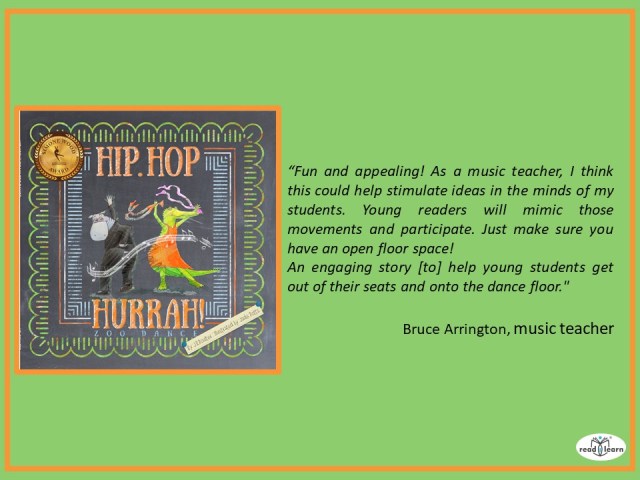
  • readilearn: Introducing Jennifer Poulter, author of Hip Hop HURRAH! Zoo Dance

    readilearn: Introducing Jennifer Poulter, author of Hip Hop HURRAH! Zoo Dance

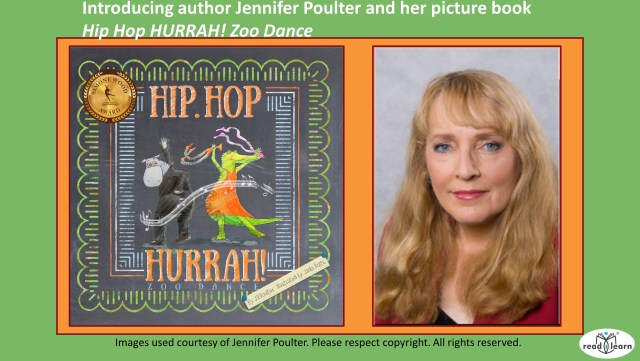
    Meet Australian author J.R. Poulter as she discusses her beautiful picture book Hip Hop Hurrah Zoo Dance which is great for reading and getting kids moving.

    This week I am delighted to introduce you to prolific Australian author Jennifer Poulter. Jennifer writes fiction and poetry for children, education and the literary market. She has had over 50 traditional books and thirteen digital picture books published. She writes under the names J.R. Poulter and J.R. McRae and has received numerous awards for both fiction and poetry writing.

    Throughout her career, Jennifer has been employed in numerous roles including Senior Education Officer with the Queensland Studies Authority and Senior Librarian with the State Library of Queensland. She even once worked in a circus. In addition to writing, Jennifer is also an editor and artist. Now, under the banner of Word Wings, Jennifer collaborates with other creatives from over 20 countries.

    Today I am talking with Jennifer about her picture book Hip Hop HURRAH! Zoo Dance.

    What initially attracted me to this book is its ability to get children moving. What a great way to incorporate fun with movement and reading into any day.

    The book also fits perfectly with a dance curriculum that encourages children to become aware of their bodies and how they move in space, to explore and improvise dance movements. Children can be encouraged to move like the zoo animals in the book or improvise movements for other animals and objects that move.

    But Hip Hop HURRAH! Zoo Dance can also find its place in the literacy curriculum. Written in rhythmic verse, it encourages children to join in with the reading. It has a treasure of words to delight and extend vocabularies and add sparkle to writing; words like ‘limber, fandangle, prance and shimmies’. Children will laugh at the hippos with the backside wobbles and be intrigued by the combination of illustrations by Jade Potts and the variety of media used by designer Takara Beech in creating the double page spreads.

    If you throw in some counting of animals and legs, needs and features of living things, and places they live, you can cover almost the entire curriculum with this one little book. But enough from me, let’s find out what Jennifer has to say.

    Continue reading: Introducing Jennifer Poulter, author of Hip Hop HURRAH! Zoo Dance – Readilearn

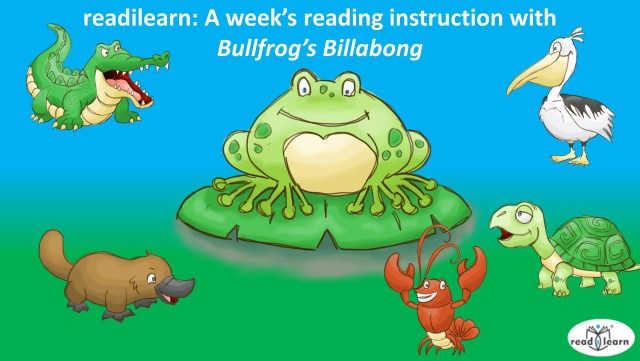
  • readilearn: A week’s reading instruction with Bullfrog’s Billabong

    readilearn: A week’s reading instruction with Bullfrog’s Billabong

    The readilearn Bullfrog’s Billabong suite of cross-curricular resources can be used as the foundation for planning a week’s reading instruction including lessons with the whole class and small groups and independent work. The activities cater for different ability levels in your early childhood classroom and can culminate in a performance to be presented to other members of the class, other classes in the school, or parents.

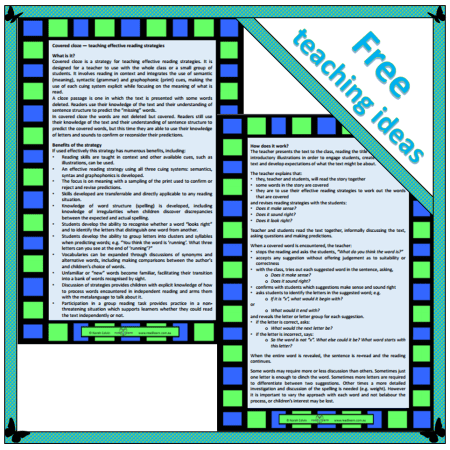
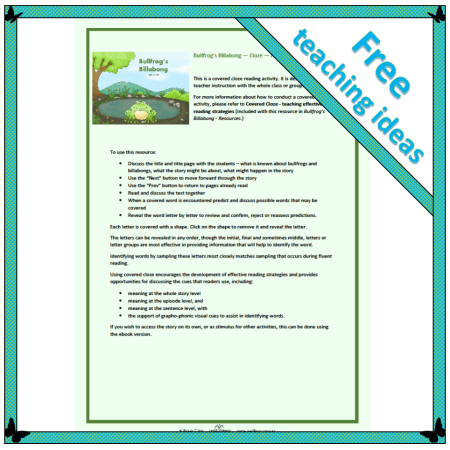
    Bullfrog's Billabong, teaching effective reading strategies with covered cloze on the interactive whiteboard

    Begin by introducing the story as a covered cloze activity (a lesson ready for you to teach) presented to the whole class on the interactive whiteboard. Although all children are engaged in reading the same story, the activity allows them to participate at their own level. The teacher-led discussion can be tailored to student needs, allowing each to contribute according to what they already know and extending their understanding by discussing cues for reading and irregular as well as regular spelling patterns. Children learn from each other as they actively participate in the cooperative reading activity. Refer to Covered cloze — teaching effective reading strategies and Bullfrog’s Billabong — Cloze — How to use this resource for suggestions.

    As with introducing all new reading material, it is important to engage children’s interest by making connections with what they already know about the topic and explaining what may be unfamiliar; for example, a billabong, and encouraging them to make predictions about what might happen in the story. As the story unfolds, children may adjust their predictions and thoughts about the story.

    Continue reading: readilearn: A week’s reading instruction with Bullfrog’s Billabong – Readilearn

  • readilearn: Libraries: A wondrous universe to explore — A guest post by Dimity Powell

    readilearn: Libraries: A wondrous universe to explore — A guest post by Dimity Powell

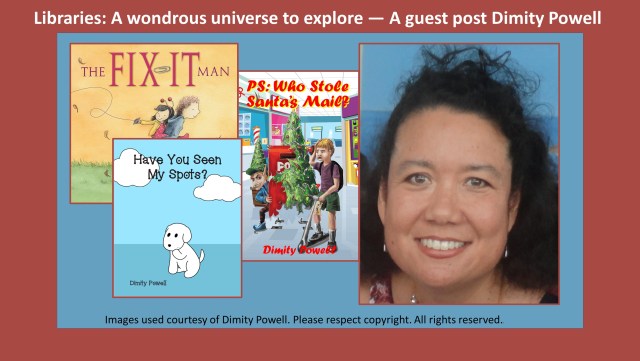
    This week I am delighted to introduce you to award-winning children’s author Dimity Powell.

    Dimity likes to fill every spare moment with words. She writes and reviews stories exclusively for kids and is the Managing Editor for Kids’ Book Review. Her word webs appear in anthologies, school magazines, junior novels, as creative digital content, and picture books including The Fix-It Man (2017) and At The End of Holyrood Lane (2018).

    She is a seasoned presenter both in Australia and overseas, an accredited Write Like An Author facilitator and a Books in Homes Role Model Volunteer in Australia.

    Dimity believes picture books are soul food, to be consumed at least 10 times a week. If these aren’t available, she’ll settle for ice-cream. She lives just around the corner from Bat Man on the Gold Coast although she still prefers hanging out in libraries than with superheroes.

    In this post, Dimity shares her love of libraries and explains why it is important to ensure every child has access to a library at school and every reader a local library.

    Welcome to readilearn, Dimity. Over to you.

    Continue reading: readilearn: Libraries: A wondrous universe to explore — A guest post by Dimity Powell

  • readilearn: Help your child read – some strategies

    readilearn: Help your child read – some strategies

    The importance of reading

    The ability to read is one of the most valuable skills we can acquire.  It is a tool for thinking, learning and entertainment. Reading opens doors and minds; it gives us the ability to unlock the secrets of the universe and release our imaginations. It is a skill that many of us take for granted, but without it the world would seem a more unfriendly place.

    No wonder learning to read is a vital part of each and every school day!

    Like everything else —the more you read, the better you get!

    Reading is more than just saying all the words on the page in order. Reading is a process of getting meaning from print. Effective readers use their knowledge of the world and of language in their quest to make meaning from the words on the page. Reading takes place when the reader understands the message of the writer.

    Strategies used by effective readers

    Effective readers use a combination of three cuing systems to predict and check what the author has written. The use of these systems is obvious in the miscues (rather than “mistakes”) that readers make.

    1. The most important cuing system is knowledge of the topic. If you know lots about dinosaurs, you can read those big difficult-looking words and understand what they mean. If you know nothing of legal jargon then even sounding out those big difficult-looking words won’t help you understand.
    2. The second system is knowledge of language and grammar. We expect the words to flow with meaning and not be a jumble of nonsense.
    3. The first two systems combine to predict the words on the page. We then check with the print to ensure our expectations were correct.

    For example, if the story is about a cowboy you may expect that he would jump on his pony, but when you look at the print, you find he actually jumped on his horse.

    Effective readers may say ‘pony’ instead of horse, but they definitely wouldn’t say ‘house’ (which looks similar) as it just wouldn’t make sense!

    Continue reading: readilearn: Help your child read – some strategies

  • readilearn: Teaching about living things in early childhood classrooms – turtles

    readilearn: Teaching about living things in early childhood classrooms – turtles

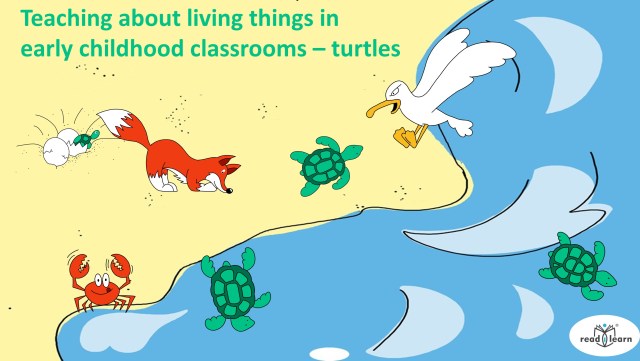
    Teaching about living things has an important place in early childhood classrooms. In the science curriculum in their first few years of school, children learn

    • What is a living thing
    • Needs of living things
    • Features of living things
    • Life stages of living things

    I have previously written about keeping and observing minibeasts in the classroom, learning about life on a farm, learning about living things – sea turtles, and observing animals in the local environment. In addition to the teaching ideas suggested in the blog posts, there are many resources in the science collection to assist you with your work.

    Let's find out abut sea turtles is an interactive digital non-fiction texts about sea turtles, for children in their first three years of school

    This week, in celebration of World Turtle Day on 23 May and World Environment Day coming up on 5 June, I have uploaded new resources to support learning about sea turtles and the existing non-fiction digital text Let’s find out about Sea Turtles.

    Continue reading: readilearn: Teaching about living things in early childhood classrooms – turtles

  • readilearn: Introducing Jacqui Halpin – picture book author – Readilearn

    readilearn: Introducing Jacqui Halpin – picture book author – Readilearn

    This week, it is my pleasure to introduce you to Jacqui Halpin – author, founding member of Write Links (a local group of published and unpublished authors and illustrators of children’s books), a former nurse and tuckshop convenor.

    Jacqui grew up in Brisbane where she still lives with her husband, one of her three adult children, and a cat called Loki. While writing and editing, Jacqui likes to sip tea from fine china and eat copious amounts of chocolate. She says she should never be allowed in a bookshop with a credit card in her possession.

    Jacqui writes picture books and short stories, some of which appear in anthologies by Stringybark Publishing and Creative Kids’ Tales. She co-wrote and independently published her elderly father’s memoir, A Long Way from Misery.

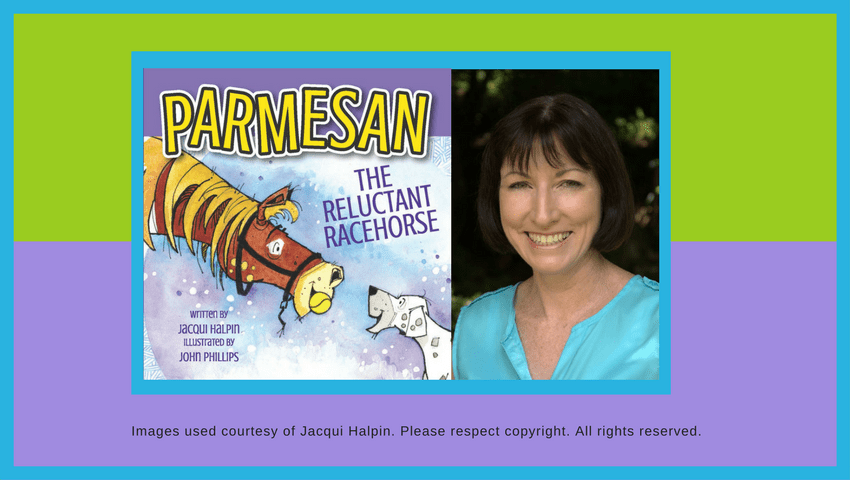
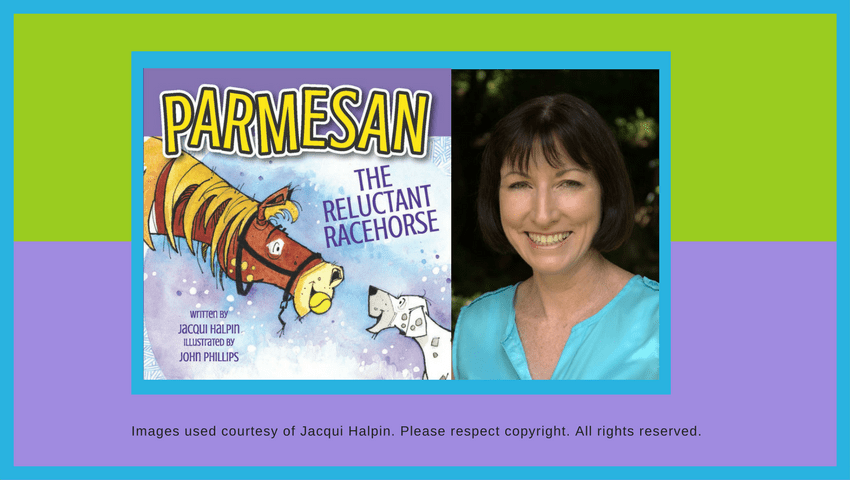
    Today Jacqui is talking with us about her first picture book Parmesan The Reluctant Racehorse, humorously illustrated by John Phillips and published by Little Pink Dog Books in October 2017. Jacqui’s second picture book, Where’s Lucky?, based on an orphaned swamp wallaby joey at a wildlife shelter, will be published in mid-2019.

    Parmesan is a delightful story of a thoroughbred racehorse who should be winning races and earning lots of money for his owner. However, Parmesan thinks he’s a dog. Instead of training with the other horses, he’s off with his doggy friends doing doggy things like playing fetch. His owner is not happy. If Parmesan isn’t ready to run in the Spring Carnival, he’s getting rid of him. Parmesan’s trainer is worried. He knows Parmesan won’t be ready, but as they arrive at the Spring Carnival, he thinks of a brilliant way to get Parmesan to run around the track. Parmesan’s triumph proves you can be a winner and stay true to who you are.

    Welcome to readilearn, Jacqui, we are looking forward to getting to know you better.

    Thanks for inviting me.

    Jacqui, when did you know you wanted to be a writer?

    I always liked writing stories and poems at school, but it wasn’t until I read picture books to my own children  Continue reading: readilearn: Introducing Jacqui Halpin – picture book author – Readilearn