Live Love Laugh Learn … Create the possibilities

Tag: early childhood teaching resources

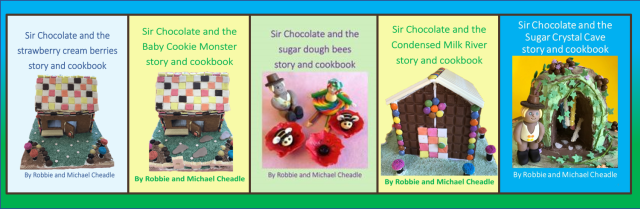
  • readilearn: Introducing Robbie Cheadle author and illustrator of the Sir Chocolate Book series

    readilearn: Introducing Robbie Cheadle author and illustrator of the Sir Chocolate Book series

    This week I have great pleasure in introducing you to Robbie Cheadle author and illustrator of the Sir Chocolate Book series.

    What most appeals to me about the Sir Chocolate Books is Robbie’s amazing fondant illustrations. I am also impressed that her twelve-year-old son Michael co-authors the books with her, and has been since he was ten. Perhaps your children will also find this aspect interesting.

    About the books

    Sir Chocolate and Lady Sweet live in Chocolate Land where everything can be eaten. In each story, told in rhyme, Sir Chocolate and Lady Sweet have a new adventure or problem to solve. Robbie also includes recipes from the story in each book.

    To date, there are five books in the Sir Chocolate Book series.

    About Robbie

    Robbie Cheadle was born in London. Her father died when she was three months old, and she and her mother emigrated to South Africa where they lived in Johannesburg, George and Cape Town. While growing up, Robbie attended fourteen different schools. This gave her many opportunities to develop social skills and meet new people as she was often “the new girl”.

    Robbie is a qualified Chartered Accountant and writes in that field about equities and investments in South Africa.

    While Michael co-authors the books with her, Robbie’s other son Gregory (aged 14) assists Robbie and Michael with filming and editing their YouTube videos and editing their books. The books are very much a family affair.

    For other books written by Robbie, see the end of the blog post.

    The interview

    Welcome to readilearn, Robbie.

    Thank you for inviting me.

     Robbie, the number of books in the Sir Chocolate book series is continually growing with five books now available. What gave you the idea for this series?

    Continue reading: readilearn: Introducing Robbie Cheadle author and illustrator of the Sir Chocolate Book series

  • When you’re on a theme, stick to it

    When you’re on a theme, stick to it

    Education is my theme. It’s my passion. Sometimes I think I should get another interest, but I’m stuck with this one. Sometimes I get stuck with a theme within a theme too. That’s happening at the moment.
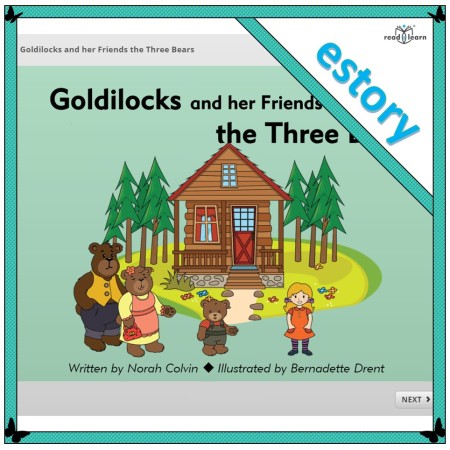
    Goldilocks and her Friends the Three Bears interactive innovation

    A couple of weeks ago, I uploaded an innovation on the traditional story of Goldilocks to readilearn, a collection of teaching resources for the first three years of school. I also added some suggestions for using the resource to teach reading and writing, including sight words in context. I have other supporting resources in progress to be added to the collection soon.

    While my story Goldilocks and her Friends the Three Bears is not really a fractured fairy tale, it’s simply a retelling with an alternative ending; I’ve also been thinking of fractured fairy tales for my Carrot Ranch Rodeo Contest coming up next month. (Look for further details to be published at the Ranch this week.)

    So stuck on this theme am I, that I wrote a 297 (3 x 99) word story as a response to Charli’s Tuff prompt “Papa’s Bar”. While this Free-Write contest is now closed (writers have only twenty-four hours to respond to the prompt), there will be four more chances to enter the TUFFest Ride event with the next one scheduled for September 19. Be sure to look out for it if you want to be in it.

    Note: I’m not sure where or what the Papa’s bar is that Charli alluded to, but I am sure that it’s not what I wrote my story about. In Australia, when we play tiggy, that you might know as tag or tig, or some other name, we might allocate a certain spot as ‘bar’. This means that you are safe and cannot be tagged when on or touching that spot. Sometimes, players will attempt to allocate a spot as bar just as they arrive at it in order to avoid being tagged.

    While I have no thoughts that I may win any of the TUFF contests, it is fun having a go. This is what I wrote in response to the Papa’s Bar prompt. I hope you enjoy it.

    bears sleeping

    Papa’s Bar

    Out in the woods lived a family of bears; Papa Bear, Mama Bear and baby bears five. All summer long, Papa Bear toiled, ensuring his family were contentedly fuelled, ready to sleep through the winter’s long dark. They filled up their bellies with berries hung low, with fish in abundance in streams flowing clear, and hives’ full bounty of gold. Mama and babies had no need to complain, every meal Papa made, a sumptuous feast.  When autumn arrived, and food became scarce, Papa Bear said, ‘Now’s time for bed. Close your eyes little ones, dream sweet dreams until spring.’

    The babies were restless, not ready for sleep.

    ‘We need a story,’ a little one said. ‘Tell us about life when you were a cub. What did you eat? Where did you play?’

    ‘Just one story — then sleep.’

    ‘We need a drink first,’ said the cubs.

    ‘Okay, but lickety-split.’

    They had just settled back when another voice said, ‘I’m hungry.’

    ‘Me too,’ chimed the others.

    ‘Can’t be,’ said Papa Bear. ‘No food until spring.’

    ‘Awh,’ they chorused.

    ‘I could make some porridge,’ yawned Mama Bear.

    ‘Yay! Porridge!’ said the baby bears.

    ‘But then you must sleep,’ said Papa Bear.

    But they didn’t. Before his story was through, Papa Bear was snoring with Mama Bear nestled beside him.

    ‘Let’s play tag,’ smirked one.

    ‘I’m It,’ said another.

    They took turns to run and catch, and through it all, the parent bears slept.

    At last, the littlest bear yawned. No more running and catching, he was ready for sleep. He scrambled over Papa Bear, escaping the tagger’s clutches with a warning, ‘Can’t get me. Papa’s bar.’

    His eyes closed and then, one by one, they snuggled into a big bear hug, murmuring ‘Papa’s bar’ as they drifted off to sleep.
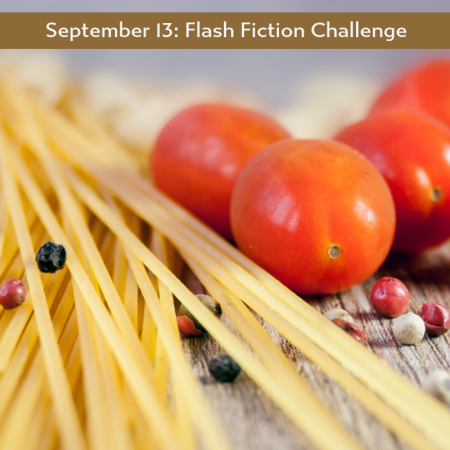
    Pasta prompt for Carrot Ranch Flash fiction prompt by Charli Mills

    When Charli Mills of the Carrot Ranch posted this week’s flash fiction prompt, challenging writers to In 99 words (no more, no less) write a story that includes pasta. It can be spaghetti, macaroni and cheese, or any variety. It can be a meal or a work of art. Go where the prompt leads, how could I not get the bears in on the act again.

    This is my response. I hope you enjoy it too.

    Pasta for Breakfast

    Papa Bear pushed back his chair. “Not this muck again.”

    Mama Bear stopped mid-ladle. “It’s Baby Bear’s favourite. I— I thought it was yours too.”

    Baby Bear’s lip quivered.

    “Pfft! Sometimes a bear needs real food.” He grabbed his hat. “I’m going for a walk.”

    “Papa!” Baby Bear went after him.

    Mama Bear dumped the porridge, pot and all, into the bin, grabbed her hat and followed.

    “Where are we going?” asked Baby Bear.

    “Somewhere nice for breakfast. It is spring after all.”

    Papa Bear paused outside BreakFasta Pasta, then went in.

    Mama Bear smiled; pasta was her favourite.

    Thank you blog post

    Thank you for reading. I appreciate your feedback. Please share your thoughts.

  • readilearn: Introducing Sonia Bestulic author of Reece Give Me Some Peace

    readilearn: Introducing Sonia Bestulic author of Reece Give Me Some Peace

    This week I have great pleasure in introducing you to Sonia Bestulic author of Reece, Give Me Some Peace. While interviews with authors and illustrators have featured regularly on the readilearn blog, this interview marks a new collaboration with Romi Sharp and the team from Books on Tour. This post is but one of several celebrating the launch of Sonia’s beautiful picture book. Please read to the end of the post for details of other posts celebrating Sonia’s work.

    About Sonia Bestulic

    Sonia grew up in Sydney Australia enjoying a childhood filled with wonderful books, a passion for writing and music entwined. She played the violin until her late teens, including performances at the Sydney Opera House. Sonia is Founder of Talking Heads Speech Pathology established in Sydney in 2006. A long-term advocate for children’s learning and literacy, Sonia continues to write and speak about all things children.

    About Reece Give Me Some Peace

    Reece Give Me Some Peace is a fun-loving book about the wonderful world of music and noisy play. Reece is a very cheeky and curious boy who loves making noise. His mother’s requests for him to be quieter only seem to make him louder. As his exuberance grows, so does his mother’s exasperation. Will she ever get any peace?

    The simple rhythmic text combined with delightful illustrations by Nancy Bevington reminds us of the power of learning through play and exploration. Children will love to join in making the sounds and adults will identify with the challenge of being able to enjoy some quiet.

    Now, let’s meet Sonia.

    The interview

    Hello, Sonia. Welcome to readilearn.

    Thank you for inviting me.

    Sonia, today we will discuss your beautiful new picture book Reece, Give Me Some Peace, but first, can you tell us what inspired you to be a writer?

    Continue reading: readilearn: Introducing Sonia Bestulic author of Reece Give Me Some Peace

  • readilearn: Celebrating reading and writing on International Literacy Day

    readilearn: Celebrating reading and writing on International Literacy Day

    Tomorrow is International Literacy Day. It has been celebrated on 8 September for over fifty years. The purpose of the day is to remind the international community of the importance of literacy and to eradicate illiteracy around the world. It values literacy education for young people the world over. This year’s theme is Literacy and skills development and focuses on the integration of literacy with other skills to enhance people’s lives and employment opportunities.

    In our early childhood classrooms, the focus is always on the development of literacy. A strong foundation in both reading and writing enables children to be more successful learners at school and independent learners out of school. It provides them with skills essential to full participation in and contribution to our world. While we may not be ostensibly training them for future employment, the literacy skills they learn in early childhood form the foundation upon which that learning develops.

    The idea of integrating literacy development with other skills is not unfamiliar to early childhood classrooms. The most effective approaches focus on teaching skills in meaningful contexts rather than in isolation.

    In celebration of International Literacy Day this year, I have uploaded some new resources to the literacy collection. As with other readilearn literacy resources, the focus is on teaching literacy skills in context.

    Continue reading: readilearn: Celebrating reading and writing on International Literacy Day

  • readilearn: Be prepared – a casual teacher’s motto

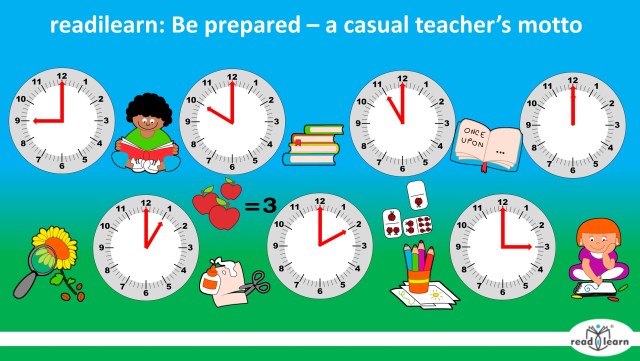
    readilearn: Be prepared – a casual teacher’s motto

    It’s not always easy being a casual teacher, taking over another teacher’s class for the day. You might be in a different class at a different school, working with a different age group and a different set of expectations, and probably playground duty, every day of the week.

    But it does have its advantages too. You can arrive just before school begins and leave when it finishes. You don’t have to do assessment, write reports or be involved in parent meetings.

    But it is important to be prepared.

    Familiarise yourself with the class timetable and program

    Many teachers leave a program for relief teachers to follow and, if one is available, it is important to follow it to maintain continuity for the children and to avoid interrupting the teaching and learning schedule. However, there may be days when a program is not available, and a casual teacher needs to be prepared for these.

    Whether a day’s program is available or not, it is important to remember that it’s not your class. There will be established class expectations, procedures and timetables. The day will work best if these can be followed as closely as possible, particularly if teacher aides, support personnel and specialist teachers are involved.

    Introduce yourself and your expectations

    Continue reading: readilearn: Be prepared – a casual teacher’s motto

  • readilearn: teaching resources for celebrating birthdays in the early childhood classroom

    readilearn: teaching resources for celebrating birthdays in the early childhood classroom

    How do you celebrate birthdays in your early childhood classroom? Suggestions from readilearn help you make a birthday a special event in your classroom.

    I’m excited! Today, 24 August 2018, marks readilearn’s second birthday. How quickly those years have passed and how the collection has grown in that time.

    When I started out with the goal of reducing teachers’ workloads by preparing lessons ready for them to teach, I made a commitment to upload new resources regularly, write a weekly blog post focusing on topics of interest to early childhood teachers, including suggestions for teaching, and publish a newsletter on the last day of each month.

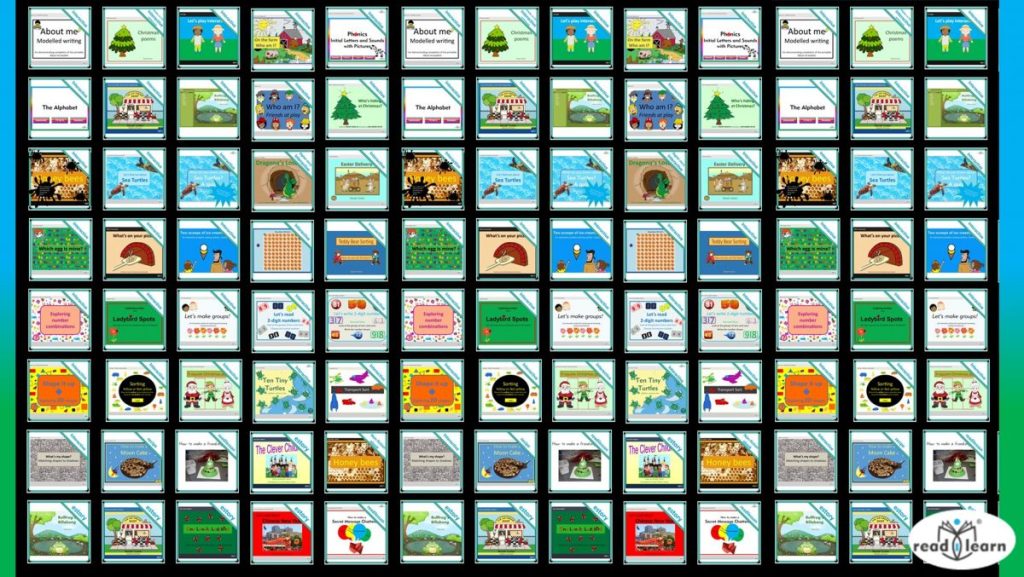
    I am proud to say that I have fulfilled that commitment. With more than two hundred resources added to the collection since the launch, that’s an addition of an average of two new resources each week. More than forty resources in the collection are interactive lessons for teachers to teach on the interactive whiteboard, exceeding the ten percent minimum I set as a target.

    Continue reading: readilearn: teaching resources for celebrating birthdays in the early childhood classroom

  • readilearn: Introducing Katrin Dreiling illustrator of The World’s Worst Pirate

    readilearn: Introducing Katrin Dreiling illustrator of The World’s Worst Pirate

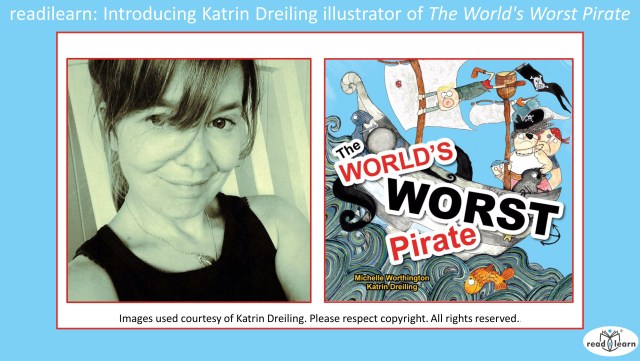
    This week I have enormous pleasure in introducing you to Katrin Dreiling illustrator of The World’s Worst Pirate, written by Michelle Worthington.

    The World’s Worst Pirate is a captivating book about being true to yourself and unleashing your inner strengths.

    Story Synopsis

    One might wonder why Will, the world’s worst pirate, would want to be a pirate anyway. The truth is, he didn’t. There wasn’t much at all he liked about being at sea. He was happiest in the galley cooking cupcakes. The ship’s captain, his mother, on the other hand, couldn’t understand why he didn’t love being a pirate as much as she did. When the ship is attacked by a terrifying sea monster, no one could have predicted the outcome. Katrin Dreiling’s illustrations are a perfect fit or Michelle Worthington’s story. They add humour, delight, and a sub-plot of their own.

    The Illustrator

    The World’s Worst Pirate, published by Little Pink Dog Books in 2017, is Katrin’s first picture book. In 2018 the book received the CBCA Notable Book award, a wonderful achievement, especially for a first book. Prior to becoming an illustrator in Australia, Katrin studied languages in Germany to become a teacher. She loves to come up with quirky creations that inspire children to get creative themselves. Katrin’s second book, also written by Michelle and published by Little Pink Dog Books, will launch in September this year.  Katrin also enjoys writing for children and regularly teaches art classes in Newfarm, Brisbane.

    The Interview

    Welcome to readilearn, Katrin.

    Thank you for inviting me.

    Katrin, The World’s Worst Pirate was listed as a Notable Picture Book in the CBCA 2018 Book of the Year awards. Congratulations. Since it is your very first published picture book, that must have been very special. How did it make you feel?

    Continue reading: readilearn: Introducing Katrin Dreiling illustrator of The World’s Worst Pirate

  • readilearn: Interactive whiteboard resources for kindergarten

    readilearn: Interactive whiteboard resources for kindergarten

    “I’ve got an interactive whiteboard in my room but I don’t know how to use it.”

    “What readilearn resources can I use with my kindergarten children?’

    “Schools have said they want our children to come to school able to listen and follow instructions. What resources can we use?”

    These are some of the statements and questions that teachers of children in their kindergarten year, the year before they start formal schooling, have put to me.

    The main focus of my preparation of readilearn teaching resources is on the first three years of school. I hadn’t considered their application with children aged four to five. However, teachers have assured me that some of the readilearn interactive whiteboard lessons are very suitable for children in kindergarten as one part of a rich play-based learning-focused environment.

    Using readilearn lessons on the interactive whiteboard in kindergarten

    • provides variety,
    • introduces children to the use of technology and some of the skills involved such as drag and drop, and click to select items,
    • provides opportunities for children to take turns, work cooperatively, listen actively to the teacher and other children,
    • encourages vocabulary development – the lessons are intended to be teacher-led and involve discussion with the children.

    readilearn lessons support kindergarten teachers with

    • lessons ready to teach – login in the morning, keep one tab open – stay logged in for the day,
    • opportunities for children to make the connection between print and spoken language,
    • providing children who are ready to read opportunities of doing so.

    readilearn interactive resources and lessons suitable for use in kindergarten:

    Continue reading: readilearn: Interactive whiteboard resources for kindergarten

  • readilearn: What place do worksheets have in your early childhood classroom?

    readilearn: What place do worksheets have in your early childhood classroom?

    How do you feel about worksheets? Love them? Hate them? Use them sparingly?

    I would say I’ve never been greatly in favour of worksheets. I’m not saying I never used them, but I used them sparingly. If I could do something as well or better without using a worksheet I would. There were a few reasons for this:

    • I valued children’s own work and didn’t feel the need to “pretty” up their books with the work of others.
    • I always looked for ways to progress children’s learning as opposed to keeping them busy.
    • I liked to reduce our paper usage.

    Available on the internet and in bookstores are oodles of collections of worksheets; worksheets for anything you can imagine. You can spend hours trawling through websites looking for a sheet to support learning or practice a specific concept. Some of that time could be better spent considering other opportunities you could provide children for learning or practice, or even doing something pleasant for yourself for a change. Now there’s a thought.

    When you think you may want a worksheet, or come across a worksheet that you may want to use, stop and evaluate its potential benefit:

    Continue reading: readilearn: What place do worksheets have in your early childhood classroom?

  • readilearn: Learning to be friends – unleash your friendship superpower

    readilearn: Learning to be friends – unleash your friendship superpower

    Sometimes we expect that all we have to do for children to make friends is to put them in close proximity to other children. We may see it happen at the park, in a playground, in a shopping centre, at school. Children are attracted to other children, but it is not always easy for them to make friends. We should no more expect them to get along than we would expect adults thrown together at a party, conference or other social situation to become friends immediately.

    While some children are gregarious and will talk to anyone, others may be more introverted and less inclined to make the first move. But whether extrovert or introvert, children need to learn how to interact with others in ways that encourage friendships to be made. The development of social-emotional skills, including empathy or understanding how others feel, is an important part of becoming a friend.

    Make friendship skills lessons an ongoing part of your program

    Lessons in how to be a friend need to be an ongoing part of any class program. While many teachers allocate some time for getting to know each other at the beginning of the school year, it is important to maintain the focus throughout the year. As children mature and interact with others, they will encounter a greater variety of situations with which they need to deal.

    It is not always necessary to timetable or set up specific lessons. Sometimes the spontaneous discussions before and after break times can help highlight needs and alert you to who is having trouble in the playground. These focused incident-specific discussions can help resolve issues and prevent them from escalating.

    As new children enter the class, they also need to be introduced and made to feel welcome and included. It is important for the introductions to go both ways. New children have many others to get to know; the existing class members have only one, and it may be difficult for a new child to settle into established groups. It is necessary to establish procedures that will help a child settle while more permanent friendships are being formed. For example, friendship buddies could be allocated to show the child around and help them become familiar with school routines and behaviour expectations.

    Establish a supportive classroom environment

    One of the best ways of ensuring that children feel friendly towards each other is by establishing a supportive classroom environment in which children have a sense of belonging, feel respected and valued.

    Previous posts about establishing a supportive classroom environment include Establishing a supportive classroom environment from day one. A search of resources using the words ‘supportive classroom’ will bring up a list of other related posts and resources.

    Continue reading: readilearn: Learning to be friends – unleash your friendship superpower