Live Love Laugh Learn … Create the possibilities

Tag: creativity

  • Life: a choose your own adventure – how do you choose?

    Made with Quozio https://quozio.com/
    Made with Quozio https://quozio.com/

    Do you grapple with making choices of how to use your time? Do you find that the things you want to do are often squeezed in after the things you have to do and the things you are expected to do? Or worse – squeezed out entirely? Do you ever find yourself doing one thing and wishing you were doing something else? Or worse: procrastinate, and then feel guilty for doing so?

    I do; and I find it very frustrating.

    I have a solution:

    Live in the here and now and enjoy every moment.

    I’m not saying it’s easy, and I’m not saying I’m good at it, but the more I practice the better I get and the more enjoyable my time is.

    While some things do not seem like a choice, usually they are; and if they are not a choice, our attitude is.

    I have been thinking about this a lot lately because the time I had intended for one thing seems to be very easily devoured by other things. I can choose to feel frustrated about the loss of time for my desired activity, wish I was doing something else and generally feel miserable. The time still passes and I am no better off.

    Alternatively I could:

    • view these activities as a choice (e.g. I could leave the house dirty, go without food, let my teeth rot, ostracize myself from family and friends)
    • appreciate that I am able to do them (e.g. I have a house to live in, I am fit and able to clean it and have all the things I need)
    • focus on what I am doing and quieten those wishes to be somewhere else, doing something else (e.g. a lengthy wait for the doctor can provide thinking time that may have been difficult to schedule otherwise)
    • banish feeling guilty about choosing time with people, pleasure (fun), or procrastination, all of which are essential to a happy life.

    Procrastination you say?

    Well procrastination can give you that all important time to reflect, re-energize and create new ideas.

    I am not alone in thinking about the effect of choice upon our use of time. This week the flash fiction prompt posted by Charli Mills was to:

    In 99 words (no more, no less) write a story about a decision between two clashing priorities.

    In her post Charli talks about “muddled priorities” and being “confronted with distractions and decisions”. She suggested that the writers among us need to “prioritize our priorities so we can swath writing time as if we were farmers of words.” She talks about the need for balance, prioritizing and planning; looking after oneself as well as one’s work; which means making choices about how one’s life is lived.

    If we accept that life really is a series of choices and that we have control over the choices we make, then acceptance of the choices and their results must follow.

    Sometimes the choices are easy, and it’s simply a matter of going with the flow. But sometimes going with the flow can be difficult; especially when the waters are a raging torrent and you are wishing you could grab hold of the reeds on the bank and pull yourself out for a little respite, such as in the analogy I have used in this first flash piece:

    Overwhelming expectations

    The waters raged around her, pummeling her against the rocks, tossing her every which way, pushing her under and holding her there until she thought she must drown. She clawed at the rocks and grasped at the reeds, gasping for breath. The bank beckoned invitingly. The torrent sucked her back, playing ‘now you see her, now you don’t’ before swirling her back to bump inelegantly over the rocky shallows, dumping her battered body on the edge. She gulped the air begging respite and revival. Her choice: the safety of the sideline bank or back to navigate a journey through.


    Sometimes the choices are difficult because they appear to promise equally attractive (or unattractive), if different, outcomes. We may think a crystal ball could make the decision easier, but perhaps the only way to find out what the future brings is to live it, as discovered in this next flash offering:


    Future seeker

    “What do you seek?”

    “Knowledge of the future.”

    “That knowledge comes at a price.”

    “I’m willing to pay.”

    The eyes as deep as the ocean and dark as coal lifted from the shiny globe, contemplating the petitioner.

    The globe’s soft glow in the dimness cast eerie shadows across the youthful face accentuating his desperate need.

    One eyebrow raised, questioning. “It involves . . . a sacrifice?”

    “I have more money than I could spend in a thousand lifetimes. Just tell me the price.”

    The dark eyes flashed.

    “Your life.”

    He saw it all in a moment, and was gone.


    Of course, as adults, it is important for us to have developed some self-regulatory skills or nothing would ever be accomplished. But what about children. How can we help children learn to make effective choices?


    In honour of your time and mine, I will leave that for a future post!


    I always enjoy reading your comments. I invite you to share your thoughts.


    If you enjoyed this post, you may enjoy others. Please click the button at the top on the right to receive future posts by email.



  • It’s no surprise! Talking education

    https://openclipart.org/image/800px/svg_to_png/185077/creepyjackinthebox.png
    https://openclipart.org/image/800px/svg_to_png/185077/creepyjackinthebox.png

    We all like a surprise, right?

    Well, you might say, that all depends on whether the surprise is a good surprise or a bad surprise.

    A surprise is simply something unexpected, and everyday life is full of surprises; some so little they go almost unnoticed, others of larger more life-changing proportions. Some are pleasant and others far less so.

    What got me thinking about surprises this week is the flash fiction prompt posted by Charli Mills at Carrot Ranch Communications.

    Charli’s challenge this week is to

    In 99 words (no more, no less) write a story that shows surprise without using the word. 

    I have been thinking of all sorts of surprises I could write about but decided to maintain my focus on education.

    There are many opportunities for surprises to occur throughout one’s education, which is not limited to (but probably, dare I say, by) one’s schooling experiences.

    For example:

    • Discovering you can read a book, all by yourself
    • Discovering an author whose work you just can’t put down
    • Finding a solution to a problem that had seemed insurmountable
    • Achieving a favourable result in a dreaded test
    • Being offered a place in the course you were wanting
    • Having work accepted, valued and receiving payment


    There are many situations in which the surprise could go either way.

    For example:

    • Being called to the principal’s office
    • Having a parent-teacher interview about your own child, or student
    • Receiving exam results or course placement offer
    • Meeting a new teacher
    • Working in a group to solve a problem


    Being a lover of stories, especially picture books, it is rare that a situation doesn’t trigger a thought connection to a story or book I have read.

    Thinking about the good surprises and bad surprises that could happen in some of these situations made me think of a book I had read to my own, and classes of, children years ago. Maybe you will remember it also.

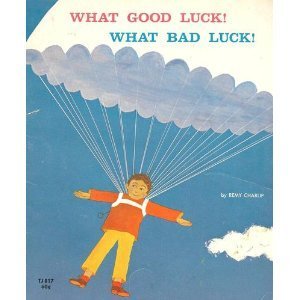
    what good luck what bad luckThe book is What Good Luck! What Bad Luck! by Remy Charlip and relates a sequence of events alternating between good and bad.

    It appears, from what I can find out, that it was first published by Ashton Scholastic in 1964 and sold for 60 cents.

    Today Amazon has used copies on offer for $34.99 or $122 and a collectible as high as $157.70.

    What good luck, I used to have a copy.

    What bad luck, it is no longer in my possession.

    I was at the stage of mentally composing my story with my fingers itching to get to the keyboard to translate it into print when I glanced at the morning paper1 and came across this headline:

    Lesson 1: Bad teachers = bad results

    As a teacher who is passionate about education but also critical of top-down force-fed schooling institutions, headlines/comments like these have me vacillating between defiant self- (and professional-) protection and agreement with the criticisms.

    Teachers come in for a lot of criticism, some of it deservedly so, other of it not so much.

    One quote I love is “Teaching is the one profession that creates all other professions”.

    On the flip-side of this is “Those who can, do. Those who can’t, teach.”

    While I take offense at this one, sometimes I am inclined to think it alludes to an important quality in a teacher. Frequently those who are expert at something, find it difficult to break a process into a series of steps that would enable an explanation to be easily understood by others. If one has struggled to master a task, the process can seem clearer and easier to explain. However there does come a point below which knowledge and experience must not fall or effective teaching cannot exist.

    In her article Bad teachers = bad results, Kylie Lang says that

    “C-grade teachers will not produce A-grade results”.

    She says,

    “Too many mediocre minds are becoming teachers. Universities usher them in, these academic underperformers who fail to qualify for courses with higher entry requirements.”

    She says that

    “A federal education department report shows a rise in the number of school leavers with poor grades being offered places on teaching courses. This year, 55 percent of Year 12 students that were allowed to undertake teaching degrees had an Australian Tertiary Admission Rank below the average . . .”

    It is a bit scary, isn’t it?

    She also says that,

    “If we are a nation that values education . . . we must attract brighter, more creative thinkers to classrooms.”

    I couldn’t agree more. However I wonder where they will get those creative thinkers if higher order thinking skills, creativity and innovation are sacrificed in the relentless quest for scores on academic tests which require students to spit back information forced upon them in hours of didactic instruction and rote learning.

    It’s no surprise that anyone who maintains the ability to think outside the square would rather not return to it!

    And so to my flash piece for this week, which comes with a warning – there’s no rhyme because there is no reason:


    What luck!

    No books, no talk were in the home.

    What luck!

    He was happy to play on his own.


    School began when he was five.

    What luck!

    Learning from flash cards, how hard he tried.


    “My boy can’t do it!” his Mum once wailed.

    What luck!

    With ‘forged’ test scores no child would fail.


    Leaving school, the options were few.

    What luck!

    Teaching was the one he could do.


    Uni years flashed by so fast.

    What luck!

    Number requirements meant he passed.


    Then into the classroom he unprepared went.

    No future joy for any student.

    What bad luck!


    I always enjoy reading your comments. I invite you to share your thoughts.


    1 Courier-Mail, Sunday May 25 2014


    If you enjoyed this post, you may enjoy others. Please click the button at the top on the right to receive future posts by email.
  • Writing to order – done in a flash!

    Writing to order – done in a flash!

    In a recent post Writing woes – Flash fiction I wrote about the difficulty I experienced in responding to a flash fiction prompt posted by Charli Mills at Carrot Ranch Communications.

    While I did eventually produce a piece in response to the prompt and received some very generous comments (thank you readers), the difficulty I was experiencing made me think of all the school children who have ever been set a topic and told to write about it, sometimes without an opportunity for discussion, reflection or planning, and often without any consideration of interests or experiences. I was feeling particularly sympathetic that week as children in Australia were, at that time, sitting the NAPLAN (National Assessment Program – Literacy and Numeracy) writing test.

    This week, while again struggling with the flash fiction prompt but this time unsuccessfully, I happened across a post entitled The dangers of a single story shared on dangerously irrelevant.  This post is an extract from a longer paper entitled Mitigating the Dangers of a Single Story by Nadia Behizadeh.

    While I have not yet read the entire paper, the abstract itself is quite interesting.

    Behizadeh begins by saying

    “The dangers of a single story in current U.S. large-scale writing assessment are that assessment practice does not align with theory and this practice has negative effects on instruction and students.”

    As shown in my previous article, large-scale writing assessment also occurs in Australian schools and, I believe, in the Education systems of many other countries as well.

    It is interesting to see that the practice, while widely implemented, is not, according to Behizadeh, supported by theory. One would have to wonder why. Oftentimes teachers lament that those making decisions about educational practices are bureaucrats with little or no training or experience in education. (Pardon me, we all went to school didn’t we?)

    In our data driven world where information can be collected on spreadsheets, compared in a wide variety of graphs and tables, and stored indefinitely, emphasis moves from qualitative to quantitative assessment. I believe that this trend towards valuing only that which can be scored numerically is having a negative effect upon children’s learning and their enjoyment of learning. It discourages creativity and imagination and forces everyone to squeeze into the same sized and shaped hole. Some manage to fit more easily and more comfortably than others, but I question the cost to all.

    Behizadeh goes on to propose

    “A new vision of large-scale sociocultural writing portfolios in K–12 education . . . that builds on the practices of past large-scale portfolio assessment … (and) also encourages students to write in multiple languages/dialects and modes for multiple purposes.”

    I love the idea of portfolios for assessment, rather than a one-off test. I would think most professional writers have a portfolio consisting of work at various stages: some as ideas jotted on slips of paper, some in planning stages, others in draft form, others completed and waiting for the next step, and others in publication.

    A portfolio allows a writer to work on different pieces at different times and at different rates. Rarely is it imperative for a piece to be completed in an hour or two. (Unless you’re a journalist I suppose.) You can dip in, leave to rest, go back, redraft, edit, start again, and not be required to churn something out for a reader, let alone assessment, more or less on the spot.

    As a teacher, too, I loved my children having portfolios of work. They would write a draft of many different pieces and store them in a folder. They would edit and “publish” those only they wished (which was usually most!).

    I would conference with them about their pieces, firstly about the content be it story, poem, letter or information discussing what they wanted to say, who they were writing it for and how they wanted the reader to think and feel. When they were happy with their message we might talk about choices of words and language structures. Finally, when they were ready to publish, we would look at the surface features of spelling and punctuation. No teacher’s red pen was ever used to mark their work. The children were engaged with the entire process of writing (we called it “process writing” back then) and had ownership of their work.

    We published by sharing our work with classmates, other classes, teachers and parents. We displayed writing on classroom walls, in the hallways and in the school foyer. Each term I would print booklets of the children’s writing for them to take home and share with their families. Many took pride of place on the family bookshelves.

    This type of portfolio clearly demonstrates a student’s ability to write in a variety of genres, to develop an idea, to express oneself grammatically, to use editing skills and to proofread for spelling and punctuation correctness. What better than that could be used to assess a child’s writing development?

    The two main points I am making in this article are:

    • a one-off writing assessment task does not give students an opportunity to show their best work and puts pressure on them to perform
    • a portfolio of work collected over time provides a clear picture of student ability, development, and next steps for learning

    While I began this article by expressing how I was feeling about responding to the flash fiction prompt, I am in no way suggesting that the flash fiction challenge has any similarity to the national writing assessment tasks that are set for children, for it does not.

    With flash fiction:

    • I choose whether to participate or not
    • I choose the genre in which I will respond
    • I hone my writing skills, paring away unimportant words to get to the heart of the story
    • I share my writing with willing readers
    • I receive lots of encouraging and supportive feedback on my writing
    • I have a sense of belonging to a community of other writers.


    This week’s prompt was:

    In 99 words (no more, no less) write a story that begins with a twist. 

    I have spent a lot of time thinking about this one, making various starts and writing some drafts but the twist in this one is, I haven’t been able to come up with something I am happy with sharing. But that’s okay because, unlike the children sitting the one-off national assessment, I can choose not to contribute this time, a low-ranking score won’t be collected and placed against my name for all time, and I can get to participate next time, if I choose.

    Although I am not contributing a piece this time, I have still learned a lot by the process of trying different things, even if I haven’t found a way to make them work, yet

    … and it provided me an opportunity of sharing some of my thoughts about writing with children. There will be more to come!

    I’d love to know what you think!


    PS Make sure you pop over to the Carrot Ranch to see how others have responded to the prompt.


  • Writing woes – Flash fiction

    For the past couple of months, Charli Mills has been posting a flash fiction challenge on her site Carrot Ranch Communications.

    I have been really enjoying the challenges as I hadn’t tried writing fiction in such brevity before. I do like having a go at various genres but the main focus of my writing is education and literacy learning. I am currently developing resources for children, parents and teachers which I plan to make available on a future website.

     Having many years’ experience in writing these types of resources, I sometimes think I would be willing to develop any resource requested by an early childhood teacher. Participating in the Flash Fiction Challenge was a way of proving to myself that I could attempt any topic and genre.

     However, I have not found writing a response to this week’s prompt so easy. Charli’s challenge was to In 99 words (no more, no less) write a travel horror story.

     I am not a fan of horror (real or imagined) and I haven’t done enough travel to have experienced a horror story (thankfully) but I was still keen to have a go and keep up my good participation record.

    The difficulty I was experiencing with this writing task made me think about writing tasks that are set for children in school. How many children have ever returned from holiday and been set the task of writing about “My Holiday”?

    Maybe that’s not so bad, they have all experienced it. But what about other topics that are of little interest to them.

     This week across Australia students in years 3, 5, 7 and 9 are sitting NAPLAN (National Assessment Program – Literacy and Numeracy) tests.

    Students in those year levels are set the same writing task . They are givena ‘prompt’ – an idea or topic – and asked to write a response of a particular text type” 

    Information on the acara (Australian Curriculum Assessment and Reporting Authority) webstite explains that

    “In 2014, as in previous years, the Writing task will be a single common task for all students. The 2014 Writing test will require students to respond to either a persuasive or narrative Writing prompt. However, the genre of the prompt will not be disclosed prior to the test period.”

    It goes on further to say that

     “The provision of a rich and broad curriculum is the best preparation for NAPLAN, including the Writing task.”

    I think I have a fairly rich and broad educational background with a reasonable level of literacy skills; but I am not convinced that, on any given day, in a restricted amount of time, under the watchful eyes of supervisors I would produce my best work in response to a prompt about which I may have little experience, knowledge or interest.


    What about you? How do you think you would go?


    Below is my response to Charli’s horror travel prompt. I don’t think it is my best work.


    Travel woes

    She willed the doors shut forever, knowing that open they must, or she’d be left behind.

    She mentally checked and re-checked required items. Surely there was something she had missed?

     Dread gripped her ankles, threatening her balance.

    Fear squeezed her chest, constricting her breath.

     Heights and enclosed spaces were not her thing.

     She straightened, attempting to hide the tremble from fellow travellers.

     “Don’t be crowded. I need space, air to breathe.”

     The doors opened. She was swept inside.

     They closed, encasing her. No escape now.

    Would she make the distance, mind intact?

     Ding!

    Floor 35. Here already.


    The NAPLAN writing tasks are marked against a rubric of 10 criteria. I wonder what the criteria for flash fiction would be and how I would score.


    Please share your thoughts.

  • Flash fiction: Revival

    The challenge from Charli Mills at Carrot Ranch Communications on April 23, 2014 was to:  In 99 words (no more, no less) describe the climate of a story as it changes to reflect a character’s mood or to create a sense of what is to come. This is my response to the challenge. I hope you enjoy it.

    dry spell
    kconnors http://morguefile.com/archive/display/8583%3C

    Revival

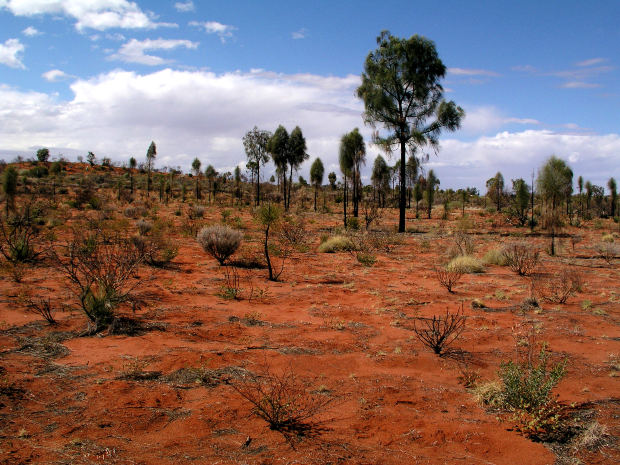
    Her motivation and inspiration was as parched as the cracked red soil beneath her feet. The days were hot and lazy: nothing to do until the rains came. One long languid day followed another. With no work to be done on the land, time did not pressure creativity. Without pressure, there was no rush, no will. The bright blueness of the skies, usually joyous, now oppressive. An occasional cloud or flash on the horizon made empty promises. Finally the winds whipped the clouds into a frenzy, reigniting her creativity as the relentless soaking rains awakened the dormant earth.


    Please let me know what you think.

  • What is education, anyway? Pt.2

    This week I am sharing a post published on Teachling earlier this year. Teachling introduces her post with a TED talk by Sir Ken Robinson, an international advisor on Education. Like Teachling, I very much admire his work and would love to see education systems implement his recommendations. I hope you will set aside the 19 minutes it will take to listen to what Ken has to say. You will be amused, entertained and educated. I intended providing a summary of important points from his talk, but found I was recording the talk in full! Teachling has provided a few notes but I would love you to listen to the entire talk and let me know what you think. How can we join the revolution that Ken says we need?

    Teachling's avatarTeachling

    Let’s face it, children are basically all the same and should be taught in the same, tried and tested, chalk and talk, fashion. Teachers in schools should focus purely on the 3R’s – Reading, wRiting and aRithmetic – and leave that creative ‘fluff’ for kids to pursue in their own time. Children should be viewed as empty vessels and a teacher’s role is to fill them with enough knowledge to pass the test. Some kids are just lazy, hyperactive or incapable of learning, so teachers should let them be whilst focussing on the other kids that can and want to learn. Wait… What? Was there actually a time when people thought this way about education? I do hope that the opinions above are not felt by any person on this earth. My opinions are much more aligned with those articulated in Ken Robinson’s Ted Talk, “How to escape education’s death…

    View original post 447 more words

  • What is education, anyway? Pt.1

    One of my favourite talks about education is a TED talk given by Ken Robinson in 2006 “How schools kill creativity”.

    His contention is that

    “creativity . . . is as important in education as literacy, and we should treat it with the same status.”

    Although the video has had more than 21 million views (while quite a few of them mine, nowhere near that number!) and drawn over 3 000 comments during the last 8 years, his views need to reach a wider audience still; an audience with the power to enact change.
    One thing I had always loved about teaching was the opportunity to express myself creatively, and to encourage my students to do the same. Unfortunately the current emphasis on a content-driven, top-down approach where test results reign supreme has left little room for anyone’s creativity. I am not saying there was ever much opportunity for creativity in formal schooling, but creative teachers could always squeeze a bit it. Now the opportunities for creative “massage” are few.
    My optimism for positive change in education is always raised when I read or hear of others who share similar views. I think if enough voices are heard chanting the same message that a change may come.
    This post (and article in Saturday’s QWeekend magazine) by Mary-Rose Maccoll “Why Banff means the World” also proclaims the vision of Ken Robinson. Mary-Rose is another fan.
    She says that

    “Being at the Banff Centre (in Canada) has made me reflect on what we lose when we don’t foster art, when we don’t foster creativity. And what we lose is the world.”

    She says that

    “even as school education becomes increasingly narrow in its focus, we’re also seeing a decline in performance on the very outcomes that standardisation seeks to improve.”

    She concludes by saying,

    “As I sit in my room and watch the mountains, listening to the trail of a contraband sax down the hall (you’re supposed to play in the soundproofed studios in the forest), reading a piece by a Scottish writer, I am grateful for artists. In our 21st century world, we surely need them.”

    I agree wholeheartedly as, I’m sure would Ken Robinson, along with Teachling whose post What is Education, anyway?Pt 1 I reblog for you here.

    I agree with Teachling’s belief that

    “many teachers would feel that – as well as their students’ innate talents and creativity being snuffed – their own talents and creativity don’t get much of a look-in. I believe most teachers are very restricted in terms of what they teach as well as how they teach it.”

    I also agree with her when she states that

    “that there’s very little teachers can do about it.

    It’s the administrators and politicians that should take Robinson’s advice. It’s also the perceptions of a majority of parents that would need to vastly change if any rethinking of fundamental principles were to occur.”

    Have a listen to Ken and read these other posts, then let me know what you think.

    How can we make our voices be heard to ensure that creativity and innovation is not lost for the future?

    Teachling's avatarTeachling

    Ken Robinson’s take on schools, and how they kill creativity…

    You’re likely one of the 20,738,467 viewers of Ken Robinson’s “Schools Kill Creativity” 2006 TED Talk. Robinson’s assertion, and general gist of the talk, is that “all kids have tremendous talents, and we squander them; pretty ruthlessly”. The “we”, we can infer from the rest of his talk, are schools.

    Let me pick out some key points:
    • “My contention is that creativity, now, is as important in education as literacy, and we should treat it with the same status.”
    • “We are educating people out of their creative capacities.”
    • “Every education system on Earth has the same hierarchy of subjects… At the top are Mathematics and Languages, then the Humanities and at the bottom are the Arts… And in pretty much every education system there’s a hierarchy within the Arts. Art and Music are normally given a higher…

    View original post 423 more words