The celebration of special occasions such as Easter may bring interruptions to the usual class program with preparation for special events and performances such as Easter Hat Parades. It may also signal time to inject some fun into the program. But involving children in Easter activities doesn’t mean the learning has to stop.
In this post, I explain how using readilearn early childhood teaching resources keeps the children thinking and learning while having fun with Easter-themed resources across curriculum areas. (Note: All readilearn Easter-themed resources can be found here.)
Cultural studies
An inclusive classroom acknowledges all traditions celebrated by its children.
Find out whether Easter is one of the traditions celebrated by the families of children in the class and discuss how it is celebrated.
Providing children with fun and purposeful activities for writing is one of the best ways to encourage a love of writing, to replace the drear with enthusiasm.
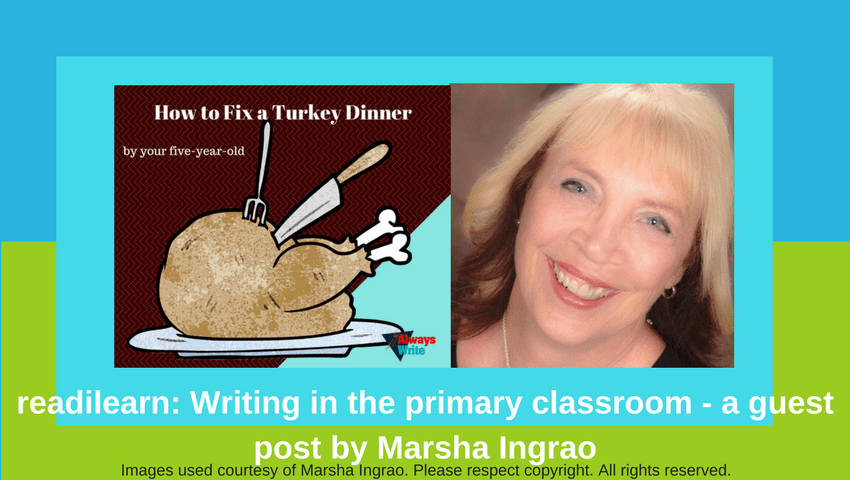
In this post, I introduce guest author Marsha Ingrao who shares suggestions for bringing joy to your writing lessons through the Language Experience Approach.
“The Language Experience Approach (LEA) is a literacy development method that has long been used for early reading development with first language learners…It combines all four language skills: listening, speaking, reading, and writing.”
Although Marsha retired from public education in 2012, her passion for education remains and she continues to educate through blogging, speaking engagements and volunteering for Kiwanis and the Chamber of Commerce. Her classroom experience ranged from teaching kindergarten to fourth grade. She left the classroom to work as a consultant for the county office of education first in math, working with migrant education, then in history and language arts. She is author of Images of America Woodlake, a history of her local Woodlake area, published by Arcadia Press.
Welcome to readilearn, Marsha. Over to you.
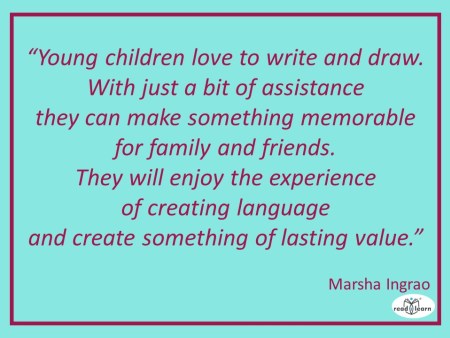
Because LEA employs all four branches of language arts, listening, speaking, reading and writing, it is perfect for teaching writing to pre-school and primary students as well. With the thrust in the United States for non-fiction reading, the language experience approach becomes the perfect avenue for teaching writing to young children.
To make the language experience approach applicable to all young students, adult assistance is required.
The “How To” Essay
Beginning in pre-school, we tackled one of the hardest types of writing, the “how to” essay. Holiday traditions are the perfect avenue for this
This week I am very excited to be interviewing Australian author Sofia Goodsoul about her picture book Nian the Lunar Dragon, illustrated by Marina Kite. With Multicultural Children’s Book Day coming up on 27 January (see previous post I am Australian) and Chinese New Year on 16 February, the time is just right.
Before we begin the interview, let me provide you with a little information about Sofia.
Sofia Goodsoul is an author, emergency kindergarten teacher and indie-publisher. Her poetry writing has grown from a hobby into a great passion. Now she can’t live a day without writing poems, riddles and stories for young children. The children give themes and inspiration for her books.
Sofia lives in Melbourne with her family and pets. She loves going to Zumba classes and taking long walks with her husband and family dog Mack. Sofia dedicates all her spare time to her writing and publishing career.
Nian the Lunar Dragon, an entertaining and beautifully illustrated rhyming narrative for young readers, is Sofia’s second picture book in collaboration with Marina Kite. The book is about the legend behind the traditions and celebrations of Chinese New Year, sometimes called Lunar New Year. According to the lunar calendar, Chinese New Year commences with the new moon at the beginning of spring.
A long time ago, the dragon named Nian lived in the deep ocean to the east of China. Nian was a strong and ferocious dragon, which no creature could defeat. Once a year, Nian climbed ashore to hunt for cattle and human prey. The people of the nearby villages and towns lived in terror, and each New Year’s Eve they had to leave their homes to save themselves. One day, a monk came to the village. He knew a well-kept secret about how to scare Nian away and free the Chinese people from the danger and their fear.
Welcome to readilearn, Sofia. We are looking forward to getting to know you a little better.
Thanks for inviting me!
Sofia, when did you know you wanted to be a writer?
I don’t remember capturing that specific moment, but my grandmother was a children’s book illustrator and I often stayed with her
I loved the addition of the interactive whiteboard to my classroom about ten years ago. I embraced the use of computer technology from when I bought my first home computer in 1985 and first used computers in my classroom in 1986. The interactive whiteboard was a way of making use of the technology inclusive. Instead of one or two children taking a turn on the computer while the rest of the class were engaged in other things, we could all be involved at the same time, if desired.
I used the interactive whiteboard with the whole class for introducing topics, brainstorming ideas and explaining concepts. It was great for modelled writing lessons and collaborative reading. I found it particularly useful for demonstrating the processes to follow in the computer lab.
I used some purchased software, but also spent a lot of time creating activities to teach or practice particular concepts or skills. Versions of many of these lessons are now available here on readilearn.
I’m so delighted to share this post on Sally Cronin’s lovely Smorgasbord – Variety is the spice of life blog. It allowed me to see my thoughts from a completely different angle. Please pop over to read and let me know what you think.
Have you ever had that moment of inspiration when two ideas mesh and you know you’ve found the answer? I’m certain you have. It’s creativity. It’s energising. It’s like bubbles in a can, popping all over the place, bursting with exuberance, needing to express; and there’s no keeping it in.
Writing is like that for me. Writing or teaching. Writing and teaching!
Except for when it’s not.
I can think and think and think and struggle to find an idea. But as soon as the two (or more) right ideas come together, there’s an explosion, and I just can’t wait to get it down, or try it out.
It’s what I love about creating teaching resources. I think: how can I best explain this concept, what will children enjoy most, how will they best learn? Fizz! And I’ve just got to do it. I love the creative outlet. Without it, life’s just, well – dull.
I like to think that what I write is different; that my teaching resources differ from the millions of repetitive worksheets that are written to keep children busily unengaged in the learning process. I imagine myself using them, and having fun with my class. I like to think of other teachers using them to encourage children to think creatively, critically, logically, imaginatively, and learning through discussion with their teachers and peers. But do they? I like to think.
Do you hear that self-doubt? Like so many creatives, I find self-promotion difficult. I struggle to put my work out there for fear it might not be good enough. Each new step requires blinkered determination, focus, and practice, practice, practice to strengthen self- belief that wavers at the first hint of a breeze.
But did you see that? I called myself a creative. Should I? Do I have the right? I always say that one thing I loved about teaching was the opportunity it gave me to be creative. Though I may think I was creative, does my thinking allow me the label?
A few years ago, I gave myself some good talking-tos, took some deep breaths, and attended a writer’s group. Sure, they were the creative types – picture book writers and junior fiction writers. And me. Well, I was aspirational, but had a number of educational publications behind me and was working on my own collection of teaching resources.
In turn, around the circle, we were required to introduce ourselves to the group, sharing what writing we were working on. I could have said I was working on picture books and junior fiction. I have several stuck away in drawers for future development, many with rejection slips to prove I was aspiring. I’d been collecting rejection slips since long before many of these writers were born. I must admit that none of them were recent though, as I’d been more involved in other things, including educational writing.
When it was my turn, I took a deep breath, and stated that I was involved in educational writing at the moment. “Oh,” said the leader. “Educational writing. That’s so formulaic.” And she quickly turned to the next person. Well, if that didn’t burst my bubble. The confidence I’d struggled to muster to even attend the meeting was felled in one swoop.
Not only was she wrong, (well, I believe she was wrong), her attitude was wrong, and her response to an aspiring writer was wrong. She asked no questions, gave no opportunity to discuss why my work may be considered creative, or what other more creative writing I might engage in. She obviously considered I had no business being there among the “real” creatives.
Similar difficulties can be experienced by children in school. People are quick to judge, assess and dismiss on perceptions of background, ability and potential. It can be difficult to stay strong and persistent when the brush of other’s biases paints you inadequate. Without a strong framework and inner fortitude, the will may crack and crumble at the first sign of tension.
Surely, one purpose of education must be to build those strong foundations in order to avoid wreckage in the future. Just as for buildings, we start from the bottom, building on a strong base, adding more to each layer. There’s no starting at the top, or even the middle. Each new layer must mesh with the one before.
I immediately thought of the mesh that is embedded in concrete to give it inner strength, to hold it together when under pressure, to prevent it cracking and crumbling. What a great analogy for both personal core strength and a foundation of a great education. How could I resist?
Here’s my story. I hope you enjoy it.
Strong foundations
Jamie heard the vehicles; the doors slam; then men’s voices. He looked to his mum. She smiled and nodded. Dad was already there, giving instructions.
“Watch, but don’t get in the way,” he’d said.
Clara arrived, breathless. “What’s happenin’?”
“Carport. Pourin’ the slab,” he answered. “That’s the frame. Keeps it in shape.”
Beep. Beep. Beep. The concrete truck backed into position.
The men quickly spread the mix, then lifted the mesh into place.
“Makes it strong,” said Jamie.
Another load of mix was spread.
“All done,” said Jamie.
Later, in the sandpit, the children experimented with strengthening their structures.
Thank you for reading. I appreciate your feedback. Please share your thoughts.
P.S. If you are a teacher of children of about 5 to 7 years of age in their first three years of school, I’d love your feedback on readilearn, my collection of early childhood teaching resources. Please complete the survey here and share this post with other early childhood educators you know. I am keen to receive honest feedback about the site’s visual appeal and usability, as well as suitability of resources. Thank you. 🙂
Next Friday 15 September is International Dot Day, a day for celebrating and promoting creativity, courage and collaboration.
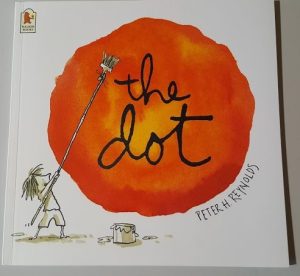
Celebration of the day was initiated in 2009 with teacher Terry Shay introducing his class to the picture book The Dot by Peter H. Reynolds.
The story is of Vashti and a teacher who encouraged her to make a mark and have a go. Lacking self-belief and courage, Vashti was reluctant to participate in art class. When the teacher framed and hung her signed painting of a tiny dot, Vashti was determined to do better. She painted all kinds of dots that wowed the people at the school art fair. What happened when one little boy admitted to Vashti that he wished he could draw will inspire children everywhere to be brave, have a go, and be creative.
For a wealth of celebratory suggestions, visit the International Dot Day Get Started page and sign up to download a free Educator’s Handbook, which includes a lovely certificate of participation which can be printed and personalised for each child.
I have included a link to the page in the new resource Getting creative with dots in which I suggest additional ideas to add to the celebration.
The suggestions, of which examples are shown below, can be used in conjunction with International Dot Day, or any day when you feel like going a little dotty.
Are you a daydreamer? Were you accused of daydreaming at school? Many of us were. With minds that are easily distracted and work that is less than exciting, it is easy for thoughts to drift away into other realms. It can take anything, or nothing, and it is often difficult to back-track from where we find ourselves, along the path of thoughts to what initiated the journey. It can be no more tangible that the dream that escapes upon waking.
While daydreaming can be pleasant and good for relaxation and creativity, it is often frowned upon in students meant to be concentrating on what they are to learn. Children would probably find it easier to attend if the work was tailored to their needs, initiated by their interests, and involved them as participants rather than recipients. The fifteen minutes of play per hour that Finnish children enjoy would also help, I’m sure, in giving time for minds to be, not corralled into predetermined channels.
In this Conversation on Daydreaming with Jerome L. Singer in Scientific American by Scott Barry Kaufman on 10 December, 2013, Singer says, “I think that teachers need to recognize that often, the daydreaming is because some of the kids are bored”.
Whether through boredom or not, daydreaming can sometimes lead to breakthroughs in solving problems, creativity and productivity as described in this CNN article by Brigid Schulte For a more productive life, daydream. Brigid lists a number of daydreamers; including:
J K Rowling
Mark Twain
Richard Feynman
Archimedes
Newton
Other famous daydreamers include:
Einstein
Edison
J. R. R. Tolkien
Boy George
Richard Branson
Here are a few other quotes about the importance of daydreaming:
Keith Richards is reported as saying that “Satisfaction”, the Rolling Stones’ most famous hit, came to him in a dream, and
Paul McCartney says the same thing about the Beatles’ hit “Yesterday”.
Neil Gaiman: “You get ideas from daydreaming. You get ideas from being bored. You get ideas all the time. The only difference between writers and other people is we notice when we’re doing it.”
George Lucas: “I’m not much of a math and science guy. I spent most of my time in school daydreaming and managed to turn it into a living.”
Professor Elizabeth Blackburn, the first Australian-born female Nobel Laureate, attributes her success as a molecular biologist, in part, to daydreaming. She is reported by the Sydney Morning Herald to have said, ‘I think you need time to daydream, to let your imagination take you where it can … because I’ve noticed [that] among the creative, successful scientists who’ve really advanced things, that was a part of their life.’
While speaking to students at Questacon in Canberra after receiving her prize, she joked, ”Your parents and your teachers are going to kill me if they hear you say, ‘she told us just to daydream.’
So why is it, if the importance of daydreaming is recognised by successful creatives, thinkers, scientists, and business people, that it is still frowned upon in school? Why do we still insist that children sit at desks, repeating mundane tasks in order to pass tests that have little bearing on their future success or on the future of our species and the planet?
In a previous post I wrote about John Dewey’s dream “of the teacher as a guide helping children formulate questions and devise solutions. Dewey saw the pupil’s own experience, not information imparted by the teacher, as the critical path to understanding. Dewey also contended that democracy must be the main value in each school just as it is in any free society.” According to Pasi Sahlberg in Finnish Lessons, What can the world learn from educational change in Finland?schools in Finland have dreamed their own dream by building upon Dewey’s.
Of course, on a much smaller scale, I have my own dream of a better way of educating our children.
Meanwhile, he filled oodles of notebooks with doodles and stories.
When school was done he closed the book on their chapter, and created his own reality with a best-selling fantasy series, making more from the movie rights than all his teachers combined.
Why couldn’t they see beneath the negativity of their comments to read the prediction in their words?
Of course, not all daydreamers become successful, and not all children have a negative schooling experience. For a much more appreciated and positive set of comments, read this post by Elizabeth on Autism Mom Saying Goodbye to Elementary School.
Thank you for reading. I appreciate your feedback. Please share your thoughts.
Giving children opportunities to question, to be creative, and to problem solve are high on my priorities. Children need to be given the time and opportunity to figure out things for themselves. While it is sometimes easier just to tell or show them what to do, or even do it for them, it is generally better for their development, to let them have a go at finding a method or solution. Please note: I am not talking about dangerous things here like playing with fire, testing to see how fierce that dog really is, or driving a car.
If children are constantly told there is a right way of doing things, they will stop exploring, discovering, and inventing their own or new ways of doing things. This is an issue because, if we always do what we’ve always done, we’ll never progress. There is generally no harm in, but much to learn from, each successive attempt.
Opportunities to explore, discover, and use intuition are also important to the development of mathematical thinking. When children are developing understanding of number, they often invent their own strategies for working with numbers. Sometimes, as attested in this paper by Heirdsfield, Cooper and Irons, the strategies used display more advanced thinking, and are more efficient, than those taught as ‘the’ correct way of solving a problem using pencil and paper.
I have noticed a change in the speed and agility with which my seven-year-old grandson works with numbers now that he has learned there are certain ways of; for example, adding two numbers. He tends to second-guess himself as he attempts to mentally calculate using the pencil and paper method he has been taught, rather than other more effective strategies he had previously invented and used. Perhaps you have noticed something similar.
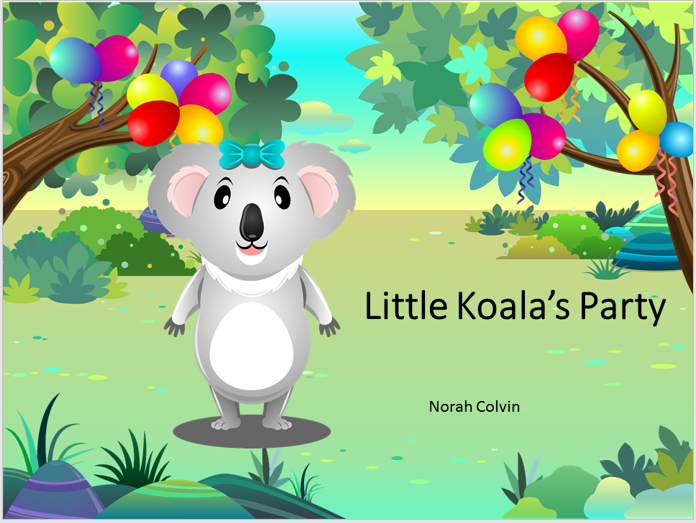
Little Koala’s Party – a story for problem solving in the readilearn mathematics resources also encourages mathematical thinking and planning. Children help Little Koala organise a party for her family and friends, deciding who will be invited, the number of guests, and what’s on the menu. The suggestion is made that children plan a party of their own and they are asked to consider how they would go about it. The discussion and sharing of ideas, rather than the imposition of one ‘right’ way, is the important thing in developing mathematical thinking.
Now it might seem a stretch to tie this in with a piece of flash fiction, but I hope you’ll be able to follow my thinking through the mist and into the light.
Father and Son sat side by side. Father cracked his knuckles and sighed repeatedly while Son sharpened his pencils, each pencil, and arranged them meticulously according to undisclosed criteria.
“Come on. Just get it done. Then you can play.”
“I’m thinking.”
“Think faster.”
“I know it’s 96.”
“Well write it down.”
“Sir says I have to do the working out.”
“Then do it.”
“I don’t know how.”
“Like this. See.”
“That’s not how we do it. Sir says…”
“Then do what Sir says.”
Slowly it dawned on Dad: Sir’s way may not be the best way for all.
Thank you for reading. I appreciate your feedback. Please share your thoughts.















 Norah Colvin