Live Love Laugh Learn … Create the possibilities

Tag: Children

  • Just imagine . . . the power of imagination

    Have you ever wished you could:

    • be in two places at once?
    • clone yourself to ensure you get everything done?
    • slow time down so that you could achieve all you wanted?
    • make time stand still so you could stay in the present moment forever?
    • pop back in time to undo that embarrassing moment, or peek forward to see the result of a decision that is pending?
    • choose both options and follow each through consecutively, as in parallel universes?

    I have.
    https://openclipart.org/image/800px/svg_to_png/194578/07-Juli-goin-on-a-summer-holiday.png
    https://openclipart.org/image/800px/svg_to_png/194578/07-Juli-goin-on-a-summer-holiday.png

    Multiple invitations or engagements often occur on the same date. Deciding between desired activities is not always easy. Cloning would make choosing unnecessary. Additionally, sending a clone to an unpleasant but unavoidable engagement could also be desirable.
    penguins

    Sometimes the number of must-do tasks can be overwhelming. The ability to engage the assistance of clones, especially to complete less desirable tasks would be great.

    Time travel, wormholes and parallel universes are the stuff of science fiction; and while I am not a fan of the science fiction genre, I wouldn’t mind having access to some of its features. However, whether any, or which, of those features ever move from science fiction to science fact remains to be seen.

    The power of imagination to drive creativity and innovation cannot be overstated. Much of what we now accept as commonplace was once a part of science fiction. Imagination, the stuff of science fiction and scientific exploration and investigation, has brought them to reality.

    You are probably familiar with following quote, initially attributed to George Bernard Shaw but also made famous by Robert F. Kennedy:

     “Some men see things as they are and say why. I dream things that never were and say why not.”

    These words highlight the importance of questioning to stimulate imagination, and when paired with creative thinking, innovation can occur.

    Einstein said that,

     “Imagination is more important than knowledge. For knowledge is limited to all we now know and understand, while imagination embraces the entire world, and all there ever will be to know and understand.”

    He also said that,

     “Education is what remains after one has forgotten everything he learned in school.”

    Although I cannot be certain, from those quotes, what Einstein’s attitude to the current trends in schooling would be (he did attend school and was very advanced in maths and sciences but did not perform so well in the humanities) I think he would not favour a content-driven curriculum which excluded opportunities for imagination and creativity.

    On the other hand, Thomas Edison, the world’s most prolific inventor, was mostly educated at home by his mother who was able to encourage his experimentation and love of learning. He said,

     “To invent, you need a good imagination and a pile of junk.”

    If these significant thinkers of the 20th century, each of whom followed different educational pathways, recognise the importance of imagination, why would anyone argue against it?

    Charli Mills at Carrot Ranch Communications certainly doesn’t. As a fiction writer she embraces imagination. It is the tool of her trade, creating stories where before there were none. This week her challenge is to In 99 words (no more, no less) craft a multiverse situation, setting or character(s)

    Now the term ‘multiverse’ takes me back to the science fiction genre: wormholes, parallel universes and time travel, for example. I’m not sure how well I’ll do with this unfamiliar genre, but I will call upon my imagination and give it a try. See what you think – does my piece fit the criteria?


    Clone Magic

    Clone magic

    All night Leone had huddled in line, sleepless with excitement, waiting for the release.

    Now she had them! Clone pills!

    ‘Take one with water. Cloning occurs in 30 minutes and lasts 24 hours.’

    Leone swallowed one tablet, then another, and another; ignoring the small print: ‘Do not take multiple tablets. Effects are unpredictable.’ 

    When three clones appeared she instructed:

    “1. Clean the house. 2. Exercise. 3. Weed the garden.”

    She flopped on the couch. “Now to read.”

    But — their hands grabbed for her book, pulling her hair and clawing her eyes.

    “Me read! Me read! Me read!”


    Thanks for reading. I appreciate your feedback. Please share your thoughts about any aspect of this article or my multiverse flash.


  • Benefits of inclusion

    Recently I listened to a compelling TEDx talk by Dan Habib. You can listen to it here:

    Dan opens his talk by asking the audience some questions about their school days:

    Did kids with and without disabilities study together and learn together?

    Did they have a best friend who had a disability?

    Did they have a boyfriend or girlfriend that had a significant disability?

    Very few of the approximate one hundred in the audience answered in the affirmative.

    Then Habib asked the audience to consider and answer the following question:

    Did you feel some fear or nervousness when you were a kid about talking to a kid with a disability?

    The majority of the audience affirmed they did.

    Had I been in the audience, my responses would have been similar.

    When I was a kid, there were no children with disabilities in my classes. Children with disabilities were hidden away as an embarrassment and were segregated into what where called ‘opportunity schools’.

    Thinking back, my impression is that people with disabilities were not visible in the community and their needs were not catered for. They were not expected to have any participation in society. Often they were targets of taunts and laughter, but mostly ignored and avoided.

    https://openclipart.org/image/800px/svg_to_png/183559/oldmaninwheelchair.png
    https://openclipart.org/image/800px/svg_to_png/183559/oldmaninwheelchair.png

    However, when I was a kid discrimination wasn’t restricted to people with disabilities. It was a time in which racial discrimination and segregation was more prevalent; before the emergence of women’s rights and children’s rights.

    Sometimes when we see how far humanity still has to go towards equality, tolerance and compassion it is hard to see how far we have come. But looking back on the changes that have occurred in just my life time, the progress is obvious, if still insufficient.

    Even into my college years I had little contact with people with disabilities and my teacher training made no mention (that I can remember) of catering for students with disabilities, who were still segregated into what became called ‘special’ schools. I don’t recall catering for individual differences being high on the agenda back then.

    I worked as a remedial teacher for a few years, supporting students who were achieving below the expected level, of reading mainly. These children were generally of average intelligence but experiencing a learning difficulty. Children falling below average on an intelligence test would still be shunted away to special schools.

    I cannot recall the inclusion of any students with intellectual or physical disabilities at any school at which I taught prior to the 1990s when integration and mainstreaming was introduced. Dan Habib says in his talk that, as he was growing up, ‘disability was just a blip on the radar screen’ as well. Maybe this experience was similar to yours?

    When Dan came to accept that his son Samuel had a disability and that he would have that disability for life, he realized that they had to create a vision for Samuel, and let ‘Samuel create a vision for himself“.

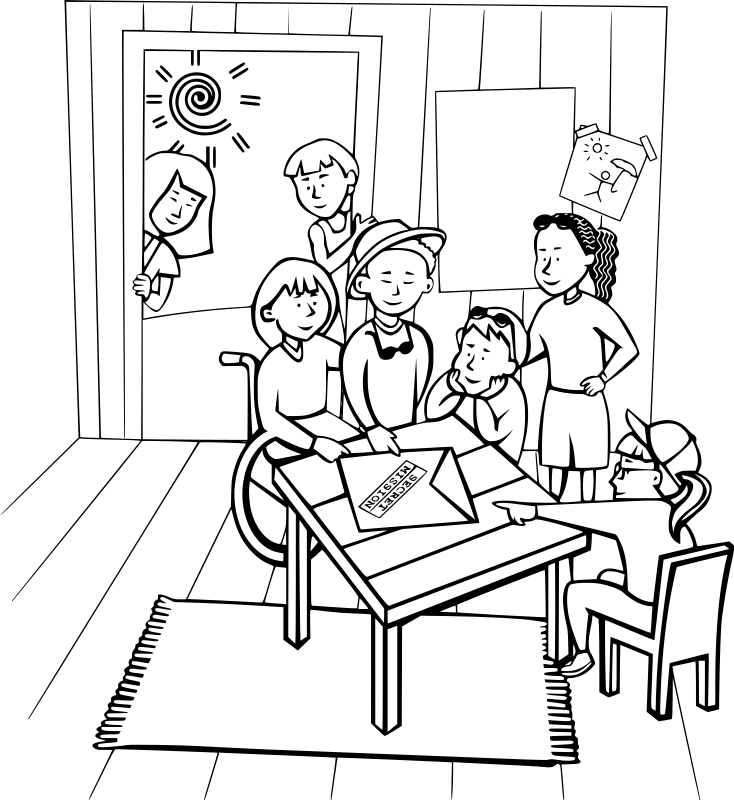
    https://openclipart.org/image/800px/svg_to_png/195899/EPA-clubhousekids.png
    https://openclipart.org/image/800px/svg_to_png/195899/EPA-clubhousekids.png

    Part of this was the need for a sense of belonging: to the neighbourhood, the community and the local school. It was this that got Dan thinking about inclusion. Dan goes on to describe the ways in which Samuel was included in the school and the community, and the benefits, for both Samuel and others.

    He urges everyone to advocate for inclusive education as the benefits include better communication skills, higher academic achievements, wider social networks and fewer behaviour problems. He decries the fact that, despite the benefits, most kids with disabilities still spend their day segregated.

    He explains that the benefits are just as valuable for typical kids who achieve higher academically while learning to be patient, caring, compassionate, and loving. In my more recent years of teaching, I got to see these benefits of inclusion first hand. Not only did the children learn, so did I.

    I didn’t just chance upon this TEDx talk. It was included in a great guest post by Gary Dietz on The Cool Cat Teacher’s blog. The post introduced a book, written by Gary, about dads of kids with disabilities and proposed 5 practical lessons for elementary classroom inclusion. The book Dads with Disabilities is described as inspiring and ‘a must read for any teacher working with special needs kids’.

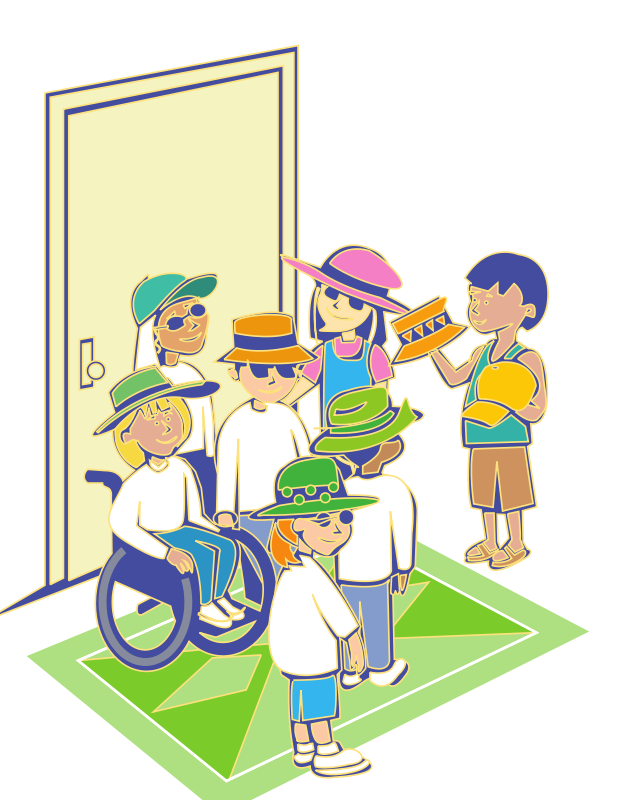
    https://openclipart.org/image/800px/svg_to_png/651/ryanlerch_kids_with_hats.png
    https://openclipart.org/image/800px/svg_to_png/651/ryanlerch_kids_with_hats.png

    The five suggestions (which I think are based on respect and are applicable for all students) are:

    1. ‘Meet the student “where the student lives” (where they need to be, at their level of development)
    2. Presume competence
    3. Be creative in your use of ‘adaptive’ technology (e.g. use of video and Skype or Facetime)
    4. Listen to parents and help them listen to the child
    5. Give “overlooked” children the same chance to shine as the superstars


    Vicki Davis is the Cool Cat Teacher. Her blog is consistently among the top 50 education blogs worldwide. Her byline is “A real teacher helping teachers be really excellent”. I agree that she is and recommend her blog to you.

    Update from Gary Dietz (12/08/2014):

    “The book ‘Dads of Disability’ is now a FREE loan if you subscribe to Amazon Prime or Kindle Unlimited. And if not, it is on sales as an ebook for $4.99. Look it up on Amazon. (Of course the paperback is still available!)”


    How do you view inclusion? What is your experience?

    I appreciate your feedback. Please share your thoughts about any aspect of this post.


  • The classroom garden

    The classroom garden

    Expecting every child in a class to respond to the same stimuli, develop at the same rate and achieve the same targets is like casting a handful of mixed seeds upon the soil and expecting them all to flourish.

    Just as each seed has its own specific requirements of soil type, temperature, sunlight and water, so too does each child have its own needs, interests and learning requirements.

    Differentiation is no less important in the classroom than it is the garden and tending to the learning and development needs of each child requires understanding of individual needs, appreciation of learning styles and a program that includes both a nurturing and expectation of individual growth with a sprinkling of well-timed instruction, support and attentive praise.


    This week Charli Mills at Carrot Ranch Communications posted a flash fiction prompt that immediately conjured up an image of a classroom as a well-tended garden in which each individual is appreciated for its own value and receives whatever is appropriate to foster its development.

    Charli’s challenge is to In 99 words (no more, no less) write a story that includes fruit.

    Jeff Kubina, Apple Orchard https://www.flickr.com/photos/kubina/2058047853/
    Jeff Kubina, Apple Orchard https://www.flickr.com/photos/kubina/2058047853/

    Here is my response about a little tree whose time has come:

    A fruitful harvest

    Little Tree stood alone at the edge of the orchard thinking, “What’s wrong with me?”

    The other trees grew tall. Their branches, laden with bright green leaves and sweet-scented blossoms, seemed to whisper mockingly.

    The sun shone. Rains watered the soil.

    Their blossoms turned to fruit, a plentiful harvest.

    Confused and dejected, Little Tree avoided the celebratory festival.

    Then all grew quiet. The bigger trees rested, preparing for the next season.

    Suddenly an insect orchestra and an unfamiliar fragrance startled Little Tree.

    “What’s up?” it asked.

    “You!” they buzzed relishing the richness of its golden blooms.


    Thank you for reading. I appreciate your feedback. Please share your thoughts about any aspect of this article or flash fiction piece.


    Featured image: rjp, Bird seed https://www.flickr.com/photos/zimpenfish/437991798/


  • I’ve got the music in me – let me count the ways!

    I’ve got the music in me – let me count the ways!

    For any hearing person, music is integral to our lives.

    Every country has a national anthem which may be taught in schools and played or sung at many and varied ceremonies and occasions, inspiring unity and national pride. Many other organisations such as schools and colleges have their songs praising their strengths and fostering a sense of identity. Couples have their special or ‘theme’ songs.

    When we enter a store we are serenaded with music chosen to make us feel comfortable and entice us to stay longer and buy more.

    Joyful advertising jingles with their subliminal messages encourage us to memorize the product name and make it our next purchase. These jingles can stay in our heads for years, like this famous one about Louie the Fly:

    A few bars of a song can revive memories from long ago. I have written about this previously in a flash fiction piece, Vagaries of time.

    Music can call us to dance, to relax, to sing, to cry. It can be chosen to match our mood, or can help to create a mood or atmosphere. The soundtrack of a film or television show tells the audience what to expect and how to feel.

    Music is also an integral part of education and learning. Learning information in a song can help one remember. Many people like to have music playing when they are reading or studying. I did when studying towards my high school exams, but now I prefer quiet when I write. Programs such as Accelerated Learning recommend using Baroque music to help learners stay relaxed and focused, increasing retention.

    I have previously written about using songs in the classroom, such as I love the mountains which I learned from Bill Martin Jr. and affirmation songs such as those of Anne Infante here and here.  I have also composed class songs and chants such as Busy Bees chant, and used songs to support class work, for example The Ugly Bug Ball when learning about mini-beasts.

    I have used music to calm and settle after play breaks, and music for activity between seated activities. I used songs in the morning to signal to children that it was time to be ready for the day’s learning, including action songs or songs about our learning, for example a phonics song:

    Image courtesy of Anne
    Image courtesy of Anne

    But of course, once we were settled, every day started with an affirmation song, or two. It got everyone into a happy expectant mood. It’s hard to be sad when singing (unless it’s a sad song).


    image courtesy of www.openclipart.org
    image courtesy of http://www.openclipart.org

    . . . and  songs in the afternoons to send the children home happy and singing with joy.

    As a year level we would sing songs to settle the children when lining up to return to class after lunchtime play. The children hurried to join in and sang their way joyfully into class. This is quite different from when I was at school and we would line up in silence and then march into school in step, subdued and quietly obedient.

    I composed songs as a child but did not continue the practice as an adult, except for one: a lullaby that I sang to soothe my baby girl to sleep. A few years later I decided to learn to play the keyboard from a very talented musical friend who guided my writing of the accompanying music. This remains my one real musical accomplishment!

    For someone who does not consider herself at all musical I certainly enjoy, and promote the use of, music in many different ways.

    On that note, I leave you with my flash fiction response to the prompt set by Charli Mills of Carrot Ranch Communications: In 99 words (no more, no less) write a story influenced by a musical score.

    Final act

    A collective gasp interrupted the music mid-beat.

    All eyes turned synchronously, as if worked by unseen strings, towards the French doors, burst open and revealing a silhouetted figure framed by billowing gossamer-like curtains.

    Out of the darkness the figure emerged: clothed in black with coat tails flapping, a top hat in one hand and a white-tipped cane held aloft in the other.

    The conductor revived the orchestra as the figure glided across the floor, seized the heroine decisively and whirled her around and around.

    The spell now broken, the cast joined in the dance to tumultuous applause.

    I hope you can imagine the score that would be written to accompany this piece and its change of moods.

    What score would you give it?

    Thank you for reading. I appreciate your feedback. Please share your thoughts about any aspect of the article or my flash fiction piece.

  • Whose story is it anyway?

    Nor and Bec reading

    Children love stories.

    They love being read stories and beg for them to be read, over and over again.

    Equally as much, if not more, they love being told stories, especially stories of their own lives. They beg for them to be told over and over, listening attentively and with wonder as their own stories (her story and his story) are being revealed. They commit these tales to memory so that eventually it is difficult to distinguish the genuine experiential memory from the telling. Even as adults they seem to not tire of hearing tales of the cute things they did when they were little, or of shared experiences.

    They also love being told stories of their parents’ lives. These are the stories that help define them and their existence: how they came to be. The stories tell of times gone by, and of how things used to be. They marvel that their parents were once children and try to imagine how that might have been.

    My daughter would often ask for stories about herself, her brother, myself or other family members. One day when she was about six, she asked again, ‘Tell me a story about when you were a little girl.’ Before I could respond she jumped in with, ‘What were the dinosaurs like?’ She was teasing, of course, and her comedic timing was perfect. A story was created, one that has been shared many times.

    History is a story, though at school I never saw it as such. Had it been a story of lives, as its name implies, I may have been interested. But history at school was a list of wars and dates, and kings and queens to be memorised and regurgitated for a test at the end of the term. There was no story, no human emotion, no semblance to any narrative that may have lured me in.

    I hope that today’s students of history are not required to commit sterile lists of facts to memory without the stories that would give them meaning and significance, some human element to help the information stick.

    History, as a subject, had always been relegated to high school. It was not a discrete part of the primary school curriculum, though aspects were explored in other subject areas such as ‘Social Studies’ when I was at school, or more recently ‘Studies of Society and Environment’. With the introduction of the new Australian Curriculum, History is now a stand-alone subject.

    As an early childhood teacher I was a bit terrified that young children would be required to memorise lists of seemingly random facts and dates. I’m pleased to say that, for the early years anyway, this is not so. Children in the early years start by exploring their own history and the history of their family, considering similarities and differences between their lives, the lives of their parents, and of their friends.

    I applaud this as an excellent starting point. I believe, when working with children, connections must always be made with their lives and what they know. What better starting point than investigating the traditions of their own family and culture.

    In Australia, as I am sure it is in many other places, a great diversity of cultures is represented in each classroom. Encouraging children to share similarities and differences of traditions with their classmates helps to develop understanding of each other’s traditions and beliefs, which in turn fosters respect and empathy. For this purpose, I developed some materials to make it easy for children to share their traditions. These are available in my Teachers Pay Teachers store.

    Whoever you areMem Fox has written a beautiful picture book Whoever you are that I love to share with children when discussing their cultures and traditions. It explains in a simple and beautiful way that although children around the world may live in different houses, wear different clothes, eat different foods, for example ‘inside, their hearts are just like yours.’ Mem Fox explains the story on her website.

    I also like to sing I am Freedom’s Child by Bill Martin Jr.; and in Australia we have a great song that tells about our different beginnings, I am, you are, we are Australian by Bruce Woodley.

    Heal the World by Michael Jackson is another great one for appreciating diversity and fostering inclusivity.

    What got me thinking about history in particular for this post is the flash fiction prompt posted by Charli Mills at Carrot Ranch Communications. Charli’s challenge is to In 99 words (no more, no less) write a story that considers history, near or far.


    This is my contribution:

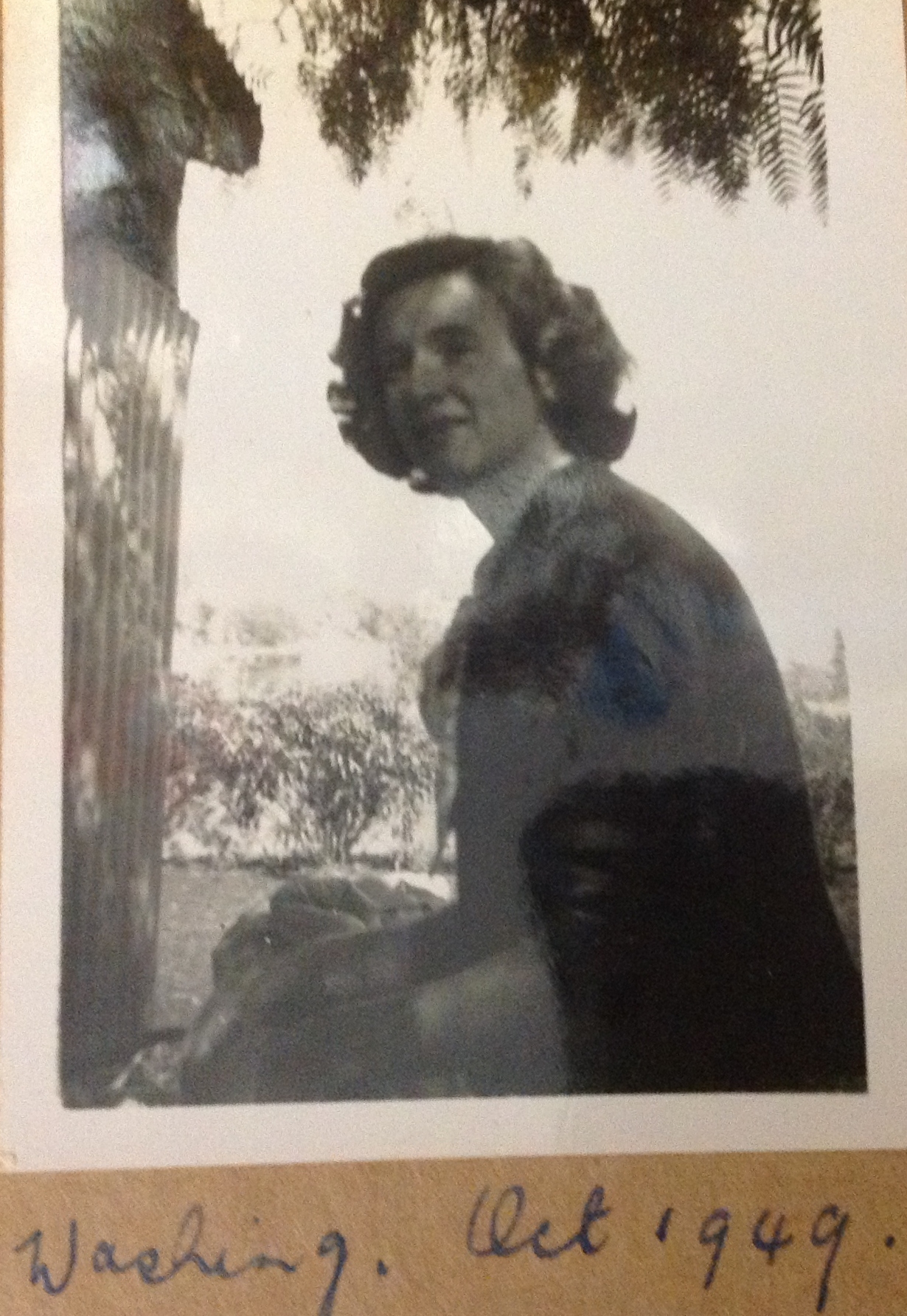
    washing 1949

    Washing day

    Her freckled, calloused hands were red and chaffed as they gripped the wooden stick and stirred Monday’s sheets in the large copper pot heating over burning blocks of wood.

    The children played in the dirt nearby, scratching like chickens, hopeful of an interesting find.

    The dirt embedded under her torn and splitting fingernails began to ease away in the warm sudsy water as she heaved the sodden sheets and plopped them onto the wooden mangles.

    The children fought to turn the handle, smearing dirty handprints on the sheets.

    She sighed, and hung them over the line. One chore done.


    I welcome your feedback. Please share your thoughts about any aspect of the article or my flash fiction piece.


  • But I want it now! How long can you wait? The importance of emotional intelligence

    marshmallow 5

    In my previous post Life: a choose your own adventure – how do you choose I discussed the difficulties we may experience in prioritising options and choices, and the need to be self-regulatory in performing tasks and achieving goals.

    The discussion reminded me of the marshmallow test I had heard about from Daniel Goleman in his book “Emotional Intelligence”.

    The marshmallow test was a study conducted in the 1960s by Walter Mischel .

    As described by Daniel Goleman, In this experiment four-year-olds from the Stanford University pre-school were brought to a room and sat in a chair in front of a juicy marshmallow on a table. The experimenter then told them they could eat it now, or get two if they were willing to wait until the experimenter came back from running an errand.

    You can watch a video demonstrating the experiment here:

    Some children could not wait and ate the marshmallow as soon as the examiner left the room. Others toyed with the idea of waiting, but were unable to resist the temptation. Others were able to wait and scored two marshmallows when the examiner returned.

    While this study revealed certain aspects of childhood behaviour, follow-up studies into the behaviour of these children when young adults and graduating from high school revealed that Those who waited, compared to those who grabbed, were more popular with their peers, had less trouble delaying gratification, and scored far higher on achievement tests.”

    A further study, conducted 40 years later, as reported by Sylvia R. Karasu writing for Psychology Today, found that the ability to resist temptation is fairly stable over the lifecycle and predictive of behaviors 40 years later!

    Goleman talks about the important role of parents in supporting children to develop the ability to control impulses and choose behaviour. As children learn to internalise and choose the ‘no’ imposed by others, they learn to regulate impulsive behaviour. He calls it the ‘free won’t’, the capacity to squelch an impulse.”

    Karasu supports this by saying that “The researchers also suggested that a family environment where self-imposed delay” is “encouraged and modeled” may give children “a distinct advantage” to deal with frustrations throughout life.”

    Goleman says that the ability to curb dangerous impulses is an aspect of emotional intelligence, “which refers to how you handle your own feelings, how well you empathize and get along with other people. (He says it) is just a key human skill.”

    He continues by saying that “it also turns out that kids who are better able to manage their emotions . . .  can pay attention better, take in information better, and remember better. In other words, it helps you learn better.”

    It sounds like emotional intelligence is something that all schools should be developing, don’t you think?

    www.openclipart.org http://goo.gl/XhPCyE
    http://www.openclipart.org http://goo.gl/XhPCyE

    Goleman says that the ability to delay gratification hinges on a cognitive skill: concentrating on the good feelings that will come from achieving a goal, and so ignoring tempting distractions. That ability also lets us keep going toward that goal despite frustrations, setbacks, and obstacles.”

    Without that ability it may be difficult for any of us to achieve our goals. Saving for the future, studying towards a qualification, working harder now to have time off later; none of these would be possible without the ability to delay gratification.

    But can emotional intelligence be taught? And should it be taught in schools?

    It seems to me that if emotional intelligence is able to predict “success” in later life, then it is important to develop it as early as possible. This can begin in the home with parents helping their children learn to delay gratification, build resilience and develop empathy.

    I believe it is important to make a place for programs that develop emotional intelligence in schools. Children need opportunities to internalise emotionally intelligent responses to a variety of situations. A very structured, force-fed, content driven, test based approach where almost every action is directed and monitored leaves little room for students to develop skills of self-regulation.

    Discussions of whether emotional intelligence can, or importantly should, be taught in schools can be read here and here. The theory is that children can no more “pick up” emotional intelligence than they can “pick up” maths or English. To leave it to chance seems to be denying our children the opportunity to develop skills that will help them lead happy and successful lives.

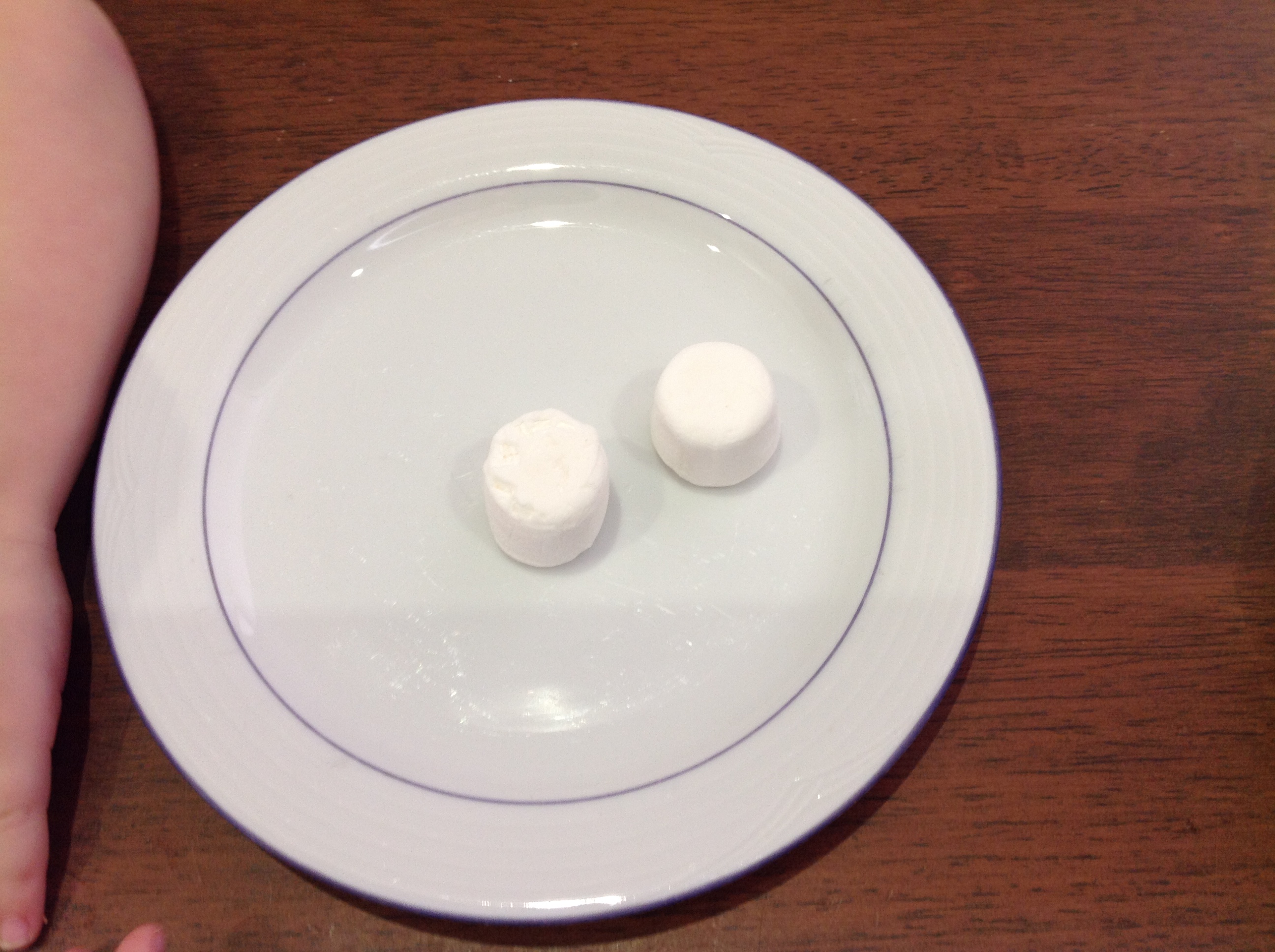
    What do you think? Would you have one marshmallow now, or double it later?

    1 marshmallow      marshmallow 2

    Please share your ideas.


    You can read more of Daniel Goleman’s work at Edutopia, and hear his talks and conversations at More Than Sound.


    If you enjoyed this post, you may enjoy others. Please click the button at the top on the right to receive future posts by email.


  • It’s no surprise! Talking education

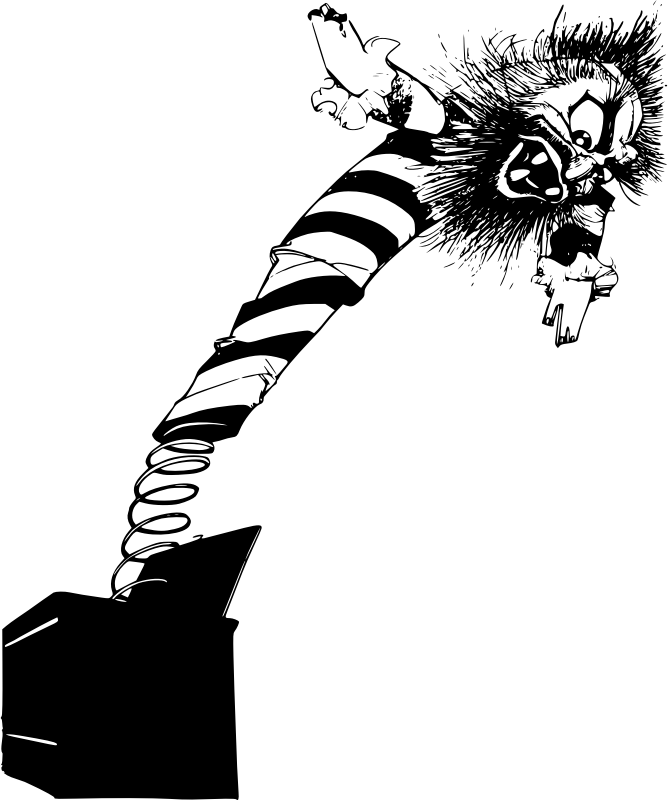
    https://openclipart.org/image/800px/svg_to_png/185077/creepyjackinthebox.png
    https://openclipart.org/image/800px/svg_to_png/185077/creepyjackinthebox.png

    We all like a surprise, right?

    Well, you might say, that all depends on whether the surprise is a good surprise or a bad surprise.

    A surprise is simply something unexpected, and everyday life is full of surprises; some so little they go almost unnoticed, others of larger more life-changing proportions. Some are pleasant and others far less so.

    What got me thinking about surprises this week is the flash fiction prompt posted by Charli Mills at Carrot Ranch Communications.

    Charli’s challenge this week is to

    In 99 words (no more, no less) write a story that shows surprise without using the word. 

    I have been thinking of all sorts of surprises I could write about but decided to maintain my focus on education.

    There are many opportunities for surprises to occur throughout one’s education, which is not limited to (but probably, dare I say, by) one’s schooling experiences.

    For example:

    • Discovering you can read a book, all by yourself
    • Discovering an author whose work you just can’t put down
    • Finding a solution to a problem that had seemed insurmountable
    • Achieving a favourable result in a dreaded test
    • Being offered a place in the course you were wanting
    • Having work accepted, valued and receiving payment


    There are many situations in which the surprise could go either way.

    For example:

    • Being called to the principal’s office
    • Having a parent-teacher interview about your own child, or student
    • Receiving exam results or course placement offer
    • Meeting a new teacher
    • Working in a group to solve a problem


    Being a lover of stories, especially picture books, it is rare that a situation doesn’t trigger a thought connection to a story or book I have read.

    Thinking about the good surprises and bad surprises that could happen in some of these situations made me think of a book I had read to my own, and classes of, children years ago. Maybe you will remember it also.

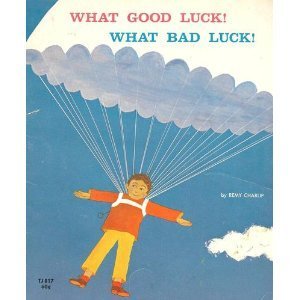
    what good luck what bad luckThe book is What Good Luck! What Bad Luck! by Remy Charlip and relates a sequence of events alternating between good and bad.

    It appears, from what I can find out, that it was first published by Ashton Scholastic in 1964 and sold for 60 cents.

    Today Amazon has used copies on offer for $34.99 or $122 and a collectible as high as $157.70.

    What good luck, I used to have a copy.

    What bad luck, it is no longer in my possession.

    I was at the stage of mentally composing my story with my fingers itching to get to the keyboard to translate it into print when I glanced at the morning paper1 and came across this headline:

    Lesson 1: Bad teachers = bad results

    As a teacher who is passionate about education but also critical of top-down force-fed schooling institutions, headlines/comments like these have me vacillating between defiant self- (and professional-) protection and agreement with the criticisms.

    Teachers come in for a lot of criticism, some of it deservedly so, other of it not so much.

    One quote I love is “Teaching is the one profession that creates all other professions”.

    On the flip-side of this is “Those who can, do. Those who can’t, teach.”

    While I take offense at this one, sometimes I am inclined to think it alludes to an important quality in a teacher. Frequently those who are expert at something, find it difficult to break a process into a series of steps that would enable an explanation to be easily understood by others. If one has struggled to master a task, the process can seem clearer and easier to explain. However there does come a point below which knowledge and experience must not fall or effective teaching cannot exist.

    In her article Bad teachers = bad results, Kylie Lang says that

    “C-grade teachers will not produce A-grade results”.

    She says,

    “Too many mediocre minds are becoming teachers. Universities usher them in, these academic underperformers who fail to qualify for courses with higher entry requirements.”

    She says that

    “A federal education department report shows a rise in the number of school leavers with poor grades being offered places on teaching courses. This year, 55 percent of Year 12 students that were allowed to undertake teaching degrees had an Australian Tertiary Admission Rank below the average . . .”

    It is a bit scary, isn’t it?

    She also says that,

    “If we are a nation that values education . . . we must attract brighter, more creative thinkers to classrooms.”

    I couldn’t agree more. However I wonder where they will get those creative thinkers if higher order thinking skills, creativity and innovation are sacrificed in the relentless quest for scores on academic tests which require students to spit back information forced upon them in hours of didactic instruction and rote learning.

    It’s no surprise that anyone who maintains the ability to think outside the square would rather not return to it!

    And so to my flash piece for this week, which comes with a warning – there’s no rhyme because there is no reason:


    What luck!

    No books, no talk were in the home.

    What luck!

    He was happy to play on his own.


    School began when he was five.

    What luck!

    Learning from flash cards, how hard he tried.


    “My boy can’t do it!” his Mum once wailed.

    What luck!

    With ‘forged’ test scores no child would fail.


    Leaving school, the options were few.

    What luck!

    Teaching was the one he could do.


    Uni years flashed by so fast.

    What luck!

    Number requirements meant he passed.


    Then into the classroom he unprepared went.

    No future joy for any student.

    What bad luck!


    I always enjoy reading your comments. I invite you to share your thoughts.


    1 Courier-Mail, Sunday May 25 2014


    If you enjoyed this post, you may enjoy others. Please click the button at the top on the right to receive future posts by email.

  • Writing to order – done in a flash!

    Writing to order – done in a flash!

    In a recent post Writing woes – Flash fiction I wrote about the difficulty I experienced in responding to a flash fiction prompt posted by Charli Mills at Carrot Ranch Communications.

    While I did eventually produce a piece in response to the prompt and received some very generous comments (thank you readers), the difficulty I was experiencing made me think of all the school children who have ever been set a topic and told to write about it, sometimes without an opportunity for discussion, reflection or planning, and often without any consideration of interests or experiences. I was feeling particularly sympathetic that week as children in Australia were, at that time, sitting the NAPLAN (National Assessment Program – Literacy and Numeracy) writing test.

    This week, while again struggling with the flash fiction prompt but this time unsuccessfully, I happened across a post entitled The dangers of a single story shared on dangerously irrelevant.  This post is an extract from a longer paper entitled Mitigating the Dangers of a Single Story by Nadia Behizadeh.

    While I have not yet read the entire paper, the abstract itself is quite interesting.

    Behizadeh begins by saying

    “The dangers of a single story in current U.S. large-scale writing assessment are that assessment practice does not align with theory and this practice has negative effects on instruction and students.”

    As shown in my previous article, large-scale writing assessment also occurs in Australian schools and, I believe, in the Education systems of many other countries as well.

    It is interesting to see that the practice, while widely implemented, is not, according to Behizadeh, supported by theory. One would have to wonder why. Oftentimes teachers lament that those making decisions about educational practices are bureaucrats with little or no training or experience in education. (Pardon me, we all went to school didn’t we?)

    In our data driven world where information can be collected on spreadsheets, compared in a wide variety of graphs and tables, and stored indefinitely, emphasis moves from qualitative to quantitative assessment. I believe that this trend towards valuing only that which can be scored numerically is having a negative effect upon children’s learning and their enjoyment of learning. It discourages creativity and imagination and forces everyone to squeeze into the same sized and shaped hole. Some manage to fit more easily and more comfortably than others, but I question the cost to all.

    Behizadeh goes on to propose

    “A new vision of large-scale sociocultural writing portfolios in K–12 education . . . that builds on the practices of past large-scale portfolio assessment … (and) also encourages students to write in multiple languages/dialects and modes for multiple purposes.”

    I love the idea of portfolios for assessment, rather than a one-off test. I would think most professional writers have a portfolio consisting of work at various stages: some as ideas jotted on slips of paper, some in planning stages, others in draft form, others completed and waiting for the next step, and others in publication.

    A portfolio allows a writer to work on different pieces at different times and at different rates. Rarely is it imperative for a piece to be completed in an hour or two. (Unless you’re a journalist I suppose.) You can dip in, leave to rest, go back, redraft, edit, start again, and not be required to churn something out for a reader, let alone assessment, more or less on the spot.

    As a teacher, too, I loved my children having portfolios of work. They would write a draft of many different pieces and store them in a folder. They would edit and “publish” those only they wished (which was usually most!).

    I would conference with them about their pieces, firstly about the content be it story, poem, letter or information discussing what they wanted to say, who they were writing it for and how they wanted the reader to think and feel. When they were happy with their message we might talk about choices of words and language structures. Finally, when they were ready to publish, we would look at the surface features of spelling and punctuation. No teacher’s red pen was ever used to mark their work. The children were engaged with the entire process of writing (we called it “process writing” back then) and had ownership of their work.

    We published by sharing our work with classmates, other classes, teachers and parents. We displayed writing on classroom walls, in the hallways and in the school foyer. Each term I would print booklets of the children’s writing for them to take home and share with their families. Many took pride of place on the family bookshelves.

    This type of portfolio clearly demonstrates a student’s ability to write in a variety of genres, to develop an idea, to express oneself grammatically, to use editing skills and to proofread for spelling and punctuation correctness. What better than that could be used to assess a child’s writing development?

    The two main points I am making in this article are:

    • a one-off writing assessment task does not give students an opportunity to show their best work and puts pressure on them to perform
    • a portfolio of work collected over time provides a clear picture of student ability, development, and next steps for learning

    While I began this article by expressing how I was feeling about responding to the flash fiction prompt, I am in no way suggesting that the flash fiction challenge has any similarity to the national writing assessment tasks that are set for children, for it does not.

    With flash fiction:

    • I choose whether to participate or not
    • I choose the genre in which I will respond
    • I hone my writing skills, paring away unimportant words to get to the heart of the story
    • I share my writing with willing readers
    • I receive lots of encouraging and supportive feedback on my writing
    • I have a sense of belonging to a community of other writers.


    This week’s prompt was:

    In 99 words (no more, no less) write a story that begins with a twist. 

    I have spent a lot of time thinking about this one, making various starts and writing some drafts but the twist in this one is, I haven’t been able to come up with something I am happy with sharing. But that’s okay because, unlike the children sitting the one-off national assessment, I can choose not to contribute this time, a low-ranking score won’t be collected and placed against my name for all time, and I can get to participate next time, if I choose.

    Although I am not contributing a piece this time, I have still learned a lot by the process of trying different things, even if I haven’t found a way to make them work, yet

    … and it provided me an opportunity of sharing some of my thoughts about writing with children. There will be more to come!

    I’d love to know what you think!


    PS Make sure you pop over to the Carrot Ranch to see how others have responded to the prompt.


  • I Feel the Need, the Need to Read! by Tiffany Oppelt

    I Feel the Need, the Need to Read! by Tiffany Oppelt

    One reader’s story!

    Tiffany has a “read for fun everyday” policy. It’s a great one, don’t you think!

    CBethM's avatarNerdy Book Club

    Hello, my name is Tiffany and I am a reader.  Always have been and always will be.  Reading is more than a hobby or a pleasurable activity.  It is a true need in my life.

    It all started early.  I don’t remember learning to read.  I clearly remember the day the words began to make sense to me.  I was about five years old and sitting at the kitchen table with the Sunday comics.  I got up to ask my mom to help me with a word and I never looked back.

    From that day forward, I was unstoppable.  Aided in large part by extremely supportive parents and grandparents, as well as key teachers and librarians, I became a voracious reader.

    Books were my constant companion throughout my childhood.  I received countless books as gifts.  I haunted my public and school libraries.  I would lose myself in stories, making new…

    View original post 519 more words

  • Passionate about literacy education

    Education is my passion.

    I have spent almost my entire life thinking about how to educate, and the rest of it being educated.

    That is to say, just like everyone else, I began to learn about the world from the moment I was born, if not before; probably before.

    From age ten I knew that I wanted to be a teacher and worked hard through school to achieve that goal.

    When I completed school I was fortunate to receive a teacher’s scholarship which meant that my three years of training was provided by the state education system and, in return, I was required to teach within the system for three years. Without the scholarship that path would have been unattainable.

    I remember sitting in my classroom on, what I will say was, my first day of teaching. I gathered a group of children around me, each of us with a reader in our hands, ready for a reading lesson. Suddenly I realised I didn’t have a clue what to do.

    Realisation 1: Teaching reading isn’t as simple as putting book in the hands of children and telling them to read.

    This was a third grade class, so I’m hoping that most of them were already able to read and we figured it out together. Round robin reading seemed to be the method of the moment.

    During that first, and the following year, I put a lot of energy into sorting books into levels and children into groups to read the books at the different levels.  I’m not sure what the children learned but I know I was earning my pay. I was ‘teaching’.

    Realisation 2: Children learn to read at different rates.

    At the beginning of my third year of teaching I was listening to children read individually, in order to group them according to reading ability, when one of the children, considered a good reader by his previous teacher, informed me proudly that he could read the book without looking; and proceeded to do so. He had memorised it! He didn’t recognise any of the words and could not read any other book.

    Realisation 3: Reading is more than reciting the words on the page.

    Major realisation: There was something wrong with the way reading was being taught, and I still didn’t feel confident about teaching it.

    Fortunately most children learn to read despite how it is taught, and although I sometimes think I’d like to apologise to all those students I “taught” when I didn’t have much of a clue, I’d like to say “I hope they’re not reading this”, but I really hope they can!

    Not long after this I had a break from teaching for a few years. During that time I read a lot of books about education, especially alternative views of schooling. I continued to feel strongly about reading instruction and even wrote a series of readers (unpublished) based on instruction in phonics. (Such was my ignorance!)

    I worked with groups of upper primary remedial readers who made great progress ostensibly using a phonics program. However they also received lots of individual attention, encouragement and opportunities for reading real books.

    At the same time I watched my three year old son become a reader without any formal instruction. I read to him, talked with him, wrote stories for him and transcribed his stories which we read together. We played games with language making up rhymes, playing “I spy”, singing songs and talking about print in our environment. Before I knew it he was jumping into bed in the mornings, prising my eyes open and begging to read to me!

    I struggled to make sense of what I was observing.

    Then the serendipitous moment arrived: I saw an advertisement for a graduate diploma in reading and language. It sounded tailored to my needs exactly. And it was.

    We packed up the family and moved across the country to enable me to undertake the study.

    It was one of the best things I have ever done. Suddenly everything made sense. The course about developing literacy skills also supported my developing beliefs and understandings about learning in general. I was at last in a place I felt comfortable. This was where I belonged. The course reignited my passion and provided the knowledge and skills that would underpin everything I have since done in education. Time has moved on but the essential understandings are timeless.

    The coordinator of the course, the person who deserves my sincerest gratitude, is just as passionate about literacy education today as he was then, influencing new generations of teachers and students. His name is Brian Cambourne, Principal Fellow on the Faculty of Education at the University of Wollongong. He is affiliated with the International Reading Association and the Australian Literacy Educators Association.

    Recently a friend sent me a link to an article about reading on The Conversation. It is titled “The seven messages of highly effective reading teachers” and begins with a caption under a photo:

    Teaching kids to read isn’t just about learning the alphabet or “sounding out”, it’s about making sense of what’s on the page.

    I read the article and quickly responded to my friend saying that I agreed wholeheartedly and that I was, in fact, writing a book about those very same ideas, right at that moment!

    Then I checked the author. Imagine my surprise when I discovered it was Brian Cambourne! I am delighted to be able to share his wisdom with you.

    In the article Brian explains the seven messages that highly effective reading teachers share with their students:

    1. A reader’s major focus should always be meaning

    2. Effective readers draw on all sources of information in the text

    3. Effective readers are always predicting

    4. Effective readers self-correct

    5. Effective readers have a range of strategies

    6. Effective readers know how they read

    7. Effective readers love reading


    Please read Brian’s full article on The Conversation.


    I welcome any feedback.