
I can’t believe it! We’ve arrived at the final contest in the Carrot Ranch Flash Fiction Rodeo. We’ve been writing two stories a week all through October. I think I’ll be suffering withdrawal symptoms next month!
But this last one will keep me going for a while. It’s TUFF! If you remember George Smilovici from the eighties, you’ll recognise the question, “How TUFF?” Not too tuff for us! Let’s join in and give it a go.
Tag: Carrot Ranch flash fiction
-
Flash Fiction Rodeo Contest #8
-
Flash Fiction Rodeo Contest #7
Got murder on your mind? Here’s a chance to work it out; in fiction anyway – contest #7 in the Carrot Ranch Flash Fiction Rodeo #FFRODEO.
Share this:
-
Flash Fiction Rodeo #6
Another contest in the Carrot Ranch Flash Fiction Rodeo. This time it’s a lot of bull. Are you in?
Share this:
-
Flash Fiction Rodeo Contest #5
And now for something completely different!
Got some time to fritter away? Try Twitter Flash Fiction in the Carrot Ranch #FFRODEOShare this:
-
Flash Fiction Rodeo Contest #4
Have you got any scars you wish to share? Maybe others you’d rather hide?
Irene Waters has thrown down the challenge for the fourth of the contests in the Carrot Ranch Flash Fiction Rodeo. #FFRODEO
We’re halfway through the challenges. Can you believe that!
I’m having a difficult time judging all the wonderful entries for my contest. Thank you to all who entered.
Have you entered any of the contests yet? There’s a $25 prize for the winner of each one!Share this:
-
Flash Fiction Rodeo Contest #3
And the third of the contests has begun!
How’s your poetry? Ever written a septolet? I haven’t. Know what one is? I didn’t.
But I’m about to change both those answers. Are you?
Contests are free to enter and the winner receives a $25 prize!Share this:
-
Flash Fiction Rodeo Contest #2
My Contest #1 in the Carrot Ranch #FFRODEO is now closed. Thank you to everyone who entered. I’ll be able to start reading tomorrow. Yippee!
Today the second of the contests kicks off. You are required to make the judges laugh in 300 words! And you have only until Friday (13th) to do it! I hope you enter. Get those laughing pens ready! Good luck!Share this:
-
Get Ready to Rodeo!
Come, join in the Flash Fiction writing rodeo. Eight different challenges, eight prizes, tons of fun! Starts next week at the Carrot Ranch.
Share this:
-
Sucked out or sucked in
We often hear stories of swimmers being sucked out to sea by dangerous riptides and of the heroic efforts of lifeguards to save them. In Australia, life savers are volunteers who generously give up their time to help ensure the safety of others. According to this article from news.com.au, most drownings in Australia occur in ocean rips; many because people are overconfident of their ability to recognise them. Though surf life savers who patrol our beaches clearly identify areas under surveillance, many beachgoers choose to swim outside the flags, believing they will be safe, that it won’t happen to them.
With summer on its way and warmer weather already (or still) here, people, including my grandchildren and their parents, are heading to the beaches for our spring school holidays. I urge everyone to stay safe and be wary of those unseen rips. I also offer a huge word of thanks to the generous volunteers who safeguard our swimmers.

This news report, which aired on Saturday evening, explains some reasons for their generosity:
“Life is just that precious. If we can’t see you, we can’t help you.”
“We get paid nothing, but it’s worth it.”
“It’s about the community giving back to the community, and you know, helping out.”

This week at the Carrot Ranch, Charli Mills is talking about riptides. She has sucked me along in the current with her challenge to In 99 words (no more, no less) write a story about a riptide. How can it be used to move a story? It could be a stretch of turbulent water or a pull of another kind. Go where the prompt leads even if you find it unexpected.
In her post, Charli repeats a line, reminiscent of a song of which I was unaware:
“I run down to the riptide”.
Each time Charli reaches the riptide, she opens a hatch of treasures and possibilities, of ideas and achievements with which she could swirl away. Me? At the mention of riptide, I was thinking of being sucked in and drowning, of being carried away from safety. But to be picked up and carried to a land of possibilities may be more enticing with more opportunities to explore. There may be more to currents than the ocean’s deadly pull. Let’s see where this one goes.
Where else but education?
For teachers, it’s important to not get carried away by the latest fads with their deceptive surfaces hiding dangers in their depths. Many teachers flounder in overwhelming workloads, unrealistic expectations, and defective advice. They lose sight of the shore and get dragged out to sea where, sadly, many drown.
It is also important for teachers to know where the (figurative) waters are safe for children, and where there are just enough ripples to challenge them, strengthening their grit and confidence.
Children themselves need to know how to interpret the waters, to avoid the dangers so that they might enjoy what is on offer. Standing on the edge in fear while others are having fun may spark “if only” thoughts of dissatisfaction. Jumping recklessly in too deep may be just as disastrous.
The same is true in life. If we don’t have a go, how will we ever know if success is possible?

I jumped into blogging just over three years ago, tested the waters and developed my swimming skills. I thought I was doing okay. A little over a year ago, I dived in deeper, perhaps a little recklessly though it didn’t seem so at the time, with the launch of readilearn, an online collection of early childhood teaching resources. I sometimes feel that I am treading water, struggling to hold my head above the surface and avoid the rip that threatens to suck me under. I knew it would be a learning journey. I just didn’t realise how much I needed to learn. Belief in what I’m doing and hope for what the future may hold, drives me forward. I swim, hoping to find the current that carries me towards my goal rather than away from it.
So, I’m thinking about the child on the beach, feeling the drag of the water underfoot, unsure of whether to enter or not. No dangerous undercurrents here. I hope you enjoy it.
Sucked in
The older ones squealed, dropped their towels, and raced for the water. The little one toddled beside Mum, each laborious step prolonged by distractions of beach debris, flapping gulls, and footprints in soft white sand. Mum’s eyes flitted between him and the two in the waves. Thankfully, guards were on duty. When they reached the water’s edge, he baulked, shook his head, and plopped backwards. Gentle waves lapped his feet, then tickled as they sucked out the sand. Mesmerised, he chuckled. His siblings joined him. When they offered their hands, he accepted, stepping joyfully alongside them in the shallows.
Thank you for reading. I appreciate your comments. Please share your thoughts.
Share this:
-
Invention vs gobbledegook

One thing I love about working with beginning literacy learners is their use of invented spellings. To avoid inhibiting the flow of ideas, children are encouraged to “have a go”. This invention involves an interaction of
- knowledge of letter sound correspondence
- recall of familiar words, such as basic sight words
- memory of words previously encountered including words of interest or meaning to them,
- in conjunction with available resources such as classroom word walls or lists.
The purpose is to encourage them to write, to express their ideas. There’s plenty of time for attention to the finer details later.
We early childhood teachers become experts at reading children’s writing. Like all effective readers, we use a combination of letter-sound knowledge, syntax, and meaning. If we are ever unable to decode a message, the writer is always happy to read the work to us, and may never realise the request stemmed from our reading disability.
As children’s knowledge of written language develops, their spellings more closely approximate the conventional. The comparison of writing samples taken over time informs teachers of the child’s progress. Consonants, especially beginning consonants, usually appear first; then a combination of first and last consonants. Vowels may be the last to be included.
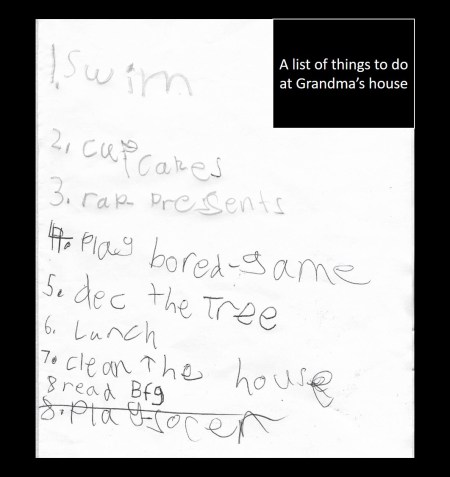
© Norah Colvin It is not surprising that vowels are the last to appear. They are more difficult to hear and distinguish, and not only may they be represented in more than one way (think of the long ī sound from my recent post A piece of pie), their pronunciation may (does) vary from locale to locale. Not only that, they are less important to reading than consonants. Think of text messages on the phone, or check out this article A World Without Vowels.
Or maybe now with predictive text available on phones, you are less likely to use the abbreviated form of words and allow your phone to predict what you want to write. That tends to work less than perfectly for me. It doesn’t always predict what I’m thinking and is just as likely to accept gobbledegook as any real word, let alone the correct one. Give me children’s invented spellings any day. At least I can use meaning and prior knowledge to help me unlock the message.
As a literacy educator, I am particularly interested in written language and fascinated by children’s development. I enjoyed the opportunity to write about children’s writing in a guest post on the Carrot Ranch A Class of Raw Literature earlier this year. I previously shared thoughts about spelling tests and the difficulty of knowing how to spell a word if its meaning is unknown. A variety of resources for teaching writing also appear in the readilearn collection.
This week at the Carrot Ranch Charli Mills has challenged writers to In 99 words (no more, no less) write a story that includes a speller. It can be one who spells or a primer like Lawrence once had. You can deviate from the primary meaning if magic catches your imagination. Go where the prompt leads. Thanks, Charli. I love this challenge. Spelling: my forte. But which meaning should I choose?
- To represent a word in written form
- To create an event using magic
- To have a rest
- To signal the occurrence of something (usual disastrous)
Can I include all four?
Here goes.
MISSPELLING SPELLING DISASTER AVERTED: NEW SPELL RELEASES OLD FOR A SPELL
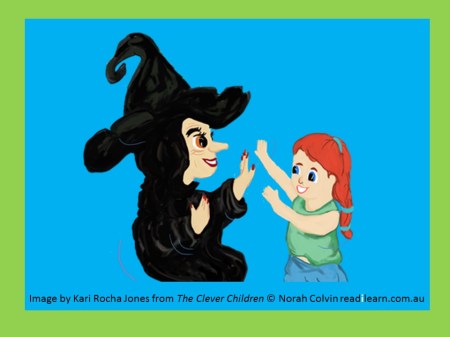
Chatter erupted as assessment commenced. A pass would grant membership to the Spellnovators, but the best would replace Imara, who, for her final duty, mixed their potions and tested their spells. She praised ingenuity as stars exploded, flowers blossomed, and extinct animals reappeared. Choosing her replacement would be difficult. Suddenly her glare in Ruby’s direction spelled trouble. The chatter ceased. “What’s this?” she demanded. “Mix in happy witches!?” Ruby’s lip quivered. “Wishes. I meant to spell wishes.” Voices united in wishes. Instantaneously, everywhere, hearts opened with love. Goodwill rained down, filling all with hope. Imara would spell in peace.

Thank you for reading. I appreciate your feedback. Please share your thoughts.
Share this:


 Norah Colvin