Live Love Laugh Learn … Create the possibilities

Tag: Affirmations

  • 3 Inspiring educators

    3 Inspiring educators

    Like every other teacher, I want to make a difference in the world.

    The thought that I could make a positive difference to the life of another is both empowering and inspiring.

    To do so, I seek out others making a positive difference and pay it forward, hoping that the ripple effect will carry it far and wide.

    flag on twitter

    Three inspiring educators who have positively influenced me are:

    Brian Cambourne

    Brian is an amazing literacy educator from whom I had the extreme good fortune of learning many years ago. I have written about him before here and here.

    Brian’s work focused on the conditions necessary for literacy development. His influence has spread beyond the classroom with the application of the conditions to learning in the workforce demonstrated.

    Tony Ryan

    Tony is an amazing educator who does his best to be the change he wants to see in the world. He talks about future-proofing and using innovative thinking to solve problems of both local and global importance.

    Anyone who believes ‘that education is the most important profession on the planet’ and does everything in his power to support teachers to be outstanding, as does Tony; must be pretty good in my books.

    One of Tony’s books The Ripple Effect is particularly apt for mention in this post. Tony says,

    “you must believe in your personal power to create ripples that spread out and change the world. In fact, if it is not you who is going to do it, then who else do you think is likely to make the effort? Remember that every change on this planet begins with a human being somewhere, somehow. It may as well be you.”

    This year Tony has started a new project called The Earth Movers Foundation which ‘helps young teenagers to create solutions to local and global issues. And they get to choose their own project. No adults will be telling them what project to do. They decide for themselves.’ Sounds pretty good to me.

    Ken Robinson

    Ken is another amazing educator. I fell in love with his ideas when I listened to his TED talk Do schools kill creativity? which I have also shared before here.

    The statement on his website declares that

    “Imagination is the source of all human achievement”.

    I could not argue with that.

    Ken introduces this short video The writing spirit which presents quotes from artists, thinkers, writers, innovators and snippets of interviews with writers. Just incidentally, and exciting for me, Richard Bach is included. Richard is the author of Jonathan Livingston Seagull, one of my favourite books for its inspirational message.

    It is more than likely that these educators have no idea how they have influenced my life (and others as a result).

    How wonderful might it be to know of the positive influence you have had on someone, and to have the opportunity of letting others know that they have positively impacted your life?

    This is the purpose of The Butterfly Light Award which was bestowed upon me my Lisa Reiter, a lovely lady who is herself inspirational for her courage and her positive attitude which she shares with others through her blog Sharing the story. Thank you, Lisa. I am honoured and accept with pleasure.

    As with any award, it comes with conditions:

    1. You should write an acceptance post, making sure you link back to the blogger who awarded you and thank them. You MAY NOT lump this award in with a batch of other awards.

    Thank you Lisa Reiter!

    1. You must individually name and re-award to a minimum of 1 and a maximum of 9999999 bloggers. You must let them know either personally with a comment on their blog OR a pingback.

    As I have been writing about educators, I am going to stick with that theme. A quick visit to these blogs will explain why I have selected them.

    Ruth Mancini

    The Nerdy Book Club

    Two Writing Teachers

    Raising a literate human

    3.  You should link back to Belinda’s blog either to http://idiotwriting.wordpress.com/about/ or http://idiotwriting.wordpress.com/2014/03/13/i-love-charismatic-geeks/

    Done!

    1. You must write a short paragraph entitled either “How I’m Spreading Light” OR “How I’m A Positive Influence” (what Lisa calls ‘the squirmy bit’).

    Done! See beginning of article.

    5. Display Belinda’s lovely “Butterfly Light Award” badge on your blog.

    Thank you, Belinda. It’s a pleasure! We can never have too many butterflies!

    butterfly-light-award

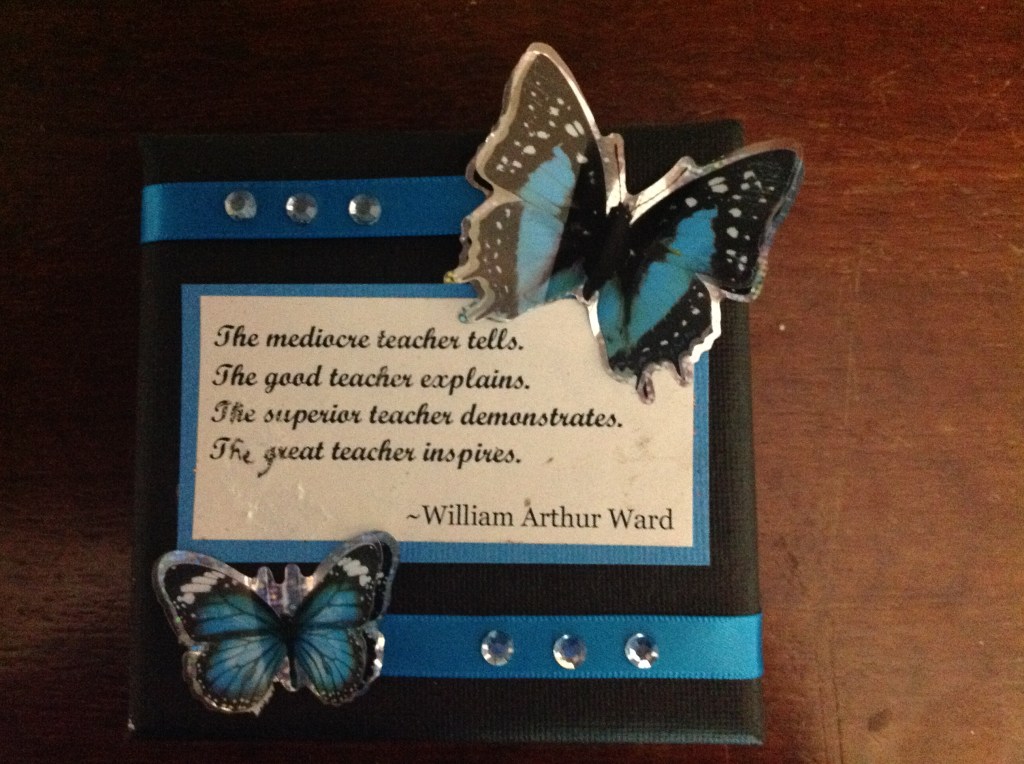
    Note: The beautiful framed quote, pictured at the top of this post, was made for me by a wonderful lady, the mother of two of my students. They all share my love of butterflies! I thank them for sharing their appreciation of my positive influence.

    I welcome your feedback. Please share your thoughts about any aspect of the article.

  • What do you have in mind?

    This week Two Writing Teachers posted a wonderful article by Stacey Shubitz (one of the Two Writing Teachers) about A Picture Book that Pushes the Growth Mindset.

    This post coincided beautifully with the flash fiction prompt posted by Charli Mills at Carrot Ranch Communications. Charli’s challenge is to:

     In 99 words (no more, no less) write a story about getting stronger.

    This is a perfect prompt for a teacher as a major focus of our work is in developing children’s strengths:

    Strengths as in abilities; strength as in self-esteem and self-confidence; strength as in willingness to face setbacks and try, try again; strength as in keeping on going even when the going gets tough.

    The picture book discussed in the article by Stacey Shubitz is The Most Magnificent Thing by Ashley Spires. Stacey suggests that the book is a great opener for discussions with children about the importance of a growth mindset.

    According to Stacey, an understanding of ‘the power of having a growth mindset’ has been enabled by the work of Carol Dweck, a Stanford psychologist. It is grounded in a belief that

    Someone can accomplish a lot more through hard work and dedication, rather than by relying on their smarts alone.

    I agree with Stacey that

    ‘Educators know the benefits of having a growth mindset, rather than having a fixed one. We learn from trial and error. There is value in failure.’

    I will not quote Stacey’s article in its entirety, but suggest you pop over and read it for yourself. (If you do, and leave a comment prior to June 27th, you may win yourself a copy of The Most Magnificent Thing, if you live in the USA or Canada.)

    Stacey says that “The girl in the story tries over ten times to build something and get it right. Through hard work and some help from her trust sidekick, her pug, she eventually succeeds.” As well as a starting point for discussing the growth mindset, Stacey suggests eight features of the book which are useful for teaching writing. The article also includes a brief, but informative, interview with the author/illustrator Ashley Spires.

    In response to Stacey’s question about using The Most Magnificent Thing for discussing a growth mindset, Ashley responds:

    ‘The character is a perfectly capable girl with a great idea and the skill to make it, but she has to try, try and try again in order to succeed. Most kids (I was one of them) think that if it’s not perfect the first time, then they should move on to something that comes to them more easily. Working hard to succeed is what true success is.”

    <p><a href=”http://vimeo.com/89499612″>The Most Magnificent Thing Book Trailer</a> from <a href=”http://vimeo.com/kidscanpress”>Kids Can Press</a> on <a href=”https://vimeo.com”>Vimeo</a&gt;.</p>

    My flash fiction, told through the jottings of a classroom teacher over time, shows a growth mindset emerging from one that was previously crushed.

    Progress

    Day one

    Timid. Needed help getting things out of bag to put in drawer. Sat towards back of group. Drew knees up under chin. Hunched over. Sucked thumb. Twisted long tangled hair under nose. Rocked.

    Day twenty-six

    Responded in roll call! Sat with ‘friend’. Legs crossed. Back straight. Smiled – briefly. Someone looked! Screamed, “Stop looking at me!” Dissolved in tears. Again. Retreated under desk. Again.

    Day fifty-two

    Initiated conversation!! Hair combed!! Nose not running!! Brought toy for show and tell. Responded with one- or two-word answers. Small, dirty, pink unicorn. B laughed. Erupted, but went to desk, not under!


    I welcome your feedback. Please share your thoughts about any aspect of the article or my flash fiction piece.

  • Versatile Blogger Award!

    the-versatile-blogger-award 

    About a month ago I was honoured to receive a nomination for the Versatile Bloggers Award from Bodicia who blogs at A Woman’s Wisdom, “A place to discover fabulous storytellers plus book reviews, life and humour.” Her blog definitely lives up to its description and is worth a visit. I am very appreciative of receiving this award from someone with such experience and versatility.

    Bodicia was nominated by Michelle James at Book Chat, also worth a visit, as are Bodicia’s other nominations which you can find listed on her post.

    The rules of the Versatile Blogger Award are:

    • Thank the person who gave you this award. Thanks Bodicia!
    •  Include a link to their blog.
    •  Next, nominate 15 bloggers for the Versatile Blogger Award — you might include a link to this site.
    •  Finally, tell the person who nominated you 7 things about yourself.


    My 15 nominees are:

    Ailish Sinclair

    Teagan Kearney

    Karen Wyld

    Vicki Addesso

    Susan Buchanan

    Paula Reed Nancarrow

    Lisa Reiter

    Lori Schafer

    Karen Oberlaender

    Diane Mottl

    Greg Mischio

    Anne Goodwin

    Caroline Lodge

    Charli Mills

    NannySheCanDo

    Apologies to those I have omitted, and to those I have nominated for a second award. I can offer neither excuse nor reason. So be it.

    This is the more difficult part – 7 things about myself. At least they don’t have to be interesting!

    Seven random things about myself!

    blue

    1. My favourite colour is blue, bright blue; blue like the clear June skies; blue like the calm waters on an early summer morning.
    ©Glenn Althor www.http://obscurepieces.com/ Used with permission.
    ©Glenn Althor www.http://obscurepieces.com/ Used with permission.

    2.   I love butterflies, birds and frogs: pictures, toys, stories, whatever. I used to think I’d like to be a bird with the freedom of flight, soaring above the world. The transformation from caterpillar to butterfly is amazing and inspiring but each stage has its own beauty and purpose; one could not be with the other. And frogs – well they’re just cute!

    www.openclipart.com
    www.openclipart.com

    3.   One of my favourite books is Jonathan Livingston Seagull by Richard Bach. I like to think I’m more like Jonathan than the other seagulls squabbling on the shore.

    www.openclipart.com
    www.openclipart.com

    4.   I love being a parent. Both my children are adults now and the joy at seeing them grown; happy, contributing, compassionate, productive; is immeasurable. To think that I had a little to do with the wonderful people they have become is rewarding, but to know that they are more than I could ever take credit for, is awesome.

    www.openclipart.com
    www.openclipart.com

    5.   I love learning and try to take an interest in most things, but am more interested in ideas than in facts. I’m not much use on a trivia team; unless it’s a nursery rhyme question – then I’m indispensable!

    www.openclipart.com
    www.openclipart.com

    6.   I enjoy puzzles and games, especially logic and thinking puzzles and word games. I love playing games with the family and sharing a laugh. I love computer games.

    Nor and Bec reading
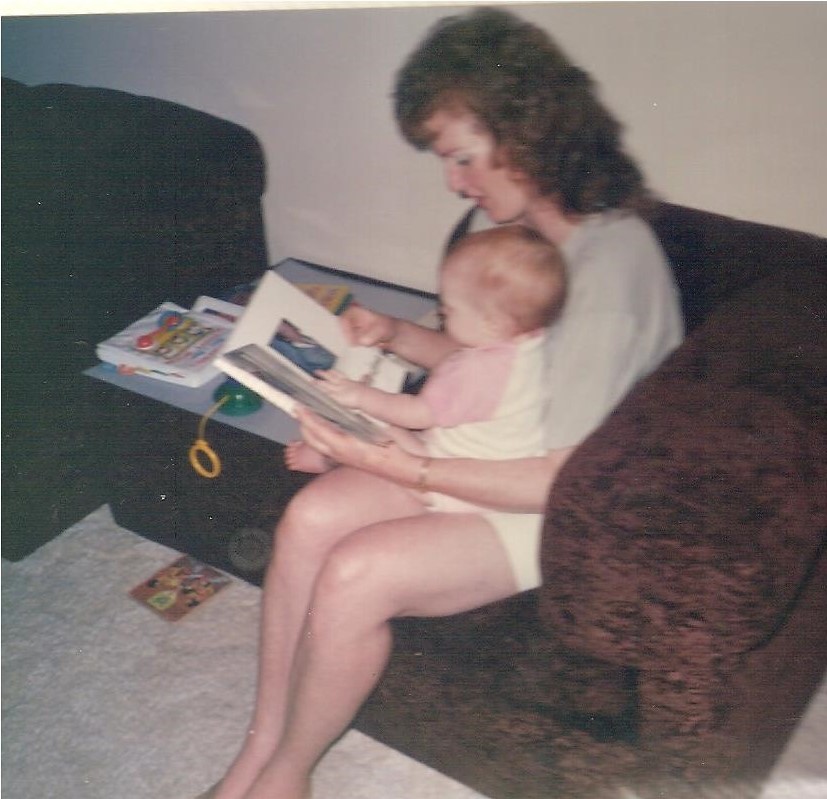
    7.   I love helping children begin their journey into literacy through reading to them, playing with words and language, telling and writing stories together.  With my own children it was magic, with hundreds of other children it was awesome, and now with my grandchildren it is just amazing. It is a privilege to share in the process.


    Congratulations to all my nominees. Check out their blogs. You may find something there of interest to you!

  • Paying it forward – a Liebster Award!

    Paying it forward – a Liebster Award!

    Last week I was intrigued, surprised and delighted to find that I had been nominated for a Liebster Award.

    I was intrigued because I had never heard of a Liebster Award; had no idea of what it was for or why I should have been nominated for it;

    I was surprised because I’d had no inkling that such an honour was about to befall me;

    and I was delighted to receive the nomination from fellow blogger, Harriet the Bloom whose blog is “A place for educators to reflect, recharge, and revive.” Thank you, Harriet, I am indeed honoured.

    In reality, before feeling delighted and honoured, I felt a little confused. Confusion, if acted upon, leads to learning. So I headed over to Google and Harriet’s blog to see what I could find out.

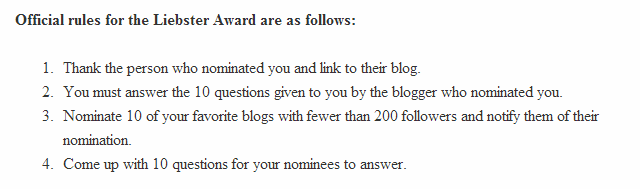
    It appears that the purpose of the Liebster Award is to:

    • provide encouragement for new bloggers with a following of fewer than 200
    • promote communication between bloggers,
    • recommend blogs to others.

    Nominating others for the award is like paying a compliment forward.

    According to Harriet, the

    Liebster rules

    Answers to the 10 questions posed by Harriet:

    1. Congratulations! You just won the Liebster Award! What are you going to do next?

    The immediate answer is contained in this post. The longer term answer is: keep on blogging!

    2. Describe yourself in three words.

    Happy. Thoughtful. Loyal.

    3. Describe your thoughts on your very first job.

    In my early teens I swept out a carpenter’s workshop on a Sunday morning. It was hard, dirty, tiring work. The head of the heavy wooden broom was about 60 cm long and difficult to manoeuvre. It would take about 2 hours to sweep up all the sawdust and I would go home and sleep for about the same length of time to recover. For hours I would be blowing black dust out of my nose, but the crisp $1 note I received in payment was sufficient encouragement for me to return and do it all again the following week.

    4.If you could go anywhere in the world, where would you go and why?

    I would love to visit Monet’s garden. I would love to sit on a seat near the bridge overlooking the waterlilies and ponder the big questions of life. I would like to share my contemplations with the artist, his contemporaries and philosophers from all eras. I love the works of Impressionist painters, especially Monet’s Waterlilies and Van Gogh’s Starry Night. The mood evoked by these beautiful paintings is especially conducive to philosophical musings.

    5. I like food. What is your favorite recipe?

    Whenever we have a family get-together it is expected that I will make a pavlova. It is enjoyed by all generations, and although I make a double (using 8 egg yolks) there is rarely any left over.

    However, for birthdays and Christmas with my immediate family (husband and children) I usually make a strawberry torte. It is a special treat that I have been making on these occasions for almost 40 years. While the in-laws find it a little rich for their taste buds, the grandchildren are taking to it in true Colvin fashion.

    OLYMPUS DIGITAL CAMERA

    strawberry torte

    6. Give a short summary of the book you are currently reading.

    As usual I have a few books “on the go” at the moment, but the one of which I have read most at this stage is “Why ‘a’ Students Work for ‘c’ Students and Why ‘b’ Students Work for the Government: Rich Dad’s Guide to Financial Education for Parents” by Robert Kiyosaki. Of course it appealed to me because of its relevance to education and because I had read others of his books years ago: “If You Want to be Rich & Happy: Don’t Go to School” and “Rich Dad Poor Dad”. In this book Kiyosaki contends that schools don’t educate students for financial success and urges parents to teach children about finances at home. He suggests that playing “Monopoly” is a great way to start. He is greatly concerned about the “entitlement mentality” which he considers to be so pervasive in our society. Some of his ideas are challenging and confronting; others make perfect sense. I recommend the book to anyone wanting to achieve financial independence. I would love the opportunity of discussing his ideas with others.

    7. What inspired you to start blogging?

    Blogging wasn’t a goal, or even an idea, initially. My intention is to create my own website to market teaching resources that I produce. I have a lot of learning to do before I am ready, and part of that learning involves attending seminars. Some of these seminars recommended having an online presence and building a “brand”. Blogging was suggested as one avenue for achieving this. I decided to give it a go, and have found it rewarding in itself – an unexpected pleasure, delightful detour and amazing adventure.

    8. How did you come up with the name for your blog?

    My blog is simply my name; that wasn’t difficult.

    9. What do you do when you experience writer’s block?

    Eat. Procrastinate. Go on with something else. Push through it. Write around it.

    10. Which post are you most proud of and why? Provide a link.

    This is tricky. I don’t think I’ve written it yet! However I very much enjoyed the comments and discussion that ensued from my series of posts about “The Examined Life” by Stephen Grosz.  The series includes:

    A book worth reading: Stephen Grosz “The Examined Life”

    Seeking praise – Stephen Grosz revisited

    and a guest post by Anne Goodwin in response:

    Examining praise: Stephen Grosz – the third instalment!

    The discussion stretched my thinking and learning and I am grateful to all participants in the conversation. Learning is what life is all about!

    Nominate 10 bloggers for the Award:

    As the rules appear to be blurred rather than definite e.g. Harriet’s rules differ slightly from those on Wording Well , which differ again from those on Sea Play Photography, I decided to nominate 13 bloggers.

    Belinda Pollard of Small Blue Dog Publishing (Australia)

    I’m starting with Belinda Pollard of Small Blue Dog Publishing because it was Belinda’s recommendation that prompted me to enter the world of blogging and tweeting. At a seminar hosted by Queensland Writers Centre last year Belinda urged all writers to have an online presence. She said that Twitter was like the water cooler for writers. I’m beginning to see that she was right. Belinda’s posts about all aspects of writing and self-publishing, including blogging, have been a great source of information for me and I appreciate what I have learned from her.

    Belinda, I know you have thousands of followers on Twitter but Word Press tells me that you have fewer than 200 followers on your blog so I hope you are happy to accept this award.

    NANNY SHECANDO (Australia)

    Next I’d like to introduce you to Hope who blogs at NANNY SHECANDO. Hope blogs about her experiences as a nanny, cooking and craft. She says, “We’re staying young, Peter Pan style, by embracing the creativity and sunshine in life.”

    Anne Goodwin (UK)

    Anne Goodwin’s website is rich with things to read: short stories, interviews with authors, book reviews, blog posts and more. Anne is one of the writers I met at ‘the water cooler’ and we have had many interesting and thought provoking conversations since then. I love the way Anne has called her website Annethology and her blog Annecdotal. She tweets @Annecdotist. Very clever!

    Caroline Lodge (UK)

    Caroline Lodge blogs at book word . . . about books, words and writing. She joined with Anne and me and we stood around the water cooler sharing ideas and exchanging thoughts. I’m certain you will find much of interest on her blog including suggestions for blogging, great books to read and writing tips.

    PS Cottier (Australia)

    For a little bit of poetry I recommend PS Cottier who posts a poem every Tuesday, and occasionally writes prose.

    Teachling (Australia)

    Teachling is a blog dedicated to improving education with ideas about teaching, learning and parenting. Teachling believes that “Improving a child’s life-chances is everyone’s responsibility” Along with me and millions of others, Teachling is a big fan of Ken Robinson.

    I have always enjoyed reading philosophy and engaging in philosophical discussions. I support the teaching of philosophy as an active thinking subject in schools and am excited about the benefits of a thinking population to the future of our world. I have two great blogs to recommend in this category:

    Peter Worley’s philosophy foundation (UK)

    Michelle Sowey at The Philosophy Club (Australia)

    Note: Last year I reblogged one of Michelle’s posts:

    Can you kill a goat by staring at it? A critical look at minimally invasive education

    There’s No Food ( Australia)

    A bit closer to home (actually much closer to home, it’s my daughter’s blog) I’d like to recommend There’s No Food. Bec blogs about “wholefoods, vegetarianism, slow living and their existential friends.” She has interesting thoughts about the impact of our food choices on the environment and practical suggestions for changes we can make to our everyday routines.

    Obscure Pieces (Australia)

    Glenn at Obscure Pieces expresses himself through black and white photography. His special interest is urban and landscape photography. He frequently offers support and comments on my posts and has generously allowed my use of some of his photographs. Thanks Glenn.

    Cultivating Questioners (USA)

    On her Cultivating Questioners blog, Nicole posts about her experiences as a teacher, especially encouraging her young students to use higher-order thinking skills . I love to see a young teacher so passionate about education.

    Nillu Nasser Stelter (UK)

    Nillu Nasser Stelter is a fiction and freelance writer and her blog features short stories, flash fiction and tips for writing. I love the ways she uses words effectively in her writing to create a picture or emotion.

    Carrot Ranch Communications (USA)

    Charli Mills at Carrot Ranch Communications also blogs about writing. As of Wednesday 5 March she launched a flash fiction challenge. Each week writers have the opportunity to accept the challenge to write a 99 word “story”. This is something I haven’t done before so I’m hoping to join in the fun. What about you? I’m sure it’s not as easy as it sounds!

    Now my nominees, it is your turn.

    These are the things I would like to know about you:

    Note: Although I have listed 13 questions, you need answer only 10. You may substitute one of your own if you wish.

    1. What do you value most in life?
    2. What activities do you enjoy and why?
    3. What is something you wish you had more time for?
    4. What is one change you would like to make in the world?
    5. What is something you would like to change about yourself?
    6. What surprises you most about your life – something good in your life that you hadn’t expected, dreamed of or thought possible?
    7. What ‘big” question do you often ponder?
    8. What sorts of things amuse you?
    9. What do you like to collect?
    10. If you could talk with anyone and ask them to explain their ideas and/or actions, who would it be, and why?
    11. What is something you can’t do without?
    12. What is something important you learned about life, and how did you learn it?
    13. What is your earliest memory?

    I look forward to reading your responses and continuing our discussions at my place or yours!

    Happy blogging!

    Footnote:
    How to find out the number of followers on a blog:
    For Word Press blogs:
    View the blogs in the Reader
    Click on the blog name at the top of the blog
    Lo and behold, you will be provided with the number of followers. Easy for Word Press.
    For other blogs
    I wasn’t sure how to find out for others not using Word Press so I sent them a message on Twitter asking their numbers. Simple.
  • “You say it long enough, it starts to be a part of you.” (Rita Pierson)

    Affirmation, encouragement, praise . . .  

    “You say it long enough, it starts to be a part of you.”

    Recently I came across this great TED talk by Rita Pierson “Every kid needs a champion”.

    Rita’s entire life centred around education. Her parents and her mother’s parents were teachers, and she was a teacher.

    She observed numerous teachers at work – some of the best and some of the worst – and believed that relationships are the key to learning.

    She said that

     “kids don’t learn from people they don’t like.”

    Rita spoke about having classes of students whose academic level was so low she wondered how she could “raise the self-esteem of a child and his academic achievement at the same time”.

    One year she told her students

    “You were chosen to be in my class because I am the best teacher and you are the best students, they put us together so we could show everybody else how to do it.”

    Affirmation, encouragement, praise . . .

    She talked about giving a student a +2 with a smiley face for getting 2 out 20 questions correct. She encouraged the student by saying

    “you’re on a roll . . . and when we review this, won’t you do better?”

    The student agreed “I can do better”.

    Affirmation, encouragement, praise . . .

    Rita told of her mother’s past students expressing their gratitude for the difference she made in their lives, saying

    “You made me feel like I was somebody, when I knew, at the bottom, I wasn’t. And I want you to just see what I’ve become.”

    Affirmation, encouragement, praise . . .

    She tells us that teachers won’t always like all the children they teach, but it’s important that the children never know it. Acting is part of the role description!

    She says that

    “Teaching and learning should bring joy. How powerful would our world be if we had kids who were not afraid to take risks, who were not afraid to think, and who had a champion? Every child deserves a champion, an adult who will never give up on them, who understands the power of connection, and insists that they become the best that they can possibly be.”

    Affirmation, encouragement, praise . . .  

    Go ahead and listen to this inspirational talk. It will take less than 8 minutes listening time but its effect will be more lasting. It has already had more than 2 600 000 views. Why not add one more to the total. I’m certain you won’t regret it.

    I can find nothing to dispute in Rita’s talk. I’d like to underline every word and make it compulsory viewing for all aspiring and practising educators in any field.

    Affirmation, encouragement, praise . . .  helpful or harmful?

    What do you think?  Please share your thoughts below.

    Refer to these previous posts for discussions on self-esteem, affirmations and praise:

    Happy being me

    Affirmations: How good are they?

    Seeking praise – Stephen Grosz revisited

    Examining praise: Stephen Grosz – the third instalment (guest post by Anne Goodwin)

    I came across this talk on a great educational website edutopia. It was included in a Five-Minute Film Festival: Videos on Kindness, Empathy, and Connection. Check the others out. You may find something else to inspire you.

    Sadly Rita Pierson passed away in June 2013. I’m grateful that we may continue to share the strength of her wisdom through her appearance with TED.

    Click here to find out more about Rita and to read a tribute posted by Tedstaff.

    “You say it long enough, it starts to be a part of you.” (Rita Pierson)

    Let’s make sure it’s the good stuff that learners everywhere are hearing!

  • Seeking praise – Stephen Grosz revisited

    Praise may be defined as an expression of approval or admiration.

    Who wouldn’t want that?

    If you write a blog, don’t you love it when others “like” a post, leave a positive comment, re-blog your article or link to it via theirs? I do. Aren’t these all expressions of approval or admiration?

    What about on Twitter when someone Re-tweets, favourites or replies positively to your comment, engaging you in conversation?

    Aren’t these also expressions of approval or admiration?

    I love to receive all these signs of encouragement and support that let me know that my efforts are appreciated and confirm that I am on the right track. If I did not receive any of this feedback I would feel quite isolated and consider my efforts to be fruitless and a waste of time. I would probably just give up.

    As a teacher I have always considered it of primary importance to create a happy and welcoming classroom environment in which children feel valued, affirmed and supported. Expressions of approval and admiration for behaviour, effort and achievement were generously given with the aim of encouraging the desired response, a happy child being foremost. I have written about this in previous posts, including:

    Happy being me

    Affirmations: How good are they?

    As a parent too I considered it important to affirm my children and display my approval and admiration for them. I still do, even now they are adults. The need for approval never ends. I know sometimes you just have to go out there and say what you know is right, even though others will disagree or ridicule you. I am not talking about those instances here.

    My strong belief in the power of affirmations and approval stems partly from the dearth of them in my childhood and school days. I have also mentioned this in a previous post: 

    Mouthing the words – the golem effect

    Recently I listened to a fabulous (audio)book, “The Examined Life: How We Lose and Find Ourselves” by Stephen Grosz. I wrote about it in my previous post A book worth reading: Stephen Grosz “The Examined Life” saying that

    “What appeals to a reader about a book, or what a reader takes away from a book is as individual and personal as the reader. What is of most significant to one, may be of lesser importance, or even insignificant to another. “

    For me the chapter of most significance is chapter 3 “How praise can cause a loss of competence”.

    To say I was startled by the title would be an understatement. I was puzzled, intrigued and challenged. How could praise cause a loss of competence? Surely negative feedback or a lack of encouragement altogether would be major contributors to diminishing competence. Was everything I had believed and practiced wrong? (Oh no –there’s my need for approval and affirmation!)

    Grosz says that during the past decade studies into self-esteem have found that praising a child as “clever” may not only inhibit school achievement, it may cause under performance. He suggests children may react to praise by quitting. Why would you try to improve or do something new if you have already done something really well or are the “best”?

    Studies showed that children who were praised for effort, rather than for being clever, were more willing to try new approaches and were more resilient. Children who were praised for being clever, tended to worry more about failure and chose unchallenging tasks, tasks they knew they could achieve or had already achieved. Being told they were clever led to a loss in self-esteem and motivation and to increased anxiety. Some children who had been praised for being clever (rather than working hard), when confronted with a more difficult task and asked to comment on it, were so unhappy with the results they lied about them, exaggerating their achievements to others.

    Grosz questions whether we may lavish praise on our children nowadays in order to demonstrate that we are different from our parents who possibly used criticism, rather than praise, on us. I hinted at something similar earlier in this article.

    While admiring our children with words like “Good boy” or “Good girl” may temporarily lift our self-esteem by showing others what wonderful parents we are or how wonderful our children are, Grosz says, it isn’t doing much for a child’s sense of self. He says that in trying to be different from our parents we end up doing the same thing: doling out empty praise where an earlier generation doled out thoughtless criticism.

    Grosz says that if we offer this empty praise without thinking about the child’s individuality and needs we are effectively showing the child indifference.

    So what do we do?

    I think the emphasis here is on the empty praise. I think support, encouragement and positive feedback are all essential. Sure, knowing in yourself that you have done well is fine but a little recognition certainly helps too. I think the difference is in recognizing what has been achieved, the learning or progress made, and the effort it took, the message communicated in a story or painting and the techniques used; not a hollow “Well done”, “Good work” or “Good boy” but “Tell be about . . .”, “Why do you think that?” “How did you work it out?” “I like the way you . . .”

    As Grosz says, this is being attentive to the child, to what the child has done and how it has been done.

    To read more on this topic:

    Sian Griffiths interviewed Stephen Grosz and reported on the interview in the article “Praise her . . . and see her fail” which adds even more clarity to my precis above.

    Maria Popova delves into the messages of this same chapter in her article “Presence, Not Praise: How to Cultivate a Healthy Relationship with Achievement

    Being attentive, being present, being really with someone, noticing what they have done and how they have done it – is it more precious than praise?

    In these days of constant distractions and must-dos to put all aside to be in the present with the child, friend or partner to talk, listen share and laugh, what better affirmation is there than that?

    What do you think?

    How has praise encouraged or discouraged you?   When has criticism hindered you?

    I’d love to hear your thoughts.

  • Mouthing the words – the golem effect

    Mouthing the words – the golem effect

    Singing is a wonderful gift. To be able to entertain oneself and others with no instrument other than one’s voice must give enormous pleasure.

    But I can only imagine the joy it must bring, for I am no singer.

    When I was at school and we were all lined up and squished in on the stairs performing for parents in our end-of-year concerts, I was told to mouth the words.

    www.openclipart.org
    http://www.openclipart.org

    Unlike the recommendation in the song written by Joe Raposo for Sesame Street and made famous by the Carpenters “Sing a Song

    “Don´t worry that it´s not good enough for anyone else to hear.
    Just sing.
    Sing a song.”

    I was told to not sing, for it was not good enough for anyone else to hear. I accepted the verdict without question, as was expected of us at school, and mouthed the words.

    Of course, my school days were long over before Joe wrote his wonderful song, and maybe no one since then has been subjected to the same humiliation.

    Over the years various family members and friends have tried to be encouraging but their words have seemed hollow, for I “knew” the truth to be otherwise. One family member even told me that, when I “sang” nursery rhymes, I sounded just like Patsy Biscoe. But that’s not true. Patsy has a beautiful voice. You can listen to her here.

    Sometimes it is difficult to not sing along for music is so inviting, often almost demanding that one join in.

    In an early childhood classroom, music is a very important part of the day; and as an early childhood teacher, I incorporate music and singing into the program, always at the beginning and end of the day, and many times in between. I have blogged about this before here and here.

    Fortunately for me, and the students, music is so readily available on CD or the internet, that finding songs for the children to sing along with is no longer a problem.  I apologise here to all the students who have had to suffer my joining in and “singing” along with them though, when I couldn’t resist the temptation. I must admit that none of them ever complained when I joined in. But I have no idea what they went home and told their parents either!

    I believe strongly in the power of positive encouragement to improve children’s self-esteem, confidence, willingness to have a go, and learning outcomes.

    I also know that a negative attitude encourages children to have a negative attitude towards themselves and their abilities, decreases self-esteem, erodes confidence and creates anxiety and a fear of trying new things or of having a go.

    According to Wikipedia

    “The Pygmalion effect, or Rosenthal effect, is the phenomenon in which the greater the expectation placed upon people, the better they perform. The effect is named after the greek myth of Pygmalion.

    A corollary of the Pygmalion effect is the golem effect, in which low expectations lead to a decrease in performance. The Pygmalion effect and the golem effect are forms of self-fulfilling prophecy. People will take the belief they have of themselves (negative in this case) and attribute traits of the belief with themselves and their work. This will lead them to perform closer to these expectations that they set for themselves. Within sociology, the effect is often cited with regard to education and social class.”

    Surprisingly I had never thought of this in relation to my singing disability, until recently.

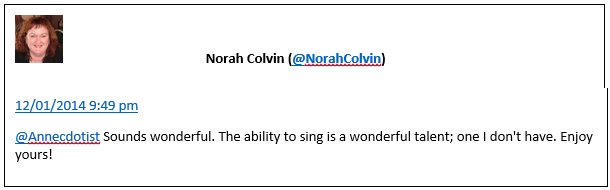
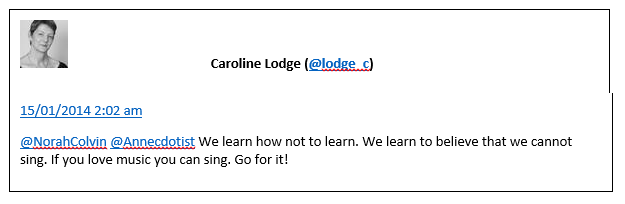
    Engaged in a Twitter discussion with Anne Goodwin (@Annecdotist) and Caroline Lodge (@lodge_c) I mentioned that I listen to audiobooks on my drive to work. Anne replied that she listens to music on long journeys, trying to “fix choral music in my head”.

    I replied, innocently enough, I thought:

    1

    To which they both responded with the type of “encouragement” I had heard many times before “Give it a go. Everyone can sing.”

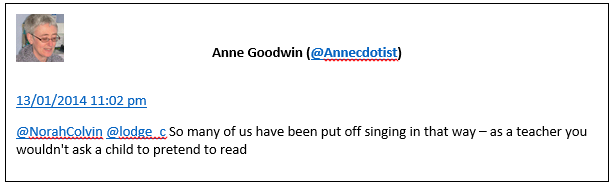
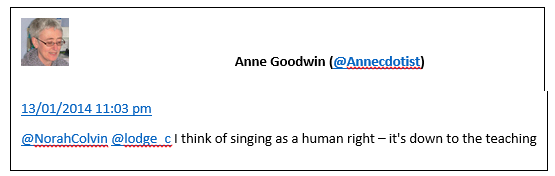
    So I told them about being told to mouth the words, and I was both surprised and challenged by their responses:

    2

    3

    4

    I had never thought of my singing disability as a learned disability. I had always thought of it being a physiology issue and, later, perhaps a hearing issue.

    I am not very good at mimicking vocal (other than speech) sounds, or at identifying which note, of two given notes, is the higher or lower. I did enrol in a brain training program which included aural exercises involving recognition of higher or lower pitch. While I did make some improvement, my scores weren’t high (I could tell that high/low difference).

    The comments of Anne and Caroline made me think about this:

    What came first: the singing disability or the disability teaching?

    Could I have learned, if given the opportunity, to sing a least a few bars in tune? Could I still be taught?

    It has sometimes crossed my mind that singing lessons could be an interesting experiment.

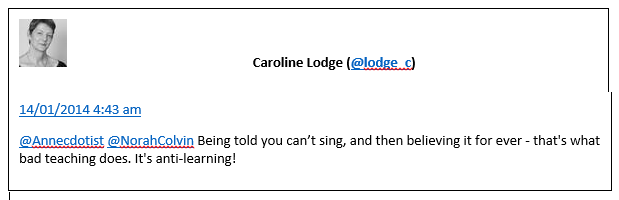
    Anne and Caroline are both encouraging, and Caroline commented:

    6

    I do love music and perhaps, one day, I will go for it and find out the truth about my singing ability.

    Perhaps I will learn to sing and fulfill the dream “to teach the world to sing in perfect harmony”.

    But for now, the experiment will have to wait, I have other things to learn.

    What do you think?

    Do you consider yourself a singer?

    Can everyone learn to sing?

    Is it a human right?

    Could my singing ability really be a “golem effect”?

    What disability have you learned, if any?

    As a parent or teacher, how do you ensure your children do not suffer from a learned disability?

    You can read more from Anne or Caroline by clicking on their names.

  • Friendship trees

    Friendship trees

    Summer_2010_ClipArt10_HeaderThe end of the school year in Australia coincides with Christmas and the summer holidays.

    TheresaKnott_christmas_tree

    This coincidence provides an opportunity to not only reflect on the year’ achievements, but to share appreciation of friendships made throughout the year while developing understanding of Christmas traditions.

    During the last few weeks of the school year, I use friendship trees with my early childhood classes for these purposes.

    About three weeks before the end of the school year each of the children make their own tree which is then displayed in the classroom until taken home on the last day of school. By then the trees are filled with messages of friendship and affirmation which the children write anonymously to each other each day.

    Although the end of the school year is when I use friendship trees in my classroom, they could be used at any time throughout the year. However they will work better when the children have been working together for a while and know a little about each other.

    These are some of the benefits of incorporating the friendship tree into the class program:

    • Is inclusive with its emphasis upon friendship
    • Provides an opportunity for reflection on friendships made
    • Encourages students to comment positively to classmates
    • Affirms students by the receipt of multiple positive comments
    • Encourages a giving attitude
    • Provides an opportunity to discuss Christmas traditions (tree as a bearer of gifts) as a way of developing cultural understandings
    • Develops understanding that kind words and actions are the greatest gift

    happy_sun_gm

    How it works

    • Children make and decorate a “friendship tree”, attaching or writing their name prominently on it. Trees are then displayed in the classroom.
    • Each day children select a name “from the hat”. (In preparation I prepare a class list of names in a table, one name per row, which I print out and cut into strips for the students to select and write their messages on.)
    • Children write a friendship note to the child whose name they have drawn, but they are to not tell anyone who it is or what they have written.
    • They may return the name and select another only if it is their own name or the name of someone for whom they have already written a message
    • They are to write something they like about the person, something the person is good at or something they appreciate about them.
    • I check what the children have written, ostensibly for readability, but also to ensure appropriateness of the message. However I have never had to edit the content. I have always been impressed by the messages the children write.
    • Children then fold and “secretly” place the messages into the tree of the recipient.
    • On the last day of school children take their trees, filled with positive messages, home to read and share with their family.

    Before children write their first message, we brainstorm what a friendship message might be. These are some examples:

    Thank you for being my friend.

    I like the way you laugh at funny stories.

    You are a good writer.

    You always do the right thing.

    Thank you for playing with me.

    However these ideas are only a starting point. I have always been amazed at the very appropriate and personalised messages the children write for each other. They really do notice the lovely things their classmates do throughout the year, and the different things that make them special.

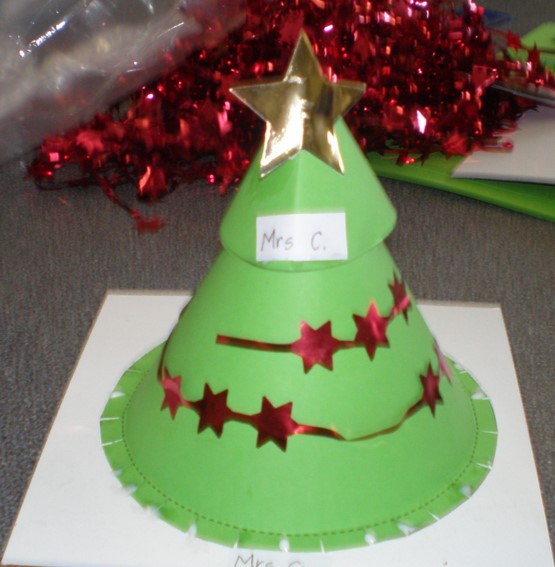
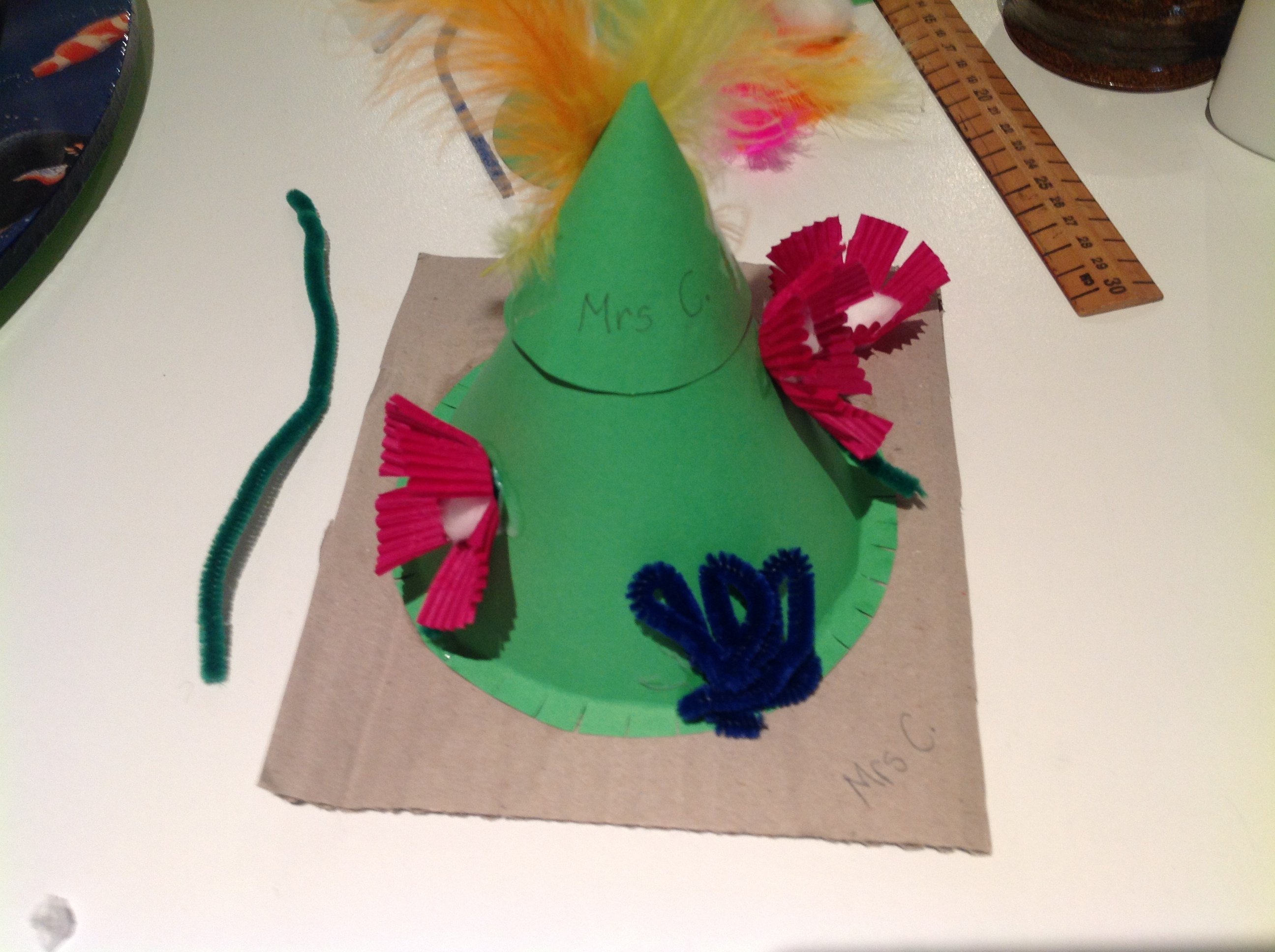
    Here are photographs of two  friendship trees I have made, one decorated for Christmas, the other for friendship:

    Friendship tree

    completed tree

    A cardboard cone (with a cut-off top) is attached to a cardboard base. A smaller cone (removable lid) tops the tree. Children lift the top to place their messages inside.

    If you would like to use a template for making the cone or view step-by-step instructions, I have made these available on the website TeachersPayTeachers. Please click here to follow the link.

    If after viewing this site, you decide to join up as I have, I would appreciate it if you refer your membership back to me my using this link. Thank you. tomas_arad_heart

    I hope you and your students enjoy the friendship tree experience as much as I and my students have!

    Let me know how it goes.

    Clipart courtesy of www.openclipart.org

  • How was your day?

    How was your day?

    Have you ever been asked that question and simply answered, “Same ol’ same ol’” without making any attempt to elaborate or delve deeper into the day’s activities.

    If so, did this mean that you didn’t enjoy your day and that there wasn’t anything interesting in it?

    Sometimes much of what we do on a daily basis can become routine with activities seeming to flow from one to another without a great deal of change or significance worthy of a remark.

    peole_laptoppeole_computer

    There are many reasons people don’t immediately share what has happened in their day, and the lack of a truly amazing outstanding event may be just one of them.

    johnny_automatic_magician_and_floating_lady

    Similarly, in response to the question “What did you do today?” school children, often simply answer “Nothing” (as described by SHECANDO) without making any attempt to elaborate or delve deeper into the day’s activities.

    Parents and others often jump to the conclusion that the child’s day has been uneventful and boring and, unless the child later volunteers some information, or the parent has a specific question to ask, that may be the end of the subject.

    However, just as with adults, there may be a number of reasons the “Nothing,” response is given, including the generalised nature of the question.

    Some reasons for this failure to elaborate, although unspoken and often unidentified, may be:

    15073-Briana-web
    Courtesy of eLearningbrothers

    ‘I’ve just finished a hard day, I don’t want to talk about it right now.”

    “So much happened today, I don’t know where to start.”

    “I don’t think you’d be interested in anything that happened to me.”

    “I can’t really think. What do you want to know: something bad, something funny or something amazing? I didn’t get into trouble.”

    Additionally, if children are not already practiced in the art of sustaining conversation with an adult, then these discussions will rarely come easily or spontaneously.

    Sometimes specific questioning, requiring more than a yes/no answer, may elicit a more detailed response that in turns leads to a more in-depth discussion of the day’s events, e.g.

    liftarn_Adult_and_child

    “Who did you sit with at lunch today?”

    “What games did you play at recess?”

    “What story did your teacher read to you? What was it about?”

    Knowing something of what occurred during the day helps parents formulate appropriate questions to elicit conversation.

    In my role as a year one classroom teacher I believe in the importance of these conversations between children and parents for a number of reasons, including:

    • to keep parents informed of what is happening the classroom, which in turn encourages a positive attitude and participation;
    • to develop children’s language skills by engaging them in conversations which require them to describe, explain, respond and exchange ideas;
    • to develop children’s thinking skills and memory, “What did I do today?” “What did I learn?” “What happened before/after lunch?”
    • to provide a time for reflection and review e.g. “What can I do now that I couldn’t do before?” “When we were doing x, we had to y. Oh, now I get it. That means . . . “
    • to provide opportunities to sort out feelings and emotions  experienced during the day, but not yet dealt with e.g. “I don’t know why that happened at lunch time. Tomorrow I will . . .”
    • to strengthen the child-parent relationship by sharing ideas, attitudes and events in their daily lives.

    In addition to giving children reminders before they left for home in the afternoons, I developed a strategy that specifically targeted the need to provide parents with a window into the child’s day in order to arm them with sufficient information to instigate robust discussion.

    I called this strategy

    Class news

    1269850054

    Each day I published class news which the children pasted into a book to take home and read with parents. These days many teachers, like Miss Hewes, use a blog to keep parents informed. However there were no blogs around when I began doing this in the 1980s!

    The class news consisted of three main sections:

    • News of individual students
    • Class things we did today
    • Class reminders

    News of individual students

    15026-Mac-web
    Courtesy of eLearningbrothers

    Each day 2 – 3 children told the class about an item of interest to them e.g. an activity, a recent purchase, a family event, or a wish.

    After each child shared their news, the class and I cooperatively composed a brief summary (one or two sentences at first). I scribed and the children read. Later in the day I printed this out for the children to take home and read to their parents.

    As well as being a very effective literacy learning strategy (which I will write about in a future post), it helped parents get to know the names of classmates and a little about each one; it provided a discussion starter about which their child could elaborate. It also affirmed the children by providing each a turn of “starring” about once a fortnight.

    Things we did today

    In this section I would tell parents briefly about a few things we did that day, e.g.

    “Mrs Colvin read “Possum Magic”. We talked about what it would be like to be invisible and discussed what we thought would be good and not-so-good about being invisible. Then we wrote our very own stories about being invisible. We had some very interesting ideas!”

    “We learned about odd and even numbers by finding out which number of different objects we could put into two even lines.  Where can you find some odd or even numbers of objects at home?”

    “In art we learned about lines: straight lines and wriggly lines; long lines and short lines; jagged lines and curved lines; thick lines and thin lines. What sort of lines can you see in your pictures?”

    When parents are informed about things that have happened during the day, they have a firm basis for opening a meaningful discussion with their child. This in turn validates the child by giving importance to the child’s activities.

    I often included a question to help parents realise that they could easily extend the child’s learning at home.

    Class reminders

    A reminder or two would be included if particular events were coming up, or payments needed e.g.

    “Sports day tomorrow. Remember to wear your sport uniform and running shoes.”

    “Friday is the final day that excursion payments will be accepted.”

    These reminders helped to reduce the possibility of a child being upset by forgetting or missing out on a class activity. They also provided parents with another opportunity for discussion and the ability to enthuse their child with the anticipation of future events.

    Publishing the class news like this every day did eat into my lunch time, but the advent of computers in the classroom helped as I was able to set up a template and print copies on the classroom printer. In the “olden” days of the spirit copiers, every day meant starting out again and having to go to another room to churn the copies out by hand.

    I continued using this strategy throughout three decades of teaching because I believe in its power to develop readers and talkers, and to involve parents by keeping them informed of classroom learning and activities. Having already received a child’s answer of ‘nothing’ to the question “What did you do today?” I was determined that no child from my class would have a reason to answer in the same way.

    What questions encourage you to open up and talk about your day?

    What questions encourage you to keep your mouth shut?

    What do you think of my daily class news?

    What other strategies do you suggest to encourage communication between parents and children?

    All images courtesy of www.openclipart.org unless stated otherwise.

  • Happy being me

    Self-esteem

    One of the most precious but fragile qualities of a person is their sense of self and self-esteem.

    A positive word of encouragement can reinforce the strength of one’s self-image.

    Machovka_Happy_fish
    image courtesy of http://www.openclipart.org

    But that image can be shattered all too easily through a sigh, a grimace, an ill-chosen word or careless remark.

    image courtesy of www.openclipart.org
    image courtesy of http://www.openclipart.org

    Our self-esteem flourishes when we are happy and wilts when we are sad. It is much easier to boost someone when they are up, and to hit them when they are down. Maintaining a healthy self-image requires just the right amount of self-knowledge and confidence to be resilient when faced with negative feedback and to not adopt an inflated sense of importance when receiving false, or genuine, positive input.

    Fostering self-esteem in the classroom

    image courtesy of www.openclipart.org
    image courtesy of http://www.openclipart.org

    As a teacher I have always considered it to be equally or more important to strengthen a child’s self-image as it is to extend their thinking and learning abilities.

    My primary aim has always been to cultivate a group of happy children, with strong senses of self, confident in what they could do and willing to have a go to extend their learning. I believe that these qualities are necessary in order for children to learn efficiently.

    A child who lacks confidence and is fearful of having a go lest a mistake be made, will make slow progress, finding it difficult to move out of the “comfort zone” into the unknown.

    Because children have no choice in whether to be in school or not, despite whether they like it or not, then, I believe, it must be a happy place, a place where they want to be and look forward to coming. How powerless must they feel if they are compelled to attend every day in a situation which gives them no pleasure.

    www.openclipart.org
    image courtesy of http://www.openclipart.org

    Sometimes the response to this remark is, “It’s life. They just have to get used to it.”

    But really, when you think of it, adults, no matter how trapped they may feel in certain situations, do have a choice. The choices may be no more palatable than the one they are in, but they are able to make that choice. My point is: children don’t make this choice. The choice is made for them. We are lucky that most children accept, and most rather willingly, indeed with enjoyment, this institution of childhood.

    Start each day with a song

    image courtesy of openclipart.org
    image courtesy of openclipart.org

    Because these beliefs and values guided the choices I made as a teacher, I started every day with at least a song or two, and always one of affirmation. It is almost impossible to frown when singing, and almost as impossible to not join in when everyone around is singing too.

    There were mornings when it was just as important for me to sing the songs as it was for the children. As for them, it gave me time to forget the problem that had occurred outside the classroom, the difficulty getting something to work the required way, or the disagreement that had taken place some time earlier. As for them, it gave me a quiet time to reflect and reassure myself, “I’m okay. I can do this. Let’s get on with our day.”

    I noticed, too, that when parent volunteers or other visitors were with us for our song, they also joined in with our singing and invariably followed up with a spontaneous comment about how much they appreciated, and needed, the song as well. Many times I received comments from passers-by about how the class’s happy singing had helped them start their day.

    image courtesy of www.openclipart.org
    image courtesy of http://www.openclipart.org

    I took every possible opportunity to remind parents of how wonderful their children were and we always shared at least one of these songs with parents during end-of-term celebrations of work. I believe the songs help to model, for parents as well as teachers, a way of sharing positive feedback and affirmations with their children.

    Affirmation songs

    Some of the songs we sang regularly in the mornings were from Anne Infante’s “Special as I can be” CD, the title song of which is my favourite and always the first I introduce to the children.

    Anne Infante (image courtesy of Anne)
    Anne Infante (image courtesy of Anne)

    Image courtesy of Anne

    Click here to find out more about Anne and her songs.

    I always wrote the songs out on charts so that, from the first day of school, we could follow along with the words as Anne sang them, even before most of the children could recognise any of them. The melody and repetitive structure of each verse invited the children to join in:

    Nobody else is just like me. 

    I’m as unique as I can be.

    I am beautiful, wonderful and

    beautiful, special as I can be.”

    The following verses substituted things such as “Nobody’s face, nobody’s smile, nobody’s eyes.” I simply told them, before the verse started, the words that changed each time.

    It wasn’t long before the children were joining in with the singing and recognising some of the words repeated in the songs e.g. “I” and “beautiful”.

    If ever I was called away during the song, they took great delight in being the one to point to the words for the rest of the class to follow.

    As the children became confident with one song, I would introduce another; and as our repertoire built, we would sing a different one each day. Sometimes the children would change the chart I had selected for another of their choosing for that particular day.

    The children loved these songs, and often during the day, while they were working on another task, someone would start quietly singing a song, and before long everyone would be joining in with joyful affirmation. I loved it when they left the classroom in the afternoon singing another of Anne’s songs, “Today I’m feeling happy. I am, I am, I am.”

    image courtesy of www.openclipart.org
    image courtesy of http://www.openclipart.org

    Singing an affirmation song is a little “happiness pill” you can take every day without any side effects.

    Happy being me

    Affirmation songs provide benefits in many ways:

    • Share the joy of being alive and happiness with self
    • Put a smile on everyone’s face
    • Invite everyone to participate
    • Encourage acceptance of and respect for self and others
    • Reinforce self-esteem
    • Insulate the classroom from outside troubles
    • Quiet the mind and settle the body in preparation for the day’s work
    • Provide words to express feelings
    • Give musical pleasure
    • Are an avenue for literacy learning.

    Please feel welcome to share your thoughts.

    If you enjoyed this post please subscribe.