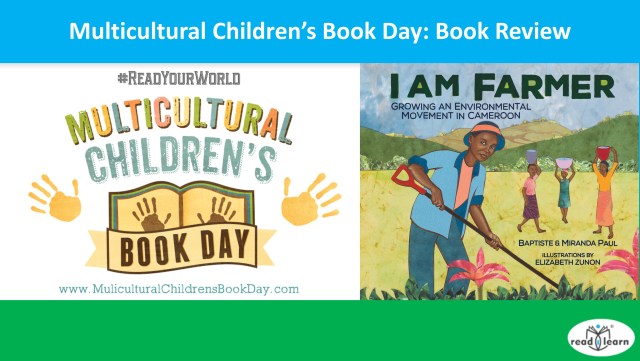
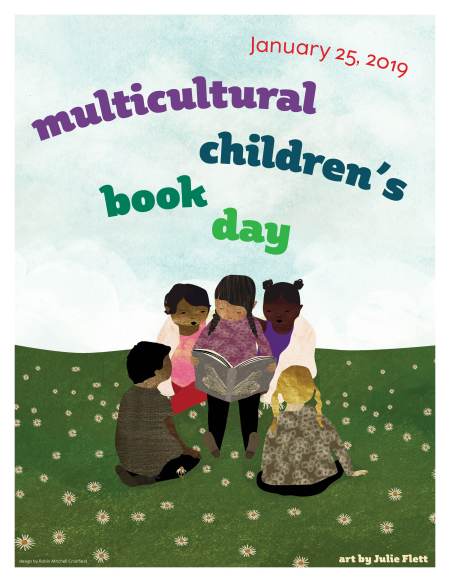
Now in its sixth year and held on the last Friday in January, Multicultural Children’s Book Day (MCBD) celebrates books that celebrate diversity. As classrooms are increasingly filled with children from a diversity of backgrounds, it is important to provide them with books that reflect their lives, books in which they can find themselves.
The purpose of Multicultural Children’s Book Day is to create awareness of books that celebrate diversity and to get more of them into classrooms and libraries.
Valarie Budayr and Mia Wenjen, co-founders of MCBD, define multicultural books as:
Books that contain characters of color as well as main characters that represent a minority point of view.
Books written by an author of diversity or color from their perspective. Search #ownvoices to discover diverse books written by diverse authors.
Books that share ideas, stories, and information about cultures, race, religion, language, and traditions. These books can be non-fiction, but still written in a way that kids will find entertaining and informative.
Books that embrace special needs or even “hidden disabilities” like ADHD, ADD, and anxiety.
Multicultural Children’s Book Day provides us with an opportunity to examine the collections of books in our classrooms and libraries to determine if they reflect the lives our children.
This year, for the first time, I am participating in the MCBD celebrations with a review of I am Farmer, a picture book written by Miranda and Baptiste Paul and illustrated by Elizabeth Zunon. I am grateful to Miranda and Paul and publisher Millbrook Press for providing me with a link to access the book on NetGallery prior to its publication in early February.
Education has the power to enrich lives. By education, I mean all of life’s experiences that contribute to learning. Sometimes these experiences occur in school. Mostly they don’t.
Schooling is but a small part of ones’ education, and its ability to enrich varies depending on:
an individual’s circumstances and attitudes to school and learning.
the school culture and attitudes to children and learning.
and the teacher’s attitude to children and learning.
Over the years I have been aware of enrichment programs offered in some schools. The programs were available to children considered ‘brighter’, having greater potential and, possibly, even ‘gifted’. The children were those who pleased their teachers with compliant behaviour and diligent work, and whose well-to-do families contributed to school facilities. Often, the program was a reward for children who needed neither incentive nor enrichment (their lives already had both) and an easy way for schools to say they were catering for diversity and individual differences.
The model of enrichment with which I was most familiar was a selective program offered one afternoon a week. Children were withdrawn from their regular classrooms to participate. Activities included things such as problem-solving, advanced science and maths, chess, reading and writing clubs.
In my opinion, these are activities which would benefit all children, especially those from impoverished homes who received little encouragement for learning, either in school or out, or opportunity for enrichment. My belief is that ‘enriched’ individuals enrich their communities and society as a whole. My suggestion of an early learning caravan, if implemented, would help remedy the situation for some.
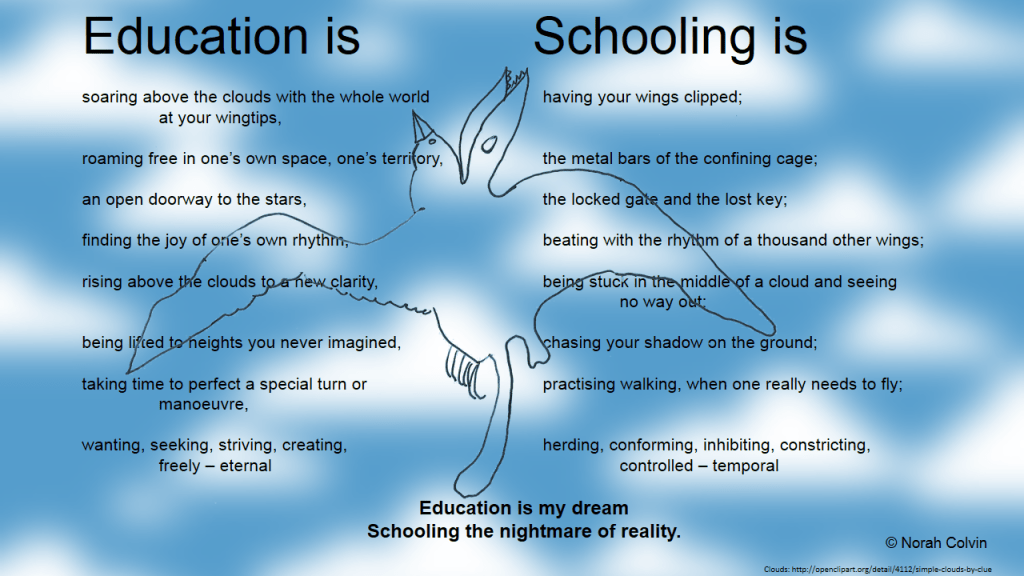
Surely education should be about enriching all lives, not just a few. It should be about asking, ‘What can I do to enrich your life, to provide opportunities for you to learn, and enhance your potential for a successful life?’ It shouldn’t just be ‘What can I cram into you for the test at the end of the week/month/term/year?’ I summed up some of these differences in my poem Education is.
Of course, not all schooling is a nightmare. Much of it is enriching. You only have to read the blogs of wonderful teachers like Jennie Fitzkee, Jacqui Murray, Marie Forst, Adam Hill and others, to realise that children’s lives are enriched by inspired teachers, every day.
My life’s work has been an attempt to enrich the lives of others through education; from my years in the classroom to my current work on readilearn where I support teachers with resources to enhance their teaching and lighten their workload.
In so doing, my own life has been enriched in many ways. You see, I consider enrichment to be something that fills one up on the inside:
with feelings of self-worth, self-respect and self-confidence,
with a sense of purpose and empowerment,
with trust, understanding and empathy,
with compassion and love for others,
and an interest in all that is.
Enrichment has little to do with external riches (though most of us wouldn’t say ‘no’ to sufficient to make our lives comfortable).
I have always seen my roles as both parent and teacher, so closely entwined, to be not only a giving back but a paying forward to the future of the universe. My children, biological and in the classroom, have enriched my life enormously, and for that I am very grateful.
The meeting dragged. After analysing data, discussing duty rosters and responsibilities, lockdown and evacuation procedures, enthusiasm flagged. Jocelyn itched. Last on the agenda; her topic was enrichment.
As she took the floor, groans and tapping pencils defied her resolve. A phone ban meant some eyes were on her, at least. Her suggestions of enrichment were met with derision.
“They don’t learn what we teach ‘em. ‘ow are we gonna’ enrich ‘em?’ Everyone laughed.
Jocelyn’s mouth opened to respond but gaped as Taya burst in bearing an enormous cake with candles ablaze.
“Now that’s my kind of enrichment.” Everyone cheered.
Thank you for reading. I appreciate your feedback. Please share your thoughts.
Establishing a writing classroom, one in which children want to write, develop confidence in writing and develop the skills to write with accuracy and clarity, begins from the first day of school.
Characteristics of a writing classroom
Nine characteristics of a writing classroom are:
purposeful writing occurs throughout the day in all areas of the curriculum,
the process of writing is modelled,
children’s writing is scaffolded,
children write in response to set tasks,
children write about topics and in genres of their own choice,
the message is paramount,
writing conventions; such as spelling, punctuation and grammar, are learned by writing,
children’s writing is celebrated, and
children enjoy writing.
If children are provided only with writing tasks and topics set by the teacher, they may view writing simply as a task to perform, something to please the teacher, rather than as a vehicle for self-expression or for sharing imaginative and creative thoughts and stories or information.
Opportunities for writing occur throughout the day and should include:
The importance of starting out right with classroom organisation
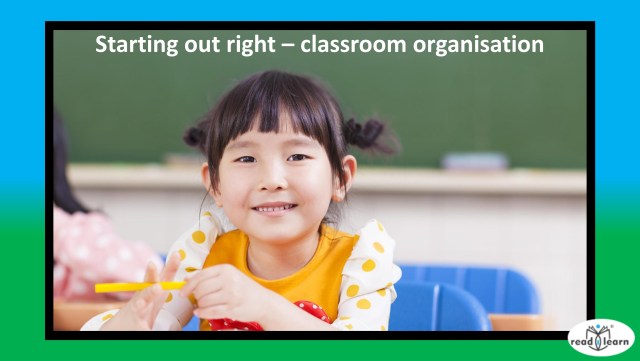
Starting the year out right requires preparation and the establishment of classroom organisation routines that will assist the first and subsequent days run smoothly.
An organised classroom contributes to a supportive classroom environment which, from day one, builds a strong foundation of positive relationships and attitudes to school and learning.
Beginning the year as you wish it to continue with a welcoming organised classroom helps children and families feel valued and comfortable in a warm and predictable environment.
Teaching resources support classroom organisation and management
Many existing readilearn resources assist teachers of the first three years of school organise their classrooms to be welcoming and supportive.
A new interactive resource extends the collection.
As the holiday season draws nigh, I wish you and your loved ones a very happy and safe holiday season. May you have time to relax, refresh, rejuvenate and, most of all, have fun.
Teaching inspiration
Holiday time can be perfect for catching up on things missed during the busyness of work. To both affirm and inspire you, I have curated a short list of some of my favourite videos. I hope you find time to enjoy them too.
Sally is not only generous in her promotions of other authors’ work, but she is also generous to readers. Until Christmas Eve, she is offering five of her ebooks to readers – FREE! Pop over to Sally’s place for details.
I’m absolutely delighted to be included in Sally Cronin’s Christmas celebrations. I shared the story of my most memorable Christmas present and Sally gave me a beautiful gift in return.
Pop over to Sally’s to check it out. While you’re there, check out Sally’s books and all her other wonderful guests too. Thank you so much for inviting me to your blog, Sally. xx

























 Norah Colvin