Live Love Laugh Learn … Create the possibilities

Blog

  • First Flight #flashfiction

    First Flight #flashfiction

    It’s almost spring here in the Southern Hemisphere. The garden is dressing up in blooms of many colours and filling the yard with the sweet scents of wattle, jasmine and other flowers. Bees busily collect the pollen, butterflies flutter from one flower to another, the butcherbirds sing joyously from the treetops, while the cockatoos noisily crack the wattle pods and prune the tree.

    Things are starting to feel fresh and new again and encouraging me to emerge from my recent writerly hibernation. While, for the previous six years I’d hardly missed responding to a weekly flash fiction challenge at the Carrot Ranch, I’ve not joined in for the past few months due to the demands of other work responsibilities. I finished that work a couple of weeks ago but have found it difficult to shake off the cobwebs and give creativity some air again. Perhaps spring and this week’s (extended) challenge provides the impetus for doing so.

    In the current prompt, Charli Mills challenged writers to In 99 words (no more, no less), write a story about a first flight. It can be anything or anyone that flies. What is significant about the first? Go where the prompt leads!

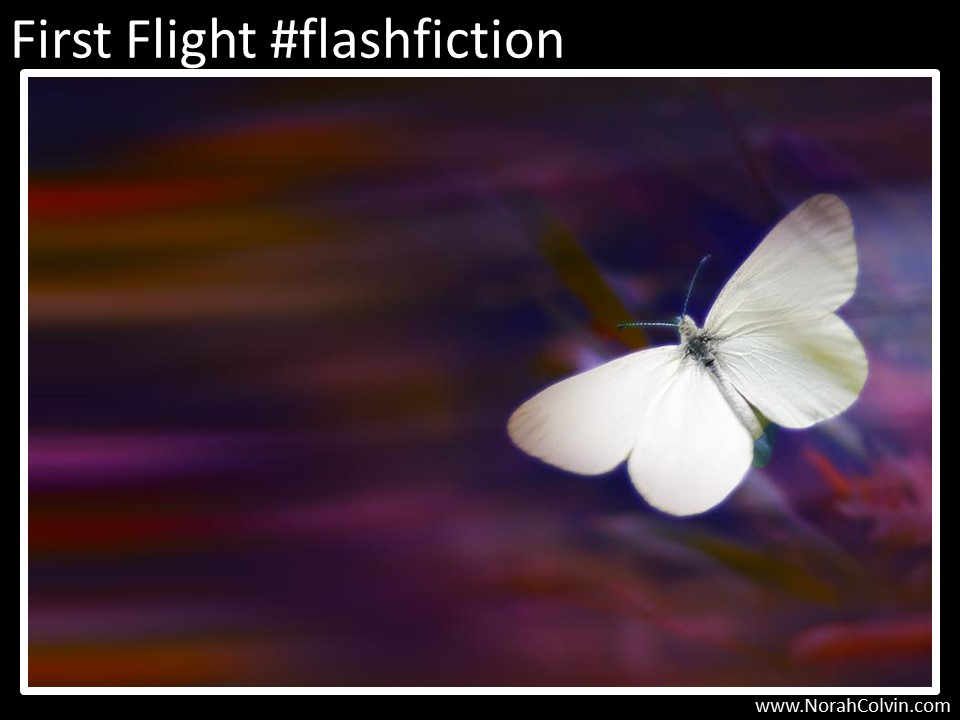
    When thinking of a first flight and spring, how could I not think of butterflies?

    butterflies in the classroom

    One of my favourite things to do with my children in the classroom was to have a butterfly house and observe the magic of all the life stages from egg to butterfly. It was wonderful to have this special little piece of nature up close in the classroom where we could see what you don’t always get to see in the world outside.

    Every day we would watch, fascinated, as the caterpillars munched their way through leaf after leaf, growing bigger and bigger. We eagerly awaited the moment they would form themselves into ‘j’ shapes, alerting us that they were about to pupate.

    We were amazed at how quickly they shed their last skin to reveal the beautiful chrysalis they had become. Then we would watch and wait until they were ready to emerge as butterflies.

    We knew when it was almost time as the chrysalis would become transparent and we could see the wings through the case. When they finally emerged, we would give them time to spread and dry their wings before releasing them into the garden for their first flight.

    The growth of a butterfly is a great analogy for creativity or the development of an idea or project. Sometimes a lot of hard work has to be expended before the idea is ready to take flight and the beauty becomes a reality.

    Here is my response to Charli’s challenge. I hope you like it.

    Dear Butterfly, Love Caterpillar

    Dear Butterfly,

    You make the impossible seem possible. You inspire our thoughts, our hopes, our dreams. How can I be like you?

    Dear Caterpillar,

    Dreams create possibilities but now you are exactly who you were meant to be.

    Dear Butterfly,

    Life is monotonous. Everyone does the same thing, day after day. Shouldn’t life be more than this?

    Dear Caterpillar,

    Nothing happens overnight. Patience, determination and persistence will reward you in the end.

    Dear Butterfly,

    I’m tired. I can’t do this anymore. I think I will sleep forever. Goodbye.


    Wake up, butterfly. It’s time to spread your wings and fly!


    Another angle

    butterfly clipart image
    venkatrao, A butterfly flying with a dotted path over a hill background https://openclipart.org/detail/69967/1278212857

    I thought I’d also share a poem that I wrote many years ago in response to an inspector’s visit to our school. As the title says, it is not really about a butterfly and was written long before I became the Butterfly Lady at another school.

    I had always believed, and still do, that the children are the most important thing in the classroom and that we do our best for them every day. The teacher next-door wasn’t of the same view. We were in a large teaching space with our own areas separated by some cupboards arranged between us.

    She spent a lot of time sitting at her desk, barking at the children to pay attention to her words. She had little of interest on display in the classroom and even less of the children’s own work. It was quite a contrast to my own space which was filled with activity, colour and children’s work.

    When the inspector’s visit was announced, she suddenly decided to decorate her room and display children’s work. I was so flummoxed by this, that I was almost tempted to do the opposite. I believed that if what I did on a daily basis wasn’t good enough for the inspector, then it wasn’t good enough for the children either. I resisted the urge to tear everything down in protest (which might have been considered a flight from the situation) and wrote this poem instead.

    Before reading it, I want you to know that the teacher and I were both teaching (perhaps I use that word lightly) year two and she was considerably younger than I.

    Not Really About A Butterfly

    Look at you now.

    You put on your show.

    Your butterfly colours are warmly aglow.


    It’s hard to imagine

    That not long ago

    You were a mere silent pupa

    With nowhere to go.


    You flit and you flutter,

    Cry, “Hey, look at me!”

    And all turn their heads,

    Wondrous beauty to see.


    But where have you come from?

    And how can this be?


    Before . . .

    Not one head would have turned.

    There was nothing to see

    — just a little green ball,

    curled up on a tree.


    Is it dishonest

    to change rapidly?
    Thank you blog post

    Thank you for reading. I appreciate your feedback. Please share your thoughts.

  • It’s readilearn’s fourth birthday – #readilearn

    It’s readilearn’s fourth birthday – #readilearn

    On Monday 24 August, readilearn will be four years old, and what an amazing four years it has been — one day, one week, one month, one year at a time. We haven’t been without our hiccups, but we haven’t been without our successes either. I express my sincere gratitude to everyone of you who has supported me along the way. Rest assured, the journey is not over yet.

    About Norah, founder of readilearn

    For those who don’t know, below are #12 things about me that preceded and contributed to the establishment of readilearn, a collection of teaching resources to support teachers of the first three years of school.

    1. Education is my life, my passion, especially literacy development and the education of young children.
    2. I decided at age 10 that I wanted to be a teacher. That desire has never waned.
    3. When I left school, I went straight into teachers’ college, and from there back into the classroom, but on the other side of the teacher’s desk.
    4. I wasn’t always happy with everything that was expected of me as a classroom teacher and read widely about education and alternatives to schooling.
    5. I undertook further study into language and literacy development.

    Continue reading: It’s readilearn’s fourth birthday – readilearn

  • Combat Boredom with Board Games – #readilearn

    Note: This article was first written for and published at the Carrot Ranch Literary Community as part of a series supporting parents with children learning at home. The benefits of playing board games are the same whether played at home or at school. If you have older children or adults available to support children while they play, board games are an excellent activity for learning in groups across many areas of the curriculum.

    One of the best ways to have fun while learning, or to learn while having fun, is by playing board games. Playing games together as a family helps to bond family relationships. Adjustments can be made to suit most numbers and ages and rules can be adapted to suit your purposes. While the main thing is to have fun together, there is a lot of learning going on too.

    Social Skills

    • One of the greatest benefits of playing board games is the development of social skills.
    • Some of the social skills children learn include:
    • Getting along and taking turns
    • Playing fair — accept the roll (if dice are used) or draw (if cards are used) for example, and respond accordingly: don’t try to pretend it

    Continue reading: Combat Boredom with Board Games – readilearn

  • Special Days and Events for Classroom Celebrations — August – #readilearn

    Special Days and Events for Classroom Celebrations — August – #readilearn

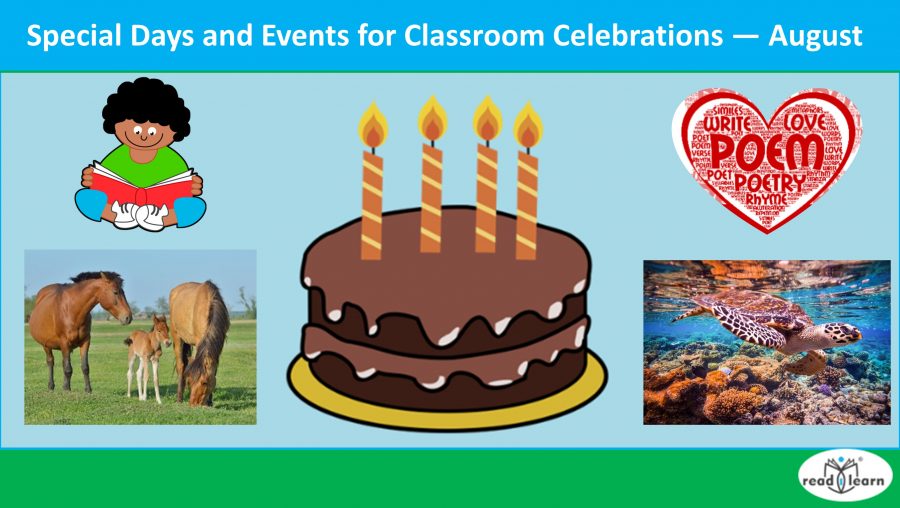
    It’s August already and we are starting to see a change in the seasons. Here in the Southern Hemisphere we are getting ready for Spring, while in the Northern Hemisphere, you are maybe hoping things will start to cool soon.  Wherever we are, it seems the uncertainty caused by the pandemic still has us in its grip. I think I’d probably be right in saying that we’d all like that to change, and soon.

    The help lighten your workload and inject something a little different into the routine, I’ve listed some special days and events you might like to celebrate in the classroom this month.

    The MS Readathon runs throughout the month of August. The purpose of the MS Readathon is to encourage children to read and, at the same time, raise money to help kids who have a parent with multiple sclerosis. Teachers can register their class or children can register individually. Find out more and download some great resources from their website.

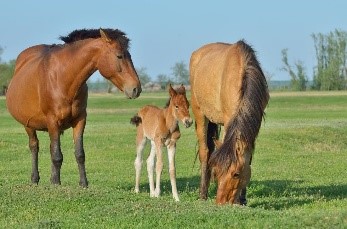
    The Horses’ Birthday is celebrated on 1 August in the Southern Hemisphere. Horses born after 1 August in will be considered one year old on 1 August the following year.

    In the Northern Hemisphere, 1 January is recognised as the horses’ birthday. The dates are chosen as most foals are born in late winter.

    Why not celebrate with a carrot cake, or give your favourite horse a carrot treat?

    Children may enjoy discussing the question, “What if we had a people’s birthday, and celebrated everyone’s birthday on the same day, regardless of when they were born?

    Some horse-related resources from readilearn:

    Continue reading: Special Days and Events for Classroom Celebrations — August – readilearn

  • Meet Marg Gibbs author of Jasper’s Jumbled Up Words – #readilearn

    Meet Marg Gibbs author of Jasper’s Jumbled Up Words – #readilearn

    Today it is my pleasure to introduce you to Marg Gibbs, author of Jasper’s Jumbled Up Words as part of a Books on Tour promotion.

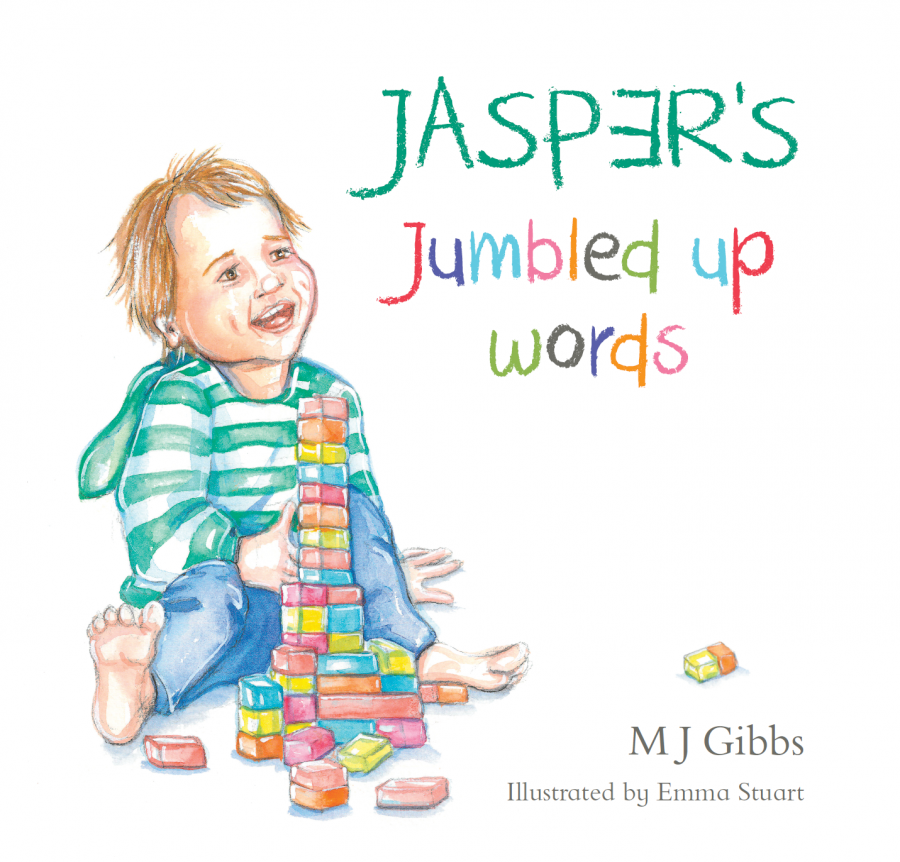
    Jasper’s Jumbled up Words is a story of a young child’s journey into communication through speech and shows how the encouragement of a loving family fosters the progress. The excitement that is felt when a child utters their first words will be familiar to most families.

    Jasper’s Jumbled Up Words © Marg Gibbs


    The back-cover blurb

    Jasper’s Jumbled up Words is a gentle story about a young boy who wants to be understood.

    ‘In Jasper’s head, strange sounds bubble, but in his mouth the words get caught and only babble comes out.’

    Jasper soon finds himself confused and upset. Then one day, he surprises everyone.

    Jasper’s Jumbled up Words sensitively deals with the difficulties surrounding language development and offers children, parents and care givers hope.

    About Marg Gibbs


    Contine reading: Meet Marg Gibbs author of Jasper’s Jumbled Up Words – readilearn

  • Educate for peace through teaching friendship skills – #readilearn

    Educate for peace through teaching friendship skills – #readilearn

    The UN International Day of Friendship on 30 July promotes friendship between peoples, countries, cultures and individuals in order to inspire peace and build bridges between communities.

    Education has an important role in fostering friendships at a grassroots level that can transform communities both small and large. We begin by developing respect, understanding and empathy among students in our classrooms and schools and reaching out to others in our local, national and international communities.

    The basis for developing friendships in the classroom is the establishment of a supportive classroom environment in which everyone is welcomed and respected. It means that we, as a class, teachers and children, get to know each other and learn to appreciate our similarities and value our differences.

    Establish a supportive classroom environment

    I have suggested strategies for establishing a supportive classroom environment in previous posts, including:

    Establishing a supportive classroom environment from day one

    Starting out right — classroom organisation

    Preparing the classroom for a successful school year

    The posts link to resources to support your work in setting up a welcoming classroom.

    Continue reading: Educate for peace through teaching friendship skills – readilearn

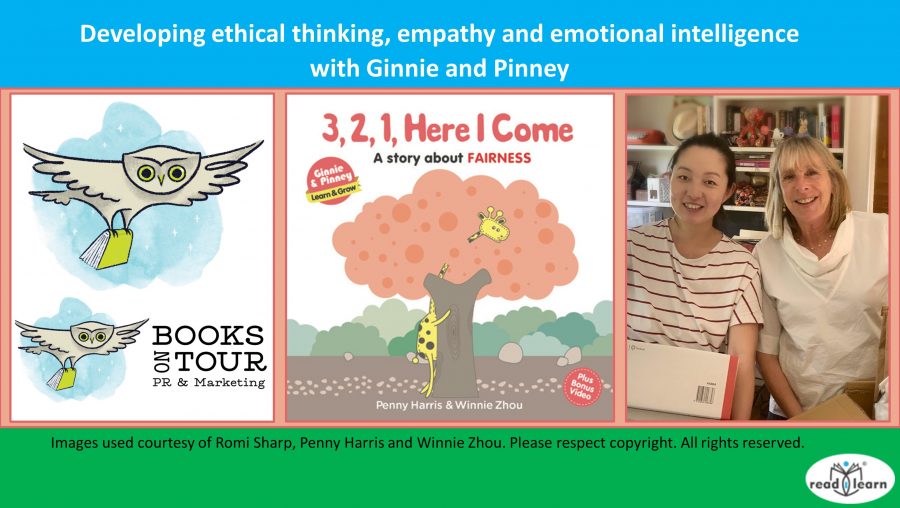
  • Developing ethical thinking, empathy and emotional intelligence with Ginnie and Pinney – #readilearn

    Developing ethical thinking, empathy and emotional intelligence with Ginnie and Pinney – #readilearn

    Today it is my pleasure to introduce you to Penny Harris who is launching the first two titles in the Ginnie and Pinney Learn and Grow series of books and videos for young children. The series of eight books encourages the development of ethical thinking, empathy and emotional intelligence. The first two books are Ginnie & Pinney; ‘3, 2, 1 and Here I Come’ and ‘Pinney the Winner’. This interview is part of a Books on Tour promotion. You can find a list of other blogs in the promotion at the end of the post.

    About the author Penny Harris

    Penny Harris is a multi-national and international award-winning animator, author and multi-media developer. She has worked with the Australian Children’s Television Foundation, Film Victoria as well as a number of Australian universities and institutions.

    About the Illustrator Winnie Zhou

    Winnie Zhou has a Masters of Multimedia Design from Monash University and is a talented illustrator and multimedia developer. Winnie lives in Melbourne and has worked closely with Penny to develop the series.

    About the series Ginnie and Pinney Learn and Grow

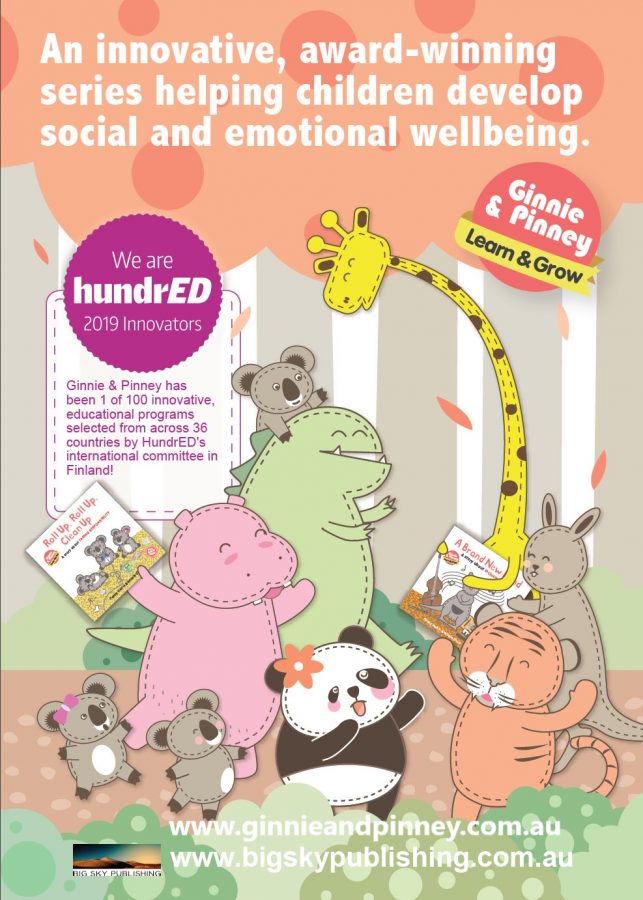
    The series consists of 8 story books, animated videos, teacher resources and finger puppets; aligns with Australian Early Years Learning Framework; and is consistent with social and emotional learning.

    The stories feature Ginnie & Pinney and their friends. Their daily social interactions, concerns and decisions pose dilemmas that model positive self-identity and behaviours: selflessness, persistence, sharing, fairness, inclusiveness, responsibility, accepting difference and learning to say sorry.

    The videos, accessed from QR codes supplied on the back of each book, are perfect for display on an interactive whiteboard in the classroom or used on any other digital device at home or at school.

    Open-ended questions included at the back of each book can be used to stimulate deep discussion and encourage social and emotional learning.

    The series was selected by the Finnish Educational Org.HundrEd, as one of a hundred of the most innovative educational programs for 2020 and was also selected by the Victorian Dept. of Education and Training as a recommended resource for 2020 for their School Readiness Funding program.

    The books

    Continue reading: Developing ethical thinking, empathy and emotional intelligence with Ginnie and Pinney – readilearn

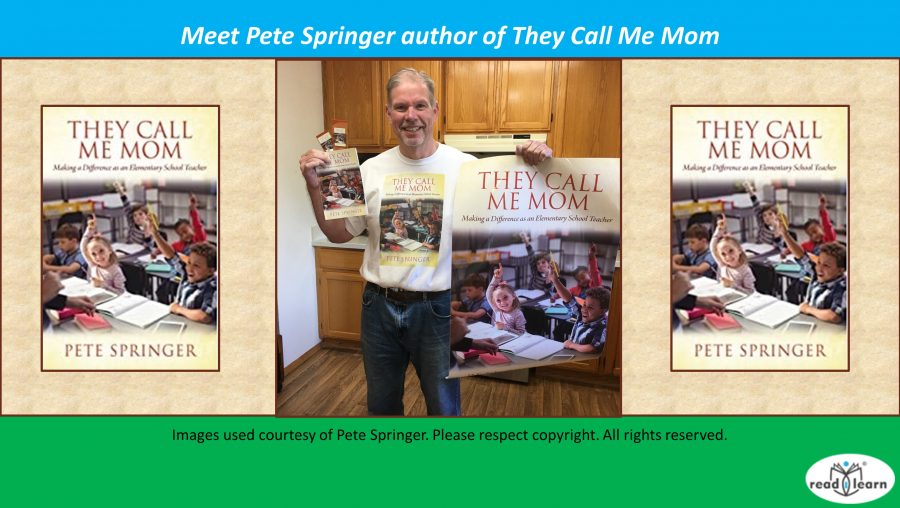
  • Meet retired teacher Pete Springer author of They Call Me Mom – #readilearn

    Meet retired teacher Pete Springer author of They Call Me Mom – #readilearn

    Today it is my great pleasure to introduce you to Pete Springer. Pete was a classroom teacher for over thirty years. When he retired, he decided to share his experiences and wisdom with others who may be at different stages of their teaching journey. His book is a pleasure to read. He writes from the heart and every teacher will find something within the pages of his book with which they can identify or/and learn from. It will have you nodding your head in agreement, inspire an ‘aha’ moment, make you laugh and make you cry. From when you open the book until you close it, you will know that this is the honest voice of an authentic teacher who made, and continues to make, a positive difference to the lives of others.

    About Pete Springer

    Hi Pete, welcome to readilearn. Before we begin the interview, please tell us a little about yourself.

    I taught elementary school (grades 2-6) for thirty-one years at Pine Hill School in Eureka, California.  I loved everything about being a teacher, and I want to be a role model for the next generation of teachers the way others inspired me to want to become a teacher.  I was a master teacher to four student teachers.  I was chosen for the Excellence in Teaching Award in 2006.  That is an annual award recognizing ten top teachers in the county.  I belong to the Humboldt County Children’s Author Festival Committee which brings in twenty-five nationally known children’s authors to speak to children in over eighty schools in the county.  My future goal is to write books for middle-grades.

    About the book They Call Me Mom — the blurb

    Continue reading: Meet retired teacher Pete Springer author of They Call Me Mom – readilearn

  • Combat Boredom with Board Games

    Combat Boredom with Board Games

    I was over at the Carrot Ranch last week, discussing the benefits of playing board games as a family with the children. Pop over there to see which games I suggest and add your own favourite board games in the comments.

  • Resources for teaching Aboriginal and Torres Strait Islander Histories and Cultures – #readilearn

    Resources for teaching Aboriginal and Torres Strait Islander Histories and Cultures – #readilearn

    NAIDOC Week celebrations, which would normally take place in early July, have been postponed until November this year due to Covid-19. However, that is no reason to cancel sharing Indigenous stories and lessons with your class. After all, Aboriginal and Torres Strait Islander Histories and Cultures is one of the cross-curriculum priorities in the Australian Curriculum and is an important part of our national heritage. While some may not feel confident teaching Indigenous perspectives, the only way to become more confident is by being informed.

    In this post I share some websites and resources that you may find useful in preparing lessons and some organisations whose goals of improving the education and future success of our Indigenous students you may wish to support.

    Raising culturally aware kids

    In this article, How to Raise Culturally Aware Kids written for ABC Life, Samantha Turnbull introduces us to Kirby Barker a Bandjalang worman and early childhood teacher from northern New South Wales. Kirby teaches her preschoolers to counter racism with kindness. The article shares Kirby’s advice on how to present information to young children including words that can be used to explain the history. She discusses

    • the need to celebrate difference
    • ways of explaining traditional owners and inviting them into the classroom
    • how to talk about reconciliation with children
    • the importance of sharing stories
    • learning Indigenous languages
    • developing empathy.

    While only a brief article, you will glean many ideas from Kirby Barker which, though easily implemented, will have a profound effect.

    Indigenous Literacy Foundation

    The aim of the Indigenous Literacy Foundation is to raise literacy levels by supplying books to remote communities.

    Continue reading: Resources for teaching Aboriginal and Torres Strait Islander Histories and Cultures – readilearn