Last week, the prompt was Danger Zone. My story saw a couple of playful children ‘trapped by quicksand’. I thought it appropriate to free them this week. My story begins where the last one finished. I hope you enjoy it.
We’re Free!
Help! Save us!
What’s wrong?
Can’t you see? We’re sinking. It’s quicksand! Help!
I’ll save you! I’ll pull you out!
Quick!
Okay. Stay right there! I’ll get a rope.
Jane, Jane. Quick, Give me your rope. The boys are sinking in quicksand. We have to get them out — before it’s too late.
I’ll come too.
Where are you going?
We have to save the boys! They’re sinking! It’s quicksand!
Quicksand? I’ll help too.
Quick! Grab the rope! Now, everyone, on the count of three, one, two, three, pu-ull! Pu-ull! Pu-ull!
Made it! You saved us! We’re free! Thank you.
Thank you for reading. I appreciate your feedback. Please share your thoughts.
Note: The collection of stories made in response to the previous prompt Danger Zone, including mine, can be read at the Carrot Ranch.
It’s not uncommon to see apostrophes used incorrectly, even in professional writing. But apostrophes don’t have to be difficult. They really have just two uses — for contractions and to show possession. Apostrophes aren’t confusing or tricky when the rules are understood.
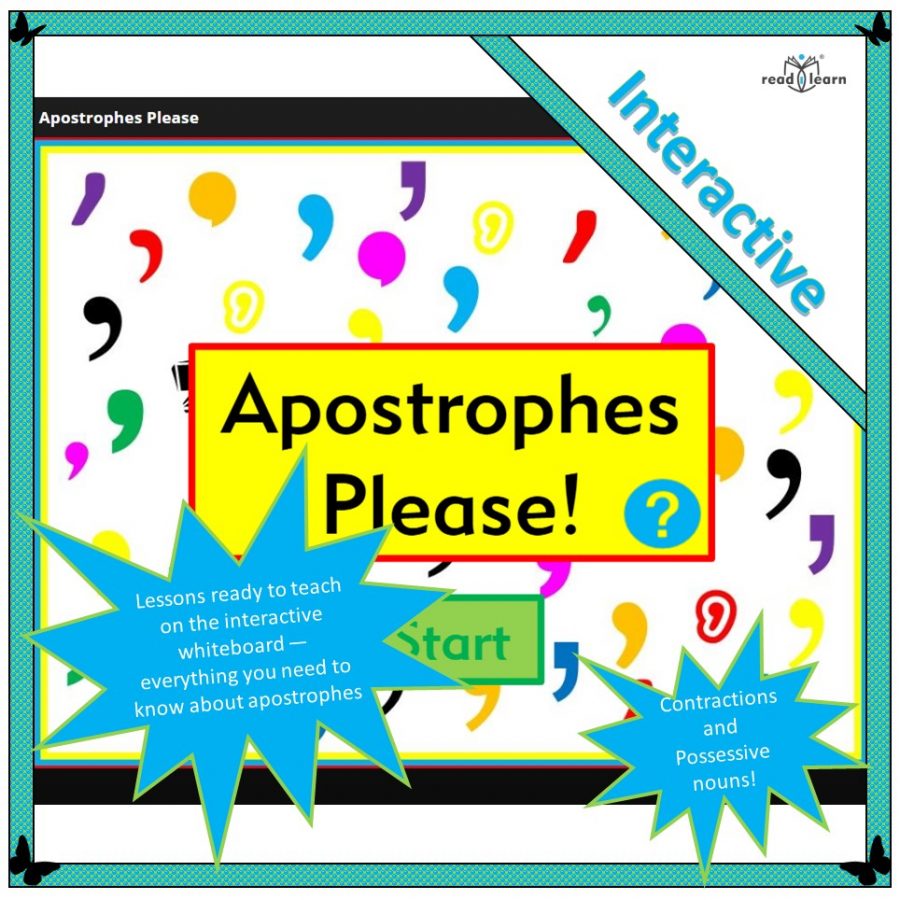
To support your teaching of this punctuation mark and to encourage writers to get their writing right, I have produced an interactive resource that explains, demonstrates and provides practice in its correct use. It is called Apostrophes Please!
About Apostrophes Please!
Apostrophes Please! is an interactive resource, ready for use on the interactive whiteboard. It consists of enough material for a series of lessons teaching the correct use of apostrophes in both contractions and possessive nouns.
Like other readilearn resources, Apostrophes Please! recognises the value of teacher input and the importance of teacher-student discussion. It is not designed for children to use independently. It relies simply on effective teaching.
The resource provides flexibility for the teacher to choose activities which are relevant to student needs and teaching focus. All lessons and activities encourage explanation, stimulate discussion and provide opportunities for children to practise, explain and demonstrate what they have learned. There are nineteen interactive slides and over thirty slides in all.
Organisation of Apostrophes Please!
Contractions and possessive nouns are introduced separately.
Apostrophes Please! Contractions menuApostrophes Please Possession menu
Both sections include three subsections, each consisting of a number of slides:
Learn — explanatory teaching slides introduce how apostrophes are used
Practice — interactive activities provide opportunities for teachers and students to discuss, demonstrate and explain how apostrophes are used
Check — a review of the use of apostrophes provides additional opportunities for practice, discussion and explanation to consolidate learning.
Charli didn’t say it could be nonsense but that’s all I could come up with after a pretty heavy week of writing books about writing for an educational publisher. The work can be draining at times and nonsense is all that is left. I hope it gives you a smile anyway. Smile and carry on.
Quicksand
Stop!
Why?
That’s quicksand.
I can’t see it.
That’s why it’s so dangerous.
It doesn’t look like quick sand.
It never does. Until you start sinking in it.
I don’t believe you. You’re just trying to scare me. I’m going in anyway.
Suit yourself.
Help! Help! Save me!
You don’t look like you need saving to me.
But I’m sinking.
It’s just your imagination.
You said it was quicksand.
I know, but I was joking.
Then why am I sinking?
You’re not sinking. You’re just — disappearing into the ground? Yikes! It really is quicksand. Help! We’re sinking! Save us!
Thank you for reading. I appreciate your feedback. Please share your thoughts.
Note: The collection of stories made in response to the previous prompt Stacking Stones, including mine, can be read at the Carrot Ranch.
Fostering self-esteem, a willingness to have a go and an ‘I can’ attitude was always important to me as both a teacher and a parent. These are important aspects of any supportive environment, whether in the home, in the classroom or in the workplace. I have written many posts and made many resources to help you develop a supportive classroom environment. In this post, I feature just one — a story you can personalise for your own class.
The Clever Children is a story about a kingdom in which a mean witch has put a spell on all the people, causing them to be confused and to forget everything they once knew. The king, who has heard about a class of very clever children (your class) asks for their help in teaching his subjects what they need to know. Every child suggests something they are good at and writes and draws a picture of them doing it on a page for inclusion in the book. When the children have taught their skill, the king throws a great party in the castle to celebrate and, of course, the children are invited.
The story not only helps develop an ‘I can do it’ growth mindset, but it helps develop friendship skills too. It was one of the first uploaded to the collection and includes a diversity of children and abilities gorgeously illustrated by Kari Rocha Jones.
The story is available in two formats.
It is an estory, ready to be displayed and read on the interactive whiteboard.
It is also a booklet that can be downloaded and printed, ready to be completed with pages written by your own children.
While both these formats are available to purchase independently, if you purchase the estory, the printable version is included.
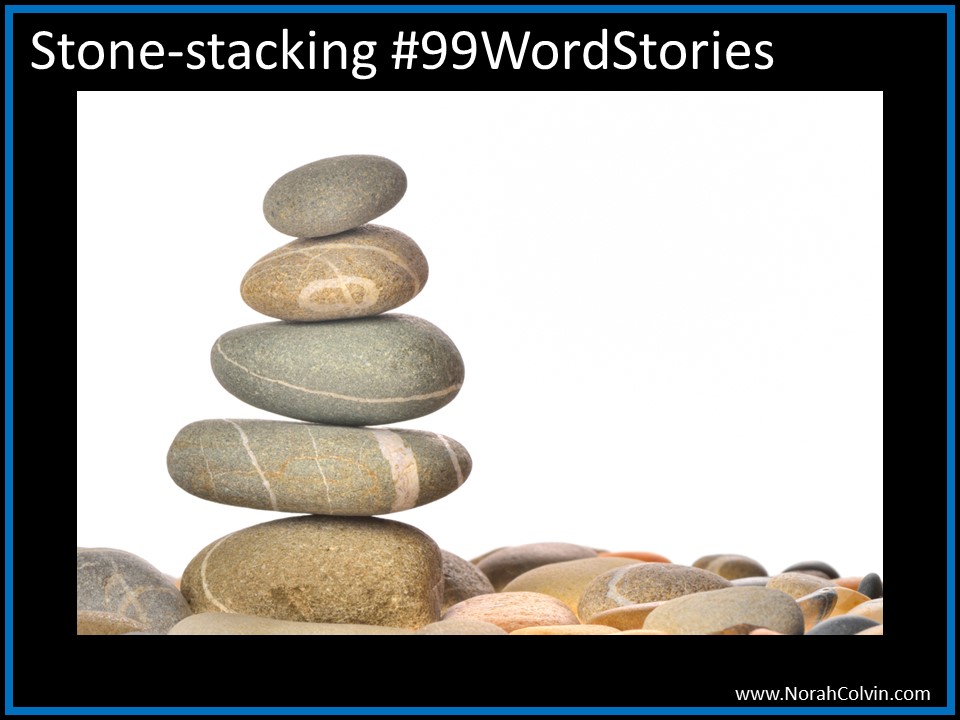
I tried all week to find a fitting ending to my story beginning but couldn’t get anything I was hoping for to fit. I have ended up with ninety-nine though, so I hope it works, at least a little.
Stacking Stones
Active children were everywhere — throwing, skipping, climbing, swinging, laughing, playing. But over in the garden, on the gravel path, one child was stacking stones.
“What’s he doing?” a visiting teacher asked.
“Jack? Counting stones. He’s been doing it for days now. At the end of playtime, he tells me how many he stacked.”
“Why?”
His teacher shrugged. “He likes counting, I guess.”
“Is he okay, I mean, you know —”
“Oh, yes. He’s completely fine. He just wants to see how high he can count.”
“How high has he got?”
“Twelve.”
“How far does he want to get?”
“Ninety-nine.”
Thank you for reading. I appreciate your feedback. Please share your thoughts.
Note: The collection of stories made in response to the previous prompt Memorials, including mine, can be read at the Carrot Ranch.
This post is a revisit of one of the first posts I published on readilearn almost six years ago in 2016. Since it was first shared, I have added many more procedures to the collection. All procedural texts and activities can be found in the Procedures subsection of Literacy resources.
Why teach procedures?
Reading and following procedures are a part of everyday life. We need to follow a procedure to make a cake, take medicine, repair a bicycle, treat head lice, assemble a DIY bookcase, or install an app on a digital device. The list in inexhaustible.
Sometimes procedures are presented as text, sometimes as illustrations or diagrams, and sometimes as a combination of both. They work best when each step of the sequence is accurately described and illustrated.
However, not all procedural texts are created equal. Sometimes the language may be inappropriate and unclear. Sometimes steps are omitted or sequenced incorrectly. Sometimes diagrams have little resemblance to what is required and confuse, rather than clarify, the process.
Trying to figure out what to do can cause a great deal of frustration in such circumstances. The more practised we are with following procedures, the more adept we are at interpreting inadequate instructions to achieve a good outcome.
It is never too soon for children to learn to read and follow procedures. The inclusion of procedural texts in a classroom literacy program has many benefits.
Following a procedure provides a context and purpose for reading. It requires children to interpret instructions through a combination of text and visual representation. It generally implies that children are doing or making something, which engages their interest and encourages participation. It develops an essential real-life skill that is transferrable to a range of situations. The sense of achievement in successfully completing a project is both affirming and empowering and often requires no other feedback.
Procedural texts can be easily incorporated into a class reading program as an independent or group reading activity. An assistant to support, encourage and oversee can be invaluable.
Features of procedural texts
The reading of procedural texts differs from reading fiction or other non-fiction texts.
Charli’s prompt was in honour of Memorial Day commemorated in the United States on 30th May.
In Australia, we have two main days for remembrance — ANZAC Day on 25th April (which we share with New Zealand), and Remembrance Day on 11th November (which we share with many other countries).
Every evening, The Ode is recited at many RSL (Returned and Services League) Clubs around Australia. The Ode is the fourth stanza of the poem “For The Fallen” by Laurence Binyon (1869-1943).
At times such as these, I always think of my family members, especially my father, who fought in the Second World War. This is my response. I hope you like it. It is a #99wordstory but it is truth (as I know it), not #flashfiction.
Memorial
As a child, he lived at Yuleba, a tiny town in south-western Queensland. His father was a boundary rider on the fence bordering New South Wales, keeping rabbits out of Queensland. A peaceful if difficult life. Aged 20, he enlisted. His overseas service included the battle at Milne Bay, a turning point of the war. Upon their return, servicemen were told to forget. Memories and nightmares disagreed, but it was years before he could talk, let alone write, about his experiences. After his death, his words were engraved on a memorial in his home town, never to be forgotten.
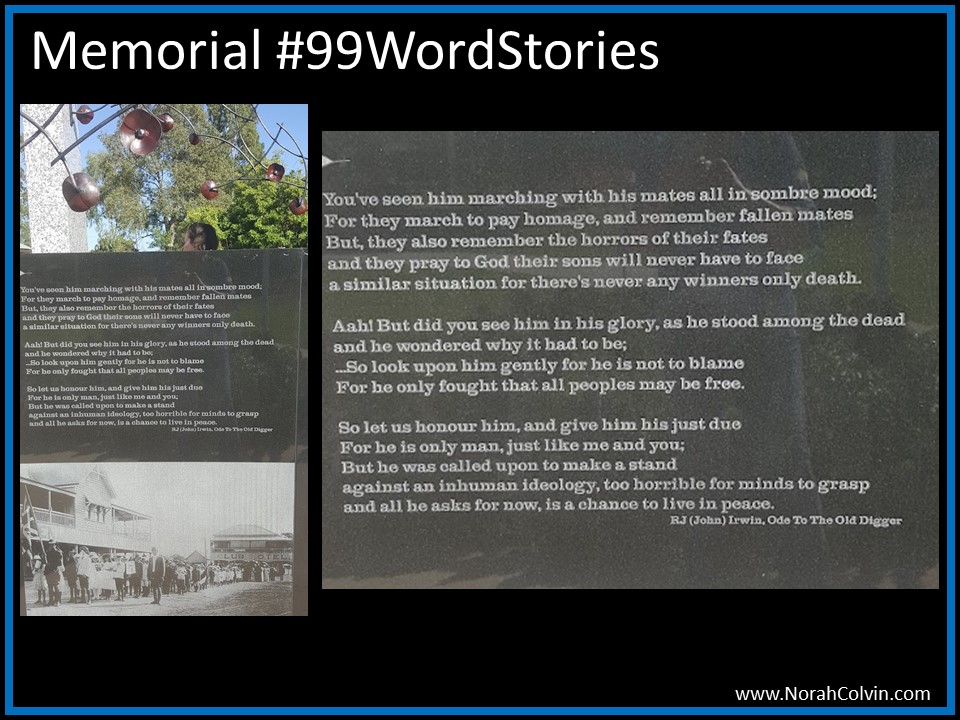
These are the words on the memorial, a brief extract from a longer poem Ode to the Old Digger by RJ (John) Irwin.
You’ve seen him marching with his mates all in sombre mood;
For they march to pay homage, and remember fallen mates
But, they also remember the horrors of their fates
and they pray to God their sons will never have to face
a similar situation for there’s never any winners only death.
Aah! But did you see him in his glory, as he stood among the dead
and he wondered why it had to be;
…So look upon him gently for he is not to blame
For he only fought that all peoples may be free.
So let us honour him, and give him his just due
For he is only man, just like me and you;
But he was called upon to make a stand
against an inhuman ideology, too horrible for minds to grasp
and all he asks for now, is a chance to live in peace.
Thank you for reading. I appreciate your feedback. Please share your thoughts.
Note: The collection of stories made in response to the previous prompt Well’s Gone Dry, including mine, can be read at the Carrot Ranch.
Next Monday 6 June is Queensland Day, and, since I am a Queenslander, I thought I’d share a little about my home state, including Queensland authors and illustrators I have interviewed over the years.
12 Facts about Queensland
Queensland is in north-eastern Australia. It is the second-largest state by area (after Western Australia) and the third-largest in population (after New South Wales and Victoria).
2. Queensland is bordered by New South Wales, Northern Territory and South Australia. The Pacific Ocean is along its eastern coastline.
3. The most northern part of Australia, Cape York, is in Queensland. Though I am told it is very beautiful and is a popular camping and four-wheel drive destination, I’ve never been there. (I’m not a camper or a four-wheel driver.)
4. One of the seven wonders of the natural world, the Great Barrier Reef, is located along Queensland’s coastline.
5. The world’s three largest sand islands, Fraser, Bribie and Stradbroke, are also located on Queensland’s coast.
6. The capital of Queensland, Brisbane (where I live), is located in the south-east corner of the state.
7. Queensland Day celebrates the day in 1859 that Queensland separated from New South Wales to become an independent colony.
8. Queensland’s state fauna emblem is the koala. The koala is a marsupial (mammal with a pouch) that is native only to Australia and lives mainly along the east and south coasts.
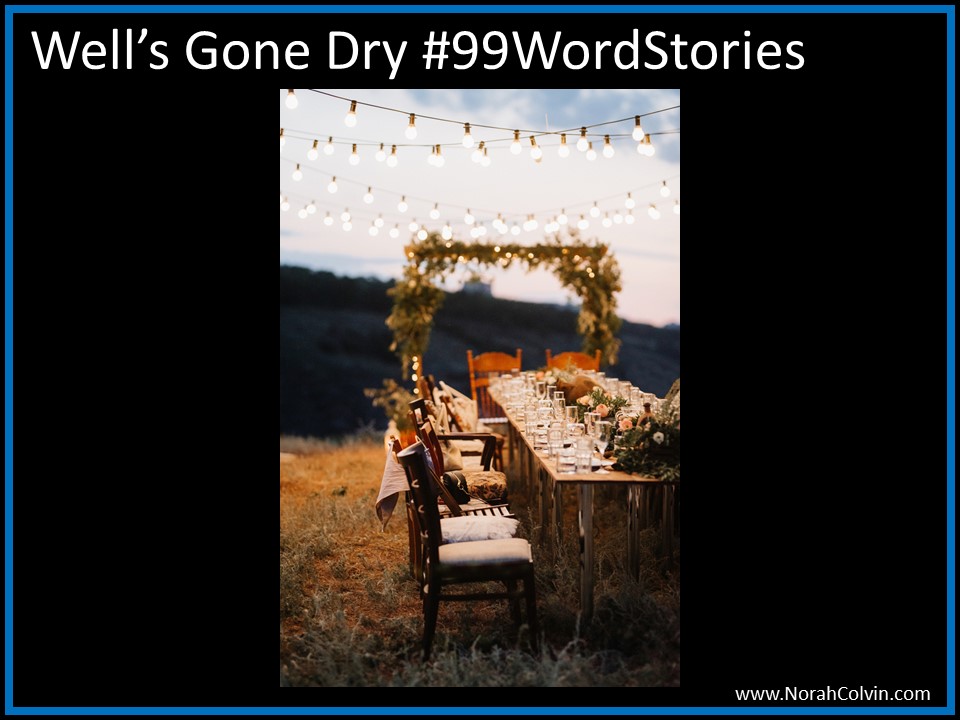
Having lived independently for years, when they moved in together, they had two of everything and needed nothing more. At their public celebration, they advised, ‘No gifts, please. Wishing well contributions appreciated.’
With well-paying jobs, they had no immediate need of the well’s contents, which they didn’t inspect but agreed to keep for a ‘rainy day’.
It sat untouched for many years, until it didn’t just rain; it poured.
“Must be all notes,” they said when it didn’t jingle.
There was but one note: “Always carry an umbrella in case of rain.”
The well remained the only thing dry.
Thank you for reading. I appreciate your feedback. Please share your thoughts.
Note: The collection of stories made in response to the previous prompt Soldier, Prisoner and Buttercup, which I unfortunately didn’t find time to respond to, can be read at the Carrot Ranch.
The collection of stories made in response to the most recent prompt I responded to Mum Selfie can also be read at the Carrot Ranch.
Today, Friday 27 May is the first day of National Reconciliation Week which runs until 3 June. The theme this year is ‘Be Brave. Make Change.’
As expressed on the Reconciliation Australia website, the theme ‘is a challenge to all Australians— individuals, families, communities, organisations and government—to Be Brave and tackle the unfinished business of reconciliation so we can Make Change for the benefit of all Australians.’
It ‘is a time for all Australians to learn about our shared histories, cultures, and achievements, and to explore how each of us can contribute to achieving reconciliation in Australia.’
The dates are chosen to commemorate two events:
On 27 May 1967, more than 90% of Australians voted ‘Yes’ in a referendum to ensure that Aboriginal and Torres Strait Islander people would be recognised in the Census.
On 3 June 1992, the Australian High Court delivered the Mabo decision which recognised the incorrectness of the term ‘terra nullius’ (land belonging to no one). This decision led to the legal recognition of Aboriginal and Torres Strait Islander people as Traditional Owners and Custodians of the land and paved the way for recognition of Native Title.
The day before Reconciliation Week, 26 May, is National Sorry Day which remembers and honours the Stolen Generations.
The website lists actions we can all take to make a change toward reconciliation.
The basis of many of these actions is education. It begins with us, teaching our children to honour and respect the cultures of our First Nations, to learn the truth of our history, and to implement actions for change.
I rarely mention politics in my posts, but with our recent change in government, I was very proud to be an Australian when the incoming Prime Minister Anthony Albanese acknowledged our First Nations peoples in both the introduction and content of his victory speech. These are the words with which he opened his speech:
“I begin by acknowledging the traditional owners of the land on which we meet. I pay my respects to their elders past, present and emerging. And on behalf of the Australian Labor Party, I commit to the Uluru Statement from the heart in full.”
And these are the words which he used further in:
“And together we can embrace the Uluru Statement from the Heart.
“We can answer its patient, gracious call for a voice enshrined in our constitution. Because all of us ought to be proud that amongst our great multicultural society we count the oldest living continuous culture in the world.”
In further recognition, in his first press conference as Prime Minister, Anthony Albanese hung the Aboriginal and Torres Strait Islander Flags alongside the Australian flag in the media room at Parliament House. These statements give me hope for the recognition that our First Nations deserve and is long overdue.
In this post, I share some wonderful books by our Aboriginal and Torres Strait Islander authors and illustrators. This is only a small selection of the growing number available. Magabala Books is a great resource to check out as it publishes only books by First Nations authors and illustrators. Other publishers also have a collection of titles, so it is worth checking out others too. I will be adding these titles to the list already available in readilearn resources Indigenous Australian picture books and resources. A previous post Resources for teaching Aboriginal and Torres Strait Islander Histories and Culture has links to many other useful resources also.
Books for Reconciliation
Common Wealth by Gregg Dreise
Published by Scholastic in 2021
Dreise is the author of many wonderful picture books. I first came upon his delightful stories in books such as Kookoo Kookaburra and Mad Magpie which introduce children to the stories of Aboriginal and Torres Strait Islander peoples.
Common Wealth is different. It is a book that challenges us to acknowledge our true history and to ‘break down the barriers of division … by discussing without ammunition, a willingness to listen … to a true common wealth vision.’
The book may not be as suitable for sharing with our younger children, but it makes valuable reading for us anyway as it can empower us in our knowledge and discussions. The half-title page informs us that this book is ‘A Slam Poetry Persuasive — A picture book for older readers. Contains some confronting imagery.’
Dreise opens the book with the words, ‘All that I’m wishing, is that you take a moment to listen …You see, I’m on a mission, to spread unity — not division.’ He takes us on a journey through our national anthem and our history, pointing out the parts that are incorrect and what we need to do to make them more inclusive and true. His illustrations pull no punches and the text added to the illustrations add to the depth of the story and its message. There is much to contemplate and discuss. It may be challenging but it is also empowering and I, for one, can’t help myself wishing for change along with Gregg.
Finding Our Heart by Thomas Mayor, illustrated by Blak Douglas
Published by Hardie Grant 2020
Thomas Mayor was involved in the writing of the Uluru Statement of the Heart. His book for adults titled Finding the Heart of the Nation: The Journey of the Uluru Statement Towards Voice, Treaty and Truth talks about the writing of the statement and reports discussions with many Aboriginal and Torres Strait Islander people whom Mayor met with as he took the Statement on a journey around Australia. It is a very valuable read for adults.