Tomorrow, 20 November 2014, is UNESCO’s World Philosophy Day. Celebration of the day “underlines the enduring value of philosophy for the development of human thought, for each culture and for each individual.”
In recognition of the day I am reblogging a recent post from The Philosophy Foundation which discusses the differences between open and closed questions and explains the greater value of The Question X.
The importance of encouraging children to ask questions has been a recurring theme on my blog (here, here, here and here) , as has the need to encourage them to think for themselves rather than to become experts at regurgitating force-fed information (here and here).
The discussion of The Question X gave me a lot to think about. Maybe it will do the same for you.
Happy thoughts and thinking on World Philosophy Day 2014!
We read this blog ‘Closed Question Quizzing, Unfashionable Yet Effective‘ by Andy Tharby the other day. The virtues of closed questioning are well known to The Philosophy Foundation as they are central to our philosophical questioning approach, so we wanted to share this extract taken from a chapter entitled ‘If it, Anchor it, Open it up: A closed, guided questioning technique‘ that Peter Worley has written for the forthcoming book The Socratic Handbook ed. Michael Noah Weiss, LIT Verlag, 2015. Some of these ideas were first written about in The Question X published in Creative Teaching and Learningand available here: The Question X. In this blog Peter has developed some of the ideas written about in The Question X.
Plato’s Socrates asks many closed questions – questions that elicit a one-word or short answer such as ‘yes’, ‘no’ or ‘Paris’. Dip in to any of the dialogues…
According to my online sources, including internetslang.com, bomb can mean “something really bad” or “something really good”.
The urbandictionary.com states that before 1997 it meant “something really bad; a failure”; and that since 1997 it has referred to something excellent, and if preceded by the word ‘the’ it means the best!
My use of the word “bomb” fits neatly into the pre-1997 definition. Perhaps it’s not surprising since I lived most of my life so far pre-1997! Hopefully, should I live long enough, half of my life will be lived after 1997 as well, but I’ve a while to wait to see if that happens!
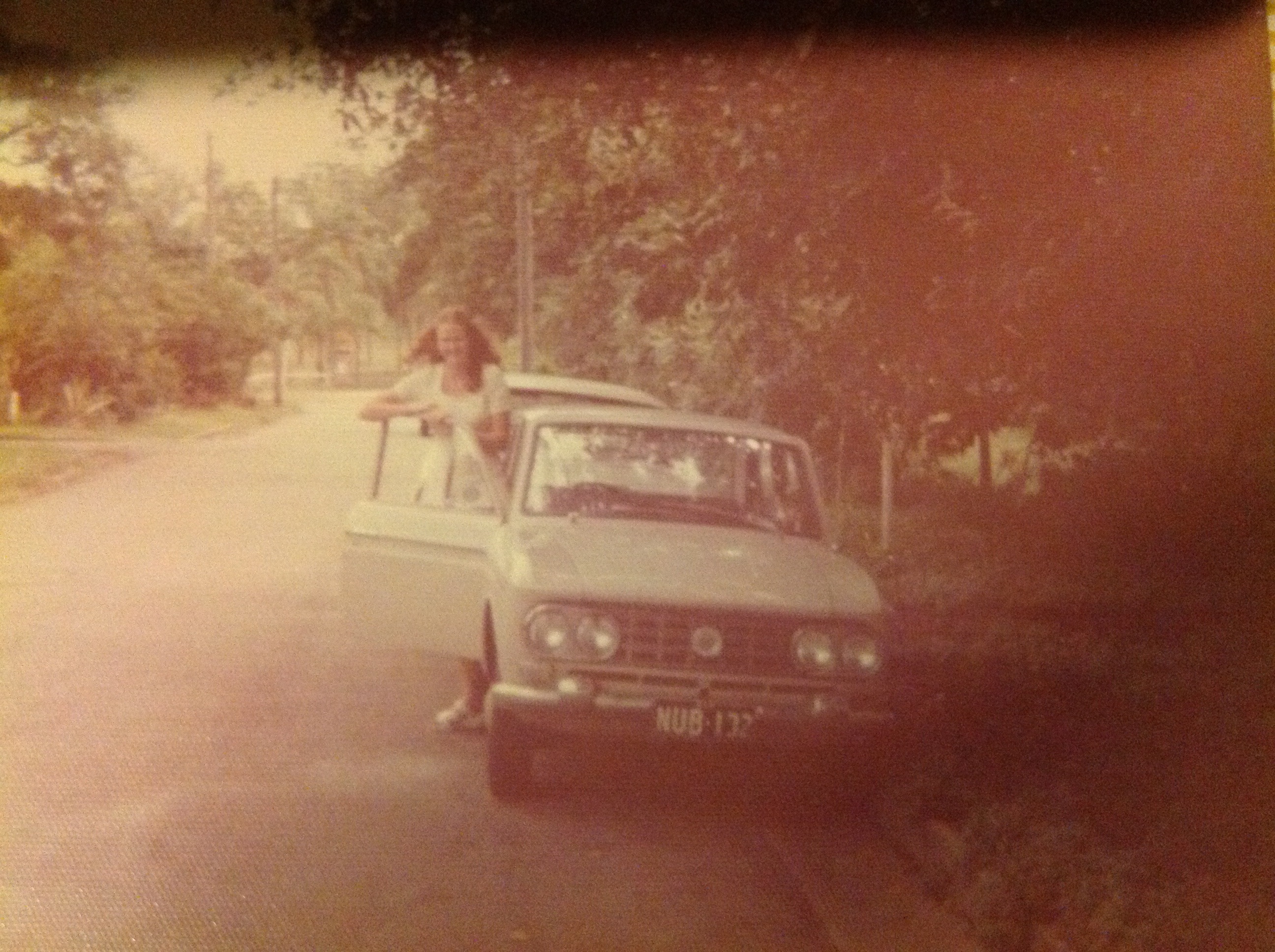
In my day the word “bomb” was often used to describe an old beat-up car. I bought my first car when it was ten years old. It may have been described by many as a bomb (it burned oil and smoked terribly amongst other things) but I loved it, adorned it with flower stickers and even named it “Ziggy”.
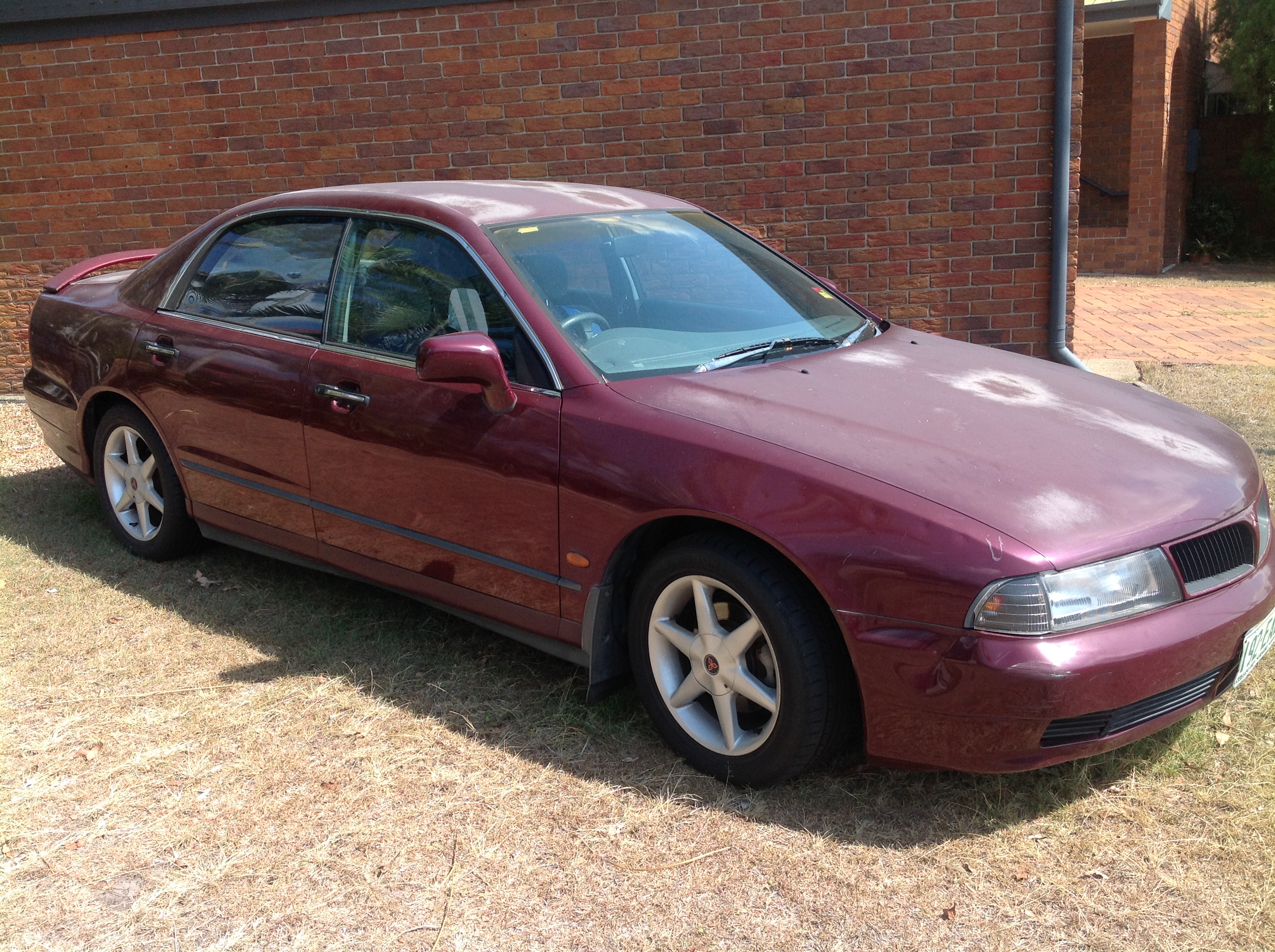
Nowadays cars seem to last a lot longer before they earn the title of bomb. Dare I say our 1997 car has only in recent years earned that title, and really only after it became unsightly due to hail damage and deterioration of the paintwork. It has been replaced by a car we might call “the bomb” but it still sits in the front yard and gets an occasional outing, too precious for someone (other than me!) to part with.
The most common use of the word as a verb was to refer to failure, particularly with regard to exams. After what felt to be a particularly dismal attempt at an exam, various students would bemoan its difficulty saying, “I bombed”. I have talked about failure in previous posts including my “failure” at singing here, and the failure of some aspects of schooling here. The word ‘bomb’ doesn’t appear in either of those posts.
It was Charli Mills of the Carrot Ranch who got me thinking about bombing with her Nov 12: Flash Fiction Challenge to In 99 words (no more, no less) write a photo bomb (serious scene interrupted by something absurd or unexpected).
Now Charlie was talking about photo bombs which she described as an “earnest photograph interrupted by the unexpected”, but I thought I would tackle video bombs. I knew I had made quite a few of those!
In an effort to learn more about making videos, which has been on my to-do list for ages, I also decided to make a compilation of video bombs to accompany my 99 words, while endeavouring to meet both Charli’s criteria and mine:
Charli:
99 words
bombing
Me:
99 words that make sense (always a priority)
find videos to match the 99 words
make a compilation video
record the video and words
My attempt is quite experimental and rather rudimentary at best but I learned a lot in the process. Since my blog is about learning, I decided to share it with you as a checkpoint on my learning journey. I know it’s definitely not “the bomb”, but I hope I haven’t totally bombed.
In the words of C.S. Lewis,
“Failures are finger posts on the road to achievement.”
Video bombing
Are you a video bomber?
Ever tried making a video but
the subject won’t cooperate,
or turns its back to you,
or perhaps it even disappears Poof! It’s out of view.
You shoot upside down or to the side,
the focus you can’t get right.
You shoot with the camera supposedly off,
then close-up your fingers when on.
You record to capture a photo,
or snap when it’s action you want.
If your answer is ‘Yes” to just one of these
come join the vid-bombers club.
We’ll commiserate
And then celebrate
When your video capture’s “the bomb”!
I appreciate your feedback. Please share your thoughts about any aspect of this post, flash fiction or video.
“Should one maintain separation from one’s online friends, or take the risk of meeting in person should the opportunity arise?”
The reason for my asking the question, although I didn’t state it openly at the time, was that I was planning a quick visit to the UK to visit family and wondered if there may have been some of my online ‘friends’ who would like to meet up while I was there.
In the short time that I had been blogging I had become part of a friendly little circle of writers who frequently visited and commented on my blog, and whose blogs I visited and commented on. Sometimes we would have quite in-depth discussions about a range of topics, and these discussions would often spill over onto Twitter. Few days would go by when we weren’t communicating with each other in some way and we were developing a certain amount of comfort with each other and our discussions.
Since some members of this group lived in the UK, I wondered if it might be fun to meet up with them in person but was concerned about what might happen to our online relationship if I didn’t live up to their expectations or we didn’t get along in face-to-face conversation.
I decided to ask the question via my blog to see what responses I would receive, and indeed to see if any of those I was thinking about contacting would respond and give me an inkling about their thoughts on the matter.
Joanne, who blogs at Writeaway, said that she had met one of her online friends in person. It obviously went well because she said that she wouldn’t be averse to meeting others though she considered geography to be a restriction. I had thought about that too, for although it’s a long way from Australia to the UK, travel distances within the UK could still be great and, while I was going to be based in London, I didn’t know where my friends lived.
Bec, who blogs at There’s no food said she believed there was a lot of value in online friendships. I knew she would because she and her partner of almost ten years met online! I wasn’t looking for a partner though. I already had one of those!
Gina Stoneheart, who blogs at Walking in the Write Direction, one Story at a Time, shared her story of meeting a friend on Twitter through following the same favourite children’s book author. They live close enough to meet up in person. She also met her partner online.
However she did have some words of caution. She said,
“Make sure you have spoken with them on the phone and have had quite a few emails exchanged. Also, see lots of pictures of them! You never know… there are some crazy people out there!”
Although, like Joanne citing geography as a restriction, Gina’s strong recommendation was to ‘go for it’.
Terry Tyler, blogging at Terry Tyler, said that she had met a few online friends in real life and had even “ended up marrying one!” Although Terry said that meeting online friends wasn’t something she would go out of her way to do, when she does meet them she really enjoys it.
Kimmie, who blogs at Stuckinscared, said that she had met some online friends and, although she had felt close to them online, she was still nervous about meeting them face-to-face but is glad that she did; and would meet others if “courage and circumstances” allowed it.
Hope of Nanny SheCanDo has met quite a few of her online friends and is glad she did; and Donna Marie from Writer Side UP! said that she has many online friends she would love to meet up with if she had the chance.
The only one (from the little group that I was thinking about contacting) to respond to my question was Geoff Le Pard who blogs at TanGental. He was enthusiastic because, he said, he loves meeting people and talking. He suggested there would be risks such as people not being as articulate in person and jeopardizing the relationship that had already formed. But he also said there would be the benefit of not being constrained by the ‘blog and comment structure’ so the conversation could be more organic, flowing from one topic to another.
The eight responses to my question were overwhelmingly encouraging so I decided to go for it.
I was delighted to receive an enthusiastic response to my rather tentative request from all four friends that I contacted: Anne Goodwin, Lisa Reiter, Geoff Le Pard, and Caroline Lodge. Unfortunately I wasn’t able to arrange a suitable time or place with Caroline, but Anne, Lisa, Geoff and I exchanged a flurry of Tweets and emails and were able to arrange a time and place that suited us all.
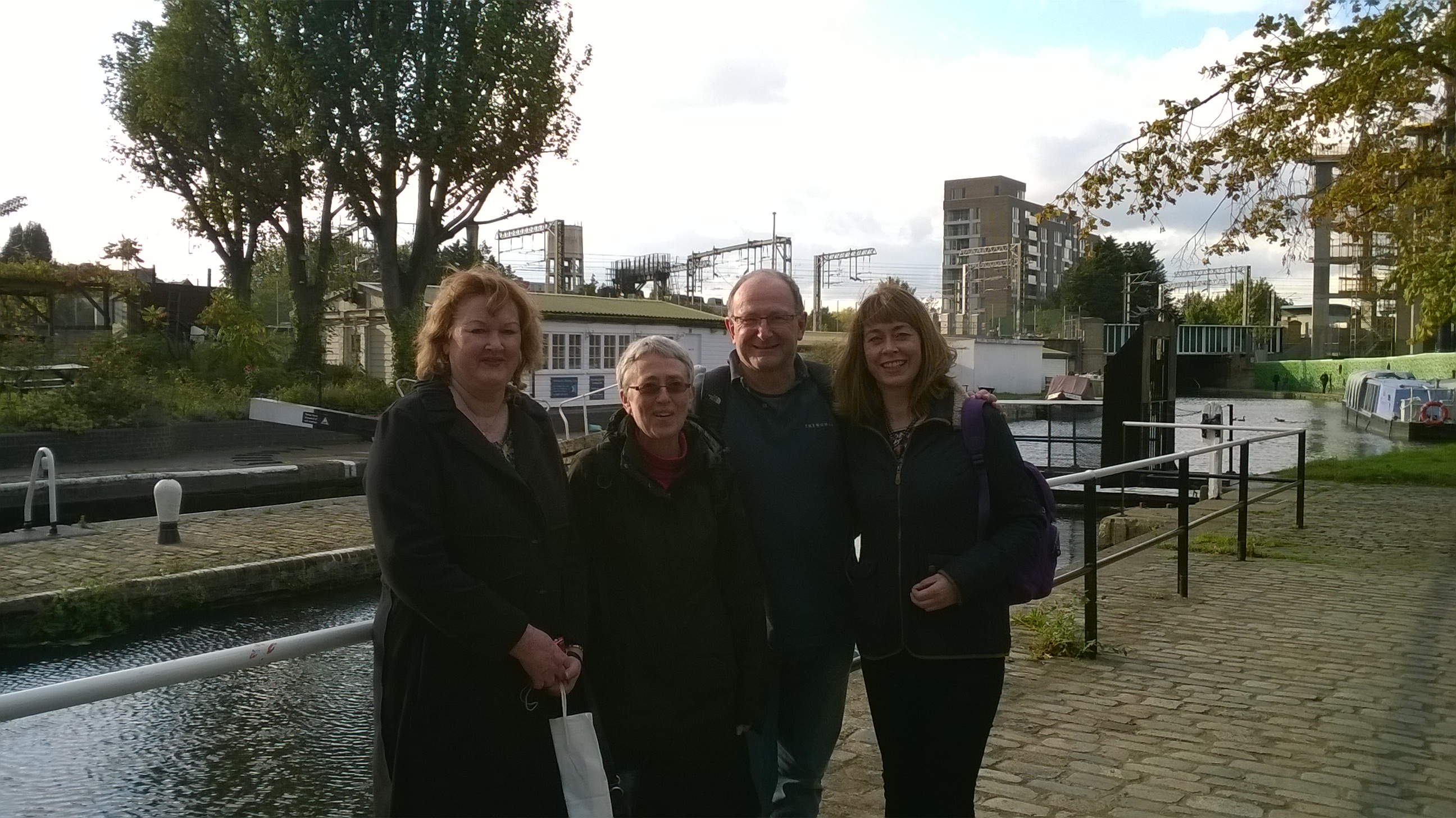
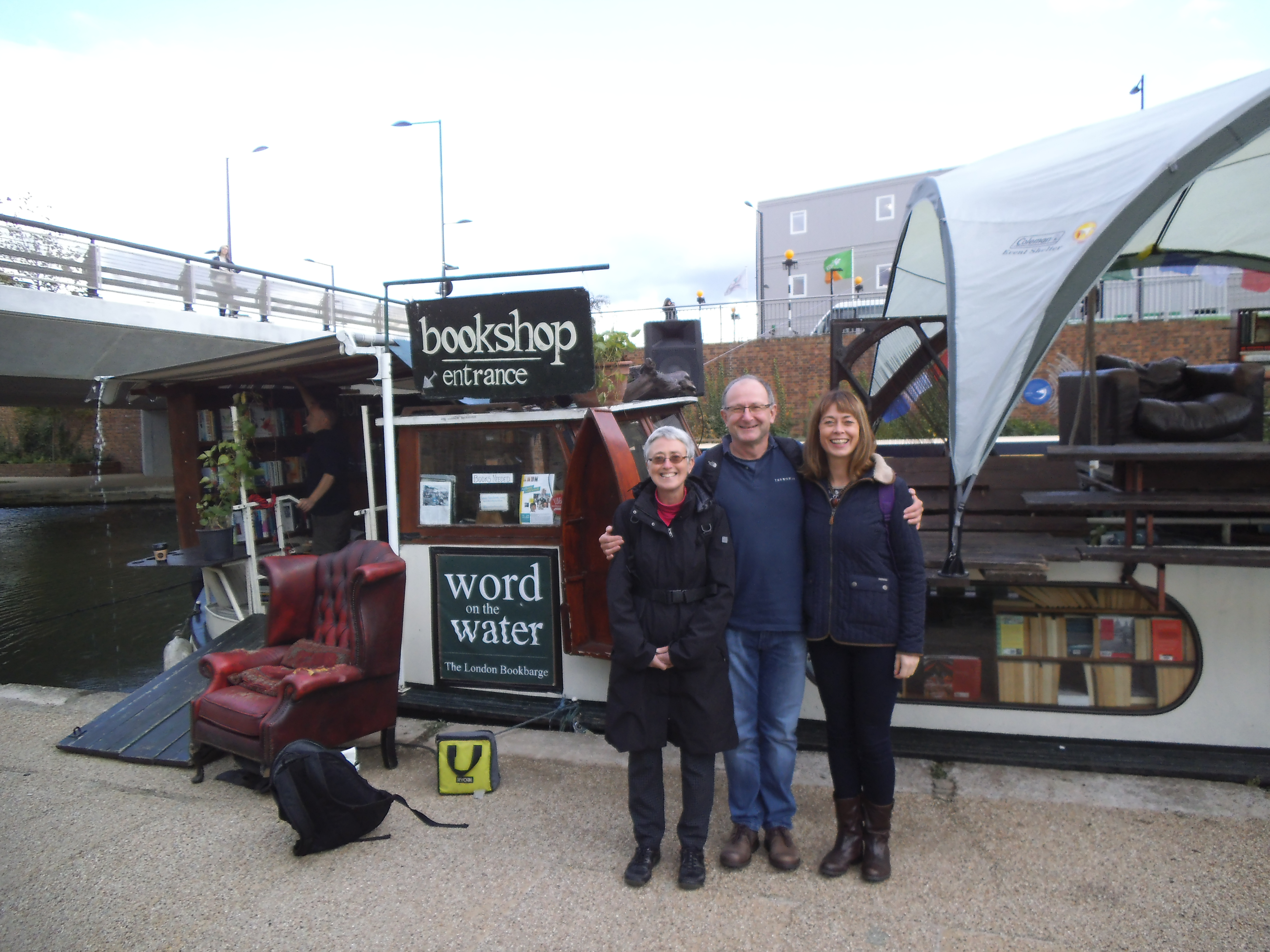
Norah, Anne, Geoff, Lisa beside the lock
We had a wonderful afternoon and evening together, meeting at the British Library for lunch and doing a little sightseeing afterwards. I even “took” them somewhere that none of them had been before (and probably won’t again!) I got to see a canal lock in action for the first time! (We don’t have those in Australia.)
It was great: more like catching up with old friends than a meeting of strangers. There was not an axe murderer among us, and no one made an excuse for a hurried retreat until after a tube ride to Covent Garden and dinner, when it was time to catch the late trains back home.
For me, meeting up with this group of online friends, was a memorable experience which I am very pleased I took a risk in initiating. I think the reason it worked is that we already knew each other quite well through our lengthy online discussions, and we were all keen to meet. The friendship moved out of the imagination and into reality.
Anne, Geoff and Lisa and a floating bookshop
These positive feelings gave me the confidence to arrange a meeting with another online friend when I travelled to Tasmania shortly after arriving home from the UK. I met up with Sue Wyatt who hosts a Student Blogging Challenge. Although Sue and I hadn’t had a great number of in-depth conversations, we had exchanged a few Tweets and comments and had a lovely morning together discussing two of our shared interests: education and blogging!
So, combining the recommendations in the responses to my questions with the results of my action research, I would agree strongly with Geoff who finished his comment with the words:
“Depends on your attitude to taking risks. Personally I’d welcome the chance of the upside.
It was definitely an upside for me, and I’m pleased I took the chance.
I welcome your feedback. Please share your thoughts. It’s not too late to tell us about meeting your online friends!
I think about education. A lot. You could say it consumes me. It has been my lifelong passion, and although I am not currently in the classroom I don’t stop thinking and reading about how we learn and how learning can best be encouraged. My discontent with how schooling often is and my optimism for what it could be has been a recurring theme on my blog and a driving force in my life. You would not have to open too many posts to find at least one expressing that view.
My poem “Education Is” sums up the differences I see between education and schooling. Some schools do education really well. Some professing to be educational institutions school, very badly. What I consider to be one of the major differences is that education encourages a love of learning that lasts a lifetime; while schooling attempts to force-feed content in such a way that learning is neither enjoyed nor viewed as anything other than what one is forced to do in school.
In traditional schools assessment often takes the form a test which requires students to regurgitate information that has been thrust upon them, whether they like it, or are interested in it, or not. This occurs across all subject areas. I have written about it before in relation to writing tasks in these three posts: Writing to order – done in a flash!Writing woes – flash fiction and Who tests the testers?
I contrasted my choice of responding to Charli Mills’ flash fiction prompts to the lack of choice students have in state- or nation-wide writing tasks. In Writing woes – flash fiction I suggested that it would be difficult for me, on a given day, with a restricted amount of time, under the watchful eyes of supervisors, to produce my best work in response to a prompt about which I may have little experience, knowledge or interest.
In my flash fiction responses I introduced a unicorn as a symbol of escape from the confines of the classroom or other oppressive situation, into the space where one is free to truly be oneself. It wasn’t a deliberate or premeditated choice, simply a response to Charli’s prompt. However I am happy to adopt it in my flash fiction as a symbol of playfulness and imagination unleashed; the basis for all great inquiry and innovation. Thank you, Charli, for the prompt!
I have returned to both these themes again in response to Charli’s most recent prompt to In 99 words (no more, no less) write a story inspired by your muse. I’m not certain who my muse is, but I am certain that it would be very difficult to call upon a muse to assist when writing in a test situation such as that expected of students in school.
My piece is titled ‘Failure’, but this is the question I have for you: Who really deserves the “F”? Whose failure is it really?
Failure
She spluttered out the splinters of pencil: no longer tasty, never helpful. The assessor’s steely eyes pounced. She wiped the last vestiges from her mouth; staring blankly, as blank as the paper in front of her.
Outside the sunlight danced like fairies on the leaves, beckoning. Below, in the shade, the unicorn pranced and called her name.
“Why do I have to do this stuff? Who cares anyway!”
She grasped the broken pencil and scored a large “F” on the page.
Then she closed her eyes and was away, riding to freedom and joy on the unicorn’s back.
What do you think?
I appreciate your feedback. Please share your thoughts about any aspect of this post or my flash fiction writing.
If you are interested in reading other of my flash fictions pieces, I have collected them all together on one page which you can access here or click on the Flash Fiction tab above.
I spent a good part of the 1990s working towards creating an alternative to traditional schooling for my own daughter and the children of similarly-minded parents. For an assortment of reasons, none of which had anything to do with education, we didn’t get the school operational. There is a big part of me that still longs for that alternative and I am always interested to hear of situations which espouse similar beliefs and attitudes to mine. When I do, my heart starts to race and I want to holler and jump for joy, shouting from the rooftops, “See it can be done! This is how it should be! This is what children need!” I want to be in there with them, a part of it all, learning from and with them, and perhaps even adding a little to their learning, should I be that impudent to suggest it possible.
Yesterday was one such occasion. I popped over to Tara Smith’s A Teaching Life blog and read her post “Preparing for a student teacher”. I always enjoy reading Tara’s blog and could identify with much of what she was feeling while preparing to welcome a student teacher into her classroom. But what got me most excited was a video of a talk given by Chris Lehmann at the 2013 MassCue (Massachusetts Computer Using Educators) conference.
Chris Lehmann is the founding principal of the inquiry-driven Science Leadership Academy (SLA) in Philadelphia. The achievements of both Chris and the SLA are rather impressive. You can read about them here, here and here. Chris is one excited, enthusiastic and inspiring educator.
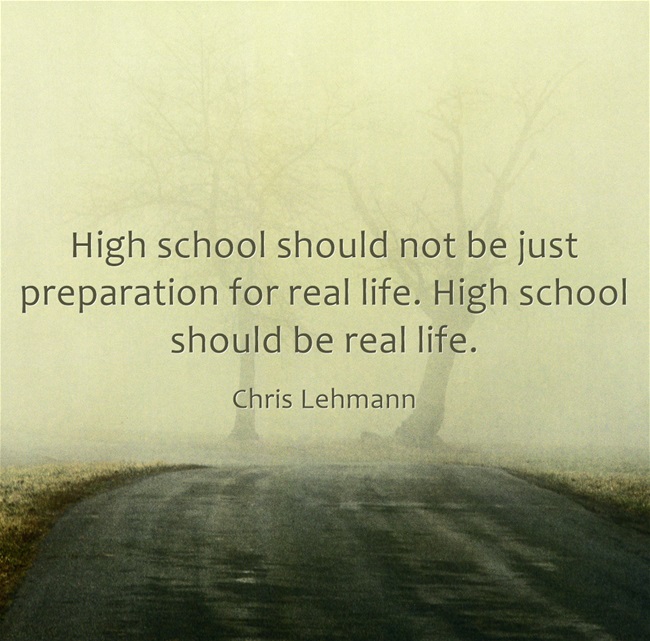
The video of Chris’s keynote address to the conference is rather long at almost 1 hour and 8 minutes (in comparison the mostly 15-minute TED talks that I often watch). I admit that when I saw how long it was I baulked, wondering if I had that amount of time to “spare”. Fortunately something in Tara’s words induced me to do so. After all I didn’t have to watch it all, did I? But watch it all I did. How could I not? His dream was my dream:
And then Chris added:
‘all these people showed up and breathed life into that dream’
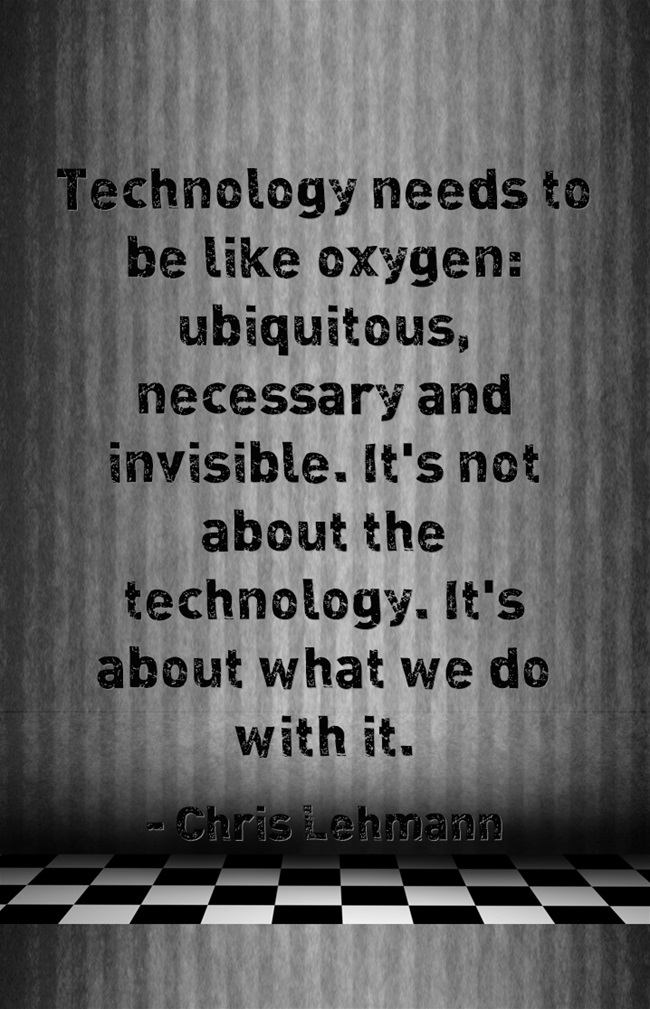
Here is his talk. If you don’t have time to listen to it all, I give you a few of my favourite quotes. (You may have already encountered some of these ideas before on my blog!) But who knows, he may have other thoughts that resonate with you.
Chris says that many people often ask why schools can have so many problems when there are so many passionate, dedicated teachers. He answer is simple: ‘We have a systemically screwed up system and if you put a good person in a bad system the system wins way too often.’ He says that ‘the factory model of education . . . no longer works for our children if it ever did.’
Chris says that one of the biggest problems with many schools is that students are being repeatedly told to do stuff that they may never need or even care about. He says, ‘If we were to write a students’ bill of rights the first statement on it should be this question:
He then goes on to say that ‘They shouldn’t even need to ask it because the reason should be so apparent through the work that they are doing that is meaningful and relevant to their life right now.’
He says that kids can do amazing things but that the sad thing is that unless it can answer a question on a state-wide test, no one will care! He says that using data from standardised tests is dangerous and that the best data comes from the work students are doing in class every day.
He says that better questions to ask of schools would be:
‘What is your college persistence rate?
How many of your graduates five years out are either in school or in a job where they are over the poverty level?
What does a student survey of your school tell you about whether or not the students feel valued and feel that their education is valuable?’
These are just some of the things that Chris Lehmannsays schools should be:
Inquiry driven
Student centred
Teacher mentored
Community based
Places of collaboration and incredible passion with
Integrated learning
Project based
In traditional classrooms the assessment tool is a test. Chris talks not about tests but about projects. He says,
“If you really want to see what a kid has learned it’s about the project, it’s about what they can do, what they can create, what they can transfer, what they can make, what they can do with their own head, heart and hands. A true project is when kids get to own it.’
His goal is to educate people to be ‘thoughtful, wise, passionate and kind’ and says that
‘ what were really trying to do is nothing less than trying to change the world.’
This brings me back to my two previous posts How much of a meliorist are you? and Can you make a difference? which drew quite a debate (unintended) about whether we believe we can, or should, try to change (i.e. improve) the ‘world’. I think Caroline Lodge who blogs at book word sums it up quite nicely for educators, saying
‘ I am a meliorist. How can someone in education stay there if they are not? The kids improve their skills and understanding, the world turns, and sometimes (like this summer) seems on the way to hell in the proverbial handcart. But there are SO MANY people working to improve the world. Educators as special people in this.’
For Chris,
‘The link between an inquiry-driven education and a care-driven education are three simple questions:
What do you think?
How do you feel?
What do you need?’
He says, ‘Everything you do should empower children.’ Thanks Chris. My words exactly!
He says,
‘Kids can do real work. We have to dare them to do that, we’ve got to help them, we’ve got to facilitate the work and we’ve got to get out of the way.’
The Science Leadership Academy is not the only ‘school’ of note. In response to previous posts, including Food for thought and Are you ready to embrace the futureCharli Mills of the Carrot Ranch left comments and links to information about a school attended by her children, the Minneapolis’s School of Environmental Studies(SES). Charli linked to this article about the school and another on Edutopia that includes a 10-minute video that she says aptly describes what makes SES a learner-based school. She also provided a link to a very impressive student project developed by two of her daughter’s classmates, and a link to a video produced by students explaining the school. Overall, if I represent her views correctly, Charli was very happy with the education her children received at SES and the impact that project-based learning had on their lives.
These are just two of the many wonderful schools out there empowering learners. If you know of others, I’d love to hear about them.
I value your feedback. Please share your thoughts about any aspect of this post. I’m happy to follow the discussion wherever you lead.
My previous post How much of a meliorist are you? attracted many comments and much lively discussion, including comparisons of seemingly pessimistic or optimistic views of the future and the validity of each.
This discussion surprised me as my intention in writing the post was not to delve into the damage that we humans have wreaked upon the world, but simply to express my belief that we humans, should we desire to do so, have the power to improve the world. We may not be able to change everything we would like to see changed, but we can make a start within our own circle of influence.
Or, in the words of Michael Jackson, one can “Look in the mirror and make a change!”
My chosen avenue for making a difference is education; through maintaining my own interest in learning, through attempts to keep alive a love of learning and a curiosity about our world and others, and through improving learning opportunities for others throughout their lives beginning at birth (or earlier!).
The contribution each of us makes is unique and reflects our own values and life choices. I am grateful to others who help me grow in my understanding of what motivates and drives us, what excites our imaginations and stimulates our curiosity, and what propels us towards choices for improving our individual and combined futures.
Among those who encourage my learning and stretch my thinking are you, my wonderful readers, who selflessly contribute thoughts and ideas to extend my understanding. To you all, my teachers, I express my great gratitude.
While I may often fall short of the mark and need to make frequent reminders to myself, these are just a few ways I try to make my little spot in the world a better place:
Smiling
Being friendly towards those I engage with throughout the day
Being polite
Being kind, sometimes randomly and anonymously without requiring thanks
Listening attentively, to understand and without interrupting or interjecting
Accepting graciously and without whingeing and whining
Finding humour in situations which enable me to laugh, especially at myself
Changing behaviours to reduce my impact on the environment
Seeking ways to ease the burdens of others
Accepting and encouraging others to be themselves
Recognising and accepting my ‘mistakes’ and shortcomings, and those of others
What about you? What do you do to make your little spot in the world a better place? Please share your ideas so we can all learn from your example.
At times in my life I have been told that I take life too seriously. At other times I have been told that I don’t take it seriously enough. I think life should be about enjoyment and fun, so I’m going to turn the seriousness of this post on its head and leave you with another quote, this time by A.H. Weiler:
“Nothing is impossible for the man who doesn’t have to do it himself.”
I welcome your feedback. Please share your thoughts and ideas about any aspect of this post, whether you agree with me or not!
Recently I was sent a link to an article titled Cheer up, it’s not all doom and gloom published by the Australian Broadcasting Commission’s The Drum.
This article mentioned a book by Steven Pinker called Better Angels of Our Nature which had been recommended to me by Geoff Le Pard in a comment on my post about childhood illness. The premise of this book is that humanity, over the ages, has become less violent. After to listening to Pinker’s history of violence, I’m pleased that I live these relatively peaceful times.
The article also introduced me to a new term ‘meliorism’ which means having a belief that the world can be improved by the actions of humans. While the term may have been unfamiliar to me, the attitude is not and I attest that I am a meliorist.
I have a very strong belief in the power of education to improve the world. Education empowers individuals, and educated individuals empower societies to build improved futures. It becomes very difficult to sustain negative practices in the face of overwhelming evidence and information.
What better place is there for education to begin than in the home?
In a recent post I referred to a new book by Michael Rosen called Good Ideas: How to Be Your Child’s (And Your Own) Best Teacher. At the time I had not read the book but now I can say, with great delight, that I have listened to most of it. With messages such as those contained in Michael’s book, it is easy to be a meliorist.
I think Rosen’s book should be available to, perhaps compulsory reading for, every parent; I consider its message to be that important. In fact, I am off to the shops today to purchase copies to give to parents of young children I know. It will become part of my gift to new parents that also includes Reading Magic by Mem Fox and a selection of picture books. I have previously blogged about that here and here.
The “Good Ideas” contained in Rosen’s book, if implemented, will keep alive the natural curiosity of one’s children and oneself. They will encourage the development of thought, creativity and responsiveness.
In the next few weeks I will post a more detailed review of the book and some of Michael’s ideas for stimulating curiosity, whoever and wherever you are.
What about you? Are you a meliorist?
I welcome your feedback. Please share your thoughts about any aspect of this post.
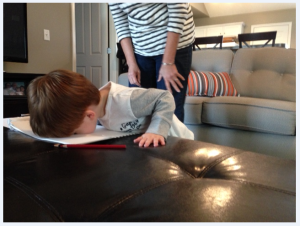
A two-year old had been working on drawing circles, so his grandma decided to amp it up a bit. She said, “Can you put a nose on it?” And he did.
With a smudge on his nose, he lifted his head with pride and accomplishment!
So, this is a cute, cute story. It’s easy to appreciate this young child exploring the world and functioning without learned behaviors or expected outcomes. In the same mind that plays these thoughts, other hypocritical thoughts contradict these beliefs. Are we even aware? Do we see possibilities in the “wrong” answers from our students and consider it to be neat?
If I were the grandma, I would have followed this “answer” with…”Can you show me another way to add a nose?” This approach helps the child develop flexible thinking without destroying his own thinking mind or confidence. He added a nose. It just wasn’t the…
Two recurring themes, amongst others on my blog, are ways of encouraging a love of literacy and of questioning in young children.
If you read my post Going on a treasure hunt! you will know that I greatly admire the work of Michael Rosen and its contribution to literacy development. You may have followed the links and checked out the riches in store on his website.
My post Child’s play – the science of asking questions introduces my thoughts about ensuring that children’s inborn curiosity is maintained through the encouragement of their questions.
You can imagine my delight, then, when I read a review of new book by Michael Rosen. (Thank you, Anne Goodwin, for alerting me to it.) The review, posted by Sabine Durrant in The Guardian on 6 September 2014, discusses Rosen’s new book How to be Your Child’s (and Your Own) Best Teacher. I confess that I have not read the book but I am very excited to see that it is now available as an audiobook, so it is next on my listening list. So much about the book appeals to me.
Rather than review the review I will simply leave with you the links to the review:






















 Norah Colvin