Curiosity, questioning and science are recurring themes on my blog. How could a post entitled “Curiosity, dead chooks, science and the S.T.E.M. push” not appeal to me? While I don’t think I’ve written about dead chooks, yet, when I was six I was the best chicken catcher in the family and I definitely saw a few chooks running around with their heads chopped off!
In this post Sheryl Gwythertalks about the awakening of her scientific questioning at age four when seeing a similar a spectacle. The transcript of a talk delivered to other authors “Children are born scientists … It’s called curiosity” (my words exactly!) is included in the post. Sheryl urges authors to include science in their writing for children and suggests three rules for doing so: Never be didactic Entertain Create characters that children can connect with
While she doesn’t say it in so many words, I think the message of keeping the science accurate is implied. (I have questioned the inaccuracy in The Very Hungry Caterpillar in previous posts.)
Sheryl’s closing paragraphs motivate and inspire writers. She says, “We have the opportunity, the passion and hopefully, the commitment to reach out to young Australian children through stories about the wonder of science, and the responsibility for their future custody of this planet. Great stories, cleverly laced with scientific understanding not didactic waffle. Great stories to make them feel and think, and question. Great stories – for the sake of their future on this planet.”
In this post I introduce you to Jeannie Baker, a collage artist and author. Jeannie was born in the UK but has lived most of her adult life in Australia, and most of her books, though having universal themes, are set in Australia.
Jeannie had already published a number of books prior to 1992 when I first became aware of her work through “Window”, winner of the Australian Picture Book of the Year Award.
“Window” tells, in beautifully detailed collage, of the transformation of a landscape from natural bush to city-scape. The changes are observed through a window by a boy as he celebrates alternate birthdays from birth to 24 years. Like many of Jeannie’s books, “Window” carries a strong environmental message. In her note at the end of the book, she says,
“Our planet is changing before our eyes. However, by understanding and changing the way we personally affect the environment, we can make a difference.”
The intricate details in this textless picture book provide many opportunities for discussion. Children and adults are enticed to study and compare the changes that take place in each successive picture. The carefully constructed collages give a sense of being able to almost step into the scene and experience the sights, sounds and smells of each landscape.
I was fortunate to attend an exhibition of Jeannie’s artwork for “Window” as it toured the country in 1992. What surprised me most was the size of the collages. With all their detail I had expected them to be quite large; but they weren’t. They are miniature, much smaller than a page of the picture book on which they appear. The collection and arrangement of a mix of natural and artificial materials is amazing. Jeannie describes the process of constructing her collages here.
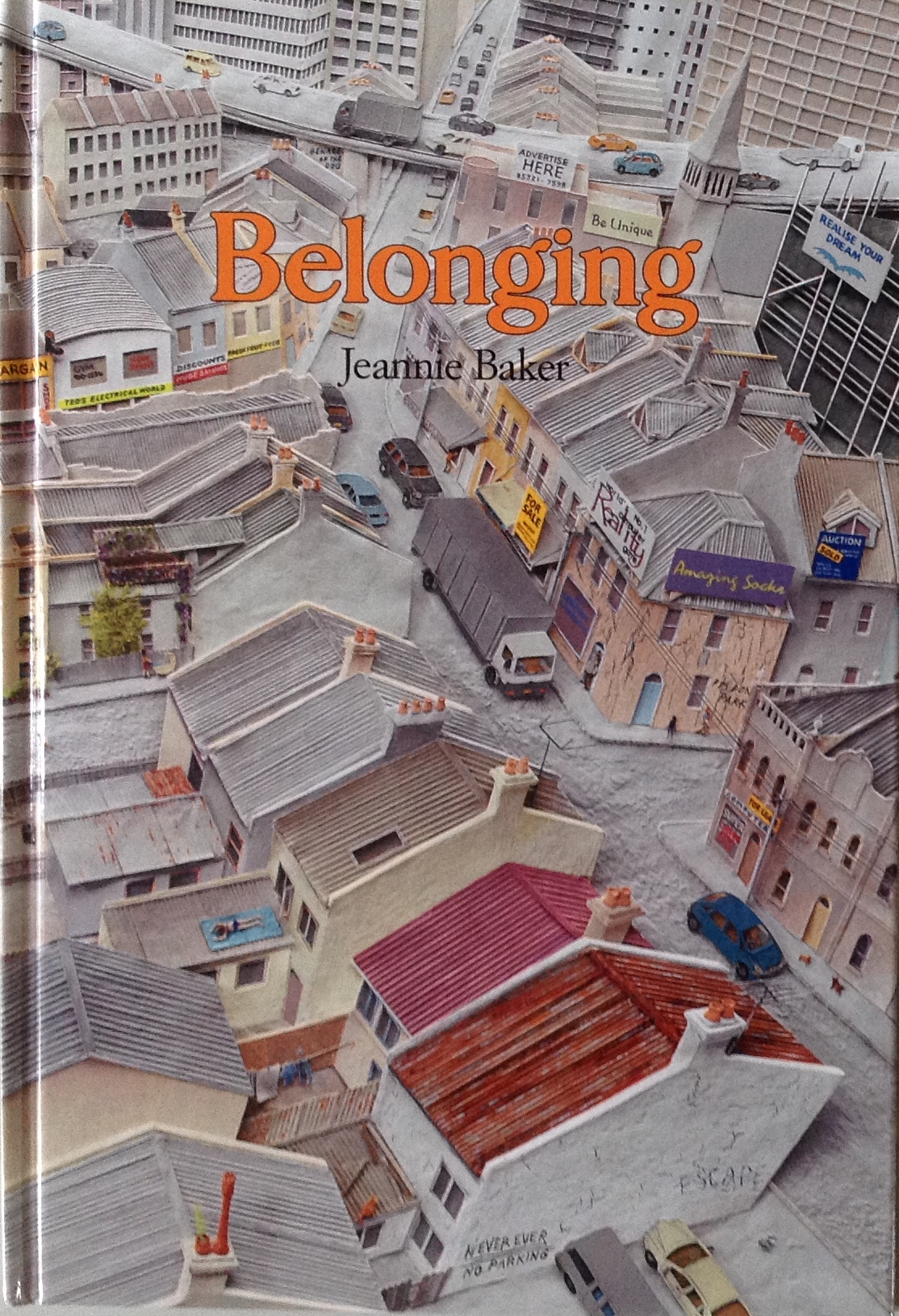
In 2004 Jeannie published a companion book to “Window” called “Belonging”, which, in 2005, also received a number of awards, including one from the Wilderness Society. This textless picture book tells a story of a changing landscape over a number of years as a city is transformed with plants and welcoming spaces for children and families. In a note at the end of this book, Jeannie says,
“It takes time … But by understanding the land on which we live and by caring for it we can choose between just having a place to live or belonging to a living home.”
“One Hungry Spider” is the third of Jeannie’s books I own. Unlike “Window” and “Belonging”, the illustrations in this one are accompanied by text. “One Hungry Spider” is a counting book, but a counting book with a difference: it includes information about the spider. For example when one of seven ladybirds gets caught in the web we find out that “the spider took no notice (because) spiders don’t like the taste of ladybirds.” And when nine wasps fly by the spider left the web and hid because wasps catch spiders. Additional details about the spider are provided at the back of the book. Once again the illustrations throughout the book are magnificent.
Surprisingly I own only these three of Jeannie’s books. However I am familiar with others. At school I had access to many of her titles in big book format (approximately 50 x 40 cm) which were perfect for sharing with a class of children.
These are other favourites:
“Where the Forest Meets the Sea”, “The Hidden Forest”, “Mirror” and “The Story of Rosy Dock”.
Are you familiar with Jeannie’s work? If so, which ones and what do you think of them?
Please check out these and other titles of Jeannie’s if you have a chance. Their illustrations will intrigue you and their positive messages will inspire you.
As a writer, I found inspiration in Jeannie’s response to the question,
“Of all the books you have made, which is your favourite?”
She answered,
“When a book is finally finished, I find it hard to think about it anymore …I want to fill my
head with something totally different, with a new book. My favourite book is the
‘new’ book I’m working on, still working out and trying to make better than the books I
made before it!”
I think that indicates a strong growth mindset and Jeannie’s joy in the “continual challenges this medium gives … to invent techniques and explore and experiment with materials and their textures.”
It affirms the quest for improvement and a reason to embrace the challenges we both set for ourselves and meet along the way.
Thank you for reading. I appreciate your feedback. Please share your thoughts.
This post is the fourth in a series celebrating picture books by Australian authors. If you missed earlier posts, please follow these links to the introduction, Mem Fox and Kim Michelle Toft.
In this post I introduce you to Narelle Oliver, a Brisbane-based author and illustrator. There is much to explore on Narelle’s site, including: information about her writing process and tips for would-be picture book authors; the research involved in creating her books, many of which are about nature; and illustration techniques that involve the use of linocut printing and rubbing, and other assorted media.
Narelle conducts workshops for children and adults. She visits schools to share with children the wonder of her books and talks to them about her writing and illustrating processes. When she visited “my” school she brought along first thoughts and illustrations for, and a dummy book of, The Very Blue Thingamajig, plus a soft toy prototype – and we all wanted one! She also brought a fox from the museum and talked about illustrating Fox and fine feathers. She read to the children, involved them in activities and gave them an experience of linocut printing. It was fascinating for both children and teachers.
Narelle talks about her workshops and sessions in this video.
While you can find a complete list of Narelle’s books here, I will share those I have on my bookshelf (in no particular order).
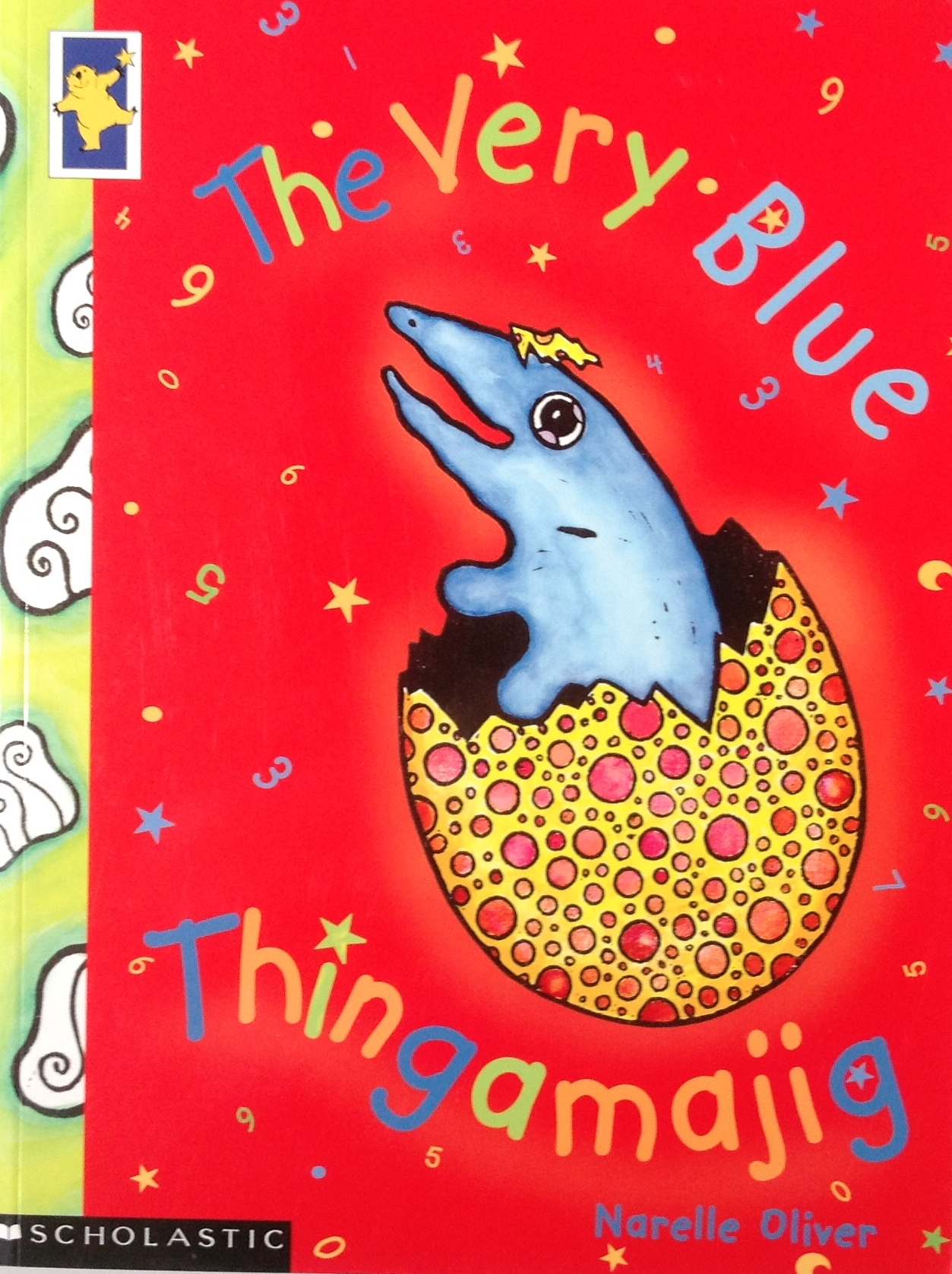
The Very Blue Thingamajig is as story about difference and acceptance told in a fun way involving mathematical concepts of patterns, counting and days of the week. The colourful illustrations made using hand-coloured linocuts are appealing, and children love to find the little bird who provides a secondary story throughout the book. On Narelle’s fun page you can colour and decorate your own thingamajig.
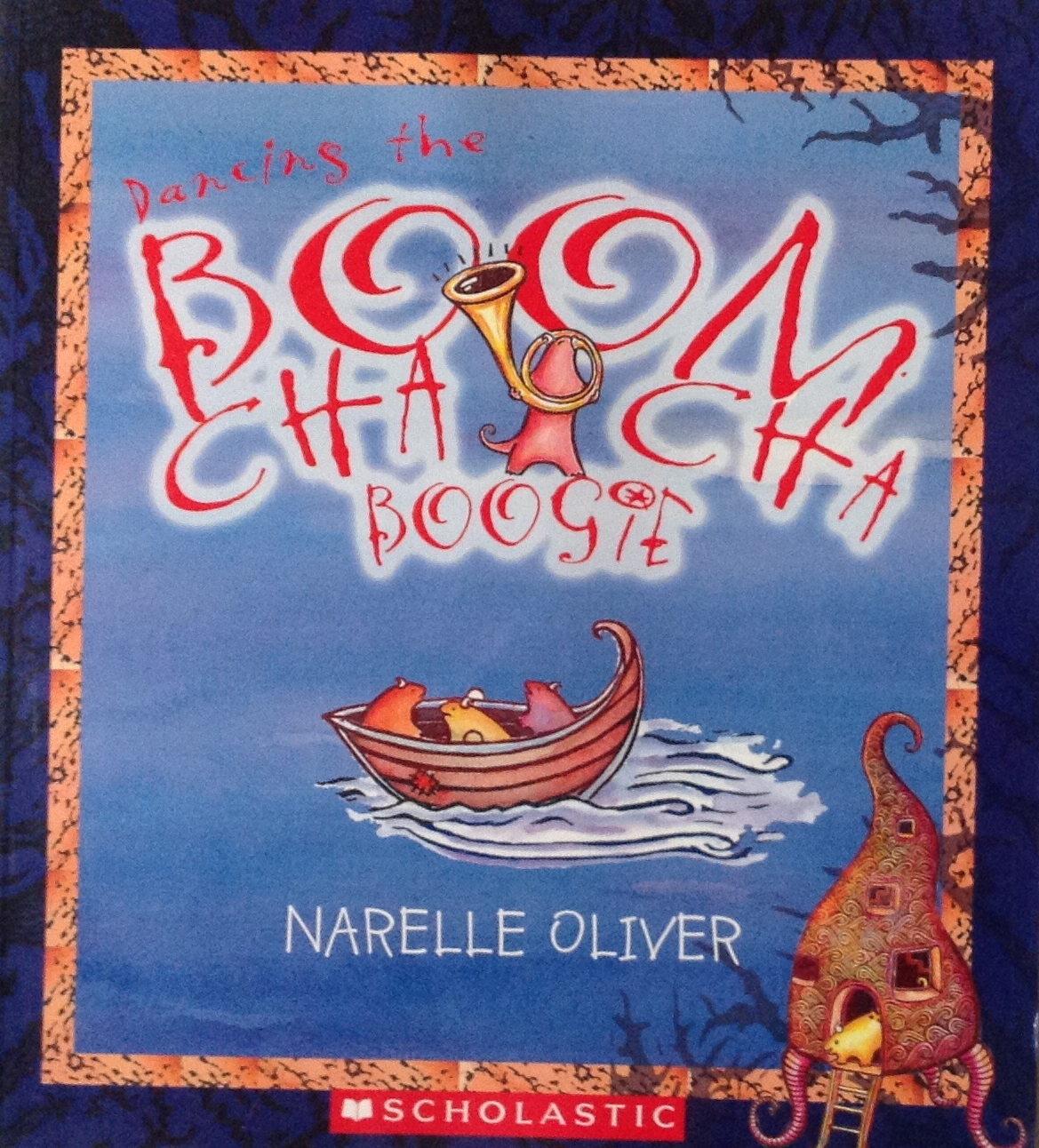
Dancing the Boom Cha Cha Boogie is a gorgeous tale of three little murmels who are washed out to sea in an arkel and arrive on a foreign shore where they are not welcomed by the resident snigs. They are imprisoned until when, the arkel is repaired, they are to leave. At night a young snig releases the murmels who teach the snig to have fun. In the end the murmels are accepted and stay happily in Snigdom with the snigs, learning from and enjoying each other’s company. This book is illustrated with hand-coloured linocuts.
Fox and fine feathers is a story of friendship, of looking out for each other and keeping each other safe. The attention to detail in these linocut illustrations coloured with pencils and pastels is amazing and accurately depicts the five creatures and the forest setting. Narelle has supported the story with information about the birds, their habitat and the dangers imposed by the feral fox, which is now a serious threat, along with other feral animals, to native species in Australia.
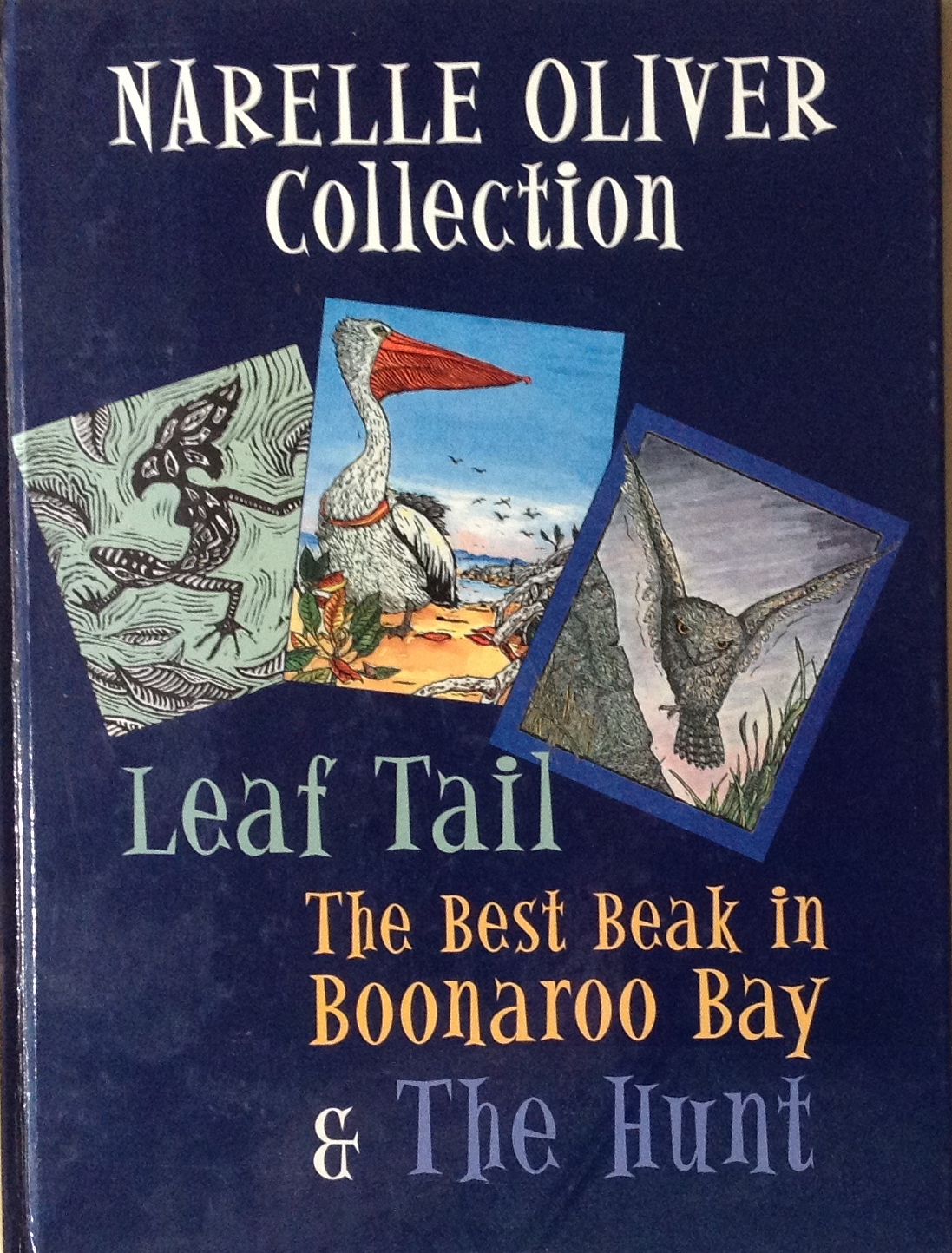
Leaf Tail, Narelle’s first picture book, illustrated by beautiful linocuts, tells the story of a leaf tail gecko and the importance of camouflage to survival in the Queensland forest.
The Best Beak in Boonaroo Bay, also illustrated with hand-coloured linocuts, tells of a squabble between five different birds, each professing its own beak to be the best. Finally clever pelican holds a contest that enables the birds to see that each beak is best in its own way. As well as a delightful story about wildlife, it also provides a springboard into discussions about, and appreciation of, differences.
The Huntis another beautifully illustrated wildlife story of camouflage and survival. The story is supported with information about its setting and the workings of animal camouflage and disguise. There are also black and white drawings showing where to find the animals camouflaged in each illustration. It is fun to see if all the animals can be found without referring to the guide.
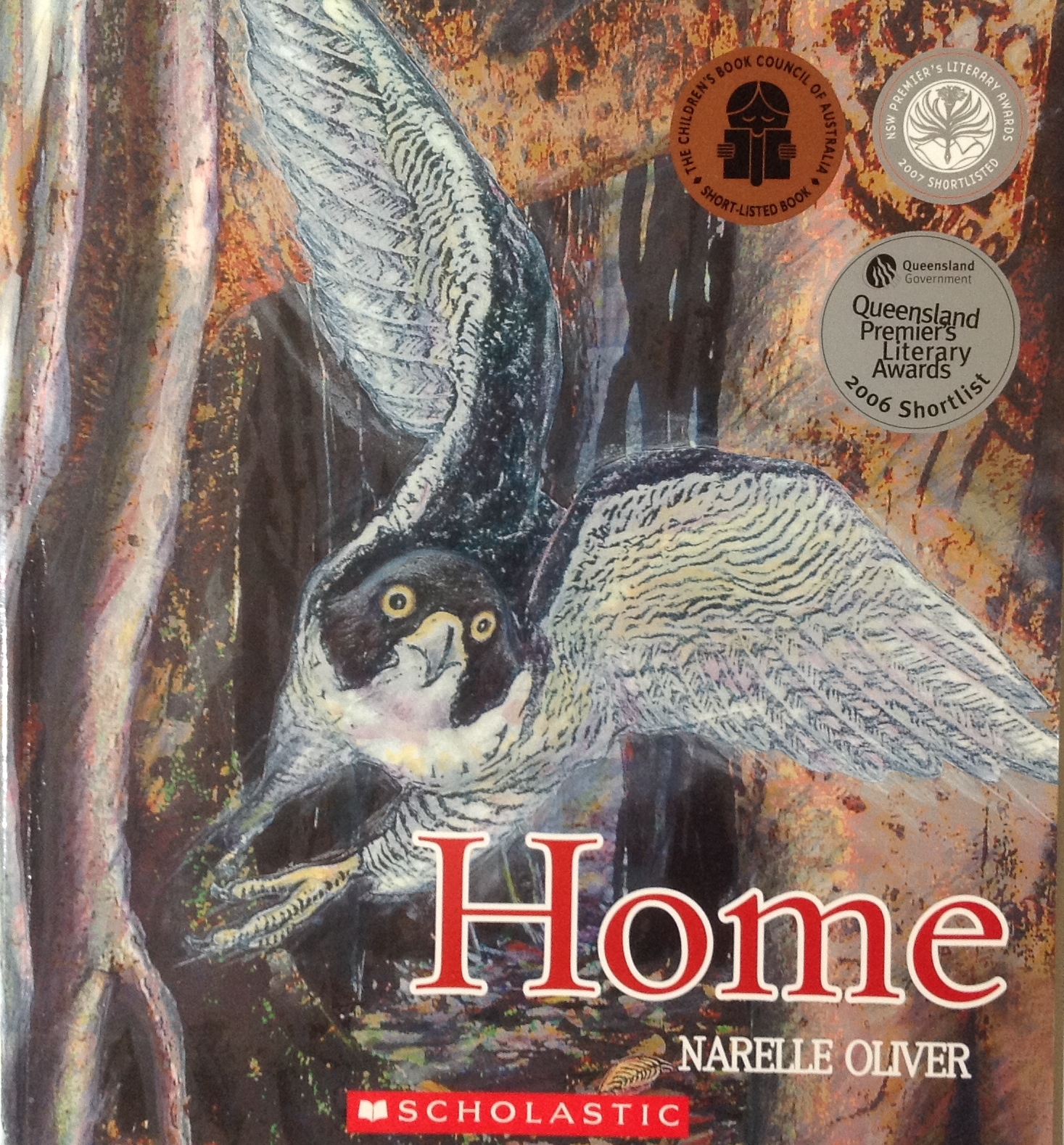
Home, referred to in a previous post Home or away, is perhaps a favourite if only because it is based on a true story of a pair of peregrine falcons that nested at the top of a 27-storey building in the city of Brisbane. The birds, named Frodo and Frieda, fascinated a city and, for a while, had their own reality show “Frodocam”. The story, beautifully illustrated using a combination of media including linocut rubbings, collage, photographs, pencil, pastels and watercolours, tells of the adaptation of wildlife to new landscapes and environments.
Each of these books can be appreciated for its story or used as a springboard for discussion. The illustrations appeal to adults and children alike for the attention to detail and accurate representation of wildlife. The addition of supporting information encourages an appreciation for wildlife and their habitats and develops an awareness of the need for their protection. They would be a wonderful addition to any book collection and be much appreciated as gifts.
Thank you for reading. I appreciate your feedback. Please share your thoughts.
This week at the Carrot RanchCharli Mills is making declarations. Specifically she is declaring herself an author, making it clear what her writerly intentions are. I also have declared my writerly intentions. In previous posts, here, here and here, I shared my goal of establishing a website with early childhood teaching resources of my creation.
In her post Charli expresses it this way: success for her is publishing books. She wants to write books for readers who want to read them. Not only that, she wants to market her books “well enough to eat more than hand-picked dandelions from (her) yard”.
Change books to early childhood teaching resources and, for me it’s the same. I want to publish teaching resources that teachers want to use, that enhance their teaching and improve children’s learning. I’d also like to do well enough to not be reduced to eating dandelions from my backyard.
Some writers consider “educational writing” less worthy and lacking in creativity. “Oh educational writing,” said one disparagingly, “that’s so prescriptive,” and quickly moved on to discuss others’ more literary pursuits.
I know some educational writing can be prescriptive. I have done some of that formulaic writing myself. However the resources I am creating do not conform to a formula, are not worksheets to be completed by students sitting quietly in rows.
I am developing a variety of resource types, some with interactivity, to help develop understanding and skills in a meaningful context. Many encourage critical thinking, problem solving and purposeful applications. Many are built around my own original stories and poems as well as non-fiction texts.
I have chosen this path in order to support teachers with ready to use teaching episodes and parents with suggestions for nurturing their child’s development. Prescriptive? Far from it. And please don’t prejudge my educational writing against the stereotype of formulaic worksheets and textbooks which are far too abundant and easily accessible on the internet and in bookstores.
Guiding parents in play sessions for parents and children.
From the declaration of writing goals to a declaration of another kind, repeated often on my blog: my appreciation of all things early childhood, especially literacy and picture books, and the importance of reading to and with children on a daily basis.
The years from birth to eight, especially those before formal schooling begins, are crucial to a child’s development and have an enormous impact on future happiness and success. It is during these years that basic skills and language are developed along with attitudes to self and relationships.
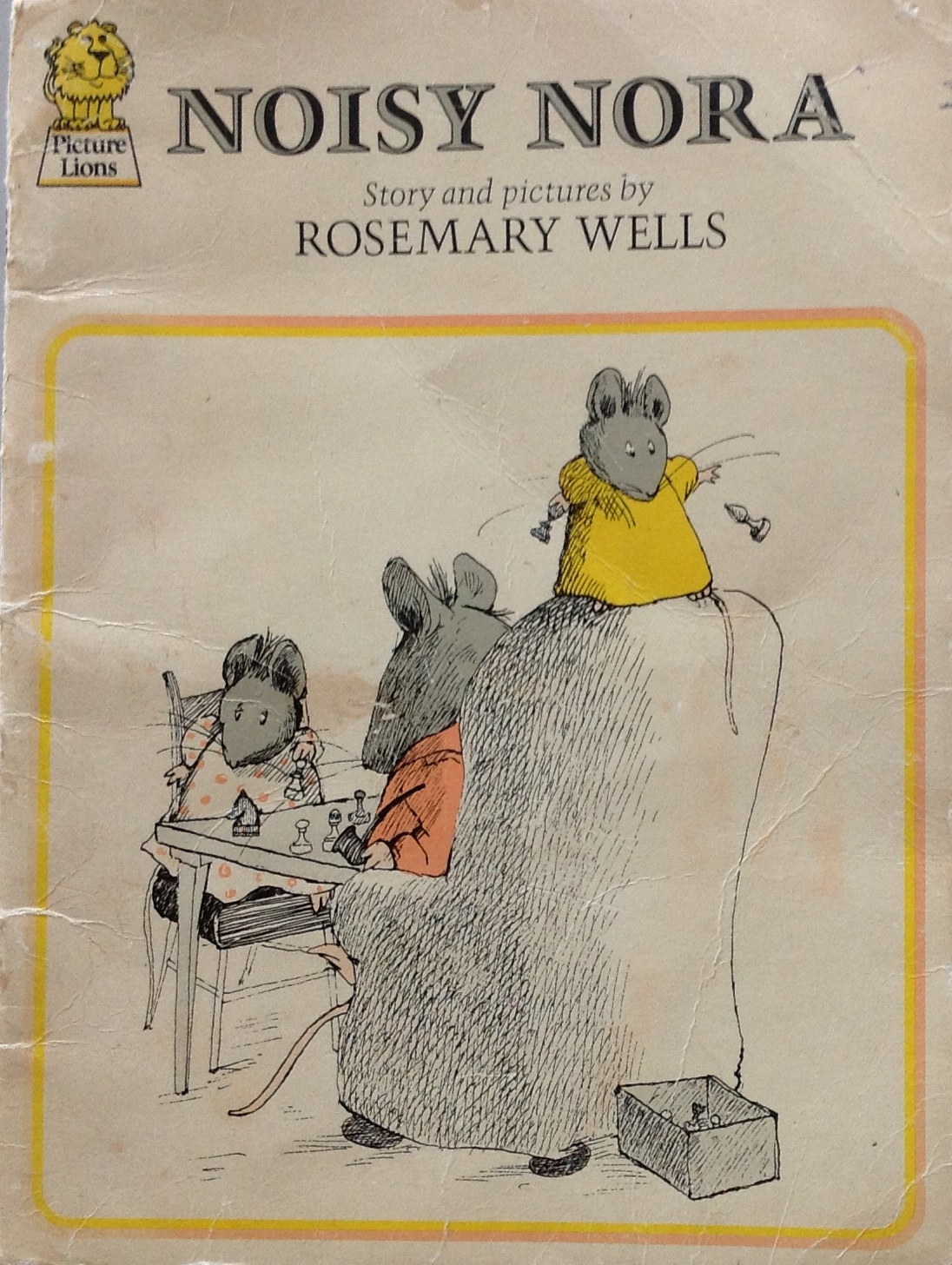
The picture book Noisy Nora by Rosemary Wells is a delightful book about a middle child who fails to get the attention of her parents who are busy with the older and younger siblings. Finally Nora declares that she is leaving and never coming back. With Nora gone the house becomes unusually quiet and the family go looking for her. At last she declares herself back again as she clatters out of the broom closet.
(This information from Wikipedia explains why my cover differs from the one in the Amazon store.)
While I wrote it with Marnie in mind, it could be about any number of others in oppressive situations and seems particularly appropriate to those trapped by the horrors of domestic violence which is at the forefront of our news at the moment. Unlike Nora, who declared she was leaving and never coming back but didn’t really leave, Marnie definitely won’t be coming back.
from “Noisy Nora” by Rosemary Wells
Leaving
It was time. No more would they treat her this way. No more would she accept the cruelty of their world. She was more than this, more than they made her believe. With cash from a secret job stashed in her pockets, a few clothes in a backpack, and hope in her heart, she left. No need to follow a bag through the window. No need to wait for night’s darkness. No. She navigated past their stupor of beer, smoke and flickering screens; paused at the door to declare, “I’m leaving,” then closed off that life as she left.
Thank you for reading. I appreciate your feedback. Please share your thoughts about any aspect of this post or flash fiction.
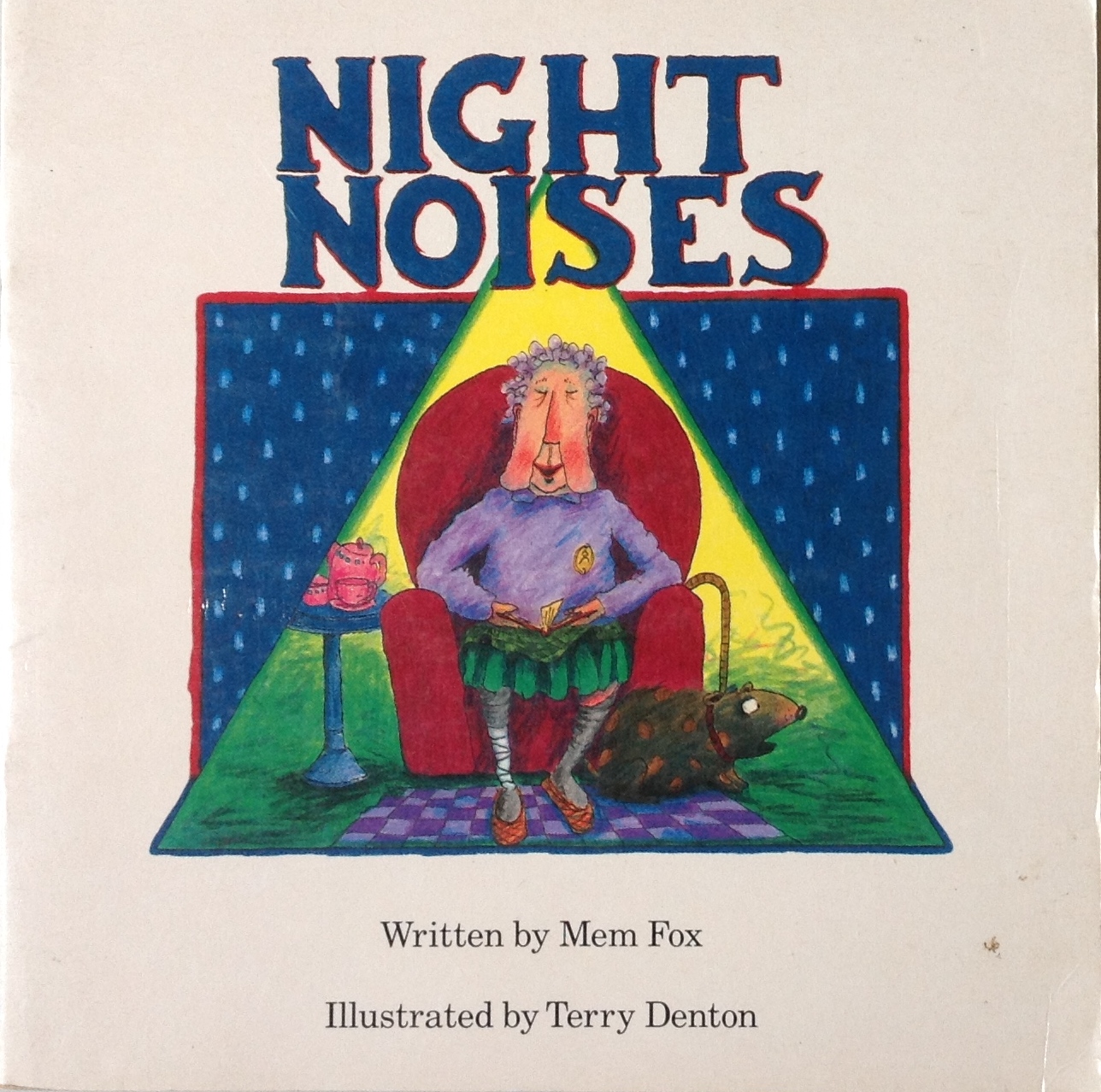
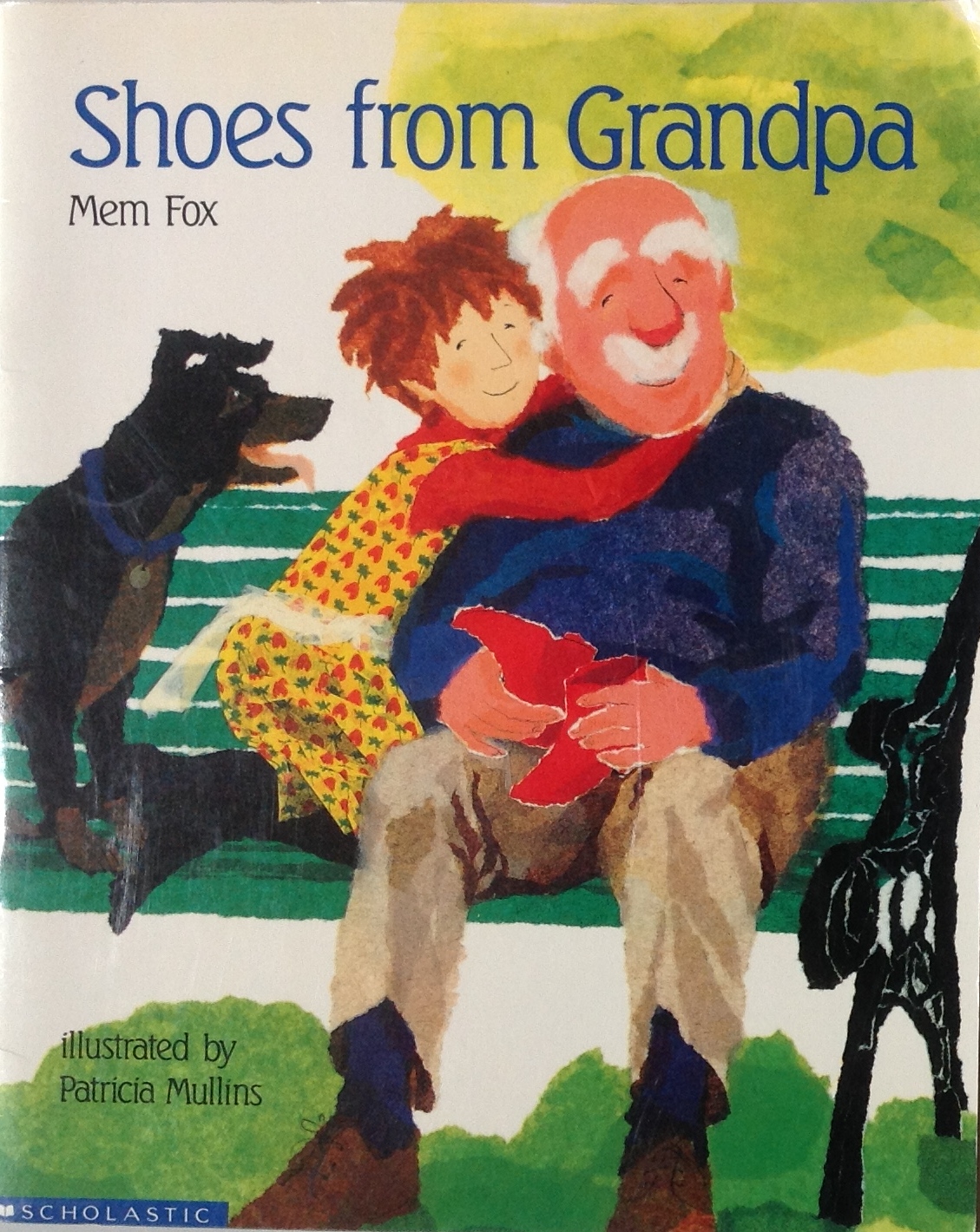
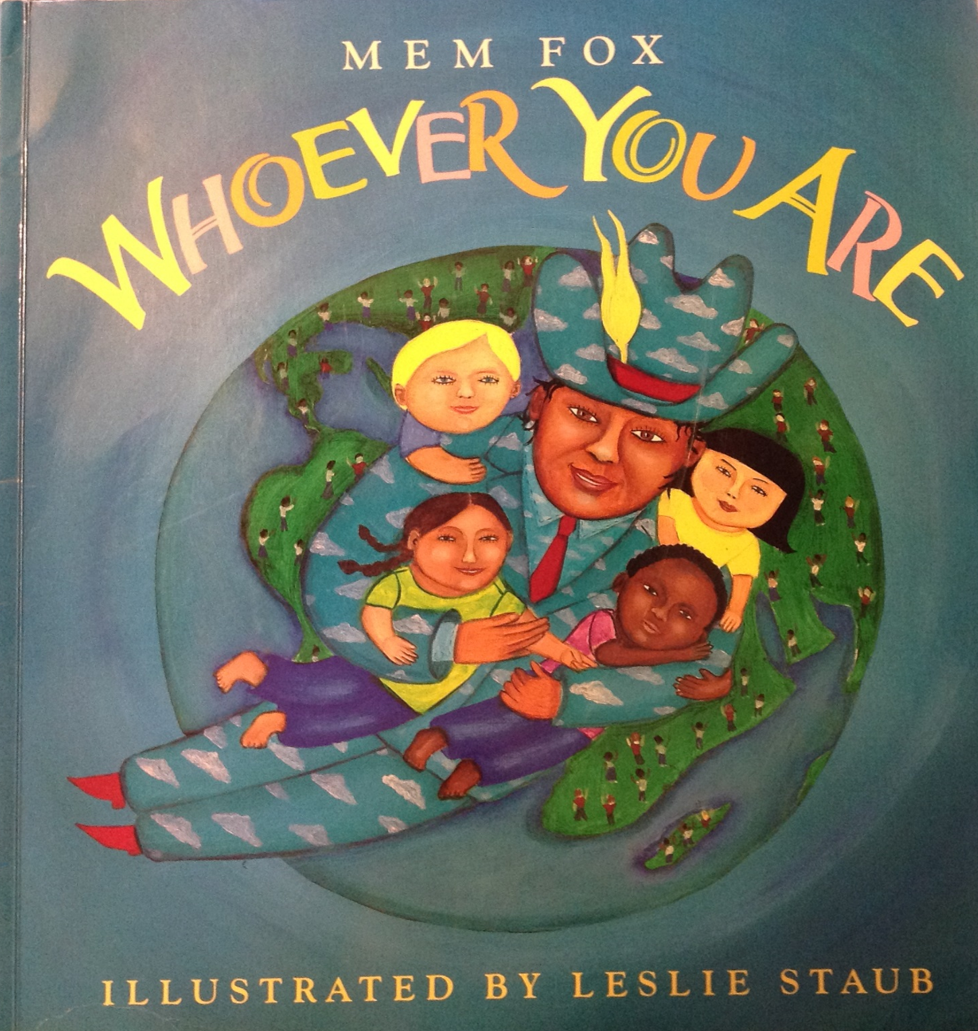
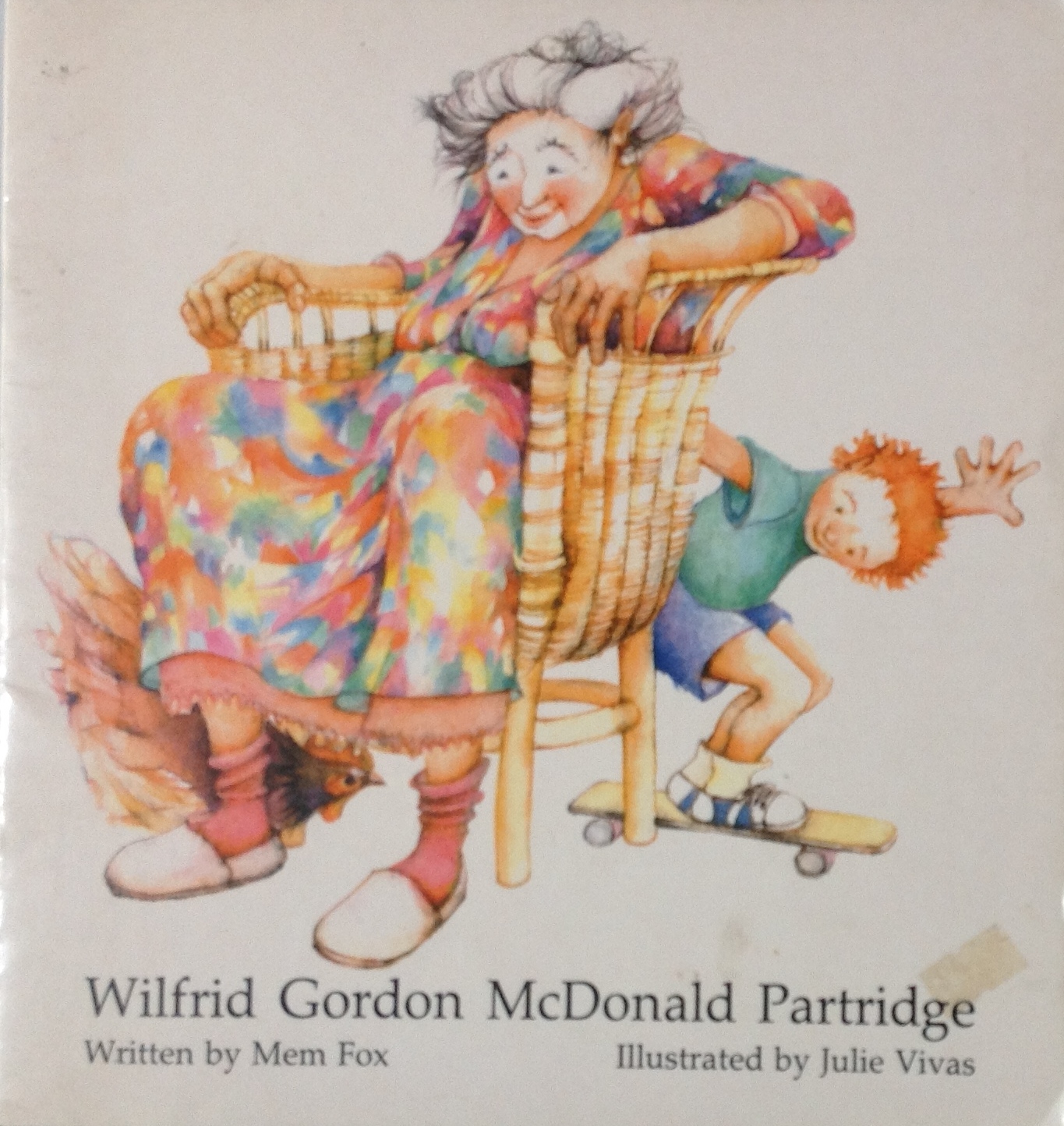
I own and have given away more picture books by Mem Fox than by any other author. To say I appreciate Mem’s work would be an understatement. I currently have on my shelves twelve of her more than thirty picture book titles and two of her eight nonfiction titles.
Her first picture book Possum Magic was published in 1983. I love the story behind this book, as much as the story itself. Mem wrote the first draft in 1978 and over the next five years it was rejected by nine publishers. When it was finally picked up by Omnibus Books she was asked to reduce it in length by two-thirds and to change the characters from mice to possums. The book is now one of Australia’s most popular with more than 3 million copies sold around the world.
You can listen to Mem read Possum Magicor some of her other books here.
In the ten years after the publication of Possum Magic Mem published almost twenty other books. I read her autobiography Mem’s the Word (released in the US as Dear Mem Fox) not long after it was published. At the time I was in my late thirties and was thrilled to find that Mem had also been in her late thirties when her first book was published. I thought there was still hope for me. I’d certainly had enough rejections by that time to fill a rather large shoebox, so maybe I just needed a few more!
Since then Mem’s output has hardly lessened and she has another new book coming out next month. In the meantime, I’m still hoping there’s time for me!
Mem is an author, not an illustrator. The twelve picture books I own were illustrated by eight different artists. Four illustrators did two of these books each. A quick glance at the list of Mem’s books confirms the number of artists who have been engaged to illustrate her work and the variety of artistic styles used. How wonderful for the artists to have that experience, and for teachers and parents the opportunity for discussing artistic styles with children.
My reason for raising this issue of author and illustrator is that I also am not an illustrator. A number of years ago when discussing picture book authors, an acquaintance scoffed at my praise for Mem’s work: how could she possibly consider herself a picture book author if she didn’t do the illustrations? This acquaintance, in the process of having her first picture book published, was author and illustrator. In the intervening years Mem has gone on to publish a number of books, and this acquaintance none. Okay, neither have I. Yet!
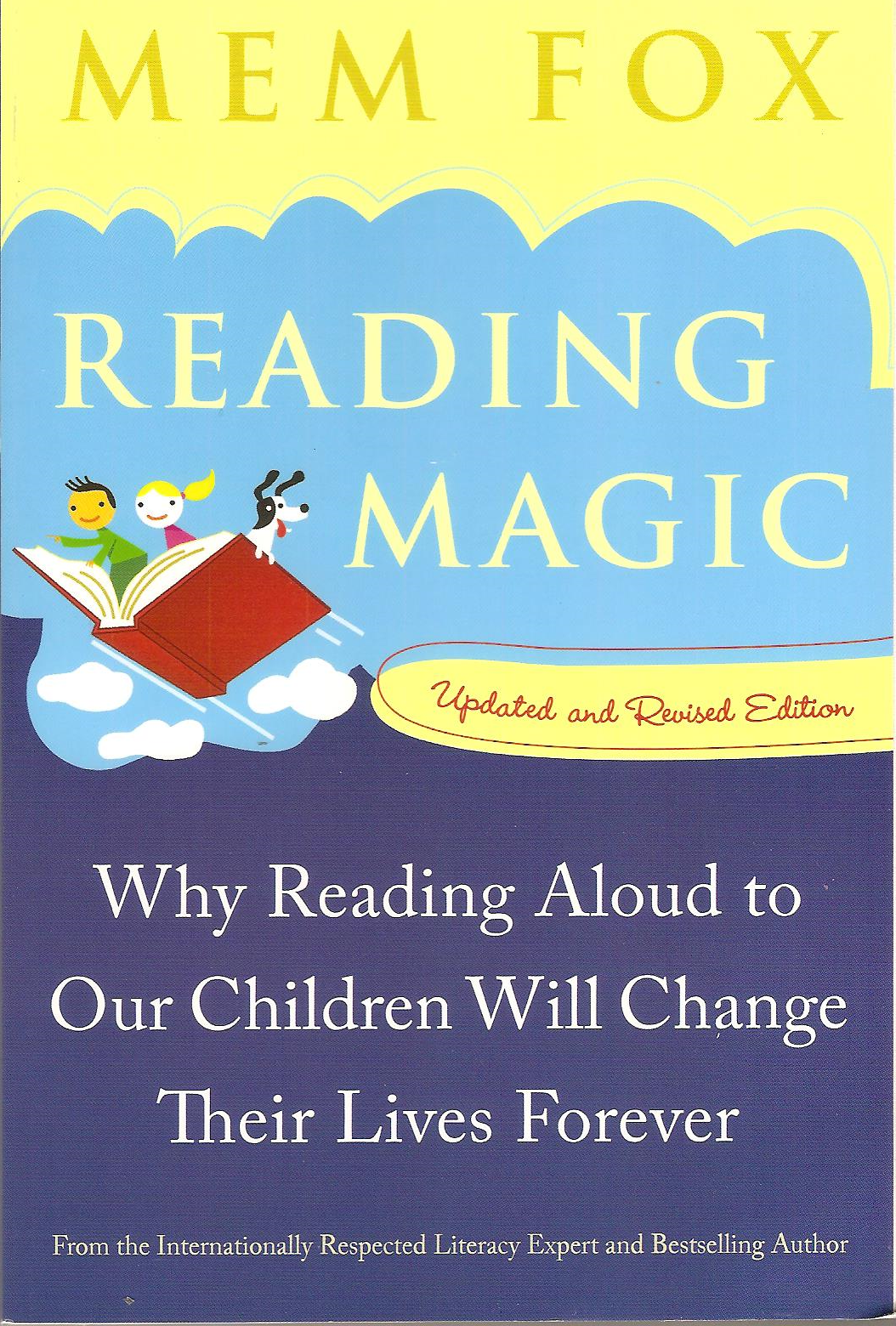
Another thing that Mem and I have in common is our passion for literacy and our advocacy of reading to children every day. Mem’s book Reading Magic should be placed in the hands of every new parent along with a collection of picture books. I practice what I preach by giving a bundle of these as gifts to friends with newborns. I have written about that here. As well as Reading Magic, the bundle generally includes Where is the Green Sheep? and Ten Little Fingers and Ten Little Toes, among others. Nurturing a love of books and reading is one of the greatest gifts a parent can give a child.
Below is a list of the Mem Fox books on my shelves at the moment (a few have mysteriously disappeared!) but the best way to check out Mem’s books is on her website here. While you are exploring her website, there is much else of value to discover, including suggestions for writers, teachers, parents, and children as well as other interesting information. Exploring Mem’s site is the best way of finding out about her wonderful books.
Here are the ones I own, in addition to the three mentioned above (in no particular order), with links to further information about each title on Mem’s site and to information about the illustrator where possible:
Of course these are about the love between parent and child, rather than romantic love, and it is from these I have drawn my inspiration. Finding a love angle that I was happy with was the first challenge and, as usual, telling a tale in 99 words was even more so. (I think I need some lessons about telling more in less.) This is my response. I’d love to know what you think.
Soon the clatter of dishes ceased. Feet padded out.
Child snuggled into warm enveloping arms. The ritual began.
They picked out stars and constellations.
“And Venus,” said Child. “Tell me about the love planet!”
“Well,” began Parent. “Long ago there were two people who loved each other …”
“More than all the stars in the sky,” interjected Child.
“That they wanted a child to love too …”
“So you got me!” said Child.
“Yes.” Parent scooped up the child. “And just as there’ll always be stars …”
”We’ll always love each other!”
Now for the books, each of which is a delight to share with young children, for reading aloud at bedtime, or any time.
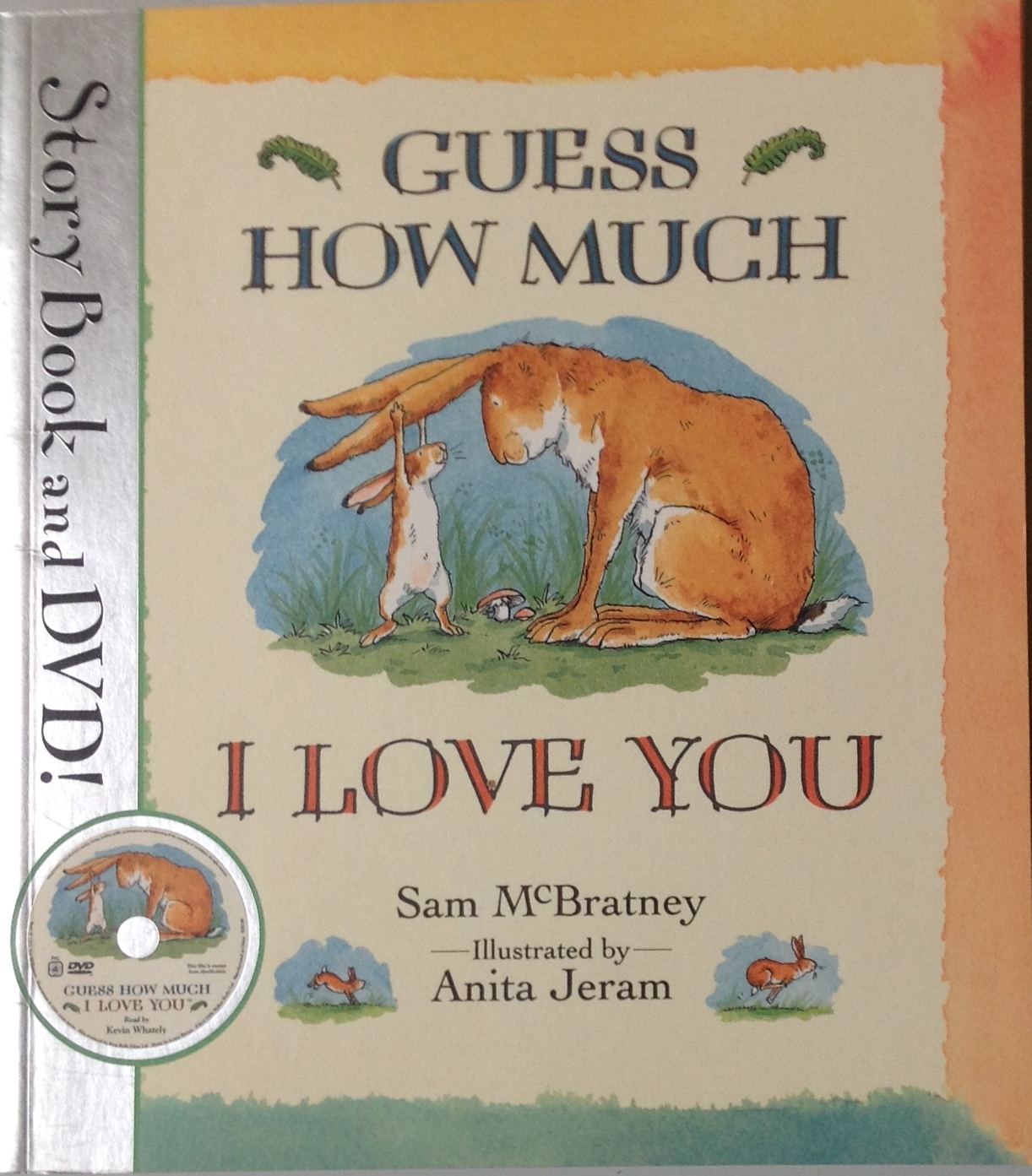
Guess How Much I Love You by Sam McBratney (Northern Ireland) and illustrated by Anita Jeram (Northern Ireland) is a beautiful tale of the love between Little Nutbrown Hare and Big Nutbrown Hare. As they try to find a way of describing their love for each other, they find that love is not easy to measure. From this beautiful story comes the classic line “I love you to the moon … and back!”
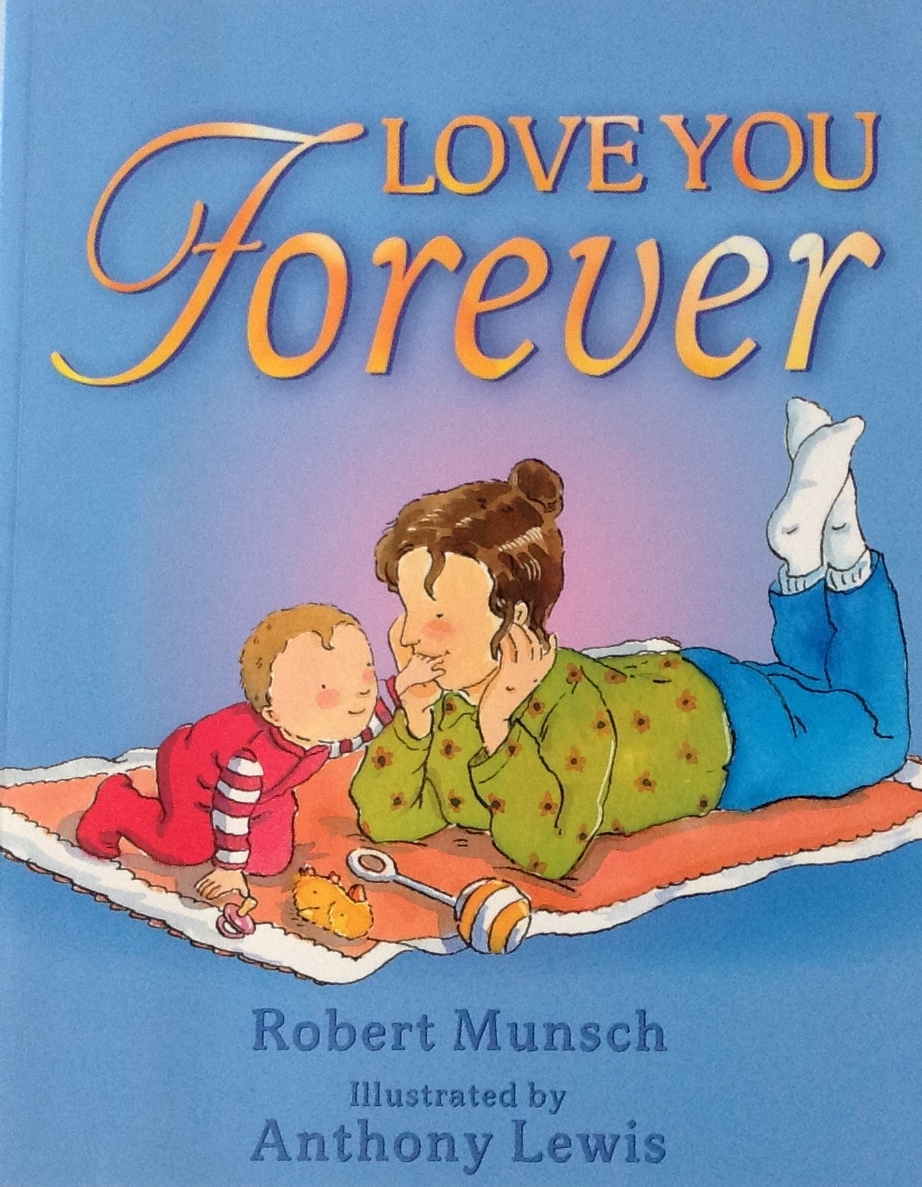
Love You Forever by Robert Munsch (Canada) and illustrated by Anthony Lewis (U.K.) tells of a mother’s love that lasts a lifetime, a love that is returned by a son and passed on to the next generation through the words of a beautiful song:
“I’ll love you forever.
I’ll like you for always.
As long as I’m living
My baby you’ll be.”
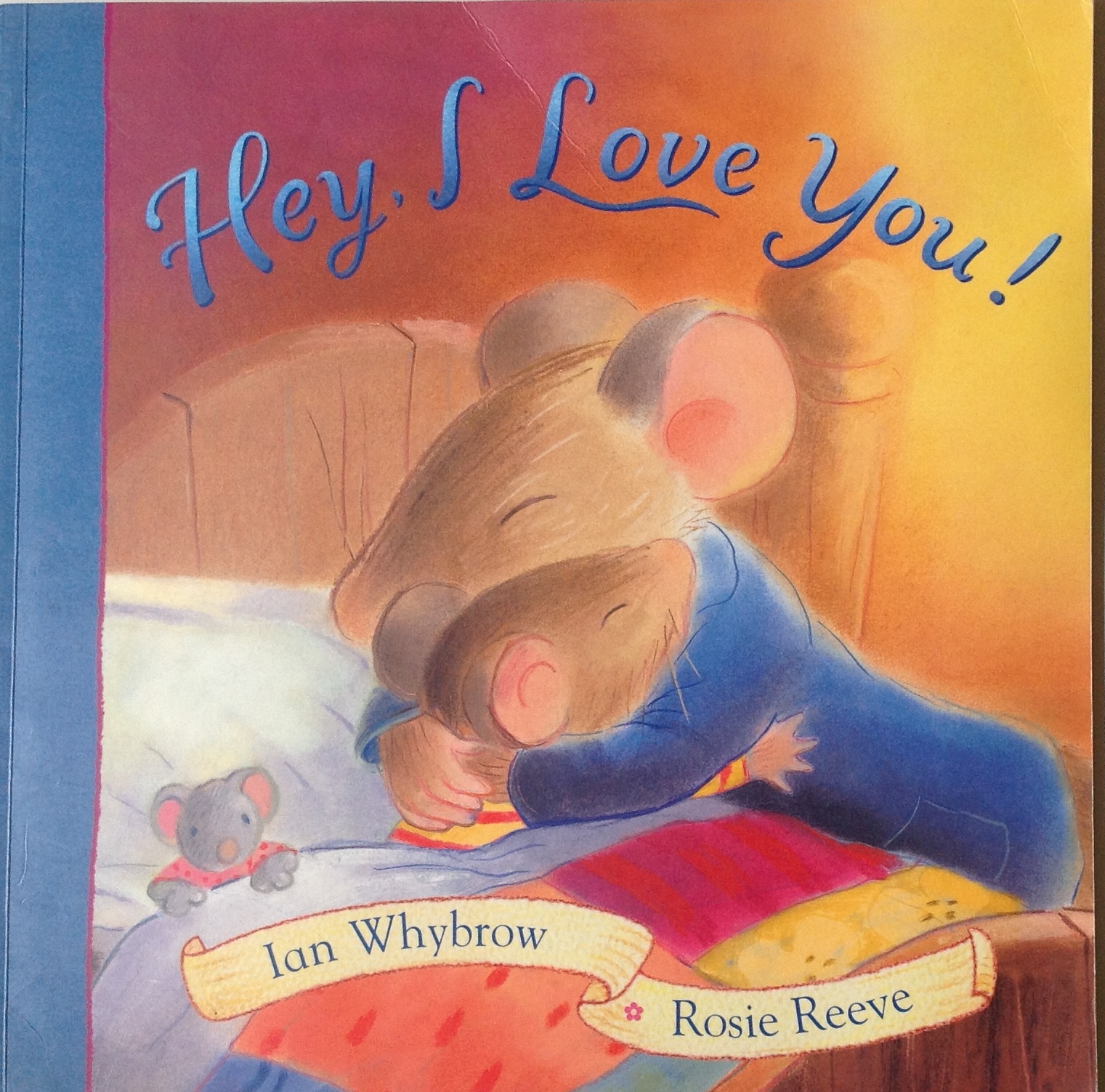
Hey, I Love You by Ian Whybrow (U.K.) and illustrated by Rosie Reeve (U.K.) is about two mice, Small and Big. Before Big goes out to get supper Small shows that he knows what to do to stay safe when Big is away. Unfortunately they forgot to say their special words and Small doesn’t follow the instructions. Fortunately Small was able to catch up to Big without incident. Attention must be paid to the illustrations to see just how lucky that was!
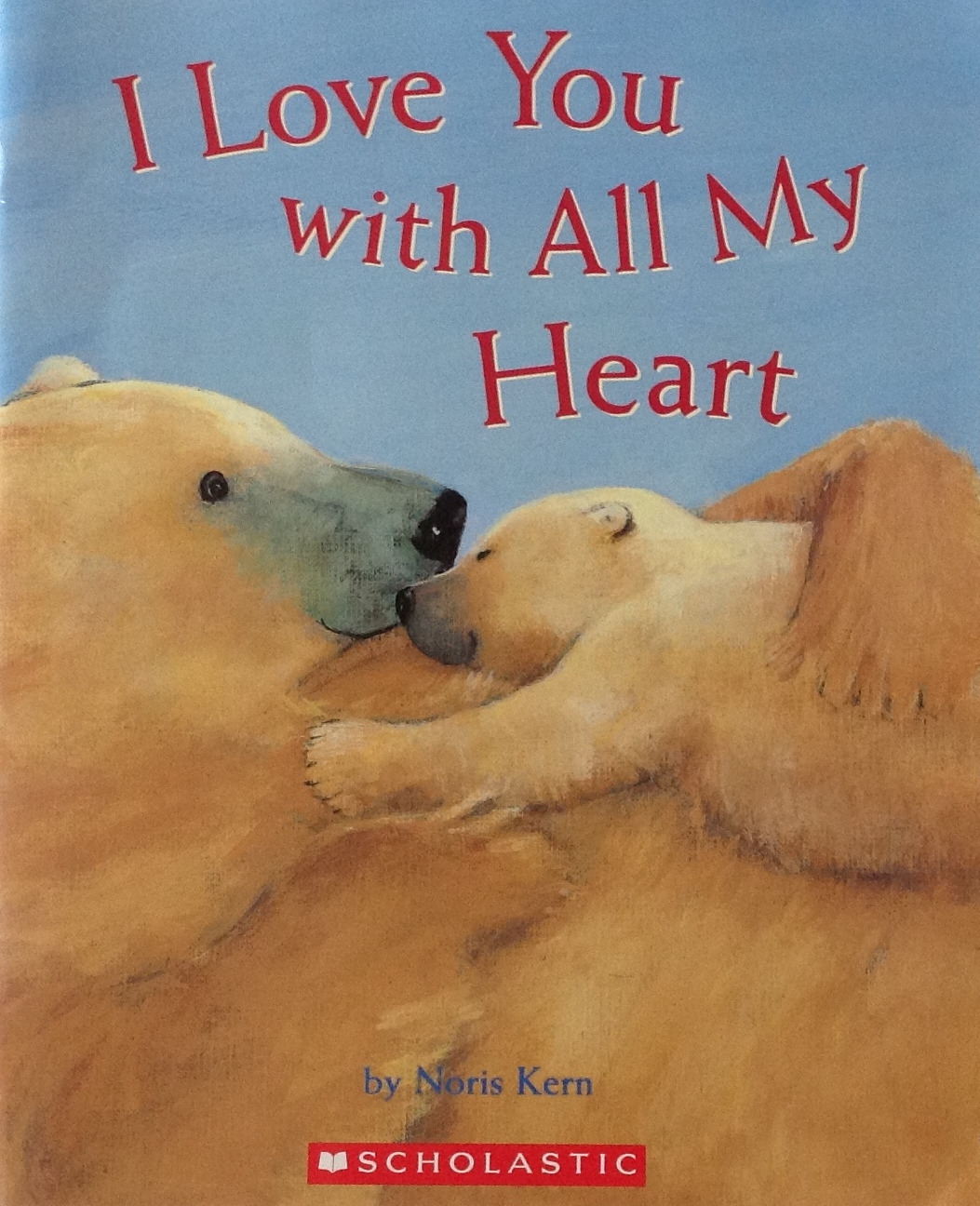
I Love You With All My Heart by Noris Kern is about Polo the Polar Bear who wants to find out the meaning of his mother loving him with all her heart. He asks the other animals how their mothers love them and finally discovers how his mother loves him and that he loves her with all his heart too. (A possible concern with this book is the mix of Arctic and Antarctic animals.)
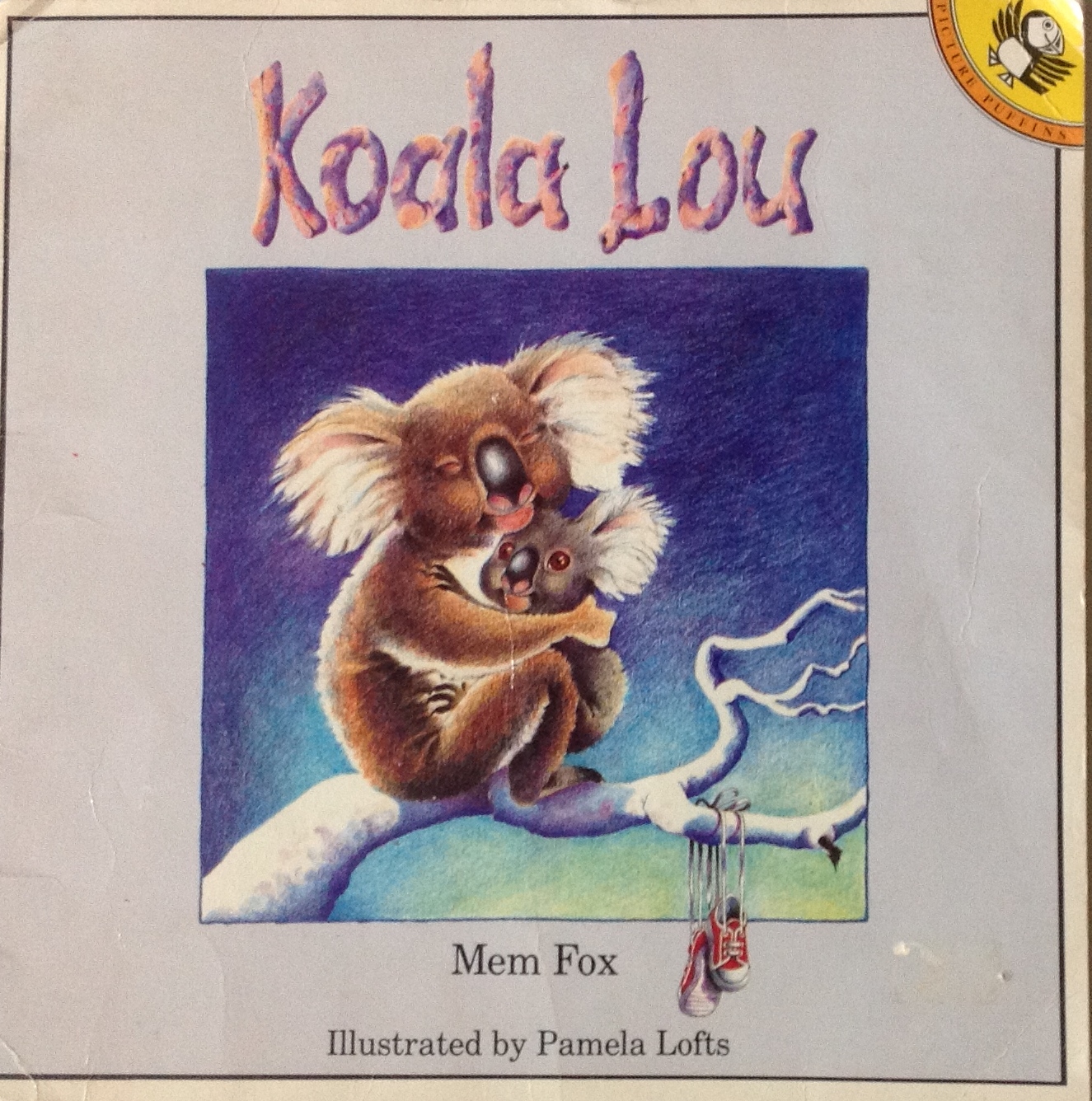
Koala Lou by Mem Fox (Australia) and illustrated by Pamela Lofts (Australia) tells of Koala Lou who is loved by everybody, especially her mother. Every day her mother would say, “Koala Lou, I DO love you!” But after other koala siblings arrive, Mother Koala doesn’t have time to give Koala Lou the attention she craves. Koala Lou comes up with a plan to hear those special words again.
Koala Lou leads beautifully into my next post which will showcase some books by Mem Fox. I hope you will join me for those.
One last thought:
I wonder what image of the Child, Parent and Family you formed from reading my flash. (I omitted some clues about other family members in the 99 word reduction.) I’d be pleased if you would share your thoughts about this.
You see, I attempted to be inclusive by avoiding specifics about things such as gender, family composition, culture and location. I wondered whether a story could be written so that each reader could interpret it to fit their own situation. Illustration could be difficult, but perhaps worth considering. This attempt to be inclusive was very different from my first thoughts to be specific to Australia, through stars observed, for example, and had nothing to do with my thoughts or opinions of the picture books shared.
However, looking back at the five books with these thoughts in mind, I notice that the relationships portrayed are:
Guess How Much I Love You – father and son
Love You Forever –mother and son
Hey, I Love You – father and son
I Love You With All My Heart – mother and son
Koala Lou – mother and daughter
What do you think? Is it worthwhile to attempt a story of the love between parent and child with an inclusive element, or is it enough that such a variety of books is already available? Do you have any other favourites, or suggestions, on this topic?
Thank you for reading. I appreciate your feedback. Please share your thoughts about any aspect of this post or flash fiction.
I had already been urged by some writing, publishing and marketing entrepreneurs to quickly create a colouring book and cash in on this new lucrative market. Apparently it’s easy to create a book using royalty free creative images found online and publish the books on Amazon where they have their own genre. People are buying them by the dozens. The books are also displayed prominently in bookstores, and promoted on social media. What is there to lose?
As a teacher and parent I have never been in favour of colouring books for children. I know some argue that colouring does have a (small) place. Children may develop fine motor skills when colouring between the lines, and colouring is sometimes integrated with other things such as graphing, mapping, and colour-by-number activities.
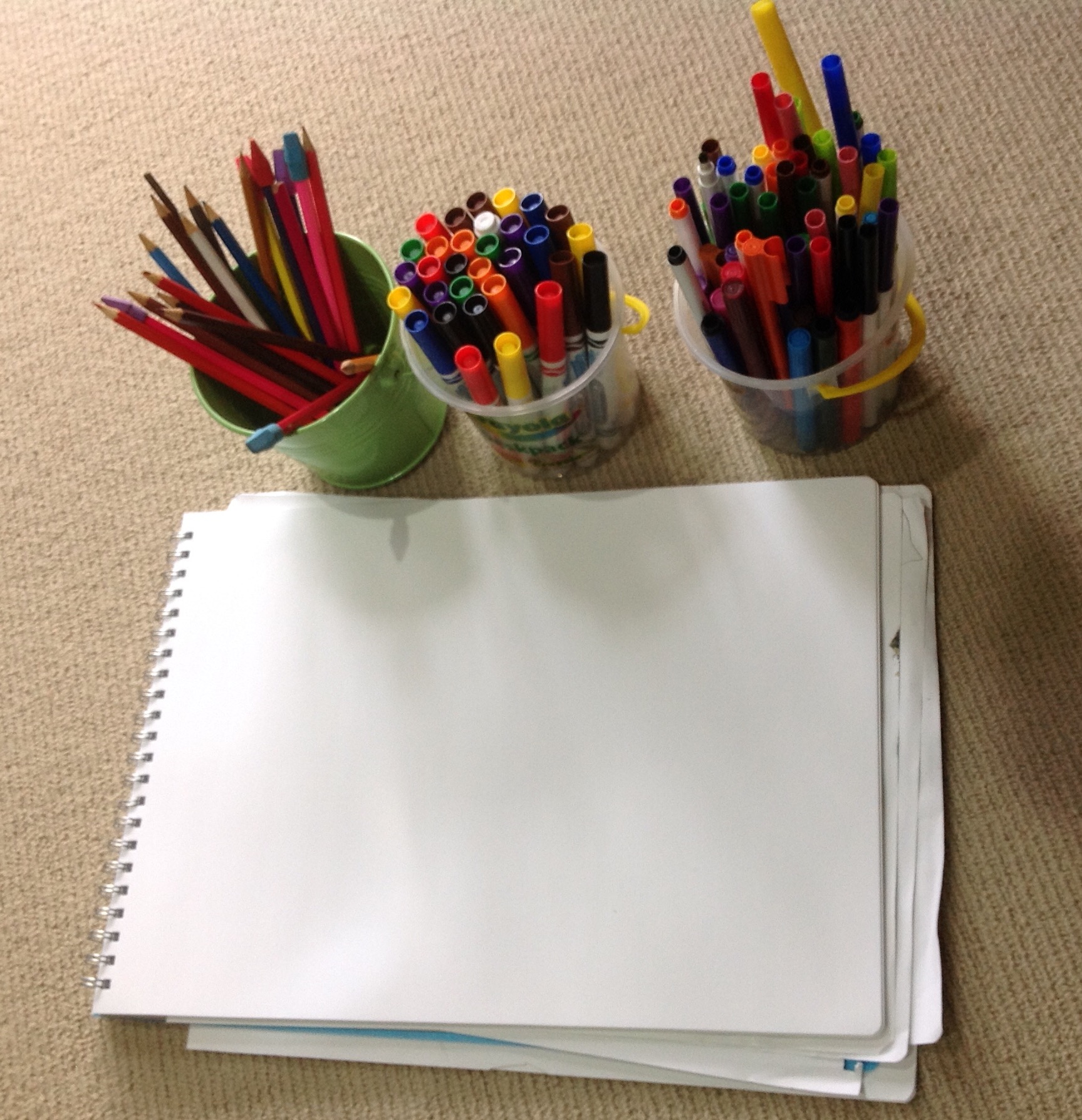
But I have rarely given a colouring book as a gift. I would rather give a blank art book and a variety of pencils and pens for children to create images from their own imaginings. Their fine motor skills and their creativity will develop perfectly well that way and it may help to avoid the feelings of inadequacy that can develop from spending too much time colouring the works of others.
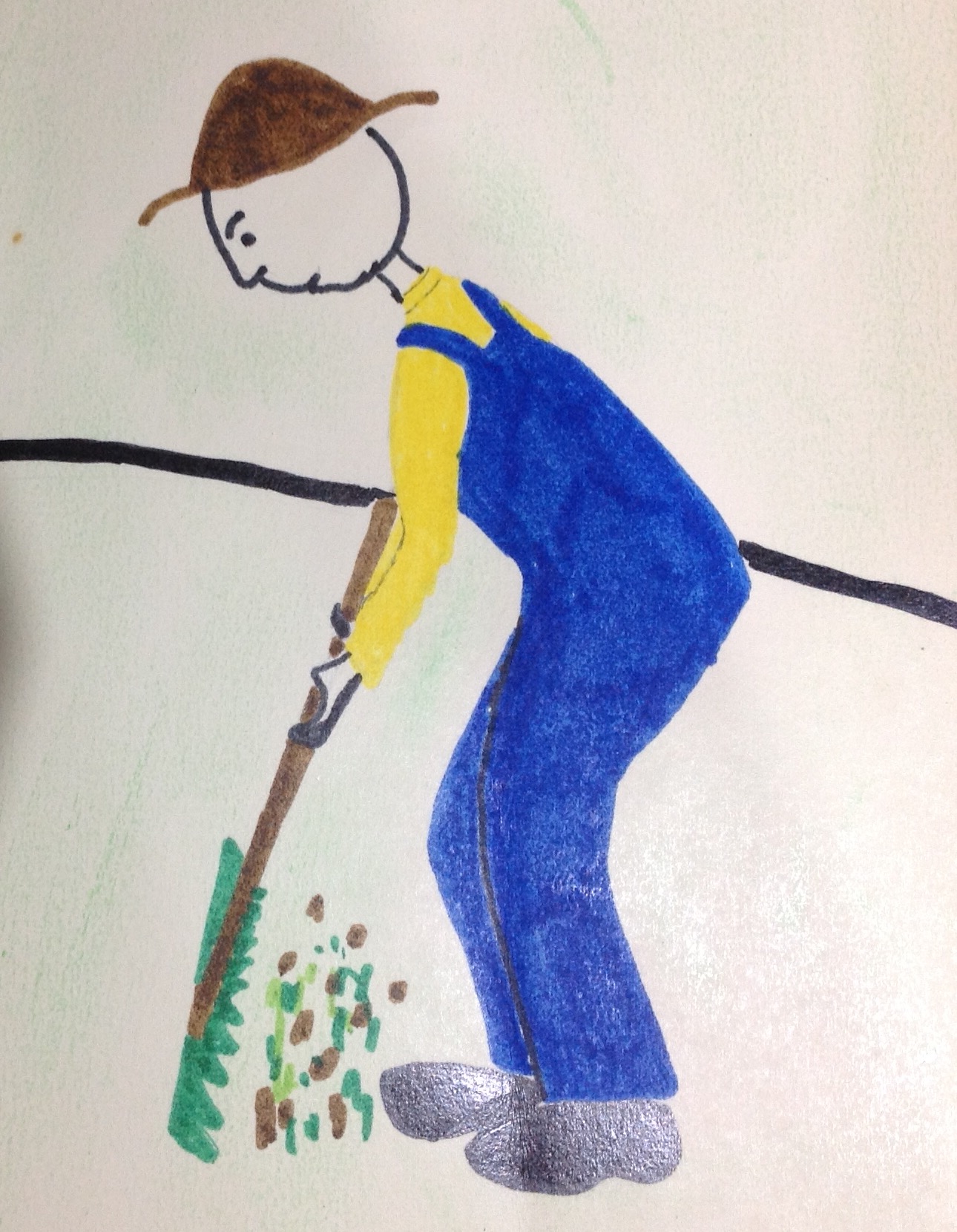
That’s not to say that learning some of the artist’s techniques is a bad thing. Twenty-five years ago I did a short “Drawing on the Right Side of Your Brain” course, based on the work of Betty Edwards. I didn’t consider myself an artist, and still don’t, preferring to write than to draw. But being interested in learning and anything to do with the brain, I decided to see what I could do. I was amazed at the results. Unfortunately, I don’t have many pre-course drawings to share with you, just this one of a gardener, but please take my word for it that I showed little promise.
In the course I learned the importance of drawing what the eye sees, not what the mind thinks it sees; for example we might think of the roundness of the rim of a cup, but what we actually see is an ellipse. The importance of seeing accurately is true whether drawing an actual or imagined object or scene.
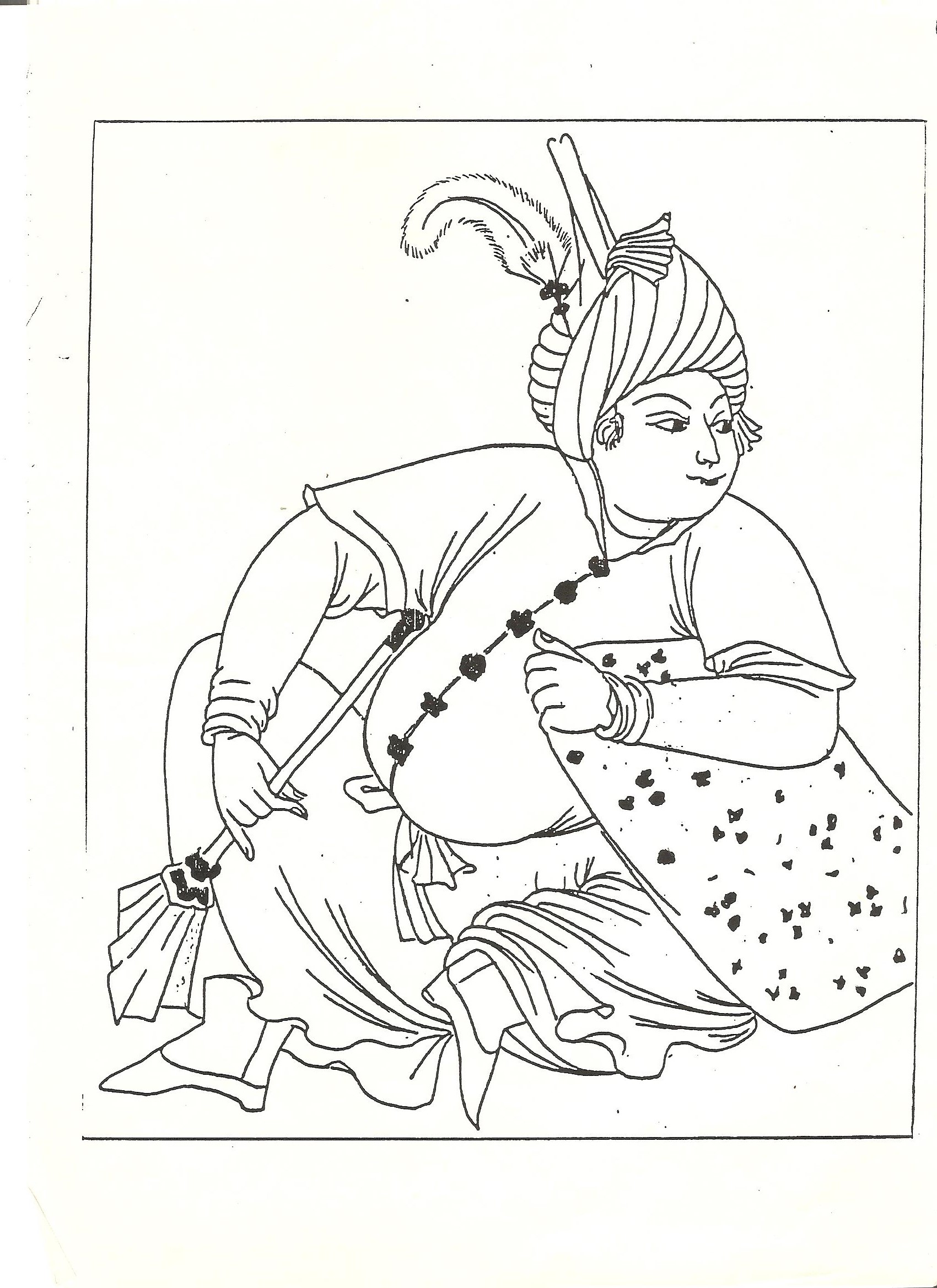
In the first lesson we were given this picture to copy.
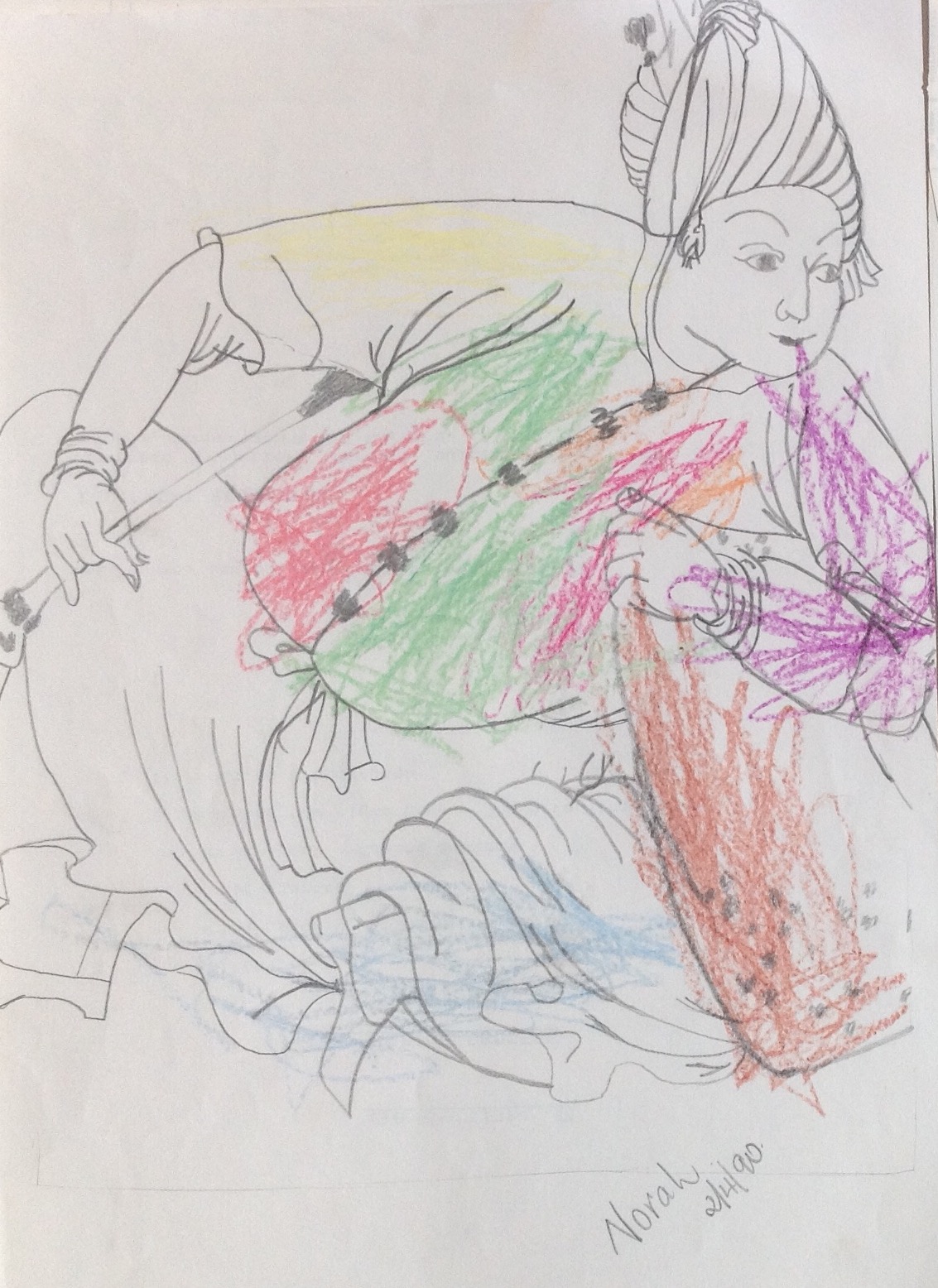
I admit that I didn’t have high expectations as I began. We were told to turn the picture upside down and to start copying from one corner. In doing this we focussed only on each of the lines, drawing just what we could see. We were not to turn the picture the right way up until we had finished. There was to be no interference from what we thought we were drawing to what we were actually drawing. Everyone in the class was amazed with their results.
And thank you to Bec, who was three at the time, for deciding it needed some colour!
For a short while I engaged in a flurry of drawing activities, but soon abandoned them to other more pressing or preferred activities. I had proved to myself it was possible. That was sufficient. Now someone just needs to come with a singing on the right side of the brain course for me!
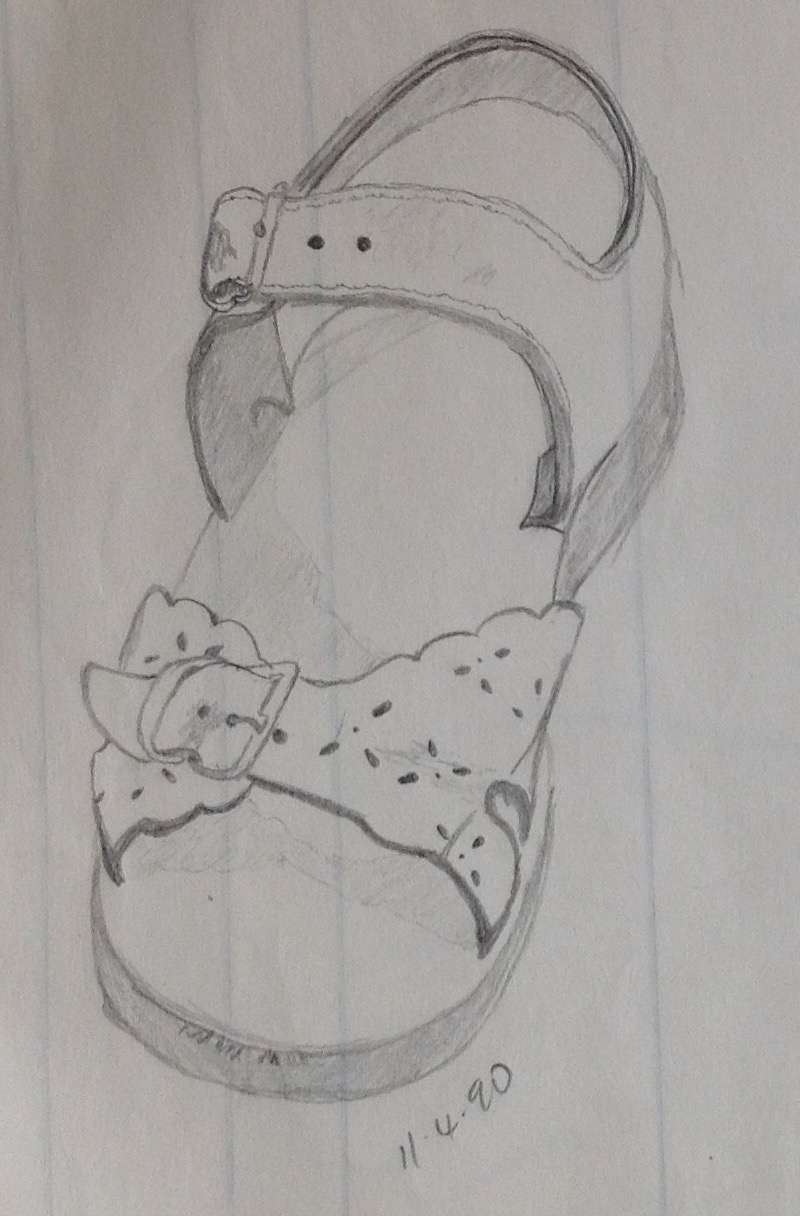
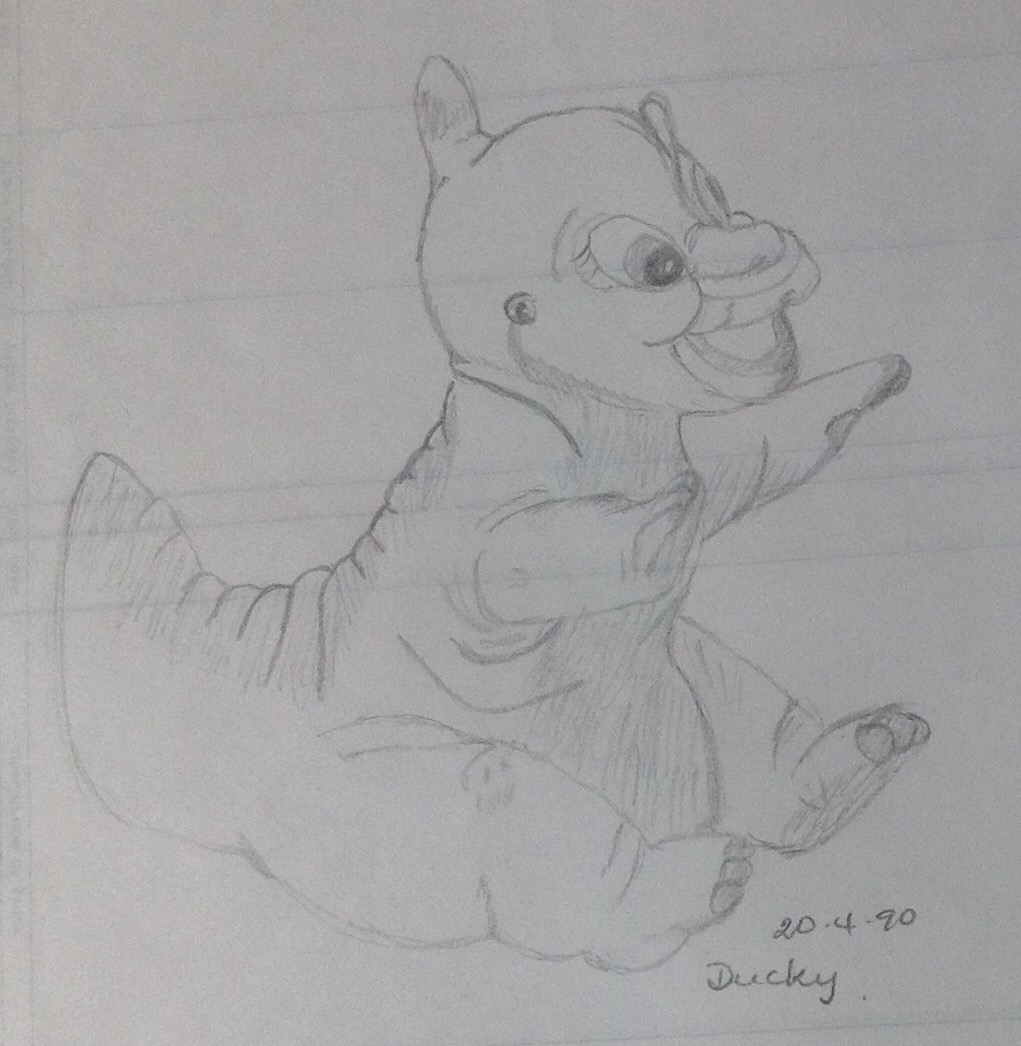
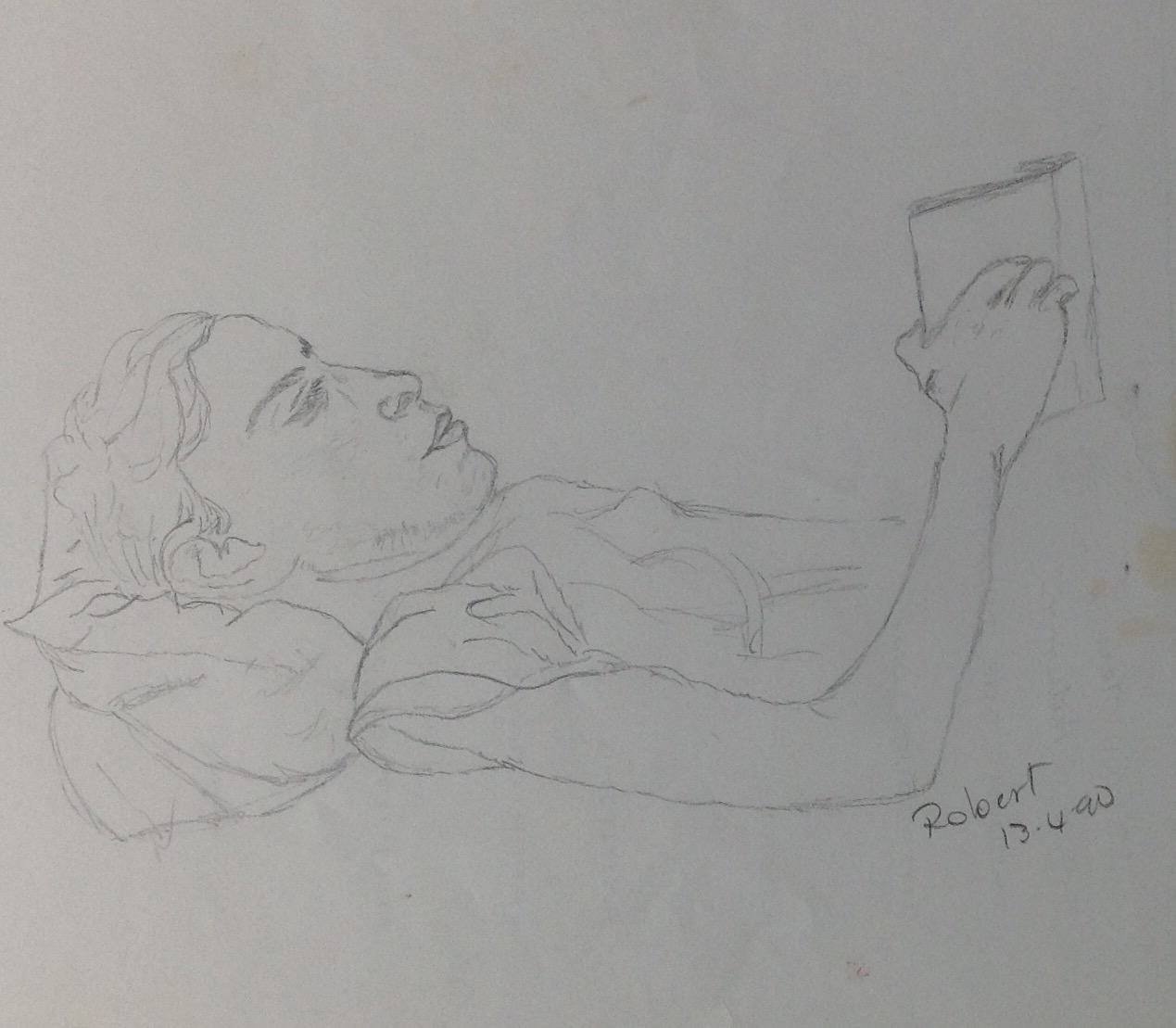
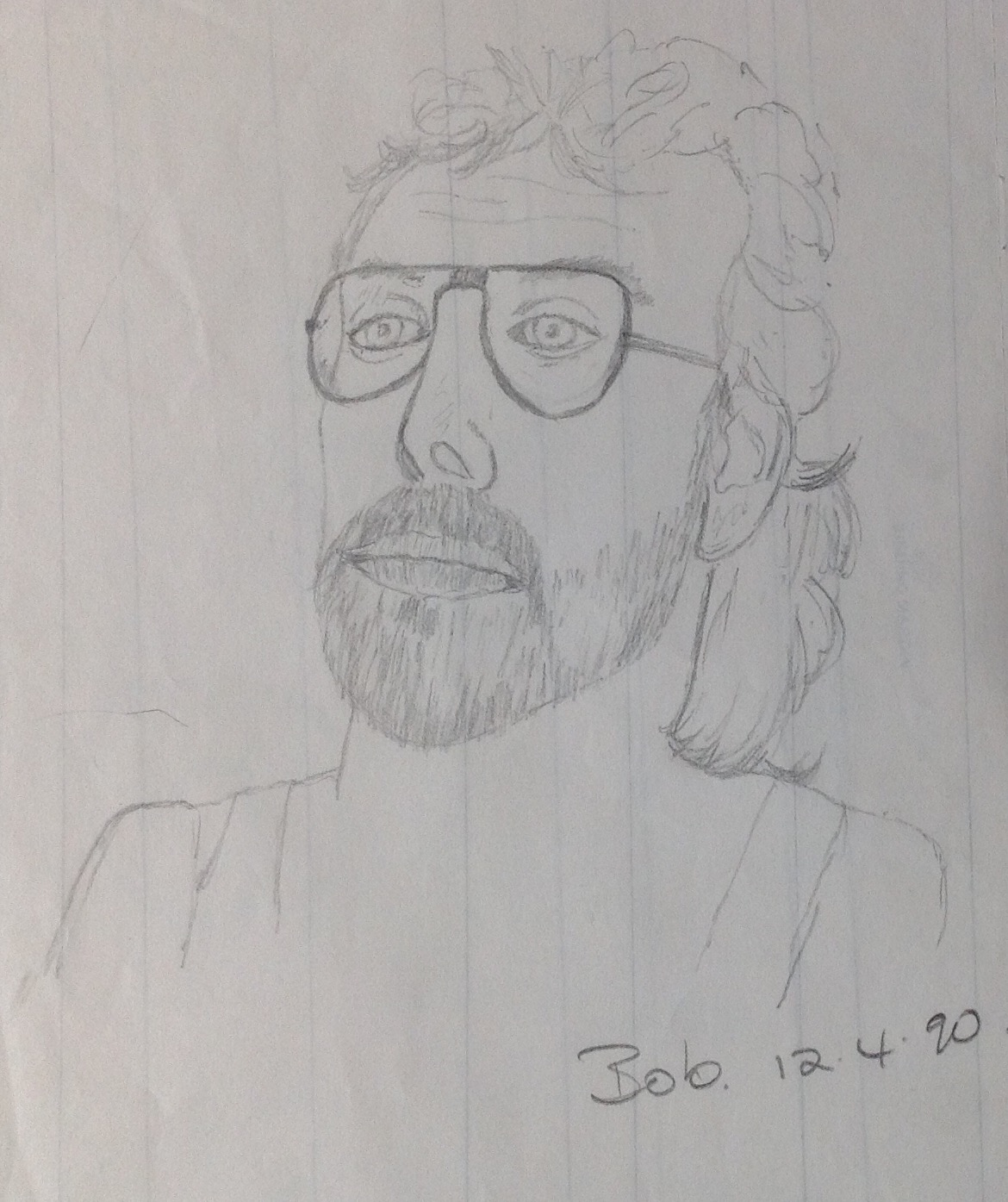
These are some of the drawings I did at that time, each from observation of a real, not imagined object:
In my pre-service teaching days I was cautioned to not use simple drawings on the board, for example a stick person or a smiley face sun, for the children to copy as it may limit their drawing ability. It was always a concern of mine. I didn’t want to limit anyone’s ability!
After doing the drawing course I bought a copy of Drawing on the Right Side of the Brain for Children and used its recommendations in art lessons. In his article about How to Teach Drawing to ChildrenMarvin Bartel warns against showing children how to draw and emphasises the need for close observation, and practice, practice, practice. I agree with his advice to not add one’s own changes or lines to a child’s drawing.
In recent years I came across some fabulous picture books by Mo Willems.
At first I didn’t find the books appealing with their simple black outlined drawings and minimal use of colour. It was only after a colleague’s repeated exhortations that I gave in and reluctantly read one. Halfway into the book “The Pigeon Finds a Hot Dog!”I was a fan! With what appears to be a few simple lines, Mo creates a great variety of expressions and moods, telling stories that children can identify with and that have them (and their teachers) holding their sides with laughter.
In the app Don’t Let the Pigeon Run This App Mo encourages children to add their voices, making the story their own. He also includes videos of how to draw the characters. The app is as much fun as the books. There are many videos by others on youtube sharing how to draw Mo’s characters, but none is better than Mo himself.
Here is a PDF of his instructions for drawing the pigeon:
and a video of Mo talking about how he creates his characters. Sorry, Mo, I underestimated you at first.
So while I accept that colouring books may have benefits for mental health for adults who choose that activity and understand that colouring can induce a meditative state and be very relaxing, I think a blank piece of paper and a variety of pencils and pens would have the same effect and, who knows, you might unleash the artist within. I certainly don’t consider their use in the best interests of children’s development and creativity.
What do you think of colouring books for children and adults? Is colouring a recreational pursuit for you? Have you bought your first colouring book for grown-ups yet?
Thank you for reading. I appreciate your feedback. Please share your thoughts.
Regular readers of my blog know that for the last eighteen months I have been participating in the flash fiction challenges set by Charli Mills at the Carrot Ranch. Each week Charli posts a prompt and invites readers to submit a response in exactly 99 words. I have participated since the first prompt and have missed only a few, maybe one or two.
I enjoy the way the prompt stretches both my thinking and my writing. I appreciate the opportunity to engage in fiction as a diversion from the mainly expository writing (and reading) I do; and to engage in a supportive and encouraging group of Rough Writers.
Since education is the focus of my blog I have given myself the added challenge of targeting an aspect of education in my response to Charli’s prompt. Mostly I have succeeded, though sometimes the posts may be a bit convoluted and the links rather tenuous, but nevertheless, I have been mostly pleased with my ability to find a link.
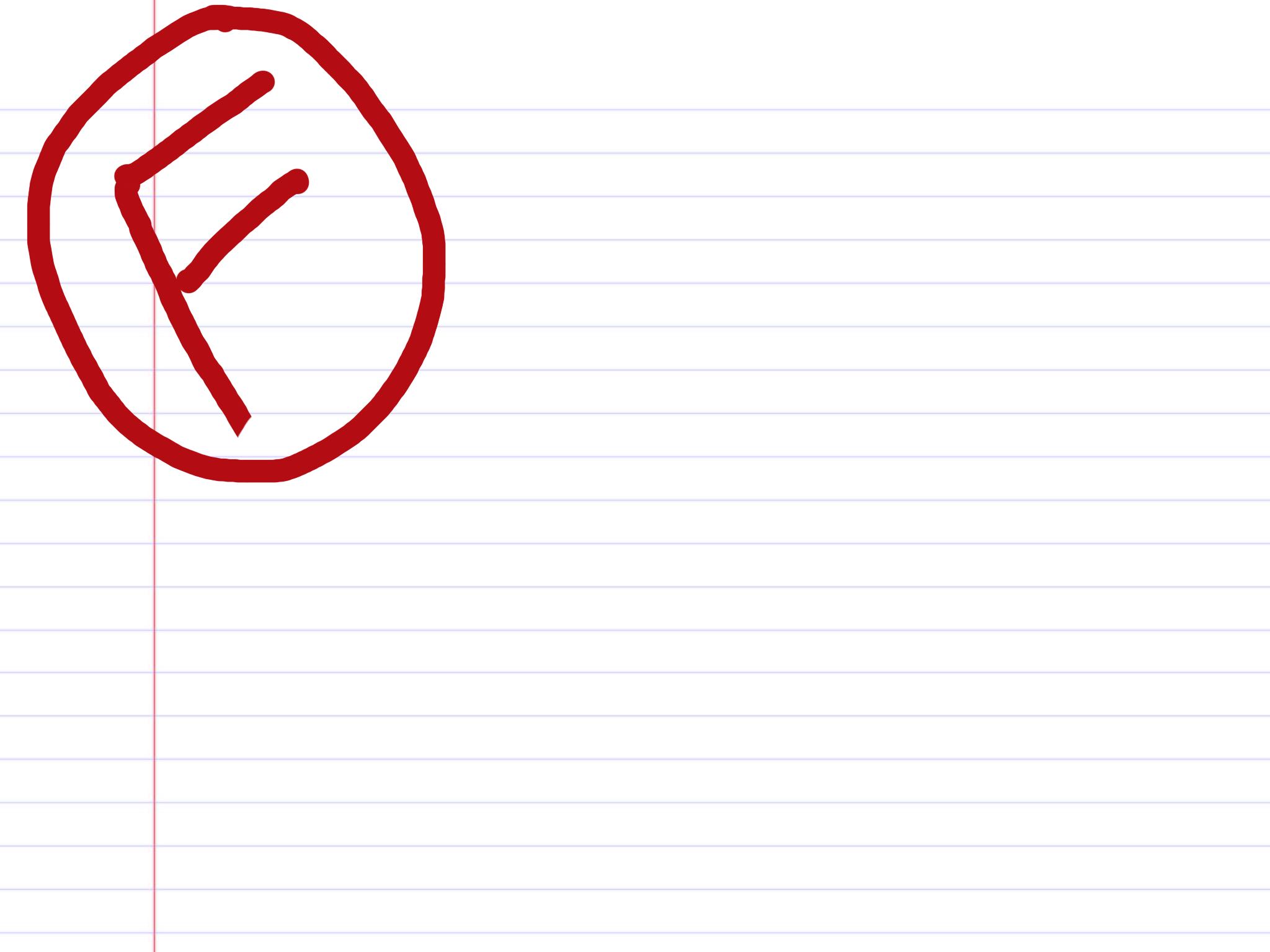
This time I didn’t think I was going to do it. While I grappled for a suitable link, none was forthcoming and I thought it was going to be an F, a no-show, this time.
You see, this week Charli is talking about the destruction caused by forest fires and other catastrophic weather events. Though Australia suffers its share of natural disasters, I am fortunate that I have never been more than inconvenienced by them. I haven’t suffered the loss of family, property and livelihood that others have; nor have I worked in a school where loss was experienced on a large scale. You could say I have lived a sheltered life, and I am grateful for it.
So without a personal experience to share, my next thoughts were to the curriculum. But I am an early childhood teacher, and young children don’t learn about catastrophic events unless they have a personal experience of them. The Australian Curriculum introduces learning about natural disasters in year six.
Another dead end. The F was looming. Would it engulf me?
Then inspiration! I remembered watching a video in which the possibility of an F being the new A was mooted. I’m sure you’ve all heard about 60 being the new 40, for example; generally put forward by the 60s rather than the 40s I conjecture. But this was a new twist.
In the video Wagner says that “What the world cares about is not what you know, but what you can do with what you know.” Content is now available through a quick internet search. We don’t need to have instant recall of numerous facts.
Instead of content, Wagner lists a set of core competencies he considers important. He says that to be lifelong learners and active and informed citizens, the following abilities are required:
To ask questions through critical thinking and problem solving
To work collaboratively
To be flexible and adaptable
To show initiative and be entrepreneurial
To communicate effectively in both oral and written modalities
To access and analyse information
To be curious and imaginative
I agree that each of these attributes is important. I think I have mentioned many of them in previous posts.
Wagner goes on to say that what is needed is innovation: the ability to generate new and better ideas that can be used to solve the problems facing us today. He questions whether America’s reputation as a leader in innovation is as a result of or despite the education system. He then asks the audience to identify what the following four people have in common.
Bill Gates (Microsoft)
Edwin Land (Polaroid camera)
Mark Zuckerberg (Facebook)
Bonnie Raitt (folk singer)
Did you, like the audience, think them to be dropouts? Wagner identified them as not just dropouts; they were Harvard College dropouts! Steve Jobs (Apple) and Michael Dell (Dell computers) were dropouts.
This fact about innovative dropouts inspired Wagner to investigate conditions that encourage the development of innovators. He interviewed many young innovators, asking if there had been an influential teacher or mentor in their lives. While not many could name one, those identified were outliers, engaging students in teamwork and interdisciplinary work involving problem solving and risk taking.
Wagner also interviewed people from innovative organisations such as IDEO, whose motto he quoted: “Fail early and fail often.” (“That’s because there is no innovation without trial and error.”) It was from a think tank at Stanford that the idea that an “F is the new A” came.
There are iterations, not failure, Wagner says, and he questions the way parents and teachers try to protect children from making mistakes saying that real self-confidence was only to be gained from learning that you could recover and learn from mistakes.
So perhaps in thinking about failure, I haven’t really failed. I’m learning. It is only to be hoped that the failures in fire management that Charli talks about in her post lead to improved management practices in the future.
A big storm was coming. Two older ones were put in charge of two younger ones. They sat at the fence, watching. Soon other neighbourhood kids gathered, sharing storm stories, waiting.
Green clouds swirled as dark clouds played leapfrog races above. The children watched the storm rush closer; mesmerised by its beauty, mindful of its power.
Soon the winds whipped up, chasing the other kids home. The older two called to the younger, but they were nowhere to be seen. Mortified they hurried inside to alert their parents.
What relief. They were already in, telling of the storm’s approach.
Thank you for reading. I appreciate your feedback. Please share your thoughts about any aspect of this post or flash fiction.
In response to a previous post the suggestion was made that I compile a list of “yet” phrases that teachers and parents could use to encourage children to develop a growth, as opposed to fixed, mindset.
Only since I have been blogging have I come across the work of Carol Dweck, a psychologist, who promotes a “yet” mindset. I am very much in favour of the “yet” way of thinking and have shared some thoughts here and here. However I am not yet ready to embrace the whole package.
I have just listened to Dweck’s book “Mindset: The New Psychology of Success” and it would be fair to say that I am struggling to accept all that she proposes with equal enthusiasm. In fact I find some of her suggestions rather challenging.
Previous posts, including the one mentioned above and others linked within it, have led to some very interesting and thought-provoking discussions about praise. Some involved in the discussion were ready to embrace the idea of praising a child for effort rather than talent. Others could see no harm in bestowing any form of praise on their children and had not felt themselves limited by being praised for their cleverness.
Dweck suggests ways of encouraging a growth mindset by thinking about what was learned or what could be learned. She says that children should not think they are special just by being, and suggests that if a child scores 100% on a paper the response should be something like, “That was too easy. Sorry for wasting your time. Let’s find something more challenging so you can learn.”
In the book Dweck shares the experience of replacing her own fixed mindset with a growth mindset. She concedes it is difficult and that regressions can occur. She shares her personal disappointment when, after they had both struggled with a problem for some time, her husband arrived at a solution and she praised him with “Excellent!” or “Brilliant!”. She was crestfallen at her lapse; until her husband explained that he knew she meant that he had worked hard, put in the effort, tried alternatives and finally solved the problem.
(Note: I am explaining these scenarios in my words not hers. Usually when I have listened to an audiobook and wish to discuss it, I buy the paper or ebook version so that I can quote accurately. I haven’t done that this time as I’m not sure which version is the same, if any, as the audiobook. Throughout this post you are receiving my interpretation or impression. You will need to go to the source for greater detail and accuracy.)
While I agree that it is important for continual learning to be the goal, I’m not sure that I am opposed to some form of congratulations being given for achievement, as well as effort. Also I think children need to be accepted for who they are, loved and nurtured, without the need to be anything else. I’ve written about that here and here and discussed the use of affirmation songs such as Special as I can Be by Anne Infante. I know it is important to not overdo the “special” bit, but it is also important for them to feel comfortable with who they are.
Image courtesy of Anne
Yes, they (we) do need to be encouraged to improve. But surely there is danger in feeling that results are always wanting, that they are never good enough. In fact, in the book, Dweck describes a girl who developed ulcers while striving to fulfill the high expectations she perceived her parents to hold. I think getting the balance right is the tricky bit. Encourage. Inspire. Motivate. But don’t demand, require, stress or, perhaps, judge.
Somewhere in my recent reading I came across the following “motivational” video, a clip from a movie of which I wasn’t aware. While I don’t wish to misrepresent Carol Dweck and suggest that she would “praise” this method, I think it could be taken as an interpretation (I hope extreme and incorrect) of her philosophy. Have a look and let me know what you think.
I felt extremely uncomfortable watching this video. I am not a sportsperson so I may not understand the culture of sports training but:
I felt sorry for the player, Brock, who was pushed to and beyond his “limits”. Sometimes that may be necessary but surely not just to “please” a coach; and this seems to be more about the needs of the coach than the player, “revenge” perhaps for thinking the other team was better prepared (I know it’s just a movie). I was worried that the player was going to have a heart attack and die on the field. I was disappointed that none of his team members intervened to protect him from the bullying coach or to help him with his load. I would definitely find it difficult to work with a manager or coach like that.
While I do not wish to take away from Dweck’s philosophy, many of the examples in her book discuss the mindsets of winners, of champions. Surely not everyone can be a champion. And if you have to push yourself, as Brock did in the video, to do your best, then I’m not sure I want to do my best.
Some people have described me as a perfectionist. I have never accepted that label. I work hard to do the best job I can, but I also recognise when good enough is good enough. Working within the constraints of resources, including time, imposes limits. Is that a limiting fixed attitude? Maybe I need to work a little more on my growth mindset.
As for the suggestion of compiling a list of “yet” phrases, I don’t think I am quite ready to tackle that one yet. Besides, I think Dweck has done it herself!
Mindset explores Dweck’s philosophy more fully. There you can test your own mindset, read some suggestions for Parents, Teachers and Coaches (and other applications) and find out about Brainology, a program written by Dweck and Blackwell to “Motivate students to grow their minds”.
There is much to explore. I have given but a few snippets here. There is much more learning for me to do.
Thank you for reading I appreciate your feedback. Please share your thoughts.
Over at the Carrot Ranch this week Charli Mills is talking about onions; onions and gophers, and how she planted onions to keep the gophers out of her veggie patch, only to find that gophers love onions! Who would have thought?
Just as children’s experiences differ, Charli’s experience with onions is very different from mine. Other than a few old onions sprouting in my veggie basket, I’d never grown onions until my lovely daughter Bec and son-outlaw Glenn planted some shallots in a pot for me. While the shallots have done well I rarely think to include them in my cooking as I am not used to having anything edible in my garden.
My dad was a one-time small crop farmer and, even after that, grew veggies for our home (and neighbourhood) use throughout most of my childhood. Bec loves to garden and harvests bountiful produce from her garden. Somehow the green thumb skipped me. Or maybe it didn’t, Maybe I just haven’t given it a chance to thrive.
While I have some knowledge about the source of my fruit and vegetables and how they grow, I had never given much consideration to the humble onion. I knew they grew as bulbs in the ground, with roots to hold them into the soil. I also knew they sprouted green bits at the top if left too long in the cupboard. But I had never thought about onion flowers.
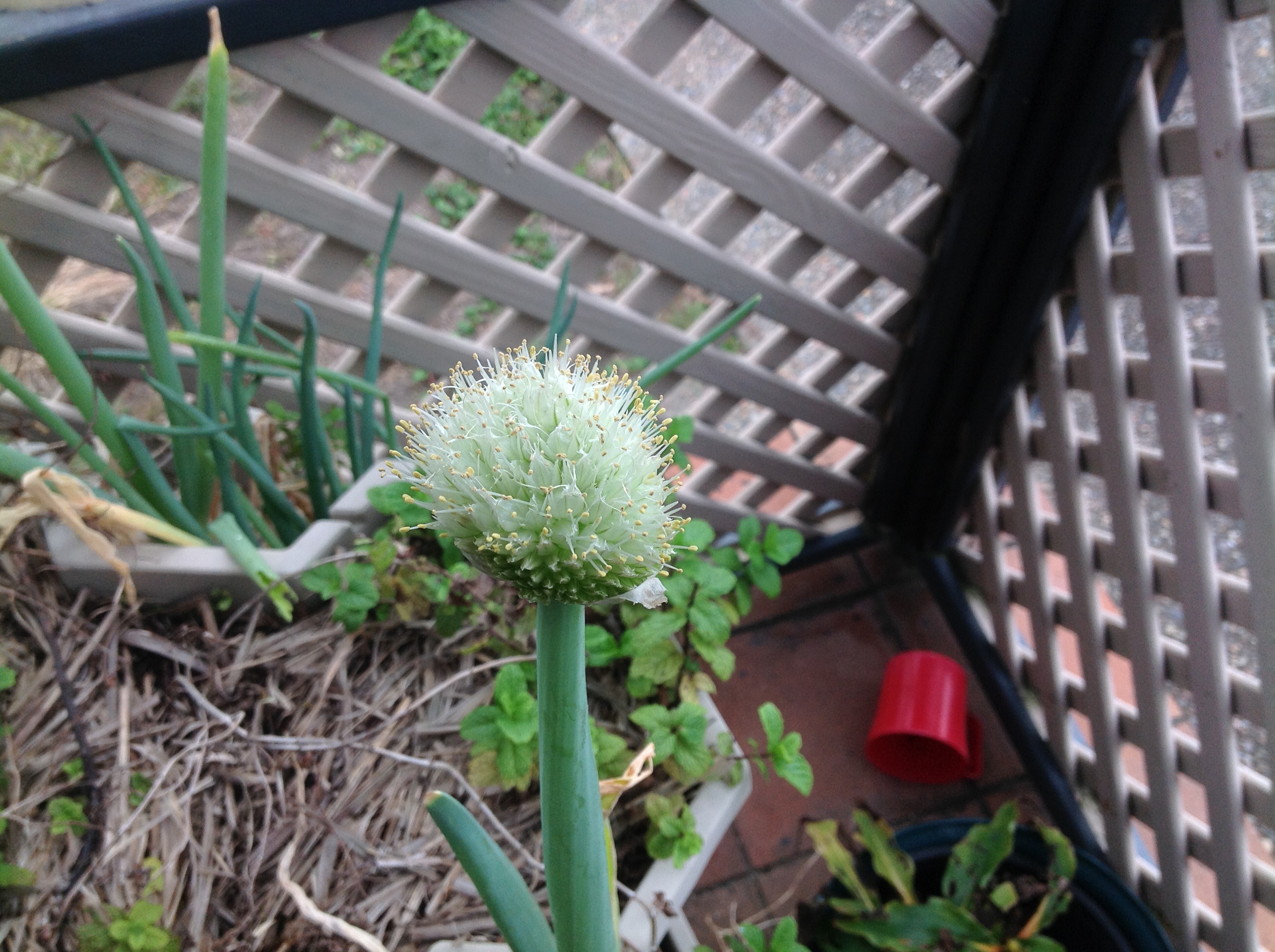
Last week I discovered a flower in my patch of shallots. I was intrigued. I suppose if I had thought about it I would have realised that onions grow from seeds. Don’t most plants grow from seeds? But I hadn’t thought about it. I just bought them in the supermarket or from the greengrocer as I needed them. I definitely hadn’t thought about onion, or shallot, flowers. But this flower is beautiful.
The discovery was a timely reminder that it is all too easy to take too much for granted, to cease to wonder about the amazing things occurring close by every day; to forget to notice and appreciate. Keeping a sense of curiosity alive, in ourselves as well as in children, is a very important thing. So how do we do that?
First of all we need to stop, notice and wonder. Would Newton have noticed the apple fall if he hadn’t stopped to notice and wonder? Would George de Mestral have invented Velcro if he hadn’t given more thought to the burrs stuck to his trousers? Our thoughts do not have to make such an impact on a global scale. They just need to keep the wonderment alive in our own lives. I have talked about the importance of a sense of wonder before here and here.
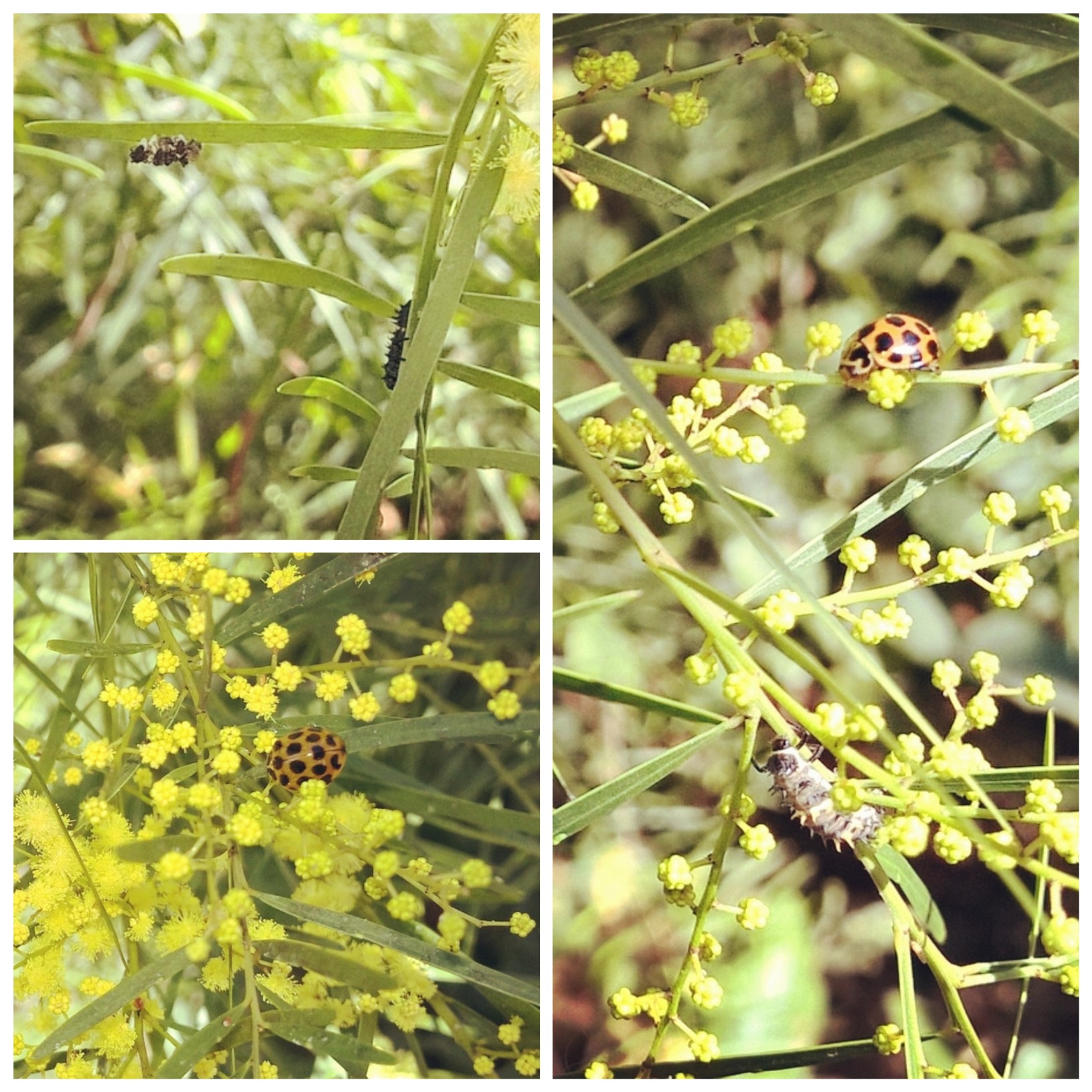
In addition to the shallot flower, I made another recent and amazing discovery in my own back yard. Over the past six weeks or so a wattle tree, planted just over a year ago, has been in bloom. We spotted the buds and eagerly awaited the sweet-smelling blossoms, making frequent inspections and eagerly predicting how long we would have to wait.
During one of these inspections I noticed a ladybird on a leaf. Soon Bec noticed a larva. Then we spotted more, many more, both ladybirds and larvae on the tree. Suddenly it occurred to us that, if there were adults and larvae, there would probably be pupae too. We looked closely and with intent and soon discovered every life stage on the tree, including pupae, eggs and mating pairs of adults. We watched larvae pupate and ladybirds emerge.
I had always enjoyed watching the butterfly’s life stages in the classroom, but to watch the ladybird’s life cycle right in my own back yard is very special. Opportunities such as this are there waiting for us to take notice, waiting for us to share it with others, to inspire curiosity and wonder.
Which brings me back again to onions and the flash fiction challenge set by Charli Mills to In 99 words (no more, no less) write a story that includes onions. I thought she had me stumped this time. Until I thought about the wonder and beauty of the onion flower; the way that delving into the complexity of a character is often referred to as peeling back the onion layers, and the shared ability of both onions and characters, including Marnie, to grow.
As Marnie reaches a sense of closure to and release from the torment of her childhood, she discovers that she no longer needs an onion to hide the real reason for her tears, and can accept that beauty, including her own inner beauty, can spring from desolation and neglect.
Onions
Before she left she was drawn back for one last look at her hiding place. There, between the garden and the wall, her tears would fall as she dreamt of better things and planned her escape.
The veggie garden was hardly recognisable, camouflaged with weeds. But wait! A flower? She stooped to look. An onion flower?
“Ha!” she thought, recalling the times she had pulled up and bitten into an onion to explain her tears should anybody ask, though they never did. Even untended a flower could bloom, as she too had blossomed despite the harshness of those days.
Thank you for reading. I appreciate your feedback. Please share your thoughts about any aspect of this post and flash fiction.

























 Norah Colvin