Live Love Laugh Learn … Create the possibilities

Category: Writing

  • Scratching around the quarry

    charlis-quarry

    This week at the Carrot Ranch Charli Mills has challenged writers to

    “In 99 words (no more, no less) write a about a quarry. It can be a place or include the the by-product. The quarry can be operational, abandoned, it can be in real-tie or mentioned from another time. Where will the quarry take you? Go where the prompt leads.”

    I usually find Charli’s prompts a challenge but, with a bit of digging around in the old brain cells, I can usually concoct something with which I am reasonably happy. This time I’ve been scratching around the surface but have found little worthy of further investigation.

    I considered a story of epic proportions, as I can’t think of a quarry without thinking of Gilgamesh.

    Many years ago, I took my teenage son and a friend to a performance of the ancient story in a disused quarry. Whether it was part of their English or theatre studies, or what prompted the outing, I can’t recall. I think they were no more familiar with this “first great work of literature” than I; and I knew nothing. The performance made a lasting impression, both for its setting and the repetitious dialogue. I recall little of the hero’s epic journey. We were amused rather than awed.

    From Gilgamesh, I considered play of a different, but more familiar kind: play in a sandpit or the dirt with diggers and trucks.

    The sandpit was always popular for play at lunchtime, particularly if diggers, trucks, and other tools were available. Often the same children would play day after day, creating and re-creating the same scene with roads, rivers, bridges, and cities. Each seemed to have a particular role and responsibility. Found objects; like leaves, bark, feathers, sticks, and stones, would also be incorporated into the designs.

    This play was great for the imagination, and for developing the friendship skills of cooperation and getting along, teamwork and working together. Surely I could find a story in there? But any ideas disintegrated faster than the sandpit structures.

    It seems timely then, to revisit previous discussions of the difficulty experienced by children when expected to write to a prompt that may have little significance for them, and about which they may have little opportunity for discussion, reflection or planning.

    I discussed this in both Writing to order – done in a flash! and Writing woes – Flash fiction. I suggested that, rather than  using a one-piece response to a prompt to assess children’s writing, the use of portfolios would provide more valuable information about children’s writing development.

    A portfolio, similar to that of professional writers, would consist of work at various stages: some as ideas jotted on slips of paper, some in planning stages, others in draft form, others completed and waiting for the next step, and others in publication. Rarely would a piece need to be completed in one sitting, let alone judged for it worth on the spot.

    I believe that:

    • a one-off writing assessment task does not give students an opportunity to show their best work and puts pressure on them to perform
    • a portfolio of work collected over time provides a clear picture of student ability, development, and next steps for learning.

    However, that writers have a choice about responding to Charli’s flash fiction prompts, makes the process quite different from that experienced by children responding to a prompt as a requirement.

    Writers have a choice whether to participate, in what genre to respond, and how to interpret the prompt.

    In recent posts Charli has discussed the importance of accepting our first drafts as “raw literature”, as part of the process. She provide us with the opportunity to hone our writing skills, and share and receive feedback on our writing in a safe, supportive environment. Surely this is no less important when encouraging young writers.

    Out of sympathy for the requirements imposed on children almost every day, I thought it only fair to respond to Charli’s prompt. This is it.

    The Quarry

    Old and disused, the bare earth was dry with no hint of topsoil or sign of life. Rock fragments, remnants of its past, littered the surface still pockmarked by tyre tracks. One wall, etched by diggers’ teeth, stood silently telling its story. Circles of ash littered with shards of glass and cigarette butts told another. But tonight it was to tell a story as old as time.  Where once huge trucks had carted away boulders carved from its interior, now rough timber platforms stood.  As darkness fell, flaming torches cast an eerie light as storytellers wove their epic tale.
    Thank you

    Thank you for reading. I appreciate your feedback. Please share your thoughts.


  • Books make the #1 best gifts!

    The love of reading is gift

    I am notorious for gifting books. I’ve written about this before in Guess what you’re getting for Christmas and other posts. It would not surprise me if you are also a notorious gifter of books. Perhaps that could be our super power: The Book Gifters!

    Reading is empowering. A book is a gift that continues to give, long after the occasion has past. It’s effects cannot always be measured.

    books-life-memories

    In this post, I suggest some books you may like to purchase for special people in your life. And why not treat yourself with one or two as well?

    Most, but not all, are fairly recent releases. A few are long-time favourites.

    Most, but not all, are written by people I know personally or through blogging. You might recognise their names from comments on other of my blog posts. A few are long-time favourites written by people who inspire me.

    I have read most. The only two not read (the books of short stories) are very, very recent. However I am happy to recommend them as I am already familiar with some of the stories, and the writers’ work  from their blogs.

    Disclaimer: These are books that appeal to me. They may not appeal to you. The important thing in choosing books for others is in finding something that they will like.

    The list is not exhaustive. It is just a beginning to provide a few ideas that you may not have considered. There are many other wonderful books that could just as easily have been included.

    I have arranged my list in this way:

    For children:

    Picture books (including fiction, non-fiction, and poetry)

    Early chapter books (for readers of about 7 to 12 years)

    For adults:

    Books of short stories

    Novels

    Memoirs

    Books for teachers and parents

    If you follow the links you will be able to discover more about the writers and their other work.

    For children:

    Picture books – Fiction

    picture-books

    Lauri Fortino The Peddler’s Bed This heart-warming story demonstrates that a kindness given can encourage kindness in others. You can read a lovely interview with Lauri on the readilearn blog here.

    Tara Lazar Little Red Gliding Hood In this fun fractured fairy tale, Little Red Riding Hood needs a new pair of skates. The only way she can acquire them is by winning a skating competition. But which fairy tale character will be her partner?

    Galvin Scott Davis Daisy Chain This is a beautifully illustrated, animated and interactive, anti-bullying book app, narrated by Kate Winslet.

    Non-fiction

    non-fiction-picture

    Rebecca Johnson The Insect Series This series of ten little books, each about a different insect, combines both fact and fiction with stunning close-up photographs. You can read a lovely interview with Rebecca on the readilearn blog here.

    Sue Fliess The Bug Book This book about bugs is beautifully illustrated with stunning photographs. Written in rhyme, it introduces children to many tiny creatures.

    Poetry

    book-cover

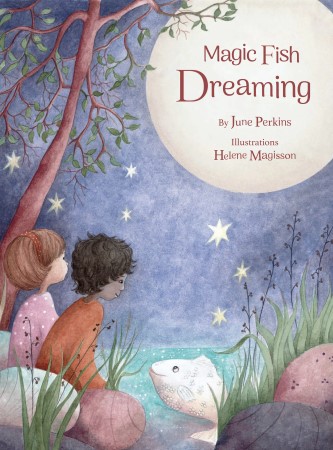
    June Perkins Magic Fish Dreaming This gorgeous book of poems with its focus on nature will uplift and inspire you and your children. You can read a lovely interview with June on the readilearn blog here.

    Early chapter books (about 7 to 12 years)

    early-chapter-books

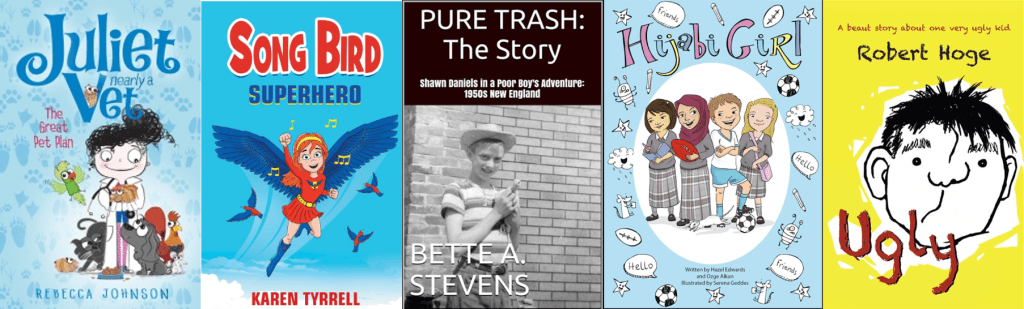
    Rebecca Johnson Juliet nearly a Vet This lovely series of books tells of the adventures of ten-year-old Juliet who aspires to be a vet, just like her mother.

    Karen Tyrrell Song Bird Superhero This story tells of Rosella Bird and her quest to fly. While she battles the bully at school and at home, she is empowered and discovers the joy of flight when she finds her voice.

    Bette A. Stevens Pure Trash: The Story Set in New England in the 1950s, this story tells of a Saturday afternoon adventure of two young boys. The Kindle version is free on Amazon until 29 November (today – be quick!). 

    Hazel Edwards & Ozge Alkan Hijabi Girl In this story, when eight-year-old Melek is deciding what to wear to the book parade, she is unable to find a super-hero who wears a hijab, so she creates her own.

    Robert Hoge Ugly (a memoir) Robert’s story is one of resilience, of survival against the odds, and of making hard decisions. While coping with difference and bullying, Robert shows that strength of character is a trait of survivors. I have introduced you to Robert previously here and here.

    Books of short stories

    short-stories

    Sarah Brentyn Hinting at Shadows This book is a collection of very short stories, each 100 words or less. While each may be a quick read, they will give insight, inspiration, and a greater understanding of what it means to be human.

    Hugh Roberts Glimpses Launching on 2 December, available for pre-order “28 short stories that will take your mind on a rollercoaster of a ride into worlds that conceal unexpected twists and turns.”

    Novels

    novels

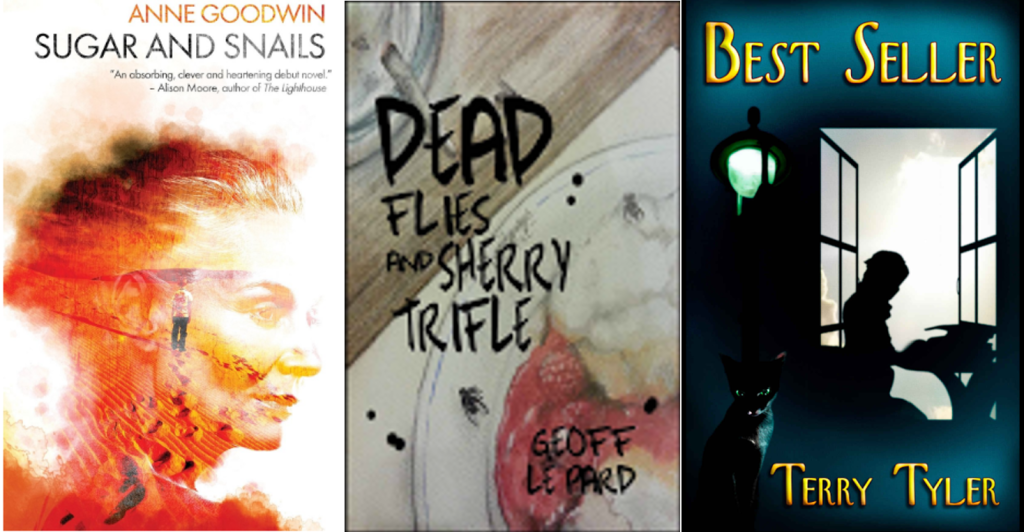
    Anne Goodwin Sugar and Snails In this mid-life coming-of-age story, Diana Dodsworth has some tough decisions to make as she comes to terms with who she really is. Anne has previously talked about her book on my blog here and here.

    Geoff Le Pard Dead Flies and Sherry Trifle This story about nineteen-year-old Harry Spittle, who is home from university for the hottest of hot holidays, will have you laughing out loud at his misadventures.

    Terry Tyler Best Seller This intriguing novella is about three writers, all of whom wish to write a best seller. One does; but which one?

    Memoirs

    memoir

    Robert Hoge Ugly (a biography) Robert’s inspirational story is one of resilience, of survival against the odds, and of making hard decisions. While coping with difference and bullying, Robert shows that strength of character is a trait of survivors. I have introduced you to Robert previously here and here.

    Lesley and Tammy Williams Not Just Black and White Told as a conversation between mother and daughter, this inspirational story tells of the importance of family, of difficulties experienced by many Indigenous Australians in relatively current times, with a drive to ensure that history is neither forgotten nor repeated.

    Malala Yousafzai Malala The Girl Who Stood up for Education and Changed the World The story of Malala, winner of the Nobel Peace Prize, is one of courage and of the difference that one person can make in the world. I have previously written about Malala here.

    Magda Szubanski Reckoning: A Memoir With a Polish father, a Scottish mother and an Australian childhood, Magda’s story is complex, courageous, compassionate, and inspirational.

    Books for teachers and parents

    for-teachers-and-parents

    Mem Fox Reading Magic This book provides lots of practical advice and support for parents in developing a love of reading in their children. I have introduced you to Mem many times previously, including here and here.

    Michael Rosen Good Ideas: How to be Your Child’s (and Your Own) Best Teacher This very readable book is packed full of suggestions for encouraging curiosity and learning in children (and you!) I have previously introduced you to Michael here and here.

    Vivian Kirkfield Show Me How Vivian passion’s for picture books and her understanding of the importance of literacy are obvious in this book that provides great ideas for reading and extending the learning experience associated with many picture books.

    Or, for a special early childhood educator, gift a subscription to readilearn, a collection of teaching resources that can be used throughout the year.

    special-gift-for-special-teacher-ad

    It’s easy. Simply send an email to hello@readilearn.com.au, arrange payment for the currently discounted subscription, and you will be emailed a voucher with a coupon code, unique to your special teacher. Print the voucher and personalise it with your own message before presenting your gift.

    Note: The subscription is for 12 months from date of activation, not purchase: a gift that will go on giving all year long.

    2

    I hope there is something in this list that you can add to your gift list.

    Thank you

    Thank you for reading. I appreciate your feedback. Please share your thoughts.


  • Introducing author and poet – June Perkins – Readilearn

    This week on the readilearn blog I am talking to June Perkins about her wonderful collection of poems for children Magic Fish Dreaming. With the beautiful illustrations by Helene Magisson, this collection is a delight for the ears, the eyes, and the spirit. Read about June’s inspiration for the poems, and use them as inspiration for poems of your own, or use them to inspire poetry writing in your students.

    Read June’s story at readilearn: Introducing author and poet – June Perkins – Readilearn

  • The end

    © Norah Colvin
    © Norah Colvin

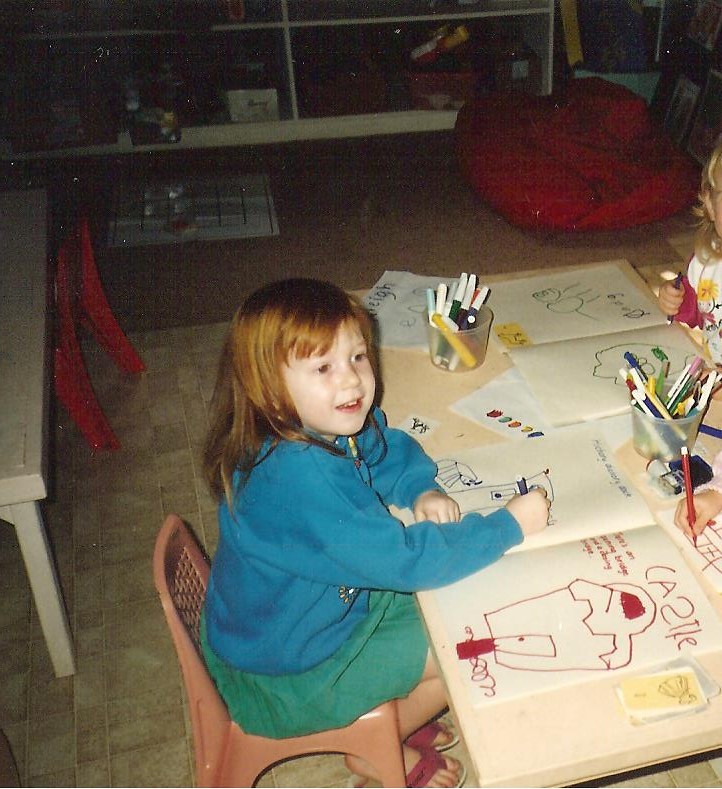
    I have always loved working with beginning writers, rejoicing with them, and sharing their excitement, as they make meaningful marks on paper for the first time.

    Their stories may be just a few writing-like squiggles, one word, one sentence, or one event in length; but the stories in their heads are much more, with elaborate settings, characters and events. Their ability to create stories, for a long time outstrips their ability to express them in written words.

    It is the role of the teacher to acknowledge the effort and, armed with an understanding of the writing process, knowledge of how writing develops, and awareness of each writer’s learning journey and needs, support the learning.

    As soon as they can, many of these beginning writers add the words “The end” to their stories. It gives them a sense of accomplishment, of completion, of a job finished with nothing more to be done.

    But don’t all writers enjoy that sense of accomplishment, of completion, of a job finished?

    However, the reality is that there is usually much more to be done: revisions and rewrites, edits and proofreads, and feedback from readers to consider. The end of the story is only the beginning of the publishing process.

    It is the process of writing that children must also learn. They need to know that not every piece must carry the perfection required of publication. Unrealistic expectations can quickly demolish a child’s willingness to have a go. Appropriate and timely feedback and encouragement is important to the development of beginning writers.

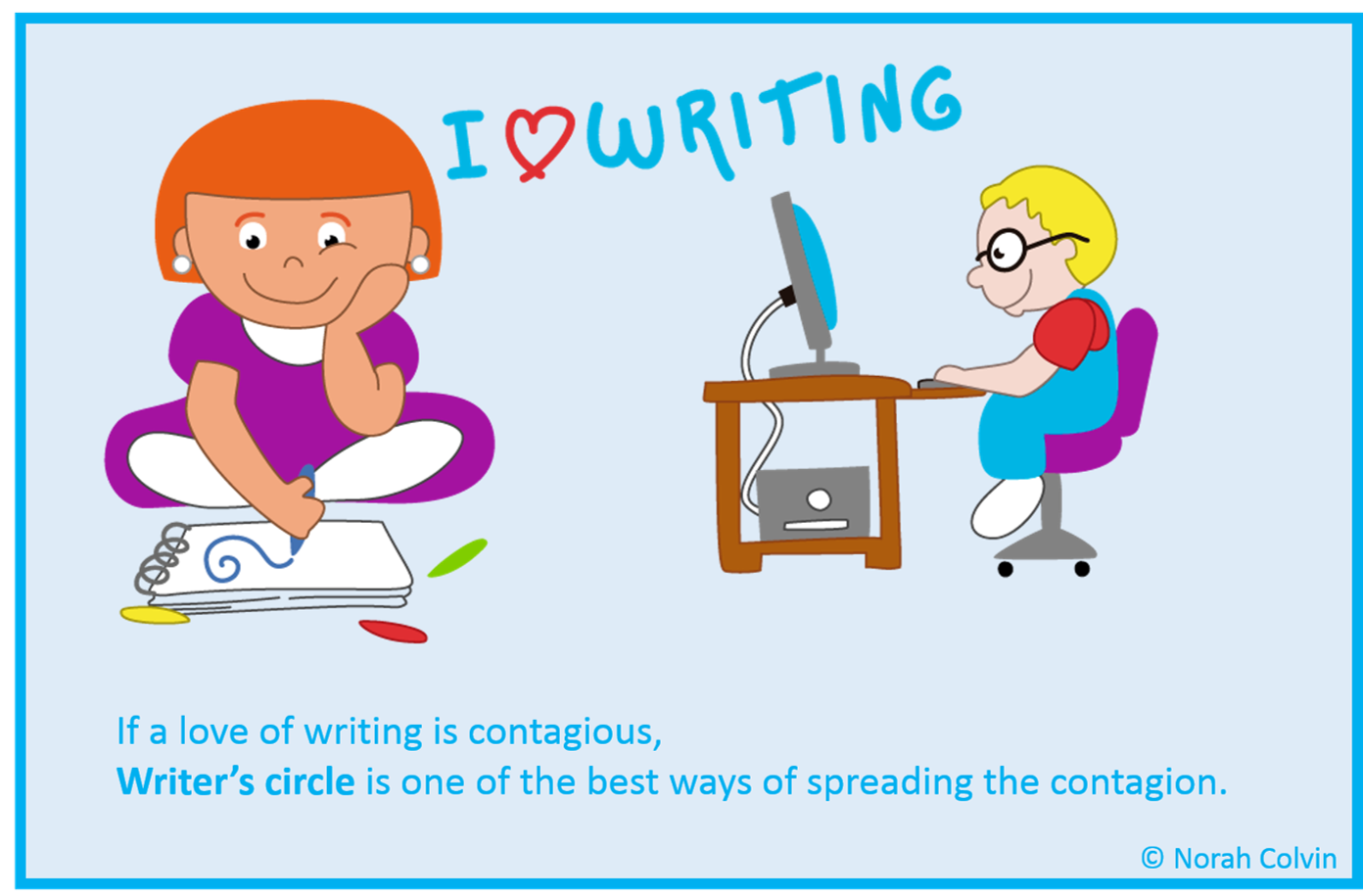
    love of writing

    Providing them with real audiences for their writing provides a purpose and incentive to engage in the process of revision, rewriting, editing and proofreading. Of course, the publication expectations of beginning writers are not as rigorous as for older or professional writers.

    There are many ways of providing young children with readers; including:

    • class books of stories and poems (not unlike the flash fiction compilations of our stories)
    • books made for siblings or children in earlier grades
    • letters written to parents, grandparents, children at other schools
    • blogging, now widely accepted and implemented
    • journal writing

    If all drafts of writing are kept in a folder or portfolio, a favourite can be chosen for improvement and publication. I wrote about this in a previous post: Writing to order. Conferences between the teacher and individual writers are important when choosing a piece and deciding on preparations required for publication.

    The initial conference would be about the content; specifically what the writer wanted to convey, the intended audience, and how the writer wanted the audience to feel.

    When the writer was happy with the message, usually after revisions, edits, and possible rewrites, discussions would focus on choice of words and sentence structures.

    The final conference would target surface features such as spelling and punctuation.

    No red pen is ever used by the teacher to mark a child’s work. All changes are made by the child in pencil. The purpose of conferencing is to help children develop independence in their own writing process. The number of conferences and revisions required would be tailored to an individual writer’s development.

    In order to respond to what has been achieved, it is necessary to understand the individual’s development, and to ascertain whether this piece of writing is reflective of that. Consideration must be given to all aspects of development displayed in the work; for example:

    • is the message clear?
    • is the piece complete?
    • what words are spelled correctly?
    • what language structures are incorporated?
    • does it sounds bookish?
    • does it have elements of figurative or poetic language?

    There is always something new to celebrate in each piece of writing.

    In the end, what is important is to encourage children to write, to wonder, and imagine. The process for young writers is not much different from that of all writers, and their egos are just as tender. We want their engagement with writing to have happy endings.

    This week at the Carrot Ranch Charli Mills wrote that

    “Every good story has a beginning, middle and end. It might be the end of the world as we know it, what comes next?”

    She challenged writers to In 99 words (no more, no less) write a story that pivots around an unexpected ending.”

    The end of my story, I hope, implies a new beginning; and a better one than that of the original I penned. (I’ll let you know at the conclusion.)

    Pretty Princess

    Once upon a time there was a princess, pretty in pink and smothered in cottonwool. In constant preparation for the life arranged for her, there were few opportunities to think outside her royal expectations and obligations: Stand straight. Point your toes. Smile sweetly; and on, and on.

    But think she did: Why does the moon shine? What makes the rain fall? How does the grass grow? Why can’t I: play outside? straighten my hair? eat with my fingers? go to school with other kids?

    One day she said, “That’s it. I’m going.”

    And she did. The end.

    In the original the parents said she’d only leave over their dead bodies. She said that could be arranged!

    “And she did. The end.”

    thank-you-1200x757

    Thank you for reading. I appreciate your feedback. Please share your thoughts.


  • Early childhood resources for celebrating friendship – Readilearn

    Republished from readilearn

    In this post I suggest ways of helping children develop friendship skills, and describe some readilearn resources for celebrating friendship.

    Developing a welcoming, happy, supportive classroom environment, a place where children want to be, is essential for learners of all ages, but especially so in early childhood. These classrooms are the first that children experience and influence lifelong attitudes to school and learning. It is important to establish strong foundations with positive attitudes, respect, and friendship.

    Making friends doesn’t come easily to everyone. Simply being put with a whole bunch of other children of similar ages doesn’t ensure friendships will be established, or that children will be accepting of, and respectful to, others.

    Strategies for helping children develop effective social skills need to be interwoven throughout the curriculum. Respect, kindness, and empathy need to be modelled and taught. It is especially important for children who have had limited experience mixing with others, or for those who respond to others in inappropriate or unkind ways.

    Some useful strategies include:

    • Develop a vocabulary of words used to describe feelings. Words

    Source: Early childhood resources for celebrating friendship – Readilearn

  • 5 forms of poetry to write with children – Readilearn

    I love to write poems. Children do too.

    Giving young children a simple structure or a repetitive pattern to start from gets them thinking about words, how they sound, what they mean, the number of syllables and letters. All the while they are having fun, playing with words and sounds, and learning about language.

    Five easy poems to write with children are:

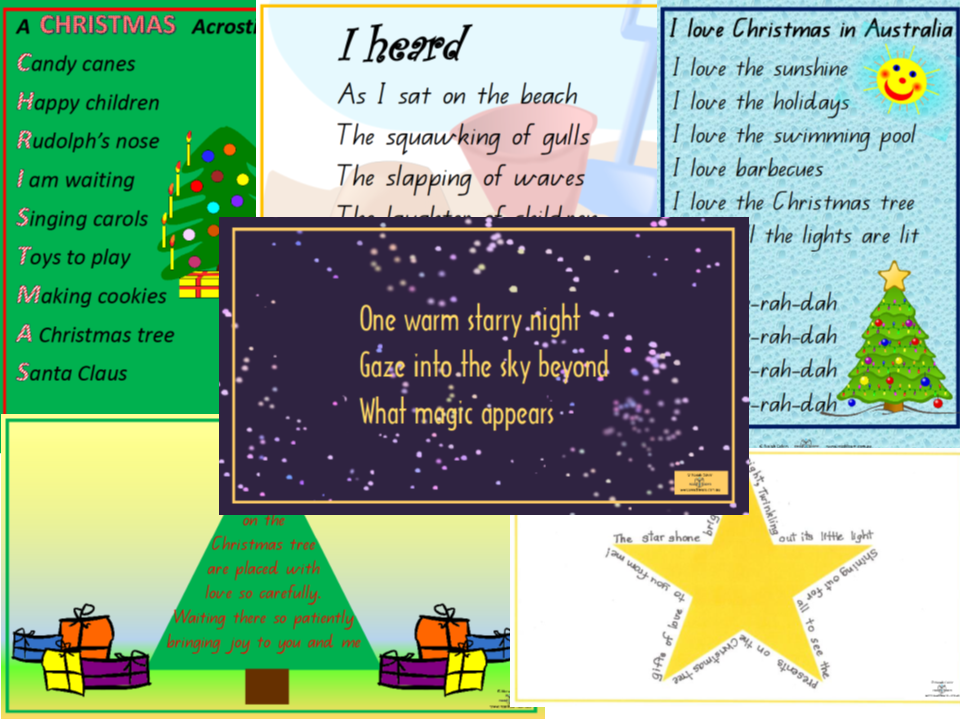
    • Acrostic poems
    • Sound poems
    • Haiku
    • “I love” poems, and
    • Shape poems

    Acrostic poems are one of the easiest. They don’t need to rhyme or follow a set rhythmic pattern.

    Click to continue reading: 5 forms of poetry to write with children – Readilearn


    Thank you for reading. I appreciate your feedback. Please share your thoughts.

  • Halloweensie contest: Spider scare

    trick-or-treat-bag

    Happy Halloween everyone!

    This year for the very first time I am joining in a Halloweensie contest set up by children’s author Susanna Leonard Hill.

    A Halloweensie is a not-very-long (100 words or less) story for children.

    I’ve been getting plenty of practice writing short stories in response to the flash fiction challenges set by Charli Mills at the Carrot Ranch; and, as my stories often feature children, I thought I’d give Susanna’s challenge a go.

    Rules of the contest are:

    Write a 100 word Halloween story appropriate for children (title not included in the 100 words, children here defined as 12 and under), using the words spiderghost, and moon.   Your story can be scary, funny or anything in between, poetry or prose, but it will only count for the contest if it includes those 3 words and is 100 words (you can go under, but not over!)

    Stories must be submitted before Monday October 31st by 11:59 PM EDT.

    There are some very generous prizes for contest winners.

    For more information, check out Susanna’s post.

    I am submitting mine a little earlier in case some of you don’t know about the contest and would like to join in. There’s still time. There’s also plenty of great Halloweensies to read on Susanna’s post if you have time for some fun reading!

    Here’s mine:

    Spider scare

    No moon was out,

    So ghosts were about,

    Looking for people to scare.

    Little Ghost was unsure,

    He’d not joined in before,

    Anxious, hesitating to dare.

    “You’ll be all right.

    Simply give them a fright.

    It’s easy, just give it a try.”

    Dad sounded brave,

    With advice that he gave:

    Nothing would scare him for sure.

    “I’ll give it a go.”

    Little Ghost followed slow,

    As Dad floated up to the door,

    Then let out a scream

    As, down from a beam,

    A spider descended nearby.

    Little Ghost laughed

    At his Dad taking fright:

    A spider like that wouldn’t bite!


    Thank you for reading. And thanks to children’s author Vivian Kirkfield, who blogs at Picture Books Help Kids Soar, for introducing me to Susanna and her fun contest.

    If you are looking for a fun game to play on Halloween, check out the Trick or Treat board game.

    Thank you

    I appreciate your feedback. Please share your thoughts.


  • Author Spotlight: Rebecca Johnson

    This post is republished from the readilearn blog.

    Hi, welcome to the readilearn blog and the first in our Author Spotlight series.

    Spring is here and summer is on its way in Australia. The excitement of new life is everywhere as flowers bloom, birds sing, and insects abound. The excitement flows into the classroom as children observe and record the life stages of the amazing minibeasts that inhabit our world.

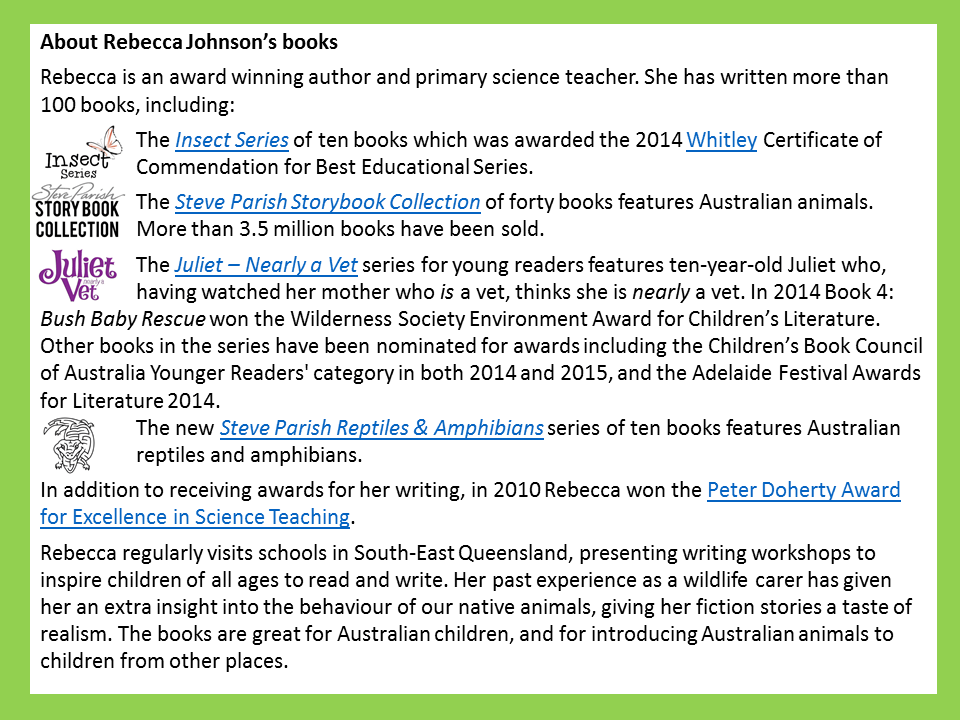
    There is no better time than spring to introduce you to Brisbane author Rebecca Johnson and her Insect Series which was awarded the 2014 Whitley Certificate of Commendation for Best Educational Series.

    rebecca
    Rebecca Johnson: award-winning author and primary school science teacher

    about-rebecca-johnsons-books

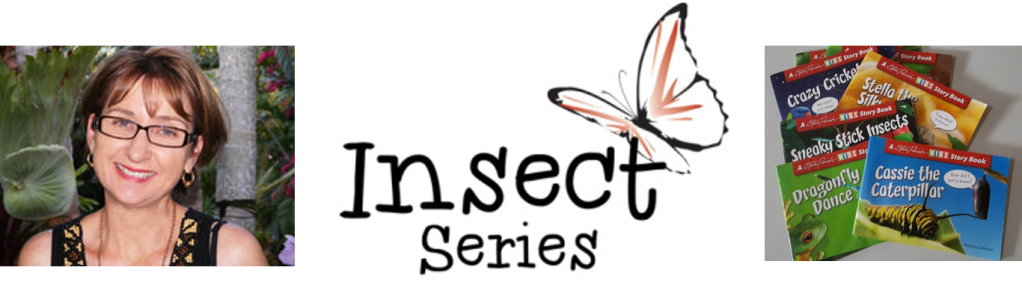
    Rebecca’s Insect Series of ten books focuses on metamorphosis, survival, adaptations, properties of natural materials and the usefulness of insects through fiction stories. The stories are accompanied by stunning close-up photos of insects of all kinds.

    The books, which won the 2014 Whitley Award for Best Educational Series, have strong listed links to the Australian Curriculum for many year levels. They are a great resource for teaching and learning about insects. The fiction stories that accompany the facts make the learning even more fun. Two free blackline masters support the use of each book. The blackline masters can be accessed on the Blake Education Website.

    While the books feature Australian insects and have links to the Australian curriculum, they are loved by children all over the world. I am happy to introduce you to Rebecca and her lovely series of books.

    Welcome to readilearn, Rebecca. We are looking forward to getting to know you a little better.

    Thanks for inviting me!

    When did you know you wanted to be a writer?

    When I was reading a lot of picture books to my very young children and could see how much they loved them.

    Where do you write? Do you like to be by yourself in the quiet, or do you like to write in a noisy space?

    I do most of my ‘writing’ in my head.  I think about my stories for ages and pitch them verbally to victims until I am sure I have it all sorted in my head, then I sit to write in my lovely, quiet study overlooking my garden. I encourage children to tell their stories out loud before they write too, because, in my opinion, it is almost impossible to write a good story if you can’t tell one.

    What do you use to write – pencil and paper or computer?

    Head first. VERY few drafts, then I type it into the computer. I can type a 7000 word novel in a week that is publisher-ready, but I have thought about it and pitched it and sounded it out in my head for weeks beforehand. I hate sitting down all day, and I hate re-doing things over and over even more, so I do heaps of my drafting mentally whilst I do other (fun) stuff like gardening, then by the time I sit down to write, it’s like typing out a movie I know really well. People give you more honest feedback too, when you tell them a story. They feel less nervous about letting you know how they really feel about it. Try it some time.

    When is the best time for you to write?

    I do my best work from 5am when the house is really quiet. I’m always too tired at night (I still teach three days a week) for anything too creative.

    When and where do you get your ideas?

    From my life’s experiences as a mother, teacher, child and my own children. I think you have to write about what you know and love.

    What gave you the idea for this series about insects?

    I am a science teacher and I love insects, and I just couldn’t find the books I needed to succinctly and factually tell kids about the life-cycles and characteristics of insects in a fun way, so I wrote some.

    What do you like best about the series?

    Kids love them because they are funny and a bit silly, but they are still full of facts and information. I think they remember things better if it is presented in more appealing and humorous way.

    What can you tell us about the photographs that illustrate the books?

    My sister (Narinda Sandry) took most of them and it was hilarious. We didn’t want to harm any of the insects, so we had to put some, like the mealworms, in the fridge for a while to slow them down to get the shots. I will always smile as I recall the day we sat around a cow pat in a paddock trying to photograph dung beetles before they re-dug themselves in! The old farmer that had let us into the paddock stood to the side scratching his head in disbelief.

    caterpillar-spread

    How did your feel when you wrote these stories?

    I was really pleased when they came out because the photos are just gorgeous, and they were very well received by schools and parents. Winning the Whitley awards was really lovely recognition too.

    How do you hope readers will feel?

    Hopefully empowered with more information and knowledge, and perhaps inspired to look more closely at the wonderful world of insects and an appreciation of the benefits they bring.

    How would you like teachers to present your books to children?

    I’d love them to make them part of their science lesson, and even team them with some real insects (like mealworms) to make it all so much more engaging. There are two free blackline masters for each one too, that are designed to be able to be used independently by children in reading groups etc. There are heaps of facts inside the covers, and a glossary of terms, so plenty to learn in each one.

    Are there any messages you would like them to discuss?

    The main thing is that insects are so important and not just a good excuse to whack something!

    Do you have any advice for teachers in their role as writing guides?

    As I said earlier….talk before writing as much as you can. It is amazing how hard kids find it to describe something verbally and yet we ask them to do it in the written form all the time with disappointing results.

    Do you have any advice for children as writers?

    Tell, tell, tell, and don’t be too hard on yourself if it takes a long time to get it right. It took me five years to get my first book published.

    What is your favourite picture book? What do you like about it?

    I have so many favourites, but Bob Graham’s Greetings from Sandy Beach always makes me laugh out loud, and humour is really important to me in a book.

    Who is your favourite children’s author? What do you like about his or her work?

    The Lion the Witch and the Wardrobe (CS Lewis).  He made me see a movie in my head. I could picture every scene, decades before there was a movie.  I remember thinking that one day, I wanted to make a reader feel like that.

    thank-you-authors-and-illustrators

    Thank you Rebecca Johnson for sharing these insights about your Insect Series and your writing process. We wish you success.

    Thank you, and thanks for having me!

    To find out more about Rebecca and her award winning books visit her website at rebeccajohnson.com.au. You can find out about and purchase her Insect Series and other books on her website.

    Look what's new

    This interview and information about Rebecca is available as a printable resource in a new subcategory in readilearn literacy resources: Author Spotlight. The information may be displayed in your classroom or included in a class book about authors and illustrators.

    Check out the readilearn resources My Minibeast ABC and Minibeast Alphabet – A list for teachers which can also be used when learning about minibeasts.

    Thank you

    Thank you for reading.

    Happy teaching and learning.

    Norah


    You can contact me:

    via email hello@readilearn.com.au

    via the Contact page

    on Twitter @readilearn or @NorahColvin

    on Facebook @readilearnteachingresources

    on my other blog NorahColvin.com

    I invite you to rate and review any resources you use, and to share information about readilearn on social media.

  • The importance of feedback


    39

    Feedback, whether inherent in the task itself or supplied by another, is essential to learning. This is true whether figuring out what happens when an item is dropped from a high chair (will it always land on the floor; will a carer always retrieve it?), how hard and at what angle to kick a ball to send it over the goalpost; how much a sibling can be antagonised before retaliation ensues; or whether your performance meets expectations.

    In almost all of these cases, the tasks are self-selected and the feedback is integral and immediate, enabling the learner to adjust what happens next accordingly. While those conditions may also be true when considering the success of performance; such as our own assessment of our output, it is not always so.

    F

    Students and employees may be engaged in tasks that are not of their choosing, which provide little inherent feedback, and are reliant upon feedback from others that may be neither timely nor specific to the learners’ needs. Sometimes the feedback can be unhelpful and hinder, rather than encourage, learning, without any real explanation of how improvement could be made.

    As a teacher, I found it necessary for an exchange of feedback between me and my students. This was sometimes supplemented with feedback from carers and other school personnel. How well the students engaged in the classroom, participated in class activities and performed tasks provided me with feedback on my performance as a teacher and provided important information about what to do next, which in turn involved feedback to students.

    While feedback is an essential ingredient in any classroom task, one of the most enjoyable for me was the daily journal. Each morning the children would write to me and every afternoon after they had gone home I would read and respond to their messages. The children loved writing these diaries as much as I loved reading and responding to them. Responding was time consuming but I believe it was worth it:

    • The children had a purpose for writing
    • Their writing had an audience
    • They saw writing as a tool for communication

    When responding to their writing, I would make neither corrections nor changes. However, I would model correct grammar, spelling and punctuation as I responded to the content of their messages. The children were then able to refer to my comment when writing their next message.

    Sometimes the children would tell me about something different each day. Sometimes we would have conversations that could extend over weeks. I always felt it a privilege to have this window into the children’s lives. At the same time, it provided a record of their development as writers.

    At the end of the year I would bundle up all of the journals that had been filled during the year and present them to the children to take home. Recently when I was talking to the mother of a child I taught in the eighties, she told me how they had been looking at those journals with his young children who are now at a similar age to his when he wrote them. How gratifying it is to know that they were treasured by at least one family.

    thank you - rose

    When I started blogging, unbelievably, almost three years ago, I had no idea of what to expect. I am a little more knowledgeable now, with thanks to those who provide feedback by reading and commenting. I am very grateful to all who have joined me along the way. The conversations here or on your own blogs are what have made the journey enjoyable and worthwhile.

    yves_guillou_question

    Now I have a decision to make and I would appreciate your feedback in helping reach it.

    At the same time as I have been blogging, I have been preparing early childhood teaching resources for my website readilearn. I always expected readilearn to include a blog and a newsletter. I knew I couldn’t write that additional content alongside posting twice weekly here and preparing new readilearn resources as well. I thought to:

    • post once a week on this original blog by continuing to participate in the flash fiction challenges set by Charli Mills at the Carrot Ranch, as I have done for more than two years; and
    • post once a week on the readilearn blog with content written specifically for early childhood teachers rather than general readership.

    However, it has recently come to my attention that it may not be possible for readers to leave comments on the readilearn blog, which leads to my quandary.

    I enjoy the discussions in response to posts almost as much as writing them; and

    I am disappointed when I am unable to “like”, leave a comment on, or share another’s blog post I have enjoyed.

    megaphone

    It seems some bloggers are more interested in broadcasting than engaging with a community, but that is not my way.

    Newsletters differ from blogs, though, and the readilearn newsletter, which will provide information about new resources, teaching suggestions and other educational content, will “broadcast” and not invite feedback.

    How important, then, is it to have a blog that doesn’t invite feedback. I’m thinking that, without feedback, I’ll quickly lose motivation.

    What do you think?

    When you read blogs, do you look for an opportunity to add your voice through a “like” button, leaving a comment, or sharing content on social media? Is the ability to engage with the writer important to you, or do you simply read?

    As a blogger, do you welcome comments and discussion, or is it more important just to get your ideas out there?

    Thank you

    Thank you for reading. I am very interested to know what you think and appreciate your feedback. Please share your thoughts.
     

  • #Sugar and Snails BirthdayBlog Tour – The legacy of a Catholic childhood

    www.openclipart.org
    http://www.openclipart.org

    I have been friends with Anne Goodwin who blogs at Annecdotal for almost as long as I have been blogging. While there are many differences in our experiences, there is the right balance of agreement and divergence for friendly and robust discussion to occur. Anne regularly contributes to the conversations on my blog through her thoughtful comments.

    Anne has also visited as a guest blogger twice before. The first was a discussion of The Examined Life by Stephen Grosz. In the second she wrote about the treatment of friendship in her debut novel Sugar and Snails. This post celebrates that novel’s first birthday! Congratulations, Anne. I wish you much success with this and future writing.

    sugar-and-snails cover

    In this post, Anne discusses the legacy of a Catholic childhood. I hope you will join me in welcoming Anne to my blog.

    The legacy of a Catholic childhood

    It was our last evening in Rome, and we’d grown weary of churches, even when they hosted a Caravaggio painting or a Bellini sculpture. But it seemed a shame to leave without a peek inside the church we’d passed almost every day that week on the way to some museum or other attraction. So while my husband walked back to our rented apartment for a pre-dinner cocktail, I pushed through the heavy door.

    Just inside, I hesitated. I hadn’t expected there’d be a service in progress. I was mesmerised: the golden light; the scent of incense, the mournful melody of human voices accompanied by an organ. I registered this, not so much with my eyes and nose and ears, but in my gut. In another country, in a less magnificent church, this had been my childhood.

    Ignoring the disapproving gaze of the usher, I passed through the rope barrier holding back the tourists, to take my place among the congregation. I no longer shared their faith, but I felt entitled to share the ritual.

    My childhood, at Catholic schools, was passed within a bubble. It was something of a culture-shock to discover, at university, that the majority of people I encountered belonged to other religions, or none. Later still, more at ease in the secular world, it was always interesting when friends and colleagues outed themselves as former Catholics. Then there’d be that nod of recognition, a shared heritage marking our psyche more indelibly than the ashen cross the priest would thumb on our foreheads at the beginning of Lent.

    I believe that we are strongly shaped by the past, so what is the legacy of a Catholic childhood? Some have found solace in the beauty of the liturgy and the sense of community while others have had their personalities destroyed through unimpeded clerical abuse. Many, like me, would place themselves somewhere in the middle, regarding Catholicism not as something to celebrate but to recover from.

    The threat of eternal damnation incites fear, or disbelief, and neither is conducive to developing a person’s moral compass. Telling a child what she must believe, rather than letting her discover it, doesn’t facilitate an enquiring mind. While it might seem comforting to be able to believe there’s a God who will always take care of you, you’ve a more secure base if you’ve been brought up by parents who are responsive to your earthly needs. There seems to be a very fine line between putting your faith in magical solutions and the “delusions” of the psychotic mind. And the veneration of suffering and a tortuous death through crucifixion is decidedly odd. As for sex, the risky business of discovering a new kind of intimacy in adolescence is further distorted by the taint of shame.

    sugar-and-snails cover

    When it came to writing my debut novel, Sugar and Snails, it made sense to give my main character a Catholic childhood. Uncomfortable in her skin from childhood, Diana finds no salvation in the church. She recalls morbid childhood games and, aged about eleven, being taken on pilgrimage to Lourdes for a miracle cure for a problem no-one will name. As an adolescent in the 1970s, her knowledge of menstruation comes from the bizarre instruction manual, My Dear Daughter, an exercise in obfuscation of North-Korean proportions, which her mother surreptitiously places on her bed along with a packet of bulky sanitary towels. Although it would be unfair to blame it entirely on Catholicism, she doesn’t have sex until the age of twenty-five and then it’s so dreadful she is celibate for the next twenty years.

    Yet I didn’t want to stuff my novel with my own issues. Firstly, because I don’t think that makes for a good read; secondly, I didn’t want to alienate potential readers, especially not the old school friends to whom my novel is partly dedicated, most of whom have stayed loyal to their childhood beliefs. Fortunately, my novel’s first year of feedback suggests I’ve managed on both counts.

    In preparing this post, I realised that less than half the Catholic scenes from earlier drafts survived to the final version. While there are solid structural reasons for these deletions, it also strikes me that, in the almost seven years I’ve been writing this novel, I’ve become less angry about the past. Perhaps it’s because I’ve worked through it or maybe simply because, as in that church in Rome, I’ve been able to reclaim the good bits. No, I don’t go to church, but I do sing with a marvellous mixed-voice choir. While we have an eclectic repertoire, it’s the sacred works – Verdi’s Requiem, Handel’s Messiah and the like – that really make me tingle inside. For more on the music that shaped my novel, see my forthcoming post on the undercover soundtrack.

    birthday blog tour final

    Please check out some other stops and posts on the Birthday Blog Tour.

    Anne Goodwin’s debut novel, Sugar and Snails, about a woman who has kept her past identity a secret for thirty years, was published in July 2015 by Inspired Quill and longlisted for the 2016 Polari First Book Prize. Her second novel, Underneath, about a man who keeps a woman captive in his cellar, is scheduled for publication in May 2017. Anne is also a book blogger and author of over 60 published short stories. Catch up with Anne on her website: annethology or on Twitter @Annecdotist.

    In honour of its first birthday, Sugar and Snails is available in Kindle format at only £0.99 / $0.99 until 31 July 2016.

    Amazon UK 

    Amazon.com

    Thank you

    Thank you for reading. I appreciate your feedback. Please share your thoughts.