

I am honoured to be featured as a guest on Hugh Roberts’ blog this week as part of his ’49 Days in 1988′ series. If you haven’t yet popped over to meet Hugh on his blog Hugh’s Views and News, please do so soon. As well as writing entertaining and often surprising stories, he is generous with his support of bloggers. Thank you for inviting me over to your place, Hugh.
Category: Writing
-
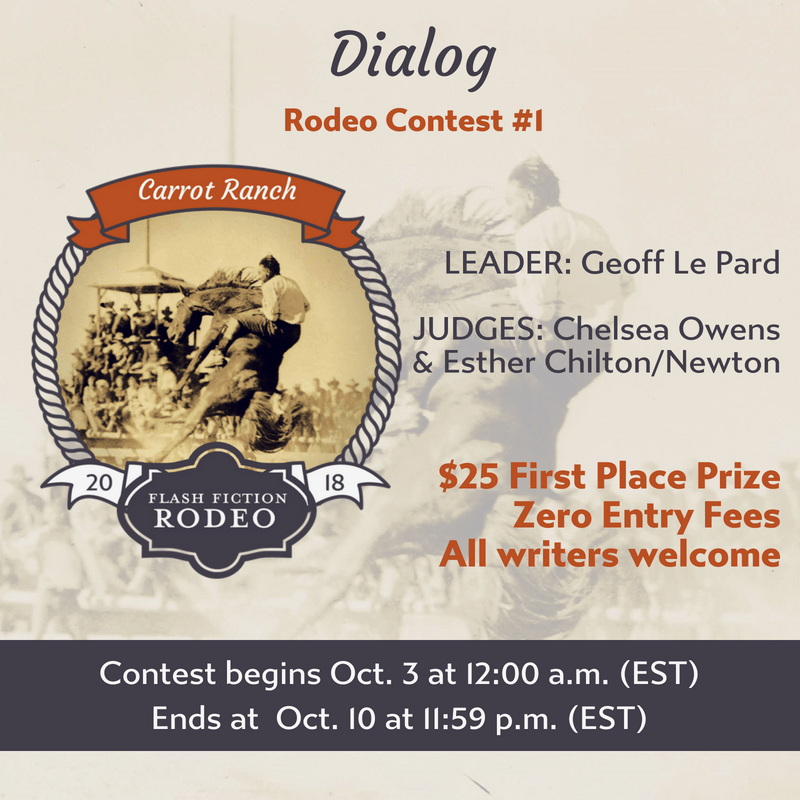
Rodeo #1: Dialog
And so the rodeo begins. Geoff le Pard has introduced the first contest: Dialog. You won’t believe who are conversing. Will you join in?
Share this:
-
Let’s Get TUFF and Rodeo!
Finalists for the TUFFest Ride have been chosen. Are you included?
Share this:
-

All You Need to Know to Rodeo
Are you saddled up ready to write in the Carrot Ranch Flash Fiction Rodeo 2018? The contests get underway this week and continue throughout October with plenty of opportunities to join in and the chance of winning a prize.
Who will be among the TUFF 5 writers? Did you enter? Could one be you.? Or maybe me? Charli reveals all on 1 October. Not long to wait!Share this:
-
#WATWB Children’s Book Authors Take A Stand
On the last Friday of each month, We Are the World Blogfest invites bloggers to join together in promoting positive news. If you would like to join in, please check out the rules and links below.
“There are many an oasis of love and light out there, stories that show compassion and the resilience of the human spirit. Sharing these stories increases our awareness of hope in our increasingly dark world.”
As someone who is passionate about education and children’s books, how could I not be attracted to an article titled Children’s Book Authors Are Selling More Than Books. They’re Taking A Stand?
Some of the issues authors are taking a stand about are the separation of migrant families in detention and gun violence. They are raising money, protesting in marches and writing books.
Click to read the whole article: https://www.nytimes.com/2018/09/05/books/childrens-books-authors-activists-politics.html
If you would like to join in with spreading the good news with #WATWB, here are the guidelines:
1. Keep your post to Below 500 words, as much as possible.
2. Link to a human news story on your blog, one that shows love, humanity, and brotherhood. Paste in an excerpt and tell us why it touched you. The Link is important, because it actually makes us look through news to find the positive ones to post.
3. No story is too big or small, as long as it Goes Beyond religion and politics, into the core of humanity.
4. Place the WE ARE THE WORLD badge or banner on your Post and your Sidebar. Some of you have already done so, this is just a gentle reminder for the others.
- Help us spread the word on social media. Feel free to tweet, share using the #WATWB hashtag to help us trend!
Tweets, Facebook shares, Pins, Instagram, G+ shares using the #WATWB hashtag through the month most welcome. We’ll try and follow and share all those who post on the #WATWB hashtag, and we encourage you to do the same.
The co-hosts for this month are: Eric Lahti, Inderpreet Uppal, Shilpa Garg, Sylvia Stein,and Peter Nena Please pop over to their blogs to read their stories, comment and share.
Click here to join in and enter the link to your post. The bigger the #WATWB group each month, the greater the joy!
Thank you for reading. I appreciate your comments. Please share your thoughts.
Share this:
-
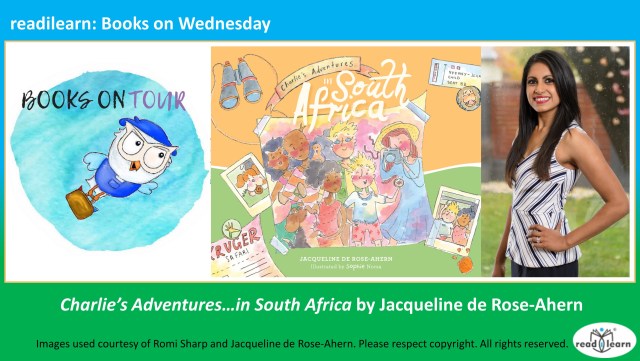
readilearn: Books on Wednesday — Charlie’s Adventures…in South Africa by Jacqueline de Rose-Ahern
This week I have great pleasure in introducing Jacqueline de Rose-Ahern author of Charlie’s Adventures…in South Africa. This post is but one of several celebrating Jacqueline’s beautiful picture book in Romi Sharp’s Books on Tour. Please read to the end of the post for details of other posts celebrating Jacqueline’s work.
About Jacqueline de Rose-Ahern
Jacqueline de Rose-Ahern is a Canberra based author and the recipient of the ACT Writers Centre 2017 Anne Edgeworth Fellowship. Her debut picture book, Charlie’s Adventures…in Hawaii, was shortlisted for the 2017 Speech Pathology Australia Book of the Year Awards and chosen as a finalist in the 2017 American Best Book Awards. Her second book in the Charlie’s Adventure series, Charlie’s Adventures…in South Africa, was recently released. At the heart of Jacqueline’s books are an appreciation of travel and the uniqueness of culture. She endeavours to encourage her readers to learn more about the world, supporting an empathetic and inclusive community.
About Charlie’s Adventures…in South Africa
Charlie is off on the second of his adventures with his family … to South Africa! With his friends, Charlie is set on a discovery of different clues to uncover South Africa’s Rainbow Nation. Join Charlie and his family on their adventures across the world.
The interview
Welcome to readilearn, Jacqueline.
Thanks for inviting me.
Jacqueline, what gave you the idea for this book?
Continue reading: readilearn: Books on Wednesday — Charlie’s Adventures…in South Africa by Jacqueline de Rose-Ahern
Share this:
-
Once Upon a Rodeo Time
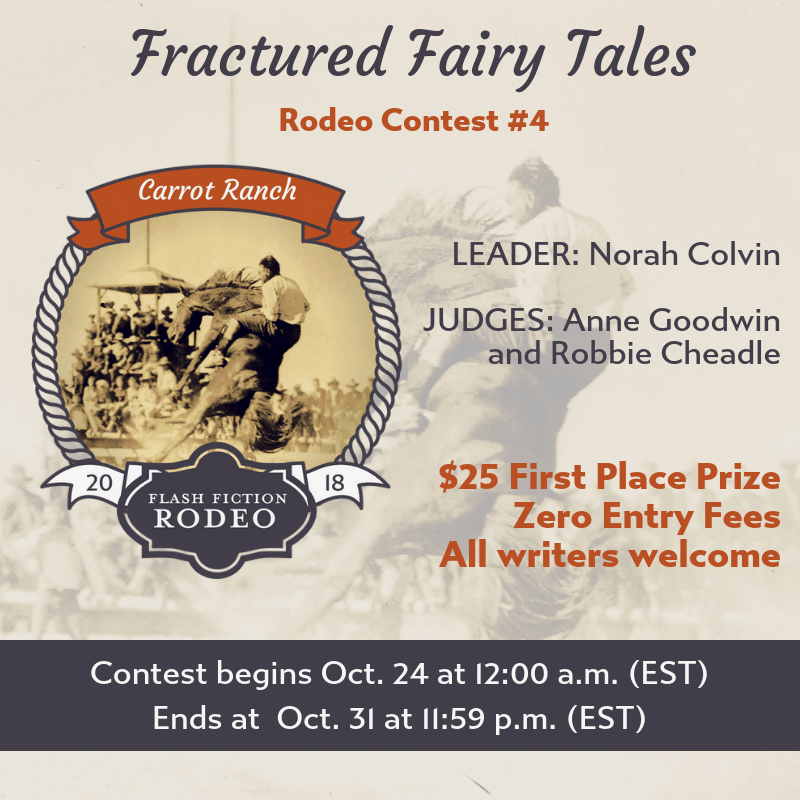
As promised, here’s some information to start your thinking in preparation for the fractured fairy tale flash fiction contest in the Carrot Ranch Rodeo next month. (Try saying that five times real fast!)
Please note: The correct date is Oct 24, not Oct 17 as shown below.
Share this:
-

Wishing on a comet
This week at the Carrot Ranch, Charli Mills challenged writers to In 99 words (no more, no less) write a story about a comet. You can consider how it features into a story, influences a character, or creates a mood. Go where the prompt leads.
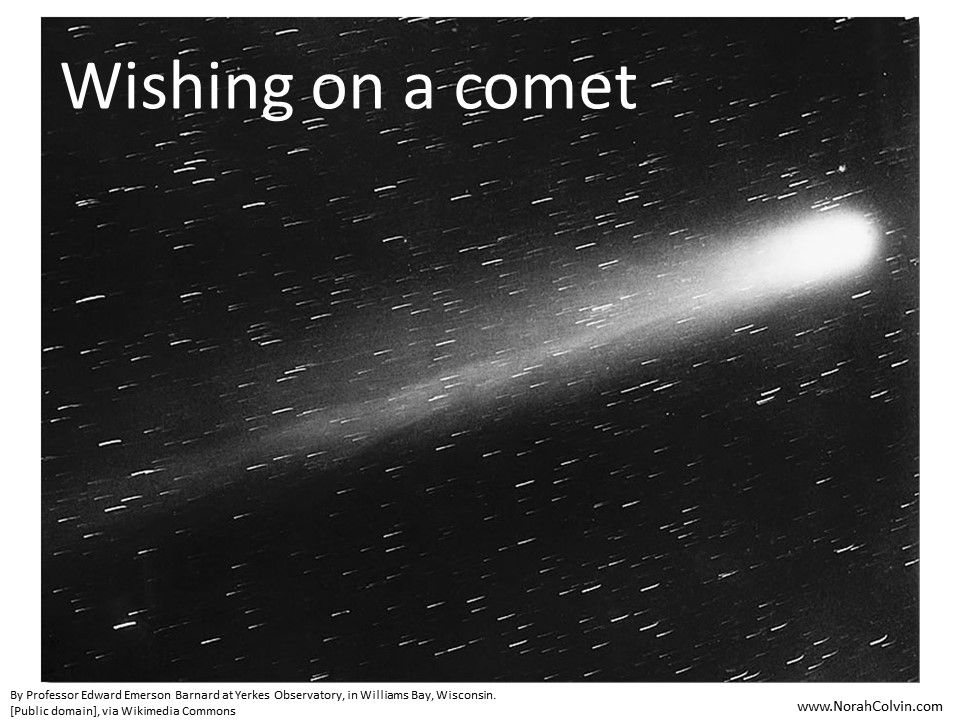
When I think of comets, I think of Halley’s Comet which passed by in 1986. At the time my son was twelve, my daughter was not yet born, and I was teaching a class of seven to nine-year-olds. My son and the children I taught may be lucky enough to see the comet for a second time when it returns in 2061. I wonder how many will still have the time capsule we made that year, and if they have it, think to open it. They will all be in their eighties.
It wasn’t an elaborate time capsule; really just a large envelope with stories and information about us, and I’m not sure what else. I was recently in contact with one of the girls from that class and she remembers the night we had a sleepover at school to look at the comet, and she still has the time capsule she made. I think that’s pretty cool. How special to create these shared memories that last.
My response to Charli’s prompt is about creating shared memories.
You may recall my previous two flash stories, the first of which was my first attempt at writing romance. He invited her to go camping. She was reluctant but gave in when she ran out of excuses. When she arrived at the campgrounds she saw the words “Marry me” spelled out with solar fairy lights. But he was nowhere to be seen.
It got such a good response that I continued the story the following week, leaving the conclusion open-ended. This too received a great response, thank you, and encouragement for me to continue the story along with lots of suggestions and ideas of how to do so. You were undecided about his intentions – were they honourable or not? At the end of the episode, she pushes back the tent flap and screams. But at what? It’s at this moment that I pick up the story, guided by Charli’s prompt. I hope you enjoy it.
An Imperfect Proposal
“What the…?”
He scrambled through bushes, slipping and sliding on twigs and gravel in haste to his love. When he reached her, she was doubled over holding her belly.
“What happened?”
She shook her head.
“What’s wrong?”
“I thought…” Her body shook.
“What?” he soothed, wiping away tears.
“Snake… I thought…” She pointed.
On the bed lay the strap of his telescope bag coiled neatly.
“You’re laughing?”
She nodded.
——
Camping became their family tradition, but their children’s favourite story was of the “snake” that frightened Mum, not of the comet that graced the sky the night that he proposed.
Thank you for reading. I appreciate your feedback. Please share your thoughts.
Share this:
-
A case of the unexpected
Do they still do Greek myths in school? I know I read some in my primary school days, but I never read any to my students when teaching.
The two stories I remember most from school were of King Midas and Pandora’s Box. Both carry strong cautionary messages which had a big impact on me.
King Midas was greedy and when offered a wish, wished that all he touched turned to gold. He was saddened and regretted his wish when even his beloved daughter turned to gold. Lesson: Don’t be greedy. However, I was more horrified at the thought of that young girl trapped in a body of gold. Surely that would be worse than a straitjacket, the thought of which is terrifying enough.
Pandora was presented with a box which she was instructed to not open. What more effective an invitation could there be to a curious soul? Of course, Pandora opened the box. Who wouldn’t? Unfortunately, in doing so, she released all the ills of the world. It is her, so the story goes, we have to thank for illness, plagues, wars, famines and so the list goes on. Lesson: Do what you’re told and don’t be curious. I’m not sure that I learned the lesson from the tale. I’d already had the message firmly installed prior to encountering it.
As I matured I realised that the lessons from stories such as these didn’t always apply and I am now an advocate for curiosity if not for greed. Where would we humans be without curiosity, wonder, and imagination?

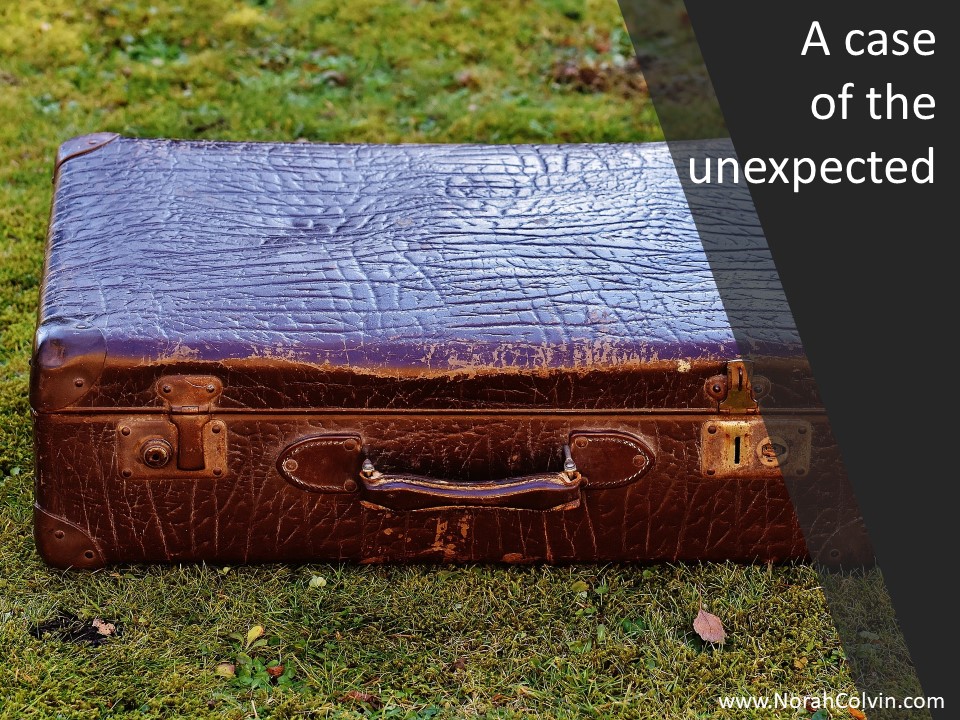
This week at the Carrot Ranch, Charli Mills challenged writers to In 99 words (no more, no less) write a story about what happens next to a stranded suitcase. Go where the prompt leads you, but consider the different perspectives you can take to tell the tale.
The five W questions that we often teach children to use when interrogating a text or preparing to write spring to mind: Who, What, Where, When and Why.
- Who abandoned the suitcase?
- What is in the suitcase?
- Where was the suitcase abandoned?
- When was it abandoned?
- Why was it abandoned?
- Who found the suitcase?
- What did they do?
- Why?
In bygone days, had I come across an abandoned suitcase, I may have investigated it to discover:
- Did it have any value?
- Was it discarded or lost?
- Was there anything of value in it?
- Could I find the owner and return it?
I remember as a child going along with my older brother’s suggestion to create a fake package, tie some fishing line to it, place it in the middle of the road and wait for a curious and unsuspecting pedestrian to come along. (Traffic was infrequent back in those days.) When the pedestrian bent to investigate the package, my brother would pull on the line and the package would move out of reach. We found the response of the pedestrians hilarious and our laughter soon gave away the plot from the bush or fence behind which we lay in wait. Fortunately, they all laughed too when they realised what we were up to.
Nowadays, with warnings about the possibilities of abandoned bags and packages containing terrorist bombs, people may be less inclined to investigate, concerned that the result may be more similar to what Pandora discovered.
For my response to Charli’s prompt, I’ve decided to go with a more innocent age when two children playing in the bush find an abandoned suitcase.
A Case of the Unexpected
“I wonder what’s inside,” said Jamie.
“D’ya think we should open it?” Nicky asked.
They looked around. No one anywhere.
Jamie shrugged. “I guess.”
“Looks old,” said Nicky.
“Probably been here for years.”
“So dirty.”
The rusty catches were unyielding.
“Might be locked,” said Nicky, hopefully.
“Let’s see,” said Jamie.
They pried with sticks, battered with stones and willed with all their might. When the catches finally snapped open, they hesitated.
“Go on,” said Nicky.
“No, you.”
“Both.”
“Okay. One, two, three … open!”
The children’s eyes widened.
“What is it?” asked Nicky.
“Dunno,” said Jamie. “Looks like …”
—
What do you think was inside?
Thank you for reading. I appreciate your feedback. Please share your thoughts.
Share this:
-
Fiction: History that might have been
I have just listened to When Nietzsche Wept by Irvin D. Yalom and was intrigued by the thought that fiction, perhaps more so historical fiction about real characters, tells a story that might have been, of situations that are equally as plausible as the real events. The only difference is, they didn’t happen. The author explains how the events he wrote about, a fictional meeting between the doctor Josef Breuer and the philosopher Friedrich Nietzsche, could almost have happened, were but a hair’s breadth away from happening.
(Note: The book was a recommendation by author Anne Goodwin. Read her review here.)
I often wonder about coincidences, those chance events and meetings that influence our futures, those things that may not have occurred had we been even one second earlier or one second later. It can be fun to contemplate the possibilities of our current situation had an alternate major decision been made. But what of the little events that slip by us every moment. How could a difference in any one fraction of time change our lives?
Memoirist Irene Waters asked a related question in her article Life is a Memoir: What is Fiction? shared at the Carrot Ranch a few weeks ago. Irene begins by saying that “Truth is considered fundamental in writing memoir” but then tells us that memory is not exact, and that it is “a construct and will vary at different times and places”. She asks, “As our remembering creates our identity, then, is our self a fiction?”
Knowing that each witness or participant may tell a different version of an event adds layers to that question. Which versions are fact and which are fiction? Are all enhanced with the fiction of our own perspectives?
Any teacher of young children, or perhaps anyone involved in jury duty, or any viewer of news stories knows, there can be many alternate histories of an event. Deciding where most truth lies can be the difficult part.
“He did it.”
“She started it.”
“It’s mine.”
“He punched me first.”
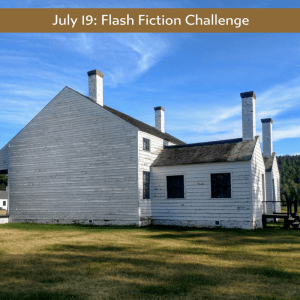
When Charli Mills of the Carrot Ranch challenged writers to In 99 words (no more, no less) write a story about Fannie Hooe. Although she is a legend in the Kewenaw, feel free to go where the prompt leads, I wondered what I could possibly write. I know nothing of the Keweenaw or of Fannie Hooe.
However, in her post, Charli explains that much of what is known about Fannie Hooe is from snippets of things “They say”, alternate histories perhaps, with either some or little resemblance to the “truth”.
Charli wrote, “legend has it, Fannie was a little girl, perhaps the daughter of an officer, who went missing. As they circled the lake they called, “Fannie…! Fannie, hooe! They say, they never found her body.”
Further in her article, Charli goes on to say, “Two historians … knew a great deal about the real Fannie. She was from Virginia and came as a single woman to Fort Wilkins to help her pregnant sister. She was not a girl, but a young lady. They say she went missing, mauled by a bear or murdered by a spurned lover.
Truth is, she returned to Virginia, married and lived a long life.”
This disparity between truth and fiction reminded me of a television program from years ago. As I recall it: three contestants professed to be the person described by the host. Each presented information about “themselves” to panellists whose role it was to judge who was telling the truth. The real person had to be truthful but the imposters could lie. After votes had been cast the ‘real’ person was asked to stand up.
This is my response to Charli’s challenge. I hope you enjoy it.
Truth or Fiction: Will the Real Fannie Hooe Please Stand Up
Contestant 1: I am Fannie Hooe. My pregnant sister was an excuse to escape my abusive husband. After the baby’s birth, I ‘disappeared’, started a new life in Canada, and never remarried.
Contestant 2: I am Fannie Hooe. While visiting my sister, I was abducted by miners and forced to be their slave. When I escaped, I was so disfigured, I wanted no one to see.
Contestant 3: I am Fannie Hooe. I was pregnant, unmarried, and begged my sister to hide me. She refused and banished me. I started a new life in Virginia as a widowed mother.
Thank you for reading. I appreciate your feedback. Please share your thoughts.
Share this:


 Norah Colvin