Live Love Laugh Learn … Create the possibilities

Category: Traditional schooling

  • Caps off for maths!

    This post is republished from the readilearn blog.

    Hi, and welcome again to the readilearn blog. I hope you’ve had a good week.

    Rarely, when the costs of education are being calculated, is the contribution made by teachers from their own pockets acknowledged. It is not very well publicised that many teachers spend a lot of their own money resourcing their classrooms, which would be far less interesting places if teachers refused to contribute in this way.

    Today I demonstrate that not all resources need be expensive. A versatile, free, and readily available resource is the humble bottle cap or lid, which  is often discarded, but can fulfill a number of functions in the classroom.

    collection

    It doesn’t take long to gather an extensive collection of lids even on your own. But ask your children to bring in lids from home and the collection builds even quicker.

    Lids have many uses.

    Children can, for example:

    Sort by colour or size

    sort-colour sort-size

    Order according to size – diameter or height

    order-diameter order-height

    Make patterns – repeating or growing

    growing-pattern repeating-ab-pattern

    Count – by ones, twos or fives

    count-in-onescount-in-2s count-in-5s

    Learn to subitise, and discover conservation of number

    conservation

    Compare, add, substract and share

    compare

    Measure length and mass

    measure-length measure-mass

    Use for collage or craft, or as tokens when playing games

    collage snakes-and-ladders

    These are just a few ideas. What other uses have you found for lids? Please share in the comments below.

    Look what's new

    What’s new – Uploaded this week!

    These ideas and others are  now available in a free maths resource Caps off for maths.

    caps-off-for-maths

    have-you-used

    Getting to know readilearn resources

    Snakes and Ladders is a popular game and great for maths groups. With some guidance from an adult, the game can be used to stimulate mathematical thinking alongside practice of computations. The readilearn resource Snakes and Ladders – An activity for maths groups provides suggestions that can be given to an assistant to maximise learning opportunities while playing the game.

    snakes-and-ladders-printable-preview

    Please contact me if you have any questions. I welcome your feedback, especially suggestions for improvements to existing resources and ideas for new ones.

    Remember, if you haven’t yet subscribed, an introductory discount of 20% is available to all who subscribe during 2016. Just use the coupon code welcome1 at the checkout to receive your discount.

    I’ll see you next week. In the meantime, enjoy the weekend.

    Thank you

    Thank you for reading.

    Happy teaching and learning,

    Norah

    You can contact me:

    via email hello@readilearn.com.au

    via the Contact page

    on Twitter @readilearn or @NorahColvin

    on Facebook @readilearnteachingresources

    on my other blog NorahColvin.com

    I invite you to rate and review any resources you use, and to share information about readilearn on social media.

    All images in this post are copyright Norah Colvin.

  • Why school this way?


    reading

    Any material being read, or listened to, will connect with individuals differently, depending on their prior knowledge and interests. An idea might spark curiosity in one, that another would dismiss as inconsequential. Sometimes a reader will pick at a thread that hadn’t been intentionally placed for further investigation. Oftentimes, authors don’t get to benefit from readers’ feedback, and may not be inspired to conduct further research for themselves.

    But bloggers do!

    Or bloggers with wonderful readers who participate in discussions and share their ideas! I am always grateful to you my readers for your encouragement to keep on learning. You are constantly challenging my assumptions, offering alternate views, and inspiring me to seek more information. I love it.

    The-best-questions-are

    While I emphasize the importance of maintaining a sense of wonder, and of encouraging children to ask questions, I’m not always good at asking those questions myself. I learned that lesson well;  so am appreciative when others stimulate questions.

    During this past week there have been a couple of robust conversations here: one about audiobooks and cheating; and another about common curricula. The conversations branched into fields as different as science fiction and history. Thank you to those who joined in.

    In This too will pass I mentioned that each state in Australia had its own set of curricula. This places an extra burden on children changing schools, particularly interstate. The mention of our new National Curriculum made Charli Mills curious about how US education evolved. She assumed it was fairly uniform across the states, with the school year developed around farming so that children could help out in the fields.

    old school room

    I thought that our Western systems of schooling had originated with industrialisation. However, Charli responded saying that industrialisation had had little influence on education in the West (of the States). So of course I was compelled to check my assumptions!

    A Google search brought me to this document Industrialization and Public Education: Social Cohesion and Social Stratification which does seem to verify a relationship between industrialisation and schooling. (But one of the most interesting things to me is the cost of a chapter, and of the entire book this first page comes from. Have a look!)

    money bag

    I also found an abstract of Chapter 2 Long-Term Trends in Schooling: The Rise and Decline (?) of Public Education in the United States, from another book, that seems to support Charli’s understanding of the homogeneity of education in the United States. I haven’t read it yet, but it could be informative.

    I couldn’t let the topic of schooling and industrialisation go without sharing a talk by one of my favourite educators Sir Ken Robinson. This is a shorter animated version of a longer talk, which I’ve also included if you are interested in listening to the original.

    This is the animated abridged version:

    This is the original:

    Now, I have to wonder, in light of the discussion about cheating mentioned earlier, would watching the shortened version qualify as having watched the talk, or would it be considered cheating?

    Thank you

    Thank you for reading. I appreciate your feedback. Please share your thoughts.

  • This too will pass

    www.openclipart.org
    http://www.openclipart.org

    When the idea of an Australian National Curriculum was mooted, many teachers and parents looked forward to the uniformity that would enable students to move from school to school or state to state without the impediments to learning posed by different curriculums. Each state had its own curriculum, its own school-starting age, its own handwriting style, textbooks, exercise books, and so on. Each state trained their own teachers in different philosophies and pedagogies, and few states gave automatic recognition to qualifications earned in another. In addition to state differences, each school had its own uniform, variation on rules, routines, and culture.

    When children arrived at a school from interstate, making the decision about which class to assign them to was always problematic. Should they be placed with age peers, or with those who had been at school the same number of years, or with those at the same level of achievement? Rarely was there a neat match between even two of these, and there were just as many reasons for and against each placement.

    With a change of school, particularly with numerous changes occurring frequently, children may have missed key areas of learning. Sometimes they would be challenged by work that was too difficult as they had no foundation on which to build. Other times the work would be too easy, often requiring repetition of familiar material. Such was the inconsistency from state to state.

    https://openclipart.org/detail/191190/brother-and-sister-traveling
    https://openclipart.org/detail/191190/brother-and-sister-traveling

    There are many reasons for children and their families to transfer interstate, and not all doing so are itinerant. Some make a once-only move.

    Some families move:

    • when a parent is transferred for work, including military transfers
    • because they are part of a travelling circus or show
    • to obtain seasonal farm work
    • to flee difficult circumstances
    • for a change of lifestyle or location
    • to be closer to, or further away from, family or friends
    • when they lose their home and/or employment.

    There are probably as many reasons as there are families. In addition to differences in curriculum and school culture, each family has its own set of issues to deal with when moving interstate. Not least among these are the emotional and social issues for children who leave behind established routines and possible friendships, and face learning new routines and making new friends.

    How well children cope with the change depends upon many factors, especially the reason for the change and the parental response to it. The number and frequency of changes will also be influential and it would not be unexpected for each to require a period of adjustment.

    school cropped

    Students who arrive one at a time for a lengthy stay, are easier to accommodate than an influx of transient students staying for just a few months; for example, for harvest season. The attitudes of the community in general, including that of teachers, parents and children, are not always positive towards itinerants. Many hold pre-conceptions of families and their children as having deficits in learning, potential, and lifestyle. These views create barriers which can be difficult to overcome, and compound rather than alleviate any problems.

    Of course, while it was hoped that an Australian National Curriculum might overcome the difficulties caused by curriculum disparity, it wouldn’t necessarily be able to address some of those associated difficulties faced by individual children, their families, the schools, and their communities.

    Although the national curriculum has been rolled out, it wasn’t the panacea hoped for, even in with regard to curriculum uniformity. Indeed, the imposition of uniformity of content and pedagogy has been riddled with controversy and it has not been fully embraced, with only partial implementation, in differing degrees, by each state. It has recently undergone a review from which came a number of recommendations for improvements.

    It seems that curriculum disparity cannot yet be removed from the list of problems faced by children when changing schools.

    What got me thinking about these issues this week is the flash fiction challenge set by Charli Mills at Carrot Ranch Communications. Charli, who has recently had homelessness thrust upon her, wrote about some of the issues she is now facing being transient, and how she is learning to cope with them. She challenged writers to In 99 words (no more, no less) write a story about something or someone that is transient. It can be a fleeting moment, a rogue vagabond, or ephemeral like trending hashtags. What is passing by and how can you capture the passing in a flash?

    For my flash, I have decided to write about an itinerant child, one who has been on the move, and faces yet another first day at yet another new school.

    Déjà vu

    “I don’t wanna go.”

    “You have to.”

    “Why?”

    “I have to work.”

    “I could look after m’self.”

    “No. You have to go to school.”

    Tears cascaded as the parent thrust the child onto the back seat littered with clothing, books, and assorted paraphernalia.

    “How long are we gonna be here?”

    “How long?”

    A small hand thumped the door. Feet pushed hard into the back of the front seat.

    Hands trembled on the steering wheel. Ash tumbled.

    “I don’t know.”

    “Where are we?”

    “Nowhere.”

    Finally, with only a cursory glance at the sign, they approached the school office.


    nlyl, reading man with glasses https://openclipart.org/detail/3133/reading-man-with-glasses
    nlyl, reading man with glasses https://openclipart.org/detail/3133/reading-man-with-glasses

    If you wish to do further reading on the topics of itinerant students and the review of the Australian National Curriculum, here are some links:

    STUDENT MOBILITY: ISSUES AND PEDAGOGICAL IMPLICATIONS FOR LITERACY EDUCATORS Dr Robyn Henderson Queensland University of Technology

    Review of the Australian Curriculum Final Report

    Thank you

    Thank you for reading. I appreciate your feedback. Please share your thoughts.

  • The Principal’s Office

    Principal's office

    The thought of being sent to the Principal’s Office is notoriously fear-inducing with the implication that some misdemeanour has occurred and that punishment will follow. Of course, I know this only from the stories of others. It’s true: I have no recollection of ever having been sent to the Principal’s Office during my school days. In fact, I have no recollection of there being a Principal’s Office at all, or indeed who that principal might have been. Perhaps there are some serious omissions in my memory files.

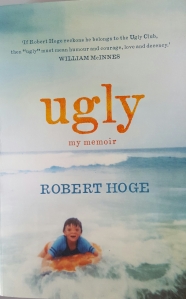
    In a previous post, I introduced you to Robert Hoge and his memoir Ugly through a lying incident he relates. Robert also shares recollections of being sent to the offices of a deputy principal and a principal while he was at school. Both incidents are also included in the version for Younger Readers.

    Ugly coverUgly for kids.PNG

    Robert recalls that,

    Most of the school lived in a vague, unspecified fear of Mr Fuller (the deputy principal). He was the perfect second-in-command. He delivered the bad news when needed and administered a strict, no-nonsense form of discipline that mainly worked by keeping students so in fear of the threat of getting in trouble, they behaved.

    One day when Robert was summoned to Mr Fuller’s office he was informed that some teasing had been occurring. As he was usually the one being teased, Robert was relieved that he wasn’t getting into trouble. Instead of informing on others who had teased him, Robert said,

    “Well, sir, it wasn’t anything really. Nothing that got me very upset anyway.”

    Sadly, though, it was Robert’s turn to be reprimanded for being the teaser. The children who were so good at teasing him, weren’t so good at taking a little teasing in return, and had made a complaint.

    Robert confesses surprise at how much the other child had been upset because he (Robert) “was teased so often … (that he) … became better and better at dealing with it” as he got older. However, it wasn’t just the children who were cruel and sometimes, when adults were cruel, he found it more difficult to take.

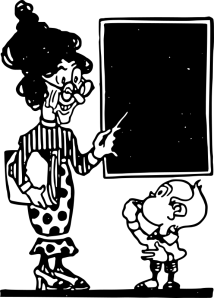
    SnipsandClips, Teacher and Child https://openclipart.org/detail/205589/teacher-and-child
    SnipsandClips, Teacher and Child https://openclipart.org/detail/205589/teacher-and-child

    Robert describes an incident that occurred in year ten when he and another student elected to do a week’s work experience as teachers at a local primary school. He was allocated to a year seven class and the other student to a year two class. Robert enjoyed the week and was pleased that his appearance drew few comments from the students.

    On Friday afternoon Robert was summoned to the principal’s office. Waiting outside, expecting perhaps to get a ‘thank you’ from the principal, he was surprised when the other student wasn’t also there. What happened when he was called into the office is astonishing.

    Without so much as a greeting, Robert was chastised for the school’s not having being warned before he arrived. Warned about what, Robert wasn’t sure. When he enquired, the principal quickly informed him, that she should have been warned about him; that when he’d arrived on Monday they’d had to swap the classes to which he and the other student were assigned. Robert was initially confused as to the reason, then he realised that she was talking about his appearance, that perhaps the year two students would not be able to cope as well as the year sevens.

    Robert was upset. He didn’t know what to say and started to cry. When he said, “I’m sorry”, the principal responded with “Good” and showed him the door. Of course, Robert was distraught. He writes,

    It wasn’t the last time I cried about the way I looked, but it was the very last time I apologised to anyone else for it.

    Each of these incidents occurred in a Catholic school. Anne Goodwin who blogs at Annecdotal recently shared a guest post here about the legacy of a Catholic childhood. I was also educated at Catholic schools. While most of my teaching service occurred in the state system, I did teach for a few years in Catholic schools. I saw and experienced many instances of adults being mean to children. I also saw many instances of kindness.

    For my flash fiction response to this week’s challenge set by Charli Mills at Carrot Ranch Communications to In 99 words (no more, no less) write an office story, I have decided to write an alternative encounter for Robert with a more principled  and compassionate principal. I’d love to know what you think.

    movie board

    The Principal’s Office, Take Two

    “Ah, Robert, come in,” she said, extending her hand and shaking mine as if I was an adult rather than a work experience student. As she returned to her desk, she indicated for me to also sit. I was puzzled. I knew I’d done a good job in the classroom. Why would the principal want to see me?  I waited. She looked at me quizzically. “Robert, I’ve heard a great deal about you this week …”  I squirmed. “… and all of it positive.” She smiled. “I’d like to suggest, if you’re still undecided, that you consider teaching as a career …”

    48

    Although Robert didn’t choose a career in teaching, he has powerful lessons for us through sharing his story.

    Thank you

    Thank you for reading. I appreciate your feedback. Please share your thoughts.

  • #Sugar and Snails BirthdayBlog Tour – The legacy of a Catholic childhood

    www.openclipart.org
    http://www.openclipart.org

    I have been friends with Anne Goodwin who blogs at Annecdotal for almost as long as I have been blogging. While there are many differences in our experiences, there is the right balance of agreement and divergence for friendly and robust discussion to occur. Anne regularly contributes to the conversations on my blog through her thoughtful comments.

    Anne has also visited as a guest blogger twice before. The first was a discussion of The Examined Life by Stephen Grosz. In the second she wrote about the treatment of friendship in her debut novel Sugar and Snails. This post celebrates that novel’s first birthday! Congratulations, Anne. I wish you much success with this and future writing.

    sugar-and-snails cover

    In this post, Anne discusses the legacy of a Catholic childhood. I hope you will join me in welcoming Anne to my blog.

    The legacy of a Catholic childhood

    It was our last evening in Rome, and we’d grown weary of churches, even when they hosted a Caravaggio painting or a Bellini sculpture. But it seemed a shame to leave without a peek inside the church we’d passed almost every day that week on the way to some museum or other attraction. So while my husband walked back to our rented apartment for a pre-dinner cocktail, I pushed through the heavy door.

    Just inside, I hesitated. I hadn’t expected there’d be a service in progress. I was mesmerised: the golden light; the scent of incense, the mournful melody of human voices accompanied by an organ. I registered this, not so much with my eyes and nose and ears, but in my gut. In another country, in a less magnificent church, this had been my childhood.

    Ignoring the disapproving gaze of the usher, I passed through the rope barrier holding back the tourists, to take my place among the congregation. I no longer shared their faith, but I felt entitled to share the ritual.

    My childhood, at Catholic schools, was passed within a bubble. It was something of a culture-shock to discover, at university, that the majority of people I encountered belonged to other religions, or none. Later still, more at ease in the secular world, it was always interesting when friends and colleagues outed themselves as former Catholics. Then there’d be that nod of recognition, a shared heritage marking our psyche more indelibly than the ashen cross the priest would thumb on our foreheads at the beginning of Lent.

    I believe that we are strongly shaped by the past, so what is the legacy of a Catholic childhood? Some have found solace in the beauty of the liturgy and the sense of community while others have had their personalities destroyed through unimpeded clerical abuse. Many, like me, would place themselves somewhere in the middle, regarding Catholicism not as something to celebrate but to recover from.

    The threat of eternal damnation incites fear, or disbelief, and neither is conducive to developing a person’s moral compass. Telling a child what she must believe, rather than letting her discover it, doesn’t facilitate an enquiring mind. While it might seem comforting to be able to believe there’s a God who will always take care of you, you’ve a more secure base if you’ve been brought up by parents who are responsive to your earthly needs. There seems to be a very fine line between putting your faith in magical solutions and the “delusions” of the psychotic mind. And the veneration of suffering and a tortuous death through crucifixion is decidedly odd. As for sex, the risky business of discovering a new kind of intimacy in adolescence is further distorted by the taint of shame.

    sugar-and-snails cover

    When it came to writing my debut novel, Sugar and Snails, it made sense to give my main character a Catholic childhood. Uncomfortable in her skin from childhood, Diana finds no salvation in the church. She recalls morbid childhood games and, aged about eleven, being taken on pilgrimage to Lourdes for a miracle cure for a problem no-one will name. As an adolescent in the 1970s, her knowledge of menstruation comes from the bizarre instruction manual, My Dear Daughter, an exercise in obfuscation of North-Korean proportions, which her mother surreptitiously places on her bed along with a packet of bulky sanitary towels. Although it would be unfair to blame it entirely on Catholicism, she doesn’t have sex until the age of twenty-five and then it’s so dreadful she is celibate for the next twenty years.

    Yet I didn’t want to stuff my novel with my own issues. Firstly, because I don’t think that makes for a good read; secondly, I didn’t want to alienate potential readers, especially not the old school friends to whom my novel is partly dedicated, most of whom have stayed loyal to their childhood beliefs. Fortunately, my novel’s first year of feedback suggests I’ve managed on both counts.

    In preparing this post, I realised that less than half the Catholic scenes from earlier drafts survived to the final version. While there are solid structural reasons for these deletions, it also strikes me that, in the almost seven years I’ve been writing this novel, I’ve become less angry about the past. Perhaps it’s because I’ve worked through it or maybe simply because, as in that church in Rome, I’ve been able to reclaim the good bits. No, I don’t go to church, but I do sing with a marvellous mixed-voice choir. While we have an eclectic repertoire, it’s the sacred works – Verdi’s Requiem, Handel’s Messiah and the like – that really make me tingle inside. For more on the music that shaped my novel, see my forthcoming post on the undercover soundtrack.

    birthday blog tour final

    Please check out some other stops and posts on the Birthday Blog Tour.

    Anne Goodwin’s debut novel, Sugar and Snails, about a woman who has kept her past identity a secret for thirty years, was published in July 2015 by Inspired Quill and longlisted for the 2016 Polari First Book Prize. Her second novel, Underneath, about a man who keeps a woman captive in his cellar, is scheduled for publication in May 2017. Anne is also a book blogger and author of over 60 published short stories. Catch up with Anne on her website: annethology or on Twitter @Annecdotist.

    In honour of its first birthday, Sugar and Snails is available in Kindle format at only £0.99 / $0.99 until 31 July 2016.

    Amazon UK 

    Amazon.com

    Thank you

    Thank you for reading. I appreciate your feedback. Please share your thoughts.

  • How should reading be taught in schools?

    The ability to read is empowering and a fundamental right. Sadly, many children leave school either unable to read or disinterested in reading. There are many reasons for this. Unfortunately, for many children, it is a learned disability. There are almost as many opinions about how how reading should be taught as there are people willing to give them. I don’t always agree with those opinions, but I do with this one by Misty Adoniou, which first appeared in The Conversation on June 21, 2016.
    Thank you
    As always, thank your for reading. I appreciate your feedback. Please share your thoughts.

    How should reading be taught in schools?

    Misty Adoniou, University of Canberra

    When my son was nine years old, he put aside the large Harry Potter novel he had been slowly, but enthusiastically, reading each evening and instead began ploughing through lots of fairly uninspiring books that he brought home from school each day.

    It turned out the Year 4 teachers had devised a competition at his school – whichever class read the most books would be rewarded with an end of term pizza party.

    The aim, I presume, was to motivate the children to read. It is ironic then that the effect was that my son stopped reading for pleasure and instead began reading for the numbers.

    Reading is now increasingly being reduced to a numbers game in schools.

    What level is your child at?

    At pick up time, parents quiz each other about what reading level their child is on. Inside the school staff room, teachers are directed to have children on level 15, 20 or 30 by the end of the school year.

    Six year olds are deciding whether they are good readers or not based on how many books they have ticked off on their take home reader sheet.

    These levels are based on algorithms that calculate the ratio of syllables to sentences, or measure word frequency and sentence length.

    The rationale is that these formulae can be applied to rank books on a scale of readability and thus guide teachers to match books with children’s reading ability.

    There are two key problems with this numbers approach to reading. First, the algorithms are faulty. Second, publishers misuse them.

    What makes a book hard or easy to read?

    The missing variables in readability algorithms are the authors’ intentions, the readers’ motivations and the teachers’ instruction.

    These are key omissions, and they seriously reduce the usability of the algorithms and the credibility of the reading levels they produce.

    Fictional stories often use familiar and high frequency vocabulary, and many authors use relatively simple sentence structures.

    However the use of literary tools like allegory and metaphor, along with challenging text themes, increases the difficulty of works of fiction in ways that are not captured in readability algorithms.

    For example, readability formulae give Hemmingway’s “The Old Man and the Sea” a reading level suitable for primary school students. They may be able to decode the words on the page but comprehension of the book is less likely.

    The same formulae may rank a non-fiction book on dinosaurs, for example, as only suitable for high school students because of its uncommon vocabulary, lengthy sentences and multi-syllabic words.

    Yet a child’s interest and familiarity with the topic, or a teacher or parent’s support and instruction, can make that non-fiction book very readable for younger children.

    Reading schemes

    As readability formulae are not always a good fit for books, the solution has been, instead, to write books which fit the formulae. And publishers have been very keen to supply those books.

    These are the books that our children take home each evening. They are written according to the numbers – numbers of high frequency words, numbers of syllables, numbers of words in a sentence.

    What is missing in those books is author intention and craft, reader engagement and interest, and teacher support and instruction.

    Essentially, then, what is missing in these books is the very essence of reading.

    What books should children read?

    We have been using the reading scheme system for decades and we still have children struggling to read.

    When we use these quasi books to teach reading, we are not adequately preparing them for real reading.

    These books, written to fit algorithms, don’t build broad vocabularies in our children. They don’t teach our children how to read complex sentence structures or deal with literary language or read between the lines. In many cases, they turn children off reading altogether.

    Children learn to read by reading a book that is a little beyond what they can already read. The gap between what they can read and what they could read is reduced when the child:

    • is highly motivated by the content of the book;
    • has existing background knowledge about that content;
    • is receiving good instruction from a teacher.

    We don’t need books arranged in coloured boxes labelled with level numbers to teach a child to read.

    Beautifully written pieces of children’s literature will do the job.

    Books full of carefully crafted writing by authors whose intentions are to engage, entertain and inform.

    Books that teachers can work with in the classroom showing how sounds work in words, and how words work in sentences to make us feel, see or think new things.

    Beautiful books that parents can also buy and delight in reading with their children.

    Why it matters

    The way we teach children to read will fundamentally influence what they understand the purpose of reading to be.

    When we teach children to read through schemes that tally their books, we teach them that reading is simply about quantity. If reading is about getting a reward of a pizza, then children are less likely to read for intrinsic rewards.

    The claims made for well-written children’s literature are many and varied.

    Reading books to your children brings you closer to them, can teach them philosophy and about world issues.

    But they can do something else. They can teach our children to read.

    The Conversation

    Misty Adoniou, Associate Professor in Language, Literacy and TESL, University of Canberra

    This article was originally published on The Conversation. Read the original article.

  • Home is where the start is

    © Norah Colvin
    © Norah Colvin

    Early childhood years, from 0-8, are the formative years. It is during these years that most is learned. Children learn about the world through their explorations. They learn about themselves through the responses they receive from others, and learn about others through these responses also. Attitudes to most things begin in the home.

    Children require warm, nurturing, positive relationships that demonstrate the way life should be lived, in actions, not just words. As Anne Goodwin, former psychologist says, the interactions with significant adults will greatly influence the adult that the child becomes.

    If home is where it starts, then we can’t wait until the children are of school age. By then it’s too late. It is relatively undisputed that it is difficult for children to catch up what may have been missed in those early years. Sadly, much of the intense formal work in school does more to alienate these children further, rather than improve their opportunities for learning.

    Therefore, we must begin in the home, and I don’t mean with formal structured programs. I mean with fun activities that validate parents and children and provide them with opportunities and suggestions for participation and learning.

    Guiding parents in play sessions for parents and children.
    Guiding parents in play sessions for parents and children. © Norah Colvin

    It is these beliefs that informed my home-based business Create-a-way,

    © Norah Colvin
    © Norah Colvin

    and my idea for an early learning caravan that, staffed with an early childhood educator, would

    •  go to the parents and children in their neighbourhoods, meeting in a local park or community greenspace, on regular weekly occasions;
    • invite parents to talk with, read to and play with their children using provided books, games and toys;
    • model positive parenting behaviour, explaining to parents the benefits to their children of engaging with them in activities and discussions;
    • provide suggestions for inexpensive and easy activities to do at home;
    • encourage borrowing from a book and toy library.

    Of course, for many parents, such as those reading this post, nurturing a child’s development is almost second nature. They have the education and resources, and a belief in the benefits, to empower them to nurture their children’s development. They require little additional support.

    Requiring most support are those without the benefits of education, resources or a belief that life could be improved. If all they have experienced through school systems is failure and rejection, they will have difficulty in perceiving any purpose in trying. It is these parents and their children that we need to reach. If they feel valued, they in turn may find value in others. If we improve the lives of those marginalised by poverty or lack of education, it must contribute to improving our society, and our world, in general. This will help us to feel safe in our homes, in our localities and in the wider world.

    This week at the Carrot Ranch, Charli Mills is talking about homes and the importance of having a roof over our heads. The way we treat each other, especially those hurting, indicates there is a greater need for compassion and for those in need to receive a helping a hand.

    In my response to Charli’s flash fiction challenge to In 99 words (no more, no less) write a story about home, I attempt to show that the situation in which one is raised is not always a self-fulfilling prophecy. Out of the cruellest situations, hope can be born. We, as a society, need to do what we can to give hope to many more, to help break the cycle of despair.

    81

    The birth of Hope

    Startled by the blueness of eyes and the intensity of unfamiliar feelings, she suddenly relaxed, as if finally, home.

    She’d not known home before: not locked in a room with hunger the only companion; not shivering through winters, barefoot and coatless; not showered with harsh words and punishments.

    She’d sought it elsewhere, mistaking attention for something more. When pregnancy ensued; he absconded. They kicked her out.

    Somehow she’d found a place to endure the inconvenience. Once it was out, she’d be gone.

    But now, feeling unexpectedly connected and purposeful, she glimpsed something different —a new start, lives entwined: home.

    Thank you

    Thank you for reading. I appreciate your feedback. Please share your thoughts.

  • Can I help?

    81

    I have written a few posts recently about requesting help and the difficulty many of us experience in doing so. It’s a topic that is oft repeated. Not only do many have difficulty in asking for help, we are often unsure about when to offer help, how to help, and whether any assistance will be beneficial.

    20

    In a comment on one of those posts Anne Goodwin, who blogs at Annecdotal, said that the way our first cries for help are responded to in infancy influences our attitudes to asking for help later in life. I suggest that the way we are responded to when offering to help in those early years also influences our attitudes later.

    In an earlier post entitled Lending a helping hand, I asserted that

     “Little ones love to help and hate to be helped in almost equal measure. “Let me do it!” and “I can do it myself!” are two frequently heard phrases in households with little ones. Opportunities for both are essential for their developing sense of self, independence and confidence. Both require a great deal of patience on the part of parents and a larger allocation of time than one would normally feel necessary.”

    Sometimes, when young children ask, “Can I help?”, parents are reluctant to involve them because of the additional time required, and often the extra effort it takes to clean up the mess that may also be created. However, I recommend that the time and energy expended are more than compensated for by the benefits to the parent-child relationship, as well as to the child’s development of knowledge and skills.

    Nor and Bec reading
    © Norah Colvin

    Just as time to play together and read together is factored into the family routine, it is important to set aside time for tasks such as cooking and cleaning that help to develop independence and life skills.

    With cleaning, as with other tasks, it is important to provide guidance and encouragement, and to accept the result. Don’t expect the child’s efforts to match yours. You can always finish off the task later, if you must, when the child is out of sight. Expecting too high a standard or being too critical will discourage a child’s willingness to try again.

    As at home, in the classroom children can take responsibility for cleaning up after themselves and working together to keep the room organised and tidy on a daily basis. It may take a little longer to establish good habits initially, but the benefits are reaped throughout the year.

    When I was in the classroom I provided children with a number of strategies to help them develop organisation skills.

    • At the beginning of the year I showed them how to organise their belongings in their tidy trays so that they could easily find what they were looking for. I made a photo display to provide visual as well as verbal reminders.
    • Throughout the day I would play music or transition games to help them move from one activity to another, and to indicate how much time remained until they were to be ready for the next activity.
    • We had a wonderful programme called You Can Do it! which helped children develop personal and social skills, one of which is organisation. We had a great set of songs to support development of the skills. At the end of each day when it was time to pack up, I would play the organisation song. The children would happily sing along and have the room neat and tidy and themselves ready for home by the time the song ended.

    These simple strategies helped the day run smoothly and required a minimum of instructions and reminders.

    cooking banner
    © Norah Colvin

    Cooking, or more specifically food preparation not necessarily requiring heat, in the classroom requires additional planning which will be influenced by the facilities and support available. Whenever possible I organised cooking experiences for small groups with the assistance of an aide or parent volunteer. This gave children more opportunities for discussion and involvement.

    © Norah Colvin 2016
    © Norah Colvin 2016

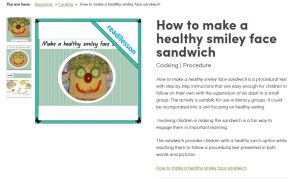
    I always organised for the healthy smiley face sandwich to be made in small groups.

    kebab 1
    © Norah Colvin

    Cutting up fruit and making fruit kebabs is suitable for small groups too. Children can be asked to bring in a serve of fruit to contribute to the choices. We used to have a daily mid-morning fruit snack so it did not require any extra effort on the part of parents, just scheduling on my part.

    © Norah Colvin
    © Norah Colvin

    One of my favourite cakes to cook with children is a moon cake. It is both fun to make and delicious to eat, and provides many opportunities for discussion. It is just as suitable for making in the classroom as it is for home. I have prepared a guided recipe which will be available on my readilearn website.

    © Norah Colvin
    © Norah Colvin

    I recently made the recipe with my grandchildren. They were eager to help and took turns to add and mix the ingredients. There are sufficient things to do to give everyone in a small group an opportunity of being involved. However, it is also suitable to do with the whole class observing while individual children do different tasks.

    tasks to do

    Making the cake provides great opportunities for observing, turn taking, vocabulary development, curiosity, and development of science knowledge. All of these contribute to life skills and experiences. And then there’s the treat at the end!

    © Norah Colvin
    © Norah Colvin

    Although involving children in tasks like cooking and cleaning at home or at school involves extra organisation and time, it is well worth it for the long-term, as well as immediate, benefits.

    Do you have any recollections of helping with tasks at home or at school? How did you feel about it? How has it influenced your current attitudes?

    Thank you

    Thank you for reading. I appreciate your feedback. Please share your thoughts.


  • Don’t fence me in

    This week at the Carrot Ranch Charli Mills is talking about anxiety, panic attacks and agoraphobia.

    The following statements taken from the Mayo Clinic website explain agoraphobia as:

    “a type of anxiety disorder in which you fear and often avoid places or situations that might cause you to panic and make you feel trapped, helpless or embarrassed.”

    “The anxiety is caused by fear that there’s no easy way to escape or seek help if intense anxiety develops.”

    “Most people who have agoraphobia develop it after having one or more panic attacks, causing them to fear another attack and avoid the place where it occurred.”

    “Agoraphobia treatment can be challenging because it usually means confronting your fears.

    Sometimes, as Charli says, we can face our fears head on and defeat them with the choices we make. Other times we may need support to help us overcome them. Sometimes therapy and medication may be needed to help those suffering the debilitating effects of anxiety. I will not be discussing those paths in this post. Nor am I going to talk about the anxieties of children with Asperger’s or Autism. There are others who do a much better job of it and are much more knowledgeable than I, such as Sherri Matthews and Shawna Ainslie.

    school cropped

    However, it is not uncommon for a child to occasionally feel anxious and stressed by situations that occur at school. The incidence increases when children are placed in situations that are inappropriate to their development and don’t respect their needs. Sometimes the anxiety and stress is manageable and alleviated by more appropriate circumstances outside of the school environment. But sometimes the distress to the child and family can increase to a level at which more help and support is required.

    A school environment more suited to children’s needs would reduce the number of anxious and stressed students, parents, and teachers. Creating a nurturing and supportive school environment requires a firm understanding of child development and a belief in their ability to learn. It also requires that children are respected and appreciated for who they are, and that they receive timely and appropriate feedback, encouragement, and support.

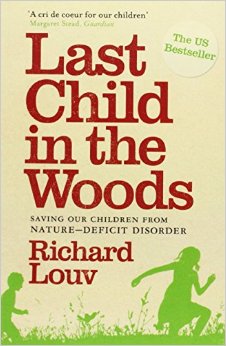
    last child in the woods


    In recent posts I have mentioned the importance of play, and of time spent in, and learning outdoors, in nature. In his book Last Child in the Woods, Richard Louv espouses the importance of nature to the development of healthy children, as well as to the physical health and well-being of adults. Perhaps more time in nature would provide the calm that is needed to combat the hustle and bustle of modern life and pressures of formal, test-driven classrooms.

    In fact, it is not just “perhaps”. In his article The School of Nature Louv provides evidence of benefits to learning that nature-based and place-based education can bring. He says, “greening schools may be one of the most cost-effective ways to raise student test scores.

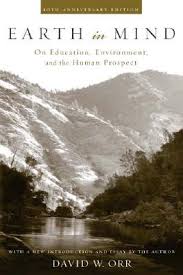
    earth in mind

    David Orr agrees. In his book Earth in Mind: On Education, Environment and the Human Prospect, he also stresses the importance of learning about, from, and in nature.  He says, that, “all education is environmental education. By what is included or excluded we teach students that they are part of or apart from the natural world.”

    It is easy to talk about the failings of the school system and suggest ways it could be improved. It is more difficult to make the desired changes happen. While the majority of teachers work hard to create warm, supportive, nurturing environments for children, there are many situations over which they have no control. It is important then to have strategies for dealing with anxiety and stress if they occur.

    stress can really get on your nerves

    I recently came across a book that may be useful if your child tends towards anxiety.  Stress Can Really Get on Your Nerves aims to provide children with strategies for coping with stress. Written by Trevor Romain and Elizabeth Verdick, it is published by free spirit Publishing as one of a series aimed at helping 8 – 13 year-olds “get through life rough spots”. With Trevor’s fun, cartoon-like illustrations on every page, the book promises to turn stressed out kids into “panic mechanics” with a toolkit of suggestions for reducing their own stress levels. I’d have to say, they’re not bad strategies for anyone’s toolkit.

    https://openclipart.org/detail/2921/toolkit
    https://openclipart.org/detail/2921/toolkit

    I first heard about the book on the free spirit publishing blog in a post by Trevor in which he explains how drawing helped him cope with his learning difference. Trevor may be an outlier, but his story certainly provides inspiration for those who struggle in the traditional classroom.

    cropped forest

    I think time outdoors, breathing the fresh air, and enjoying the natural world is a great antidote to stress. I may no longer gambol in the grass, but I can sit in stillness and quiet, appreciating the beauty around me as I unplug from technology and reconnect by grounding myself in nature. I’m not sure how that works for agoraphobics with a fear of open places though. Perhaps having more time in nature as a child and learning techniques for coping with anxiety and stress could work as a preventative. But it’s only a thought. I am no expert.

    This brings me back to Charli Mills and her flash fiction prompt to In 99 words (no more, no less) write a response to an agoraphobic moment.  I have used the Mayo Clinic’s broader interpretation rather than the “narrow” definition of “fear of open spaces”. (I’d rather not be fenced in!) I hope my story portrays a recognisable response that could occur in a variety of circumstances. Please let me know what situation you think of as you read, and whether you consider my attempt successful.

    Confrontation

    She could hardly manage to chew, let alone swallow, the morsel of cereal occupying her mouth.

    Her vacant stare and stifled moans alerted him.

    “Are you okay?”

    “I’m trying,” she mumbled, and squeezed her hands between her quivering knees.

    “You’ll be fine. You haven’t had an attack for months. And, you’re prepared.”

    “I know.” She pressed her arms against her gurgling belly. “But …”

    He waited.

    Finally, she looked at him. “But …”

    He sponged her clammy forehead.

    She looked away. “What if they don’t like me?”

    “They won’t like you. They’ll love you. Come on. I’ll take you.”

    What did you think of as you read? I wrote the piece about young teacher about to meet her first class. Did you pick it?

    While anxiety about school is more commonly thought of as presenting in children, it is not uncommon for teachers to suffer from school anxiety as well. We accept that teaching is a stressful role, but for some it can also cause anxiety.

    I think there are few who are immune from anxiety. We need to be more open in talking about mental health in general. Recognition, acknowledgment and supportive discussion are important factors in helping to overcome the effects of anxiety.

    Thank you

    Thank you for reading. I appreciate your feedback. Please share your thoughts.

  • Formal Schooling and the Death of Literacy

    Paul Thomas in this post describes the literate home environment of his early childhood days, an environment that created his advantage, his privilege in becoming literate.
    He also describes the tedium of school days that had to be endured rather than enjoyed, and decries the cult of measuring and labeling texts and students that “murders literacy among our students“.
    He goes on to say that “The very best and most effective literacy instruction requires no textbooks, no programs, and no punitive reading policies.
    Literacy is an ever-evolving human facility; it grows from reading, being read to, and writing—all by choice, with passion, and in the presence of others more dexterous than you are.
    I couldn’t agree more.
    If you enjoy this post by Paul, check out this follow-up post Everyone Learns to Read by Direct Instruction on his blog the becoming radical. You may find many other posts of interest as well.

    Thank you

    Thank you for reading. I appreciate your feedback. Please share your thoughts.

    plthomasedd's avatardr. p.l. (paul) thomas

    My privilege is easily identified in my being white and male, but it is the story of my life that better reveals my enormous privilege established by my mother when I was a child.

    I entered formal schooling with such a relatively high level of literacy and numeracy that from those first days I was labeled “smart”—a misnomer for that privilege.

    From Green Eggs and Ham to Hop on Pop, from canasta to spades, from Chinese checkers to Scrabble—games with my mother and often my father were my schooling until I entered first grade. And none of that ever seemed to be a chore, and none of that involved worksheets, reading levels, or tests.

    Formal schooling was always easy for me because of those roots, but formal schooling was also often tedious and so much that had to be tolerated to do the things I truly enjoyed—such as collecting, reading…

    View original post 1,019 more words