Live Love Laugh Learn … Create the possibilities

Category: Traditional schooling

  • Clearing confusion – reading and writing for the masses

    This week at the Carrot Ranch, Charli Mills is talking about disorientation and has challenged writers to In 99 words no more, no less) write a story about disorientation. She suggested exploring different ways confusion could be expressed, and the tension that could be created by that confusion.

    I decided to give myself a break from writing about the confusion that students may feel as they attempt to navigate the murky waters of expectations and inappropriate curricula that have little connection with their lives; or about how disoriented they may feel in an environment that bears little resemblance to any other they will experience.

    Instead I decided to share an interesting story I heard this week and a flash fiction which is more memoir than fiction, a reminder to self of how lucky I am to be doing what I am.

    First for the story.

    My current audiobook is Alphabetical: How Every Letter Tells a Story by Michael Rosen. In the book Rosen talks about the English alphabet, dealing with each of the 26 letters in turn. He has organised the book so that

    “Each letter in the book is linked to a topic. Each chapter takes on different aspects of how the alphabet has been used. Each chapter is preceded by the short story of how that particular letter evolved, how its name came to be pronounced that way and something on how the letter itself is spoken and played with.”

    K

    When listening to Rosen read his chapter about the letter ‘K’, “K is for Korean”, I was fascinated to find out that the alphabet of South Korea, Hangul, is “the earliest known successful example of a sudden, conscious, total transformation of a country’s writing.”

    The alphabet, described by Rosen as more of “syllabic monograms” than letters and is easy to learn, was devised in the mid-fifteenth century by the ruler of the time, King Sejong, as a way of enabling everyone to be literate.

    Prior to the introduction of this alphabet, Chinese characters were used. According to an article on Wikipediausing Chinese characters to write was so difficult for the common people that only privileged aristocrats usually male, could read and write fluently. The majority of Koreans were effectively illiterate before the invention of Hangul.

    Rosen says that what is “remarkable . . . is that there was an already existing system of writing which was, to all intents and purposes, overthrown in its entirety – not adapted. (It happened) because one part of the ruling elite decided that a total change was the only way in which everyone could read and write easily.

    Hear! Hear! I say, and express a wish that all our students of English would find learning to read and write far more easy and enjoyable than many do, that more emphasis would be placed upon helping students learn than in “teaching” particular content at particular times.

    Also included in Rosen’s chapter about ‘K’ was mention of the Voynich Manuscript which appears to be scientific in origin, but which contains fictitious plants and is written in a “language” which no one, including codebreaking experts, has been able to decipher and read. Rosen says that “With one beautifully executed volume, (the author) causes instability and doubt at the heart of the production, ownership and use of knowledge. It is a carefully constructed absurdist joke.

    Unfortunately for a small (but too large) number of our students, reading and writing for them is often as confusing as the Voynich Manuscript.

    Man-resigning


    For a little bit of reminiscing, here is a video of Michael Rosen talking about the dreaded Friday spelling test. I wonder how his experience matches yours.

    And so to my flash fiction of disorientation and confusion . . .

    Obfuscation

    The pulsing train wheels pounded in my head.

    Way off in the distance voices called instructions to each other.

    “What day is it?” I said.

    The voices were closer now. “She’s in here.”

    “Can you walk? Come with us,” they said.

    They led me to a vehicle and bade me lie down inside.

    Then came the questions:

    What’s your name? When were you born? What day is it? Why are you here? Who are you with?

    Slowly, as if from the deepest recesses, I drew each recalcitrant answer, recreating identity.

    “You’re okay. You bumped your head,” they said.

    Thank you

    Thank you for reading. I appreciate your feedback. Please share your thoughts about any aspect of this post or flash fiction.

  • In their own time

    This quote by Albert Einstein is one of my favourites:

    “The only reason for time is so that everything doesn’t happen at once.”

    https://openclipart.org/image/800px/svg_to_png/20496/CoD-fsfe-calendar.png
    https://openclipart.org/image/800px/svg_to_png/20496/CoD-fsfe-calendar.png

    Without the addition of a date to signify, I would find it difficult to separate out the memories and distinguish how far apart events occurred or in which sequence.

    If the “The only reason for time“ was applied to the school situation, it might be quite different, for example,

    “The only reason for time is to ensure that everyone is doing the same thing at the same time.”


    school cropped

    In previous posts I have talked about the importance of having a growth mindset and the power of ‘not yet’ thinking. Most respondents to these posts agreed on a preference for thinking about their own goals as not yet achieved, rather than as failed to achieve. Much like for a twelve month old child who is not yet walking, ‘not yet’ implies no failure, just steps in the right direction, an expectation of success, when the time is right and the child is ready.

    https://openclipart.org/image/800px/svg_to_png/20496/CoD-fsfe-calendar.png
    https://openclipart.org/image/800px/svg_to_png/20496/CoD-fsfe-calendar.png

    For many things we do in life there is no hard and fast rule about when they should be achieved. Most developmental milestones are presented as an average, a range of ages during which time most will achieve. But the edges are blurred and, unless attainment falls way beyond the guide, there is generally no cause for concern.

    When it comes to school learning there is much more anxiety about achievement and reaching particular benchmarks by certain ages. Anne Goodwin hinted at this is her comment on my post Reading is out of this world. Anne said,

    “we need to create the conditions in which children want to learn to read and to continue reading regularly. Sadly, I think some kids are put off by attempts to teach them to read before they are ready, which just gives the message that it’s hard or boring or both.”

    She said that we need ways to “get them in their own time, to where they need to be.”

    Anne is right. Children may be put off reading by attempting to teach them before they are ready; just as often, I would add, by inappropriate methods that present reading as a series of unrelated skills devoid of context, meaning and enjoyment.

    Children may come to reading at various ages and in various ways. Some read early. Mem Fox says that, if she were queen of the world, “children would learn to read easily, long before they came to school”, like my two did.  Others suggest a “better late than early” approach or not hurrying the child.

    I think it is important to recognise that a ‘one size fits all’ approach has no place in education. I would love Mem Fox to be queen of the world and for all children to learn to read easily and with joy before school age, but there is much to do for that ideal situation to exist. David Elkind says that no one believes in hurrying children but parents, educators and legislators can always find a reason to do so.

    Being out of step with peers can be a great cause of anxiety; and anxiety begets anxiety which further impedes learning, as shown in this presentation by Heidi Lyneham.

    To improve the situation for learners we need to recognise that

    • Learners learn in their own time. We need more flexible timeframes that honour each child’s development and learning journey.
    • Learners learn in ways that are as individual as they are. However there are conditions which improve the chances of learning occurring, such as these conditions for literacy learning  as proposed by Brian Cambourne.

    In her comment on my post Reading is out of this world, Nicole Hewes indicated support for this view by describing how she assisted a student’s learning by providing books about whales, a topic the student was greatly interested in.

    Along with the recognition of different timeframes, there must be recognition of and value placed upon the time required by students to develop the skills; and time and opportunity must be provided for that development.

    Just when I was writing this post, Bec, who loves to look after my reading and learning needs, sent me a link to this article by Pernille Ripp who asks,

    “Why do we forget that time to read is the one thing readers need the most to become better readers?”

    And then Charli Mills of the Carrot Ranch posted her flash fiction challenge for this week: In 99 words (no more, no less) write a 2 a.m. story.

    Time: everything was pointing in the same direction.

    Thinking of a learner’s timing being out of sync with that of others made me think about waking up in the middle of the night (say 2am) and not being able to get back to sleep; knowing that one should be asleep; that everyone else is asleep; that one needs to be asleep because there’s a “big” day head. And all the while the anxiety grows as quickly as the ability to sleep fades. Maybe you can identify?

    https://openclipart.org/image/800px/svg_to_png/19413/manio1-Digital-Clock-2.png
    https://openclipart.org/image/800px/svg_to_png/19413/manio1-Digital-Clock-2.png

    Wakefulness

    One moment deep asleep. Next, upright; breath still; ears intent; staining to hear above her pounding heart.

    Nothing. Just the familiar: fan whirring, palm frond swishing against the house.

    Must investigate: bravely, fearfully.

    With limbs trembling, palms sweating and mouth dry, she eases her legs out of the bed, puts her feet on the floor, pushes herself up and pads to the window.

    Peeking out she scans the yard, illuminated by the full moon.

    Nothing. A dream?

    She pads back to bed. 2am.

    “Ooh! Only three hours!” She closes her eyes, wishing hopelessly for sleep until morning’s liberation.

    Thank you

    Thank you for reading. I appreciate your feedback. Please share your thoughts about any aspect of this post or flash fiction.

  • Finding meaning

    Always look on the bright side of life’ is a philosophy to which I aspire. Many think I have achieved it but they don’t know how hard I struggle. I do try to find the good in people and situations, but it’s not always my first and instinctive reaction. When I realise I’ve reacted negatively I try to change or hide my negative thoughts and replace them with positive ones. But it’s not always easy to convince myself, regardless of whether I convince anyone else or not.

    It reminds me of a quote on a laundry bag which has stayed with me in eight different homes in three different states and for well more than thirty years. After all this support I have finally thought to seek out the source of the wisdom and found it to be UK poet and playwright Christopher Fry.

    bag

    I feel the quote represents me quite well; doing what I can to hold it all together and keeping those negative instincts in check by ‘nipping them in the bud’, all the while fearful of one day just losing it and letting it all out in one mighty swoosh. I guess the expectation of fewer years remaining in which I will need to keep myself contained makes me a little optimistic. (Always look on the bright side!)

    I like to think I’m more of a hopeful realist than either a Pollyanna or a negative realistic. A discussion about optimism and pessimism followed a previous post in which I asked How much of a meliorist are you?  But meliorism is more a belief that the world can be improved by the actions of humans than an optimistic or pessimistic expectation of the outcome.

    I believe that humans have an amazing potential for improving our world (i.e. every aspect of it). That makes me a meliorist. Recognising what is happening in the world now makes me a realist. A belief that human actions will make improvements in the future makes me an optimist, but not one without some pessimistic fears. While stories of terrorism, climate change and violence fuel the fears, stories like this TED talk by Tasso Azevedo show that improvements can be, and are being, made.

    I am an education meliorist. I believe that education is a powerful agent for change and has an enormous potential for improving lives. My optimism that education will impact positively upon individual lives as well as the collective human situation outweighs my pessimism about the outcomes I see in current systemic trends and leads me to seek out educators, like Ken Robinson, Chris Lehmann , Michael Rosen, Barbara Arrowsmith-Young and Rita Pierson who share my vision of what could be.

    A quest to improve my own life and the lives of others through education has been a long time passion. Ensuring that my own children experienced the benefits of learnacy, though I hadn’t heard of the term at the time, as well as literacy and numeracy was of great importance to me. I encouraged them to question, to create, to think critically, to read, to learn, to wonder . . .  There is so much we teach our children the list goes on. It is very rewarding for me to see that they have a love of learning and are passing that same love on to the next generation.

    Having, sharing and fostering a lifelong love of learning perhaps in some ways contributes to giving meaning to my life. But it also leads me to question life and its purpose in ways that many others don’t.  This questioning can lead to a sense of unease, of lacking fulfilment, of needing to do and achieve more. I know others who better accept the way things are, accept each day as it comes, and are content in their existence. Sometimes I envy their complacency.  Other times I want to shake them and make them realise that there is more to life than this.

    But am I wrong? Is there actually less to life than this? It is sometimes said that there is no point in accumulating wealth and possessions as you can’t take them with you when you go. But is there any point in accumulating a lot of learning and knowledge? After all, you can’t take it with you when you go either; but like wealth and possessions, you can leave it behind for future generations. If we lived only for what we could take with us, would there be a point?

    I guess what matters is what helps each of us reach that level of contentment, of being here and now in the present moment because, after all, it is all we ever have.

    I often think about life, existence, why we are here and the purpose of it all, constantly wavering between seeing a point and not. A recent discussion with a friend about her feelings of emptiness and needing to find more purpose and meaning in life disturbed my approaching, but elusive, equilibrium again. Will I ever reach that blissful and enviable state of contentment: knowing and accepting who I am, where I am, where I am going and how I am going to get there? Who knows? But I can have fun figuring it out. I am determined to enjoy the journey. I don’t think there will be much joy at the end!

    Which is all very timely with the current flash fiction prompt set by Charli Mills at the Carrot Ranch who talks about actions that we take to reach our goals and challenges writers to In 99 words (no more, no less) write a story that describes a moment of being.

    I hope you enjoy my response.

    Being, positive

    “It’s positive,” he said.

    She smiled. She knew. She only needed official confirmation.

    He wanted dates. She supplied.

    But she knew the very moment an unexpected but welcome spark enlivened her being with its playful announcement, “Surprise! I’m here!”

    She’d carried the secret joy within her for weeks, never letting on, keeping it to herself, waiting. No one would have believed her without proof. But with her whole being she knew.

    Finally, after nine inseparable months, she held the child, distinct and individual. She marvelled at the tiny creation whose existence breathed purpose and meaning into hers.

    Thank you

    Thank you for reading. I appreciate your feedback. Please share your thoughts about any aspect of this post and flash fiction.

  • The Power of Not Yet by @TeacherToolkit

    The Power of Not Yet by @TeacherToolkit

    Some of my most popular posts of 2014 were those that discussed praise, growth mindset, assessment and failure.
    My final post for the year included thoughts about failure and the need to reflect and refine to move forward.
    It is fitting to begin 2015 with a post that revisits and extends those themes. I’m sharing a post about The Power of Not Yet I read on @TeacherToolkit’s blog. The post includes a video of Carol Dweck explaining that

    “if (students) didn’t pass a course, they got the grade “Not Yet.” And I thought that was fantastic, because if you get a failing grade, you think, I’m nothing, I’m nowhere. But if you get the grade “Not Yet” you understand that you’re on a learning curve. It gives you a path into the future.”

    I would much rather consider that I have not yet achieved my writing goals, than think I failed to achieve them in 2014. Not yet means I am making progress, and will continue to do so in 2015 and beyond.
    In the video Dweck shares research showing a difference that having a growth ‘not yet’ mindset can make to student effort and achievement.
    For me, her most powerful statement is that at the end of the talk:

    “Once we know that abilities are capable of such growth it becomes a basic human right for children, all children, to live in places that create that growth, to live in places filled with yet.”

    It’s a bit like learning to ride a bike. There is no failure, just stages of growth in ability.

    I hope you enjoy the article, and especially, Carol Dweck’s video.

    Thank you

    Thank you for reading. I value your feedback. Please share your thoughts about any aspect of this post.

  • Reflect and refine

    The end of a year is often used as a time for reflection, reassessment, and redefining goals. This week at the Carrot Ranch Charli Mills is talking just that: reflecting on the year that was, assessing her achievements and failures and redefining her goals for the next part of her journey. Charli admits that she didn’t achieve all she had hoped but acknowledges that those shortcomings were more opportunities for learning than failure as such. While she learned more about herself and her abilities she was able to recalculate her goals and redefine her vision.

    In education, failure is recognised as integral to learning.

    Willingness to

    • have a go
    • try something new
    • seek alternate solutions and ways of finding solutions
    • persist and not give up
    • recognise that success does not always come with a first attempt;

    these are effective characteristics of learners, innovators and creative people.

    Thomas Edison, after many unsuccessful attempts said,

    “I have not failed. I’ve just found 10,000 ways that won’t work.”

    There is no failure in a failed attempt; there is only failure in giving up.

    Again, to quote from Edison,

    “Many of life’s failures are people who did not realize how close they were to success when they gave up.”

    C.S. Lewis is also quoted as saying,

    “Failures, repeated failures, are finger posts on the road to achievement.”

    He says,

    “One fails forward toward success.”

    The-greatest-glory-in Ralph Waldo Emerson

    What helps that ability to rise again is a sense of where we are going, of what we are aiming for and what we want to achieve. This is often referred to as a vision, and it is a vision that Charli Mills has challenged writers to include in a flash fiction piece this week: In 99 words (no more, no less) write a story that includes a vision.

    Having a vision of the future and working towards that future is essential to effective teaching.

    As explained by Vicki Davis in her post Thank You Teacher for Your Presence on the Cool Cat Teacher blog, teachers are constantly preparing students for more independent and resourceful futures.

    Through learning from a mentor teacher Jackie Catcher was able to refine her vision for effective teaching, which she shared on Three Teachers Talk :

    “I learned that to lead students into our subject, we must make them feel valued within our community. We must work to acknowledge their strengths and show them that we are all equals when it comes to developing as readers and writers. We must praise their hard work and determination far more than their failures, and we must make ourselves available both in and outside of class to have meaningful conversations and connections. In the end, we are never too old to change our outlook and education. After all, one teacher can make the difference.”

    I constantly share my own, and others’, views about and vision for education on this blog.

    I-had-this-dream-Chris Lehmann

    Some of those posts are:

    Visioning a better school, a better way of educating

    Talking interviews

    Whose failure?

    Imagine that!

    Child’s play – the science of asking questions


    I have also referred to an alternative to traditional schooling that I “failed” to establish in the 1990s. The vision for that alternative was:

    “A dynamic centre of learning opportunities

    for children, families and communities

    which focuses upon the development

    of self-esteem and positive attitudes

    in a nurturing environment

    in which individuals are appreciated

    for their uniqueness and diversity

    while fostering the commonality of their human essence.”

    The-best-questions-are

    Which brings me to my flash fiction piece for this week. In it I attempt to draw together many threads from views expressed over the year and finish with an optimism for the future.


    The power of “No”

    It was grey.

    For as long as anyone could remember.

    They moved about, comfortable in the familiar, avoiding the unknown.

    Shadowy shapes beyond incited fear: a threat to all they knew?

    Lives lacked definition, blending to sameness, conforming to rules.

    “But why?” The tiny voice shattered the stillness.

    All eyes turned. Bodies stiffened.

    Whose was this unruly child?

    “Shhh!” the hapless parents failed to hide their offensive produce.

    “Why?”

    Again! No one moved.

    “Because!” was the parents’ definitive reply.

    They breathed. “Because!” they confirmed in unison.

    Defiantly the child pressed the dust-covered switch and flooded the world with light.


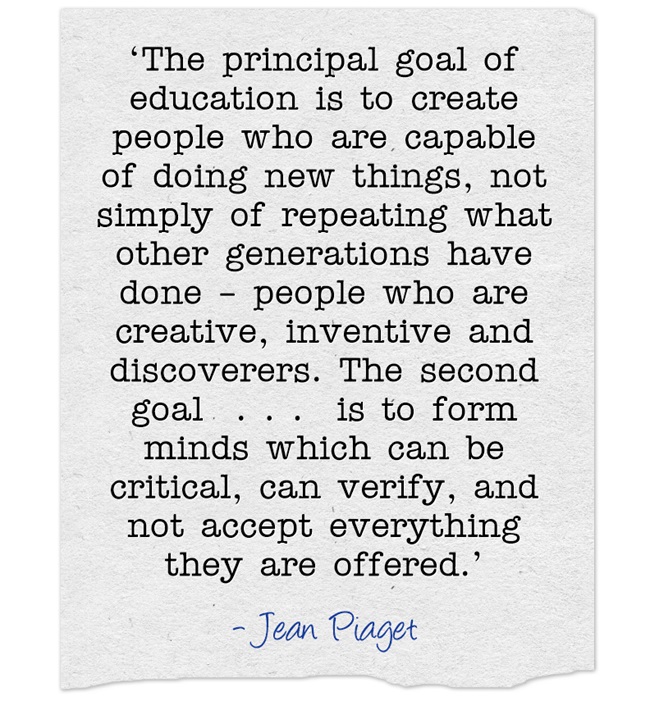
    The-principal-goal-of education - Piaget

    Thank you

    Thank you for reading. I appreciate your feedback. Please share your thoughts about any aspect of this post or flash fiction.

    I wish you success as your vision takes shape in 2015.

    HappyNewYear_by_Rones

  • It’s not fiction

    Most of my current writing is non-fiction with a strong focus on education. The two blog posts I publish each week generally address educational issues or share my thoughts about learning.

    In my ongoing work-for-self I develop educational materials and resources for parents, teachers and children. Some of these are available in my Teachers Pay Teachers store, and are listed on the Teaching and learning resources page of this blog.  My goal is to set up my own website on which all the resources I produce will be available.

    During my work-for-pay hours I am also involved in writing resources for teachers. Most of my published material, listed on the Writing – interest and publications page, is also educational.

    That is not to say that I am not interested in writing fiction. Over the years I have enjoyed writing in a variety of other genres including stories for children, short stories and poetry; and still do. They are just not my main focus at the moment. That may change in the future. Or it may not.

    One opportunity for writing fiction that I am very much enjoying at the moment is the weekly 99 word flash fiction challenge  set by Charli Mills at the Carrot Ranch.

    Initially my responses to Charli’s prompts were unsystematic. However it was not long before I was incorporating them into longer posts which maintained the educational focus of my blog. A recurrent theme is the importance for schooling to target the particular needs of individual children.

    Soon a character emerged: Marnie — a young girl, from a dysfunctional family, for whom school would be a threatening and meaningless experience without the support of a passionate and caring teacher. Sometimes, as with this week’s, the prompt inspires immediately and I write a story in which I hope that the message is strong enough for it to stand alone, without the support of a lengthier post explaining my thinking background.

    Here is this week’s response to Charlie’s prompt: In 99 words (no more, no less) write a story about rare gems. I’d love to know how successful you think I have been.


    glitch, trophy gem http://goo.gl/VEQVxM
    glitch, trophy gem http://goo.gl/VEQVxM

    Uncut gem

    She examined the new arrival, assessing the possible effects of integration into the existing collective. Would the group be enhanced or would this newcomer disrupt the established harmony?

    From every angle the edges were rough and uneven. The years of obvious neglect obscured the potential from any but a trained eye.

    Fortunately her eyes were keen. A bit of encouragement here, a little adjustment there, an opportunity to sparkle and display unique and positive attributes.

    She smiled. Experience had shown what could be achieved with a little polish and care.

    “Welcome to our class, Marnie,” she said.


    Thank you

    Thank you for reading. I value your feedback. Please share your thoughts about this post and flash fiction story.

  • Whose failure?

    I think about education. A lot. You could say it consumes me. It has been my lifelong passion, and although I am not currently in the classroom I don’t stop thinking and reading about how we learn and how learning can best be encouraged. My discontent with how schooling often is and my optimism for what it could be has been a recurring theme on my blog and a driving force in my life. You would not have to open too many posts to find at least one expressing that view.

    education-is-2

    My poem “Education Is” sums up the differences I see between education and schooling. Some schools do education really well. Some professing to be educational institutions school, very badly. What I consider to be one of the major differences is that education encourages a love of learning that lasts a lifetime; while schooling attempts to force-feed content in such a way that learning is neither enjoyed nor viewed as anything other than what one is forced to do in school.

    In traditional schools assessment often takes the form a test which requires students to regurgitate information that has been thrust upon them, whether they like it, or are interested in it, or not. This occurs across all subject areas. I have written about it before in relation to writing tasks in these three posts: Writing to order – done in a flash!  Writing woes – flash fiction  and Who tests the testers?

    I contrasted my choice of responding to Charli Mills’ flash fiction prompts to the lack of choice students have in state- or nation-wide writing tasks. In Writing woes – flash fiction  I suggested that it would be difficult for me, on a given day, with a restricted amount of time, under the watchful eyes of supervisors, to produce my best work in response to a prompt about which I may have little experience, knowledge or interest.

    www.openclipart.org http://goo.gl/Ep1vK6
    http://www.openclipart.org http://goo.gl/Ep1vK6

    In my flash fiction responses I introduced a unicorn as a symbol of escape from the confines of the classroom or other oppressive situation, into the space where one is free to truly be oneself. It wasn’t a deliberate or premeditated choice, simply a response to Charli’s prompt. However I am happy to adopt it in my flash fiction as a symbol of playfulness and imagination unleashed; the basis for all great inquiry and innovation. Thank you, Charli, for the prompt!

    I introduced the unicorn in the post Of rainbows and unicorns – Part 1 – Fantastic creatures and magical realms and used it again in What do you have in mind? , I’m too busy to be tired! And Reading is all it’s cracked up to be: 10 tips for an early childhood classroom

    I have returned to both these themes again in response to Charli’s most recent prompt to In 99 words (no more, no less) write a story inspired by your muse. I’m not certain who my muse is, but I am certain that it would be very difficult to call upon a muse to assist when writing in a test situation such as that expected of students in school.

    My piece is titled ‘Failure’, but this is the question I have for you: Who really deserves the “F”? Whose failure is it really?

    Failure

    She spluttered out the splinters of pencil: no longer tasty, never helpful. The assessor’s steely eyes pounced. She wiped the last vestiges from her mouth; staring blankly, as blank as the paper in front of her.

    Outside the sunlight danced like fairies on the leaves, beckoning. Below, in the shade, the unicorn pranced and called her name.

    “Why do I have to do this stuff? Who cares anyway!”

    She grasped the broken pencil and scored a large “F” on the page.

    Then she closed her eyes and was away, riding to freedom and joy on the unicorn’s back.

    What do you think?

    Thank you

    I appreciate your feedback. Please share your thoughts about any aspect of this post or my flash fiction writing.

    If you are interested in reading other of my flash fictions pieces, I have collected them all together on one page which you can access here or click on the Flash Fiction tab above.

  • Visioning a better school, a better way of educating

    school cropped

    I spent a good part of the 1990s working towards creating an alternative to traditional schooling for my own daughter and the children of similarly-minded parents. For an assortment of reasons, none of which had anything to do with education, we didn’t get the school operational. There is a big part of me that still longs for that alternative and I am always interested to hear of situations which espouse similar beliefs and attitudes to mine. When I do, my heart starts to race and I want to holler and jump for joy, shouting from the rooftops, “See it can be done! This is how it should be! This is what children need!” I want to be in there with them, a part of it all, learning from and with them, and perhaps even adding a little to their learning, should I be that impudent to suggest it possible.

    Yesterday was one such occasion. I popped over to Tara Smith’s A Teaching Life blog and read her post “Preparing for a student teacher”. I always enjoy reading Tara’s blog and could identify with much of what she was feeling while preparing to welcome a student teacher into her classroom. But what got me most excited was a video of a talk given by Chris Lehmann at the 2013 MassCue (Massachusetts Computer Using Educators) conference.

    Chris Lehmann is the founding principal of the inquiry-driven Science Leadership Academy (SLA) in Philadelphia. The achievements of both Chris and the SLA are rather impressive. You can read about them here, here and here. Chris is one excited, enthusiastic and inspiring educator.

    The video of Chris’s keynote address to the conference is rather long at almost 1 hour and 8 minutes (in comparison the mostly 15-minute TED talks that I often watch). I admit that when I saw how long it was I baulked, wondering if I had that amount of time to “spare”. Fortunately something in Tara’s words induced me to do so. After all I didn’t have to watch it all, did I? But watch it all I did. How could I not? His dream was my dream:

    I-had-this-dream-Chris Lehmann

    And then Chris added:

     ‘all these people showed up and breathed life into that dream’

    Here is his talk. If you don’t have time to listen to it all, I give you a few of my favourite quotes. (You may have already encountered some of these ideas before on my blog!) But who knows, he may have other thoughts that resonate with you.

    People-send-us-their Chris Lehmann

    Chris says that many people often ask why schools can have so many problems when there are so many passionate, dedicated teachers. He answer is simple: ‘We have a systemically screwed up system and if you put a good person in a bad system the system wins way too often.’ He says that ‘the factory model of education . . . no longer works for our children if it ever did.’

    Chris says that one of the biggest problems with many schools is that students are being repeatedly told to do stuff that they may never need or even care about. He says, ‘If we were to write a students’ bill of rights the first statement on it should be this question:

    www.openclipart.com
    http://www.openclipart.com


    ‘Why do I need to know this?’


    He then goes on to say that ‘They shouldn’t even need to ask it because the reason should be so apparent through the work that they are doing that is meaningful and relevant to their life right now.’

    https://openclipart.org/image/800px/svg_to_png/191354/Good_Grade.png
    https://openclipart.org/image/800px/svg_to_png/191354/Good_Grade.png

    He says that kids can do amazing things but that the sad thing is that unless it can answer a question on a state-wide test, no one will care! He says that using data from standardised tests is dangerous and that the best data comes from the work students are doing in class every day.

    He says that better questions to ask of schools would be:

    ‘What is your college persistence rate?

    How many of your graduates five years out are either in school or in a job where they are over the poverty level?

    What does a student survey of your school tell you about whether or not the students feel valued and feel that their education is valuable?’

     Personalised-instruction Chris Lehmann

    These are just some of the things that Chris Lehmann says schools should be:

    • Inquiry driven
    • Student centred
    • Teacher mentored
    • Community based
    • Places of collaboration and incredible passion with
    • Integrated learning
    • Project based

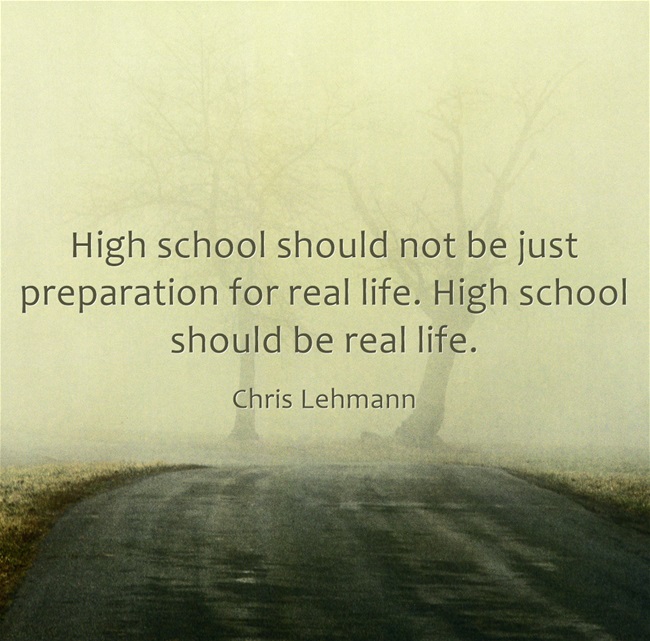
     High-school-should-not Chris Lehmann

    In traditional classrooms the assessment tool is a test. Chris talks not about tests but about projects. He says,

    “If you really want to see what a kid has learned it’s about the project, it’s about what they can do, what they can create, what they can transfer, what they can make, what they can do with their own head, heart and hands. A true project is when kids get to own it.’

    Every-moment-of-time-a Chris Lehmann

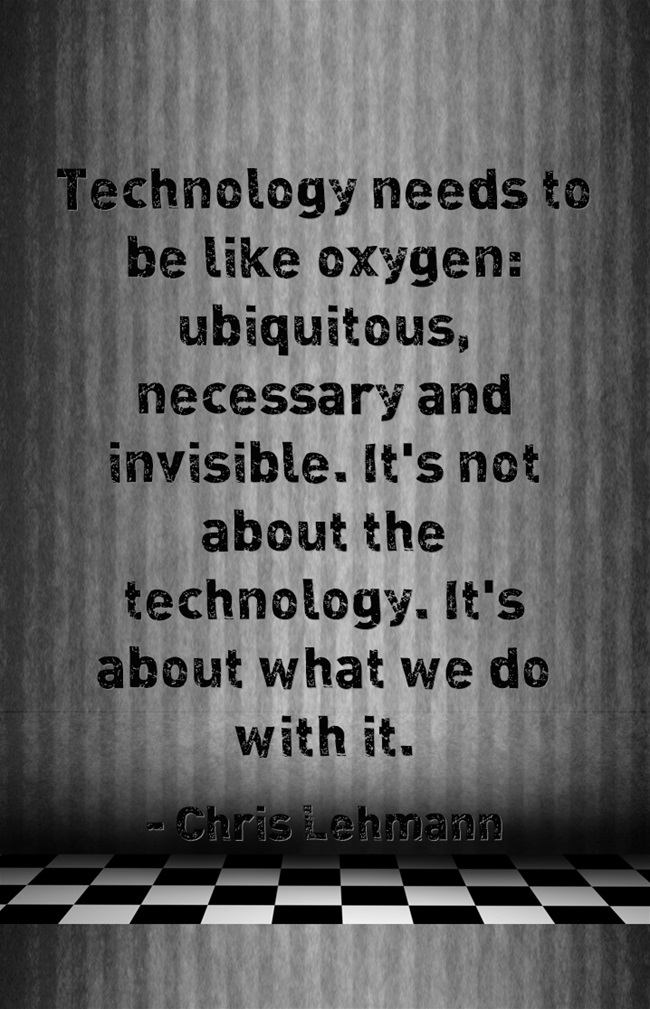
    Technology-needs-to-be Chris Lehmann

    His goal is to educate people to be ‘thoughtful, wise, passionate and kind’ and says that

    ‘ what were really trying to do is nothing less than trying to change the world.’

    This brings me back to my two previous posts How much of a meliorist are you? and Can you make a difference? which drew quite a debate (unintended) about whether we believe we can, or should, try to change (i.e. improve) the ‘world’. I think Caroline Lodge who blogs at book word sums it up quite nicely for educators, saying

    ‘ I am a meliorist. How can someone in education stay there if they are not? The kids improve their skills and understanding, the world turns, and sometimes (like this summer) seems on the way to hell in the proverbial handcart. But there are SO MANY people working to improve the world. Educators as special people in this.’

    For Chris,

    ‘The link between an inquiry-driven education and a care-driven education are three simple questions:

    What do you think?

    How do you feel?

    What do you need?’


    He says, ‘Everything you do should empower children.’ Thanks Chris. My words exactly!

    He says,

    ‘Kids can do real work. We have to dare them to do that, we’ve got to help them, we’ve got to facilitate the work and we’ve got to get out of the way.’

    The Science Leadership Academy is not the only ‘school’ of note. In response to previous posts, including Food for thought and Are you ready to embrace the future Charli Mills of the Carrot Ranch left comments and links to information about a school attended by her children, the Minneapolis’s School of Environmental Studies (SES). Charli linked to this article about the school and another on Edutopia that includes a 10-minute video that she says aptly describes what makes SES a learner-based school. She also provided a link to a very impressive student project developed by two of her daughter’s classmates, and a link to a video produced by students explaining the school. Overall, if I represent her views correctly, Charli was very happy with the education her children received at SES and the impact that project-based learning had on their lives.

    These are just two of the many wonderful schools out there empowering learners. If you know of others, I’d love to hear about them.

    Thank you

    I value your feedback. Please share your thoughts about any aspect of this post. I’m happy to follow the discussion wherever you lead.


  • Who’s the best teacher?

    Two recurring themes, amongst others on my blog, are ways of encouraging a love of literacy and of questioning in young children.

    If you read my post Going on a treasure hunt! you will know that I greatly admire the work of Michael Rosen and its contribution to literacy development. You may have followed the links and checked out the riches in store on his website.

    My post Child’s play – the science of asking questions introduces my thoughts about ensuring that children’s inborn curiosity is maintained through the encouragement of their questions.

    You can imagine my delight, then, when I read a review of new book by Michael Rosen. (Thank you, Anne Goodwin, for alerting me to it.) The review, posted by Sabine Durrant in The Guardian on 6 September 2014, discusses Rosen’s new book How to be Your Child’s (and Your Own) Best Teacher. I confess that I have not read the book but I am very excited to see that it is now available as an audiobook, so it is next on my listening list. So much about the book appeals to me.

    Rather than review the review I will simply leave with you the links to the review:

    Michael Rosen: Why curiosity is the key to life

    and Michael’s website.

    I’m sure you will find much to enjoy.

    Thanks for reading.

    Thank you

  • Education in five minutes

    And now for something a little lighter, I share with you Father Guido’s proposal for a five minute university.

    I hope you enjoy it. There is a little bit of truth hiding there in the fun!

    Thank you

    Thank you for visiting my blog.

    I appreciate your feedback. Please share you thoughts about any aspect of this post, or education in general.