Live Love Laugh Learn … Create the possibilities

Category: Teaching resources

  • You’d have to be mad!

    That is, as in M.A.D. — Making a Difference.

    I love to hear of children being involved in projects that help others, that aim to make a difference to the world. I have previously written about some of those projects here, here, and here.  Sarah Brentyn, who blogs at Lemon Shark, often shares about the wonderful ways in which she and her boys are making a positive difference in their community.

    This week I read about the M.A.D. projects of Canadian teacher Peter Cameron (a.k.a. Mr. C) and his students. At the beginning of the school year Mr. C challenged his students with the question, What will you do to make a difference? The projects, which were selected, organised, and conducted by the students, were recently completed. They included things such as:

    • Helping others on snowy days by shovelling driveways
    • Helping parents, grandparents, and great grandparents
    • Giving compliments
    • Supporting Doctors Without Borders
    • Helping the elderly
    • Helping at the Humane Society
    • Keeping their school tidy
    • Assisting the homeless by collecting socks, making supper, and hot chocolate
    • Encouraging kids to eat healthy, and to spend more time outdoors.
    • You can see a celebration of their projects in this video.

    Mr. C. said that it was one of the most rewarding aspects of his 20+ years teaching career. The acknowledgement received from their member of parliament in the Canadian House of Commons, and his encouragement for others to join in, further affirmed the merit of the project.

    Now Mr C. is reaching out to other classes around the world to join in with their M.A.D. projects and form a Global Make a Difference Team in which participants complete a M.A.D Project to help make our world an even better, happier, healthier place to live”.  Their goal is to have 100+ classes join in. Will yours be one of them?

    To make it easy, Mr. C is making available to teachers all of his resources which may be modified to suit individual classes and situations. He says,

    “The goal is simple: challenge your school, class, clubs and individual or groups of students to make a difference and see where it takes them! Be sure to let us know that your school/class will be participating and fill in the form to add your class to our M.A.D map!”

    Places on the map are so far confined to North America. How wonderful it would be for locations to be added from all around the world. Children would see not only the differences they are making in their own communities, but also the positive actions of others around the world, which may in turn, inspire further projects.

    Be sure to let us know of other projects that involve children in making a difference. I know there are many, some conducted by organisations, and others by individuals and families. They are what give us hope for the future.

    Thank you

    Thank you for reading. I appreciate your feedback. Please share your thoughts.


  • Recipes for the classroom

    cooking banner
    © Norah Colvin 2016

    As completion, and therefore launch, of readilearn, my website of early childhood teaching resources approaches, it has become obvious that some categories are less well-resourced than others.

    I consider food preparation to be a great way of involving children in learning that is fun, purposeful, integrates curriculum areas, and develops skills that can be applied in everyday life. I have previously written about learning in the kitchen with suggestions for parents at home.

    In the introduction to the readilearn cooking resources I write

    Cooking, including food preparation that doesn’t include any heating, is a great way to teach life skills and integrate learning in a meaningful and enjoyable way across curriculum areas. When children are involved in food preparation they may be developing:

    • Social skills of cooperation, turn taking, sharing, patience
    • Literacy skills – reading and following the recipe, selecting ingredients, writing a menu and invitations, writing a recount, writing a shopping list
    • Mathematics – counting e.g. the number of eggs, measuring with spoons and cups, measuring time, sharing (e.g. the number of cookies, how many slices to make)
    • Science – mixing, adding or removing heat
    • Safety – with knives, peelers and hot implements and ingredients
    • Social Studies: Culture – when preparing ethnic food

    readilearn materials are designed to engage children in activities that are both fun and purposeful, with opportunities for learning across the curriculum in a meaningful context.

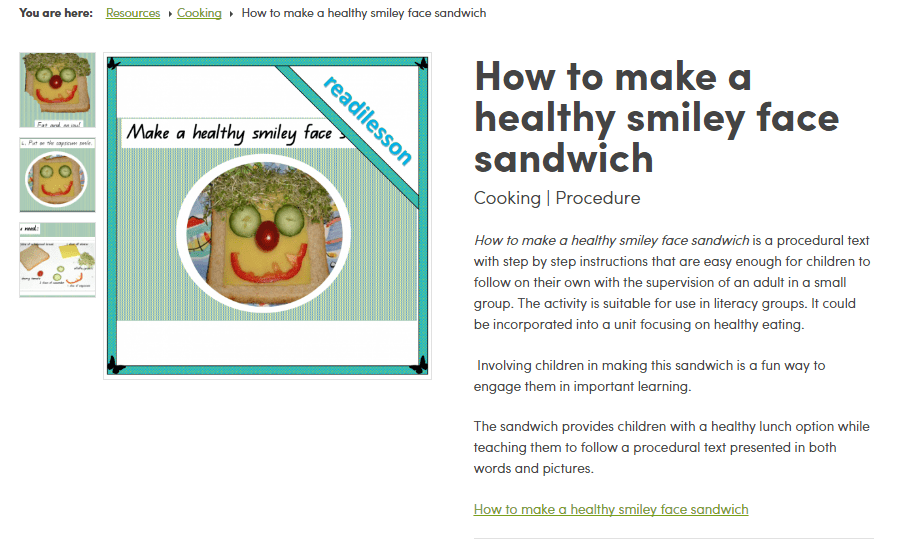
    I was disappointed to realise that I had only one cooking resource prepared: How to make a healthy smiley face sandwich

    © Norah Colvin 2016
    © Norah Colvin 2016

    A remedy was required and I tried to think of other resources I could add.

    I have previously made ladybird biscuits by icing an Arrowroot biscuit and adding Smarties for spots. I will probably add that recipe in the future, but I was trying to think of something healthier to begin with. I wondered if it might be possible to make a ladybird from an apple. This is what I did:

    © Norah Colvin 2016
    © Norah Colvin 2016
    © Norah Colvin 2016
    © Norah Colvin 2016
    © Norah Colvin 2016
    © Norah Colvin 2016
    © Norah Colvin 2016
    © Norah Colvin 2016
    © Norah Colvin 2016
    © Norah Colvin 2016
    © Norah Colvin 2016
    © Norah Colvin 2016
    © Norah Colvin 2016
    © Norah Colvin 2016
    © Norah Colvin 2016
    © Norah Colvin 2016
    © Norah Colvin 2016
    © Norah Colvin 2016

    When I made one for my grandson on the weekend, I was pleased that he recognised it as a ladybird beetle, even without the spots!

    Unfortunately, it’s more suitable for an adult to make for a child than for children to make for themselves. Apples are too difficult for young children to cut. It is therefore not suitable for readilearn. However, I had fun making it and will continue to think of other recipes I can add to readilearn’s cooking collection.

    Thank you

    Thank you for reading. I appreciate your feedback. Please share your thoughts.
  • 3 + 2 = 5 Let me count the ways!

    Billboards

    That we live in a print-rich environment is undisputed. Even in country areas one cannot travel far without being bombarded by print. In addition to road signs there is a plethora of billboards advertising the best places to sleep, eat, or play that can be found just ahead.

    Environmental print is the genre with which many children first engage successfully with reading.  Ask any parent who’s detoured around fast food outlets, hidden shopping catalogues, or camouflaged cheaper brand names of identical products.

    That we are immersed in mathematics in our daily lives is just as evident but doesn’t always receive the same recognition. I think this may in part be because people often think of mathematics as abstract algorithms and theorems that we (they try to get us to) learn in school; and that have no apparent application to our lives beyond the walls of the classroom.

    algebra

    However, even the examples mentioned above are just as rich in mathematics are they are in print. They include distances, and perhaps time, to the destination, cost of items, opening hours, and number of attractions. Anyone travelling a distance with young children will have answered questions such as “Are we there yet?”, “How much further?”, and “What time is it?

    As I say in my statement about mathematics on my readilearn site,

    “Mathematics is all around us. We use it every day for a huge range of purposes from deciding on the sequence in which we dress ourselves, to calculating how much time we have available for an activity.”

    mathematics readilearn

    One of the resources suggests 25 ways for parents to keep their children thinking mathematically over the school holidays. I have shared these ideas previously in Counting on the holidays.

    25 ways to think mathematically

    Recently I was at the gardens with my two grandchildren (G1 and G2, aged 6 and 4), their mother, and my Hub. The children consulted a map and signposted paths to follow the Children’s Trail which had various sculptures along the way. I am undecided about the value of distracting children from the trees and plants, as if the vegetation itself would not be interesting enough. However, the children enjoyed locating the sculptures in the sequence numbered on the map, and reading the accompanying information. They were engaged in purposeful reading and mathematical thinking in context: real life learning!

     © Norah Colvin 2016
    Pandas on the Children’s Trail © Norah Colvin 2016

    As we headed back, G2 made a comment that showed she was engaged in mathematical thinking of her own. She observed that there were two children and three adults, which made five of us all together.

    “That’s right,” I confirmed. “There are five’. I thought for a little while, then added, “And do you know what? As well as two children and three adults, there are two boys and three girls.” The children looked at the group and confirmed that I was right. They laughed – a different interpretation.

    This gave me an idea for a thinking game: how many other arrangements of three and two could there be?  I wondered if the children would like to play along. I had never attempted this before and had no idea if there’d be more, or if we had already exhausted all options.

    I looked at the group. I noticed our shoes: three had closed shoes and two had open shoes. I thought about our names: three shared one surname, two another. Then we were on. Everyone was thinking of ways we could be arranged into groups of two and three.

    Sometimes we sorted according to different characteristics, as in the previous examples. Others times we used a simple yes or no sorting, such as two have hats with brims and three don’t have hats with brims. This is the easiest sorting to do, and the first that children learn.

    G2 made many suggestions of this type of sorting for one and four.  One has the characteristic, the others don’t. This was age appropriate for her, and it was great to see her joining in confidently and contributing to the discussion. G1 was able to engage in the more complex thinking required for the groupings of three and two.

     I was amazed at the number of different combinations we came up with, and that each of us was combined with others in many different ways.

    These are some of the ways we arranged ourselves into groups of two and three (not physically, just in our discussion).

    Arranging ourselves 3 + 2

    This seemingly mundane activity has potential for developing thinking and learning by encouraging:

    • thinking about things in new and different ways
    • looking for similarities and differences
    • observing detail
    • sorting according to different characteristics – which is important to both maths and science (think animal and plant classification)
    • having fun with maths
    • having fun with family

    But wait, there’s more: When we left for home, two went in one car and three in the other!

    I think this would be a great activity to do with young children learning about number. It may be a challenge for teachers in Australia where children wear uniforms to school but I’m already thinking of how it could be done with toys or illustrations. It’s not quite the same as doing it with the children themselves, but it could be fun. What do you think?

    teddy bear sorting

    You won’t be surprised to discover that I have prepared a readilearn resource for sorting as well!

    Thank you

    Thank you for reading. I appreciate your feedback. Please share your thoughts.
     

  • Eroding thoughts

    Uluru © Norah Colvin 2015
    Uluru © Norah Colvin 2015

    This week at the Carrot Ranch Charli Mills is talking about erosion, but not just the literal kind. She says “It can be natural, cultural or something different.” Of course I must answer my usual call to tackle the “something different”.

    Generally, erosion refers to the wearing away of the earth. Sometimes it signifies the disintegration of our resolve, our self-image, or of our spirit. Just as various strategies can be employed to prevent erosion or to repair damage incurred by the land, there are strategies that can be used to shore up one’s resolve, build self-esteem, and mend a sagging spirit.

    rejection slip

    Perhaps nobody knows this better than writers with their stashes of rejection slips rated from encouraging to just plain rude, or non-existent. Few have achieved success without first receiving a downpour of those slips, who haven’t had to work at their skills and accept the edits without eroding their intended message. Sometimes it seems that, with every move, one lands on the “Go back to start” square; and that, while it feels like things are in motion, the end doesn’t appear any closer.

    go back to start

    Or maybe nobody understands the fragility of the spirit and self-esteem more than does a teacher; and of the importance of building on prior learning to take children from where they are to places they haven’t thought possible; to ensure their esteem stays strong and is not eroded by unrealistic expectations and the tedium of a repetitive diet of something meaningful only to others.

    Welcome pack
    Welcome pack

    I have written many times previously about the importance of establishing a supportive classroom environment, and of using affirmations in growing children’s confidence and self-image.

    This doesn’t mean a diet of empty praise, but it does mean that all individuals are recognised for what they can do, and are valued for the contribution they make to the classroom community. Included in these writings was a series, inspired by a Twitter discussion with Anne Goodwin, on praise culminating in Seeking praise – Stephen Grosz revisited and including a guest post by Anne.

    The Clever Children Resource

    I have also developed resources to support children’s growing confidence and self-image for inclusion on my in-progress website readilearn. One of these resources is a story called The Clever Children which teachers can personalise for use with their own class.

    The Clever Children printable

    Children write about and illustrate something they can do. The pages are then added to the story which is printed and collated into a book which can be placed in the reading corner or taken home to read to parents and siblings.  My children always loved being a part of this story. I am looking forward to other children being a part of it too. The story aims to build, rather than erode, self-esteem and a love of books and reading.

    Which brings me back to Charli’s challenge to In 99 words (no more, no less) write a story, using the power of erosion.

    The Nature Principle

    For my flash I combine two ideas:

    • Richard Louv’s suggestion in The Nature Principle that, for physical and mental health, we need to be more attuned with nature
    • the need for resolve and inner strength when faced with issues that would erode it.

    It’s not really a story, perhaps, but a moment in time. I hope you enjoy it.

    1 (7)

    The rock

    The rock, promising permanence, beckoned: perfect for contemplating expanses beyond while pondering life and one’s significance. She sighed, and succumbed. The waves, licking repetitively at the base, soothed somehow; as if each grain of sand stolen from beneath her feet loosened her tension. Becoming one with the rhythm, her heart sang the melody as her mind slowed, releasing all thought. Feeling whole again, as solid as the rock, and with renewed strength, she prepared to face those who sought to erode her. Though tides would rearrange and redecorate, and often do their best to annihilate, they could not obliterate.

    Thank you

    Thank you for reading. I appreciate your feedback. Please share your thoughts.

  • Let’s Talk About Purposeful Play

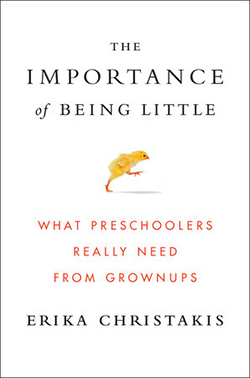
    Earlier this week I shared a post and a new book, The Importance of Being Little by Erika Christakis, about the importance of play for young children.

    the importance of being little
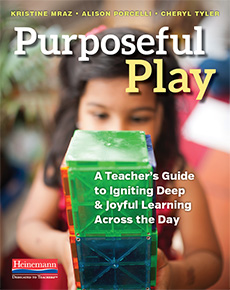
    Today I wish to share another post and another new book about the importance of play. This book by Kristi Mraz, Alison Porcelli, and Cheryl Tyler is called Purposeful Play with the tagline Igniting Deep and Joyful Learning Across the Day. (Hint: Click on Kristi’s post here for a chance to win a copy of the book. Read more about the book here to download the first chapter free!)

    Purposeful play
    These three teachers begin by stating that all play is purposeful and explain ways of honouring children and their play throughout the day in early childhood classrooms. This book is full of practical ideas for teachers who want to incorporate more play to foster children’s learning and maintain their enthusiasm for and enjoyment of it.
    If you wish to make your teaching day more playful, either of these books will provide ideas to get you started.

    Thank you

    Thank you for reading. I appreciate your feedback. Please share your thoughts.

    kristimraz's avatarkinderconfidential

    I am so excited to share that in a week or so my new book (with Alison Porcelli and Cheryl Tyler- play gurus and authors of this handy book on choice time) about PLAY will descend upon this fine earth!!!! Now, listen, there is nothing I like to do more in advance of a new book coming out then have imaginary conversations of excitement and anxiety in my head. As a matter of fact, if you wake up at 3 AM to go to the bathroom, please rest assured that I am staring at my ceiling trying to execute everything I learned while writing A Mindset for Learning.

    So, in the hopes of getting the word out about the book, and also maybe stop communing with my ceiling in the wee hours of the morning, I thought it might be nice to put out a post that conquers some of the…

    View original post 1,278 more words

  • Delivering a sneak peek for Easter

    Launching soon - readilearn2

    For the past few years I have been preparing early childhood teaching resources for a website that I hoped would be up and running by now. Unfortunately, there have been some delays with the developer. In the meantime, I thought I’d share a resource with an Easter theme to give you a free taste test. This will be of interest mainly to early childhood teachers or parents of young children. Everyone else is excused.

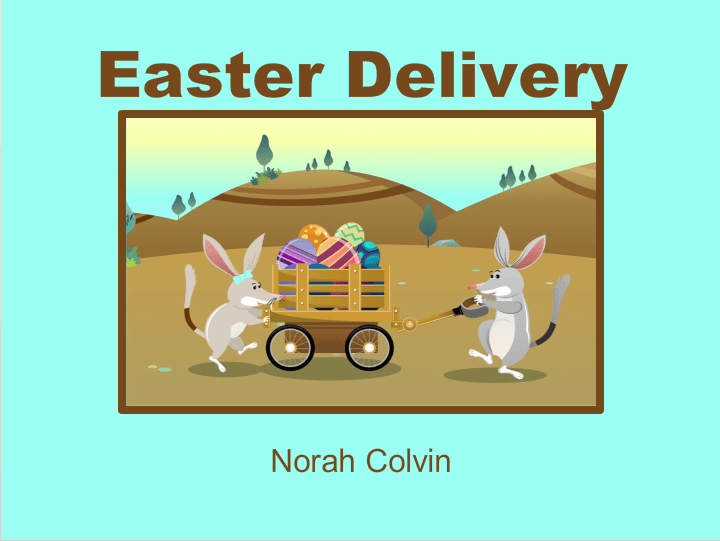
    The resource, called “Easter Delivery”, is a story about twin bilbies, Benny and Belinda, who get to deliver eggs to the families of some friends for the first time. It incorporates addition concepts and is suitable for use with the whole class on the interactive white board.

    The story involves the children in helping Benny and Belinda work out how many eggs they need to deliver to each family and the combination of packs they could choose. The maths concepts are probably most suitable to year one students but teachers may use their discretion about how much maths to include.

    Included is an information sheet about the resource and three printable follow-up activities:

    • Benny and Belinda’s Easter Activity – children record the number of people in their own family and draw and calculate the number of eggs Benny and Belinda would deliver
    • A Happy Easter Card from the Bilbies – a card with a picture to colour and blank inside for children’s own messages
    • The Bilbies’ Easter Colouring Page

    The resource is available clicking on the image until Thursday 24 March 2016. Hopefully it will be available on my website for Easter 2017!

    © Norah Colvin 2016
    © Norah Colvin 2016

    Yes. It is a bit of shameless promotion but it is also a gift for you to use if you would like to in the lead-up to Easter. The resource is not downloadable, but I am happy for the link to be shared with your early childhood teaching friends and colleagues. While it is not a requirement of use, I’d really appreciate some feedback. Please use the poll or share your thoughts in the comment box below.

    Thank you

    Thank you for reading. I do appreciate your feedback. Please share your thoughts.

  • Be a scientist in real life!


    Scout, Science Girl https://openclipart.org/detail/192588/science-girl
    Scout, Science Girl https://openclipart.org/detail/192588/science-girl

    I have often talked about the scientific explorations of young children and referred to children as born scientists. Their curiosity, ability to engage in their own explorations and investigations, and make their own discoveries can be encouraged by adults who welcome their questions and become co-investigators.

    I recently read a post on The School Bell, An Official Blog of Harris County Department of Education that excited me about ways of maintaining that engagement. The post, contributed by Lisa Felske, is entitled Kids Count: Let them Be Citizen Scientists. Lisa says that there of hundreds of projects children can get involved with, some for the long-term as a classroom project, and others that can be conducted independently. They are all real projects that help researchers collect and analyse data.

    Lisa says,

    “For students, participation can make them feel connected to a community or a place far from home and can give them the satisfaction of knowing they have made a small but important contribution to real science.”

    How exciting to be part of a real project, collecting data that will make a difference to our world.

    www.morguefile.com
    http://www.morguefile.com

    Lisa says that one of her favourites is “Penguin Watch, which allows students to monitor penguins in remote regions by looking at still images and counting the number of adults, chicks and eggs seen in the photos.”

    I imagine many children would be interested in that too. But when you follow the link to Penguin Watch you find it is only a small part of the Zooniverse, “a collection of web-based citizen science projects that use the efforts of volunteers to help researchers deal with the flood of data that confronts them”. With projects ranging from astronomy to zoology, you could say there is something for everyone.

    gardening

    Lisa also mentions other favourites including Project BudBurst and BudBurst Buddies (for younger students) in which junior scientists observe and record changes in plants throughout the changing seasons. While these are US based projects, the websites are rich with suggestions for adaptation in other places.

    Finding out about, appreciating and caring for everything, plant, animal or mineral, large or small, near or far is a major part of the real purpose of education. I think involvement in programs such as those described in Lisa’s article will do much to maintain a learner’s curiosity and sense of wonder. What an amazing use of the Internet. I was definitely born too soon.

    Thank you

    Thank you for reading. I appreciate your feedback. Please share your thoughts.


  • Writing poetry with children

    Horses go galloping

    This week at the Carrot Ranch Charli Mills has challenged writers to write about galloping. What keeps replaying in my head is the phrase “The horses go galloping, galloping, galloping” interspersed with the lines from “The Highwayman” by Alfred Noyes, a poem I learned at school.

    The Highwayman came riding, riding, riding,

    The Highwayman came riding, up to the old inn-door.

    tomas_arad_heart

    Learning poems at school was a joy. I love poetry and, in younger years, used to read a lot of it, less currently. Perhaps I should say I loved poetry, but that would unfair, just as it would be unfair to say that I no longer love an old friend that I haven’t seen for years, for at the moment we meet up again the connection is just as strong as ever, the ties never broken.

    Oftentimes when I read Charli’s challenges I know how I will respond immediately. Other times I need to massage the idea until I hit just the right spot. This time the horse has bolted and the paddock is left empty without a horse in sight. All I’m left with are my thoughts of poetry.

    Fortunately, as an early childhood teacher with a love of picture books, recent years haven’t been completely devoid of the poetic form. While not necessarily written in what might be considered “poetic language”, many are written in rhythmic rhyming verse. Others contain verses within the story, such as the refrain in The Gingerbread Man or the song in Love You Forever by Robert Munsch.

    The gingerbread man

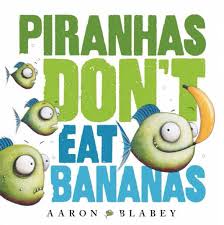
    A title recently added to my list of favourites, through repeated readings and recitations by my grandchildren, is Piranhas Don’t Eat Bananas by Australian author Aaron Blabey. Its rhythm, rhyme and sense of fun is an absolute joy. We laughed together at every reading by G1, and every recitation by G2. It begs to be read and re-read, recited and recited again. Sadly, I got to read it aloud only once, and even then not all the way through! “Hey,” I protested in vain. “I like to read picture books too!

    piranhas don't eat bananas

    Of course there are also many books of poems and rhymes written for children, including Nursery Rhymes, though many of those weren’t written with children in mind. There are also some that fit into a horsey theme such as

    In addition to reading poems and stories to my class I also enjoyed writing poems with them. At this early childhood stage the poems would be more rhythmical verse, sometimes rhyming and sometimes not, with only the hint of an introduction to poetic language.  I have previously written about writing our versions of I Love the Mountains, a traditional camping song.

    I have also written some resources for supporting teachers when Writing Christmas poems with early childhood students. These are available in my Teachers Pay Teachers store and soon to be included in readilearn resources. With easy-to-follow structures, writing these poems give children immediate boosts to their writing confidence.

    I had been thinking for a while that I should write some new versions suited to other times of the year, but hadn’t prioritised it. However, when I read Rowena Dreamer’s post Mr’s Poem: Through My Window on her blog beyondtheflow, another idea sprang to mind. Rowena discussed the writing of a poem “Through my window” that had been set as homework for her son.  I immediately thought of the sound poems that I had taught my students and wondered if the structure could be adapted for sight poems.

    The structure of a sound poem

    This is what I came up with:

    I saw as I looked through my window

    You’ll notice that I haven’t exactly maintained the structure. This is what happens, particularly when young children are writing their versions. It is to be expected and accepted. The purpose of the structure is to support, not restrict.

    I then wondered if it could be used with the other senses and, at the same time, realised that four verses, four senses, would just about reach the target of Charli’s challenge to In 99 words (no more, no less) write a story about galloping. With no other ideas galloping into view, how could I resist giving it a go?

    Disappointingly, I found the structure less accommodating for smell and taste, and had difficulty in conjuring different words to use for each. For example, I wanted to smell and taste the freshness of bread and the sweetness of apples. I had thought touch would be more difficult but have realised that’s not the case. The repetition of the word “felt” for both touch and emotion is perhaps not ideal though.

    I would love to say more here about the necessity for teachers to experiment before setting tasks for children, and of the value of learning from the process rather than the product, but I think I’ve probably said enough in this post.  I will just share what I’ve written which, though responding to Charli’s challenge, doesn’t actually fit the criteria of flash fiction. However, if you’d be kind enough, I’d still love to know what you think.

    Market Day

    I heard

    as I sat curled with a book

    the thundering of hooves

    the snorting of nostrils

    the jangle of stirrups.

    I felt anxious.

    I saw

    as I looked through the window

    the horse at the gate

    the rider on the path

    the bag in his hand.

    I felt excited.

    I smelled

    As I opened the bag

    The freshness of bread

    The sweetness of apples

    The promise of coffee.

    I felt famished.

    I felt

    As I savoured my lunch

    The crunchiness of crusts

    The crispness of apple

    The warming of coffee.

    I felt satisfied.

    Yum! Fresh produce.

    Thank you

    Thank you for reading. I appreciate your feedback. Please share your thoughts.


  • Are we finished?

    work-in-progress
    Anonymous, Work in progress https://openclipart.org/detail/12941/work-in-progress

    I am a work in progress. I reflect on the past, predict the future, and live in the present moment. Nearly everything I do is a work in progress. Some things just make more progress than others!

    Over the past few years I have been preparing resources for my readilearn website. It’s slow going, slower than I expected, but I’m getting … somewhere. Even when the website launches it will be a work in progress as I update old and add new resources.

    Launching soon - readilearn2

    In a flurry of activity, with the intention of completing additional resources as development of the website nears completion, I experimented with making a product promotional video. My intention is to make a number of these, possibly explaining the use of each interactive resource. Doing so is far more time consuming that I had expected.

    Below is my first attempt. But please don’t let that word “first” mislead you into mistakenly thinking it was my only attempt. I lost count of the number of takes and couldn’t believe how difficult it was to utter just a few short sentences. While I am sharing it, please consider it a work in progress. Making promotional videos for my products is something I need much more practice with.

    My purpose in sharing the video is to illustrate the importance of being a lifelong learner, which involves a combination of persistence, resilience and confidence, including:

    • a willingness to make mistakes and repeated attempts
    • a growth mindset without an expectation of immediate success
    • confidence to say “I haven’t got it yet, but I’m working on it”
    • belief in the ability to succeed, either independently or with support
    • an ability to adjust future attempts according to feedback provided from the past.

    I learned a lot in making this video, perhaps more about what doesn’t work than what does. But eliminating what doesn’t work is crucial in finding out what does. For example, I learned after repeated attempts on both, that selfie videos recorded with phone or iPad just weren’t going to be good enough. I learned that neither of the software programs for making videos I owned would allow me to achieve what I wanted on its own. I needed to combine recordings from each. After many trials I finally made something that at least has the semblance of an attempt.

    Included in my passion for learning is a passion for learning about learning: how we learn, why we learn and the conditions that contribute to our learning. I am fascinated by learning that occurs at all ages, but particularly during early childhood.

    Morguefile http://mrg.bz/omEd2M
    Morguefile http://mrg.bz/omEd2M

    In the process of repeated attempts described above, I responded constantly to feedback provided, and adjusted each new attempt accordingly. Feedback is necessary for learning. But perhaps more important than the feedback is the response to it.

    Hopeful of getting some other feedback, I shared the video with my family on the weekend. They made some helpful suggestions. But perhaps the most interesting feedback, about feedback, was that given by my four-year-old granddaughter, G2.

    G2 watched the video with her mother and immediately wanted to play the game. I was delighted, of course, and opened the resource on the iPad for her to use. She had no trouble manipulating the objects to make the ice creams and quickly made a few combinations. When I asked if a mango with strawberry on the top was the same as, or different from, a strawberry with mango on the top, she confidently explained that they were different because “this one’s got the strawberry on the top and this one’s got the mango on the top”. She went on making combinations.

    icecreams
    © Norah Colvin

    After she’d made about ten combinations she asked, “Are we finished yet?” I said, “We can finish whenever you like.” I wasn’t using it as a “teaching episode”, simply as something fun for her to do. She asked again, “But are we finished? You know –“ and she indicated for something to happen on the screen showing that we had finished.

    Suddenly I realised that she was wanting feedback from the program to tell her that she was finished, that she was successful; perhaps some bells, whistles or fireworks. Because I designed the resource as an open-ended teaching episode, for use by a teacher with a class rather than by individual children, the resource does not have any inbuilt feedback. The feedback occurs in the discussion between teacher and students.

    What I intended as a teaching episode became, for me, a learning episode; thinking and learning about feedback.

    • G2 expected to receive feedback about completion, and
    • she wished to continue until she received that feedback.

    However,

    • she doesn’t’ require feedback about completion from all apps, for example, drawing programs: she decides when she is finished, and
    • during play she decides which activity she will take up and when she will finish.

    G2 has a good balance of activities with home and Kindy; indoor and outdoor with a variety self-selected and self-directed imaginative play mixed with cooperative activities including reading, board games and screen time with a variety of apps.

    GDJ, Playful stick figures https://openclipart.org/detail/230070/playful-stick-figure-kids
    GDJ, Playful stick figures https://openclipart.org/detail/230070/playful-stick-figure-kids

    With such variety she receives feedback from many sources including self and others, as well as from manipulation with real and electronic objects. I think her question “Are we finished yet?” was related to use of the specific device and type of activity (game to her), not indicative of a generalised need for feedback from outside.

    But what of children who are more engaged with electronic games, have less time for self-directed activity, and fewer opportunities to engage with others? Will the need for feedback from an outside source overtake the ability to provide feedback for self? I hope not. I believe the abilities to self-monitor, self-regulate and self-determine to be extremely important to life-long learning. What do you think?

    Thank you

    Thank you for reading. I appreciate your feedback. It is important to me! Please share your thoughts about any aspect of this post.


  • I found it first!

    Launching soon - readilearn2

    In my previous post Not lost but found I discussed the notion of adopting the title “Founder” when describing my relationship to readilearn my soon-to-launch website of early childhood teaching resources. The title both bemused and amused me at first but I have now accepted its appropriateness. In fact, I realise that readilearn is not the first thing I have founded.

    © Norah Colvin
    © Norah Colvin

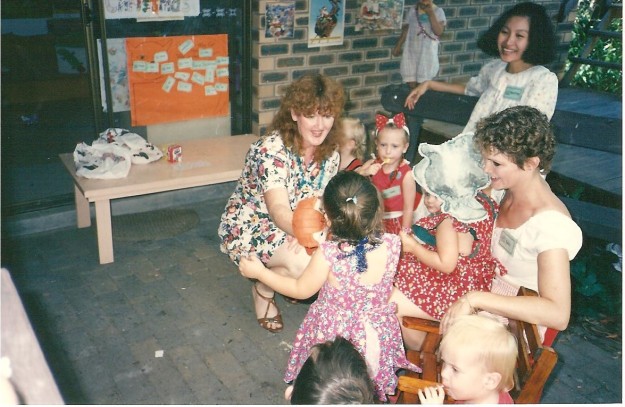
    Create-a-Way was perhaps the first that I founded. It was a home-based business offering educational sessions for children of before school-age and their parents. The impetuses for founding Create-a-Way included:

    • The decision, made before Bec was born, that I would parent and educate her (The alternative to keep teaching the children of others while entrusting her education to another didn’t make sense to me.)
    • A dissatisfaction with playgroups that were simply bitch and coffee mornings for mums and squabble sessions for children left to their own devices
    • A realisation that parents didn’t stimulate or foster their children’s intellectual growth because they didn’t know how, not because they didn’t care

    I saw a niche that would honour:

    • My passion for education and need to be doing something in that area
    • My firm belief in the importance of early years learning
    • My appreciation of children’s innate curiosity and need to learn coupled with the joy of sharing their sense of wonder and creativity
    • My certainty in the power of reading and education to improve the lives of individuals and society
    • A conviction that there are better ways of educating than simply accepting the status quo.

    And best of all, I could do it with Bec! (Although she is not in this photo.)

    Guiding parents in play sessions for parents and children.
    Guiding parents in play sessions for parents and children.

    I express this passion and these basic beliefs repeatedly. They are what make me. They are my driving force; the threads that weave their way through everything I do, holding them and me together. They were the basis for my attempt at founding an alternative school; they guided my classroom pedagogy and now the preparation of resources for readilearn.

    © Norah Colvin
    © Norah Colvin
    © Norah Colvin
    © Norah Colvin

    It’s funny looking back now at the documents I wrote, it seems almost a lifetime ago (well almost all of Bec’s lifetime and more than half of mine), on an Apple IIE computer. I’m still proud of what I offered and truly believe in the value of sessions such as these. However, I can see that, while there has been little change to my passion and beliefs over the years, if I were to do the same thing now I may update some statements to more closely match my current understanding of a growth mindset.

    The thought of doing the same again now is not far from my imaginings. The format of Create-A-Way sessions forms the model of another project I would love to found The Early Learning Caravan. Maybe Steven’s suggestion of crowdfunding would be appropriate for getting it started, but that’s not a project for the immediate future.

    © Norah Colvin
    © Norah Colvin

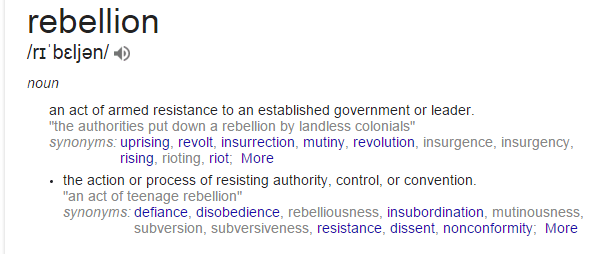
    I wonder if my inability to simply accept what is could be considered rebellion? What is a rebellion? I’m thinking of these terms as this week at the Carrot Ranch Charli Mills has challenged writers to In 99 words (no more, no less) write a rebellion.

    rebellion definition

    The rebellions of which Charli writes are of a larger scale, more in keeping with the first definition.

    In this TED Talk Ken Robinson urges us to Bring on the Learning Revolution making “the case for a radical shift from standardized schools to personalized learning — creating conditions where kids’ natural talents can flourish. I’m proud to be a rebel fighting in the same revolution as Sir Ken.

    In addition to these larger scale rebellions and revolutions there are many that take place on an individual and daily basis in our families and classrooms, and on our streets. Some of the battles, such as  teenage rebellion are fought for justice, independence and identity, a natural and necessary part of growing up. But the need to establish one’s individuality, one’s separateness as a person begins years before that, as anyone who has ever had anything to do with a two-year old can testify.

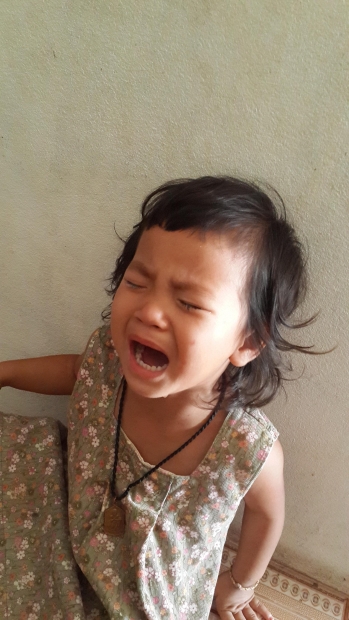
    Sometimes the same battles are played out over and over and parents wonder why the children just don’t accept that they need to clean their teeth, wash their hands, put on their shoes or whatever, rather than battle over it each and every time. It is this early childhood rebellion that has inspired my flash fiction response to Charli’s challenge this week. I hope you enjoy it.

    crying

    You’re not the boss of me!

    Eyes blazed defiance, daring a struggle which could end only in tears and frustration, or a standoff with no real winner. She was ready to flee the moment there was a hint of movement. Our eyes met. I contemplated my options. Did we have to do this now?

    Again the challenge: “You’re not the boss of me!

    I pretended to read.

    Another volley, quieter: “You’re not the boss of me.

    No response.

    Soon she was snuggling beside, pointing to pictures.

    I read aloud.

    We laughed at the antics.

    As I closed the book I said, “Ready? Let’s do this.”

    Thank you

    Thank you for reading. I appreciate your feedback. Please share your thoughts.