Live Love Laugh Learn … Create the possibilities

Category: Philosophy

  • The pretender – putting on a show!

    19178-School-Building-Graphic

    Back in the early days of my teaching career, back before many of our younger teachers were born, let alone teaching, we used to have a visit from a school inspector every year or two. The role of the inspector was to monitor and evaluate the implementation of school programs as well as to provide advice and support to teachers.

    However many teachers tended to think of them in less positive ways and these visits often engendered a sense of fear in some teachers as the inspector could appear at the classroom door at any time and ask to see current curriculum programs and mark books, test the spelling and computational ability of the class as a whole, and hear individual children read.

    Because of this, when one of these visits was imminent there was often a flurry of activity getting curriculum documents and assessment up to date, and displaying children’s work in the classrooms and foyer.

    But I wasn’t one of those teachers frantic in preparation and fear of being found out. I firmly believed that if what I was doing each day for the children in my class wasn’t good enough, then so be it. They were the ones that mattered after all and their education was my priority. I could not see what else I could do to prepare for these visits.

    My programs were well researched, up to date and innovative. They were responsive to individual needs which were well documented with anecdotal records and diagnostic assessments as well as required testing, and supported by samples of student work. My classroom had an ever-changing display of children’s current work allowing visitors to see what we had been working on as well as giving the students a sense of pride in their achievements.

    I guess also, for me back then, the school inspector was only one of the many visitors to my classroom as I was used to people coming to see what we were doing. Parents were always welcome and there were many who helped out on a regular basis and others who made the effort to come for special events and celebrations.

    The principal was very involved and supportive and often popped in to see what we were up to and to provide additional support for children’s learning. In addition, teachers from other schools would visit in order to observe and take ideas back to their own classrooms; and pre-service teachers (student teachers they were called then) were often involved.

    So, for me, the inspector’s visit was just another day, business as usual.

    I am having difficulty in summoning words to describe how I felt when I saw the teacher next door (our classrooms were open, separated only by cupboards and shelves) busily testing children and writing marks in mark books, filling in “current” curriculum programs for the preceding term’s work and covering the previously bare classroom walls with displays of children’s work completed that day.

    I guess you could say I was aghast at what I considered to be blatant dishonesty. I felt it was so wrong that I almost wanted to remove what I had on display for fear of the inspector thinking it was simply there for his benefit.

    I didn’t.

    Instead I turned to poetry, as I often do, to express my feelings; and I would like to share it with you, its first readers.

    I had forgotten all about it until I came across it unexpectedly while looking for something else. It reminded me of the attempt at deception I saw enacted. I say “attempt” because, of course, the principal would have been aware of the situation and I have no doubt that these trained inspectors would be able to see through the veneer.

    I think if I was writing the poem now, rather than 30 years ago, I would not be so generous with my analogy, nor so disrespectful to the butterfly.

    Here it is:
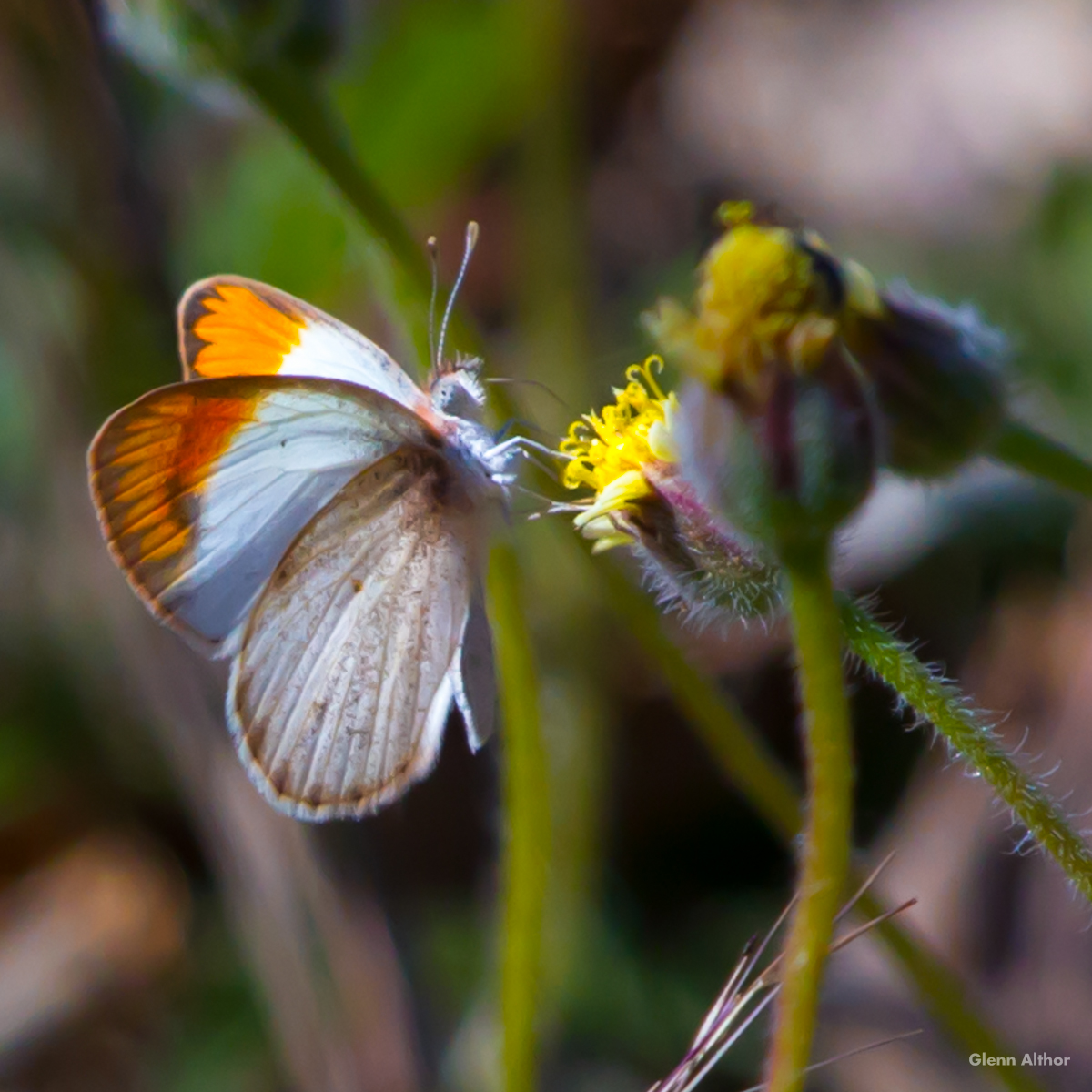
     

    ©Glenn Althor www.http://obscurepieces.com/ Used with permission.
    ©Glenn Althor www.http://obscurepieces.com/ Used with permission.

    Not really about a butterfly

    Look at you now.

    You put on your show.

    Your butterfly colours are warmly aglow.

    It’s hard to imagine

    That not long ago

    You were a mere silent pupa

    With nowhere to go.

    You flit and you flutter

    Cry, “Hey, look at me!”

    And all turn their heads

    -wondrous beauty to see.

    But where have you come from?

    And how can this be?

    Before . . .

    Not one head would have turned.

    There was nothing to see,

    –          just a little green ball,

    curled up on a tree.

    Is it dishonest

    To change rapidly?

    What do you think?

  • Learning At Its Best

    If you have been following my blog you will know that I have certain misgivings about traditional styles of education. That’s not to say that I don’t have certain misgivings about alternative styles of education as well, for I do. It was these collective misgivings that led me to home educate my daughter in her early years while attempting to establish an alternative school that met my expectations.

    In researching programs on offer in many traditional and alternative schooling environments, I read a lot of school descriptions, policy and philosophy statements. I usually find there is little to argue with in these statements, it is usually the way the beliefs are translated into practice with which I have difficulty.

    Occasionally I read something about a school that really excites me and I think “Wow, this school has really got it all together: philosophy and pedagogy. Children and their learning needs are at the centre of this organisation.”

    Recently I read a description that made me wish I was six years old again and enrolled to start my schooling there.

    According to the article it is
    “Learning at its best . . . where the MAGIC happens” and describes a “Disney World – only better”, where
    • Imagination can prosper
    • Friendship and freedom of speech is fostered
    • Conflict resolution skills are developed
    • Active and open listening is encouraged
    Among other things, it has:
    • a creativity corner
    • a nature reserve
    • a dramatic play area

    Why don’t I just let you read the article that fired my imagination, then you can let me know what you think . . .

    Hope's avatarshecando

    .. Is where the MAGIC happens.

    Given my interest in all things children, education and teaching, being lucky enough to have a tour of Miss Charlie’s classroom was like getting a private and personalized tour of Disney World – only better!

    Her class, and the rest of the Junior School (Kindy, Year 1 & 2), share newly renovated and connected federation houses in one part of the campus. Here they have their own tennis courts, play grounds, rooftop gardens, a junior library and even a secret corridor connecting them to the main gym and swimming pools and on to the rest of the school. It’s rather impressive, even if I say so myself.

    What really amazed me, and made me want to never leave (I’m not joking, I might have to apply for a teaching job there ASAP), was the open planned piazza that connects the junior school classrooms. This…

    View original post 616 more words

  • Goals of education

    reachstars
    http://www.openclipart.org

    The following quote from Jean Piaget, Swiss psychologist (1896 – 1980) is one that has driven the direction of my own thinking about education. It has guided many of my choices both as a teacher and as a learner.

    When I listen to the creative ideas and view the innovations demonstrated through TED talks, I know that the principle goal is being met by many.

    When I hear about the wonderful work being done, such as that by The Philosophy Foundation and P4C (Philosophy for Children), to introduce school children to philosophic enquiry, including critical thinking and reasoning, I know the second goal is also being met.

    “The principle goal of education is to create people who are capable of doing new things, not simply of repeating what other generations have done – people who are creative, inventive, and discoverers.

    The second goal . . . is to form minds which can be critical, can verify, and not accept everything they are offered.”

    What do you think?

    How did your education help you achieve these goals?

    How do you see these goals being achieved?

  • SOLE Man

    I love listening to TED talks.

    TED stands for Technology, Entertainment and Design.

    The mission of this organisation is Spreading ideas, a goal dear to my heart.

    I always find the talks fascinating, challenging and inspiring. I feel quite humbled by the fact that there are so many clever, creative and innovative people in the world. However, at the same time, I feel reassured, knowing that our collective future and the future of our planet is in such capable hands.

    Recently I listened to some talks by an educational researcher, Sugata Mitra,  winner of the 2013 TED Prize.

    The TED Prize is awarded to an extraordinary individual with a creative and bold vision to spark global change. . . . the TED Prize supports one wish to inspire the world.

    Mitra’s wish is to build a School in the Cloud, a school where children learn from each other. He introduces the idea of the Self Organized Learning Environment and invites people around the word to help him achieve his wish by downloading a SOLE toolkit to bring these Self Organised Learning Environments to their own communities.

    The toolkit is a step-by-step guide which is designed to “prepare you to ignite the fire of curiosity in kids at home, in school or at after-school programs.”

    A SOLE is basically a small group of children learning together, using the internet to answer questions of interest to them, with minimal teacher intervention.

    There was much in Mitra’s talks that I agreed with, such as

    schools as we know them now, they’re obsolete. I’m not saying they’re broken. It’s quite fashionable to say that the education system’s broken. It’s not broken. It’s wonderfully constructed. It’s just that we don’t need it anymore. It’s outdated.

    “Encouragement seems to be the key.”

    “There is evidence from neuroscience. The reptilian part of our brain, which sits in the center of our brain, when it’s threatened, it shuts down everything else, it shuts down the prefrontal cortex, the parts which learn, it shuts all of that down. Punishment and examinations are seen as threats. We take our children, we make them shut their brains down, and then we say, “Perform.”

    much that intrigued me, such as the grandmother method

    “Stand behind them. Whenever they do anything, you just say, ‘Well, wow, I mean, how did you do that? What’s the next page? Gosh, when I was your age, I could have never done that.’ You know what grannies do.”

    much that inspired me, such as

    “I think what we need to look at is we need to look at learning as the product of educational self-organization. If you allow the educational process to self-organize, then learning emerges. It’s not about making learning happen. It’s about letting it happen. The teacher sets the process in motion and then she stands back in awe and watches as learning happens.”

    and much that I wasn’t sure about, that led me to question, such as, 

    “Could it be that we don’t need to go to school at all? Could it be that, at the point in time when you need to know something, you can find out in two minutes? Could it be — a devastating question, a question that was framed for me by Nicholas Negroponte — could it be that we are heading towards or maybe in a future where knowing is obsolete? But that’s terrible. We are homo sapiens. Knowing, that’s what distinguishes us from the apes. But look at it this way. It took nature 100 million years to make the ape stand up and become Homo sapiens. It took us only 10,000 to make knowing obsolete. What an achievement that is. But we have to integrate that into our own future.”

    As well as listening to TED talks, I also love reading about philosophy, especially the inclusion of the study of philosophy in the school curriculum.

    While following up this philosophical interest, I came across this great blog post by Michelle Sowey, “Can you kill a goat by staring at it? A critical look at minimally invasive education“.

    I couldn’t resist the title, of course, but imagine my delight when I realised that Sowey was critically appraising Mitra’s SOLEs from a philosophical standpoint.

    Sowey saw much to agree with in Mitra’s talks, but for her also, the talks raised many questions.

    These are points of convergence that Sowey saw between  Mitra’s approach and that of philosophical enquiry in the classroom:

    • both are curiosity-driven
    • both involve collaboration of students
    • both seek to engage children’s interest in big questions
    • both support children in exploring ideas and sharing discoveries
    • both offer the prospect of intellectual adventures that spring from children’s sense of wonder and their ability to work together.

    Sowey went on to say:

    “What’s more, Dr Mitra’s proposed curriculum of big questions includes many deeply philosophical ones, such as ‘Can anything be less than zero?’, ‘Will robots be conscious one day?’ and ‘What is altruism?’”

    Then came the BUT:

    Sowey went on to say

    “There are two major points of difference, though, and it’s here that I see cracks in the veneer of minimally invasive education. It differs from collaborative enquiry in that (1) it features the internet as a principal learning medium and (2) it renounces the guidance of qualified teachers or practitioners.”

    Sowey raised concerns including the need to develop in students the ability

    • to assess the credibility of internet sources
    • to challenge faulty arguments
    • to question claims that are dogmatic, propagandistic, biased, pseudoscientific or downright erroneous

    She went on to say:

    “We need to make sure that kids develop thinking and reasoning skills alongside skills in research and information awareness. For this, the support of a competent guide is indispensable, equipping children not only to assess the reliability of different sources but also to evaluate the many arguments they will encounter.”

    I agree wholeheartedly with this.

    She then goes on to say:

    “To dismiss the infrastructure of schooling altogether because of traditional standardisation is to throw the baby out with the bathwater. Surely it makes more sense to repurpose that infrastructure in ways that better nourish children’s curiosity, critical thinking and creative exploration.”

    which makes perfect sense to me also.

    Although I am not a fan of traditional schooling and have made that stance very clear in previous posts, I have expended a lot of energy in trying to establish what I consider to be a better approach. The goal of nourishing “children’s curiosity, critical thinking and creative exploration” was always high on the agenda.

    I encourage you to listen to Mitra’s inspirational talks, and to read Sowey’s compelling article in its entirety.

    Sugata Mitra “Build a school in the cloud

    Sugata Mitra “The child-driven education

    Michelle Sowey “Can you kill a goat by staring at it? A critical look at minimally invasive education

    I will leave you with Sowey’s concluding statement:

    “We need the incisiveness and probing of critical and creative thinking to get deep into the viscera of the facts and anti-facts, the experts and anti-experts. And we need the incisiveness and probing of good teachers to go deep into children’s thought-space: to discover what they’re understanding and what they’re not, yet.”

    What do you think?

    Please share your thoughts.

  • Thinking about Philosophy

    18457-Bubbles-Comic-webThe third Thursday in November has been identified by UNESCO as World Philosophy Day, and the theme for this year is Inclusive Societies, Sustainable Planet”.

    A round table discussion will include topics such as “the growing inequalities between rich and poor within many countries and between countries and sustainable development” including “concepts of social justice, solidarity, exclusion and inclusion in different societies, as well as issues related to the vulnerability of various groups – including women, children, young people, people with disabilities, minorities, indigenous peoples, migrants, refugees, people living in poverty – and the interfaces between these issues and sustainable development.”

    18457-Bubbles-Comic-webThe development of global citizens who are able to reason, think critically and contribute positively to the world by the ability to identify, discuss and suggest ways of resolving such moral and ethical issues can begin with the study of philosophy in schools.

    Peter Worley, co-founder of the charity The Philosophy Foundation, is just one of many philosophers who believe that children are able to engage in philosophical discussions, and are convinced of the importance of placing the study of philosophy at the heart of education.

    In his article “Class Act”, published by The Philosophers Magazine (April 2, 2013) Peter Worley explains why he considers philosophy should be taught in schools. The following is an excerpt from that article. Please follow the link to read his article in full.

    “The “basic” argument: Thinking and reasoning are even more basic than the three Rs (reading, writing and arithmetic) given that reasoning (the fourth “R”?) and the concepts involved in reasoning underpin all three. Philosophy is the subject that specialises in conceptual thinking and reasoning, therefore we may appeal to a very basic educational need for doing philosophy, i.e. conceptual thinking and reasoning.

    The “truth” argument: By honing the concepts that we use in all other truth-seeking subjects (e.g. the sciences), philosophy, which is singularly concerned with concepts and reasoning, is the subject best placed to improve the thinking on which the other truth-seeking subjects are based, thereby improving our efforts to reach truth. (This is to paraphrase an argument owed to Catherine McCall.)

    The incoherence argument: When incoherence occurs between disciplines (or simply in the way the world seems to “hang together” or not) one needs the tools to deal with such incoherence, to be able to attempt to make sense of it. Philosophy is the subject that specialises in making sense of incoherence. Therefore philosophy should be taught. (This is a paraphrase of an argument put forward to me by Stephen Boulter.)

    It is worth noting that incoherence is just as much a feature of school children’s lives as anyone else’s. Just think of the way the children learn objectivity in the sciences but then are taught something like universal relativism in other aspects of their schooling, perhaps in religious education or the classroom mantra “opinions are never wrong” and such like.

    The inescapability argument: Philosophical problems are inescapable. Every time you read something in a newspaper or on the internet you are faced with a philosophical problem: how do you know when something is true? When the teacher teaches you about atoms and shows you the atomic model: how do they know that atoms look like that if they’ve never seen one? If it’s true that philosophical problems are inescapable then surely there is an argument for preparing people/students for how to respond to these problems intelligently and philosophically. (This is a paraphrase of an argument put to me by Michael Hand.)

    Perhaps the last word on teaching philosophy to children should go to Montaigne, who wrote, back in the sixteenth century: “Since philosophy is the art which teaches us how to live, and since children need to learn it as much as we do at other ages, why do we not instruct them in it?”

    I am grateful to Peter for permitting me to reproduce this excerpt as my contribution towards the celebration of World Philosophy Day. For more information about Peter’s publications, please visit

    The Philosophy Foundation.

    Watch this video to listen to Peter and Emma Worley, co-founders of The Philosophy Foundation, explain why it is important for philosophy to be taught in schools:

    Teaching philosophy in schools

    You may also enjoy this entertaining and enlightening video, written by Emma Worley, “What has philosophy ever done for us?” (adapted from Monty Python’s Life of Brian):

    What has philosophy ever done for us?

    What do you think? How important is philosophy to you?

  • The teacher effect

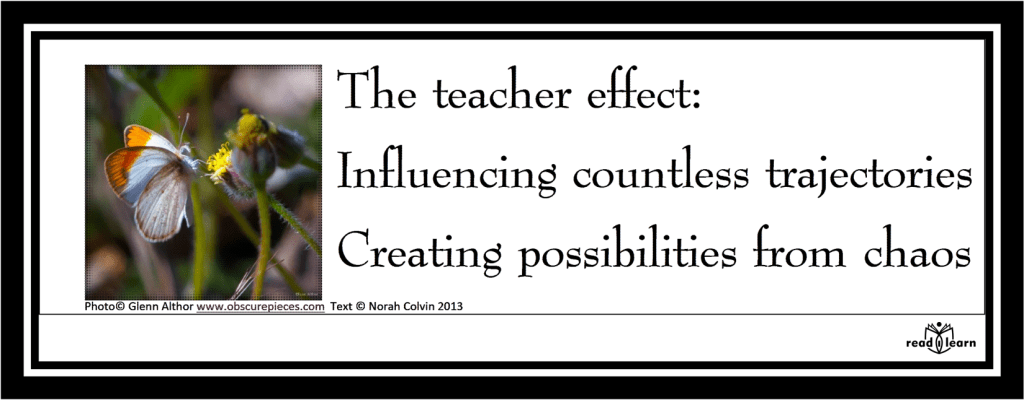
    The teacher effect

    The celebration of World Teachers’ Day in Australia this Friday provides me with the perfect opportunity to acknowledge the powerful influence a teacher may have on the life of another.

    Like the butterfly effect, the ripples may travel far and unseen, with consequences that are sometimes intentional but sometimes not; often visible, but just as often not; and occasionally acknowledged, but frequently not.

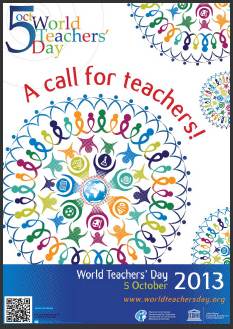
    World Teachers’ Day was established by UNESCO in 1996 with 5th October claimed as the date of its celebration. A map of the world shows that not all participating countries observe that specific date each year, but usually do recognise a day in October. As 5th October falls during the school holidays for most Australian children, the last Friday of October is the date celebrated in Australia.

    According to UNESCO, the day was established to be “devoted to appreciating, assessing, and improving the educators of the world. The real point is to provide a time to look at and address issues pertaining to teachers. Strangely one of the most central, vital professionals to society does not receive the respect it deserves in some parts of the world.”

    a call for teachers

    The slogan for this year’s celebration is “A call for teachers”, highlighting the dire shortage of professionally trained teachers in so many places around the world, a situation which is not expected to show any improvement before 2030.

    While I often talk of the limitations I see in a traditional approach to education, I am very appreciative of the fact that, in Australia, every child has access to an education system with well-trained and educated professionals. It is certainly a privilege not shared by all around the world.

    So on World Teachers’ Day, let’s celebrate what we do have, and what we have learned from the many teachers who have touched our lives. The fact that you are reading this means that someone, somewhere supported you to learn to read. There may be a teacher who touched your life in a very special way. Are they still around? Have you let them know?

    If you have children at school, have you told their teachers how much you appreciate their efforts?

    Some people say “They are just doing their job, why should I thank them?”

    But let me assure you: there are very few teachers who just ‘do’ their job. The wonderful, innovative, creative and inspiring teachers live it! It is their purpose in life. They are devoted to improving the educational outcomes for their students. They work long hours, away from the classroom, reflecting on learning and how to improve it and make it engaging for students.

    www.openclipart.org
    http://www.openclipart.org

    Some children think teachers even sleep at school, that they have no life out of the classroom. I can hear the chuckling of the teachers who are reading this now, because it’s true! Well, not really, but sometimes it seems like it. They carry the children in their hearts, striving for ways to help each fulfill their dreams and ease their worries.

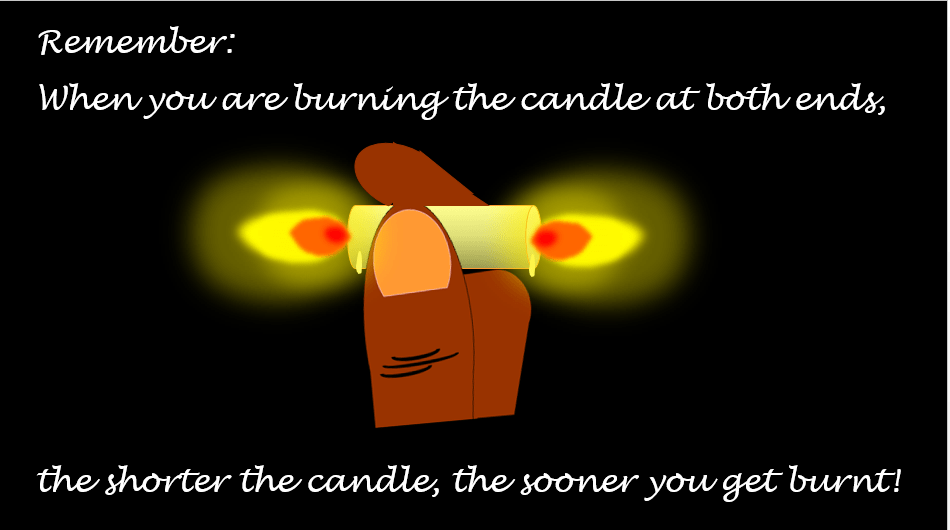
    However maintaining that dedication year after year with little acknowledgment or a sense of being valued can be difficult and disheartening; and many teachers burn out when there is little fuel to keep the flame alight. A small word of appreciation may be all it takes to keep their energy and motivation levels high.

    So join with me in acknowledging a teacher who has made a difference in your life . . . the teacher effect!

    I acknowledge two inspirational teachers:

    Dr Brian Cambourne and Peter Kidston

    Dr Brian Cambourne was Head of the Reading-Language Centre at Riverina CAE when I did literacy studies there a long time ago. (”CAE” gives a hint at how long ago!) He is still working in the field of literacy education at the University of Wollongong. It was an enormous privilege to learn from such an intuitive, innovative, inspirational and influential literacy educator. Not only am I indebted to him, but the ripple effect travels far and unseen, touching the lives of the students and teachers with whom I have since worked, and beyond. . . Thank you, Brian. Your power is immeasurable.

    Acceptance for study in the program under Brian’s tutelage came at a time when I was searching for answers about how children learn and how best to teach them. When I applied for a course about teaching literacy, I didn’t realise the impact it would have upon my developing philosophy of education and understanding of how children learn. I already had serious misgivings about the traditional approach I had been schooled in and the systems I was working for, but had nothing tangible to replace it with.

    Through developing an understanding of Brian’s “conditions for learning” I began to see how I could not only effectively support students with their learning, but could make that learning meaningful and enjoyable as well. I found that the conditions Brian espoused applied to all learning, not just literacy. The understanding from readings I had previously engaged with about educational alternatives e.g. books by John Holt, Ivan Illich, A.S. Neill and John Dewey, combined with my new understandings to help me formulate a strong and effective pedagogical practice. Armed with my new understandings and skills, I was ready to once again face the classroom.

    And that’s where Peter Kidston came in.

    Peter Kidston was the principal at one of the first schools to which I was assigned after completing my studies at Riverina CAE. Peter was an effective leader; strong but relaxed, firm but compassionate. He was respected and loved by staff, students and parents. He was actively involved in the community and worked tirelessly for the benefit of his students. If there were problems, he often solved them by . . . listening. I think he worked on the premise that, when a problem has a proper airing, the solution soon presents itself.

    My first step onto the school grounds told me that this school was going to be different. The students were friendly and welcoming, greeting me as I walked through the grounds. The staff too, were friendly and relaxed, and Peter was pleased to see me.

    One of the roles of a principal is that of educational leadership, and Peter was the best I have met. I firmly believe that the tone of a school is set by the principal; and the warmth and friendliness of the school I attribute to Peter’s leadership. Peter always let his teachers know how valued they were through feedback, encouragement and support. He led by showing, not telling.

    Peter encouraged the innovative strategies I was implementing in my classroom by providing support, respect and professional freedom. At the same time he ensured educational expectations were being addressed through questioning and conversations designed to encourage a wider and more in-depth reflection on my practice. He followed up with classroom visits to monitor the students’ participation and learning progress. The respect and value he placed upon my professionalism enabled me to stretch beyond my own expectations; at the same time developing effective, independent and self-directed learners who enjoyed the school experience as much as I did.

    Thank you, Peter. I am indebted to you. The ripple effect of my learning under your leadership goes far and unseen beyond those few classes at your school into unknown territories.

    happy world teachers day

    Which teacher will you thank today?

    If you would like to print out your own “The teacher effect” bookmarks for a teacher special to you, click here.

  • Is it any wonder?

    ©Glenn Althor www.http://obscurepieces.com/ Used with permission.
    ©Glenn Althor www.http://obscurepieces.com/ Used with permission.

    One of the things I appreciate most about spending time with young children is learning to see the world again through their eyes, with the sense of wonder they shine on all they view.

    “What’s this?”

    “Did you see that?”

    “Why is like that?”

    “What would happen if …?”

    For many adults, that sense of wonder has been buried deep inside, hidden by the worries and concerns in the hustle and bustle of modern life; the busyness with which we seem to cloak our daily activities.

    ©Glenn Althor www.http://obscurepieces.com/ Used with permission.
    ©Glenn Althor www.http://obscurepieces.com/ Used with permission.

    But how joyous it can be to fling off that cloak of busyness and once more allow a childlike sense of wonder to emerge. The company of a young child is not essential for this to occur, although it may help to reawaken the sense initially.

    Take a moment each day to step off the treadmill of relentless must dos and appreciate the wonder all around.

    It can be easier than you think:

    Smile at a fellow commuter or passer-by.

    Appreciate the friendliness of a smile, a gesture, a kind word.

    Look around for changes in the landscape, notice details you may have missed before – “How long has that been there?”

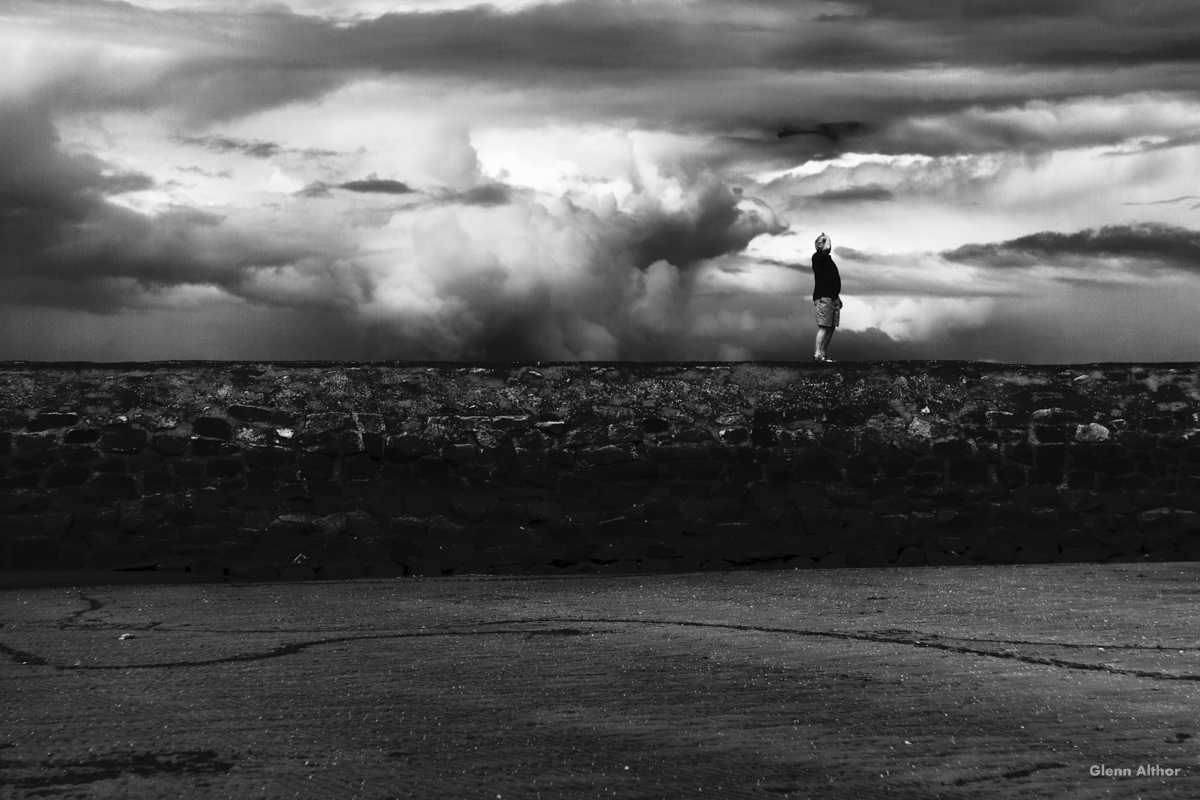
    Cloud gaze.

    ©Glenn Althor www.http://obscurepieces.com/ Used with permission.
    ©Glenn Althor www.http://obscurepieces.com/ Used with permission.

    Search through the daily cacophony to identify the song of each individual instrument: man, machine, nature.

    Listen to music; old favourites or new tunes. Louis Armstrong’s “What a wonderful world”  and Van Morrison’s “A sense of wonder”  help to get me in the mood.

    Pause to ponder the whys, the hows, the possibilities and the big questions, like “Who am I? Why am I here?” and “What is the meaning of life?”

    Stop telling people how busy you are, instead think of something you are enjoying, have achieved or are working on right now. Share the joy of being alive and capable.

    Breathe deeply; and as you focus on the breath as it moves in an out of your body, appreciate the life-giving air that surrounds you.

    ©Glenn Althor www.http://obscurepieces.com/ Used with permission.
    ©Glenn Althor www.http://obscurepieces.com/ Used with permission.

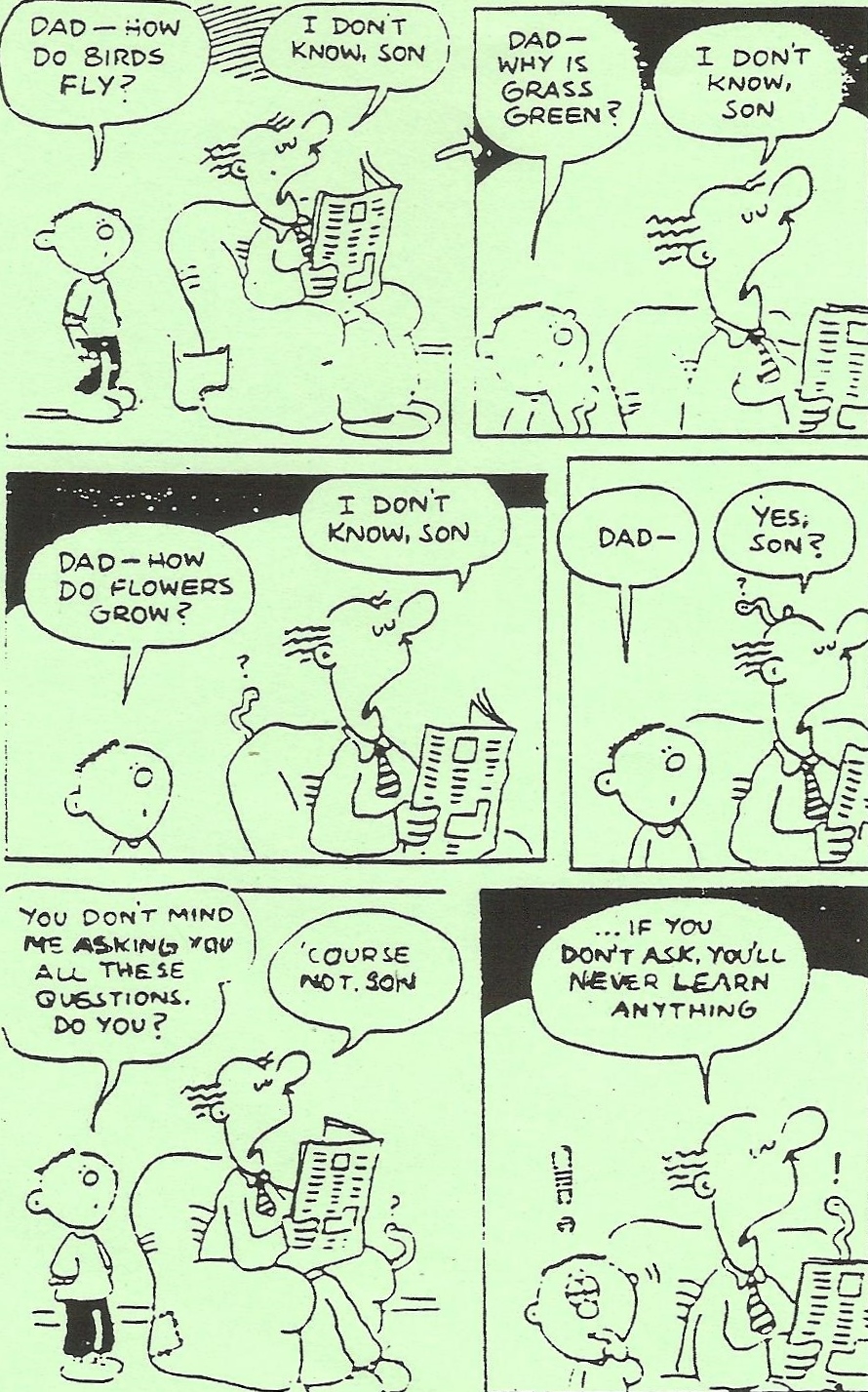
    If a child should ask a question, avoid the impulse to rush in with a wonder-stop: “That’s the way it is. I don’t know. I haven’t got time. I’m not worried about that now. We have to go. Not now.”

    I apologise that I am unable to attribute this cartoon correctly. I clipped it from a newspaper many years ago and no longer have the source. If you are able to help me with identifying the source so I can acknowledge it appropriately, I'd be very appreciative.
    I apologise that I am unable to attribute this cartoon correctly. I clipped it from a newspaper many years ago and no longer have the source. If you are able to help me with identifying the source so I can acknowledge it appropriately, I’d be very appreciative.

    Instead, pause for a moment and ask yourself the question as if you were the child, seeing and wondering for the first time, with a burning curiosity and longing to know. Look where the child is looking, see what the child is seeing. You’ll be amazed at what wonders will be revealed.

    ©Glenn Althor www.http://obscurepieces.com/ Used with permission.
    ©Glenn Althor www.http://obscurepieces.com/ Used with permission.

    Reclaim your right to wonder. After all, “Wonder is the beginning of wisdom.” (Socrates) and “The important thing is not to stop questioning. Curiosity has its own reason for existing.” (Einstein)

    These ideas are but a few. I invite you to share your favourites.

  • Why do I have to?

    19178-School-Building-Graphic

    School attendance during some years of their childhood is compulsory for most children around the world. In Australia schooling is compulsory for children between the ages of about five and fifteen. Most children accept this attendance without question and, in fact, many really enjoy it! A society in which schooling was not compulsory and children didn’t want to attend would be very different from that which we currently enjoy.  So while I have some misgivings about the type of schooling on offer, I guess I feel grateful that it is compulsory and that most children are happy to attend.

    Given that schooling is compulsory, I believe that a school must be a place where children wish to be; where they feel safe and comfortable, respected and valued; where their needs are met and imaginations excited; where they have some sense of purpose and control; and where they are challenged to be more than they ever thought they could.

    For some children, schooling does provide all these things and, as adults, they may look back on their school days with fondness. Others become disengaged, unable to see the purpose in endless tasks and expectations that appear to bear little connection to their lives either now or in the future, as they imagine it. Reigniting enthusiasm for learning once the first flush has faded is more difficult than maintaining it in the first place, which is often challenging enough.

    The study of philosophy in schools may help students understand the purposes of what they are learning, maintain their engagement with the curriculum and contribute to their excitement for learning and the desire to stay in school.

    I have always had a personal interest in philosophy and philosophical discourse, though I do not claim to have any great knowledge of particular philosophers and their thinking. The “Philosophy for Children” program developed by Dr Matthew Lipman, which has been implemented in many schools throughout the world, including Australia, favours a community of enquiry and democratic approach in which students are encouraged to think; critically, creatively and reflectively. They are also encouraged to think and talk about thinking. When I was first introduced to the approach in the mid-1990s, I was not surprised to find that development of the approach had been influenced by John Dewey’s ideals of progressive education. The program not only fitted with my philosophy of education perfectly, but expanded my thinking and gave more credence to what I believed. I was pleased to receive, through use of the program, guidance for implementing these important thinking skills in my early childhood classroom.

    Recently, on the recommendation of my friend and fellow philosophy-enthusiast, Glenn, I listened to a podcast “Philosophy in Education” available on the Philosophy Now website. In this podcast, three philosophers, Peter Worley, Dr Michael Hand and Dr Stephen Boulter, discussed the question “Should schools teach philosophy?” All three were unanimous, of course, and presented some very interesting and convincing arguments for the inclusion of philosophy in the curriculum.

    The discussion dealt with questions about values and basic morality, what one ought to do or should do, and the reasons why. It also raised the importance of “why” questions in maths and science e.g. “Why do we know that 2 + 2 = 4?”, or “How do we know that what we perceive in the natural sciences is reliable?”

    17925-Microscope-Graphic

    All three agreed that the importance of the basics in education can’t be denied, but Stephen contended that if we want to improve the basics of reading, writing and arithmetic, then we need to start with philosophy. He said that secondary school students are already asking philosophical questions about the material they are being taught in subjects like chemistry and history; questions like “Why do I have to learn this?” or “Why is this important?”  (I suggest that children are asking these same questions from a far younger age.)

    questions

    Stephen asserted that these questions about the curriculum are philosophical questions that must be answered if students’ engagement with the curriculum is to be maintained.

    This argument was the most compelling for me as it confirmed the importance of providing students with an understanding of the purposes for the learning they are required to undertake. Michael explained that while the basics are important in education, education is more than just that; it is for the “whole of life”. Stephen agreed, insisting that children need to know the reasons why adults force them to go through so many years of formal education. He said that although there were answers to these questions, they were infrequently given to students.

    Peter agreed that children need more than just the practical reasons, for example learning to count so that you can add up when you go to the shops. Stephen maintained that students would find it easier to engage and put effort in if they saw the point of the learning, including an understanding of what it is to be an educated person. Not only that, children need to know why they should believe all the information they are being presented with in school, not just because the teacher tells them so.

    19180-Text-Book-Graphic

    The arguments for including philosophical discussions in school, and I would suggest in all curriculum areas, are very convincing. Peter explains that philosophy is inescapable as it deals with concepts and the ability to reason and suggests that these underpin the basics. He questions whether, if the basics haven’t improved for a long time, it may be because no one is questioning what needs to be learned before these skills can be developed. Maybe philosophy and the development of reasoning and concepts is the answer.

    What do you think?

    How important is it for you to understand the reasons for what is expected of you?

    If a seemingly meaningless task is expected of you in your role, do you more willingly accept the requirement if the reason for it is explained?

    All clip art used in this post is copyright but used with permission of the eLearning brothers.