

I’m over at Sally Cronin’s wonderful blog again this week, sharing another post from my family archives. However, this time the post author is my wonderful daughter who shares her thoughts on being home educated. We’d all love it if you popped over to read and share your thoughts.
Category: Literacy education
-
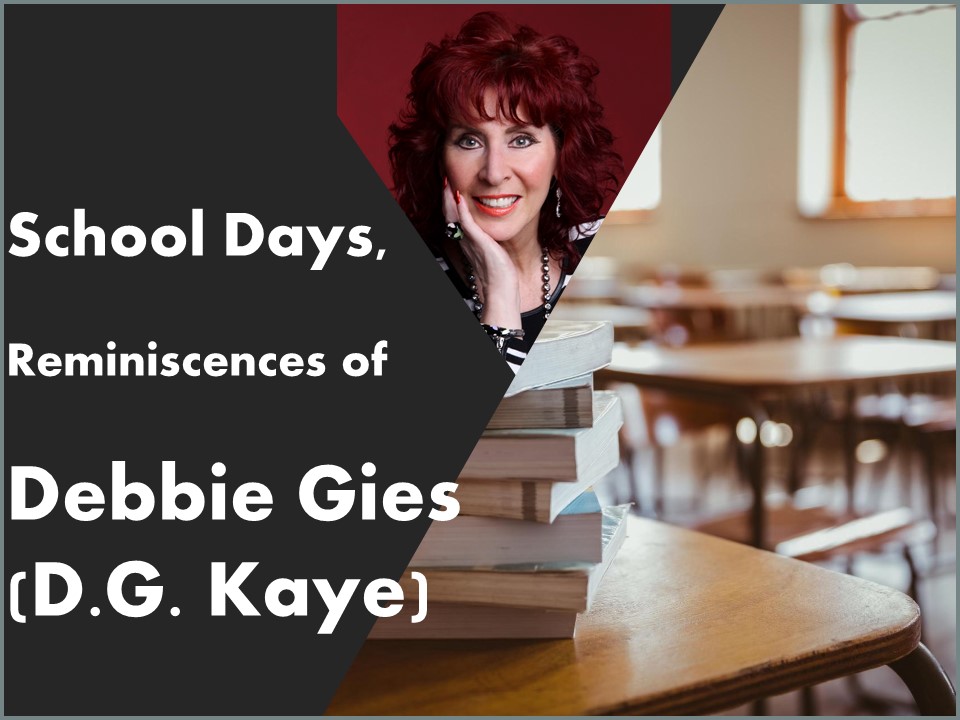
School Days, Reminiscences of Debby Gies (D.G. Kaye)
Welcome to the School Days, Reminiscences series in which my champion bloggers and authors share reminiscences of their school days. It’s my small way of thanking them for their support and of letting you know about their services and publications.
This week, I am pleased to introduce Debby Gies (D.G. Kaye), author and blogger extraordinaire. I can’t remember when or how I met Debby, but I do know that very early on I read and thoroughly enjoyed her travel memoir Have Bags, Will Travel. While Debby has done far more travel than I, there was much in her book with which I could identify. I remember laughing out loud in places, surprised to find there was someone else who shared similar obsessive behaviour.
Debby is a prolific writer, mainly of memoir. I have read others of her books and never been disappointed. Her style is open, from the heart, and conversational. You could be having a chat with a best friend over coffee, sharing love, life and laughter. In fact, those are things we both have in our blog taglines. How could we not be friends?
Since our first encounter, Debby has been a constant supporter of both my blogs, always dropping by to share some words of wisdom or encouragement — a true champion.
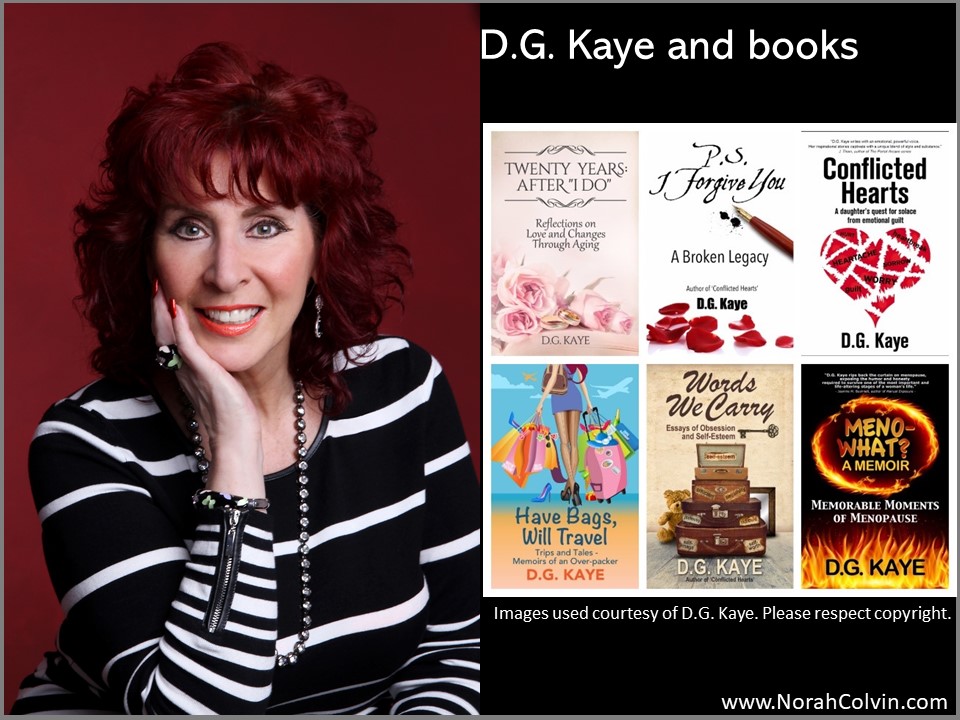
But perhaps I should allow Debby to tell you a little of herself:
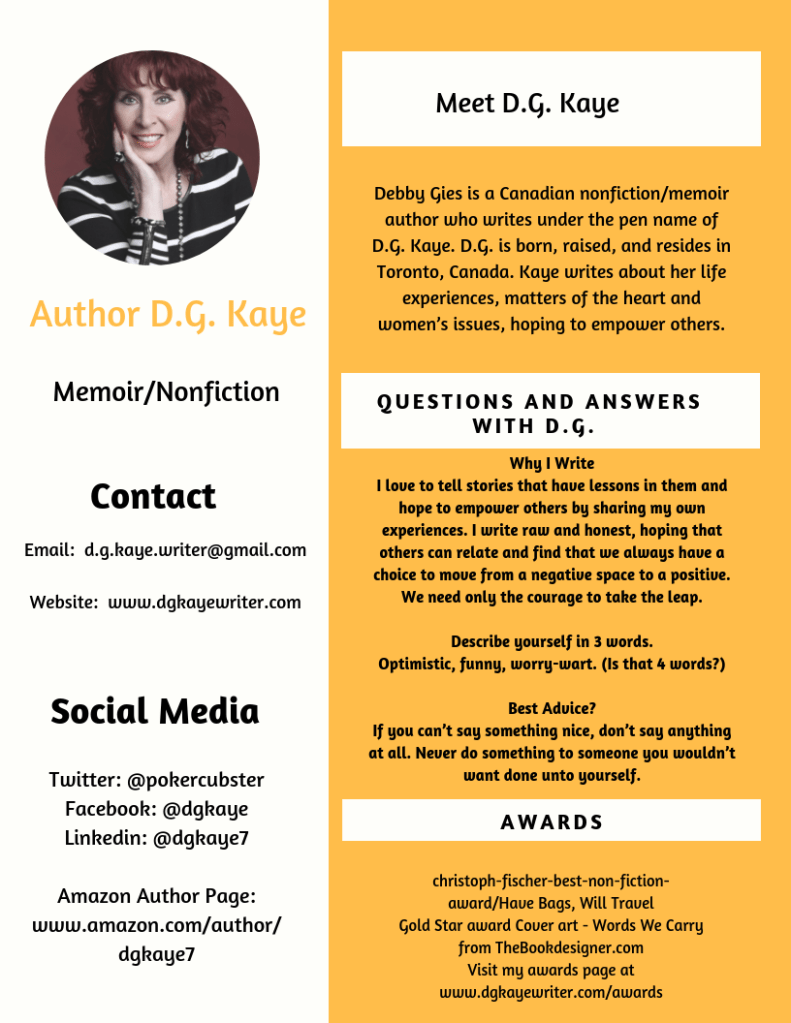
Debby Gies is a Canadian non-fiction/memoir author who writes under the pen name of D.G. Kaye. D.G. is born, raised, and resides in Toronto, Canada. Kaye writes about her life experiences, matters of the heart, and women’s issues hoping to empower others.
Why I write: I love to tell stories that have lessons in them and hope to empower others by sharing my own experiences. I write raw and honest, hoping that others can relate and find that we always have a choice to move from a negative space to a positive. We need only the courage to take the leap.
Describe yourself in three words: Optimistic, funny, worry-wart. (Is that four words?)
Best advice: If you can’t say something nice, don’t say anything at all. Never do something to someone you wouldn’t want done unto yourself.
Welcome Debby.
Now let’s talk school. First of all, could you tell us where you attended school?
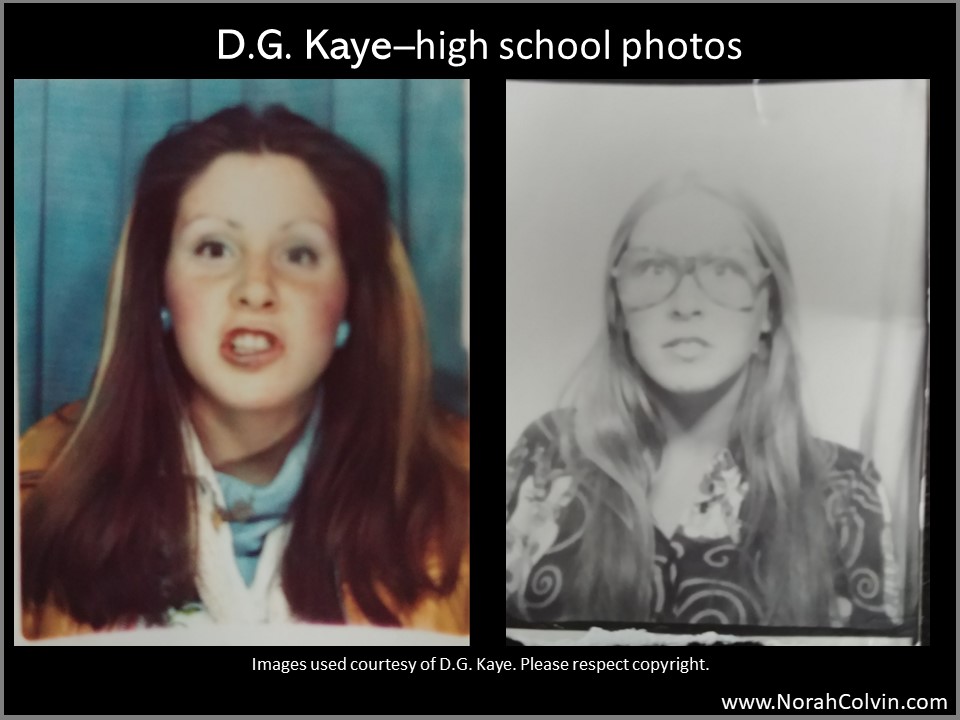
I’m born and raised in Toronto, Canada. I originally began grade 1 going to a parochial school. Before the school year ended, I was stamping my feet demanding I wanted to go to ‘real school’, lol, meaning public school. I got my wish and grade 2 was Kenton Drive Public School where I was thrilled to have Miss Jacobs for my teacher as she was very compassionate toward me. In middle of grade 4, we moved (again) and changed schools to Rockford Road Public School till grade 7 where I spent my 3 years at Fisherville Junior High. In grade 10 I went to high school at William Lyon Mackenzie Collegiate – far out of my living district, but considered higher academically than the one near my home. It was a half mile walk to the bus and 3 busses there and back a day throughout high school. After high school I moved away from home and began working and taking night school classes for business and accounting where I received diplomas, which proved useful for many of the secretarial and admin jobs I had through the years. I also became a certified travel agent and then proceeded back to University of Toronto to study voice and theory in music.
Did you attend a government, private or independent school?
They were all government schools.
What is the highest level of education you achieved?
High school diploma and the school of hard knocks.
What work or profession did you choose after school and was there anything in school that influenced this choice?
While in school I couldn’t make up my mind what I wanted to do. My initial goals were to become a journalist or a lawyer. I had the grades to do so but not the inspiration nor the encouragement to follow through. I worked in the clothing industry for a few years in my early twenties, started as a salesgirl, working my way up to managerial positions and buyer. The fashion bug hit me early. I then became an executive secretary for a general manager of the Carlton Inn Hotel – best job ever! And then I moved on to run an office for a construction company for a friend and later did the same work for an architectural firm. After ‘those days’ I went to ‘dealer’ school where I became a licensed blackjack and poker dealer and worked in the casino business until I met my husband. I also spent the better part of my twenties trying to catch a break in the music industry as a singer. Fun times in bands doing gigs. I recorded a demo tape, but eventually I gave up the dream.
What is your earliest memory of school?
My earliest memory of school was a kind teacher I had in kindergarten – Mrs. Wagner. She knew my emotional struggles and paid me extra attention. I came from a severely, ongoing, broken home situation and a few of these teachers I pointed out were like angels with radar.
What memories do you have of learning to read?
Honestly, I don’t have any memories of learning to read other than I loved reading. Nobody ever read to me at home and we didn’t have any books. I must have had some great teachers!
What memories do you have of learning to write?
I couldn’t wait how to learn to write. I do remember I began writing as soon as I learned how to write as a tool to release my thoughts and feelings. I wrote poems and love notes on scraps of paper and made cards. Some I gave to intended recipients – some I never showed a soul.
What do you remember about math classes?
I enjoyed math until high school and always had good grades, but I lost interest when we began learning physics and calculus. I much preferred English and French classes. Languages have always fascinated me.
What was your favourite subject?
It’s a toss up between history and geography. I loved to learn about other countries and cultures, even as a child. But I’ll have to go with geography, which I think stimulated my interest to travel.
What did you like best about school?
My teachers. I had developed several rapports with teachers in many grades. When I look back on those days, I know it had to do with the compassion and extra attention they gave me that I didn’t receive at home.
What did you like least about school?
I hated gym class. I was not an active child, more of a thinker than a doer. I didn’t like the ugly uniforms we wore that weren’t the least flattering, especially for girls carrying extra weight, and I didn’t enjoy sports. I was the proverbial girl chosen last when picking teams. Here’s the girl who always kept a high 80s average throughout high school until the year I actually failed gym, which cut into my good grade average. Seriously, who fails gym?
How do you think schools have changed since your school days?
Oh my, that’s a loaded question. Even though I never had children, I’m quite aware how much the system has changed. There have been many cutbacks in after school programs, classrooms have too many students in them, and I hear complaints from parents that their kids are inundated with homework nowadays. Not to mention, the whole computer era that wasn’t our world then. The saddest thing I think that’s happening is the decision to no longer teach cursive writing. How on earth can they not teach that anymore? It’s sad the art of letter writing is on its way out with time. It also makes me wonder if children will even learn how to sign their name where print doesn’t cut it.
What do you think schools (in general) do well?
I’m not too familiar with what’s happening nowadays in classrooms, but I do know from having a 7-year-old great niece and having picked her up from school a few times, the system for safety seems to be excellent before picking up children from school. I must sign in, and my niece (her mother) must call the school to alert them someone else will be picking up her child.
How do you think schools could be improved?
They could definitely use more government funding, more teachers, more after school programs, and more benefits for the children whose families can’t afford supplies and books for their kids, and for field trips.
Thank you for sharing your reminiscences of school and thoughts about education in general, Debby. It’s pleasing to know that you enjoyed school and that you had compassionate teachers who helped you blossom. It’s been wonderful to have you here. I learned so much I didn’t already know about you.
Find out more about Debby Gies (D.G. Kaye)
and connect with her on social media or any of her author and blog pages
www.twitter.com/@pokercubster (Of course there’s a story to this name!)
Debby invites you to come join our Literary Diva’s Library Facebook group for writers and authors
And our #ABRSC –Authors/bloggers rainbow support club.
We are also on Mewe – https://mewe.com/join/theliterarydivashangout
BOOKLINKS:


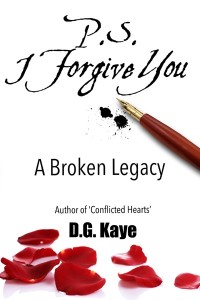

Visit me at my Amazon Author Page
![School Days, Reminiscences of Charli Mills Welcome to the School Days, Reminiscences series in which my champion bloggers and authors share reminiscences of their school days. It’s my small way of thanking them for their support and of letting you know about their services and publications. This week, I am pleased to introduce Debby Gies (D.G. Kaye), author and blogger extraordinaire. I can’t remember when or how I met Debby, but I do know that very early on I read and thoroughly enjoyed her travel memoir Have Bags, Will Travel. While Debby has done far more travel than I, there was much in her book with which I could identify. I remember laughing out loud in places, surprised to find there was someone else who shared similar obsessive behaviour. Debby is a prolific writer, mainly of memoir. I have read others of her books and never been disappointed. Her style is open, from the heart, and conversational. You could be having a chat with a best friend over coffee, sharing love, life and laughter. In fact, those are things we both have in our blog taglines. How could we not be friends? Since our first encounter, Debby has been a constant supporter of both my blogs, always dropping by to share some words of wisdom or encouragement — a true champion. But perhaps I should allow Debby to tell you a little of herself: Debby Gies is a Canadian non-fiction/memoir author who writes under the pen name of D.G. Kaye. D.G. is born, raised, and resides in Toronto, Canada. Kaye writes about her life experiences, matters of the heart, and women’s issues hoping to empower others. Why I write: I love to tell stories that have lessons in them and hope to empower others by sharing my own experiences. I write raw and honest, hoping that others can relate and find that we always have a choice to move from a negative space to a positive. We need only the courage to take the leap. Describe yourself in three words: Optimistic, funny, worry-wart. (Is that four words?) Best advice: If you can’t say something nice, don’t say anything at all. Never do something to someone you wouldn’t want done unto yourself. Welcome Debby. Now let’s talk school. First of all, could you tell us where you attended school? I’m born and raised in Toronto, Canada. I originally began grade 1 going to a parochial school. Before the school year ended, I was stamping my feet demanding I wanted to go to ‘real school’, lol, meaning public school. I got my wish and grade 2 was Kenton Drive Public School where I was thrilled to have Miss Jacobs for my teacher as she was very compassionate toward me. In middle of grade 4, we moved (again) and changed schools to Rockford Road Public School till grade 7 where I spent my 3 years at Fisherville Junior High. In grade 10 I went to high school at William Lyon Mackenzie Collegiate – far out of my living district, but considered higher academically than the one near my home. It was a half mile walk to the bus and 3 busses there and back a day throughout high school. After high school I moved away from home and began working and taking night school classes for business and accounting where I received diplomas, which proved useful for many of the secretarial and admin jobs I had through the years. I also became a certified travel agent and then proceeded back to University of Toronto to study voice and theory in music. Did you attend a government, private or independent school? They were all government schools. What is the highest level of education you achieved? High school diploma and the school of hard knocks. What work or profession did you choose after school and was there anything in school that influenced this choice? While in school I couldn’t make up my mind what I wanted to do. My initial goals were to become a journalist or a lawyer. I had the grades to do so but not the inspiration nor the encouragement to follow through. I worked in the clothing industry for a few years in my early twenties, started as a salesgirl, working my way up to managerial positions and buyer. The fashion bug hit me early. I then became an executive secretary for a general manager of the Carlton Inn Hotel – best job ever! And then I moved on to run an office for a construction company for a friend and later did the same work for an architectural firm. After ‘those days’ I went to ‘dealer’ school where I became a licensed blackjack and poker dealer and worked in the casino business until I met my husband. I also spent the better part of my twenties trying to catch a break in the music industry as a singer. Fun times in bands doing gigs. I recorded a demo tape, but eventually I gave up the dream. What is you earliest memory of school? My earliest memory of school was a kind teacher I had in kindergarten – Mrs. Wagner. She knew my emotional struggles and paid me extra attention. I came from a severely, ongoing, broken home situation and a few of these teachers I pointed out were like angels with radar. What memories do you have of learning to read? Honestly, I don’t have any memories of learning to read other than I loved reading. Nobody ever read to me at home and we didn’t have any books. I must have had some great teachers! What memories do you have of learning to write? I couldn’t wait how to learn to write. I do remember I began writing as soon as I learned how to write as a tool to release my thoughts and feelings. I wrote poems and love notes on scraps of paper and made cards. Some I gave to intended recipients – some I never showed a soul. What do you remember about math classes? I enjoyed math until high school and always had good grades, but I lost interest when we began learning physics and calculus. I much preferred English and French classes. Languages have always fascinated me. What was your favourite subject? It’s a toss up between history and geography. I loved to learn about other countries and cultures, even as a child. But I’ll have to go with geography, which I think stimulated my interest to travel. What did you like best about school? My teachers. I had developed several rapports with teachers in many grades. When I look back on those days, I know it had to do with the compassion and extra attention they gave me that I didn’t receive at home. What did you like least about school? I hated gym class. I was not an active child, more of a thinker than a doer. I didn’t like the ugly uniforms we wore that weren’t the least flattering, especially for girls carrying extra weight, and I didn’t enjoy sports. I was the proverbial girl chosen last when picking teams. Here’s the girl who always kept a high 80s average throughout high school until the year I actually failed gym, which cut into my good grade average. Seriously, who fails gym? How do you think schools have changed since your school days? Oh my, that’s a loaded question. Even though I never had children, I’m quite aware how much the system has changed. There have been many cutbacks in after school programs, classrooms have too many students in them, and I hear complaints from parents that their kids are inundated with homework nowadays. Not to mention, the whole computer era that wasn’t our world then. The saddest thing I think that’s happening is the decision to no longer teach cursive writing. How on earth can they not teach that anymore? It’s sad the art of letter writing is on its way out with time. It also makes me wonder if children will even learn how to sign their name where print doesn’t cut it. What do you think schools (in general) do well? I’m not too familiar with what’s happening nowadays in classrooms, but I do know from having a 7-year-old great niece and having picked her up from school a few times, the system for safety seems to be excellent before picking up children from school. I must sign in, and my niece (her mother) must call the school to alert them someone else will be picking up her child. How do you think schools could be improved? They could definitely use more government funding, more teachers, more after school programs, and more benefits for the children whose families can’t afford supplies and books for their kids, and for field trips. [thank you] Thank you for sharing your reminiscences of school and thoughts about education in general, Debby. It’s pleasing to know that you enjoyed school and that you had compassionate teachers who helped you blossom. It’s been wonderful to have you here. I learned so much I didn’t already know about you. Find out more about Debby Gies (D.G. Kaye) and connect with her on social media or any of her author and blog pages www.dgkayewriter.com www.goodreads.com/dgkaye www.amazon.com/author/dgkaye7 www.twitter.com/@pokercubster (Of course there’s a story to this name!) www.facebook.com/dgkaye www.linkedin.com/in/DGKaye7 www.mewe.com/i/debbygies www.instagram.com/dgkaye www.pinterest.com/dgkaye7 Debby invites you to come join our Literary Diva’s Library Facebook group for writers and authors And our #ABRSC -Authors/bloggers rainbow support club. We are also on Mewe - https://mewe.com/join/theliterarydivashangout BOOKLINKS: [image] Conflicted Hearts [image] MenoWhat? A Memoir [image] Words We Carry [image] Have Bags, Will Travel [image] P.S. I Forgive You [image] Twenty Years: After “I Do” Visit me at my Amazon Author Page [books] If you missed previous reminiscences, check them out here: Charli Mills Sally Cronin Anne Goodwin Geoff Le Pard Hugh W. Roberts Look for future interviews in this series to be posted on Sunday evenings AEST. Coming soon: Pauline King Jules Paige D. Avery With more to follow. Note that, as next Sunday is Easter Sunday, I won’t be posting an interview. Pauline’s interview will be posted on 28 April. See you then. [thank you] Thank you for reading. I appreciate your comments. Please share your thoughts.](https://norahcolvin.com/wp-content/uploads/2019/04/books-by-d.g.-kaye.jpg?w=1024&h=1024)
If you missed previous reminiscences, check them out here:
Look for future interviews in this series to be posted on Sunday evenings AEST.
Coming soon:
With more to follow.
Note that, as next Sunday is Easter Sunday, I won’t be posting an interview. Pauline’s interview will be posted on 28 April. See you then.
Thank you for reading. I appreciate your comments. Please share your thoughts.
Share this:
-

Interview with Teena Raffa-Mulligan, author of The Apostrophe Posse
Today, it is with great pleasure that I introduce you to Teena Raffa-Mulligan, author of a fun story for young readers The Apostrophe Posse.
This interview is part of Romi Sharp’s Books On Tour PR & Marketing and just one of several celebrating the launch of Teena’s book. Please read to the end of the post for details of other posts celebrating Teena’s work.
Note: Mostly, I publish these interviews first on readilearn but, until the readilearn blog schedule is resumed, I am sharing them here first.
About Teena Raffa-Mulligan
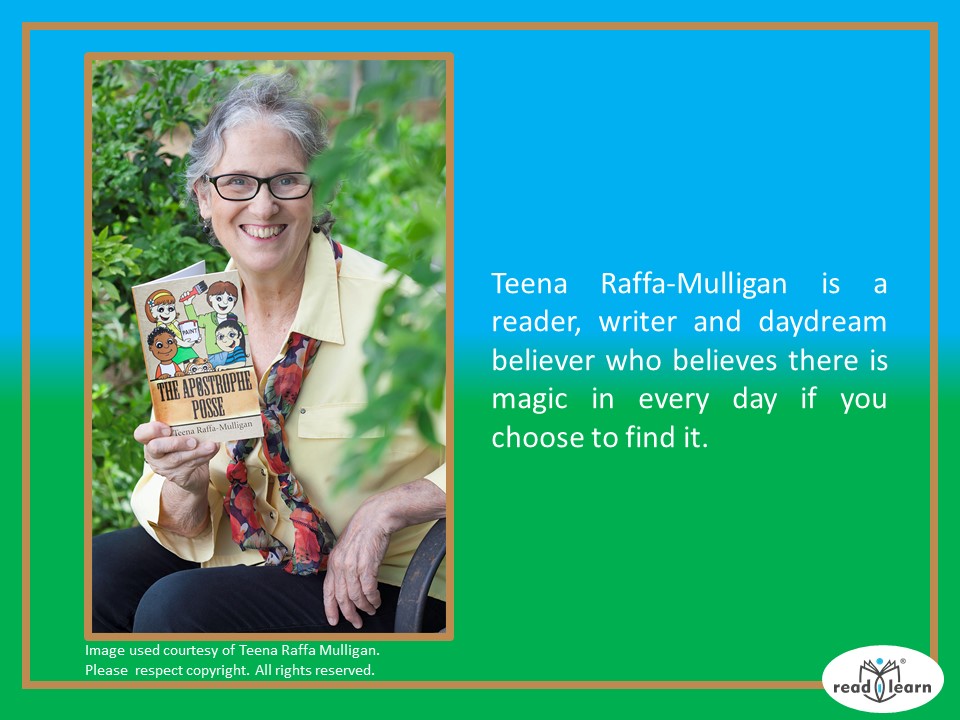
Teena Raffa-Mulligan is a reader, writer and daydream believer who believes there is magic in every day if you choose to find it. She discovered the wonderful world of storytelling as a child and decided to become a writer at an early age. Teena’s publications for children include poetry, short stories, picture books and chapter books. Her writing life has also included a long career in journalism. She shares her passion for books and writing by presenting talks and workshops to encourage people of all ages to write their own stories.
About The Apostrophe Posse
Trouble comes to Tea Tree Bend…
In cowboy movies the sheriff forms a posse to round up all the bad guys. Cam and Ellie from Daisy Cottage and their friends Billy and Louisa have formed a different posse. Their mission is to find and fix all the signs in Tea Tree Bend with missing apostrophes. The summer holidays are almost over so they have just nine days to complete their task.
How can doing the right thing go so wrong?My thoughts
I couldn’t resist reading a book with the title The Apostrophe Posse. Many writers, children and adults alike, have difficulty with apostrophes and I could just imagine a posse going out after all the missing or misused apostrophes. I see so much of it myself and would love to round up all those apostrophes and put them where they should be.
I also found the consonance and assonance in the title appealing. It hinted that the book would be fun, and it is.
The book would be a great stimulus to discussions about the placement of apostrophes, but it’s too good a read to be limited to that alone.
Let’s find out what Teena has to say.
The interview.
Hi, Teena. Welcome to my blog.
Thanks for inviting me.
Teena, when did you know you wanted to be a writer?
I grew up in an English/Italian family, surrounded by natural story tellers whose tales about their lives captured my imagination. Once I learnt to read, books opened a wonderful window into the world of make believe and I knew from a very early age that I wanted to become a writer. I also wanted to be a ballerina, so I thought I’d write novels in the dressing room between performances while travelling the world. Reality woke me from the dancing dream, but I didn’t give up on the ambition to become an author and began submitting short adult fiction and poetry to publishers in my late teens. When I became a mum at the age of 21 and began sharing books with my small son, I realised I wanted to write for children.
Where do you write? Do you like to be by yourself in the quiet, or do you like to write in a noisy space?

I write in the lounge room in my recliner chair near the front window, in bed, at the kitchen bench, on the back patio, out on the deck overlooking the back garden, and I also have the luxury of my own office at home. When my children were small, I wrote anywhere around the house in snatched fragments of time. I didn’t have an office (they needed somewhere to sleep!) so I had a gorgeous timber roll-top desk in the kitchen that I bought with my first earnings from writing stories. It wasn’t quiet or peaceful with the business of the household going on around me and that didn’t seem to matter then. Those days are long gone, and I have become accustomed to my peace and quiet. I don’t even play music while I’m writing.
What do you use to write – pencil and paper or computer?
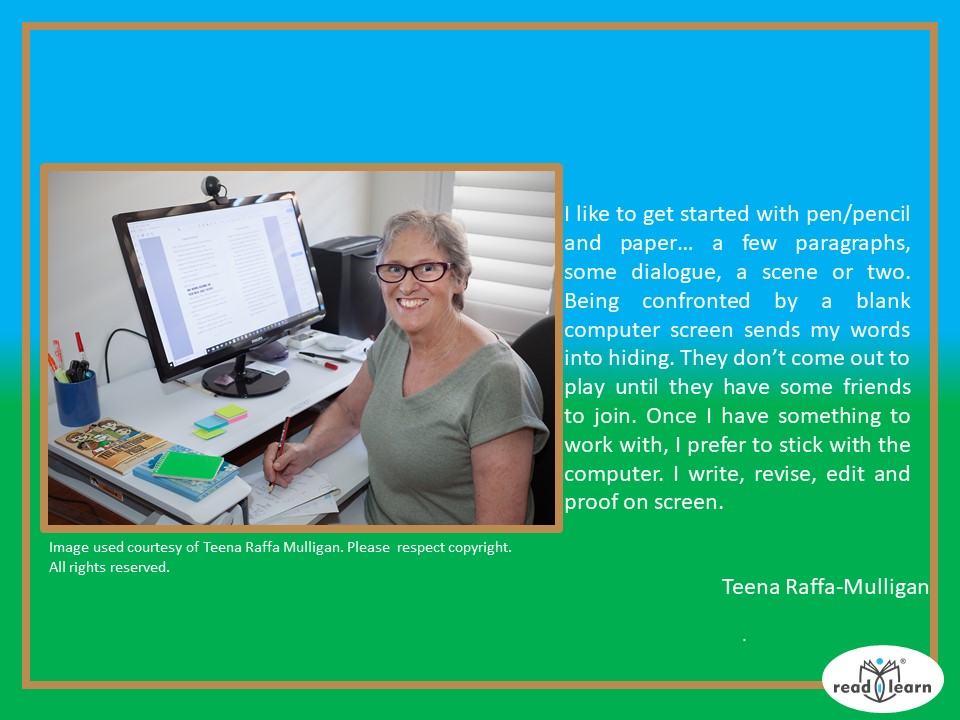
I like to get started with pen/pencil and paper… a few paragraphs, some dialogue, a scene or two. Being confronted by a blank computer screen sends my words into hiding. They don’t come out to play until they have some friends to join. Once I have something to work with, I prefer to stick with the computer. I write, revise, edit and proof on screen.
When do you write?
Not often enough! I spend hours every day on writing related activities but not necessarily on progressing my current WIP. I’m volunteer coordinator of the local writing centre so that keeps me busy. I also visit schools, libraries and community groups to present author talks and writing sessions whenever I get the opportunity. I recently ventured into indie publishing, releasing some of my own books and also my late father’s collection of spiritual writing. Then there’s social media to keep up with, plus reading blogs and watching videos to develop new writing and publishing skills. My new writing happens around all of that. I do set myself deadlines each week but they’re rather elastic.
When do you get your ideas?
They can come anytime and anywhere. The best ideas often arrive unexpectedly in the middle of the night, especially in winter when the last thing I want to do is leave my cosy, warm bed. I’ve learnt to keep notebooks handy after losing some wonderful stories because I thought I’d remember them in the morning. Once I have an initial idea, I don’t plan my stories. I start writing and see where they take me. This means I often don’t know what happens next. Walking, driving and washing dishes are great times for figuring that out.
Do you think of the story in your head before you write it?
Always. I compose sentences, mentally write paragraphs, describe scenes and devise conversations.
What gave you the idea for The Apostrophe Posse?
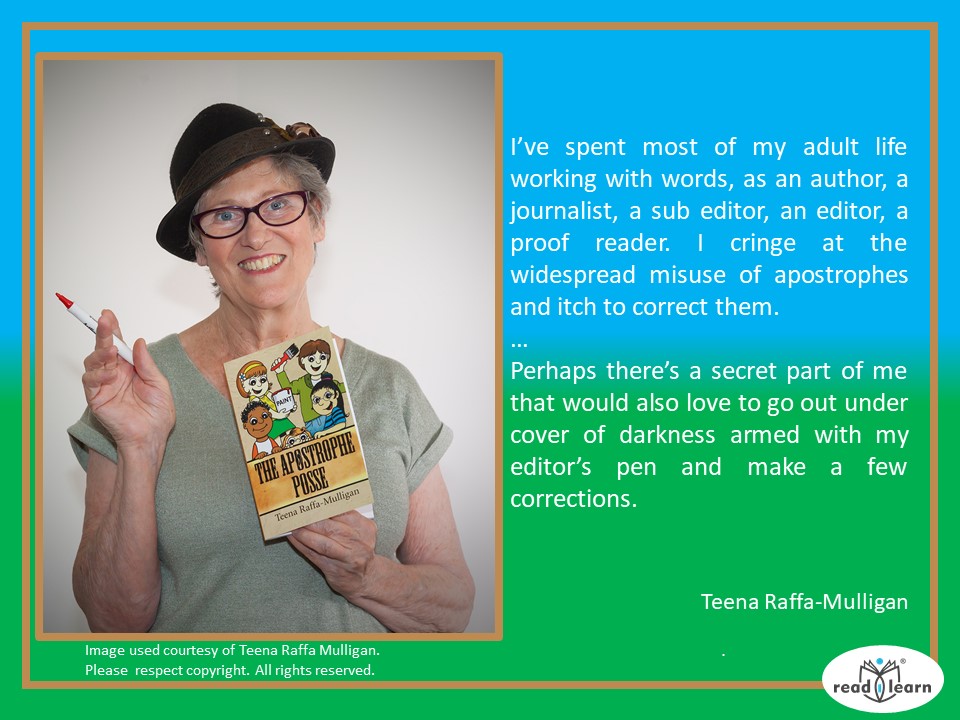
I’ve spent most of my adult life working with words, as an author, a journalist, a sub editor, an editor, a proof reader. I cringe at the widespread misuse of apostrophes and itch to correct them. I love the book Eats, Shoots and Leaves by Lynne Truss. I was driving to my job at the local paper one morning after dropping my children off at school when the idea for The Apostrophe Posse popped into my head. I watched quite a few cowboy movies as a kid and the sheriff often gathers his posse of men to ride out of town to catch the bad guys. In my story that’s Cam and company and they want to find and fix all the incorrect signs around town. Perhaps there’s a secret part of me that would also love to go out under cover of darkness armed with my editor’s pen and make a few corrections.
What do you like best about The Apostrophe Posse?
The way Cam, Ellie, Billie and Louisa want to put something right, but everything goes wrong.
Do you like the way Veronica Rooke illustrated the cover?
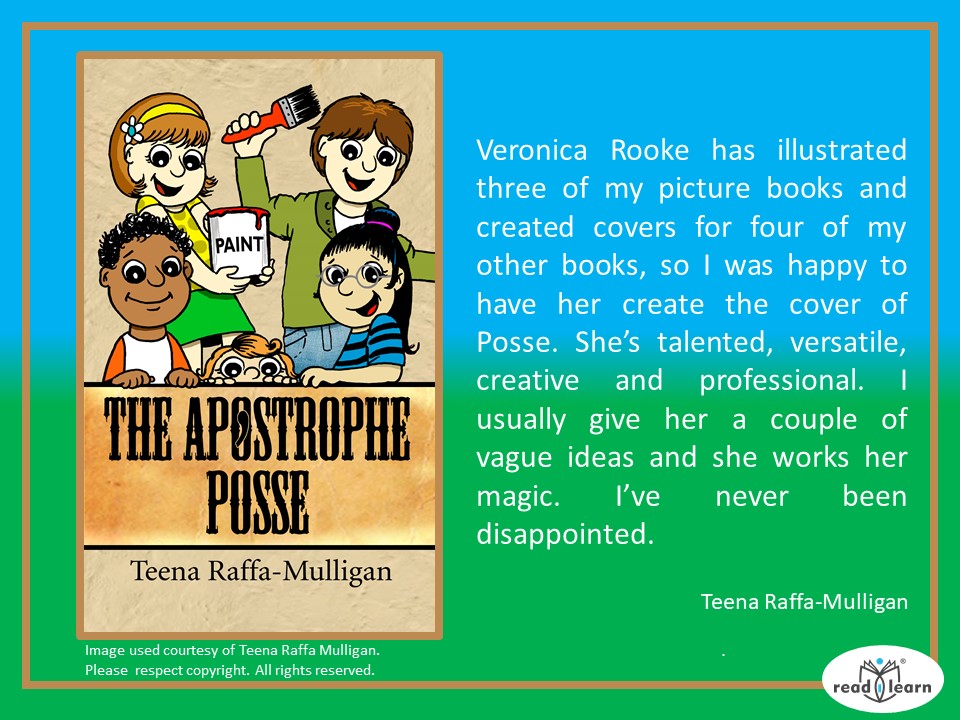
Veronica has illustrated three of my picture books and created covers for four of my other books, so I was happy to have her create the cover of Posse. She’s talented, versatile, creative and professional. I usually give her a couple of vague ideas and she works her magic. I’ve never been disappointed.
How did you feel when you wrote The Apostrophe Posse?
It was fun coming up with what could go wrong when a group of well-meaning country kids set out to do their good deed for the community. Of course, everything worked out happily in the end, as it always does in my stories, so I sat at my computer with a big smile on my face.
How do you hope readers will feel?
It would be great if my story brought a smile to their day and left them with the feeling they’d made some new friends.
How would you like teachers to present The Apostrophe Posse? to children?
I hope it will be presented first as a book to enjoy, a fun story about a group of kids whose good intentions get them into trouble. Discussion could follow about community, cooperation, consequences and, of course, punctuation and why we need it if we are going to communicate clearly with each other.
Are there any messages you would like them to discuss?
Cooperation and the importance of working together to achieve something positive. Facing the consequences of our actions. Children could also think about why we have rules and guidelines in our communities and what might happen if there were none.
Do you have any advice for teachers in their role as writing guides?
If you’re excited about books and language, students will pick up on this. Create a spirit of adventure around writing stories and encourage them to explore where words can take them. A lot of kids get stuck at the start because they’re convinced they don’t know what to write or how to express the ideas they do have. It’s important to stress that they don’t have to get it right, just get it down. In the beginning, it’s all about creating something to work on.
Do you have any advice for children as writers?
Writing stories is fun. You get to create characters, put them in weird and wonderful situations and then decide what happens next. In your imagination you can be anyone, go anywhere and do anything at all. What will you be today? A super hero? A detective? An astronaut? Where will you go? Deep beneath the sea? To the top of the world’s highest mountain? To the farthest stars? It’s up to you! Don’t worry about whether what you’re writing is an amazing story. Just play with the words. Let one follow another and see where they take you. It’s an adventure.
What is your favourite children’s book?
I’ve read so many wonderful books for children over the years and it’s impossible for me to choose just one. Books I loved reading when I was in primary school were Enid Blyton’s Famous Five and Secret Seven series, E. Nesbitt’s Five Children and It and The Railway Children and Frances Hodgson Burnett’s The Secret Garden. What Katy Did also struck a chord, as did books by Elizabeth Goudge. As a teenager I discovered John Wyndham and read all of his books including The Chrysalids, Day of the Triffids and The Kraken Wakes. Fantasy also captured my imagination, particularly Anne McCaffrey’s Dragon Riders of Pern series.
Who is your favourite children’s author? What do you like about his or her work?
When I visit schools and children ask me which of the books I’ve written I like best, I always tell them I have three children and they are all special in their own way. I could not choose one ahead of the other. I feel the same about authors. I am in awe of some of the writing being produced, from picture books to YA novels, and I’ve lost count of the times I’ve come to the final word in a story and closed the book on the thought, ‘Wow! I wish I’d written that!’
When my children were small, I enjoyed sharing the Dr Seuss books with them. I loved the way he played with words.

Thank you, Teena. I enjoyed meeting you and finding out a little more about your writing process, your fun book The Apostrophe Posse and your purpose for writing it. As you said, there is much more to your book than a lesson in apostrophes. It is a lesson in life. You have shared so many valuable thoughts with us. I found myself nodding along with you and thinking, “I wish I’d said that!”
Find out more about Teena
from her website: Teena Raffa-Mulligan
or her blog: In Their Own Write
Connect with her on social media
Facebook: Teena Raffa-Mulligan.Author

Check out other posts about The Apostrophe Posse on the Blog tour schedule:
Monday April 1 – Friday April 5: www.justkidslit.com/blog
PLUS!
Tuesday April 2: www.instagram.com/thebyrdandthebookworms
Thursday April 4: www.authorjillsmith.wordpress.com
Friday April 5: www.littlebigreads.com
SPECIAL FEATURE!
Middle Grade Mavens Podcast: www.middlegradepodcast.com
Thank you for reading. I appreciate your feedback. Please share your thoughts.
Share this:
-
Smorgasbord Posts from Your Archives – #Family – Whose story is it anyway by Norah Colvin
I’m over at Sally Cronin’s wonderful blog this week, sharing a post from my archives about family history. Sally and I would love for you to pop over and have a read and share your thoughts.
Share this:
-
What do you love?
We use the word ‘love’ to mean care deeply about, as in people, or like a lot, as in food, objects and activities. Questions such as “Who do you love?” and “What do you love?” will elicit very different responses and we generally have little difficulty in distinguishing between the intensity of the feelings. Mostly the whos are more important to us than the whats, and it is easy to distinguish between the likes and the loves, though they can sit along a continuum.

For me, housework sits at the opposite end of the continuum from reading and writing. You won’t find me writing any posts about housework. But you will find lots of posts about reading and writing, especially encouraging a love of reading and writing in children. I find sharing a love of reading and writing to be almost equal in enjoyment as reading and writing for myself. To see children light up with enthusiasm for reading and writing is sheer joy.
I have often said that one of the greatest gifts a parent can give a child is a love of reading. A love of reading and writing, and indeed for all learning, is the best gift a teacher can give.

It is often said that a love of reading is caught, not taught. The same goes for writing. It is important for teachers to ensure that there is time every day to read aloud to children, to inspire them and excite their imaginations with wonderful literature and to provide them with time for expressing their own thoughts and imaginative ideas through writing and any other of the expressive arts.
I have written many blog posts, both here and for readilearn, with suggestions for making time for literature and literacy, but it was the prompt set by Charli Mills at the Carrot Ranch that kept me thinking that way this week.

You see, Charli challenged writers to In 99 words (no more, no less) write a story about valentines. It can be Valentine’s Day, the exchange, love for another, romance, or friendship. Have a heart and go where the prompt leads!
But, as well as being Valentine’s Day, 14 February is also Library Lovers’ Day and International Book Giving Day.
Why wouldn’t I write about one of my loves — reading and writing? I hope you enjoy it.
Just for the love of it
The teacher closed the book, but the children were abuzz.
“Keep going,” they urged.
“Will they be alright?”
“What will happen?”
The teacher looked at the clock. The minutes had passed like seconds. Was there time?
“Pleeeease!”
The teacher opened the book.
“Yay!” cheered the children, then hushed as the words flowed.
As the story unfolded, their eyes lit up and imaginations sparked. They discussed the story’s intricacies and contemplated outcomes as they journeyed with the author through good and fearsome times. Finally, just as the dragon was about to swoop, the teacher stopped. “Now write! What happens next?”
Here are links to just five of the posts I’ve written about reading and writing:
A sprinkle of this, a pinch of that, and Poof! It’s reading — magic!
Wrapping up a year of books — the gift of reading
Reading is all it’s cracked up to be: 10 tips for an early childhood classroom!
And two more about libraries:
Libraries: A wondrous universe to explore — a guest post by Dimity Powell
Libraries, books and reading = infinite worlds to explore
Thank you for reading. I appreciate your feedback. Please share your thoughts.
Share this:
-
Reading signs in the environment
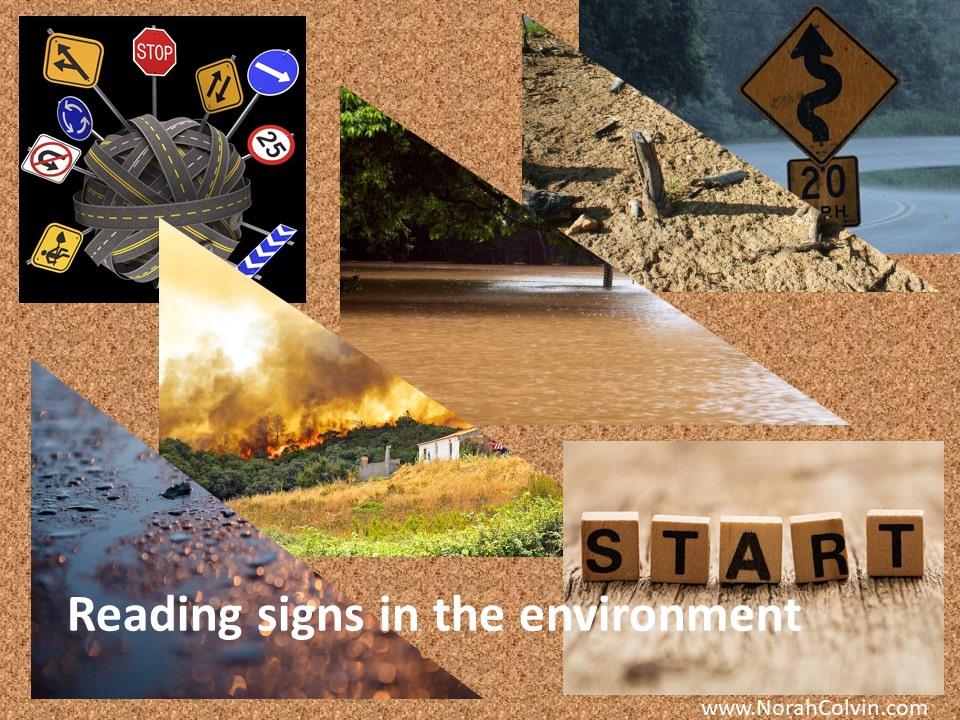
Our environment is rich in print. From their earliest days observing the environment, children are surrounded by print that may include words, symbols and images, each portraying meaning in different ways. We see:
- names of stores
- signs directing pedestrians and vehicles
- instructions for entering and leaving buildings
- labels on items
- prices on goods
- timetables
- banners advertising local events
- information about landmarks and points of interest
and so the list goes on.
Reading and understanding the plethora of signs is important to independent living and successful negotiation of our print-rich and print-dependent world. Although we often take our ability to do so for granted, one only has to visit a foreign place to realise how much we rely on print to navigate our way.
Helping children to read and understand signs is important, requires no planning and can occur effortlessly whenever parents are out and about with their children. All that is required of the parents is to point them out and explain their meaning.
Very young children can learn to recognise the entry and exit and signs on doors, particularly if colour is used as a clue, and the signs on restroom doors.

Stop signs are easily recognisable as are other road signs such as those indicating speed humps, pedestrian and animal crossings, speed limits and left and right turns. Children quickly come to understand what is happening when the traffic lights change colour, but their learning is always enhanced by parental explanations. On journeys when children might become restless, it can be fun to keep their minds occupied by spotting particular signs.
It doesn’t take children long to recognise the logo of their favourite fast food or ice cream store. Names of other stores frequented by the family can also be pointed out for them to learn to recognise. It can also be useful to explain to children how items are being selected, how you know what the items are and where you locate the price. They can be shown how to use symbols and colours on packaging to identify items they like and may come to recognise (if not read) the names of some of their favourite products.
A fun activity for the first days of school is to provide children with an assortment of environmental print to identify. Often children begin school hoping to learn to read on the first day, little realising how much they can already ‘read’. Reading environmental print boosts their self-esteem and self-confidence by showing what they can do and makes a connection between school and what is familiar to them.
I used to like making an ‘I can read’ book on the first day with my children. I would supply children with a collection of advertisements cut from magazines and product labels that I thought children would readily recognise. I would also print signs, symbols and company logos from the computer.
I would provide children with six to ten pages, each labelled with the words ‘I can read’. Children would then select items they could ‘read’ (recognise) from the collection and paste each onto a page. When they were done, children would proudly read their books to their friends and to me, and take them home to read to their families.
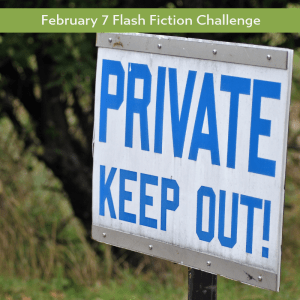
I am thinking about signs in the environment as this week Charli Mills at the Carrot Ranch challenged writers to In 99 words (no more, no less) write a story that includes a sign. It can be a posted sign, a universal sign, a wonder. Go where the prompt leads.
I could have written a flash about children reading signs in the environment, as I’ve described. Or, still in keeping with my educational theme, I could have written about the signs that teachers look for everyday showing that progress has been made or that misconceptions and misunderstanding exist.
However, the environment worldwide is shouting to us loud and clear, with signs that can no longer be denied, that our climate is changing.
Since the beginning of this year, Australia has suffered unprecedented and catastrophic weather events. Across the country, the land has been ravaged by heatwaves that have seen record maximums in temperatures and bushfires have raged across large tracts of land. While much of the country is suffering from prolonged drought, other areas have been devastated by extraordinary rainfalls and flooding. In fact, some of the farming community, who had been crippled by drought, rejoiced when the rains began, only to lament when the rains didn’t end and the rain and floods caused massive stock losses.
It is of these farmers that I have chosen to write. Some of my family live and raise stock, some sheep and some cattle, in the devastated areas and have suffered enormous losses. The heartbreak is unimaginable. If you would like to help the farmers, you can find out how to do so in this article.
You can read more about the plight of the farmers in these articles:
Flood Affected Farmers Witness Entire Cattle Herds Wiped Out By Catastrophic Deluge
Queensland Farmers Confronted by Stock Losses
Torrential Rain in Queensland is Manna from Heaven for Some Farmers but Catastrophic for others
How to Help Farmers in Flood-Ravaged Queensland
I hope my flash goes a little way to recognising the plight of our stoic farmers.
Ominous Signs
Every day, the farmers scanned the skies for a sign, any sign, that a reprieve from the relentless drought was on its way. The dusty red soil yielded not a single blade of feed for the suffering stock. Bales of hay, donated by city folk, helped but soon it too would be gone. When the rains finally came, the farmers rejoiced. For four days it rained; beautiful, drenching, life-giving rains, soaked up by the thirsty soil. But it wouldn’t stop. It transformed their world into an enormous, red, muddy sea. Hopes drowned alongside precious stock leaving heartbreak and devastation.
Thank you for reading. I appreciate your feedback. Please share your thoughts.
Share this:
-

First week of February celebrations – Readilearn
In the first week of February, celebrations include World Read Aloud Day, Children’s Mental Health Week and Chinese New Year.
Readilearn has lessons ready to assist you with each of these celebrations.
World Read Aloud Day
First up is World Read Aloud Day on 1 February—today! The day aims to encourage people everywhere to “read aloud together and share stories to advocate for literacy as a human right that belongs to all people“.
Perhaps no one knows better than teachers of young children the importance of reading aloud. Children who come to school having been read to at home have the advantage of more extensive vocabularies and proficiency with language, greater general knowledge and interest in the world around them, and an interest in books and learning. These advantages contribute to success in school and life.
Making time for reading aloud in a busy class program is a priority for teachers of children in their first three years of school. Opportunities occur in every subject area, and it is not difficult to find ways of working a few extra stories into the program. Why not use World Read Aloud Day as an excuse to read a few more books than usual (as if an excuse is needed).
If you are unsure where to start selecting, visit the library and ask the librarian for suggestions, or take the class with you and ask them to each choose a book they’d like to hear.
The guest post by teacher Jennie Fitzkee on the importance of reading aloud is also full of suggestions.
Five of my favourite picture books (of which there are hundreds so impossible to list) are:
Continue reading: First week of February celebrations – Readilearn
Share this:
-
Christmas classroom activities that focus on learning – Readilearn
As Christmas draws near, keeping children focussed on their lessons can be a challenge for teachers. But it’s not impossible. It is not necessary to fill every moment with Christmas themed activities, but a few interspersed throughout the day can be motivating and lift everyone’s spirits. Activities that promote children’s learning should always take precedence over time fillers.
To assist teachers keep the focus on learning while children would rather be thinking of Christmas and holidays, I have prepared a range of lessons and suggestions for use in different subject areas. Many of the lessons and suggestions integrate learning across curriculum areas. All readilearn Christmas themed activities can be found under the Cultural Studies tab in the subcategory Christmas.
Focus on the children
A great place to start is always with the children and their family’s traditions.

Begin with a survey to find out which children in the class do and do not celebrate Christmas. While you will already have an idea of which children do, it can be an interesting way to begin the discussion of different cultural traditions celebrated by children in your class.
The main ingredient in any of these discussions should always be respect, and it is important to find ways of making classroom activities inclusive.
How many school days until Christmas?
Advent Calendars that count down the twenty-five December days until Christmas are great for families to use in the home but not so suitable for school. What about counting down the school days until Christmas? Twenty-five school days would mean starting at least five weeks before school finishes, which might be a bit soon, so choose another number which suits your program. Fifteen (three weeks) could be a good number. (Note: If, for inclusivity, you didn’t wish to count down to Christmas, you could count down to the holidays.)
A countdown calendar
Schedule opportunities for the children to present information about their family traditions as part of the countdown.
Continue reading: Christmas classroom activities that focus on learning – Readilearn
Share this:
-
Reading the Iron Man to spark imagination, inspire writing and motivate making – Readilearn
One of my favourite read-aloud books is The Iron Man by Ted Hughes. The influence of poetry is obvious in this compelling modern fairy tale that begins as it might end.
When I introduce this book to children, I conceal it so they cannot see from which part of it I am reading. I tell them the title of the book and ask them to tell me whether I am reading from the beginning, the middle or the end of the book.
I then read, mostly without interruption though I do explain that ‘brink’ is the very edge, the first two pages that describe the Iron Man and how he stepped off the top of a cliff into nothingness and crashed into pieces on the rocks below.
The children listen in awe, fascinated by the size of the Iron Man, incredulous that he would step off the cliff, mesmerised by the telling of each part breaking off and crashing, bumping, clanging to lie scattered on the rocky beach.
They invariably tell me it is the end of the story. How could it be otherwise? When I tell them it is just the beginning, they are amazed and excitedly discuss how the story might continue. This could lead to writing if the children are keen, but there are other opportunities further into the story.
When this initial discussion has run its course, I go back to the beginning and read it again, stopping to encourage further discussion and to spark the children’s imaginations.
allow their imaginations to contemplate possibilities
Continue reading: Reading the Iron Man to spark imagination, inspire writing and motivate making – Readilearn
Share this:
-
readilearn: Engaging mathematics learning with Halloween themed resources
In just a couple of weeks, people in many parts of the world will be celebrating Halloween. Even in Australia, where the festival has only recently begun to take hold, merchandise now fills our (mainly discount) stores, and children look forward to a night of fun, knocking on doors and collecting treats from family and friends.
The festival dates back two thousand years to its origins in what is now Ireland, England and France. Irish immigrants took the festival to America in the 1800s. Halloween arrived in Australia with immigrants and through its portrayal in movies and on television. Always looking for an excuse to party, Australians are ready to join in.
Originally, the festival celebrated the end of summer harvests and marked the beginning of the long dark northern winters. The festivities have evolved over the centuries with changes to focus and traditions.
I have always thought that adding a bit of fun to the school day helps the learning go down. If the children are going to be distracted by thoughts of their Halloween costumes and what booty they might score in an evening of trick or treating, why not harness those distractions and channel them into learning?
To combine fun with learning, this week I have uploaded three new interactive Halloween themed maths resources for use on the interactive whiteboard. The resources help to develop number concepts up to ten and are available to subscribers. As do other readilearn resources, they acknowledge that it is the richness of discussion occurring between teacher and children that helps to consolidate children’s learning.
Continue reading: readilearn: Engaging mathematics learning with Halloween themed resources
Share this:


 Norah Colvin