Live Love Laugh Learn … Create the possibilities

Category: Literacy education

  • The importance of feedback


    39

    Feedback, whether inherent in the task itself or supplied by another, is essential to learning. This is true whether figuring out what happens when an item is dropped from a high chair (will it always land on the floor; will a carer always retrieve it?), how hard and at what angle to kick a ball to send it over the goalpost; how much a sibling can be antagonised before retaliation ensues; or whether your performance meets expectations.

    In almost all of these cases, the tasks are self-selected and the feedback is integral and immediate, enabling the learner to adjust what happens next accordingly. While those conditions may also be true when considering the success of performance; such as our own assessment of our output, it is not always so.

    F

    Students and employees may be engaged in tasks that are not of their choosing, which provide little inherent feedback, and are reliant upon feedback from others that may be neither timely nor specific to the learners’ needs. Sometimes the feedback can be unhelpful and hinder, rather than encourage, learning, without any real explanation of how improvement could be made.

    As a teacher, I found it necessary for an exchange of feedback between me and my students. This was sometimes supplemented with feedback from carers and other school personnel. How well the students engaged in the classroom, participated in class activities and performed tasks provided me with feedback on my performance as a teacher and provided important information about what to do next, which in turn involved feedback to students.

    While feedback is an essential ingredient in any classroom task, one of the most enjoyable for me was the daily journal. Each morning the children would write to me and every afternoon after they had gone home I would read and respond to their messages. The children loved writing these diaries as much as I loved reading and responding to them. Responding was time consuming but I believe it was worth it:

    • The children had a purpose for writing
    • Their writing had an audience
    • They saw writing as a tool for communication

    When responding to their writing, I would make neither corrections nor changes. However, I would model correct grammar, spelling and punctuation as I responded to the content of their messages. The children were then able to refer to my comment when writing their next message.

    Sometimes the children would tell me about something different each day. Sometimes we would have conversations that could extend over weeks. I always felt it a privilege to have this window into the children’s lives. At the same time, it provided a record of their development as writers.

    At the end of the year I would bundle up all of the journals that had been filled during the year and present them to the children to take home. Recently when I was talking to the mother of a child I taught in the eighties, she told me how they had been looking at those journals with his young children who are now at a similar age to his when he wrote them. How gratifying it is to know that they were treasured by at least one family.

    thank you - rose

    When I started blogging, unbelievably, almost three years ago, I had no idea of what to expect. I am a little more knowledgeable now, with thanks to those who provide feedback by reading and commenting. I am very grateful to all who have joined me along the way. The conversations here or on your own blogs are what have made the journey enjoyable and worthwhile.

    yves_guillou_question

    Now I have a decision to make and I would appreciate your feedback in helping reach it.

    At the same time as I have been blogging, I have been preparing early childhood teaching resources for my website readilearn. I always expected readilearn to include a blog and a newsletter. I knew I couldn’t write that additional content alongside posting twice weekly here and preparing new readilearn resources as well. I thought to:

    • post once a week on this original blog by continuing to participate in the flash fiction challenges set by Charli Mills at the Carrot Ranch, as I have done for more than two years; and
    • post once a week on the readilearn blog with content written specifically for early childhood teachers rather than general readership.

    However, it has recently come to my attention that it may not be possible for readers to leave comments on the readilearn blog, which leads to my quandary.

    I enjoy the discussions in response to posts almost as much as writing them; and

    I am disappointed when I am unable to “like”, leave a comment on, or share another’s blog post I have enjoyed.

    megaphone

    It seems some bloggers are more interested in broadcasting than engaging with a community, but that is not my way.

    Newsletters differ from blogs, though, and the readilearn newsletter, which will provide information about new resources, teaching suggestions and other educational content, will “broadcast” and not invite feedback.

    How important, then, is it to have a blog that doesn’t invite feedback. I’m thinking that, without feedback, I’ll quickly lose motivation.

    What do you think?

    When you read blogs, do you look for an opportunity to add your voice through a “like” button, leaving a comment, or sharing content on social media? Is the ability to engage with the writer important to you, or do you simply read?

    As a blogger, do you welcome comments and discussion, or is it more important just to get your ideas out there?

    Thank you

    Thank you for reading. I am very interested to know what you think and appreciate your feedback. Please share your thoughts.


  • How should reading be taught in schools?

    The ability to read is empowering and a fundamental right. Sadly, many children leave school either unable to read or disinterested in reading. There are many reasons for this. Unfortunately, for many children, it is a learned disability. There are almost as many opinions about how how reading should be taught as there are people willing to give them. I don’t always agree with those opinions, but I do with this one by Misty Adoniou, which first appeared in The Conversation on June 21, 2016.
    Thank you
    As always, thank your for reading. I appreciate your feedback. Please share your thoughts.

    How should reading be taught in schools?

    Misty Adoniou, University of Canberra

    When my son was nine years old, he put aside the large Harry Potter novel he had been slowly, but enthusiastically, reading each evening and instead began ploughing through lots of fairly uninspiring books that he brought home from school each day.

    It turned out the Year 4 teachers had devised a competition at his school – whichever class read the most books would be rewarded with an end of term pizza party.

    The aim, I presume, was to motivate the children to read. It is ironic then that the effect was that my son stopped reading for pleasure and instead began reading for the numbers.

    Reading is now increasingly being reduced to a numbers game in schools.

    What level is your child at?

    At pick up time, parents quiz each other about what reading level their child is on. Inside the school staff room, teachers are directed to have children on level 15, 20 or 30 by the end of the school year.

    Six year olds are deciding whether they are good readers or not based on how many books they have ticked off on their take home reader sheet.

    These levels are based on algorithms that calculate the ratio of syllables to sentences, or measure word frequency and sentence length.

    The rationale is that these formulae can be applied to rank books on a scale of readability and thus guide teachers to match books with children’s reading ability.

    There are two key problems with this numbers approach to reading. First, the algorithms are faulty. Second, publishers misuse them.

    What makes a book hard or easy to read?

    The missing variables in readability algorithms are the authors’ intentions, the readers’ motivations and the teachers’ instruction.

    These are key omissions, and they seriously reduce the usability of the algorithms and the credibility of the reading levels they produce.

    Fictional stories often use familiar and high frequency vocabulary, and many authors use relatively simple sentence structures.

    However the use of literary tools like allegory and metaphor, along with challenging text themes, increases the difficulty of works of fiction in ways that are not captured in readability algorithms.

    For example, readability formulae give Hemmingway’s “The Old Man and the Sea” a reading level suitable for primary school students. They may be able to decode the words on the page but comprehension of the book is less likely.

    The same formulae may rank a non-fiction book on dinosaurs, for example, as only suitable for high school students because of its uncommon vocabulary, lengthy sentences and multi-syllabic words.

    Yet a child’s interest and familiarity with the topic, or a teacher or parent’s support and instruction, can make that non-fiction book very readable for younger children.

    Reading schemes

    As readability formulae are not always a good fit for books, the solution has been, instead, to write books which fit the formulae. And publishers have been very keen to supply those books.

    These are the books that our children take home each evening. They are written according to the numbers – numbers of high frequency words, numbers of syllables, numbers of words in a sentence.

    What is missing in those books is author intention and craft, reader engagement and interest, and teacher support and instruction.

    Essentially, then, what is missing in these books is the very essence of reading.

    What books should children read?

    We have been using the reading scheme system for decades and we still have children struggling to read.

    When we use these quasi books to teach reading, we are not adequately preparing them for real reading.

    These books, written to fit algorithms, don’t build broad vocabularies in our children. They don’t teach our children how to read complex sentence structures or deal with literary language or read between the lines. In many cases, they turn children off reading altogether.

    Children learn to read by reading a book that is a little beyond what they can already read. The gap between what they can read and what they could read is reduced when the child:

    • is highly motivated by the content of the book;
    • has existing background knowledge about that content;
    • is receiving good instruction from a teacher.

    We don’t need books arranged in coloured boxes labelled with level numbers to teach a child to read.

    Beautifully written pieces of children’s literature will do the job.

    Books full of carefully crafted writing by authors whose intentions are to engage, entertain and inform.

    Books that teachers can work with in the classroom showing how sounds work in words, and how words work in sentences to make us feel, see or think new things.

    Beautiful books that parents can also buy and delight in reading with their children.

    Why it matters

    The way we teach children to read will fundamentally influence what they understand the purpose of reading to be.

    When we teach children to read through schemes that tally their books, we teach them that reading is simply about quantity. If reading is about getting a reward of a pizza, then children are less likely to read for intrinsic rewards.

    The claims made for well-written children’s literature are many and varied.

    Reading books to your children brings you closer to them, can teach them philosophy and about world issues.

    But they can do something else. They can teach our children to read.

    The Conversation

    Misty Adoniou, Associate Professor in Language, Literacy and TESL, University of Canberra

    This article was originally published on The Conversation. Read the original article.

  • Recipes for the classroom

    cooking banner
    © Norah Colvin 2016

    As completion, and therefore launch, of readilearn, my website of early childhood teaching resources approaches, it has become obvious that some categories are less well-resourced than others.

    I consider food preparation to be a great way of involving children in learning that is fun, purposeful, integrates curriculum areas, and develops skills that can be applied in everyday life. I have previously written about learning in the kitchen with suggestions for parents at home.

    In the introduction to the readilearn cooking resources I write

    Cooking, including food preparation that doesn’t include any heating, is a great way to teach life skills and integrate learning in a meaningful and enjoyable way across curriculum areas. When children are involved in food preparation they may be developing:

    • Social skills of cooperation, turn taking, sharing, patience
    • Literacy skills – reading and following the recipe, selecting ingredients, writing a menu and invitations, writing a recount, writing a shopping list
    • Mathematics – counting e.g. the number of eggs, measuring with spoons and cups, measuring time, sharing (e.g. the number of cookies, how many slices to make)
    • Science – mixing, adding or removing heat
    • Safety – with knives, peelers and hot implements and ingredients
    • Social Studies: Culture – when preparing ethnic food

    readilearn materials are designed to engage children in activities that are both fun and purposeful, with opportunities for learning across the curriculum in a meaningful context.

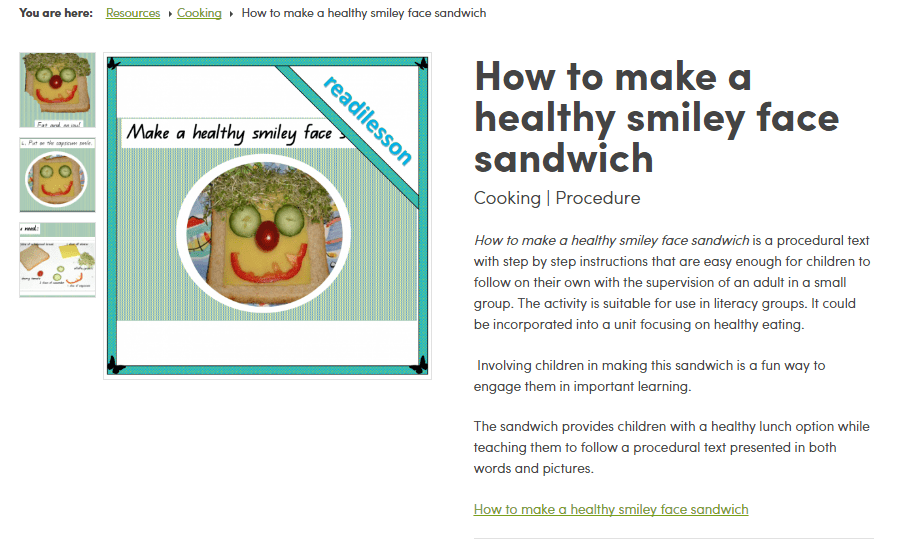
    I was disappointed to realise that I had only one cooking resource prepared: How to make a healthy smiley face sandwich

    © Norah Colvin 2016
    © Norah Colvin 2016

    A remedy was required and I tried to think of other resources I could add.

    I have previously made ladybird biscuits by icing an Arrowroot biscuit and adding Smarties for spots. I will probably add that recipe in the future, but I was trying to think of something healthier to begin with. I wondered if it might be possible to make a ladybird from an apple. This is what I did:

    © Norah Colvin 2016
    © Norah Colvin 2016
    © Norah Colvin 2016
    © Norah Colvin 2016
    © Norah Colvin 2016
    © Norah Colvin 2016
    © Norah Colvin 2016
    © Norah Colvin 2016
    © Norah Colvin 2016
    © Norah Colvin 2016
    © Norah Colvin 2016
    © Norah Colvin 2016
    © Norah Colvin 2016
    © Norah Colvin 2016
    © Norah Colvin 2016
    © Norah Colvin 2016
    © Norah Colvin 2016
    © Norah Colvin 2016

    When I made one for my grandson on the weekend, I was pleased that he recognised it as a ladybird beetle, even without the spots!

    Unfortunately, it’s more suitable for an adult to make for a child than for children to make for themselves. Apples are too difficult for young children to cut. It is therefore not suitable for readilearn. However, I had fun making it and will continue to think of other recipes I can add to readilearn’s cooking collection.

    Thank you

    Thank you for reading. I appreciate your feedback. Please share your thoughts.
  • Smile! It’s contagious

    https://openclipart.org/image/800px/svg_to_png/192642/Children_holding_hands.png
    https://openclipart.org/image/800px/svg_to_png/192642/Children_holding_hands.png

    This week at the Carrot Ranch Charli Mills has challenged writers to in 99 words (no more, no less) write a story that changes with a smile. It reminded me of the old television program I used to watch when growing up: Candid Camera.

    Like the situation set-up in Car without a motor, people were presented with an improbable situation, a misrepresentation of reality, a lie. We laughed at their responses; and they laughed when told to “Smile, you’re on candid camera.”

    The situations were all meant to be fun and the majority of the people, those we were shown anyway, responded in good humour. However, we don’t always respond with such good humour when we feel we have been lied to intentionally, or mislead for whatever reason.

    The story of The Boy Who Cried Wolf is a good example what happens when one habitually lies. Nobody likes to be made a fool of, and generally people try to take what they are told at face value, rather than question the veracity of the speaker’s tale.

    Nobody likes to be caught out telling lies either. However, it seems that, no matter how much we protest against or attempt to excuse our own lies, lying may be a part of human nature.  Not only that, there may be many different reasons for lying. If you can, recall the last time you told a fib and your reason for doing so. But please don’t share. I’m not interested in true, or false, confessions.

    I recently watched this fascinating Ted talk by Kang Lee who asked Can you really tell if a kid is lying?

    Lee states that there are three commonly held misconceptions about children and lying:

    • Children only start to lie when they are of school age
    • Children are not good at lying and adults can easily detect their lies
    • If children lie at a young age they will become pathological liars for life

    Lee then goes on to disprove these misconceptions, citing studies that show that “lying is really a typical part of development. And some children begin to tell lies as young as two years of age.”

    He goes on to suggest that children who lie at a younger age than others are advanced in development of the two key ingredients for successful lying:

    Mind reading: I know something that you don’t, and I know that you don’t, therefore I can lie to you; and

    Self-control: “the ability to control your speech, your facial expression and your body language, so that you can tell a convincing lie”.

    He explains that both mind reading and self-control are essential to function well in society, and that

    In fact, deficits in mind-reading and self-control abilities are associated with serious developmental problems, such as ADHD and autism. So if you discover your two-year-old is telling his or her first lie, instead of being alarmed, you should celebrate –

    I dare say that the typical Candid Camera scenarios relied upon these two ingredients also.

    Lee also demonstrates that most adults, including parents, social workers, child-protection workers and police, cannot detect when children are lying. However, he explains that, hidden behind the neutral facial expressions, there are a variety of fleeting emotions including fear, shame, guilt, and possibly “liar’s delight”. These emotions, too subtle to be perceived by the naked eye, can be detected by “transdermal optical imaging” which detects changes in blood flow.

    The benefits of the imaging go beyond just lie detection but can be used in assessing people’s health, including pulse, stress levels, mood and pain levels.

    SnipsandClips, Teacher and Child https://openclipart.org/detail/205589/teacher-and-child
    SnipsandClips, Teacher and Child https://openclipart.org/detail/205589/teacher-and-child

    While teachers weren’t listed among those tested for detection of children’s lies, it stands to reason that they would be no better than those included. It makes me wonder about those times when a child may have been punished, not through evidence, but through someone’s conviction that he was lying, or that he was telling the truth. Maybe you were one of those innocents who wasn’t believed and suffered punishment as a result; or was believed when lying to protect another and suffered the punishment anyway.

    I know I was never able to convince my mother. She always knew when I was lying (Who me? Never!) Maybe, like Emily in my flash fiction story, I should have been more careful to hide the incriminating evidence! But, as Lee says, Sally should celebrate that Emily is displaying developmentally appropriate, or even advanced, behaviour.

    Gotcha!

    Investigating the suspicious quiet, Sally found Emily perched on a stool in the bathroom, smiling at her reflection. Sensing Sally’s arrival, Emily turned on her “innocent” face and hid her hands behind her back.

    Suppressing a smile, Sally asked, “What’re you doing?”

    “Nuthin’.”

    “I think you’re doing something.”

    Protests belied guilt smeared on the face.

    Sally enveloped Emily, and turned her lipstick-painted face towards the mirror.

    “How did that get there? ” she asked, feigning seriousness.

    “Don’t know. ”

    Sally pointed to the brush in Emily’s hand.

    “Oh.”

    Their eyes met in the mirror, and smiles turned to laughter.

    Thank you

    Thank you for reading. I appreciate your feedback. Please share your thoughts.
  • 3 + 2 = 5 Let me count the ways!

    Billboards

    That we live in a print-rich environment is undisputed. Even in country areas one cannot travel far without being bombarded by print. In addition to road signs there is a plethora of billboards advertising the best places to sleep, eat, or play that can be found just ahead.

    Environmental print is the genre with which many children first engage successfully with reading.  Ask any parent who’s detoured around fast food outlets, hidden shopping catalogues, or camouflaged cheaper brand names of identical products.

    That we are immersed in mathematics in our daily lives is just as evident but doesn’t always receive the same recognition. I think this may in part be because people often think of mathematics as abstract algorithms and theorems that we (they try to get us to) learn in school; and that have no apparent application to our lives beyond the walls of the classroom.

    algebra

    However, even the examples mentioned above are just as rich in mathematics are they are in print. They include distances, and perhaps time, to the destination, cost of items, opening hours, and number of attractions. Anyone travelling a distance with young children will have answered questions such as “Are we there yet?”, “How much further?”, and “What time is it?

    As I say in my statement about mathematics on my readilearn site,

    “Mathematics is all around us. We use it every day for a huge range of purposes from deciding on the sequence in which we dress ourselves, to calculating how much time we have available for an activity.”

    mathematics readilearn

    One of the resources suggests 25 ways for parents to keep their children thinking mathematically over the school holidays. I have shared these ideas previously in Counting on the holidays.

    25 ways to think mathematically

    Recently I was at the gardens with my two grandchildren (G1 and G2, aged 6 and 4), their mother, and my Hub. The children consulted a map and signposted paths to follow the Children’s Trail which had various sculptures along the way. I am undecided about the value of distracting children from the trees and plants, as if the vegetation itself would not be interesting enough. However, the children enjoyed locating the sculptures in the sequence numbered on the map, and reading the accompanying information. They were engaged in purposeful reading and mathematical thinking in context: real life learning!

     © Norah Colvin 2016
    Pandas on the Children’s Trail © Norah Colvin 2016

    As we headed back, G2 made a comment that showed she was engaged in mathematical thinking of her own. She observed that there were two children and three adults, which made five of us all together.

    “That’s right,” I confirmed. “There are five’. I thought for a little while, then added, “And do you know what? As well as two children and three adults, there are two boys and three girls.” The children looked at the group and confirmed that I was right. They laughed – a different interpretation.

    This gave me an idea for a thinking game: how many other arrangements of three and two could there be?  I wondered if the children would like to play along. I had never attempted this before and had no idea if there’d be more, or if we had already exhausted all options.

    I looked at the group. I noticed our shoes: three had closed shoes and two had open shoes. I thought about our names: three shared one surname, two another. Then we were on. Everyone was thinking of ways we could be arranged into groups of two and three.

    Sometimes we sorted according to different characteristics, as in the previous examples. Others times we used a simple yes or no sorting, such as two have hats with brims and three don’t have hats with brims. This is the easiest sorting to do, and the first that children learn.

    G2 made many suggestions of this type of sorting for one and four.  One has the characteristic, the others don’t. This was age appropriate for her, and it was great to see her joining in confidently and contributing to the discussion. G1 was able to engage in the more complex thinking required for the groupings of three and two.

     I was amazed at the number of different combinations we came up with, and that each of us was combined with others in many different ways.

    These are some of the ways we arranged ourselves into groups of two and three (not physically, just in our discussion).

    Arranging ourselves 3 + 2

    This seemingly mundane activity has potential for developing thinking and learning by encouraging:

    • thinking about things in new and different ways
    • looking for similarities and differences
    • observing detail
    • sorting according to different characteristics – which is important to both maths and science (think animal and plant classification)
    • having fun with maths
    • having fun with family

    But wait, there’s more: When we left for home, two went in one car and three in the other!

    I think this would be a great activity to do with young children learning about number. It may be a challenge for teachers in Australia where children wear uniforms to school but I’m already thinking of how it could be done with toys or illustrations. It’s not quite the same as doing it with the children themselves, but it could be fun. What do you think?

    teddy bear sorting

    You won’t be surprised to discover that I have prepared a readilearn resource for sorting as well!

    Thank you

    Thank you for reading. I appreciate your feedback. Please share your thoughts.


  • Bug me, please!

    Monarch butterfly

    That I have an appreciation of and fascination with insects is no secret as I have written about it many times previously.

    The Very Hungry Caterpillar

    Some of my earliest posts formed a series in which I suggested using Eric Carle‘s Very Hungry Caterpillar story for developing critical literary, encouraging children to question the authenticity of what they read and the qualifications and intentions of the author.

    Carle’s purpose with the story was to entertain, not to teach, and he was therefore unconcerned about inaccuracies in the butterfly life cycle.

    The book, popular for its bright colourful illustrations and inspiring story of an ordinary caterpillar who becomes a beautiful butterfly achieves the author’s goal to entertain.

    In a more recent post Revisiting The Very Hungry Caterpillar I provided a summary of, and links to, each of the four original posts which explained my recommendation that this very popular book was more relevant to teaching critical literacy than science.

    © Bec Colvin
    © Bec Colvin

    Acknowledging the importance of maintaining Wondering in the everyday and an attachment with nature in wild spaces, I described my excitement at being able to observe every stage of the ladybird’s life cycle up close in my own backyard; an excitement that had perhaps exceeded observing the butterfly life cycle in the classroom with our live butterfly kits which had allowed us to Breathe – a sense of wonder!  I even shared a section of a television interview in this post about Talking Interviews.

    I talked about some insect themed classroom and teaching resources in The comfort zone. Others are listed on my page Early Childhood Teaching Resources and are available in my Teachers Pay Teachers and Teach in a Box stores. These, and many more, will be available on my readilearn website when it launches later in the year. Here is a sneak peek at some that will be included:

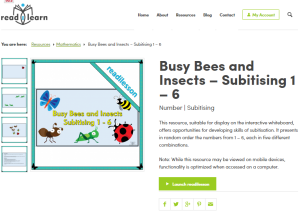
    9 square insect puzzle Busy Bees 100 chart Busy Bees and Insects subitising Busy Bees birthday chart Busy Bees Celebrate 100 days of school One Lonely Ladybird

    But the truth is I don’t really love all insects. I’m not too keen on cockroaches, though the native Australian giant burrowing cockroaches are pretty cool. And although I am aware of vital roles of insects in the environment

    • as a food source for many animals
    • as pollinators for flowering plants
    • as decomposers

    and I know that without them we’d basically not have an environment, in fact, we wouldn’t be; I often wonder whether we would be all that worse off without disease-spreading mosquitoes and flies. However, it seems that they too are vital to the health of our planet, whether we like them or not. It’s a bit of a “can’t live with them and can’t live without them” situation.

    This brings me to the flash fiction prompt set by Charli Mills of The Carrot Ranch this week. She has challenged writers to In 99 words (no more, no less) include insects in a story. How could I resist? In fact, the real challenge was choosing what to put in and what to leave out of the post, and how to not be predictable in my response.

    Surprise!

    It took just one, then the word was out. The streets were abuzz with the news – a triumph of social media.

    “Kyle’s having a barbecue. Tell everyone. Don’t bring anything. There’s always plenty.”

    The excitement was palpable as guests swarmed towards Kyle’s. Some, initially unsure, flapped about nervously. Others, more experienced, felt they were dancing on the ceiling. Eventually all were on their way.  The waft of seared flesh left no doubt about the location.

    Kyle was ready when they arrived. “Who invited you?” he grinned and waved, as he knocked them out with the can of spray.

    Well, what would you do?

    #9 on this list of Ten thing about flies you may not know says,

    “The use of pesticides on crops to try to kill flies and insects is actually causing more damage to the ecosystem than the flies themselves.”

    It’s something to think about next time you reach for that fly swat or can of insect spray.

    I’ll leave you with a bit of nostalgia with a television advertisement, starring Louie,  from my childhood days.

    Thank you

    Thank you for reading. I appreciate your feedback. Please share your thoughts.

  • Sharing circles

    http://www.morguefile.com/
    http://www.morguefile.com/

    On Tuesdays I have regularly published a post and response to the flash fiction challenge set by Charli Mills at the Carrot Ranch. Today I am breaking with tradition as I wrote the prompt this week and included my flash with it.

    In that post I mentioned classroom sharing circles where everyone comes together to share their work, thoughts and ideas, not unlike the sharing of stories and ideas at the Carrot Ranch. In the classroom everyone in the circle is equal, with equal opportunity to see and hear, and to be seen and heard. The focus is lifted from the teacher and shared equally among class members, creating a democracy.

    In this post I describe some of the sharing circles I used in my classroom and show how these processes are not all that dissimilar from our own blogging circles.

    reading

    D.E.A.R. (Drop Everything and Read) is a daily quiet reading session lasting about 15 minutes. In these sessions everyone, including the teacher, chooses a book and finds a comfortable space for reading. Some children sit at desks, some on cushions in the reading corner, others prop themselves up against the wall, and others lie on the floor.

    The one rule is:

    • Everybody reads without interruption.

    This means:

    • Nobody talks
    • Everybody chooses enough reading material for the session
    • No outside interruptions are permitted (unless it’s an emergency)

    It is essential for the teacher to engage in personal reading, along with the children, to show that reading is valued and to provide a model of “expert reader” behaviour. Inviting other school personnel to join the session is also valuable. It is particularly important for children, who may not see adults engaged in regular sustained recreational reading at home, to see adults enjoying reading.

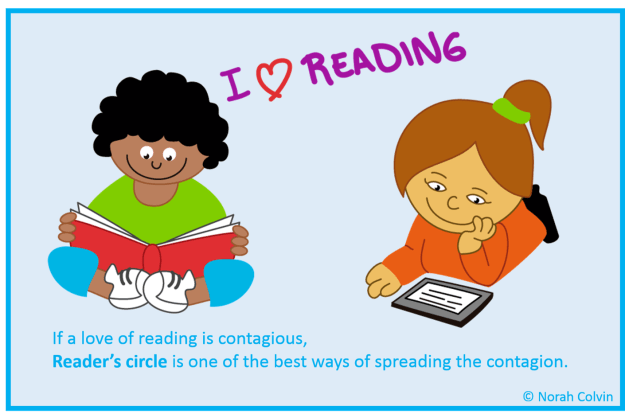
    I always concluded my D.E.A.R. sessions with a Reader’s circle. Children would bring their books to the circle and share what they had read. While there wasn’t time for every child to share every day, I ensured each child had an opportunity of doing so at least once a week. Children would:

    • Tell the book’s title and author
    • What it was about
    • What they liked about it, and
    • Read a small section to the class

    I loved the way children would look to each other’s book responses to guide their own selection, often asking others to help them find a book that had previously been talked about. We do the same in sharing and reading book reviews on our blogs.

    If a love of reading is contagious, Reader’s circle is one of the best ways of spreading the contagion.

    love of reading

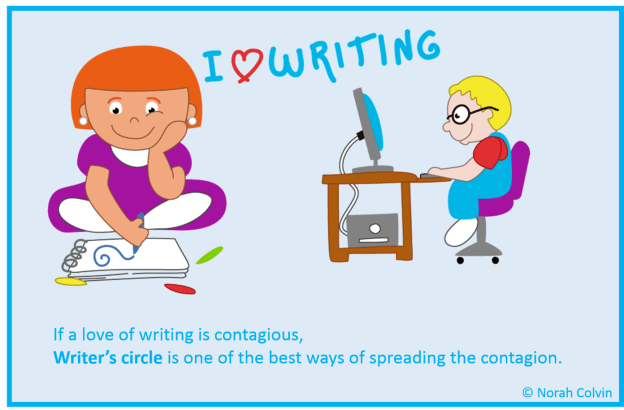
    A love of writing can be equally contagious. One of the things children enjoyed most about writing, other than the actual writing, was sharing it with others. Children would have opportunities to discuss and read their writing to each other in pairs and small groups as well as in the Writer’s circle.

    Sometimes we would have a pre-writing circle to share ideas and inspiration. It was rare that anyone would leave the circle without an idea. Surprisingly perhaps, it was even rarer that two would write about the same thing. Bouncing ideas off each other seemed to encourage a diversity, rather than similarity, of ideas. I guess the responses to Charli’s flash fiction prompt demonstrate the same principle.

    Post-writing circles provided opportunities to discuss what had been written and to read sections to others. Writers might share what they liked about their writing, or what they were having trouble with. Others might ask questions for clarification, to understand character motivations, or to find out what will happen next. Sometimes, with the writer’s permission, I would use a piece of writing to discuss an aspect of the writing process that would have application for many. If any children were reluctant to read their own writing, I would be more than happy to read it with them.

    If a love of writing is contagious, Writer’s circle is one of the best ways of spreading the contagion.

    love of writing

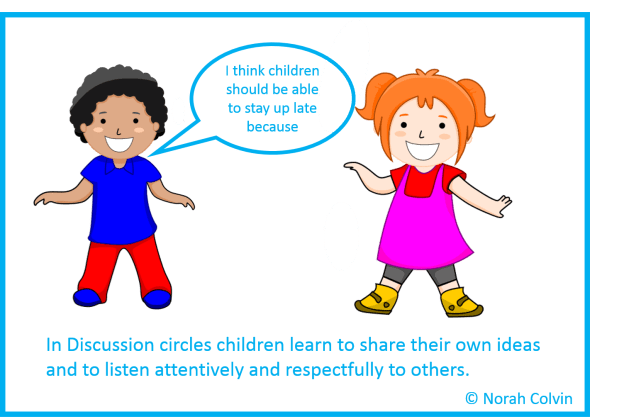
    Discussion circles could occur at any time, in any subject on any topic where a sharing of ideas was required. I had a lovely smiley face ball that children would sometimes pass around, or across the circle, to each other, to indicate whose turn it was to talk. This ensured that everyone had an opportunity to share their ideas and thoughts, as well as to hear the ideas and thoughts of others. Topics could be as diverse as:

    • “I feel happy when …”
    • “When I lose a tooth …”
    • “On the holidays, I …”
    • “I think children should be able to … because …”

    discussion circles

    Each of these sharing circles gives children a voice, demonstrating that they, their thoughts, their ideas and their opinions are accepted and valued. Each encourages children to listen attentively and respectfully to others by providing a supportive environment in which they can test out ideas, then reflect and reassess in response to the reactions of others.

    These discussions are not unlike those we engage in on our blogs; sharing books and articles read, and videos watched, along with our ideas and opinions and, most of all, our writing.

    Thank you

    Thank you for the opportunity of sharing mine. I appreciate your feedback. Please share your thoughts.

  • Formal Schooling and the Death of Literacy

    Paul Thomas in this post describes the literate home environment of his early childhood days, an environment that created his advantage, his privilege in becoming literate.
    He also describes the tedium of school days that had to be endured rather than enjoyed, and decries the cult of measuring and labeling texts and students that “murders literacy among our students“.
    He goes on to say that “The very best and most effective literacy instruction requires no textbooks, no programs, and no punitive reading policies.
    Literacy is an ever-evolving human facility; it grows from reading, being read to, and writing—all by choice, with passion, and in the presence of others more dexterous than you are.
    I couldn’t agree more.
    If you enjoy this post by Paul, check out this follow-up post Everyone Learns to Read by Direct Instruction on his blog the becoming radical. You may find many other posts of interest as well.

    Thank you

    Thank you for reading. I appreciate your feedback. Please share your thoughts.

    plthomasedd's avatardr. p.l. (paul) thomas

    My privilege is easily identified in my being white and male, but it is the story of my life that better reveals my enormous privilege established by my mother when I was a child.

    I entered formal schooling with such a relatively high level of literacy and numeracy that from those first days I was labeled “smart”—a misnomer for that privilege.

    From Green Eggs and Ham to Hop on Pop, from canasta to spades, from Chinese checkers to Scrabble—games with my mother and often my father were my schooling until I entered first grade. And none of that ever seemed to be a chore, and none of that involved worksheets, reading levels, or tests.

    Formal schooling was always easy for me because of those roots, but formal schooling was also often tedious and so much that had to be tolerated to do the things I truly enjoyed—such as collecting, reading…

    View original post 1,019 more words

  • Thankful and inspired: schools and education

    I have just watched the movie “He named me Malala”. The message has not lost its importance or impact. Sadly the need for her message to be heard and responded to has only grown over time. I share this post again as a reminder of Malala’s courage, strength, and determination. She says, “The terrorists thought they would change my aims and stop my ambitions, but nothing changed in my life except this: weakness, fear and hopelessness died. Strength, power and courage were born.”

    Norah's avatarNorah Colvin

    In recent posts there was some discussion about the importance of education, the value of schools and the role of teachers. I thought it timely to re-share this post, first published in July 2015.
    Earlier this week I read a post by Kimmie of Stuck In Scared about Ten Things of Thankful. I have also read many other posts about things to be thankful for. These posts prompted me to share something for which I am thankful: schools and education.

    I know that I often write about what I consider the shortcomings of traditional schooling and make suggestions of how schools could be improved. However I live in a country that values education and in which every child has a right to a free education. For that I am thankful. Those of us who have access to schools and education are the lucky ones.

    This week I have been…

    View original post 238 more words

  • Delivering a sneak peek for Easter

    Launching soon - readilearn2

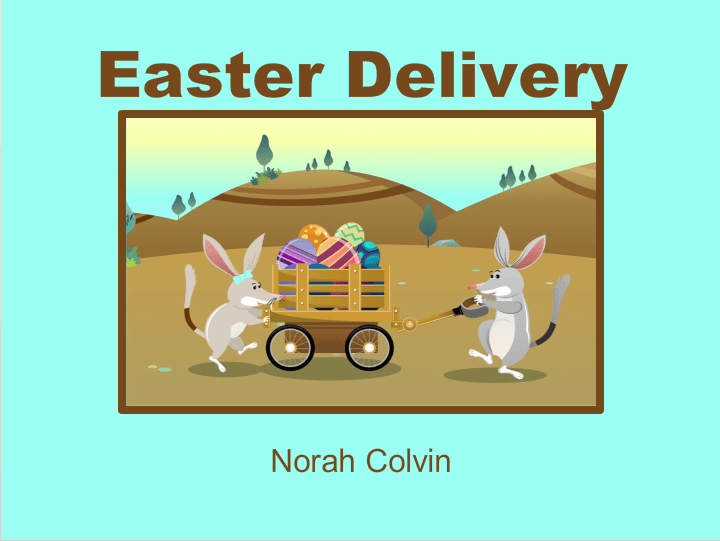
    For the past few years I have been preparing early childhood teaching resources for a website that I hoped would be up and running by now. Unfortunately, there have been some delays with the developer. In the meantime, I thought I’d share a resource with an Easter theme to give you a free taste test. This will be of interest mainly to early childhood teachers or parents of young children. Everyone else is excused.

    The resource, called “Easter Delivery”, is a story about twin bilbies, Benny and Belinda, who get to deliver eggs to the families of some friends for the first time. It incorporates addition concepts and is suitable for use with the whole class on the interactive white board.

    The story involves the children in helping Benny and Belinda work out how many eggs they need to deliver to each family and the combination of packs they could choose. The maths concepts are probably most suitable to year one students but teachers may use their discretion about how much maths to include.

    Included is an information sheet about the resource and three printable follow-up activities:

    • Benny and Belinda’s Easter Activity – children record the number of people in their own family and draw and calculate the number of eggs Benny and Belinda would deliver
    • A Happy Easter Card from the Bilbies – a card with a picture to colour and blank inside for children’s own messages
    • The Bilbies’ Easter Colouring Page

    The resource is available clicking on the image until Thursday 24 March 2016. Hopefully it will be available on my website for Easter 2017!

    © Norah Colvin 2016
    © Norah Colvin 2016

    Yes. It is a bit of shameless promotion but it is also a gift for you to use if you would like to in the lead-up to Easter. The resource is not downloadable, but I am happy for the link to be shared with your early childhood teaching friends and colleagues. While it is not a requirement of use, I’d really appreciate some feedback. Please use the poll or share your thoughts in the comment box below.

    Thank you

    Thank you for reading. I do appreciate your feedback. Please share your thoughts.