Live Love Laugh Learn … Create the possibilities

Category: Flash fiction

  • Once was a dog

    grenny

    I am not a dog person. In fact, I am not a pet person at all. The only pets I ever owned were short-lived: goldfish, fighting fish, hermit crabs, and billabong bugs. I was successful at keeping caterpillars in the classroom and observing them grow, pupate, and emerge as butterflies. But they couldn’t really be classed as pets. I’ve written about this before here.

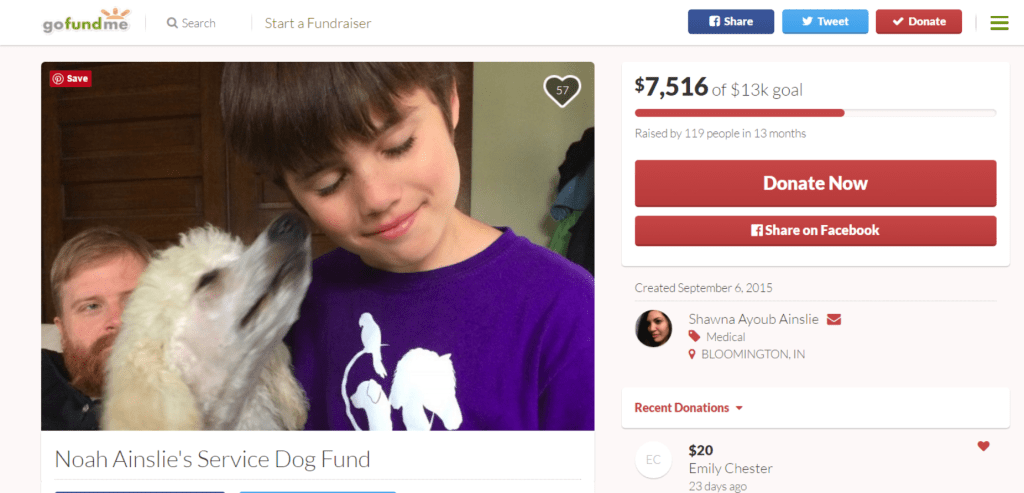
    I know all the theories about pet ownership; especially for helping children develop a sense of responsibility and care for others. I know about the contribution of pets to the physical and psychological health of their owners of all ages through the companionship and unconditional love they offer. I am touched by the heart warming story of Noah Ainslie, a little boy suffering from autism, and the difference his service dog Appa has made to his life, and the lives of his family. Please help if you can.
    screenshot-2016-10-10-19-53-42

    It would not be unrealistic, with my focus on nurturing young children, to expect that I would be a pet owner. However, I’ve never been inclined to make the commitment required

    My parents were both country people who moved to suburbia to raise their large family. There were never any pets. They said that dogs didn’t belong in towns. The dogs they were used to were working dogs, never pets. I guess there were enough mouths to feed without adding pets to the mix as well.

    Unlike for some, lack of a pet as a child did not induce me to want one on reaching adulthood. Consequently, my children also missed out. Daughter had some mice, rats, and a guinea pig at various times; but nothing to compare to a “real” pet, like a cat or a dog. As soon as she moved into a house that allowed pets, she and partner went out and got themselves a dog.

    screenshot-2016-10-11-20-21-38

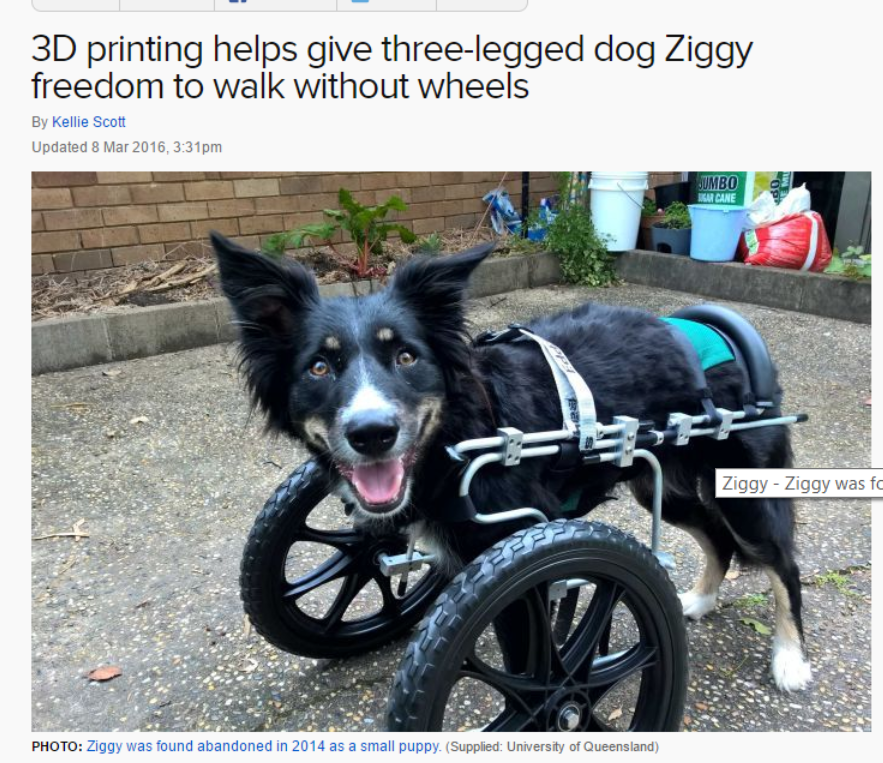
    I must say, Ziggy is a gorgeous dog with a happy, friendly, easy-going nature. If I was going to have a dog, he’d be it. I’m beginning to get an inkling of the relationship between humans and their animal friends. There is definitely something very special about it. However, I’m still not interested in forming an attachment of my own.

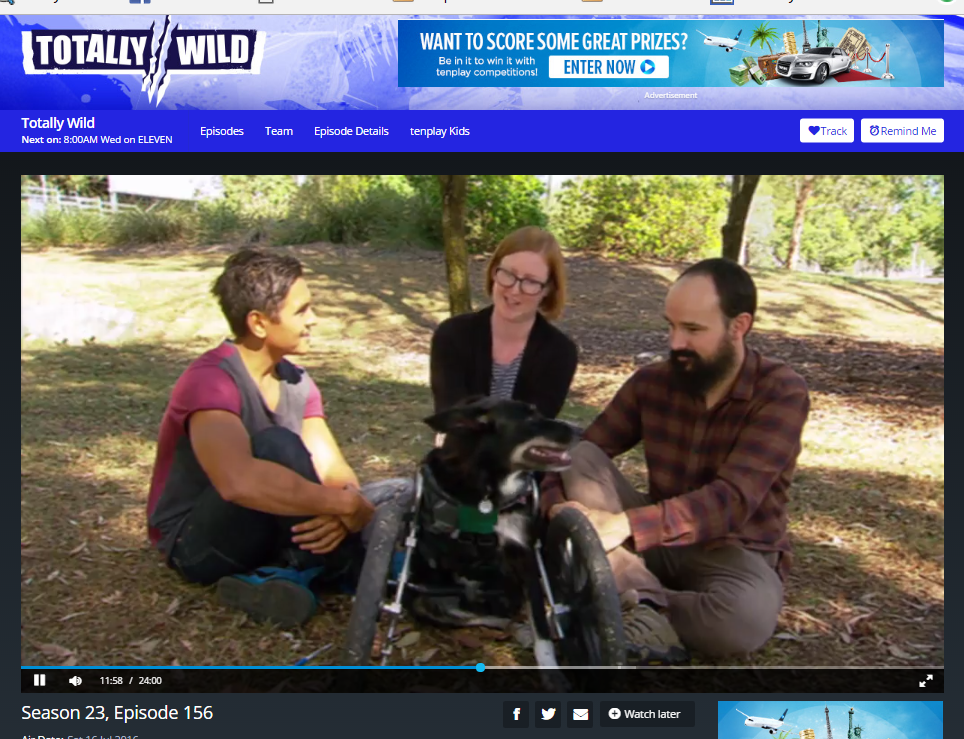
    Ziggy is a very special dog with very special owners. You can get to know the three of them in this video. (Watch from 11:.24 – 15:20.)

    Unfortunately the video may not play for those residing outside Australia. Thanks to Anne Goodwin for alerting me to the fact.
    screenshot-2016-10-11-20-21-12

    Ziggy’s innovative surgery put him in the spotlight for a little while. His story was also featured on the Tripawds blog

    ziggy-on-tripawds-blog

    and ABC News

    screenshot-2016-10-10-19-24-20

    The importance and depth of the human-pet relationship was reinforced for me this week when Charli Mills of the Carrot Ranch reported that her big brown canine friend Grenny was gone.

    Charli was devastated by his unexpected passing and shared stories of his special abilities and the ways in which he added to their lives. Her post is a wonderful tribute to Grenny’s life and his contribution to theirs. Charli asked writers to share stories about big brown dogs this week.

    Charli said, In 99 words (no more, no less) write a story about a Big Brown Dog. I just want to read Big Brown Dog stories this week. I know dogs aren’t everyone’s cup of tea, but you can write about that, too. Keep it happy, write something funny, surprising or tender. Thank you.

    Well, Charli knows that dogs aren’t my cup of tea. She also understands that, with no personal experience on which to draw, I feel inadequate to respond appropriately to her situation, other than offer my heartfelt sympathies. As for writing, I could come up with nothing other than nonsense which I don’t consider at all appropriate.  Other writers have written beautiful brown dog stories for Charli.

    Please follow the link to read Charli’s post, the lovely comments, and the beautiful stories.

    Instead of a flash, I’ll leave you with a few picture books about pets you might like to read:

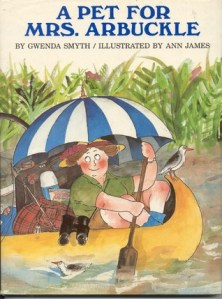
    A Pet for Mrs Arbuckle by Gwenda Smith
    a-pet-for-mrs-arbuckle-by-gwenda-smyth

    What Pet Should I Get? by Dr Seuss

    lifetimes

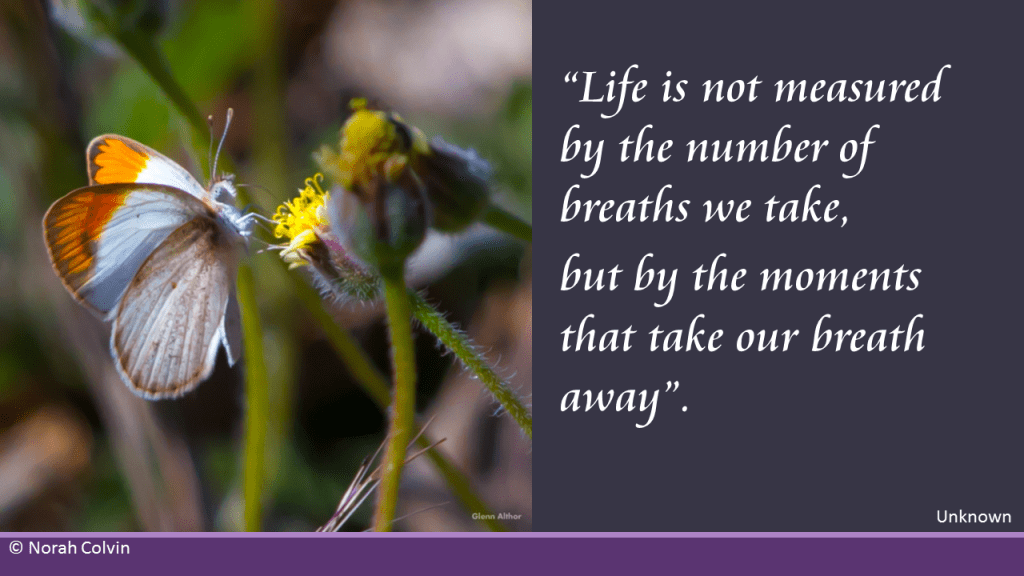
    Lifetimes by Bryan Mellonie is a beautiful book for explaining death to children. It’s great to read at any time to help children understand that every living thing has its own lifetime. It is also great to read when the death of a pet is imminent or occurs. Understanding that death is a part of life, helps with the grieving process.

    Breaths - life is not measured

    Thank you

    Thank you for reading. I appreciate your feedback. Please share your thoughts.


  • Feeling a little prickly?

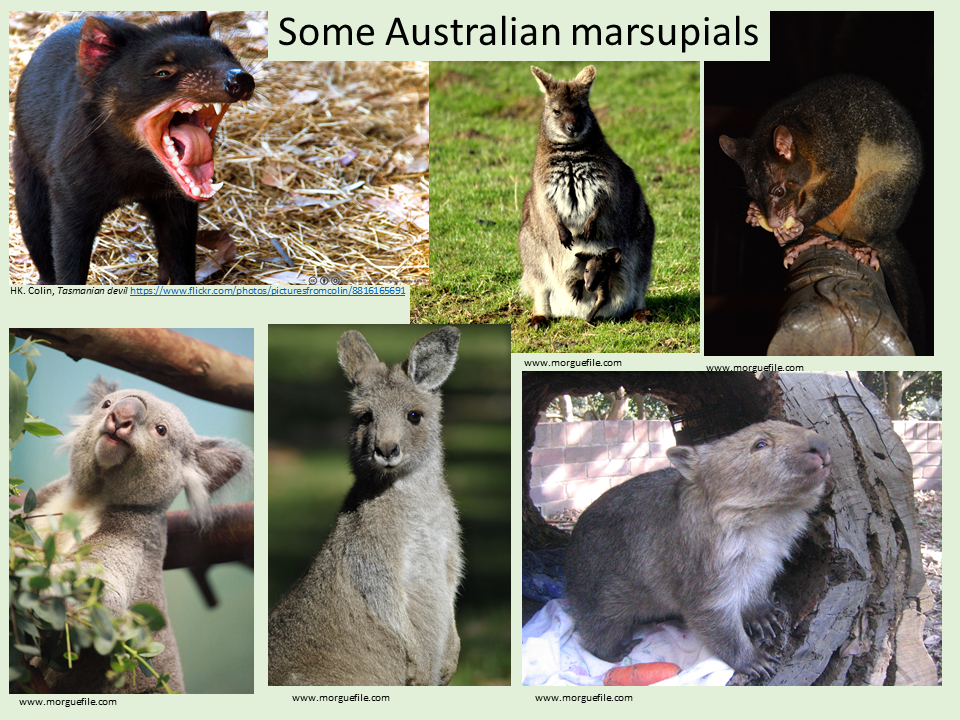
    Australia is home to a great diversity of, and many unique animals. Most native Australians are not found anywhere beyond its territories. I guess that’s not surprising since it is the world largest island or smallest continent country with vast expanses of ocean between it and other continents.

    feeling-prickly-marsupials

    Australia is home to almost 70% of the world’s marsupials. Other marsupials are found in the Americas, mostly South America. Kangaroos, wallabies, koalas, possums, wombats, Tasmanian devils, numbats, bilbies, and quolls are among the species of marsupials found in Australia.

    Marsupials are mammals that give birth to live young before they are fully developed. The young, usually referred to as joeys, continue to develop in the mother’s pouch for a number of months, suckling on their mother’s milk.

    feeling-prickly-monotremes

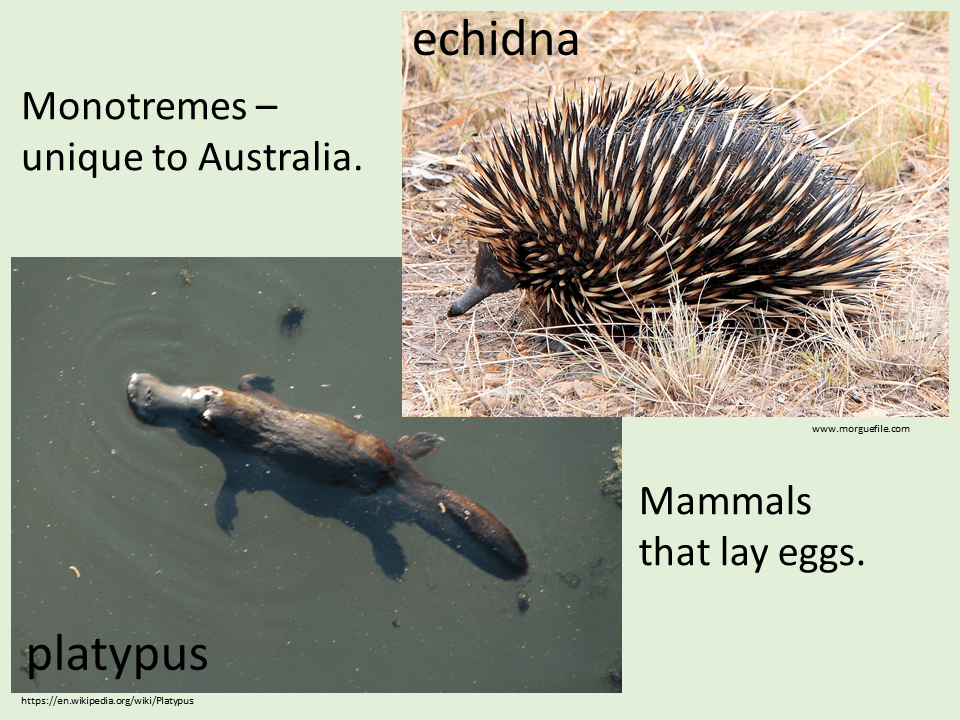
    There is another group of even more unusual mammals: the monotremes. Monotremes are egg-laying mammals. The platypus and the echidna, the only existing species of monotremes, are unique to Australia.

    The platypus

    When Europeans first saw a platypus, they thought it was a hoax with its bill like a duck’s, tail like a beaver’s, and feet like an otter’s. It has fur like other mammals but, unlike other mammals, it lays eggs.

    The platypus lives in burrows on the banks of freshwater streams and small rivers in eastern Australia, including Tasmania. It spends much of its time foraging in the muddy river beds for crayfish, worms and insect larvae.

    Female platypus usually lay two eggs. When the young hatch, the mother releases milk from pores in her skin. The milk pools on her abdomen and is lapped up by the young for about three to four months. There is no special baby name for baby platypus. They are simply called ‘baby platypus’.

    The male platypus, with a poisonous spur on its hind foot, is one of only a few venomous mammals.

    Platypus predators include crocodiles, eagles, dingoes, and introduced animals such as foxes and feral cats.

    The echidna

    Echidnas, the oldest surviving mammals, live all over Australia in many different habitats. They usually live alone and are not territorial. Although it is rare to see an echidna in the wild, they are considered common. They generally hide away under vegetation, in logs, or in the burrows of other animals.

    Echidnas eat termites and ants, and sometimes the larvae of other insects. They use their long snouts to forage in leaf litter, rotting logs, or ant mounds in search of food. Their long tongues are covered in sticky saliva for catching prey.

    Echidnas are covered with spines along the head, back and tail. The spines are sharp and used for defence against predators.

    Female echidnas usually lay one egg at a time. When the young, called a “puggle”, hatches, it makes its way to the mother’s pouch area to suckle milk. When the puggle starts to develop spines, at about 50 days, it is removed from the pouch. The mother continues to suckle it until it is about six to seven months old, at which time she deposits it at the entrance to the burrow, then walks away and abandons it.

    Predators include goannas, Tasmanian devils, dingoes, eagles, and introduced animals such as foxes and feral cats. When threatened an echidna may run away or curl up in a ball.

    Although all have spines, echidnas are not related to either hedgehogs or porcupines.

    Here is a great article about these amazing echidnas.

    If you are looking for books about Australian animals, check out the Steve Parish Storybook Collection by Rebecca Johnson, featured in last month’s Author Spotlight, which includes stories about both monotremes, many marsupials, and other fabulous creatures.

    Monotremes and marsupials feature in the readilearn stories Bullfrog’s Billabong and Little Koala’s Party and their suite of resources.

    Bullfrog's Billabong - coverlittle-koalas-party-cover

    I was prompted to think about the diversity and uniqueness of these Australian animals, especially the echidna, by this week’s flash fiction challenge set by Charli Mills at Carrot Ranch Communications. She challenged writers to In 99 words (no more, no less) write a prickly story. I thought there was no better opportunity to share with you some of our amazing creatures, particularly since just last week I was lucky enough to see an echidna in the wild for the very first time.

    The uniqueness and diversity of Australian animals reflects our own individual uniqueness and the diversity among us. We have much to learn about accepting difference, appreciating diversity, and acknowledging the unique characteristics each individual contributes to the enrichment of our collective humanity. Together we stand. Divided we fall.

    Here is my response. I hope you enjoy it.

    Stronger together

    She bristled, warning platypus to stop. He didn’t.

    “Feeling a little prickly, are we?”

    Kookaburra, oblivious, laughed at the “joke”.

    She smarted. Couldn’t he see the hurt in his words? Like a spur in her side, that last barb, really stung. Mocking difference pushed them apart.

    The bush quietened. Not a breath of wind. Not a leaf’s rustle. Not a bird’s chirrup. Were all waiting for the victor to be decided?

    Suddenly, out of the undergrowth, rushed a devil, hungry for blood.

    Platypus turned to echidna. She contemplated leaving him. But stayed. Spur and spines together: a powerful defence.


    Author’s note: Tasmanian devils have been known to eat echidnas, spines and all!

    Thank you

    Thank you for reading. I appreciate your feedback. Please share your thoughts.
  • It’s not what you see

    1-2

    This week at the Carrot Ranch, Charli Mills is talking about the effect of changing a lens on how things are viewed. She says,

     “No matter what lens we apply, there is something to be seen in each of us that is worthy.

    Perhaps if we focus differently, we might actually achieve peace.”

    This is true too of children. Sadly, I think too often children are seen for what they are not yet, rather than appreciated for what they are. Childhood is all too fleeting, and with the current focus on assessment and teaching-to-the-test in many educational systems, it is becoming almost non-existent. Recess and free-play times are being eroded to cram in more cramming time.

    I recently read an article in the Washington Post that told of children in a US school having to walk laps during a 20-minute recess. The supposed intention was to get the children active. However, most children would be naturally active if allowed the freedom to run and play. The benefits of free-play activities for health, well-being, and social development would be far greater than that of walking laps.

    file1051239031460

    This practice contrasts with one described in an article in the Sydney Morning Herald. Children in Finland have fifteen minutes of mandatory outdoor play every hour, whatever the weather. “Fresh air, nature and regular physical activity breaks are considered engines of learning.”

    Each of these practices recognises the importance of activity, but each has a different way of providing for it, and only one is effective. I wonder why those with the power to make positive changes in education, fail to see the damage being done by didactic and test-driven practices that rob children of any love for or joy in learning. It seems to matter little what lens is used, they are unable to focus clearly on what matters most.

    In this TEDx talk, Nancy Carlsson-Paige explains what happens When Education Goes Wrong: Taking the Creativity and Play out of Learning.

    Towards the end of the talk, beginning at 12:45, Nancy says,

     “The difference between understanding concepts and reciting facts is very important for us to understand right now, because it captures the essence of what is happening in education today. There is a gross misunderstanding of what education is that has swept across the country, and the unfortunate belief is that you can direct teach, and you can measure and you can quantify learning; but the truth is, it is only the most superficial and the most mechanical aspects of learning that can be reduced to numbers. Unfortunately, this mistaken idea about the nature of education has pushed down to our youngest children. “

    She says that when we “drill and grill” kids, we not only lose the power of the learning experience, we lose all the amazing capacities that children bring to us in education:

    • initiative
    • creativity
    • the ability to define and solve their own problems
    • originality of thought
    • invention of new ideas
    • perseverance
    • cooperation.

    She says that when we take those capacities out, we take away the love of and joy in learning, not only from the children but from teachers too.

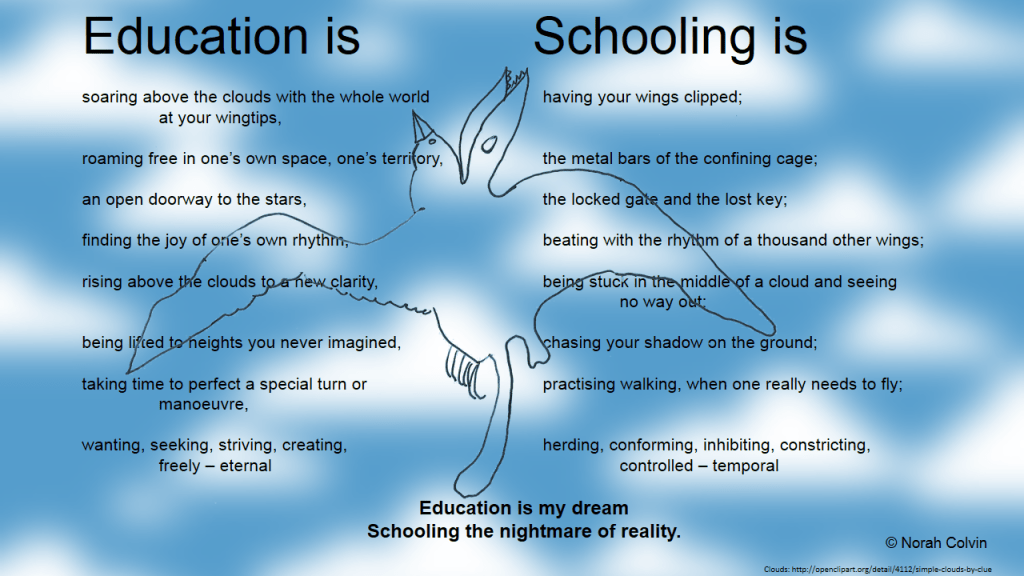
    These are themes that are familiar to regular readers of my blog, and the most influential when I decided to leave the classroom. More than thirty years ago I wrote a poem to describe the differences between what often is, and what could be.

    © Norah Colvin
    © Norah Colvin

    Sadly, I cannot say that nothing has changed. It has. The differences have become more stark.

    Here is my response to Charli’s prompt to: In 99 words (no more, no less) write a story using a lens. It can be literal, like looking at the world through rose-colored lenses or the need for spectacles.

    pink-sunglasses-clipart-1

    Unfortunately, I couldn’t find my rose-coloured glasses.

    What you see

    They saw him for what he wasn’t and what he lacked, not for what he was and what he could be. Their ill-fitting garments failed to clothe, and their unpalatable diet failed to nourish. If only they’d zoomed in upon his potential. Instead the wide-angled lens showed a panorama of disadvantage: an excuse for failure to fulfil his needs or enable his possibilities. A lens in proper focus may have seen a burning curiosity, a rich imagination, a wisdom older than time, and a heart in harmony with the universe. Instead they considered the negatives not worthy of development.

    Thank you

    Thank you for reading. I appreciate your feedback. Please share your thoughts.
  • One small step

    Neil Armstrong walks on the moon, NASA
    Neil Armstrong walks on the moon, NASA

    It is no secret that I love having time with young children. Their development constantly amazes me. They are curious learners on a quest to find out as much as they can about the world and how it works. They are scientific researchers making observations, forming hypotheses, and drawing conclusions; always with a plan for the next step if the results aren’t what was expected.

    How many times do they need to release a spoon to be confident that it will always be pulled towards the floor? How early do they laugh when something doesn’t perform as expected; for example, when a balloon floats up instead of falling down?

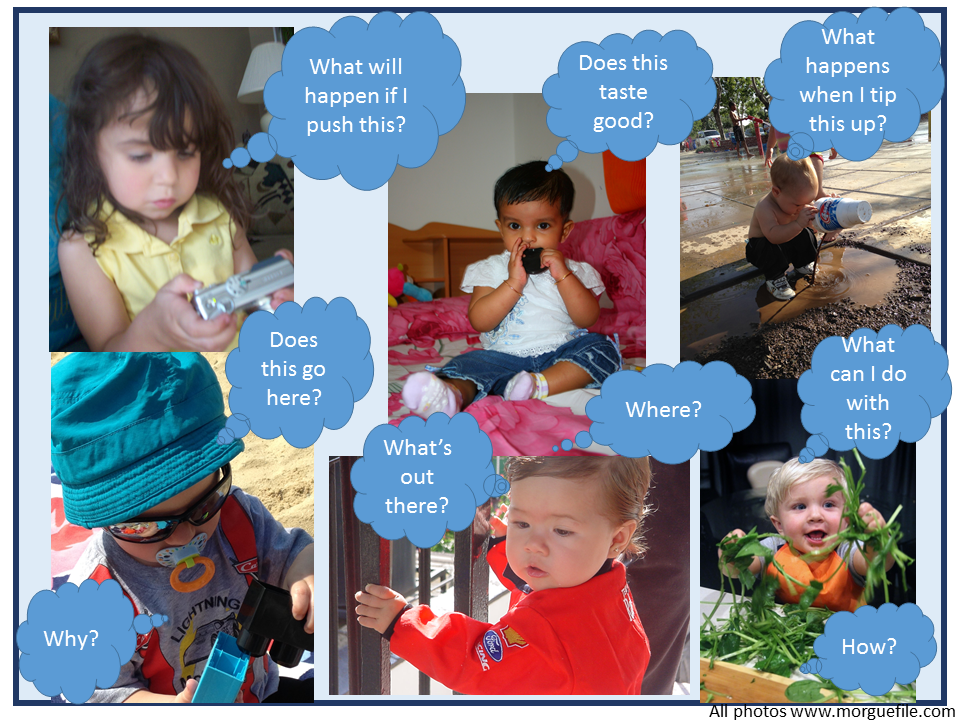
    Many of a young child’s explorations seek answers to questions they ask of themselves; questions that may never be verbalised.

    childrens-questions

    After they have investigated their immediate environment, and their language begins to develop, they start to look at the wider world, and begin to ask questions about how things work and why things happen.

    Here are a couple my granddaughter asked me recently:

    “Norah, you know about gravity? Why do clouds stay up in the air? Why don’t they fall down?”

    “If babies grow into adults, and adults give birth to babies. Which came first the baby or the mother?”

    questions-children-ask

    The determination and persistence of young children is also almost limitless. Watch them learning to roll, or to sit, or to stand. It is never achieved on the first attempt, but that doesn’t stop them. They don’t give up. They try and try again until they do it. The look of satisfaction on their faces is priceless. No stickers are required. Sometimes, when the result differs from expectation, the look is of surprise. But even then they are quickly deciding what to do next.

    Without formal instruction of any kind, in their first few years, children perform amazing feats. Without the imposition of test requirements or standardised assessment, children are driven to learn. Intrinsic rewards, accompanied by the encouragement of significant others, for example, parents, are sufficient.  Children are driven by a “yet” mindset and a belief that there is no such thing as “can’t”. This ensures they continue to practice until they succeed. Immediately they succeed, they set themselves another challenge. That is, unless they are taught otherwise.

    When they are nurtured in an environment that is encouraging and supportive, with a balance of comfort and challenge, and well-timed feedback, children will thrive physically, emotionally, and mentally. They will learn through their observations and interactions with people and objects. Each question answered will stimulate the next.

    These are just a few of the remarkable achievements made by children before setting foot inside any formal education establishment. They learn to

    • interact
    • roll over
    • sit up
    • crawl
    • clap hands
    • stand
    • walk
    • place things inside, and take things out of, other objects
    • feed oneself
    • talk
    • run
    • undo and do up buttons
    • push buttons (of all sorts)
    • open doors
    • play games

    Given an encouraging, supportive environment with caring adults who respond to their needs, surround them with language, love them, and model behaviour, children learn amazing things.

    This week at The Carrot Ranch Charli Mills challenged writers to In 99 words (no more, no less) write a story about an amazing feat. My response is a tribute to the amazing feats performed by little ones every day.

    One small step

    Everything she had ever done was preparation for this moment. All eyes were on her. The audience’s expectation was palpable, bolstering her determination. She pulled herself up to full height and looked around, smiling. The audience waited. She checked the positioning of her feet, and her balance. She held up one hand, signifying that an attempt was imminent. She put one foot forward; then raised the other hand as she brought her back foot alongside the first. She paused, poised, momentarily. Immediately cameras clicked and cheers erupted. After two more steps, she launched, triumphant, into her father’s waiting arms.

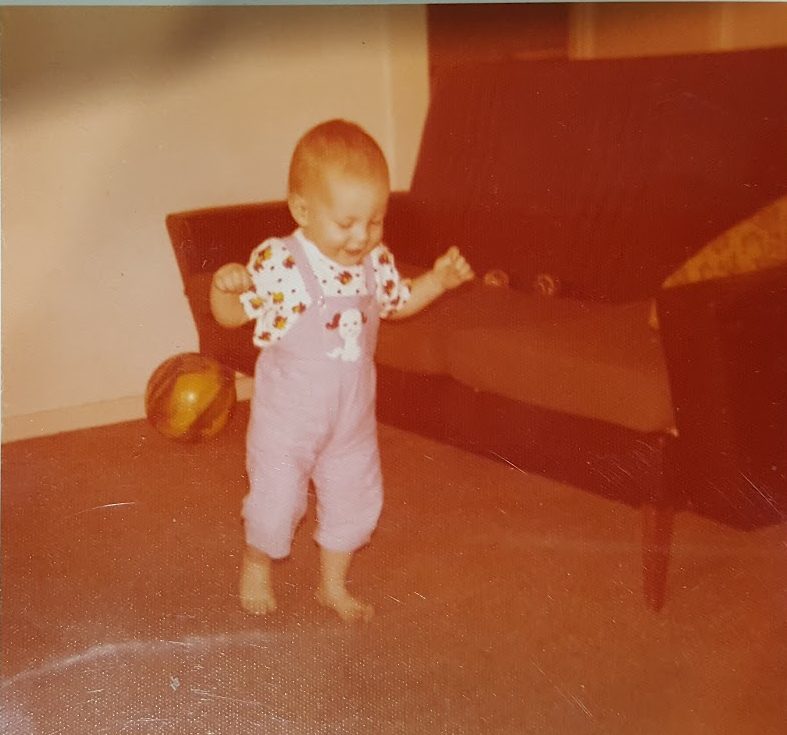
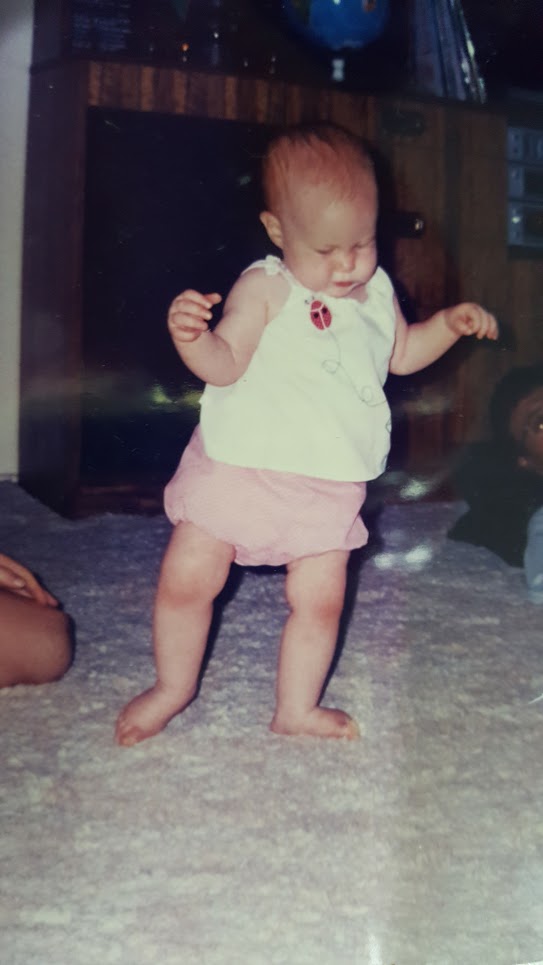
    Here are photos of my two little (now big) ones. While not of their first steps, these photos were taken within the first month each of them walked.


    © Norah Colvin
    © Norah Colvin
    bec-walking
    © Norah Colvin

    Thank you

    Thank you for reading. I appreciate your feedback. Please share your thoughts.


  • The first goodbye

    20

    The first goodbye between a parent and a child will elicit a range of emotions from each. The feelings, and responses, of both parent and child, are dependent upon a range of factors including who the child is being left with, how well the child and the substitute carer know each other, the feelings of all parties about each other, the circumstances, the environment, and the list goes on.

    A parent who feels empowered by the decision, and views the child’s new situation positively, will accept and adjust to the change more easily. That’s not to say a parent won’t feel some sense of loss and anxiety as well, but it is important that the child is prepared with reassurance rather than the negativity of anxiety or concerns. A more confident and secure child will view the situation with positive expectations.

    Anne Goodwin, on her blog Annecdotal, often refers to attachment theory, and the responses of children to real or imagined abandonment. In her post Compassion: Something we all need Anne shares the following video, explaining that

    “Research psychologist Mary Ainsworth developed an ingenious method of assessing whether or not an infant has developed secure attachments. In the Strange Situation, babies play in a comfortable room until, at a given signal, the mother leaves. What distinguishes securely from insecurely attached infants, is not how they behave when the mother (or other primary carer) leaves, but whether they are able to settle on her return.”

    She continues

    “Research suggests that about two thirds of the population can be categorised as securely attached. That’s a whopping one third of us who aren’t.”

    The research also suggests that how secure children feel in their infancy influences how secure they feel later in life. A sense of security influences one’s ability to adapt to change and new situations.

    It is not unusual for children, or anyone, to feel a little apprehension in a new situation. A more secure individual generally accepts and adapts more easily.  When carers drop their children at child care, kindy, or school, they may be advised to “drop and go”. Mostly the children are fine once the parents have disappeared and the children have time to settle.

    36

    If children experience more difficulty than most, or if it occurs for a prolonged period, causes may need to be investigated. Sometimes a child may suffer from anxiety. Sometimes the environment may not be welcoming or appropriate to the child’s needs. Happy, secure, confident children will always face new situations better than those who feel anxious and insecure.

    father and child

    Parents can help children prepare for that first day of kindy or school by:

    • Talking about what to expect and the fun things they will do
    • Having special items for the child to take or wear; for example, a back pack or lunch container, hat or shoes
    • Rehearsing the journey
    • Visiting the kindy or school, and meeting the carers or teachers if possible
    • Writing happy messages (in words or pictures) to be found in bags, or lunchboxes
    • Establishing routines, including the goodbye routine

    Hey I love you with quote

    While the routine doesn’t have to be as elaborate or serious as that in Ian Whybrow’s Hey, I Love You!, a signal that the parent is leaving is useful in making the break. It doesn’t have to be immediate. Depending on the practices established, parents may be able to accompany the child to the door, or into the room.

    I always welcomed parents to come in with their children in the morning. The children could show their parents around and discuss work we were doing. Parents could help children organise their belongings, and talk to other parents and children. When it was time for work to begin, I would play music that would signal children to join the song or dance, and parents to take their leave.

    This week at the Carrot Ranch Charli Mills is talking about goodbyes. She is on the move from a place to which she felt attached, to a situation unfamiliar. She is sad at leaving but is able to view with hopefulness the situation to which she is moving. Charli has challenged writers to

    In 99 words (no more, no less) write a story about a goodbye. It can be the last polka until next time; a farewell without end; a quick see ya later. How does the goodbye inform the story. What is the tone, the character’s mood, the twist? Go where the prompt leads.

    Usually I post my response as the deadline draws close. However, as she is on the move, Charli has extended the submission period. If you would like to join in with a flash fiction “goodbye”, you have another week until September 13 to do so.

    Here is my response to the challenge.

    cartoon-waving-guy
    http://morguefile.com/

    A goodbye clapping song

    (Parent and child chant the verses together or take turns, changing the pronouns to suit. They begin by clapping their own, then each other’s’ hands. On the last three beats of each line, they clap each other’s hands. The pattern for each line is “Own, other’s, own other’s, own, other’s. other’s. other’s. On the last line they smile, wave, blow a kiss, and leave! It’s meant to be a bit of nonsense and a bit of fun establishing a goodbye routine.)

    It’s time for you to go, go, go

    I’ve lots to do and can’t be slow.

    It’s time for me to fly, fly, fly

    Upon my broom into the sky.

    It’s time for you to leave, leave, leave

    I will be happy, do not grieve.

    It’s time for me to run, run, run

    And jump so high I touch the sun

    It’s time to say goodbye, bye, bye

    You’ve work to do and so have I.

    I’ll blow a kiss, and smile, smile, smile

    I’ll see you in a little while.

    Bye. Have a good day. Love you!

     Thank you

    Thank you for reading. I appreciate your feedback. Please share your thoughts.

  • Where will the children play?

    This week at the Carrot Ranch Charli Mills is talking about playgrounds. I love playgrounds. Who doesn’t? They are a familiar part of life. Most neighbourhoods have at least one park or playground where children can go to play.

    Playgrounds are great places for children to:

    • Meet other children
    • Learn to socialize, through sharing of equipment and taking turns
    • Develop physical skills such as coordination, balance, strength
    • Develop confidence and persistence, and a willingness to have a go and try out new things
    • Play imaginatively, on one’s own or collaboratively
    • Be outdoors in the fresh air and in nature
    • Be active

    Charli suggested we think about empty playgrounds. I thought about the differences between modern playgrounds and the playgrounds of my childhood.

    So many pieces of play equipment that were common and popular in “my day” are no more. They disappeared over the years, due to changing attitudes to safety and responsibility. So much of the playground equipment I played on as a child would not be allowed in a playground today.

    Alanspeak, A slide for children to play on https://openclipart.org/detail/191139/childrens-slide
    Alanspeak, A slide for children to play on https://openclipart.org/detail/191139/childrens-slide

    It got me thinking about the history of playgrounds and playground equipment, and I was surprised to find that playgrounds are a fairly recent invention, little more than 150 years old. This article about playgrounds on Wikipedia states that playgrounds originated in Germany and were attached to schools. The first “purpose built public-access playground was built in a park in Manchester England in 1859.” The first in the USA appeared in San Francisco in 1887.

    Other articles such as How We Came to Play: The History of Playgrounds, Evolution of American playgrounds, History of playgrounds and The history of playgrounds – past, present and future provide an interesting overview of the changing landscape of playgrounds over the years.

    I was pleased to find that the philosophies of both Froebel and Dewey had been influential in the early days of playground design. I wrote about Froebel, the father of kindergarten, and provided links to information about his works in a previous post Let them Play! My thoughts about education and pedagogy were heavily influenced by the philosophy of progressive educator John Dewey. I previously shared some of his ideas, though not specifically related to play, in  John Dewey’s Dream.

    GDJ, Playful stick figures https://openclipart.org/detail/230070/playful-stick-figure-kids
    GDJ, Playful stick figures https://openclipart.org/detail/230070/playful-stick-figure-kids

    Of course I couldn’t write about playgrounds without including something about school playgrounds. I hope that all schools have somewhere for children to run and play at break times. I recently read This is why Finland has the best schools and was impressed to find that

    ‘schoolchildren in Finland have a mandatory 15-minute outdoor free-play break every hour of every day. Fresh air, nature and regular physical activity breaks are considered engines of learning. According to one Finnish maxim, “There is no bad weather. Only inadequate clothing.””

    The benefits to health, happiness and learning must be enormous.

    Play at break time can be the highlight of a child’s day. Children may love the opportunity to run and play with their friends in a relatively unstructured, but safe environment. However, it is not so for all children. Some children dislike the freedom, the space, the lack of structure, the noise. Some don’t know how to make friends or how to play.

    While it is great for children to have unstructured play time. It is also important to have equipment to support their play, be it imaginative, social, or physical. I have seen many disagreements occur when children have nothing to play with and no ideas for creating games of their own. It seems that many of the games we used to play, before the invention of video games and (cough cough) television, have been lost to subsequent generations. One day I will compile a list!

    For now I will leave you with my response to the flash fiction challenge set by Charli at Carrot Ranch Communications. She challenged writers to

    In 99 words (no more, no less) write a story about an empty playground. Is it abandoned or are the children in school? What is it about the emptiness that might hint of deeper social issues. It can be a modern story, apocalyptic or historical. Go where the prompt leads.

    I didn’t find it as easy as I thought I might.

    From empty playground

    She stopped abruptly as her scattered thoughts aligned to focus on the playground gate. As if restrained by an invisible chain, she was motionless. Beyond the gate children called to each other; but never her. She was not welcome, never included. Their taunts stabbed at her emptiness, twisting as they penetrated deep into the chasm within. She’d wait until they’d gone.

    Suddenly a child was there, eying her quizzically; then a mother, appraising her, uncertain.

    “Miss. Miss. Are you all right?”

    “Y-yes,” she said, straightening herself. “J-just reminiscing.” How could a life once empty, be now so full?

    Self-determination.

    Thank you

    Thank you for reading. I appreciate your feedback. Please share your thoughts.

  • Digging for dinosaur bones

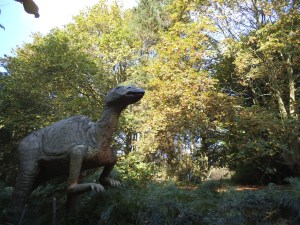
    Dinosaur Adventure, Norwich © NorahColvin
    Dinosaur Adventure, Norwich
    © NorahColvin

    My family has had a love affair, some might say obsession, certainly a fascination, with dinosaurs for almost forty years. My son initiated the affair when he was about three after being undecided whether to watch or not when dinosaurs burst onto the drive-in screen in One Million Years BC. I’m not sure when I first discovered dinosaurs, but It may have been at the same time.

    By the time Rob was four, like many children, he knew the names of a great number of dinosaurs and could rattle off screeds of information about them. It had been a steep learning curve for all of us, though he remembered far more than I. A travelling encyclopedia salesman was so impressed by his knowledge that he gave him a book about dinosaurs. (I’d already purchased; it wasn’t an incentive.) Later, his little sister Bec shared his interest.

    dinosaurs at museum Jan 91
    © Norah Colvin

    Now the affair continues with Rob’s own children. Six-year-old G1 can name and identify far more dinosaurs than I realised existed.  His younger sister G2 is not far behind. Such is the power of these mighty, and not so mighty, beasts to excite the imagination. The entire family become dinosaur experts in support of the children’s quest for knowledge.

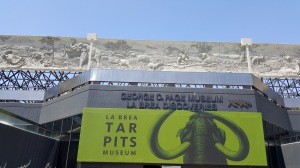
    I recently accompanied the family to the La Brea Tar Pits in Los Angeles, and the American Museum of Natural History in New York. I have mentioned this previously here. Both were wonderful learning experiences.

    © Norah Colvin
    © Norah Colvin

    La Brea Tar Pits is a museum located at a fossil site where there are ongoing excavations. In the grounds, we saw realistic sculptures of prehistoric woolly mammoths trapped in the tar. Inside, we saw fossilised skeletons removed from the tar pits; including skeletons of animals such as mammoths, sabre-toothed cats, dire wolves, and camels. Yes, camels originated in North America.

    © Norah Colvin
    © Norah Colvin

    Walking the grounds, we had to sidestep the smelly tar that still oozes in puddles around the site. It’s an amazing experience, walking on the same land where these prehistoric creatures walked, their presence almost tangible. In an enclosed area, a group of paleontologists were working with fossils recovered from the site. Scientists use these fossils to help construct our understanding of life before human history began.

    What I find interesting about the understandings derived from these fossils, is that much of it is guesswork; educated guesswork, yes, but fossils tell only part of the story. The rest must be filled in using knowledge of contemporary and recorded life. Sometimes assumptions are made, especially when only partial skeletons are found, that must be altered when, or if, complete skeletons are found.

    American Museum of Natural History © Norah Colvin
    American Museum of Natural History © Norah Colvin

    I was very impressed with the way this aspect of science was dealt with in the American Museum of Natural History. Many signs informed us that scientists don’t know for sure, but that they have substantial evidence for making their assumptions. Other signs told of claims that had been revised as new information was discovered. I appreciated being told, in essence: “This is what we know, this is what we think, and this is the evidence to support our claims.”

    This talk by palaeontologist Jack Horner, which I discovered via a link from Charli Millspost, demonstrates the process with some fascinating dinosaur discoveries and assumptions.

    This recent BBC article Meet Nanotyrannus, the dinosaur that never really existed provides additional evidence to support Horner’s claims.

    © Norah Colvin
    © Norah Colvin

    A study of dinosaurs provides many opportunities for learning across the curriculum and what a great way to incorporate children’s natural interests and curiosity when looking at topics such as scientific method, evolution and climate change.

    I’m grateful to Charli Mills at the Carrot Ranch for the incentive to write about this topic with her challenge to In 99 words (no more, no less) write a story that features a fossil or uses the word in its variant forms (fossilize, dino bones, petrification, gastroliths, ichnofossils, etc.)

    Since “discovering dinosaurs”, so to speak, I’ve always thought how wonderful it must be to unearth a great find. I haven’t made it an ambition, but I appreciate the potential for excitement. Here’s my response to Charli’s challenge. I hope you enjoy it.

    Old Bones

    She scratched at the surface tentatively at first, all senses keened, certain of imminent success. She’d uncovered bones here before. Usually one meant there’d be more. All it required was patience and persistence. Suddenly she contacted something more solid than the surrounding earth. She froze. Then exhaled. Could this be the object of her search? Frantically she scraped away the surrounding soil, exposing her find. She stepped back momentarily, assessing it, assuring herself it was real. Then with one final swoop, she removed the bone as carefully and proudly as any paleontologist would a dinosaur bone. “Woof!”

    Thank you

    Thank you for reading. I appreciate your feedback. Please share your thoughts.


  • This too will pass

    www.openclipart.org
    http://www.openclipart.org

    When the idea of an Australian National Curriculum was mooted, many teachers and parents looked forward to the uniformity that would enable students to move from school to school or state to state without the impediments to learning posed by different curriculums. Each state had its own curriculum, its own school-starting age, its own handwriting style, textbooks, exercise books, and so on. Each state trained their own teachers in different philosophies and pedagogies, and few states gave automatic recognition to qualifications earned in another. In addition to state differences, each school had its own uniform, variation on rules, routines, and culture.

    When children arrived at a school from interstate, making the decision about which class to assign them to was always problematic. Should they be placed with age peers, or with those who had been at school the same number of years, or with those at the same level of achievement? Rarely was there a neat match between even two of these, and there were just as many reasons for and against each placement.

    With a change of school, particularly with numerous changes occurring frequently, children may have missed key areas of learning. Sometimes they would be challenged by work that was too difficult as they had no foundation on which to build. Other times the work would be too easy, often requiring repetition of familiar material. Such was the inconsistency from state to state.

    https://openclipart.org/detail/191190/brother-and-sister-traveling
    https://openclipart.org/detail/191190/brother-and-sister-traveling

    There are many reasons for children and their families to transfer interstate, and not all doing so are itinerant. Some make a once-only move.

    Some families move:

    • when a parent is transferred for work, including military transfers
    • because they are part of a travelling circus or show
    • to obtain seasonal farm work
    • to flee difficult circumstances
    • for a change of lifestyle or location
    • to be closer to, or further away from, family or friends
    • when they lose their home and/or employment.

    There are probably as many reasons as there are families. In addition to differences in curriculum and school culture, each family has its own set of issues to deal with when moving interstate. Not least among these are the emotional and social issues for children who leave behind established routines and possible friendships, and face learning new routines and making new friends.

    How well children cope with the change depends upon many factors, especially the reason for the change and the parental response to it. The number and frequency of changes will also be influential and it would not be unexpected for each to require a period of adjustment.

    school cropped

    Students who arrive one at a time for a lengthy stay, are easier to accommodate than an influx of transient students staying for just a few months; for example, for harvest season. The attitudes of the community in general, including that of teachers, parents and children, are not always positive towards itinerants. Many hold pre-conceptions of families and their children as having deficits in learning, potential, and lifestyle. These views create barriers which can be difficult to overcome, and compound rather than alleviate any problems.

    Of course, while it was hoped that an Australian National Curriculum might overcome the difficulties caused by curriculum disparity, it wouldn’t necessarily be able to address some of those associated difficulties faced by individual children, their families, the schools, and their communities.

    Although the national curriculum has been rolled out, it wasn’t the panacea hoped for, even in with regard to curriculum uniformity. Indeed, the imposition of uniformity of content and pedagogy has been riddled with controversy and it has not been fully embraced, with only partial implementation, in differing degrees, by each state. It has recently undergone a review from which came a number of recommendations for improvements.

    It seems that curriculum disparity cannot yet be removed from the list of problems faced by children when changing schools.

    What got me thinking about these issues this week is the flash fiction challenge set by Charli Mills at Carrot Ranch Communications. Charli, who has recently had homelessness thrust upon her, wrote about some of the issues she is now facing being transient, and how she is learning to cope with them. She challenged writers to In 99 words (no more, no less) write a story about something or someone that is transient. It can be a fleeting moment, a rogue vagabond, or ephemeral like trending hashtags. What is passing by and how can you capture the passing in a flash?

    For my flash, I have decided to write about an itinerant child, one who has been on the move, and faces yet another first day at yet another new school.

    Déjà vu

    “I don’t wanna go.”

    “You have to.”

    “Why?”

    “I have to work.”

    “I could look after m’self.”

    “No. You have to go to school.”

    Tears cascaded as the parent thrust the child onto the back seat littered with clothing, books, and assorted paraphernalia.

    “How long are we gonna be here?”

    “How long?”

    A small hand thumped the door. Feet pushed hard into the back of the front seat.

    Hands trembled on the steering wheel. Ash tumbled.

    “I don’t know.”

    “Where are we?”

    “Nowhere.”

    Finally, with only a cursory glance at the sign, they approached the school office.


    nlyl, reading man with glasses https://openclipart.org/detail/3133/reading-man-with-glasses
    nlyl, reading man with glasses https://openclipart.org/detail/3133/reading-man-with-glasses

    If you wish to do further reading on the topics of itinerant students and the review of the Australian National Curriculum, here are some links:

    STUDENT MOBILITY: ISSUES AND PEDAGOGICAL IMPLICATIONS FOR LITERACY EDUCATORS Dr Robyn Henderson Queensland University of Technology

    Review of the Australian Curriculum Final Report

    Thank you

    Thank you for reading. I appreciate your feedback. Please share your thoughts.
  • Listen to the sounds

    Charli's picture

    This week at the Carrot Ranch, Charli Mills is talking about sound, and has challenged writers to

    In 99 words (no more, no less) write a story that includes the sense of sound. It can be an onomatopoeia, a swearing session with sound alike substitutes, lyrical prose or a description of a sound. Go where you hear the prompt calling.

    I thought it was quite timely for me as I had just written a piece about audiobooks. However, I have decided to keep that for posting another day and have instead decided to look at picture books. Regular readers may not be surprised.

    Picture books are often a child’s first introduction to stories, poems, fantasy and other worlds. The language of picture books is immensely important and must captivate the ear as the illustrations engage the eye. Through picture books children are learning the sounds of the language: its rhythms and intonations; its accents and pronunciations; its beauty and its meaning.

    Many picture books are written in rhythmic, rhyming language and we are quick to note when the timing is a little off or the rhyme not quite right. Successful picture book authors write and rewrite until they get the sound of the language just right for a read aloud experience. Though the words may be few, the task may be difficult. Children, their parents, and teachers are a discerning audience.

    As onomatopoeia (a word that phonetically imitates, resembles or suggests the source of the sound that it describes) features in many children’s songs and picture books, it is the focus of this post.

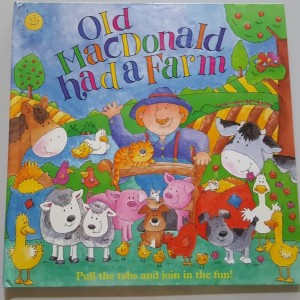
    Old MacDonald had a Farm

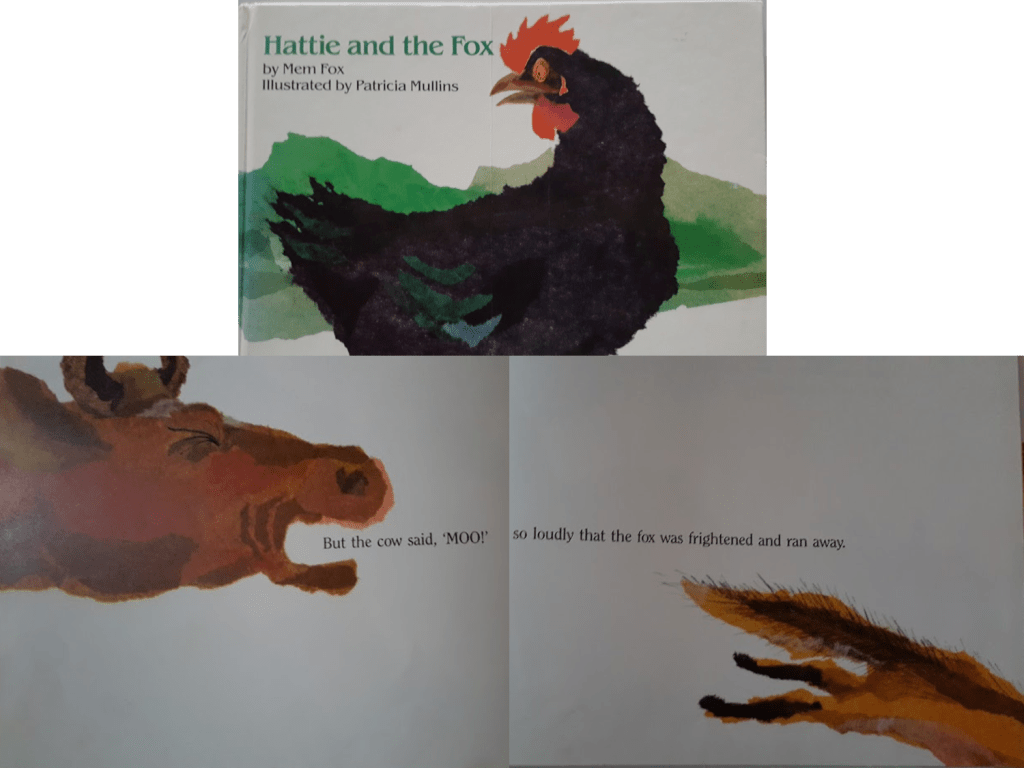
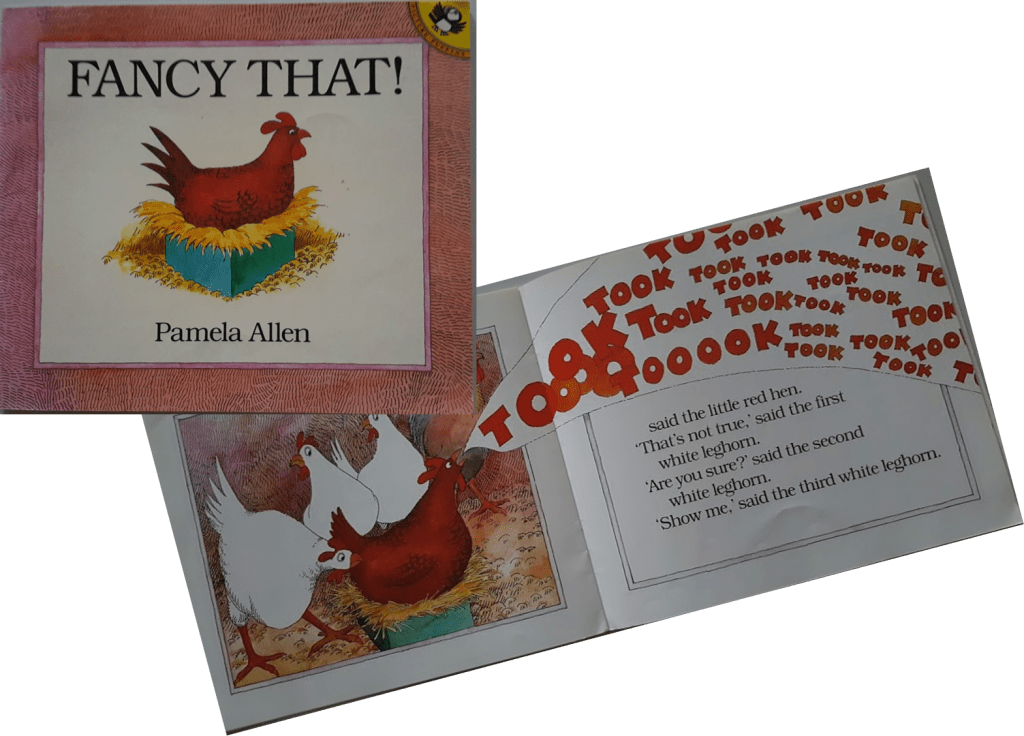
    Animal sounds, familiar through songs such as Old MacDonald Had a Farm, frequently occur in picture books, including Hattie and the Fox and Fancy That!

    Hattie and the Fox

    Fancy That

    The sounds of machines are also popular. Some of you may recall the song about The Marvellous Toy that “went zip when it moved, and bop when it stopped, and whirr when it stood still.”

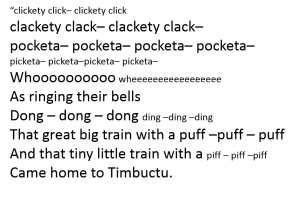
    the Train to Timbuctu

    The repetitive rhythmic sound of a train’s motion is frequently portrayed, as in The Train to Timbuctu that went

    Timbuctu rhyme

    the Little Engine that Could

    and The Little Engine that Could with its

    “I think I can – I think I can – I think I can – I think I can – I think I can – I think I can – I think I can – I think I can – I think I can.”

    followed by

    “I thought I could. I thought I could. I thought I could. I thought I could. I thought I could. I thought I could.”

    A great demonstration of a growth mindset.

    Bertie and the Bear

    There are also the sounds of musical instruments as in Bertie and the Bear.

    An Old Witch Song

    There are the sounds associated with actions, like the swish of the broomstick and the plop of the hop toad in Old Old Witch;

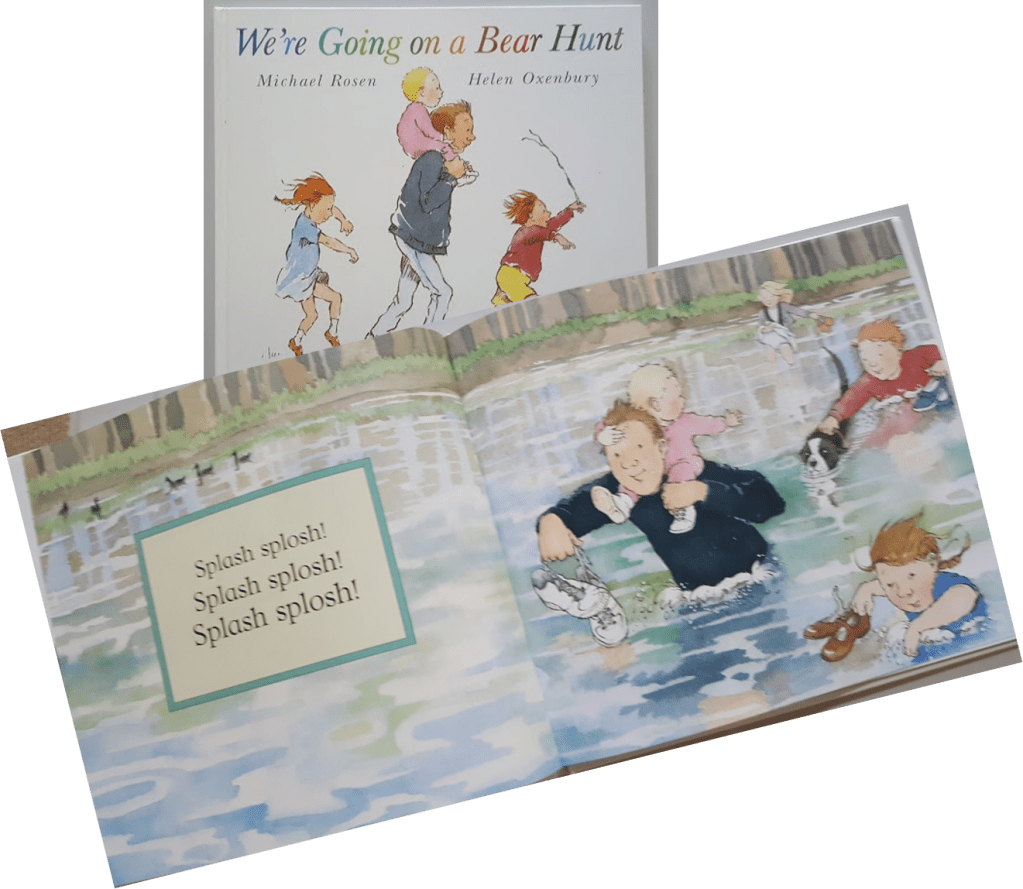
    Going on a bear hunt

    and those from Going on a Bear Hunt with its swishy swashy of moving through grass, splash splosh of wading through water, and squelch squelch of walking in mud.

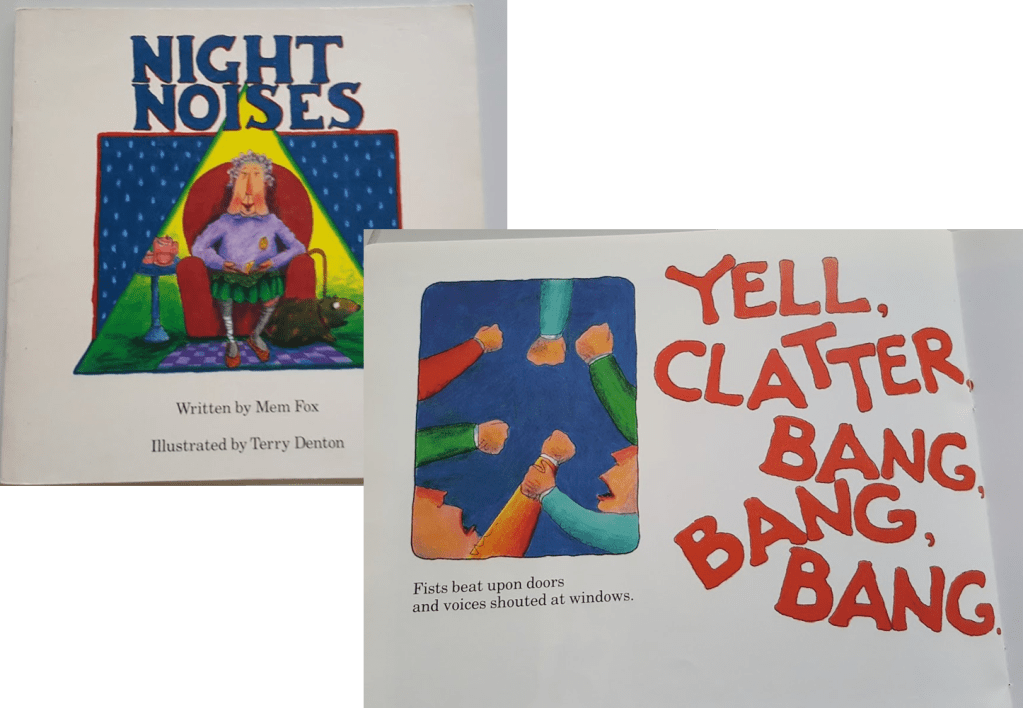
    Night Noises

    Some stories introduce a variety of onomatopoeic words. Night Noises, about a surprise party for Lillie Laceby who was nearly ninety, includes the click clack of car doors opening and closing, the crinch crunch of feet tip-toeing on a garden path, the murmur and mutter of voices whispering, the creak crack of knees, and the snick snack of bolts on the door.

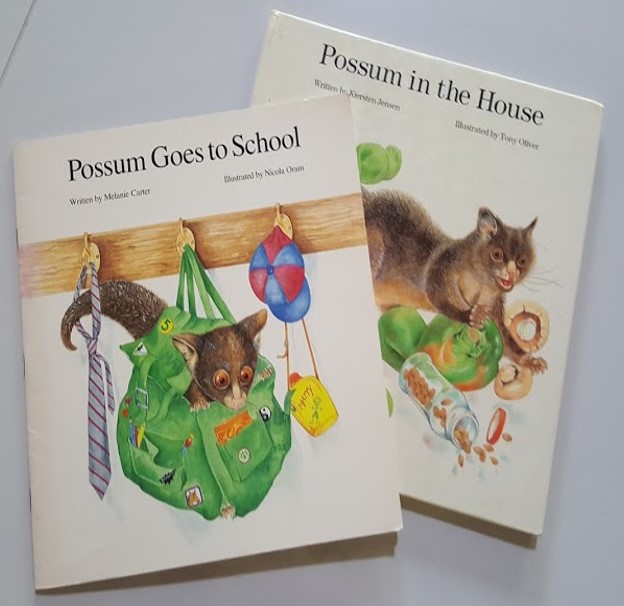
    Possum goes to school

    When there’s a Possum in the House or Possum Goes to School, there is nothing but trouble, with possum making a mess at every opportunity.

    At home, in the pantry the cornflakes go crunch crunch, in the kitchen the saucepans go clatter clatter, and in the study the pages go rustle rustle. Each time the possum’s whereabouts is discovered, it goes screech screech and runs off to another room to create yet more mess.

    The same occurs at school with paints going drip drip in the art room, claws going scratch scratch in the staff room, and the goldfish going splash splash in the science room.

    Burping Baby

    Then of course, there are also the body noises that children seem to take delight in, like those from Burping Baby.

    I recently discovered Lauri Fortino’s Frog on a [B]log, a blog celebrating picture books. Lauri has a delightful picture book of her own The Peddler’s Bed, illustrated by Bong Redila. Lauri recently shared a reading of the story on her blog. Since we are talking about sounds, if you have a few spare minutes, pop over and have a listen.  You will also find an example of onomatopoeia in her story with the repetition of squeak squeak squeak.

    Onomatopoeic words are often presented in fonts of different size or colour, or even different type. Children are fascinated by them, pointing to, asking about, maybe even recognising them, long before they are able to recognise any other words. You can help to get them started by pointing to the words and inviting them to join in the hullabaloo. What a great introduction to the world of reading.

    Now that I have reminded you of these types of onomatopoeia and provided you with these wonderful examples, I wonder what I was thinking. How can I match them in my flash? I need a flash of inspiration, or maybe a flash of lightning to begin my story about a mother and child hurrying to make it home before the storm hits. I hope you enjoy it.

    The eye of the storm

    “Storm’s coming!”

    Pit pitter-patter Pat pitter-patter hasten four feet.

    Lightning and thunder boom down the street.

    “H-h-h-hurry.” Mum urges. “Home – nearly there.”

    Pit scuffle-scuffle Pat scuffle-scuffle “Straight up the stair.”

    Clink-chink-fumble-fumble “No need to knock.”

    Scritch-scratch “I’ve managed – the key’s in the lock.”

    Whoosh! chortles wind, as it rushes inside.

    Damn! cusses chair chucked onto its side.

    P-u-sh!  The door bangs! Avoid pellets of ice

    Smashing and tumbling like millions of dice.

    Rat-a-tat raindrops, another crash-boom!

    Shuffle and scurry. “Straight to the safe room.”

    Huddled together, hardly daring to breathe,

    Listening and waiting for the monster to leave.

    Then sudden quiet, the child whispers hope

    “Is it all over?” Mum answers, “Nope.”


    The first fifteen lines meet Charli’s 99 work criteria. I added the last two because I was thinking of the eye of a storm that brings a quiet calm but not the end of the storm –  there’s still more to come. I’d love to know what you think.

    Thank you

    Thank you for reading. I appreciate your feedback. Please share your thoughts.
  • The Principal’s Office

    Principal's office

    The thought of being sent to the Principal’s Office is notoriously fear-inducing with the implication that some misdemeanour has occurred and that punishment will follow. Of course, I know this only from the stories of others. It’s true: I have no recollection of ever having been sent to the Principal’s Office during my school days. In fact, I have no recollection of there being a Principal’s Office at all, or indeed who that principal might have been. Perhaps there are some serious omissions in my memory files.

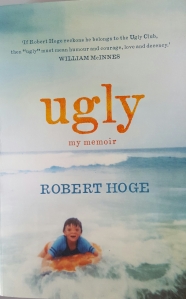
    In a previous post, I introduced you to Robert Hoge and his memoir Ugly through a lying incident he relates. Robert also shares recollections of being sent to the offices of a deputy principal and a principal while he was at school. Both incidents are also included in the version for Younger Readers.

    Ugly coverUgly for kids.PNG

    Robert recalls that,

    Most of the school lived in a vague, unspecified fear of Mr Fuller (the deputy principal). He was the perfect second-in-command. He delivered the bad news when needed and administered a strict, no-nonsense form of discipline that mainly worked by keeping students so in fear of the threat of getting in trouble, they behaved.

    One day when Robert was summoned to Mr Fuller’s office he was informed that some teasing had been occurring. As he was usually the one being teased, Robert was relieved that he wasn’t getting into trouble. Instead of informing on others who had teased him, Robert said,

    “Well, sir, it wasn’t anything really. Nothing that got me very upset anyway.”

    Sadly, though, it was Robert’s turn to be reprimanded for being the teaser. The children who were so good at teasing him, weren’t so good at taking a little teasing in return, and had made a complaint.

    Robert confesses surprise at how much the other child had been upset because he (Robert) “was teased so often … (that he) … became better and better at dealing with it” as he got older. However, it wasn’t just the children who were cruel and sometimes, when adults were cruel, he found it more difficult to take.

    SnipsandClips, Teacher and Child https://openclipart.org/detail/205589/teacher-and-child
    SnipsandClips, Teacher and Child https://openclipart.org/detail/205589/teacher-and-child

    Robert describes an incident that occurred in year ten when he and another student elected to do a week’s work experience as teachers at a local primary school. He was allocated to a year seven class and the other student to a year two class. Robert enjoyed the week and was pleased that his appearance drew few comments from the students.

    On Friday afternoon Robert was summoned to the principal’s office. Waiting outside, expecting perhaps to get a ‘thank you’ from the principal, he was surprised when the other student wasn’t also there. What happened when he was called into the office is astonishing.

    Without so much as a greeting, Robert was chastised for the school’s not having being warned before he arrived. Warned about what, Robert wasn’t sure. When he enquired, the principal quickly informed him, that she should have been warned about him; that when he’d arrived on Monday they’d had to swap the classes to which he and the other student were assigned. Robert was initially confused as to the reason, then he realised that she was talking about his appearance, that perhaps the year two students would not be able to cope as well as the year sevens.

    Robert was upset. He didn’t know what to say and started to cry. When he said, “I’m sorry”, the principal responded with “Good” and showed him the door. Of course, Robert was distraught. He writes,

    It wasn’t the last time I cried about the way I looked, but it was the very last time I apologised to anyone else for it.

    Each of these incidents occurred in a Catholic school. Anne Goodwin who blogs at Annecdotal recently shared a guest post here about the legacy of a Catholic childhood. I was also educated at Catholic schools. While most of my teaching service occurred in the state system, I did teach for a few years in Catholic schools. I saw and experienced many instances of adults being mean to children. I also saw many instances of kindness.

    For my flash fiction response to this week’s challenge set by Charli Mills at Carrot Ranch Communications to In 99 words (no more, no less) write an office story, I have decided to write an alternative encounter for Robert with a more principled  and compassionate principal. I’d love to know what you think.

    movie board

    The Principal’s Office, Take Two

    “Ah, Robert, come in,” she said, extending her hand and shaking mine as if I was an adult rather than a work experience student. As she returned to her desk, she indicated for me to also sit. I was puzzled. I knew I’d done a good job in the classroom. Why would the principal want to see me?  I waited. She looked at me quizzically. “Robert, I’ve heard a great deal about you this week …”  I squirmed. “… and all of it positive.” She smiled. “I’d like to suggest, if you’re still undecided, that you consider teaching as a career …”

    48

    Although Robert didn’t choose a career in teaching, he has powerful lessons for us through sharing his story.

    Thank you

    Thank you for reading. I appreciate your feedback. Please share your thoughts.