Live Love Laugh Learn … Create the possibilities

Category: Family

  • Learning in the kitchen

    Learning in the kitchen

    The kitchen is a great place for learning.

    kitchen

    When children participate in the preparation and cleaning up of meals and other food items the learning is richer than just cooking and cleaning, they are learning skills which will be invaluable for their future independent lives such as:

    • cooperation, sharing, taking turns and patience (how long before they’ll be ready?)
    • the etiquette of dining.
    • hygienic food handling.
    • the language of food and cooking and the preciseness of vocabulary such as the difference between dice and chop, shred and slice, boil and steam, bake and roast.
    • counting and one to one matching when setting the table with one of each item for each person.
    • the mathematics of measuring mass (250 g), volume (1 cup or 250 ml) and time (bake for 15 minutes).
    • the mathematics of linear measurement; measuring the length, width and depth of baking tins and trays.
    • reading and following procedures, and understanding that unless the steps of a recipe are followed in order the outcome may not be what was expected.
    • writing of menus and shopping lists.
    • organisational and preparation skills: making sure all ingredients and utensils are available and assembled.
    • the science of mixing and combining, heating and cooling, and the different effects these may have upon different ingredients and utensils.
    • understanding that some of the changes that occur are reversible e.g. water to ice and back again; but that some are irreversible e.g. cream to butter, but not back again.

    While it is not suitable for children to use knives or handle hot utensils or heating appliances when young, and only under careful adult supervision when older, children can be included in many kitchen tasks from a young age.

    Watching, discussing and asking questions provide great opportunities for learning. Children can be introduced to tasks such as mixing, pouring, measuring, menu planning and cleaning up, amongst others, as they grow.

    One of the fantastic things about food preparation is the opportunity it provides for asking questions: it can be an ongoing edible science experiment, for example:

    Why do the cakes rise?

    What makes the water bubble?

    Why is a cloud coming out of the jug?

    Where does the water go when it boils?

    Why isn’t the egg white white before it’s cooked?

    What would happen if I didn’t put the egg in the cake mixture?

    Why is some sugar brown?

    What the difference between sugar, caster sugar and brown sugar?

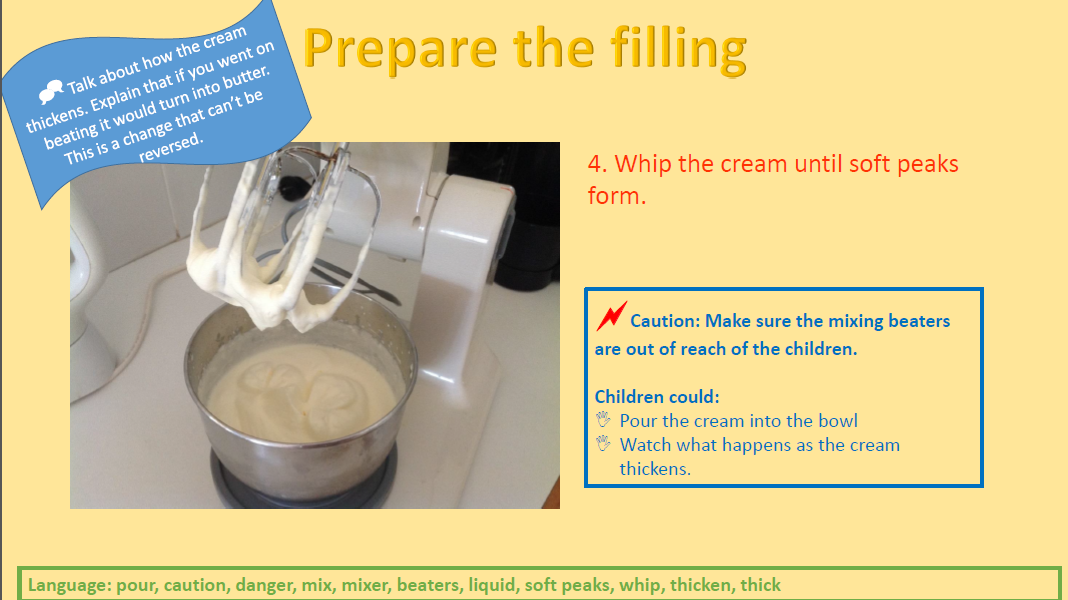
    What happens to cream when it is beaten?

    At the moment I am grappling with a kitchen science dilemma, and if you can provide an answer to my question, I’d be very appreciative.

    My question is:

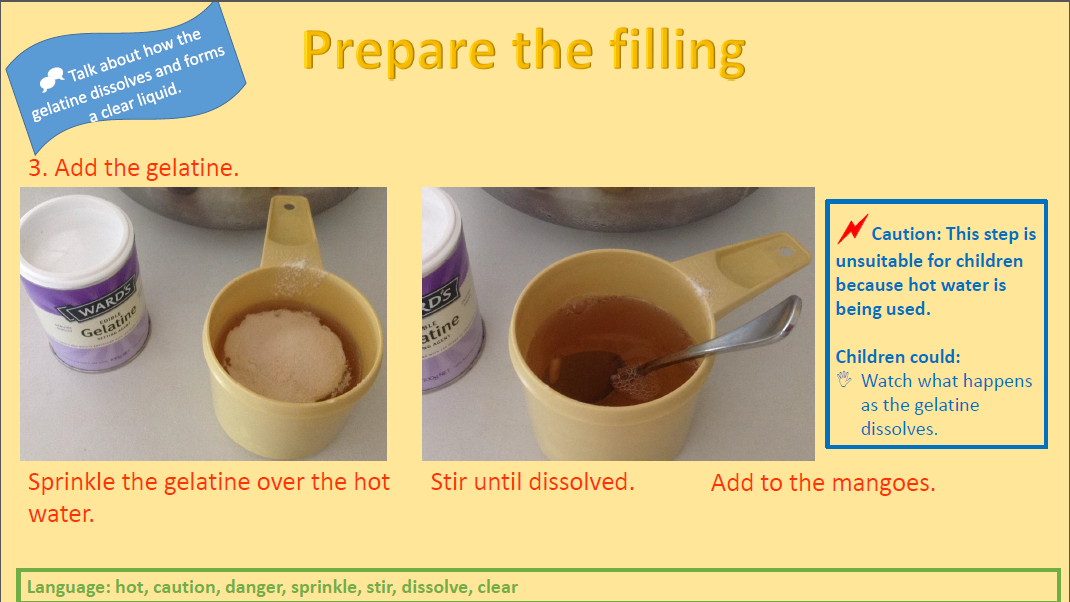
    What is a suitable vegetarian substitute for gelatine?

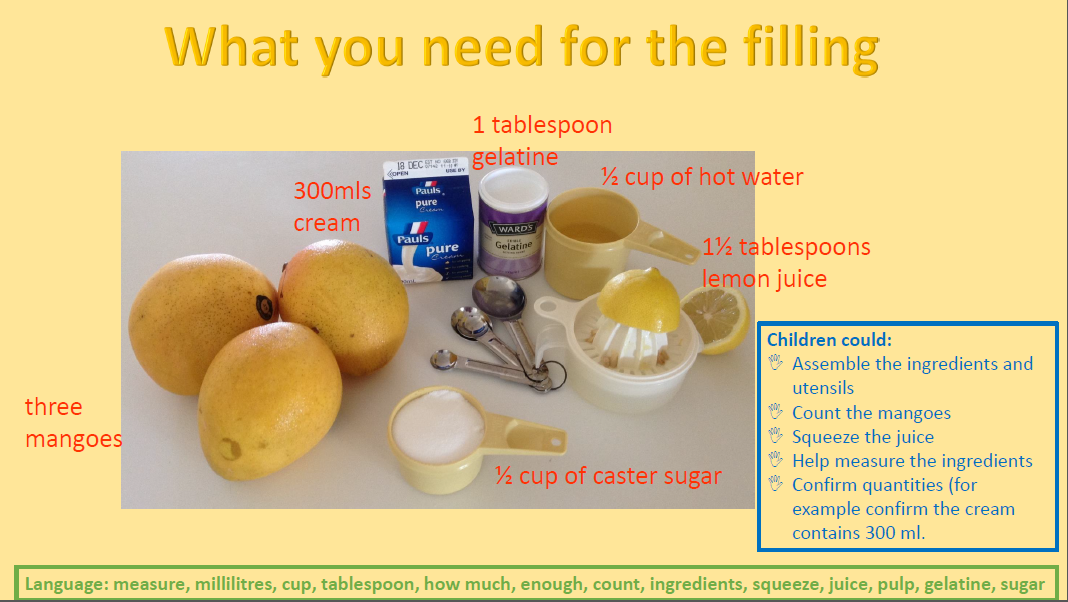
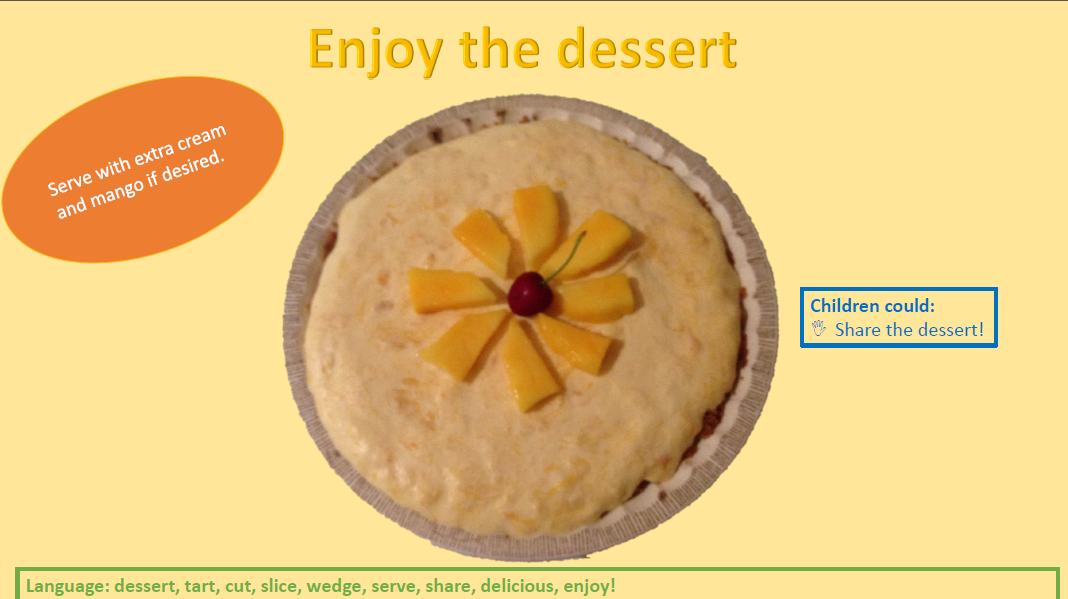
    One of my family’s favourite desserts is Mango Cream Tart. Gelatine is used as a setting agent in the dessert.

    Some of my family members are vegetarians who, upon discovering the answer to the seemingly innocuous question

    What is gelatine made from?

    realised that eating anything containing gelatine no longer suited their food choices.

    So rather than remove the dessert from family menus, or make something that was unacceptable to these family members, I decided the only thing to do was find a substitute for the offending ingredient.

    I have purchased two different vegetarian substitutes but both require being boiled in the liquid which they are to set and are therefore unsuited to the Mango Cream Tart and other cream cheese cheesecakes I may wish to make. An additional factor confirming their lack of suitability is the warning that they may not set some fruit juices.

    I did an online search and found 3 Vegetarian Substitutes for gelatine. If you have used with success any these products, or another product, that may be suitable to use in my Mango Cream Tart recipe I would love to know please.

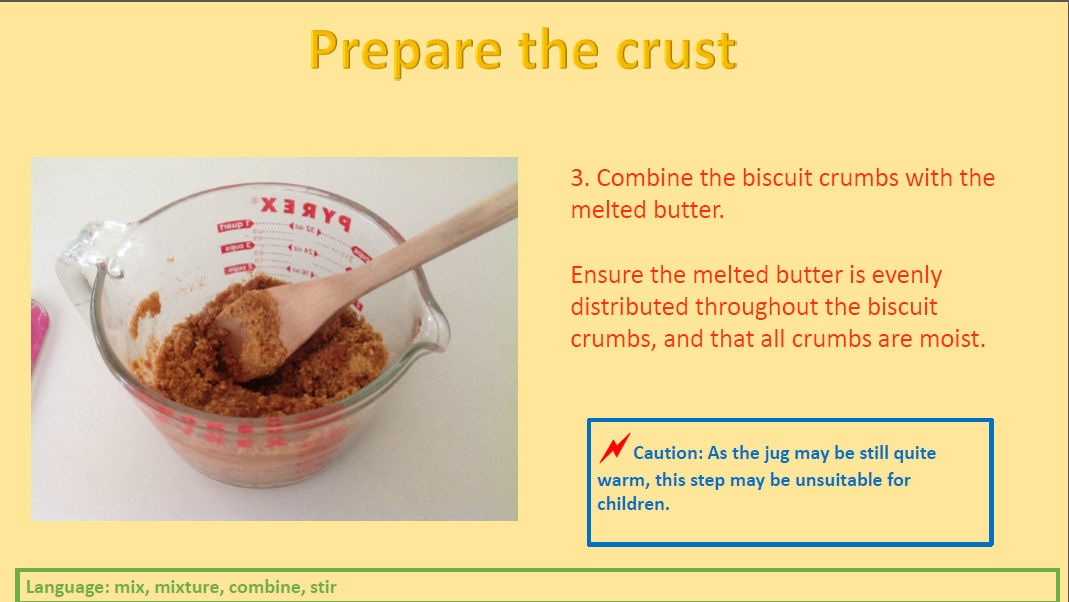
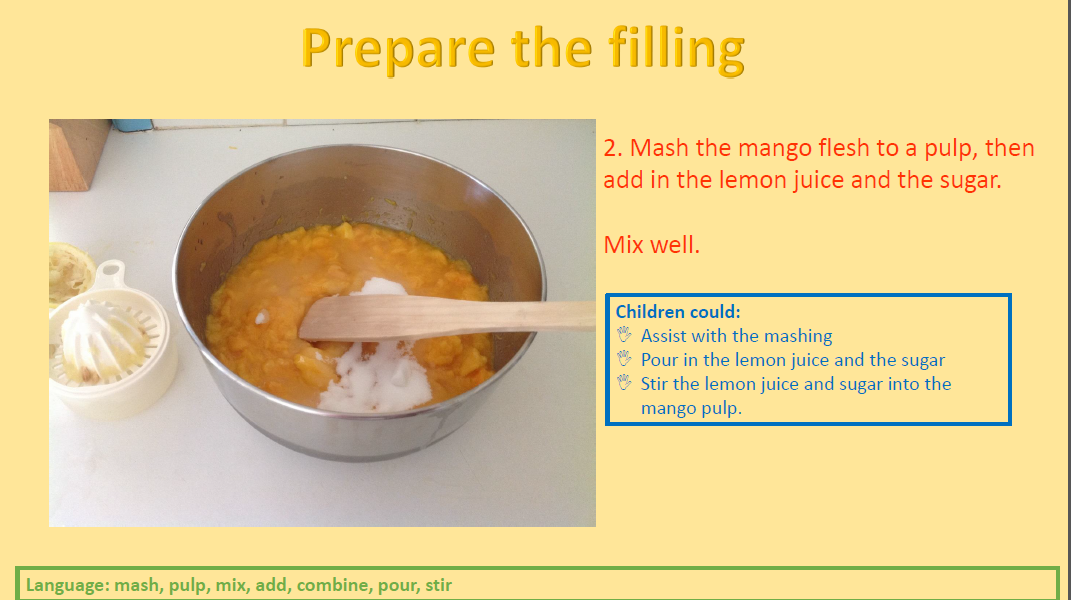
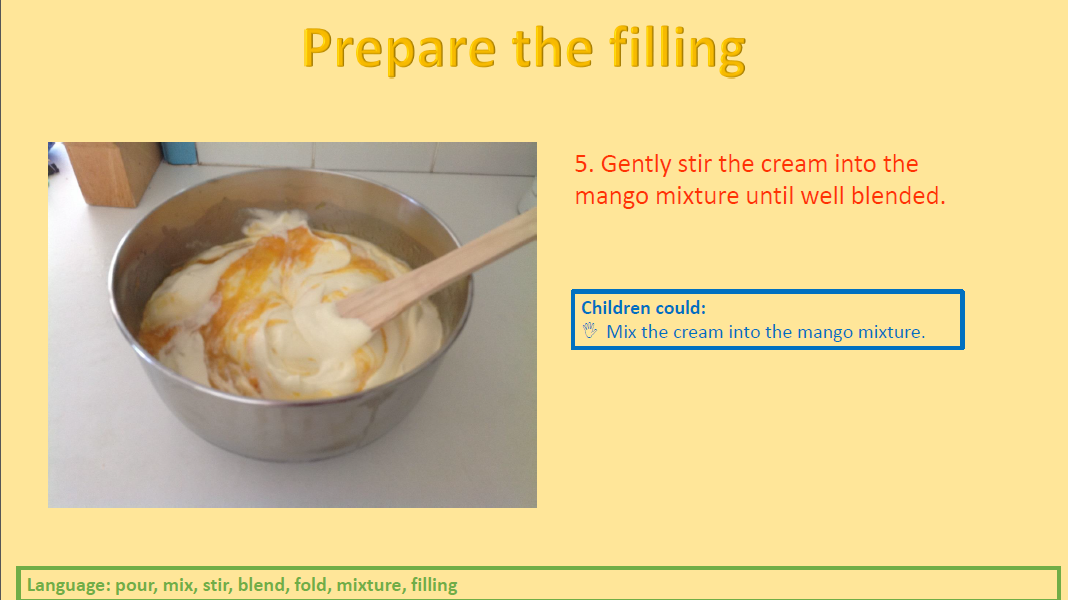
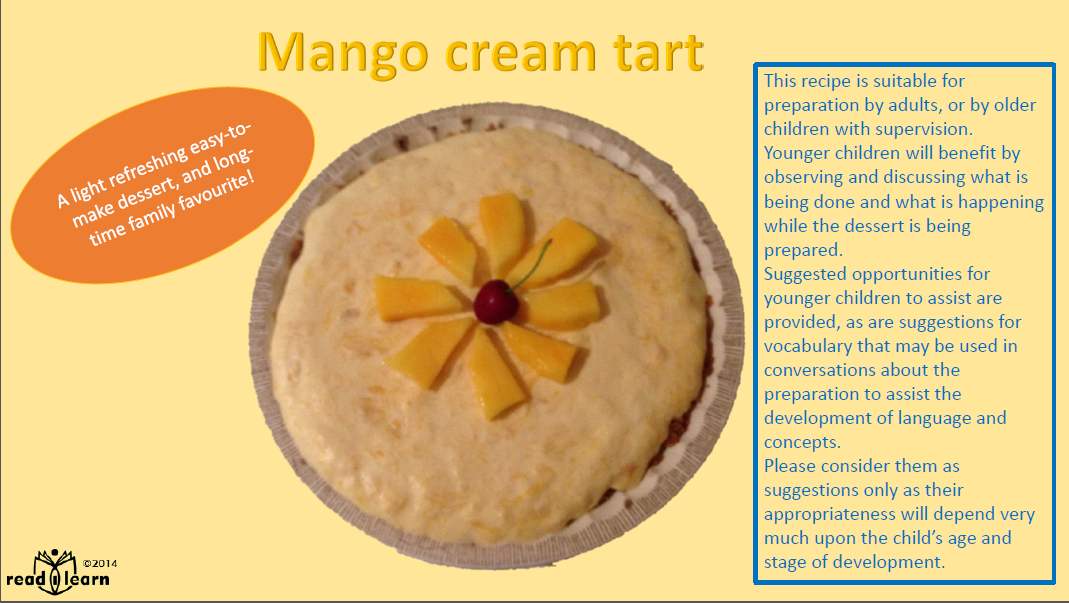
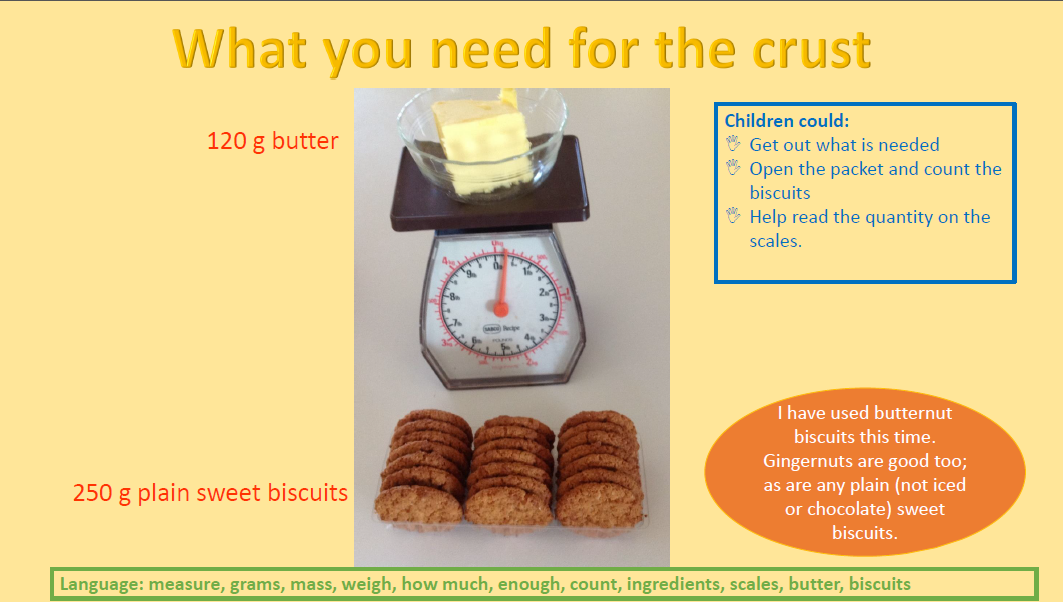
    Here is the recipe which includes suggestions for parents on how they can incorporate learning opportunities for their children while making it. If you can’t help solve my gelatine dilemma, I’d love to know what you think of the way I have presented the recipe. Would this format be useful to parents of young children?
    Mango 1

    mango 2

    Mango 3

    mango 4

    Mango 5

    Mango 6

    Mango 7

    Mango 8

    Mango 9

    Mango 10

    mango 11

    mango 12

    Mango 13

    Mango 14

    You can click on this link: Mango cream tart – recipe for a full-screen slideshow of the recipe.

    The quote by Michael Rosen at the top of this post is from his new book: Good Ideas How to Be Your Child’s (and Your Own) Best Teacher. In the book he includes a chapter “The Kitchen” explaining why he thinks the kitchen is the best classroom invented.

    Thank you

    Thank you for reading. I appreciate your feedback. Please share your thoughts about any aspect of this post. I’d especially appreciate feedback on my presentation of the recipe and suggestions for a vegetarian substitute for gelatine.


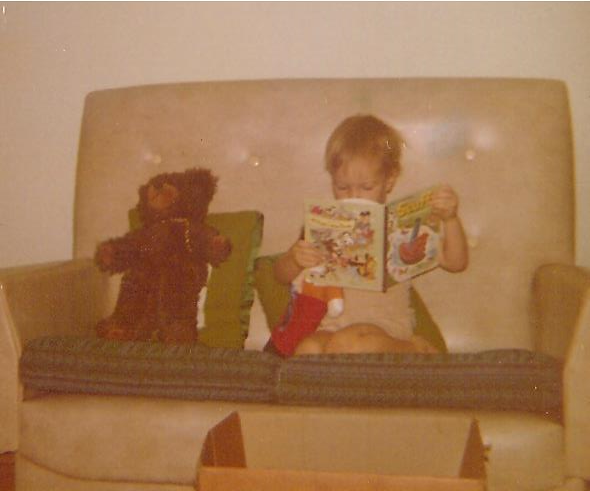
    Kitchen photo credit: https://www.flickr.com/photos/john-schilling/364481975/  http://creativecommons.org/licenses/by-nd/2.0/


  • I’m (not) dreaming of a white Christmas

    https://openclipart.org/image/800px/svg_to_png/59389/happy_sun_gm.png
    https://openclipart.org/image/800px/svg_to_png/59389/happy_sun_gm.png

    Last week the flash fiction prompt set by Charli Mills of the Carrot Ranch was to write a story using two objects, people or ideas that don’t go together. There was quite an assortment of responses, including mine. You can read them all here.

    This week Charli has continued in the same vein, challenging us to In 99 words (no more, no less) write a story that pairs something seasonal with something odd. 

    In Australia that’s easy. We’ve already got Christmas in summer. Most people around the world would say you can’t get much odder than that!

    www.openclipart.org
    http://www.openclipart.org

    But it is summertime in Australia and Christmas is just around the corner.

    While we enjoy warm days at the beach and in the pool, picnics in the park and barbecues in the back yard, hoping the big storm doesn’t get us this time (like the one that hit Brisbane on 27 November); those from whom we have inherited our Christmas traditions are cooling down in the Northern Hemisphere, many looking forward to a (not too) white Christmas.


    Shops here are playing traditional (northern) carols with snow, sleighbells and mistletoe; decorations are tinged with fake snow and cards show snowy scenes with families huddled around the fireplace.

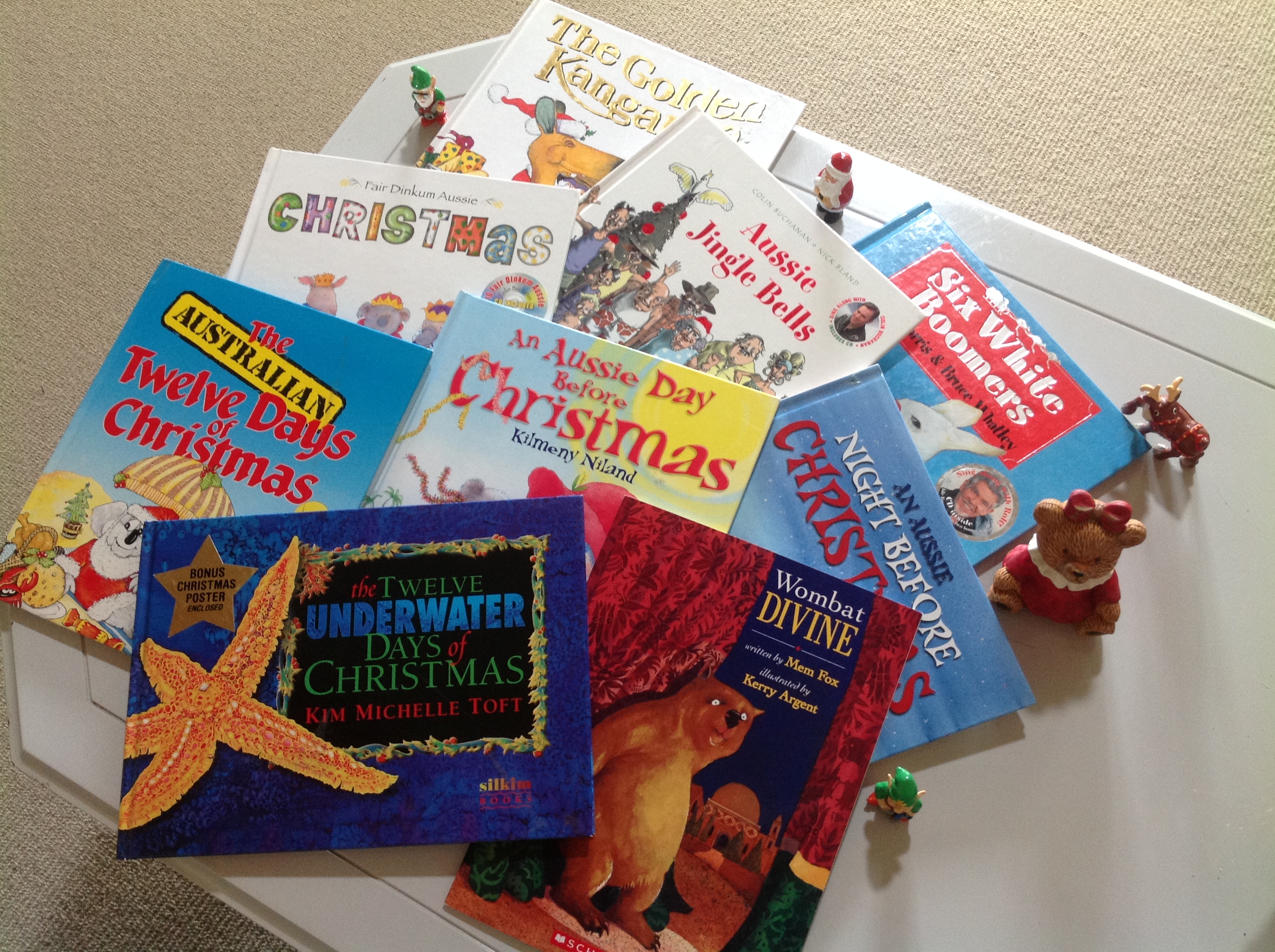
    While there is an increasing number of songs and books with an Australian flavour many are merely innovations on the traditional such, as “The Australian Twelve Days of Christmas”, “Aussie Jingle Bells” or “An Aussie Night before Christmas”.

    Some Australian Christmas picture books
    Some Australian Christmas picture books

    One innovation that I particularly like is The Twelve Underwater Days of Christmas by Kim Michelle Toft. Kim is an Australian who uses her talents as author and illustrator to educate children about the things she feels passionate about: ocean life and coastal habitats. Her illustrations, hand-painted on silk, are absolutely stunning.

    12 Underwater days

    In addition to the visual beauty of the book there is great value in the supporting information through which Kim explains the importance of conserving each of the creatures included in the book. While written by an Australian, the application of the book is not limited to our shores. Creatures from all over the world adorn the pages.  If you ever wished to own a book simply for the beauty of its illustrations, this is a great choice.

    One original song I enjoyed listening to on the radio as a child is “Six White Boomers”. Despite the reasons that make me reluctant to mention it this year, it is a delightful tale of a joey who rides on Santa’s sleigh, pulled by six huge white kangaroos, to be reunited with his mother on Christmas Day.

    Peter CombePeter Combe has written two albums of original, but with a traditional rather than specifically Australian flavour, Christmas songs for children, including this one:

    Some Christmas traditions popular with Australian communities are Nativity plays, carols by candlelight and Christmas parades. Many classes and schools perform their own end-of-year “break-up” concerts to which parents and the wider community are invited.

    Using the traditional Nativity play as the setting, Mem Fox created an original and fresh story in Wombat Divine. It is a delightful tale of Wombat who loved everything Christmas. When finally he was old enough to be in the Nativity Play he rushed along to the auditions. Unfortunately it was difficult to find a part that was just right for Wombat. Can you guess which part he got? You’ll have to read the book to find out! Children all over the world will identify with Wombat and his predicament and enjoy the heart-warming tale.

    Books are wonderful gifts to give or receive at any time. The titles I have mentioned here are perfect for giving, reading and sharing at this time of year. When I was growing up there was always a book for Christmas and birthdays, a tradition that I have continued with my extended family and friends. You can almost, but not always, guarantee that if it is a gift from Norah, it is a book.

    After my siblings and I had grown up and swelled the family numbers with partners and children of our own, my Mum used to say, “There’ll be no presents this year.” It wasn’t that she wasn’t a giving person, for she was. It was just that there were so many of us! When she passed away this year she had about fifteen grandchildren and eight grandchildren, in addition to her remaining nine children and their partners. (I’m saying ‘about’ for grandchildren and great-grandchildren in case I’ve missed some in the count!) You can imagine how daunting a task it would be to go shopping for all these people ranging in age from six months to sixty! However it was always surprising how frequently she did not follow her own rules and had a small something wrapped up to present to many of us.

    This year there will be no presents from Mum, and more sadly, we will be without her presence.

    Although I have borrowed my Mum’s words, “No presents” for both flash fiction pieces included in this post, the stories do not cast aspersions on her generosity. I have simply explored how the oddness of no presents or presence at Christmas time may have impacted Marnie, a character I have been developing in my flash fiction pieces, at different times in her life. At this stage of my writing I am still investigating her character, discovering a little more with each flash piece as her once indistinct figure begins to step out of the shadows and take shape.

    This first piece is written about a difficult time for teenager Marnie and a situation that may be the catalyst for her leaving home.


    No presents

    Marnie jerked backwards avoiding the predictable grope. In so doing she collided with her mother, sending her sprawling onto the tattered sofa.

    “Aargh!” her mother screamed. “Look what you’ve done!”

    Marnie watched the liquid from the upturned glass merge with the patchwork of stains collected in the carpet. If it was her blood it would not have mattered more.

    “I … I’m sorry,” she stammered. But her sorry was for all the years it had been like this.

    He smirked, raising his hand to strike, “No presents for you this year!”

    “That’s right!” She ducked. “No presence!”


    So as to not be too dismal at this time of year, I have written a second piece about a younger Marnie for whom there still seems a glimmer of hope.


    No presence

    With faces as bright as their Christmas wear, the children bubbled into the room, each carrying gifts for the Kindness tree, “for those less fortunate”.

    Parents fussed, removing smudges and replacing wayward hair before blowing kisses and hurrying off for the parade.

    And there was Marnie: no parent, no Christmas dress, no gift, no smoothed-down hair; no smile.

    One last chance.

    “Marnie!” I beckoned, and held out my Christmas cape and crown. “Will you be my special helper?”

    Our eyes locked communicating more than any words. Her smile was my reward.

    “I’m proud of you,” I whispered.

    Thank you

    Thank you for reading. I appreciate your feedback. Please share your thoughts about any aspect of this post or flash fiction pieces.

  • December reflections

    https://openclipart.org/image/800px/svg_to_png/194578/07-Juli-goin-on-a-summer-holiday.png
    https://openclipart.org/image/800px/svg_to_png/194578/07-Juli-goin-on-a-summer-holiday.png

    The end of the school year in Australia has approached swiftly and silently this year, for me at least. You see, now that I am not in the classroom I am not absorbed by all the things that the end of the school year brings.

    In Australia the school year coincides with the calendar year so November and early December are frantic for teachers completing the final assessment and reporting for the year, preparing their students (and themselves) for separation after spending so much of the year together, and making preparations to welcome a new class in the new year.

    The classroom remains busy with learning and curriculum matters until the last day. Both teachers and students begin to tire and the warming (hot, in most parts of Australia) days in classrooms without air-conditioning add to the fraying edges of all as they anticipate the long summer holidays.

    teacher beginning and end

    One thing I always enjoyed about the end of the year, that made all the extra work and the increasing heat tolerable, was the learning about family traditions and celebrations, including Christmas.

    Some Australian Christmas picture books
    Some Australian Christmas picture books

    Last year I wrote about some of the Christmas activities I did with my class, such as making friendship trees

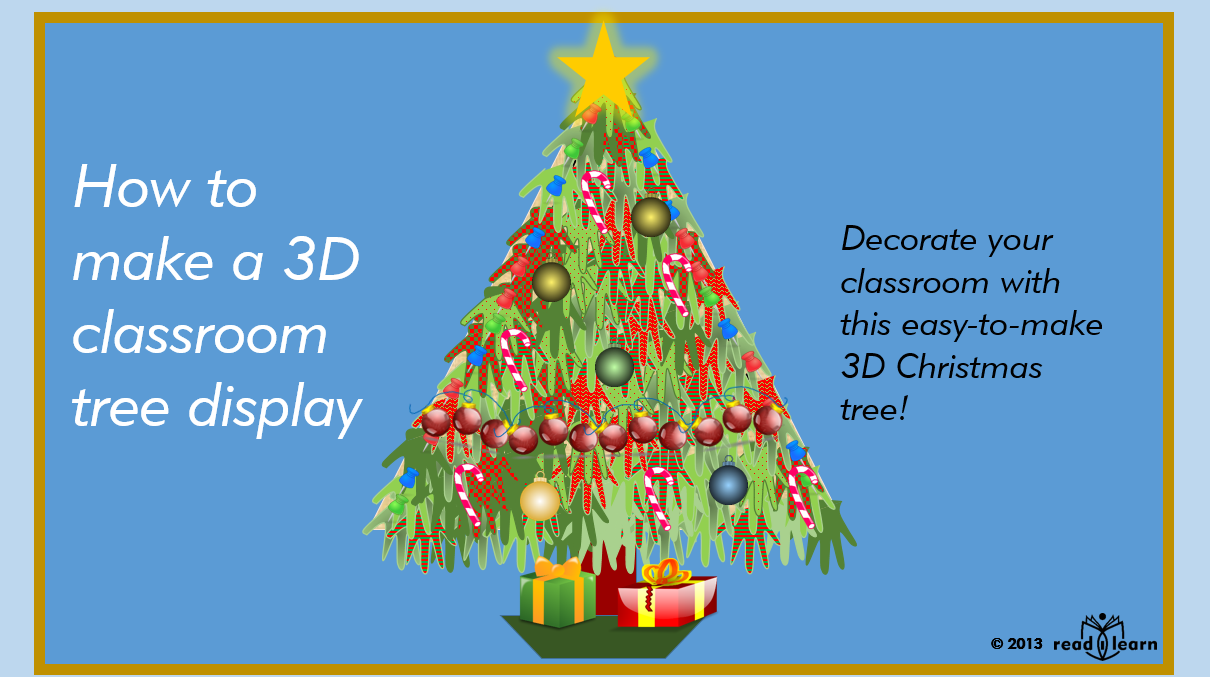
    Friendship treeand a co-operative 3D display.

    3D Christmas tree display
    3D Christmas tree display

    I shared some suggestions for parents to support their children’s  reading, writing and maths development in fun ways during the holidays. (These and other items are available in my TeachersPayTeachers store.)

    I also provoked a lively discussion about whether Christmas should be included in a school program by suggesting tens reasons for its inclusion. Many readers joined in explaining their position either in support or against.

    I always enjoyed this special time of year. I loved hunting through discount stores for items with which children could make cards and gifts for their families and decorations for their home. Often we talked about “free” gifts they could give and made vouchers for things like a free car wash, breakfast in bed or unlimited smiles and hugs.

    https://openclipart.org/image/800px/svg_to_png/59389/happy_sun_gm.png
    https://openclipart.org/image/800px/svg_to_png/59389/happy_sun_gm.png

    As well as the gifts they made for each other in class, such as the friendship trees and Christmas crackers, I always gave each child a small gift, usually a book to read, a pencil and notebook for writing in; something to do over the holidays.

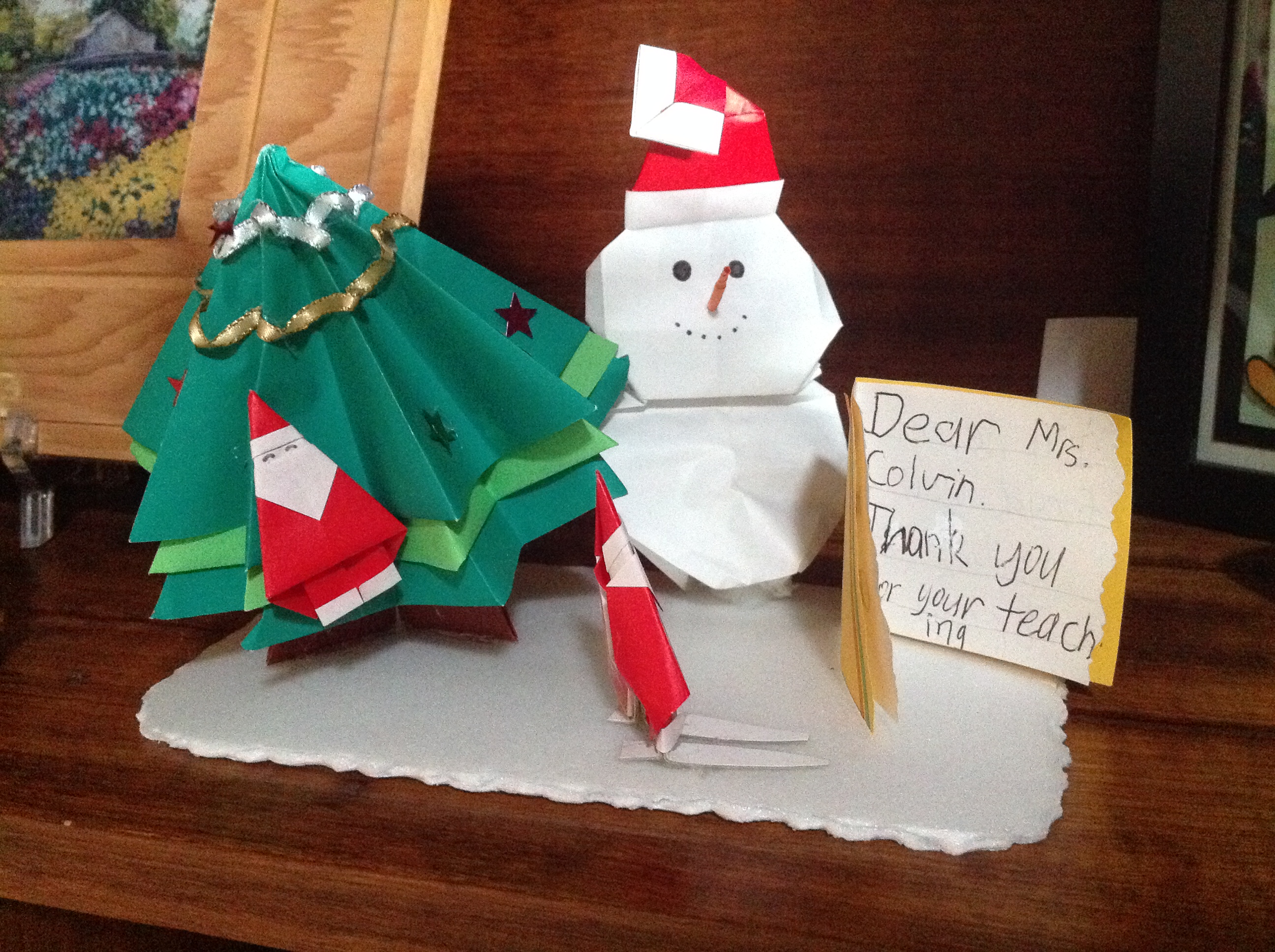
    While it was never expected, but always very much appreciated, many of the parents and children presented me with lovely ‘thank you’ cards, letters and gifts, some purchased, many home-made; all treasured. While the consumables were long ago enjoyed, many other items still adorn my shelves!

    A selection of gifts from over the yeats
    A selection of gifts from over the years

    Brian

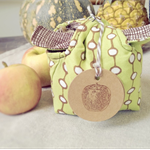
    Sometimes it was difficult to know what to give as a gift to recognise a special teacher. This year Bec has come up with, what I think, is the perfect gift, though she didn’t design it for that purpose. It’s the apple cozy: a special little bag for carrying an apple safely, protecting it from bumps and bruises. They are available in her Made It and Etsy stores. An apple for the teacher in its own special bag: how cute!

    Apple Cozy // Joyce
    Apple Cozy // Joyce

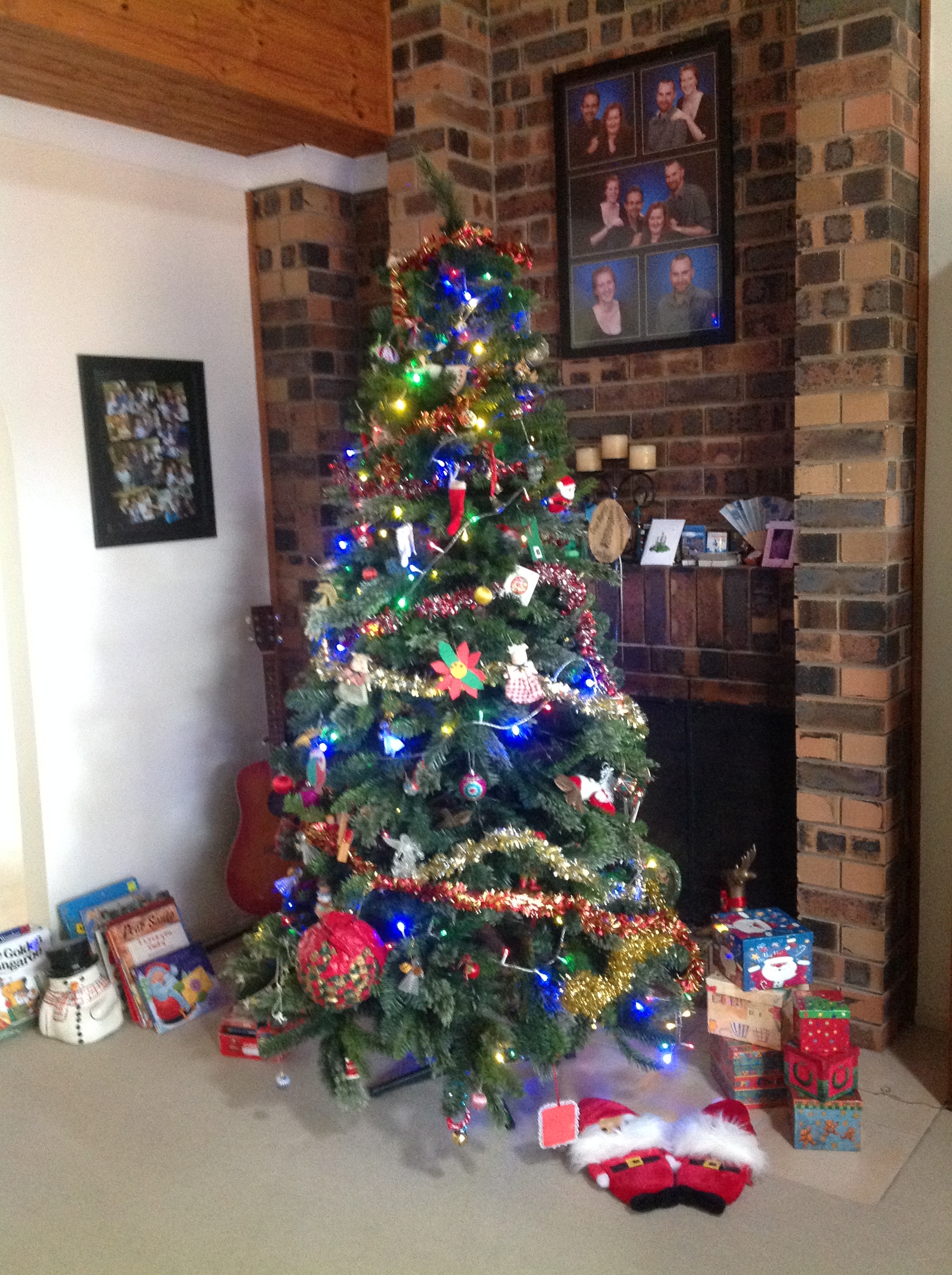
    Although there are no preparations for Christmas at work this year (except for Secret Santa) there is still much to do at home. The traditional time for putting up the tree and decorations is December 1, and I usually have mine up by the end of the first week in December. Now that both my children are grown and living in homes of their own, I thought I would have the lonely experience of decorating on my own this year (Hub says he helps by not helping, but actually he gets tree and decorations down from the roof space for me!)

    What a delightful surprise it was to have both my children and grandchildren (all two of each) visit on the day I was putting up the tree and help me out. The joy that the excitement of a 3- and a 5-year old bring to such activities cannot be matched. I think we did a pretty good job! When I look at it I relive the fun we had together.

    Christmas 2014
    Christmas 2014

    Although to most it would appear simply a Christmas tree, and some may consider many decorations to be ready for the discard pile, most decorations have a story to tell. For me it is a memory tree. It holds decorations made by my own children over the years, and now some by my grandchildren.  There are gifts from family and friends, and children I have taught. Each item, as it is placed on the tree, provides a time for reflecting upon the wonderful people whose lives have touched mine over the years. Each has its own story to tell of the joy that others’ kindnesses can bring. But it is more even that just a memory tree. It is a giving tree; a time for remembering and being grateful.

    What are you family traditions? What and how do you celebrate?

    Thank you


    Thank you for reading. I appreciate your feedback. Please share your thoughts about any aspect of this post.


  • The Very Inspiring Blogger Award – Acceptance

    The Very Inspiring Blogger Award – Acceptance

    birthday-cake-25388As a birthday gift to me (though he didn’t know it was my birthday) Geoff Le Pard, who blogs about the Universe and whatever occurs to him at TanGental, nominated me for the Very Inspiring Blogger Award.

    Needless to say I was both surprised and delighted. I could say that I aspire to inspire, but I think even that would be a great exaggeration.


    In his post Geoff provides three reasons for selecting me:

    • I see life through a prism
    • I have a firmly fixed moral compass, and
    • He wishes I’d taught him at school!!!!!

    The first two I am not sure about, but I am definitely honoured by the third. Thank you Geoff. I will endeavour to attain this high bar you have set.

    The rules for accepting this award are:

    1. Thank and link to the amazing person(s) who nominated you.

    2. List the rules and display the award.
    3. Share seven facts about yourself.
    4. Nominate 15 other amazing blogs and comment on their posts to let them know they have been nominated.
    5. Optional: Proudly display the award logo on your blog and follow the blogger who nominated you.


    Thank you, Geoff. I am honoured.

    These are seven things about me:

    1. I am passionate about education and the power that education has for transforming lives. I believe that everyone has a right to an education. I have spent all of my adult life involved in education in some way; and most of my childhood was spent in school!

    2. I am the third of ten children. What that tells you about me I’m not sure, but I believe we are more than the product of our birth order and environment; that each of us has the power to make choices about how we want to live our lives. I’m not saying environment and genetics don’t play a large role in who we are, but I am saying they do not determine everything.

    3. I have two adult children of whom I am extremely proud and who I love very much. They are what is important in my life. They each have a wonderful partner who I also love, and my son has two beautiful children who I adore. My family gives me an enormous amount of pleasure. I am very fortunate to have all of them living close to me.

    4. I enjoy playing games, especially word games like Scrabble, Upwords and Balderdash. I especially enjoy playing them with my family. We often spent days playing games together when the children were growing, and had grown, up. We’re having a bit of a rest now that the grandchildren are small and doing the entertaining. I’m sure we’ll have three generations playing together again soon. We collaboratively do the ‘Big Quiz’ (40 trivia questions) in the local paper when we get together on Sundays, hoping that someone in the family may know the answer. None of us fair too well on the sporting questions!

    5. I have a silly sense of humour. I enjoy word plays and puns and alternate meanings for words and sayings. In my head I finish words and statements with ridiculous things before the person speaking has even time to finish them. I laugh uncontrollably at something I think is funny, like this silly senior’s password email that arrived in my inbox this week:

    windows

    6. I think life is short and should be fun. We don’t know how much time we have so we should enjoy what we’ve got. This doesn’t mean we have to be out partying and playing all the time. It means we need to focus on enjoying what we are doing in the present moment, no matter how unpleasant it may be. It also means making choices and accepting responsibility for the choices we make.

    7. I love learning. Learning gives so much joy. There is too much to learn in one life time, and it is scary now that the road ahead is considerably shorter than the one already travelled. I hope that in my days of teaching I have inspired in children a love of and joy in learning that they will carry with them throughout their life travels.

    Nominating 15 other amazing bloggers is the hard part. Not because there are not 15 amazing and inspiring bloggers, but because I have nominated many before for a Butterfly Award, a Versatile Blogger Award and a Liebster Award. Not only that Geoff has nominated many of these same bloggers for this award, and Charli Mills has nominated them also.

    We have a wonderful community of very supportive and encouraging bloggers. We each write our own blogs about our own interests, explaining our ideas and points of view. We read and comment on each other posts sharing points of convergence and divergence, and often adding further insights.

    Rather than re-nominate bloggers I have nominated before (and be assured that you are all very deserving of this award and if you wish to add the Inspiring Blogger’s badge to your blog I am happy for you to do so) – over the next few weeks I am going to do a little more exploring to seek out other inspiring bloggers to add to our growing community.

    A big thank you, to each and every one of you, for encouraging and supporting me on my blogging journey. Having your company is what makes it all worthwhile!

    I appreciate your feedback. Please share your thoughts on any aspect of this article.


    Previous nominees:

    Liebster Award

    Belinda Pollard of Small Blue Dog Publishing (Australia)

    NANNY SHECANDO (Australia)

    Anne Goodwin (UK)

    Caroline Lodge (UK)

    PS Cottier (Australia)

    Teachling (Australia)

    Peter Worley’s philosophy foundation (UK)

    Michelle Sowey at The Philosophy Club(Australia).

    There’s No Food ( Australia)

    Obscure Pieces (Australia)

    Cultivating Questioners (USA)

    Nillu Nasser Stelter (UK)

    Charli Mills Carrot Ranch Communications (USA)


    Versatile Bloggers

    Ailish Sinclair

    Teagan Kearney

    Karen Wyld

    Vicki Addesso

    Susan Buchanan

    Paula Reed Nancarrow

    Lisa Reiter

    Lori Schafer

    Karen Oberlaender

    Diane Mott

    Greg Mischio

    Anne Goodwin

    Caroline Lodge

    Charli Mills

    NannySheCanDo


    Butterfly Award

    Ruth Mancini

    The Nerdy Book Club

    Two Writing Teachers

    Raising a literate human


  • Whose story is it anyway?

    Nor and Bec reading

    Children love stories.

    They love being read stories and beg for them to be read, over and over again.

    Equally as much, if not more, they love being told stories, especially stories of their own lives. They beg for them to be told over and over, listening attentively and with wonder as their own stories (her story and his story) are being revealed. They commit these tales to memory so that eventually it is difficult to distinguish the genuine experiential memory from the telling. Even as adults they seem to not tire of hearing tales of the cute things they did when they were little, or of shared experiences.

    They also love being told stories of their parents’ lives. These are the stories that help define them and their existence: how they came to be. The stories tell of times gone by, and of how things used to be. They marvel that their parents were once children and try to imagine how that might have been.

    My daughter would often ask for stories about herself, her brother, myself or other family members. One day when she was about six, she asked again, ‘Tell me a story about when you were a little girl.’ Before I could respond she jumped in with, ‘What were the dinosaurs like?’ She was teasing, of course, and her comedic timing was perfect. A story was created, one that has been shared many times.

    History is a story, though at school I never saw it as such. Had it been a story of lives, as its name implies, I may have been interested. But history at school was a list of wars and dates, and kings and queens to be memorised and regurgitated for a test at the end of the term. There was no story, no human emotion, no semblance to any narrative that may have lured me in.

    I hope that today’s students of history are not required to commit sterile lists of facts to memory without the stories that would give them meaning and significance, some human element to help the information stick.

    History, as a subject, had always been relegated to high school. It was not a discrete part of the primary school curriculum, though aspects were explored in other subject areas such as ‘Social Studies’ when I was at school, or more recently ‘Studies of Society and Environment’. With the introduction of the new Australian Curriculum, History is now a stand-alone subject.

    As an early childhood teacher I was a bit terrified that young children would be required to memorise lists of seemingly random facts and dates. I’m pleased to say that, for the early years anyway, this is not so. Children in the early years start by exploring their own history and the history of their family, considering similarities and differences between their lives, the lives of their parents, and of their friends.

    I applaud this as an excellent starting point. I believe, when working with children, connections must always be made with their lives and what they know. What better starting point than investigating the traditions of their own family and culture.

    In Australia, as I am sure it is in many other places, a great diversity of cultures is represented in each classroom. Encouraging children to share similarities and differences of traditions with their classmates helps to develop understanding of each other’s traditions and beliefs, which in turn fosters respect and empathy. For this purpose, I developed some materials to make it easy for children to share their traditions. These are available in my Teachers Pay Teachers store.

    Whoever you areMem Fox has written a beautiful picture book Whoever you are that I love to share with children when discussing their cultures and traditions. It explains in a simple and beautiful way that although children around the world may live in different houses, wear different clothes, eat different foods, for example ‘inside, their hearts are just like yours.’ Mem Fox explains the story on her website.

    I also like to sing I am Freedom’s Child by Bill Martin Jr.; and in Australia we have a great song that tells about our different beginnings, I am, you are, we are Australian by Bruce Woodley.

    Heal the World by Michael Jackson is another great one for appreciating diversity and fostering inclusivity.

    What got me thinking about history in particular for this post is the flash fiction prompt posted by Charli Mills at Carrot Ranch Communications. Charli’s challenge is to In 99 words (no more, no less) write a story that considers history, near or far.


    This is my contribution:

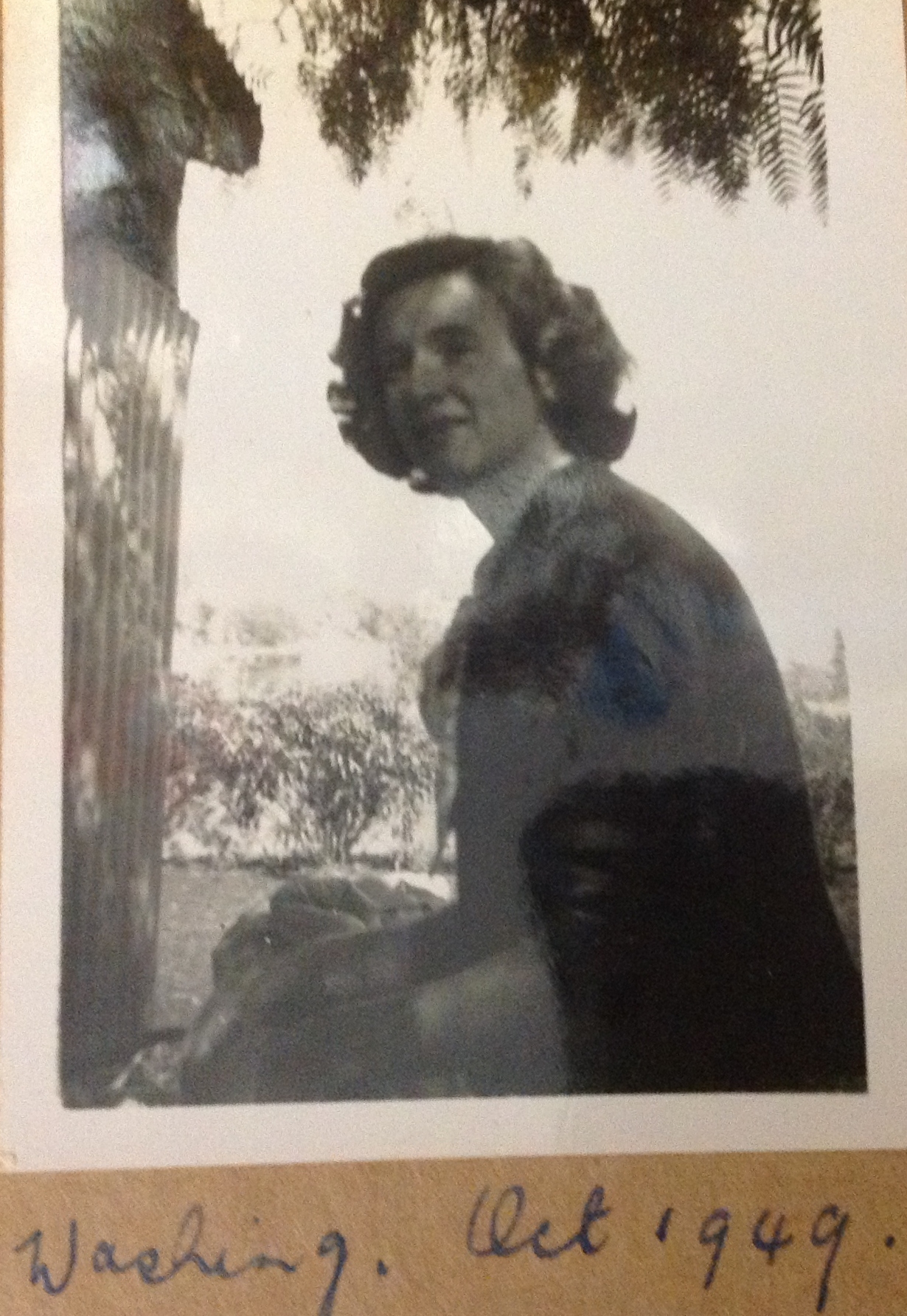
    washing 1949

    Washing day

    Her freckled, calloused hands were red and chaffed as they gripped the wooden stick and stirred Monday’s sheets in the large copper pot heating over burning blocks of wood.

    The children played in the dirt nearby, scratching like chickens, hopeful of an interesting find.

    The dirt embedded under her torn and splitting fingernails began to ease away in the warm sudsy water as she heaved the sodden sheets and plopped them onto the wooden mangles.

    The children fought to turn the handle, smearing dirty handprints on the sheets.

    She sighed, and hung them over the line. One chore done.


    I welcome your feedback. Please share your thoughts about any aspect of the article or my flash fiction piece.


  • I’m sick! Talking about preventable childhood illnesses

    www.openclipart.org http://goo.gl/dsS3P6
    http://www.openclipart.org http://goo.gl/dsS3P6

    I am grateful that vaccinations against many diseases that were commonplace when I was a child are now readily available in Australia.

    I am grateful that these vaccinations protect children from suffering the diseases which were an expected part of growing up when I was young.

    Thanks to the scientists who studied the diseases and developed the vaccinations, most children in developed countries should not fear contracting diseases such as polio, measles, mumps, rubella, chicken pox, smallpox, tuberculosis, whooping cough and others. I look forward to the day when these diseases are eradicated worldwide.

    Unfortunately many parents, who have neither witnessed nor experienced the effects of these diseases (due to the effectiveness of immunisation programs), do not appreciate the seriousness of contracting them and choose to not vaccinate their children. In doing so, these people not only put the health of their own children at risk, but also the health of others in the community. Sadly these people are usually misinformed by purveyors of unscientific ‘evidence’. The numbers, and science, stand strongly on the side of vaccination.

    This issue is one that I feel strongly about for evidence shows that an entire community can once again become vulnerable to these diseases if enough people reject immunisation. The risk of disability or death occurring as the result of a preventable disease, in my opinion, is one not worth taking.

    At the end of this post I will link to various articles and websites that explain in greater depth and with more scientific and medical support than I am able.

    The impetus for sharing my thoughts on this issue came from Lisa Reiter who, on her blog Sharing the Story, invites others to share Bite-size memoirs. This week’s topic is Childhood Illness.

    I will begin by sharing 10 things I remember:

    I remember rushing to be first into the bath, but instead slipping and falling into the pot of hot water that had been heated on the stovetop in readiness to add warmth to the cold from the tap. I remember being terribly scalded and that I was rushed to the doctor. I remember being dusted with powder while I lay on his high surgery table. I was three at the time, so while I have some images that I am sure are genuine, others may be family lore.

    I remember a girl in my class at school who had suffered from polio. Her name was Christine and she lived not far from me. She had one boot that was built up, about 4 inches high; and she had iron cages around both legs. She walked with difficulty and a sway from side to side. Interestingly enough my husband, who grew up on the other side of the world, also had a friend who suffered from polio and had a built up boot.

    I remember reading about ‘the girl in the iron lung’ and being terrified of contracting the dreadful disease polio.

    I remember feeling very relieved when we were given a tiny pink droplet of vaccine on a white plastic spoon. Thank you Dr Salk. Polio has not been a cause of fear for my children or grandchildren.

    I remember us all having the mumps when I was eight and my Mum was pregnant with my little sister (the seventh of ten children). I remember that our glands were swollen and our throats were sore. We were tired, headachy and miserable. I remember my Mum got Bell’s Palsy too, and the muscles in her face were affected and never fully recovered. I remember her being sick in bed for weeks and a friend kindly came and stayed to look after us and help out.

    I remember having measles and being dabbed all over with calamine lotion to help stop the itch. It was difficult to not scratch.

    I remember when the rubella vaccination became available, but it was too late for me because I’d already had it as a child. I remember thinking how lucky everyone was to be able to have the vaccine and not suffer the illness.

    I remember having chickenpox during the summer holidays when I was about thirteen or fourteen. It was such a scorching hot summer, or it certainly seemed that way; two weeks of the longed for holidays ruined by this horrible illness.

    I remember the chickenpox blisters that started small, then grew bigger and finally scabbed. I remember the pink baths in Condy’s crystals and the strong smell which I would still recognise if not describe. I could never associate it with anything pleasant.

    I remember waking one night and finding three neat little piles of vomit on my bed beside my pillow. I remember waking my Mum and her coming and cleaning it up.

    What overwhelms me now when I think of all these childhood illnesses that inflicted us with so much discomfort  is the thought of my mother tending to a houseful of sick kids, when she was probably sick herself, and if not sick then probably pregnant or at least feeding a baby. What a life it would have been. One child going down after another, moaning and complaining and needing attention or treatment. I found it difficult with just one child at a time! (There are 12 years between my two.) On top of that she had all the usual household chores and a husband to attend to. Makes me wonder that she wasn’t worn out long before her 90 years! How grateful she would have been had we all been inoculated against these now preventable illnesses.

    Thanks, Lisa, for the opportunity of sharing these memories, and thank you, my readers for indulging me.

    I welcome your feedback. Please share your thoughts about any aspect of this post.


    Here are some links to further information about vaccinations if you are interested:

    Australian Government Department of Human Services, Immunising your children

    My DR for a healthy Australia, Immunising your child

    Raising Children Network, The Australian Parenting Website, Vaccinations and autism spectrum disorder

    The Daily Life, Adverse Reactions by Benjamin Law

    Mama Mia, What everyone’s talking about, 9 vaccination myths busted. With science! By Dr Rachael Dunlop

  • Flash fiction – White flowers

    The sixth flash fiction challenge from Carrot Ranch Communications:

    In 99 words (no more, no less) write a story that includes white flowers.

    When Charli posted this challenge, I was thinking of writing about my Mum’s white flowers. At the time I didn’t expect that she would pass away before I had it written. After losing her my mind has been otherwise occupied and I have struggled to think beyond those two words “white flowers”. However, tonight I decided to write a brief tribute to my Mum who peacefully went “to Heaven” on Friday evening.  We will say our farewells to her tomorrow. So, it’s not really flash and it’s not really fiction but it is on the topic and is 99 words.

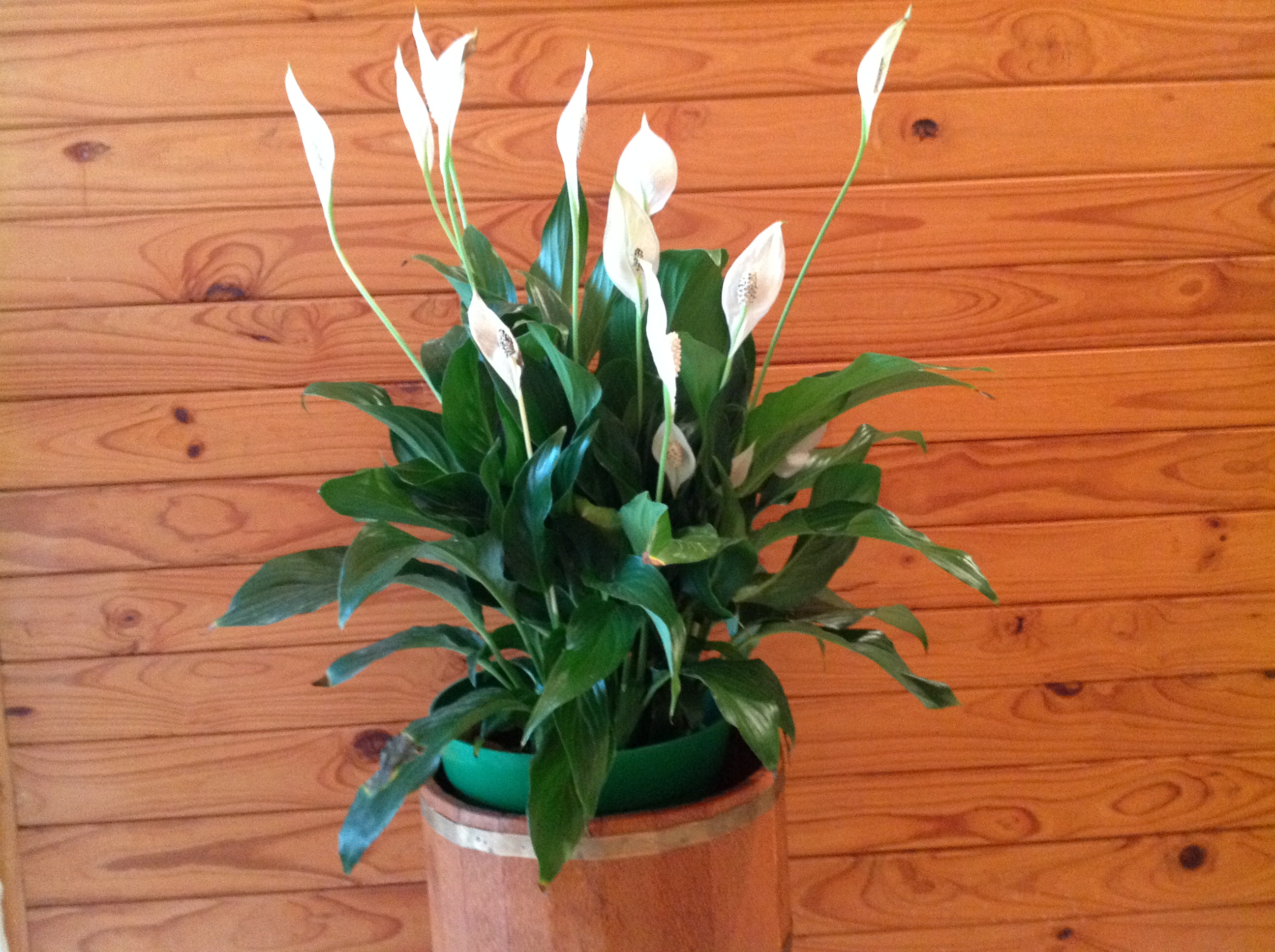
    peace lilies

    These white flowers in the pot at my door remind me of you.
    I bought them for you, to remind you of home, when you moved, with reluctant acceptance.
    Peace lilies.
    Your beautiful peace lily flourished in the warmth of the sunny spot beside your favourite chair; the favourite chair that you took with you to your new home; that transported you to Heaven. You were ready.
    Now they reside with me, in the pot made by his hands; a fitting spot.
    You will rest with him in his plot, together again, now at peace, forever.
    Love you, Mum.

  • Examining praise: Stephen Grosz – the third instalment!

    Guest post by Anne Goodwin (Annethology)

    Earlier this year, after reading 7 Reasons Why Lovers of Fiction Should Read The Examined Life by Stephen Grosz on Anne Goodwin’s writing blog, I decided the book sounded too good to resist and promptly listened to it as an audiobook on my commute to and from work.

    I was delighted with Anne’s recommendation, and like her, found the book compelling reading and thought provoking. So much so that I wrote a post about it: A book worth reading: Stephen Grosz “The Examined Life”.

    However the chapter that captured my attention and challenged my thinking more than any other was the one about praise. I also blogged about this: Seeking praise: Stephen Grosz revisited.

    My post about praise got Anne Goodwin thinking further about this issue and she was able to delve into it more deeply with her background in psychology. She has very generously written this guest post to share her thoughts.

    Thanks Anne – over to you:

    Although I was enchanted by The Examined Life from the first page, I glossed over the chapter on praise. Reading primarily for the parallels between these therapeutic case studies and reading and writing fiction, I didn’t stop to analyse my reaction, to acknowledge I was challenged by the suggestion that praise could be detrimental. Perhaps I dismissed this chapter as a reaction to the rarefied atmosphere of that cosy part of North London that is the hub of British psychoanalysis. In my neck of the woods, as reflected in my flash fiction piece, Peace-and-Quiet Pancake, I’m more concerned about a shortage of praise and encouragement than an excess.

    I was initially disappointed when Norah mentioned on Twitter that, with over thirty chapters to choose from, she’d decided to blog about the chapter on praise. Yet her wonderful post showed me what I’d missed in my initial (defensive) reading and inspired me to go back to the book and ponder the depths of wisdom within those four and a half pages for myself.

    “Stephen Grosz calls into question where our ideas of good practice originate.”

    In suggesting we rethink what’s best for our children, Stephen Grosz calls into question where our ideas of good practice originate. We tend to respond to the mistakes of our forebears by striving to do the opposite, so those of us who suffered from a dearth of praise ourselves might be inclined to lavish praise on the next generation. Yet we can become so fixated on turning our backs on the approaches we know from experience to be unhelpful, we’re blinded to the potential pitfalls of the alternative path. Cutting back on praise feels treacherous, like siding with the harsh disciplinarians of days gone by. Stephen Grosz points us towards a third way.

    “Behavioural strategies are invaluable for introducing the necessary structures and routines in which children can prosper and learn.”

    Behavioural psychology shows that targeted rewards, either tangible, or intangible like praise, increase the frequency of desired behaviours. Rewards are actually most effective when they’re doled out intermittently, which might be one argument (although not the author’s) for soft-pedalling on the praise. Behavioural strategies are invaluable for introducing the necessary structures and routines in which children can prosper and learn. However, they can also result in the over-controlled and compliant child, one who is well versed in pleasing adults but struggles to think for him or herself.

    “Stephen Grosz suggests that parents and educators can become as addicted to praise as these children.”

    Stephen Grosz suggests that parents and educators can become as addicted to praise as these children. The mother who continually tells her child she is good might be vicariously praising herself. Underlying this might be a lack of confidence in her own parenting skills and a difficulty accepting her child as a separate person, with potentially different values and preferences. This is unlikely to enhance the child’s confidence and self-esteem.

    “He also cautions us to be wary of praising children for what they are rather than for what they do.”

    He also cautions us to be wary of praising children for what they are rather than for what they do. He cites a study in which, consistent with attribution theory, children praised for their effort rather than their intelligence, developed a more positive approach to problem solving. We can always put in more effort, but if we believe success is down to stable and unchangeable factors we might be less resilient in the face of the failure we will all, however talented, meet at some point in our lives.

    “a third position where the adult is benignly attentive to the child and curious about what he/she is doing.”

    What the author recommends is not a return to a pedagogy of threat and punishment, but a third position where the adult is benignly attentive to the child and curious about what he/she is doing. The child who believes that an adult is genuinely interested in their ideas, thoughts and feelings, is likely to develop a strong sense of agency and self-worth. While this might seem a radical approach, it’s not dissimilar to the behaviour of a tuned-in mother who watches over and mirrors her baby’s moves. It’s also the stance taken by the psychoanalytically orientated psychotherapist.

    This is familiar ground for me, but I didn’t recognise it on an initial reading. Having already decided I loved the book from hearing snippets on the radio, I was reading it for what I could praise. I hope it wasn’t empty praise, but I was unwilling to engage with parts that were hard to swallow. On the second reading, my stance flipped to critical, almost punitive, focusing more on what was missing from the chapter than what was actually there. Now this process of putting my thoughts into words has brought me towards the position of curiosity and attentiveness I wish I’d had first time round. Whilst other readers might be less defensive, it does make me wonder, if it’s a struggle to reach this position in relation to a text, how difficult might it be to apply this learning in the real world and on a larger scale?

    “While parents, politicians and educationalists might all claim to value individual expression and personal growth, this has to be weighed against an equally strong pressure for the achievement of standardised performance goals.”

    On a sociopolitical level, we might resist this understanding because of conflicting views as to what education is for. While parents, politicians and educationalists might all claim to value individual expression and personal growth, this has to be weighed against an equally strong pressure for the achievement of standardised performance goals.

    On the individual level, as Stephen Grosz says in his final paragraph, being present with others is hard work. Therapists have their own therapy in addition to training and supervision; parents striving to do a similar job with only their experience of their own parenting to draw on could struggle to find the position of attentiveness beyond both praise and chastisement.

    “Children who have never been praised, even for attributes outside their control, might have no concept of their own ability to impact on their environment.”

    Furthermore, for the child entering school knowing only neglect and criticism, a teacher’s benign curiosity could be experienced as threatening, just as the neutrality of therapist can provoke anxiety in his or her client. Children who have never been praised, even for attributes outside their control, might have no concept of their own ability to impact on their environment. Does the busy classroom teacher have the resources to be truly present with them in the way they require?

    Thanks, Norah, for challenging me to revisit this chapter and for the invitation to rework my comment into a guest post. For those who’ve had the patience to stay present this far, I look forward to your reactions.

    Thank you Anne for the insight and challenge you have offered with much for us to think about.

    I reiterate Anne’s invitation for you, the reader, to share your thoughts on this topic, and suggest you head on over to Anne Goodwin’s writing blog (Annethology) for a great assortment of interesting fare.

  • One for the children . . . A “Who’s hiding?” picture book

    On Christmas Eve, my post is one for the children, especially my two gorgeous little grandchildren, Artie and Anna.

    I hope they, and children everywhere, will enjoy this little guessing game.

    Next year my skills may have developed enough to make it interactive, or even an app!!! Now, let’s not get too excited!

    I am very grateful to Bernadette Drent who created the illustrations for me with very little notice.

    Here it is for you:

    Happy Christmas everyone!

  • Searching for meaning in a picture book — Part A

    Searching for meaning in a picture book — Part A

    Do you recognise this book?

    The Very Hungry Caterpillar

    Chances are you do.

    According to the website of the author Eric Carle, since its publication in 1969 it has been published in over 50 languages and more than 33 million copies have been sold worldwide. It ranks highly in the Wikipedia List of best-selling books.

    Most primary schools, preschools and kindergartens would have numerous copies in their libraries with a copy in most classrooms as well as in teachers’ private collections. Most homes with young children would have a copy in their storybook collection.

    reading

    In addition to the books, many of those schools, classrooms and homes would have some of the associated merchandise; including toys, games, puzzles, posters and colouring books, which are now available.

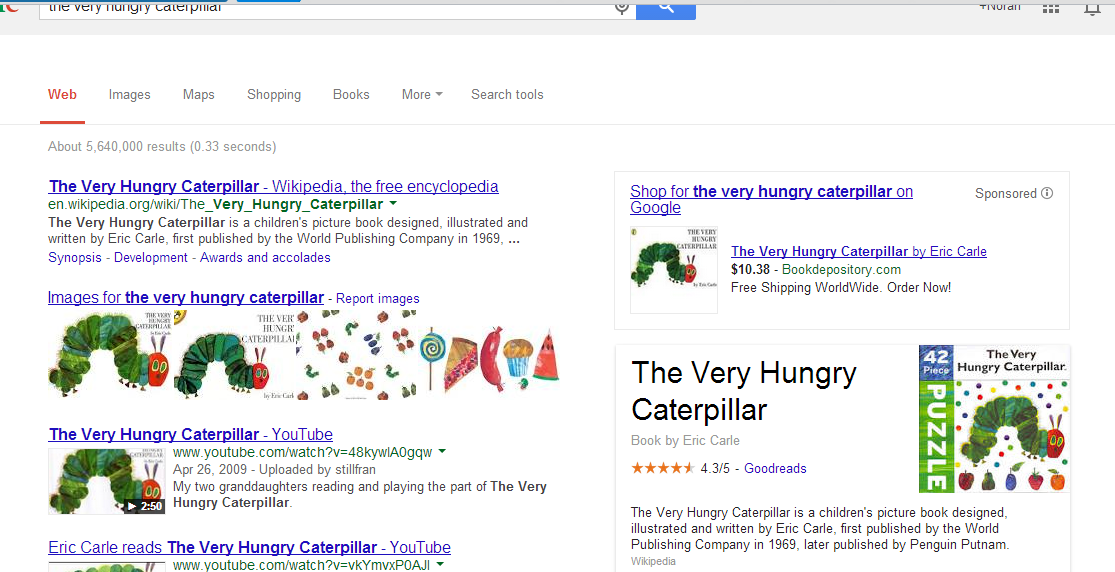
    When I typed ‘the very hungry caterpillar’ into the Google search bar about 5,640,000 results were listed in 0.33 seconds!

     Google search the very hungry caterpillar

    There are activities, lesson plans, printables, videos, and advertisements for merchandise. There is a plethora of suggestions for using the book as a teaching resource, including counting, days of the week and sequencing.

    I think you would be hard pressed to find someone that hasn’t at least heard of the book. That is quite an impact, wouldn’t you say?

    For a book to have done so well, it must have a lot going for it. And it does.

    There are many things I like about this book, including:

    • The bright, colourful, collages with immediate appeal
    • The natural flow and rhythm of the language making it easy to read, dramatize and recall
    • The sequence of numbers and days encouraging children to predict and join in with the reading and retelling
    • The match between the illustrations and the text supporting beginning readers as they set out upon their journey into print
    • The simple narrative structure with an identifiable beginning, a complication in the middle with which most children can empathise (being ill from overeating) and a “happy” resolution with the caterpillar turning into a beautiful butterfly.

    Reading to children

     Nor and Bec reading

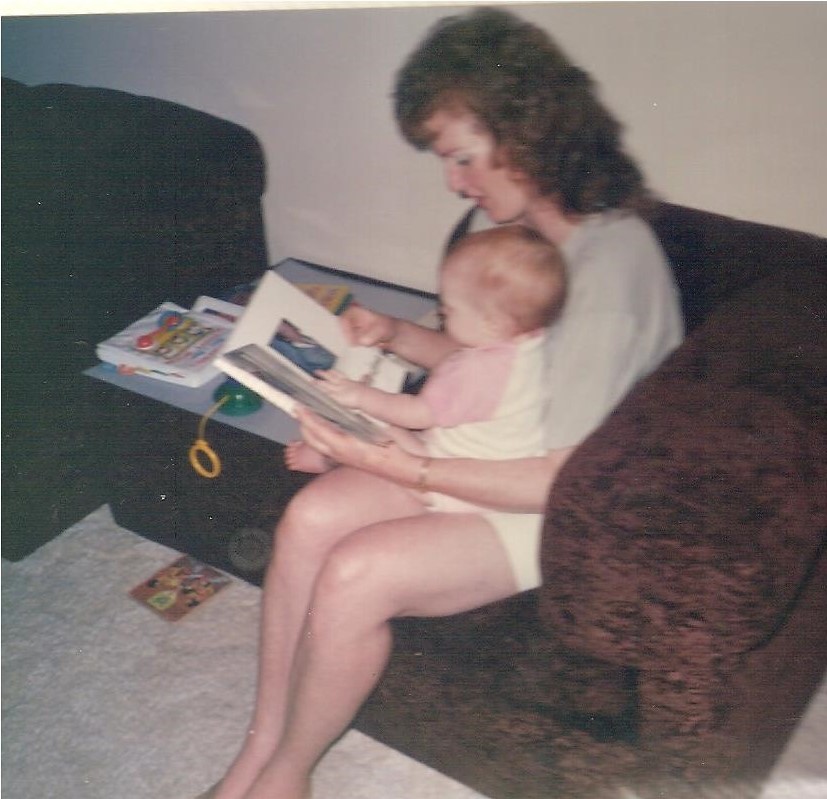
    Sharing of picture books with children from a very young age has a very powerful effect upon their learning.

    There are many benefits to both parent and child of a daily shared reading session.

    clock

    It can be seen as a special time of togetherness, of bonding; of sharing stories and ideas. It can be a quiet and calming time; a time to soothe rough edges and hurt feelings; a time for boisterous fun and laughter; or a time for curiosity, inquiry, imagination and wonder.


    Whatever the time, it is always a special time for a book
    ; and all the while, children are learning language.

    8-12-2013 7-38-33 PM
    © Bernadette Drent. Used with permission.

    They are hearing the sounds and rhythm of their language. They are being exposed to new vocabulary, sentence structures, concepts and ideas. They are learning important understandings that will support them on their journey into literacy e.g. they are learning that the language of a book differs from oral language and that the words in a book always stay the same.

    They begin to realise that it is the little black squiggly marks that carry the message, and they may even start to recognise some words.

    Robert 2

    Many of these, and other, features make “The Very Hungry Caterpillar” suitable for incorporation in an early childhood curriculum, for example:

    The Very Hungry Caterpillar

    • Literature appreciation – love of language, knowledge of story, interest in books
    • Reading – the clear, simple and predictable text make it an easy first reader
    • Maths – counting and sequencing the numbers, sequencing the days of the week
    • Visual arts – learning about collage and composition of a picture
    • Philosophical inquiry —sharing interpretations and discussing feelings about the story, asking questions raised including the ‘big questions’ of life

    ryanlerch_thinkingboy_outline

    Eric Carle, in an interview with Reading rockets, describes it as a book of hope. He says:

    You little, ugly, little, insignificant bug: you, too, can grow up to be a beautiful, big butterfly and fly into the world, and unfold your talents.”

    He goes on to explain that,

    I didn’t think of this when I did the book, but I think that is the appeal of the book.”

    But I’m not going to let him have the last word!

    While “The Very Hungry Caterpillar” has always been one of my very favourite picture books, I do have some misgivings about the impact that this book has had.

    In future posts I will share what I consider to be some limitations of the text, and what I consider to be the most powerful use of all.

    What do you think?

    What appeals to you about this book?

    What questions does it raise for you?

    Please share your ideas. I look forward to hearing what you think.