Live Love Laugh Learn … Create the possibilities

Category: eLearning

  • Not lost but found

    12

    I am struggling with a writing task at the moment. Part of the reason is that is has been at the back, rather than the forefront, of my mind as I worked on other tasks, and part of the reason is that it involves self-promotion in a marketing kind of way. It confuses me a little, because haven’t I been self-promoting all the time I have been writing a blog? Surely putting my ideas out there is at least presentation, if not promotion, of said ideas.

    With the goal of sharing original early childhood teaching resources and stories for children on a website of my own, I began writing a blog and engaging in social media about two and a half years ago. This was in responses to advice received from attending writing seminars and reading books about website development. Preparation of resources for my website took a back seat for a while as I engaged with other writers in the blogosphere.

    Now it is time to turn the focus back onto the website, the launch of which is fast approaching. With an extra effort over the past couple of weeks, I now have sufficient resources to begin. Additional resources will be uploaded at relatively frequent, if irregular, intervals, not unlike adding to my blog.

    80

    I have no issue with ideas for additional resources or blog posts. My stumbling block is the content for my bio and promotional information about the website. It should be easy, I know, but I am struggling to find the answers to these questions:

    • What do people want or need to know about me?
    • How can I promote my resources in an honest way that entices people to sign up to a paid subscription?
    • What is a fair price for subscription?
    • How can I persuade potential subscribers that they will get value for money?
    • How can I ensure that subscribers do not feel let down by the available resources or ripped off by misleading promotion?

    These questions arise even before I begin to tackle the really difficult one:

    • How do I connect with my target audience: early childhood teachers?

    I know I am not alone with these concerns.

    Recently Sarah Brentyn, who blogs at Lemon Shark, questioned the validity of her profile, enflaming my anxiety by stating that “It’s seen by far too many people who judge you by those 10 – 20 words.” The thought to change my blog’s About page, with far more than 10-20 words, hasn’t yet moved beyond that guilt-ridden thought. And while I know it is not suitable as is for my website, perhaps editing or rewriting it is a place to start.

    90

    Throughout the year Anne Goodwin, who blogs at Annecdotal, shared the process of stepping out from under the covers of introversion to promote her debut novel Sugar and Snails.  In her post One huge leap for Anne, one teeny tiny step for womankind, she questioned how to balance celebrating her achievement with the suspicion that many would be unimpressed. In another post on Book pricing: a cautionary tale Anne questioned pricing and value and shared the hope that people wouldn’t feel ripped off. I am fairly confident that Anne’s concern on each of these issues turned out to be unwarranted. Will mine be the same?

    Charli Mills of Carrot Ranch Communications also frequently writes about marketing and the importance of finding one’s niche. In September she declared her position saying,

    “My intention … (is) to write and publish novels. My intention is to be a successful author. Success to me is publishing books I want to write for readers who want to read them. My secondary goal is to market well enough to eat more than hand-picked dandelions from my yard. Many will say it’s a fool’s dream.”

    Charli has expressed it well. Substitute “early childhood teaching resources and stories for children” for novels and it could be me. I hope that neither Charli nor I are dreaming the impossible. Charli at least has a long list of credentials.

    I have spent some time looking at other websites which may be considered competitors and looking at bios on others. If there’s one thing I have discovered it is this:
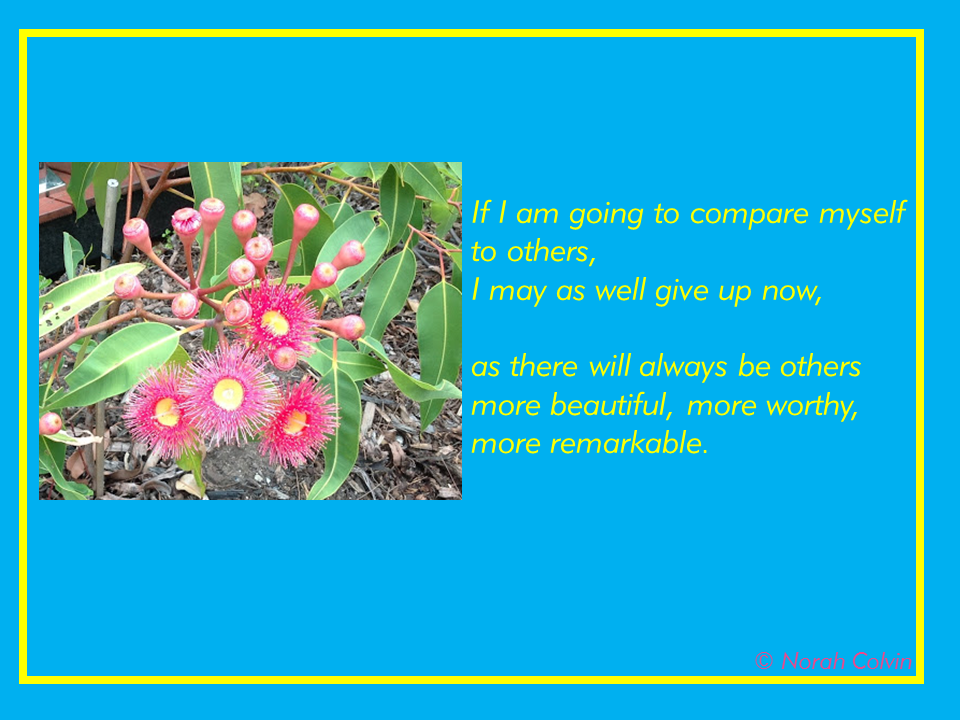
    compare - give up

    There is a multitude of websites offering early childhood teaching resources. Some websites offer all resources free. Teachers love freebies. There are also many websites with resources available to subscribers. Why would anyone want mine?

    However, I’m not going to give up now.

    compare - none

    I hope there are many early childhood teachers who will see sufficient value in my website to pay the annual subscription. As far as I explored, I have not found anyone offering interactive resources similar to mine. It is possible that they exist and I just haven’t found them. However, I am hoping that teachers see value enough in these alone, and consider the other resources a bonus. Time will tell. If it returns nothing but the pleasure of achievement, then I will consider it my jetski. If it does more than that I will be well pleased.

    So, if I am not going to give up, maybe I just need to get on with the task of writing my bio and promotion paragraph. The other day I read a bio that described the website owner as its founder. Hmm. I thought. Maybe that’s a title I could use.
    founder of readilearn

    I was amused at the thought that I would found something that hadn’t been lost. It just hadn’t been before. I thought about other things, briefly mentioned in other posts, that I had founded:

    Create-A-Way, educational sessions for children of before-school-age and their parents.

    Centre of Learning Opportunities, envisioning an alternative way of educating.

    Perhaps I can now add another to my list. I just need to get the bio written.

    What advice do you have for me? What should I include? What should I leave out? What is the most important thing of which I need to be mindful?

    Thank you

    Thank you for reading. I appreciate your feedback. Please share your thoughts.


  • Ignorance is bliss … Learning to be explicit

    My Dad used to say that what I didn’t know wouldn’t do me any harm. He was not impressed when a brother wrote in my autograph book when I was in my early teens that what I didn’t know wouldn’t do me much good either!

    © Norah Colvin
    © Norah Colvin

    I’m torn between the two. I have come to realise that the more I know, the more there is to learn.

    the more I know the more there is to learn

    This learning journey never ceases. Each step is just one further into the unknown. I seem to know less now, or need to know more now, than I ever have before. How can that be?

    There are those around me who are content with who they are, with where they are, with what they are doing, and wake up to each day wanting no more than it brings. I strive to achieve that contentment, and practice the joy of being in the present moment, believing strongly in its rewards. But at the same time I strive to do more, to learn more, to achieve more. The doing and learning is joy in the present moment, for me. It is both exhilarating and disheartening to realise that the learning journey stretches so far ahead.

    Learning about learning

    I have spent almost my entire life thinking and learning about learning and education, particularly literacy education and the education of young children. Though the journey has been long, my knowledge is narrow and small, and of absolutely no use in a trivia quiz, unless the question happens to be about a nursery rhyme, and then don’t ask me too much about its “real” or original meaning.

    GDJ, Humpty Dumpty https://openclipart.org/detail/223086/humpty-dumpty
    GDJ, Humpty Dumpty https://openclipart.org/detail/223086/humpty-dumpty

    When I set upon my journey to create a website of teaching resources that I had made, I thought it was an easy thing. I had many resources already made. I just needed to get some illustrations done and put them on a website. What could be simpler than that?

    Simple?

    Every step I take drives me deeper into complexity, into the unknown. Unravelling the complexity demands that I be explicit, that I see and describe each minute step.

    Being explicit

    I always considered the ability to be explicit, to see and understand each step, essential to effective teaching in an early childhood classroom. If one was unable to see the exact spot where a child was going wrong, where a misunderstanding had been formed, or a misconception learned, or the potential for its occurrence, it was difficult to either prevent or repair it. I considered that ability to be one of my strengths as a teacher.

    nicubunu, broken chain https://openclipart.org/detail/22063/broken-chain
    nicubunu, broken chain https://openclipart.org/detail/22063/broken-chain

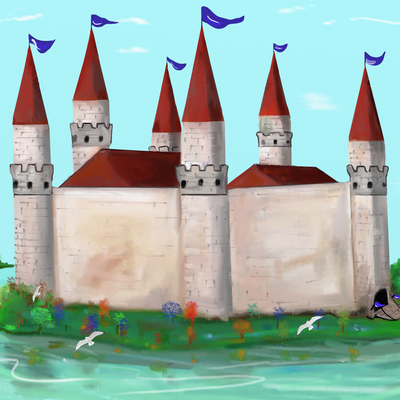
    Over the past few years when I have been giving art briefs to illustrators, my need to be explicit was stretched anew. I had to describe in precise detail exactly what I wanted. It was no use saying I wanted a castle on a hill and expect that the artist would be able to fill in all the details I could see in my mind. I had to explicitly describe it in detail:  did it need a moat or a drawbridge, was the drawbridge to be up or down, were there turrets or flags, and if there were flags, what colour and design they would have, how many windows, how many people, and what were they doing and how were they dressed …

    © Norah Colvin Artwork by Kari Rocher Jones
    © Norah Colvin Artwork by Kari Rocher Jones

    Then it was time to start thinking more specifically about what I required of the website … More complexity to unravel!

    frankes, ship – colored  https://openclipart.org/detail/214500/ship-coloured
    frankes, ship – colored https://openclipart.org/detail/214500/ship-coloured

    Oh for a journey across the seas rather than deeper into complexity!

    It is said that it is darkest before the dawn. How much darker will it get?

    A recent comment by Sarah Brentyn of Lemon Shark alerted me to the fact that although I have mentioned my website in previous posts, I had not made it clear that the purpose of the website is to make my resources available through subscription i.e. to sell my resources. While some will be available without subscription, many will be available only by paid subscription. I have received a quote for establishing the website, which I am considering. I have previously referred to it being my jetski. I think I was fairly explicit about my requirements in discussions with the designer.

    However, I want some of my resources to be interactive, not downloadable, used only on the website by paid subscribers. It appears that creating the types of interactivity I have in mind will be more problematic, but they are what I consider will be my point of difference. I have had to learn to explain, very explicitly, the types of interactions I require. I even made videos demonstrating the interactions in the hope of achieving greater clarity.

    However, it was while being explicit about these steps that I realised I had omitted something from my website brief that will be necessary for the interactions to be used effectively, if they can be made at all.

    © Norah Colvin
    © Norah Colvin

    And so I go in my merry dance – up the ladders and down the snakes, hoping to fall into a pool of clarity rather than a puddle of complexity.

    Thank you for allowing me to express my muddle through writing in an attempt to make sense of it all.

    Thank you

    Thank you for reading. I appreciate your feedback and suggestions. Please share your thoughts.


  • Displaying symptoms or true colours

    For just over a year now I have been participating in the weekly flash fiction challenge set by Charli Mills of the Carrot Ranch. I enjoy participating for a variety of reasons, including:

    Challenge: I enjoy the challenge of

    • thinking of something to write
    • telling in story or scene in the 99 word total
    • applying it in some way to my blog’s focus on education

    Variety: I enjoy writing in various forms and genres and the fiction is a pleasant change from the informational writing that I am primarily engaged with at the moment

    Practice: The requirement to tell a story in just 99 words means that I need to:

    • choose my words carefully to make my meaning explicit
    • decide what can be told, what can be implied, and what can be omitted
    • think of alternate ways of expressing an idea or describing a situation or character

    rough-writers-web-compCommunity: The Congress of Rough Writers: I have made connections and online friendships with a wonderfully supportive and encouraging group of bloggers, whose numbers are constantly growing.


    Feedback: The feedback that I receive in response to my flash fiction pieces and the posts in which I embed them gives meaning and purpose to the writing. I enjoy the in-depth discussions which quite often occur in response to the blog’s content and the additional thinking that I often need to do as a result. While it does distract me somewhat from my longer-term writing goals, the immediacy of the feedback is encouragement to continue and I am always appreciative of it.

    There are many other reasons and benefits of participating in the challenges. The above are just a few. If you have not yet considered joining in the fun, now might be the time to do so.

    www.openclipart.org
    http://www.openclipart.org

    This week Charli Mills wrote about a vivid dream that compelled her from her bed in order to capture it on paper before it escaped. She says that

    “Characters sneak into our dreams, our waking moments and tease us. We write to find out who they are.”

    Thinking about the character from her dream led her to consider symptoms, and the way that symptoms reveal more of who they are.  She challenged the Rough Writers to In 99 words (no more, no less) write a story to reveal a character’s symptoms. 

    Many of my responses to Charli’s challenges have been written to find out more about Marnie, who reveals snippets of her life, as if in flashbacks or dreams, at various ages. You can read what we already know about Marnie here.

    “Symptoms” seemed perfect for revealing a little more about Marnie. A child such as she would display a great variety, an important one of which would be her attempt to hide those symptoms from others.

    Here then is the next part of Marnie’s story, which follows on from the bullying episode shared last week.


     Symptoms

    The children suddenly appeared: one bedraggled and muddied, the other exuding authority.

    “Brucie tripped her. On purpose!” declared Jasmine.

    “Come on, Marnie. Let’s get you cleaned up,” said Mrs Tomkins. ”Then we’ll see about Brucie.  Is your mum home today?”

    Marnie looked down and shook her head.

    “Will I help you with that jumper?”

    A jumper? It’s too warm . . .” Her thoughts raced.

    Marnie turned away. As she pulled up her jumper, her shirt lifted revealing large discolorations on her back.

    Over the years Mrs Tomkins had seen too many Marnies; too many Brucies; never enough Jasmines.


    Sadly, children like Marnie and Brucie are very real and very familiar to many teachers.

    A few weeks ago I shared a post by Julieanne Harmatz on her blog To Read To Write To Be. I always enjoy reading Julieanne’s blog because it helps me walk right back into the classroom, in my mind. The Student Z she described in that post has many “symptoms” in common with other students I have worked with over the years.

    This week Julieanne shares ways she provides authentic opportunities for using digital technologies in her classroom. One of the ways is student blogging, and Julieanne linked to a post written by one of her students, Zoe. I was very impressed. I’m sure you will be too.

    In the post Zoe shares information about, and links to, her favourite song and singer. She says it is her “favorite song because it teaches you why not to bully.”

    The song is a rap version of “True Colours” with additional original anti-bullying content written by 12 year old MattyB to support his younger sister who is excluded and bullied because of her “symptoms”. I have not linked to the song here because I would like you to read Zoe’s blog and listen to the song there.

    I was so impressed by Zoe and MattyB, both showing traits of strength and of being an “upstander”, as described by Mrs Varsalona in the comments on Zoe’s post,  that I decided to find out a bit more about MattyB.

    Here is the story of how MattyB and his family wrote the song to support MattyB’s sister Sarah.

    I love to hear positive stories like this, don’t you?

    Thank you

    Thank you for reading. I appreciate your feedback. Please share your thoughts about any aspect of this post or flash fiction.

  • Are you a lemon or a grapefruit? – Ten articles about creativity

    Are you a lemon or a grapefruit? – Ten articles about creativity

    I am a great fan of creativity.

    Imagination and creative thinking are what inspire and drive improvement, innovation and progress.

    I affirm my belief in the power of creativity in my header: ‘Create the possibilities . . .’

    In this post I share articles and blog posts that discuss creativity. It is not an exhaustive list, just a few to get you started. You will notice that many, but not all, are from Edutopia, a website that is ‘dedicated to improving the K-12 learning process through innovative, replicable, and evidence-based strategies that prepare students to thrive in their studies, careers, and adult lives’; and TED, an organisation of people who ‘believe passionately in the power of ideas to change attitudes, lives and, ultimately, the world.’

    1. In this article on Creativity and education Judy O’Connell says that

    ‘Every student is creative in some way, and the job of educators is to release and support that creative talent in an appropriate manner.’

    She adds that

    ‘Teaching creatively and for creativity entails taking students on a creative journey where their responses are not predetermined.’

    In her article Judy lists some features of teaching for creativity and includes a video of a new school in New Zealand that she suggests fits the criteria. It is quite exciting and worth a look.

    1. In this article shared on Edutopia Do Standards Kill Creativity Claus von Zastrow suggests creative ways of teaching creativity while teaching standards.

    Linking of subject areas, as we used to do through ‘themes’ in the old days, or more recently ‘integrated units’, before subjects were divided and each given their own slot in the timetable, was one suggestion.  A number of varied and interesting comments accompany the article.

    1. I have previously shared this TED talk by Sir Ken Robinson on How schools kill creativity here and here. If you have not yet listened to it, please do. As well as sharing a very important message, Ken is a very entertaining speaker. I’m sure you will enjoy it.

    4. Following on from that talk is this article by Bruce Price shared on examiner.com Ken Robinson and the Factory Method of Education. The article shares an animated talk by Ken Changing Education Paradigms.

    Bruce does not agree with Ken’s views and warns readers to be sceptical of information imparted by Ken. He says that Ken’s opposition to traditional schooling is unhelpful and argues that, unlike most others referenced here, that creativity cannot be taught.

    5. In this article by Deepak Kulkarni Recreational and Educational Value of Math Puzzles shared on Edutopia the suggestion is made that creative problem solving can be taught using maths puzzles.

    6. A variety of Techniques for creative teaching are shared on the Iowa State University Center for Excellence in Learning and Teaching website which states that

    in order to teach creativity, one must teach creatively’.

    7. In yet another article shared on Edutopia, Andrew Miller states enthusiastically Yes, You Can Teach and Assess Creativity! Andrew provides suggestions for recognising creativity as well as teaching and assessing it.

    8. Also on Edutopia, Diane Darrow talks about Creativity on the Run: 18 Apps that Support the Creative Process.

    9. In this rather long TED talk on his life, authenticity vs karaoke culture Malcolm McLaren postulates that ‘we’re living in a karaoke culture, with false promises of instant success, and that messiness and failure are the key to true learning.’ He talks about his own schooling and attitude to creativity.

    10. Michael Michalki shared an article on Edutopia regarding what he considers the 7 Tenets of Creative Thinking, including:

    Believe you are creative

    ‘While creative people believe they are creative, those who don’t hold that belief are not.’

    Work at it and ‘produce an incredible number of ideas — most of which (may be) bad. He says that

    ‘more bad poems were written by major poets than by minor poets’.

    Go through the motions – ‘Every hour spent activating your mind by generating ideas increases creativity’; visualise what you want and go for it.

    On his own website Creative Thinking, Michael Michalko suggests many more ideas for getting you to think creatively.

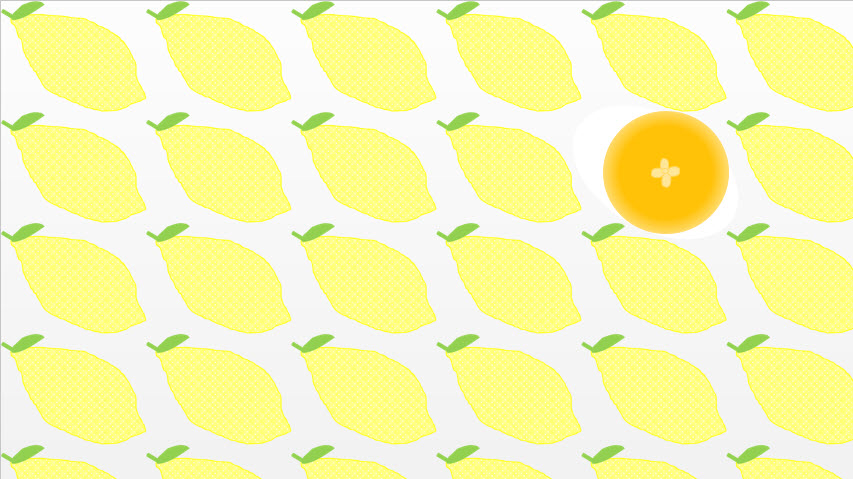
    The header of Michael’s website states that “A grapefruit is a lemon that took a chance.”

    lemons and grapefruit

    So which are you: a lemon or a grapefruit?

    I appreciate your feedback. Please share your thoughts about any aspect of this post and let me know whether you agree or disagree with the value of creativity and if it can be taught.

    Thanks for reading.

  • SOLE Man

    I love listening to TED talks.

    TED stands for Technology, Entertainment and Design.

    The mission of this organisation is Spreading ideas, a goal dear to my heart.

    I always find the talks fascinating, challenging and inspiring. I feel quite humbled by the fact that there are so many clever, creative and innovative people in the world. However, at the same time, I feel reassured, knowing that our collective future and the future of our planet is in such capable hands.

    Recently I listened to some talks by an educational researcher, Sugata Mitra,  winner of the 2013 TED Prize.

    The TED Prize is awarded to an extraordinary individual with a creative and bold vision to spark global change. . . . the TED Prize supports one wish to inspire the world.

    Mitra’s wish is to build a School in the Cloud, a school where children learn from each other. He introduces the idea of the Self Organized Learning Environment and invites people around the word to help him achieve his wish by downloading a SOLE toolkit to bring these Self Organised Learning Environments to their own communities.

    The toolkit is a step-by-step guide which is designed to “prepare you to ignite the fire of curiosity in kids at home, in school or at after-school programs.”

    A SOLE is basically a small group of children learning together, using the internet to answer questions of interest to them, with minimal teacher intervention.

    There was much in Mitra’s talks that I agreed with, such as

    schools as we know them now, they’re obsolete. I’m not saying they’re broken. It’s quite fashionable to say that the education system’s broken. It’s not broken. It’s wonderfully constructed. It’s just that we don’t need it anymore. It’s outdated.

    “Encouragement seems to be the key.”

    “There is evidence from neuroscience. The reptilian part of our brain, which sits in the center of our brain, when it’s threatened, it shuts down everything else, it shuts down the prefrontal cortex, the parts which learn, it shuts all of that down. Punishment and examinations are seen as threats. We take our children, we make them shut their brains down, and then we say, “Perform.”

    much that intrigued me, such as the grandmother method

    “Stand behind them. Whenever they do anything, you just say, ‘Well, wow, I mean, how did you do that? What’s the next page? Gosh, when I was your age, I could have never done that.’ You know what grannies do.”

    much that inspired me, such as

    “I think what we need to look at is we need to look at learning as the product of educational self-organization. If you allow the educational process to self-organize, then learning emerges. It’s not about making learning happen. It’s about letting it happen. The teacher sets the process in motion and then she stands back in awe and watches as learning happens.”

    and much that I wasn’t sure about, that led me to question, such as, 

    “Could it be that we don’t need to go to school at all? Could it be that, at the point in time when you need to know something, you can find out in two minutes? Could it be — a devastating question, a question that was framed for me by Nicholas Negroponte — could it be that we are heading towards or maybe in a future where knowing is obsolete? But that’s terrible. We are homo sapiens. Knowing, that’s what distinguishes us from the apes. But look at it this way. It took nature 100 million years to make the ape stand up and become Homo sapiens. It took us only 10,000 to make knowing obsolete. What an achievement that is. But we have to integrate that into our own future.”

    As well as listening to TED talks, I also love reading about philosophy, especially the inclusion of the study of philosophy in the school curriculum.

    While following up this philosophical interest, I came across this great blog post by Michelle Sowey, “Can you kill a goat by staring at it? A critical look at minimally invasive education“.

    I couldn’t resist the title, of course, but imagine my delight when I realised that Sowey was critically appraising Mitra’s SOLEs from a philosophical standpoint.

    Sowey saw much to agree with in Mitra’s talks, but for her also, the talks raised many questions.

    These are points of convergence that Sowey saw between  Mitra’s approach and that of philosophical enquiry in the classroom:

    • both are curiosity-driven
    • both involve collaboration of students
    • both seek to engage children’s interest in big questions
    • both support children in exploring ideas and sharing discoveries
    • both offer the prospect of intellectual adventures that spring from children’s sense of wonder and their ability to work together.

    Sowey went on to say:

    “What’s more, Dr Mitra’s proposed curriculum of big questions includes many deeply philosophical ones, such as ‘Can anything be less than zero?’, ‘Will robots be conscious one day?’ and ‘What is altruism?’”

    Then came the BUT:

    Sowey went on to say

    “There are two major points of difference, though, and it’s here that I see cracks in the veneer of minimally invasive education. It differs from collaborative enquiry in that (1) it features the internet as a principal learning medium and (2) it renounces the guidance of qualified teachers or practitioners.”

    Sowey raised concerns including the need to develop in students the ability

    • to assess the credibility of internet sources
    • to challenge faulty arguments
    • to question claims that are dogmatic, propagandistic, biased, pseudoscientific or downright erroneous

    She went on to say:

    “We need to make sure that kids develop thinking and reasoning skills alongside skills in research and information awareness. For this, the support of a competent guide is indispensable, equipping children not only to assess the reliability of different sources but also to evaluate the many arguments they will encounter.”

    I agree wholeheartedly with this.

    She then goes on to say:

    “To dismiss the infrastructure of schooling altogether because of traditional standardisation is to throw the baby out with the bathwater. Surely it makes more sense to repurpose that infrastructure in ways that better nourish children’s curiosity, critical thinking and creative exploration.”

    which makes perfect sense to me also.

    Although I am not a fan of traditional schooling and have made that stance very clear in previous posts, I have expended a lot of energy in trying to establish what I consider to be a better approach. The goal of nourishing “children’s curiosity, critical thinking and creative exploration” was always high on the agenda.

    I encourage you to listen to Mitra’s inspirational talks, and to read Sowey’s compelling article in its entirety.

    Sugata Mitra “Build a school in the cloud

    Sugata Mitra “The child-driven education

    Michelle Sowey “Can you kill a goat by staring at it? A critical look at minimally invasive education

    I will leave you with Sowey’s concluding statement:

    “We need the incisiveness and probing of critical and creative thinking to get deep into the viscera of the facts and anti-facts, the experts and anti-experts. And we need the incisiveness and probing of good teachers to go deep into children’s thought-space: to discover what they’re understanding and what they’re not, yet.”

    What do you think?

    Please share your thoughts.
  • Flag this Twitter advice

    stop email

    I have just read a very helpful post by Claire Diaz-Ortiz explaining how to unsend an email.

    Reading it prompted me to write me this post which I have been mulling over for some time now. I would like to read a post entitled:

    “How to unflag on Twitter”.

    You see, I am a newcomer to Twitter; reading, tweeting and re-tweeting for just over two months now.

    Luckily for me there are many wonderful bloggers who generously share their tips and information to help newbies like me get started. I have read and re-read some of these blog posts many times in order to glean as much information as possible in order to avoid making it obvious to everybody just what a newbie I am.

    Just as an email can be unsent, the delete button on Twitter can be used to withdraw a message tweeted by mistake. That’s easy.

    However it is not so easy, in fact it is impossible, so far as I can see, to unflag a flag.

    Now I’m a reasonably intelligent person, and I have used a number of computer programs and applications over the years, and one thing that I have discovered is that learning is transferrable. What is learned in one program or application can generally be applied in others. I have also learned that one should not worry too much about clicking the wrong button because most things can be undone and not much harm can be done anyway.

    I had plenty of prior experience with flags to understand their use.

    Anonymous_globe_of_flags_1

    nicubunu_Game_marbles_-_flags

    In Microsoft  Word, the little flag icon is used to bookmark a part of the text one wishes to locate later.

    The flag in Microsoft Outlook is used to mark an email to follow up.

    I may use a flag to highlight a section of text in a book if I consider its content important or interesting enough to revisit another time.

    swim between the flags

    Flags on the beach indicate areas where it is safe to swim.

    Flags on a car-yard are there to entice would-be buyers.

    HappyNewYear_by_Rones
    Party time!

    In all these instances flags are used to draw attention to items of interest or importance to make them easy to locate. So it follows that I should be able to transfer this knowledge to other applications. Right?

    Well, usually; but not with Twitter.

    tweet bird
    A little Twitter panic!

    I learned this from my own first-hand experience though, so the learning is powerful and permanent and I will not need to revisit this situation again to make sure I have got it right. The learning was also accompanied by quite a degree of embarrassment and anguish, so if I can prevent anyone else from making the same mistake, my purpose in writing this post will be accomplished.

    tragicmaskThis is how the tragedy unfolded:

    One day I encountered a tweet with a fun poem attached as media. I wanted to be able to come back to this poem at a later time to reflect on it some more. I wondered how I might do that.

    Flag media

    Then, out of the corner of my eye, I noticed a little box down to the right that said “Flag media”.

    “Great,” I thought, “Easy,” and pressed the button.

    Immediately the button changed to “Flagged learn more”.

    Now where there’s a link there’s a way to new learning, so of course I clicked on it . . .

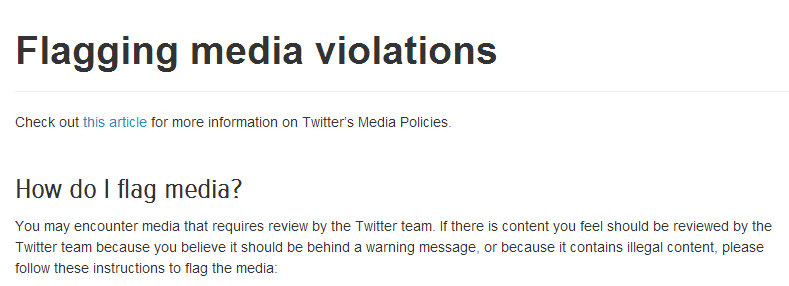
    and was totally aghast when I came to the Twitter Help Centre “Flagging media violations”.

    flagging media violations

    I hadn’t wanted to flag the poem as a media violation. I just wanted to read it again later.

    “Quick,” I thought, “better unflag it before anyone notices; especially the author!”

    As I frantically searched the Twitter Help Centre, the panic started to rise as I could find no instructions for unflagging.

    I couldn’t remember it being mentioned in any of the articles I had read, but I went back and checked, just to make sure. Nowhere could I find mention of flagging, let alone unflagging. I just had to let it be and hope that when the Twitter team checked the flag, they would realise that an error had been made. However, I do sincerely apologise to George and can only be thankful that my followers were few, and hopeful that nobody, especially George, noticed.

    So here is my number one piece of advice when using Twitter: Don’t flag!

    don't flag

    Not unless you consider “there is content you feel should be reviewed by the Twitter team because you believe it should be behind a warning message, or because it contains illegal content”.

    I wish I had read that before I flagged George’s poem, “Everything is a car!”

    Anonymous_double_star

    However you could use this strategy if you wish to come back to a tweet later:

    favourite it.

    That way it will turn up in your favourites list and you will easily be able to locate it.

    Just be wary of favouriting too many tweets as advised by Mary C. Long in the Social Times earlier this year. However Mary’s warning doesn’t apply to favouriting a tweet in the way I have just suggested.

    What have you learned about Twitter that you think I should know?

    What learning experiences would you like to share?

    Here are seven great bloggers or websites with useful advice about using Twitter appropriately:

    Mom this is how Twitter works

    The eLearning coach Ten ways to learn from Twitter

    Claire Diaz-Ortiz How to create your own Twitter profile (and others)

    Belinda Pollard Why emerging authors need Twitter (and others)

    Molly Greene  Ten tweets you should never send (and others)

    Jeff Bullas 10 tips for creating marketing and sharing content on Twitter

    Judy O’Connell Being web savvy includes twitter

    Rachel in the OC Ten quick tips to help any author

    And don’t forget the Twitter Support Centre

    Happy tweeting!

    All clipart courtesy of  www.openclipart.org  some with minor modifications and additions.