Rita’s entire life centred around education. Her parents and her mother’s parents were teachers, and she was a teacher.
She observed numerous teachers at work – some of the best and some of the worst – and believed that relationships are the key to learning.
She said that
“kids don’t learn from people they don’t like.”
Rita spoke about having classes of students whose academic level was so low she wondered how she could “raise the self-esteem of a child and his academic achievement at the same time”.
One year she told her students
“You were chosen to be in my class because I am the best teacher and you are the best students, they put us together so we could show everybody else how to do it.”
Affirmation, encouragement, praise . . .
She talked about giving a student a +2 with a smiley face for getting 2 out 20 questions correct. She encouraged the student by saying
“you’re on a roll . . . and when we review this, won’t you do better?”
The student agreed “I can do better”.
Affirmation, encouragement, praise . . .
Rita told of her mother’s past students expressing their gratitude for the difference she made in their lives, saying
“You made me feel like I was somebody, when I knew, at the bottom, I wasn’t. And I want you to just see what I’ve become.”
Affirmation, encouragement, praise . . .
She tells us that teachers won’t always like all the children they teach, but it’s important that the children never know it. Acting is part of the role description!
She says that
“Teaching and learning should bring joy. How powerful would our world be if we had kids who were not afraid to take risks, who were not afraid to think, and who had a champion? Every child deserves a champion, an adult who will never give up on them, who understands the power of connection, and insists that they become the best that they can possibly be.”
Affirmation, encouragement, praise . . .
Go ahead and listen to this inspirational talk. It will take less than 8 minutes listening time but its effect will be more lasting. It has already had more than 2 600 000 views. Why not add one more to the total. I’m certain you won’t regret it.
I can find nothing to dispute in Rita’s talk. I’d like to underline every word and make it compulsory viewing for all aspiring and practising educators in any field.
Affirmation, encouragement, praise . . . helpful or harmful?
What do you think? Please share your thoughts below.
Refer to these previous posts for discussions on self-esteem, affirmations and praise:
However the chapter that captured my attention and challenged my thinking more than any other was the one about praise. I also blogged about this: Seeking praise: Stephen Grosz revisited.
My post about praise got Anne Goodwin thinking further about this issue and she was able to delve into it more deeply with her background in psychology. She has very generously written this guest post to share her thoughts.
Thanks Anne – over to you:
Although I was enchanted by The Examined Life from the first page, I glossed over the chapter on praise. Reading primarily for the parallels between these therapeutic case studies and reading and writing fiction, I didn’t stop to analyse my reaction, to acknowledge I was challenged by the suggestion that praise could be detrimental. Perhaps I dismissed this chapter as a reaction to the rarefied atmosphere of that cosy part of North London that is the hub of British psychoanalysis. In my neck of the woods, as reflected in myflash fiction piece, Peace-and-Quiet Pancake, I’m more concerned about a shortage of praise and encouragement than an excess.
I was initially disappointed when Norah mentioned on Twitter that, with over thirty chapters to choose from, she’d decided to blog about the chapter on praise. Yet her wonderful post showed me what I’d missed in my initial (defensive) reading and inspired me to go back to the book and ponder the depths of wisdom within those four and a half pages for myself.
“Stephen Grosz calls into question where our ideas of good practice originate.”
In suggesting we rethink what’s best for our children, Stephen Grosz calls into question where our ideas of good practice originate. We tend to respond to the mistakes of our forebears by striving to do the opposite, so those of us who suffered from a dearth of praise ourselves might be inclined to lavish praise on the next generation. Yet we can become so fixated on turning our backs on theapproaches we know from experience to be unhelpful, we’re blinded to the potential pitfalls of the alternative path. Cutting back on praise feels treacherous, like siding with the harsh disciplinarians of days gone by. Stephen Grosz points us towards a third way.
“Behavioural strategies are invaluable for introducing the necessary structures and routines in which children can prosper and learn.”
Behavioural psychology shows that targeted rewards, either tangible, or intangible like praise, increase the frequency of desired behaviours. Rewards are actually most effective when they’re doled out intermittently, which might be one argument (although not the author’s) for soft-pedalling on the praise. Behavioural strategies are invaluable for introducing the necessary structures and routines in which children can prosper and learn. However, they can also result in the over-controlled and compliant child, one who is well versed inpleasing adults but struggles to think for him or herself.
“Stephen Grosz suggests that parents and educators can become as addicted to praise as these children.”
Stephen Grosz suggests that parents and educators can become as addicted to praise as these children. The mother who continually tells her child she is good might be vicariously praising herself. Underlying this might be a lack of confidence in her own parenting skills and a difficulty accepting her child as a separate person, with potentially different values and preferences. This is unlikely to enhance the child’s confidence and self-esteem.
“He also cautions us to be wary of praising children for what they are rather than for what they do.”
He also cautions us to be wary of praising children for what they are rather than for what they do. He cites a study in which, consistent with attribution theory, children praised for their effort rather than their intelligence, developed a more positive approach to problem solving. We can always put in more effort, but if we believe success is down to stable and unchangeable factors we might be less resilient in the face of the failure we will all, however talented, meet at some point in our lives.
“a third position where the adult is benignly attentive to the child and curious about what he/she is doing.”
What the author recommends is not a return to a pedagogy of threat and punishment, but a third position where the adult is benignly attentive to the child and curious about what he/she is doing. The child who believes that an adult is genuinely interested in their ideas, thoughts and feelings, is likely to develop a strong sense of agency and self-worth. While this might seem a radical approach, it’s not dissimilar to the behaviour of a tuned-in mother who watches over and mirrors her baby’s moves. It’s also the stance taken by the psychoanalytically orientated psychotherapist.
This is familiar ground for me, but I didn’t recognise it on an initial reading. Having already decided I loved the book from hearing snippets on the radio, I was reading it for what I could praise. I hope it wasn’t empty praise, but I was unwilling to engage with parts that were hard to swallow. On the second reading, my stance flipped to critical, almost punitive, focusing more on what was missing from the chapter than what was actually there. Now this process of putting my thoughts into words has brought me towards the position of curiosity and attentiveness I wish I’d had first time round. Whilst other readers might be less defensive, it does make me wonder, if it’s a struggle to reach this position in relation to a text, how difficult might it be to apply this learning in the real world and on a larger scale?
“While parents, politicians and educationalists might all claim to value individual expression and personal growth, this has to be weighed against an equally strong pressure for the achievement of standardised performance goals.”
On a sociopolitical level, we might resist this understanding because of conflicting views as to what education is for. While parents, politicians and educationalists might all claim to value individual expression and personal growth, this has to be weighed against an equally strong pressure for the achievement of standardised performance goals.
On the individual level, as Stephen Grosz says in his final paragraph, being present with others is hard work. Therapists have their own therapy in addition to training and supervision; parents striving to do a similar job with only their experience of their own parenting to draw on could struggle to find the position of attentiveness beyond both praise and chastisement.
“Children who have never been praised, even for attributes outside their control, might have no concept of their own ability to impact on their environment.”
Furthermore, for the child entering school knowing only neglect and criticism, a teacher’s benign curiosity could be experienced as threatening, just as the neutrality of therapist can provoke anxiety in his or her client. Children who have never been praised, even for attributes outside their control, might have no concept of their own ability to impact on their environment. Does the busy classroom teacher have the resources to be truly present with them in the way they require?
Thanks, Norah, for challenging me to revisit this chapter and for the invitation to rework my comment into a guest post. For those who’ve had the patience to stay present this far, I look forward to your reactions.
Thank you Anne for the insight and challenge you have offered with much for us to think about.
I reiterate Anne’s invitation for you, the reader, to share your thoughts on this topic, and suggest you head on over to Anne Goodwin’s writing blog (Annethology) for a great assortment of interesting fare.
If you didn’t participate in the poll, but would like to, have a go now.
What did you answer?
If you are familiar with this book
you may have chosen both statements as correct along with one third of respondents in the poll.
In his book Eric Carle writes that
“He (the caterpillar) built a small house, called a cocoon, around himself. He stayed inside for more than two weeks. Then he nibbled a hole in the cocoon, pushed his way out and . . . he was a beautiful butterfly!”
If you either read or wrote one of the hundreds of thousands of articles about “The Very Hungry Caterpillar”, or about butterflies and caterpillars in general, published on the internet, you probably also identified those two statements as correct.
But if you did, just like Eric Carle, you’d be wrong!
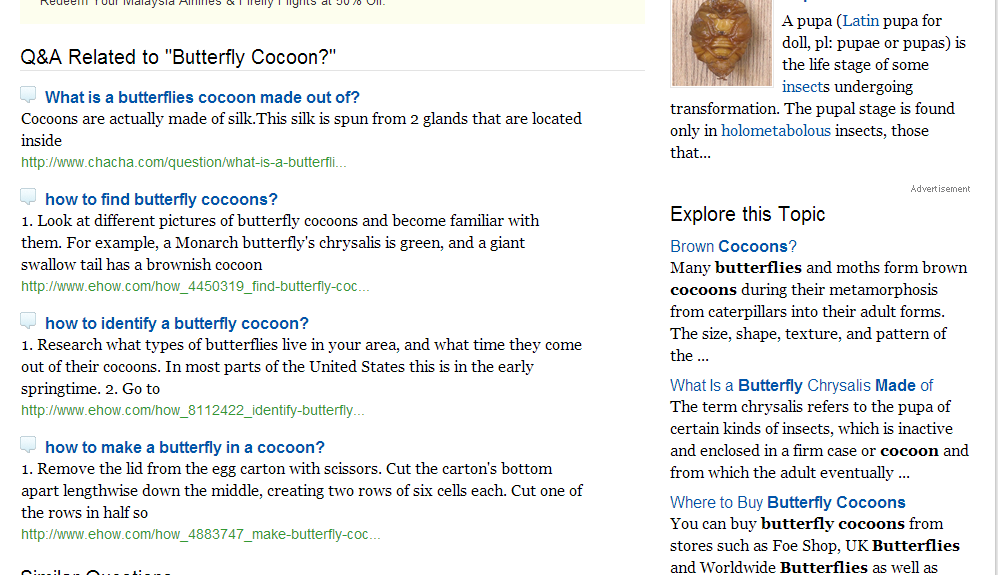
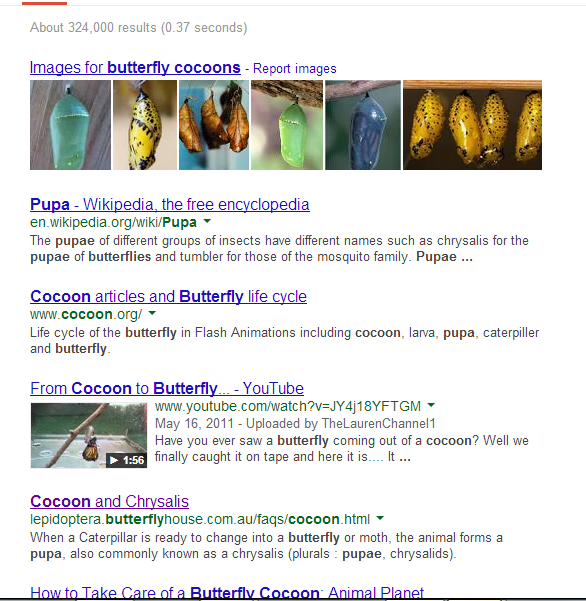
A caterpillar that undergoes metamorphosis to become a butterfly does not spin a cocoon and does not nibble its way out. The fully grown caterpillar moults into a chrysalis and, when ready, it splits the chrysalis to emerge as a butterfly.
For a series of beautiful photos showing the last moult of a caterpillar as it becomes a chrysalis, and another series showing a butterfly emerging from its chrysalis, click here.
Or watch this video by Strang Entertainment showing the caterpillar becoming a chrysalis
or this one by Neil Bromhall showing a butterfly emerging
A moth’s caterpillar does spin a cocoon and does nibble its way out (think of a silkworm cocoon and moth).
This video shows silkworm caterpillars nibbling hungrily away at the mulberry leaves. Then when a caterpillar is fully grown (about 2 mins in) it spins it cocoon.
Compare the process with that of a monarch caterpillar forming a chrysalis. It is a very different thing.
It is impossible to rely on the information provided by many of the websites to guide one’s use of “The Very Hungry Caterpillar” when working with children.
For example, on the website Math & Reading Help, these suggestions are made:
“Many Teaching Moments
Though it’s a very brief picture book with sparse and simple language, The Very Hungry Caterpillar conveys an impressive array of wisdom and lessons for children. Most prominent among these is the life cycle of a caterpillar. The caterpillar in the story begins his life as an egg, then progresses through the larva stage. The time in his cocoon is his chrysalis stage, followed by his adult appearance as a butterfly.
This is a factually accurate portrayal of how lepidopterans (sic), an order of insects including butterflies and moths, grow and change. It teaches your child to understand this biological process. When you encounter a caterpillar, you can refer to The Very Hungry Caterpillar and ask your child about what it’s doing, since it’s likely to be looking for food. Likewise, you can reference the book when you see a butterfly, noting how it’s a caterpillar that has emerged from its cocoon after its transformation.”
You have already picked out the inaccuracies in that statement, haven’t you?
Another website, Primary upd8 also suggests using the book for teaching children about the butterfly’s life cycle, and look how it promotes itself!
“When speaking to teachers I often find raised eyebrows when I explain that butterflies’ larvae do not make cocoons. The teachers refer to Eric Carle’s book, The Very Hungry Caterpillar, where he refers to a ‘cocoon’.
Why does this misinformation persist, and why did Eric Carle use misleading statements in his book?
Does it matter if children (and adults) think that butterflies hatch out of cocoons?
Eric Carle didn’t seem to think it did.
Unfortunately I was unable to locate for confirmation an article I’d read years ago. This article, if I recall correctly, reported a response of Carle’s to children enquiring why he had used “cocoon” rather than “chrysalis”. His response was one of disdain. What did it matter?
If you search Eric Carle’s current website for cocoon, this is the response you will receive:
While Carle concedes that most butterflies come from a chrysalis, he triumphantly states that one rare genus pupates in a cocoon! I confirmed this with the Encyclopaedia Britannica .
Does that one rare instance let Carle off the hook?
“Actually, the Parnassians pupate inside cocoon-like webs usually constructed among leaves or in rubbish piles.” (my underlining)
So not quite true and not quite off the hook Eric Carle.
In addition, although I couldn’t find the article I was searching for, I found this from Scholastic which shows that Eric was aware of the error and declined to change it.
“By the way, Eric already knows that a caterpillar emerges from a chrysalis, not a cocoon! So don’t bother writing to tell him. Eric explains how the famous “mistake” crept into the book:
“My editor contacted a scientist, who said that it was permissible to use the word cocoon. Poetry over science. It simply would not have worked to say, ‘Come out of your chrysalis!’ If we can accept giants tied down by dwarfs, genies in bottles, and knights who attack windmills, why can’t a caterpillar come out of a cocoon?”
There are many points for discussion in that statement:
His editor contacted a scientist – What sort of scientist? I would say one with questionable credentials or entomological knowledge.
Permissible to use the word “cocoon” – Why? For what purpose?
Poetry over science!!!!!!! Chrysalis is a beautiful word, specific to the butterfly. What could be more poetic than that? Poetic and scientific! What a great combination!
Why wouldn’t it have worked to say “Come out of your chrysalis”?
A caterpillar doesn’t come out of a cocoon. A caterpillar spins a cocoon; then a moth comes out of it; not a butterfly! (Except for the rare Parnassian butterfly.)
Is this issue, as Carle suggests, the same as giants and dwarfs, genies in bottles and knights who attack windmills?
What do you think?
Do picture book authors have a responsibility in imparting factual information to children?
“We writers – and especially writers for children, but all writers – have an obligation to our readers: it’s the obligation to write true things, especially important when we are creating tales of people who do not exist in places that never were – to understand that truth is not in what happens but what it tells us about who we are. Fiction is the lie that tells the truth”
Not quite the same thing I know, but an obligation nonetheless?
Though not there now, when I first looked at the Reading Rockets interview with Eric Carle this quote was prominently displayed beside it:
“The more that you read, the more things you will know. The more you learn, the more places you’ll go.”
— Dr. Seuss
A bit ironic, don’t you think?
How much of the responsibility should remain with the reader to verify the correctness/accuracy of what is read? How does one go about that?
I have always been a believer in the “question everything” approach. “Don’t believe everything you read,” I say. But sometimes knowing what to accept and what to question can be a difficult thing.
I’d love to know what you think. Please leave a comment in the comment box.
Here are links to some of the articles I referred to in this post:
When I was growing up “Get Smart” was a popular show with my family and friends. The question “Would you believe . . .?” was often asked humorously, in Max-style, starting off with an exaggerated and unbelievable suggestion, then moving through a series of diminishing magnitude to the, often insignificant, reality.
I am not going to start with an exaggeration for I am rather pleased with what I have achieved. I wish to make no comparison with anyone else who may have achieved a whole lot more, or even those who may have done less. I just know that I have learned a lot, and in fact, have learned so much that I now know what future learning I need to do.
If you know nothing, you don’t know what you need to know. It is only when you know something that you get an inkling of what there is to learn.
If, this time last year, you had said to me:
“One year from now you will be writing a blog and publishing your fiftieth blog post; you will have over 800 followers on Twitter and you will engage in conversations with people from all over the world.”
I would have laughed and said you were crazy. I had no thought of writing a blog and thought Twitter was just for twits.
I had followed only one or two blogs posted by family and friends on holidays so knew nothing of the pleasure or potential of writing or following blogs.
What I “knew” of Twitter was minimal and misinformed. I thought it was people sending messages about eating breakfast, going to the bathroom and other mundane events. I couldn’t see the point in that.
How wrong were my misconceptions how they have changed!
How Ihave changed.
What I would have considered a Max-style exaggeration a year ago is now a reality. And it didn’t take a year. It has all happened in just six months.
Six months ago I published my first blog post and tweeted for the first time.
I was both nervous and excited and had no expectations other than to see what would happen.
I am delighted with the result: the learning I have done, the people I have met and the way my writing has grown. One of the greatest pleasures is having control over what I write; another is meeting so many interesting people, some like-minded and others with differing views, but all supportive and willing to share their knowledge, ideas and thoughts.
In late 2012 I did a couple of sessions about digital publishing with Simon Groth (Manager of if:book Australia), and another at the beginning of 2013. While the talks were fascinating and I learned a lot, I was such a N00b that it was all still a forest to me and I couldn’t see the path to take me in and didn’t have the tools to clear a path. I needed more time to absorb the information I had heard and work out what to do with it. I still wasn’t convinced that blogging and social media were for me.
Belinda Pollard of Small Blue Dog Publishing changed all that at another QWC session in June. I am very grateful to her for convincing me that this was the way to go and that I just needed to get started. She described Twitter as the “water cooler for writers” and a great way to meet other writers.
Less than two months after hearing Belinda speak I was on my way, hacking a path through the undergrowth, searching for the warmth of sunlight through the canopy. My quest for information started with her website and crawled its way out and around other websites and blogs, some of which I return to often for reassurance, reminders and more information.
Now in answer to the question, “Are you experienced?” I can reply with a very definitive: ”Yes, I am experienced!”
I have lost my nervousness, but not my excitement. I have grown in confidence and knowledge but know that there is so much more to learn. In my Twitter profile I say that I was born too soon, but maybe I just started late. Considering that there were no computers and no internet for more than half my life and the only “mobile” phone I knew in my younger days was Maxwell Smart’s shoe, I think I’m doing okay in the catch-up.
In addition to all the generous bloggers and twitter users who have helped me along the way, many without knowing it, I am also very grateful to you, my readers and followers, who have visited, commented, liked, favourited and otherwise shared my posts and tweets, but more especially your knowledge, support and ideas. While I had no expectation that any of you would drop by to read or engage me in conversation, I’m so glad you did. Thank you. Please stay with me as my journey continues.
Praise may be defined as an expression of approval or admiration.
Who wouldn’t want that?
If you write a blog, don’t you love it when others “like” a post, leave a positive comment, re-blog your article or link to it via theirs? I do. Aren’t these all expressions of approval or admiration?
What about on Twitter when someone Re-tweets, favourites or replies positively to your comment, engaging you in conversation?
Aren’t these also expressions of approval or admiration?
I love to receive all these signs of encouragement and support that let me know that my efforts are appreciated and confirm that I am on the right track. If I did not receive any of this feedback I would feel quite isolated and consider my efforts to be fruitless and a waste of time. I would probably just give up.
As a teacher I have always considered it of primary importance to create a happy and welcoming classroom environment in which children feel valued, affirmed and supported. Expressions of approval and admiration for behaviour, effort and achievement were generously given with the aim of encouraging the desired response, a happy child being foremost. I have written about this in previous posts, including:
As a parent too I considered it important to affirm my children and display my approval and admiration for them. I still do, even now they are adults. The need for approval never ends. I know sometimes you just have to go out there and say what you know is right, even though others will disagree or ridicule you. I am not talking about those instances here.
My strong belief in the power of affirmations and approval stems partly from the dearth of them in my childhood and school days. I have also mentioned this in a previous post:
Recently I listened to a fabulous (audio)book, “The Examined Life: How We Lose and Find Ourselves” by Stephen Grosz. I wrote about it in my previous post A book worth reading: Stephen Grosz “The Examined Life” saying that
“What appeals to a reader about a book, or what a reader takes away from a book is as individual and personal as the reader. What is of most significant to one, may be of lesser importance, or even insignificant to another. “
For me the chapter of most significance is chapter 3 “How praise can cause a loss of competence”.
To say I was startled by the title would be an understatement. I was puzzled, intrigued and challenged. How could praise cause a loss of competence? Surely negative feedback or a lack of encouragement altogether would be major contributors to diminishing competence. Was everything I had believed and practiced wrong? (Oh no –there’s my need for approval and affirmation!)
Grosz says that during the past decade studies into self-esteem have found that praising a child as “clever” may not only inhibit school achievement, it may cause under performance. He suggests children may react to praise by quitting. Why would you try to improve or do something new if you have already done something really well or are the “best”?
Studies showed that children who were praised for effort, rather than for being clever, were more willing to try new approaches and were more resilient. Children who were praised for being clever, tended to worry more about failure and chose unchallenging tasks, tasks they knew they could achieve or had already achieved. Being told they were clever led to a loss in self-esteem and motivation and to increased anxiety. Some children who had been praised for being clever (rather than working hard), when confronted with a more difficult task and asked to comment on it, were so unhappy with the results they lied about them, exaggerating their achievements to others.
Grosz questions whether we may lavish praise on our children nowadays in order to demonstrate that we are different from our parents who possibly used criticism, rather than praise, on us. I hinted at something similar earlier in this article.
While admiring our children with words like “Good boy” or “Good girl” may temporarily lift our self-esteem by showing others what wonderful parents we are or how wonderful our children are, Grosz says, it isn’t doing much for a child’s sense of self. He says that in trying to be different from our parents we end up doing the same thing: doling out empty praise where an earlier generation doled out thoughtless criticism.
Grosz says that if we offer this empty praise without thinking about the child’s individuality and needs we are effectively showing the child indifference.
So what do we do?
I think the emphasis here is on the empty praise. I think support, encouragement and positive feedback are all essential. Sure, knowing in yourself that you have done well is fine but a little recognition certainly helps too. I think the difference is in recognizing what has been achieved, the learning or progress made, and the effort it took, the message communicated in a story or painting and the techniques used; not a hollow “Well done”, “Good work” or “Good boy” but “Tell be about . . .”, “Why do you think that?” “How did you work it out?” “I like the way you . . .”
As Grosz says, this is being attentive to the child, to what the child has done and how it has been done.
To read more on this topic:
Sian Griffiths interviewed Stephen Grosz and reported on the interview in the article “Praise her . . . and see her fail” which adds even more clarity to my precis above.
Being attentive, being present, being really with someone, noticing what they have done and how they have done it – is it more precious than praise?
In these days of constant distractions and must-dos to put all aside to be in the present with the child, friend or partner to talk, listen share and laugh, what better affirmation is there than that?
What do you think?
How has praise encouraged or discouraged you? When has criticism hindered you?
What appeals to a reader about a book, or what a reader takes away from a book is as individual and personal as the reader. What is of most significant to one, may be of lesser importance, or even insignificant to another. The fact that many different readers can read the same book and take away a very different impression, understanding and emotional connection is testament to the power of the written word, the value of reading and the ability of an author to reach readers on many different levels.
Recently I read Anne Goodwin’s review of the book “The Examined Life: How We Lose and Find Ourselves” by Stephen Grosz. Anne described the book as a “must read for any thoughtful individual.”
I was already familiar with the quote attributed to Socrates:
“An unexamined life is not worth living.”
and recently read an article by Simon Longstaff in the NewPhilosopher magazine examining the quote.
Simon suggested that
“one can make sense of Socrates’ claim if it is understood to mean something like – those who do not examine their lives (make conscious ethical decisions) fail to live a life that allows them to experience being fully human.”
He goes on to say that
“In a world of abiding uncertainty and complexity one can recognise a certain attraction in not examining too much, for too long in life. Thus the allure of those who offer to provide clear answers, simple directions, precise instructions (whatever) so that you may set aside examination and merely comply, or unthinkingly follow custom and practice – perhaps living a conventionally moral life rather than an examined ethical life. One can easily imagine how pleasant anunexamined life might be.”
I like to think of myself as a thinker often engaging in a bit of self- or other-reflection, living a somewhat examined life, not blindly complying or following customs and practice and always open to a challenge of my beliefs and ideas.
Anne’s review intrigued me. By fortunate coincidence I was finishing one audiobook and ready for another, and was delighted to find that “The Examined Life” was available in audio format.
Anne’s review gives 7 reasons why readers and writers of fiction should read “The Examined Life”. You can read them here.
As Anne suggested, I found it compelling “reading” throughout and agree with her description of the stories as
“especially exquisite. Beautiful prose, tightly structured, these are moral stories without being moralistic, gentle fables . . . that leave us pondering the big questions of how to live.”
Alex Clark on Vintage Books was also complimentary, saying that
“what The Examined Life shows above all else is that we should not fear looking deeply into ourselves, because it is more likely that the effort of holding our feelings at bay will render them far more damaging.”
In search of a succinct synopsis, I found this on the Book Depository:
“We are all storytellers we create stories to make sense of our lives. But it is not enough to tell tales. There must be someone to listen. In his work as a practicing psychoanalyst, Stephen Grosz has spent the last twenty-five years uncovering the hidden feelings behind our most baffling behavior. The Examined Life distils more than 50,000 hours of conversation into pure psychological insight without the jargon. This extraordinary book is about one ordinary process: talking, listening, and understanding. Its aphoristic and elegant stories teach us a new kind of attentiveness. They also unveil a delicate self-portrait of the analyst at work and show how lessons learned in the consulting room can reveal as much to the analyst as to the patient. These are stories about our everydaylives: they are about the people we love and the lies we tell, the changes we bear and the grief. Ultimately, they show us not only how we lose ourselves but also how we might find ourselves.”
Each of these reviews focused upon the importance of examining life, of delving into our own stories and emotions.
At the commencement of this article I suggested that what we each take away from a book is as individual as we are; because what each of us brings to a book is very different, and what we need to take away is also different.
The part of this book that had the greatest impact upon my thinking will the subject of my next post. I hope you will join me for it.
If you have read or read “The Examined Life” by Stephen Grosz I would love to know what you think of it and which of it resonates mostly with you.
When I first stepped, rather tentatively, into the world of blogging and tweeting I had no idea of the pleasures I would find. I found a whole community of others who share my passion for education, learning, literacy and writing. I found a comfortable niche, discussion group, and a place for sharing ideas like I hadn’t for a long time. I’ve “come home” on the internet.
In these few short months I have come across some bloggers with very powerful messages that I wish everyone could read and act upon in the ways described. What a wonderful world we would have!
Over the coming months I will let you know about some articles I consider ‘must reads’.
Please let me know of others you think I should also be reading!
Thanks for sharing and supporting me on my learning journey thus far.
The story has just begun!
This first in the series is a lecture given by Neil Gaiman entitled “Reading and obligation”
“It’s important for people to tell you what side they are on and why, and whether they might be biased.”
If you have read any other articles on my blog, you will know that I am biased; biased towards a child-centered, hands-on, creative and innovative approach to education. I believe that children are capable of far more than a structured didactic approach to schooling gives them credit for; and that big changes in the way education is delivered are necessary if we are to make best use of our most valuable resource – human potential.
As a reader, writer and literacy educator I am biased towards approaches which foster a love of reading and writing. The pleasures to be gained from a literate existence are immeasurable. But more than that, being literate is not only personally empowering, it is a basic human right.
Obviously the articles on my must read list will be those that share my biases.
Please follow the link to watch the video or read the complete transcript of Neil’s lecture.
I offer a few teasers below to incite your interest.
“everything changes when we read”
Wow! How powerful is that statement!
“The simplest way to make sure that we raise literate children is to teach them to read, and to show them that reading is a pleasurable activity. And that means, at its simplest, finding books that they enjoy giving them access to those books and letting them read them.”
“Fiction has two uses. Firstly, it’s a gateway drug to reading. . .
And the second thing fiction does is to build empathy.”
“Fiction can show you a different world. It can take you somewhere you’ve never been. Once you’ve visited other worlds, like those who ate fairy fruit, you can never be entirely content with the world that you grew up in. Discontent is a good thing: people can modify and improve their worlds, leave them better, leave them different.”
Don’t you love that last statement? I do. If we are always “happy” with the way things are, why would we ever try to improve or change them? A little discontent can be a good thing!
“We need to read and write, we need global citizens who can read comfortably, comprehend what they are reading, understand nuance, and make themselves understood.”
Neil goes on to talk about our obligations as readers, writers and citizens of the world.
He lists the following (read or listen for his explanation)
Read for pleasure
Support libraries
Read aloud to our children
To use the language
We writers – and especially writers for children, but all writers – have an obligation to our readers: it’s the obligation to write true things, especially important when we are creating tales of people who do not exist in places that never were – to understand that truth is not in what happens but what it tells us about who we are. Fiction is the lie that tells the truth (underlining is mine)
not to bore our readers
not to preach, not to lecture, not to force
never, ever, under any circumstances, to write anything for children to read that we would not want to read ourselves.
to understand and to acknowledge that as writers for children we are doing important work,
to daydream We have an obligation to imagine. . . . individuals change their world over and over, individuals make the future, and they do it by imagining that things can be different.
to make things beautiful.
to tell our politicians what we want
Neil reminds us that
“Albert Einstein was asked once how we could make our children intelligent. His reply was both simple and wise.
“If you want your children to be intelligent,” he said, “read them fairy tales. If you want them to be more intelligent, read them more fairy tales.“
I couldn’t agree more.
What about you? What do you think of Neil’s list of obligations? Are there any you would omit, or any you would add?
Singing is a wonderful gift. To be able to entertain oneself and others with no instrument other than one’s voice must give enormous pleasure.
But I can only imagine the joy it must bring, for I am no singer.
When I was at school and we were all lined up and squished in on the stairs performing for parents in our end-of-year concerts, I was told to mouth the words.
Unlike the recommendation in the song written by Joe Raposo for Sesame Street and made famous by the Carpenters “Sing a Song”
“Don´t worry that it´s not good enough for anyone else to hear.
Just sing.
Sing a song.”
I was told to not sing, for it was not good enough for anyone else to hear. I accepted the verdict without question, as was expected of us at school, and mouthed the words.
Of course, my school days were long over before Joe wrote his wonderful song, and maybe no one since then has been subjected to the same humiliation.
Over the years various family members and friends have tried to be encouraging but their words have seemed hollow, for I “knew” the truth to be otherwise. One family member even told me that, when I “sang” nursery rhymes, I sounded just like Patsy Biscoe. But that’s not true. Patsy has a beautiful voice. You can listen to her here.
Sometimes it is difficult to not sing along for music is so inviting, often almost demanding that one join in.
In an early childhood classroom, music is a very important part of the day; and as an early childhood teacher, I incorporate music and singing into the program, always at the beginning and end of the day, and many times in between. I have blogged about this before here and here.
Fortunately for me, and the students, music is so readily available on CD or the internet, that finding songs for the children to sing along with is no longer a problem. I apologise here to all the students who have had to suffer my joining in and “singing” along with them though, when I couldn’t resist the temptation. I must admit that none of them ever complained when I joined in. But I have no idea what they went home and told their parents either!
I believe strongly in the power of positive encouragement to improve children’s self-esteem, confidence, willingness to have a go, and learning outcomes.
I also know that a negative attitude encourages children to have a negative attitude towards themselves and their abilities, decreases self-esteem, erodes confidence and creates anxiety and a fear of trying new things or of having a go.
“The Pygmalion effect, or Rosenthal effect, is the phenomenon in which the greater the expectation placed upon people, the better they perform. The effect is named after the greek myth of Pygmalion.
A corollary of the Pygmalion effect is the golem effect, in which low expectations lead to a decrease in performance. The Pygmalion effect and the golem effect are forms of self-fulfilling prophecy. People will take the belief they have of themselves (negative in this case) and attribute traits of the belief with themselves and their work. This will lead them to perform closer to these expectations that they set for themselves. Within sociology, the effect is often cited with regard to education and social class.”
Surprisingly I had never thought of this in relation to my singing disability, until recently.
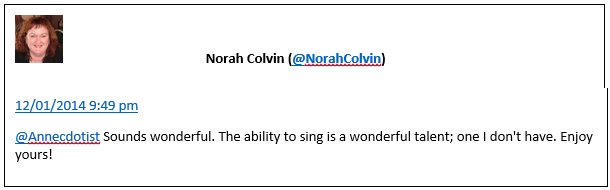
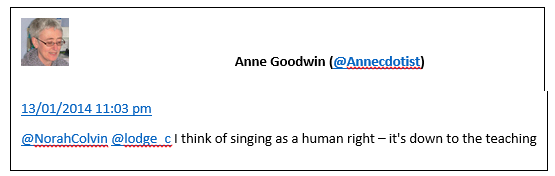
Engaged in a Twitter discussion with Anne Goodwin (@Annecdotist) and Caroline Lodge (@lodge_c) I mentioned that I listen to audiobooks on my drive to work. Anne replied that she listens to music on long journeys, trying to “fix choral music in my head”.
I replied, innocently enough, I thought:
To which they both responded with the type of “encouragement” I had heard many times before “Give it a go. Everyone can sing.”
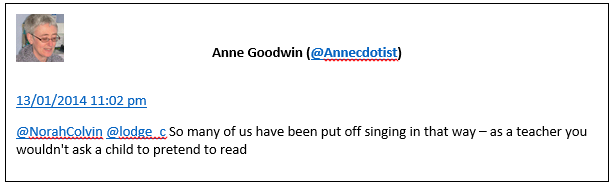
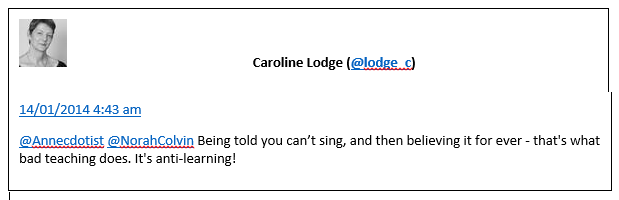
So I told them about being told to mouth the words, and I was both surprised and challenged by their responses:
I had never thought of my singing disability as a learned disability. I had always thought of it being a physiology issue and, later, perhaps a hearing issue.
I am not very good at mimicking vocal (other than speech) sounds, or at identifying which note, of two given notes, is the higher or lower. I did enrol in a brain training program which included aural exercises involving recognition of higher or lower pitch. While I did make some improvement, my scores weren’t high (I could tell that high/low difference).
The comments of Anne and Caroline made me think about this:
What came first: the singing disability or the disability teaching?
Could I have learned, if given the opportunity, to sing a least a few bars in tune? Could I still be taught?
It has sometimes crossed my mind that singing lessons could be an interesting experiment.
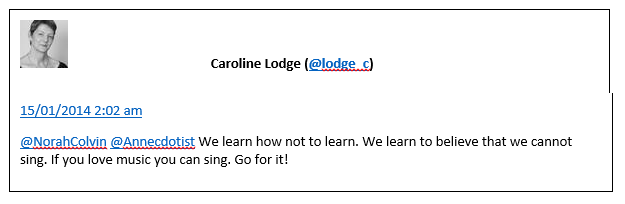
Anne and Caroline are both encouraging, and Caroline commented:
I do love music and perhaps, one day, I will go for it and find out the truth about my singing ability.
Perhaps I will learn to sing and fulfill the dream “to teach the world to sing in perfect harmony”.
But for now, the experiment will have to wait, I have other things to learn.
What do you think?
Do you consider yourself a singer?
Can everyone learn to sing?
Is it a human right?
Could my singing ability really be a “golem effect”?
What disability have you learned, if any?
As a parent or teacher, how do you ensure your children do not suffer from a learned disability?
You can read more from Anne or Caroline by clicking on their names.
One of my favourite talks about education is a TED talk given by Ken Robinson in 2006 “How schools kill creativity”.
His contention is that
“creativity . . . is as important in education as literacy, and we should treat it with the same status.”
Although the video has had more than 21 million views (while quite a few of them mine, nowhere near that number!) and drawn over 3 000 comments during the last 8 years, his views need to reach a wider audience still; an audience with the power to enact change.
One thing I had always loved about teaching was the opportunity to express myself creatively, and to encourage my students to do the same. Unfortunately the current emphasis on a content-driven, top-down approach where test results reign supreme has left little room for anyone’s creativity. I am not saying there was ever much opportunity for creativity in formal schooling, but creative teachers could always squeeze a bit it. Now the opportunities for creative “massage” are few.
My optimism for positive change in education is always raised when I read or hear of others who share similar views. I think if enough voices are heard chanting the same message that a change may come.
This post (and article in Saturday’s QWeekend magazine) by Mary-Rose Maccoll “Why Banff means the World” also proclaims the vision of Ken Robinson. Mary-Rose is another fan.
She says that
“Being at the Banff Centre (in Canada) has made me reflect on what we lose when we don’t foster art, when we don’t foster creativity. And what we lose is the world.”
She says that
“even as school education becomes increasingly narrow in its focus, we’re also seeing a decline in performance on the very outcomes that standardisation seeks to improve.”
She concludes by saying,
“As I sit in my room and watch the mountains, listening to the trail of a contraband sax down the hall (you’re supposed to play in the soundproofed studios in the forest), reading a piece by a Scottish writer, I am grateful for artists. In our 21st century world, we surely need them.”
I agree wholeheartedly as, I’m sure would Ken Robinson, along with Teachling whose post What is Education, anyway?Pt 1 I reblog for you here.
I agree with Teachling’s belief that
“many teachers would feel that – as well as their students’ innate talents and creativity being snuffed – their own talents and creativity don’t get much of a look-in. I believe most teachers are very restricted in terms of what they teach as well as how they teach it.”
I also agree with her when she states that
“that there’s very little teachers can do about it.
It’s the administrators and politicians that should take Robinson’s advice. It’s also the perceptions of a majority of parents that would need to vastly change if any rethinking of fundamental principles were to occur.”
Have a listen to Ken and read these other posts, then let me know what you think.
How can we make our voices be heard to ensure that creativity and innovation is not lost for the future?
Ken Robinson’s take on schools, and how they kill creativity…
You’re likely one of the 20,738,467 viewers of Ken Robinson’s “Schools Kill Creativity” 2006 TED Talk. Robinson’s assertion, and general gist of the talk, is that “all kids have tremendous talents, and we squander them; pretty ruthlessly”. The “we”, we can infer from the rest of his talk, are schools.
Let me pick out some key points:
• “My contention is that creativity, now, is as important in education as literacy, and we should treat it with the same status.”
• “We are educating people out of their creative capacities.” • “Every education system on Earth has the same hierarchy of subjects… At the top are Mathematics and Languages, then the Humanities and at the bottom are the Arts… And in pretty much every education system there’s a hierarchy within the Arts. Art and Music are normally given a higher…
At this time of the year children, parents and teachers in Australia are thinking about the return to school which is approaching with haste. For some those thoughts are of excitement and expectation. For others they are of anxiety and dread.
While children have enjoyed the break from imposed structure and the pressure of school days and homework, many look forward to seeing their friends again and the routine of having something to do after long, lazy summer days. Others may feel anxious about being in a new class with a new teacher and new yet-to-be-made friends. For those starting at a new school, or school for the first time, there may be a confusion of feelings and vacillation between excitement and fear.
Parents, too, have mixed feelings about their children starting or returning to school. They may look forward to a return to routine and a relief from the pressure of providing full-time entertainment or alternative care arrangements. They may also experience feelings of loss when they hand their children over to the care of a stranger for most of the day. However, I think what parents most want for their children when they return to school, or indeed at any time, is for them to be happy. Teachers experience a similar range and vacillation of feelings from excitement and expectation through to anxiety and dread. Even now many of those teachers are out fossicking through the cheap shops, scouring stationery and educational supply stores, looking for items for use in their classrooms. Others will be at home trawling the internet looking for resources, or making their own resources in preparation for the new school year.
One thing that is important to all is to begin the year positively and happily.
Strategies for parents
Some strategies parents can use to ensure their children begin the school year happily include:
Talk to children in positive and supportive ways that will strengthen their optimism about returning to school, allay any fears and settle anxieties.
Ensure children are aware of how they will travel to and from school, and of any arrangements that have been made for before or after school care.
Familiarize children with the route to and from school by travelling it as they will be expected to, whether by foot, cycle, bus or car. If necessary, point out landmarks along the way.
Make sure children know their first and last names, address and parents’ phone number/s.
Have children’s equipment ready with books covered and every item identified with the child’s name.
If possible, take the child to school on the first day and meet the teacher.
The positive feelings can be continued throughout the year by:
Daily conversations about the school day: learning, events and friends.
Volunteering in the class or school, or being involved with after school activities.
Maintaining open and positive communication with the class teacher.
Strategies for teachers
Some strategies teachers can utilize to ensure that children (and parents) begin the school year happily include:
Create a welcoming classroom with signs, posters, items of interest and inviting reading corners and activity nooks.
Greet children and parents with a friendly smile.
Engage children in activities that help you get to know them, and them to get to know each other.
Display children’s work to give them a sense of ownership and belonging.
Explain management and behaviour expectations and include children in composing a classroom management and behaviour plan.
Ensure children know the school timetable; when the breaks will occur and any lessons to be taken by specialist or other teachers.
Explain playground behaviour expectations, including showing areas where they may / may not play.
Take them on a walk around the school to show them the library, office, bathrooms and any other areas they may need to know.
Include singing during the day and send them home with a song and a reminder of what has been learned or engaged with during the day. (In a previous post Happy being me I wrote about Anne Infante’s songs of affirmation. Any of these are great ones to sing and help to create a positive environment.)
What other suggestions can you make?
What helped you as a child, parent or teacher prepare for the new school year?
Teachers, check out my new products on TEACHERSpayTEACHERS to help you set up your classroom and greet your new students with a Busy Bee theme. There are many resources to get you started, ready to download and print out.
Bee courtesy of Bernadette Drent, used with permission.














 Norah Colvin