Live Love Laugh Learn … Create the possibilities

Category: Education

  • You’d have to be mad!

    That is, as in M.A.D. — Making a Difference.

    I love to hear of children being involved in projects that help others, that aim to make a difference to the world. I have previously written about some of those projects here, here, and here.  Sarah Brentyn, who blogs at Lemon Shark, often shares about the wonderful ways in which she and her boys are making a positive difference in their community.

    This week I read about the M.A.D. projects of Canadian teacher Peter Cameron (a.k.a. Mr. C) and his students. At the beginning of the school year Mr. C challenged his students with the question, What will you do to make a difference? The projects, which were selected, organised, and conducted by the students, were recently completed. They included things such as:

    • Helping others on snowy days by shovelling driveways
    • Helping parents, grandparents, and great grandparents
    • Giving compliments
    • Supporting Doctors Without Borders
    • Helping the elderly
    • Helping at the Humane Society
    • Keeping their school tidy
    • Assisting the homeless by collecting socks, making supper, and hot chocolate
    • Encouraging kids to eat healthy, and to spend more time outdoors.
    • You can see a celebration of their projects in this video.

    Mr. C. said that it was one of the most rewarding aspects of his 20+ years teaching career. The acknowledgement received from their member of parliament in the Canadian House of Commons, and his encouragement for others to join in, further affirmed the merit of the project.

    Now Mr C. is reaching out to other classes around the world to join in with their M.A.D. projects and form a Global Make a Difference Team in which participants complete a M.A.D Project to help make our world an even better, happier, healthier place to live”.  Their goal is to have 100+ classes join in. Will yours be one of them?

    To make it easy, Mr. C is making available to teachers all of his resources which may be modified to suit individual classes and situations. He says,

    “The goal is simple: challenge your school, class, clubs and individual or groups of students to make a difference and see where it takes them! Be sure to let us know that your school/class will be participating and fill in the form to add your class to our M.A.D map!”

    Places on the map are so far confined to North America. How wonderful it would be for locations to be added from all around the world. Children would see not only the differences they are making in their own communities, but also the positive actions of others around the world, which may in turn, inspire further projects.

    Be sure to let us know of other projects that involve children in making a difference. I know there are many, some conducted by organisations, and others by individuals and families. They are what give us hope for the future.

    Thank you

    Thank you for reading. I appreciate your feedback. Please share your thoughts.


  • Carrot Ranch in Crisis

    For more than two years now I have been participating in the weekly flash fiction challenge set by Charli Mills at the Carrot Ranch. As well as the challenge, I enjoy the camaraderie and support from other writers, especially Charli who ropes us in with her prompts and encouragement.
    For the last little while I have been posting my flash fiction responses on Tuesday evenings, just scraping in before Charli’s deadline. But not tonight. Tonight I am sharing Charli’s post, the post that would normally include a flash fiction prompt, but instead this time included a plea for help. Charli is in crisis mode, kicked out of home and in transit.
    Often when friends are in need we can lend a hand by cooking a meal, offering a bed for the night, assisting with chores, and listening. But when that friend is over 12,000 kilometres away, helping out is not such an easy thing. For that reason, this evening I am sharing Charli’s post. Maybe one of you is able to help her out in her time of need.
    Thank you for reading. As always, I appreciate your feedback.

  • Recipes for the classroom

    cooking banner
    © Norah Colvin 2016

    As completion, and therefore launch, of readilearn, my website of early childhood teaching resources approaches, it has become obvious that some categories are less well-resourced than others.

    I consider food preparation to be a great way of involving children in learning that is fun, purposeful, integrates curriculum areas, and develops skills that can be applied in everyday life. I have previously written about learning in the kitchen with suggestions for parents at home.

    In the introduction to the readilearn cooking resources I write

    Cooking, including food preparation that doesn’t include any heating, is a great way to teach life skills and integrate learning in a meaningful and enjoyable way across curriculum areas. When children are involved in food preparation they may be developing:

    • Social skills of cooperation, turn taking, sharing, patience
    • Literacy skills – reading and following the recipe, selecting ingredients, writing a menu and invitations, writing a recount, writing a shopping list
    • Mathematics – counting e.g. the number of eggs, measuring with spoons and cups, measuring time, sharing (e.g. the number of cookies, how many slices to make)
    • Science – mixing, adding or removing heat
    • Safety – with knives, peelers and hot implements and ingredients
    • Social Studies: Culture – when preparing ethnic food

    readilearn materials are designed to engage children in activities that are both fun and purposeful, with opportunities for learning across the curriculum in a meaningful context.

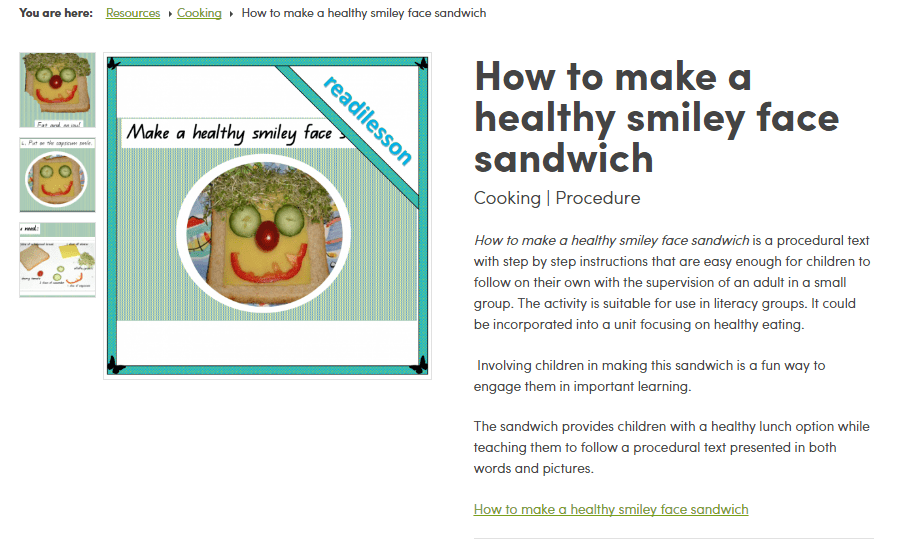
    I was disappointed to realise that I had only one cooking resource prepared: How to make a healthy smiley face sandwich

    © Norah Colvin 2016
    © Norah Colvin 2016

    A remedy was required and I tried to think of other resources I could add.

    I have previously made ladybird biscuits by icing an Arrowroot biscuit and adding Smarties for spots. I will probably add that recipe in the future, but I was trying to think of something healthier to begin with. I wondered if it might be possible to make a ladybird from an apple. This is what I did:

    © Norah Colvin 2016
    © Norah Colvin 2016
    © Norah Colvin 2016
    © Norah Colvin 2016
    © Norah Colvin 2016
    © Norah Colvin 2016
    © Norah Colvin 2016
    © Norah Colvin 2016
    © Norah Colvin 2016
    © Norah Colvin 2016
    © Norah Colvin 2016
    © Norah Colvin 2016
    © Norah Colvin 2016
    © Norah Colvin 2016
    © Norah Colvin 2016
    © Norah Colvin 2016
    © Norah Colvin 2016
    © Norah Colvin 2016

    When I made one for my grandson on the weekend, I was pleased that he recognised it as a ladybird beetle, even without the spots!

    Unfortunately, it’s more suitable for an adult to make for a child than for children to make for themselves. Apples are too difficult for young children to cut. It is therefore not suitable for readilearn. However, I had fun making it and will continue to think of other recipes I can add to readilearn’s cooking collection.

    Thank you

    Thank you for reading. I appreciate your feedback. Please share your thoughts.

  • Truth or lie?

    In my previous two posts, here and here, I discussed the issue of lying and the suggestions that:

    • lying may be a part of human nature
    • it is difficult to tell whether someone, even a child, is lying or not.
    www.morguefile.com
    http://www.morguefile.com

    This morning when I parked my car at work, the young man in the car in the next parking bay called out, “I’m stuck.”

    I asked him what the problem was, and he explained that he had parked too close to the car beside him and couldn’t get out.

    I walked around his car and saw that there was a gap of about 15 centimetres between the two cars, not enough to open a door.

    As I glanced along between them, I noticed that the side mirror of the other car, which had reversed into the park, was broken. I said nothing, and, so far as I am aware my facial expression didn’t change. However, the young man immediately protested, “I didn’t do that. I promise you, I didn’t do that!

    I didn’t respond to his remark but thought, “Yeah right!” I then proceeded to guide him out of his car park by suggesting he tuck in his side mirror and straighten his wheels. He was then able to reverse out without hitting the car beside him, and drive back in giving himself enough room to get out of his car.

    Although he stated his innocence, I didn’t know if he had caused the damage to the mirror on the other car.

    • Why did he protest immediately when I’d hardly had time to notice it, let alone mention it? Wouldn’t he have done better to say nothing?
    • Was it too much of a coincidence that the car should be damaged in a way that may have been caused by this young man trying to reverse out?
    • Why would he have even noticed the damage to the mirror or think it worthy of mention? Did his protests not imply his guilt?

    What was I to do?

    If he was guilty he should leave a note for the driver, apologizing and giving his details. If he was guilty and didn’t do that, should I leave a note telling the driver his licence number and explaining what I suspected? What if I supplied that information and he was innocent?

    What then? I’d be telling a lie.

    Call me gullible but I do prefer to take people at face value and believe in their honesty. That doesn’t mean I don’t have a suspicious mind. However, I had no way of ascertaining, without access to transdermal optical imaging, as mentioned by Kang Lee whether this young man was telling the truth or a lie. So I wished him a good day and left it at that.

    When I returned to my car in the afternoon, both cars were still there. I checked the young man’s side mirror to see if it was damaged. I thought that if he had damaged the other car’s mirror with his, then his mirror would likely be damaged too. But it was not.

    Was he telling the truth? Was it just a coincidence? I’ll never know. But it did give me something to think about.

    What do you think?

    PS The characters in this story are real, as are the incidents. It was a young male driver, and not me, who was having difficulty parking! And me who helped him!

    Thank you

    Thank you for reading. I appreciate your feedback. Please share your thoughts.
  • If not you, then who?

    chocolate
    http://www.morguefile.com

    Earlier this week in my post Smile! It’s contagious I mentioned the commonly held misconception that adults usually know when children are lying. I say ‘misconception’ because it’s been shown that adults have no idea whether children are lying or not, and it appears that children, also, have no idea if others, even their siblings, are lying.

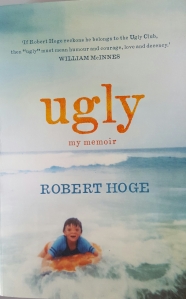
    This inability to distinguish the liar from the truth-teller is portrayed clearly in an incident in the book Ugly, a memoir, by Robert Hoge. We’ll call it The Chocolate Incident.

    Ugly cover

    Robert is the youngest of five siblings. One day the five of them were called to a family meeting in the lounge room. When they were all standing up straight in a line from oldest to youngest Robert knew that something was up. Their mother soon informed them that chocolates had been taken from a box on top of the fridge, and not just a couple that wouldn’t be missed, but more than that.

    Both parents were involved in the interrogation. Their mother said, “We’re going to ask who took the chocolates. We’re going to look you in the eye and ask you, and you’d better come clean or there’ll be real trouble.

    Robert explains that in turn she approached each child, starting with the oldest. She stared at each for a few seconds, then asked, “Did you take any chocolates?” In turn each child replied in the negative and, as they did so, turned to look at the next in line.

    As the parents moved from child to child Robert, knowing he was innocent, observed the responses of his siblings. Who took the chocolates? The looks of dread, panic and fear that were so obvious on each face convinced him of their guilt. But no, each sibling denied it.

    When the fourth child denied taking chocolates and turned to face Robert, he realised that he was the last in line, “there was no one there for me to look at. Not even Sally, our dog.

    He continues, “I started crying before Mum got to me. One by one the others turned to look at me. Dad glared ominously over Mum’s shoulder and I tried to say, “It wasn’t me. It wasn’t me.” But everything was lost to my sobbing and I got the blame. I still don’t know who took those chocolates.

    I wonder if there’ll ever be a confession! Or if the culprit ever felt remorse for Robert, the youngest, having to take the blame.

    There is more to Robert than this one incident portrays. His is a remarkable story. I have heard it many times and am yet to tire of hearing it. I first heard him speak at a writers’ seminar, the seminar that was the final impetus to set me on my blogging journey. I heard him speak again at a Writers’ festival at which I purchased his memoir. I have also seen him tell his story on television more than once.

    My signed copy from the writers' festival!
    My signed copy from the writers’ festival!

    I own three versions of Robert’s memoir: paperback, audiobook and the Kindle version for younger readers. Robert reads the audiobook, which is a special treat. It gives authenticity to the listening experience, particularly since I was already familiar with his voice. It also means when I read his books to myself, that I hear his voice telling me his story. All versions are written in a pleasant, easily readable and conversational tone, as if we are sitting together, chatting over a cup of tea and a Tim Tam.

    tim tam and tea

    When I handed my Mum a copy of the book, I wasn’t sure whether she’d enjoy it or not. However, after 70+ years of adult reading (she was 90), she informed me that it was the best book she had ever read.

    I’m not sure why this story makes such a strong impression on us. Maybe it’s because we think it could have happened to either of our families. Robert is only two years older than my Robert, and six years younger than Mum’s youngest of ten.

    Houghton Highway

    Maybe it’s because the family’s culture, growing up in another Brisbane bay-side suburb just across the bridge, was similar to ours.

    Maybe it’s because it’s a story of resilience, of survival against the odds, and of making hard decisions. Maybe it’s a bit of all of these, and more, including the raw honesty with which Robert writes.

    Ugly for kids.PNG

    There are many opportunities for learning in Robert’s book, many different topics I could choose to write about; so many that I haven’t known where to start. After the previous discussion about lying, this seemed an appropriate introduction.

    I haven’t told you much of Robert’s story. It is better to have him tell you himself. He introduces himself in this TED talk.

    Links to other interviews, and to connect with Robert online, can be found here

    I recommend Robert’s story to you. It is definitely a story worth sharing.

    Thank you

    Thank you for reading. I appreciate your feedback. Please share your thoughts.
  • Smile! It’s contagious

    https://openclipart.org/image/800px/svg_to_png/192642/Children_holding_hands.png
    https://openclipart.org/image/800px/svg_to_png/192642/Children_holding_hands.png

    This week at the Carrot Ranch Charli Mills has challenged writers to in 99 words (no more, no less) write a story that changes with a smile. It reminded me of the old television program I used to watch when growing up: Candid Camera.

    Like the situation set-up in Car without a motor, people were presented with an improbable situation, a misrepresentation of reality, a lie. We laughed at their responses; and they laughed when told to “Smile, you’re on candid camera.”

    The situations were all meant to be fun and the majority of the people, those we were shown anyway, responded in good humour. However, we don’t always respond with such good humour when we feel we have been lied to intentionally, or mislead for whatever reason.

    The story of The Boy Who Cried Wolf is a good example what happens when one habitually lies. Nobody likes to be made a fool of, and generally people try to take what they are told at face value, rather than question the veracity of the speaker’s tale.

    Nobody likes to be caught out telling lies either. However, it seems that, no matter how much we protest against or attempt to excuse our own lies, lying may be a part of human nature.  Not only that, there may be many different reasons for lying. If you can, recall the last time you told a fib and your reason for doing so. But please don’t share. I’m not interested in true, or false, confessions.

    I recently watched this fascinating Ted talk by Kang Lee who asked Can you really tell if a kid is lying?

    Lee states that there are three commonly held misconceptions about children and lying:

    • Children only start to lie when they are of school age
    • Children are not good at lying and adults can easily detect their lies
    • If children lie at a young age they will become pathological liars for life

    Lee then goes on to disprove these misconceptions, citing studies that show that “lying is really a typical part of development. And some children begin to tell lies as young as two years of age.”

    He goes on to suggest that children who lie at a younger age than others are advanced in development of the two key ingredients for successful lying:

    Mind reading: I know something that you don’t, and I know that you don’t, therefore I can lie to you; and

    Self-control: “the ability to control your speech, your facial expression and your body language, so that you can tell a convincing lie”.

    He explains that both mind reading and self-control are essential to function well in society, and that

    In fact, deficits in mind-reading and self-control abilities are associated with serious developmental problems, such as ADHD and autism. So if you discover your two-year-old is telling his or her first lie, instead of being alarmed, you should celebrate –

    I dare say that the typical Candid Camera scenarios relied upon these two ingredients also.

    Lee also demonstrates that most adults, including parents, social workers, child-protection workers and police, cannot detect when children are lying. However, he explains that, hidden behind the neutral facial expressions, there are a variety of fleeting emotions including fear, shame, guilt, and possibly “liar’s delight”. These emotions, too subtle to be perceived by the naked eye, can be detected by “transdermal optical imaging” which detects changes in blood flow.

    The benefits of the imaging go beyond just lie detection but can be used in assessing people’s health, including pulse, stress levels, mood and pain levels.

    SnipsandClips, Teacher and Child https://openclipart.org/detail/205589/teacher-and-child
    SnipsandClips, Teacher and Child https://openclipart.org/detail/205589/teacher-and-child

    While teachers weren’t listed among those tested for detection of children’s lies, it stands to reason that they would be no better than those included. It makes me wonder about those times when a child may have been punished, not through evidence, but through someone’s conviction that he was lying, or that he was telling the truth. Maybe you were one of those innocents who wasn’t believed and suffered punishment as a result; or was believed when lying to protect another and suffered the punishment anyway.

    I know I was never able to convince my mother. She always knew when I was lying (Who me? Never!) Maybe, like Emily in my flash fiction story, I should have been more careful to hide the incriminating evidence! But, as Lee says, Sally should celebrate that Emily is displaying developmentally appropriate, or even advanced, behaviour.

    Gotcha!

    Investigating the suspicious quiet, Sally found Emily perched on a stool in the bathroom, smiling at her reflection. Sensing Sally’s arrival, Emily turned on her “innocent” face and hid her hands behind her back.

    Suppressing a smile, Sally asked, “What’re you doing?”

    “Nuthin’.”

    “I think you’re doing something.”

    Protests belied guilt smeared on the face.

    Sally enveloped Emily, and turned her lipstick-painted face towards the mirror.

    “How did that get there? ” she asked, feigning seriousness.

    “Don’t know. ”

    Sally pointed to the brush in Emily’s hand.

    “Oh.”

    Their eyes met in the mirror, and smiles turned to laughter.

    Thank you

    Thank you for reading. I appreciate your feedback. Please share your thoughts.

  • Room for one more

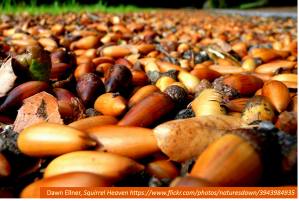
    Squirrel Heaven

    Have you ever squirreled anything away? I have.

    In the year prior to my 50th birthday I squirreled away every $5 note I received. By the time my birthday arrived I had stored over $1000: enough to purchase a charm bracelet to mark the achievement of a half-century. Now, almost a decade and a half later, it would be impossible for me to repeat the process. From using cash for most purchases at the dawn of this century, I now use mainly card and rarely carry cash. How quickly and, unless giving thought to it, almost imperceptibly the changes occur.

    To some, the differences in the seasons in the part of Australia in which I live are subtle, with the changes almost imperceptible, at least when compared to the four distinct seasons occurring in many other places. However, changes do occur and are obvious to those who are attuned to them, especially the Indigenous Peoples of Australia.

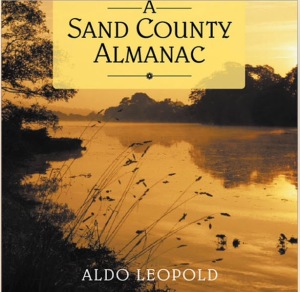
    I was reminded of this when listening to A Sand County Almanac by Aldo Leopold, a book recommended and referred to numerous times by Charli Mills. I second her recommendation.

    A Sand County Almanac

    The book is divided into twelve chapters. In each chapter Leopold describes the subtle differences that occur from month to month in the environment around his home. I marvel at the detail of his observations and the knowledge that he gleans from subtle changes. In March he says,

    “A March morning is only as drab as he who walks in it without a glance skyward, ear cocked for geese.”

    He then goes on to say,

    “I once knew an educated lady, banded by Phi Beta Kappa, who told me that she had never heard or seen the geese that twice a year proclaim the revolving season to her well-insulated roof”,

    and asks,

    “Is education possibly a process of trading awareness for things of lesser worth?”

    Sadly, I think many of us, myself included, are aware of the fluctuations in temperature and the coming of the storm season, but not so attuned to the habits of animals and seasonal variations in plants. The majority of our native trees are evergreen and, in our insulated and insular cities, changes in the natural world are less obvious. Indeed, many seasonal changes are obscured by artificial means.

    In cooler climates animals have adapted to the changing seasons in various ways. Some migrate; some, such as squirrels, store food for the winter; and some hibernate.

    While some Australian birds, moths and other animals migrate, I am not aware of any squirreling away large stockpiles of food to see them through the cooler seasons (please inform me if there are any I should know about); there is but one native Australian mammal hibernator, the mountain pygmy possum.

    I have been thinking of this in relation to the flash fiction challenge set by Charli Mills at the Carrot Ranch this week. While Anne Goodwin, blogging at Annecdotal may have instigated her thinking about squirrels, Charli included the metaphorical as well as rodent  variety.

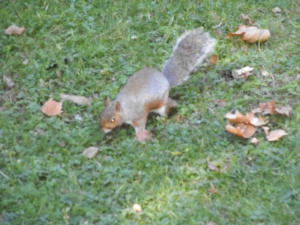
    Until visiting in London in 2014 I had not seen a squirrel as they are not native to Australia and, until checking just now and finding this article, was not aware that any had been introduced here. I saw many cute grey squirrels in parks and gardens in London and I was quite fascinated by the tiny creatures.

    © Norah Colvin 2014
    © Norah Colvin 2014

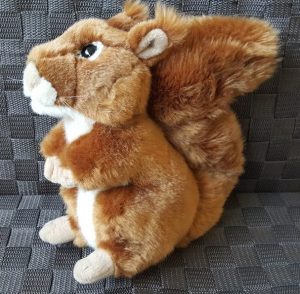
    However, I was disappointed to find that they are not natives to the UK either, but introduced from North America in the 19th Century, and are doing just as much damage to the native fauna as are many introduced species here. At least when I visited Hamley’s, the most amazing toy store, the only toy squirrels I could find were red, the native kind.

    © Norah Colvin 2016
    © Norah Colvin 2016

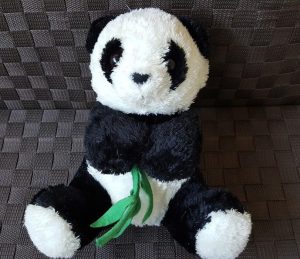
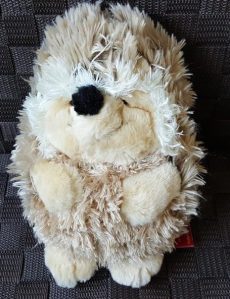
    The squirrel toy was purchased to add to others collected as mementoes of countries visited; and joined my panda from Beijing and hedgehog from Belfast.

    © Norah Colvin 2016
    © Norah Colvin 2016
    © Norah Colvin 2016
    © Norah Colvin 2016

    In a couple of months, I am accompanying my grandchildren and their parents on a quick visit to Los Angeles and New York. I am determined to expand my soft toy collection, but am wondering which animal might be an appropriate choice. If you have a suggestion, I’d love to hear it please.

    Meanwhile, back to Charli’s challenge to In 99 words (no more, no less) write a story that features a squirrel. It can be about a squirrel, for a squirrel or by a squirrel. Think nutty, naturalistic, dinner or ironic. Go where the prompt leads and don’t forget to twirl with imagination.

    I decided to go with the theme and make my own toy story.

    toy box

    One more?

    They knew when she left – airplane tickets in one hand, luggage in the other – that it meant only one thing.

    “Time to plan,” announced Kanga, the original and self-proclaimed leader.

    “It’s too crowded!” moaned Little Koala.

    All stuffed in the box inhibited thought.

    “Right. Everybody out,” said Rabbit, taking over.

    Squirrel, last in, was first out, twirling her tail.

    Soon everyone was out, exchanging opinions. Inevitably disagreements erupted. Ever patient Kanga quietened them.

    “We always make room. We will adjust. We will welcome the newcomer. Once we all were different. We still are. But we learn to get along.”

    Thank you

    Thank you for reading. I appreciate your feedback. Please share your thoughts.


  • 3 + 2 = 5 Let me count the ways!

    Billboards

    That we live in a print-rich environment is undisputed. Even in country areas one cannot travel far without being bombarded by print. In addition to road signs there is a plethora of billboards advertising the best places to sleep, eat, or play that can be found just ahead.

    Environmental print is the genre with which many children first engage successfully with reading.  Ask any parent who’s detoured around fast food outlets, hidden shopping catalogues, or camouflaged cheaper brand names of identical products.

    That we are immersed in mathematics in our daily lives is just as evident but doesn’t always receive the same recognition. I think this may in part be because people often think of mathematics as abstract algorithms and theorems that we (they try to get us to) learn in school; and that have no apparent application to our lives beyond the walls of the classroom.

    algebra

    However, even the examples mentioned above are just as rich in mathematics are they are in print. They include distances, and perhaps time, to the destination, cost of items, opening hours, and number of attractions. Anyone travelling a distance with young children will have answered questions such as “Are we there yet?”, “How much further?”, and “What time is it?

    As I say in my statement about mathematics on my readilearn site,

    “Mathematics is all around us. We use it every day for a huge range of purposes from deciding on the sequence in which we dress ourselves, to calculating how much time we have available for an activity.”

    mathematics readilearn

    One of the resources suggests 25 ways for parents to keep their children thinking mathematically over the school holidays. I have shared these ideas previously in Counting on the holidays.

    25 ways to think mathematically

    Recently I was at the gardens with my two grandchildren (G1 and G2, aged 6 and 4), their mother, and my Hub. The children consulted a map and signposted paths to follow the Children’s Trail which had various sculptures along the way. I am undecided about the value of distracting children from the trees and plants, as if the vegetation itself would not be interesting enough. However, the children enjoyed locating the sculptures in the sequence numbered on the map, and reading the accompanying information. They were engaged in purposeful reading and mathematical thinking in context: real life learning!

     © Norah Colvin 2016
    Pandas on the Children’s Trail © Norah Colvin 2016

    As we headed back, G2 made a comment that showed she was engaged in mathematical thinking of her own. She observed that there were two children and three adults, which made five of us all together.

    “That’s right,” I confirmed. “There are five’. I thought for a little while, then added, “And do you know what? As well as two children and three adults, there are two boys and three girls.” The children looked at the group and confirmed that I was right. They laughed – a different interpretation.

    This gave me an idea for a thinking game: how many other arrangements of three and two could there be?  I wondered if the children would like to play along. I had never attempted this before and had no idea if there’d be more, or if we had already exhausted all options.

    I looked at the group. I noticed our shoes: three had closed shoes and two had open shoes. I thought about our names: three shared one surname, two another. Then we were on. Everyone was thinking of ways we could be arranged into groups of two and three.

    Sometimes we sorted according to different characteristics, as in the previous examples. Others times we used a simple yes or no sorting, such as two have hats with brims and three don’t have hats with brims. This is the easiest sorting to do, and the first that children learn.

    G2 made many suggestions of this type of sorting for one and four.  One has the characteristic, the others don’t. This was age appropriate for her, and it was great to see her joining in confidently and contributing to the discussion. G1 was able to engage in the more complex thinking required for the groupings of three and two.

     I was amazed at the number of different combinations we came up with, and that each of us was combined with others in many different ways.

    These are some of the ways we arranged ourselves into groups of two and three (not physically, just in our discussion).

    Arranging ourselves 3 + 2

    This seemingly mundane activity has potential for developing thinking and learning by encouraging:

    • thinking about things in new and different ways
    • looking for similarities and differences
    • observing detail
    • sorting according to different characteristics – which is important to both maths and science (think animal and plant classification)
    • having fun with maths
    • having fun with family

    But wait, there’s more: When we left for home, two went in one car and three in the other!

    I think this would be a great activity to do with young children learning about number. It may be a challenge for teachers in Australia where children wear uniforms to school but I’m already thinking of how it could be done with toys or illustrations. It’s not quite the same as doing it with the children themselves, but it could be fun. What do you think?

    teddy bear sorting

    You won’t be surprised to discover that I have prepared a readilearn resource for sorting as well!

    Thank you

    Thank you for reading. I appreciate your feedback. Please share your thoughts.


  • Eroding thoughts

    Uluru © Norah Colvin 2015
    Uluru © Norah Colvin 2015

    This week at the Carrot Ranch Charli Mills is talking about erosion, but not just the literal kind. She says “It can be natural, cultural or something different.” Of course I must answer my usual call to tackle the “something different”.

    Generally, erosion refers to the wearing away of the earth. Sometimes it signifies the disintegration of our resolve, our self-image, or of our spirit. Just as various strategies can be employed to prevent erosion or to repair damage incurred by the land, there are strategies that can be used to shore up one’s resolve, build self-esteem, and mend a sagging spirit.

    rejection slip

    Perhaps nobody knows this better than writers with their stashes of rejection slips rated from encouraging to just plain rude, or non-existent. Few have achieved success without first receiving a downpour of those slips, who haven’t had to work at their skills and accept the edits without eroding their intended message. Sometimes it seems that, with every move, one lands on the “Go back to start” square; and that, while it feels like things are in motion, the end doesn’t appear any closer.

    go back to start

    Or maybe nobody understands the fragility of the spirit and self-esteem more than does a teacher; and of the importance of building on prior learning to take children from where they are to places they haven’t thought possible; to ensure their esteem stays strong and is not eroded by unrealistic expectations and the tedium of a repetitive diet of something meaningful only to others.

    Welcome pack
    Welcome pack

    I have written many times previously about the importance of establishing a supportive classroom environment, and of using affirmations in growing children’s confidence and self-image.

    This doesn’t mean a diet of empty praise, but it does mean that all individuals are recognised for what they can do, and are valued for the contribution they make to the classroom community. Included in these writings was a series, inspired by a Twitter discussion with Anne Goodwin, on praise culminating in Seeking praise – Stephen Grosz revisited and including a guest post by Anne.

    The Clever Children Resource

    I have also developed resources to support children’s growing confidence and self-image for inclusion on my in-progress website readilearn. One of these resources is a story called The Clever Children which teachers can personalise for use with their own class.

    The Clever Children printable

    Children write about and illustrate something they can do. The pages are then added to the story which is printed and collated into a book which can be placed in the reading corner or taken home to read to parents and siblings.  My children always loved being a part of this story. I am looking forward to other children being a part of it too. The story aims to build, rather than erode, self-esteem and a love of books and reading.

    Which brings me back to Charli’s challenge to In 99 words (no more, no less) write a story, using the power of erosion.

    The Nature Principle

    For my flash I combine two ideas:

    • Richard Louv’s suggestion in The Nature Principle that, for physical and mental health, we need to be more attuned with nature
    • the need for resolve and inner strength when faced with issues that would erode it.

    It’s not really a story, perhaps, but a moment in time. I hope you enjoy it.

    1 (7)

    The rock

    The rock, promising permanence, beckoned: perfect for contemplating expanses beyond while pondering life and one’s significance. She sighed, and succumbed. The waves, licking repetitively at the base, soothed somehow; as if each grain of sand stolen from beneath her feet loosened her tension. Becoming one with the rhythm, her heart sang the melody as her mind slowed, releasing all thought. Feeling whole again, as solid as the rock, and with renewed strength, she prepared to face those who sought to erode her. Though tides would rearrange and redecorate, and often do their best to annihilate, they could not obliterate.

    Thank you

    Thank you for reading. I appreciate your feedback. Please share your thoughts.

  • Teacher appreciation

    Readilearn bookmark

    In the US, for the entire month of May, people are encouraged to acknowledge and show appreciation for teachers who have influenced their lives. Although the first week is the main focus, I think it is wonderful to have a month dedicated to appreciating teachers. While I always felt the appreciation of my students and their parents, there seemed to be little shown in the community beyond that and it was often a struggle even to get World Teachers’ Day acknowledged in some places I worked.

    In previous posts here, here, and here, for example, I acknowledged teachers who had a positive impact upon my learning and my teaching. In this post I even shared a letter of appreciation written by a parent about me. It was lovely to read Emily Case’s Reflections on Teacher Appreciation Week and the acknowledgements she received from students and parents.

    From time to time I have shared the work of other inspiring teachers, and discussed with many, teachers who had influenced them. I was pleased to read this email in which President Obama honoured his fifth grade teacher, Ms Hefty. He said that she made everyone in the class feel special, and reinforced the value of empathy, a message which he carries with him every day.

    Thank you to my wonderful students, and their lovely Mum who made this for me!
    Thank you to my wonderful students, and their lovely Mum who made this for me!

    He wrote of librarians and their important role in bringing people and books together, and of programs to provide books for those who might otherwise not have access. He acknowledged that reading for just 20 minutes a day can have a powerful effect upon one’s life. I’m delighted to say that on those issues the President and I agree. They are familiar topics on my blog.

    For me there is nothing like passionate educators sharing their love of learning and the joy they receive from working with children.  I have to admit that it gives me goosebumps; but I am a softie at heart.

    In this post I am delighted to share with you a TEDX talk by teacher Lisa Lee who shares her passion for education and admits, as I also have, that she has learned more from her students than they ever learned from her.

    In the video she shares her belief that

    “Every single person has the capacity to make a difference”

    She also discusses the Common Core, but perhaps not in the form those words may conjure up for you. She speaks of the common core in the heart, and says it must come first. I can do nothing other than agree with her words:

    The common core – everyone one of us needs to be “valued, respected and accepted and seen as who we are”

    I hope you enjoy the video.

    Please share your thoughts and, if you care to, your appreciation for a teacher who inspired you. As President Obama said it can be a teacher who inspired you, a book that changed you, or a college that shaped you.”

    Thank you

    Thank you for reading. I appreciate your feedback.