Live Love Laugh Learn … Create the possibilities

Category: Education

  • A piece of pie

    This week at the Carrot Ranch Charli Mills has challenged writers to In 99 words (no more, no less) write a story that features a pie. You can make it any kind of pie, focus on filling or crust, or tell us about the pie-maker. How does pie set a tone in a story? Does it warm the hearth or bring disappointment?

    But which pie should I choose: meat, vegetable or fruit, with pastry that is short, flaky or puff? Perhaps a piece of pie for a correct answer in Trivial Pursuit?

    I considered words that rhyme with pie, and what a list I made:
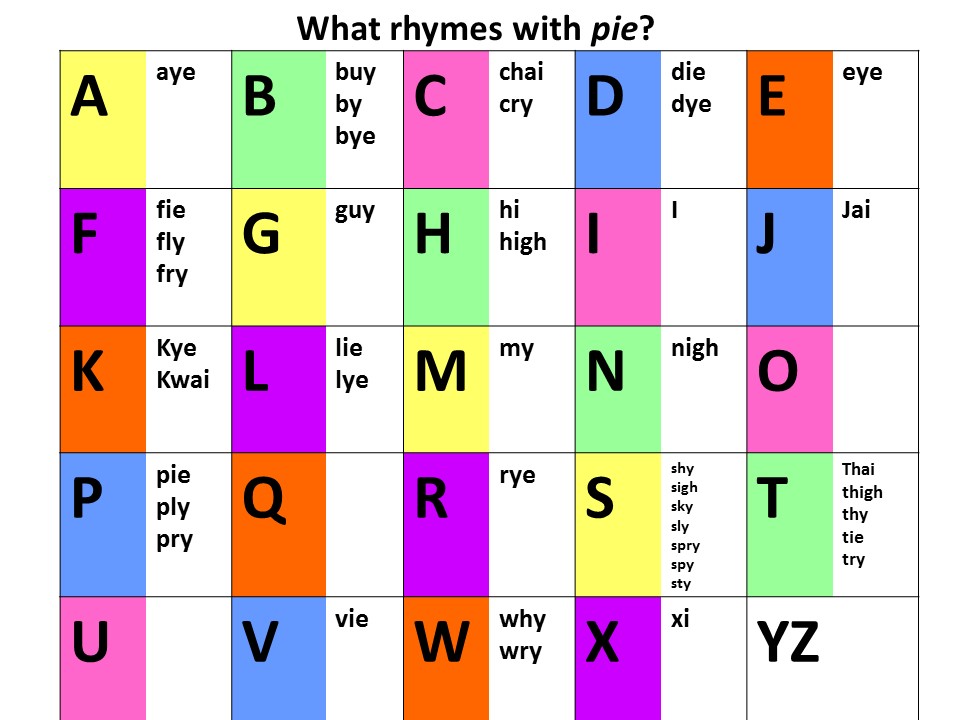
    what rhymes with pie

    Forty-three words!

    Maybe you can add even more.

    Did you notice the variety of ways we spell the long vowel ī, as in the word pie?

    There are eight:

    aye    uy    y     ye     ai     ie     igh    and     i!

    Isn’t it a wonder that any of us ever learned to read or spell.

    Did you notice there were two ‘pie’s in my title: A piece of pie?

    Did you notice that each time the three letters ‘pie’ were used, they represented different sounds?

    As mature readers and writers we have no difficulty with any of these vagaries of the English language, but for beginners, they can be a challenge.

    The challenge reminds me of “Old Lucy Lindy and the Pies” from Sounds of Laughter in the Sounds of Language Series by Bill Martin Jnr. In the story, Lucy Lindy loves to bake pies. She bakes all kinds of pies, including mince pies. Since all her pies looked the same with their delicious layer of pastry on the top, Lucy Lindy wanted to be sure she knew which pies were which when she took them out of the oven. She came up with a brilliant plan. She put the initials IM on the mince pies, for Is Mince. Then, on the pies that weren’t mince, she put the initials IM, for Isn’t Mince. Children laugh out loud when they realise it wasn’t such a clever plan after all.

    A Necklace of Raindrops

    Another lovely story for young children is “There’s some Sky in this Pie” from the collection A Necklace of Raindrops by Joan Aiken. The story has a cumulative structure similar to that of The Gingerbread Man, but with an additional sprinkle of creativity that could be used to ignite children’s own imaginative stories.

    When the old woman was making a pie for the old man, she looked outside at the snow “coming down so fast out of the white sky.

    “Then she went on rolling the pastry. But what do you think happened? A little corner of the sky that she had been looking at got caught in the pastry.”

    When the pie was cooked and the old woman opened the oven, the pie floated across the room. The woman and man and their cat jumped onto the pie to try to stop it, but they couldn’t, and they floated away on it. From time to time they met others who called out to them,

    “Old woman, old man, little puss, so high,

    Sailing along on your apple pie,

    Why are you floating across the sky?”

    They answered:

    “Because we can’t stop, that’s the reason why.”

    (Notice those different ways of spelling the long ī sound again – three spellings in that short extract.)

    Lucy Lindy and the Sky in the Pie are light-hearted and imaginative stories.

    Recipe for a Perfect Planet Pie

    Another favourite pie story is Recipe for Perfect Planet Pie by Kim Michelle Toft, an Australian author/illustrator and the only illustrator anywhere to illustrate all her stories with silk paintings.

    I have shared some of Kim’s work with you before here and here, and I’m certain to again as I attended the launch of her eleventh picture book Coral Sea Dreaming on the weekend and have scheduled a readilearn interview with her later in the year.

    Kim is passionate about conservation, especially of our marine environment and its inhabitants. In each of her books, she uses her stunning silk paintings to ignite a wonderment in the natural world and inspire a love of and caring for the environment. Recipe for Perfect Planet Pie continues these themes.

    The book reads like a recipe with a list of ingredients, a method, fourteen step-by-step instructions, and “Helpful hints” on each page. The recipe begins:

    1 To prepare the base. Sift the rich chocolate earth and crystallised minerals together. Make a well and pour in one cloud full of rain.”

    and concludes:

    “Serve pie immediately with a side of love and a slice of happiness.”

    At the end of the book, Kim includes information about the pie’s ingredients and the importance of each. She provides suggestions that we can implement to help create a happy, healthy planet and says,

    “Planet Earth is our only home and it is up to us to create change and put our knowledge into action.”

    I’m sure you’ll agree with that.

    For my response to Charli’s challenge I decided to go with a bit of nonsense and see how many of the rhyming words I could use to construct a pie story and still maintain some sort of sense. I wonder how successful you will think I’ve been. I managed to incorporate 28 and at least one from each of the spelling variants.

    A piece of pie

    Kye met Jai at the mall.

    Hi,” said Kye.

    “Nice day,” replied Jai. “Look at that sky. Wish I could fly.”

    “Time for a chai?”

    Aye. And maybe a pie. I’ll buy.”

    “What a great guy!”

    “I try!”

    “I’ll have toasted rye.”

    They sat high by the window and played “I spy.”

    “Oh my,” said Kye, rubbing his eye.

    “What? Why?

    Kye started to cry.

    “Don’t mean to pry.” Sigh.

    “It’s no lie. The end is nigh.”

    “Will we all fry? Will everyone die?”

    “No, just wish I had your piece of pie.”

    Fie! Wish I had Thai!”

    Bye.”

    Thank you for reading. I appreciate your feedback. Please share your thoughts.

  • Introducing illustrator Muza Ulasowski – Readilearn

    This month I am delighted to introduce you to the very talented illustrator Muza Ulasowski. I’m certain you will find her illustrations to be quite remarkable.

    Although Muza has illustrated many books, I first came across her work in the beautiful picture book Forest Wonder, written by Caroline Tuohey. It is Forest Wonder, a winner of international awards, that Muza and I are discussing today. Before we get started on the interview, first let me tell you a little about Muza.

     Muza Ulasowski is a graphic designer and children’s book illustrator based in the leafy western suburb of Brookfield in Brisbane, Queensland. Australia. She is inspired and surrounded by a vast array of local birds and animals who tend to make their appearances in her book illustrations. She shares her life with her wonderfully patient husband, their charismatic bulldog called Charlie and a black magic cat named Basil.

    In 2010, she was invited to illustrate her first children’s picture book and enjoyed it so much, that

    Continue reading: Introducing illustrator Muza Ulasowski – Readilearn

  • Ready for landing

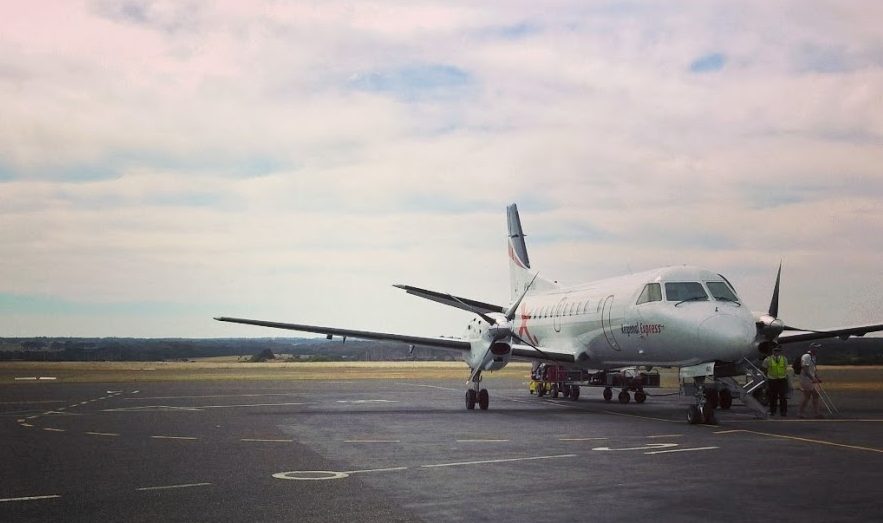
    Air travel wasn’t available when I was a child, or not for me anyway. I am unable to recall anyone in my circles, family or friend, who travelled anywhere by air. Perhaps we weren’t an adventurous lot, but air travel wasn’t as easy, affordable, comfortable, quick, or commonplace as it is now.

    Though I’d often thought I’d love to be a bird soaring above the world, I was a young adult before I experienced my first flight. I was entranced by the land below as I sailed on the wind in a glider, like a bird on the wing.

    It was a couple of years later that I had my first plane fight, and many years later before I travelled internationally. Yes, I’ve lived a sheltered life. Like many of the younger generations, my grandchildren have already experienced air travel, both within Australia and internationally. They would require almost as many fingers as I to count plane trips.

    Whether travelling or not, airports are always a great place to visit with children. There is much to observe, learn, wonder about, and imagine.

    Watching planes take off and land can fascinate children, and encourage all sort of questions, not only about the physics of flight, but the types and features of planes, the airlines, and where they are going to or coming from.

    People watching can also be absorbing and encourage even more questions about the jobs people are doing and the reasons for them, where the people are going to or coming from, and who they are travelling with.

    There is much to see and learn about, like passports, boarding passes, security scanners, customs officers, flight attendants, cleaners, retailers, baggage handlers, check-in operators. Or there were, until recently. Some of these roles have now been automated.

    The boards showing arrivals and departures can spark discussions about places around the world, the people who live there, and who might be travelling to or from each location and for what purpose.

    The currency exchange tellers with their constantly changing figures can lead to even more discussions.

    I’m sure I’ve omitted more than I’ve included and that you can add many other points of interest.

    But knowledge of what goes on in airports is not all that can be developed. Children’s imaginations can also be inspired. Observation tells so much. The gaps can be filled by imaginations creating stories of what might be.

    I was doing my share of people watching recently while waiting for the arrival of daughter Bec on a flight from Canberra. People were coming and going, some hurriedly, others more relaxed. Some were obviously waiting for their own flights, others waited with them. Others, like I was, were waiting for the arrival of family or friend.

    Sadly, we were all to be disappointed. Brisbane experienced an unusual weather event – dense evening fog which prevented planes from landing or taking off. Bec’s plane turned back to Canberra mid-flight. At least she was returned home. It wasn’t so for some of the other passengers, stranded for additional days away from their destination, be it home, holiday or other.

    Evening fog in Brisbane is unusual; morning fog, less so. Last year when returning from LA, my flight was diverted to Coolangatta. Fortunately, disruptions to travel caused by fog are not frequent.

    But why am I thinking about planes and airports?

    This week at the Carrot Ranch, Charli Mills challenged writers to In 99 words (no more, no less) write a story about an unexpected landing. It can be acrobatic, an unplanned move or created into a metaphor. Go where the prompt, or chickens, lead.

    This is where my thoughts landed after a foggy start.

    Ready for landing

    “Are we there yet?”’

    “Not yet, Honey. Look. This is us. This is where we’re going. Another couple of hours. Watch a movie. Then we’ll be almost there.”

    Mum replaced her mask and earplugs. Soon there’d be others to entertain Flossie while she relaxed on the beach or caught up with old friends.

    She hadn’t realised she’d drifted off until Flossie’s insistent, “How much longer?” awakened her.

    “Must be soon,” she flicked on the flight tracker.

    “Please fasten your seatbelts for landing.”

    “Yep. Almost there.”

    “DIVERTED” flashed on and off the screen.

    “What! Where?” She squinted. “Home! Why?”

    Fog!

    Thank you for reading. I appreciate your feedback. Please share your thoughts.
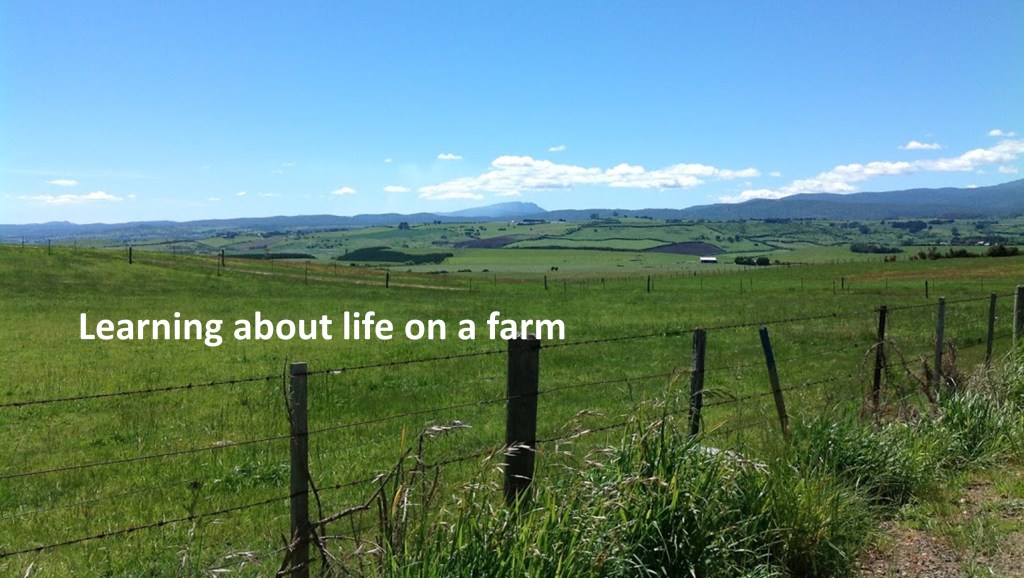
  • Learning about life on a farm – Readilearn

    Learning about life on a farm holds great interest for children and many opportunities for integrated learning across the curriculum. Most of today’s children are town-dwellers and have little experience with rural and farm life. Many have no idea where their food comes from beyond the attractive supermarket shelves.

    This week I have uploaded some new resources which support an early childhood K-2 unit of work about farms. However, they can be used as part of a literacy program, independent of a farm unit. Sight words and phonic skills can be developed through reading in a context that is both meaningful and interesting to children.

    New resources include:

    On the farm Who am I? This interactive digital story is great for use on the interactive whiteboard. Children are presented with a series of clues to help them identify an animal that lives on a farm. Children select the answer from those provided. The resource includes both domestic and “wild” animals.

    Continue reading: Learning about life on a farm – Readilearn

  • Shine a light

    The flash fiction prompt set by Charli Mills at the Carrot Ranch this week challenges writers to In 99 words (no more, no less) write about a beacon. It can be from a lighthouse or other source. Use the word literally or figuratively and go where the prompt leads you.

    Charli writes about our fear of change, fear of the unknown, and of the need for guides “to bring us in to a new harbor, a light to show us the rocky shoals.” She suggests that “Perhaps blogging, writing, are mediums of light that shine a path to bridge cultural differences.” but also acknowledges that, “Instead of looking for a way, some people have backed out of the water and barricaded themselves on the beach.

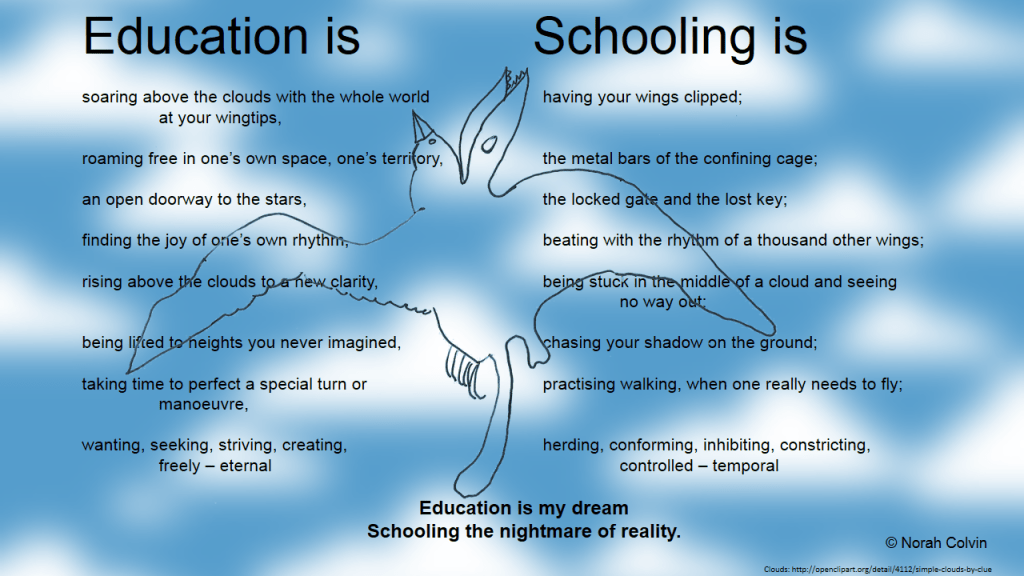
    I see education as the way that will bring us to a “new harbour”, the light that will “shine a path to bridge cultural differences”. Sadly, as I say in my poem about education, there is far too much emphasis on schooling and not enough on education, too much desire to keep the masses down by the insistence on conformity and ignorance rather than the encouragement of creativity.

    © Norah Colvin

    I was well-schooled as a child, but have spent my adulthood exploring what it means to be educated and promoting the benefits of a learner-centred education as opposed to other-directed schooling. I read of a book about “teaching backward”, beginning with what the student needs to know and working backwards. (Needs as determined by others, not the student.) I’d rather teach forwards, beginning with what the student wants to know and going from there.

    When my earliest teaching experiences fell short of my expectations, I searched for the beacons to guide my way out of the murkiness in which I found myself. I devoured books by John Holt, A. S. Neill, Ivan Illich, Paolo Freire, and others, with ideas about education and schooling that were as challenging as they were exciting. I read of innovative educators such as John Dewey, Maria Montessori, and Rudolf Steiner.

    The ideas challenged what I’d been taught but blended comfortably what I had learned through observation of children, including my own young child, and relating it to my own experiences. The pieces began to fit.

    At about the same time, I undertook further studies in literacy learning and was fortunate to work with a team of inspired educators led by Brian Cambourne, whose work and guidance placed the piece that helped the puzzle take shape, and guided my learning journey.

    Beacons, or shining lights, that guide and inspire us, are as essential to our growth as sunlight is for plants. Educators such as those mentioned, and more recently, Ken Robinson, Rita Pierson, and many others, are such beacons. We are constantly told of the success of the Finnish school system and I wonder why it is that those holding the power in other school systems fail to see their light. We need at least one to rise above the fog of number crunching and data collecting to see the bright lights shining on the hill.

    Is it fear, as Charli suggests, that keeps them out of the water? I watched the movie Monsters Inc on the weekend. It seems to deal with the issue of controlling the masses with falsehoods and fear quite well. It is also a great laugh – one of the most entertaining movies I’ve seen for a while. If you haven’t seen it yet, I recommend it.

    I’ve attempted a similar situation with my response to Charli’s challenge. I hope it works.

    Let there be light

    Eyes squinted in the dim light under low ceilings. Immobilised by never-ending paperwork, the menials dared not look up. Flickering numbers on data scoreboards mesmerised supervisors. Inconsistencies meant remonstrations, even punishment, from above. Heads down, keep working, don’t ask questions. The system worked fine, until … Maxwell nodded off. His pencil fell, tapped first, then rolled away. Startled, Maxwell went after it. The room stilled. Sliding too fast, he slammed into the wall, activating a button that illuminated a set of stairs leading up. Everyone gasped. Maxwell hesitated, took one step, then another. Nothing happened. He continued. Everyone followed.

    Thank you for reading. I appreciate your feedback. Please share your thoughts.


  • Celebrating NAIDOC Week – Readilearn

    Celebrating NAIDOC Week – Readilearn

    This week, from 2 – 9 July, is NAIDOC Week in Australia with celebrations occurring all around the country. The purpose of the week is to celebrate the history, culture and achievements of Aboriginal and Islander Peoples and acknowledge their contributions to our country. The acronym NAIDOC stands for National Aborigines and Islanders Day Observance Committee.

    The theme of this year’s celebration is Our Languages Matter. When Europeans first arrived in Australia a little more than 200 years ago, more than 250 Indigenous languages were in use across the land. As the languages were spoken, not written, many of these languages have been erased. Fewer than half that number remain, and many of the young people are no longer familiar with the language of their ancestors.

    According to the NAIDOC website,

    “The 2017 theme – Our Languages Matter – aims to emphasise and celebrate the unique and essential role that Indigenous languages play in cultural identity, linking people to their land and water and in the transmission of Aboriginal and Torres Strait Islander history, spirituality and rites, through story and song.”

    This article in the Conversation provides a little more information about Australian Indigenous languages and the Dreaming.

    By now, NAIDOC Week celebrations are almost over, and most Australian school children are enjoying their mid-year break. However, many teachers will be looking for ways to share the celebrations with their students when school resumes. As any time is a good time to incorporate learning about Indigenous culture and history, in this post, I provide links

    Continue reading: Celebrating NAIDOC Week – Readilearn

  • The Battle of Bug World – Interview with Karen Tyrrell – Readilearn

    The Battle of Bug World – Interview with Karen Tyrrell – Readilearn

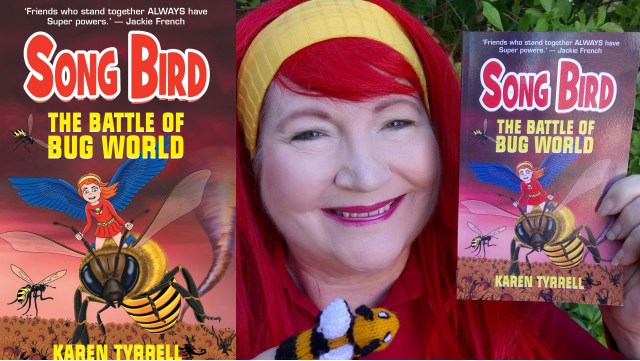
    This week I have the pleasure of welcoming Karen Tyrrell back to the blog. I previously interviewed Karen about her book Songbird Superhero for the Author Spotlight series. Karen has now published a second book in the Song Bird Series The Battle of Bug World.

    I enjoyed Songbird Superhero, so was delighted when Karen approached me to participate in her blog tour. The fact that the book is about bugs may have something to do with it. As you saw last week, I am a fan of minibeasts, including bugs.

    As soon as Karen announced the release of her book, I purchased an advance copy and was able to post a pre-review on Goodreads. This is what I wrote:

    I loved Song Bird Superhero and wondered if a sequel could possibly match it. But with The Battle of Bug World, Karen Tyrrell didn’t just match it, she surpassed it!
    This fast-paced page-turning story is packed with disasters that even Song Bird is not sure she can fix.
    What is that nasty Frank Furter up to now? And what’s with the severe thunder storm hovering above his house? What’s happened to all the bees? And why has Song Bird’s sister

    Continue reading: The Battle of Bug World – Interview with Karen Tyrrell – Readilearn

  • Away with the fairies

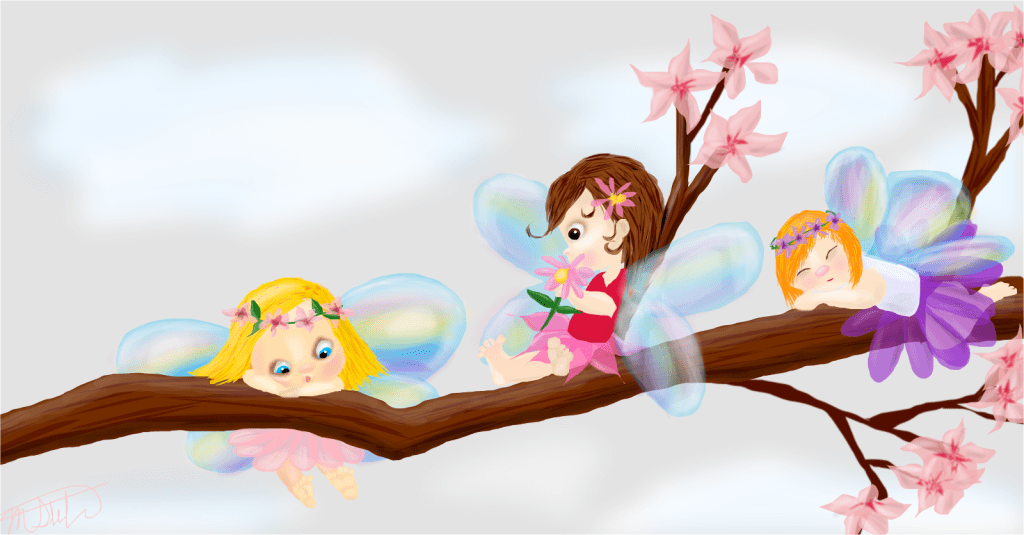
    © 2014 Shelly ʕ•ᴥ•ʔ https://www.sketchport.com/drawing/6517152420986880/fairies. Licensed under CC-BY.

    Are you a daydreamer? Were you accused of daydreaming at school? Many of us were. With minds that are easily distracted and work that is less than exciting, it is easy for thoughts to drift away into other realms. It can take anything, or nothing, and it is often difficult to back-track from where we find ourselves, along the path of thoughts to what initiated the journey. It can be no more tangible that the dream that escapes upon waking.

    While daydreaming can be pleasant and good for relaxation and creativity, it is often frowned upon in students meant to be concentrating on what they are to learn. Children would probably find it easier to attend if the work was tailored to their needs, initiated by their interests, and involved them as participants rather than recipients. The fifteen minutes of play per hour that Finnish children enjoy would also help, I’m sure, in giving time for minds to be, not corralled into predetermined channels.

    In this Conversation on Daydreaming with Jerome L. Singer in Scientific American by Scott Barry Kaufman on 10 December, 2013, Singer says, I think that teachers need to recognize that often, the daydreaming is because some of the kids are bored”.

    Whether through boredom or not, daydreaming can sometimes lead to breakthroughs in solving problems, creativity and productivity as described in this CNN article by Brigid Schulte For a more productive life, daydream. Brigid lists a number of daydreamers; including:

    • J K Rowling
    • Mark Twain
    • Richard Feynman
    • Archimedes
    • Newton

    Other famous daydreamers include:

    • Einstein
    • Edison
    • J. R. R. Tolkien
    • Boy George
    • Richard Branson

    Here are a few other quotes about the importance of daydreaming:

    Keith Richards is reported as saying that “Satisfaction”, the Rolling Stones’ most famous hit, came to him in a dream, and

    Paul McCartney says the same thing about the Beatles’ hit “Yesterday”.

    Neil Gaiman: “You get ideas from daydreaming. You get ideas from being bored. You get ideas all the time. The only difference between writers and other people is we notice when we’re doing it.”

    George Lucas: “I’m not much of a math and science guy. I spent most of my time in school daydreaming and managed to turn it into a living.”

    Professor Elizabeth Blackburn, the first Australian-born female Nobel Laureate, attributes her success as a molecular biologist, in part, to daydreaming.  She is reported by the Sydney Morning Herald to have said, ‘I think you need time to daydream, to let your imagination take you where it can … because I’ve noticed [that] among the creative, successful scientists who’ve really advanced things, that was a part of their life.’

    While speaking to students at Questacon in Canberra after receiving her prize, she joked, ”Your parents and your teachers are going to kill me if they hear you say, ‘she told us just to daydream.’

    So why is it, if the importance of daydreaming is recognised by successful creatives, thinkers, scientists, and business people, that it is still frowned upon in school? Why do we still insist that children sit at desks, repeating mundane tasks in order to pass tests that have little bearing on their future success or on the future of our species and the planet?

    In a previous post I wrote about John Dewey’s dreamof the teacher as a guide helping children formulate questions and devise solutions. Dewey saw the pupil’s own experience, not information imparted by the teacher, as the critical path to understanding. Dewey also contended that democracy must be the main value in each school just as it is in any free society.” According to Pasi Sahlberg in Finnish Lessons, What can the world learn from educational change in Finland? schools in Finland have dreamed their own dream by building upon Dewey’s.

    Of course, on a much smaller scale, I have my own dream of a better way of educating our children.

    This week at the Carrot Ranch, Charli Mills dreamed a dream and challenged writers to In 99 words (no more, no less) write a story that involves a dream. This action could have happened while awake, such as daydreaming, or make up a dream when asleep. Go where the prompt leads as it could be a nightmare or just fond memories or ambition.

    This is my response. I hope you enjoy it.

    Off with the fairies

    Each year the school reports told the same story:

    He’s off with the fairies.

    Poor concentration.

    Needs to pay more attention.

    Daydreamer.

    Doesn’t listen in class.

    Must try harder.

    Needs a better grasp on reality.

    Will never amount to anything.

    Meanwhile, he filled oodles of notebooks with doodles and stories.

    When school was done he closed the book on their chapter, and created his own reality with a best-selling fantasy series, making more from the movie rights than all his teachers combined.

    Why couldn’t they see beneath the negativity of their comments to read the prediction in their words?


    Of course, not all daydreamers become successful, and not all children have a negative schooling experience. For a much more appreciated and positive set of comments, read this post by Elizabeth on Autism Mom Saying Goodbye to Elementary School.

    Thank you for reading. I appreciate your feedback. Please share your thoughts.

  • The Battle of Bug World – Book launch, Blog tour & Prizes!

    Karen Tyrrell announces the second in her Song Bird Superhero series, The Battle of Bug World, a children’s fun-filled eco fantasy.

    Can Song Bird STOP the bully, save her sister, the bees and the environment?Karen is an award-winning author who writes books to empower kids (and adults) and help them live strong and be resilient.  After many years of classroom teaching experience, she continues to educate through sharing her own story of resilience as a survivor of bullying, through her words on the page, and through her workshops for adults that deal with writing, marketing, and funding, in addition to empowerment.
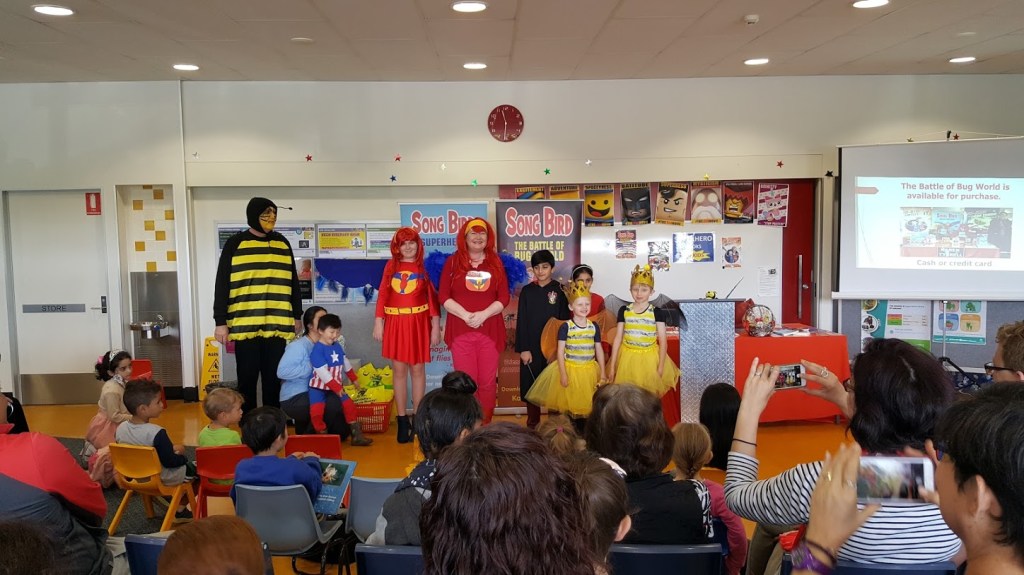
    Karen presents workshops for children in schools, libraries, and other creative spaces. With her flair for costuming and performance, she conducts entertaining sessions with a splash of fun staring in her own scripted pantomimes. As I was lucky enough to attend the launch of her latest book The Battle of Bug World on Saturday, I can testify to the enjoyment that was shared by all attendees.

    The Battle of Bug World is a fast-paced and action-packed story that children won’t want to put down until they find out if, and how, Song Bird can save her sister, her friends, and the environment from her evil neighbour Frank Furter.

    I previously had the pleasure of interviewing Karen on readilearn about her first book in the series Song Bird Superhero, and am delighted to be a part of Karen’s blog tour celebrating the launch of this sequel, which even surpasses the first.

    Please pop over to readilearn on Friday to read my post in the blog tour. Read other posts in the tour by following the links below. Leave a comment on any post for a chance to win great prizes including signed books, signed artwork, and a book critique (Comment on more posts for more chances to win!)


    The Battle of Bug World – Song Bird 2 Blog Tour!

    Look what’s happening to celebrate the Amazon release of The Battle of Bug World.

    BLOG TOUR!

    From Mon June 26 AMAZON LAUNCH KarenTyrrell.com

    From Tues June 27 CURLY Q’S Kids Book Review

    From Tues June 27 REVIEW Just Write For Kids

    From Wed June 28 REVIEW Georgina Ballantine

    From Thurs June 29 Writing Junior Novels Megan Higginson’s Blog

    From Fri June 30 REVIEW & interview readilearn blog

    BOOK GIVEWAYS!

    Just leave a comment on any of the posts in the blog tour, to win a copy of The Battle of Bug World (Song Bird 2). Add initials SB2

    FREE Children’s Book Assessment!

    Win a free children’s book assessment (up to 10 pages) by the author Karen Tyrrell. Just comment on any of the posts in the blog tour and add the initials CBA

    FREE Artwork!

    Win signed artwork by illustrator Trevor Salter. Add initials AW

    Remember the more you comment, the more chances you have to win prizes for The Battle of Bug World Blog Tour. Good luck 😊


  • Classroom minibeasts – Readilearn

    Learning about minibeasts in the classroom is a great way of engaging children with science knowledge, appreciation of nature, the interrelationships between people and the environment, sustainability, and caring for our planet. It fits beautifully into the science curriculum in an early childhood classroom when children are learning about living things, their needs, their external features, and their life stages.

    With live minibeasts in the classroom, it is possible for children to observe all these aspects of a tiny creature. They can use their observations to consider how the life stages of minibeasts compare to those of others, including themselves.

    My personal favourite minibeasts for the classroom are butterflies, but there are many others equally suitable; such as:

    • Silkworms
    • Meal worms
    • Stick insects
    • Cockroaches
    • Spiders

    The timing and choice may depend upon your location.

    For Australians, Minibeast Wildlife is a great resource.

    This week I have uploaded some new resources to support a unit of work about minibeasts in an early childhood classroom. These are resources I used for many years in my own classroom. I hope you find them useful too.

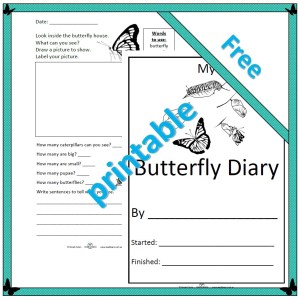
    Butterfly diary is a free printable resource for recording observations of butterflies in the classroom. Observing the stages in these brief lives helps develop an appreciation for all life. Recording observations integrates science learning with other subject areas

    Continue reading: Classroom minibeasts – Readilearn