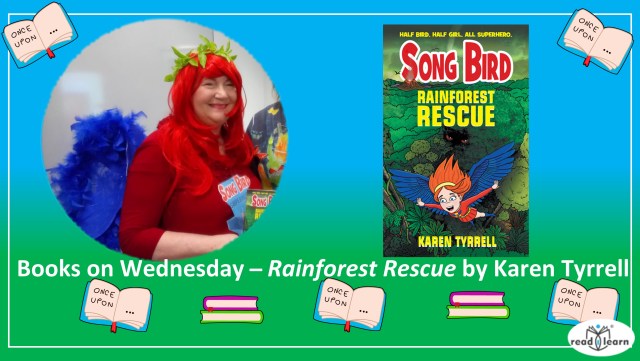
A review of Rainforest Rescue the third in the Song Bird series of empowering junior fiction books by author Karen Tyrrell.
This week, I want to let you know about Rainforest Rescue, newly released and third junior fiction novel in the Song Bird series of empowering books for young people, by Karen Tyrrell.
I have previously interviewed Karen about the other books in her Song Bird series, Song Bird Superhero and The Battle of Bug World so wanted to let you know that the third is now available.
I was delighted to attend the recent launch of Rainforest Rescue. Song Bird (Karen) and Tree Man (Karen’s husband and co-author, Steve) wowed their audience that included other superheroes as well as mere mortals like me.
Since the launch, Karen and Steve have been busy visiting schools and making bookshop appearances as part of Book Week Celebrations. If you would like a visit from Karen with one of her empowering presentations or pantomimes, you can contact her on her website here, or connect with her on social media — Twitter: @Karen_Tyrrell. FB: @KarenTyrrellAuthor.
Visit Karen’s website for free teacher resources, a special offer for Australian readers, and information about purchasing Rainforest Rescue elsewhere.
This is my review of Rainforest Rescue, which you can read on Amazon here.
Rainforest Rescue is the third book in the Song Bird series by Karen Tyrrell and the best yet.
My children were early readers. Both began reading real books well before their fourth birthdays. Of course, the timing, whether early or late, matters little now that they are adults. What matters is that they are readers who read competently and confidently for a range of purposes including for information and pleasure. They are readers by choice as well as purpose.
The ability to read is something that most of us take for granted. Many have no recollection of learning to read, only of being able to do so all of a sudden, as if we just could, by magic.
But, as with any spell, there are certain essential ingredients that make the magic happen and others that inhibit the process. Creating readers of choice and not just purpose is the real magic. Creating non-readers is the effect of a spell in reverse, of a bad mix of ingredients, that sadly occurs all too often.
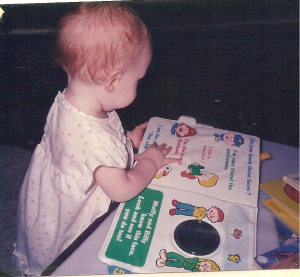
Bec reading to herself at 12 months
My children were readers of choice long before they could read anything for themselves. I wouldn’t say I set out to “teach” them to read. In fact, I didn’t at all. I set out to encourage in them a love of books and writing. Their learning to read was a by-product of sharing the love of words, language and reading.
The magic ingredients for developing readers:
Talk
Play
Read
Write
Love
Fun
I loved having time with my children. Being with them, watching them grow and develop was special, the best and most magical of days. They taught me as much or more about love, life and learning as they learned from me.
Talk
From their earliest days I talked to them, explained things to them — what was happening, what we were doing, and how things worked. I pointed things out and told them what it was called, what it was doing, what it was used for, or how it worked. When we were out and about, I’d point out signs and explain how I knew to stop or where to go. I avoided “baby” talk and always used appropriate everyday language.
Play
We played and had fun together, using our imaginations to create our own games. Sometimes we played simple board games and completed jigsaw puzzles. Whatever we played, talk always accompanied it.
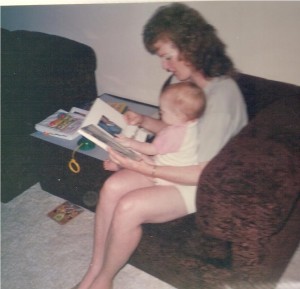
Reading to Bec at about 12 months old.
Read
I read to them, every day, not just one but many books. As I read, we discussed details in the illustrations and made predictions about the stories, sharing our thoughts. If a word was presented in a large or colourful font, I’d point to it as I read it. We’d laugh at the funny stories and cry at the sad and discuss all the story events. When they could read, they’d read to me, and we took turns reading together until they were early teens.
Write
When they first started to talk, I made books with pictures and words from their growing vocabulary. I labelled items in their rooms; for example, bed, shelf, window, door.
I made books about things we did with photographs and text. A book about our family made for my daughter’s first birthday was one of the favourites when cousins came to visit too.
The environment
I provided my children with an environment rich in language, books and opportunities for thinking. I’d read and write with them and to them, and they’d see me reading and writing for myself as well.
When son Rob was little, I didn’t yet know what I now know about the development of language, reading, and thinking. He taught me much that was later confirmed by my studies.
Rob, aged two, reading to some of his toys.
When he was only two, Rob would line up his toys on the couch, sit in the middle, and “read” to them. He would almost recite the stories from beginning to end. He already knew that the words in a book remain the same each time they are read — an important concept for beginning readers to grasp. When he was only three, he’d jump into bed beside me in the early morning after Hub had gone to work, prise my eyes open, and read to me! Magic!
Daughter Bec was born twelve years after Rob. Meanwhile, I had returned to college and studied the development of reading and language. I was amazed to find that we had unwittingly created the essential mix of ingredients for his learning to occur
Naturally, armed with experience as well as understanding, I did things pretty much the same for Bec — talking, reading, writing, playing, having fun and enjoying time together.
Bec sharing one of her favourite books.
When she was five, Bec was invited to participate in a study of children who learned to read before starting school. Of the children (maybe half a dozen) involved in the study, Bec was the only one the researcher considered to be really reading. She was reading fluently, with comprehension and at a higher level than the other children.
Some of the children were able to recognise isolated words, but not read them in continuous text. Others had been taught letters and sounds using flashcards and stopped to ‘sound’ out every word. They hadn’t become real readers.
Bec was not subjected to reading “lessons” as the other children had been. She was immersed in an environment that encouraged a love of learning, language and literacy. The other parents had a need for their children to read as if their value as parents depended on it.
While I had an expectation that Bec would read, I was confident that she would come to it in her own time. My credibility as a parent was not tied to her ability. Having said that, both children (adults) are now very successful in their chosen fields, so I must have done something right. Or perhaps we were just lucky that we chanced upon the magic mix of ingredients.
I do wish that all parents would include a sprinkle of language and a pinch of reading mixed with love and fun into their children’s lives every day. It would contribute greatly toward eradicating illiteracy.
I’m absolutely delighted to be invited to Sally Cronin’s place for afternoon tea with an amazing line up of writerly guests, a delicious array of food, and music to please the ears. Thank you, Sally. 🙂
“I’ve got an interactive whiteboard in my room but I don’t know how to use it.”
“What readilearn resources can I use with my kindergarten children?’
“Schools have said they want our children to come to school able to listen and follow instructions. What resources can we use?”
These are some of the statements and questions that teachers of children in their kindergarten year, the year before they start formal schooling, have put to me.
The main focus of my preparation of readilearn teaching resources is on the first three years of school. I hadn’t considered their application with children aged four to five. However, teachers have assured me that some of the readilearn interactive whiteboard lessons are very suitable for children in kindergarten as one part of a rich play-based learning-focused environment.
Using readilearn lessons on the interactive whiteboard in kindergarten
provides variety,
introduces children to the use of technology and some of the skills involved such as drag and drop, and click to select items,
provides opportunities for children to take turns, work cooperatively, listen actively to the teacher and other children,
encourages vocabulary development – the lessons are intended to be teacher-led and involve discussion with the children.
readilearn lessons support kindergarten teachers with
lessons ready to teach – login in the morning, keep one tab open – stay logged in for the day,
opportunities for children to make the connection between print and spoken language,
providing children who are ready to read opportunities of doing so.
readilearn interactive resources and lessons suitable for use in kindergarten:
How do you feel about worksheets? Love them? Hate them? Use them sparingly?
I would say I’ve never been greatly in favour of worksheets. I’m not saying I never used them, but I used them sparingly. If I could do something as well or better without using a worksheet I would. There were a few reasons for this:
I valued children’s own work and didn’t feel the need to “pretty” up their books with the work of others.
I always looked for ways to progress children’s learning as opposed to keeping them busy.
I liked to reduce our paper usage.
Available on the internet and in bookstores are oodles of collections of worksheets; worksheets for anything you can imagine. You can spend hours trawling through websites looking for a sheet to support learning or practice a specific concept. Some of that time could be better spent considering other opportunities you could provide children for learning or practice, or even doing something pleasant for yourself for a change. Now there’s a thought.
When you think you may want a worksheet, or come across a worksheet that you may want to use, stop and evaluate its potential benefit:
Do they still do Greek myths in school? I know I read some in my primary school days, but I never read any to my students when teaching.
The two stories I remember most from school were of King Midas and Pandora’s Box. Both carry strong cautionary messages which had a big impact on me.
King Midas was greedy and when offered a wish, wished that all he touched turned to gold. He was saddened and regretted his wish when even his beloved daughter turned to gold. Lesson: Don’t be greedy. However, I was more horrified at the thought of that young girl trapped in a body of gold. Surely that would be worse than a straitjacket, the thought of which is terrifying enough.
Pandora was presented with a box which she was instructed to not open. What more effective an invitation could there be to a curious soul? Of course, Pandora opened the box. Who wouldn’t? Unfortunately, in doing so, she released all the ills of the world. It is her, so the story goes, we have to thank for illness, plagues, wars, famines and so the list goes on. Lesson: Do what you’re told and don’t be curious. I’m not sure that I learned the lesson from the tale. I’d already had the message firmly installed prior to encountering it.
As I matured I realised that the lessons from stories such as these didn’t always apply and I am now an advocate for curiosity if not for greed. Where would we humans be without curiosity, wonder, and imagination?
The five W questions that we often teach children to use when interrogating a text or preparing to write spring to mind: Who, What, Where, When and Why.
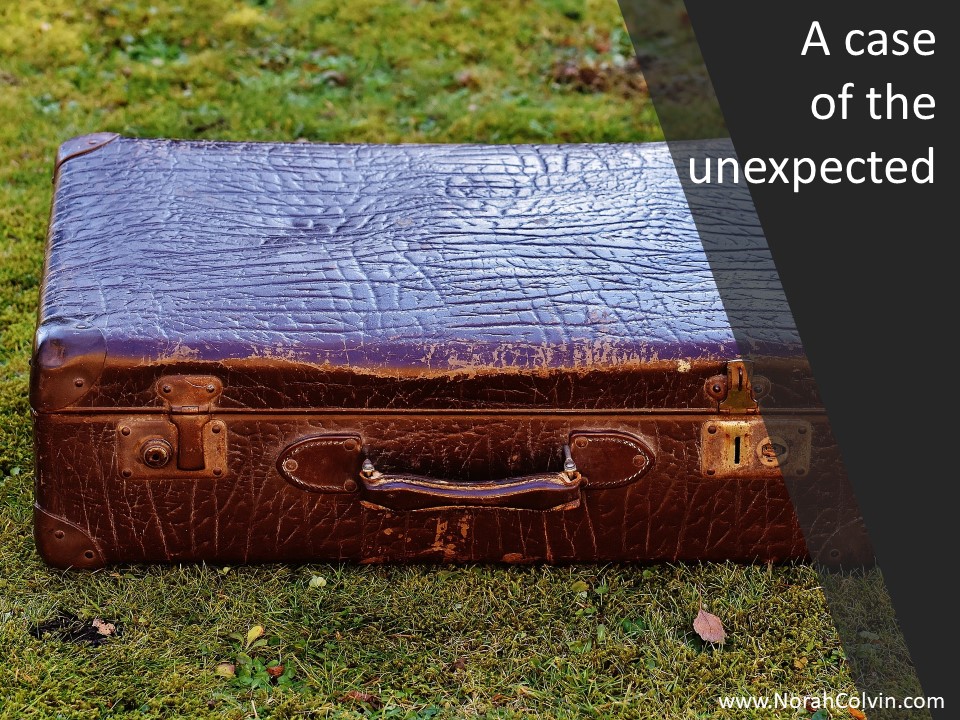
Who abandoned the suitcase?
What is in the suitcase?
Where was the suitcase abandoned?
When was it abandoned?
Why was it abandoned?
Who found the suitcase?
What did they do?
Why?
In bygone days, had I come across an abandoned suitcase, I may have investigated it to discover:
Did it have any value?
Was it discarded or lost?
Was there anything of value in it?
Could I find the owner and return it?
I remember as a child going along with my older brother’s suggestion to create a fake package, tie some fishing line to it, place it in the middle of the road and wait for a curious and unsuspecting pedestrian to come along. (Traffic was infrequent back in those days.) When the pedestrian bent to investigate the package, my brother would pull on the line and the package would move out of reach. We found the response of the pedestrians hilarious and our laughter soon gave away the plot from the bush or fence behind which we lay in wait. Fortunately, they all laughed too when they realised what we were up to.
Nowadays, with warnings about the possibilities of abandoned bags and packages containing terrorist bombs, people may be less inclined to investigate, concerned that the result may be more similar to what Pandora discovered.
For my response to Charli’s prompt, I’ve decided to go with a more innocent age when two children playing in the bush find an abandoned suitcase.
A Case of the Unexpected
“I wonder what’s inside,” said Jamie.
“D’ya think we should open it?” Nicky asked.
They looked around. No one anywhere.
Jamie shrugged. “I guess.”
“Looks old,” said Nicky.
“Probably been here for years.”
“So dirty.”
The rusty catches were unyielding.
“Might be locked,” said Nicky, hopefully.
“Let’s see,” said Jamie.
They pried with sticks, battered with stones and willed with all their might. When the catches finally snapped open, they hesitated.
“Go on,” said Nicky.
“No, you.”
“Both.”
“Okay. One, two, three … open!”
The children’s eyes widened.
“What is it?” asked Nicky.
“Dunno,” said Jamie. “Looks like …”
—
What do you think was inside?
Thank you for reading. I appreciate your feedback. Please share your thoughts.
Sometimes we expect that all we have to do for children to make friends is to put them in close proximity to other children. We may see it happen at the park, in a playground, in a shopping centre, at school. Children are attracted to other children, but it is not always easy for them to make friends. We should no more expect them to get along than we would expect adults thrown together at a party, conference or other social situation to become friends immediately.
While some children are gregarious and will talk to anyone, others may be more introverted and less inclined to make the first move. But whether extrovert or introvert, children need to learn how to interact with others in ways that encourage friendships to be made. The development of social-emotional skills, including empathy or understanding how others feel, is an important part of becoming a friend.
Make friendship skills lessons an ongoing part of your program
Lessons in how to be a friend need to be an ongoing part of any class program. While many teachers allocate some time for getting to know each other at the beginning of the school year, it is important to maintain the focus throughout the year. As children mature and interact with others, they will encounter a greater variety of situations with which they need to deal.
It is not always necessary to timetable or set up specific lessons. Sometimes the spontaneous discussions before and after break times can help highlight needs and alert you to who is having trouble in the playground. These focused incident-specific discussions can help resolve issues and prevent them from escalating.
As new children enter the class, they also need to be introduced and made to feel welcome and included. It is important for the introductions to go both ways. New children have many others to get to know; the existing class members have only one, and it may be difficult for a new child to settle into established groups. It is necessary to establish procedures that will help a child settle while more permanent friendships are being formed. For example, friendship buddies could be allocated to show the child around and help them become familiar with school routines and behaviour expectations.
Establish a supportive classroom environment
One of the best ways of ensuring that children feel friendly towards each other is by establishing a supportive classroom environment in which children have a sense of belonging, feel respected and valued.
Previous posts about establishing a supportive classroom environment include Establishing a supportive classroom environment from day one. A search of resources using the words ‘supportive classroom’ will bring up a list of other related posts and resources.
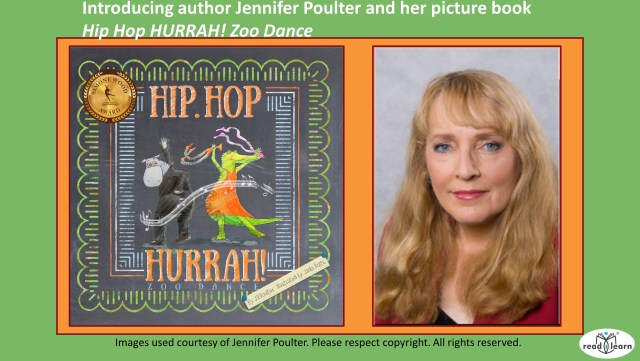
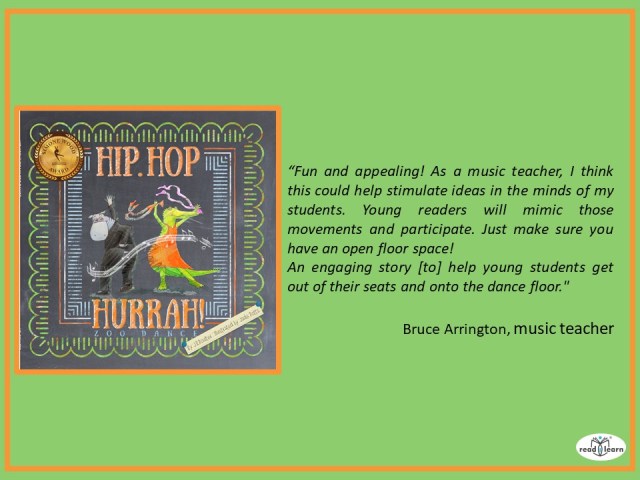
Meet Australian author J.R. Poulter as she discusses her beautiful picture book Hip Hop Hurrah Zoo Dance which is great for reading and getting kids moving.
This week I am delighted to introduce you to prolific Australian author Jennifer Poulter. Jennifer writes fiction and poetry for children, education and the literary market. She has had over 50 traditional books and thirteen digital picture books published. She writes under the names J.R. Poulter and J.R. McRae and has received numerous awards for both fiction and poetry writing.
Throughout her career, Jennifer has been employed in numerous roles including Senior Education Officer with the Queensland Studies Authority and Senior Librarian with the State Library of Queensland. She even once worked in a circus. In addition to writing, Jennifer is also an editor and artist. Now, under the banner of Word Wings, Jennifer collaborates with other creatives from over 20 countries.
Today I am talking with Jennifer about her picture book Hip Hop HURRAH! Zoo Dance.
What initially attracted me to this book is its ability to get children moving. What a great way to incorporate fun with movement and reading into any day.
The book also fits perfectly with a dance curriculum that encourages children to become aware of their bodies and how they move in space, to explore and improvise dance movements. Children can be encouraged to move like the zoo animals in the book or improvise movements for other animals and objects that move.
But Hip Hop HURRAH! Zoo Dance can also find its place in the literacy curriculum. Written in rhythmic verse, it encourages children to join in with the reading. It has a treasure of words to delight and extend vocabularies and add sparkle to writing; words like ‘limber, fandangle, prance and shimmies’. Children will laugh at the hippos with the backside wobbles and be intrigued by the combination of illustrations by Jade Potts and the variety of media used by designer Takara Beech in creating the double page spreads.
If you throw in some counting of animals and legs, needs and features of living things, and places they live, you can cover almost the entire curriculum with this one little book. But enough from me, let’s find out what Jennifer has to say.
As you know, there are many types of fences: literal, metaphorical, even imagined. Fences are usually built to contain things, to keep people or things on one side or the other, or to define a boundary and possibly restrict passage. But the term “mending broken fences” has a different nuance of meaning. In this use, it means to repair a broken relationship as opposed to improving boundary security.
But which fence should I choose?
Should I share some history?
Rabbit-Proof Fence
This year marks the one-hundredth anniversary of my family (grandfather, grandmother and their young family – my father, the fifth of nine, was born three years later) taking up residence on a property owned by the Rabbit Board. My grandfather was a boundary rider until 1955, repairing the fence built to protect farming and grazing lands from the destructive introduced species. His youngest son replaced him, continuing until the role terminated in 1957. My uncle purchased the property from the Rabbit Board and lived there with his family until his death this year not long after the anniversary celebrations.
or perhaps reminisce?
The Cow Jumped Over the Fence
Until I was six, my parents were small crop farmers. The farm didn’t generate much income and there were more bad years than good. To help feed the growing family (there were six of us by then) Mum and Dad invested in chickens for both eggs and meat and a milking cow. The first cow knocked down the fence and escaped to freedom. Dad repaired it and bought another cow, which squeezed under the fence. After a third cow jumped the fence, Mum and Dad decided milk deliveries were a better option and we kids never learned to milk.
Note: I did write about this incident, a little differently, here.
Should I plan a lesson?
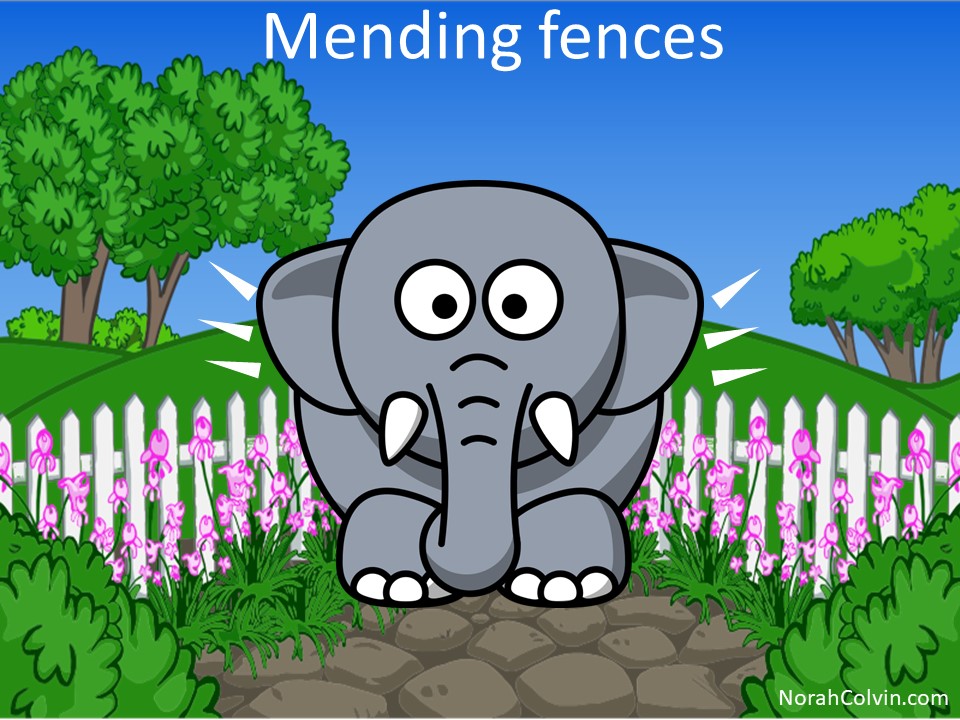
Teaching positional prepositions with The Elephant’s Fence
Make a fence from pop sticks.
Make an elephant using different-sized pom poms for body and head; pipe cleaners for legs, trunk and tail; paper or felt for ears; and googly eyes.
Place your elephant according to these instructions:
Beside the fence
In front of the fence
Behind the fence
Under the fence
Between the palings
Next to the fence
Above the fence
Below the fence
On the fence.
Now choose a place for your elephant to be. Tell your elephant’s story:
Why is it there?
How did it get there?
What is it doing?
What will happen next?
or attempt a story?
Sometimes it is the imaginary fences that can be more limiting. Sometimes it’s better to leave things that aren’t broken in the first place.
Broken with intent
The fence was too high to jump or even see over, no footholds to climb, and palings too close to squeeze or even peer through. It hugged the soil too compacted to dig. It seemed impenetrable, and so intrigued. He stacked boxes for makeshift steps—not high enough. Finally, he hatched a plan—balloons! He blew them big and tied them tight, attached some string, and waited. And waited. Then a gust of wind lifted him high, over the fence, where another, just like him, smiled and said, “Should’ve used the gate; latch is broken—always open to friends.”
Thank you for reading. I appreciate your feedback. Pleasure share your thoughts.


 A review of Rainforest Rescue the third in the Song Bird series of empowering junior fiction books by author Karen Tyrrell.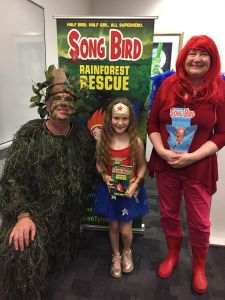
















 Norah Colvin