
I’m over at Sally Cronin’s wonderful blog this week, sharing a post from my archives about family history. Sally and I would love for you to pop over and have a read and share your thoughts.
Category: Education
-

What’s water to you?
Last Friday 22 March was World Water Day.
Sustainable Development Goal 6 is crystal clear water for everybody by the year 2030.
Many of us living in developed countries take access to clean healthy water for granted. We turn on a tap and it is there. Even though it is free and plentiful, the sale of water in plastic bottles is increasing and the bottles are contributing greatly to the destruction of the environment.
If it seems crazy, it must seem especially so to those who live in places without access to regular supplies of clean water.
The figures quoted on the World Water Day website are astounding:
- 2.1 billion people live without safe water at home
- 1 in 4 primary schools have no drinking water service
- about 159 million people collect their water from ponds and streams.
And so, the list continues with one horrifying statistic after another.
Water is essential for life, not only for drinking but also for many of our personal, societal and global everyday activities. According to business reports, it is even more precious than gold. Maybe we could live without gold, but we can’t live without water.
Learning about water — the water cycle, its uses, conservation and pollution — is an important part of everyone’s education. Sometimes we find teachers in the most unexpected places.

Not surprisingly, education is the theme I’ve taken in my response to the flash fiction challenge set by Charli Mills at the Carrot Ranch this week to In 99 words (no more, no less) write a story that features a bucket of water. What is the condition of the water and what is the bucket for? Drop deep into the well and draw from where the prompt leads!

More Precious than Gold
The children observed the bucket.
Teacher explained, “Let’s find out about what’s in the bucket. Ask only ‘yes’ or ‘no’ questions. Do not say what you think it is.”
“Is it wet?” “Yes.”
“Is it a liquid?” “Yes.”
“Is it heavy?” “Try.” “Yes.”
“Do we drink it?” “Does it come from clouds?” “Does it make puddles?”
“Yes. Yes. Yes.”
“Is it more precious than gold?”
“Don’t be stupid,” spluttered Andy. “It’s water!”
Teacher glared. Andy’s smirk dissolved.
Ahmed looked squarely at Andy. “In my country… “
Teacher closed the book. Ahmed’s lesson was more effective than any she’d prepare.

Thank you for reading. I appreciate your feedback. Please share your thoughts.
Share this:
-

School Days, Reminiscences of Anne Goodwin
Welcome to the School Days, Reminiscences series in which my champion bloggers and authors share reminiscences of their school days. It’s my small way of thanking them for their support and of letting you know about their services and publications.
This week, I am pleased to introduce Anne Goodwin, short story writer, novelist, reviewer and blogger … to list just a few of her many accomplishments. Anne and I have been friends almost since the beginning of my blogging days and she has featured in my posts several times in the past, including here, here and here.
Anne was not the first person I met when I began blogging, but she is the earliest to still be with me on my journey. Interestingly, we met on Twitter where a discussion about singing (or not) led to a blog post and then countless conversations on her blog and mine for more than five years. She also supported me as co-judge for two years running in the Carrot Ranch Rodeo Flash Fiction Contests.
I had the pleasure of meeting Anne in London in 2014 when I was visiting family. We met at the British Library and, during the course of the day, Anne revealed a secret – she had secured a contract for her first novel Sugar and Snails. She was already a published and award-winning writer of short stories, but now she could add novelist to her achievements. I was thrilled to be one of the first to know and I told her that I was pleased to have known her before she became famous.
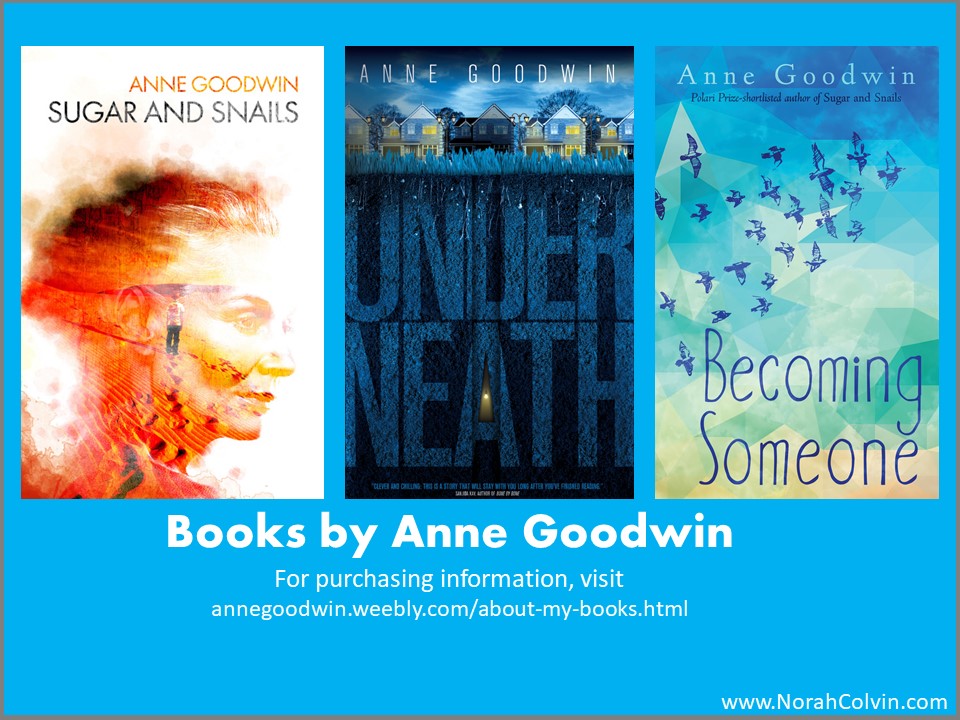
Since then Anne has published a second novel Underneath and is working towards publication of a third. Her most recent book Becoming Someone is a collection of her short stories. Some of the stories I had previously read, and just as many or more I hadn’t. I had been a fan of Anne’s stories since first encountering them and was thrilled to have a collection in one volume, perfect for savouring morsel by morsel. I was even more delighted with the acknowledgement in the front of the collection ‘For Norah Colvin and Charli Mills’. What’s to not like?
I could continue to ‘sing’ Anne’s praises, but perhaps we should move onto her interview. Before we do, I’ll let Anne tell you a little of herself:
Anne Goodwin’s debut novel, Sugar and Snails, about a woman who has kept her past identity a secret for thirty years, was shortlisted for the 2016 Polari First Book Prize. Her second novel, Underneath, about a man who keeps a woman captive in his cellar, was published in May 2017. Her short story collection, Becoming Someone, on the theme of identity, was published in November 2018. A former clinical psychologist, Anne is also a book blogger with a special interest in fictional therapists.
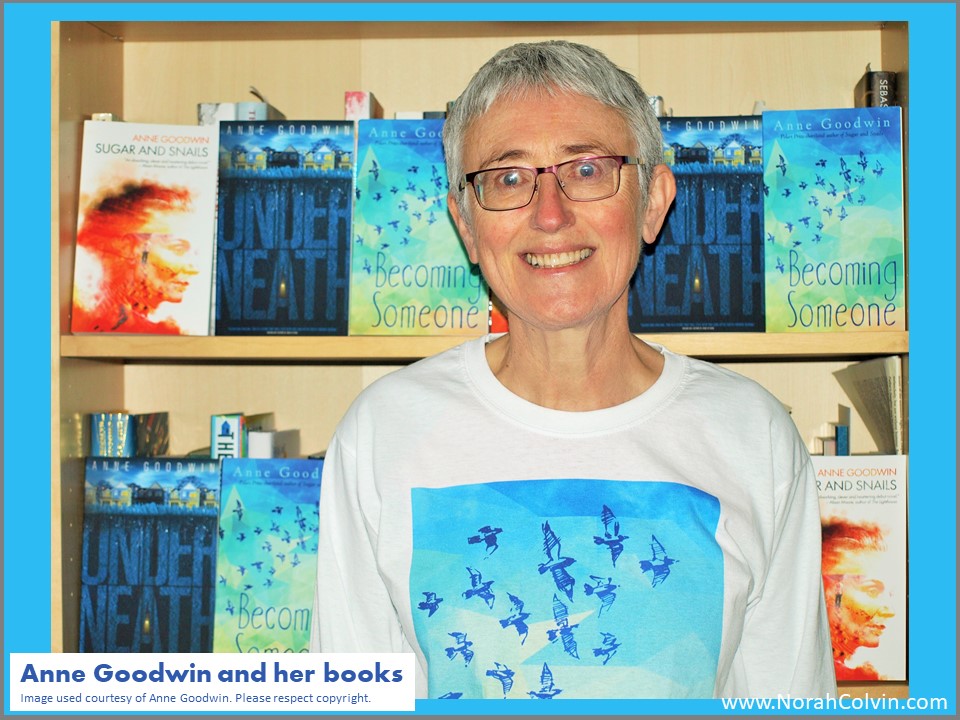
Welcome, Anne.
Now let’s talk school. First of all, where did you go to school, and what was the highest level of education you received?
I attended Catholic (state) schools in a small town in the north of England from the age of 5 to almost 18. I then went to university where I gained a BSc in Mathematics and Psychology and a PhD in Psychology, then an MSc in Clinical Psychology which was also a license to practice.
What work or profession did you choose after school and was there anything in school that influenced this choice?
I suspect my career in Clinical Psychology was despite my schooling – or perhaps unconsciously I wanted to understand why it was so bizarre! (One of my short stories, “Kinky Norm”, which you can read for free, is based on a true story of the impact of repression on adolescent girls.)
What is your earliest memory of school?
It might not be my earliest memory, but I do recall a boy being caught by the teacher picking his nose. ‘Where do you put it?’ she asked, vis-à-vis the snot. ‘Nowhere,’ said the boy, which I thought an excellent answer. I couldn’t understand why she ridiculed him but, in those days, ridicule was the norm.
I also remember being so anxious that, if the teacher said an as in an apple, I heard it as Anne, and assumed some punishment was on its way. I suppose that was a product of the strictness of both school and home cultures, where it was deemed perfectly acceptable for an adult to hit a child. I think (memory being so fickle) I managed to avoid the worst of it by hypervigilance and obedience, which served me in good stead in a system that was less about genuine learning than doing as you were told.
What memories do you have of learning to read?
I couldn’t read on starting school, but quickly learnt, despite the classroom tension. I remember the primers (Janet and John) being ever so dull, but I didn’t mind too much as I soon moved on to better things.
What memories do you have of learning to write?
Learning to write was more frustrating, as described in a post on my blog. The teacher stood at the blackboard etching row upon row of noughts and crosses in coloured chalk. We sat at desks, copying the figures into our books with fat wax crayons. At home, colour meant drawing wherever the inspiration took me. When we progressed to proper letters, I couldn’t see why it was wrong to shape my ‘g’ and ‘a’ as they appeared in a printed book.
What do you remember about maths classes?
We didn’t embark on what I call mathematics (as opposed to arithmetic) until secondary school, with yummy simultaneous equations and those soon-to-be obsolete slide rules, of which I had two (and probably still have somewhere in the loft). Before that came the dreaded times tables, catechism with numbers, yet after hours of chanting (and a 1st class degree) I still can’t tell you what 7×8 makes, without stopping to work it out.
What did you like best about school?
School was a life sentence; I didn’t expect to enjoy it. But I always liked reading and writing, as long as we were free to choose the topic for ourselves. And Music and Movement, which was a radio programme that did what it says on the tin, and features in my debut novel, Sugar and Snails.
What else would you like to tell us about your school days?
I almost left school at sixteen, and stayed on for A’ levels (university entrance) only because the career officer’s recommendation that I work in a bank (being good at maths, albeit not at numbers) seemed even less inspiring. I’m so glad I did! Out of uniform and in classes of no more than a dozen (education post 16 being a new venture for my school), I blossomed, especially in English. (Why didn’t I study that at university? Maybe because I associated reading with leisure, although the texts we picked apart in class were anything but.)
Given my capacity for compliance, I’m lucky I made the transition to critical analysis. Suddenly (although we’d probably been sliding dangerously towards it since the age of eleven), I was expected to have an opinion, to examine texts from different points of view. (Although not in maths, which provided a counterbalance, a safe space where the right answer remained stable over time.)
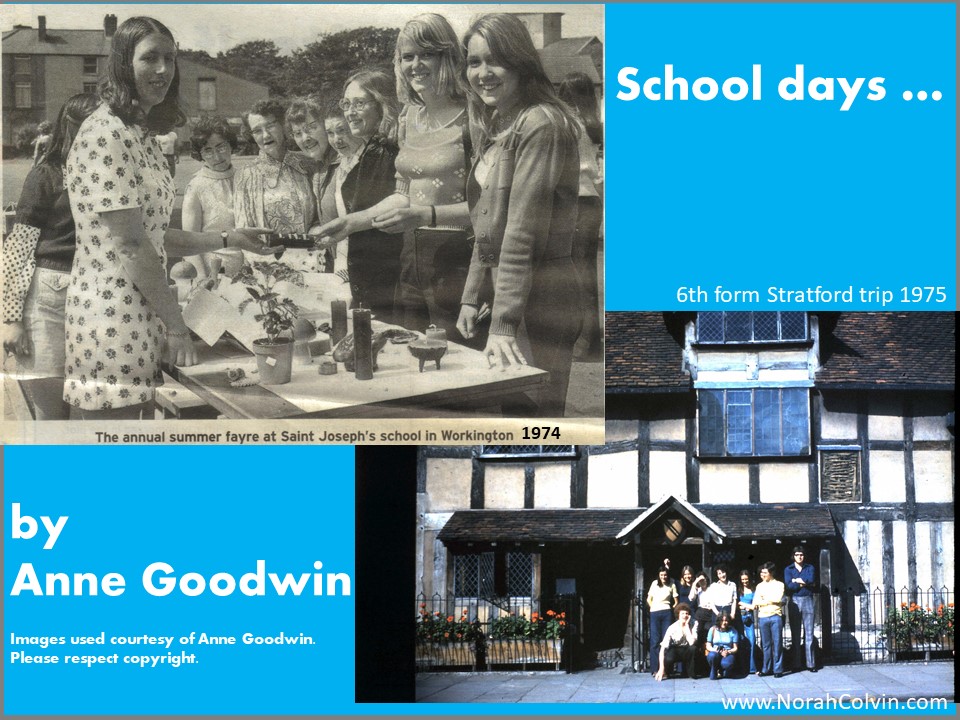
All credit to Pauline Blair, the teacher who joined the school at the start of our A’ level years. I think she found it a culture shock, and we were equally bewildered by her. She was posh! She claimed to be a feminist which, in my ignorance, I thought meant feminine, given that she ticked me off for slouching and sitting with my legs wide apart. She took us to see the Royal Shakespeare Company in Stratford, and sang (properly, the way I do now) on the long drive home. She’s the only teacher I’d like to meet again, to see what she made of us in that insular part of the world.
What are your thoughts about schools, then and now?
I think it’s great that so many kids these days enjoy school: despite repeated ministerial interference, teachers must be doing something right. It’s great that there’s no physical punishment but, with limited resources, more kids are excluded than in my day. It’s still impossible to tailor teaching to individual learning styles (I’d probably have struggled in a noisy aka lively classroom) and much more pressure (or maybe my school was atypical in being insufficiently clued up for the antediluvian equivalent of league tables) on exams.
How do you think school could be improved?
- Reinvest in SureStart (it was a UK New Labour thing for at-risk preschoolers) so that all kids have the skills they need for school.
- Scrap private schools’ charitable status and put the taxes raised into state education.
- Abolish all religious schools, and schools established to follow a particular fad.
- Provide every child with a light breakfast and a three-course vegan lunch (to avoid the expense of catering for different diets) for free. Kids can’t learn if they’re hungry, and we desperately need to give the adults of tomorrow the skills to pursue a healthy diet. (So cooking and gardening lessons too.)
- Halve class sizes, and give teachers more support, including optional counselling / short-term therapy for anyone working with kids.
- Foreign language and music classes from the early(ish) years and (although I hated it) compulsory exercise through a diversity of sports. (Why should these life-long benefits be restricted to those whose parents can cough up the dosh?)
- Prevent (religious) parents from withdrawing their children from certain lessons, such as sex and relationships, including same-sex couples.
Idealistic? Too expensive? Not if we care about the future society we build.
Thank you for sharing your reminiscences of school and thoughts about education in general, Anne. It’s been wonderful to have you here again. I enjoyed learning about your school days and agree with so many of your recommendations for improving education. Now, if only we could get some of those with the ‘power’ to listen to us.
Find out more about Anne Goodwin:
Website: annegoodwin.weebly.com
Blog: annegoodwin.weebly.com/annecdotal
Amazon author page: https://www.amazon.co.uk/Anne-Goodwin/e/B0156O8PMO/
and her books:
Anne’s books: annegoodwin.weebly.com/about-my-books.html
YouTube: www.youtube.com/channel/UCLxWxjJlY4hxuP9bzah5F_g
Connect with her on social media:
Twitter: @Annecdotist
If you missed previous reminiscences, check them out here:
Look for future interviews in this series to be posted on Sunday evenings AEST.
Coming soon:
with more to follow.
Thank you for reading. I appreciate your comments. Please share your thoughts.
Share this:
-

Smorgasbord Posts from Your Archives – #Family – Understanding family relationships by Norah Colvin
Sally Cronin has featured my post about understanding family relationship in her Smorgasbord Posts from your Archives #family series. If you missed it the first time, you might like to pop over to Sally’s to read and check out other posts on Sally’s wonderful blog.
Thank you so much for sharing, Sally. It’s a pleasure to feature on your blog.Share this:
-
It’s a point of view
Have you ever been faced with a task, at work or at home, that seemed so big you didn’t know where to start?
Have you ever been hustled by a supervisor, external or internal, to make a start whether ready or not?
Have you ever jumped in, hoping it would all work out in the end?
Have you ever chipped away without any real sense of direction and eventually found what you were looking for?
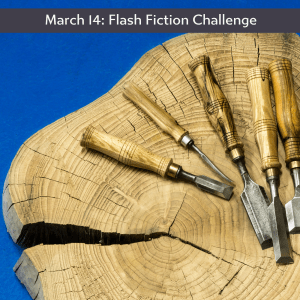
It was of these situations I was thinking as I responded to this week’s flash fiction prompt set by Charli Mills at the Carrot Ranch to In 99 words (no more, no less) write a story that includes a chisel. Use chisel as a noun or a verb. Think about what might be chiseled, who is chiseling. Be the chisel. Go where the prompt leads!
Perspective
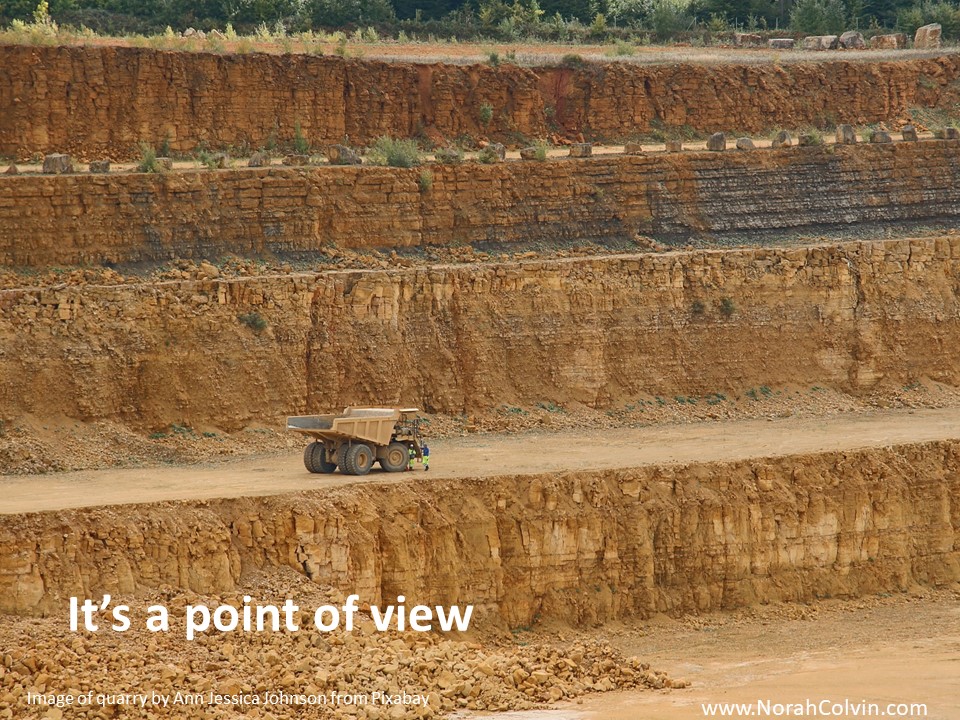
The monumental task cast a shadow deep and long, miniaturising the toolkit at his feet.
He shook his head, muttering complaints and impossibilities.
The supervisor appeared. “Better get started. No time to waste.”
He rummaged through the toolkit, lifting, inspecting and replacing each implement in turn.
“What’s the holdup?” bellowed the supervisor.
He grabbed the mallet and whacked the stone. “Take that!” Chunks smashed around him. He wiped his brow and whacked again.
“Great. You’ve started at last,” encouraged the supervisor.
Later, as the light turned, the shadow faded and diminished. He lifted his chisel and refined his work.
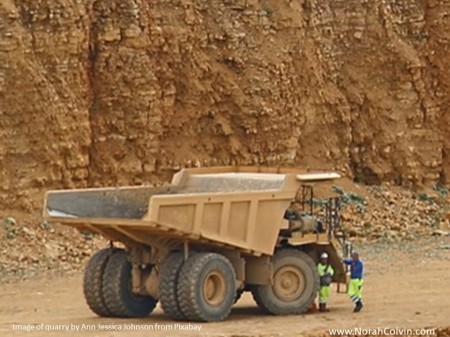
Of course, I’ve had the opposite happen too. I’ve begun a task that I thought was miniscule but turned out to be mammoth. What about you?
Thank you for reading. I appreciate your feedback. Please share your thoughts.
Image of quarry by Ann Jessica Johnson from Pixabay.
Share this:
-
School Days, Reminiscences of Sally Cronin
Welcome to the School Days, Reminiscences series in which my champion bloggers and authors share reminiscences of their school days. It’s my small way of thanking them for their support and of letting you know about their services and publications.
This week, I am pleased to introduce Sally Cronin, author, blogger and supreme supporter of authors and bloggers. Sally is a prolific writer on numerous topics on her blog and in her publications. She seems to have an infinite capacity for supporting other writers with guest posts, reviews, blog visits and comments, and shares on social media. I am constantly in awe of her output and the esteem in which she is held and I am very grateful for the support she provides me in the online world.
I am especially pleased with the timing of Sally’s interview as today 17 March is St Patrick’s Day and Sally is Irish! She even has a lovely book of Tales from the Irish Garden, published late last year.

Before we begin the interview, I’ll allow Sally to tell you a little of herself:
I have lived a fairly nomadic existence living in eight countries including Sri Lanka, South Africa and the USA before settling back here in Ireland. My work, and a desire to see some of the most beautiful parts of the world in the last forty years, has taken me to many more incredible destinations around Europe and Canada, and across the oceans to New Zealand and Hawaii. All those experiences and the people that I have met, provide a rich source of inspiration for my stories.
After a long and very happy career, I took the step to retrain as a nutritional therapist, a subject that I was very interested in, and to make the time to write my first book. Size Matters was a health and weight loss book based on my own experiences of losing 70kilo. I have written another eleven books since then on health and also fiction including three collections of short stories. I am an indie author and proud to be one. My greatest pleasure comes from those readers who enjoy my take on health, characters and twisted endings… and of course come back for more.
Welcome, Sally.
Now let’s talk school. First of all, could you tell us where you attended school?
Portsmouth UK (3), Malta, Cape Town South Africa, Preston UK,
Did you attend a government, private or independent school?
All the schools were government.
What is the highest level of education you achieved?
Diplomas in Secretarial Studies and a Diploma in Nutritional Therapy.
What work or profession did you choose after school and was there anything in school that influenced this choice?
I started as a secretary in a dental practice but within a few months started training as a dental nurse which I found more interesting.
What is you earliest memory of school?
Age four arriving at the first class at primary and noticing all the names scratched out on my extremely old desk and my teacher Mrs. Miller.
What memories do you have of learning to read?
My sisters read to me and taught me the basics so I could read before I went to school. I already had a collection of books by the age of four.
What memories do you have of learning to write?
I remember the blackboard with lines drawn and beautiful letters that we had to copy and a poster with all the letters and an object that began with that letter. We all had lined copy books and we would practice a letter until we got it right.
What do you remember about math classes?
Not much I am afraid as it was not my favourite subject. I was always good at mental arithmetic and knew my times tables before I was five, but triangles and other angular objects never fascinated me. I passed it at o’level just!
What was your favourite subject?

I loved history and being in schools outside of my home country I got to learn far more than I would have done if locked into the curriculum in the UK. In South Africa for instance, I learnt about the Boer War from a completely different perspective and it did not paint the British in a good light. It was 1964 and I also heard about the war first hand from the grandmother of one of my friends. Living history is the best.
What did you like best about school?
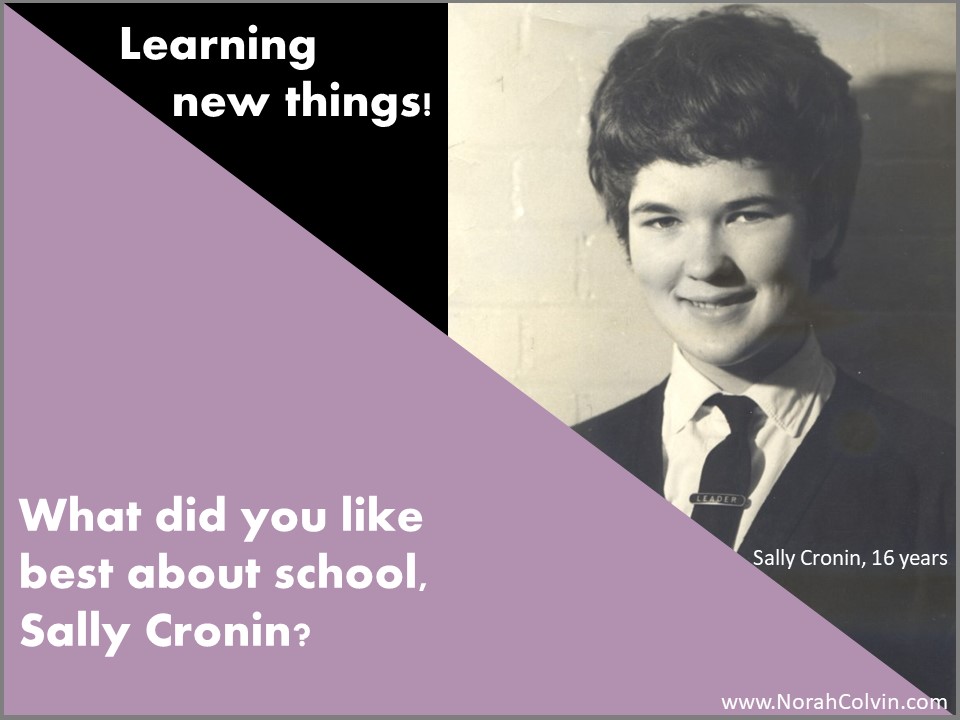
Learning new things, once the basics of reading and writing were done it was like opening a door to the world. I loved all lessons (apart from maths) and also the access to sport which I enjoyed including hockey, swimming and tennis.
What did you like least about school?
Probably leaving them as I would make friends and then two years later we would be on the move again. Then I would start again out of phase often for my age, with a different curriculum which included new subjects I was unfamiliar with that had not been taught at the previous school. It always felt that I was playing catch up and spent most of my evenings with extra homework to do that.
How do you think schools have changed since your school days?
I can only judge this by friends who still have children in school and it would seem that there is less freedom, less physical activity, less homework, and more crowded.
What do you think schools (in general) do well?
I think that schools do well with the basics and for children who are academic they provide a solid platform to secondary education.
How do you think schools could be improved?
I feel that there is a one size fits all approach to education which does not take into account the individual child’s needs or abilities. In the UK in particular there has been a push in the last decade to get children into university, and the loss of technical colleges (now rebranded as universities) that I went to for those who want a more practical approach to their careers. Also I believe that there should be a push for more apprenticeships and that some children who want to follow that route should be allowed to leave school at 14 as long as they are going into an approved apprenticeship. I understand that is happening in Australia and I think it should also be introduced in the UK and Ireland and other countries.
Thank you for sharing your reminiscences of school and thoughts about education in general, Sally. I appreciate your perspective. It’s been wonderful to have you here. I learned so much I didn’t already know about you.
Find out more about Sally Cronin
On her blog: Smorgasbord Blog Magazine
Amazon Author Page: http://www.amazon.com/Sally-Cronin/e/B0096REZM2
Goodreads Author Page: https://www.goodreads.com/author/show/7979187.Sally_Cronin
Connect with her on social media
Facebook: https://www.facebook.com/sally.cronin
Twitter: https://twitter.com/sgc58
LinkedIn: http://uk.linkedin.com/in/sallycronin1
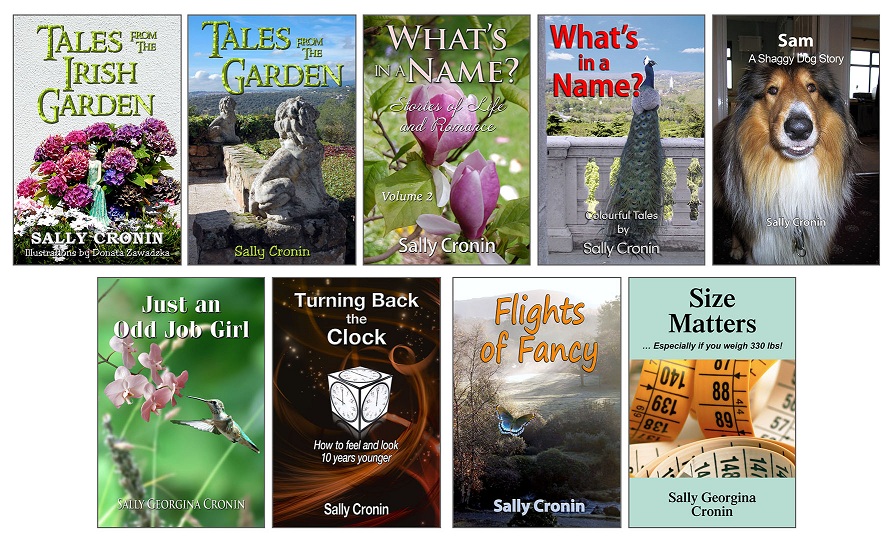
All Sally’s books are available from
Amazon UK: https://www.amazon.co.uk/Sally-Georgina-Cronin/e/B003B7O0T6
And Amazon US: https://www.amazon.com/Sally-Cronin/e/B0096REZM2
If you missed previous reminiscences, check them out here:
Look for future interviews in this series to be posted on Sunday evenings AEST.
Coming soon:
with more to follow.
Thank you for reading. I appreciate your comments. Please share your thoughts.
Share this:
-
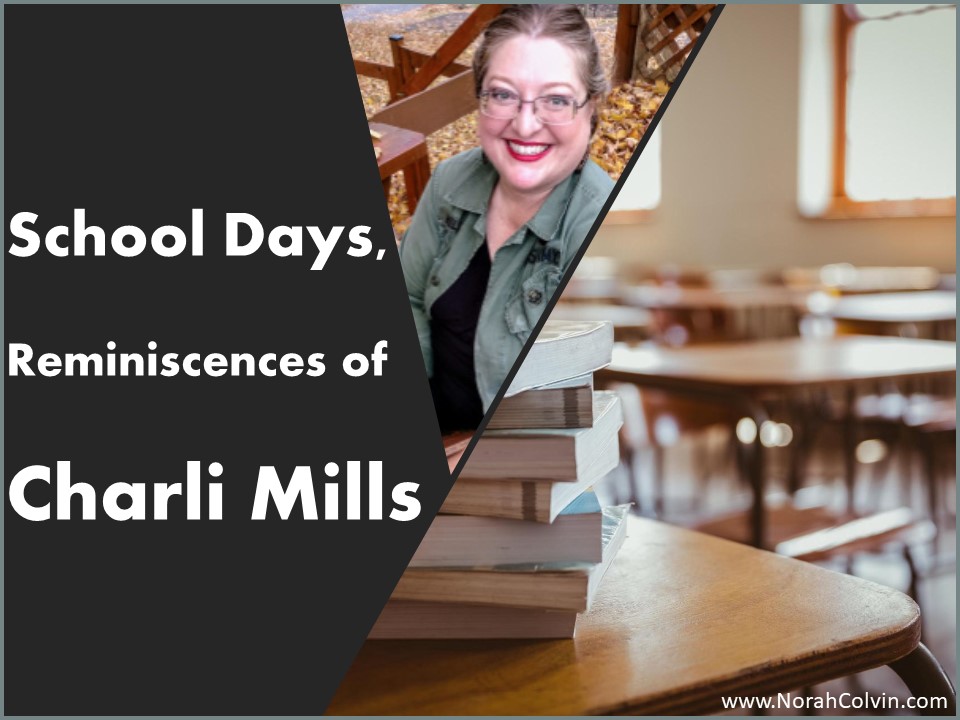
School Days, Reminiscences of Charli Mills
Welcome to the School Days, Reminiscences series in which my champion bloggers and authors share reminiscences of their school days. It’s my small way of thanking them for their support and of letting you know about their services and publications.
First to share her reminiscences is Charli Mills, lead buckaroo at the Carrot Ranch where she challenges writers with a weekly flash fiction prompt and an annual flash fiction rodeo. She believes in the power of literary art to change lives and that it should be accessible to everyone. She encourages writers to find their voice in a supportive environment where everyone is welcome.
I have known Charli for almost as long as I have been blogging and was among the first to participate in her flash fiction challenges when they began five years ago this month. I have rarely missed a week since. Charli’s support and encouragement of my writing and my work has been unfaltering, even when she was experiencing her own tough times, and I am extremely grateful for it. I don’t know how well I may have maintained my yet mindset without her.
Before we begin the interview, I’ll allow Charli to tell you a little of herself:
Charli Mills, a born buckaroo, is the award-winning goat-tying champion of a forgotten 1970s rodeo. Now she wrangles words. Married to a former US Army Ranger, Charli is “true grit” although shorter than John Wayne. She writes about the veteran spouse experience and gives voice to women and others marginalized in history, especially on frontiers. In 2014 she founded an imaginary place called Carrot Ranch where real literary artists could gather where she hosts a weekly 99-word challenge. She’s pursuing her MFA with SNHU, writing novels, and leading workshops to help writers with professional development.
Welcome, Charli.
Now let’s talk school. First of all, could you tell us where you attended school?
Sacred Heart Catholic School (Hollister, California), Sunnyside Elementary (Hollister, California), Diamond Valley School (Woodfords, California), Douglas High School (Minden, Nevada), and Carroll College (Helena, MT).
Did you attend a government, private or independent school?
Sacred Heart was a private Catholic school, and so was Carroll College. I achieved kindergarten at one and a BA at the other. The other three were public schools. Diamond Valley was located next to the Woodfords Community of the Washoe Tribe. Our county was too small in population to warrant its own high school and the mountains cut us off from the nearest California option at Lake Tahoe so we were bussed into Nevada to Douglas High School, which was a horrible experience as we faced much prejudice as the “Alpine kids” even though not all of us were Native American.
What is the highest level of education you achieved?
To date, I’ve earned a Bachelor of Arts degree in English –Writing. However, I’m in the application process to pursue a Masters of Fine Art in Creative Writing.
What work or profession did you choose after school and was there anything in school that influenced this choice?
At Diamond Valley, in 7th-grade, Mr. Price made us write a spelling story once a week using the “prompt” of words from our spelling list. My stories were long and he encouraged me to write them longer. Then he asked me to read my stories aloud to the class every week, and I have loved reading my writing ever since. In high school, I struggled unless writing was involved. Ms. Bateman hit me hard with editing, but also taught me how to improve. She invited me to be on the newspaper team and I was the youngest member. By my senior year, I was co-editor. After high school I waited tables, worked road construction, and wrote for a daily newspaper, dreaming of going to college to be an archeologist and an author. Ten years later, I enrolled in a writing degree when my three young children started school. I often joked that I went back to kindergarten with them. My freelance writing took off while I was still in college. I never did become an archeologist and I worked 20 years in marketing before pursuing my author dreams, but my first novel will feature a character who is an archeologist. It’s all connected to my days at Diamond Valley School, and the skills I honed at Carroll College.
What is your earliest memory of school?
My earliest memory of school is being in trouble. I was highly imaginative and evidently, the nuns did not appreciate my drawings in textbooks. We lived on a ranch outside of Hollister California and my mother worked in town. She’d drop me off at a sitter’s and I’d walk to school every morning with the daughter who was in kindergarten, too. She never got in trouble. I recall wondering why I was so different and why the nuns didn’t like my freedom of expression. At Carroll College, I took an art appreciation class and wrote a paper on my theory of Greek influences on modern pornography. I worried I was going to get in trouble again for expressing my ideas, but the Jesuits loved it. I thought about sending that paper to Sister Margaret at Sacred Heart, explaining that I turned out fine, using my imagination. Not sure she would agree!
What memories do you have of learning to read?
Books captivated me! I wanted to crack the code and would sit and pretend read. The nuns said I couldn’t read so the next grade placed me in remedial reading until the teacher caught me “pretend” reading a chapter book. She realized I wasn’t pretending. How I learned to read mystifies me. I couldn’t grasp the components, but I could read. Math was similar. I had the answers but struggled to show the work. Spelling escapes me but writing flows. Learning was always a frustration in school, yet I was always curious and even now I love to learn.
What memories do you have of learning to write?
Again, learning the actual mechanics of writing was frustrating, but any time teachers let me be creative or pursue curiosity, I could write volumes. Like reading, I just wrote. It wasn’t until high school when Ms. Bateman got a hold of me and drilled grammar into my head, and explained editing as a process. But I also felt it shut down my creativity. I didn’t learn until later how creativity serves as a bridge between my right and left brain. Once I understood that, I’ve made it a point to allow creativity to thrive in my work and writing.
What do you remember about math classes?
Pain and suffering! I never found a saving grace in math because I never found a way to be creative with numbers. In fact, creativity with numbers is frowned upon.
What was your favourite subject?
I loved history because it was full of stories. I’ve been a natural born story-catcher and history seemed to be a part of that. Where I lived was part of the old Comstock Lode and emigrant trails, and I attended school with Washoe students, learning their lore and history. My aunt used to take me relic hunting, and I had a huge collection of arrowheads, trade beads and square nails. I could spot a relic from on top of my horse. I learned to read the human imprint on the land, and when I was 17, I met a state archeologist who legitimized my ability and he coached me to record 11 archeological sites in my hometown area. So, in school, I loved history most.
What did you like best about school?

Skiing. In the winter, we skied once a week at the ski resort near our school for winter PE. It was the best! I don’t know of any other school that ever had such a perk. I remember waking up so excited on ski days. The resort was huge and when we were young, six and seven years old, we were sent to the bunny hills and taught to alpine ski. By the time we were pre-teens we were skiing black diamond routes. I remember #4 best. I loved #4! We’d take the #1 chairlift up, and ski over to the #2 chairlift. At the top of #2, we’d ski down a long, steep and remote mountainside where chairlifts #3 and #4 sat perpendicular to each other. After we skied down #3, we’d take the longest lift at the resort, #4 all the way to the top of a mountain so isolated and remote, it boggles my mind today that we got to do this as school kids. Here’s a link to Kirkwood today: https://www.kirkwood.com/the-mountain/about-the-mountain/trail-map.aspx. When we skied, there were only six chairlifts, but you can see how far away #4 was from the lodge. Funny story – by the time I was in 7th-grade and was writing spelling stories, my good friend Gerald shared his dad’s Ian Fleming novels with me. I went from Little House on the Prairie to James Bond! Gerald was my skiing buddy and we used to make the #4 loop together. We’d pretend we were British spies! Ah, it was good to have someone to share an imagination with. I doubt anyone else who answers this question will ever say skiing.
What did you like least about school?
Mean people. Kids and adults can be cruel and I don’t fully understand why – is it cultural? Is it human nature? The level of cruelty could be stunning at times. I think this is what taught me empathy. Bullies taught me to care about others. If I wasn’t the one being bullied, I found I couldn’t tolerate others being bullied either.
How do you think schools have changed since your school days?
For one thing, I don’t think students are turned loose on ski hills anymore! I think there’s more respect for cultural diversity than when I went to school. Obviously, technology has changed. Diamond Valley is still a small remote school, but it now has an alternative high school, which is a good change. I think bullying is better dealt with now and parents are more involved, perhaps too involved. In the US, the crisis of school shootings is unfathomable to me. Even with all my bad experiences of being bullied and witnessing it, no one was armed. But that mean spirit was always there and now it has access to guns and that is terrifying. Hopefully, education continues to be important as technology changes our societal landscapes, and through education, we can resolve this shameful American blight on our school system. Maybe we need to focus less on gun control and getting more to the heart of abuses of power in our nation. We need to heal from institutions of slavery and Native American genocide. We need less division and more dignity.
What do you think schools (in general) do well?
I think schools provide inroads to learning that are valuable to becoming productive and happy human beings. Schools are amazing, really. They have been a part of what is America at its worst and what is America at its best. Schools do well to create environments where real learning takes place.
How do you think schools could be improved?
Most importantly, schools need to be safe. Early on, we need to give children the gifts of education and not the burdens. I think citizens should be involved in their public schools even if they don’t have children. How can we be part of the improvement? I don’t have the answers, but I’m willing to be a part of solutions. I support EveryTown for Gun Safety, and until we deal with the hardest cultural issues in our nation, it doesn’t matter if our schools achieve awards or graduate students who score well on tests.
Thank you for sharing your reminiscences of school and thoughts about education in general, Charli. It’s been wonderful to have you here. I learned so much I didn’t already know about you.
Find out more about Charli Mills
at the Carrot Ranch: https://carrotranch.com/
and on her Amazon Author Page: https://www.amazon.com/Charli-Mills/e/B078FV6JGB
Connect with her on social media
Facebook Page: https://www.facebook.com/CarrotRanch/
Twitter: https://twitter.com/charli_mills
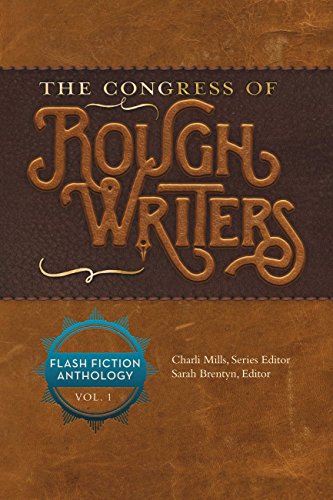
Purchase your own copy of
The Congress of the Rough Writers Flash Fiction Anthology Vol 1
via the Carrot Ranch bookstore: https://store.bookbaby.com/book/The-Congress-of-Rough-Writers
Participate in a
Carrot Ranch Writing Refuge (Keep updated at the Ranch)
Look for future interviews in this series to be posted on Sunday evenings AEST.
Coming soon:
with more to follow.
Thank you for reading. I appreciate your comments. Please share your thoughts.
Share this:
-
Beach adventures and sea mist
Growing up near the beach
Beach adventures were a big part of my childhood. I spent many long days swimming, sunbaking and exploring with friends and siblings at the beach no more than 500 metres from home. Generally, the instruction was to be home by tea time so, on our long summer holidays, we could spend as much time on the beach as we liked.
It wasn’t the most beautiful of beaches. The sand was coarse and yellow and the shore rocky in places. The water was often filled with jellyfish and seaweed. The narrow beach was edged by tall red cliffs which prompted Captain James Cook to name the area Redcliffe when he passed by in 1770. But we loved it anyway.
There were huge cotton trees, as perfect for climbing as the red cliffs were for scaling, and a playground with swings and slides, many of which are no longer considered child-safe. But we survived.
We’d explore the rocks for sea life, avoiding the jellyfish and seaweed as best we could, both in and out of the water. We’d play in the water and on the sand and lie on our towels talking, laughing and dreaming of whatever we did as children back then.
Sun safety
It may sound idyllic and perhaps it was, though to us, it just was. Most of us are now paying for those long days at the beach with sun damaged skin. If anyone was aware of the dangers of being too long in the sun back then, we certainly weren’t. We considered a bad dose of sunburn as nothing more than inconvenient and we took turns to peel layers of skin off each other’s backs when the blisters burst.
Nowadays, my beach adventures are mostly confined to observations of sparkling white sands and perfect blue water from a shady deck with a cool drink in hand. However, I may venture out for a stroll in the late afternoon when the sun’s light has dimmed, leaving the water and sky to meet and greet in shades of pink and lilac.
Our Australian culture has a love-hate relationship with the beach and sunshine. At the first hint of warm summer weather, we’ll be told it’s a great day for the beach and we’ll be presented with images of beaches crowded with sunbathers. On another occasion, we’ll be advised to stay out of the sun and avoid the damage to our skin. Queensland is, after all, the skin cancer capital of the world. I’ve never figured out why we don’t get a more sensible approach that combines enjoyment with safety.
But let’s not dwell too long on the negatives. Hopefully now with better education and the availability of protective products, the younger generation will not be so nonchalant about time spent in the sun.
A beach excursion
A beach excursion, whether with school or family, presents as many opportunities for learning as it does for fun. There are phenomena to inspire wonder and stimulate curiosity, and countless questions to ask and answers to discover; for example,
Ten beach-inspired questions
- What makes the waves?
- Why does the tide come in and out?
- How is sand made?
- Where do the shells come from?
- Why does the sand squeak when we walk on it?
- What lives in the ocean?
- Why should we take our rubbish home with us or put it in a bin?
- How do fish breathe?
- What made these tracks on the sand?
- My sandcastle was here this morning. What happened to it?
Some answers can be discovered through investigation and exploration at the beach. Others require research.
Three fun beach activities that involve learning
Shells are not only fun to collect, they are great for sorting and counting, measuring and making, creating patterns and trading.
Fish might be fun to catch (for some); but they can also be identified, measured and weighed. Children can research the different types of fish and regulations for catching them.
Photographs provide a great record of beach adventures. Children can be encouraged to compile them and write a recount or report about the outing.
And of course, there are always wonderful books to read about the beach; such as:
Ten beach or ocean themed picture books
The Magic Beach by Alison Lester
Where the Forest Meets the Sea by Jeannie Baker
Circle by Jeannie Baker
The Hidden Forest by Jeannie Baker
The Rainbow Fish by Marcus Pfister
Mister Seahorse by Eric Carle
One Less Fish by Kim Michelle Toft
Coral Sea Dreaming by Kim Michelle Toft
Neptune’s Nursery by Kim Michelle Toft
Swimmy by Leo Lionni
Beach-inspired flash fiction
I was taken back to the beach this week by the challenge set by Charli Mills at the Carrot Ranch to In 99 words (no more, no less) write a story about sea mist. How does it create an environment for a story? It can set the stage or take the stage. Go where the prompt leads.
This is my response. I hope you like it.
Canned Sea Mist
No more than a hint of sea spray and she was flown back on wings of joy to carefree childhood days frolicking in the shallows, basking on golden sands, fossicking for hints of life in rockpools and amassing precious collections of shells and other treasures arranged for her pleasure by the tide. Lulled by a gentle breeze and waves whispering a heart’s rhythm, she dozed, uninterrupted by seagulls squawking, murmured conversations, hushed laughter, or the shuffle of approaching and receding footsteps. As the sun glowed bright above, she sighed her last, now and forever one with the sea’s mist.
Thank you for reading. I appreciate your feedback. Please share your thoughts.
Share this:
-

Don’t give up – Yet!
Discussions of the importance of having a ‘yet’ attitude or a growth mindset abound, including on this blog. I am very much in favour of the ‘yet’ thinking, as proposed by Carol Dweck.
Basically, it means that we don’t consider our ability to learn as finite. We believe our potential to be constantly expanding. We may not know or be able to do something ‘yet’, but we can work at it and with each attempt come closer to achieving it.
The resolve to maintain a growth mindset can be challenged at times when the going gets tough and there is no obvious solution. It can be difficult knowing when enough is enough and it’s time to move on; or if success is hiding just around the corner or on a slight detour.
I often debate with myself about how to interpret the truth in the messages the universe seems to be sending, weighing up giving up against exerting just a little more persistence and patience. Consequently, I shouldn’t have been surprised by the unplanned theme in my response to the flash fiction prompt at the Carrot Ranch this week.
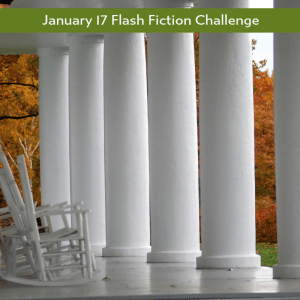
Charli Mills challenged writers to In 99 words (no more, no less) write a story that includes colonnades. It can be natural, architectural, or a metaphor. Take a stroll and go where the prompt leads.
What could colonnades possibly have to do with a growth mindset you might think, as would I. But when I sat at the keyboard, without a clue of what to write, this is what developed. I hope you like it.
Never Give Up
The solid grey wall stretched without end, both left and right —impenetrable, no way around, no way through. Perhaps a way over? Even from that distance, it appeared unscaleable.
He removed his backpack and rested his head upon it as he lay, gazing upward. He sighed heavily. He’d trekked so far believing this was the way. How could he have been so wrong?
He closed his eyes and drifted into a deep sleep. Refreshed, upon awakening, he decided to continue rather than retreat.
As he drew closer, the wall separated into columns spaced perfectly to allow an easy passage.
…
Do you see what I saw emerge? A story about not giving up? Of the importance of adjusting focus when it seems a dead end is reached, when there’s nowhere else to go and nothing else to try? Or is the theme significant to only me as I try to find a way through the colonnades in my path?
As I was writing this story, I was reminded of one I wrote for children using the nursery rhyme Humpty Dumpty as a stimulus. In a similar way to Charli’s prompts, I was prompting children to think about possible reasons for Humpty Dumpty to be sitting on a wall and causes for him to fall.
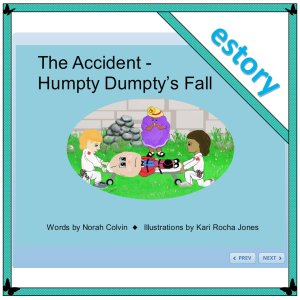
Of course, I couldn’t do the prompting without writing a story of my own: The Accident – Humpty Dumpty’s Fall.
In the story, ‘Humpty looked at the wall. He couldn’t see through it. He couldn’t see over it. And there was no way around it.’ He thought it was ‘no use’. Fortunately, his friend Pomble wasn’t one to give up quite so easily and found a way for them to see over the wall. It was what occurred when Humpty was looking over the wall that caused him to fall. I won’t tell you what happened but, unlike the nursery rhyme, my story has a happy ending.
Thank you for reading. I appreciate your feedback. Please share your thoughts.
Share this:
-
Multicultural Children’s Book Day: Book Review – Readilearn
Now in its sixth year and held on the last Friday in January, Multicultural Children’s Book Day (MCBD) celebrates books that celebrate diversity. As classrooms are increasingly filled with children from a diversity of backgrounds, it is important to provide them with books that reflect their lives, books in which they can find themselves.
The purpose of Multicultural Children’s Book Day is to create awareness of books that celebrate diversity and to get more of them into classrooms and libraries.
Valarie Budayr and Mia Wenjen, co-founders of MCBD, define multicultural books as:
- Books that contain characters of color as well as main characters that represent a minority point of view.
- Books written by an author of diversity or color from their perspective. Search #ownvoices to discover diverse books written by diverse authors.
- Books that share ideas, stories, and information about cultures, race, religion, language, and traditions. These books can be non-fiction, but still written in a way that kids will find entertaining and informative.
- Books that embrace special needs or even “hidden disabilities” like ADHD, ADD, and anxiety.
Multicultural Children’s Book Day provides us with an opportunity to examine the collections of books in our classrooms and libraries to determine if they reflect the lives our children.

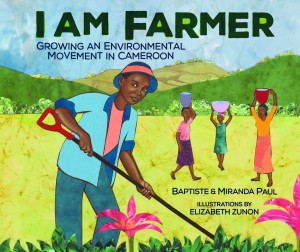
This year, for the first time, I am participating in the MCBD celebrations with a review of I am Farmer, a picture book written by Miranda and Baptiste Paul and illustrated by Elizabeth Zunon. I am grateful to Miranda and Paul and publisher Millbrook Press for providing me with a link to access the book on NetGallery prior to its publication in early February.
Continue reading: Multicultural Children’s Book Day: Book Review – Readilearn
Share this:


 Norah Colvin