Live Love Laugh Learn … Create the possibilities

Category: Early childhood education

  • Asking and accepting help

    Last week I shared with you the post in which Charli Mills acknowledged that the Carrot Ranch was in Crisis. She admitted that, although she doesn’t like to ask for help, she needed it. She explained not only the type of help she required, but also the ways in which she is able to help others. I know many of you popped over to the Carrot Ranch to read Charli’s story and lend a helping hand. I sincerely thank you for doing so.

    Difficulty in asking for help is something from which many of us suffer. The reasons are probably quite complex and may differ depending on the circumstance; for example, we may not:

    • wish to inconvenience others
    • consider ourselves worthy, there are always others with greater need
    • know who or how to ask
    • wish to admit that we can’t do it on our own, that we’re not perfect, not coping, or can’t do it all.

    We may:

    • fear rejection
    • or fear making our vulnerabilities obvious when we had tried so hard to obscure them.

    Of course, once one asks for help, then one must be prepared to accept kindness from others. Again, this is not always easy.

    Susan Bruck who blogs at To Wonder at Beauty admitted as much in her recent post Appreciating kindness — the Practice of Gratitude.

    Susan says, “I used to feel that I had to do everything myself.  I never thought I was perfect, but I wanted other people to think I was.” She says that she needed to learn how to accept that making mistakes was a part of life.

    In the post, Susan shares some quotes from Brené Brown’s book The Gifts of Imperfection: Let go of Who You Think You’re Supposed to Be and Embrace Who You Are, including this one:

    “One of the greatest barriers to connection is the cultural importance we place on “going it alone.” Somehow we’ve come to equate success with not needing anyone. Many of us are willing to extend a helping hand, but we’re very reluctant to reach out for help when we need it ourselves. It’s as if we’ve divided the world into “those who offer help” and “those who need help.” The truth is that we are both.”

    Barbara Vitelli who blogs at Book Club Mom also confessed her reluctance to ask for help in a post entitled The Art of Asking, using the title of  Amanda Palmer’s book, which she reviews. Although the title appealed for its “self-help” potential, Barbara considers herself to have been misled as it is “mostly a memoir about Palmer’s performance and music career.” I guess this demonstrates, in part, that admitting help is required, if only to oneself, doesn’t always bring forth the assistance required. We need to know where to look and who to ask.

    Barbara alerted me to a  TED talk by Palmer about the art of asking.

    Palmer talks about her time as a street performer, then as a musician when she asked her fans for a place to sleep, for food, and for musicians to support her performances. She talks about making her music available for free, and explains the difference between making people pay, and asking people to pay. My son-in-law has been telling me about this concept for some time as he uses it for music he performs and purchases.

    Three other organisations that do something similar by requesting financial support rather than payment by subscription are Wikipedia, The Conversation, and Brain Pickings . I’m sure there are others but these ones came immediately to mind.

    Launching soon - readilearn2

    As readilearn, my website of early childhood teaching resources, moves ever so slowly towards launch day, these ideas have got me thinking about my decision to go with a subscription model. My intention is that some resources will be available free to registered users, but the majority will be available through an annual subscription of $25.

    I’m not about to change my mind, but I wonder how well it would work if I was to ask users to pay on an honour system, as others do. Of course I don’t have a following like Palmer’s fan base, or a readership to match Wikipedia. How useful others will consider my resources is yet unknown.

    It will be impossible for me to ensure that users of my site don’t share with others or keep resources after their subscription expires. It’s just the way it is in the digital world, and with teachers. I know that. In this way I am already placing a certain amount of trust in people’s sense of fairness. I hope they consider my price fair, and that they will treat me fairly in return.

    It is an interesting concept. It is often said that you only get what you pay for. If you don’t have to pay, will you? Everybody loves to get something for nothing, don’t they? It would be interesting to be able to compare two similar (small) projects, one with a set price, one with an honour system.

    What do you think? Do you find it easy to ask for help, or are you in the reluctant boat? Have you ever put your hand out and asked for help? Have you used an honour system of payment, either in a project of your own, or when using the products of someone else? Do you consider, as Palmer does, that the honour system of payment is similar to asking for help?

    Thank you

    Thank you for reading. I appreciate your feedback. Please share your thoughts.

  • Recipes for the classroom

    cooking banner
    © Norah Colvin 2016

    As completion, and therefore launch, of readilearn, my website of early childhood teaching resources approaches, it has become obvious that some categories are less well-resourced than others.

    I consider food preparation to be a great way of involving children in learning that is fun, purposeful, integrates curriculum areas, and develops skills that can be applied in everyday life. I have previously written about learning in the kitchen with suggestions for parents at home.

    In the introduction to the readilearn cooking resources I write

    Cooking, including food preparation that doesn’t include any heating, is a great way to teach life skills and integrate learning in a meaningful and enjoyable way across curriculum areas. When children are involved in food preparation they may be developing:

    • Social skills of cooperation, turn taking, sharing, patience
    • Literacy skills – reading and following the recipe, selecting ingredients, writing a menu and invitations, writing a recount, writing a shopping list
    • Mathematics – counting e.g. the number of eggs, measuring with spoons and cups, measuring time, sharing (e.g. the number of cookies, how many slices to make)
    • Science – mixing, adding or removing heat
    • Safety – with knives, peelers and hot implements and ingredients
    • Social Studies: Culture – when preparing ethnic food

    readilearn materials are designed to engage children in activities that are both fun and purposeful, with opportunities for learning across the curriculum in a meaningful context.

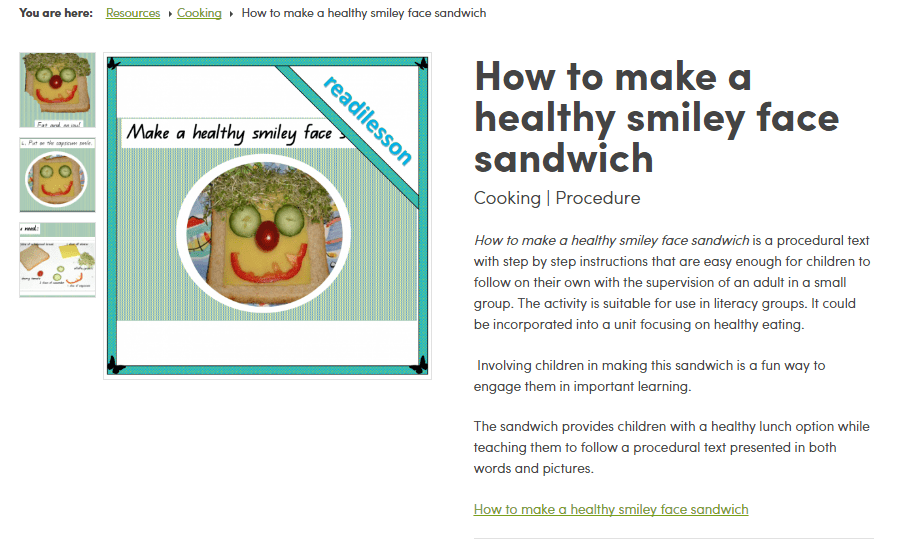
    I was disappointed to realise that I had only one cooking resource prepared: How to make a healthy smiley face sandwich

    © Norah Colvin 2016
    © Norah Colvin 2016

    A remedy was required and I tried to think of other resources I could add.

    I have previously made ladybird biscuits by icing an Arrowroot biscuit and adding Smarties for spots. I will probably add that recipe in the future, but I was trying to think of something healthier to begin with. I wondered if it might be possible to make a ladybird from an apple. This is what I did:

    © Norah Colvin 2016
    © Norah Colvin 2016
    © Norah Colvin 2016
    © Norah Colvin 2016
    © Norah Colvin 2016
    © Norah Colvin 2016
    © Norah Colvin 2016
    © Norah Colvin 2016
    © Norah Colvin 2016
    © Norah Colvin 2016
    © Norah Colvin 2016
    © Norah Colvin 2016
    © Norah Colvin 2016
    © Norah Colvin 2016
    © Norah Colvin 2016
    © Norah Colvin 2016
    © Norah Colvin 2016
    © Norah Colvin 2016

    When I made one for my grandson on the weekend, I was pleased that he recognised it as a ladybird beetle, even without the spots!

    Unfortunately, it’s more suitable for an adult to make for a child than for children to make for themselves. Apples are too difficult for young children to cut. It is therefore not suitable for readilearn. However, I had fun making it and will continue to think of other recipes I can add to readilearn’s cooking collection.

    Thank you

    Thank you for reading. I appreciate your feedback. Please share your thoughts.
  • A bunny breakfast

    Kimmie's rabbit

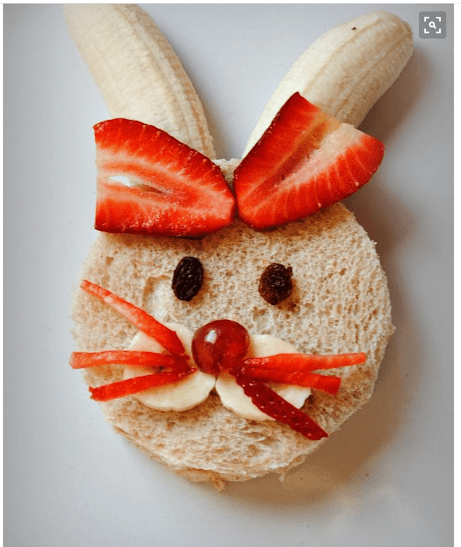
    A little while ago Kimmie, who blogs at Stuck in Scared, posted this lovely picture of a creative breakfast she made for her Littlie on Easter Sunday. It is not only visually appealing, it is delicious and nutritious.

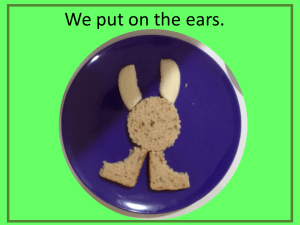
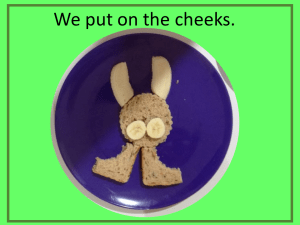
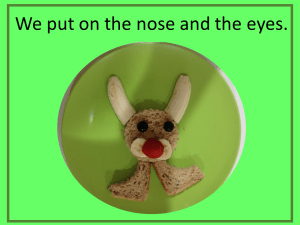
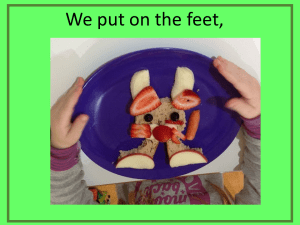
    When my grandchildren visited for a sleepover recently, I thought they’d enjoy making their own for breakfast. We discussed it the evening before and they were excited to do so, adding their own suggestions and insisting that the ingredients be listed. G2 decided to write the list and I helped her decide, or simply told her, what letters were required.

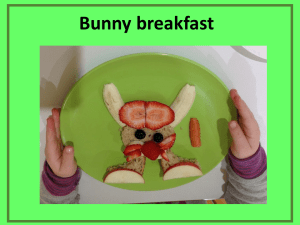
    This is our version.

    Slide1

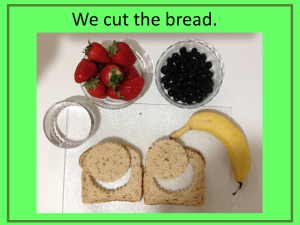
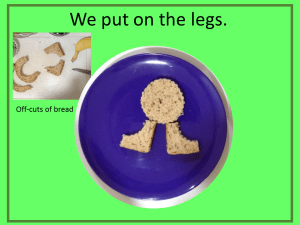
    This is what we did. (I did the cutting. G2 did the decorating. G1 played with his dinosaurs. Both children ate!)

    Slide2

    Slide3

    Slide4

    Slide5

    Slide6

    Slide7

    Slide8

    Slide9

    Slide10


    Slide11

    Slide12

    Slide13

    Slide14

    Such a simple but enjoyable activity with a nutritious reward at the end.

    Thank you Kimmie for the inspiration!

    Thank you

    Thank you for reading. I hope it didn’t make you feel too hungry! I appreciate your feedback. Please share your thoughts.
  • 3 + 2 = 5 Let me count the ways!

    Billboards

    That we live in a print-rich environment is undisputed. Even in country areas one cannot travel far without being bombarded by print. In addition to road signs there is a plethora of billboards advertising the best places to sleep, eat, or play that can be found just ahead.

    Environmental print is the genre with which many children first engage successfully with reading.  Ask any parent who’s detoured around fast food outlets, hidden shopping catalogues, or camouflaged cheaper brand names of identical products.

    That we are immersed in mathematics in our daily lives is just as evident but doesn’t always receive the same recognition. I think this may in part be because people often think of mathematics as abstract algorithms and theorems that we (they try to get us to) learn in school; and that have no apparent application to our lives beyond the walls of the classroom.

    algebra

    However, even the examples mentioned above are just as rich in mathematics are they are in print. They include distances, and perhaps time, to the destination, cost of items, opening hours, and number of attractions. Anyone travelling a distance with young children will have answered questions such as “Are we there yet?”, “How much further?”, and “What time is it?

    As I say in my statement about mathematics on my readilearn site,

    “Mathematics is all around us. We use it every day for a huge range of purposes from deciding on the sequence in which we dress ourselves, to calculating how much time we have available for an activity.”

    mathematics readilearn

    One of the resources suggests 25 ways for parents to keep their children thinking mathematically over the school holidays. I have shared these ideas previously in Counting on the holidays.

    25 ways to think mathematically

    Recently I was at the gardens with my two grandchildren (G1 and G2, aged 6 and 4), their mother, and my Hub. The children consulted a map and signposted paths to follow the Children’s Trail which had various sculptures along the way. I am undecided about the value of distracting children from the trees and plants, as if the vegetation itself would not be interesting enough. However, the children enjoyed locating the sculptures in the sequence numbered on the map, and reading the accompanying information. They were engaged in purposeful reading and mathematical thinking in context: real life learning!

     © Norah Colvin 2016
    Pandas on the Children’s Trail © Norah Colvin 2016

    As we headed back, G2 made a comment that showed she was engaged in mathematical thinking of her own. She observed that there were two children and three adults, which made five of us all together.

    “That’s right,” I confirmed. “There are five’. I thought for a little while, then added, “And do you know what? As well as two children and three adults, there are two boys and three girls.” The children looked at the group and confirmed that I was right. They laughed – a different interpretation.

    This gave me an idea for a thinking game: how many other arrangements of three and two could there be?  I wondered if the children would like to play along. I had never attempted this before and had no idea if there’d be more, or if we had already exhausted all options.

    I looked at the group. I noticed our shoes: three had closed shoes and two had open shoes. I thought about our names: three shared one surname, two another. Then we were on. Everyone was thinking of ways we could be arranged into groups of two and three.

    Sometimes we sorted according to different characteristics, as in the previous examples. Others times we used a simple yes or no sorting, such as two have hats with brims and three don’t have hats with brims. This is the easiest sorting to do, and the first that children learn.

    G2 made many suggestions of this type of sorting for one and four.  One has the characteristic, the others don’t. This was age appropriate for her, and it was great to see her joining in confidently and contributing to the discussion. G1 was able to engage in the more complex thinking required for the groupings of three and two.

     I was amazed at the number of different combinations we came up with, and that each of us was combined with others in many different ways.

    These are some of the ways we arranged ourselves into groups of two and three (not physically, just in our discussion).

    Arranging ourselves 3 + 2

    This seemingly mundane activity has potential for developing thinking and learning by encouraging:

    • thinking about things in new and different ways
    • looking for similarities and differences
    • observing detail
    • sorting according to different characteristics – which is important to both maths and science (think animal and plant classification)
    • having fun with maths
    • having fun with family

    But wait, there’s more: When we left for home, two went in one car and three in the other!

    I think this would be a great activity to do with young children learning about number. It may be a challenge for teachers in Australia where children wear uniforms to school but I’m already thinking of how it could be done with toys or illustrations. It’s not quite the same as doing it with the children themselves, but it could be fun. What do you think?

    teddy bear sorting

    You won’t be surprised to discover that I have prepared a readilearn resource for sorting as well!

    Thank you

    Thank you for reading. I appreciate your feedback. Please share your thoughts.


  • Eroding thoughts

    Uluru © Norah Colvin 2015
    Uluru © Norah Colvin 2015

    This week at the Carrot Ranch Charli Mills is talking about erosion, but not just the literal kind. She says “It can be natural, cultural or something different.” Of course I must answer my usual call to tackle the “something different”.

    Generally, erosion refers to the wearing away of the earth. Sometimes it signifies the disintegration of our resolve, our self-image, or of our spirit. Just as various strategies can be employed to prevent erosion or to repair damage incurred by the land, there are strategies that can be used to shore up one’s resolve, build self-esteem, and mend a sagging spirit.

    rejection slip

    Perhaps nobody knows this better than writers with their stashes of rejection slips rated from encouraging to just plain rude, or non-existent. Few have achieved success without first receiving a downpour of those slips, who haven’t had to work at their skills and accept the edits without eroding their intended message. Sometimes it seems that, with every move, one lands on the “Go back to start” square; and that, while it feels like things are in motion, the end doesn’t appear any closer.

    go back to start

    Or maybe nobody understands the fragility of the spirit and self-esteem more than does a teacher; and of the importance of building on prior learning to take children from where they are to places they haven’t thought possible; to ensure their esteem stays strong and is not eroded by unrealistic expectations and the tedium of a repetitive diet of something meaningful only to others.

    Welcome pack
    Welcome pack

    I have written many times previously about the importance of establishing a supportive classroom environment, and of using affirmations in growing children’s confidence and self-image.

    This doesn’t mean a diet of empty praise, but it does mean that all individuals are recognised for what they can do, and are valued for the contribution they make to the classroom community. Included in these writings was a series, inspired by a Twitter discussion with Anne Goodwin, on praise culminating in Seeking praise – Stephen Grosz revisited and including a guest post by Anne.

    The Clever Children Resource

    I have also developed resources to support children’s growing confidence and self-image for inclusion on my in-progress website readilearn. One of these resources is a story called The Clever Children which teachers can personalise for use with their own class.

    The Clever Children printable

    Children write about and illustrate something they can do. The pages are then added to the story which is printed and collated into a book which can be placed in the reading corner or taken home to read to parents and siblings.  My children always loved being a part of this story. I am looking forward to other children being a part of it too. The story aims to build, rather than erode, self-esteem and a love of books and reading.

    Which brings me back to Charli’s challenge to In 99 words (no more, no less) write a story, using the power of erosion.

    The Nature Principle

    For my flash I combine two ideas:

    • Richard Louv’s suggestion in The Nature Principle that, for physical and mental health, we need to be more attuned with nature
    • the need for resolve and inner strength when faced with issues that would erode it.

    It’s not really a story, perhaps, but a moment in time. I hope you enjoy it.

    1 (7)

    The rock

    The rock, promising permanence, beckoned: perfect for contemplating expanses beyond while pondering life and one’s significance. She sighed, and succumbed. The waves, licking repetitively at the base, soothed somehow; as if each grain of sand stolen from beneath her feet loosened her tension. Becoming one with the rhythm, her heart sang the melody as her mind slowed, releasing all thought. Feeling whole again, as solid as the rock, and with renewed strength, she prepared to face those who sought to erode her. Though tides would rearrange and redecorate, and often do their best to annihilate, they could not obliterate.

    Thank you

    Thank you for reading. I appreciate your feedback. Please share your thoughts.

  • Bug me, please!

    Monarch butterfly

    That I have an appreciation of and fascination with insects is no secret as I have written about it many times previously.

    The Very Hungry Caterpillar

    Some of my earliest posts formed a series in which I suggested using Eric Carle‘s Very Hungry Caterpillar story for developing critical literary, encouraging children to question the authenticity of what they read and the qualifications and intentions of the author.

    Carle’s purpose with the story was to entertain, not to teach, and he was therefore unconcerned about inaccuracies in the butterfly life cycle.

    The book, popular for its bright colourful illustrations and inspiring story of an ordinary caterpillar who becomes a beautiful butterfly achieves the author’s goal to entertain.

    In a more recent post Revisiting The Very Hungry Caterpillar I provided a summary of, and links to, each of the four original posts which explained my recommendation that this very popular book was more relevant to teaching critical literacy than science.

    © Bec Colvin
    © Bec Colvin

    Acknowledging the importance of maintaining Wondering in the everyday and an attachment with nature in wild spaces, I described my excitement at being able to observe every stage of the ladybird’s life cycle up close in my own backyard; an excitement that had perhaps exceeded observing the butterfly life cycle in the classroom with our live butterfly kits which had allowed us to Breathe – a sense of wonder!  I even shared a section of a television interview in this post about Talking Interviews.

    I talked about some insect themed classroom and teaching resources in The comfort zone. Others are listed on my page Early Childhood Teaching Resources and are available in my Teachers Pay Teachers and Teach in a Box stores. These, and many more, will be available on my readilearn website when it launches later in the year. Here is a sneak peek at some that will be included:

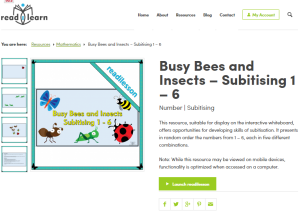
    9 square insect puzzle Busy Bees 100 chart Busy Bees and Insects subitising Busy Bees birthday chart Busy Bees Celebrate 100 days of school One Lonely Ladybird

    But the truth is I don’t really love all insects. I’m not too keen on cockroaches, though the native Australian giant burrowing cockroaches are pretty cool. And although I am aware of vital roles of insects in the environment

    • as a food source for many animals
    • as pollinators for flowering plants
    • as decomposers

    and I know that without them we’d basically not have an environment, in fact, we wouldn’t be; I often wonder whether we would be all that worse off without disease-spreading mosquitoes and flies. However, it seems that they too are vital to the health of our planet, whether we like them or not. It’s a bit of a “can’t live with them and can’t live without them” situation.

    This brings me to the flash fiction prompt set by Charli Mills of The Carrot Ranch this week. She has challenged writers to In 99 words (no more, no less) include insects in a story. How could I resist? In fact, the real challenge was choosing what to put in and what to leave out of the post, and how to not be predictable in my response.

    Surprise!

    It took just one, then the word was out. The streets were abuzz with the news – a triumph of social media.

    “Kyle’s having a barbecue. Tell everyone. Don’t bring anything. There’s always plenty.”

    The excitement was palpable as guests swarmed towards Kyle’s. Some, initially unsure, flapped about nervously. Others, more experienced, felt they were dancing on the ceiling. Eventually all were on their way.  The waft of seared flesh left no doubt about the location.

    Kyle was ready when they arrived. “Who invited you?” he grinned and waved, as he knocked them out with the can of spray.

    Well, what would you do?

    #9 on this list of Ten thing about flies you may not know says,

    “The use of pesticides on crops to try to kill flies and insects is actually causing more damage to the ecosystem than the flies themselves.”

    It’s something to think about next time you reach for that fly swat or can of insect spray.

    I’ll leave you with a bit of nostalgia with a television advertisement, starring Louie,  from my childhood days.

    Thank you

    Thank you for reading. I appreciate your feedback. Please share your thoughts.

  • Welcome to my world

    www.openclipart.org
    http://www.openclipart.org

    When children enter school for the first time it takes a while for them to adjust to the unfamiliar culture and environment which pertains only to school. They need to settle in, get used to the new routines, and understand what is and is not allowed.  A supportive classroom environment with established procedures for welcoming new students makes for a smoother transition.

    Children also need to be familiarised with the physical surroundings so that they are able to confidently navigate their way to, from and between their classroom and places like the amenities block, the office, the canteen, the library, and the playground.

    Students moving from one school, or even one class within the same school, to another, also require a period of adjustment. While some understandings of the culture from the previous situation may be transferrable, there will be some aspects which are unfamiliar. No two classes or schools are identical or have the same set of rules and expectations.

    school rules

    I saw the difficulty experienced by each of my children when the newcomer in an established group. While both were confident and resilient children, verbally able to express themselves, both struggled initially to find their place within already established friendship groups that were comfortable and confident in their familiar surroundings.

    My son changed schools at the beginning of his second year at school and was the only addition to an existing class. A more sensitive teacher with established procedures for welcoming new students may have eased his transition. Although, due to delivery delays, he was wearing his previous school’s uniform, his teacher failed to realise that he was new to the school and class and did nothing to help him integrate into the group or to familiarise him with school procedures and facilities.

    ist day of school
    Bec’s first day of school © Norah Colvin

    The situation for my daughter was a little different. Her first experience of school was at age nine when she entered year four. Although I had explained what she might expect, everything about the culture and the environment was unfamiliar. While her teacher was a little more sensitive and did what she could to help her settle in, there was much about the established culture and environment that others took for granted.

    When we are familiar with and comfortable in a situation it can be easy to forgot how unfamiliar and daunting it can be to someone new to an environment in which nothing can be taken for granted, nothing is known for sure.

    I always established a welcoming classroom but the experiences of my own children confirmed its importance. If they, as members of the majority culture, found it difficult, how much more difficult would it be for those from minority groups.  I suggest that every teacher should have in place procedures for welcoming new students.

    image courtesy of www.openclipart.org
    image courtesy of http://www.openclipart.org

    Here are just a few suggestions:

    Welcoming a new class of students at the beginning of the year:

    • Provide many opportunities for students to get to know each other through group activities, discussion circles and paired work with many different combinations of children
    • Explain expectations and rules. It is no fun being chastised for a misdemeanour that resulted from lack of knowledge as opposed to poor choice
    • Take students on a walk around the school showing them places they will need to visit (as well as any places they are not allowed); for example:
      • Toilets
      • The office
      • The library
      • The playground
      • The canteen
      • Where to eat lunch, and to dispose of their rubbish
      • Where to line up
      • Where to place bags and other belongings

    school directions

    Procedures for welcoming new students throughout the year may differ slightly. It is not always practical to repeat the same procedures that were used when familiarising an entire class.

    However, students still need to have the expectations explained to them, as some may differ from what has already been experienced, for example: are they required to put up their hands for individual release when the play bell rings or are they dismissed for play en masse; do they keep their water bottles on their desks or are they stored somewhere else; do they line up with a row of boys and a row of girls or are the rows mixed?

    I always found it a useful practice to include newcomers when messages were sent to the office, the canteen or the library, for example. This would help children get to know and be known by other school personnel, as well as get to know their way around the school.

    https://openclipart.org/image/800px/svg_to_png/192642/Children_holding_hands.png
    https://openclipart.org/image/800px/svg_to_png/192642/Children_holding_hands.png

    Until their own friendship groups were established I ensured there was a friend to “look after” them at break time, showing them where to sit, where to play, where to line up and, especially, to play with them. There were always plenty of willing friends.

    I have been thinking about the importance of showing students around the classroom and school this week in response to the flash fiction challenge at the Carrot Ranch. Anne Goodwin, author of Sugar and Snails, took over the reins from Charli Mills this week, prompting writers to compose a 99-word flash on the theme of showing someone around a property As usual the prompt allows for a variety of interpretations and Anne suggests that we not let out imaginations be confined by four walls.

    I never like to think of imaginations being confined and in recent posts I have talked about the importance of imaginative play, even introducing many to a new term: loose parts play.

    I decided to play with loose parts this week, and include a welcoming environment. It occurs in a home, rather than a school. I hope you enjoy it.

    New world

    Thinking it much too quiet, Sally excused herself from the conversation.

    She peeked through the door. A sheet was draped from the top bunk to the curtain rail. The drawers were stacked staircase-like, their contents piled high in the corner. Emily, adorned in crown and cape, watched Jessica, in cowboy boots, fossick in the overturned toy box. Max sat nearby reading to assorted stuffed animals. All three sensed Sally’s presence simultaneously.

    “Mum! Look what we made!” beamed Jessica. Sally suppressed her initial reaction: mess.

    “Come in. We’ll show you! This is our cave. This is our mountain …”

    Thank you

    Thank you for reading. I appreciate your feedback. Please share your thoughts.

  • Let them loose

    johnny_automatic_playing_dress_up

    It is a wonderful thing to see children engaging in imaginative creative play. Let them loose with an assortment of bits and pieces and it’s amazing to see what they can construct, both physically with the equipment and in the ways they interact with their constructions, creating imaginative worlds and stories.

    A fabric offcut might be a cape, a veil, an apron, a dress, the sail of ship, a red carpet, or the curtain for a puppet theatre.

    A cardboard box might be a car, a home for a pet, a high-rise building, an explorer’s ship or a magician’s table.

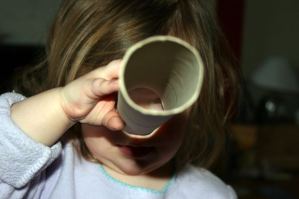
    A cardboard tube might be a ship’s funnel, a car’s garage, a railway tunnel, a fairy wand, or a telescope for gazing at the far-off stars and planets.

    www.morguefile.com
    http://www.morguefile.com

    Anything can create magic in a child’s imagination. Sometimes the cheapest things can offer the most value. You only have to watch a young child discard the expensive toy and spend hours playing with the wrapping and packaging materials to see this.

    Of course there is value in construction sets and other toys that allow children to imagine and create. However, a cardboard box decorated by the child can be as effective an oven as a fancy store bought one. And while most construction sets come with suggestions of what to build, it is best to put the instructions away and let the children discover for themselves what they can create, and how to incorporate the materials into their play.

    While learning to read and follow instructions is an important skill, making only what someone else has already created stifles the imagination and can even suppress the willingness to try, especially if the instructions and constructions are too difficult for the child, and sometimes even the adult, to follow.

    I expect young children to have ready access to a variety of materials, as well as opportunities to use them to support their play, both at home and in educational settings they attend. It is something I take for granted as being fundamental to early childhood development. It’s always been, and hopefully will always be.

    I was surprised, therefore, when I recently came across an unfamiliar term and theory for describing this type of play.

    Loose Parts Theory, according to articles like this one, was first proposed by architect Simon Nicholson. He believed that it is the loose parts in our environment, such as those that can be “moved, carried, combined, redesigned, lined up, and taken apart and put back together in multiple ways”, that stimulate creativity.  The term was unfamiliar, but not the thinking.

    It took me a little while to find the source of this theory but I finally found a paper written by Nicholson through this post by Kate on An Everyday Story.

    I find use of the term Loose Parts interesting. It is appropriate. However, the creative, imaginative play it describes was occurring long before anyone thought to apply such a term to it. If I suggested that it could be a “trendy” term to describe what has always been, I’d be showing just how much of a slow learner I am. Nicholson proposed the term in 1972!

    What do you think of Loose Parts Theory? Have you heard the term before? Did you engage in loose parts play when you were a child, or have you observed children playing imaginatively and creatively with loose parts?

    Thank you

    Thank you for reading. I appreciate your feedback. Please share your thoughts.

  • Sharing circles

    http://www.morguefile.com/
    http://www.morguefile.com/

    On Tuesdays I have regularly published a post and response to the flash fiction challenge set by Charli Mills at the Carrot Ranch. Today I am breaking with tradition as I wrote the prompt this week and included my flash with it.

    In that post I mentioned classroom sharing circles where everyone comes together to share their work, thoughts and ideas, not unlike the sharing of stories and ideas at the Carrot Ranch. In the classroom everyone in the circle is equal, with equal opportunity to see and hear, and to be seen and heard. The focus is lifted from the teacher and shared equally among class members, creating a democracy.

    In this post I describe some of the sharing circles I used in my classroom and show how these processes are not all that dissimilar from our own blogging circles.

    reading

    D.E.A.R. (Drop Everything and Read) is a daily quiet reading session lasting about 15 minutes. In these sessions everyone, including the teacher, chooses a book and finds a comfortable space for reading. Some children sit at desks, some on cushions in the reading corner, others prop themselves up against the wall, and others lie on the floor.

    The one rule is:

    • Everybody reads without interruption.

    This means:

    • Nobody talks
    • Everybody chooses enough reading material for the session
    • No outside interruptions are permitted (unless it’s an emergency)

    It is essential for the teacher to engage in personal reading, along with the children, to show that reading is valued and to provide a model of “expert reader” behaviour. Inviting other school personnel to join the session is also valuable. It is particularly important for children, who may not see adults engaged in regular sustained recreational reading at home, to see adults enjoying reading.

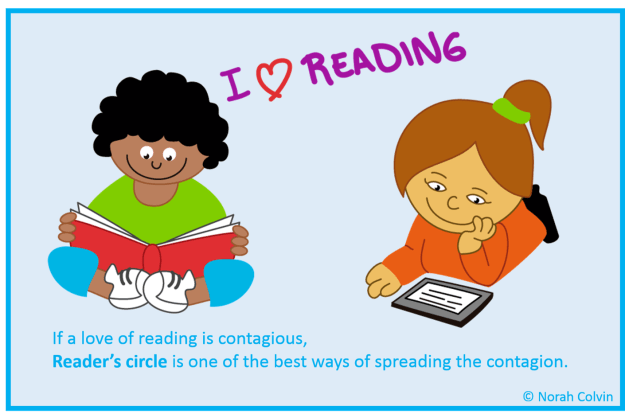
    I always concluded my D.E.A.R. sessions with a Reader’s circle. Children would bring their books to the circle and share what they had read. While there wasn’t time for every child to share every day, I ensured each child had an opportunity of doing so at least once a week. Children would:

    • Tell the book’s title and author
    • What it was about
    • What they liked about it, and
    • Read a small section to the class

    I loved the way children would look to each other’s book responses to guide their own selection, often asking others to help them find a book that had previously been talked about. We do the same in sharing and reading book reviews on our blogs.

    If a love of reading is contagious, Reader’s circle is one of the best ways of spreading the contagion.

    love of reading

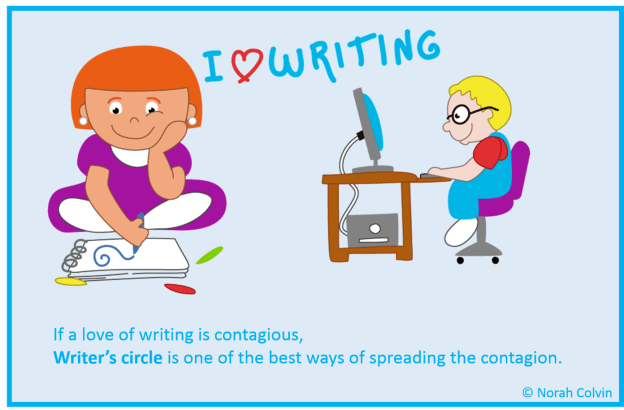
    A love of writing can be equally contagious. One of the things children enjoyed most about writing, other than the actual writing, was sharing it with others. Children would have opportunities to discuss and read their writing to each other in pairs and small groups as well as in the Writer’s circle.

    Sometimes we would have a pre-writing circle to share ideas and inspiration. It was rare that anyone would leave the circle without an idea. Surprisingly perhaps, it was even rarer that two would write about the same thing. Bouncing ideas off each other seemed to encourage a diversity, rather than similarity, of ideas. I guess the responses to Charli’s flash fiction prompt demonstrate the same principle.

    Post-writing circles provided opportunities to discuss what had been written and to read sections to others. Writers might share what they liked about their writing, or what they were having trouble with. Others might ask questions for clarification, to understand character motivations, or to find out what will happen next. Sometimes, with the writer’s permission, I would use a piece of writing to discuss an aspect of the writing process that would have application for many. If any children were reluctant to read their own writing, I would be more than happy to read it with them.

    If a love of writing is contagious, Writer’s circle is one of the best ways of spreading the contagion.

    love of writing

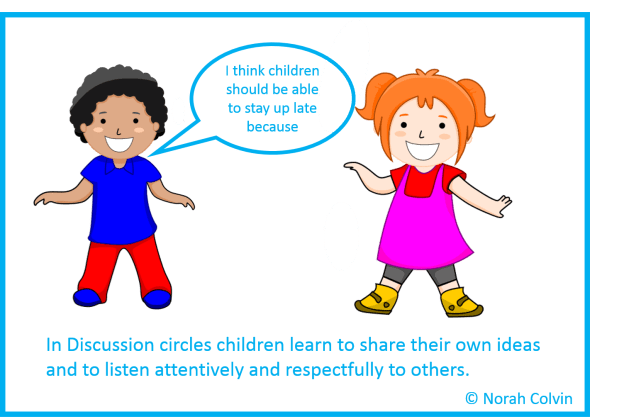
    Discussion circles could occur at any time, in any subject on any topic where a sharing of ideas was required. I had a lovely smiley face ball that children would sometimes pass around, or across the circle, to each other, to indicate whose turn it was to talk. This ensured that everyone had an opportunity to share their ideas and thoughts, as well as to hear the ideas and thoughts of others. Topics could be as diverse as:

    • “I feel happy when …”
    • “When I lose a tooth …”
    • “On the holidays, I …”
    • “I think children should be able to … because …”

    discussion circles

    Each of these sharing circles gives children a voice, demonstrating that they, their thoughts, their ideas and their opinions are accepted and valued. Each encourages children to listen attentively and respectfully to others by providing a supportive environment in which they can test out ideas, then reflect and reassess in response to the reactions of others.

    These discussions are not unlike those we engage in on our blogs; sharing books and articles read, and videos watched, along with our ideas and opinions and, most of all, our writing.

    Thank you

    Thank you for the opportunity of sharing mine. I appreciate your feedback. Please share your thoughts.

  • Lending a helping hand

    johnny_automatic_playing_dress_up

    If I was to ask a group of six year olds what a friend is, I would receive responses such as:

    • A friend is someone who plays with you
    • A friend is someone who likes you
    • A friend is someone who helps you
    • A friend is someone who looks after you when you’re hurt

    For just over two years now a group of writers have formed a bond of friendship by playing together each week, responding to a flash fiction prompt set by Charli Mills at the Carrot Ranch. You couldn’t get a more supportive group of writers. In fact, a while ago I coined the term S.M.A.G. (Society of Mutual Admiration and Gratitude) to express the relationship many of us feel.

    SMAG ccbyncnd

    This week Lisa Reiter, who blogs at Sharing the Story, showed that the ability to lend a hand is not restricted to friends who live close by. Although they live at opposite sides of the Atlantic and half the world away from each other; and despite the fact that no request for help had been made, like the true friend that she is, Lisa saw a need and immediately assisted Charli by writing this week’s flash fiction prompt and post. You won’t be surprised to know that the theme is helping out.

    https://openclipart.org/detail/117199/Friendship
    https://openclipart.org/detail/117199/Friendship

    This ties in beautifully with a TED talk I listened to this week. The talk by Australian humanitarian Hugh Evans is titled What does it mean to be a citizen of the world?  Hugh talks about the organisation he co-founded: Global Citizen; which is described on the website in this way:

    Global Citizen is a community of people like you. People who want to learn about and take action on the world’s biggest challenges—and use their power to get other people involved too.

    We bring you stories and actions that make a difference. That help fight extreme poverty and inequality around the world, and support approaches that will make life more sustainable for people and the planet.”

    EarthsOtherSide

    These are some of the points I have brought away from Hugh’s talk:

    • A global citizen is “someone who self-identifies first and foremost not as a member of a state, a tribe or a nation, but as a member of the human race, and someone who is prepared to act on that belief, to tackle our world’s greatest challenges.”
    • Hugh describes himself as “one of those seriously irritating little kids that never, ever stopped asking, “Why?” He went from asking questions like, “Why can’t I dress up and play with puppets all day?” to why couldn’t he change the world?
    • He had already been raising large amounts of money for communities in the developing world when, at age fourteen, he spent a night in a slum in Manila and thought, “Why should anyone have to live like this when I have so much?
    • “that of the total population who even care about global issues, only 18 percent have done anything about it. It’s not that people don’t want to act. It’s often that they don’t know how to take action, or that they believe that their actions will have no effect.”
    • Hugh initiated the Global Citizen Festival in New York’s Central Park. Tickets for the festival couldn’t be bought, They had to be earned by taking action for a global cause. He said, “Activism is the currency”.
    • By becoming a global citizen one person can achieve a lot because they are not alone – there are now hundreds of thousands of global citizens in more than 150 countries

    “We, as global citizens, now have a unique opportunity to accelerate large-scale positive change around the world. “

    “Global citizens who stand together, who ask the question “Why?,” who reject the naysayers, and embrace the amazing possibilities of the world we share.”

    He finishes his talk with the challenge:

    “I’m a global citizen. Are you?”

    Hugh’s contribution to the world is a great recommendation for encouraging children to ask questions, isn’t it?


    Here is his talk if you would like to be inspired by his own words. You may find other points that speak more clearly to you.

    This brings me back to Lisa’s helping hand which, while not on the same scale, clearly demonstrates the opportunities that exist to help if we take the focus from ourselves and place it on others in an attempt to understand their situations and how we might be able to assist.

    Lisa’s prompt is to In 99 words (no more, no less) write about offering to help someone. What’s their situation? What’s yours? Do they think they need help? How is it received? Could you be misinterpreted?

    child helping

    For my flash, I’m bringing you back even closer to home, to a situation with young children that will be familiar to many. Little ones love to help and hate to be helped in almost equal measure. “Let me do it!” and “I can do it myself!” are two frequently heard phrases in households with little ones. Opportunities for both are essential for their developing sense of self, independence and confidence. Both require a great deal of patience on the part of parents and a larger allocation of time than one would normally feel necessary. I think I must have been in a rush and didn’t have time to wait in the queue when patience was being dished out. Fortunately, my children shared some of theirs with me. Sadly, not always soon enough for their benefit. (Sorry, Kids.)

    A playdate at Bella’s

    Mummy checked the calendar. Oops! Her turn for cake. Dulcie was engrossed playing. Great! Just enough time, if ….

    Scarcely was everything out when up popped Dulcie. “Let me do it!”

    Too pressed for winnerless battles, Mum kept one eye watching Dulcie, the other on the clock.

    With the cake finally baking, Mummy suggested clothes to wear.

    “No! I want this one,” pouted Dulcie.

     “Let me help with the buttons.”

    “No! I can!” objected Dulcie.

    Only thirty minutes late, with warm cake and buttons all askew, they arrived.

    “Come in,” greeted Bella’s mum, “Looks like you need a hand.”

    Thank you

    Thank you for reading. I appreciate your feedback. Please share your thoughts.