Live Love Laugh Learn … Create the possibilities

Category: Early childhood education

  • Why school this way?


    reading

    Any material being read, or listened to, will connect with individuals differently, depending on their prior knowledge and interests. An idea might spark curiosity in one, that another would dismiss as inconsequential. Sometimes a reader will pick at a thread that hadn’t been intentionally placed for further investigation. Oftentimes, authors don’t get to benefit from readers’ feedback, and may not be inspired to conduct further research for themselves.

    But bloggers do!

    Or bloggers with wonderful readers who participate in discussions and share their ideas! I am always grateful to you my readers for your encouragement to keep on learning. You are constantly challenging my assumptions, offering alternate views, and inspiring me to seek more information. I love it.

    The-best-questions-are

    While I emphasize the importance of maintaining a sense of wonder, and of encouraging children to ask questions, I’m not always good at asking those questions myself. I learned that lesson well;  so am appreciative when others stimulate questions.

    During this past week there have been a couple of robust conversations here: one about audiobooks and cheating; and another about common curricula. The conversations branched into fields as different as science fiction and history. Thank you to those who joined in.

    In This too will pass I mentioned that each state in Australia had its own set of curricula. This places an extra burden on children changing schools, particularly interstate. The mention of our new National Curriculum made Charli Mills curious about how US education evolved. She assumed it was fairly uniform across the states, with the school year developed around farming so that children could help out in the fields.

    old school room

    I thought that our Western systems of schooling had originated with industrialisation. However, Charli responded saying that industrialisation had had little influence on education in the West (of the States). So of course I was compelled to check my assumptions!

    A Google search brought me to this document Industrialization and Public Education: Social Cohesion and Social Stratification which does seem to verify a relationship between industrialisation and schooling. (But one of the most interesting things to me is the cost of a chapter, and of the entire book this first page comes from. Have a look!)

    money bag

    I also found an abstract of Chapter 2 Long-Term Trends in Schooling: The Rise and Decline (?) of Public Education in the United States, from another book, that seems to support Charli’s understanding of the homogeneity of education in the United States. I haven’t read it yet, but it could be informative.

    I couldn’t let the topic of schooling and industrialisation go without sharing a talk by one of my favourite educators Sir Ken Robinson. This is a shorter animated version of a longer talk, which I’ve also included if you are interested in listening to the original.

    This is the animated abridged version:

    This is the original:

    Now, I have to wonder, in light of the discussion about cheating mentioned earlier, would watching the shortened version qualify as having watched the talk, or would it be considered cheating?

    Thank you

    Thank you for reading. I appreciate your feedback. Please share your thoughts.

  • Listen to the sounds

    Charli's picture

    This week at the Carrot Ranch, Charli Mills is talking about sound, and has challenged writers to

    In 99 words (no more, no less) write a story that includes the sense of sound. It can be an onomatopoeia, a swearing session with sound alike substitutes, lyrical prose or a description of a sound. Go where you hear the prompt calling.

    I thought it was quite timely for me as I had just written a piece about audiobooks. However, I have decided to keep that for posting another day and have instead decided to look at picture books. Regular readers may not be surprised.

    Picture books are often a child’s first introduction to stories, poems, fantasy and other worlds. The language of picture books is immensely important and must captivate the ear as the illustrations engage the eye. Through picture books children are learning the sounds of the language: its rhythms and intonations; its accents and pronunciations; its beauty and its meaning.

    Many picture books are written in rhythmic, rhyming language and we are quick to note when the timing is a little off or the rhyme not quite right. Successful picture book authors write and rewrite until they get the sound of the language just right for a read aloud experience. Though the words may be few, the task may be difficult. Children, their parents, and teachers are a discerning audience.

    As onomatopoeia (a word that phonetically imitates, resembles or suggests the source of the sound that it describes) features in many children’s songs and picture books, it is the focus of this post.

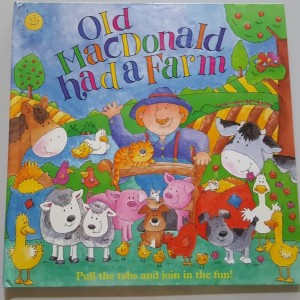
    Old MacDonald had a Farm

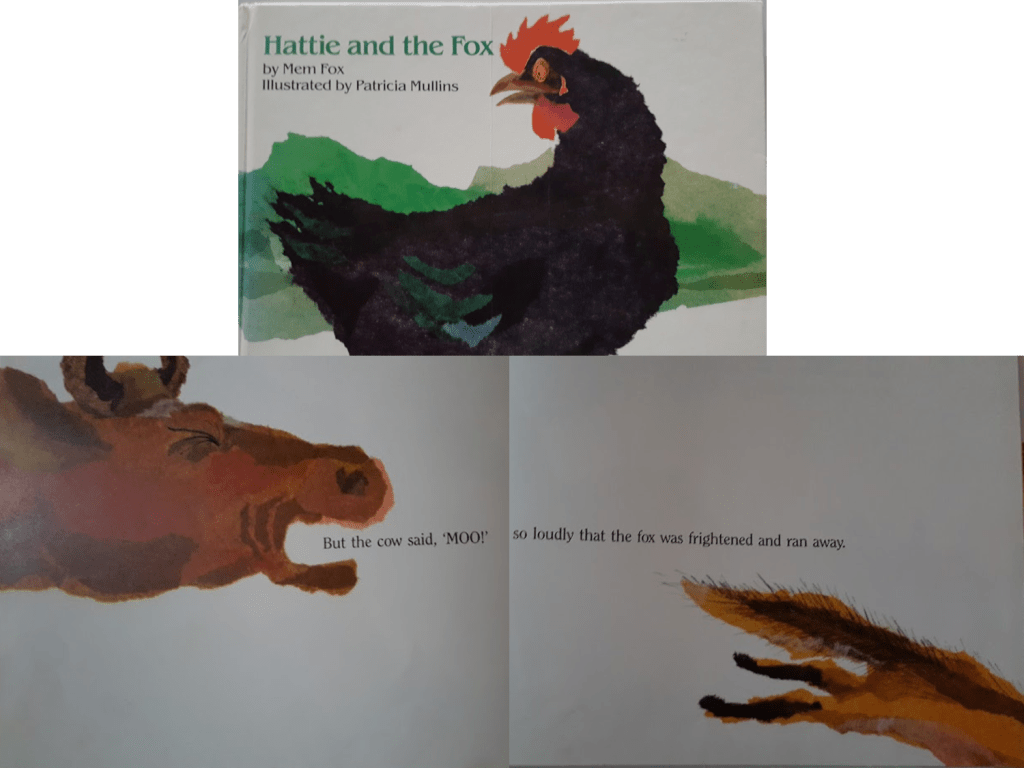
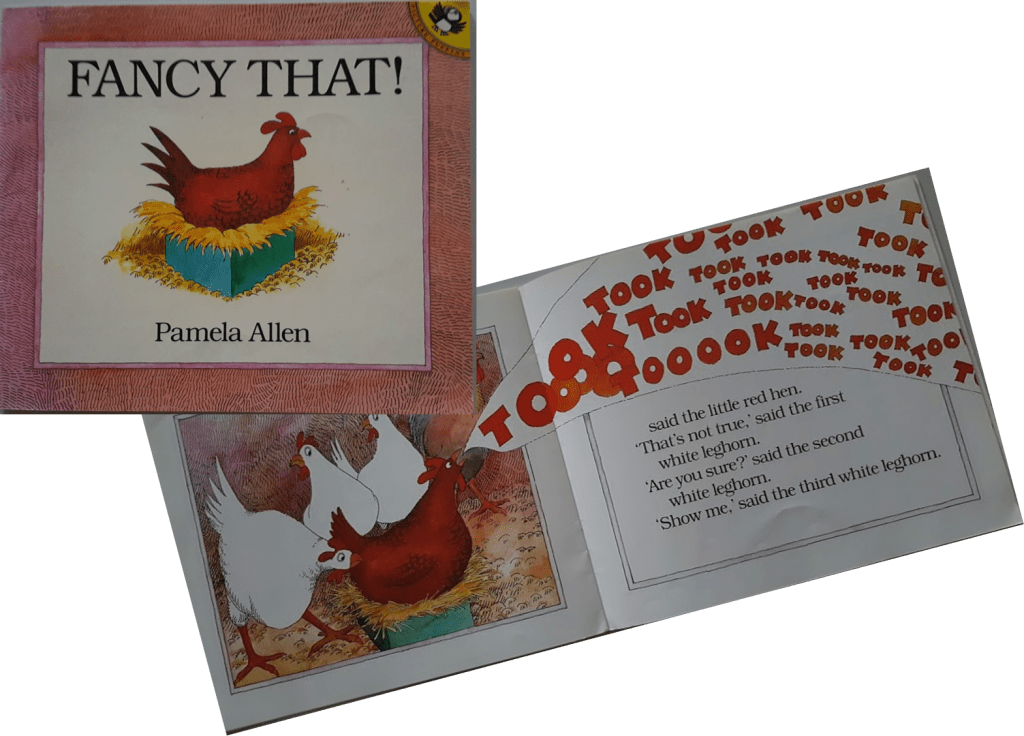
    Animal sounds, familiar through songs such as Old MacDonald Had a Farm, frequently occur in picture books, including Hattie and the Fox and Fancy That!

    Hattie and the Fox

    Fancy That

    The sounds of machines are also popular. Some of you may recall the song about The Marvellous Toy that “went zip when it moved, and bop when it stopped, and whirr when it stood still.”

    the Train to Timbuctu

    The repetitive rhythmic sound of a train’s motion is frequently portrayed, as in The Train to Timbuctu that went

    Timbuctu rhyme

    the Little Engine that Could

    and The Little Engine that Could with its

    “I think I can – I think I can – I think I can – I think I can – I think I can – I think I can – I think I can – I think I can – I think I can.”

    followed by

    “I thought I could. I thought I could. I thought I could. I thought I could. I thought I could. I thought I could.”

    A great demonstration of a growth mindset.

    Bertie and the Bear

    There are also the sounds of musical instruments as in Bertie and the Bear.

    An Old Witch Song

    There are the sounds associated with actions, like the swish of the broomstick and the plop of the hop toad in Old Old Witch;

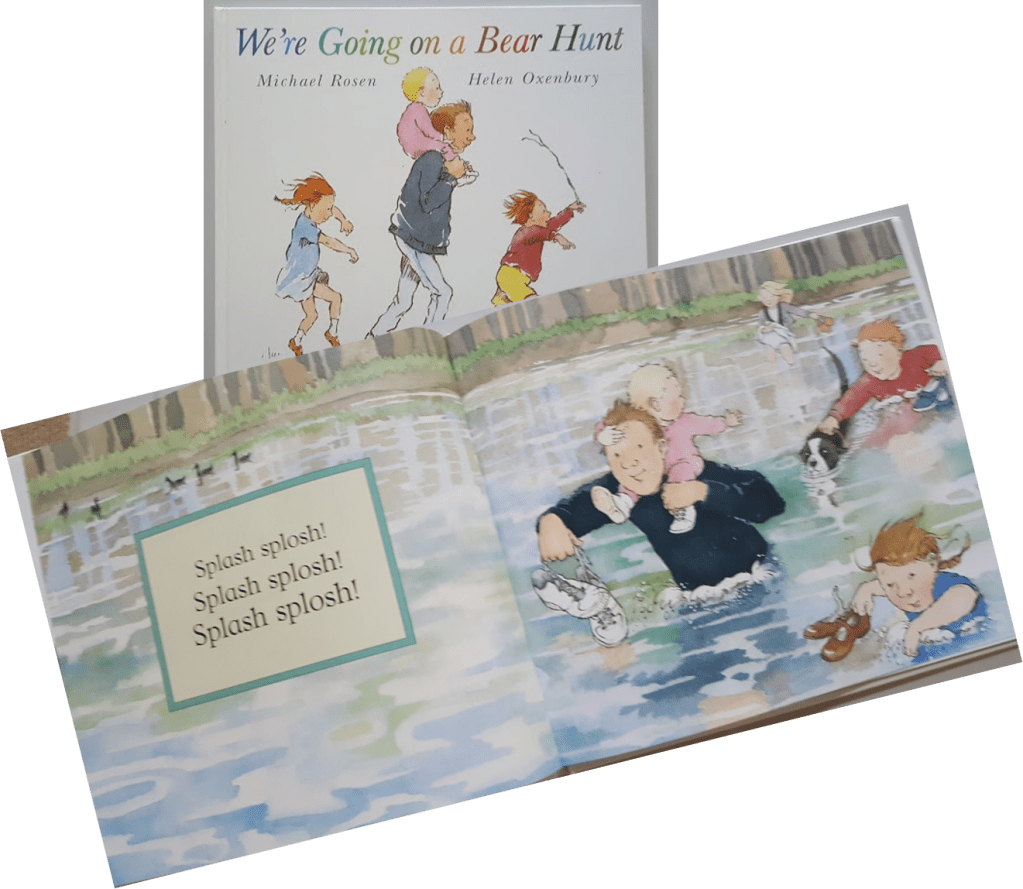
    Going on a bear hunt

    and those from Going on a Bear Hunt with its swishy swashy of moving through grass, splash splosh of wading through water, and squelch squelch of walking in mud.

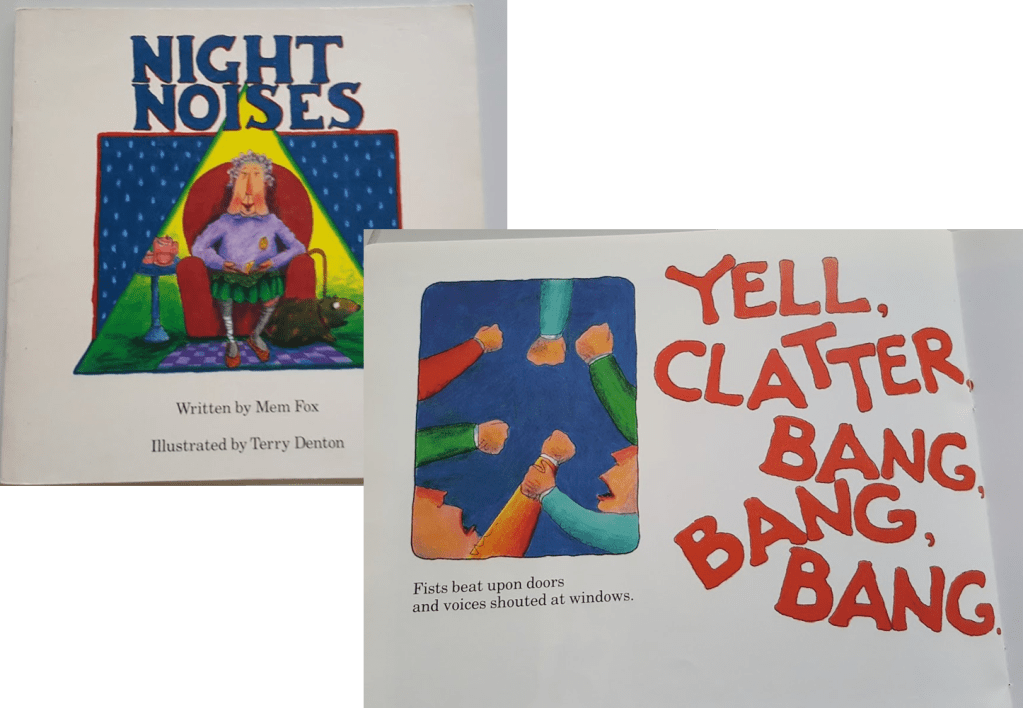
    Night Noises

    Some stories introduce a variety of onomatopoeic words. Night Noises, about a surprise party for Lillie Laceby who was nearly ninety, includes the click clack of car doors opening and closing, the crinch crunch of feet tip-toeing on a garden path, the murmur and mutter of voices whispering, the creak crack of knees, and the snick snack of bolts on the door.

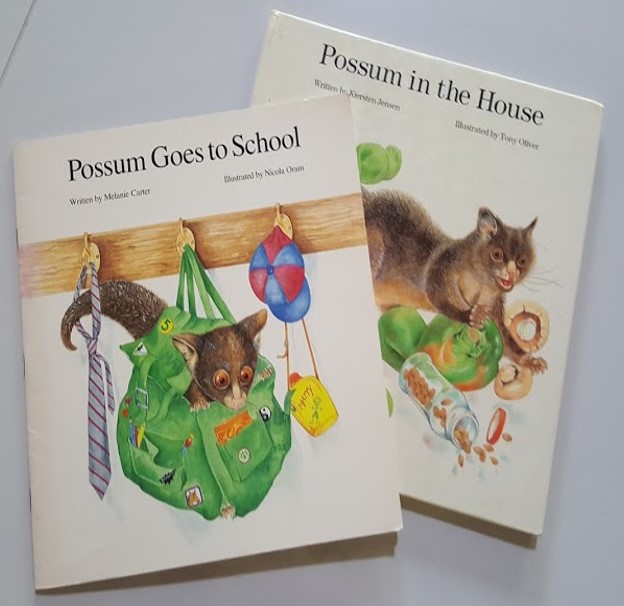
    Possum goes to school

    When there’s a Possum in the House or Possum Goes to School, there is nothing but trouble, with possum making a mess at every opportunity.

    At home, in the pantry the cornflakes go crunch crunch, in the kitchen the saucepans go clatter clatter, and in the study the pages go rustle rustle. Each time the possum’s whereabouts is discovered, it goes screech screech and runs off to another room to create yet more mess.

    The same occurs at school with paints going drip drip in the art room, claws going scratch scratch in the staff room, and the goldfish going splash splash in the science room.

    Burping Baby

    Then of course, there are also the body noises that children seem to take delight in, like those from Burping Baby.

    I recently discovered Lauri Fortino’s Frog on a [B]log, a blog celebrating picture books. Lauri has a delightful picture book of her own The Peddler’s Bed, illustrated by Bong Redila. Lauri recently shared a reading of the story on her blog. Since we are talking about sounds, if you have a few spare minutes, pop over and have a listen.  You will also find an example of onomatopoeia in her story with the repetition of squeak squeak squeak.

    Onomatopoeic words are often presented in fonts of different size or colour, or even different type. Children are fascinated by them, pointing to, asking about, maybe even recognising them, long before they are able to recognise any other words. You can help to get them started by pointing to the words and inviting them to join in the hullabaloo. What a great introduction to the world of reading.

    Now that I have reminded you of these types of onomatopoeia and provided you with these wonderful examples, I wonder what I was thinking. How can I match them in my flash? I need a flash of inspiration, or maybe a flash of lightning to begin my story about a mother and child hurrying to make it home before the storm hits. I hope you enjoy it.

    The eye of the storm

    “Storm’s coming!”

    Pit pitter-patter Pat pitter-patter hasten four feet.

    Lightning and thunder boom down the street.

    “H-h-h-hurry.” Mum urges. “Home – nearly there.”

    Pit scuffle-scuffle Pat scuffle-scuffle “Straight up the stair.”

    Clink-chink-fumble-fumble “No need to knock.”

    Scritch-scratch “I’ve managed – the key’s in the lock.”

    Whoosh! chortles wind, as it rushes inside.

    Damn! cusses chair chucked onto its side.

    P-u-sh!  The door bangs! Avoid pellets of ice

    Smashing and tumbling like millions of dice.

    Rat-a-tat raindrops, another crash-boom!

    Shuffle and scurry. “Straight to the safe room.”

    Huddled together, hardly daring to breathe,

    Listening and waiting for the monster to leave.

    Then sudden quiet, the child whispers hope

    “Is it all over?” Mum answers, “Nope.”


    The first fifteen lines meet Charli’s 99 work criteria. I added the last two because I was thinking of the eye of a storm that brings a quiet calm but not the end of the storm –  there’s still more to come. I’d love to know what you think.

    Thank you

    Thank you for reading. I appreciate your feedback. Please share your thoughts.

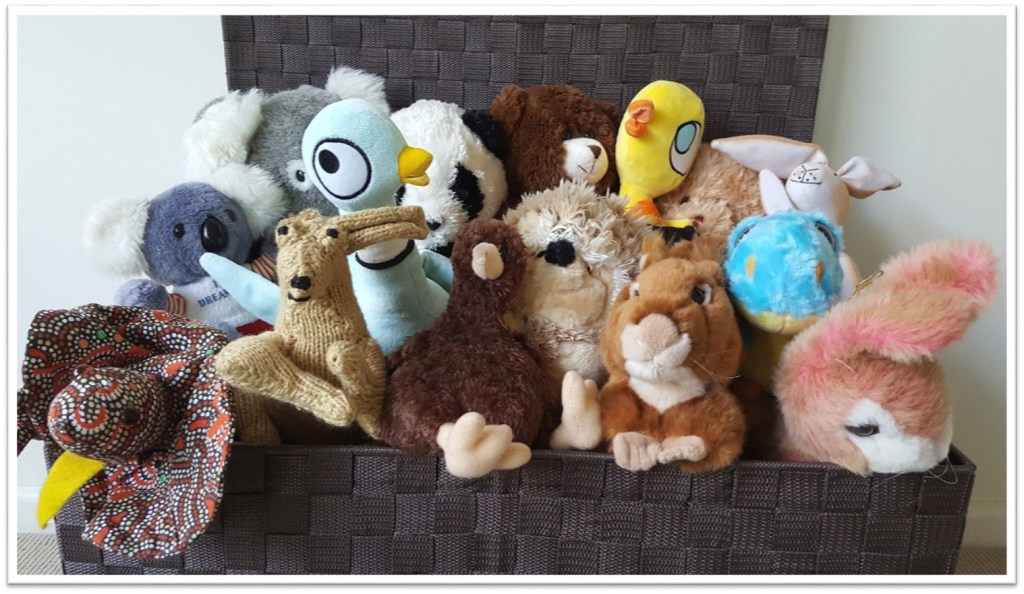
  • Welcome to the toy box

    © Norah Colvin
    © Norah Colvin

    A little while ago I wrote about my (small) collection of international toys and the fact that I wished to add to it when I visited Los Angeles and New York with my grandchildren. I received a few suggestions:

    Sarah suggested anything I wouldn’t want to stare in the eye

    Irene thought maybe a rattle snake, coyote or woodpecker

    Charli wondered if a bison or grizzly bear would do, and

    Geoff suggested a snake.

    Many requested I share my choice.

    I have now returned from that quick visit to the US, and did indeed bring back a small collection of toys to add to my toy box. (Four-year-old granddaughter informs me that 2 can be a collection, 3 is even better, and 100 is definitely a collection!) I have three to add to the toy box. A fourth got confiscated along the way.

    When we visited Los Angeles, we went to the La Brea Tar Pits, a fossil site with an active excavation and museum. For a family fascinated with prehistoric creatures, the museum was a must visit. We were not disappointed.

    © Norah Colvin
    © Norah Colvin

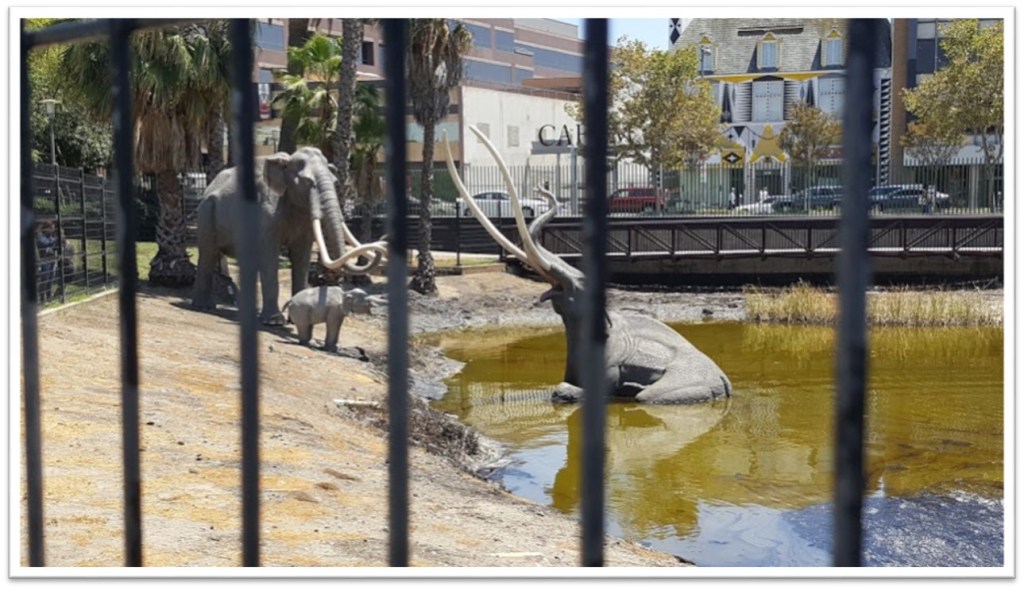
    Outside the museum we saw life-size sculptures of a mammoth family succumbing to the sticky entrapment of the tar pit. You may wonder why the sculptures are fenced. The mammoths may not be real, but the tar pit is! We saw much tar oozing up through cracks around the site as well as in the pond.

    © Norah Colvin
    © Norah Colvin

    Inside the museum we saw skeletons and depictions of many of the animals trapped in the tar pits. These are skeletons of a mother and baby mastodon who fell victim of the tar:

    © Norah Colvin
    © Norah Colvin

    We also viewed a 3D movie that provided information about the Titans of the Ice Age, including stories to explain the fate of animals whose fossils were found in the tar.

    In this short of the movie, you may sight Smilodon, a sabre tooth cat.

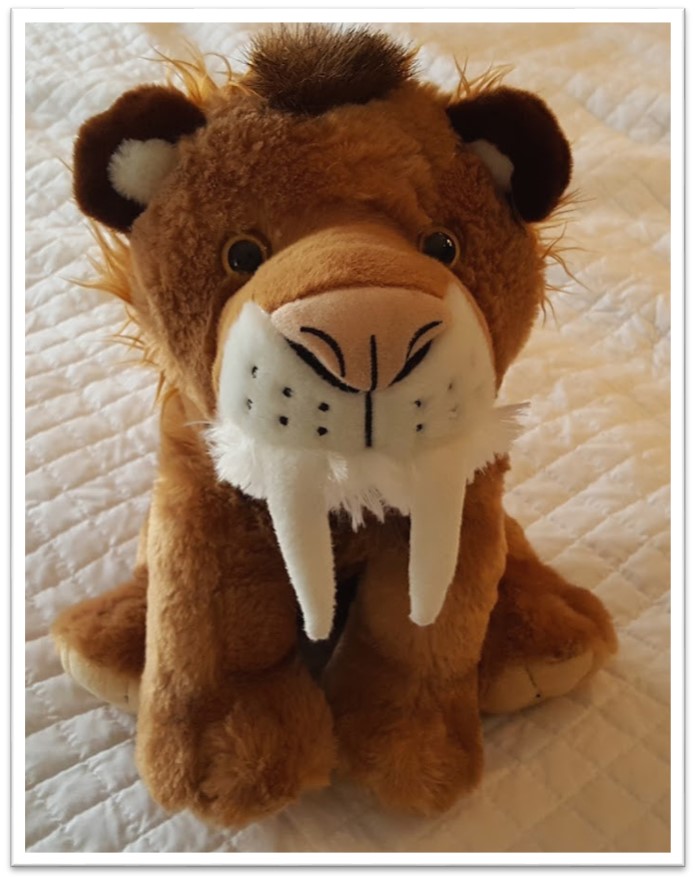
    I discovered that Smilodon is California’s State Fossil, so it was the first toy to add to my collection.

    © Norah Colvin
    © Norah Colvin

    Unfortunately, Smilodon was confiscated by my grandchildren and didn’t make it home with me. I am assured it is very happy at their place with its competitor Dire Wolf, also seen in the movie trailer.

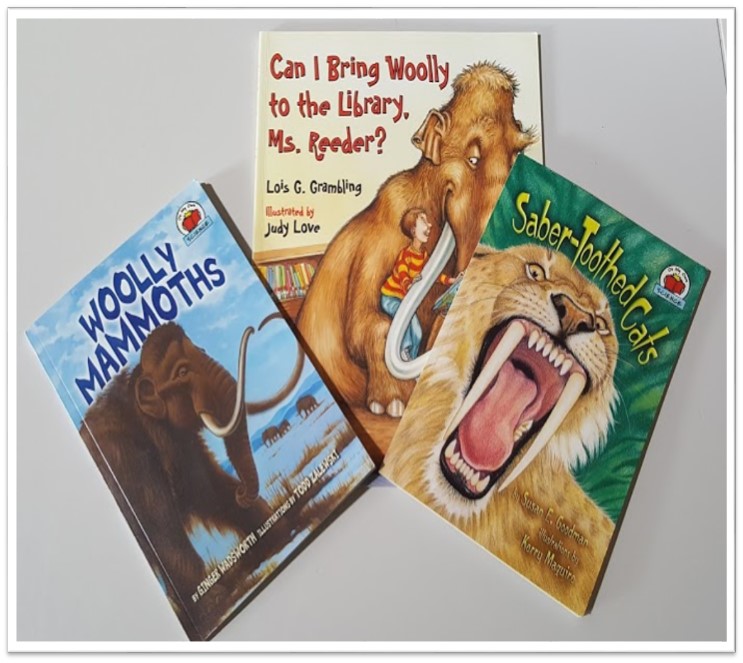
    Of course, I couldn’t leave the store without some books as well.

    © Norah Colvin
    © Norah Colvin

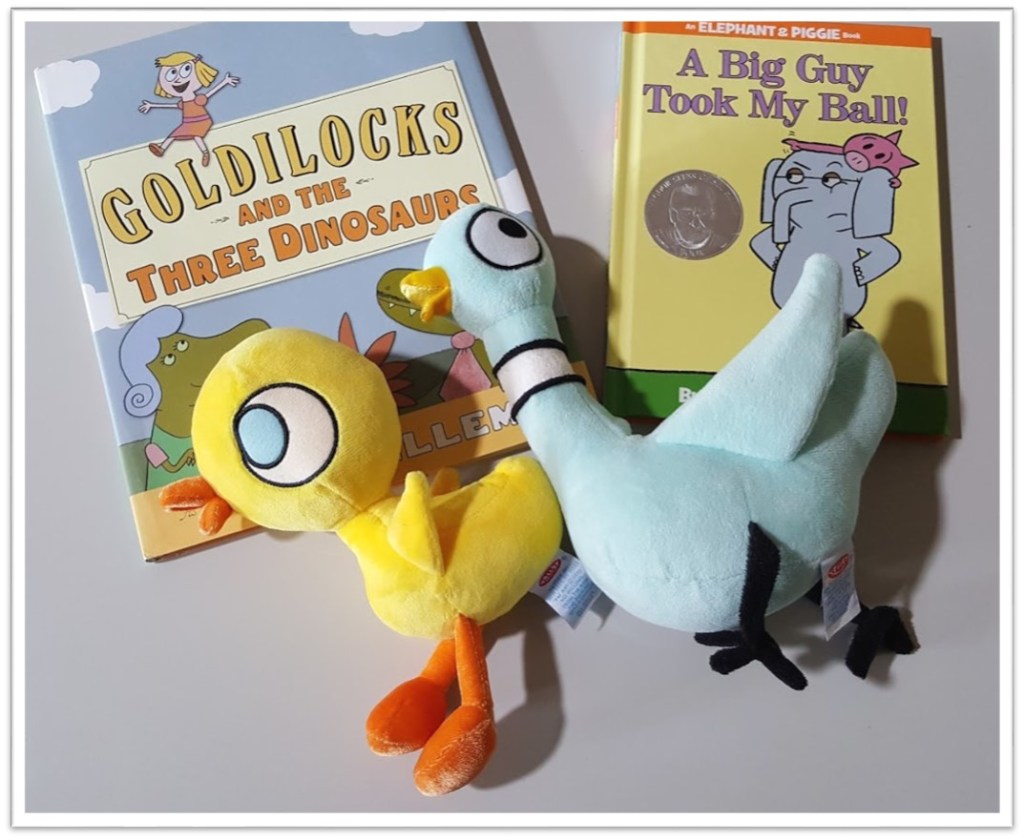
    In New York my choices turned to fiction. I discovered that an exhibition of works by Mo Willems was being held at New York’s oldest museum, the New York Historical Society Museum and Library, not far from where we were staying.  I have previously shared my delight in Willems’ books. His books are humorous, and his illustrations, with their seemingly simple line drawings, are very expressive. Of course, I had to go, and had to buy.

    I came away with Pigeon and Duckling, and two of Willems’ books.

    © Norah Colvin
    © Norah Colvin

    I thought I was done adding to my toy collection, but when we visited the American Museum of Natural History, granddaughter insisted that I purchase this T-Rex because it was my favourite colour. How could I resist?

    © Norah Colvin
    © Norah Colvin

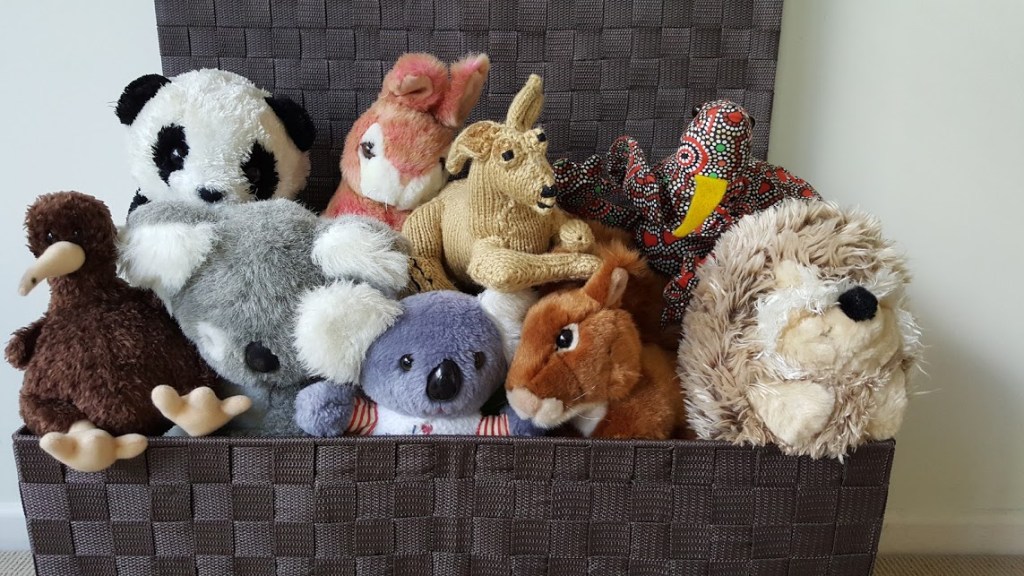
    Now that I am home, I have introduced Pigeon, Duckling and T-Rex to the other toys in my toy box.

    welcome to the toy box
    © Norah Colvin

    They are settling in quite well, though everyone is complaining that it is becoming a bit squishy. However, I think they are rather pleased that Smilodon got waylaid along the way!

    So I didn’t end up with any of the suggested choices. I hope you don’t mind.

    Thank you

    Thank you for reading. I appreciate your feedback. Please share your thoughts. 
     

  • The importance of feedback


    39

    Feedback, whether inherent in the task itself or supplied by another, is essential to learning. This is true whether figuring out what happens when an item is dropped from a high chair (will it always land on the floor; will a carer always retrieve it?), how hard and at what angle to kick a ball to send it over the goalpost; how much a sibling can be antagonised before retaliation ensues; or whether your performance meets expectations.

    In almost all of these cases, the tasks are self-selected and the feedback is integral and immediate, enabling the learner to adjust what happens next accordingly. While those conditions may also be true when considering the success of performance; such as our own assessment of our output, it is not always so.

    F

    Students and employees may be engaged in tasks that are not of their choosing, which provide little inherent feedback, and are reliant upon feedback from others that may be neither timely nor specific to the learners’ needs. Sometimes the feedback can be unhelpful and hinder, rather than encourage, learning, without any real explanation of how improvement could be made.

    As a teacher, I found it necessary for an exchange of feedback between me and my students. This was sometimes supplemented with feedback from carers and other school personnel. How well the students engaged in the classroom, participated in class activities and performed tasks provided me with feedback on my performance as a teacher and provided important information about what to do next, which in turn involved feedback to students.

    While feedback is an essential ingredient in any classroom task, one of the most enjoyable for me was the daily journal. Each morning the children would write to me and every afternoon after they had gone home I would read and respond to their messages. The children loved writing these diaries as much as I loved reading and responding to them. Responding was time consuming but I believe it was worth it:

    • The children had a purpose for writing
    • Their writing had an audience
    • They saw writing as a tool for communication

    When responding to their writing, I would make neither corrections nor changes. However, I would model correct grammar, spelling and punctuation as I responded to the content of their messages. The children were then able to refer to my comment when writing their next message.

    Sometimes the children would tell me about something different each day. Sometimes we would have conversations that could extend over weeks. I always felt it a privilege to have this window into the children’s lives. At the same time, it provided a record of their development as writers.

    At the end of the year I would bundle up all of the journals that had been filled during the year and present them to the children to take home. Recently when I was talking to the mother of a child I taught in the eighties, she told me how they had been looking at those journals with his young children who are now at a similar age to his when he wrote them. How gratifying it is to know that they were treasured by at least one family.

    thank you - rose

    When I started blogging, unbelievably, almost three years ago, I had no idea of what to expect. I am a little more knowledgeable now, with thanks to those who provide feedback by reading and commenting. I am very grateful to all who have joined me along the way. The conversations here or on your own blogs are what have made the journey enjoyable and worthwhile.

    yves_guillou_question

    Now I have a decision to make and I would appreciate your feedback in helping reach it.

    At the same time as I have been blogging, I have been preparing early childhood teaching resources for my website readilearn. I always expected readilearn to include a blog and a newsletter. I knew I couldn’t write that additional content alongside posting twice weekly here and preparing new readilearn resources as well. I thought to:

    • post once a week on this original blog by continuing to participate in the flash fiction challenges set by Charli Mills at the Carrot Ranch, as I have done for more than two years; and
    • post once a week on the readilearn blog with content written specifically for early childhood teachers rather than general readership.

    However, it has recently come to my attention that it may not be possible for readers to leave comments on the readilearn blog, which leads to my quandary.

    I enjoy the discussions in response to posts almost as much as writing them; and

    I am disappointed when I am unable to “like”, leave a comment on, or share another’s blog post I have enjoyed.

    megaphone

    It seems some bloggers are more interested in broadcasting than engaging with a community, but that is not my way.

    Newsletters differ from blogs, though, and the readilearn newsletter, which will provide information about new resources, teaching suggestions and other educational content, will “broadcast” and not invite feedback.

    How important, then, is it to have a blog that doesn’t invite feedback. I’m thinking that, without feedback, I’ll quickly lose motivation.

    What do you think?

    When you read blogs, do you look for an opportunity to add your voice through a “like” button, leaving a comment, or sharing content on social media? Is the ability to engage with the writer important to you, or do you simply read?

    As a blogger, do you welcome comments and discussion, or is it more important just to get your ideas out there?

    Thank you

    Thank you for reading. I am very interested to know what you think and appreciate your feedback. Please share your thoughts.
     

  • Life is for living

    Life is for living

    I first published this post two years ago. I am sharing it again as I continue to hear of similar things happening. I apologise to those who may have read it the first time around. 🙂

    Many would agree that to enjoy life to the full we must live in the present moment, appreciating what we have and being mindful of our surroundings and others.

    Most would also agree that a certain amount of preparation for the future is necessary to both enjoy and deal with what lies ahead.

    marshmallow 5

    In previous posts I have referred to related ideas including The importance of emotional intelligence and the ability to delay gratification, for example when studying towards a degree or saving to purchase a car. Recently I wrote about future-proofing kids by preparing them to embrace the future. Schooling is often considered a preparation for the future, for ‘what you want to be when you grow up’.

    firefighter and nurse

    Are the concepts of living in the present moment and preparing for the future contradictory?

    Generally I would say that a balance is needed. We need to live in the present while making some preparation for the future. Hopefully the choices made can still be appreciated now and enjoyment is not all delayed until the future “When I . . .”

    https://openclipart.org/image/800px/svg_to_png/544/Gerald_G_Balance_Scale.png
    https://openclipart.org/image/800px/svg_to_png/544/Gerald_G_Balance_Scale.png

    Recently I read an article that caused me some concern because, it seemed to me, there was little balance between appreciating the present and preparation for the future. Of greater concern was that the one for whom balance was lacking was not the one making the choice.


    https://openclipart.org/image/800px/svg_to_png/2312/liftarn_Scissors_and_ribbon.png
    https://openclipart.org/image/800px/svg_to_png/2312/liftarn_Scissors_and_ribbon.png

    The article described a situation in which a 3½ year old was being taught to use scissors by an occupational therapist. The teaching, which had been occurring in regular sessions for over seven months, began before the child was three years of age.

    Like I did, you might assume the child had a developmental delay which required regular sessions with the occupational therapist (OT). However no mention of that was made in the article.

    The parent, writing the article, described feeling sad while watching the child experience difficulty in using the scissors.  Additionally, it was mentioned that the child had not been requested by the parent to use scissors at home as it just made the child miserable.

    After seven months the parent finally broached the subject with the OT, asking why the use of scissors was being pushed at this time.

    It was the reported response of the OT that caused me greatest concern.

    http://pixabay.com/en/birthday-cake-cake-food-candles-25388/
    http://pixabay.com/en/birthday-cake-cake-food-candles-25388/

    The OT explained that when the child entered kindergarten at age five, the ability to use scissors appropriately would be expected. The lessons in learning to use scissors were being given to avoid the child being behind when beginning kindergarten. The OT went on to further explain that the use of scissors was not developmentally appropriate until age five!

    The OT, presumably a trained professional, who believed it was not developmentally appropriate for a child to be using scissors until age five, began teaching a child to use scissors before that child was even three years of age!

    The child was miserable when using scissors and the parent was saddened when viewing the attempts!

    If using scissors is developmentally appropriate at age five, then when the child is entering kindergarten, unless there is a development delay, coordination or muscular problem, that child will easily learn to use scissors appropriately, without the need for lessons from an OT. Forcing a child to practice a skill before developmentally ready is definitely not in the child’s best interests.

    Think of the wonderful things about a child of two or three years of age; the things they are learning and doing. I am always amazed at how quickly children learn and progress. They grow up so quickly and are only little for such a short time. Why try to pressure them through to stages beyond their current development? These years of enormous growth and potential are precious. We are adults for most of our lives. What is wrong with appreciating the special two-ness or three-ness of a child? It will not matter in the future if scissors can be used at age three, age five or age seven.

    If the child is constantly pressured to perform in ways that are not developmentally appropriate then feelings of inadequacy, loss of confidence and self-esteem may ensue, resulting in an ‘I can’t do it attitude’, a fear of failure and unwillingness to have a go. I believe many perceived behaviour problems are problems only because the expectations are not relevant to a child’s stage of development.

    When adults strive for a child to achieve beyond the age expected norms they are not appreciating, but rather showing a lack of respect for, who the child is and for the stage of development. This is not living in the present. It is attempting to live in the future, which can become very scary if one does not feel it can approached with confidence.

    One may hope this scissors example is an extreme and isolated incident, but sadly pressure placed upon children by expectations that are not developmentally appropriate is far too common.

    Teaching colleagues here in Australia often express their dismay that children in the first three years of school are crying every day because they find the expectations upon their learning and behaviour too great.

    I hear similar stories about trying to rush the children through from the UK, Canada and the USA. Maybe it is happening in other places too. Sadly the pressure of unrealistic expectations doesn’t achieve anything positive for the students, the teachers or the parents.

    How different would schools be if, instead of being considered a preparation for life, they were focused on living life now? If three year olds were appreciated and respected as three year olds, five year olds as five year olds, and eight year olds as 8 year olds, rather than as apprentices for the adult they will one day be, how different would their school situation be?

    https://openclipart.org/image/800px/svg_to_png/192642/Children_holding_hands.png
    https://openclipart.org/image/800px/svg_to_png/192642/Children_holding_hands.png

    An affirmation song I used to sing with my classes is one by Anne Infante called Just the way I am.

    The song is made up of a series of verses about appreciating oneself just as one is – now, not in the future – including characteristics such as responsible,  lovable, confident and friendly; for example:

    I am beautiful and I like me,

    I am beautiful and I like me,

    I am beautiful and I like me,

    Just the way I am.

    I have written about using Anne’s songs of affirmation in previous posts, here and here.

    What do you think? How have you seen developmentally appropriate programs in action? How have you seen them disregarded? What have been the effects?

    Further reading: The Cost of Ignoring Developmentally Appropriate Practice

    Thank you

    Thank you for reading. I appreciate your feedback. Please share your thoughts.


  • How should reading be taught in schools?

    The ability to read is empowering and a fundamental right. Sadly, many children leave school either unable to read or disinterested in reading. There are many reasons for this. Unfortunately, for many children, it is a learned disability. There are almost as many opinions about how how reading should be taught as there are people willing to give them. I don’t always agree with those opinions, but I do with this one by Misty Adoniou, which first appeared in The Conversation on June 21, 2016.
    Thank you
    As always, thank your for reading. I appreciate your feedback. Please share your thoughts.

    How should reading be taught in schools?

    Misty Adoniou, University of Canberra

    When my son was nine years old, he put aside the large Harry Potter novel he had been slowly, but enthusiastically, reading each evening and instead began ploughing through lots of fairly uninspiring books that he brought home from school each day.

    It turned out the Year 4 teachers had devised a competition at his school – whichever class read the most books would be rewarded with an end of term pizza party.

    The aim, I presume, was to motivate the children to read. It is ironic then that the effect was that my son stopped reading for pleasure and instead began reading for the numbers.

    Reading is now increasingly being reduced to a numbers game in schools.

    What level is your child at?

    At pick up time, parents quiz each other about what reading level their child is on. Inside the school staff room, teachers are directed to have children on level 15, 20 or 30 by the end of the school year.

    Six year olds are deciding whether they are good readers or not based on how many books they have ticked off on their take home reader sheet.

    These levels are based on algorithms that calculate the ratio of syllables to sentences, or measure word frequency and sentence length.

    The rationale is that these formulae can be applied to rank books on a scale of readability and thus guide teachers to match books with children’s reading ability.

    There are two key problems with this numbers approach to reading. First, the algorithms are faulty. Second, publishers misuse them.

    What makes a book hard or easy to read?

    The missing variables in readability algorithms are the authors’ intentions, the readers’ motivations and the teachers’ instruction.

    These are key omissions, and they seriously reduce the usability of the algorithms and the credibility of the reading levels they produce.

    Fictional stories often use familiar and high frequency vocabulary, and many authors use relatively simple sentence structures.

    However the use of literary tools like allegory and metaphor, along with challenging text themes, increases the difficulty of works of fiction in ways that are not captured in readability algorithms.

    For example, readability formulae give Hemmingway’s “The Old Man and the Sea” a reading level suitable for primary school students. They may be able to decode the words on the page but comprehension of the book is less likely.

    The same formulae may rank a non-fiction book on dinosaurs, for example, as only suitable for high school students because of its uncommon vocabulary, lengthy sentences and multi-syllabic words.

    Yet a child’s interest and familiarity with the topic, or a teacher or parent’s support and instruction, can make that non-fiction book very readable for younger children.

    Reading schemes

    As readability formulae are not always a good fit for books, the solution has been, instead, to write books which fit the formulae. And publishers have been very keen to supply those books.

    These are the books that our children take home each evening. They are written according to the numbers – numbers of high frequency words, numbers of syllables, numbers of words in a sentence.

    What is missing in those books is author intention and craft, reader engagement and interest, and teacher support and instruction.

    Essentially, then, what is missing in these books is the very essence of reading.

    What books should children read?

    We have been using the reading scheme system for decades and we still have children struggling to read.

    When we use these quasi books to teach reading, we are not adequately preparing them for real reading.

    These books, written to fit algorithms, don’t build broad vocabularies in our children. They don’t teach our children how to read complex sentence structures or deal with literary language or read between the lines. In many cases, they turn children off reading altogether.

    Children learn to read by reading a book that is a little beyond what they can already read. The gap between what they can read and what they could read is reduced when the child:

    • is highly motivated by the content of the book;
    • has existing background knowledge about that content;
    • is receiving good instruction from a teacher.

    We don’t need books arranged in coloured boxes labelled with level numbers to teach a child to read.

    Beautifully written pieces of children’s literature will do the job.

    Books full of carefully crafted writing by authors whose intentions are to engage, entertain and inform.

    Books that teachers can work with in the classroom showing how sounds work in words, and how words work in sentences to make us feel, see or think new things.

    Beautiful books that parents can also buy and delight in reading with their children.

    Why it matters

    The way we teach children to read will fundamentally influence what they understand the purpose of reading to be.

    When we teach children to read through schemes that tally their books, we teach them that reading is simply about quantity. If reading is about getting a reward of a pizza, then children are less likely to read for intrinsic rewards.

    The claims made for well-written children’s literature are many and varied.

    Reading books to your children brings you closer to them, can teach them philosophy and about world issues.

    But they can do something else. They can teach our children to read.

    The Conversation

    Misty Adoniou, Associate Professor in Language, Literacy and TESL, University of Canberra

    This article was originally published on The Conversation. Read the original article.

  • What the world needs now

    This week at the Carrot Ranch Charli Mills is talking about needs. She questions why necessities sometimes feel like luxuries and why basic necessities, such as drinking water and access to a bathroom, incur a fee. While she is temporarily homeless, she is seeing first hand some of the ongoing difficulties of others faced with long-term homelessness. Surely to be treated with some compassion and afforded the dignity of respect is equally a basic human need and a right.

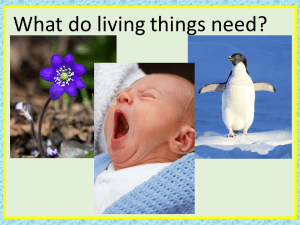
    what do living things need

    Young children begin to learn about needs when they start caring for plants and animals. In science they learn about the needs of living things and how those needs are met. It is not long before they start to learn about the differences between a need and a want. This understanding, and acceptance, can take a long time to develop. Some never develop it.

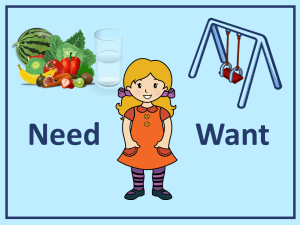
    need want

    Perhaps if there was a greater understanding of the difference between a need and a want, the gap between those who have much and those who have little would decrease. But perhaps not. While there is little increase to basic needs over time, the wants increase exponentially; and the more one has, the more one wants.

    If it is difficult for adults to distinguish between needs, wants and must haves, imagine how much more difficult it is for young children. It is possibly even more difficult for young children in an age with frequent replacement of one model for another, one gadget and one gimmick for another; the latest is always the best.

    This difficulty is the focus of my flash fiction response to Charli’s challenge to in 99 words (no more, no less) write a story that explores human needs.

    The latest thingamajig

    “But Mum, I need it. Everyone’s got one.”

    “Who?”

    “Marco; and Christopher; and … everybody!”

    Mum pictured their big houses and flashy cars.

    “Has Yin got one?”

    “No.”

    “Amir?”

    “No.”

    “Why do you want it?”

    “They won’t play with me if I don’t have one.”

    “Who?”

    “Marco and Christopher.

    “I thought Yin and Amir were your friends.”

    “But Marco and Christopher are cool.”

    “And you want to be cool like Marco and Christopher?”

    His eyes flickered.

    “Will you still be cool when they get the next best thing? What about Yin and Amir? Will they still be your friends?”

    ####

    In a recent post Home is where the start is, I wrote about the importance of the early years to a child’s development. I suggested that it is difficult to regain what is missed in those early years. However, as Sarah Brentyn who blogs at Lemon Shark said: it may be difficult, but not impossible to make improvements. Sarah was concerned that parents may not make an effort if they thought it was too late. I agree with Sarah that it is never too late to make improvements. However, it is much more difficult to change established patterns and to make up for lost learning time. Not impossible. Difficult. It is even more difficult for those who have not had their basic needs met.

    An article in the Huffington Post on June 30 compares two boys who were born on the same day in the same town, but will have dramatically different lives. The boys are now five years old. One boy who received a diet of nutrient-rich foods is now at school, making good progress, and has many friends.

    The parents of the other boy were too poor to do the same for their child. He now suffers from chronic malnutrition, or “stunting”, which affects growth, strength of the immune system, and brain function. According to the article, 1 in 4 children worldwide suffer from chronic malnutrition. The statistics reported in the article are quite confronting, and challenge a privileged view of needs and wants.

    After reading the article, it is with some embarrassment that I now admit to a need to be away from the blogosphere for the next few weeks. I will be back intermittently to read and respond to your comments. I apologise in advance for any delay in doing so. Please know that I do enjoy our conversations and appreciate your comments. I will be back to respond to you as soon as I can.

    Thank you

    Thank you for reading. I appreciate your feedback. Please share your thoughts.

  • How do you know?

    49

    Being able to verbalise the steps taken to arrive at an answer or a conclusion is a valuable skill. It is particularly important with mathematical thinking, even at beginning stages. Sometimes it feels as if the answer appears without the need for thought. Of course we aim for this with automaticity of number facts and times tables. However, I am referring to problems that may involve two or more different calculations.

    maths problem

    Unless one understands the processes involved in solving one problem, it can be difficult to apply the same strategy in other situations. Sometimes it may be difficult for a teacher who finds the answer effortlessly to understand a learner’s confusion leading to mis-steps and miscalculations.

    I generally collect my six-year-old grandson (G1) from school once or twice a week.  Now that he’s a big year one boy he thinks he doesn’t need to hold my hand to cross the road. However, there is a bit of traffic around his school and I prefer him to do so, telling him it’s for my safety too.

    holding hands to cross road

    One day I, erroneously, told him he needed to hold an adult’s hand until he was ten. (Ten is closer to the age for riding a bike unsupervised.) While this post is about mathematical thinking rather than traffic safety, if you wish to do so, you may find some information about traffic safety with young children here.

    Always on the lookout for teachable moments that encourage thinking, I then asked if he knew how many more years it would be until he was ten. It was a bit of a redundant question because, of course he did. He is an able mathematician, just like his dad who constantly extends his ability to compute and think mathematically.

    When G1 didn’t answer immediately, I assumed that he was either ignoring my question as it was too easy for him and not worth answering; or that he was thinking of the implications of my initial statement about holding an adult’s hand until he was ten.  Then again, perhaps teacher-type questions from GM are sometimes better ignored, particularly after a day in school. I was happy to accept his silence as we continued across the road and didn’t press him for an answer.

    Once safely on the footpath he said, “It’s four.”

    “Know how I know?” he continued, pre-empting my question (he knows his grandmother well).

    He held up both hands. “Because 5 and 5 are 10.” (He put down 4 fingers on one hand.) “And that’s 6. And 4 more makes 10.”

    6 + 4 = 10

    Although I hadn’t asked how he knew (on this occasion), I was pleased he was able to tell me, even though, in reality, he “knew” without having to work it out. On previous occasions when I had asked him how he worked it out, or how he knew, he hadn’t always provided an explanation. He may have shrugged, said “I don’t know” or simply ignored my question. Being able to explain his thinking demonstrates his growing mathematical knowledge and metacognition.

    The ability to think through and verbalise steps is important to understanding. How many of you talk yourself through steps of a procedure you are following? I certainly do at times. While knowing that six plus four is ten is an automatic response for most of us. It wasn’t always so and we needed a strategy to help us understand the concept and recall the “fact”.

    Opportunities for mathematical conversations occur frequently in everyday situations but are often overlooked. Recently I described some ways the children and I discussed different ways of combining five of us on an outing to show that 3 + 2 = 5.

    maths in the car

    Recently when two grandparents and two grandchildren were travelling together in the car four-year old G2, without any prompting from me, began describing how we could be combined to show that 2 + 2 = 4, for example

    2 adults in the front, 2 children in the back, that makes 4. There were many different ways that we could be combined; and just as many that would group three together and leave one out, for example

    1 driver and 3 passengers.

    We had other mathematical discussions during that car trip. I had cut an apple for each child into a different number of pieces. Each was to guess how many pieces there were. G1 went first. I’d introduced him to prime number just once previously when I’d cut his apple into seventeen pieces so I didn’t expect him to be proficient with them. He certainly wouldn’t have been introduced to them at school at this stage.

    These are the clues I gave him, the guesses he made and my responses supporting his growing understanding. I thought he did very well. He requests a guessing game each time I cut apple for him now. It’s sometimes a challenge for me to think of new clues.

    pieces of apple


    I had cut 15 pieces for G2. G1 helped her work it out when I told her that she needed to count all of her fingers and the toes on one foot.

    For an additional challenge I asked G1 if he knew how many fingers and toes there were in the car all together. He thought for a moment before giving the answer. Then proceeded to tell me how he knew as I started to ask. He explained that he had counted in twos because each of us had twenty, and counting twenties was just like counting twos but they’re tens. A quicker and more effective way that adding on twenty each time which I may have suggested he do.

    Asking how do you know or how did you work it out helps children think about their own thinking. Listening to their responses helps adults understand where they are in developing mathematical concepts. Asking questions about their thinking can challenge and extend them further, but it is important to not expect too much and to support their developing understanding.

    What maths did you engage in today? Did you even realise or was it automatic?

    Thank you

    Thank you for reading. I appreciate your feedback. Please share your thoughts.

  • Home is where the start is

    © Norah Colvin
    © Norah Colvin

    Early childhood years, from 0-8, are the formative years. It is during these years that most is learned. Children learn about the world through their explorations. They learn about themselves through the responses they receive from others, and learn about others through these responses also. Attitudes to most things begin in the home.

    Children require warm, nurturing, positive relationships that demonstrate the way life should be lived, in actions, not just words. As Anne Goodwin, former psychologist says, the interactions with significant adults will greatly influence the adult that the child becomes.

    If home is where it starts, then we can’t wait until the children are of school age. By then it’s too late. It is relatively undisputed that it is difficult for children to catch up what may have been missed in those early years. Sadly, much of the intense formal work in school does more to alienate these children further, rather than improve their opportunities for learning.

    Therefore, we must begin in the home, and I don’t mean with formal structured programs. I mean with fun activities that validate parents and children and provide them with opportunities and suggestions for participation and learning.

    Guiding parents in play sessions for parents and children.
    Guiding parents in play sessions for parents and children. © Norah Colvin

    It is these beliefs that informed my home-based business Create-a-way,

    © Norah Colvin
    © Norah Colvin

    and my idea for an early learning caravan that, staffed with an early childhood educator, would

    •  go to the parents and children in their neighbourhoods, meeting in a local park or community greenspace, on regular weekly occasions;
    • invite parents to talk with, read to and play with their children using provided books, games and toys;
    • model positive parenting behaviour, explaining to parents the benefits to their children of engaging with them in activities and discussions;
    • provide suggestions for inexpensive and easy activities to do at home;
    • encourage borrowing from a book and toy library.

    Of course, for many parents, such as those reading this post, nurturing a child’s development is almost second nature. They have the education and resources, and a belief in the benefits, to empower them to nurture their children’s development. They require little additional support.

    Requiring most support are those without the benefits of education, resources or a belief that life could be improved. If all they have experienced through school systems is failure and rejection, they will have difficulty in perceiving any purpose in trying. It is these parents and their children that we need to reach. If they feel valued, they in turn may find value in others. If we improve the lives of those marginalised by poverty or lack of education, it must contribute to improving our society, and our world, in general. This will help us to feel safe in our homes, in our localities and in the wider world.

    This week at the Carrot Ranch, Charli Mills is talking about homes and the importance of having a roof over our heads. The way we treat each other, especially those hurting, indicates there is a greater need for compassion and for those in need to receive a helping a hand.

    In my response to Charli’s flash fiction challenge to In 99 words (no more, no less) write a story about home, I attempt to show that the situation in which one is raised is not always a self-fulfilling prophecy. Out of the cruellest situations, hope can be born. We, as a society, need to do what we can to give hope to many more, to help break the cycle of despair.

    81

    The birth of Hope

    Startled by the blueness of eyes and the intensity of unfamiliar feelings, she suddenly relaxed, as if finally, home.

    She’d not known home before: not locked in a room with hunger the only companion; not shivering through winters, barefoot and coatless; not showered with harsh words and punishments.

    She’d sought it elsewhere, mistaking attention for something more. When pregnancy ensued; he absconded. They kicked her out.

    Somehow she’d found a place to endure the inconvenience. Once it was out, she’d be gone.

    But now, feeling unexpectedly connected and purposeful, she glimpsed something different —a new start, lives entwined: home.

    Thank you

    Thank you for reading. I appreciate your feedback. Please share your thoughts.

  • Can I help?

    81

    I have written a few posts recently about requesting help and the difficulty many of us experience in doing so. It’s a topic that is oft repeated. Not only do many have difficulty in asking for help, we are often unsure about when to offer help, how to help, and whether any assistance will be beneficial.

    20

    In a comment on one of those posts Anne Goodwin, who blogs at Annecdotal, said that the way our first cries for help are responded to in infancy influences our attitudes to asking for help later in life. I suggest that the way we are responded to when offering to help in those early years also influences our attitudes later.

    In an earlier post entitled Lending a helping hand, I asserted that

     “Little ones love to help and hate to be helped in almost equal measure. “Let me do it!” and “I can do it myself!” are two frequently heard phrases in households with little ones. Opportunities for both are essential for their developing sense of self, independence and confidence. Both require a great deal of patience on the part of parents and a larger allocation of time than one would normally feel necessary.”

    Sometimes, when young children ask, “Can I help?”, parents are reluctant to involve them because of the additional time required, and often the extra effort it takes to clean up the mess that may also be created. However, I recommend that the time and energy expended are more than compensated for by the benefits to the parent-child relationship, as well as to the child’s development of knowledge and skills.

    Nor and Bec reading
    © Norah Colvin

    Just as time to play together and read together is factored into the family routine, it is important to set aside time for tasks such as cooking and cleaning that help to develop independence and life skills.

    With cleaning, as with other tasks, it is important to provide guidance and encouragement, and to accept the result. Don’t expect the child’s efforts to match yours. You can always finish off the task later, if you must, when the child is out of sight. Expecting too high a standard or being too critical will discourage a child’s willingness to try again.

    As at home, in the classroom children can take responsibility for cleaning up after themselves and working together to keep the room organised and tidy on a daily basis. It may take a little longer to establish good habits initially, but the benefits are reaped throughout the year.

    When I was in the classroom I provided children with a number of strategies to help them develop organisation skills.

    • At the beginning of the year I showed them how to organise their belongings in their tidy trays so that they could easily find what they were looking for. I made a photo display to provide visual as well as verbal reminders.
    • Throughout the day I would play music or transition games to help them move from one activity to another, and to indicate how much time remained until they were to be ready for the next activity.
    • We had a wonderful programme called You Can Do it! which helped children develop personal and social skills, one of which is organisation. We had a great set of songs to support development of the skills. At the end of each day when it was time to pack up, I would play the organisation song. The children would happily sing along and have the room neat and tidy and themselves ready for home by the time the song ended.

    These simple strategies helped the day run smoothly and required a minimum of instructions and reminders.

    cooking banner
    © Norah Colvin

    Cooking, or more specifically food preparation not necessarily requiring heat, in the classroom requires additional planning which will be influenced by the facilities and support available. Whenever possible I organised cooking experiences for small groups with the assistance of an aide or parent volunteer. This gave children more opportunities for discussion and involvement.

    © Norah Colvin 2016
    © Norah Colvin 2016

    I always organised for the healthy smiley face sandwich to be made in small groups.

    kebab 1
    © Norah Colvin

    Cutting up fruit and making fruit kebabs is suitable for small groups too. Children can be asked to bring in a serve of fruit to contribute to the choices. We used to have a daily mid-morning fruit snack so it did not require any extra effort on the part of parents, just scheduling on my part.

    © Norah Colvin
    © Norah Colvin

    One of my favourite cakes to cook with children is a moon cake. It is both fun to make and delicious to eat, and provides many opportunities for discussion. It is just as suitable for making in the classroom as it is for home. I have prepared a guided recipe which will be available on my readilearn website.

    © Norah Colvin
    © Norah Colvin

    I recently made the recipe with my grandchildren. They were eager to help and took turns to add and mix the ingredients. There are sufficient things to do to give everyone in a small group an opportunity of being involved. However, it is also suitable to do with the whole class observing while individual children do different tasks.

    tasks to do

    Making the cake provides great opportunities for observing, turn taking, vocabulary development, curiosity, and development of science knowledge. All of these contribute to life skills and experiences. And then there’s the treat at the end!

    © Norah Colvin
    © Norah Colvin

    Although involving children in tasks like cooking and cleaning at home or at school involves extra organisation and time, it is well worth it for the long-term, as well as immediate, benefits.

    Do you have any recollections of helping with tasks at home or at school? How did you feel about it? How has it influenced your current attitudes?

    Thank you

    Thank you for reading. I appreciate your feedback. Please share your thoughts.